The Importance of Business Communication in 2026: Definition, Types & Tips
TL;DR:
Business communication is every message a company sends or receives — internal or external, spoken, written, or digital. Get it right and you win faster decisions, motivated teams, and loyal customers. Get it wrong and deals stall, employees disengage, and support tickets pile up.
Here's what this guide covers:
- 01What business communication actually is — a plain-English definition and why it matters more than any single skill on your resume
- 025 types of business communication — internal upward and downward, external upward and downward, plus CRM-driven messaging automation
- 033 means of business communication — verbal, written, and remote — with what each does best
- 047 practical tips to sharpen your business communication skills — body language, listening, channel choice, and preparation
- 05A quick FAQ covering the questions people ask most about business communication
Whether you run a team, close deals, or answer customer calls, this guide gives you the vocabulary, the frameworks, and the tactics you can use today.
People communicate constantly. Without it, the modern workplace stops — deals stall, teams misalign, customers churn. And in a business context, communication isn't just chat: it's how work gets done, decisions get made, and revenue moves.
That's what makes business communication a category worth understanding — not just something to "be good at." Below, we define it, break down its 5 main types, cover the 3 core means of delivering it, and hand you 7 tips you can put to work this week.
What Is Business Communication?
Business communication is the exchange of information between people inside and outside a company for the purpose of getting work done. That includes emails, meetings, phone calls, reports, presentations, chats, and every other channel where a message travels for a business reason.
At its core, it does three things:
- Moves information — decisions, updates, requests, feedback
- Aligns people — teams, customers, partners, and vendors
- Builds relationships — the trust that keeps deals, hires, and support running smoothly
Why Communication Matters in Business
Business communication is what turns strategy into action. Strong communication influences behavior, changes attitudes, and drives motivation — and it's the single most important professional skill you can invest in, no matter your role.
As teams grow more distributed and workflows more automated, clear communication becomes a competitive advantage. It streamlines handoffs, prevents overwork, and keeps decisions grounded in facts instead of assumptions. It's also inseparable from customer experience — and increasingly, from how AI reshapes business communication at scale.
Teams that want to formalize this often build a dedicated stack: a shared inbox, structured meeting cadences, a CRM, and a communication tool that unifies voice, chat, and messaging in one place. G2's guide to the best customer communications management software is a useful starting point for the customer-facing side of that stack.

Unify internal and external conversations across every channel — voice, SMS, WhatsApp, and CRM — with CloudTalk. Start free for 14 days, no credit card required.

Types of Business Communication (With Examples)
Business communication splits into two broad categories — internal (inside the company) and external (with anyone outside it) — each of which flows in two directions: upward and downward. There's also a fifth, increasingly essential category: CRM-driven messaging automation. For a broader overview of how these show up in modern teams, see our full guide to the types of business communication.
#1 Internal Upward
Any information flowing from an individual up the organizational hierarchy — for example, from a rep to a manager, or from a manager to a director. It's how leadership sees what's actually happening on the ground.
Examples:
- Sales reports
- Surveys
- Templates
- Summaries
- Systematic forms
- Feedback forms, grievances, and disputes
#2 Internal Downward
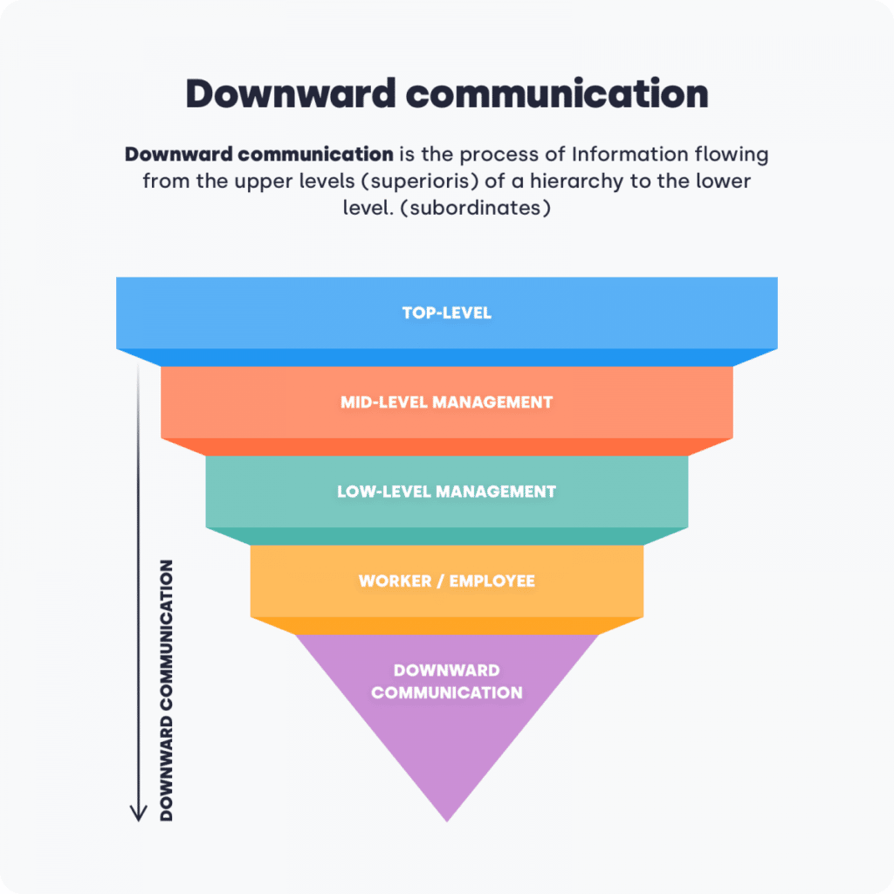
The opposite direction — from a superior to one or more subordinates. Managers use it to transfer priorities, give instructions, spark discussions, motivate staff, and drive productivity. A well-designed internal communication tool makes this consistent instead of chaotic.
Examples:
- Job instructions and rationale sent from directors to managers
- Forms sent from mid-level to low-level management employees
- Procedures and practices
- Performance feedback forms
- Presentations about a company's strategy and core values shown to new employees during onboarding
#3 External Upward
Communication between employees inside your organization and external stakeholders higher in the broader hierarchy — business partners, government officials, regulators, community leaders, and administrators.
Examples:
- Invoices
- Annual reports
- Purchase orders
- Newsletters
- Magazines
#4 External Downward
The company reaching outward to customers, prospects, suppliers, and partners. This includes brochures, email campaigns, newsletters, posters, and marketing forms — anything designed to attract, inform, or convert an external audience. The supplier side of that flow carries real commercial weight, which is why negotiating contracts with vendors succeeds or fails on how clearly terms and expectations get communicated. Marketing forms in particular are often used to collect leads, understand preferences, and trigger targeted campaigns.
Keeping these materials visually consistent helps reinforce your brand and creates a more cohesive experience for customers. An AI design generator with built-in branding features can make it easier to create on-brand designs across every customer touchpoint.
Examples:
- Product training and support communication
- Promotional and marketing content
- Communication with sales and delivery channels
#5 CRM Automation Through Messaging Platforms
As customer communication becomes instant and multi-channel, CRMs that integrate with messaging apps like WhatsApp are now a must. These tools let you automate interactions, qualify leads, and centralize communication without overwhelming your support team.
Kommo, for example, combines CRM functionality with native WhatsApp integration and a built-in Salesbot, so you can send automated replies, guide customers through the sales funnel, and keep every interaction in one inbox.
Examples:
- WhatsApp chatbot for lead qualification
- Automated replies to FAQs via CRM
- Centralized inbox for WhatsApp, Instagram, and email
The payoff: fast, personal responses at scale — without adding headcount.
The 3 Means of Business Communication
Business communication happens through three main modes. Most teams use all three — the trick is matching the mode to the message.
Verbal
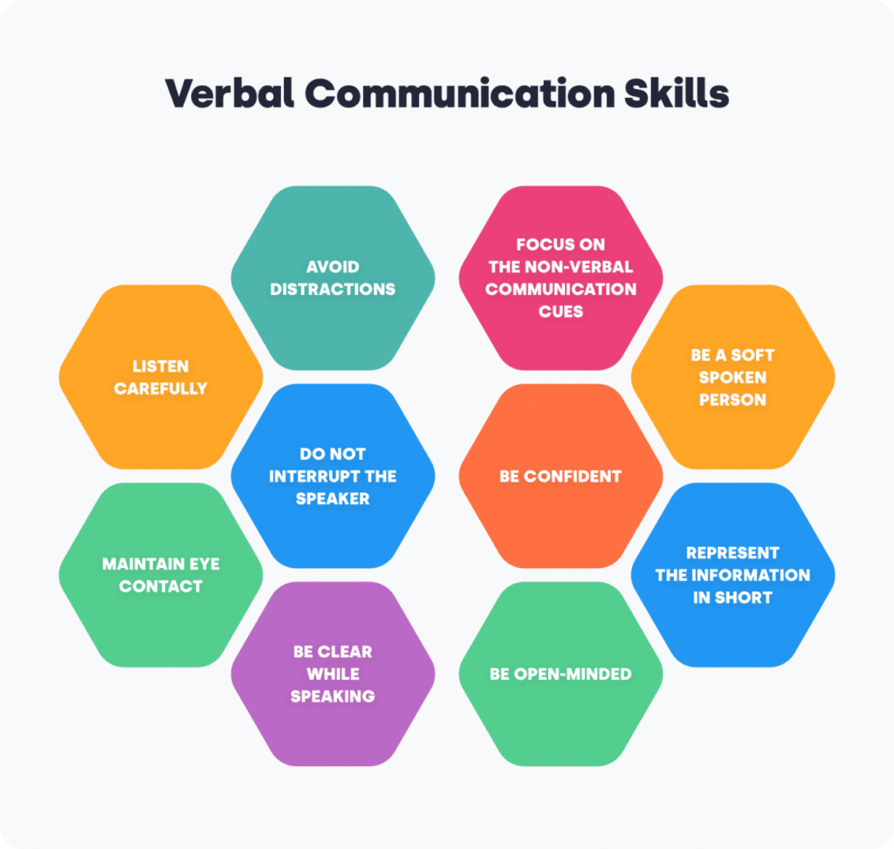
Any spoken exchange — in person, on a call, or over video. It's the fastest way to build trust, resolve ambiguity, and read the room, because tone and pacing carry information that text can't.
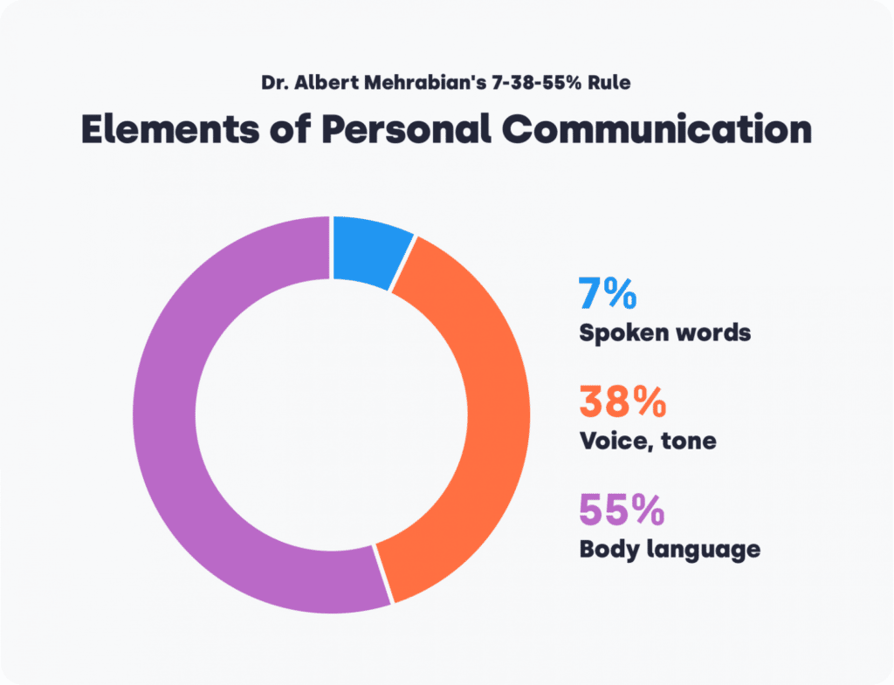
You may have heard of the 7-38-55 rule. It comes from psychologist Albert Mehrabian's 1971 research on nonverbal communication: when someone's words, tone, and body language conflict, listeners tend to weight 7% of meaning on the words themselves, 38% on tone of voice, and 55% on body language. Mehrabian's rule specifically applies to communicating feelings and attitudes under mixed signals — it isn't a universal law of all conversation — but the takeaway holds: how you say something often lands harder than what you say. Worth remembering next time you're negotiating a raise.
Written
Everything that lives on a page or a screen — emails, letters, reports, telegrams, bulletins, manuals, announcements, and Slack threads. Unlike verbal communication, written messages carry emotion less easily, which makes clarity and structure non-negotiable.
Three things to watch: pick the right level of formality for your audience, catch spelling and grammar mistakes before you hit send, and lead with the point — the reader shouldn't have to scroll to find what you actually need from them.
Script smarter calls, automate follow-ups, and connect every channel your team uses — see CloudTalk in a live 20-minute demo.
Remote
Remote communication is any exchange that happens at a distance, mostly through electronic tools. In 2026, with hybrid work now the norm at most companies, it's the backbone of everyday operations — not a fallback. Done well, it lets distributed teams collaborate as if they were in the same room. Done badly, it fractures alignment and burns everyone's calendar. For a deeper playbook, see our guide to remote team communication.
Tools that make remote communication work:
- Phone calls through cloud call center solutions
- Emails
- Email ticketing systems
- Online chats and team messaging
- Work operating systems
- Video meetings and webinars
- Visual tools like screen recorders, snipping tools, and GIF makers
How to Master Your Business Communication Skills: 7 Practical Tips
Now that you know the types and the means, here are 7 tips you can start using this week to become the person in the room people actually want to hear from.
1. Work on Your Body Language
Your body language and appearance shape how you're perceived long before your words register. Pay attention to posture, eye contact, and the small gestures you use in meetings. Stick to the appropriate dress code, and remember the 7-38-55 principle — when signals conflict, tone and body language win.
2. Listen Carefully
Communication works both ways. Make a point of actually processing what the other person is saying — not just waiting for your turn. It signals respect, and it catches details you'd otherwise miss.
For readers who want to build stronger listening and communication habits, exploring the best books for communication skills can provide additional practical guidance.
"If you think communication is all talking, you haven't been listening." — Ashleigh Brilliant
3. Practice Your General Communication Skills
Practice makes fluent. Give short talks, chat with friends about topics you don't usually cover, join discussion groups, listen to good interviewers on podcasts. You'll see results faster than you expect — and a bunch of workplace communication strategies will start feeling second-nature.
4. Use the Right Channels for the Right Conversations
Not every message belongs in every channel. Set clear guidelines — sync work on video, async updates in Slack, sensitive conversations on a call, formal decisions in writing — and stick to them. A well-organized channel map is one of the strongest signals of a healthy team, and it starts with a solid communications plan.
The same logic applies to customer service. Phone still matters — customers rate voice as the channel they trust for anything complex — so running your support line through a modern call center tool is often the difference between "we resolved it in one call" and "we escalated the ticket." CloudTalk is one of the strongest options here for teams that want personalized, human-to-human support without stitching together five tools.
5. Expand Your Business Vocabulary
If you work in a specialized industry, learn its language. Read trade publications, listen to industry podcasts, and pick up terminology from the coworkers who use it fluently. Fluency compounds fast — a few months of intentional exposure and you'll notice the difference.
6. Prepare for Meetings to Avoid Stress
Stress is the enemy of clear communication. Prepare in advance — outline what you want to say, anticipate the questions you'll get, and rehearse if the meeting is high-stakes. There's nothing worse than freezing mid-sentence, and preparation prevents it.
7. Engage in Discussions
The more you engage in real conversations — not monologues — the sharper your instincts get. Ask questions, disagree politely, invite pushback. Business communication is a skill you can train, and discussion is the training. For more on getting this right with customers specifically, see our 10 ways to improve communication with customers.
All-Things Business Communication — Discovered
Business communication is one of the highest-leverage skills in any company. Get it right and everything downstream — team performance, customer satisfaction, career growth — gets easier.
In this guide, we've:
- Defined what business communication actually means
- Walked through 5 types and 3 means, with examples for each
- Given you 7 tips you can use this week
Communication matters everywhere, but nowhere more than in professional settings where clarity has revenue attached to it. For more on running these channels well, browse the CloudTalk blog — especially our coverage of contact centers, telephony, and modern customer communication.
Every Business Conversation, One Platform.

Frequently asked questions
Business communication is the exchange of information between people inside and outside a company to get work done. It covers everything from a Slack message to a quarterly report. See our full breakdown of the types of business communication.
It's the tool managers use to guide, motivate, and coordinate teams. Strong communication conveys goals, delivers feedback, resolves issues, and builds trust — the base layer for every management decision.
Five types: internal upward, internal downward, external upward, external downward, and CRM-driven messaging automation. Each flows in a different direction and serves a different purpose. Learn more about internal communication software.
Verbal (spoken exchanges — in person, phone, video), written (emails, reports, chats), and remote (any distance-based communication via digital tools). See our guide to the top communication channels for business.
Albert Mehrabian's 1971 finding: when spoken words, tone, and body language conflict, listeners weight meaning as 7% words, 38% tone, 55% body language. It applies to emotional messages, not all communication. More on workplace communication strategies.
Concise project updates, meeting agendas sent in advance, professional customer service scripts, well-structured reports with executive summaries, and personalized sales pitches tied to a customer's actual needs.
Listen actively, prepare before meetings, match the channel to the message, watch your body language, and practice in real conversations. For a customer-facing playbook, see our 10 ways to improve communication with customers.