
Call Recording Software Captures Every Word
CloudTalk's cloud call recording software captures every inbound and outbound call automatically, on every plan. Agents pause with one tap when a card number comes up and resume after, whether they're on desktop, browser, or mobile, and CloudTalk is PCI-DSS compliant.
Recordings sync to the right CRM contact on their own, encrypted end-to-end and covered by SOC 2 Type 2, ISO 27001, GDPR, and HIPAA.
⭐ Our Price: $25/user/month
 SOC2 CompliantISO 27001
Trusted by 30,000+ sales & support professionals to power more & better conversations
















Call Recording
What is Call Recording Software?
Sales call recording software automatically captures and stores phone conversations so businesses never lose important details. Whether it's a customer inquiry, a sales call, or a support interaction, every word is securely logged for future reference.
Beyond saving conversations, it helps teams improve communication, support compliance, and train new hires faster. With AI-powered tools you can search, analyze, and learn from past calls without listening to a single one end to end.
How Does Call Recording Software Work?
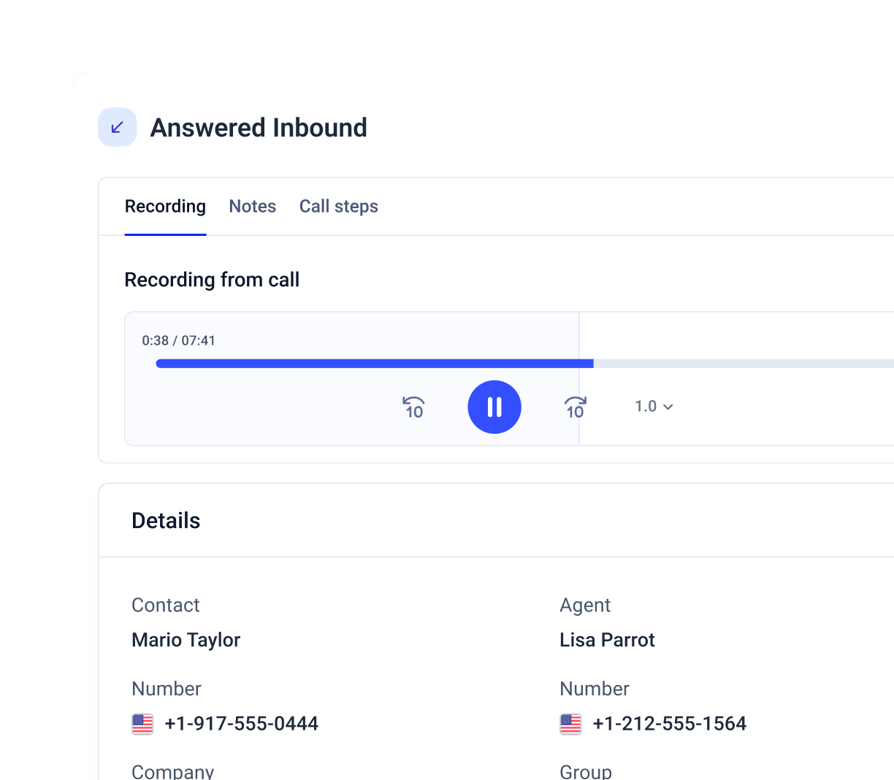
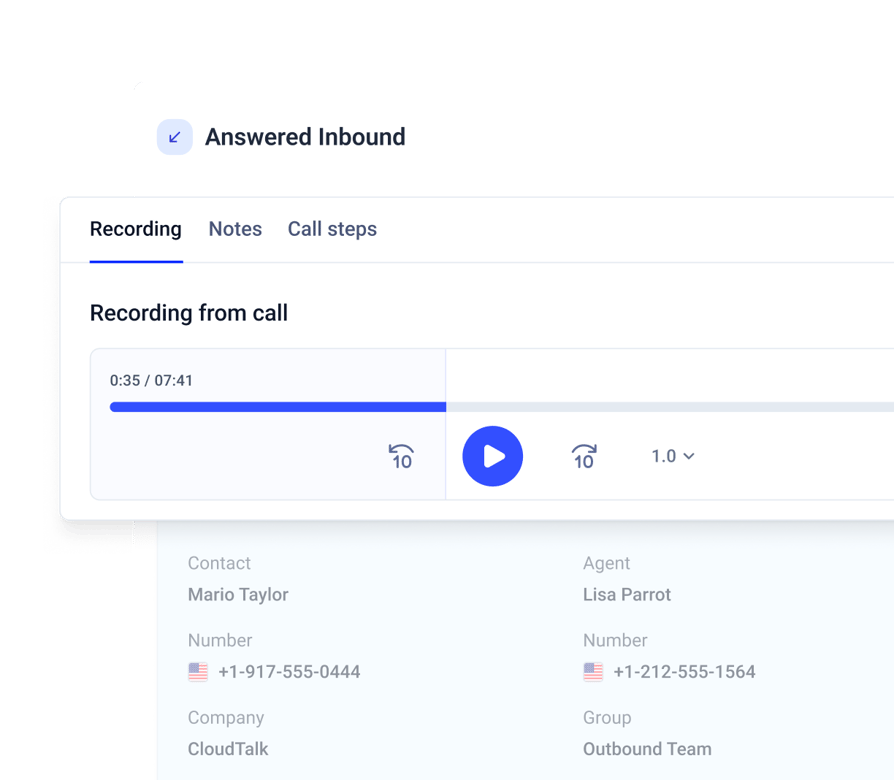
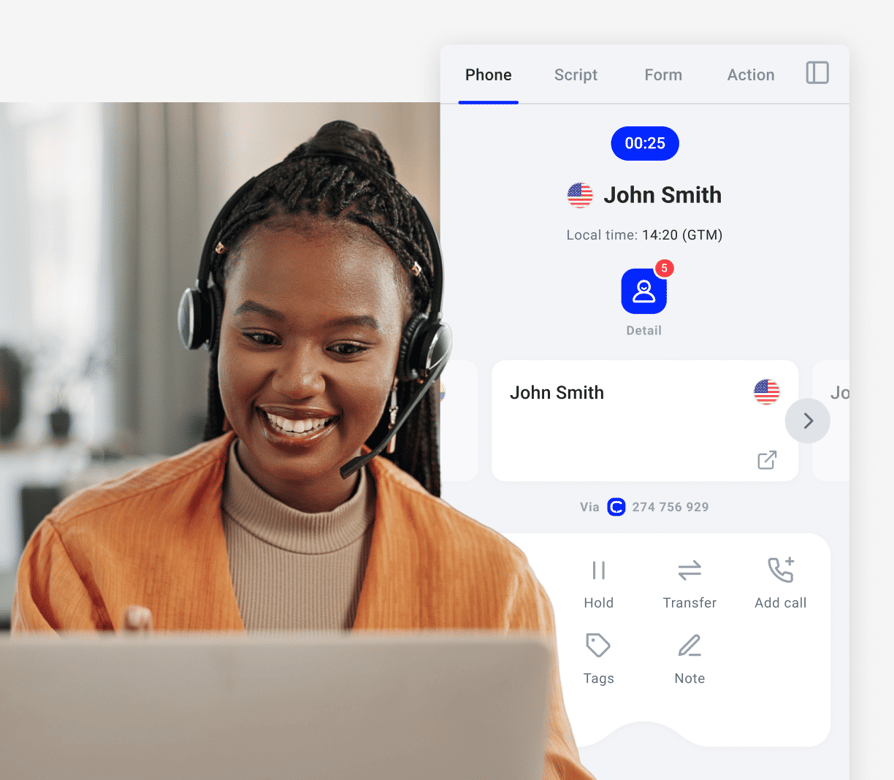
Business call recording software connects to your phone system, saving incoming and outgoing conversations as audio files as soon as a call starts. Once you turn it on in CloudTalk, it records automatically in the background, attaching each file to the contact's activity record in secure cloud storage.
You can access your recordings from any phone, laptop, or web browser. Quickly pull up specific conversations by filtering for the rep, date, or call result. If you add Conversation Intelligence, you can also search your entire call library by specific keywords and jump straight to that point in the audio.
Customize Your Call Recording Strategy
No matter your industry—be it sales, customer support, or compliance-heavy sectors—CloudTalk empowers you to adapt call recording features to suit your specific requirements:
- 01Automatic Call Recording: Record every inbound and outbound call without anyone lifting a finger. Best for training and consistent service quality.
- 02On-Demand Recording: Let agents start, pause, and resume manually. The setting you want when reps take card payments or handle sensitive information.
- 03Custom Retention Policies: Set how long recordings are stored and when they're deleted, with archived calls a click away. Adjustable to whatever your regulator expects.
- 04Role-Based Access: Agents see their own calls, managers see the team's. Sensitive recordings stay restricted.
Leverage AI Call Recording Software to Generate Actionable Insights
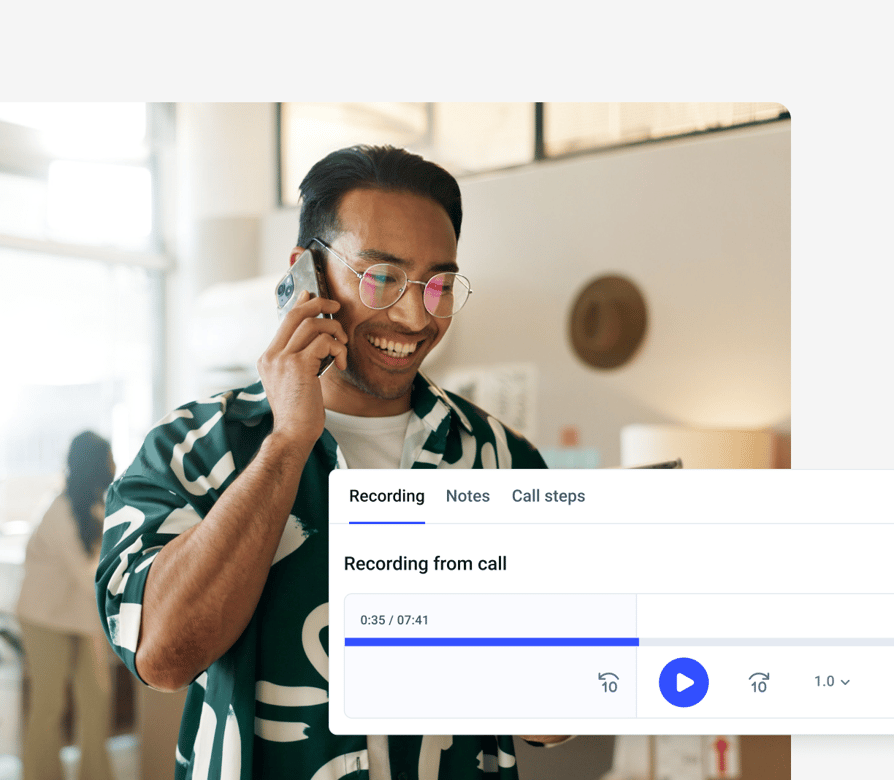
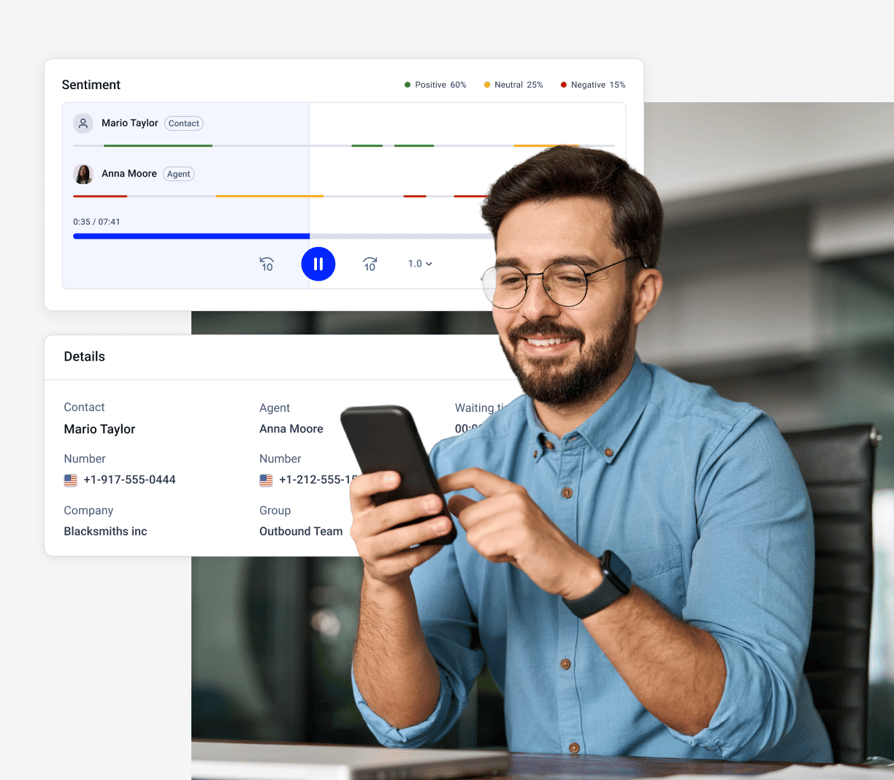
A recording tells you what was said. Pairing your call center recording system with call intelligence tells you what it meant, and does it across every call instead of the handful anyone has time to open.
Automatic Call Summaries, Sentiment Analysis, and Topic Extraction do the work your team would otherwise do by listening. Key moments surfaced, customer mood tracked, recurring themes flagged before anyone thinks to look for them. Managers cut review time by roughly 80%, which mostly gets spent coaching instead.
Conversation Intelligence is an add-on to any CloudTalk plan. Recording itself is included on all of them.
Connect Call Recording Software to Your CRM
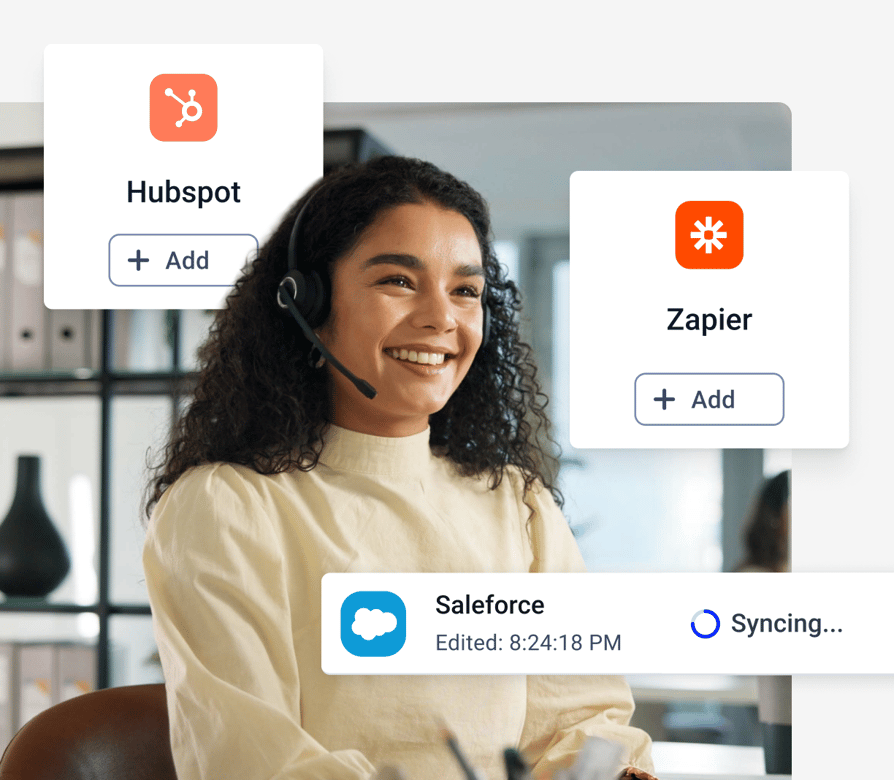
CloudTalk's call recording software for business syncs with HubSpot, Salesforce, Pipedrive, Zoho, and 100+ other tools, attaching each recording to the right contact, deal, or ticket the moment the call ends.
Nobody logs anything by hand, and nobody goes looking for a file.
For sales teams, that means the recording is already on the deal when a manager opens it, and reps review their own calls in the CRM, following up with the actual details.
How to Set Up Call Recordings in CloudTalk?
- 01On the dashboard of your CloudTalk account,
navigate to Account > Settings. - 02Scroll to “Visibility of calls and recordings.”
- 03Set the rules for Inbound and Outbound calls, and save your settings.
- 04Once this setting is updated, changes are reflected for all users.
Benefits of Call Recording
Drive Better Results with The Right Call Recording Data
Capture Every Customer Interaction in Real Time
Ensure that no critical customer engagement data is lost. Call recording lets you capture every customer interaction in real time, giving you a complete and accurate record of each conversation as it happens. This means no missed details.
Revisit Your Calls Anytime, Anywhere
Access call recordings and insights whenever and wherever you need them. With every conversation securely captured and stored, your team can easily revisit key moments on demand—no more relying on memory or scrambling through notes.
Train Your Team with Real-World Situations
Review past calls to identify coaching opportunities, refine sales techniques, and enhance agent training. Real conversations from your own business provide the most valuable insights for continuous development, leading to better services and more deals.
Store All Interactions Securely and Compliantly
Robust cloud security and end-to-end encryption protect customer data in compliance with HIPAA, ISO27001, GDPR, PCI (AOC), and other regulatory standards. Plus, built-in features like automatic pause-and-resume ensure private information is never recorded.
Record Every Call. Find Any Moment in Seconds.
Every call captured automatically, on every plan. Finding the one that matters is the part we actually solved.
Save around 25 hours a week on call reviews
Nobody listens well while typing. Automatic recording and AI Notes (CI add on) catch the details so you don't have to waste hours listening to calls.
Save 3 hours/week on data entry
Automatic CloudTalk Call Notes generate summaries instantly so agents skip writing notes by hand.
SOC 2, ISO 27001, GDPR, HIPAA, PCI-DSS
Meet GDPR, HIPAA, PCI-DSS, and other regulatory requirements with call recording software.
Call Recording Software Knowledge: Need to Know
From consent rules and cloud storage to CRM sync and AI-powered insights, here are the questions teams ask most before choosing sales call recording software.
The features that matter are the ones that remove a manual step from someone's day. Automatic recording on every inbound and outbound call, so nothing depends on a rep remembering. Pause and resume, so sensitive moments stay off the tape without switching recording off entirely. Secure cloud storage with retention policies you set once. CRM sync that attaches the recording to the right contact by itself. Search by agent, date, number, tag, or keyword inside the transcript. And compliance controls that match the regulations you actually operate under.
Two questions worth asking any vendor before you sign. Is recording storage genuinely unlimited, or does it quietly expire on your plan? And are the AI features you saw in the demo included, or metered separately? The answers vary more than the marketing pages suggest, and both tend to surface at renewal rather than at purchase.
Yes, recording business calls is legal essentially everywhere, as long as you follow the consent rules where you and your customer are sitting. Those rules split into two camps. One-party consent means one person on the call has to know it is being recorded, and that person can be you: this covers US federal law, most internal UK business use, and Canada's baseline. Two-party or all-party consent means everyone on the call has to agree before recording starts, which covers roughly 11 US states including California, Florida, and Massachusetts, along with the EU and UK under GDPR and Australia under state surveillance acts.
The practical version for anyone running call center software across borders: assume all-party consent and build it into the call flow. CloudTalk handles this with automated disclosure prompts in the IVR, pause and resume controls for the moments that should not be on tape, and retention settings that delete recordings on a schedule rather than relying on someone remembering to do it. There is more detail in our guide to call recording legality.
Worth saying plainly: this is not legal advice, and consent law is one of the few areas where figuring it out later is genuinely expensive. Check with counsel for the jurisdictions you sell into.
CloudTalk holds SOC 2 Type 2 and ISO/IEC 27001 certification, and is compliant with GDPR, CCPA, HIPAA, and PCI-DSS. It also participates in the EU-US Data Privacy Framework program. Full detail and current certification status live in our security documentation and at trust.cloudtalk.io.
What that means in practice for a growing team. PCI-DSS covers the payment problem: agents pause recording with one tap when a card number comes up and resume after, on desktop, in the browser, and in the CloudTalk Go mobile app. HIPAA covers healthcare, including BAA support and PHI handling on the recording pipeline. GDPR and CCPA cover the consent and deletion obligations for European and California customers. SOC 2 Type 2 and ISO 27001 are the two your prospect's security review will ask for by name.
Underneath the certifications: data centers run on AWS and Google Cloud across nine global locations, themselves SOC 2 Type II and ISO 27001 certified, with no CloudTalk employee holding physical access. Independent third-party penetration testing runs at least annually, with no customer data exposed to the testing firm.
The difference between legacy on-premise recording and cloud call recording software comes down to what you have to own, and what you can change on a Tuesday afternoon.
Infrastructure. On-premise means server racks, PBX hardware, and an implementation timeline measured in months. Cloud means a browser and an admin login. Cost and scale. On-premise carries the hardware bill upfront and charges you again in physical licenses every time you hire, while cloud scales per seat, up and down, on a subscription you can forecast. Remote access. On-premise ties agents to a desk or a VPN. Cloud means an agent records calls from a laptop in another country and the recording lands in the same place it always does, which for distributed teams is usually the argument that ends the conversation.
AI. On-premise systems mostly cannot do it, and bolting it on means another vendor and another integration. AI call center platforms treat transcription, summaries, and sentiment as part of the recording pipeline rather than a separate product. If you are building the internal case for a move, we have covered the tradeoffs of shifting a contact center to the cloud in more depth.
Yes, and this is the feature that quietly saves the most time. CloudTalk's integrations include native two-way sync with HubSpot, Salesforce, Pipedrive, Zoho CRM, Zendesk, and Intercom, alongside 100+ other tools.
When a call ends, the recording link and call details attach themselves to the right contact, deal, or ticket. With Conversation Intelligence enabled, the AI summary, topics, and sentiment score ride along too. In Zendesk they arrive as an internal note on the ticket, so the next agent to open it sees what already happened.
Three things this changes. Nobody logs calls by hand, so reps stop reconstructing conversations from memory at 5pm and your CRM data stops being a work of fiction. Managers review deals without leaving the CRM, because the recording is already on the record. Support agents get context before they say hello, which fixes the single most common complaint in support surveys. Call dispositions write back automatically too, so workflow automation can trigger off call outcomes: escalate a negative-sentiment call, fire an SMS follow-up, ping a Slack channel when a VIP call goes unanswered.
Traditional QA has a sampling problem. Managers review a small fraction of calls, usually the ones that were flagged or the ones that happened to be on top, then draw conclusions about the whole team from that sample. It is not that managers are lazy. It is that listening to calls in real time is the most expensive way to gather information ever devised.
AI call recording software analyzes every call instead of a sample. CloudTalk's Conversation Intelligence add-on cuts manager review time by roughly 80% and saves around five minutes of after-call work per conversation, which compounds fast across a team of ten.
Automatic transcription converts each call to text with speaker separation, fully tested in English, French, German, Portuguese, and Spanish, with broader coverage across 60+ languages. Reviewing a transcript takes about half the time of listening to the call. AI Smart Notes and summaries extract action items, decisions, open questions, deadlines, and risks the moment the call ends, which is how new reps get up to speed without shadowing for three weeks. Sentiment analysis scores each call so you can filter for the ones that went badly and coach on those, rather than on whichever call you happened to open.
Talk-to-listen ratio is the most reliable leading indicator of discovery quality on a sales call, and the one metric reps immediately understand without being told why it matters. AI call scoring grades every call against your own criteria: playbook adherence, required disclosures, whatever your scorecard says. Topic detection identifies what was actually discussed and aggregates it across hundreds of calls, so a competitor coming up more often this month surfaces as a trend rather than as a rumour someone heard. All of it feeds targeted coaching plans instead of gut feel.
Conversation Intelligence is a paid add-on on top of any plan, so recording itself never depends on it. Managers who want live oversight rather than post-call review can use call monitoring to listen, whisper, or barge into a call in progress.
Storage on CloudTalk is unlimited from the Essential plan upward. Entry tiers carry a shorter retention window, so if long-term archiving is a compliance requirement rather than a nice-to-have, Essential is your floor. Admins set retention policies per account and can archive or delete on a schedule.
Searching them is where call center recording software earns back its cost. Transcript search runs exact-match keyword search across your entire archive: search a competitor's name and get every call where it came up, or search "cancel" and find your churn signals. That is the difference between an archive and a liability. Metadata filters in the Dashboard and Statistics narrow by agent, queue, number, duration, date, tag, or CRM disposition. Combine the two and you get something like every negative call from the enterprise queue last month, sorted by duration, which is a coaching session that plans itself.
These are three separate jobs, and together they are the strongest case for call recording for business. Compliance: recordings provide an auditable record that agents followed the required script, disclosure, and procedure. In financial services, healthcare, and insurance this is not optional. Dispute resolution: when a customer disputes what was said or agreed, the recording settles it. That protects the customer as often as it protects you, and it ends the category of argument where both sides are certain and neither has evidence.
Training: real calls from your own business beat any roleplay. A manager can pull the call that went perfectly and the call that fell apart, play both, and coach on the difference with full context rather than from memory. Paired with structured coaching workflows, this is usually what shortens ramp time for new hires more than any script rewrite.
Recording captures the call. Conversation intelligence tells you what was in it.
Call recording is base platform on CloudTalk, included on every plan, along with pause and resume and cloud storage. It answers the question "what exactly did we say?", and for dispute resolution and compliance that is often enough. Conversation Intelligence is a separate add-on that turns each recording into structured data: transcript, summary, topics, sentiment, tags, action items, talk-to-listen ratio, and a searchable index. It answers the questions you would otherwise need to listen to fifty calls to answer.
The rough rule: if you need recordings for compliance and the occasional "what did we agree?", recording alone covers it. If you are coaching a team or trying to understand why win rates moved, you want the analysis layer.
Call recording is included on every CloudTalk plan rather than sold separately, which is not universal in this category. Plans start at $25 per user per month for Starter, which is sold globally. Essential at $29 is where unlimited recording storage, IVR, CRM integrations, and API access arrive, and it is the tier most growing teams settle on. Expert at $49 adds real-time call monitoring, Salesforce, and the dialer.
AI Conversation Intelligence is $9 per user per month on top of any plan. Current figures for every tier are on the pricing page, and there is a wider breakdown of what call center software costs if you are building a comparison.
Setting up call recording software for call center teams takes about two minutes from the admin dashboard. Open Account Settings: log into your CloudTalk Dashboard as an admin, then select Account and click Settings in the left sidebar. Find your recording rules: scroll to the Visibility of calls and recordings section, where inbound and outbound recording are configured separately.
Pick a recording strategy: Record Automatically captures every call across the account, while On-Demand lets agents start, pause, and resume manually, which is the setting you want if reps regularly handle card payments or other sensitive information. Save: settings apply immediately across every agent, number, and app on the account, including mobile. Step-by-step detail lives in our help center article on configuring call recordings.
From there, the useful next step is deciding who can hear what. Permissions are role-based, so agents can be limited to their own recordings while managers see the whole team's.
Integrations
Plug into everything you use
CRMs, helpdesks, applicant tracking systems and more. Get started instantly with 100+ built-in integrations, or expand further with Zapier, Make or CloudTalk’s own workflow automation builder.


Features
Other features you might like

Call Summary & Tags
Summarize every call instantly with AI-generated Summaries & Tags, and reduce manual work while keeping your contacts up to date.
Learn more about Call Summary & Tags
Sentiment Analysis
Get immediate feedback on your caller’s mood by following their sentiment shifts, and adjust your pitch to build stronger rapport.
Learn more about Sentiment Analysis
Call Transcription
Automatically transcribe and analyze your calls with AI, then use the insights to improve conversations and drive conversions.
Learn more about Call Transcription
Analytics
Access centralized data on your team’s performance, and use it to optimize operations, cut costs, and close more deals.
Learn more about Analytics
Ready to Get Started with Call Recording Software?
Join over 5,500+ modern companies that already trust CloudTalk to have MORE and BETTER calls.
We’ve helped thousands of global companies
Case studies featuring customers who are building faster.

Global Sales Engine Powered by Connected Conversations
“CloudTalk’s AI transcripts and analytics make it easier to track talk ratios, discovery depth, and regional performance—all without requiring formal training to get started.”

Revolutionizing Revolut’s Efficiency and Saving 40+ Hours
"Thanks to CloudTalk’s reliability, we could improve sales teams’ performance and close more deals than we could have ever imagined."

Increasing productivity for 200 customer support agents
"With CloudTalk's Analytics I now get to see every step of the way. We can find discrepancies and gain a much better understanding of our teams."

Delivering success for Glovo’s customer support team
"CloudTalk improved our team's cost and efficiency. The script feature allows us to lead the calls in a much more systematic way."
Call Recording Software FAQs
To record calls in CloudTalk, activate the Call Recording feature in your account settings under Visibility of calls and recordings. Once enabled, recordings are automatically saved in the client's contact details and call history. You can listen to them directly from the Dashboard or Statistics section.
In CloudTalk, you can play call recordings directly in the Dashboard or in Statistics. You also have the option to download your recordings for offline access or sharing.
With CloudTalk's Speech-to-Text feature, part of the AI Conversation Intelligence add-on, every call recording is automatically converted into a searchable, shareable text transcript. You can export transcripts directly from the dashboard for use in coaching, compliance review, or CRM notes.
The best call center recording software depends on your needs, but leading solutions combine automatic recording, AI-powered transcription and call summaries, CRM integration, searchable archives, and compliance controls in a single platform. CloudTalk is a top-rated call recording software for call centers because it delivers all of these capabilities, plus Sentiment Analysis and Call Scoring on every conversation, without requiring complex setup.
The most important features in business call recording software include: automatic recording for all calls, secure cloud storage with configurable retention policies, AI-powered transcription and summaries, CRM integration with automatic attachment to contact records, keyword search and filtering across all recordings, and compliance controls covering SOC 2, ISO 27001, GDPR, HIPAA, and PCI-DSS. Contact center call recording software should also include AI Summaries and Sentiment Analysis to turn recordings into coaching and QA data.
A call center voice recording system is truly effective when it goes beyond storing audio. The most impactful systems combine recording with AI analytics, compliance controls, CRM sync, and searchability, so managers spend less time finding calls and more time acting on what they reveal. When recordings feed directly into coaching, QA scoring, and performance reporting, they become a continuous source of improvement rather than a passive archive.
Phone recording system costs vary by features and number of users. CloudTalk includes Call Recording on every plan, starting at $19/user/month for Lite in the Americas and $25/user/month for Starter worldwide. Unlimited recording storage arrives on Essential at $29/user/month. AI-powered features like transcription, summaries, and call scoring come with the AI Conversation Intelligence add-on, available on any plan.


Hello 👋 My name is Emma. Still have questions?
Can’t find the answer you’re looking for? Please chat to our friendly team.