Few phone systems are as easy to learn as Aircall, and that's rarely why teams leave it. They look for Aircall alternatives when they want to start on one seat instead of three, need local numbers in more countries, or want a dialer that rings several lines at once.
So we checked ten Aircall competitors against it: pricing pages, help centers, product pages, review videos and real reviews. CloudTalk is our product, so we point out where another tool does the job better. The order is by fit, not a ranking, and six questions settle most decisions: seats on day one, the countries you call, how much you text, whether reps dial lists, live AI coaching, and whether your team works in a helpdesk.
What Is the Best Alternative to Aircall?
The best Aircall alternatives in 2026 are Dialpad, CloudTalk, JustCall, RingCentral and Talkdesk, and the right one depends on what holds your team back today: seats, countries, texting, dialing or coaching. Match your need to a pick:
- Best Aircall alternative for real-time AI coaching: Dialpad, from $15/user/month
- Top Aircall competitor for global SMB sales and support: CloudTalk, from $25/user/month with one seat
- Best alternative to Aircall for texting-heavy sales: JustCall, from $29/user/month (2-seat minimum)
- Best Aircall alternative for one suite across a larger company: RingCentral, from $20/user/month
- Best Aircall replacement for a growing contact center: Talkdesk, from $85/user/month
- Best app like Aircall for a small team sharing a text inbox: Quo, from $15/user/month
If your support team lives in a helpdesk and values a quick rollout over everything else, Aircall still earns its place. To see all ten side by side, jump to the comparison table.
TL;DR: 10 Best Aircall Alternatives and Competitors
| # | Tool | Best For | Seat Minimum | Starting Price | G2 Rating |
|---|---|---|---|---|---|
| 0 | Aircall (baseline) | Support teams that want a phone system up and running fast, wired into their helpdesk | 3 licences | From $30/user/month | 4.4/5 |
| 1 | Teams that want AI coaching live on the call | None on Standard | $15/user/month | 4.4/5 | |
| 2 | SMB sales and support teams calling customers in several countries | 1 (3 on Expert) | $25/user/month | 4.4/5 | |
| 3 | Sales teams that text customers as often as they call them | 2 | $29/user/month | 4.3/5 | |
| 4 | Larger companies that want phone, video and messaging in one suite | None | $20/user/month | 4.2/5 | |
| 5 | Support operations growing into a full contact center | Not published | $85/user/month | 4.4/5 | |
| 6 | European teams that want calls and messaging channels together | 3 | $19/user/month | 4.6/5 | |
| 7 | A few people in the US or Canada sharing numbers and one text inbox | None | $15/user/month | 4.7/5 | |
| 8 | Small businesses that want voice, video and chat from one vendor | Not published | $15/user/month | 4.5/5 | |
| 9 | Sales reps who dial all day from HubSpot or Pipedrive | Not published | On request | 4.8/5 | |
| 10 | Very small teams that need to keep costs down | None | $19/user/month | 4.4/5 |
Why Are Teams Searching for an Aircall Alternative?
Aircall is one of the easiest cloud phone systems to roll out. The app is clean, 250+ integrations put calls inside the helpdesk or CRM your team already uses, and AI transcripts come with the first plan. Teams look for an Aircall alternative when they need one or two seats, numbers in more countries, a multi-line dialer, or live coaching inside the plan.
Aircall is a cloud phone system for support and sales teams, founded in Paris in 2014 and headquartered in New York and Paris, with 24,000+ business customers. Plans start at $30/user/month on annual billing with a three-licence minimum and connect to 250+ tools. Is Aircall a good company? Its 4.4/5 on G2 from 1,650+ reviews says most customers think so, though 3/5 on Trustpilot from 1,100+ reviews is more mixed. Our in-depth review covers each plan.
From Aircall's own pricing page and what teams moving off it say, five reasons stand out:
5 Main Cons of Aircall That Make Teams Look for an Alternative
- Three licences before your first callEssentials and Professional are sold from three licences, so one person pays $90 a month.
- Local numbers in about 40 countries, texting in about a dozenIts coverage page lists numbers in about 40 countries, and its pricing page limits SMS to 14, domestic only.
- A dialer that rings one line at a timeThe Power Dialer comes with Professional, calls one number after another, and isn't in the mobile app.
- Live coaching and deeper analytics cost extraAI Assist Pro, the live coaching add-on, is $49/user/month, and Analytics+ adds $15 per seat.
- Reaching a person on support can take a whileTeams moving off Aircall say getting a person on support takes too long.
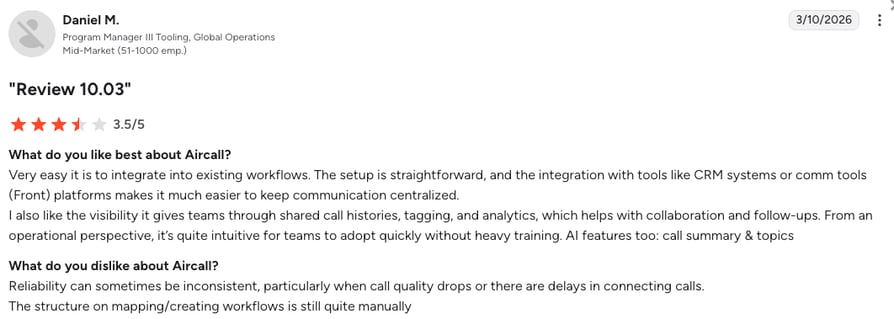
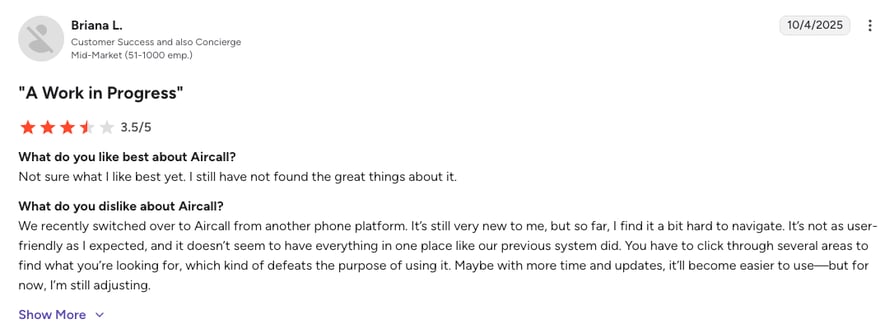
Aircall earns its place with support teams that want a quick rollout inside their helpdesk: an app that's easy to use and set up, 250+ integrations, AI transcripts from Essentials, AI Assist included on Professional in 24 languages, and a brand buyers trust. For other needs, a different VoIP alternative may fit better.
How We Evaluated the Best Aircall Alternatives and Competitors
Every Aircall competitor here got the same treatment. We went through the same sources for each, then set it next to Aircall on five checks. We don't score with numbers, because the right pick changes with your seat count and countries.
| Criterion | What we checked |
|---|---|
| Cost to start at your seat count | Seat minimums, and what one, three and ten seats cost on annual billing |
| Local numbers and texting by country | Where you can buy a number, where you can text from it, and whether texts cross borders |
| Dialing | Which dialer each tool has, how many lines it rings at once, and the first plan that includes it |
| CRM and helpdesk sync | Which tools connect natively, and from which plan |
| AI and support | AI during the call and after it, AI voice agents, and how you reach a person |
The Top 10 Alternatives to Aircall for 2026
At a glance, here's Aircall next to CloudTalk, Dialpad, JustCall and Ringover, the four tools buyers most often evaluate alongside it:
| Feature | Aircall | CloudTalk | Dialpad | JustCall | Ringover |
|---|---|---|---|---|---|
| Starting price | $30/user/mo | $25/user/mo | $15/user/mo | $29/user/mo | $19/user/mo |
| Seat minimum | 3 licences | 1 (3 on Expert) | 1 on Standard | 2 | 3 |
| Local numbers (countries) | About 40 | 160+ | 50+ | 70+ | 65 |
| Texting | About a dozen countries, domestic only | Pay-as-you-go SMS and WhatsApp | SMS on every Connect plan | Shared SMS and WhatsApp inbox | WhatsApp and social on Unified |
| Dialer | Power Dialer on Professional, one line | Power on Expert or $15 add-on; Parallel (five lines) $39 | Multi-line Dialer on Sell Premium | Power on Pro; predictive on SalesPro | Power Dialer on Business |
| CRM integrations from | Essentials ($30) | Essential ($29) | Pro ($25) | Team ($29) | Business ($49) |
| AI coaching and summaries | Summaries on Professional; live coaching $49 | After the call, from $9/user/mo | Summaries on every plan; Live Coach on Advanced | Real-time assist on Pro Plus | Summaries on every plan |
| AI voice agent | $99/mo minimum, 38 languages | From $99/mo, 70+ languages | Custom-priced | Usage-based | AIRO, from $100/mo |
| Free trial |  no length published | 14 days | 14 days | 14 days | 7 days |
| G2 rating | 4.4/5 (1,650+) | 4.4/5 (1,950+) | 4.4/5 (4,250+) | 4.3/5 (2,350+) | 4.6/5 (500) |
A plan name in a cell is the first tier that includes the feature. Three rows decide most moves: the seat minimum for one or two people, local numbers if you call abroad, and the dialer if reps work lists.
1. Dialpad vs Aircall: Best for Real-Time AI Coaching
What Is Dialpad?
Dialpad is an AI-first business phone system that runs calls, meetings and messaging in one app. Every Connect plan transcribes calls and writes a summary.
Next to Aircall, Dialpad puts the AI in the plan, not in an add-on. Transcripts start at $15 with single seats, where Aircall prices live coaching at $49 on top.
Who Should Pick Dialpad Over Aircall?
- Managers who coach during the call: Live Coach comes with Sell Advanced ($59) or Support Advanced ($119).
- One or two people who want AI notes: Standard is sold by the seat, call transcripts included.
- Support teams that schedule agents: Workforce management comes with Support Premium ($149).
Where Dialpad Beats Aircall, and Where It Doesn't
Dialpad wins on AI in every plan, native workforce management on Support Premium, and its new multi-line Dialpad Dialer on Sell Premium ($79). Aircall wins on integrations: 250+ from Essentials, where Dialpad's start on Pro, plus a wider helpdesk catalog and ease of use G2 reviewers rate a touch higher.
How to decide: Pick Dialpad if live AI coaching on the call matters most. Stay with Aircall if your team works inside a helpdesk.
Dialpad builds AI into every seat, and Aircall builds the phone into every tool you use.
What Are the Pros & Cons of Dialpad?
| Pros | Cons |
|---|---|
| AI transcripts and summaries on every plan | Live Coach needs Sell or Support Advanced |
| Single seats on Standard, 14-day trial | CRM integrations start on Pro ($25) |
| Live Coach, workforce management and a multi-line dialer on higher licences | Numbers in 50+ countries, Enterprise by quote |
What Are Dialpad's Plans & Pricing?
Dialpad pricing starts at $15/user/month (Connect Standard, annual billing):
| Plan | Price (annual billing) | Key Features |
|---|---|---|
| Connect Standard | $15/user/mo | Calls, meetings and messaging, SMS, real-time transcripts and AI summaries |
| Connect Pro | $25/user/mo | Everything in Standard + CRM integrations and 24/7 support |
| Connect Enterprise | Custom quote | Everything in Pro, with enterprise terms by quote |
| Dialpad Sell | $39, $59 and $79/user/mo | Outbound sales licence. Live Coach on Advanced, the multi-line Dialpad Dialer on Premium |
| Dialpad Support | $89, $119 and $149/user/mo | Contact center licence. Live Coach on Advanced, the Dialer as an add-on |
How Do Reviewers Rate Dialpad?
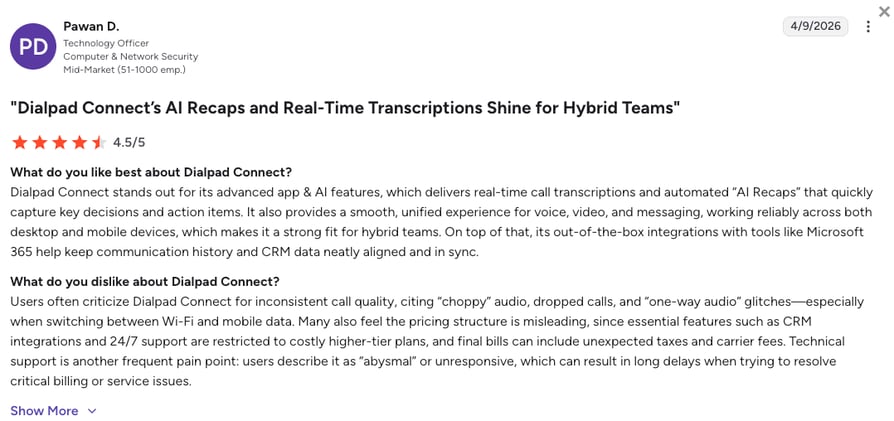
Dialpad holds 4.4/5 on G2 across 4,250+ reviews. The reviewer below likes the AI recaps and real-time transcriptions, and points to uneven call quality.
2. CloudTalk vs Aircall: Best for Global SMB Sales and Support Teams
What Is CloudTalk?
CloudTalk is our own cloud phone system, built for SMB to mid-market sales and support teams with customers in more than one country. Local numbers in 160+ countries, the AI Sales Dialer and AI voice agents share one account.
Against Aircall, the difference is reach and how you buy. You can start with one seat, get a local number in most markets you sell to, and add a parallel dialer without changing systems.
Who Should Pick CloudTalk Over Aircall?
- Teams selling across borders: Local numbers in 160+ countries, against about 40 on Aircall's coverage page.
- One or two people who don't want to pay for three: Starter and Essential start at one seat, and HubSpot, Pipedrive and Zendesk connect from Essential.
- Teams that can't afford dropped calls: Calls run over a network of carrier partners with 99.999% uptime, and chat and email support answer 24/7.
Where CloudTalk Beats Aircall, and Where It Doesn't
CloudTalk wins on numbers by country, single seats, and outbound: the Parallel Dialer rings up to five lines with voicemail detection, where Aircall's Power Dialer calls one number at a time. A reputation add-on for US numbers and Smart Rotation help keep caller IDs from being flagged, and AI voice agents cover 70+ languages, against the 38 Aircall lists for its own.
Aircall wins on live coaching, which CloudTalk doesn't offer (our AI Conversation Intelligence works after the call), on integrations at 250+ against our 100+, and on ease of use, where G2 reviewers put it a touch ahead. Salesforce also needs our Expert plan, which starts at three seats.
How to decide: Pick CloudTalk if you sell and support across countries, want to start from one seat, and want a parallel dialer and AI voice agents on the same system. Stay with Aircall if your support team lives in a helpdesk and live coaching is a must.
Both are cloud phone systems for sales and support, and they pull in different directions. Aircall goes deep on helpdesk integrations and a fast start. CloudTalk goes wide on countries, sells a single seat, and adds parallel dialing and AI voice agents to the same account. Plans, add-ons, AI and G2 scores sit side by side in our full comparison.
What Are the Pros & Cons of CloudTalk?
| Pros | Cons |
|---|---|
| Numbers in 160+ countries, single seats on Starter and Essential | No live coaching or real-time assist |
| Parallel Dialer on up to five lines ($39/user/month add-on), Power Dialer included on Expert or $15/user/month | Expert, the plan with Salesforce, has a 3-seat minimum |
| AI voice agents from $99/month for 200 minutes | SMS is pay-as-you-go, with no bulk SMS campaigns |
What Are CloudTalk's Plans & Pricing?
CloudTalk pricing starts at $25/user/month on Starter, billed annually:
| Plan | Price (annual billing) | Key Features |
|---|---|---|
| Starter | $25/user/month | Unlimited US and Canada calls, 500 EU/UK outbound minutes, queues, click-to-call, recording (1-month retention) |
| Essential | $29/user/month | Everything in Starter + IVR, smart routing, CRM and helpdesk integrations (HubSpot, Pipedrive, Zoho, Zendesk and more), unlimited recording retention |
| Expert | $49/user/month | Everything in Essential + AI Sales Dialer with the Power Dialer, Smart Dialer, Salesforce, 24/7 phone support (3-seat min) |
| AI Conversation Intelligence (add-on) | From $9/user/month | AI transcripts, call summaries, call scoring, sentiment analysis, and agent coaching insights after the call |
| AI Conversation Intelligence Plus (add-on) | $19/user/month | Everything in AI Conversation Intelligence + call scoring templates auto-assigned by team, custom summary templates, custom topics, AI-drafted follow-up emails |
| AI Receptionist (add-on) | From $99/mo (200 min) | Inbound AI call answering, routing, logging; 50 free minutes on every account; tiers up to $699/mo (2,500 min) |
| AI Specialist (add-on) | From $349/mo (1,000 min) | Sales-led custom AI voice agents for inbound and outbound workflows; plans scale up to $1,249/mo (5,000 min) |
| Virtual Phone Numbers | From $6/number/mo | Local, toll-free, national, and mobile numbers in 160+ countries, instant self-serve in the US and Canada, SMS and WhatsApp on eligible numbers |
Aircall's plans today: its pricing page lists SMS in 14 countries, domestic only, AI Assist inside Professional, and AI voice agents from $99 a month.
How Do Reviewers Rate CloudTalk?
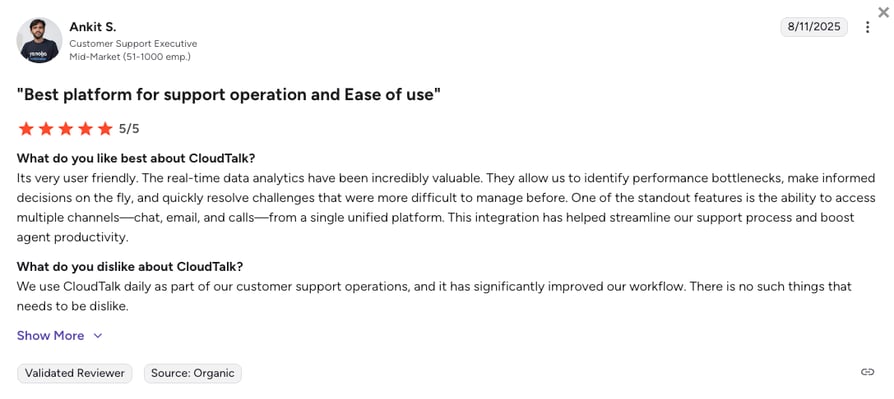
CloudTalk holds 4.4/5 on G2 across 1,950+ reviews. Reviewers bring up clear audio, a quick setup and automatic CRM logging. The gripes are about plans: Salesforce waits for Expert, and texts are billed separately. Two more voices sit further down: a verified G2 reviewer who moved from Aircall to CloudTalk and an r/ITManagers thread on Aircall alternatives.
3. JustCall vs Aircall: Best for Teams That Text as Much as They Call
What Is JustCall?
JustCall is a cloud phone system from SaaS Labs that puts calls, SMS and WhatsApp in one shared inbox, with dialers on its higher plans.
JustCall is the Aircall alternative for teams whose customers answer a text faster than a call. It starts at two seats, sells numbers in 70+ countries, and doesn't cap calling minutes.
Who Should Pick JustCall Over Aircall?
- Sales teams that text all day: A shared SMS and WhatsApp inbox, with bulk SMS on Pro.
- Two-person teams: Team starts at two seats, so $58 a month against Aircall's $90.
- Outbound floors that need several lines: Predictive dialing reaches 10 lines on SalesPro.
Where JustCall Beats Aircall, and Where It Doesn't
JustCall wins on texting, the seat floor, dialing depth, and real-time agent assist, part of Pro Plus ($89) where Aircall sells live coaching as an add-on. Aircall wins on integrations and helpdesk fit, and G2 reviewers rate its setup and support a little higher.
How to decide: Pick JustCall if your team texts as much as it calls. Stay with Aircall if tickets, not texts, run your day.
It comes down to where your team spends the day: in tickets or in texts.
What Are the Pros & Cons of JustCall?
| Pros | Cons |
|---|---|
| Shared SMS and WhatsApp inbox, bulk SMS | Fewer integrations than Aircall's 250+ |
| Two-seat minimum, numbers in 70+ countries | Real-time assist waits for Pro Plus ($89) |
| Power dialing on Pro, predictive on SalesPro | SalesPro and Business are quote-only |
What Are JustCall's Plans & Pricing?
JustCall pricing starts at $29/user/month (Team, annual billing, two-seat minimum):
| Plan | Price (annual billing) | Key Features |
|---|---|---|
| Team | $29/user/mo | Calls, SMS and WhatsApp in a shared inbox, CRM integrations, unlimited AI transcription, 500 to 1,000 SMS segments (2-seat min) |
| Pro | $49/user/mo | Everything in Team + Power dialing, Salesforce CTI, bulk SMS |
| Pro Plus | $89/user/mo | Everything in Pro + real-time agent assist and AI call scoring |
| Business | Custom quote | Custom terms, from 10 seats |
| SalesPro | Custom quote | Dynamic and Predictive dialing on up to 10 lines |
How Do Reviewers Rate JustCall?
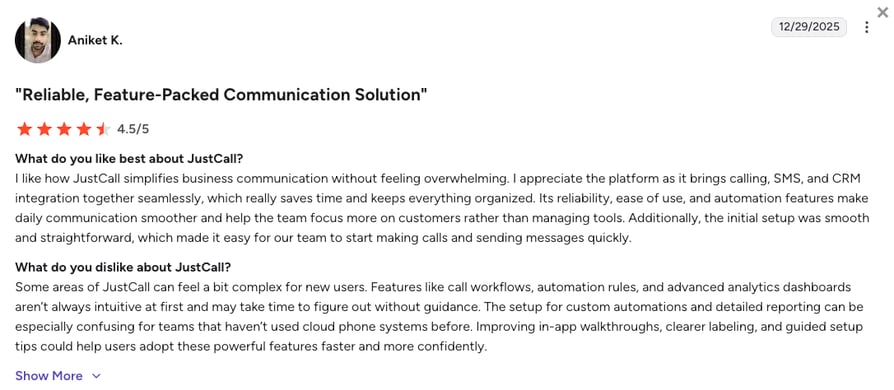
JustCall holds 4.3/5 on G2 across 2,350+ reviews. Reviewers praise the easy app and the texting tools. Call issues are the most common complaint.
4. RingCentral vs Aircall: Best for Larger Companies on One Suite
What Is RingCentral?
RingCentral sells RingEX, a suite that puts phone, video meetings and team messaging in one app. Its contact center, RingCX, is a separate product.
The key difference between RingCentral and Aircall is scope. RingCentral covers every department with one suite, while Aircall is a phone system built for the sales and support floor.
Who Should Pick RingCentral Over Aircall?
- Companies standardizing on one vendor: Phone, video and messaging come in every plan, with no seat minimum.
- IT teams with a long app list: The app gallery lists 500+ integrations, and the AVA assistant is included.
- Enterprises adding a contact center later: RingCX sits beside RingEX.
Where RingCentral Beats Aircall, and Where It Doesn't
RingCentral wins on breadth and scale: one suite for the whole company, no seat minimum, and an app gallery twice the size of Aircall's. Aircall wins for sales and support teams: RingEX has no sales dialer, CRM integrations start on Advanced, and Core includes 25 texts per user.
How to decide: Pick RingCentral if you want one suite for phone, video and messaging across a larger company. Stay with Aircall if the phone mainly serves a sales or support team.
RingCentral is bought by IT for everyone, and Aircall by a sales or support lead for one team.
What Are the Pros & Cons of RingCentral?
| Pros | Cons |
|---|---|
| Phone, video and messaging in every plan | No sales dialer in RingEX |
| 500+ app integrations, no seat minimum | CRM integrations start on Advanced |
| Published prices on all three tiers | AI Receptionist ($39) and Conversational Intelligence ($60) are add-ons |
What Are RingCentral's Plans & Pricing?
RingCentral pricing starts at $20/user/month (RingEX Core, annual billing):
| Plan | Price (annual billing) | Key Features |
|---|---|---|
| Core | $20/user/mo | Phone, video meetings, team messaging, AVA, 25 texts per user |
| Advanced | $25/user/mo | Everything in Core + CRM integrations, 100 texts per user |
| Ultra | $35/user/mo | Everything in Advanced + 200 texts per user |
How Do Reviewers Rate RingCentral?
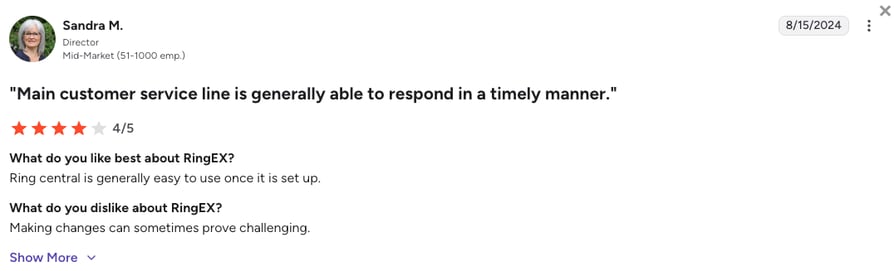
RingCentral's RingEX holds 4.2/5 on G2 across 1,550+ reviews. The reviewer below finds it easy once it's set up, though making changes takes effort.
5. Talkdesk vs Aircall: Best for Contact Centers Outgrowing a Phone System
What Is Talkdesk?
Talkdesk is a cloud contact center platform. On top of calling it adds workforce management, quality management, and CXA, its set of AI agents and copilots.
Talkdesk is what teams move to when a phone system like Aircall stops being enough. It brings contact-center tooling, at a starting price close to three times Aircall's.
Who Should Pick Talkdesk Over Aircall?
- Support operations planning for 50+ agents: Workforce and quality management are part of the platform.
- Regulated industries: Industry Experience Clouds add workflows for specific sectors.
- Teams that want AI agents across channels: CXA AI is on every plan, and SMS starts on Digital Essentials.
Where Talkdesk Beats Aircall, and Where It Doesn't
Talkdesk wins on contact-center depth: workforce tools, quality management, and AI agents with a copilot. Aircall wins on cost and speed. Talkdesk starts at $85/user/month with no stated billing term and no trial on paid plans, though Talkdesk Express gives US and Canadian businesses under 50 employees 25 licences and a $100 credit.
How to decide: Pick Talkdesk if you're building a contact center with workforce and quality tools. Stay with Aircall if a phone system inside your helpdesk still covers the work.
Aircall gets a team calling this week, and Talkdesk gives a large operation the tools to run it.
What Are the Pros & Cons of Talkdesk?
| Pros | Cons |
|---|---|
| Workforce and quality management built in | Starts at $85/user/month, billing term not stated |
| CXA AI agents and copilot on every plan | No free trial on paid plans |
| Industry clouds for regulated sectors | More platform than a small team needs |
What Are Talkdesk's Plans & Pricing?
Talkdesk pricing starts at $85/user/month (Digital Essentials, billing term not stated):
| Plan | Price | Key Features |
|---|---|---|
| Digital Essentials | $85/user/mo | Digital channels including SMS, CXA AI |
| Voice Essentials | $105/user/mo | Voice added to the digital channels |
| Elite | $165/user/mo | Advanced AI, workforce management and the full quality management suite |
| Industry Experience Clouds | $225/user/mo | Editions with workflows for regulated industries |
How Do Reviewers Rate Talkdesk?
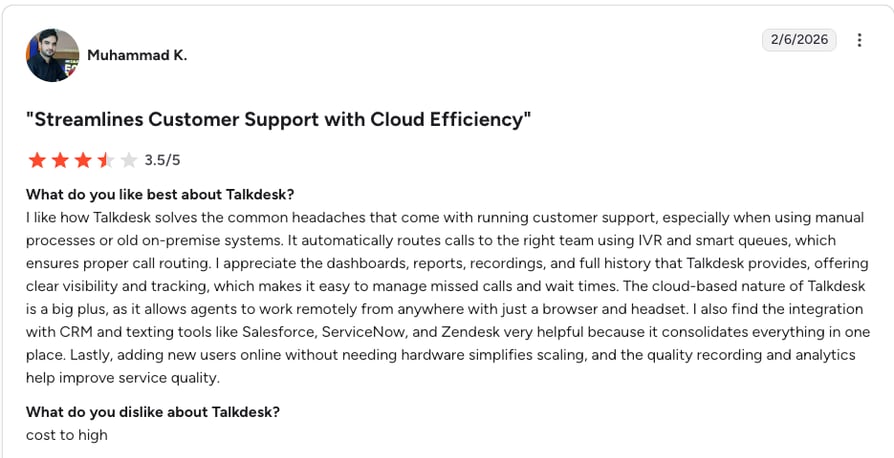
Talkdesk holds 4.4/5 on G2 across 2,600+ reviews. The reviewer below likes the call routing and dashboards, and says the cost is too high.
6. Ringover vs Aircall: Best for European Teams Mixing Calls and Messaging
What Is Ringover?
Ringover is a European cloud phone system that pairs calling with messaging. Its Unified plan adds WhatsApp, Messenger, Instagram and email to the same inbox.
Ringover and Aircall look alike on paper, down to the three-seat minimum. The difference is inside the plan: Ringover includes AI summaries from its first tier.
Who Should Pick Ringover Over Aircall?
- European teams calling across the continent: Business includes unlimited calls to 90 destinations and numbers in 65 countries.
- Teams that answer on several channels: Unified puts WhatsApp, Messenger, Instagram and email beside calls.
- Managers who want AI notes without an upgrade: Transcription and summaries start with Talk at $19.
Where Ringover Beats Aircall, and Where It Doesn't
Ringover wins on what the base plans include: AI summaries from Talk, a power dialer on Business, omnichannel messaging on Unified, and numbers in 65 countries. Aircall wins on integrations, with 250+ from Essentials where Ringover's start on Business ($49), and on flexibility: Ringover's annual prices carry a 12-month commitment.
How to decide: Pick Ringover if you're a European team that wants calls and messaging channels in one place. Stay with Aircall if you need your CRM connected on the entry plan.
Both ask for three seats, then spend your money differently.
What Are the Pros & Cons of Ringover?
| Pros | Cons |
|---|---|
| AI transcription and summaries on every plan | 3-seat minimum, 12-month commitment on annual |
| Unlimited calls to 90 destinations on Business | Talk includes numbers in only 7 countries |
| WhatsApp, Messenger, Instagram and email on Unified | CRM integrations start on Business ($49) |
What Are Ringover's Plans & Pricing?
Ringover pricing starts at $19/user/month (Talk, annual billing with a 12-month commitment):
| Plan | Price (annual billing) | Key Features |
|---|---|---|
| Talk | $19/user/mo | Calling, numbers in 7 countries, transcription and AI summaries (3-seat min) |
| Business | $49/user/mo | Everything in Talk + Power Dialer, numbers in 65 countries, unlimited calls to 90 destinations, 100+ CRM integrations |
| Unified | $69/user/mo | Everything in Business + WhatsApp, Messenger, Instagram and email |
| Enterprise | Custom quote | Custom terms, from 50 users |
How Do Reviewers Rate Ringover?
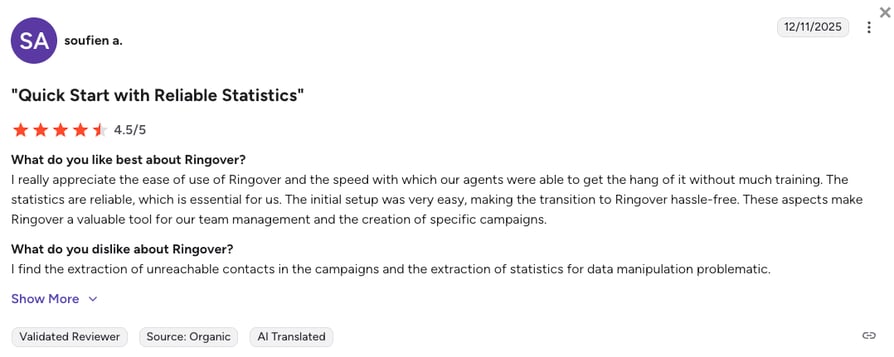
Ringover holds 4.6/5 on G2 from 500 reviews, a smaller base than Aircall's. The reviewer below praises the easy setup and reliable statistics, and finds campaign exports awkward.
7. Quo vs Aircall: Best for Small Teams Sharing a Text Inbox
What Is Quo?
Quo (formerly OpenPhone) is a phone app for small teams. A few people share a number and see every call and text in one thread.
Quo is the lightest tool on this list, and that's the point. It starts at $15 with no seat minimum, and leaves out the dialer and the long integration list.
Who Should Pick Quo Over Aircall?
- Two to ten people sharing a number: Calls and texts land in one thread everyone can answer.
- Owners who want one seat: Starter is $15 a month, against $90 for Aircall's three licences.
- Teams that miss calls after hours: Sona, its AI agent, answers on every plan, with 10 free calls a month.
Where Quo Beats Aircall, and Where It Doesn't
Quo wins on price, single seats, and the simplest shared numbers and text inbox on this list. Aircall wins once a team grows: Quo has no dialer, CRM integrations and full AI summaries start on Business ($23), and numbers are US and Canada only, where Aircall sells them in about 40 countries.
How to decide: Pick Quo if a few people share numbers and a text inbox in the US or Canada. Stay with Aircall if you call from other countries or need a dialer.
Quo keeps a small team in one thread, and Aircall gives a growing one routing and a dialer.
What Are the Pros & Cons of Quo?
| Pros | Cons |
|---|---|
| Shared number and text inbox from $15 | US and Canadian numbers only |
| No seat minimum, 7-day trial | No dialer |
| Sona AI agent, 10 free calls a month | CRM integrations start on Business ($23) |
What Are Quo's Plans & Pricing?
Quo pricing starts at $15/user/month (Starter, annual billing):
| Plan | Price (annual billing) | Key Features |
|---|---|---|
| Starter | $15/user/mo | Calling and texting on US and Canadian numbers, shared numbers, Sona with 10 free calls a month |
| Business | $23/user/mo | Everything in Starter + CRM integrations, full AI summaries, automatic call recording |
| Scale | $35/user/mo | Everything in Business, Quo's top published tier |
How Do Reviewers Rate Quo?
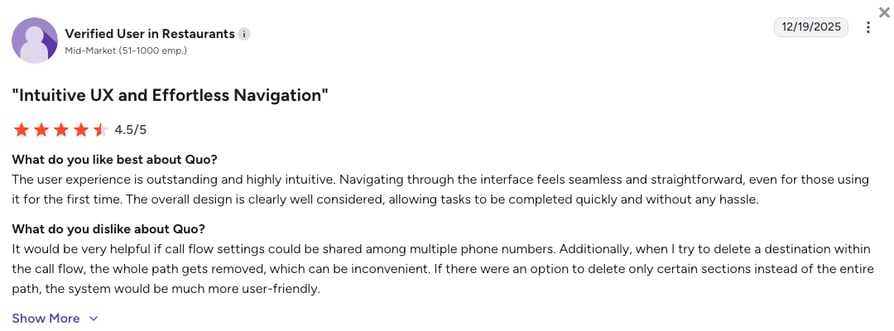
Quo holds 4.7/5 on G2 across 3,400+ reviews. The reviewer below likes the user experience and asks for call-flow settings that can be shared.
8. Nextiva vs Aircall: Best for Voice, Video and Chat on One Bill
What Is Nextiva?
Nextiva is a US business communications platform that bundles calling, video meetings, team chat and texting, with a basic CRM on its entry plan.
Nextiva replaces more tools than Aircall does, for half the entry price. Core costs $15 a user and covers meetings and chat as well as calls.
Who Should Pick Nextiva Over Aircall?
- Small businesses paying for three separate apps: Voice, video and chat arrive on one bill from $15.
- Offices that text customers often: Plans include 100, 500 or unlimited texts as you move up.
- Owners who want contacts and calls together: Core's basic CRM keeps customer notes beside the phone.
Where Nextiva Beats Aircall, and Where It Doesn't
Nextiva wins on the bundle: voice, video, chat and a basic CRM from $15, with unlimited texts and AI on Scale ($75). Aircall wins on depth for sales and support teams. Nextiva limits Core to 50 AI transcriptions a month, shows no free trial, and keeps dialing for its contact-center line.
How to decide: Pick Nextiva if a small business wants voice, video and chat on one bill. Stay with Aircall if calls logged into a CRM or helpdesk are the main job.
What Are the Pros & Cons of Nextiva?
| Pros | Cons |
|---|---|
| Voice, video, chat and a basic CRM from $15 | AI capped at 50 transcriptions a month on Core |
| Texts on every plan, unlimited on Scale | No free trial shown |
| AI transcriptions and summaries on every plan | Dialers sit in the contact-center plans |
What Are Nextiva's Plans & Pricing?
Nextiva pricing starts at $15/user/month (Core, annual billing):
| Plan | Price (annual billing) | Key Features |
|---|---|---|
| Core | $15/user/mo | Voice, video, team chat, a basic CRM, 100 texts, 50 AI transcriptions and summaries a month |
| Engage | $25/user/mo | Everything in Core + 500 texts and 200 AI transcriptions and summaries a month |
| Scale | $75/user/mo | Everything in Engage + unlimited texts and unlimited AI transcriptions and summaries |
How Do Reviewers Rate Nextiva?
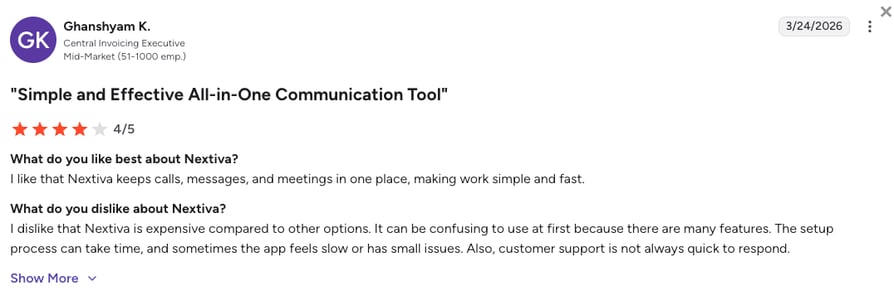
Nextiva holds 4.5/5 on G2 across 3,700+ reviews. The reviewer below likes calls, messages and meetings in one place, and finds it expensive.
9. Kixie vs Aircall: Best for HubSpot and Pipedrive Sales Teams
What Is Kixie?
Kixie is a sales dialer and texting tool that works from inside the CRM. Reps start a session from a HubSpot or Pipedrive list, and each call is written back to the record.
Kixie does one thing Aircall doesn't: it dials several lines at once. Its multi-line PowerDialer rings up to four numbers per rep. Kixie publishes no prices, so the comparison starts with a quote.
Who Should Pick Kixie Over Aircall?
- Reps who live in HubSpot or Pipedrive: CRM sync is on every plan, with five native integrations and 90+ apps listed.
- Outbound teams with low connect rates: The multi-line PowerDialer calls up to four numbers at once.
- Teams that want a local area code on every call: Local presence comes on its self-serve plans.
Where Kixie Beats Aircall, and Where It Doesn't
Kixie wins on multi-line dialing, local presence, CRM sync on every plan, and reviews, with the highest G2 rating on this list. Aircall wins on published prices, on 250+ integrations against Kixie's five native ones, and on numbers that are yours alone: Kixie's local presence draws on a shared pool of 50,000+ numbers.
How to decide: Pick Kixie if your reps live in HubSpot or Pipedrive and dial all day. Stay with Aircall if you want prices on the page and a wider set of integrations.
What Are the Pros & Cons of Kixie?
| Pros | Cons |
|---|---|
| Multi-line PowerDialer on up to four lines | No published prices |
| CRM sync on every plan | Local presence uses a shared number pool |
| 7-day trial, highest G2 rating on this list | Five native CRM integrations |
What Are Kixie's Plans & Pricing?
Kixie pricing is available on request only, so the table shows what each plan includes:
| Plan | Price | Key Features |
|---|---|---|
| Professional | On request | Calling and SMS, two-way CRM sync, IVR and call queues |
| Single-Line PowerDialer | On request | Everything in Professional + a one-line power dialer |
| Multi-Line PowerDialer | On request | Everything in Single-Line + dialing on up to four lines at once |
How Do Reviewers Rate Kixie?
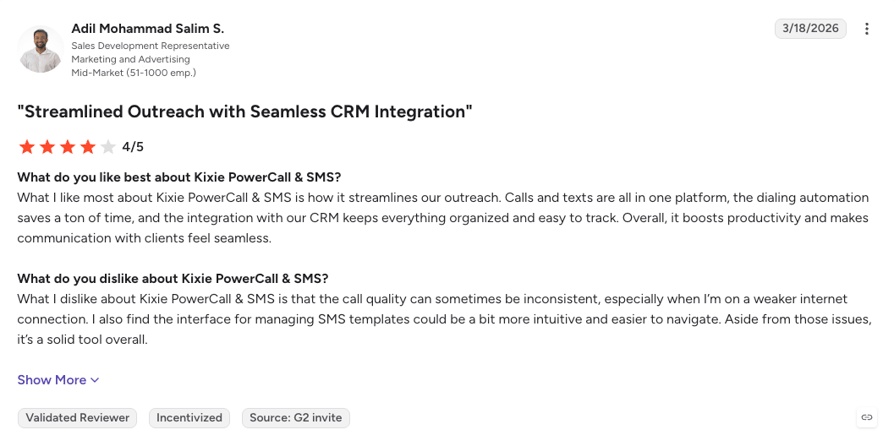
Kixie holds 4.8/5 on G2 across 850+ reviews. The reviewer below likes calls and texts in one platform with CRM sync, and mentions call quality on weak connections.
10. CallHippo vs Aircall: Best for Micro-Teams on a Tight Budget
What Is CallHippo?
CallHippo is a low-cost virtual phone system for very small teams. You can start on a free Basic plan for the first six months, then move to Starter at $19.
CallHippo costs about a fifth of Aircall's minimum to get started. One Starter seat is $19 a month against $90 for three Aircall licences, though the review base is much smaller.
Who Should Pick CallHippo Over Aircall?
- One or two people starting out: Basic is free for six months, and Starter is sold one seat at a time.
- Teams that want to try before paying: The trial runs 10 days and needs no card.
- Small outbound teams: A predictive dialer is sold as its own plan, from $35.
Where CallHippo Beats Aircall, and Where It Doesn't
CallHippo wins on entry cost, single seats, and a predictive dialer plan with a public price. Aircall wins on what a growing team adds: CRM integrations from the first plan, where CallHippo's start on Professional ($30), and a review base four times the size.
How to decide: Pick CallHippo if budget comes first and the team is tiny. Stay with Aircall if CRM integrations have to work from day one.
What Are the Pros & Cons of CallHippo?
| Pros | Cons |
|---|---|
| Free Basic plan for six months, Starter at $19 | CRM integrations only from Professional ($30) |
| No seat minimum, 10-day trial with no card | Prices change with your number's region |
| Predictive dialer plan from $35 | 400+ reviews against Aircall's 1,650+ |
What Are CallHippo's Plans & Pricing?
CallHippo pricing starts at $19/user/month (Starter, annual billing), after a free Basic plan for six months:
| Plan | Price (annual billing) | Key Features |
|---|---|---|
| Basic | Free for 6 months | An entry plan where you pay for numbers and usage |
| Starter | $19/user/mo | The first paid plan, sold one seat at a time, 100 SMS |
| Professional | $30/user/mo | Everything in Starter + CRM integrations, call transcription, 500 SMS |
| Ultimate | $42/user/mo | Everything in Professional, 1,000 SMS |
| Predictive dialer plan | From $35 to $200 | Predictive dialing, priced on its own |
How Do Reviewers Rate CallHippo?
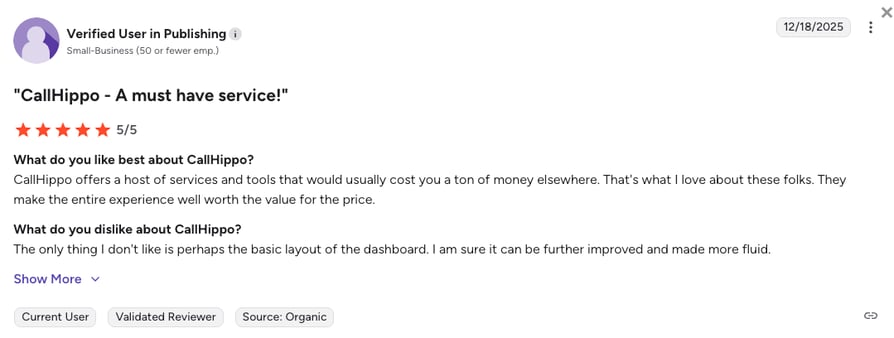
CallHippo holds 4.4/5 on G2 from 400+ reviews, a far smaller base than Aircall's. Reviewers like the value for money. The reviewer below calls the dashboard basic.
Aircall Pricing vs. Alternatives: What You're Really Paying
Aircall's list price is fair, and the bill depends on how you buy. Essentials is $30 per licence a month on annual billing, sold from three licences, with add-ons priced per seat. So when you compare Aircall vs an alternative, start with the seat minimum and the add-ons you'll need.
| What you need | Aircall | What that means |
|---|---|---|
| A phone system for one person | Essentials at $30/licence/month on annual billing, sold from 3 licences | $90 a month on annual billing |
| A team of 10 on Essentials | 10 x $30/licence/month | $300 a month on annual billing |
| A team of 10 on Professional | 10 x $50/licence/month | $500 a month on annual billing |
| A power dialer | Included in Professional, one line at a time | Every dialing seat moves up from Essentials |
| Live AI coaching | AI Assist Pro, $49/user/month on top | Added to the plan price for each coached seat |
| $10/seat/month add-on | Priced per seat, on top of the plan | |
| Deeper analytics | Analytics+, $15/seat/month | Priced per seat, on top of the plan |
| Salesforce Voice | $30/seat/month add-on | Priced per seat, on top of the plan |
| AI voice agents | $99/month minimum, then $0.29/min pay as you go | Bundles start at 1,000 minutes for $250 |
On CloudTalk, one person pays for one seat. Starter is $25/user/month and Essential, the first plan with CRM integrations, is $29/user/month, both on annual billing with no seat minimum. You add a dialer only for the reps who dial. We break down Aircall's full pricing plan by plan in a separate guide.
Why Aircall's $30 Price Tag Is Actually $90 to Start
Aircall sells Essentials and Professional from three licences, on annual and monthly billing alike. A solo consultant, a two-person startup or a small local business still buys three, which puts the starting cost at $90 a month before the first call. CloudTalk, Dialpad, Quo, RingCentral and CallHippo sell a single seat, and JustCall starts at two.
Which Aircall Alternative Has the Best Free Trial?
Try the calls on your own lines before you move a team:
- CloudTalk: 14 days
- Dialpad and JustCall: 14 days
- RingCentral: 14 days, for up to five users
- CallHippo: 10 days, no card
- Ringover, Quo and Kixie: 7 days
- Aircall: free access, with no length published
- Talkdesk: no trial on paid plans, and a $100 credit on Talkdesk Express
- Nextiva: no trial shown
Aircall Alternatives by Feature: Which Platform Wins at What?
If one missing feature is why you're leaving Aircall, start with the platform that does that one thing best.
| Feature Need | Best Alternative | Why It Wins Over Aircall |
|---|---|---|
| Call quality & uptime | CloudTalk | 99.999% uptime over a network of carrier partners |
| Outbound dialing | CloudTalk | Power and Parallel Dialers (up to five lines) vs. Aircall's one-line Power Dialer |
| Live AI coaching | Dialpad | Real-time transcripts on every plan, Live Coach on Sell or Support Advanced |
| HubSpot/Salesforce sync | CloudTalk | Auto-logs calls and recordings. HubSpot from Essential, Salesforce on Expert |
| SMS & bulk texting | JustCall | Shared SMS and WhatsApp inbox vs. Aircall's SMS in about a dozen countries |
| Global number coverage | CloudTalk | Local numbers in 160+ countries vs. about 40 for Aircall |
| Free or cheap entry | CallHippo | Basic plan free for the first 6 months, then Starter at $19 |
| Contact center depth | Talkdesk | Workforce management, quality management and CXA AI in one platform |
Best Aircall Alternatives & Competitors for HubSpot and Salesforce Users
CloudTalk and Dialpad offer the strongest CRM connections among the alternatives, and Aircall deserves credit too: its HubSpot integration is one reason teams pick it. CloudTalk connects HubSpot from Essential and Salesforce on Expert, and logs each recording and call outcome on the contact timeline without a click. For an Aircall alternative with HubSpot integration and better call analytics, it adds real-time dashboards.
Best Aircall Competitors With a Power Dialer or Parallel Dialer
If your sales floor does high-volume outbound calling, CloudTalk goes a step past Aircall's one-line dialer. Aircall's Power Dialer comes with Professional, calls one number at a time from lists of up to 1,000, and isn't in the mobile app. CloudTalk has a Power Dialer too, plus a Parallel Dialer that calls up to five numbers at once and drops voicemails and IVRs before they reach the rep.
Best Aircall Alternative for AI Call Transcription and Summaries
For live, on-screen transcription, Dialpad is the strongest option. Aircall covers the basics well too, with transcripts from Essentials and AI Assist summaries on Professional. If your main goal is post-call analysis, CloudTalk's AI Conversation Intelligence (from $9/user/month) adds call summaries and sentiment tracking that push to your CRM.
Case Study: How Revolut Cut 40 Hours of Manual Work Using CloudTalk's HubSpot Sync
When Revolut grew its outbound sales team, its previous VoIP provider lacked the agent oversight and CRM sync the team needed, which is why scaling teams often weigh CloudTalk against competitors like Aircall.
With CloudTalk's Smart Dialer, 193+ international numbers and a real-time HubSpot sync, call logging became automatic. That saved the sales operations team 40+ hours a month and helped Revolut onboard 500+ sales reps.
What Users Are Really Saying About Aircall Alternatives & Competitors
Vendor pages tell you what a tool can do, and users tell you how it goes. Here's what a Reddit thread and Quora say about alternatives to Aircall, how the tools compare on G2, and what reviewers wrote after they chose to switch from Aircall.
What Redditors Are Saying about Aircall Competitors
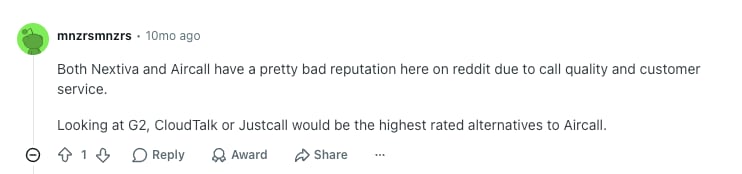
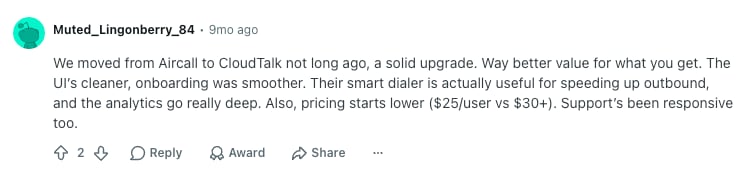
In an r/ITManagers thread on alternatives to Aircall, the poster had left over support and billing and needed local numbers in several regions plus HubSpot integration:
- CloudTalk: Several commenters who moved off Aircall mention smoother onboarding, responsive support, international number coverage and an AI voice agent.
- JustCall and Dialpad: The poster's two finalists. JustCall worked out of the box, and Dialpad took more setup, but its team helped with planning and training.
- Nextiva: Commenters warn about automatic contract renewal.
What Quora Users Are Asking about Aircall Alternatives
On Quora, these themes recur where users weigh Aircall against its competitors:
- Setup speed and cost: Some answers call the bigger names hard to start with and expensive, and recommend alternatives such as CloudTalk for small teams.
- Helpdesk integration: One thread asks which call center software integrates best with Zendesk, and the answers weigh how well calls and tickets stay in sync.
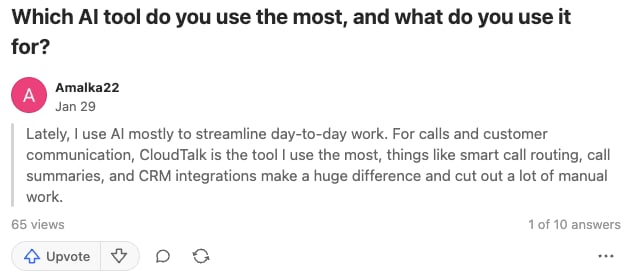
- AI in the workflow: In a thread on the AI tools people use most, AI voice agents, smart call routing and call summaries are named as reasons to choose a modern phone system.
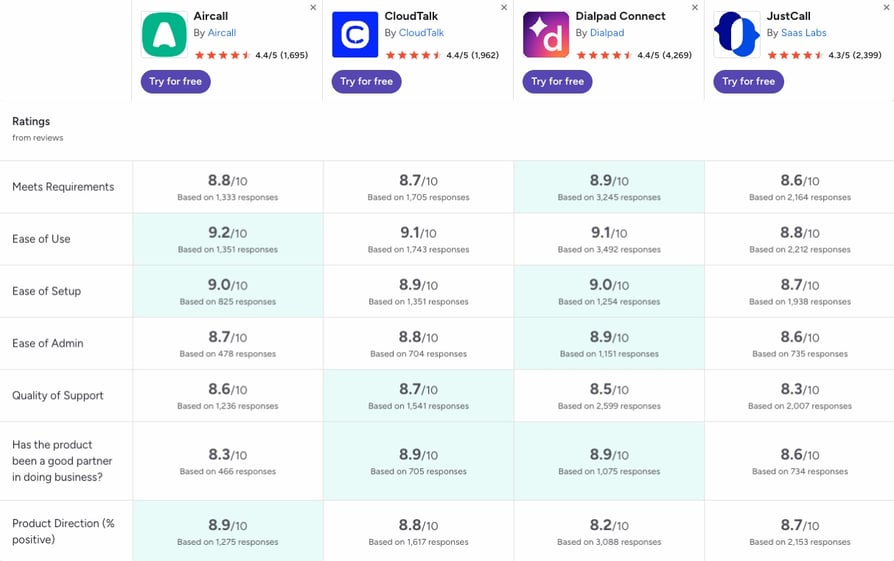
How Do the Best Aircall Alternatives Compare on G2?
On G2, Aircall and its three most-compared alternatives sit within a tenth of a point of each other, so the category scores say more than the stars. Aircall is the baseline at 4.4/5 from 1,650+ reviews, next to CloudTalk at 4.4/5 from 1,950+, Dialpad at 4.4/5 from 4,250+, and JustCall at 4.3/5 from 2,350+.
- Where Aircall sits: The best ease of use (9.2) and product direction (8.9) of the four and joint-best ease of setup (9.0), with the lowest score for being a good partner in doing business (8.3).
- Where CloudTalk lands: Level on the overall rating, with the best support score (8.7) and the joint-best partnership score (8.9, against Aircall's 8.3), a touch behind Aircall on ease of use and setup.
- Where Dialpad and JustCall land: Dialpad leads on meeting requirements and ease of admin (8.9 each) and ties on partnership, with the lowest product direction score (8.2). JustCall is lowest on support (8.3). For support teams, read Aircall and CloudTalk. For AI, read Dialpad.
What Verified G2 Reviewers Say About Switching From Aircall
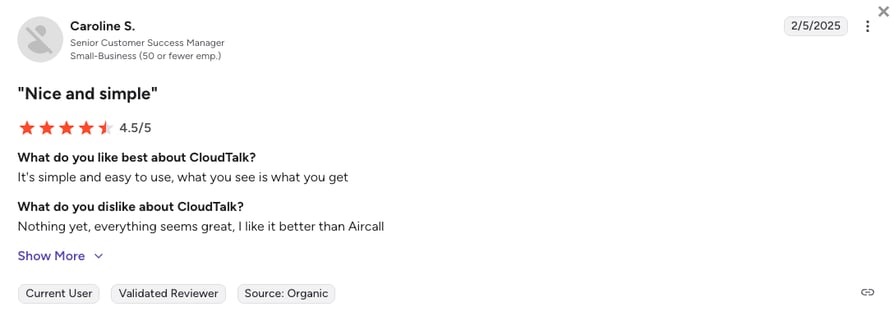
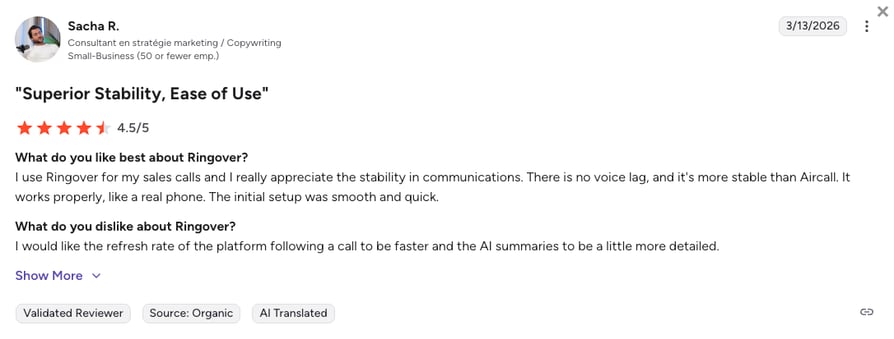
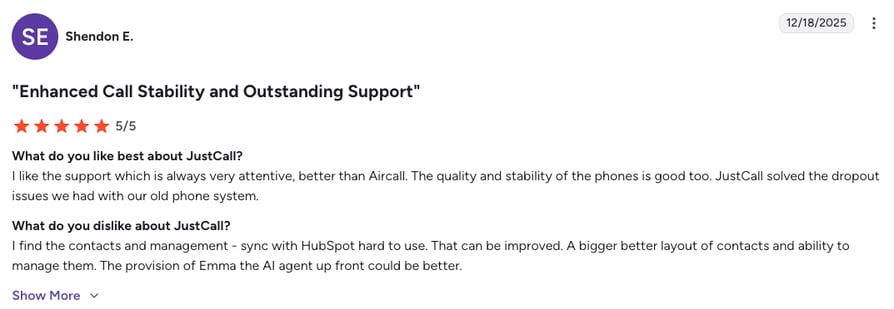
Three verified G2 reviews describe a switch from Aircall to a tool on this list:
- CloudTalk (rated 4.4/5): A former Aircall user says they prefer the overall experience on CloudTalk.
- Ringover (rated 4.6/5): A reviewer who moved from Aircall to Ringover says the system "works properly" for their sales calls.
- JustCall (rated 4.3/5): A business that moved from Aircall praises JustCall's attentive support and steadier calls.
Best Aircall Alternative by Industry and Team Type
Different industries rely on different phone features. Here is a quick guide to matching your business type with the right platform.
What Is the Best Aircall Competitor for B2B SaaS Sales Teams?
SaaS sales teams need to burn through lead lists fast and ramp up new hires quickly. CloudTalk's Parallel Dialer rings up to five lines at once, so reps spend more of the day in live conversations. Dialpad is a great secondary choice for its live coaching prompts, which help new sales development reps stick to the script during their first few weeks.
Pipedrive's sales teams run their calls on CloudTalk. Every call logs to the CRM automatically, and top SDRs make 270+ calls a month.
Aircall vs. Nextiva: Which Is Better for Small Support Teams?
Nextiva and Aircall solve different problems. Nextiva bundles calls, video meetings, and team chat into one app from $15/user/month, so a small support team replaces Zoom and a chat tool at the same time. Aircall is a calling-first phone system with a broader integration catalog (250+) and AI transcripts from its first plan, but it starts at $30 with three licences. If your Aircall vs Nextiva question is really about getting everything in one window, Nextiva wins. If it's about calls landing on the right ticket, Aircall does. And if you need local numbers in 160+ countries with single-seat plans, CloudTalk is the one to try.
Which Is the Best Aircall Alternative for Customer Support Teams?
Support teams need clear routing so customers never get stuck on hold. CloudTalk's visual IVR designer lets managers build complex routing trees easily, ensuring VIP clients get pushed to the front of the line. Nextiva is a solid alternative if your support team also wants video meetings and team chat in the same app as their phone calls. For customer service teams that work remotely, both run on laptops and mobile apps, so agents can take queue calls from anywhere without a desk phone.
Support leads on Aircall often ask us for two things: a person to reach when something breaks, and reports that go past basic call counts.
What Is the Best Aircall Alternative for Small Businesses and Startups?
Startups need to keep costs low and avoid technical bloat. CloudTalk fits because Starter and Essential are sold one seat at a time, starting at $25/user/month. Quo is another favorite for tiny teams in the US and Canada, offering a highly intuitive mobile app and a shared texting inbox that feels just like using an iPhone. That flexibility is what makes CloudTalk the best Aircall competitor for small business teams that expect to grow past one or two seats.
Small teams keep telling us the same thing: they pay for more seats than they use, and the bill grows with every hire.
Which Is the Best Aircall Competitor for Recruitment and Staffing Agencies?
Recruiters live on the phone and need high connection rates. CloudTalk can show a local number from the candidate's country on the caller ID. It also logs calls and syncs contacts natively with Bullhorn and with GoHighLevel, which Aircall offers only through a partner-built connector that may cost extra. Ringover is the other pick: its Business plan adds a power dialer and 100+ CRM integrations.
Hiredly, a recruitment company in Malaysia, runs its sales calls on CloudTalk. Its deal cycle went from two months to two weeks.
What Is the Best Aircall Alternative for Home Services and Field Teams?
HVAC, pest control and construction crews miss calls for a simple reason: they're on a roof, in a crawl space or driving. CloudTalk's AI Receptionist answers when nobody can, takes the details, and books the job into your calendar, with 50 free minutes on every account and plans from $99 a month for 200 minutes. Add a local number for each area you serve, and a two-van business can start on one seat. Quo suits a small US or Canadian crew that mostly needs a shared number and a text thread with customers.
Which Is the Best Aircall Alternative for Nonprofits and Small Offices?
A nonprofit or a three-desk consulting office usually needs one or two lines, a bill that doesn't move, and recordings for training and records. Aircall's three-licence minimum puts the floor at $90 a month, even for one person. CloudTalk's Starter plan is sold one seat at a time, every plan records calls, and the pricing page lists seats and add-ons up front. CallHippo is the lower-cost route for a very small office: Starter is $19 a seat, after a free Basic plan for the first six months.
How to Choose the Right Aircall Alternative for Your Team
Six questions sort the right Aircall alternative from the rest. Answer them for your own team first:
- Which countries do you call and text?
- How many seats do you need on day one?
- Do your reps dial lists, and on how many lines?
- Does your team work in a helpdesk or a CRM?
- Do you want AI coaching during the call or after it?
- Are your numbers being flagged as spam?
What Is the Best Aircall Alternative for International Calling?
CloudTalk is the best Aircall alternative for international calling, with JustCall and Ringover next. CloudTalk sells local numbers in 160+ countries, JustCall in 70+, Ringover in 65, Dialpad in 50+, and Aircall lists about 40. Most countries ask for local documents before releasing a number, whoever the provider is. List every country you'll call and text, and check each one.
Which Aircall Alternative Has the Best AI Coaching?
Dialpad has the best AI coaching among Aircall alternatives, with JustCall's real-time assist second and Aircall's own AI Assist Pro a $49 add-on. CloudTalk doesn't coach live: our AI Conversation Intelligence reviews calls afterwards, and our AI voice agents hand callers to a person in the same queue. In a Gartner customer service survey, 87% of customers said companies using generative AI in service must keep a route to a human agent.1 Decide if reps need prompts mid-call or managers need scored recordings.
Which Aircall Alternative Has the Best Dialer for Outbound Teams?
CloudTalk has the best dialer for outbound teams leaving Aircall, and Kixie suits reps who work from HubSpot or Pipedrive. CloudTalk's Parallel Dialer rings up to five lines with voicemail detection, Kixie's rings four, JustCall's predictive dialer reaches 10 on SalesPro, and Dialpad's new Dialer rings several on Sell Premium. Our Aircall Power Dialer comparison goes mode by mode. Put the same call list through each trial before you choose.
Frontspin, Nooks, Orum and PhoneBurner sit on top of a phone system or CRM and don't replace one, so teams that buy them still need numbers and inbound routing.
Which Aircall Alternative Is Best for SMS and Texting?
JustCall is the best Aircall alternative for SMS and texting, with a shared SMS and WhatsApp inbox and bulk SMS. Quo suits a small US or Canadian team, and Ringover's Unified plan adds social channels. Aircall's own SMS works in about a dozen countries, domestic only. CloudTalk offers pay-as-you-go SMS and WhatsApp with no bulk campaigns. Check that you can text in each country you sell to.
What Is the Best Aircall Alternative for a Large Call Center?
Talkdesk is the best Aircall alternative for a large call center, with RingCentral's RingCX the choice for companies already on RingEX, and Five9 worth a look past 50 seats. CloudTalk's fit is SMB to mid-market: teams that want call queues, routing and dialers without a contact-center rollout. Count the agents you'll have in two years, and buy for that number.
Are There Aircall Alternatives Without a Seat Minimum?
Yes, several Aircall alternatives have no seat minimum. CloudTalk on Starter and Essential, Dialpad on Connect Standard, Quo, RingCentral and CallHippo all sell a single seat. JustCall starts at two, and Ringover and CloudTalk's Expert plan start at three, like Aircall. Check the minimum on the plan that holds your must-have feature.
Which Aircall Alternative Keeps Your Numbers From Getting Flagged?
CloudTalk is the Aircall alternative built to keep your numbers from getting flagged. People already ignore callers they can't place: the Hiya State of the Call 2026 report found that 86% of unidentified calls go unanswered.2 Aircall sells a reputation check and branded caller ID as paid add-ons. CloudTalk registers your numbers with the main spam-analytics platforms, offers reputation monitoring through Numeracle as an add-on for US numbers, and can rotate calls across your own numbers. Kixie's local presence draws on a shared pool. Ask each vendor whose numbers you'll call from.
What Is the Best Aircall Alternative for Growing Teams?
CloudTalk is the best Aircall alternative for growing teams, from SMB to mid-market. What usually breaks past ten seats is the second country, the one-line dialer, or add-ons stacking up per seat. CloudTalk starts at one seat and grows into a mid-market phone system with local numbers, the Parallel Dialer and AI voice agents on one account. Get a quote at 10, 25 and 50 seats, add-ons included.
CloudTalk vs. Aircall: A Detailed Feature Comparison
CloudTalk or Aircall? It comes down to where your customers are. Aircall is built to sit inside a helpdesk, and CloudTalk is a call center platform built around local numbers and outbound dialing. The video above shows CloudTalk end to end, and the table marks where each one leads.
| Category | CloudTalk | Aircall |
|---|---|---|
| Price and seat minimum | $25/user/mo, from one seat | $30/user/mo, from 3 licences |
| CRM and helpdesk integrations | 100+ in total, the full catalog on Expert | 250+, from Essentials (wider) |
| Salesforce | On Expert (3-seat minimum) | Salesforce Voice, $30/seat add-on |
| Dialer | Power on Expert or $15/user/mo; Parallel $39/user/mo, five lines | Power Dialer on Professional, one line |
| Local numbers | 160+ countries | About 40 countries |
| Texting | Pay-as-you-go SMS and WhatsApp | SMS in about a dozen countries, domestic only |
| Live AI coaching | Not available | AI Assist Pro, $49/user/mo (Aircall leads) |
| AI Conversation Intelligence | From $9/user/mo add-on | AI Assist included on Professional |
| AI voice agents | From $99/mo for 200 min, 70+ languages | $99/mo minimum, $0.29/min, 38 languages |
| Number reputation | US reputation add-on, Smart Rotation caller ID | Reputation check ($0.03) and branded caller ID ($0.08 per call) as add-ons |
| G2 ease of use | 9.1 | 9.2 (Aircall ahead) |
| G2 quality of support | 8.7 | 8.6 |
| G2 rating | 4.4/5 (1,950+ reviews) | 4.4/5 (1,650+ reviews) |
| Free trial | 14 days | Free access, no length published |
Aircall is for support teams that want a quick rollout inside a helpdesk and can buy three seats, and CloudTalk is for SMB teams that call across countries, buy seats one at a time and want parallel dialing plus AI voice agents in one account.
How to Switch from Aircall Without Losing Any Data or Numbers
Many teams stay with a phone system they've outgrown because they fear losing their phone numbers or messing up their CRM records. Moving from Aircall is mostly paperwork, and your customers shouldn't notice it.
Here is the 4-step framework to switch from Aircall to CloudTalk:
- Export your data: Go to your Aircall dashboard and download your contact lists, users, and call history as a CSV file.
- Port your numbers: Submit a porting request to your new provider. CloudTalk's porting team runs the carrier side, and fees and timing depend on the country.
- Build your call flows: While you wait, set up routing, business hours, and IVR menus in CloudTalk's Call Flow Designer.
- Connect your CRM: Link HubSpot, Pipedrive or another CRM, so new calls log to the right records from day one.
- Note your renewal date and notice periodCheck your contract for both.
- Pull 12 months of invoicesThey show what add-ons really cost you.
- Export recordings and call logsAircall keeps the last 6 months in the dashboard, and older ones go through its support.
- Start porting before you cancel, never afterNumber porting needs an active account, so your numbers keep working on Aircall until the day they move.
- Plan US texting earlyA2P 10DLC registration starts again with any new provider. CloudTalk files it for you, with no markup on carrier fees.
Which Aircall Alternative Should You Pick?
Name the one thing you'd change about your phone system, then find it below. Each of the best Aircall alternatives fits a different need:
- Pick Dialpad if reps need AI prompts while the customer is still on the line.
- Pick CloudTalk if your customers are in several countries, you'd rather begin with one seat, and you need a parallel dialer and AI voice agents in one system.
- Pick JustCall if texting does as much of the work as calling, or Quo if a few people share one text inbox in the US or Canada.
- Pick RingCentral or Talkdesk if you've outgrown a team phone system: RingCentral for one suite across the company, Talkdesk for a full contact center.
- Pick CallHippo if the budget is tight and the team is very small.
- Stay with Aircall if your support team works in a helpdesk, values a quick rollout and can buy three seats.
For a growing sales or support team looking to replace Aircall, CloudTalk is the best overall fit: one seat to start, local numbers where you sell, a five-line dialer, and AI voice agents on your queues. Not ready to port? Bring Your Own Carrier lets you keep your carrier and numbers.
Sources:
- Gartner, customer service survey press release, 2026.
- Hiya, State of the Call, 2026.
Frequently Asked Questions about Aircall Alternatives & Competitors
Quick answers about Aircall, the tools buyers compare it with, and when staying put is the right call.
The best Aircall alternative in 2026 depends on the job: Dialpad for live AI coaching, CloudTalk for SMB teams calling across countries, JustCall for texting-heavy teams, and Talkdesk for a growing contact center. Our VoIP alternatives hub covers the wider field.
Teams switching from Aircall to CloudTalk usually name four things: buying one or two seats, local numbers in 160+ countries, a Parallel Dialer that rings up to five lines, and tools that help keep numbers from being flagged as spam. Teams that rely on live AI coaching often stay.
Aircall's pricing is competitive per seat, but it costs more to start than most other vendors. Aircall costs $30 per user per month on Essentials and $50 on Professional with annual billing, so $90 a month for the minimum three seats.
The best Aircall alternatives for Salesforce and HubSpot are CloudTalk, JustCall and Kixie. CloudTalk connects HubSpot from Essential and Salesforce on Expert, and our Salesforce integration comparison sets it next to Aircall, which sells Salesforce Voice as a $30 per seat add-on. Kixie includes CRM sync on every plan.
No, Aircall doesn't support international SMS. Its pricing page lists texting in about a dozen countries, including the US and the UK, and delivery is domestic only, with the US and Canada the one exception. Check each provider's SMS countries before you switch. CloudTalk's SMS is pay-as-you-go, priced by destination country.
Yes, you can keep your Aircall numbers when you switch. You ask the new provider to move them through number porting, sign a letter of authorization and send a recent invoice. Keep your Aircall account active until the port date.
The main competitors of Aircall are Dialpad for live AI coaching, CloudTalk for global SMB sales and support teams, JustCall for texting, RingCentral for larger companies, Talkdesk for contact centers, Ringover for European teams, Quo for small shared inboxes, Nextiva for voice, video and chat, Kixie for HubSpot and Pipedrive dialing, and CallHippo for tight budgets.
Yes, Aircall's system can record calls for training and reference. Call recording comes with both Essentials and Professional. The dashboard keeps the last six months, and older recordings go through Aircall's support.
Yes, Aircall is a good phone system for support teams that want a fast rollout and deep integrations. It holds 4.4/5 on G2 from 1,650+ reviews, as our Aircall review covers. It's a weaker fit if you need one or two seats, numbers beyond about 40 countries, or a multi-line dialer.
What's better than Aircall depends on what you need it to do. CloudTalk is better for one-seat teams and local numbers in 160+ countries, Dialpad for built-in AI coaching, as our CloudTalk vs Dialpad comparison shows, and RingCentral for a company-wide suite.
CloudTalk is the best Aircall alternative for ecommerce teams, because order and delivery calls often cross borders. It pairs local numbers in 160+ countries with a native Shopify integration that logs calls on the customer profile. Aircall lists numbers in about 40 countries.
The best alternatives to Aircall for customer service teams are CloudTalk and Nextiva. CloudTalk gives support managers a visual call flow designer, smart routing and real-time dashboards, as our inbound support center overview shows. Nextiva fits teams that want video meetings and chat beside calls.
The cheapest Aircall alternative for outbound sales teams is CallHippo on list price: Starter is $19 a seat, with a predictive dialer sold as its own plan. CloudTalk suits outbound teams that also need local numbers in many countries, with the Power Dialer and Parallel Dialer as add-ons.
The best Aircall alternative for remote teams that need local numbers in 100+ countries is CloudTalk. It sells international numbers in 160+ countries, against about 40 on Aircall's coverage page, and every seat works from a laptop or the mobile app.
The difference between Aircall and RingCentral is scope. Aircall is a phone system for sales and support teams, with 250+ integrations and a three-licence minimum. RingCentral's RingEX is a suite for the whole company, with phone, video and messaging from $20 a user. For focused calling with wider country coverage, see how CloudTalk compares with RingCentral.