TL;DR: 10 Best Alternatives to RingCentral
| # | Platform | Best for | Starting Price (annual billing) | G2 Rating |
|---|---|---|---|---|
| 1 | CloudTalk | Global SMB sales and customer support teams | $19/user/mo | 4.4/5 |
| 2 | Nextiva | Unified voice, video, and team messaging | $15/user/mo | 4.5/5 |
| 3 | Aircall | Growing support teams that prioritize simple UX | $30/user/mo | 4.4/5 |
| 4 | JustCall | High-velocity outbound sales prospecting | $29/user/mo | 4.3/5 |
| 5 | Dialpad | Real-time conversational AI and live transcripts | $15/user/mo | 4.4/5 |
| 6 | Quo (OpenPhone) | Early-stage startups needing shared text inboxes | $15/user/mo | 4.7/5 |
| 7 | Five9 | Large-scale enterprise contact center operations | $119/user/mo | 4.1/5 |
| 8 | 8×8 | Organizations heavily reliant on Microsoft Teams | $24/user/mo | 4.1/5 |
| 9 | Ringover | European-based staffing and recruitment agencies | $21/user/mo | 4.6/5 |
| 10 | CallHippo | Budget-conscious micro-teams and solo operators | $16/user/mo | 4.5/5 |
Why Teams Are Searching for a RingCentral Alternative?
RingCentral (whose core unified comms product recently rebranded to RingEX) historically takes a dominant position as an enterprise safe choice for UCaaS (Unified Communications as a Service). However, as the requirements of scaling SMBs and mid-market teams become more specialized, leaders realize that paying for a massive suite of unused modules stifles operational agility.
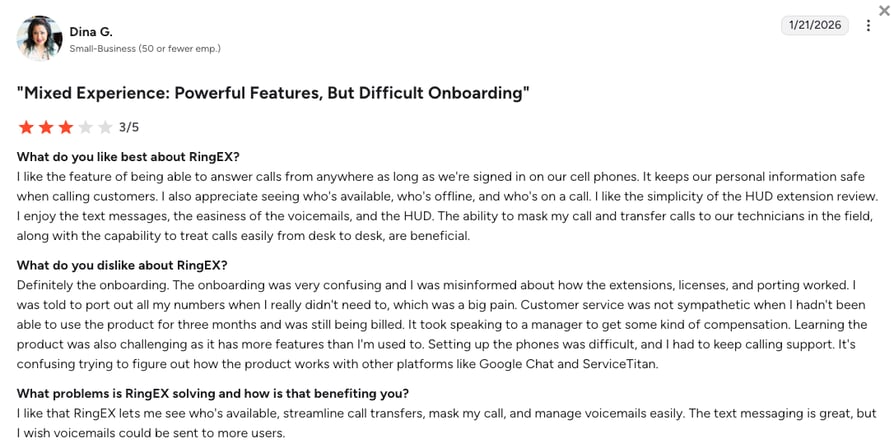
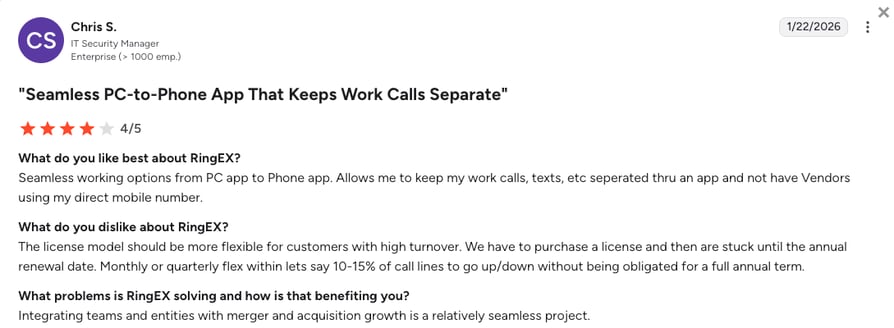
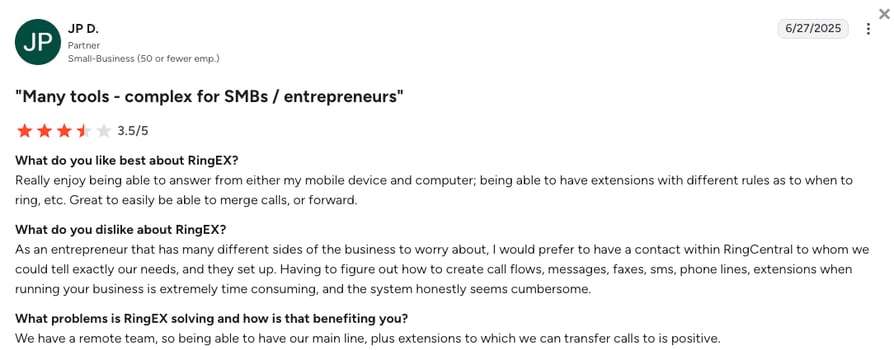
Based on verified G2 reviews (where RingCentral scores 4.2/5 based on 1,300+ reviews) and market intelligence, revenue and support teams outgrow RingCentral due to five main challenges:
5 Main Cons of RingCentral: Based on Real User Reviews
- Inconsistent Global ReliabilityReviewers frequently mention connection issues, delays, and poor sound quality that compound for distributed teams. Being hostage to a single-carrier network means that when local traffic spikes, calls drop.
- Enterprise Complexity and Admin BurdenRingCentral's backend is notoriously complex, with routing configurations buried across multiple, bulky legacy menus. Even with their advanced IVR tools, the heavy IT lift slows down frontline teams that need to adjust call flows or provision numbers in minutes rather than days.
- Slow and Tiered SupportUsers frequently report a negative customer service experience marked by a slow, ticket-based, and offshored escalation path. Frontline teams face critical mid-day downtime waiting for representatives who lack the technical authority to resolve issues.
- Unexpected Costs and Auto-RenewalsAdvertised base prices swell rapidly due to strict user requirements, expensive SMS boosters, and premium AI add-ons. Contractual lock-in prevents teams from downsizing efficiently, turning the platform into an unpredictable budget drain.
- Unreliable CRM IntegrationsThe platform frequently struggles to natively sync call data and notes with CRMs like Salesforce or HubSpot. Teams are forced to rely on manual steps or workarounds because the out-of-the-box connectors fail to trigger specific CRM workflows
What Is the Best Alternative to RingCentral?
CloudTalk is the best alternative to RingCentral, especially for scaling global sales and support teams. CloudTalk offers a lower starting price of $19/user/month without the heavy enterprise bloat. It also provides crystal-clear call quality through a proprietary multi-carrier global infrastructure, entirely bypassing the regional single-carrier outages that plague RingCentral users.
As your team scales, CloudTalk embeds specialized and revenue-driving tools directly into your workflow. Features like native power dialers, a drag-and-drop call flow builder, and deep CRM synchronization prevent IT bottlenecks and avoid RingCentral's expensive add-on tax.
Auto Dialers Compared:
See how CloudTalk’s native sales dialers stack up against RingCentral’s in our head-to-head auto dialer comparison.
Why Teams Consider CloudTalk the Best RingCentral Alternative
5 Main Pros of CloudTalk: Based on Real User Experience
- Multi-Carrier Global CoverageInstead of regional quality gaps, CloudTalk operates on a multi-carrier infrastructure across 160+ countries. If one route degrades, the system instantly fails over, significantly improving connect rates and call clarity.
- SMB-Centric SimplicityCloudTalk replaces bulky, IT-dependent enterprise menus with an intuitive, drag-and-drop visual call flow designer. Non-technical ops managers can easily build queues and adjust routing live, resulting in fast onboarding and zero IT bottlenecks.
- Responsive, Product-Integrated SupportCloudTalk positions support as a fast and human extension of the product rather than gating it behind premium tiers. Mid-day routing glitches are met with immediate escalation paths, minimizing lost revenue.
- Predictable Total Cost of OwnershipCloudTalk leans on transparent and usage-aligned pricing with flexible month-to-month options. You avoid RingCentral's aggressive auto-renewals, strict seat counts, and expensive AI module upgrades.
- Deep Workflow AutomationsCloudTalk specializes in robust and bi-directional integrations with tools like Salesforce and HubSpot. Automation natively handles data entry and triggers CRM actions, meaning your team never misses a coachable moment or manual log again.
How We Evaluated The Best RingCentral Alternatives and Competitors
To find the best RingCentral alternatives for 2026, we spent weeks testing each platform hands-on. We prioritized tools that solve the primary bottlenecks reported by mid-market users. Our evaluation cross-referenced technical testing with verified user feedback on G2, Quora, and Reddit.
Our research focused on six essential pillars:
- Network Stability: We tested for near-zero latency and multi-carrier redundancy to ensure distributed teams are not held hostage by regional single-carrier failures.
- AI Productivity: We looked for native conversational intelligence that actively automates CRM data entry rather than acting as a highly-priced and standalone shelf-ware module.
- CRM Deep-Sync: Our focus was on reliable and bi-directional workflows that trigger specific helpdesk and CRM actions without requiring custom developer connectors.
- Global Footprint: We prioritized providers offering rapid provisioning for international numbers across 100+ countries to support immediate global expansion.
- Support Response: We measured time-to-mitigation during active revenue hours, favoring systems that guarantee fast, domestic, and human support over layered ticketing portals.
- Total Cost of Ownership (ToC): We analyzed the true effective cost per agent, verifying platforms that offer transparent flexibility and eschew aggressive auto-renewal traps.
Top 10 Alternatives to RingCentral for 2026
Before we dive into detailed breakdowns of the 10 best alternatives to RingCentral software, here is how our top picks stack up at their entry-level pricing.
RingCentral Competitors Compared
| Feature | RingCentral | CloudTalk | Aircall | Dialpad | JustCall |
|---|---|---|---|---|---|
| Starting Price (Annual) | $20/mo | $19/mo | $30/mo | $15/mo | $29/mo |
| Minimum Seats | 1 User | 1 User | 3 Users | 1 User | 2 Users |
| Local Numbers | 110+ Countries | 160+ Countries | 100+ Countries | 50+ Countries | 70+ Countries |
| Automatic Call Recording |  |  | | | |
| Click-to-Call | | | | | |
| Visual Call Flow Builder | (basic and clunky) | | | | |
| Inbound Call Queuing | | | | | |
| Free Trial | 14 Days | 14 Days | 7 Days | 14 Days | 14 Days |
1. CloudTalk: The #1 RingCentral Alternative for International SMB Sales & Support Teams
What is CloudTalk?
CloudTalk is a cloud-based VoIP and contact center platform built specifically for fast-growing outbound sales and customer support teams that require absolute reliability, deep CRM synchronization, and global reach.
Trusted by 5,500+ businesses around the world, CloudTalk is the definitive upgrade for SMB to mid-market teams looking to escape RingCentral's heavy administration and hidden fees.
Why Is CloudTalk a Strong RingCentral Alternative?
- Global Reach and Multi-Carrier Reliability: Offers local virtual numbers in 160+ countries and bypasses the regional single-carrier outages that plague RingCentral users by utilizing a proprietary multi-carrier network with automatic failover.
- Accessible Call Flow Builder: Replaces RingCentral's updated, but still quite bulky configuration menus with an intuitive drag-and-drop designer that non-technical managers can adjust in minutes without submitting IT tickets.
- No Premium Support Tiers: Removes the frustration of RingCentral's notoriously slow and offshored ticketing system by offering fast, integrated support for all users.
- Transparent Pricing: Avoids RingCentral's aggressive auto-renewals, strict seat minimums, and unexpected feature add-on taxes.
- Native Deep-Sync CRM: Fixes the manual data entry caused by RingCentral's surface-level integrations with flawless, bi-directional syncing for Salesforce and HubSpot.
- Top-Rated RingCentral Competitor by G2: CloudTalk is a G2 Spring 2026 Leader for sales and support, officially outranking RingCentral in user-rated categories like "Ease of Use," "Support Quality," and "Ease of Setup."
What Are the Pros & Cons of CloudTalk?
| Pros | Cons |
|---|---|
| Superior international coverage: Virtual numbers in 160+ countries (vs. RC's 110). | No native video calling: Requires an external integration like Zoom or Google Meet. |
| Advanced dialing: Power, Preview, and Smart dialers available to maximize outbound reach. | Lite plan limitations: Available only for NA & LATAM regions. |
| 100+ CRM & Helpdesk integrations: Including Deep-Sync for HubSpot & Salesforce. | Parallel Dialing: Requires an add-on rather than being included in the standard plans. |
| Native AI Voice Agents: Automate inbound and outbound calling workflows seamlessly. | |
| Enterprise-grade reliability: Proprietary network ensures 99.999% uptime. |
How does call reliability stabilize when you switch from RingCentral?
Move from RingCentral’s single-carrier vulnerability to a proprietary multi-carrier infrastructure. CloudTalk’s network includes automatic failover. If one carrier path experiences latency in a specific country, your call is instantly rerouted. This eliminates the dropped calls and missed connections that frustrate distributed global teams.
What Are CloudTalk's Plans & Pricing?
CloudTalk pricing starts at $19/user/month, and the platform offers the following plans:
- Lite - $19/user/month
- Starter - $25/user/month
- Essential - $29/user/month
- Expert - $49/user/month
- Custom - Quote-based pricing, ideal for enterprises
What Are CloudTalk Customers Saying?
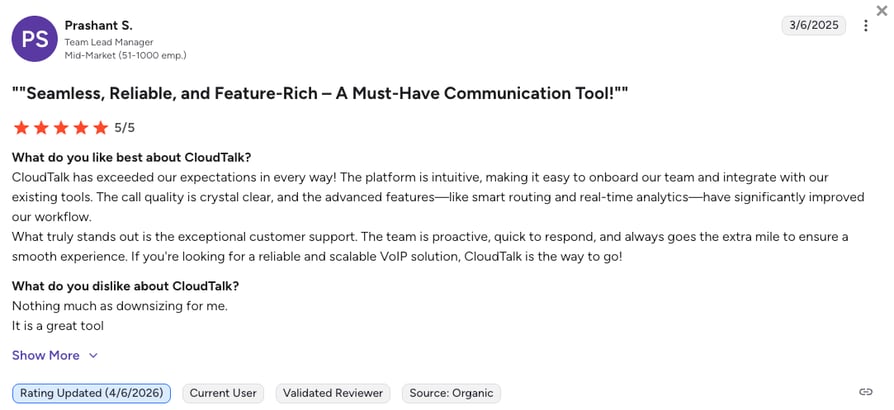
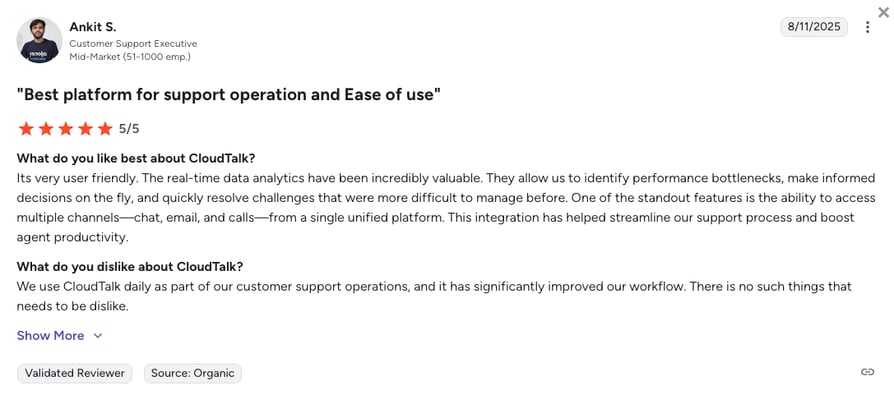
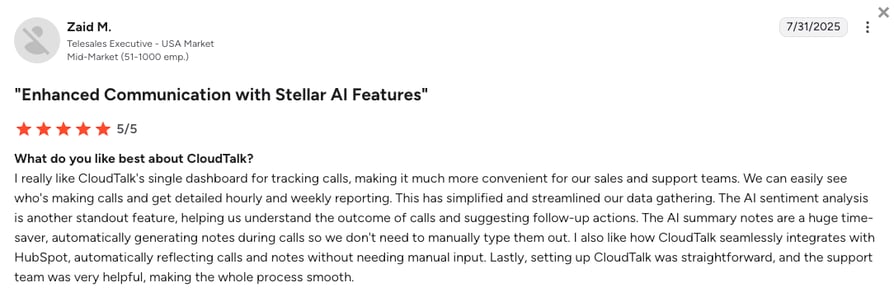
When comparing the top competitors of RingCentral, CloudTalk customers who have switched often highlight why it performs better than RingCentral, pointing to immediate improvements in audio stability and an intuitive interface that doesn't require a dedicated IT person to manage.
- Clearer Audio: Users report that CloudTalk resolves the severe call quality issues, delays, and poor sound experienced on RingCentral.
- Flawless CRM Sync: Teams love that every call logs and every contact updates perfectly without the manual workarounds needed in RingCentral.
- Transparent Pricing: Finance teams appreciate flexible and predictable packages instead of RingCentral's unexpected add-on costs and strict auto-renewals.
- Visual Call Routing: Operations managers use the drag-and-drop builder to implement changes in minutes, completely removing IT bottlenecks.
- Actionable Reporting: Teams rely on CloudTalk's superior analytics and user data visibility, which is often a major limitation in RingCentral.
How G2 Users Rate CloudTalk?
CloudTalk's current G2 rating is 4.4/5, out of 1,750+ verified user reviews.
Recommended Reads
Escape RingCentral's IT bottlenecks today
2. Nextiva: Best for Unified Voice, Video, and Team Messaging
What is Nextiva?
Nextiva is a leading UCaaS platform. When evaluating RingCentral vs Nextiva, mid-market enterprises frequently choose it as a direct and reliable VoIP alternative to RingCentral for voice, video, and chat, but with a massive upgrade in customer service quality.
Why Is Nextiva a Strong RingCentral Alternative?
- High Quality Service Philosophy: Solves RingCentral's notorious offshore support problem by providing highly responsive and domestic-based technical assistance.
- Transparent Contracts: Avoids the auto-renewals and perceived billing hurdles that frequently frustrate RingCentral admins.
- Included Base Value: Generous SMS limits and basic features are included out-of-the-box, unlike RingCentral's restrictive Core plan limits.
What Are the Pros & Cons of Nextiva?
| Pros | Cons |
|---|---|
| All-in-one platform: Combines voice, video, and chat natively. | Pricing jumps for advanced routing: High costs for full contact center capabilities. |
| Domestic support: Responsive and high-quality customer service teams. | Cluttered dashboard: The interface can feel overwhelming for non-technical users. |
| Eliminates SMS limits: Generous allowances prevent mid-month texting freezes. | Slower setup: Initial implementation takes longer than lightweight VoIP apps. |
What Are Nextiva’s Plans & Pricing?
Nextiva pricing starts at $15/user/month (billed annually), with the following main plans:
- Core - $15/user/month
- Engage - $25/user/month
- Scale - $75/user/month
- Professional - Quote-based (Enterprise plans)
What Are Nextiva Customers Saying?
Nextiva customers love the platform's reliability and all-in-one convenience, though some mention the learning curve is steep.
- Rock-Solid Uptime: Reviewers frequently praise the audio stability and enterprise-grade reliability.
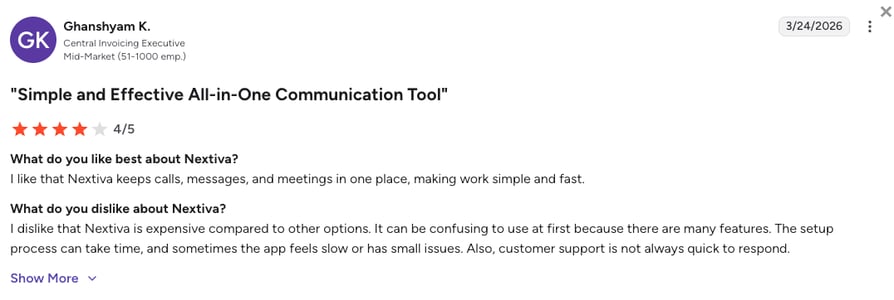
- All-in-One Convenience: Users like that Nextiva keeps calls, messages, and meetings in one place, acting as a true unified hub.
- Steep Learning Curve: Reviewers point out that navigating the backend can be confusing at first, and setup takes a bit of time.
How G2 Users Rate Nextiva?
Nextiva's current G2 rating is 4.5/5, out of 3,400+ verified user reviews.
Recommended Reads
3. Aircall: Best for Growing Support Teams That Prioritize Simple UX
What is Aircall?
Aircall is a sophisticated voice solution known for its native CTI embedding and massive app ecosystem. It is heavily favored by modern and fast-scaling support teams who prioritize an intuitive interface over complex and legacy enterprise platforms.
Why Is Aircall a Strong RingCentral Alternative?
- Rapid Deployment: Bypasses the months-long professional implementation often required by RingCentral, getting teams up and running in under an hour.
- Consumer-Grade UX: Ditches the bulky and outdated menus of RingCentral for a clean, streamlined application that requires near-zero agent training.
What Are the Pros & Cons of Aircall?
| Pros | Cons |
|---|---|
| Native CTI embedding: Flawless CRM data sync without manual entry. | Strict 3-user minimum: The $90/mo starting floor prices out solo operators. |
| Intuitive interface: Clean app design that requires near-zero training. | Lacks native bulk SMS tools: Requires third-party integrations for outbound texting campaigns. |
| Fast onboarding: Teams can set up routing and numbers in under an hour. | Premium analytics upgrades: Deep reporting requires expensive tier jumps. |
What Are Aircall’s Plans & Pricing?
Aircall pricing starts at $30/user/month (billed annually, 3-user minimum), with the following plans:
- Essentials - $30/user/month
- Professional - $50/user/month
- Custom - Quote-based pricing
What Are Aircall Customers Saying?
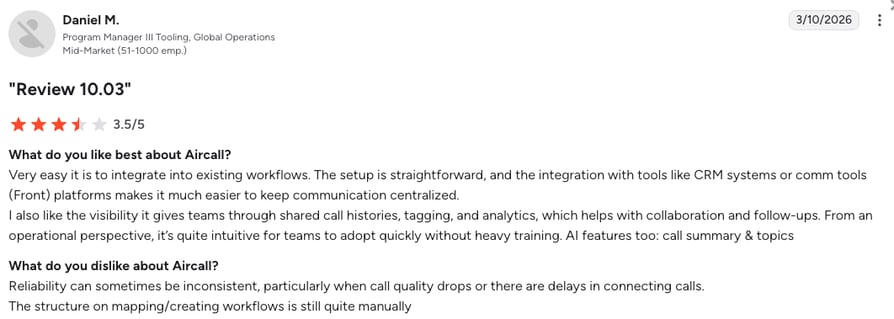
Users frequently praise Aircall's reliability when connecting to major CRMs and its overall ease of use for remote teams.
- Time Saved on Entry: Users rave about how native integrations save hours of manual entry compared to legacy systems.
- Easy to Learn: New reps are able to start taking calls almost immediately thanks to the modern and intuitive interface.
- Reliability Issues: While the general consensus is positive, some users report inconsistent call quality and delays in connecting calls when scaling.
How G2 Users Rate Aircall?
Aircall's current G2 rating is 4.4/5, out of 1,500+ verified user reviews.
Recommended Reads
4. Dialpad: Best for Real-Time Conversational AI and Live Transcripts
What is Dialpad?
Dialpad is an AI-powered platform built from the ground up on proprietary natural language processing (NLP). It’s an ideal platform for sales teams that want conversational intelligence actively assisting them during live calls, rather than just reading reports afterward.
Why Is Dialpad a Strong RingCentral Alternative?
- Native AI Foundation: Embeds AI into standard plans, bypassing the need to buy RingCentral's expensive RingSense add-on.
- Real-Time Live Coaching: Provides agents with instant cheat sheets and sentiment analysis during the call, unlike RingCentral's post-call analytics.
- Modern IT Administration: Replaces RingCentral's legacy updates with a clean and cloud-native backend that integrates deeply with Google Workspace.
What Are the Pros & Cons of Dialpad?
| Pros | Cons |
|---|---|
| Real-time transcripts: Pop-up coaching tips appear live during conversations. | 24/7 support requires upgrades: Baseline users do not get round-the-clock help. |
| AI features are native: Included in foundation plans rather than as expensive add-ons. | Toll-free bundles get expensive: High-volume inbound can inflate monthly invoices. |
| No mandatory minimums: Single users can sign up without being forced into seat minimums. | Slightly lower SLA: Offers a 99.9% uptime guarantee vs. RingCentral's or CloudTalk’s 99.999%. |
What Are Dialpad’s Plans & Pricing?
Dialpad pricing starts at $15/user/month (billed annually), with the following plans:
- Standard - $15/user/month
- Pro - $25/user/month
- Enterprise - $35/user/month
Note: Dialpad Contact Center plans start at $95/user/month
What Are Dialpad Customers Saying?
Dialpad customers love how the built-in AI improves their daily calls, but voice frustrations over tier limitations and support access.
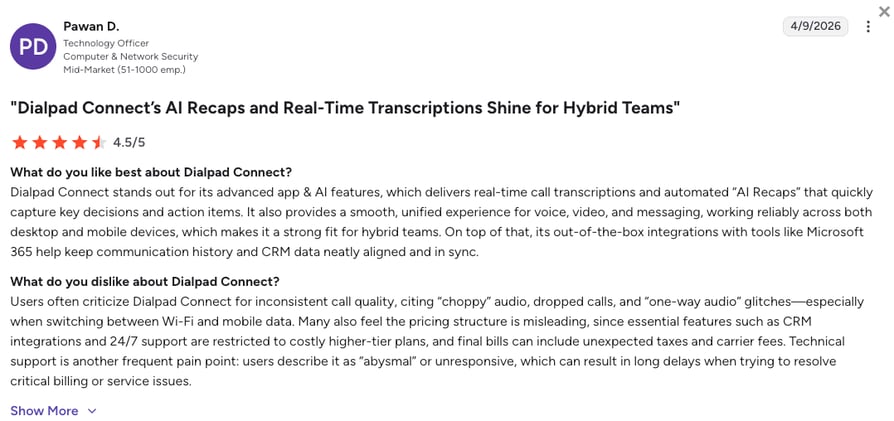
- Powerful AI Transcripts: Users praise the real-time transcriptions and automated AI Recaps that capture key decisions effortlessly.
- Unified Experience: The platform works reliably across desktop and mobile devices, fitting hybrid teams perfectly.
- Inconsistent Support: Reviewers frequently express frustration that 24/7 technical support is restricted to costly higher-tier plans.
How G2 Users Rate Dialpad?
Dialpad's current G2 rating is 4.4/5, out of 5,500+ verified user reviews.
Recommended Reads
5. JustCall: Best for High-Velocity Outbound Sales Prospecting
What is JustCall?
JustCall is a specialized VoIP alternative designed for outbound-led sales teams that require aggressive prospecting tools like predictive dialers, or SMS and WhatsApp workflows. Rather than offering a broad UCaaS suite, JustCall focuses on maximizing the number of interactions an agent can have each day.
Why Is JustCall a Strong RingCentral Alternative?
- Aggressive Outbound Tools: Features 10-line predictive dialers natively in sales tiers, avoiding RingCentral's forced upgrade to their heavy RingCX contact center platform.
- Built for Speed-to-Lead: Tailored explicitly for high-velocity sales floors rather than acting as a generalized office phone system.
- Sentiment Analysis: Helps managers score calls more effectively and identify which reps need coaching without navigating RingCentral's complex analytics dashboard.
What Are the Pros & Cons of JustCall?
| Pros | Cons |
|---|---|
| Powerful predictive dialer: Automates outreach for high-volume sales floors. | Mandatory seat minimums: A strict 2-user minimum creates a deceptive starting entry price. |
| CRM integrations: Logs calls and messages to keep teams aligned automatically. | Expensive AI agents: Advanced AI Voice Agents are structured as costly add-ons. |
| Shared text inboxes: Allows teams to communicate with clients collaboratively. | Metered models: Base plans rely heavily on pay-per-minute outbound billing. |
What Are JustCall’s Plans & Pricing?
JustCall pricing starts at $29/user/month (billed annually, 2-user minimum), with the following plans:
- Team - $29/user/month
- Pro - $49/user/month
- Pro Plus - $89/user/month
- Business - Custom quote-based pricing
What Are JustCall Customers Saying?
JustCall customers appreciate the sales-focused tools but frequently cite pricing hurdles and call drops as pain points.
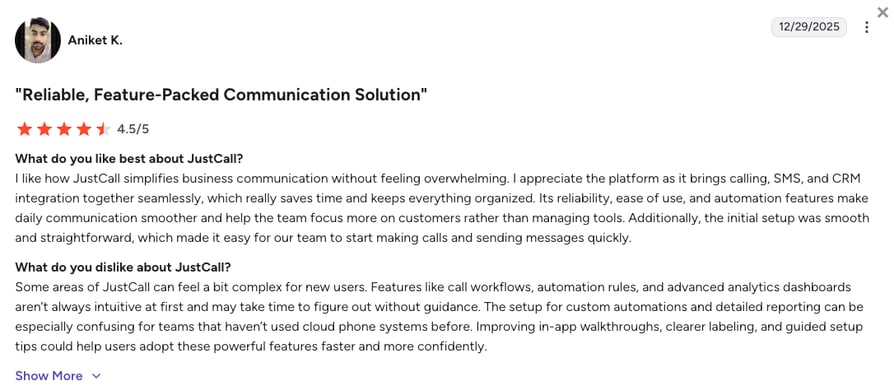
- Valuable Integrations: Users appreciate that calls and texts log into their CRMs, saving time on manual follow-ups.
- Budget-Friendly Base: For basic needs, the starting price looks attractive to small teams. Just don’t forget about JustCall’s 2-seat subscription minimum.
- Pricing and Scalability Hurdles: Users report frustration with being stuck on tiers because basic workflow upgrades require massive price jumps.
How G2 Users Rate JustCall?
JustCall's current G2 rating is 4.3/5, out of 2,300+ verified user reviews.
6. Quo (OpenPhone): Best for Early-Stage Startups Needing Shared Text Inboxes
What is Quo?
Quo, following its rebranding from OpenPhone, is a collaborative and mobile-first shared inbox. For those searching for apps like RingCentral but with a more modern feel, it reimagines the business phone by mimicking intuitive and consumer-grade texting apps, making it one of the most accessible RingCentral alternatives small business owners can adopt.
Why Is Quo a Strong RingCentral Alternative?
- Shared Numbers: Allows multiple team members to manage a single phone number from a shared inbox, avoiding RingCentral's strict per-user line licensing.
- Consumer-Style UX: Completely removes the steep learning curve and corporate UI fatigue associated with legacy RingCentral dashboards.
- Zero Seat Minimums: Starts at an affordable $15 with no multi-user requirements, making it an ideal option for micro-teams.
What Are the Pros & Cons of Quo?
| Pros | Cons |
|---|---|
| Shared inbox: Eliminates duplicate text responses and improves collaboration. | Lacks power dialers: Not suited for aggressive, outbound sales floors. |
| Mobile app UX: Seamless design requires zero team training to adopt. | Limited international coverage: Number provisioning is restricted compared to leaders. |
| AI summaries included: Foundational plans feature automated call recaps. | No emergency calling: Does not support 911, making it a secondary tool for some. |
What Are Quo’s Plans & Pricing?
Quo pricing starts at $15/user/month (billed annually), with the following plans:
- Starter - $15/user/month
- Business - $23/user/month
- Enterprise - Custom quote-based pricing
What Are Quo Customers Saying?
Quo customers praise the app for its consumer-grade simplicity, though some wish for better backend routing flexibility.
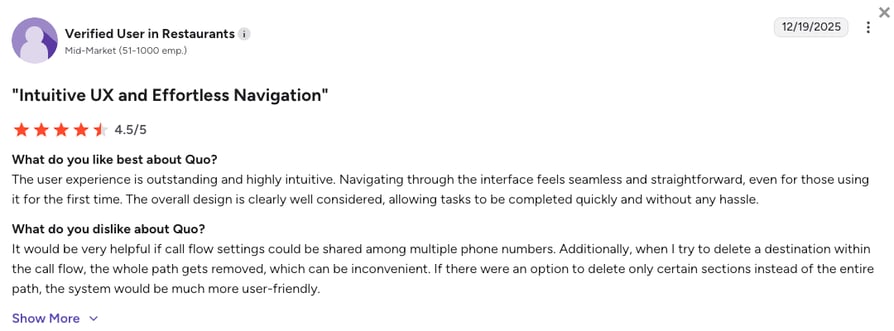
- Highly Intuitive UX: Users rave about the outstanding and seamless design that makes the app easy to navigate immediately.
- Fast Setup: Eliminates the frustration of legacy VoIP systems with an instant and modern onboarding experience.
- Rigid Call Flows: A specific complaint is that call flow settings cannot be shared across multiple numbers, and deleting routing steps deletes the whole path.
How G2 Users Rate Quo?
Quo’s current G2 rating is 4.7/5, out of 3,000+ verified user reviews.
Recommended Reads
7. Five9: Best for Large-Scale Enterprise Contact Center Operations
What is Five9?
When evaluating RingCentral vs Five9, Five9 stands out as the industry standard for massive and highly-regulated contact centers. Five9 is one of the most popular RingCentral contact center alternatives, engineered specifically for high-concurrency environments driving thousands of automated outbound attempts per shift.
Why Is Five9 a Strong RingCentral Alternative?
- Pure-Play CCaaS Excellence: Focuses entirely on contact center optimization rather than RingCentral's generalist UCaaS approach to office communication.
- Predictive Algorithmic Dialers: Calculates connection metrics and agent availability to drastically outpace standard dialing limits.
- Intelligent Virtual Agents: Handles routine customer interactions autonomously, deflecting massive inbound volume to reduce headcount costs.
What Are the Pros & Cons of Five9?
| Pros | Cons |
|---|---|
| Predictive algorithms: Eliminates agent idle time by connecting live answers instantly. | Extremely expensive: Starting at $119/mo, it dwarfs standard SMB VoIP pricing. |
| Granular tracking: Offers 120+ pre-built report templates for massive teams. | IT-heavy implementation: Deployment typically takes three to six months. |
| Automated compliance: Shields enterprises from TCPA liability automatically. | Strict 50-seat minimum: Creates a massive entry barrier for scaling teams. |
What Are Five9’s Plans & Pricing?
Five9 pricing starts at $119/month (billed annually), with the following plans:
- Digital - $119/user/month (Chat and email only)
- Core - $159/user/month (Voice only)
- Plus / Pro / Enterprise - Custom quote-based pricing
What Are Five9 Customers Saying?
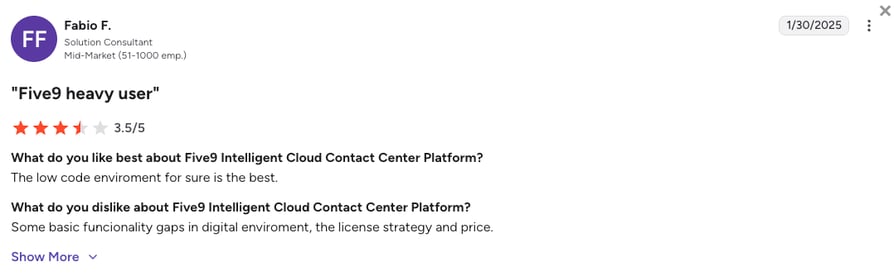
Five9 users appreciate the platform's heavy-duty routing foundation but note that pricing and certain digital tools leave room for improvement.
- High Dialing Speed: Sales managers praise the automated dialers for vastly increasing agent talk time.
- Low-Code Environment: Users appreciate the low-code setup that makes navigating the complex contact center environment easier.
- Price and Functionality Gaps: Reviewers express dislike for the expensive licensing strategy and note functionality gaps in the digital ecosystem.
How G2 Users Rate Five9?
Five9's current G2 rating is 4.1/5, out of 550+ verified user reviews.
Recommended Reads
8. 8x8: Best for Organizations Heavily Reliant on Microsoft Teams
What is 8x8?
8x8 is a powerful and global UCaaS system renowned for its patented voice network. As one of the oldest RingCentral Office competitors, 8x8 operates as a highly traditional alternative for organizations that rely heavily on Microsoft Teams but need a resilient telephony backend.
Why Is 8x8 a Strong RingCentral Alternative?
- Patented Global Network: Provides elite stability and unified routing for multinational corporations, avoiding RingCentral's regional call quality variations.
- Meaningful Out-of-the-Box Analytics: Includes actionable visibility into network quality and user adoption without treating analytics as a premium upcharge.
- Turnkey MS Teams Routing: Operates invisibly inside Microsoft Teams without requiring separate Microsoft phone licenses.
What Are the Pros & Cons of 8x8?
| Pros | Cons |
|---|---|
| Native operation inside MS Teams: Eliminates the need for users to toggle apps. | Administrative dashboard is clunky: Suffers from the same legacy UI issues as RingCentral. |
| Unlimited international zones: Provides predictable billing for global callers. | Expensive CCaaS upgrades: Contact center tools demand massive tier jumps. |
| Patented global voice network: Ensures high-quality audio routing internationally. | Translation accuracy issues: Users report poor performance on secondary digital tools. |
What Are 8x8’s Plans & Pricing?
8x8 pricing is quote-based, but most users report it starts at around $24/user/month (billed annually):
- Unified Comms (X2/X4) - Est. $24 - $44/user/month
- Contact Center (X6) - Est. $85/user/month
- CX Beyond (X7/X8) - Est. $110 - $140/user/month
What Are 8x8 Customers Saying?
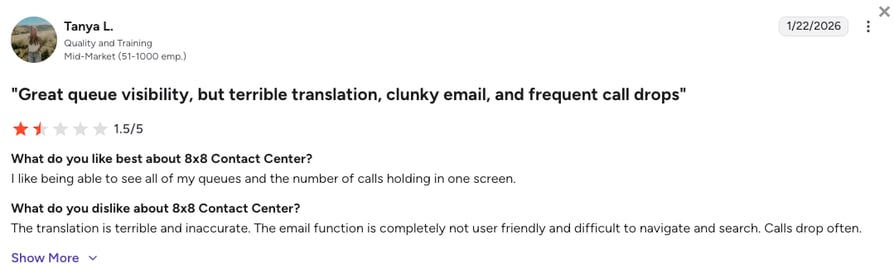
8x8 customers appreciate the high-level dashboard visibility but report significant issues with secondary features and occasional drops.
- Perfect for MS Teams: IT teams love how 8x8 operates in the background to power MS Teams telephony.
- Great Queue Visibility: Managers like being able to see all of their call queues and holding metrics on a single screen.
- Clunky Features and Drops: Users complain about inaccurate translations, a difficult-to-navigate email function, and a steep learning curve.
How G2 Users Rate 8x8?
8x8's current G2 rating is 4.1/5, out of 200+ verified user reviews.
Recommended Reads
9. Ringover: Best for European-Based Staffing and Recruitment Agencies
What is Ringover?
Ringover is an agile cloud telephony solution heavily optimized for the European market, making it one of the top RingCentral alternatives UK and EU teams frequently adopt. It has made strong inroads with staffing agencies and recruitment-heavy teams by offering fast setup and predictable international pricing.
Why Is Ringover a Strong RingCentral Alternative?
- Predictable International Rates: Guarantees unlimited calling to 110+ destinations at a fixed monthly price, curing the anxiety of RingCentral's variable international fees.
- Five-Minute Onboarding: Allows non-technical admins to procure numbers and set up routing rules instantly, avoiding RingCentral's heavy IT lift.
- Built-in Conversation Intelligence: The Empower tool transcribes calls automatically, providing an easier path to AI than RingCentral's bolted-on modules.
What Are the Pros & Cons of Ringover?
| Pros | Cons |
|---|---|
| Five-minute configuration: Unlocks incredibly fast team onboarding. | CRM sync lags behind leaders: Occasional data drops compared to Deep-Sync tools. |
| Unlimited calling to 110+ countries: Removes international cost unpredictability. | SMS and MMS limitations: Slower deliverability in the US and per-message fees for MMS. |
| Live agent whispering: Managers can monitor and assist agents in real-time. | Mobile app glitches: Users report refresh issues on the mobile application. |
What Are Ringover’s Plans & Pricing?
Ringover pricing starts at $21/user/month (billed annually), with the following plans:
- Smart - $21/user/month
- Business - $44/user/month
- Advanced - $54/user/month
What Are Ringover Customers Saying?
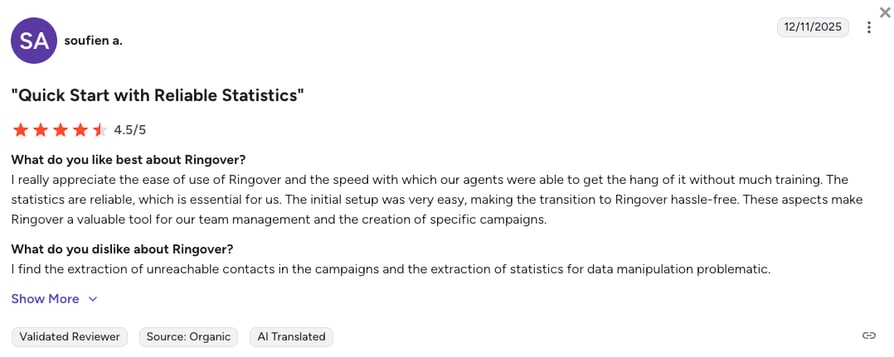
Ringover users often praise the speed of deployment, but face hurdles when trying to pull raw data for external manipulation.
- Fast Onboarding: Managers appreciate how quickly agents learn the system without needing heavy IT training.
- Reliable Statistics: Sales teams love the integrated dialer and the in-app analytics that keep campaigns organized.
- Data Extraction Issues: Users find exporting unreachable contacts and raw statistics for CRM manipulation to be problematic.
How G2 Users Rate Ringover?
Ringover's current G2 rating is 4.6/5, out of 450+ verified user reviews.
10. CallHippo: Best for Budget-Conscious Micro-Teams and Solo Operators
What is CallHippo?
CallHippo is a simplified and inexpensive VoIP platform built for budget accessibility. It targets tiny startups that need a quick and low-cost way to establish virtual numbers in multiple countries without committing to enterprise contracts.
Why Is CallHippo a Strong RingCentral Alternative?
- Zero Dollar Entry: If you are specifically searching for RingCentral alternatives free of monthly seat fees, CallHippo offers a $0 Basic pay-as-you-go plan, making you forget about RingCentral's strict licensing costs and multi-year contracts.
- Instant Provisioning: Allows micro-teams to establish a global presence immediately without the severe number-provisioning delays common to RingCentral.
- Accessible Pricing: Perfect for teams that prioritize low upfront costs over complex AI coaching or enterprise omnichannel routing.
What Are the Pros & Cons of CallHippo?
| Pros | Cons |
|---|---|
| Highly affordable starting tiers: Includes a free pay-as-you-go plan. | Lacks complex auto dialers: Not built for aggressive outbound sales floors. |
| Instant global number acquisition: Fast provisioning for international presence. | Unresponsive support: Resolving technical issues can take days. |
| Timezone warnings: Prevents SDRs from calling prospects during illegal hours. | Dated interface: The dashboard layout lacks the fluidity of modern competitors. |
What Are CallHippo’s Plans & Pricing?
CallHippo paid pricing starts at $16/user/month (billed annually), with the following plans:
- Basic - $0/user/month
- Bronze - $16/user/month
- Silver - $24/user/month
- Platinum - $40/user/month
What Are CallHippo Customers Saying?
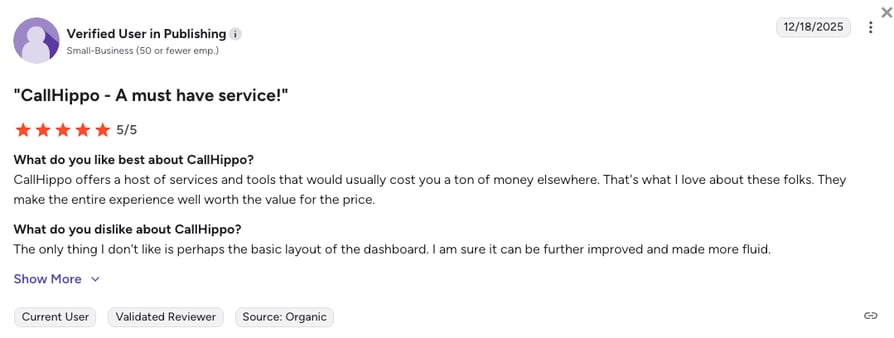
CallHippo customers love the value they get for the price, even if the interface isn't the most fluid on the market.
- Unbeatable Value: Customers highlight that CallHippo offers a host of services that would cost a fortune on legacy platforms.
- Basic Dashboard Layout: While the tools are highly effective, some users feel the backend routing and layout could be significantly improved.
- Add-On Fatigue: Users note that while the base is cheap, the hidden costs of upgrading for deep CRM syncs add up.
How G2 Users Rate CallHippo?
CallHippo's current G2 rating is 4.5/5, out of 350+ verified user reviews.
What Users Are Really Saying About RingCentral Alternatives and Competitors
To give you a more complete picture, we dug into what real users are saying about RingCentral and its alternatives across three major discussion platforms. Here is what we found across G2, Reddit, and Quora.
What Redditors Are Asking and Saying about RingCentral Alternatives
Reddit’s peer-to-peer format surfaces unfiltered opinions on administrative complexity, billing, and routing stability. Here is the consensus from users moving away from RingCentral:
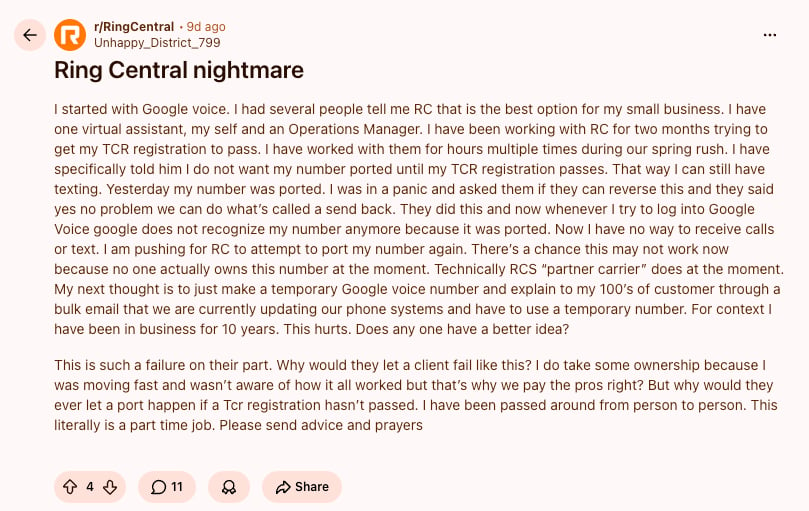
- Support Runarounds and Porting Nightmares: Users on r/RingCentral frequently share frustrations regarding botched number porting and delayed TCR registrations. When critical phone lines go down, founders report being "passed around from person to person," making CloudTalk's responsive 24/7 human support a massive relief.
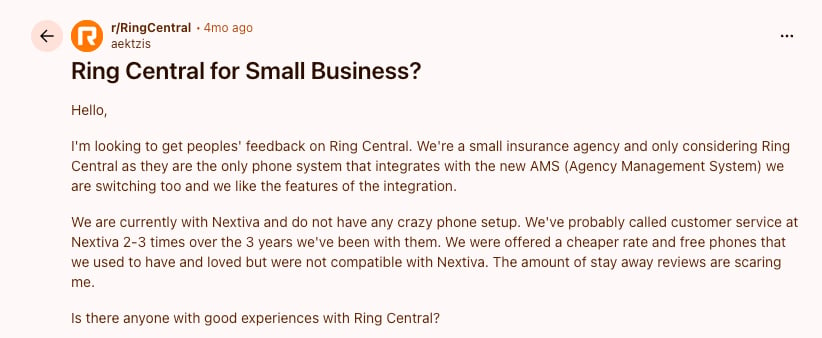
- SMBs Scared by Poor Reputations: Even when drawn in by niche CRM integrations, small businesses hesitate to switch to RingCentral due to the overwhelming volume of "stay away" reviews. Scaling teams prefer CloudTalk to get flawless CRM synchronization without risking their daily operations on a notoriously complex system.
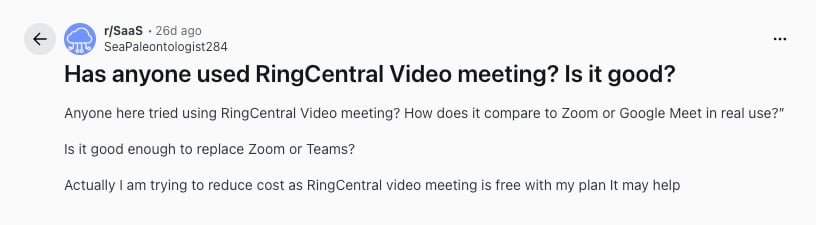
- Questioning the Value of Bloated Suites: In r/SaaS, users actively question if RingCentral's bundled video tools justify the platform's overall cost compared to dedicated apps like Zoom. Agile teams increasingly choose CloudTalk to secure premium voice AI and calling reliability without paying for a clunky, forced unified communications bundle.
What Quora Users Are Asking about RingCentral Alternatives
Quora’s Q&A format surfaces technical advice from consultants and unfiltered feedback from small business owners. Here are the recurring themes:
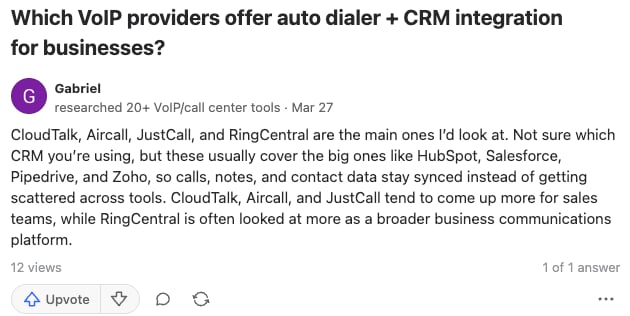
- Deep-Sync Integrations: Researchers regularly recommend CloudTalk for teams that need Deep-Sync technology to cure the manual logging and missed data that occur when using RingCentral's basic Salesforce or HubSpot connectors.
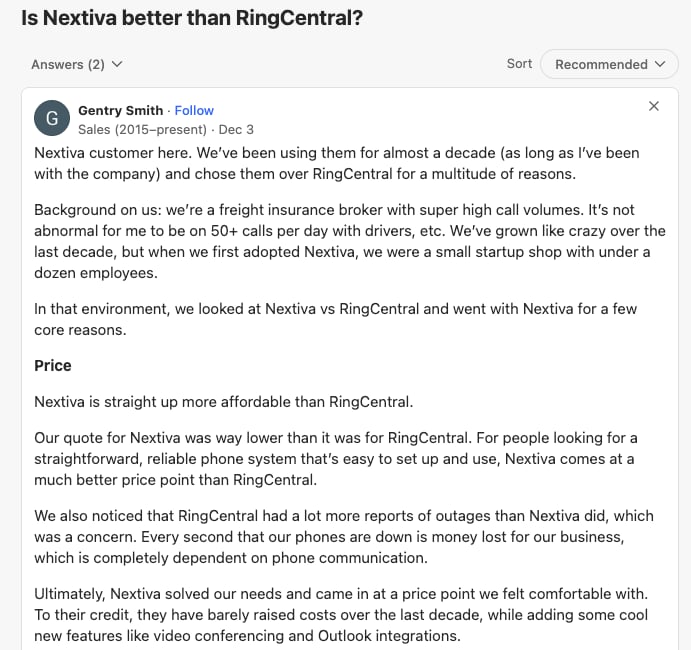
- Price and Reliability Head-to-Heads: When users ask for direct comparisons like Nextiva vs. RingCentral, the consensus heavily favors the alternatives. High-volume teams note that RingCentral's frequent outage reports and expensive quotes drive them to seek out more reliable and transparently priced platforms.
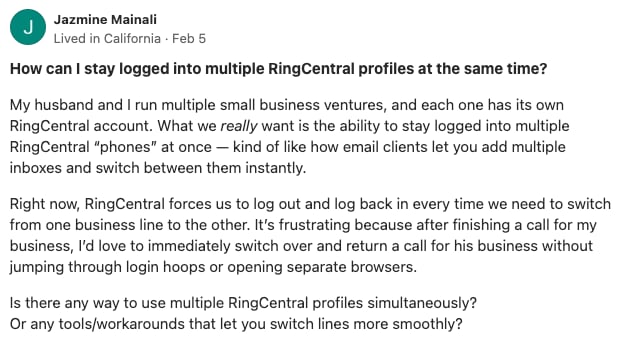
- UX Friction and Profile Management: Entrepreneurs managing multiple numbers or ventures express deep frustration with RingCentral's rigid app interface. Users complain about jumping through login hoops just to switch lines, driving them toward modern platforms for seamless multi-number management.
What Verified G2 Reviewers Say about Switching from RingCentral
Verified G2 reviews show a clear trend of users migrating away from RingCentral due to inconsistent call quality, confusing admin menus, and slow tiered support.
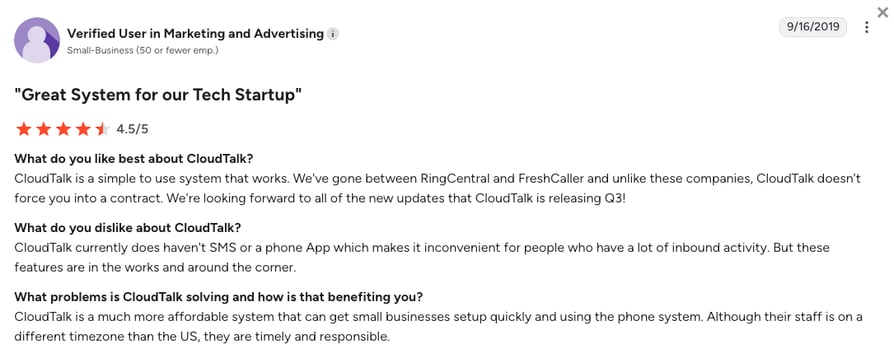
- CloudTalk (Rated 4.4/5/5): G2 users who have transitioned from RingCentral to CloudTalk frequently cite the immediate improvement in audio stability and the relief of not being forced into long-term contracts. Teams highlight that CloudTalk is a much more affordable system that allows businesses to get set up quickly without waiting on IT tickets.
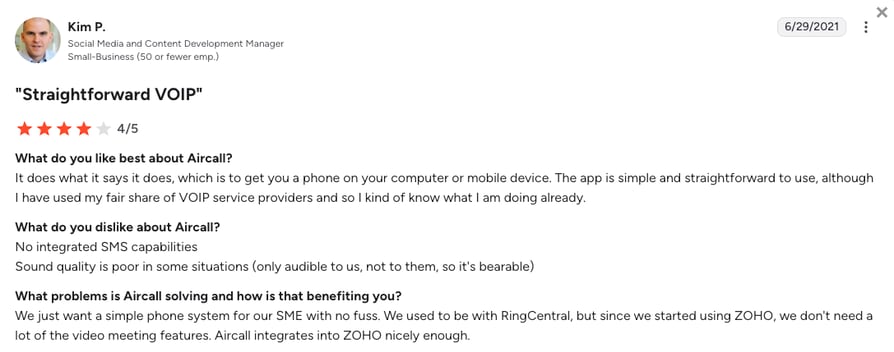
- Aircall (Rated 4.4/5): Reviewers who switched from RingCentral praise Aircall for being a simple and straightforward phone system without the fuss of bloated video meeting features. Users highlight its consumer-grade UX and how easily it integrates into CRMs like Zoho.
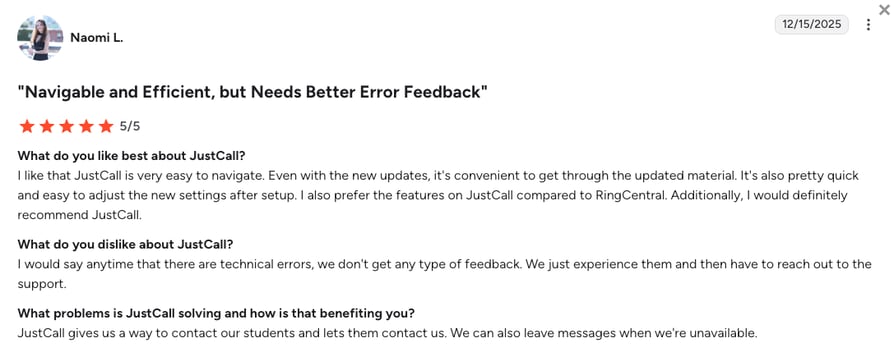
- JustCall (Rated 4.3/5): Former RingCentral users who moved to JustCall appreciate the platform's straightforward navigation and streamlined feature set. They frequently note that making adjustments after the initial setup is remarkably quick and easy compared to legacy systems.
CloudTalk vs. RingCentral: Final Head-to-Head Comparison
When choosing between CloudTalk and RingCentral, the biggest difference comes down to their main focus. RingCentral acts as a broad unified communications (UCaaS) app for internal team collaboration and video, while CloudTalk is purpose-built to handle external sales and customer support reliably.
Check out this direct, side-by-side comparison of how the two platforms stack up for scaling SMBs.
RingCentral vs CloudTalk: The Final Comparison
| Category | CloudTalk | RingCentral | Winner |
|---|---|---|---|
| Starting Price (annual billing) | $19/user/mo | $20/user/mo | CloudTalk |
| Minimum Seats | 1 user | 1 user | Tie |
| Native Video Conferencing | Relies on integrations (Zoom, Google Meet) | Fully integrated into all base plans | RingCentral |
| Call Quality & Uptime | 99.999% uptime via a multi-carrier global network | Users frequently report dropped calls due to single-carrier routing | CloudTalk |
| Global Coverage | 160+ countries | 110+ countries | CloudTalk |
| Conversation Intelligence | Add-on from $9/user/mo, can be added to any plan | Requires the expensive $60/user/mo RingSense add-on | CloudTalk |
| Voice AI Receptionist | $99/mo (200 mins) and $0.50/min overages | $59/mo (100 mins) and $0.50/min overage | Tie |
| CRM Integrations | Native Deep-Sync for Salesforce, HubSpot, and 100+ others | Basic surface-level API pushes; often requires custom dev | CloudTalk |
| Smart Dialers | Power, Preview, and Smart dialers natively available from the $49/mo Expert plan, and Parallel Dialer as an add-on for $39/mo | Predictive and Progressive dialers require a massive upgrade to the RingCX CCaaS platform (starts at $65/mo) | CloudTalk |
| SMS Allowances | Logical SMS bundling without restrictive entry caps | Highly restrictive 25 messages/user limit on the Core plan | CloudTalk |
| G2 Rating | 4.4/5 (1,700+ reviews) | 4.2/5 (1,300+ reviews) | CloudTalk |
| Free Trial | 14 days | 14 days | Tie |
The RingCentral Core Plan Trap
RingCentral’s $20/user/month base price restricts essential tools. It caps SMS at 25 messages per user and withholds native CRM integrations. Scaling up brings additional costs. Accessing advanced dialers requires migrating to the separate RingCX platform starting at $65/month, while CloudTalk unlocks them natively on its $49/month Expert plan. Finally, RingCentral’s AI Receptionist has a lower $59 entry price for 100 minutes, but CloudTalk provides double the volume for $99 to help growing SMBs avoid overage penalties.
How to Choose the Right RingCentral Alternative for Your Team?
When choosing the right RingCentral alternative, think about your specific business bottlenecks and not just the feature sets. Based on search trends and community questions from platforms like Reddit and Quora, here is how to match your business use case to the right platform:
1. What Is the Best RingCentral Alternative for Predictable Billing?
If you have been burned by RingCentral's strict auto-renewals, 25-message SMS caps, or the expensive $60/user/month RingSense AI add-on, prioritize tools with clear and transparent pricing structures.
- Top Picks: CloudTalk is the best RingCentral alternative for cost predictability because it avoids hidden enterprise bundles. For instance, CloudTalk’s Conversation Intelligence is an accessible $9/user/month add-on available on any plan, rather than forcing a massive tier upgrade. Nextiva is also a solid choice for straightforward UCaaS pricing.
2. Which RingCentral Alternative Has the Best CRM Sync?
If your team is losing time manually logging notes because RingCentral's surface-level API connectors fail or drop data, look for platforms built around native and bi-directional CTI embedding.
- Top Picks: CloudTalk’s workflow automation and deep-sync technology to ensure every call, tag, and AI summary automatically updates in HubSpot or Salesforce. Aircall also offers highly reliable ecosystem connectivity.
3. What Is the Best RingCentral Alternative for International Reach?
If you support regions outside North America, RingCentral's regional single-carrier gaps can lead to devastating mid-day outages. You need a platform with built-in multi-carrier redundancy.
- Top Picks: CloudTalk is the absolute winner here, offering local virtual numbers in 160+ countries powered by an infrastructure that automatically fails over if one route degrades. 8x8 is also an excellent choice for its extensive multinational coverage.
4. Are There RingCentral Alternatives without Heavy Enterprise IT Complexity?
RingCentral is notorious for its steep learning curve and bulky backend, forcing teams to submit IT tickets just to change a simple call queue.
- Top Picks: CloudTalk completely replaces legacy menus with an intuitive, drag-and-drop visual call flow builder that takes minutes to learn. If you are a tiny startup, Quo (OpenPhone) is fantastic for a consumer-style shared inbox that requires zero training.
5. What Is the Best RingCentral Alternative for Pure-Play Enterprise Contact Centers?
If you have outgrown RingCentral’s unified communications and manage thousands of outbound dials per shift, you need a heavy-duty CCaaS platform.
- Top Picks: Five9 is the leading RingCentral enterprise alternative for massive and highly-regulated contact centers that need predictive algorithmic dialers and strict TCPA compliance tools.
6. Overall, What Is the Best RingCentral Alternative Worth Switching To?
If your goal is to replace RingCentral's enterprise bloat, unexpected fees, and slow support with high-performance routing, reliable global calling, and native AI, CloudTalk is the definitive choice.
- Top Picks: CloudTalk stands out as the ultimate upgrade for growing businesses and their revenue and support teams, which often demand speed-to-value, transparent pricing, and robust CRM automation.
Ready to Make the Switch from RingCentral?
As verified user reviews across platforms like G2, Reddit, and Quora show, scaling teams typically leave RingCentral due to three main bottlenecks: frustrating IT complexity, poor regional call quality, and unpredictable contract costs.
Here is what switching from RingCentral to CloudTalk gets you:
- Rock-Solid Uptime: Move from RingCentral's single-carrier regional gaps to CloudTalk’s multi-carrier global infrastructure, securing a 99.999% uptime regardless of the plan you’re on.
- Massive Global Reach: You gain access to local virtual numbers in 160+ countries, a significant upgrade from RingCentral’s 110-country limit.
- Zero IT Bottlenecks: Replace bulky administration menus with a drag-and-drop visual call flow designer that team leads can update in minutes.
- Transparent Pricing: With CloudTalk, you can start at $19/user/month, and forget about the complexity tax of expensive RingSense AI add-ons and auto-renewals in favor of clear and usage-aligned value.
Ready to trade legacy bloat for rock-solid reliability?
Frequently Asked Questions
about RingCentral Alternatives
Find answers to the most common questions businesses have about RingCentral competitors.
CloudTalk is the best overall RingCentral alternative in 2026, mainly because it replaces heavy enterprise complexity with a streamlined and high-performance platform. You get an intuitive visual call flow builder, reliable multi-carrier global routing with crystal-clear call quality, local numbers in 160+ countries, and native CRM syncing without unexpected add-on costs.
Some of the best services like RingCentral include CloudTalk, Nextiva, and Aircall. When looking at who RingCentral's competitors are, the market generally divides into agile platforms for sales and support (like CloudTalk), shared SMS inboxes for startups (like Quo), and massive enterprise contact centers (like Five9). The right choice depends entirely on your team's size and daily workflows.
Yes, CloudTalk is definitely cheaper than RingCentral when evaluating total cost of ownership (ToC). While RingCentral markets a low base plan, it heavily restricts SMS usage and hides essential AI, voice agents, and CRM integrations behind expensive premium tiers. CloudTalk offers transparent and flexible pricing that bundles advanced dialers and integrations logically.
Dedicated SMS business solutions compare very favorably to RingCentral because RingCentral heavily restricts texting on its entry-level plans. For example, RingCentral's Core tier limits users to just 25 messages a month before forcing expensive upgrades. In contrast, SMS-first alternatives like Quo or flexible VoIP platforms like CloudTalk offer shared inboxes and logical SMS bundling without those severe bottlenecks.
CloudTalk and Aircall are the strongest alternatives for Salesforce and HubSpot because they use native Deep-Sync integrations. This technology guarantees that call records, tags, and AI summaries log flawlessly in your CRM. It completely avoids the manual data entry workarounds often required by RingCentral.
CloudTalk is the best RingCentral competitor for consultants needing multiple extensions because of its intuitive visual call flow builder. Instead of submitting an IT ticket or navigating complex legacy menus to set up a new consultant's line, you can map out unlimited extensions, routing paths, and specialized greetings in seconds using a simple drag-and-drop interface.
Yes, you can absolutely keep your existing RingCentral numbers when switching to a provider like CloudTalk. This process is called number porting. CloudTalk handles all the transfer paperwork for free, and your RingCentral service stays active right up until the exact moment the transfer completes, ensuring zero downtime.
When comparing RingCentral vs other cloud call center software, CloudTalk gives the best return on investment for scaling teams. RingCentral forces mid-market businesses to pay a complexity tax for a massive catalog of enterprise features they rarely deploy. CloudTalk focuses purely on the tools that drive revenue like automated dialers, deep CRM sync, and reliable global numbers.
If you are a tiny startup or solo operator, Quo provides a highly intuitive and consumer-style shared inbox that is much easier to manage than RingCentral. For growing SMBs that need professional sales and support capabilities without the IT headache, CloudTalk is the industry favorite.
Aircall is better than RingCentral if your primary goal is consumer-grade ease of use and rapid onboarding. Aircall's clean interface allows support teams to get up and running in under an hour. In contrast, RingCentral often requires lengthy IT implementation and training.
CloudTalk and JustCall both outpace RingCentral's basic offerings for outbound sales. CloudTalk is the top choice because it natively incorporates advanced Power and Parallel dialers. These add-ons to your base plan (note: Power Dialer is also included in CloudTalk’s Expert plan) allow reps to burn through prospect lists rapidly without paying for an expensive upgrade to RingCentral's CCaaS platform.
Migrating from RingCentral is very simple when you choose a provider with dedicated onboarding support. Platforms like CloudTalk de-risk the migration with phased porting plans, hands-on admin training, and a visual call flow builder that takes minutes to configure.
While we wouldn’t call them hidden fees, RingCentral users frequently report frustration with RingCentral's additional costs. These include strict auto-renewal clauses, mandatory seat minimums, expensive per-user SMS boosters, and premium pricing for AI tools like RingSense or AI Receptionist. These extra charges rapidly inflate the actual monthly invoice.