OpenPhone Plans & Pricing: Full Guide for 2026
OpenPhone - now rebranded as Quo- offers three pricing tiers: Starter ($15/user/month), Business ($23/user/month), and Scale ($35/user/month), all billed annually.
| Plan | Price (Annual) | Price (Monthly) | Best For... |
|---|---|---|---|
| Starter | $15/user/month | $19 /user/month | Solo founders and small teams that need a basic, reliable U.S. & Canada phone system. |
| Business | $23/user/month | $33 /user/month | Growing teams that want AI call summaries, CRM integrations, and automatic recording. |
| Scale | $35/user/month | ~$50/user/month | Established teams that need AI call tags, dedicated onboarding, and priority support. |
In a Nutshell
While the entry-level Starter plan covers the basics for tiny teams, most growing businesses will hit their ceiling quickly. It lacks AI call summaries for regular calls, automatic call recording, call transfers, phone menus (IVR), CRM integrations, and analytics. As a result, the Business plan is the standard choice for SMBs that want built-in collaboration tools, integrations, and AI features.
Things to be aware of: Advertised prices exclude telecom taxes and regulatory fees, a one-time $19.50 carrier (TCR) registration fee for texting, a $1.50–$3/month campaign fee, and $5/month per additional number. Sona AI includes 1,000 free credits (~10 AI-answered calls) per month; heavier usage requires paid credit bundles starting at $25/month.
What Pricing Plans Does OpenPhone Offer?
OpenPhone (now Quo) offers three levels: Starter ($15/user/month), Business ($23/user/month), and Scale ($35/user/month), billed annually. It uses a tiered per-user subscription model designed for small and medium-sized businesses.
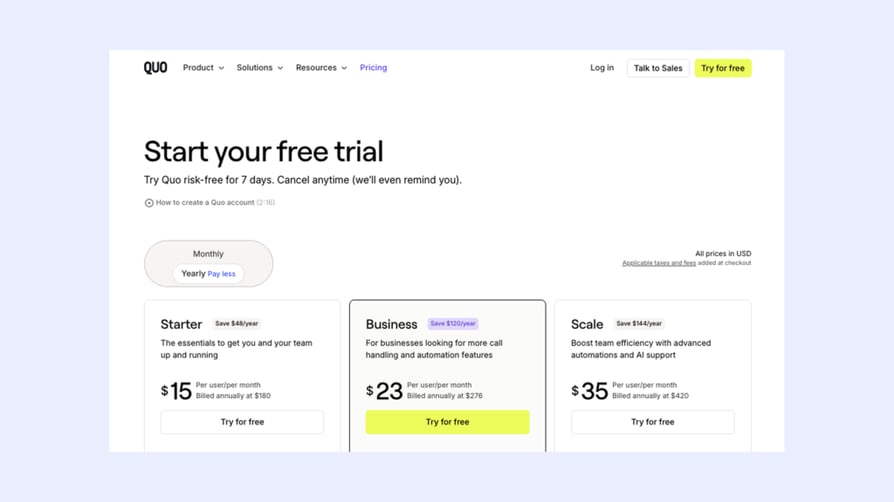
OpenPhone's pricing is built around simplicity and AI automation. Every plan includes 1,000 free automation credits per month to power Sona, the platform's 24/7 AI agent. Heavy users—those automating high call volumes or running messaging campaigns through the API—will need to top up with credit bundles starting at $25/month.
The table below compares OpenPhone's plans side by side:
| Feature/Aspect | Starter | Business | Scale |
|---|---|---|---|
| Annual Pricing | $15 per user/month. | $23 per user/month. | $35 per user/month. |
| Monthly Pricing | $19 per user/month. | $33 per user/month. | ~$50 per user/month. |
| Unlimited Calling (US & Canada) | |||
| AI Call Summaries & Transcripts (all calls) | |||
| Call Recording | Manual. | Automatic. | Automatic. |
| Phone Menus (IVR) | |||
| Call Transfers | |||
| Analytics & Reporting | |||
| HubSpot & Salesforce Integrations | |||
| Live Chat Support | |||
| Best For | Small teams looking for a basic business phone system for the U.S. and Canada. | Growing teams looking for higher call volume and more advanced features. | Established teams scaling outreach with priority support. |

Don't let your phone system hold you back.

OpenPhone's Starter Plan
What Is OpenPhone's Starter Plan?
OpenPhone's Starter plan is the gateway tier—built for solo founders, freelancers, and micro-teams who just need a professional, reliable phone number for the U.S. and Canada without paying for features they won't use. At $15 per user/month billed annually (or $19 monthly), it's one of the most affordable business phone plans on the market.
What's Included in OpenPhone's Starter Plan?
- Unlimited calling and messaging to US and Canadian numbers.
- Voicemail transcripts.
- Free number porting.
- One local or toll-free number per user.
- Shared phone numbers for up to 10 users.
- Sona AI with 1,000 free credits/month (~10 AI-answered calls).
Who Is OpenPhone's Starter Plan Best For?
OpenPhone's Starter plan is ideal for small businesses and remote teams needing a basic, affordable communication solution. It offers unlimited calls and texts within the U.S. and Canada, perfect for companies with limited call volumes and simpler communication needs without advanced features.
What You Need to Know About OpenPhone's Starter Plan
The Starter plan is genuinely barebones. It does not include call transfers, phone menus (IVR), Analytics, AI summaries for regular calls, automatic recording, or CRM integrations. AI call summaries on Starter only apply to calls handled by Sona. If your team is even remotely growth-oriented, you'll likely outgrow it within a few months—most Starter users end up on the Business plan after their first quarter.
OpenPhone's Business Plan
What Is OpenPhone's Business Plan?
The Business plan is OpenPhone's most popular tier and the sweet spot in their lineup. At $23 per user/month billed annually (or $33 monthly), it adds the AI features, automation, and integrations that growing teams actually need—without jumping into Enterprise territory.
What's Included in OpenPhone's Business Plan?
- Call transfers and group calling.
- Phone menus (IVR) and ring order.
- HubSpot and Salesforce integrations.
- Analytics and reporting.
- Automatic call recording plus AI summaries and transcripts for all calls.
- Unlimited shared phone numbers.
Who Is OpenPhone's Business Plan Best For?
This plan is built for growing SMBs, customer support teams, and inside sales squads that need to coordinate around shared numbers, log calls into a CRM, and review conversations with AI summaries. If your team has outgrown sticky notes and shared inboxes, this is the plan that delivers the productivity boost.
What You Need to Know About OpenPhone's Business Plan
The Business plan still has notable gaps for outbound-heavy teams: no Power Dialer, no WhatsApp integration, and fewer integrations compared to competitors. Teams running cold outbound or operating outside North America will likely want to compare alternatives before committing.
OpenPhone's Scale Plan
What Is OpenPhone's Scale Plan?
The Scale plan is OpenPhone's top tier, slotted above Business at $35 per user/month billed annually. It targets established teams that have outgrown the Business plan but don't need the pricey treatment of an enterprise.
What's Included in OpenPhone's Scale Plan?
- AI call tags.
- Dedicated onboarding and account manager.
- Priority live chat, email, and inbound phone support during business hours.
- Audit log.
Who Is OpenPhone's Scale Plan Best For?
This plan is designed for mid-sized teams handling high call volumes that want premium support response times and proactive onboarding when they roll out the platform across new departments. It's the right fit for teams that treat their phone system as mission-critical infrastructure.
What You Need to Know About OpenPhone's Scale Plan
Despite the price jump from Business, Scale doesn't add new core calling features—the value is concentrated in the support tier and AI tagging. Teams that need outbound dialers, WhatsApp, or international coverage will still need to look elsewhere, even at this price point.
OpenPhone US Phone Number Pricing
OpenPhone's US phone number pricing is included in every subscription: each user gets one free local or toll-free US number with their seat, whether new or ported over. Beyond that, US phone number pricing is straightforward:
- First US number per user: included in all plans ($15–$35/user/month).
- Additional US numbers: $5 per number/month, on any plan.
- Number porting: free, with most transfers completing without service disruption.
- Texting from a US number: requires one-time TCR business registration ($19.50) plus a $1.50–$3/month campaign fee to guarantee deliverability with AT&T, T-Mobile, and Verizon.
The practical implication: a solo user needing separate numbers for sales, support, and marketing pays $15 for the seat plus $10 for two extra numbers—$25/month before taxes and registration fees.
What Do Real Users Say About OpenPhone Pricing on Reddit and G2?
Advertised prices only tell half the story. Here's how OpenPhone's pricing is discussed by real users across Reddit, G2, and Trustpilot.
OpenPhone Pricing Review on Reddit
Across r/openphone, r/VOIP, and r/smallbusiness, OpenPhone is generally considered cheap and cost-effective for micro-teams—but the sentiment shifts as teams grow. Three themes come up repeatedly:
- Best value for small, Wi-Fi-based teams: Solo founders, agencies, and 2–5 person teams consistently praise the price-to-simplicity ratio, fast setup, and quick text registration—one user reported TCR approval in under 24 hours after waiting 2+ weeks with Dialpad.
- Registration and add-on fees frustrate small businesses: The one-time $19.50 carrier registration fee, monthly campaign fees, and per-number charges are recurring complaints, with some young companies describing SMS compliance costs as a burden for text-heavy clientele.
- Reliability concerns off Wi-Fi: The most serious complaint isn't the price itself—it's paying for calls that drop when users leave a Wi-Fi connection. Field-based teams (real estate, home services) frequently report unreliable call quality on cellular data, even with full signal.
OpenPhone Pricing Review on G2/Trustpilot
OpenPhone (Quo) holds an impressive 4.7/5 rating on G2 based on more than 3,300 verified reviews. It's widely praised as one of the most beginner-friendly business phone systems on the market, with reviewers consistently calling out the clean interface, fast porting, and value for money at the entry level.
That said, the most common thread across reviews—including the glowing ones—is that OpenPhone's affordability comes with trade-offs. Users love the simplicity and the price point, but power users frequently mention hitting feature ceilings as their teams grow. On Trustpilot, support responsiveness is the dominant complaint, while connection stability accounts for a large share of negative G2 mentions.
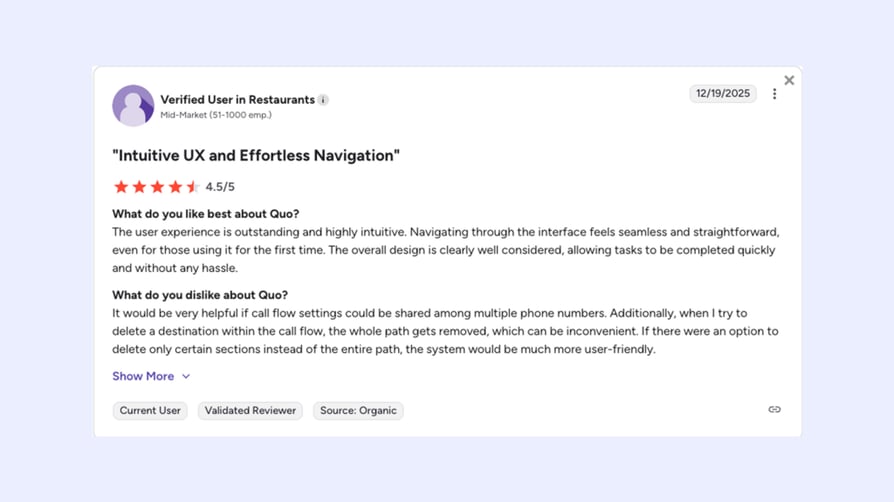
"While I enjoy OpenPhone's flexibility, a drawback is the additional cost to validate as a legitimate business for text messaging. Understandably necessary, yet challenging for young companies catering to text-savvy clientele."
The takeaway: For teams whose needs go beyond basic U.S./Canada calling—international coverage, advanced dialers, deeper analytics, or more CRM integrations—that "feature ceiling" can become a real growth blocker.
How Much Does OpenPhone Cost Per Month?
OpenPhone costs $15 to $35 per user per month with annual billing, or $19 to roughly $50 per user per month with monthly billing. The annual discount is significant—roughly 21% on Starter and 30% on Business and Scale. Here's the full OpenPhone pricing per user per month breakdown:
| Plan | Monthly Billing | Annual Billing (per month) | Total Annual Cost (per user) |
|---|---|---|---|
| Starter | $19/user/month | $15/user/month | $180/user |
| Business | $33/user/month | $23/user/month | $276/user |
| Scale | ~$50/user/month | $35/user/month | $420/user |
Keep in mind these per-user figures exclude telecom taxes and regulatory fees (calculated from your billing address), the one-time $19.50 TCR registration, monthly campaign fees, extra numbers, and Sona AI credit top-ups—which is why real invoices for small teams often run 25–40% above sticker price.
OpenPhone AI Voice Agent Pricing
OpenPhone's AI voice agent is called Sona—a 24/7 AI receptionist that answers inbound calls, takes messages, answers common questions, captures leads, and transfers calls. Sona is included on all plans, but its usage is credit-based:
| Sona AI Tier | Price | What You Get |
|---|---|---|
| Included (all plans) | Free | 1,000 automation credits/month (~10 AI-answered calls) |
| Credit Bundle 1 | $25/month | ~40 AI-answered calls |
| Credit Bundle 2 | $49/month | ~100 AI-answered calls |
| Credit Bundle 3 | $199/month | ~600 AI-answered calls |
| Overage | $0.45–$0.75/call | Per-call rate depending on tier |
Two limitations worth knowing before you build your workflow around Sona: it currently supports English only and handles inbound calls only—there's no outbound AI calling. A front desk fielding real volume (say, 300 calls/month) is looking at roughly $199/month in AI credits on top of seat licenses. For comparison, CloudTalk's AI Voice Agents handle both inbound and outbound use cases with multilingual support and predictable pricing.
OpenPhone Pricing for Call Recording & Transcription
Call recording and AI transcription are among the most-searched OpenPhone feature costs—and the most common reason users upgrade from Starter. Here's exactly how the pricing works:
- Manual call recording is included on the Starter plan ($15/user/month)—but agents must press record on every call. Miss the button, lose the record.
- Automatic call recording requires the Business plan ($23/user/month). For a 10-person team, that upgrade adds $960/year versus Starter—effectively the price of compliance-grade recording.
- AI transcription and call summaries for all calls also require Business or Scale. On Starter, AI summaries and transcripts only cover calls answered by Sona.
- AI call tags (auto-labeling calls by topic) are exclusive to the Scale plan ($35/user/month).
- Voicemail transcription is the one AI feature included on every plan.
The practical takeaway: if recording and transcription matter to your team—for coaching, QA, or compliance—the real OpenPhone entry price is $23/user/month, not $15. For comparison, CloudTalk includes unlimited call recording with storage from lower tiers, plus AI transcription, sentiment analysis, and transcript search as a flat AI add-on.
What a Real OpenPhone Pricing Bill Actually Looks Like
Plan prices are one thing—invoices are another. Below are four realistic scenarios showing what teams actually pay once registration fees, extra numbers, AI credits, and add-ons are factored in. All figures use annual billing rates; telecom taxes vary by state and are excluded.
Scenario 1: The Solo Founder (2 Users, Starter Plan)
The Setup: A two-person startup needing separate lines for sales and support, with business texting for appointment confirmations.
The Registration Pitfall: To text customers at all, you must complete TCR business registration—a one-time $19.50 fee plus an ongoing $1.50–$3/month campaign fee. Texting isn't even available during the free trial. And with only manual recording on Starter, any missed record button means a lost call record.
| Line Item | Unit Cost | Quantity | Subtotal |
|---|---|---|---|
| Starter Plan Licenses | $15.00 / seat | 2 | $30.00 |
| Extra Local Number (marketing line) | $5.00 / month | 1 | $5.00 |
| TCR Campaign Fee (SMS deliverability) | $1.50–$3.00 / month | 1 | $3.00 |
| Monthly Bill Subtotal | $38.00 / month |
Real Cost per Active User: ~$19.00 / month — about 27% above the advertised $15, plus the one-time $19.50 registration and applicable telecom taxes.
Scenario 2: The Growing Support Team (10 Users, Business Plan)
The Setup: A 10-person support and inside sales team that needs automatic call recording, HubSpot syncing, phone menus, and AI summaries for every call.
The Upgrade Driver: None of those features exist on Starter. Automatic recording, IVR, CRM integrations, analytics, and full-call AI summaries all gate on the Business plan—an effective $96/user/year upgrade tax that nearly every growing team ends up paying.
| Line Item | Unit Cost | Quantity | Subtotal |
|---|---|---|---|
| Business Plan Licenses | $23.00 / seat | 10 | $230.00 |
| Extra Numbers (department lines) | $5.00 / month | 3 | $15.00 |
| Sona AI Credit Bundle (~40 calls) | $25.00 / month | 1 | $25.00 |
| TCR Campaign Fee | $3.00 / month | 1 | $3.00 |
| Monthly Bill Subtotal | $273.00 / month |
Real Cost per Active User: ~$27.30 / month — an 82% jump over the advertised $15 entry price most buyers see first.
Scenario 3: The AI-Reception Front Desk (5 Users, Business + Heavy Sona Usage)
The Setup: A service business (clinic, law firm, agency) using Sona as a 24/7 AI receptionist for roughly 300 inbound calls per month, with 5 human seats for follow-up.
The Credit Catch: The free 1,000 credits cover only ~10 AI calls. At 300 calls/month, you need the $199 credit bundle—and if volume spikes past 600 calls, overages of $0.45/call kick in. The AI receptionist line item quickly dwarfs the seat licenses.
| Line Item | Unit Cost | Quantity | Subtotal |
|---|---|---|---|
| Business Plan Licenses | $23.00 / seat | 5 | $115.00 |
| Sona AI Credit Bundle (~600 calls) | $199.00 / month | 1 | $199.00 |
| Extra Numbers | $5.00 / month | 2 | $10.00 |
| Monthly Bill Subtotal | $324.00 / month |
Real Cost per Active User: ~$64.80 / month — nearly triple the Business plan's per-seat rate once the AI receptionist runs at realistic volume.
Scenario 4: The Scaling Outbound Team (20 Reps, Scale Plan)
The Setup: A 20-rep sales organization that needs AI call tags, priority support, dedicated onboarding, and analytics—running high daily outbound volume.
The Structural Gap: Even on the top tier, OpenPhone has no Power Dialer, no parallel dialing, and inbound-only AI. Reps dial manually, one number at a time. The Scale premium buys support quality, not outbound productivity—which is exactly where a 20-rep team loses the most money.
| Line Item | Unit Cost | Quantity | Subtotal |
|---|---|---|---|
| Scale Plan Licenses | $35.00 / seat | 20 | $700.00 |
| Extra Local Numbers (regional presence) | $5.00 / month | 6 | $30.00 |
| Sona AI Credit Bundle (~100 calls) | $49.00 / month | 1 | $49.00 |
| Automated SMS via API (est. 3,000 segments) | $0.01 / segment | 3,000 | $30.00 |
| Monthly Bill Subtotal | $809.00 / month |
Real Cost per Active User: ~$40.45 / month — a 16% markup over list price, paid for a platform that still lacks the outbound dialers this team size typically requires.
What Are OpenPhone Add-Ons?
When evaluating OpenPhone pricing, it is crucial to look beyond the base subscription and factor in the cost of essential add-ons like international calling, extra phone numbers, and API messaging fees:
- Additional phone numbers: $5 per number/month.
- International calling and messaging: billed per minute or per message, with rates based on destination. Charged using credits.
- Automated messages via Zapier or API: $0.01/segment.
- TCR business registration: $19.50 one-time fee, required for business texting.
- Messaging campaign fee: $1.50–$3/month.
- Sona AI credit bundles: $25–$199/month depending on call volume.
How Competitive Is OpenPhone Pricing vs Similar Vendors?
When choosing a VoIP provider, finding one that fits your budget is just the beginning. Here's how OpenPhone's pricing stacks up against CloudTalk, Google Voice, and Dialpad.
Short Overview of CloudTalk's Plans and Pricing
CloudTalk pricing starts at $25 per user/month with the Starter plan. There are 3 pricing plans on offer, plus a custom option that lets you tailor your solution to your unique business needs.Here's a breakdown of CloudTalk's plans:
- Starter: CloudTalk's basic plan is designed specifically for small businesses. Easy to set up and easier to use, this plan offers small teams everything they need to kick off their call center operations.
Key Features: Click-to-Call, Voicemail, Call Flow Designer (CFD), Automatic Call Distribution (ACD)
Price: $25 per user/month - Essential: CloudTalk's medium plan, focused on growing SMBs and MMBs. This plan helps teams expand their inbound and outbound operations, automate processes, and improve experiences.
Key Features: SMS/MMS, Interactive Voice Response (IVR), Skill-Based Routing, Callback, Integrations + Open API
Price: $29 per user/month - Expert: CloudTalk's feature-packed plan for growing MMBs and enterprises or any team that requires robust calling capabilities. This plan helps customer-facing departments streamline outreach and improve performance.
Key Features: Power Dialer, Smart Dialer, VIP Queues, WhatsApp Inbound & Outbound Messages, Call Monitoring
Price: $49 per user/month - Custom: CloudTalk's ultimate plan for the most demanding of companies, tailored perfectly to their particular business needs. This plan allows you to do it all, from coordinating teams to conquering the world's many markets.
Key Features: Custom Onboarding, Unlimited Outbound Calls with Flat Rates, Enterprise-Level Security, Developer Support
Price: Varies based on features, number of users, etc.
CloudTalk Vs. OpenPhone, How Do They Differ? Direct Comparison
| Feature/Aspect | CloudTalk | OpenPhone |
|---|---|---|
| Starting Price | $25 per user/month. | $15 per user/month. |
| Free Trial | 14 days. | 7 days. |
| Inbound Calls | Unlimited for other countries (except high-cost ones). | Unlimited in the US & CA. |
| Outbound/Domestic Calls | 500 / 1,000 / Unlimited Based on plan, worldwide. | Unlimited in the US & CA. |
| Mobile Apps (iOS, Android) | ||
| International Numbers | 160+ countries. | Only in the US & CA. |
| 1 Toll-Free Number | ||
| Number Porting | ||
| Call Flow Designer | ||
| Power Dialer | ||
| Advanced Analytics | ||
| WhatsApp Integration | ||
| Voicemail Transcripts | ||
| AI Call Summaries | ||
| Sentiment Analysis | ||
| Smart Notes | ||
| Trending Topics | ||
| Transcript Search | ||
| 24/7 Live Human Support |
OpenPhone Vs. Google Voice and Dialpad
- OpenPhone vs. Google Voice: Google Voice starts at $10/user/month and undercuts OpenPhone on entry price, but it's a much thinner product—no shared inbox model, weaker team features, and it requires a Google Workspace subscription on top. See the full Google Voice vs. OpenPhone comparison.
- OpenPhone vs. Dialpad: Dialpad starts at $15/user/month—matching OpenPhone's entry price—but bundles real-time AI transcription and video meetings into the base tier, making it stronger for teams that want AI without add-on credits. See the full Dialpad vs. OpenPhone comparison.
"Overall, CloudTalk has been a strategic win for our business. Data-driven insights, user-friendly interface, and cost efficiency - it's the trifecta for any call center looking to improve performance."
CloudTalk Vs. OpenPhone: Key Insights
- International Calling: CloudTalk is the best choice for global businesses and those based outside the US and Canada, with numbers in 160+ countries, unlimited inbound calls, and unlimited outbound calls starting with the Expert Plan.
- Integrations: If you rely on multiple tools or CRMs, CloudTalk is ideal with 100+ integrations, including Pipedrive and Zendesk, compared to OpenPhone's limited integrations.
- Advanced Analytics: OpenPhone has basic analytics gated to the Business plan, while CloudTalk offers a more detailed dashboard with real-time charts and AI features like Sentiment Analysis and Talk/Listen Ratio.
- Artificial Intelligence: CloudTalk provides advanced AI features. With Trending Topics and Transcript Search, you can find specific conversations instantly by keyword. With Smart Notes, you'll never have to take notes manually during calls again—and there are no per-call AI credit meters.
- 24/7 Live Support: For peace of mind with round-the-clock assistance, CloudTalk is the best choice, offering 24/7 support from the Essential Plan. In contrast, OpenPhone provides chat-based support gated by plan tier.
What Are OpenPhone Pros & Cons?
According to user reviews, these are the most notable pros and cons of OpenPhone beyond its affordable pricing:
PROS:
- Easy setup and user-friendly interface: Users appreciate the straightforward setup process, allowing them to start using the service quickly without extensive training.
- Sona AI on every plan: All tiers include the Sona AI agent with 1,000 free monthly credits—most competitors gate AI receptionists behind higher tiers.
- Free number porting: Users can port their existing phone numbers to OpenPhone at no cost, with fast TCR text registration reported by switchers.
- Unlimited texting: OpenPhone offers unlimited SMS and MMS messaging within the US and Canada on all plans (subject to fair usage), which users highly value.
CONS:
- Call quality off Wi-Fi: The most serious recurring complaint—users report unreliable calls on cellular data, a dealbreaker for field-based teams.
- Customer support: Some users mention delays and non-responses, and would prefer 24/7 phone support to resolve critical tech and billing issues more quickly.
- Feature gating: IVR, call transfers, CRM sync, analytics, and automatic recording all require the Business plan—features many competitors include at entry level.
- Add-on and registration fees: TCR registration, campaign fees, extra numbers, and AI credit bundles push real invoices 25–40% above sticker price.
CloudTalk: Advanced Global Solutions at a Fair Price
In summary, OpenPhone is an affordable solution if you need basic features, have a tight budget, and operate mainly within the U.S. and Canada.
However, if that's not your case, OpenPhone may not be the best option. CloudTalk is the ideal solution for global teams seeking advanced features at an affordable price—without credit meters, registration surprises, or feature ceilings.
Need more than basic?
Frequently asked questions
OpenPhone pricing in Canada is the same as in the US: Starter at $15, Business at $23, and Scale at $35 per user/month (billed annually, in USD). Canadian local and toll-free numbers are included, and unlimited calling and texting covers both the US and Canada on every plan.
OpenPhone doesn't have a free plan, but it offers a 7-day free trial. Note that texting and international calls aren't available during the trial, since business texting requires TCR registration first. For comparison, CloudTalk offers a 14-day free trial.
OpenPhone costs $15–$35 per user/month with annual billing, or $19 to roughly $50 per user/month with monthly billing. Real invoices typically run higher once telecom taxes, extra numbers ($5/month each), registration fees, and Sona AI credit bundles are added.
Partially. Manual call recording and voicemail transcription are included on Starter ($15/user/month), but automatic recording plus AI summaries and transcripts for all calls require the Business plan ($23/user/month). AI call tags require Scale ($35/user/month).
OpenPhone includes one local or toll-free number per user, with additional numbers available for $5 each per month on any plan.
OpenPhone bills international calls and messages using credits, at per-minute and per-message rates that vary by destination, starting around $0.02/minute. Only US and Canadian calling is unlimited.
Yes. OpenPhone offers annual subscription discounts: roughly 21% on Starter and 30% on the Business and Scale plans versus monthly billing.
CloudTalk is the best OpenPhone alternative, with global coverage in 160+ countries, 24/7 support, AI-powered analytics, sales dialers, and advanced integrations for growing businesses.
OpenPhone plans can scale for SMBs, but limited advanced features, inbound-only AI, no dialers, and lack of international coverage may restrict growth for global or outbound-heavy businesses.
Canceling is easy via the OpenPhone app, and service remains active until the billing cycle ends. Numbers and data are accessible for 60 days after cancellation.