
AI Call Scoring Software That Scores 100% of Your Calls
Manual QA reviews 1 to 3% of calls. AI call scoring reads every transcript against your own scorecard and returns a scored breakdown by category, in seconds.
Replace manual QA sampling with automated call scoring, customize scoring criteria, and turn call scores into specific coaching plans that drive real performance gains.
Our Price: $9/user/month; Add-on
 SOC2 CompliantISO 27001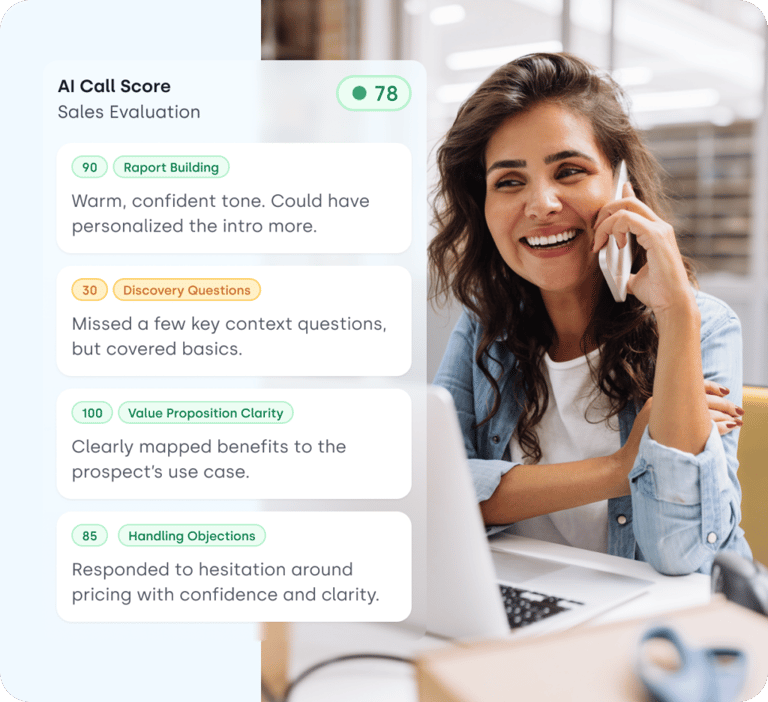
Trusted by 30,000+ sales & support professionals to power more & better conversations
















Turn Automated Call Scoring Into Business Results
100% Call Review Coverage
Manual QA reviews 1 to 3% of calls. Automated call scoring covers all of them, every agent, every campaign, with the same criteria applied consistently.
80% Less Time on Call Reviews
Replace repetitive review tasks with automated call scoring, transforming hours of manual listening into instant insights. Free up managers to focus on coaching, performance improvement, and strategic growth.
More Consistent Evaluations
Two reviewers score the same call differently. One scorecard applied by AI does not. Agents see the same criteria every time, which is what makes scores something they will act on.
Step Inside CloudTalk's
AI Call Scoring
Two minutes, no signup. Build a scorecard, score a call, read the breakdown.
AI Call Scoring
Scoring Your Team Will Actually Trust
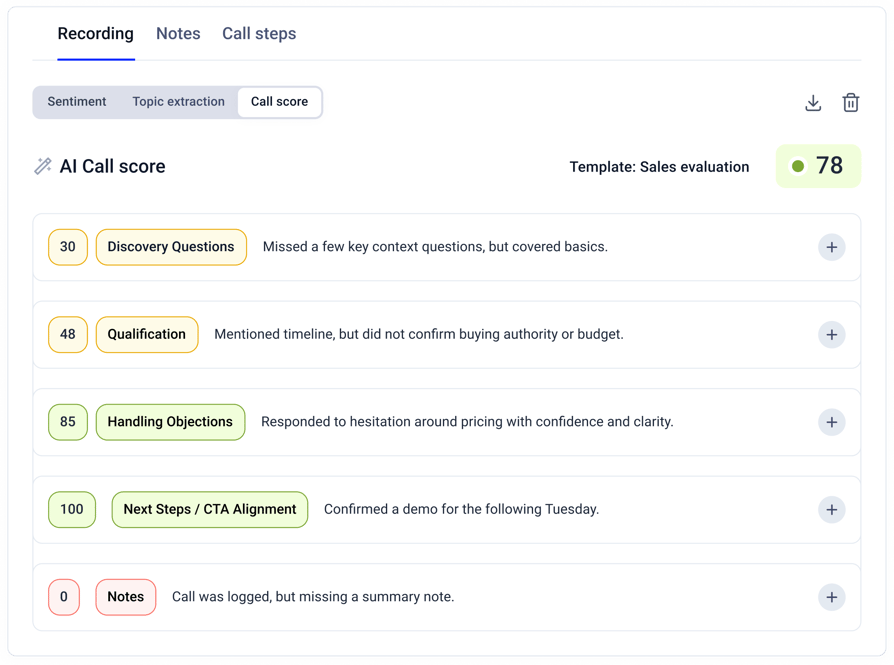
The fastest way to kill a QA program is to score people with criteria they cannot see. Agents get the same scorecard the managers use, the same category breakdown, and a link to the exact moment in the transcript behind every mark.
That changes the conversation from "here is what I thought of your call" to "here is where the call turned". Coaching sessions get shorter and land better.
Let Call Scoring Data Lead Your Strategy
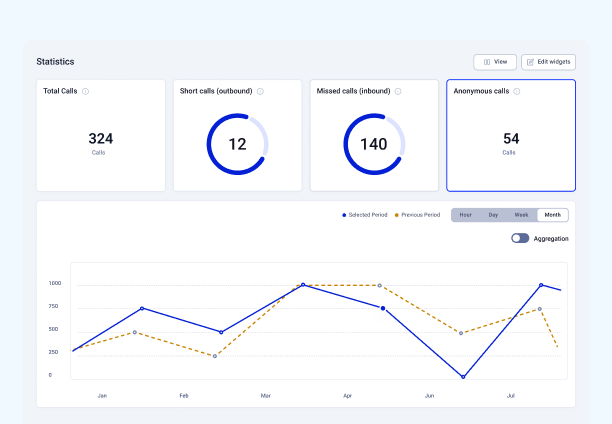
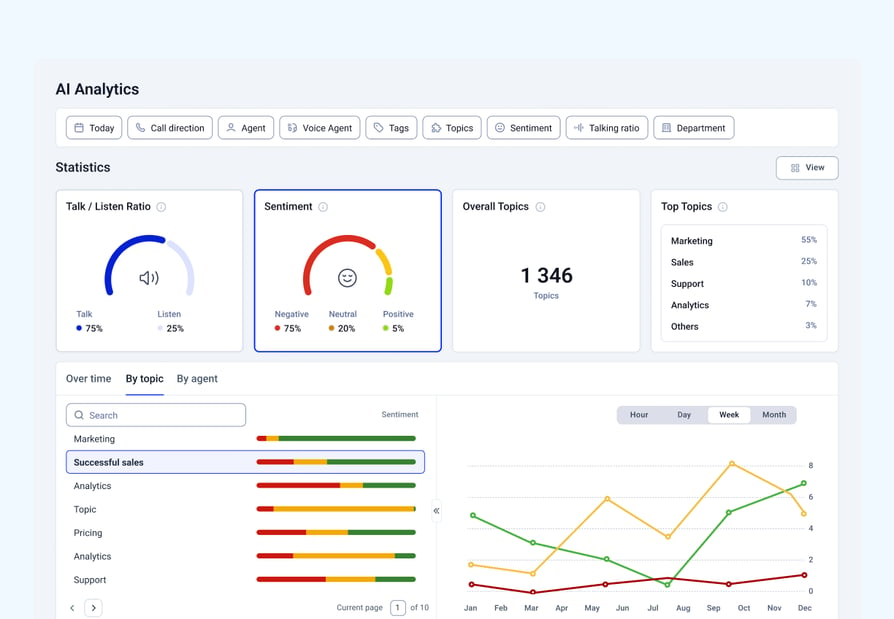
One bad call is noise. Fifteen reps failing the same objection is a messaging problem wearing a coaching problem's clothes.
Filter scores by agent, team, campaign or date range and the recurring failures surface on their own. That is the difference between a QA program that grades people and one that tells you what to fix in the playbook.
How to Set Up Call Scoring in CloudTalk
- 01First, make sure the AI Conversation Intelligence package is active on your CloudTalk plan.
- 02Go to Account Settings → AI Conversation Intelligence (top menu).
- 03Scroll to the Call Scoring card and click Edit scoring template.
- 04Edit categories and add, remove, or edit questions to match your QA style.
- 05Click Save. Your scorecards are now aligned with how and what you want scored on every call.
AI Call Scoring
Who AI Call Scoring Is For
Any team running enough call volume that manual review has stopped being representative. If you are comparing call center QA software because a supervisor can realistically listen to two or three percent of calls, that is the threshold. Three groups get the most out of it.
Where it is a poor fit: teams handling a few dozen calls a month. At that volume a manager listening to a sample genuinely is representative, and the scorecard takes longer to build than the reviews take to run.
What Does AI Call Scoring Cost?
Call scoring is part of AI Conversation Intelligence, an add-on to any CloudTalk plan at 9/user/month. That covers transcription, sentiment analysis, topic extraction, AI notes and talk/listen ratio in the same call record, so there is no separate QA licence and no contact center tier to upgrade into first.
- 01Is scoring included in your tier, or gated behind a contact center SKU? Several vendors sell QA only alongside a full contact center platform, which changes the real cost considerably.
- 02Does it score every call, or a sample? Some tools automate the scoring but still run it on a subset, which leaves you with the same blind spot you started with.
- 03Is transcription billed separately? Scoring reads transcripts, so a cheap scoring licence with metered transcription can cost more than a bundled one.
What Does AI Call Scoring Cost?
Call scoring is part of AI Conversation Intelligence, an add-on to any CloudTalk plan at $9/user/month. That covers transcription, sentiment analysis, topic extraction, AI notes and talk/listen ratio in the same call record, so there is no separate QA licence and no contact center tier to upgrade into first.
Pricing Overview
AI Conversation Intelligence
$9User / month - Billed annually
Full visibility into every conversation with 80% less time spent on call review.
- Call scoring
- Individual, aggregated insights and team filtering (sales, support)
- Summaries, searchable transcripts, AI notes
- Topic extraction and trending topics
- Talk/listen ratio
- Customer sentiment
- PDF & CRM export
Features
Other features you might like

Call Summary & Tags
Eliminate repetition and boost efficiency with AI-powered post-call Summaries & Tags.
Learn more about Call Summary & Tags
Sentiment Analysis
Get immediate feedback on your caller's mood by following their sentiment shifts.
Learn more about Sentiment Analysis
Call Transcription
Analyze and understand your calls by automatically transcribing them with AI.
Learn more about Call Transcription
Call Monitoring
Call Monitoring — Listen in, whisper, or barge in on live calls.
Learn more about Call MonitoringAI Call Scoring Benefits
Win Every Conversation with Automated Call Scoring
Slash Call Review Time
AI instantly analyzes every conversation, ranking the call based on your criteria. Skip endless recordings and focus your energy on what actually drives better outcomes.
Create Coaching Plans That Work
Set objective scores to evaluate how each agent measures up to your standards. Use the insights to design tailored coaching plans that accelerate growth and help every rep perform at their best.
Elevate Every Agent's Game
With clear call scoring and feedback, agents quickly learn what drives better outcomes and consistently deliver higher performance. When best strategies are uncovered, supervisors can replicate them across the team.
Keep Calls On-Brand and Compliant
Track script adherence and required disclosures automatically, so call center QA stops being a spot check and becomes a record.
We’ve helped thousands of global companies
Case studies featuring customers who are building faster.

Global Sales Engine Powered by Connected Conversations
“CloudTalk’s AI transcripts and analytics make it easier to track talk ratios, discovery depth, and regional performance—all without requiring formal training to get started.”

Revolutionizing Revolut’s Efficiency and Saving 40+ Hours
"Thanks to CloudTalk’s reliability, we could improve sales teams’ performance and close more deals than we could have ever imagined."

Increasing productivity for 200 customer support agents
"With CloudTalk's Analytics I now get to see every step of the way. We can find discrepancies and gain a much better understanding of our teams."

Delivering success for Glovo’s customer support team
"CloudTalk improved our team's cost and efficiency. The script feature allows us to lead the calls in a much more systematic way."

See It Score One Of Your Own Calls
Book 20 minutes and we will build a scorecard against your criteria and run it on a real recording.
AI Call Scoring FAQs
Everything teams ask before switching from manual QA sampling to automated call scoring: how it works, what it costs to run, what it can and cannot judge, and who gets the most out of it.
Call scoring is the process of evaluating phone conversations against a defined set of criteria, such as script adherence, tone, empathy, and resolution success, to measure agent performance and call quality. Traditionally done manually by QA reviewers sampling a fraction of calls, AI call scoring automates the entire process, analyzing 100% of conversations using natural language processing and conversation intelligence.
In CloudTalk, automated call scoring applies your custom scorecard to every recorded call immediately after it ends, generating objective scores without requiring a human to listen to the recording. This means QA managers get complete coverage, not just a sampled snapshot, and can act on performance data across the full team far faster than manual review allows.
To use AI for call scoring, turn on call recording and transcription, build a scorecard that reflects what a good call actually looks like in your business, let the AI evaluate every completed call against that rubric, then review the scored calls in your analytics dashboard and coach from the gaps. The whole point is that no one has to listen to calls to find out how calls are going.
In practice, a rollout looks like this:
- Enable recording and transcription. AI call scoring reads transcripts, not audio, so transcription is the dependency. No transcript, no score.
- Define your scorecard. Group questions into categories like greeting, discovery, objection handling, compliance, and close. Use Yes/No for binary behaviors and a 5-point scale for judgment calls. In CloudTalk, admins edit the template under Settings, then AI Conversation Intelligence, then Call Scoring.
- Weigh what matters. A missed compliance disclosure should not cost the same as a slightly flat greeting.
- Let it score everything. Traditional QA samples a tiny slice of calls. A conversation AI call scoring system scores the whole population, which is the difference between an anecdote and a trend.
- Coach on patterns, not one-offs. Filter by agent, team, campaign, or date range and look for the recurring failure. One bad call is noise. A rep at 95% on openers and 60% on closes is a coaching plan.
Two things worth knowing before you start: scorecard changes apply going forward only, so calls already scored are not retroactively recalculated, and questions the AI cannot evidence from the transcript are returned as N/A and excluded from the weighted total rather than counted as failures.
Manual QA review relies on supervisors listening to a small percentage of calls, typically 2 to 5%, and scoring them based on their individual interpretation of the criteria. This introduces inconsistency: two reviewers can score the same call differently, and high-performing or low-performing agents may never be reviewed at all if their calls aren't sampled.
Automated call scoring using AI eliminates both of these problems. It applies the same scoring criteria consistently across every single call, removing human bias and random sampling gaps. The result is a complete, objective view of agent performance that manual QA simply cannot match at scale. That said, AI scoring works best when the scoring template is well defined, so teams should invest time in setting up meaningful criteria before expecting the data to drive decisions.
It's a composite rating that reflects how well an agent follows processes, communicates with customers, and resolves issues according to company standards. AI call scoring tools generate these automatically after every call, giving managers a consistent benchmark across the team.
CloudTalk's call scoring software is built around fully customizable scorecards. You define the categories that matter most to your team, whether that's opening greeting quality, objection handling, compliance disclosures, closing language, or anything in between, and the AI evaluates every call against those exact criteria.
Within each category, you can create specific yes/no or weighted questions, assign importance scores, and organize criteria by call type or team. This flexibility means a sales team's scorecard can look completely different from a support team's, each reflecting the outcomes and behaviors that actually drive results in that context. Custom scoring templates are a key advantage over fixed-template tools that force you to evaluate calls the same way regardless of use case.
In a cloud contact center like CloudTalk, conversation AI call scoring is part of the broader AI Conversation Intelligence layer. After each call, the AI transcribes the conversation, analyzes the content against your scoring template, and generates a scorecard, all automatically, without any manual input.
The score, transcript, and any flagged moments are stored alongside the call record and are accessible directly in the dashboard. Because everything lives in one platform, managers can jump from the score to the transcript to the recording in seconds. This tight integration between conversation AI and call scoring is what makes it practical to act on quality data at the volume a modern contact center generates.
Automated scoring templates apply a predefined set of criteria to every call, which is useful for getting started quickly with a consistent baseline. Custom call outcome models go further, letting you define scoring logic based on the specific outcomes that matter to your business, such as whether a deal was advanced, a complaint was resolved, or a compliance disclosure was made. CloudTalk supports fully custom scorecards so teams can move beyond generic templates and score what actually matters.
Yes, this is one of the most compelling use cases for AI call scoring in a cloud contact center. When combined with call monitoring, automated scoring eliminates the need for random QA sampling entirely. Every call is scored automatically, and managers can use the scores to prioritize which recordings to review rather than listening blindly.
For QA managers evaluating whether AI can replace manual sampling, the answer is that it can handle the volume and consistency manual review never could. The human role shifts from listening to hundreds of calls per week to acting on insights already surfaced by the AI, focusing energy on the calls and agents that actually need attention.
Call scores give managers an objective starting point for every coaching conversation. Rather than relying on general impressions or anecdotal examples, managers can pull up specific scored calls, see exactly where an agent underperformed, and link directly to the transcript or recording to review the moment in context. This makes coaching sessions more focused, faster, and easier for agents to act on.
Over time, call scoring data also reveals team-wide patterns. If multiple agents consistently score low on the same criteria, that's a signal to update the script, adjust training, or revisit the playbook. AI tools for scoring agent performance using call transcripts like CloudTalk allow managers to filter by agent, time period, or score range, so they can identify both top performers worth replicating and struggling reps who need targeted support.
AI call scoring works for sales coaching by grading every rep's calls against the same playbook, then turning the score breakdown into a specific behavior to fix. Instead of a manager listening to three calls a month and offering impressions, you get per-rep, per-stage performance across the entire call volume, which makes coaching diagnostic rather than editorial.
The mechanics:
- The scorecard is the playbook, made measurable. Discovery questions asked, value framed before price, objections handled, next step confirmed. If it is in your sales methodology, it can be a scored question.
- Scores segment by skill, not by person. Talk to listen ratio, script adherence, and sentiment shifts show where in the call things break. A rep scoring high on rapport and low on the close needs a different session than one who never reaches discovery.
- Sentiment gives you the moment. Sentiment timelines let you jump straight to the point in the transcript where the call turned, so a coaching session is thirty seconds of evidence instead of forty minutes of playback.
- Trends beat snapshots. Aggregate scoring across a team surfaces the objection nobody has a good answer to yet, which is a messaging problem masquerading as a coaching problem.
- Onboarding gets faster. New reps compare against the scored library of calls that actually closed.
You define your scorecard to match your own criteria and success metrics. Common call scoring KPIs include sentiment, script adherence, response accuracy, and resolution success, all of which feed into overall call quality and agent performance.
Alongside the scorecard itself, most teams track a handful of call center KPIs that scoring data feeds into: Customer Satisfaction (CSAT), First-Call Resolution (FCR), Average Handling Time (AHT), and compliance or playbook adherence. These metrics are the foundation of any effective automated call scoring program, because they connect what happened on the call to what happened to the customer.
Use AI call scoring insights to coach agents, refine scripts, track key KPIs, and reward consistent improvement through targeted feedback and regular training. Call center agent scoring automation makes it easier to spot patterns and intervene early before issues become habits.
No. It replaces the listening, not the judgment. AI handles scoring at volume, which is the part of QA that does not scale with headcount, and it does it consistently across every call rather than a sample.
Your QA team still calibrates the scorecard, interprets edge cases, decides what a score actually means in context, and runs the coaching that follows. What changes is where their week goes. Instead of listening to calls to find out what happened, they start from evidence across the full call volume and spend their time acting on it.
Yes, and it is one of the strongest cases for automating it. Required disclosures, identity verification steps, and mandatory script language are binary behaviors, either present in the transcript or not, which is exactly the kind of question automated scoring handles most reliably.
Weight those questions heavily in your scorecard and call center QA stops being a spot check on a sample and becomes a record across every conversation. For regulated teams, that shift matters more than the time saved: a 2% sample tells you almost nothing about your exposure, while full coverage tells you exactly where the gaps are and which agents need retraining.
Any team that handles a significant volume of phone calls and wants to maintain or improve quality at scale. This includes inbound support centers, outbound sales teams, BPO operations, and customer success teams. Call scoring using AI is especially valuable for managers who don't have time to review calls manually but still need reliable data to coach agents, meet compliance requirements, and report on performance.
CloudTalk is among the best automated call scoring solutions for agent performance because it combines accuracy, real-time automation, and ease of use. It delivers customizable scoring templates, full transcript access, and native integration with your CRM and contact center tools, making it one of the most complete AI call scoring tools available for teams of any size.
A wider market comparison, including tools that sit on top of an existing phone system rather than replacing it, is in our roundup of the best AI call scoring software.
AI call scoring for dental practices is the automatic evaluation of every inbound and outbound patient call against a scorecard, so practice owners can see how the front desk handles new patient inquiries, insurance questions, and appointment requests without listening to recordings. The AI transcribes the call, checks it against criteria you set, and returns a score with a breakdown by category.
For a dental practice specifically, the scored criteria tend to be the things that decide whether a caller becomes a patient:
- Did the team member ask how the caller found the practice
- Was the treatment need identified before quoting a price
- Was an appointment actually offered, with a specific time
- Was the call ended without booking, and if so, why
- Was insurance handled accurately instead of deferred
- Was tone warm rather than transactional
The business case is unglamorous and fairly compelling. A single unbooked implant or ortho consult is worth more than a month of most software subscriptions, and manual QA at a busy practice reviews maybe one or two percent of calls, which is another way of saying it reviews almost none. An AI call scoring tool covers the full volume and surfaces the pattern behind the losses instead of a vibe about the front desk.
One caveat that matters more in healthcare than anywhere else: calls contain protected health information, so scoring belongs inside a HIPAA-compliant phone system with a signed BAA, encryption, and role-based access to transcripts. Scoring also pairs naturally with an AI receptionist for dentists, since you can score the AI's calls on the same rubric as your humans and find out which one is actually booking.
Dental practices have two routes to AI call scoring: a phone system with scoring built in, or a dental-specific call intelligence layer that sits on top of whatever phone system you already have. The main options are CloudTalk, Weave, Patient Prism, Dialpad, and the contact center tiers of Nextiva and RingCentral.
- CloudTalk. AI call scoring is built into Conversation Intelligence, with a custom scorecard template, sentiment analysis, transcription, and topic extraction in the same call record. HIPAA-ready with a signed BAA available. Best for multi-location practices and DSOs that want calling, dental phone system features, and QA in one platform instead of three.
- Weave. Automated call scoring inside Call Intelligence, layered on its patient communication suite. Dental is its largest customer segment. Best for single-site practices already using Weave for texting, reminders, and payments.
- Patient Prism. Dental-native call intelligence that scores every patient interaction against a custom rubric and flags unbooked high-value calls for recovery. Phone-system agnostic, so it layers on top of your existing lines. Best for practices happy with their current phones that want new-patient conversion analysis.
- Dialpad. AI Scorecards auto-suggest grades against predefined criteria, plus real-time coaching prompts during the call. Best for teams that want live in-call assist, though scoring sits on the Contact Center and Sell tiers rather than the base business phone plans.
- Nextiva and RingCentral. Scoring arrives through contact center quality management add-ons rather than the standard plan. Best for practices prioritizing uptime and simple setup over analytics depth.
Before you sign anything, check three things: whether the vendor will sign a BAA, whether scoring is included in your tier or gated behind a contact center SKU, and whether it scores every call or just a sample.


Hello 👋 My name is Emma. Still have questions?
Can’t find the answer you’re looking for? Please chat to our friendly team.