
Branded Caller ID Software
Display your business name, logo, and reason for calling on outbound calls instead of an unrecognized number. Branded caller ID is how customers know it is you before they decide whether to pick up.
⭐ 4.4/5 on G2 across 1,702+ reviews
 SOC2 CompliantISO 27001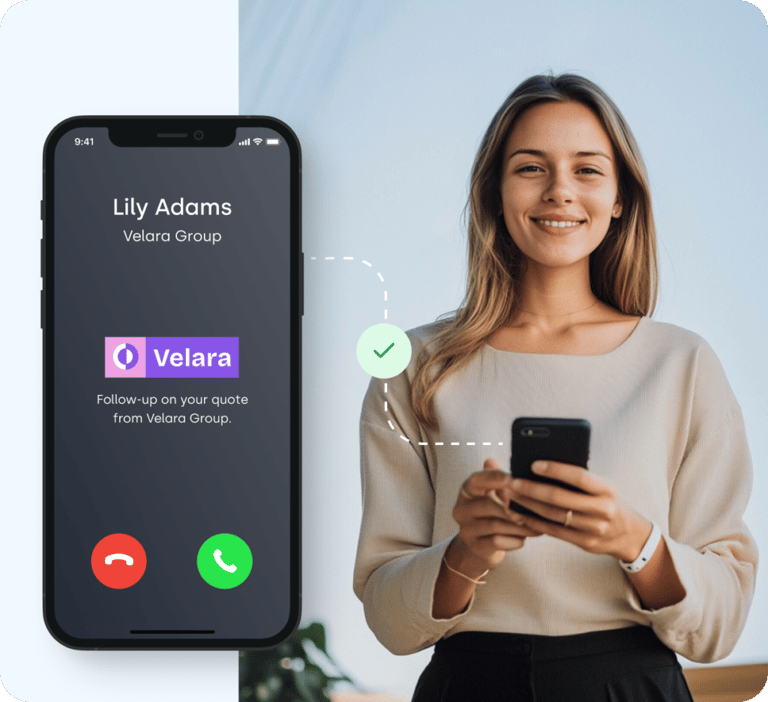
Trusted by 30,000+ sales & support professionals to power more & better conversations
















Benefits of Branded Caller ID
Stand Out the Moment You Call
Customers Pick Up Calls They Expect
Business caller ID puts your name on the screen for appointment confirmations, delivery updates, and follow-ups, so the customer knows to answer.
Build Trust Before the First Word
We are all suspicious of unknown numbers. Displaying a vetted business name on caller ID signals a the call is not spam.
Get More Callbacks
Clients recognize branded calls in the call log. So if they missed the call, they'll know who they're calling back and why.
Protect Your Number Reputation
Higher answer rates and fewer reported calls keep your numbers out of spam-likely territory. Caller ID branding and clean calling work together.
Branded Caller ID
What is Branded Caller ID?
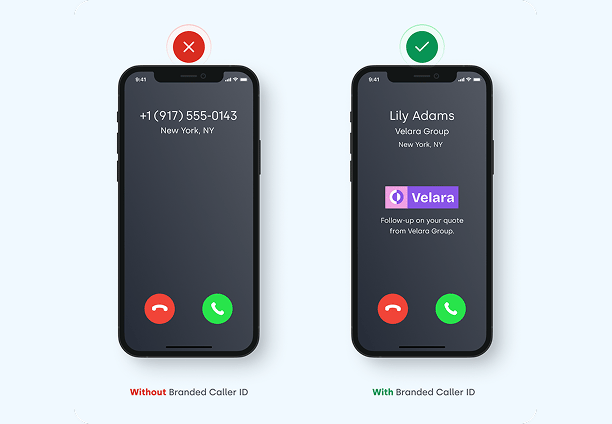
Branded Caller ID replaces an unknown phone number with your verified business name, logo, and reason for calling right on your customer's screen.
Instead of ignoring a random string of digits, customers immediately see who is calling and why, and thus are more likely to answer.
How Does Branded Caller ID Work on Outbound Calls?
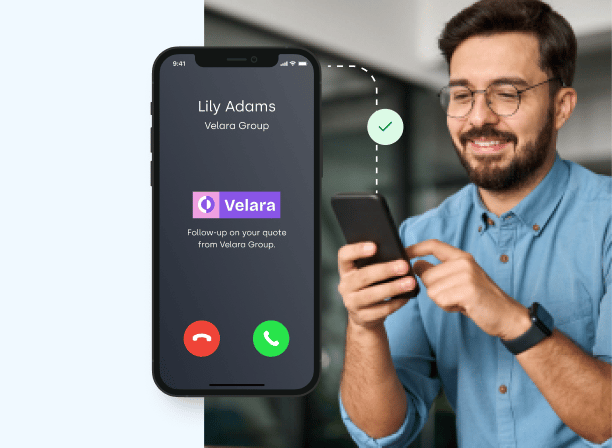
Branded calling enhances existing call authentication to deliver your verified name and logo before the phone rings. The display appears seamlessly whenever three conditions align: your brand assets are vetted in advance, the call passes carrier security checks, and the recipient’s carrier and device support rich display—the main reason overall coverage varies.
Branded Caller ID vs Standard CNAM
CNAM is a legacy landline system limited to 15 text characters. It relies on slow, optional database lookups that take days to update and are frequently ignored by modern mobile networks.
Branded caller ID for VoIP attaches your verified name, logo, and call reason directly to the call—no outside lookup required. Pushing data straight to the phone screen keeps your branding rich, professional, and reliable.

Where Branded Calling Is Available
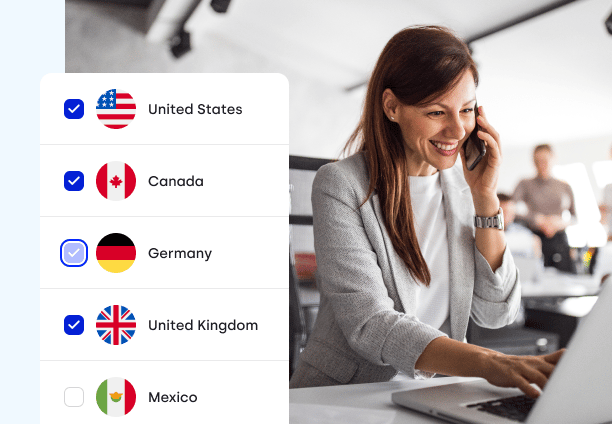
Branded display depends on the recipient’s carrier and device, so coverage isn't universal yet. Where branded ID isn't supported, automated local and international numbers seamlessly step in with familiar area codes to keep your answer rates high.
Use Cases
When Branded Caller ID Helps, and When It Does Not
Branded caller ID works best on calls people are actually expecting, like appointment reminders, support callbacks, delivery updates, and renewals.
It’s less effective for cold outreach. If someone has never heard of you, seeing an unfamiliar company name gives them an easy reason to decline. For cold prospecting, local virtual numbers are a much better fit. Branded calling is built for warm customer touchpoints, not calling strangers.
We got almost a 100% increase in revenue after switching to outbound with CloudTalk.
Joshua Niyonzima
Owner, Tillväxtbyggarna
We’ve helped thousands of global companies
Case studies featuring customers who are building faster.

Global Sales Engine Powered by Connected Conversations
“CloudTalk’s AI transcripts and analytics make it easier to track talk ratios, discovery depth, and regional performance—all without requiring formal training to get started.”

Revolutionizing Revolut’s Efficiency and Saving 40+ Hours
"Thanks to CloudTalk’s reliability, we could improve sales teams’ performance and close more deals than we could have ever imagined."

Increasing productivity for 200 customer support agents
"With CloudTalk's Analytics I now get to see every step of the way. We can find discrepancies and gain a much better understanding of our teams."

Delivering success for Glovo’s customer support team
"CloudTalk improved our team's cost and efficiency. The script feature allows us to lead the calls in a much more systematic way."
Features
Other features you might like

Number Porting
Transfer old business numbers from more than 100 countries easily and maintain your connections and corporate identity.
Learn more about Number Porting
Toll-Free Numbers
Boost inbound calls by making it easy for international customers to reach you—free of charge or at local rates, no matter where they are.
Learn more about Toll-Free Numbers
Virtual Caller ID
Generate caller IDs with appropriate local area codes or with numbers your customers are already familiar with.
Learn more about Virtual Caller ID
Automatic
Outbound Numbers
Automatically display a number that matches the country of the recipient for every international call.
Learn more about AutomaticOutbound Numbers
Put Your Name on Every Outbound Call
Join over 5,500+ modern companies that already trust CloudTalk to have MORE and BETTER calls.
Branded Caller ID FAQs
How branded calling works, where it is supported, what it costs, and when it is the wrong tool for the job.
Branded caller ID is a service that displays a verified business name, and on supported devices a logo and a short reason for calling, on the recipient’s screen in place of a raw phone number. The business registers the numbers it calls from along with its brand assets, an independent vetting agent confirms it has the right to use them, and that verified information is delivered alongside the call itself.
The problem it solves is a specific one. Most people now treat unrecognised numbers as suspicious by default, so a legitimate business call and a nuisance call look identical on the screen at the moment someone decides whether to pick up. Branded caller ID changes what is on that screen.
It is worth being precise about what it is not. It is not a spam filter, it does not change whether a carrier believes your call is legitimate, and it does not work everywhere. It is a display layer that sits on top of call authentication, and it only appears where the receiving carrier and device support it.
The effect also outlasts the call. A missed branded call stays identifiable in the call log, which is usually where the difference in callback rates comes from rather than from the live moment of ringing.
Branded calling works by attaching verified brand information to an authenticated call, so the recipient’s carrier can display it before the phone rings. It rides on top of call authentication rather than replacing it.
The sequence on any given call looks like this:
- The business registers its numbers and brand assets, and an independent vetting agent verifies it has the right to use that name and logo. This happens once, up front.
- An outbound call is placed and the originating carrier authenticates it, confirming the calling number genuinely belongs to the business making the call.
- The registered brand data tied to that number is retrieved as the call is routed.
- The recipient’s carrier passes the name, and where supported the logo and call reason, to the handset, which displays it as the phone rings.
Three conditions all have to hold for anything to appear. Your numbers and brand assets must be vetted in advance, the call must be authenticated at the level the carrier requires, and the recipient’s carrier and device must both support enhanced caller display. If any one of those fails, the call still connects normally and simply shows as an ordinary number.
That third condition is why coverage varies by market and by network rather than being universal, and why the same call can display your brand to one customer and a plain number to another.
The core difference is direction. CNAM asks the receiving carrier to go and look up a name in an external database. Branded caller ID sends verified brand data along with the call itself, so nothing has to be looked up.
That distinction produces most of the practical differences:
- Data source. CNAM reads from an external database originally built for landlines. Branded calling carries registered data with the call.
- What can be displayed. CNAM is typically capped at 15 characters and is text only. Branded calling can carry a full business name, a logo, and a reason for calling.
- Control and accuracy. CNAM entries can be out of date, and updates can take days to propagate. Branded calling data is registered and vetted by the business itself.
- Mobile behaviour. Many mobile networks do not perform CNAM lookups at all, which is why a name that appears on a landline often does not appear on a mobile. Branded calling was designed for mobile display.
- Cost model. CNAM is generally a low or no cost per-number registration. Branded calling involves vetting and per-call charges.
Neither one replaces the other outright. Branded calling only displays where the carrier and device support it, and CNAM still covers a long tail of older devices and networks that do not. In practice most businesses running serious outbound volume end up with both in place, using branded calling where it is supported and CNAM as the fallback.
It changes the information available at the moment someone decides whether to answer. An unrecognised number gives the recipient nothing to go on, and the safe default has become not answering. A verified business name, especially on a call the person was expecting, gives them a reason to pick up.
The effect is strongest on calls the recipient already has a reason to expect: appointment confirmations, support callbacks, delivery and dispatch updates, renewals, and follow-ups after a form fill. On those calls the customer usually wants to be reached and the only obstacle is not knowing who is ringing.
There is a second effect that gets overlooked. Even when a branded call is missed, it stays identifiable in the call log afterwards, so it is far more likely to be returned than a missed call from an unknown number. For many teams the callback lift matters more than the live answer rate.
On cold outbound the picture is less straightforward, and it is worth saying so. Identifying yourself to someone who has never heard of your company gives them information they can act on, and some will act on it by declining. If your outbound is genuinely cold, local presence dialing through virtual caller ID or automatic outbound numbers often does more for connect rates than branding does.
No provider in this category publishes a reliable uplift figure, and any specific percentage you see quoted should be treated with suspicion, because the result depends heavily on your call types, markets, and existing number reputation. The practical way to find out is to register a portion of your numbers and compare them against the rest over a month of normal calling.
No. Branded calling is not universal, and any provider suggesting otherwise is worth a second question. Display depends on the recipient’s carrier and device supporting enhanced caller information, which means the same call can show your brand on one network and a plain number on another.
Coverage is determined by three things rather than one: which countries have a branded calling framework in place, which carriers within those countries participate, and whether the recipient’s handset supports the enhanced display. Ecosystems in different regions have developed at different speeds and operate under different governance, so coverage is a patchwork rather than a single global standard.
Where a call lands on an unsupported network or device, nothing breaks. The call connects normally and displays as an ordinary number. For markets without branded calling support, virtual caller ID and automatic outbound numbers address the same recognition problem from a different angle, by showing a local number the recipient is more likely to recognise and trust.
It reduces the likelihood but does not guarantee it. Branded caller ID is a display layer, not a spam filter, and no provider can promise your calls will never be labelled.
It helps in two ways. Directly, a call carrying verified business information is far less likely to be treated as suspicious by the analytics engines that assign spam labels, because the business behind it has been vetted. Indirectly, branded calls tend to be answered more and reported less, and answer rate and report rate are among the strongest inputs into how carriers score a number over time.
What it cannot do is compensate for calling behaviour. Spam labelling is driven largely by patterns: high volumes of very short calls, low answer rates, repeated dialling of numbers that never pick up, and complaints. A vetted brand attached to that pattern will still end up flagged.
Keeping numbers clean is mostly operational rather than technical. Honour do-not-call and suppression lists, respect local calling hours, keep the number of distinct numbers you rotate through proportionate to real volume, and give people a reason to expect the call. Branded caller ID and disciplined calling practice work on the same problem from two directions, and neither substitutes for the other.
Branded calling is generally not priced per seat, which surprises teams used to per-user SaaS billing. The cost sits with the carriers and vetting agents who verify and display your brand, not with the calling software, so it is priced closer to how telecoms bill than how software does.
The usual structure has two parts:
- A registration and vetting component, charged per business and per set of numbers you register. This covers the identity verification that proves you have the right to display the brand you are claiming.
- A per-call component, charged where the branded display is confirmed as delivered. You are generally not charged for calls that landed on an unsupported network or device, since nothing was displayed.
The practical consequence is that cost scales with call volume rather than headcount, so a small team making very high volumes can pay more than a large team making few calls. That is the opposite of how most of the rest of a phone system is priced, and it is worth modelling against your actual outbound volume before committing.
Because pricing depends on your markets, volume, and number count, it is quoted rather than listed. Talk to sales for a figure against your own calling profile.
Setup has three stages: you register your business and numbers, an independent vetting agent verifies you, and branded display switches on once approval lands. You can keep calling normally throughout.
- Register your business and brand assets. Legal entity details, the numbers you call from, your display name, and your logo where the market supports one.
- Verification. An independent vetting agent confirms the business exists and has the right to use the name and logo submitted. This is the step that takes the time, and it is deliberate: it is what stops anyone from displaying a brand that is not theirs.
- Number association. Your verified brand is linked to each registered number, so calls from those numbers carry the right identity.
- Go live. Branded display begins on supported carriers and devices. Calls to unsupported networks continue to connect as normal, showing an ordinary number.
On timing, registration and vetting typically run from next-day to around two weeks depending on the route and the market. US SMS registration sits on a longer, separate track. Nothing is blocked while you wait: your team keeps calling as usual and the branded display simply appears once approval completes.
The most common cause of delay is not the queue but a mismatch between the business details you submit and the ones on public record, so it is worth checking that your registered company name, address, and website all match before you start.
CloudTalk handles registration and verification with you, and confirms which of your markets are supported before you commit to anything. Talk to sales to start the process.


Hello 👋 My name is Emma. Still have questions?
Can’t find the answer you’re looking for? Please chat to our friendly team.