10 Best AI Receptionists for Insurance Brokers and Agencies in 2026: Ranked & Reviewed
TL;DR:
CloudTalk takes the top slot for most agencies: an AI receptionist from $99/month with 200 minutes, SOC 2 Type 2 and ISO 27001 certification, BAAs available for HIPAA, and 50 free minutes to test on your own number.
Sonant AI is the only insurance-native option, with certified Applied Epic integration, but publishes no pricing. Smith.ai adds human agents behind the AI. Retell AI and Vapi are developer platforms, not products you switch on.
The honest headline: no general-purpose AI receptionist integrates natively with Applied Epic, EZLynx, HawkSoft, QQCatalyst or AMS360 except Sonant. Everyone else reaches your AMS through a CRM, an API or Zapier. Decide how much that matters before you shortlist.
The best AI receptionist for insurance brokers answers every policy inquiry call instantly, 24/7, without voicemail and without adding headcount. Every call that goes unanswered is a quote request, a renewal or a first notice of loss that can end up with a competitor instead.
This guide ranks 10 tools an insurance agency can actually buy in 2026. Each one is scored against seven criteria that matter in this industry:
- Compliance (HIPAA and SOC 2)
- Agency management system (AMS) integration
- 24/7 coverage
- FNOL and claims handling
- Appointment booking
- Languages
- Pricing clarity: whether the vendor will tell you the price
It also covers when an AI receptionist beats a traditional insurance agency answering service, and when it does not.


How We Selected the Best AI Receptionists for Insurance Brokers and Agencies
We assessed every tool on the ten criteria below. The seven we could score consistently across all vendors appear in the scoring table.
- Insurance vocabulary and workflows. Does it understand deductible, endorsement, binder, FNOL, or does it need every term scripted by hand?
- Call handling quality. Natural voice, interruption handling, and whether a policyholder can tell within ten seconds that they are talking to software.
- Live transfer and escalation. Can it hand an urgent claim to a licensed agent mid-call, with context, instead of taking a message?
- CRM and AMS integration. Native connection to the systems your agency already runs, not a promise of an API.
- Appointment booking. Real calendar writes into Google or Outlook, with confirmations, not a callback request.
- Languages. English and Spanish at minimum for most US books of business.
- Pricing transparency. A published price you can budget against without a sales call.
- Time to go live. Days for a turnkey product, weeks or months for a platform you have to build on.
- Compliance and auditability. HIPAA support with a signed BAA where health data is in play, SOC 2 and GDPR posture, plus insurance call transcription that creates an audit trail of every policyholder interaction.
- Answering service coverage. Can it genuinely replace an after-hours answering service, handling overflow at volume rather than just capturing names?
We checked every compliance claim on the vendor's own security or trust page. Where a vendor does not state a certification publicly, this guide says so rather than assuming it.
AI Receptionist for Insurance: Tool Scoring Table
We tested insurance-specific inbound scenarios (policy inquiry, FNOL, appointment booking), reviewed G2 and Capterra data, and scored each tool from 1 to 5 per criterion.
HIPAA support is mandatory for any platform handling policyholder health data, and it is the criterion most vendors are vaguest about.
| Tool | HIPAA/SOC 2 | AMS Integration | 24/7 Coverage | FNOL/Claims | Appointment Booking | Multilingual | Pricing Clarity | Total |
|---|---|---|---|---|---|---|---|---|
| CloudTalk | 5 | 3 | 5 | 4 | 5 | 5 | 5 | 32/35 |
| Sonant AI | 3 | 5 | 5 | 5 | 4 | 2 | 1 | 25/35 |
| Retell AI | 5 | 1 | 5 | 2 | 3 | 4 | 4 | 24/35 |
| Synthflow AI | 4 | 1 | 5 | 2 | 4 | 5 | 2 | 23/35 |
| Smith.ai | 2 | 1 | 5 | 1 | 4 | 2 | 5 | 20/35 |
| My AI Front Desk | 3 | 1 | 5 | 1 | 4 | 1 | 5 | 20/35 |
| Vapi | 2 | 1 | 5 | 1 | 3 | 4 | 3 | 19/35 |
| IBM watsonx | 3 | 1 | 4 | 2 | 1 | 4 | 3 | 18/35 |
| Kenyt.AI | 1 | 1 | 3 | 1 | 3 | 1 | 2 | 12/35 |
| DataRobot | 4 | 1 | 1 | 3 | 1 | 1 | 1 | 12/35 |
One caveat: this scores platform capability, not how hard it is to go live. Retell AI and Vapi score respectably and are still the wrong purchase for an agency without a developer. The list below is ordered by fit for a typical insurance agency, not by raw score.
Quick Answers: What Insurance Agencies Ask About AI Receptionists
What is the best AI receptionist for an insurance brokerage managing inbound policy inquiry calls?
CloudTalk is the strongest all-round choice, because it covers the whole policy inquiry call in one system:
- Answers coverage questions from your own uploaded knowledge base, 24/7
- Hands complex calls to a licensed producer with the context already collected
- Logs every call to your CRM automatically, with routing rules set in a no-code call flow designer
Sonant AI is the pick if native AMS write-back decides the deal. Smith.ai suits brokerages that want a human agent behind the AI on sensitive calls.
Which AI platforms for insurance agents have the best customer service?
Weigh rating against sample size. A 4.9 from five customers tells you less than a 4.3 from sixteen hundred.
- Retell AI: 4.8/5 across 2,638 G2 reviews
- CloudTalk: 4.3/5 across 1,600+ G2 reviews, with onboarding support included
- Smith.ai: 4.9/5 across 82 G2 reviews
- Sonant AI: 4.9/5, but on only five reviews
Ask every vendor which support tier your plan includes. Several reserve named support for enterprise contracts.
What AI tools reduce insurance hold times most effectively?
The ones with no cap on simultaneous calls. When 50 policyholders call at once after a storm, CloudTalk's AI receptionist answers all 50.
- CloudTalk: unlimited concurrent calls
- Retell AI: 20 concurrent lines included, then $8 per line per month
- Vapi: 10 concurrent lines included, then $10 per line per month
A traditional answering service can only answer as many calls as it has people on shift.
What AI customer support platforms should an insurance operations head consider for traceable, compliant response automation?
The shortlist is narrow. Look for a signed BAA, a readable SOC 2 report and an automatic record of every call.
- CloudTalk: SOC 2 Type 2, ISO 27001, BAAs available, and every call transcribed and logged for the audit trail
- Retell AI: SOC 2 Type 1 and Type 2, with self-serve BAAs
- Synthflow: HIPAA and SOC 2 Type 2 listed, but the documents sit behind an NDA
- Vapi: HIPAA mode is a $2,000/month add-on
Whichever you pick, confirm retention periods and audit log depth before going live.
Insurance Agency Answering Service: AI vs Traditional
Many insurance agencies still rely on a traditional answering service: human receptionists who pick up overflow calls and take messages. An AI answering service handles the same workflows around the clock, for a fraction of the cost. Here is how they compare.
| Dimension | AI Answering Service (CloudTalk) | Traditional Answering Service |
|---|---|---|
| Coverage | 24/7/365, no staffing gaps | Limited to service hours; often offshore agents after hours |
| Simultaneous calls | Unlimited concurrent calls | Capped by how many agents are on shift |
| Insurance knowledge | Configurable knowledge base: policy terms, FNOL scripts, coverage FAQs | Generic scripts; insurance knowledge depends on custom training |
| CRM and AMS logging | Automatic; every call transcribed and logged, no manual entry | Message emailed to the agency; someone rekeys it into the AMS |
| Compliance | SOC 2 Type 2, ISO 27001, GDPR, PCI-DSS; BAA available to support HIPAA | Varies by vendor; must be verified separately |
| Starting price | $99/month for 200 minutes, plus 50 free minutes to test | Typically $250 to $600/month for basic cover |
| Best for | Growing agencies needing 24/7 cover and automatic AMS logging | Boutique agencies that want a live human voice on every call |
If your missed calls are quote requests and claims, AI coverage is the cheaper way to answer all of them: it captures the quote, routes the claim and books the consultation that would otherwise have hit voicemail.
The trade-off is real, though. A traditional service gives every caller a human, and for a small agency whose brand is personal service, that can be worth the premium.
Best AI Answering Service for Insurance Agencies: US Market
US agencies have four realistic options, each with a different strength. Pricing and compliance for each are covered in the reviews below.
- CloudTalk: one system for AI and human calls, with local numbers across 160+ countries
- Smith.ai: US-based, bilingual human agents behind the AI
- My AI Front Desk: the budget no-code option for one or two-producer agencies
- Sonant AI: the US P&C specialist, Applied Epic certified
The 10 Best AI Receptionists for Insurance Brokers and Agencies in 2026
Ordered by fit for a typical insurance agency: turnkey products first, enterprise platforms and developer infrastructure last.
1. CloudTalk: Best AI Receptionist for Insurance Brokers Overall
What Is CloudTalk?
CloudTalk is an AI-powered business phone system with an AI receptionist built into the call path rather than bolted on top of it.
For an insurance agency, that means one system handles the AI agent, the live transfer to a licensed producer, the recording, the transcript and the CRM write-back. There is no connector between two vendors to break at 2am during a catastrophe event.
Category Scores
| Criterion | CloudTalk |
|---|---|
| HIPAA/SOC 2 | 5/5 |
| AMS Integration | 3/5 |
| 24/7 Coverage | 5/5 |
| FNOL/Claims | 4/5 |
| Appointment Booking | 5/5 |
| Multilingual | 5/5 |
| Pricing Clarity | 5/5 |
| Total | 32/35 |
Why 3/5 on AMS integration? CloudTalk connects natively to 100+ CRMs and offers an open API and webhooks, but it has no native connector for insurance AMS platforms such as Applied Epic, EZLynx, HawkSoft or AMS360. A 5/5 is reserved for native AMS write-back, which only Sonant AI offers.
Key Features of CloudTalk for Insurance Agencies
- 24/7 AI voice agent answering unlimited simultaneous calls, with no queue and no hold music
- Answers policy and coverage questions from your uploaded knowledge base, in 60+ languages with automatic detection
- Books consultations straight into Google or Outlook calendars with automatic confirmation
- Warm transfer to a licensed agent with full context, using skills-based routing for claims escalation
- Automatic call recording, insurance call transcription and automatic call summary tags written to the CRM
- Insurance CRM and AMS integrations across 100+ tools plus an open API
Insurance-Grade Compliance Built In
- Certifications: SOC 2 Type 2 and ISO/IEC 27001 certified, PCI-DSS compliant, and fully compliant with GDPR and CCPA
- HIPAA: security controls and policies comply with HIPAA, so CloudTalk can sign a Business Associate Agreement with your agency and support your own HIPAA compliance
- Encryption: every call protected with 256-bit encryption
- Audit trail: every call transcribed and logged automatically
- Access control: role-based permissions decide who sees what
See the full HIPAA and SOC2 compliance detail before your security review.
24/7 Claims Triage and Policy Inquiry Handling
The AI receptionist spots high-urgency calls such as FNOL and emergency claims, then escalates them to an on-call producer immediately, with the details already gathered.
Routine calls are answered from your knowledge base and logged to your CRM without anyone touching them:
- Policy and coverage questions
- Payment status
- Renewal reminders
Our guide to the HIPAA-compliant call center for insurance covers the routing side in more depth.
No-Code Call Flow Designer for Insurance Workflows
An operations manager builds and edits call flows in a drag-and-drop designer, without involving IT. Typical insurance flows:
- Quote intake
- FNOL routing and escalation triggers
- Renewal reminders
- Appointment scheduling
Flows can be updated in minutes during a claims surge or open enrollment. Insurance inbound call routing and smart call routing for insurance agencies are configured in the same place.
AMS and CRM Integration
CloudTalk connects natively to 100+ CRMs and helpdesks, including HubSpot CRM integration for insurance and Salesforce integration for insurance agencies, plus Pipedrive, Zoho and Microsoft Dynamics. An open API and webhooks cover everything else.
The limit: there is no native Applied Epic, EZLynx, HawkSoft or AMS360 connector. If your book of business lives entirely in an AMS with no CRM layer, scope that integration during the demo.
Pros and Cons
| Pros | Cons |
|---|---|
| Published pricing you can budget against, from $99/month for 200 minutes | No native insurance AMS connector; AMS reach is via CRM, API or middleware |
| SOC 2 Type 2, ISO 27001, PCI-DSS, GDPR, and BAAs available for HIPAA | Outbound AI minutes are billed separately from the inbound bundle |
| AI and human agents in one routing system, one dashboard, one bill | HIPAA-compliant messaging is not supported; voice only for PHI |
| 50 free minutes on your own number, no credit card | Self-serve support on the entry AI Receptionist tiers |
G2 Rating
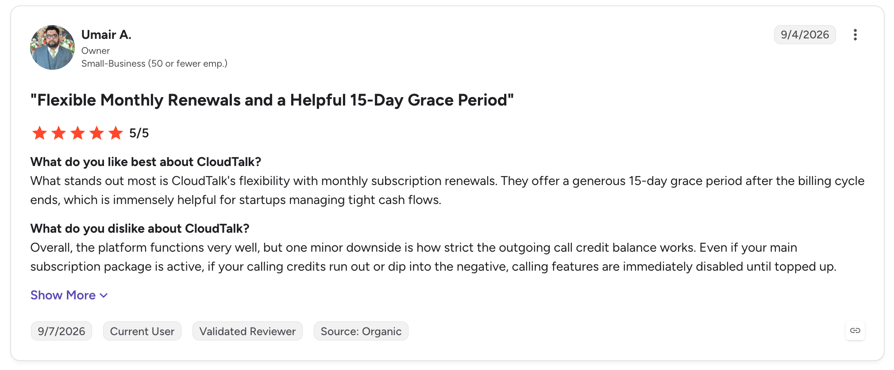
4.3/5 across 1,600+ reviews on G2, with a comparable score on Capterra.
What Is the Pricing of CloudTalk?
- AI Receptionist: 50 free minutes to start, then $99/month for 200 minutes, $199 for 500, $299 for 1,000, $699 for 2,500. One-month minimum contract
- AI Specialist (full workflow automation including outbound renewal campaigns): from $349/month for 1,000 minutes
- Phone system plans: Starter $25, Essential $29, Expert $49 per user per month
- 14-day platform trial, no credit card required
When to Use CloudTalk
- Your agency takes 20+ inbound policy inquiry calls a day and wants every one answered, with no queues and no voicemail
- You need call handling that supports your HIPAA compliance, with a signed BAA and automatic transcription for the audit trail
- You want to automate your insurance answering service without replacing your phone system: the AI receptionist is an add-on, not a migration
- You want to test on your real agency number before committing
Bottom Line
The best balance of compliance, transparency and time-to-live for most insurance agencies. The gap to close in your demo is AMS integration depth.
2. Sonant AI: Best for Agencies Running on Applied Epic and Other AMS Platforms
What Is Sonant AI?
Sonant AI is a voice AI phone agent built specifically for property and casualty insurance agencies. It is the only tool in this guide designed around the agency management system rather than the CRM, and the only one that is a certified Applied Epic vendor integration.
Category Scores
| Criterion | Sonant AI |
|---|---|
| HIPAA/SOC 2 | 3/5 |
| AMS Integration | 5/5 |
| 24/7 Coverage | 5/5 |
| FNOL/Claims | 5/5 |
| Appointment Booking | 4/5 |
| Multilingual | 2/5 |
| Pricing Clarity | 1/5 |
| Total | 25/35 |
Key Features of Sonant AI
- Certified Applied Epic vendor integration, with EZLynx, HawkSoft, QQCatalyst and AMS360 also supported
- FNOL capture that collects loss details on the call and routes them into the claims workflow
- Live transfer to a producer during business hours
- Spanish handling from the first ring, 24/7
- Calendar booking via Calendly, Google Calendar, Outlook and Cal.com
Compliance Summary
Sonant displays an AICPA SOC 2 badge and states it maintains GDPR-compliant data processing agreements with its sub-processors.
There is no blanket HIPAA claim on its security page; a HIPAA BAA is described as available where an agency's book includes healthcare exposure. Ask for the SOC 2 report type in writing.
AMS and CRM Integration
The strongest in this guide, and the reason to shortlist Sonant. Native AMS write-back rather than a CRM workaround.
Pros and Cons
| Pros | Cons |
|---|---|
| Only tool here with certified Applied Epic integration | No published pricing at all; every evaluation starts with a sales call |
| Purpose-built FNOL capture and routing | Five G2 reviews and zero on Capterra: too thin to verify claims independently |
| Spanish from the first ring | No published language count beyond English and Spanish |
G2 Rating
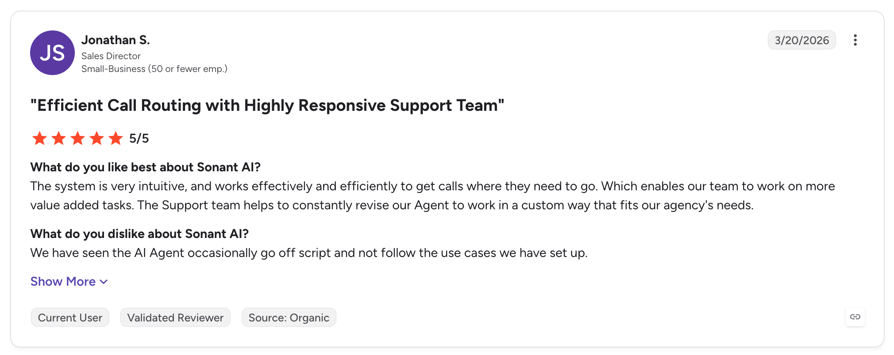
4.9/5 across 5 reviews on G2 as of September 2026, and no Capterra reviews. Treat the score as directional given the sample size.
What Is the Pricing of Sonant AI?
Not published. Sonant lists no tiers, no per-minute rate and no free trial. Pricing is quoted on a demo call.
CloudTalk vs Sonant AI
| Dimension | CloudTalk | Sonant AI |
|---|---|---|
| Native AMS integration | No; 100+ CRMs, API and webhooks | Yes; Applied Epic certified plus EZLynx, HawkSoft, QQCatalyst, AMS360 |
| Pricing transparency | Published from $99/month | Not published |
| Compliance evidence | SOC 2 Type 2, ISO 27001, PCI-DSS, BAA available | SOC 2 badge, GDPR DPAs, conditional HIPAA BAA |
| Languages | 60+ with auto-detection | English and Spanish confirmed |
| Review base | 1,600+ G2 reviews | 5 G2 reviews |
When to Use Sonant AI
- Your agency runs on Applied Epic, EZLynx, HawkSoft, QQCatalyst or AMS360 and native write-back is non-negotiable
- FNOL intake volume is high enough that generic call flows would need heavy configuration
- You are a P&C agency and want a vendor that only sells to insurance
When Not to Use Sonant AI
- You need to compare costs before booking a demo
- You want an independently verified review base before signing
- Your book of business needs languages beyond English and Spanish
Bottom Line
The insurance-native pick. Worth the demo call if your AMS is the system of record, but go in with a budget number in mind since they will not publish one.
3. Smith.ai: Best for Agencies That Want a Human Behind the AI
What Is Smith.ai?
Smith.ai is a hybrid virtual receptionist service: AI handles the call, with live North American agents available behind it. It bills per call rather than per minute, which suits agencies with short, frequent calls and penalises those with long ones.
Category Scores
| Criterion | Smith.ai |
|---|---|
| HIPAA/SOC 2 | 2/5 |
| AMS Integration | 1/5 |
| 24/7 Coverage | 5/5 |
| FNOL/Claims | 1/5 |
| Appointment Booking | 4/5 |
| Multilingual | 2/5 |
| Pricing Clarity | 5/5 |
| Total | 20/35 |
Key Features of Smith.ai
- AI receptionist with the option to escalate to live US-based agents
- 24/7 call answering on every tier, including the free plan
- AI scheduling with Calendly and other calendar tools
- English and Spanish conversational fluency on all tiers
- Native Salesforce and HubSpot integration plus 5,000+ apps via Zapier and Make
Compliance Summary
Smith.ai states it has complied with GDPR since May 2018 and describes itself as a data processor. It makes no public HIPAA or SOC 2 claim on its own site. For an agency handling policyholder health information, that gap needs answering before you sign.
AMS and CRM Integration
No insurance AMS integration. Salesforce, HubSpot, Clio and 5,000+ apps through Zapier and Make. Your AMS reaches Smith.ai only if it has a Zapier connector or an API someone will wire up.
Pros and Cons
| Pros | Cons |
|---|---|
| Live human agents behind the AI for sensitive policy conversations | No public HIPAA or SOC 2 statement |
| Free tier with 25 real calls a month | Per-call billing gets expensive at volume |
| Fully published pricing, month to month | No insurance AMS integration |
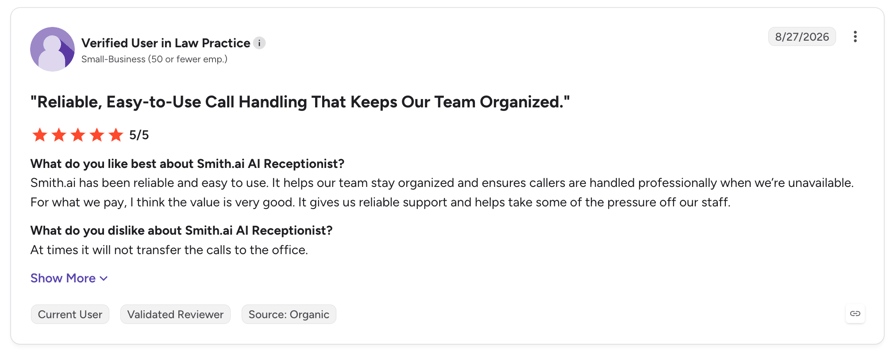
| 4.9/5 on G2 with a credible review base | Callers do not always reach the same agent |
G2 Rating
4.9/5 across 82 reviews on G2 and 4.9/5 across 46 on Capterra, as of September 2026.
What Is the Pricing of Smith.ai?
- Free: $0/month, 25 real calls, then $3.00 per additional call
- Pro: $150/month for 75 to 300 calls, $2.00 down to $1.67 per call
- Enterprise: from $500/month for 300 to 1,000+ calls, $1.67 per call and down
- Month-to-month billing, with a better rate on a six-month plan. Full detail in our Smith.ai pricing guide
CloudTalk vs Smith.ai
| Dimension | CloudTalk | Smith.ai |
|---|---|---|
| Billing model | Per minute bundle from $99/month | Per call, from $150/month on Pro |
| Compliance | SOC 2 Type 2, ISO 27001, BAA available | GDPR stated; no public HIPAA or SOC 2 |
| Human escalation | Transfer to your own licensed agents with context | Smith.ai's own agents answer |
| Languages | 60+ | English and Spanish |
| Insurance AMS | CRM, API and webhooks | Zapier and Make only |
When to Use Smith.ai
- You want a human voice available on escalation without staffing an after-hours rota
- Call volume is moderate and calls are short, so per-call pricing works in your favour
- You want to start free and prove the model on 25 calls a month
When Not to Use Smith.ai
- Policyholder health data is in scope and you need a BAA and a SOC 2 report
- Your agency takes hundreds of calls a week: per-call pricing compounds fast
- You need AMS write-back or languages beyond English and Spanish
Bottom Line
The best hybrid option, and the easiest to trial. The missing compliance statements are the thing to resolve before an insurance deployment.
4. My AI Front Desk: Best Budget AI Receptionist for Small Insurance Agencies
What Is My AI Front Desk?
My AI Front Desk is a subscription AI receptionist for small businesses covering voice, chat and SMS, sold in credit-based usage bundles. It is the cheapest turnkey option here and the fastest to switch on.
Category Scores
| Criterion | My AI Front Desk |
|---|---|
| HIPAA/SOC 2 | 3/5 |
| AMS Integration | 1/5 |
| 24/7 Coverage | 5/5 |
| FNOL/Claims | 1/5 |
| Appointment Booking | 4/5 |
| Multilingual | 1/5 |
| Pricing Clarity | 5/5 |
| Total | 20/35 |
Key Features of My AI Front Desk
- AI receptionist across voice, web chat and SMS in one subscription
- Books appointments against your live calendar
- Outbound calling included, up to 20 a day on the main plan
- Unified inbox for calls, texts and chat conversations
- No-code setup aimed at owner-operators rather than IT teams
Compliance Summary
The vendor states HIPAA compliance with signed BAAs, encryption in transit and at rest, and strict access controls, plus an on-premise deployment option. SOC 2 and GDPR are not stated publicly on its site.
One G2 reviewer, an angel investor, put it bluntly: "Compliance and security features also feel fairly basic."
AMS and CRM Integration
No insurance AMS integration. Its own insurance landing page describes claims processing as a future trend rather than a shipped capability, which is worth knowing before you build a workflow around it.
Pros and Cons
| Pros | Cons |
|---|---|
| $79/month billed annually, the lowest turnkey entry price here | No AMS integration and no FNOL capability |
| HIPAA stated with signed BAAs available | No SOC 2 or GDPR statement published |
| 7-day free trial, no credit card | No published language count |
| Voice, chat and SMS in one bundle | Credit-based overage adds up at roughly $0.25/minute |
G2 Rating
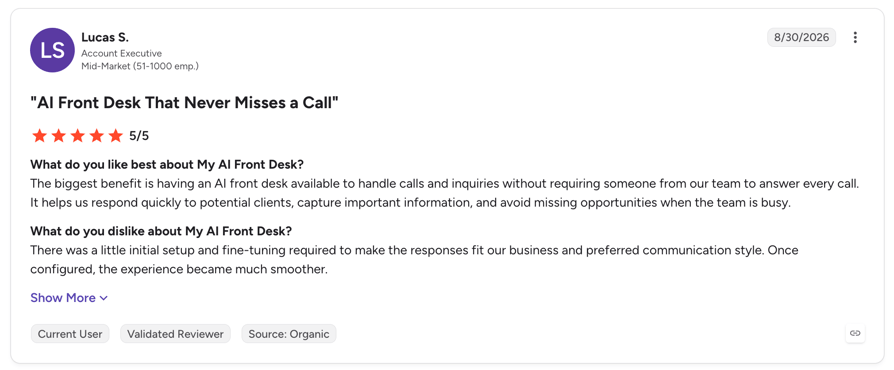
4.9/5 across 18 reviews on G2 as of September 2026.
What Is the Pricing of My AI Front Desk?
- Business-in-a-Box: $79/month billed annually or $99/month month-to-month
- Includes 200 voice minutes, 100 chatbot conversations, 400 SMS and 20 outbound calls a day
- Overage at roughly $0.25 per voice minute via a credit system, auto-reloading at $10 per 1,000 credits
- Enterprise: custom, with per-minute cost as low as roughly $0.07 at volume
- 7-day free trial, no credit card required
CloudTalk vs My AI Front Desk
| Dimension | CloudTalk | My AI Front Desk |
|---|---|---|
| Entry price | $99/month for 200 minutes, 50 free to test | $79/month annual for 200 minutes, 7-day trial |
| Compliance evidence | SOC 2 Type 2, ISO 27001, PCI-DSS, GDPR, BAA | HIPAA and BAA stated; no SOC 2 or GDPR statement |
| Claims and FNOL | Configurable call flows with escalation | Not supported |
| Phone system | Full business phone system with routing and analytics | Receptionist layer only |
When to Use My AI Front Desk
- You are a one or two-producer agency and price is the deciding factor
- You want voice, chat and SMS covered by a single low monthly fee
- Your calls are mostly simple: hours, directions, taking a message, booking a slot
When Not to Use My AI Front Desk
- You need FNOL or claims intake handled properly
- Your security review requires a SOC 2 report
- You serve policyholders in languages beyond English
Bottom Line
Good value for a small agency with straightforward calls. It is a receptionist, not an insurance workflow platform, and it does not claim otherwise.
5. Synthflow AI: Best No-Code Voice Agent Builder for Larger Agencies
What Is Synthflow AI?
Synthflow is a no-code AI voice agent builder for inbound and outbound calls. It has moved sharply upmarket during 2026: the self-serve Starter, Growth and Team tiers have been retired and the vendor now sells enterprise contracts only.
Category Scores
| Criterion | Synthflow AI |
|---|---|
| HIPAA/SOC 2 | 4/5 |
| AMS Integration | 1/5 |
| 24/7 Coverage | 5/5 |
| FNOL/Claims | 2/5 |
| Appointment Booking | 4/5 |
| Multilingual | 5/5 |
| Pricing Clarity | 2/5 |
| Total | 23/35 |
Key Features of Synthflow AI
- No-code builder for inbound and outbound voice agents
- 43 languages plus a multilingual auto-switch mode
- Native calendar booking with Cal.com, Google Calendar and Microsoft Calendar
- CRM and CCaaS integrations including Salesforce, HubSpot, Zoho, GoHighLevel, Twilio, Zapier and Make
- Implementation, onboarding, testing and launch support included in the enterprise contract
Compliance Summary
Synthflow's trust centre lists HIPAA, SOC 2 Type 2, GDPR, PCI DSS v4.0.1 and ISO/IEC 27001.
The caveat matters: "Most documents are available after submitting an access request and accepting our NDA." You cannot verify the scope of those certifications before a sales conversation.
AMS and CRM Integration
No insurance AMS integration. Generic CRM and connector tooling only. Claims intake would be a custom flow built on webhooks, not an out-of-the-box product.
Pros and Cons
| Pros | Cons |
|---|---|
| Broad compliance list including SOC 2 Type 2 and HIPAA | Compliance documentation gated behind an NDA |
| 43 languages, the widest coverage here after CloudTalk | Enterprise contracts start at $30,000 a year |
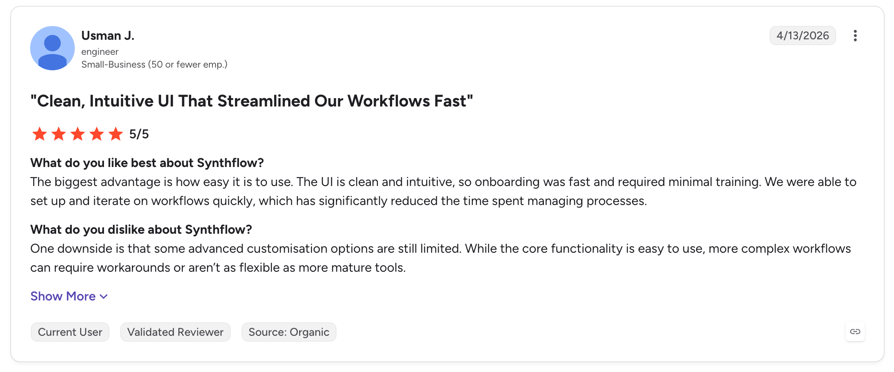
| Implementation support included at the enterprise tier | Reviewers report setup complexity and CRM data-mapping failures |
| 4.5/5 across 1,015 G2 reviews | No self-serve option any more |
G2 Rating
4.5/5 across 1,015 reviews as of September 2026.
What Is the Pricing of Synthflow AI?
- Enterprise only: contracts start at $30,000 annually, scoped on call volume, concurrency, telephony setup, integrations and security requirements
- Self-serve Starter, Growth and Team tiers have been retired
- No per-minute rate or free tier published on the vendor site
- More detail in our Synthflow AI review
CloudTalk vs Synthflow AI
| Dimension | CloudTalk | Synthflow AI |
|---|---|---|
| Entry cost | $99/month, 50 free minutes | $30,000/year minimum contract |
| Compliance verification | Certifications stated publicly | Documents behind an access request and NDA |
| Telephony | Own carrier-grade network, 160+ countries | Bring your own via Twilio and similar |
| Time to live | Minutes on the AI receptionist | Scoped implementation project |
When to Use Synthflow AI
- You are a large agency or MGA with a five-figure automation budget and multiple call workflows
- You need 20+ languages across a multinational book
- You want the vendor to run implementation rather than doing it yourself
When Not to Use Synthflow AI
- You want to start small and prove value before committing budget
- Your security team needs certification scope confirmed before an NDA
- Your AMS integration has to work on day one
Bottom Line
Capable, and now priced for enterprises. The 2026 move to $30,000 contracts takes it off the shortlist for most independent agencies.
6. Retell AI: Best for Agencies With Developer Resources
What Is Retell AI?
Retell AI is voice agent infrastructure: you assemble the agent from components through an API and dashboard. The compliance posture is the best in this guide, and the deployment effort is the reason most agencies should still look elsewhere.
Category Scores
| Criterion | Retell AI |
|---|---|
| HIPAA/SOC 2 | 5/5 |
| AMS Integration | 1/5 |
| 24/7 Coverage | 5/5 |
| FNOL/Claims | 2/5 |
| Appointment Booking | 3/5 |
| Multilingual | 4/5 |
| Pricing Clarity | 4/5 |
| Total | 24/35 |
Key Features of Retell AI
- Component-level control over voice, transcription and language model
- 20 concurrent calls included, more at $8 per line per month
- Native Cal.com booking with availability checks, rescheduling and cancellation
- Knowledge base, denoising, safety guardrails and PII removal as priced add-ons
- CRM integrations including HubSpot, Salesforce, Zoho, Dynamics 365 and Pipedrive
Compliance Summary
The most transparent here:
- HIPAA compliance, with a signed BAA required before transmitting PHI
- SOC 2 Type 1 and Type 2, with independently audited controls
- GDPR compliance via a DPA, though Retell does not currently operate services inside the EU
- BAAs and DPAs are self-serve rather than gated behind an enterprise contract
AMS and CRM Integration
No insurance AMS integration. Note a naming trap: Retell integrates with Epic the healthcare EHR, not Applied Epic the insurance AMS. They are different systems from different companies.
Pros and Cons
| Pros | Cons |
|---|---|
| SOC 2 Type 1 and 2, HIPAA with self-serve BAA, GDPR DPA | Configuration needs a developer, by reviewers' own account |
| Fully itemised pricing from $0.07/minute | Component pricing compounds and is hard to forecast |
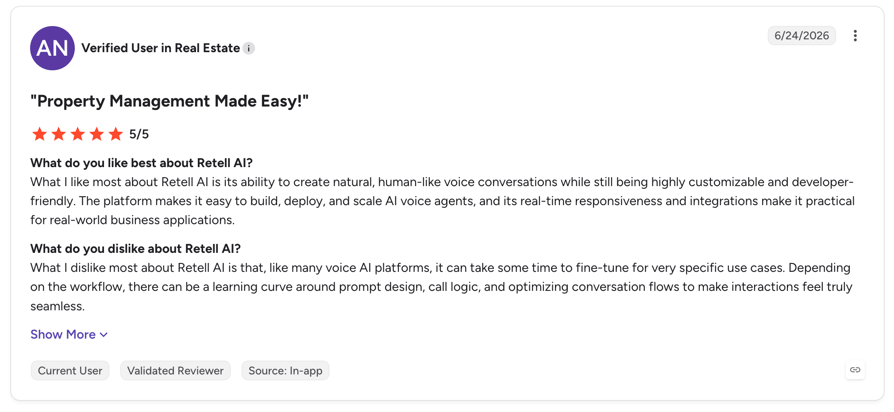
| 4.8/5 across 2,638 G2 reviews | No AMS integration and no verified insurance case study |
| $10 in free credits to test | Its published FNOL claims cite no named customer |
G2 Rating
4.8/5 across 2,638 reviews as of September 2026, the largest credible review base in this guide.
What Is the Pricing of Retell AI?
- Pay as you go: from $0, with $10 in free credits. Blended voice agent rate $0.07 to $0.31 per minute depending on components
- Retell voice infrastructure $0.055/min; text-to-speech $0.015 to $0.040/min; language model $0.003 to $0.32/min
- Add-ons: knowledge base, denoising and guardrails at $0.005/min each, PII removal $0.01/min
- Phone number $2/month, extra concurrency $8 per line per month
- Enterprise: custom, with unlimited concurrency and dedicated support
CloudTalk vs Retell AI
| Dimension | CloudTalk | Retell AI |
|---|---|---|
| Who configures it | An operations manager, in a visual designer | A developer, through an API and dashboard |
| Pricing model | Fixed monthly minute bundles | Per-minute, itemised by component |
| Time to live | Minutes | Weeks, with engineering time |
| Compliance | SOC 2 Type 2, ISO 27001, BAA available | SOC 2 Type 1 and 2, HIPAA with self-serve BAA |
When to Use Retell AI
- You have in-house developers or an implementation partner
- You want component-level control over voice, model and cost
- You need a BAA signed without an enterprise negotiation
When Not to Use Retell AI
- Nobody at your agency writes code
- You need a predictable monthly bill rather than per-component metering
- You expected an insurance product: this is infrastructure to build one on
Bottom Line
The best-documented compliance story in this guide, wrapped around a platform most insurance agencies cannot deploy without hiring help.
7. Vapi: Best for Engineering Teams Building a Custom Insurance Voice Agent
What Is Vapi?
Vapi is developer-first voice AI infrastructure. Engineers assemble agents from modular speech-to-text, language model and text-to-speech providers. It is explicitly not a turnkey receptionist.
Category Scores
| Criterion | Vapi |
|---|---|
| HIPAA/SOC 2 | 2/5 |
| AMS Integration | 1/5 |
| 24/7 Coverage | 5/5 |
| FNOL/Claims | 1/5 |
| Appointment Booking | 3/5 |
| Multilingual | 4/5 |
| Pricing Clarity | 3/5 |
| Total | 19/35 |
Key Features of Vapi
- Modular provider choice across speech recognition, language models and voices
- 10 concurrent call lines included, more at $10 per line per month
- Native Google Calendar tool for booking
- Cal.com and Calendly reachable through Zapier, Make and Pipedream
- Language coverage that varies by chosen provider, from 18 to 140+
Compliance Summary
Vapi lists SOC 2, PCI DSS v4.0.1, GDPR and CCPA on its trust centre, with full audit reports behind an access request.
HIPAA is the sticking point:
- HIPAA mode needs an enterprise subscription or a $2,000/month add-on, plus a signed BAA
- It restricts you to an approved subset of model and voice vendors
- Zero data retention costs another $1,000/month
AMS and CRM Integration
No insurance AMS integration. Generic Google Calendar, Cal.com, Zapier, Make and Pipedream connectors only.
Pros and Cons
| Pros | Cons |
|---|---|
| Lowest headline platform cost at $0.05/minute | HIPAA mode costs $2,000/month on top |
| Full control over every component of the stack | Effectively unrated: only 3 G2 reviews |
| SOC 2 and PCI DSS listed | 14-day call data retention by default |
| Bring your own model API keys at no markup | Developer-only configuration |
G2 Rating
Effectively unrated. G2 shows only 3 reviews with inconsistent aggregates, and there is no Capterra or TrustRadius listing.
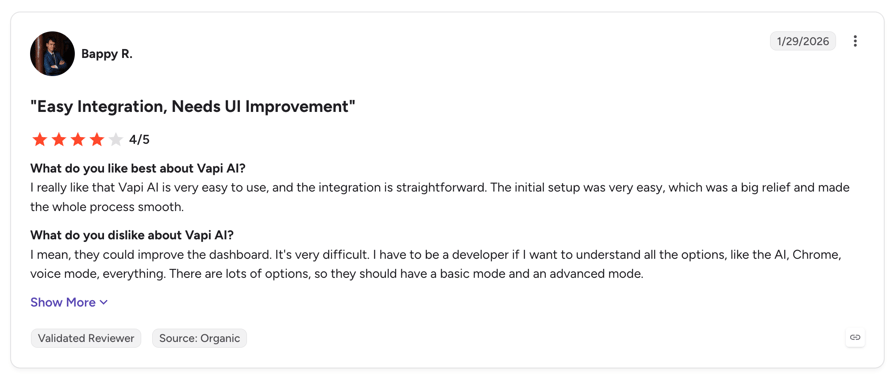
One reviewer, a verified user in healthcare, reported: "They doubled the price for HIPAA compliance overnight with no warning. We received no response for three weeks." Verify current HIPAA pricing in writing.
What Is the Pricing of Vapi?
- Build: no platform fee. Hosting $0.05/minute, SMS and chat $0.005 per message, 10 concurrent lines included, $10 per extra line per month
- Model costs passed through at cost, or free if you bring your own API keys
- HIPAA mode: $2,000/month add-on. Zero data retention: $1,000/month
- Scale: annual contract, custom pricing, with SOC 2, HIPAA, PCI, SSO and RBAC included
- More in our Vapi AI pricing breakdown
CloudTalk vs Vapi
| Dimension | CloudTalk | Vapi |
|---|---|---|
| Cost of HIPAA support | Included; BAA on request | $2,000/month add-on plus a signed BAA |
| Setup | No-code, live in minutes | Developer build |
| Data retention | Configurable, with audit logging | 14 days by default on Build |
| Review base | 1,600+ G2 reviews | 3 G2 reviews |
When to Use Vapi
- You have an engineering team and want maximum control over the voice stack
- You are building a product, not buying a receptionist
- Call volume is high enough that $0.05/minute beats a bundled plan
When Not to Use Vapi
- Policyholder health data is in scope and $24,000 a year for HIPAA mode is not in budget
- You want vendor references and a verifiable review base
- You need someone to call when a transfer fails
Bottom Line
Powerful infrastructure at a low headline rate, with compliance priced as a premium. Fine for a product team, hard to justify for an agency front desk.
8. IBM watsonx: Best for Enterprise Carriers Building Custom Agents
What Is IBM watsonx Assistant?
IBM's enterprise conversational AI platform, now being folded into watsonx Orchestrate. It is a horizontal agent-building platform for large organisations, with no insurance vertical and no receptionist product.
Category Scores
| Criterion | IBM watsonx |
|---|---|
| HIPAA/SOC 2 | 3/5 |
| AMS Integration | 1/5 |
| 24/7 Coverage | 4/5 |
| FNOL/Claims | 2/5 |
| Appointment Booking | 1/5 |
| Multilingual | 4/5 |
| Pricing Clarity | 3/5 |
| Total | 18/35 |
Key Features of IBM watsonx
- Enterprise agent orchestration with custom tool creation
- 14 languages in the legacy Watson Assistant documentation
- Data isolation and a dedicated data space on the Premium tier
- 30-day free trial
- Enterprise-grade governance and audit tooling
Compliance Summary
- SOC 2: IBM Cloud maintains SOC 2 Type 2 across a defined service list, but watsonx Assistant is not named on it
- HIPAA: IBM lists 31 platform services ready for PHI under a BAA, and watsonx Assistant is not among them
- Successor product: the only HIPAA reference is a "HIPAA-ready option" on the Premium tier
For an insurance buyer, HIPAA coverage needs confirming with IBM in writing rather than assuming.
AMS and CRM Integration
No insurance AMS integration stated. Everything is custom-built through the tool and agent framework.
Pros and Cons
| Pros | Cons |
|---|---|
| Enterprise governance and data isolation options | From $530/month, rising to $6,360/month on Standard |
| Published tier pricing, unusual at this end of the market | No receptionist product; you build the use case |
| 30-day free trial | HIPAA coverage for this product is not publicly confirmed |
| 4.4/5 across 392 G2 reviews for watsonx Orchestrate | Mid-migration between product names |
G2 Rating
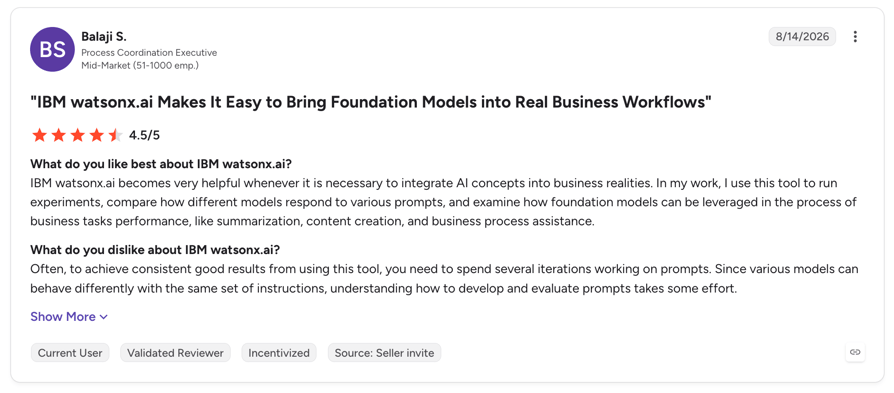
4.4/5 across 392 reviews for watsonx Orchestrate, as of September 2026.
What Is the Pricing of IBM watsonx?
- Trial: free for 30 days
- Essentials: from $530/month, 4,000 monthly active users, up to 200,000 messages
- Standard: from $6,360/month, 40,000 monthly active users, up to 2,000,000 messages
- Premium: custom, adding data isolation and the HIPAA-ready option
CloudTalk vs IBM watsonx
| Dimension | CloudTalk | IBM watsonx |
|---|---|---|
| Product shape | AI receptionist you switch on | Platform you build an agent on |
| Entry cost | $99/month | $530/month |
| HIPAA | BAA available to support your compliance | Not confirmed for this product; Premium HIPAA-ready option |
| Insurance fit | Insurance call flows out of the box | Build it yourself |
When to Use IBM watsonx
- You are a carrier or large MGA with an existing IBM relationship
- You need enterprise data isolation and governance controls
- You have the engineering capacity to build and maintain custom agents
When Not to Use IBM watsonx
- You are an independent agency wanting your phone answered
- You need HIPAA coverage confirmed without a procurement cycle
- Your budget starts below $500 a month
Bottom Line
Enterprise infrastructure for carriers. For an agency front desk it is the wrong size and the wrong shape.
9. Kenyt.AI: Best for Multi-Channel Lead Capture Outside Insurance
What Is Kenyt.AI?
Kenyt.AI is a general-purpose multi-channel conversational AI platform covering voice, chat, WhatsApp and SMS. It markets to real estate, healthcare, education, automotive, retail and hospitality. Insurance agencies are not a named vertical.
Category Scores
| Criterion | Kenyt.AI |
|---|---|
| HIPAA/SOC 2 | 1/5 |
| AMS Integration | 1/5 |
| 24/7 Coverage | 3/5 |
| FNOL/Claims | 1/5 |
| Appointment Booking | 3/5 |
| Multilingual | 1/5 |
| Pricing Clarity | 2/5 |
| Total | 12/35 |
Key Features of Kenyt.AI
- Voice, chat, WhatsApp and SMS in one platform
- Appointment scheduling through its sales AI agent
- CRM integrations with HubSpot, Salesforce, Zoho, Stripe and Shopify
- Lead qualification and routing across channels
- 30-day free trial referenced in vendor material
Compliance Summary
No HIPAA, SOC 2 or GDPR statement found anywhere on the vendor's site. For an insurance agency, that alone is disqualifying until Kenyt provides documentation.
AMS and CRM Integration
No insurance AMS integration. Generic CRM connectors only.
Pros and Cons
| Pros | Cons |
|---|---|
| Genuinely multi-channel across voice, chat and WhatsApp | No published compliance posture at all |
| Free trial available | Pricing hidden behind interactive calculators |
| Lower price point than enterprise platforms | No insurance vertical, AMS integration or FNOL capability |
| 4.6/5 on G2, 4.5/5 on Capterra | Support responsiveness flagged in reviews |
G2 Rating
4.6/5 across 12 reviews on G2 and 4.5/5 across 67 on Capterra.
What Is the Pricing of Kenyt.AI?
Not published in any fixed form. Kenyt routes buyers to self-managed and managed pricing calculators rather than a rate card, and lists no per-minute rate, tier price or seat minimum. A 30-day free trial with no credit card is referenced in vendor material.
CloudTalk vs Kenyt.AI
| Dimension | CloudTalk | Kenyt.AI |
|---|---|---|
| Compliance | SOC 2 Type 2, ISO 27001, PCI-DSS, GDPR, BAA | Not stated publicly |
| Insurance fit | Insurance call flows, FNOL routing, escalation | No insurance vertical |
| Pricing | Published from $99/month | Calculator only |
| Channel focus | Voice-native, telephony included | Chat-first with voice added |
When to Use Kenyt.AI
- Your priority is WhatsApp and web chat rather than phone calls
- You run marketing lead capture across several channels
- Compliance documentation is not a gating requirement for your use case
When Not to Use Kenyt.AI
- You handle policyholder data and need a documented compliance posture
- You need a price before a sales conversation
- Phone answering is the core job
Bottom Line
A reasonable multi-channel chat platform, but nothing about it is built for an insurance phone line, and the missing compliance documentation rules it out for most agencies.
10. DataRobot: Best for Claims Analytics, Not for Answering Calls
What Is DataRobot?
DataRobot is not an AI receptionist. It is an enterprise machine learning platform for data science teams, with no voice or telephony capability anywhere in the product.
It appears in this guide because it is frequently listed alongside AI receptionists, and insurance operations teams should understand what it actually does before shortlisting it.
Category Scores
| Criterion | DataRobot |
|---|---|
| HIPAA/SOC 2 | 4/5 |
| AMS Integration | 1/5 |
| 24/7 Coverage | 1/5 |
| FNOL/Claims | 3/5 |
| Appointment Booking | 1/5 |
| Multilingual | 1/5 |
| Pricing Clarity | 1/5 |
| Total | 12/35 |
Key Features of DataRobot
- AutoML and MLOps for building and deploying predictive models
- Pre-built accelerators for insurance claims triage and fraudulent claim detection
- Model monitoring and governance
- Single-tenant SaaS deployment on AWS, Azure and GCP
- No voice, no telephony, no call handling of any kind
Compliance Summary
Strong on paper: SOC 2 Type II assessed annually, ISO 27001 certified, and GDPR, CCPA, CPRA and EU AI Act compliance stated.
HIPAA is tied to the single-tenant SaaS offering on AWS, Azure and GCP rather than the standard SaaS product.
AMS and CRM Integration
None. Any connection to your agency management system would be a data pipeline your own engineers build.
Pros and Cons
| Pros | Cons |
|---|---|
| Genuine claims triage and fraud detection accelerators | Answers no calls and books no appointments |
| SOC 2 Type II, ISO 27001, HIPAA single-tenant option | Requires a data science team to operate |
| Enterprise governance and model monitoring | Pricing not published |
G2 Rating
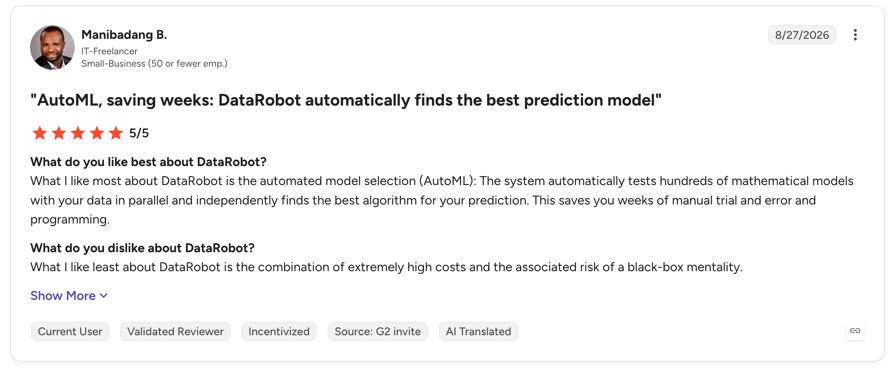
4.4/5 across roughly 40 reviews. Those reviews assess the machine learning platform, not any reception or voice use case.
What Is the Pricing of DataRobot?
Not published. DataRobot's pricing page shows no tiers and no per-unit rates, only trial and demo requests. Third-party procurement trackers confirm pricing is quote-only and negotiated.
CloudTalk vs DataRobot
| Dimension | CloudTalk | DataRobot |
|---|---|---|
| Answers phone calls | Yes, 24/7, unlimited concurrency | No |
| What it is for | Handling and routing policyholder calls | Predicting and scoring claims data |
| Who operates it | An operations manager | A data science team |
| Pricing | Published from $99/month | Not published |
When to Use DataRobot
- You are a carrier with a data science function and a claims dataset to model
- You want to score and prioritise claims that have already been captured
- Fraud detection on historic claims is the problem you are solving
When Not to Use DataRobot
- You want your phone answered: it cannot do this
- You have no data science team
- You expected a receptionist and found a modelling platform
Bottom Line
A serious platform for the wrong job. If nobody at your agency has the title data scientist, this is not your shortlist.
How to Choose an AI Receptionist for Your Insurance Agency
Make Sure It Understands Insurance Terminology and Workflows
A general-purpose receptionist that has never heard the word endorsement will take a message. One configured with your policy terms, coverage FAQs and carrier list will answer the question.
Ask every vendor to run three live test calls using your own vocabulary:
- A deductible question
- A certificate of insurance request
- A claim report
You will learn more in those three calls than in three demos.
AI Receptionist for Insurance Agents: Compliance and Traceable Responses
If your agency touches policyholder health information (life, health, disability or workers' comp), HIPAA applies to your vendor as a business associate, and that requires a signed Business Associate Agreement.
There is no such thing as HIPAA certification, so a vendor claiming to be "HIPAA certified" does not understand the rule. Ask for these instead:
- A signed BAA
- A SOC 2 Type 2 report you can read
- A stated data retention period
- Audit logs showing who accessed a recording and when
Of the ten tools here, CloudTalk, Retell AI, Synthflow and DataRobot publish the clearest compliance positions. Smith.ai and Kenyt.AI make no public HIPAA or SOC 2 statement. Our guide to the HIPAA-compliant virtual receptionist covers what to ask for in writing.
Evaluate Live Transfer and Urgent Call Escalation
High-quality live transfer separates a receptionist from an answering machine. The test: can the AI recognise an urgent call, reach a licensed producer, and hand over the context already collected, so the policyholder does not repeat their policy number?
Also ask what happens when nobody picks up the transfer. Some platforms simply drop the caller.
AI Receptionist for Insurance FNOL and Claims Intake
A first notice of loss call has a fixed shape. The AI should capture all of it in one call, in the caller's language, without an agent on the line:
- Policyholder name and policy number
- Date, time and location of the incident
- A description of the loss
Best equipped here:
- Sonant AI: FNOL capture routed into the claims workflow through a certified Applied Epic integration
- CloudTalk: configurable FNOL call flows with automatic transcription and CRM logging
- IBM watsonx: for carriers building custom intake at scale
Ask to see the script running, not described. And confirm every FNOL call is transcribed, dated and stored in an audit-ready format before going live, not after your first disputed claim.
Best AI Appointment Setter for Insurance Agencies in 2026
Booking is where most agencies see payback first, because a booked consultation is a measurable outcome rather than a saved minute.
- CloudTalk: books into Google and Outlook calendars with automatic confirmation, in 60+ languages
- Smith.ai: qualifies the prospect first, with a human verifying high-value appointments
- My AI Front Desk: books against a live calendar on a budget plan
- Sonant AI: covers Calendly, Google, Outlook and Cal.com
What to check: real-time availability rather than a booking request, automatic confirmation and reminder, and whether the AI can reschedule without a human. Our guide to the best AI voice agent for appointment scheduling goes deeper on calendar mechanics.
Consider How It Integrates With Your Existing Systems
This is the sharpest dividing line in the category: only Sonant AI offers native integration with insurance agency management systems. Everyone else reaches Applied Epic, EZLynx, HawkSoft, QQCatalyst or AMS360 through a CRM, an open API, or Zapier and Make.
If your agency runs on an AMS with no CRM alongside it, that is either a reason to shortlist Sonant or a reason to budget for integration work.
Take Pricing and Scalability Into Account
Three pricing models compete here:
- Minute bundles (CloudTalk): predictable and easy to budget
- Per-call pricing (Smith.ai): rewards short calls and punishes long ones
- Per-minute infrastructure (Retell, Vapi): looks cheapest until you add concurrency, add-ons and, in Vapi's case, HIPAA mode
Model your actual call volume against all three before choosing.
Plan for a Gradual Rollout
Start with after-hours and overflow, which is where missed calls concentrate and where mistakes cost least. Measure booked appointments and captured FNOLs rather than answer rate, since a call answered badly is not a win.
Expand to full inbound coverage once the transcripts show the AI handling your five most common call types cleanly.
AI Receptionist for Insurance Agencies: Use Cases by Workflow
Here is where agencies see the return, workflow by workflow.
24/7 Coverage Without a Night Shift
Policyholders call when something has gone wrong, and things go wrong at night and at weekends. An AI receptionist answers at 3am on a Sunday without a rota, an on-call allowance or an offshore contract.
No More Missed Revenue From Missed Calls
Run the numbers on your own line. If ten quote requests a week go to voicemail and one in four would have converted, that is roughly 130 lost policies a year. The tool only needs to recover a handful of them to pay for itself.
Handling High Volume Without Adding Headcount
Open enrollment, renewal season and catastrophe events all create the same problem: volume arrives faster than humans can answer it. Unlimited concurrency means the tenth caller and the fiftieth get the same answer time.
Reducing Insurance Hold Times With AI Receptionists
Hold time peaks exactly when it hurts most: after a weather event, during open enrollment, in the first hours of a catastrophe. CloudTalk removes the queue by answering every inbound call at once, so 50 simultaneous callers get 50 immediate answers.
A traditional answering service is capped by how many people are on shift, so a surge produces a queue no matter how good the agents are. That is why AI for insurance agents shows up first in exactly these surge scenarios.
AI Receptionist for Insurance Renewals and Upsell Outbound Calls
Renewal calls are among the highest-return outbound uses of AI in insurance, because every renewed policy is revenue kept.
- CloudTalk's AI Specialist: renewal reminders, add-on coverage prompts and payment confirmation, set up without a developer
- Synthflow: renewal sequences in its no-code builder, on an enterprise contract
Outbound AI minutes are billed separately from inbound bundles on most platforms, CloudTalk included, so scope the volume before you build the campaign.
AI Receptionist for Financial Advisors and Mortgage Brokers
Insurance agencies often sit alongside advisers, mortgage brokers and wealth management firms that face the same inbound problem and the same compliance constraints.
CloudTalk's AI receptionist handles inquiry calls, appointment booking and compliance logging for those teams too, so a multi-line practice does not need two vendors. The best AI voice agents for insurance generally transfer well to these neighbouring verticals.
Stronger Lead Capture and Cleaner Records
The quote request that came in at 9pm is in the pipeline by 9:01pm, transcribed and logged with the caller's details filled in, rather than living on a sticky note. Add spam blocking for insurance agencies and your producers stop spending their morning on robocalls.
Your Next Policyholder Is Calling. Will You Pick Up?
The best AI receptionist for insurance brokers answers every policy inquiry call 24/7, routes FNOL claims instantly, books consultations and logs everything to your AMS or CRM. Getting there is about matching the tool to how your agency actually works.
- Your AMS is the system of record: Sonant AI
- You want a human voice on escalation: Smith.ai
- You have developers and want to build: Retell AI
- You are a carrier with a data science team: DataRobot, for a different problem entirely
For most independent agencies and brokerages, the pragmatic answer is an AI receptionist that is compliant, has a published price, and is live this week rather than next quarter. With CloudTalk, you can test it on your own agency number before you decide anything.
FAQs: AI Receptionists for Insurance Brokers and Agencies
CloudTalk leads for most brokers, with published pricing, SOC 2 Type 2 certification, BAAs available for HIPAA and 60+ languages. Sonant AI is the insurance-native alternative with certified Applied Epic integration, and Smith.ai suits brokers who want live agents behind the AI.
It depends on your system of record. If you need native AMS write-back, Sonant AI is the only tool that offers it. If you want published pricing, documented compliance and a fast start, CloudTalk is the stronger pick. Agencies with under 25 calls a month can start on Smith.ai's free tier.
For most agencies, an AI answering service now beats a traditional one on cost and coverage. CloudTalk starts at $99/month with unlimited concurrent calls and 24/7 cover, against $250 to $600 a month for a basic traditional service capped by staff on shift. A traditional service still wins if every caller must reach a human; in that case, use AI for overflow only.
For US agents, the practical shortlist is CloudTalk (one system for AI and human calls), Smith.ai (US-based human agents behind the AI), My AI Front Desk (the budget option) and Sonant AI (the P&C specialist). Match the billing model to your call pattern: minute bundles for long calls, per-call pricing for short ones.
CloudTalk books consultations directly into Google and Outlook calendars with automatic confirmation, in 60+ languages. Smith.ai qualifies the prospect first and has a human verify high-value appointments. In any demo, check for real-time availability, automatic reminders and rescheduling without a human.
Judge rating alongside sample size. Retell AI (4.8/5, 2,638 G2 reviews), CloudTalk (4.3/5, 1,600+) and Smith.ai (4.9/5, 82) all have credible review bases. Sonant AI shows 4.9/5 on only five reviews. Ask which support tier your plan includes, since several vendors reserve named support for enterprise contracts.
For agencies that want a product rather than a platform: CloudTalk for compliance and published pricing, Sonant AI for AMS-native workflows. For teams with engineers building something custom: Retell AI, which offers self-serve BAAs. Synthflow is now enterprise-only from $30,000 a year, and Vapi's HIPAA mode costs $2,000 a month.
A well-configured AI agent collects the full first notice of loss on the call (name, policy number, incident date, time, location and a description of the loss), routes it into the claims workflow and escalates urgent cases to an on-call producer. Sonant AI does this through Applied Epic; CloudTalk through configurable call flows with automatic transcription and CRM logging.
Four cover the US market properly. CloudTalk offers local US numbers, 60+ languages and BAAs. Smith.ai provides bilingual US-based human agents behind the AI. My AI Front Desk is the budget no-code choice. Sonant AI is the property and casualty specialist with certified Applied Epic integration.
Yes, though this is outbound calling and is usually priced separately. CloudTalk's AI Specialist runs renewal reminders, add-on coverage prompts and payment confirmation from $349/month for 1,000 minutes. Before you launch, check that your call list meets TCPA consent rules in the US.