TL;DR
The best AI voice agent for HR and recruiting is CloudTalk for teams that want AI screening inside a wider calling and CRM workflow rather than a separate interview tool.
Other strong picks:
HeyMilo AI expressly designed for voice interviews with structured scoring written straight back to the Applicatnt Tracking System, Humanly for explainable, evidence-backed shortlists, Phenom for enterprise talent acquisition on a single talent suite, Ribbon for published tiered pricing you can budget against, and Synthflow for teams with engineering capacity building their own HR voice workflows.
We compared nine AI voice agent platforms on screening call quality, ATS integration depth, interview scheduling, candidate consent handling, bias audit capability, multilingual support and price at volume.
Here's every platform in this guide and what it does best:
- 01HeyMilo AI: best for two-way ATS integration with automatic scorecard write-back
- 02Ribbon: best for public tiered pricing and a same-week start
- 03Classet (Joy): best for high-volume frontline and skilled-trades hiring on a per-job budget
- 04Alex AI (formerly Apriora): best for identity verification and interview-fraud detection
- 05Humanly: best for explainable, evidence-backed shortlists in hourly hiring
- 06CloudTalk: best for AI screening inside a real phone system, inbound and outbound
- 07Synthflow: best for enterprises building custom HR voice workflows on their own telephony
- 08Paradox (Olivia): best for enterprise interview scheduling at scale
- 09Phenom: best for voice screening inside a full talent-experience suite
AI Voice Agents for HR and Recruitment: Comparison Table
What Are the Best AI Voice Agents for HR and Recruiting?
| Provider | Key Features | Best For | Starting Price | G2 Rating |
|---|---|---|---|---|
| HeyMilo AI | Voice, video and SMS screening; 20+ ATS partners with two-way sync; scorecard write-back; cheat detection | Teams that want screening results on the candidate record automatically | Quote-based | 4.8/5 (18 reviews) |
| Ribbon | AI interviewer over video and voice; 10+ languages on every tier; ATS field mapping; API access | Small and mid-size teams that want a price list, not a demo | $499/month (Growth) | Not retrievable at time of writing |
| Classet (Joy) | Voice interviews minutes after apply; automated follow-ups; 100+ ATS integrations; SOC 2 Type II | Continuous hiring for a small number of high-volume roles | $190/week per job | 4.7/5 (9 reviews) |
| Alex AI (formerly Apriora) | Phone, video or text interviews; identity verification and fraud signals; calendar booking; ATS talent rediscovery | Hiring where candidate identity fraud is a live risk | Quote-based | 5.0/5 (2 reviews) |
| Humanly | AI recruiter and AI interviewer across chat, voice and video; built-in ATS and CRM; ranked shortlists with transcripts | Hourly and frontline hiring that needs the evidence behind a shortlist | Quote-based | 4.8/5 (115 reviews) |
| CloudTalk | Inbound and outbound AI Voice Agent; knockout qualification; calendar booking with SMS confirmation; 60+ languages; transfer to a recruiter on the same line | HR and staffing teams that need AI screening inside a business phone system | $25/user/month plus the AI Voice Agent add-on from $99/month | 4.4/5 (1,702+ reviews) |
| Synthflow | Visual flow designer; in-house telephony; test center for pre-launch simulation; auto-QA | Enterprises with engineering capacity and voice use cases beyond hiring | From $30,000/year | 4.5/5 (1,000+ reviews) |
| Paradox (Olivia) | Applicant screening over chat or text; interview scheduling; SAP SuccessFactors and Indeed Apply integrations | Enterprise frontline hiring where scheduling is the bottleneck | Quote-based | 4.7/5 (39 reviews) |
| Phenom | Voice Screening Agent inside the Intelligent Talent Experience platform; CRM, career site, internal mobility | Enterprises consolidating on one talent suite | Quote-based | 4.3/5 (430 reviews) |
Applications arrive far faster tthan recruiters can screen them. That's why early field research is promising: 70,000 job applicants found that those interviewed by an AI voice agent were 12% more likely to receive an offer and 18% more likely to start the job, with human recruiters retaining full authority over final hiring decisions.
This comparison evaluates the top AI voice agent HR recruitment platforms across screening depth, ATS integrations, interview scheduling, compliance controls, language coverage, and high-volume pricing. The ideal platform depends on whether your team requires a no-code campaign launch, ATS-native integration with automatic scorecard write-back, developer control for custom workflows, large-scale concurrency for high-volume hiring, multilingual outreach for diverse candidate pools, or enterprise governance with bias audit trails.
Important: These platforms do not replace recruiters. Instead, they automate repetitive first-touch screening and scheduling, handing off qualified candidates to human recruiters for relationship-building, offer negotiation, and final decisions.

Book a demo of CloudTalk

What Is the Best AI Voice Agent for HR and Recruiting in 2026?
The best AI voice agent for HR depends on your tech stack: CloudTalk if you need a full telephony system, HeyMilo if you want a standalone voice interviewing tool, and Phenom if you want an AI voice screening module native to a broader enterprise talent platform.
- Purpose-built AI interview platforms (HeyMilo AI, Ribbon, Classet, Alex AI, Humanly) are built for one job. They interview applicants, score the answers against your criteria, and push a ranked shortlist to recruiters. Screening depth is their strength. Most assume the conversation is outbound or asynchronous, and most won't publish a price.
- General-purpose voice platforms adapted for HR (CloudTalk, Synthflow) start from telephony rather than from recruiting. That matters when candidates ring you back, when a call needs to transfer to a live recruiter mid-conversation, or when HR isn't the only team that wants a voice agent. You get the phone system, and you configure the recruiting logic. If the category itself is new to you, start with what an AI voice agent is before you compare vendors on it.
- Talent suites with a voice module (Paradox, Phenom) put screening inside a platform that also runs your career site, CRM and internal mobility. The appeal is one vendor and one candidate record. The cost is a suite implementation, and the assumption that you want the rest of the suite.
Our Methodology: How We Chose the Best AI Voice Agents for HR and Recruiting in 2026
Here's what in to building this comparison:
- Vendor documentation, read this week. Every feature, price and integration claim comes from the provider's own live pages, checked in early August 2026. Where a page said "contact sales," we wrote "quote-based" instead of repeating a third-party estimate.
- Review themes rather than cherry-picked quotes. Pros and cons come from recurring themes across each product's G2 reviews. Where a product has fewer than 20 reviews, we say so, because a 5.0 rating on two reviews isn't a rating.
- Primary sources for every statistic. Each number here names the organization that published it. The vendor blog statistics circulating in this category (market size, ROI multiples, candidate-preference percentages) traced back to vendor marketing, so we left them out.
- Compliance read against the law. The regulatory section cites the EU AI Act, New York City's Department of Consumer and Worker Protection, and the Illinois statute directly.
- Practitioner discussion, not just review sites. We read public threads in r/recruiting and r/humanresources for the objections that don't make it into a G2 review, and we paraphrase them rather than quoting individuals.
- Five scoring categories, applied identically to all nine. Screening depth and question consistency; ATS integration and scorecard write-back; interview scheduling and calendar sync; compliance, consent and bias controls; pricing transparency and value at scale.
Those scores are our editorial judgment, based on what each vendor documents publicly plus the themes in its reviews. They aren't a benchmark, and nobody ran a controlled test of these products against each other.
Read them as shorthand for how strong the public evidence is, and read the "when not to use" note under each one before you shortlist anything.
Why Trust Our Software Reviews?
For nearly a decade, we've helped over 30,000+ professionals find and implement smarter business communication tools. We've reviewed 200+ software tools across industries, analyzed 5,500+ verified customer reviews from platforms like G2, Capterra, and Trustpilot, and drawn insights from real user discussions on Reddit and Quora.
In the past year alone, we published 1,000+ articles, each one written by humans for humans. Learn how we keep our content integrity and our software review methodology.
Best AI Voice Agents for HR & Recruiting: Top 9 Honest Picks
The list runs from purpose-built recruiting products, through voice platforms that serve HR as part of a wider calling stack, to the enterprise talent suites. That's the order most buyers should evaluate in, smallest commitment first.
1. HeyMilo AI
HeyMilo AI positions itself as an "AI recruiter for high-volume hiring." It screens applicants over voice, two-way video, SMS and resume scoring, then pushes the results back into the ATS you already use. Among the nine platforms here, its write-back behavior is the best documented.
Key Features of HeyMilo AI
- Screening results land on the candidate record. PDF reports, scores, transcripts and recordings appear in your ATS, and some integrations also update skills, tags and custom fields.
- Your ATS is probably on the list. HeyMilo documents 20+ ATS partners with two-way sync, including Workday, Greenhouse, Ashby, Bullhorn, Lever, iCIMS and SuccessFactors. In Ashby and Greenhouse it's a native assessment partner, so screening can auto-trigger on stage entry.
- One platform covers four screening surfaces. Phone screens, scored video, SMS qualification and form-based eligibility knockouts, so you can match the surface to the role.
- Interview fraud gets checked. Cheat Detection flags identity spoofing during the screen.
What Are HeyMilo AI's Pros and Cons?
| Pros | Cons |
|---|---|
| Quick setup and ease of use is the most consistent theme across its G2 reviews | Reviewers ask for more ATS integration options, which likely means "my specific ATS isn't covered yet" |
| Candidates complete interviews on their own schedule, so recruiters have a read on them before the first live conversation | Occasional issues with how the AI agent behaves mid-interview |
| Integrates with existing systems rather than asking recruiters to work somewhere new | Only 18 G2 reviews, so the sample is thin |
Who Is HeyMilo AI Best For?
Recruiting teams already committed to Greenhouse, Ashby, Bullhorn or another of its 20+ two-way ATS partners, who want screening results to appear on the candidate record without anyone copying them across. It suits high-volume hiring where the recruiter's first live conversation should start from a transcript and a score rather than a CV.
What Is the Pricing of HeyMilo AI?
- Quote-based. HeyMilo's pricing page resolves to a demo booking form with no figures on it.
- White labeling is available, and the enterprise tier adds a dedicated CSM and engineer.
- No public trial or credit allowance is documented.
What Is HeyMilo AI's G2 Rating?
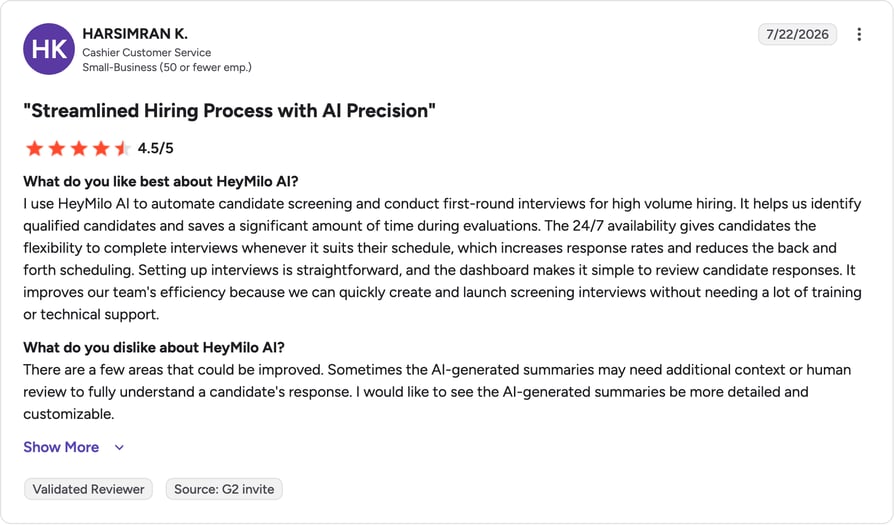
G2 rating: 4.8/5 (18 reviews). Read HeyMilo AI reviews on G2
What Do Customers Say About HeyMilo AI?
Reviewers praise how fast it is to get running and how little training the interface needs. Several describe the real win as walking into the first live conversation already knowing how a candidate answered the basics. Integration breadth reads as both a strength and a request, and a minority flag the agent behaving oddly mid-interview.
When Should You Use HeyMilo AI, and When Shouldn't You?
Use it when your ATS is Greenhouse, Ashby or Bullhorn and you want screening results to appear on the candidate record automatically rather than in a separate dashboard.
Skip it when you need published pricing before you'll take a sales call, or when you need a documented language count for a specific market. HeyMilo markets multilingual screening for BPOs without publishing how many languages it covers.
How Does HeyMilo AI Score for HR and Recruiting?
| Criterion | Score (/10) |
|---|---|
| Screening depth & question consistency | 9/10 |
| ATS integration & scorecard write-back | 10/10 |
| Interview scheduling & calendar sync | 7/10 |
| Compliance, consent & bias controls | 5/10 |
| Pricing transparency & value at scale | 3/10 |
2. Ribbon
Ribbon calls itself "the AI recruiter that handles interviews, email, and SMS." It runs AI interviews over video and voice with named voices, and it's the only platform in this comparison that publishes full tiered pricing, including per-interview overage rates.
Key Features of Ribbon
- You can budget for it before you talk to anyone. Every tier, seat count, interview allowance and overage rate sits on the public pricing page, with a 7-day free trial on all paid tiers.
- Candidates get followed up automatically. SMS and email outreach is included on every paid tier, so screening isn't gated on someone checking their inbox.
- It works across languages out of the box. 10+ languages on every tier rather than reserved for enterprise contracts.
- The interview digs past the script. Reviewers describe the AI interviewer asking genuine follow-up questions, and it returns transcripts, summaries and ranked candidates immediately after.
What Are Ribbon's Pros and Cons?
| Pros | Cons |
|---|---|
| Time-saving automation and an easy interface; simplifies candidate tracking | Can experience delays, and complex workflows may need fine-tuning |
| AI interviewers dig deeper with follow-up questions | Reviewers in lower-cost markets find the price high |
| Instant transcripts, summaries and data-driven candidate rankings | Automatic scorecard write-back into a named ATS isn't documented |
Who Is Ribbon Best For?
Small and mid-size recruiting teams running 100 to 1,000 interviews a month who need to budget before they buy. It's the fit for teams that would rather read a price list and start inside a week than run a procurement cycle around a quote.
What Is the Pricing of Ribbon?
- Growth: $499/month for 2 seats, 2 active roles and 100 interviews per month, then $4.00 per extra interview.
- Business: $999/month for 5 seats, 5 active roles and 400 interviews per month, then $3.00 per extra interview.
- Scale: $1,999/month for 10 seats, 10 active roles and 1,000 interviews per month, then $2.50 per extra interview, plus implementation support.
- Enterprise: custom pricing with unlimited interviews, custom voices and accents, SAML SSO, sub-teams, SOC 2 and security reviews.
- Prices are billed annually (annual saves 20% against the monthly toggle), and every paid tier includes a 7-day trial.
What Is Ribbon's G2 Rating?
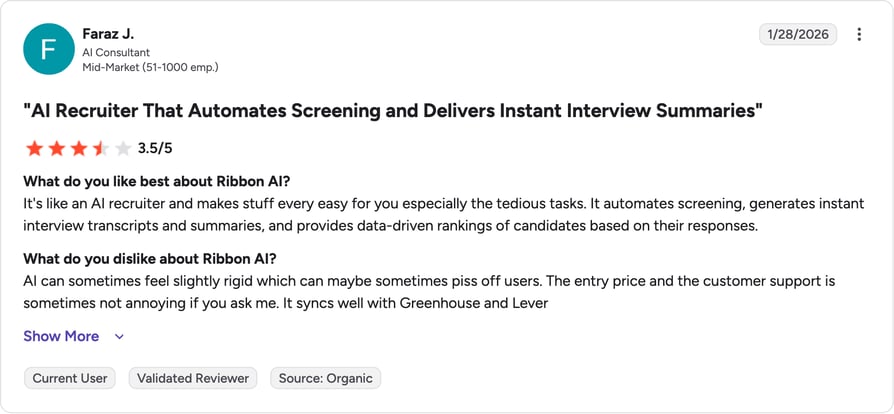
G2 rating: not retrievable at time of writing. Ribbon's G2 profile exists, but neither the score nor the review count could be retrieved, so we're not publishing a number for it. Read Ribbon reviews on G2
What Do Customers Say About Ribbon?
The dominant theme is time recovered: candidate tracking and scheduling get simpler, and the volume of first conversations a team can handle goes up. The interviewer itself gets credit for feeling like a conversation rather than a form, mostly because of the follow-up questions. Complaints cluster on occasional latency and workflows that needed tuning, plus price sensitivity from teams hiring in lower-cost markets.
When Should You Use Ribbon, and When Shouldn't You?
Use it when you want to run 100 to 1,000 AI interviews a month, you'd rather read a price list than sit through a demo, and you want to trial it inside a week.
Skip it when you need documented scorecard write-back into a specific ATS, or in-call transfer to a live recruiter. Ribbon's demo flow tells candidates a real recruiter will review their responses, which is a human-review promise rather than a live handoff.
How Does Ribbon Score for HR and Recruiting?
| Criterion | Score (/10) |
|---|---|
| Screening depth & question consistency | 8/10 |
| ATS integration & scorecard write-back | 6/10 |
| Interview scheduling & calendar sync | 4/10 |
| Compliance, consent & bias controls | 4/10 |
| Pricing transparency & value at scale | 10/10 |
3. Classet (Joy)
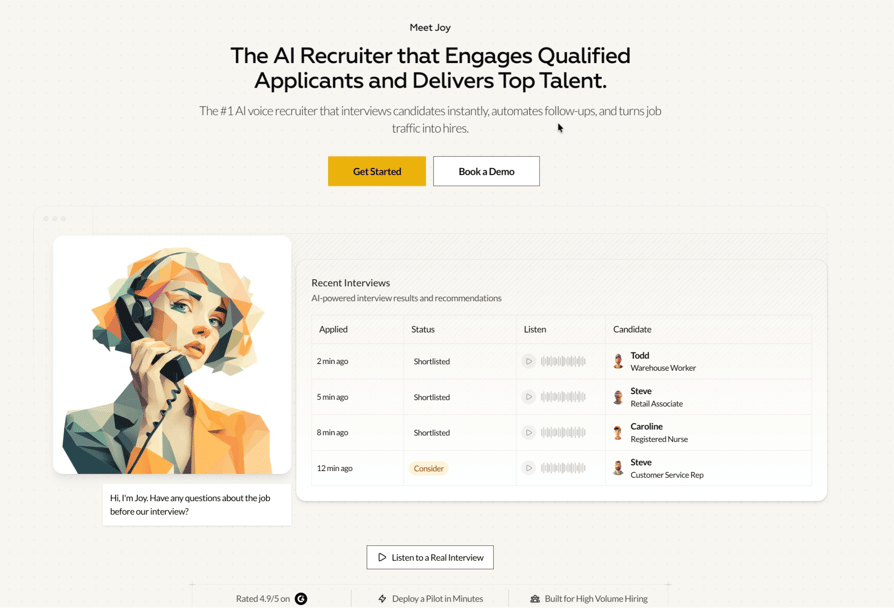
Classet is an AI voice recruiter for frontline and skilled-trades hiring, and its agent is named Joy. It calls applicants within minutes of them applying, pre-screens them, and drops shortlist or consider recommendations into a review queue with the call recording attached. Its pricing is per job rather than per seat, which no other platform here does.
Key Features of Classet (Joy)
- Applicants get called while they still care. Joy phones candidates minutes after they apply, the window where frontline applicants are most reachable.
- Ghosting gets chased automatically. Automated follow-ups keep working the candidate instead of leaving drop-off to a coordinator.
- Integration surface is wide. 100+ ATS integrations, either direct or through a REST API.
- Security basics are documented. SOC 2 Type II, SSO and role-based access.
What Are Classet's Pros and Cons?
| Pros | Cons |
|---|---|
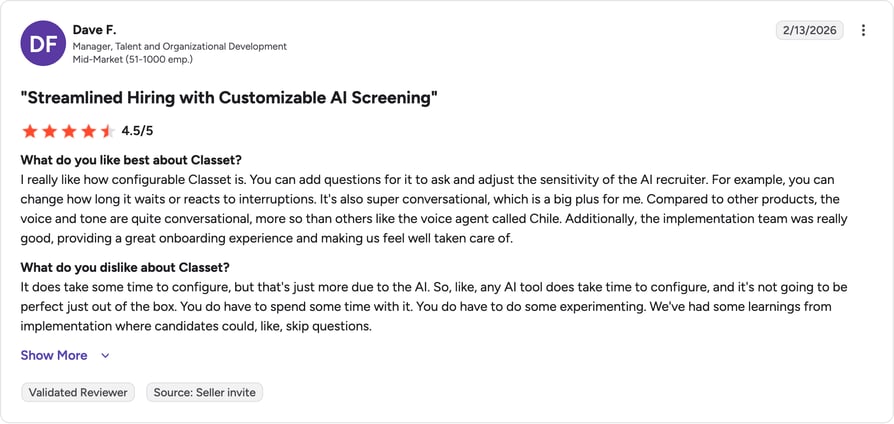
| Easy to set up and customize; reviewers describe smooth ATS integration with quick job imports and simple script creation | Only 9 G2 reviews, too thin a base to generalise from |
| One reviewer reports time to first screening call dropping from about a day to about an hour | Per-job pricing gets expensive if you run many requisitions at once |
| Reviewers describe Joy as personable, responsive and professional rather than robotic | Multilingual screening isn't publicly documented |
Who Is Classet (Joy) Best For?
Frontline and skilled-trades employers hiring continuously for a small number of high-volume roles, where reaching an applicant in the first hour decides whether you reach them at all. The per-job price works in your favour when requisition count is low and applicant count per requisition is high.
What Is the Pricing of Classet?
- Entry: $190/week per job, covering 50 AI interviews per job per month, then $4 per extra interview. A flat monthly option is available at $700/month per job.
- Higher tier: from $1,995/month, which Classet frames against a loaded senior-recruiter cost of $90,000 to $130,000 a year.
- Free 7-day trial, no contract at the entry tier.
What Is Classet's G2 Rating?
G2 rating: 4.7/5 (9 reviews). Read Classet reviews on G2
What Do Customers Say About Classet?
Speed is what reviewers notice first, specifically how quickly an applicant goes from submitting a form to having been screened. The ATS side gets praised for quick job imports and easy script setup. Several reviewers comment on how Joy comes across on the phone, describing her as efficient and human rather than scripted. With nine reviews on record, these are early signals rather than a settled pattern.
When Should You Use Classet, and When Shouldn't You?
Use it when you hire continuously for a small number of high-volume frontline roles and you'd rather pay per job than per seat.
Skip it when you're running dozens of concurrent requisitions, because the per-job model works against you, or when you need documented multilingual screening. Interview scheduling isn't documented as a distinct capability either.
How Does Classet Score for HR and Recruiting?
| Criterion | Score (/10) |
|---|---|
| Screening depth & question consistency | 8/10 |
| ATS integration & scorecard write-back | 7/10 |
| Interview scheduling & calendar sync | 4/10 |
| Compliance, consent & bias controls | 6/10 |
| Pricing transparency & value at scale | 8/10 |
4. Alex AI (formerly Apriora)

Alex AI, previously and still widely known as Apriora, runs first-round interviews and lets the candidate choose the channel: phone, video or text. Its distinguishing feature is Verify, which validates candidate identity and flags interview fraud with explainable signals. Nothing else in this comparison documents that.
Key Features of Alex AI
- Candidate identity gets checked. Verify validates who's on the call and surfaces fraud signals with an explanation attached, which matters if you've been burned by proxy interviewing.
- The candidate picks the channel. Phone call, video interview or text, so you aren't forcing one format on a whole applicant pool.
- Qualified candidates go straight into a calendar slot. Coordinator books them directly onto your team's calendars after the interview.
- Your existing ATS pool gets reused. Talent Match rediscovers candidates already in your ATS for new roles and reaches out automatically.
What Are Alex AI's Pros and Cons?
| Pros | Cons |
|---|---|
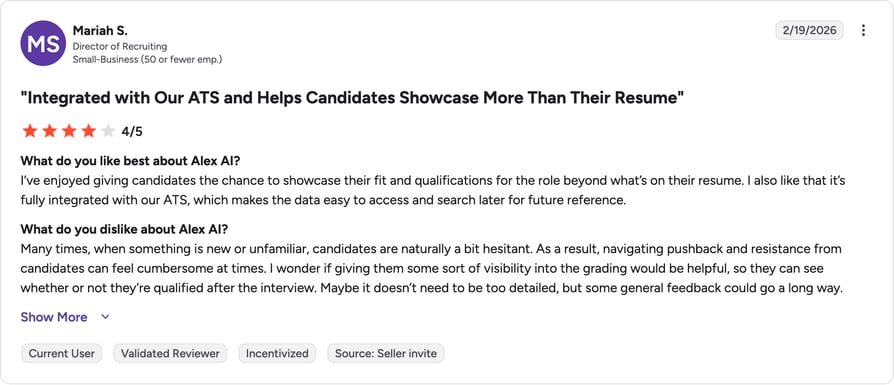
| Resume fit scores plus direct interviewing lets recruiters concentrate on top-scoring applicants; reviewers report higher placement rates | Only 2 reviews on its G2 product page, so there's effectively no review base |
| Consistent screening criteria improves fairness and efficiency, according to reviewers | Reviewers wanted stronger training and rollout support, and leaned on an internal champion to drive adoption |
| Identity verification and fraud detection is documented, which is rare in this category | Scorecard write-back isn't documented, and multilingual coverage isn't verifiable on its own site |
Who Is Alex AI Best For?
Employers whose pipelines have a live candidate-identity problem: proxy interviewing, misrepresented candidates, or remote hiring where you can't verify who answered. It also suits teams who want candidates to choose between a phone call, a video interview and text.
What Is the Pricing of Alex AI?
- Quote-based. Alex AI's pricing page is a 30-minute demo booking calendar. No numbers anywhere on it.
- No published trial, credit allowance or per-interview rate.
- The company has raised $20M, which is worth knowing for a procurement risk assessment.
What Is Alex AI's G2 Rating?
G2 rating: 4.8/5 (28 reviews). Read Alex AI reviews on G2
What Do Customers Say About Alex AI?
Both reviewers on record describe the same benefit: resume fit scores plus AI-conducted interviews let them spend their attention on the highest-scoring applicants while the rest get pre-vetted, and both report better placement outcomes. Consistency of screening criteria comes up as a fairness benefit. The clearest criticism is onboarding, where reviewers wanted more structured training. Treat all of this as anecdote rather than pattern.
When Should You Use Alex AI, and When Shouldn't You?
Use it when interview fraud and candidate identity spoofing is a real risk in your pipeline, or when you want candidates to choose between phone, video and text.
Skip it when you need public pricing, a meaningful review base to judge it on, or verified multilingual coverage. Third-party comparisons claim multilingual interview flows; Alex AI's own site doesn't document them.
How Does Alex AI Score for HR and Recruiting?
| Criterion | Score (/10) |
|---|---|
| Screening depth & question consistency | 8/10 |
| ATS integration & scorecard write-back | 5/10 |
| Interview scheduling & calendar sync | 8/10 |
| Compliance, consent & bias controls | 6/10 |
| Pricing transparency & value at scale | 3/10 |
5. Humanly
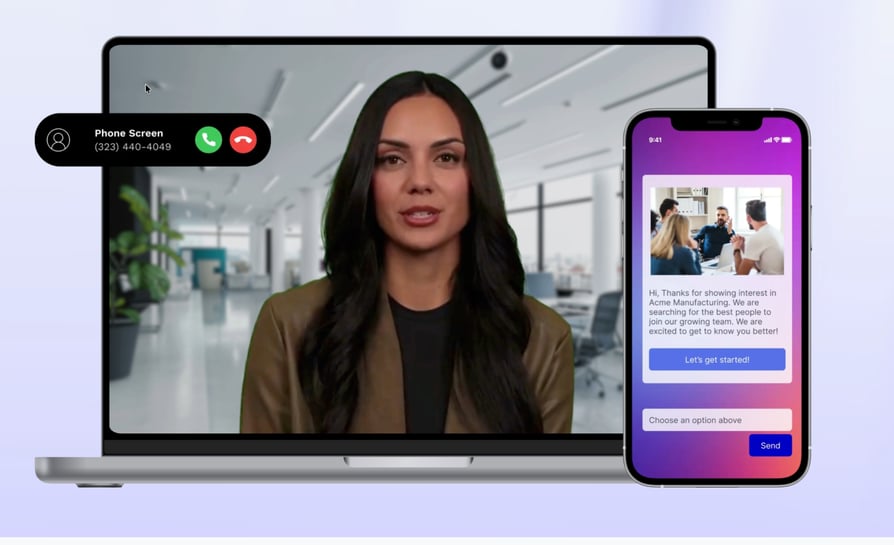
Humanly is AI recruiting software for hourly, frontline and high-volume hiring, and it ships its own ATS and CRM alongside the AI recruiter. Its positioning is explicitly anti-black-box: every recommendation arrives with the transcript and the reasoning behind it. With 115 G2 reviews, it also has the largest review base of the purpose-built platforms here.
Key Features of Humanly
- Hiring managers can see why a candidate ranked where they did. Humanly delivers a ranked shortlist with transcripts and clear reasoning behind every name, rather than a score with no working shown.
- One system covers first message to booked interview. The AI recruiter engages, screens and schedules applicants 24/7 across chat, voice and video, on top of a built-in CRM and ATS.
- Structured interviews stay structured. The AI interviewer runs the same interview at scale, which is the point of moving first-round screening off individual recruiters' calendars.
- Candidates get chased without a human doing it. Automatic follow-up keeps applicants from falling out of the process quietly.
What Are Humanly's Pros and Cons?
| Pros | Cons |
|---|---|
| Responsive support through implementation and afterwards, the most consistent theme across 115 reviews | Pricing is the main drawback reviewers raise |
| User-friendly interface; reviewers report a meaningfully improved recruitment process | Reviewers say it's overkill for purely inbound or very low-volume hiring |
| ATS integration plus custom dashboards give pipeline visibility and support faster decisions | Write-back into a third-party ATS isn't documented the way its native stack is |
Who Is Humanly Best For?
Hourly, frontline and high-volume employers whose hiring managers won't act on a score they can't interrogate. It fits teams that want the transcript and the reasoning attached to every ranked name, and that are open to adopting its ATS and CRM rather than bolting screening onto an existing one.
What Is the Pricing of Humanly?
- Quote-based. There's no public pricing page at all; the URL returns "page not found."
- The only conversion paths on the site are a demo request and a "try an AI interview" experience.
- Because Humanly includes its own ATS and CRM, price comparisons against a screening-only tool aren't like for like.
What Is Humanly's G2 Rating?
G2 rating: 4.8/5 (129 reviews). Read Humanly reviews on G2
What Do Customers Say About Humanly?
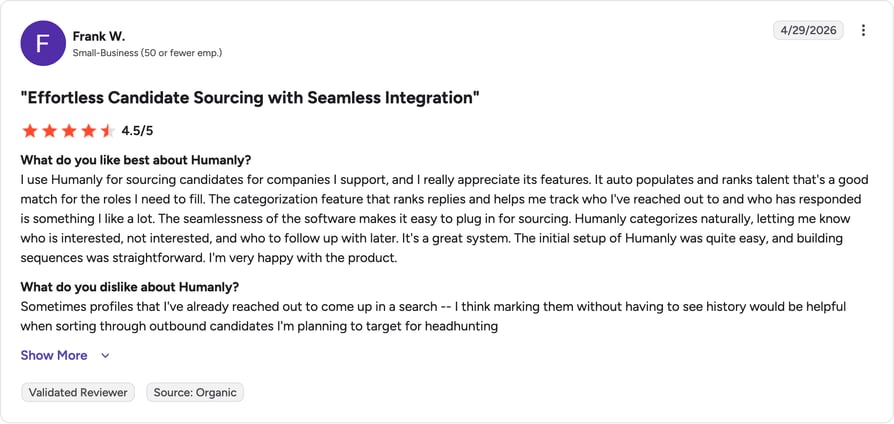
Support is the theme reviewers return to most, during implementation and long after it. The interface gets described as straightforward, and several reviewers tie it to a measurable change in how their recruiting process runs rather than a vague efficiency gain. Dashboards and pipeline visibility come up as the reason hiring managers stayed bought in. Price is the recurring objection.
When Should You Use Humanly, and When Shouldn't You?
Use it when you hire hourly or frontline staff at volume and your hiring managers want to see the evidence behind a shortlist before they'll trust it.
Skip it when your hiring is low-volume or purely inbound, which its own reviewers say plainly, or when you're committed to an existing ATS and don't want a second system holding an opinion about your pipeline.
How Does Humanly Score for HR and Recruiting?
| Criterion | Score (/10) |
|---|---|
| Screening depth & question consistency | 9/10 |
| ATS integration & scorecard write-back | 7/10 |
| Interview scheduling & calendar sync | 8/10 |
| Compliance, consent & bias controls | 7/10 |
| Pricing transparency & value at scale | 3/10 |
6. CloudTalk: Best for HR and Recruiting Teams Who Need an Integrated Telephony Stack
CloudTalk is a cloud phone system, and its AI Voice Agent (internally CeTe) is the layer that handles autonomous conversations on top of it. For recruiting, that changes what the agent can do: it answers inbound candidate calls as well as making outbound screening calls, and it can transfer a candidate to a live recruiter on the same line.
Every platform above this point is built for recruiting. This one is built for phone calls and configured for recruiting, which is the standalone voice agent versus integrated system trade-off in its clearest form.
Key Features of CloudTalk's AI Voice Agent
- Candidates who call you get answered. CeTe handles inbound candidate calls around the clock, covering role FAQs, application status and after-hours enquiries, and it runs outbound screening campaigns too. The purpose-built platforms in this list are outbound or asynchronous only.
- A warm candidate doesn't get told to call back. Escalation runs on the same telephony stack as your human agents, so a call CeTe answers and then transfers to a recruiter becomes one continuous CRM record with the AI's notes and recording attached.
- Screening applies your knockout criteria in real time. The agent qualifies applicants against role-specific knockout criteria, then updates your ATS and creates candidate files as the call happens.
- Interviews get booked before the candidate hangs up. CeTe connects to the calendar, offers open slots, locks in the interview and sends an SMS confirmation.
- Language coverage is the widest here. 60+ languages and accents, against 10+ for the only other platform that publishes a count.















What Are CloudTalk's Pros and Cons?
| Pros | Cons |
|---|---|
| Inbound and outbound in one agent, plus 60+ languages and 95+ CRM, helpdesk and ATS integrations, a combination no purpose-built platform here documents | The AI Voice Agent is an add-on on top of a per-seat plan, so your total is plan plus minutes rather than one all-in per-interview price |
| Escalation to a human recruiter on the same stack, with one continuous record | ATS integrations start on the Essential plan, not on Starter |
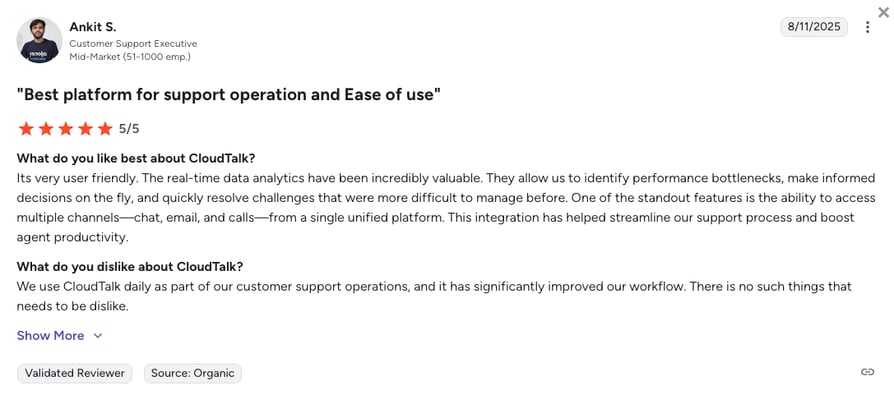
| Trustpilot reviewers consistently name reliable call quality, quick setup and CRM sync, and single out support responsiveness | Structured scorecard write-back into a named ATS's scorecard object isn't documented the way HeyMilo's is, and reviewers say picking a plan without help from sales can be long-winded |
Who Is CloudTalk Best For?
CloudTalk is best for HR, staffing and recruiting teams that need a working phone system as much as a screening agent: candidates who call the number on the job posting, after-hours applicant inquiries, and outbound qualification that has to hand off to a live recruiter mid-call. It's also the fit when HR isn't the only team that wants a voice agent.
What Is the Pricing of CloudTalk?
- Starter: $25/user/month, CloudTalk's baseline plan in every region. Includes interactive voice response (IVR) plus skill and smart condition-based routing.
- Essential: $29/user/month, where the 95+ CRM, helpdesk and ATS integrations, Smart Dialer, and API and data sync become available.
- Expert: $49/user/month, which includes Power Dialer and the advanced Salesforce and Microsoft Teams integrations.
- Custom: contact sales.
- AI Voice Agents are always a paid add-on and are never included in a subscription plan. Pricing is usage-based rather than per seat, starting at $99/month for 200 minutes (AI Receptionist, with the first 50 minutes free in your first month), and from $349/month for 1,000 minutes (AI Specialist, which adds dedicated technical consulting). The published add-on ladder runs $99, $199, $299 and $699, then $349, $749 and $1,249.
- AI Conversation Intelligence is also always an add-on, at $9/user/month billed annually. Power Dialer is included on Expert and costs $15/user/month as an add-on on Starter or Essential.
- 14-day free trial. Full tier detail sits on the CloudTalk pricing page.
What Is CloudTalk's G2 Rating?
G2 rating: 4.4/5 (1,702+ reviews). Read CloudTalk reviews on G2
When Should You Use CloudTalk, and When Shouldn't You?
Use it when you need one system that answers inbound candidate calls 24/7, runs outbound screening, and hands a warm candidate straight to a recruiter on the same line, and when your team needs a business phone system anyway. It's also the strongest option here if you hire across a lot of languages.
Skip it when you want a single all-in per-interview price with no seat licenses, or when your only requirement is asynchronous scored interviews with native ATS scorecard write-back. A purpose-built platform is the tighter fit for that, and HeyMilo documents the write-back behavior more thoroughly.
How Does CloudTalk Score for HR and Recruiting?
| Criterion | Score (/10) |
|---|---|
| Screening depth & question consistency | 7/10 |
| ATS integration & scorecard write-back | 7/10 |
| Interview scheduling & calendar sync | 9/10 |
| Compliance, consent & bias controls | 9/10 |
| Pricing transparency & value at scale | 10/10 |
7. Synthflow
Synthflow builds enterprise voice AI agents with in-house telephony, and it has no recruiting product. You get a visual flow designer, a test harness and a deployment methodology, and you build the screening logic yourself. That's a real option if you have engineering capacity and voice use cases beyond hiring, and a poor one if you don't.
Key Features of Synthflow
- You design the conversation. A visual Flow Designer with multi-agent subflows and API connections, so knockout logic and branching are yours to define.
- You can test before candidates hear it. The Test Center runs simulated calls to measure accuracy, response quality and compliance against your own KPIs, with version rollback if a change regresses.
- Rollout has a documented method. Synthflow publishes a BELL framework (Build, Evaluate, Launch, Learn) and pairs it with auto-QA and monitoring of live conversations.
- Capacity gets scoped up front. Enterprise contracts cover custom concurrency planning, routing, escalation paths and fallback logic. It's the only platform here that names concurrency at all.
What Are Synthflow's Pros and Cons?
| Pros | Cons |
|---|---|
| Ease of use and fast setup; no-code deployment without needing technical expertise, the dominant review theme | No recruiting-specific functionality, so knockout scoring, ATS write-back and candidate workflows are custom build work |
| Genuinely no-code without feeling limited, with drag-and-drop flow logic | Pricing gets steep as usage scales, and the entry point is now $30,000 a year |
| Natural voice quality and smooth integrations | Some reviewers report the AI sounding robotic, with awkward pauses between sentences |
Who Is Synthflow Best For?
Enterprises with engineering capacity and voice use cases beyond hiring, who want to build recruiting logic themselves on their own telephony rather than buy a recruiting product. It is not the fit for an HR team without a developer attached to the project.
What Is the Pricing of Synthflow?
- Enterprise only. Contracts start at $30,000 annually.
- Final pricing is scoped around call volume, concurrency, telephony setup, integrations, security needs and launch support.
- No self-serve tier is published. If you've seen the old $375/month-plus-usage figures quoted in other comparisons, those tiers are gone from the live pricing page.
- For the tier history and how the current contract minimum breaks down, see our breakdown of Synthflow pricing.
What Is Synthflow's G2 Rating?
G2 rating: 4.5/5 (1,000+ reviews). Read Synthflow reviews on G2
What Do Customers Say About Synthflow?
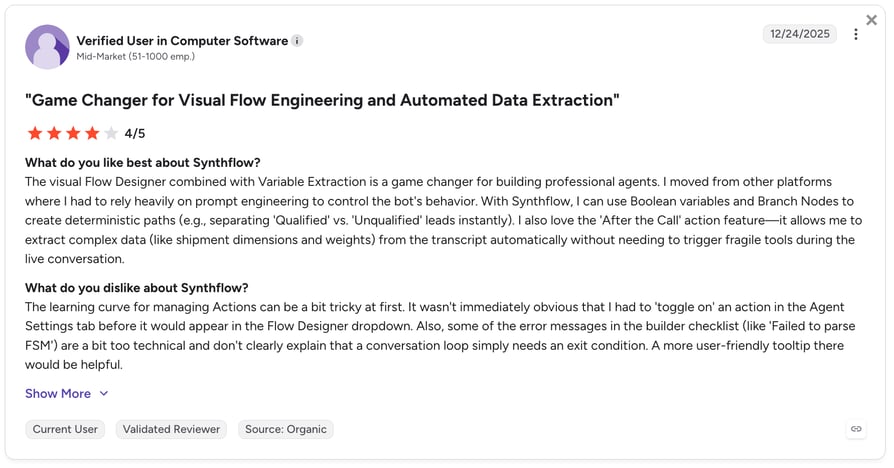
Reviewers cite how quickly they got an agent live without writing code, and several say the drag-and-drop builder didn't box them in the way no-code tools usually do. Multilingual agents come up as something people set up within hours. The criticism splits two ways: cost that climbs with usage, and voice quality that a minority describe as robotic. None of the review themes touch recruiting workflows, because there aren't any.
When Should You Use Synthflow, and When Shouldn't You?
Use it when you have engineering capacity, an enterprise budget, and voice AI use cases beyond hiring, so one platform with your own telephony and a real test harness beats buying a point solution per department.
Skip it when you're an HR team that wants candidate screening working next week. There's no recruiting product to configure, and the entry price is $30,000 a year before you've built anything.
How Does Synthflow Score for HR and Recruiting?
| Criterion | Score (/10) |
|---|---|
| Screening depth & question consistency | 4/10 |
| ATS integration & scorecard write-back | 3/10 |
| Interview scheduling & calendar sync | 4/10 |
| Compliance, consent & bias controls | 5/10 |
| Pricing transparency & value at scale | 4/10 |
8. Paradox (Olivia)
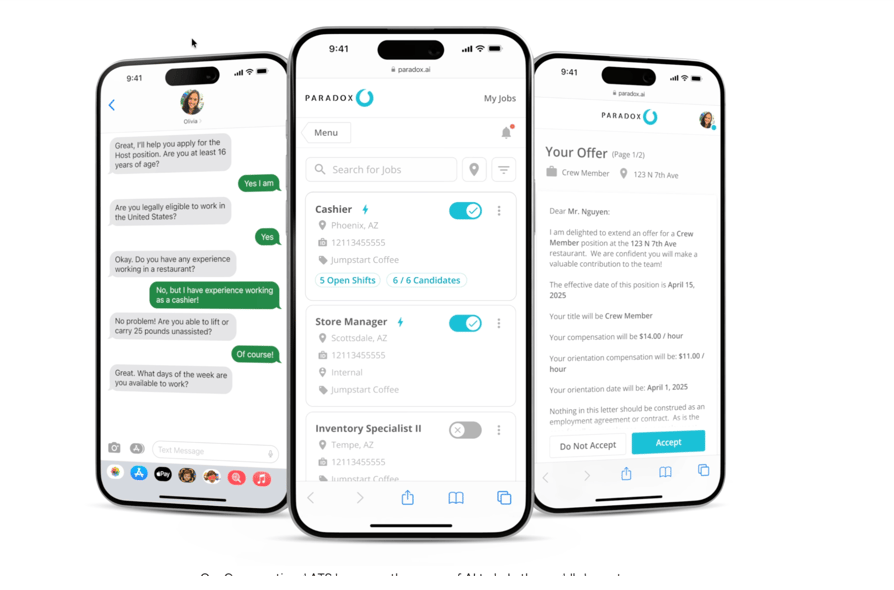
Paradox is conversational hiring software built around an assistant named Olivia, aimed at enterprise high-volume frontline hiring. It handles job search and apply, applicant screening, scheduling and onboarding tasks. One accuracy note before you shortlist it: Paradox's own documentation describes screening through chat or text, not voice.
Key Features of Paradox
- Scheduling is the strongest documented capability in this comparison. Interview scheduling is Paradox's highest-rated feature on G2 at 9.8, and reviewers single it out.
- Qualifications get validated up front. Applicant screening validates important qualifications through chat or text before anyone's calendar gets involved.
- It's built for the enterprise stack you already run. Dedicated SAP SuccessFactors and Indeed Apply products, plus a published partner directory.
- The ATS side holds up. Applicant tracking scores 9.8 and job posting 9.7 on G2.
What Are Paradox's Pros and Cons?
| Pros | Cons |
|---|---|
| Intuitive technology and excellent customer support, with a 9.5 G2 support score and reviewers citing fast response times | Complex tasks can take longer than expected to complete |
| Performance scores 9.5, and reviewers report a smooth experience | Some reviewers raise usability concerns with the conversational interface affecting data quality during candidate interactions |
| Olivia cuts manual scheduling and communication work; reviewers report increased interview rates | Screening is documented as chat and text, so voice screening needs verifying directly with Paradox |
Who Is Paradox (Olivia) Best For?
Enterprise frontline and hourly employers where the bottleneck is scheduling rather than screening quality, especially teams already running SAP SuccessFactors or sourcing heavily through Indeed Apply.
What Is the Pricing of Paradox?
- Quote-based. The pricing URL resolves to the homepage, and every call to action on the site is a demo request.
- No published tiers, per-interview rates or trial.
- Third-party comparisons circulate an estimate of "$1,000+/month enterprise." That's an unverified estimate, and we're not repeating it as a price.
What Is Paradox's G2 Rating?
G2 rating: 4.7/5 (39 reviews). Read Paradox reviews on G2
What Do Customers Say About Paradox?
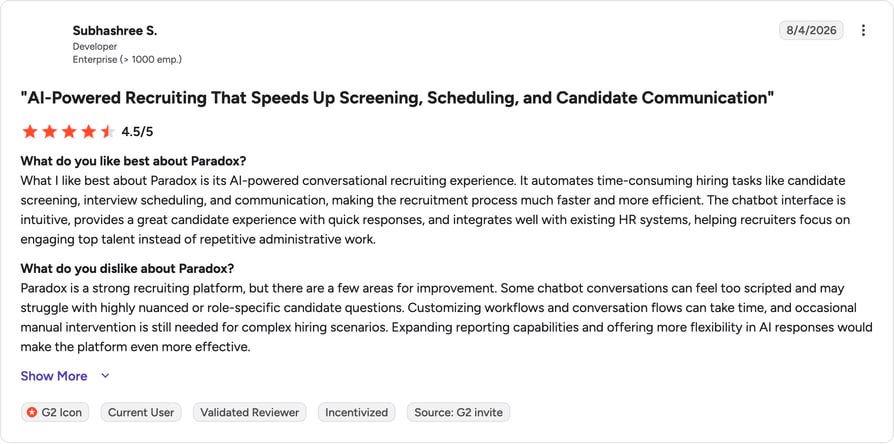
Support and responsiveness are what reviewers praise most, and the numbers back it: 9.5 for support and 9.5 for performance on G2. Scheduling is the capability people describe as transforming their workload, with several reporting more interviews happening as a direct result. The criticisms are narrower: complex tasks that take longer than expected, and a conversational interface that some reviewers say affects the quality of data captured from candidates.
When Should You Use Paradox, and When Shouldn't You?
Use it when you're an enterprise hiring frontline staff at scale, especially on SAP SuccessFactors, and scheduling throughput is the thing actually slowing you down.
Skip it when you specifically need voice screening, since its documented screening runs over chat and text, or when you're a small team, or when you need a published price.
How Does Paradox Score for HR and Recruiting?
| Criterion | Score (/10) |
|---|---|
| Screening depth & question consistency | 6/10 |
| ATS integration & scorecard write-back | 9/10 |
| Interview scheduling & calendar sync | 10/10 |
| Compliance, consent & bias controls | 5/10 |
| Pricing transparency & value at scale | 2/10 |
9. Phenom
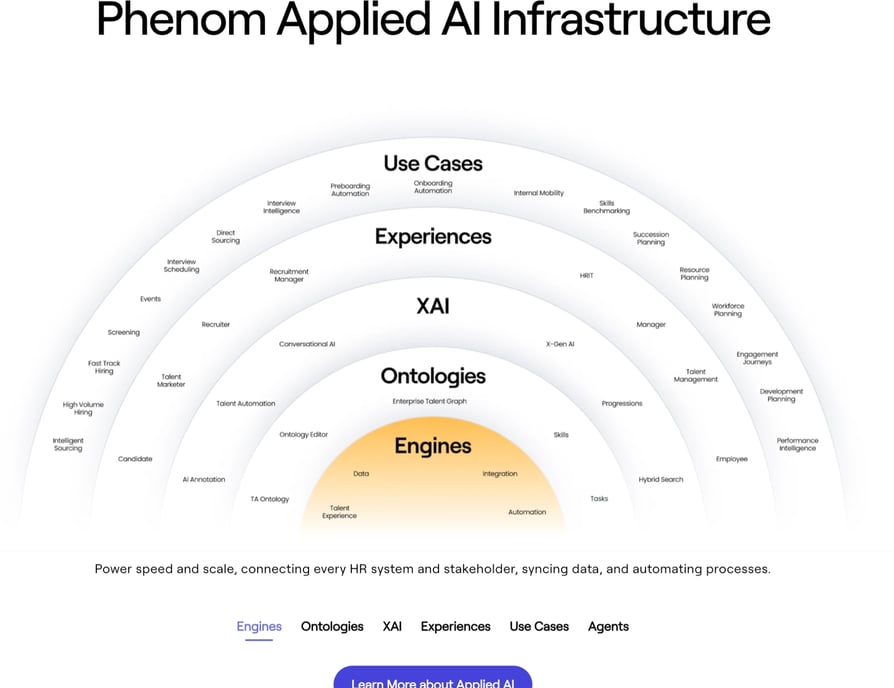
Phenom's Intelligent Talent Experience platform bundles talent acquisition, candidate relationship management, career pathing and AI capabilities, with a Voice Screening Agent shipped to enterprise customers as one module inside it. Among the eight non-CloudTalk platforms here, Phenom has the second-largest review base after Synthflow, and the lowest rating of the nine.
Key Features of Phenom
- Voice screening lives inside the suite. The Voice Screening Agent is a module in the wider platform rather than a standalone product you integrate.
- Internal mobility is covered natively. CRM, career site, career pathing and internal mobility sit in one platform, which matters if you want redeployment outreach and external hiring on the same rails.
- Recruiters get recommendations, and not only records. Actionable analytics surface candidates rather than leaving recruiters to search.
- Governance is published in the open. Phenom publishes human-in-the-loop and governance guidance for voice agents. That's thought leadership rather than a product spec, but it's more than most vendors here offer.
What Are Phenom's Pros and Cons?
| Pros | Cons |
|---|---|
| Ease of use and automation improve recruitment efficiency and candidate engagement | Advanced functionality carries a learning curve for new users |
| Automates repetitive tasks and delivers actionable insights, so recruiters spend less time on admin | Integration with legacy systems can be complex, which slows initial adoption |
| Intuitive interface and data-driven recommendations make it easier to identify strong candidates quickly | Lowest G2 rating of the nine platforms here at 4.3/5 |
Who Is Phenom Best For?
Large enterprises consolidating career site, CRM, internal mobility and screening onto one talent platform, and willing to take a suite implementation to get one candidate record across all of it. It's the wrong starting point if you only want voice screening.
What Is the Pricing of Phenom?
- Quote-based. The pricing page is a "Pricing & RFP Requests" form that routes you to a Phenom expert.
- No published tiers, module pricing or trial.
- Because voice screening is one module inside a suite, expect the commercial conversation to cover the platform rather than the agent.
What Is Phenom's G2 Rating?
G2 rating: 4.3/5 (430 reviews). Read Phenom reviews on G2
What Do Customers Say About Phenom?
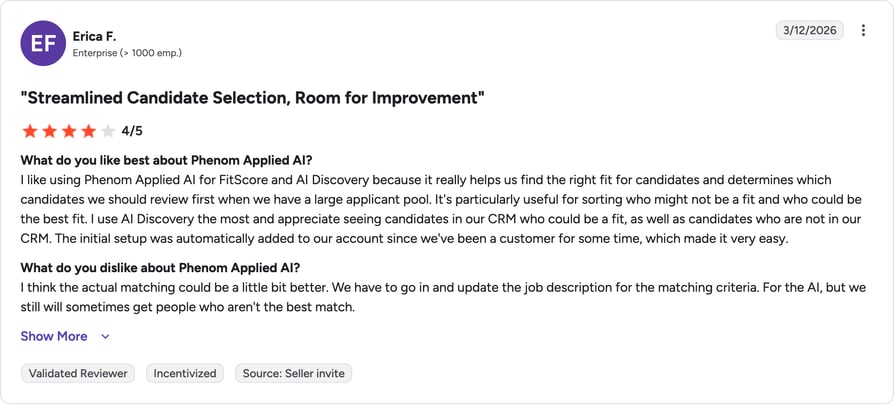
With 430 reviews, the themes are steadier than anywhere else in this list. Reviewers credit the automation with efficiency gains and better candidate engagement, and they like that the platform surfaces recommendations instead of making them dig. The two consistent complaints are both implementation-shaped: a learning curve on the advanced functionality, and difficulty connecting legacy systems, which delays the point at which the platform starts paying for itself.
When Should You Use Phenom, and When Shouldn't You?
Use it when you're an enterprise already consolidating onto a talent suite and you want voice screening governed in the same place as your career site, CRM and internal mobility program.
Skip it when you want voice screening only, you want it live this quarter, or you can't absorb a suite implementation. It's also the lowest-rated option here, at 4.3/5 across 430 reviews.
How Does Phenom Score for HR and Recruiting?
| Criterion | Score (/10) |
|---|---|
| Screening depth & question consistency | 6/10 |
| ATS integration & scorecard write-back | 8/10 |
| Interview scheduling & calendar sync | 6/10 |
| Compliance, consent & bias controls | 7/10 |
| Pricing transparency & value at scale | 2/10 |
AI Voice Agents for HR: Feature and Compliance Comparison
Think of the first table as your quick shortlist and this one as your deep dive. Where you see 'not documented,' the vendor hasn't made that info public—which is a answer in itself, and a great item for your Request for Proposal list. Pay extra attention to language support if you hire globally; verified multilingual support in this category lag way behind the marketing claims."
AI Voice Agents for HR: Feature and Compliance Comparison
| Provider | ATS Integration Depth | Scorecard Write-Back | Interview Scheduling | Languages | Volume Allowance | Human Escalation | Compliance Signals |
|---|---|---|---|---|---|---|---|
| HeyMilo AI | 20+ ATS partners, two-way sync; native assessment partner in Ashby and Greenhouse | Documented: reports, scores, transcripts and recordings into the ATS; some integrations update skills, tags and custom fields | Documented: calendar booking after the screen | Multilingual marketed, count not published | Not published | Not documented as a named capability | Cheat detection; nothing else documented |
| Ribbon | Integrations on all paid tiers; field mapping on Scale, custom mapping on Enterprise | Not documented | Not documented | 10+ on every tier | 100 / 400 / 1,000 interviews per month by tier; unlimited on Enterprise | Not documented; candidates are told a recruiter will review | SOC 2 and security reviews on Enterprise; SAML SSO |
| Classet (Joy) | 100+ integrations, direct or REST API | Partially documented: reviewers describe scores and report links written back | Not documented | Not documented | 50 AI interviews per job per month, then $4 each | Not documented | SOC 2 Type II, SSO, role-based access |
| Alex AI | Reads from the ATS for talent rediscovery | Not documented | Documented: books qualified candidates onto team calendars | Not verifiable on its own site | Not published | Not documented as in-call transfer | Identity verification and fraud signals with explanations |
| Humanly | Own ATS and CRM; third-party integrations cited by reviewers | Native inside its own stack; third-party mechanism not documented | Documented: engages, screens and schedules 24/7 | Not documented | Not published | Documented: ranked candidates with transcripts go to a human decision | Explainability-led positioning; no bias audit feature documented |
| CloudTalk | 95+ CRM, helpdesk and ATS integrations from Essential, plus API, webhooks and Zapier | Documented: updates the ATS and creates candidate files in real time. Not scorecard-object write-back | Documented: calendar connection, slot offering, booking, SMS confirmation | 60+ languages and accents | Bounded by the minutes in your AI Voice Agent add-on bundle | Documented: transfer to a recruiter on the same telephony stack, one continuous record | GDPR and HIPAA compliance and encrypted lines claimed by the vendor |
| Synthflow | Custom build via API and webhooks; no ATS product | Not applicable, custom build | Calendar integrations in scope; no recruiting scheduling product | Multilingual agents documented, count not published | Not published; concurrency planning is scoped per contract | Documented as an enterprise scoping item | Test Center measures compliance against your own KPIs; auto-QA on live calls |
| Paradox (Olivia) | ATS functionality scores 9.8 on G2; deep SAP SuccessFactors integration | Not documented | Documented and highest-rated in this set (9.8 on G2) | Global deployments, count not published | Not published | Not documented as a named capability | Not documented |
| Phenom | Enterprise ATS and HCM integrations across the suite | Not documented | Part of suite automation, not verified as a discrete voice-agent capability | Global deployments, count not published | Not published | Published human-in-the-loop governance guidance | Governance content addresses disclosure and bias at a principles level |
Before you look at individual tools, there are three industry-wide dirty secrets you need to know about AI voice agents for recruiting:
- They won't tell you how many calls the system can make at once. Every vendor claims they can handle high call volumes. None of them actually publish the maximum number of simultaneous calls their platform can handle. Some limit your total monthly calls, but that won’t tell you if the system will crash on a Monday morning when 200 candidates try to interview at the exact same time. Translation: Get a guaranteed max call limit in writing before buying.
- None of them can handle complex team scheduling. If you need to book an interview with just one recruiter, these tools do fine. But if you need to schedule a panel interview with multiple people (like a hiring manager AND a team lead), none of these platforms have proven they can do it automatically. Translation: Plan on coordinating multi-person interviews manually.
- They brag about speed, but nobody backs it up. How fast the AI responds during a phone call determines whether it sounds natural or awkward. Only two companies give exact speeds (Synthflow and CloudTalk) Translation: Test the phone line yourself to see if there's an awkward lag.
AI Screening Compliance: What HR Teams Must Get Right
A recent SHRM survey revealed a massive compliance blind spot: 19 states now regulate workplace AI, but 57% of local HR leaders are unaware of the rules—and only 12% are actually compliant.
We wrote this section to help you bridge that gap. Standard caveat: this isn't legal advice, and vendors can't clear your compliance risk for you—take this to your legal team. While you're at it, ask vendors how candidate voice recordings are stored and retained, as regulators are targeting data privacy next
Does the EU AI Act Cover AI Candidate Screening?
Yes. Regulation (EU) 2024/1689, the EU AI Act classifies AI systems intended for the recruitment or selection of people, including systems that analyze and filter applications and evaluate candidates, as high-risk under Annex III, point 4(a). High-risk classification brings obligations around risk management, data governance, documentation, human oversight and transparency.
On timing, Article 113 states the Regulation applies from 2 August 2026, with listed exceptions: Chapters I and II applied from 2 February 2025, several chapters from 2 August 2025, and Article 6(1) with its associated obligations from 2 August 2027. If you screen candidates in the EU, the main body of the Regulation is live now rather than pending.
What Does New York City's Local Law 144 Require?
Local Law 144 of 2021 prohibits an employer from using an automated employment decision tool unless three conditions are met: the tool has had a bias audit within one year of its use, the audit results are publicly available, and required notices have gone to employees and candidates. New York City's Department of Consumer and Worker Protection began enforcement on 5 July 2023, and clarified in June 2023 that notice must be given 10 business days before the tool is used.
Whether a given screening tool meets the law's definition of an automated employment decision tool turns on whether it substantially assists or replaces discretionary decision-making. That determination is the employer's to make, and no vendor in this list documents a bias audit as a product feature.
Does Illinois's Video Interview Act Apply to Voice-Only Screens?
Not clearly, and that is the honest answer. The Illinois Artificial Intelligence Video Interview Act (820 ILCS 42) is written around video, and it requires employers to notify applicants that AI may be used to analyze a video interview, explain how the AI works and what characteristics it evaluates, and obtain consent before the interview. It bars evaluating applicants who haven't consented, requires deletion of videos within 30 days of an applicant's request, and requires demographic reporting where AI analysis alone decides who gets an in-person interview.
Read the scope carefully. The statute covers employers who ask applicants to record video interviews and who use AI analysis of those videos. Whether it reaches a voice-only AI phone screen isn't established in the statute's text, and we couldn't find an authority extending it there. Plenty of articles in this category flatten that into "Illinois requires consent for AI interviews." The safer practice, and the one we'd recommend, is to get consent anyway.
What Must You Disclose to Candidates About AI Screening?
In many jurisdictions, disclosure is mandatory, and the duty falls on you as the employer rather than on the vendor. The awkward part is that not one of the nine platforms documents candidate consent capture or AI disclosure as a product feature: no call-start announcement, no logged consent record, no audit trail you could hand to a regulator.
The EU AI Act's transparency requirements and New York City's 10-business-day notice rule both land on the employer. So put disclosure in the RFP. Four questions worth asking every vendor:
- Does the agent state at the start of the call that the candidate is speaking with an AI system, and can we edit that wording?
- Is the candidate's consent recorded as structured data we can export and retain, or only as audio?
- What happens if a candidate declines, and can they be routed to a human recruiter instead of dropping out of the process?
- Has this product been through a bias audit, and can we see the results?
Weigh a vendor who won't answer those in writing accordingly.
How to Choose the Right AI Voice Agent for HR and Recruiting
What is the first step in picking an AI voice agent?
Define your exact workflow step-by-step before booking a single demo.
"We want AI screening" is a vague wish—and every vendor will claim they do it. Instead, map out the precise sequence you need. For example: "Candidate submits an application $\rightarrow$ receives a call within 10 minutes $\rightarrow$ answers 5 knockout questions $\rightarrow$ books a calendar slot $\rightarrow$ transcript syncs to Greenhouse."
Having a concrete specification tells you instantly which product category to shop in:
- Inbound calls: If candidates call you back expecting answers, you need an AI call center agent.
- Outbound screening: If the flow is strictly one-way (you calling them), a purpose-built screening platform will give you a cleaner setup.
Do Results Land in Your ATS or in Another Dashboard?
Usually, no—at least not in the clean, automated way vendors advertise.
While almost every vendor claims ATS integration, very few document what data actually transfers, where it lands, or whether it updates a scorecard, a note, or a custom field. If you run a staffing agency with a separate CRM, check this twice: screening data is useless if it lands somewhere your consultants never look.
The Fix: Ask the vendor for a live screenshot or quick demo showing a completed interview inside your specific ATS setup. If your recruiters have to log into a separate vendor dashboard to read notes, you've added extra work instead of automating it.
What Is the Real Cost per Screened Candidate?
The true cost is your total monthly spend divided by completed interviews—not the advertised sticker price.
Base platform fees can be deceiving. To find your actual cost per hire, calculate your total projected spend against an 8-minute call average at your real monthly candidate volume.
For context, the math below evaluates a baseline of 200 completed screens per month using published vendor rates. (If you want to plug in your own numbers, run your volume through our [AI Voice Agent ROI Calculator].)
Cost per Screened Candidate at 200 Screens a Month
| Provider | Published price used | Cost at 200 screens/month | Per screen |
|---|---|---|---|
| Ribbon | Business, $999/month, 400 interviews included | $999 | $5.00 (drops to $2.50 if you use all 400) |
| Classet (Joy) | $700/month per job, 50 interviews per job | Four jobs at 50 each: $2,800. One job with 150 overage at $4: $1,300 | $14.00 spread across four jobs, $6.50 concentrated in one |
| CloudTalk | AI Voice Agent add-on, $349/month for 1,000 minutes, plus a per-seat plan from $25/user/month | 200 screens at 8 minutes is about 1,600 minutes, above the entry Specialist bundle | About $2.79 per screen at that bundle's effective rate of roughly $0.35 a minute, plus seat licenses. 1,600 minutes exceeds the bundle, so you'd move up a rung, and the allowances on the $749 and $1,249 rungs aren't published. Ask |
| Synthflow | $30,000/year floor, before any recruiting logic is built | $2,500/month | $12.50, plus build and maintenance cost |
Who Talks to Candidates After the AI Does?
Deloitte's 2026 Global Human Capital Trends report found that while 60% of executives now use AI in decision-making, just 5% say they manage it well, and only 6% of leaders say they're making progress on designing human-AI interactions. In hiring, that gap shows up as an unowned handoff.
Decide in advance who picks up a candidate the AI couldn't qualify, who handles a candidate who asks a question the agent can't answer, and whether the candidate can reach a person at all. Two capabilities are worth separating: a human reviewing the transcript afterwards, which most platforms offer, and a live transfer mid-call, which only a couple document. If it's the second one you need, the underlying call routing has to know which recruiter is free before the agent promises anything.
What Can an AI Voice Agent Not Do?
SHRM's research on non-technical barriers to HR automation found that 72% of HR professionals believe those barriers would prevent full automation of their HR function even if every technical barrier disappeared, and 87% of that group point to the preferences of HR's own customers, including job applicants. Legal and regulatory barriers came second at 57%.
AI voice agents are good at repeatable first-touch work: the same questions, the same order, at any hour, in any volume. They're the wrong tool for assessing a senior candidate's judgment, for selling a role to someone who has three other offers, for negotiating compensation, or for making the hiring decision. Those conversations still need a recruiter with a script they wrote themselves, which is why good cold calling scripts for recruiters don't stop mattering once an agent handles the first round. Even the field experiment that produced the strongest evidence in favor of AI screening had human recruiters evaluating every interview and making every call.
Key Features to Look for in an AI Voice Agent for HR
- Two-way conversation, not a phone tree. The agent should understand intent, ask follow-up questions and handle a candidate who answers out of order. If it's IVR call routing with a nicer voice, candidates will hang up.
- Documented ATS write-back. Specifically: what object it writes to, which fields it updates, and whether it triggers on stage entry.
- Scheduling that closes the loop. Offering slots, booking the interview, and sending a confirmation the candidate will actually see, usually by SMS.
- A defined escalation path. Live transfer to a recruiter, a callback queue, or at minimum a documented fallback when the agent can't handle the conversation.
- Language coverage you can verify. A published count, not "multilingual." Two of the nine platforms here publish a number.
AI Voice Agent Recruiting Use Cases: What Can It Actually Automate?
Outbound First-Round Screening Calls
A candidate applies, and the agent calls within minutes to run the same qualifying questions every applicant gets: availability, location, certifications, right to work, salary expectations, whatever your knockout criteria are. This is what automated candidate screening software does when it runs on a phone line instead of a form. The output is a transcript, a score and a recommendation that a recruiter reviews. Consistency is the underrated benefit, because it makes candidates comparable in a way that eight recruiters' phone-screen notes never are. The mechanics are the same ones that improve cold calling with AI voice agents on the sales side, pointed at applicants instead of prospects.
Inbound Candidate Inquiries
Almost every platform in this category treats voice AI as outbound, which leaves the calls candidates make to you unanswered. Applicants ring the number on the job posting to ask about shift patterns, pay bands or where their application went, and after hours that call goes to voicemail. An agent on your actual phone system answers around the clock, handles role FAQs and application status, and transfers anyone worth a recruiter's time. That's after-hours call handling applied to a candidate pipeline, and CloudTalk's AI Voice Agent covers both directions on one stack, which is why it sits differently in this list from the purpose-built screening tools.
Interview Scheduling and Calendar Booking
Scheduling is the highest-volume administrative task in recruiting and the easiest to automate cleanly. Automated interview scheduling AI works through four steps:
- Reads live availability. The agent queries the recruiter's or hiring manager's calendar rather than a static list of slots.
- Offers open slots mid-call. It reads back two or three real times while the candidate is still on the phone.
- Books the slot the candidate picks. The event lands on the interviewer's calendar with the candidate's details attached.
- Confirms by SMS. The candidate gets the time and joining details in writing, which is where most no-shows get prevented.
The failure mode to watch is panel scheduling, which no vendor in this comparison documents.
High-Volume and Seasonal Hiring Campaigns
Warehouse peaks, retail seasons, campus intakes and new-site openings all produce more applicants in three weeks than your team can phone in three months. This is where AI screening earns its keep, and it's the context the strongest evidence comes from: the Jabarian and Henkel field experiment ran in customer-service hiring at high volume. Whatever you buy has to hold up under high call volume rather than in a demo, so check the volume allowance in your contract before the peak, not during it.
Candidate Nurturing and Status Updates
Silence is the most common complaint candidates have about hiring, and it's usually a capacity problem rather than a policy one. It's also an employer branding problem, because the candidates you ghost tell other candidates. An agent can call or message candidates who are still in play with a status update, re-engage a talent pool when a similar role opens, and confirm whether someone who applied six weeks ago is still looking. Automating the update doesn't mean nobody owns the relationship, so decide who the candidate reaches when they want a real answer.
Internal Mobility and Redeployment Outreach
Most teams forget this one. When a contract ends, a site closes or a role is restructured, someone has to call the affected employees and work out what they'd move to. Here a voice AI hiring agent is talking to an employee rather than an applicant, which changes the tone but not the mechanics: it runs that first conversation at scale, captures preferences, availability and location constraints, and routes anyone who wants to talk to a person straight to HR. Given how directly this touches employee engagement, it's the use case where AI disclosure and a fast human escalation path matter most.
Quick Answers on AI Voice Agents in HR
What Is an AI Voice Agent for Recruiting?
An AI voice agent for recruiting is software that holds a two-way phone conversation with candidates instead of following a menu tree. It asks qualifying questions, understands the answers, records a transcript and score, and takes actions like booking an interview or updating your ATS. It handles first-touch screening and scheduling, then hands the shortlist to a recruiter who makes the hiring decision.
Can an AI Voice Agent Conduct First-Round Candidate Screening Calls?
Yes, and that's the main reason teams buy one. The agent calls applicants, asks your knockout questions in the same order every time, and returns a transcript, a score and a recommendation. In the 70,000-applicant field experiment run by economists Brian Jabarian and Luca Henkel, applicants screened this way were 12% more likely to receive an offer, with human recruiters still evaluating every interview.
How Does an AI Voice Agent Schedule Interviews Automatically?
The agent connects to your calendar, reads real availability, and offers open slots to the candidate during the screening call. When the candidate picks one, the agent books it and sends a confirmation, usually by SMS. That's the same booking logic behind any call scheduling software, applied mid-conversation. Multi-interviewer panel scheduling isn't documented by any of the nine platforms we reviewed.
What Are the Best AI Tools for HR Beyond Voice Screening?
Voice agents cover screening, scheduling and inbound candidate calls. Around them, HR teams commonly run resume-parsing and ranking inside the ATS, interview-scheduling assistants, and note-taking or transcript tools. The capabilities and use cases of AI voice set the boundary: conversation and follow-through are the voice layer's job, and document-level assessment sits in the ATS.
Is It Legal to Use AI Voice Agents for Candidate Screening?
In most jurisdictions, yes, but subject to conditions that vary. The EU AI Act classifies recruitment and candidate-evaluation AI as high-risk, with obligations applying from 2 August 2026. New York City's Local Law 144 requires a bias audit within a year of use, publicly posted results, and notice 10 business days before use. Illinois requires consent for AI analysis of video interviews. Check with counsel.
Do Candidates Have to Be Told They're Talking to AI?
Often, yes, and the obligation sits with the employer rather than the vendor. The EU AI Act carries transparency requirements for high-risk recruitment systems, New York City requires candidate notice 10 business days before an automated tool is used, and Illinois requires notice and consent for AI analysis of video interviews. None of the nine platforms we reviewed documents disclosure or consent capture as a product feature, so ask.
What Do Real Users Say About AI Voice Agents in Recruiting?
Recruiters and HR practitioners talk about these tools candidly in places vendors don't control, and the themes there run ahead of the review sites. Three threads carried most of the substance, and we paraphrase them below rather than quoting individuals. The same three worries came up in all of them.
What Do Recruiters Say About Candidate Drop-Off on AI Screens?
The most consistent worry isn't accuracy. It's what the first interaction signals. In a thread in r/humanresources about a company planning to put AI in front of first-round screening, the practitioner who posted said something important gets lost when a candidate's first conversation is with a bot. Commenters agreed almost unanimously.
Several reported that candidates now abandon applications the moment they see an AI or one-way video step. More than one said they withdraw at that point themselves rather than hand over a recording of their voice and face. A separate run of complaints in the same discussion was about what happens after: candidates who cleared an automated step, then heard nothing for months. The practical read is that drop-off is real, it clusters at the moment the AI step is disclosed, and telling candidates what happens next matters as much as the agent's script.
What Do Practitioners Say About ATS Integration in Practice?
Recruiters who have actually deployed this are far more enthusiastic about the admin layer than the interview layer. In a thread in r/recruiting asking whether anyone has genuinely cut hiring costs with AI tools at scale, the replies describing lasting value were almost all about transcripts, automatic call summaries and auto-filled ATS fields. Several commenters said that's the only part that stuck in their workflow. One practitioner rated voice screening well for high-volume frontline hiring specifically, while pointing to a large employer's rollout that lost strong candidates.
Skepticism about the wider "AI everything" wave ran heavy in that thread, and the integration question people kept returning to was whether a tool would connect to the ATS they already run, not whether it could interview. If you sell into agencies or run one, that maps closely to the same integration debate around staffing agency software: the tool that doesn't write back is the tool nobody uses twice.
What Do HR Teams Say About Getting Compliance Ready?
Very few feel ready. In a thread in r/humanresources on preparing for EU AI Act compliance in hiring, a staffing practitioner said most companies they deal with aren't prepared at all. Then they made a point worth stealing: almost every ATS on the market already does some form of automated screening or ranking, so most HR teams can't say which of their current tools use AI under the hood. Others in the thread worked out mid-conversation that an assessment step they'd already shipped might fall in scope. The advice that emerged was to check what does the scoring, rather than what the vendor calls the feature. That matches SHRM's finding on state AI rules: awareness, not intent, is the bottleneck.
Top AI Voice Agents for HR and Recruiting by G2 Reviews and Ratings
Every figure below is the score and count each product's G2 profile showed at the time of writing, so check the live profile before you rely on it. Read the table with one more caveat in front of you: review volume in this category is low because most of these products are one to three years old. A 5.0 rating built on two reviews and a 4.3 built on 430 aren't the same kind of number, and the honest comparison is both figures together. For context on how volume-weighted recognition works, CloudTalk's G2 Top 50 Best Software award rests on the same review base you see below.
On that basis, CloudTalk sits at the top on volume, with 1,702+ reviews at 4.4/5. It does not have the highest score. Six of the eight other platforms rate higher, most of them on samples a fraction of that size.
AI Voice Agents for HR and Recruiting Ranked by G2 Data
| Provider | G2 Reviews | G2 Rating | Full Review Link | Read as |
|---|---|---|---|---|
| Alex AI (formerly Apriora) | 2 | 5.0/5 | Alex AI review | Highest rating, effectively no sample |
| HeyMilo AI | 18 | 4.8/5 | HeyMilo AI review | High rating, thin sample |
| Humanly | 115 | 4.8/5 | Humanly review | High rating on the largest sample among purpose-built platforms |
| Classet (Joy) | 9 | 4.7/5 | Classet review | High rating, thin sample |
| Paradox (Olivia) | 39 | 4.7/5 | Paradox review | High rating, modest sample for an enterprise product |
| Synthflow | 1,000+ | 4.5/5 | Synthflow review | High rating on a large sample, but a general voice platform rather than a recruiting one |
| CloudTalk | 1,702+ | 4.4/5 | CloudTalk review | Largest review base in this comparison; reviews mostly cover the phone system rather than the recruiting agent |
| Phenom | 430 | 4.3/5 | Phenom review | Lowest rating, second-largest sample |
| Ribbon | Not retrievable | Not retrievable | Ribbon review | Profile exists; figures couldn't be retrieved at time of writing |
Conclusion: Which AI Voice Agent Should You Choose?
The nine platforms here don't compete on the same axis, which is why there's no single best AI for HR professionals to standardize on. The useful question is which constraint you're solving for: results in your ATS, a price you can budget, calls in both directions, or governance you can show an auditor. CloudTalk's AI voice solutions overview is the starting point if the constraint turns out to be the phone system underneath.
Best for High-Volume Hiring and Staffing Agencies
If your problem is throughput on a small number of repeated roles, per-interview or per-job economics beat per-seat licenses, and published pricing beats a quote you'll renegotiate every year. Ribbon at $2.50 to $5.00 per screen and Classet's per-job model are the two you can model before you commit. Check the volume allowance against your peak, and price the overage. Agencies should also weigh what the calling layer underneath costs them, because VoIP for recruiting firms is the line item that carries both candidate and client conversations.
Customer story: Hiredly (recruitment and HR services). Hiredly runs a job portal and a full-service recruitment agency in Malaysia. On the commercial side of that business, CloudTalk's dialing, automatic activity logging and lead routing helped them reach 100% lead follow-up and compress a sales cycle from more than two months to two weeks. Read the Hiredly story
Best for HR Teams Without Engineering Support
If nobody on your team is going to build conversation flows, rule out the general-purpose platforms that expect you to. What you want is a product where screening logic is configuration rather than development: knockout questions you type in, a template you adapt, an agent live in an afternoon. Read up on how to implement an AI voice agent before the first demo, then ask how long setup takes without vendor services and do it yourself in the trial.
Best for Enterprise Talent Acquisition
At enterprise scale the deciding factor is usually the stack you already run, not the agent. Where the calendar is the bottleneck, Paradox is the one vendor here whose scheduling strength shows up in its review scores rather than only in its marketing. Where the goal is one vendor and one candidate record across the whole talent lifecycle, Phenom's suite argument holds, at the cost of a suite implementation and the lowest rating in this comparison.
Best for Defensible, Explainable Screening
Nobody in this category ships a bias audit as a feature, so "defensible" means something narrower: consistent questions asked in the same order, a transcript behind every score, and reasoning a hiring manager can inspect. Humanly's explainability-led approach is the closest thing here, and HeyMilo's write-back puts the evidence on the candidate record where an auditor would look for it. The rest of the defensibility work is yours: notice, consent, human review and documentation.
Best Starting Use Case for Most Teams
Start with the calls you're already failing to answer. For most teams the fastest win is covering the phone line itself: the applicant who dials the number on the posting, the candidate chasing status at 9pm, and the first-touch qualification call nobody has time to make. That's the case for running the agent on the phone system you already need, as CloudTalk does, so an AI conversation can become a human one on the same line without asking the candidate to start again. Smaller HR teams can see the lightest version of that setup on CloudTalk's page for AI voice agents for smaller teams.
Whichever way you go, pick the workflow before the vendor, and keep a recruiter on the end of it.
See what an AI Voice Agent sounds like on your own lines
FAQ: AI Voice Agents for HR and Recruiting
AI handles the repeatable parts of hiring: resume screening, first-round phone screens, interview scheduling and follow-up. Recruiters keep the judgment calls. The established use cases for AI voice agents are screening and booking.
It depends on the constraint: HeyMilo AI for ATS scorecard write-back, Ribbon for published pricing, Classet for per-job frontline hiring, CloudTalk when candidates also call you. Our wider best AI voice agents roundup covers non-HR uses.
Published prices run from $190/week per job (Classet) to $499–$1,999/month (Ribbon) to $30,000/year (Synthflow). CloudTalk's usage-based AI voice agent pricing starts at $99/month for 200 minutes. Five of nine publish nothing.
Generally yes, subject to disclosure, consent and bias-audit rules that vary by jurisdiction. The EU AI Act treats recruitment AI as high-risk; NYC requires a bias audit and 10 days' notice. Also check whether call recording is legal locally.
Yes, on some platforms. HeyMilo documents scores, transcripts and reports landing in the ATS. CloudTalk documents calendar booking with SMS confirmation and real-time ATS updates, the same logic behind appointment scheduling.
Most claim to, and coverage varies. HeyMilo documents 20+ two-way ATS partners, Classet lists 100+, CloudTalk 95+ from Essential. Check your own system, as you would for any Workable integration, before signing.
They answer common questions and escalate, but a live mid-call handoff is rarer than vendors imply. Only CloudTalk and Synthflow document escalation paths, and CloudTalk's runs on the same stack as its call transfers.
CloudTalk trades screening depth for telephony depth. Purpose-built tools score interviews and write scorecards back. CloudTalk answers inbound candidate calls, covers 60+ languages, and brings 95+ ATS integrations.