9 Best AI Voice Agents for Automated Payment Reminders
TL;DR:
We compare nine platforms on compliance controls, right-party verification, pricing model, integrations and audit trail, and say plainly where each is the wrong choice. Every vendor performance figure here is labeled a vendor claim, because none of the nine publishes an audited number.
9 best AI voice agents for automated payment reminders by use case:
- 01Skit.ai: best for pure-play collections agencies with third-party books and a compliance function.
- 02Prodigal: best for loan servicing and first-party collections at portfolio scale.
- 03Fini: best for regulated fintechs that want reminders and support on one per-resolution contract.
- 04Lorikeet: best for complex regulated outbound where escalation quality matters more than dial volume.
- 05Dapta: best for small teams and bilingual English and Spanish books with no developer.
- 06CloudTalk (CeTe): best for AR and billing teams that need reminder calling inside a full business phone system.
- 07Retell AI: best for fast, cheap pilots with transparent per-minute economics.
- 08Bland AI: best for engineering-led teams and on-prem or VPC deployments.
- 09PolyAI: best for brand-sensitive, high-value reminder calls at enterprise scale.
According to the CFPB's 2025 Consumer Response Annual Report1, published in March 2026, the bureau received approximately 387,400 debt collection complaints in 2025, up from approximately 207,800 in 2024. Most of that jump came from credit-reporting disputes about debts consumers did not recognize, not from calling practices, so read it as a signal about scrutiny.
For the team chasing those invoices, the failure is consistency. The same account gets called twice on Tuesday and not at all the following week, the disclosure gets skipped when someone is in a hurry, and nobody can prove afterward what was said. Most teams have tried the obvious fixes, temps before quarter close and an SMS sequence bolted onto billing.
Be clear about what these tools do not do. An AI voice agent does not make consent optional and does not transfer your legal exposure to a vendor. The FCC has confirmed that AI-generated voices are "artificial" under the Telephone Consumer Protection Act, so a reminder call placed by one needs prior express consent.


What Is the Best AI Voice Agent for Automated Payment Reminders in 2026?
The best AI voice agent for automated payment reminders depends on your regulatory position. Skit.ai is strongest for licensed collectors needing Regulation F controls enforced by the platform. CloudTalk suits AR and billing teams wanting an AI voice agent for payment reminders inside an existing phone system. Retell AI is the cheapest pilot.
Three more situations have clear answers. A large first-party book inside loan servicing fits Prodigal. A security review that will not let consumer data leave your infrastructure fits Bland AI, the only vendor here publishing on-prem deployment. And when the overdue account belongs to a customer you cannot afford to annoy, PolyAI optimizes for how the call sounds.
How Did We Choose These AI Voice Agents?
We built this comparison from what each vendor publishes on its own site, checked against primary regulatory sources. Four rules decided what made it onto the page.
- Vendor sites are a verification source, not a citation. Where a vendor's marketing content contradicted its own product pages, we say so and use the product page.
- No accuracy percentages. Not one of these nine publishes a documented right-party-contact accuracy figure, so we replaced the usual "RPC accuracy" column with "RPC verification method".
- Regulatory claims come from regulators, statistics from named institutions. Regulation F points cite 12 CFR Part 1006, TCPA points the FCC's own rulings, PCI points the PCI Security Standards Council, and the state AI disclosure point the enrolled text of Utah S.B. 226. Every figure names the CFPB or TransUnion in the sentence.
- Scores are editorial and we show our work. Each provider gets a 1 to 5 score on collections compliance depth, RPC verification, pricing transparency, integration and write-back, and time to first live campaign. A score reflects what a buyer can verify before signing, so a low one often means "not stated publicly", which is useful in an RFP. We apply the same criteria across the other use cases for AI voice agents we cover, and every entry names the counter-case as well as the case.
Why Trust Our Software Reviews?
For nearly a decade, we've helped over 30,000+ professionals find and implement smarter business communication tools. We've reviewed 200+ software tools across industries, analyzed 5,500+ verified customer reviews from platforms like G2, Capterra, Trustpilot and TrustRadius, and drawn insights from real user discussions on Reddit and Quora.
In the past year alone, we published 1,000+ articles, each one written by humans for humans. Learn how we keep our content integrity and our software review methodology.
Best AI Voice Agent for Automated Payment Reminders: Comparison Table
One table, built to take into a vendor call: the buying summary plus the compliance detail that decides whether a reminder program survives its first audit.
| Provider | Key Features | Best For | Starting Price, Model and Trial | RPC Verification | TCPA and FDCPA Controls Published | PCI-DSS (vendor-stated) | Audit Trail | G2 Rating |
|---|---|---|---|---|---|---|---|---|
| Skit.ai | Collections-only, 50-state rule engine, auto mini-Miranda | Pure-play collections agencies | Quote-based; no trial | Not stated | Auto mini-Miranda delivery and logging, consent and cadence controls, Reg F frequency and quiet-hour checks | Listed, no level | Immutable, 7-year, consumer-searchable | 0.0 (0 reviews) |
| Prodigal | proAgent, PIE context layer, proPay portal, proInsight QA | Loan servicing, first-party collections at scale | Quote-based; no trial | Not stated | "Fully compliant" claimed, no controls named | Not stated | proInsight QA and scorecards; retention not stated | 4.9 (55 reviews) |
| Fini | Voice, chat and email on one agent; per-resolution billing | Regulated fintechs wanting reminders plus support | $3,600/mo (Growth), per resolution; 90-day zero-pay pilot | Not stated | Audit trails and guardrails; no FDCPA-specific controls named | Not listed on Fini's compliance copy | Included; Enterprise adds a decision audit trail | 4.9 (8 reviews) |
| Lorikeet | Phone, SMS, chat, email and WhatsApp resolution; outcome credits | Complex regulated fintech and healthtech outbound | $1,500/mo billed annually, per resolved ticket; no trial | Not stated | Send-time compliance for FDCPA and Reg F, quiet hours, cross-channel opt-out, hardship escalation | Not stated | Automated QA per ticket; retention not stated | 0.0 (0 reviews) |
| Dapta | No-code voice and text agents, WhatsApp calls, EN and ES product | Small bilingual teams with no developer | $99/mo (Pro), credit-based; self-serve signup | Not stated | None published | Not stated | Not specified | Not verified |
| CloudTalk (CeTe) | Payment-reminder template, 60+ languages, sub-800ms latency, your existing numbers and CRM | AR and billing teams inside a full phone system | $25/user/mo plus the AI Voice Agents add-on; 14-day trial, first 50 agent minutes free | Not stated on the product page | STIR/SHAKEN signing, secure recording, recording-consent handling, Call Masking, number blacklisting; no FDCPA cadence engine and no native DNC-list management | "PCI-DSS compliant", no level stated | Transcripts, recordings and AI summaries feed AI Conversation Intelligence (paid add-on) | 4.4/5 (1939+ reviews) |
| Retell AI | Low-code builder plus API, Batch Call, Branded Call ID, Post Call Analysis | Fast pilots and low-code builds | $0.07/min pay as you go; free signup, no platform fee | Not stated | Safety guardrails, PII redaction, opt-out recording, verified numbers; nothing FDCPA-specific | Not listed | Post Call Analysis and AI QA; custom retention on Enterprise | 4.8 (2,600+ reviews) |
| Bland AI | On-prem and VPC deployment, phone-tuned models, Conversational Pathways, version lock | Engineering-led and on-prem regulated builds | $0.14/min, no platform fee; Start tier needs no card | Not stated | None published; Pathways make behavior buyer-implemented | Not stated | Not specified on public pages | 5.0 (11 reviews) |
| PolyAI | Dialog-RSN-1 model, Agent Studio, published payments use case, 99.9% SLA | Brand-sensitive, high-value reminder calls | Quote-based per minute; no trial | Authentication is a named use case; method unspecified | None published | "PCI-DSS compliant" (named, among others) | Analytics page exists; retention not stated | 5.0 (12 reviews) |
- Vendor-published accuracy percentages are unaudited. That includes every RPC, containment and resolution figure any of these companies advertises. We left them out rather than reprint them as facts.
- PCI-DSS levels are set by the card brands, not the PCI Security Standards Council. A vendor saying "we are Level 1" is describing a card-brand validation tier. Ask for a current Attestation of Compliance instead.
- A per-minute price is not comparable to a per-resolution price until you model it against your own non-contact rate, which is why AI voice agent pricing is worth reading as a model rather than a number.
The 9 Best AI Voice Agents for Automated Payment Reminders
One rule governs the list: a vendor claim is labeled as a vendor claim, with the company that made it named in the sentence. Nobody here publishes audited performance data, and several publish marketing content their own product pages contradict.
1. Skit.ai: Best for Pure-Play Collections Agencies
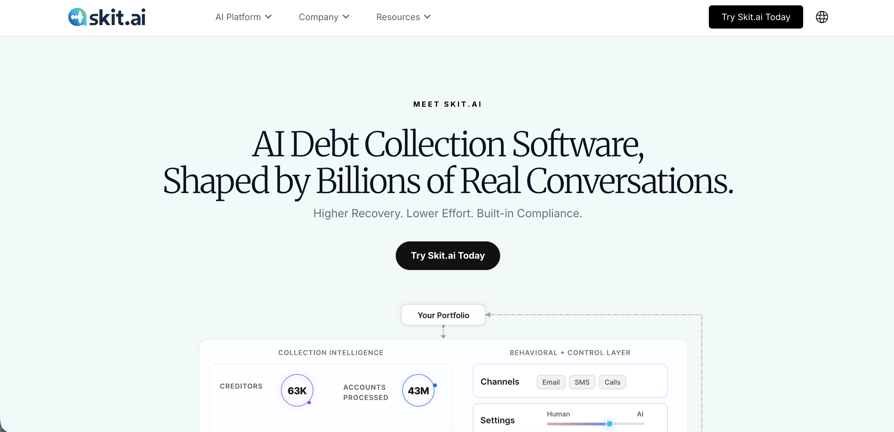
What Is Skit.ai?
Skit.ai is an AI platform built for one job: debt collection. It sells to licensed collectors, not to support teams adding a reminder use case.
Why Is Skit.ai a Strong Pick for Automated Payment Reminders?
- Compliance is the product surface, not a settings tab. It delivers the mini-Miranda automatically and logs it in real time on every call, the way a TCPA-compliant dialer has to enforce rules rather than document them.
- State rules stop being your operations problem. A State Rule Engine applies rules by debtor location across all fifty states, naming California two-party consent, New York's 1+3 rule, Massachusetts' two-calls-per-week ceiling and Utah's AI disclosure duty. Regulatory change monitoring auto-applies new rules as they land.
What Are the Pros and Cons of Skit.ai?
| Pros | Cons |
|---|---|
| The only vendor here built solely for collections, so compliance is native | No published pricing page, and no trial |
| State rule engine and seven-year immutable audit trail are the most testable claims in this set | Overkill for an AR team sending polite invoice reminders |
What Is the Pricing of Skit.ai?
Quote-based, sales-led and unpublished. You can't model cost per resolved account before entering a sales cycle, which is the first calculation this guide recommends.
What Do Customers Say About Skit.ai?
Skit.ai's G2 listing exists but is empty: zero reviews posted as of this writing.
G2 rating: No reviews yet, confirmed via Skit.ai's G2 product page.
When Should You Use Skit.ai, and When Should You Not?
Use it when you are a licensed third-party collector and compliance will be asked to defend every call in writing. Do not use it if you are a first-party AR team chasing your own invoices, or need to size a deal without procurement.
Our scores (1 to 5): collections compliance 5 · RPC verification 2 · pricing transparency 1 · integration and write-back 3 · time to first live campaign 2
2. Prodigal: Best for Loan Servicing and First-Party Collections at Scale
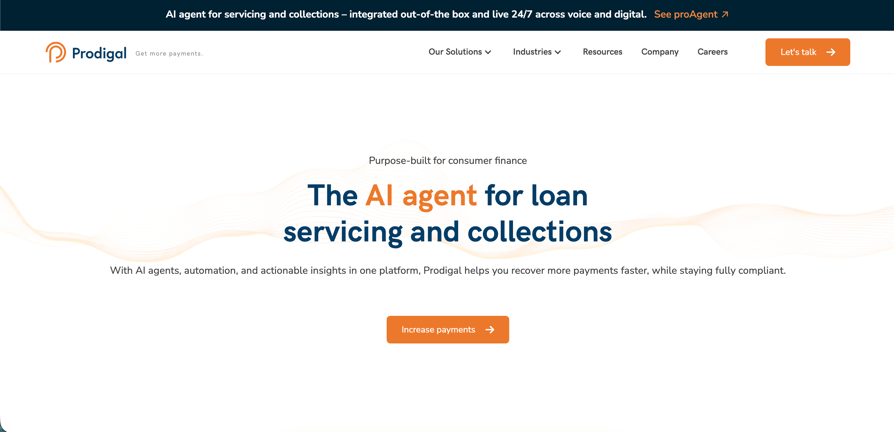
What Is Prodigal?
Prodigal is an AI platform for loan servicing and collections, built around an omnichannel agent plus products for payments, scoring and QA. Its verticals are auto finance, lending, collections and healthcare revenue cycle.
Why Is Prodigal a Strong Pick for Automated Payment Reminders?
- Post-call data is a product here, not a webhook. proInsight ships QA automation and scorecards on the same pattern as call scoring, and proNotes writes standardized call notes in real time, now in Spanish.
- proAgent captures the payment on the call itself. Prodigal states it accepts payments directly across voice, text or email, including partial payments and settlement offers, with proPay as the self-serve portal behind it. proScore ranks accounts on 500+ attributes, so a 5-day-late account stops getting 90-day treatment.
What Are the Pros and Cons of Prodigal?
| Pros | Cons |
|---|---|
| The only vendor here shipping a payment portal, a QA product and a scoring product alongside the agent | No published pricing and no self-serve entry point |
| Purpose-built for consumer finance, with Spanish at the notes layer | Claims "fully compliant" without naming one specific FDCPA control |
What Is the Pricing of Prodigal?
Not publicly listed. There is no pricing page and the only path is a sales conversation; expect an annual contract sized to portfolio volume.
What Do Customers Say About Prodigal?
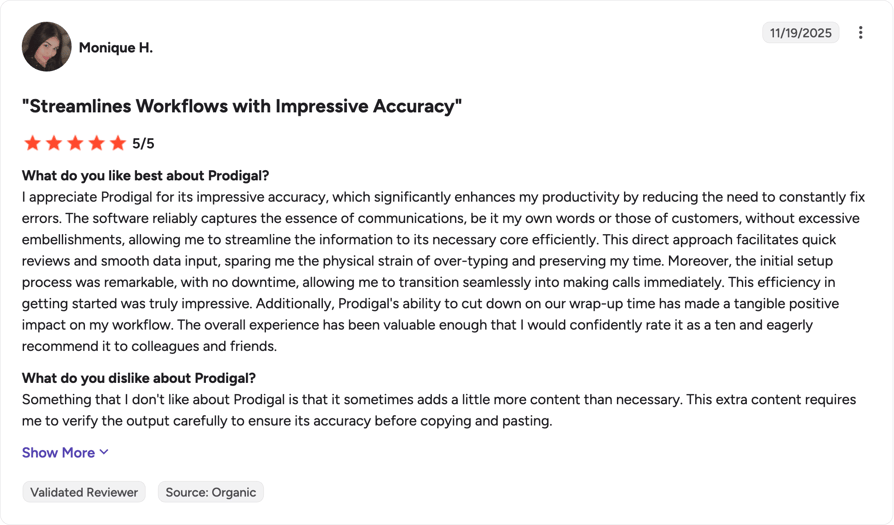
G2 rating: 4.9 out of 5 (55 reviews), per Prodigal's G2 product page.
When Should You Use Prodigal, and When Should You Not?
Use it when you service loans at portfolio scale and want scoring, payments and QA in the same system as the calling. Do not use it if you need reminder calls next month, or want a named control surface rather than a general assurance.
Our scores (1 to 5): collections compliance 3 · RPC verification 2 · pricing transparency 1 · integration and write-back 5 · time to first live campaign 2
3. Fini: Best for Regulated Fintechs Wanting Reminders and Support on One Contract
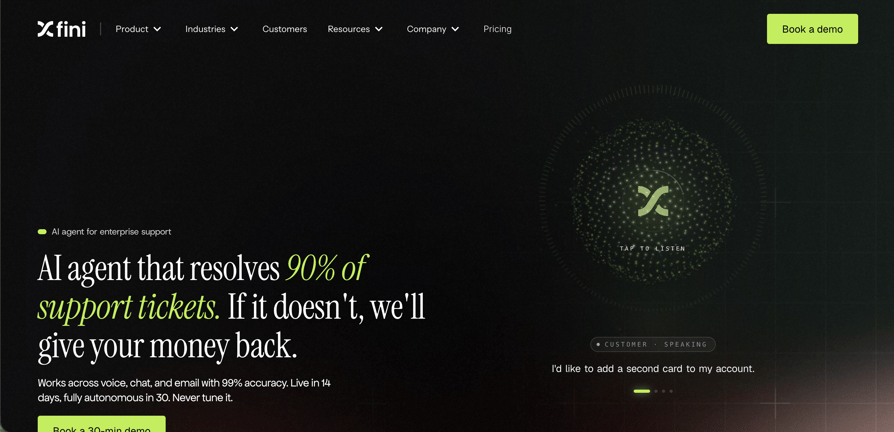
What Is Fini?
Fini handles voice, chat and email on one agent, positioned as the "#1 multi-modal AI agent for enterprise support". Payment reminders are one motion inside a conversational AI software product, and you pay per resolution, not per minute.
Why Is Fini a Strong Pick for Automated Payment Reminders?
- The billing model matches the collections reality. Fini charges per resolved issue and does not bill escalations, which answers the objection collections buyers raise hardest about per-minute pricing.
- The pilot offer is the strongest here: a published 90-day zero-pay enterprise pilot on live traffic, against written resolution, CSAT and accuracy targets. Every plan also carries SOC 2 Type II, ISO 27001, HIPAA and BAA-eligible handling, GDPR and CCPA.
What Are the Pros and Cons of Fini?
| Pros | Cons |
|---|---|
| Cleanest incentive alignment here: per-resolution pricing with free escalations, and a full published price list | Its marketing guide contradicts its own product pages on deployment time, PCI-DSS and accuracy |
| Certifications stated publicly rather than behind a demo request | $3,600/month is the highest published floor here, with no collections-specific control surface |
What Is the Pricing of Fini?
Growth: $3,600/month, 2,000 resolutions, $0.89 overage. Scale: $9,000/month, 8,000 resolutions plus 500 answered voice calls, $0.69 overage. Enterprise: $18,000/month, unlimited resolutions plus 2,500 voice calls, $0.49 overage.
Voice add-on: $0.89 per answered call to 10,000/month, $0.59 to 50,000, $0.35 above; the per-minute alternative runs $0.22, $0.18 and $0.14. Annual billing gives two months free, and no plan charges per seat.
What Do Customers Say About Fini?
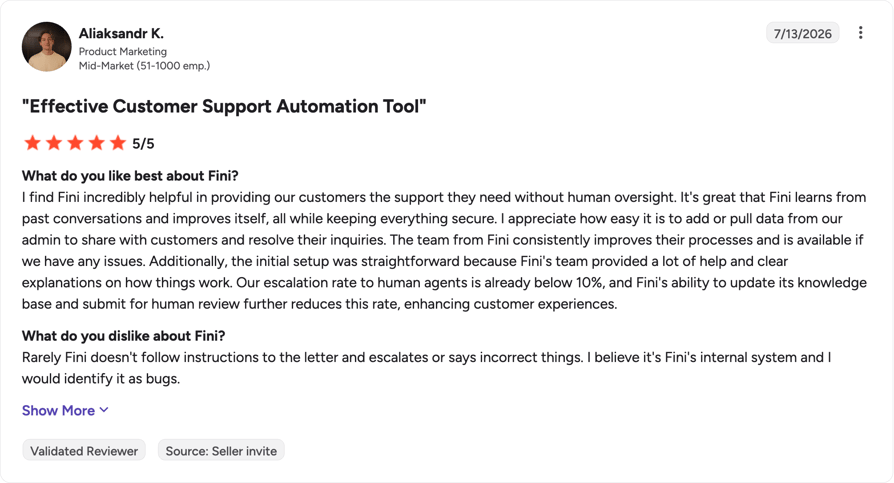
G2 rating: 4.9 out of 5 (8 reviews), confirmed on Fini's G2 product page rather than the homepage badge.
When Should You Use Fini, and When Should You Not?
Use it when a regulated fintech support function also sends reminders and your volume clears the $3,600 floor. Do not use it if reminders are your only use case, your budget is a few hundred dollars a month, or you need documented FDCPA controls.
Our scores (1 to 5): collections compliance 2 · RPC verification 2 · pricing transparency 5 · integration and write-back 3 · time to first live campaign 3
4. Lorikeet: Best for Complex Regulated Outbound Where Escalation Quality Matters
What Is Lorikeet?
Lorikeet calls itself "The AI Customer Concierge for complex companies", built for fintechs and healthtechs resolving problems end to end across phone, SMS, chat, email and WhatsApp. Its value is in what happens when the conversation gets hard.
Why Is Lorikeet a Strong Pick for Automated Payment Reminders?
- You can compute unit economics without a sales call. Lorikeet publishes credit weights per interaction type, so cost per resolved voice interaction comes off the pricing page, and it charges only for successfully resolved tickets.
- Hardship handling is documented, not assumed. It publishes guidance on hardship detection, escalation and cross-channel opt-out: the moments in a collections call script most likely to fail without anyone noticing. WhatsApp, SMS and email run on the same agent, so the payment link needs no second system.
What Are the Pros and Cons of Lorikeet?
| Pros | Cons |
|---|---|
| Most transparent published unit economics here, with outcome-based billing and no seat fees | Voice costs 1.5x to 1.6x a digital resolution, so a voice-heavy program burns the pool fast |
| Real published guidance on send-time compliance, quiet hours and opt-out | Annual commitment, no monthly self-serve entry, and benchmarked against chat agents rather than collections dialers |
What Is the Pricing of Lorikeet?
Start: $1,500/month paid annually, 18,000 credits a year, for under 5,000 monthly tickets. Voice resolution costs 1.50 credits, digital 0.95, tagging 0.30, automated QA 0.30.
Scale: $4,000/month paid annually, 48,000 credits a year, voice at 1.20 credits and digital at 0.80. Enterprise: custom. No free trial, though unsatisfactory tickets are not billed.
What Do Customers Say About Lorikeet?
Lorikeet's G2 listing exists but is empty: zero reviews posted as of this writing.
G2 rating: No reviews yet, confirmed via Lorikeet's G2 product page.
When Should You Use Lorikeet, and When Should You Not?
Use it when reminder calls run into real hardship conversations and opt-out has to hold across five channels at once. Do not use it if your program is voice-only and high-volume, since the credit weighting works against you.
Our scores (1 to 5): collections compliance 3 · RPC verification 2 · pricing transparency 5 · integration and write-back 3 · time to first live campaign 2
5. Dapta: Best for Small Bilingual Teams With No Developer
What Is Dapta?
Dapta is a conversational AI voice and text platform aimed at SMBs, sold mainly as a sales-agent product with a debt collections page. It is bilingual as a company: site, docs and webinars all ship in English and Spanish.
Why Is Dapta a Strong Pick for Automated Payment Reminders?
- It is the cheapest realistic starting point here at $99/month, self-serve, no sales cycle, which makes it a credible first AI voice agent for a small business chasing its own invoices.
- Spanish is real rather than advertised. Product, docs and community run in both languages, which decides whether a Spanish-language reminder call sounds right to the person receiving it. WhatsApp AI calls give a native follow-up channel, and native paths run into HubSpot, GoHighLevel and Salesforce.
What Are the Pros and Cons of Dapta?
| Pros | Cons |
|---|---|
| Lowest published entry price here at $99/month, fully self-serve | No collections compliance surface: no mini-Miranda handling, cadence engine or audit-trail spec |
| Bilingual in product and in company, not a Spanish language pack bolted on | Credit-based pricing makes cost per resolved account hard to model |
What Is the Pricing of Dapta?
Pro is $99/month with 100k credits, unlimited agents and flows and 5 users; Scale Up is $499/month with 500k credits, unlimited users and assisted onboarding; Prime is $1,499/month. A calculator sizes plans by monthly minutes, contacts or messages, which is the only way to compare it to a per-minute vendor.
What Do Customers Say About Dapta?
Dapta's homepage shows a "4.7" without naming the platform it came from. Dapta has no G2 listing, product page or seller page to check that number against.
When Should You Use Dapta, and When Should You Not?
Use it when you are a small first-party AR team with Spanish-speaking customers and want reminder calls running this week. Do not use it if the FDCPA applies to you directly; with no published cadence engine or audit-trail spec, you would be proving those controls yourself.
Our scores (1 to 5): collections compliance 1 · RPC verification 2 · pricing transparency 4 · integration and write-back 3 · time to first live campaign 5
6. CloudTalk: Best for AR and Billing Teams Inside a Full Phone System
What Is CloudTalk?
CloudTalk is a business phone system with an AI calling layer on top, and CeTe is its AI Voice Agent. For payment reminders it ships a pre-built template that confirms payment status, answers questions and offers support. It is not a collections platform; it is the reminder capability attached to the phone system your team already uses.
Why Is CloudTalk a Strong Pick for Automated Payment Reminders?
- No second telephony stack to buy, secure and reconcile. CeTe uses CloudTalk's own numbers, routing, recording and analytics, so a call the agent takes and later transfers lands in the CRM as one continuous record.
- It handles the replies a reminder call really gets. Rather than following a rigid IVR tree, CeTe holds a two-way conversation, pulls answers from a knowledge base, acts in connected systems and escalates only when needed. "I can pay Friday" does not have to become a callback.
- Write-back is native, and setup is not a project. CloudTalk ships 100+ native integrations plus a Workflow Automation Designer, public API, webhooks and Zapier. The CRM, helpdesk and ATS connectors and the API and data sync both start on the Essential plan. Self-Service Configuration builds an agent in under 10 minutes, across 60+ languages and accents at sub-800ms latency.
- Reminders can sit inside a wider recovery workflow, with the human follow-up running on CloudTalk's collections dialer instead of an export to a second tool.
What Are the Pros and Cons of CloudTalk?
| Pros | Cons |
|---|---|
| The reminder agent runs on the phone system, numbers, routing and CRM integrations the team already has | Not a purpose-built collections platform; no published mini-Miranda enforcement, Reg F cadence engine or CFPB-ready export |
| Broadest published language coverage here, with self-service setup, a pre-built template and the first 50 minutes free | The AI Voice Agent is always a paid add-on on top of a per-user plan, and on-call card capture is not described |
What Is the Pricing of CloudTalk?
Platform plans: Starter at $25/user/month, Essential at $29/user/month, Expert at $49/user/month, Custom on request. Free trial: 14 days.
AI Voice Agents are always an add-on, never included in a subscription plan, as is AI Conversation Intelligence. Power Dialer is included on Expert and is a paid add-on on Starter and Essential.
AI Voice Agents add-on: from $99/month for 200 minutes, first 50 minutes free in month one. Budget plan and add-on together; full CloudTalk pricing is published per plan.
What Do Customers Say About CloudTalk?
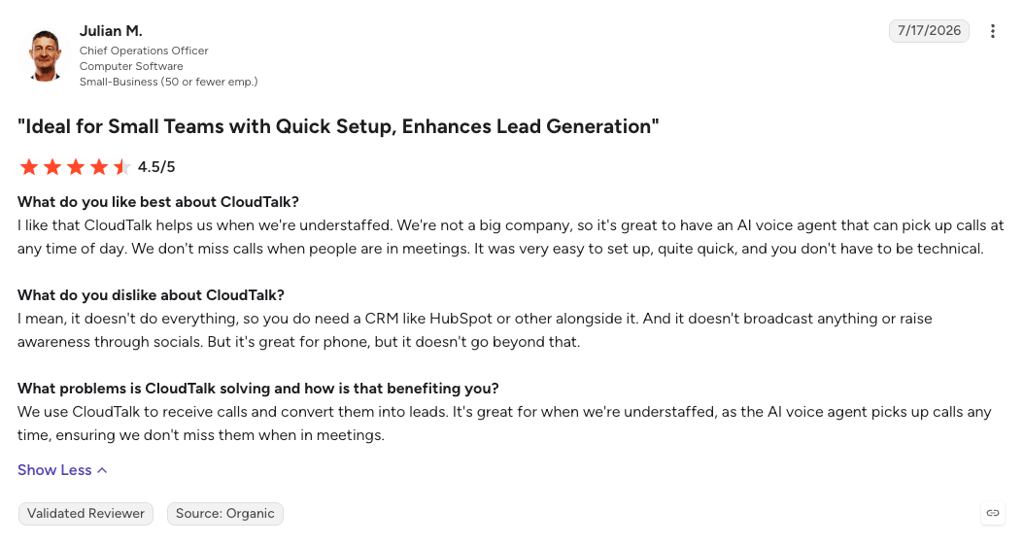
G2 rating: 4.4/5 (1939+ reviews)
When Should You Use CloudTalk, and When Should You Not?
Use it when your team already needs a business phone system and you want the AI's calls, transcripts and CRM records alongside your humans' calls. Do not use it if you are a licensed third-party collector needing the platform to enforce Reg F cadence limits, log the mini-Miranda and produce a CFPB-ready export; those controls are not published.
Our scores (1 to 5): collections compliance 3 · RPC verification 2 · pricing transparency 4 · integration and write-back 5 · time to first live campaign 4
Point the pre-built agent at one aging bucket and test CloudTalk against your real reminder volume with a 14-day free trial.
7. Retell AI: Best for Fast, Cheap Pilots
What Is Retell AI?
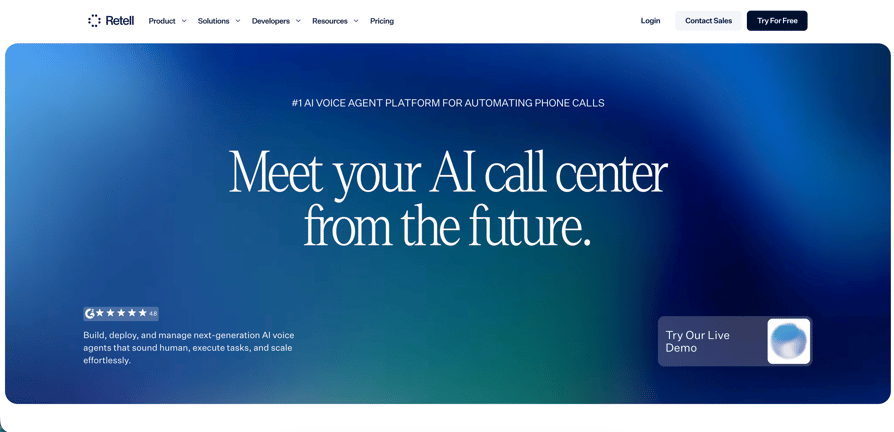
Retell AI is a voice-agent platform for call centers, with a low-code builder, a developer API and a debt collection page. It is model-agnostic: you choose the LLM, the text-to-speech provider and the carrier, and the pricing page itemizes what each costs per minute.
Why Is Retell AI a Strong Pick for Automated Payment Reminders?
- You can model a campaign before signing anything, because every cost component is itemized, from $0.055/minute voice infrastructure to each voice provider's rate.
- The contact-rate problem gets addressed at the carrier layer. Branded Call ID and verified numbers reduce spam flagging, the same lever as branded caller ID, which most vendors here ignore in favor of better scripts. Batch Call handles the volume, and Post Call Analysis and AI Quality Assurance ship as named products.
What Are the Pros and Cons of Retell AI?
| Pros | Cons |
|---|---|
| The most transparent per-minute pricing here, with free signup and no platform fee | Per-minute billing is the model collections buyers object to hardest |
| Branded Call ID and verified numbers tackle answer rates at the network layer | Compliance is generic, and orchestration is your job: reminder logic, suppression lists, dispute routing, write-back |
What Is the Pricing of Retell AI?
Pay as you go: $0.07 to $0.31 per minute depending on the LLM, voice and add-ons, with 20 concurrent calls and free signup. Full Retell AI pricing breaks the components down.
Itemized: voice infrastructure $0.055/min; platform, Minimax, Fish, Cartesia and OpenAI voices $0.015/min; ElevenLabs $0.040/min. Enterprise: custom, no concurrency cap, dedicated server, custom MSA, DPA and BAA.
What Do Customers Say About Retell AI?
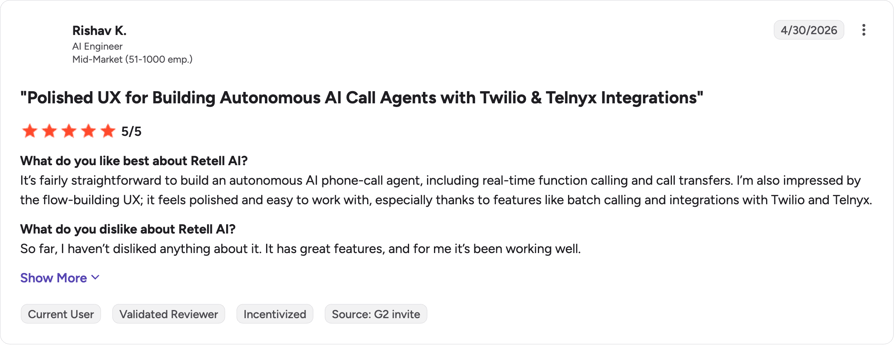
Retell AI's G2 listing is unusually active for how young the product is: 4.8 out of 5 across roughly 2,600 reviews.
G2 rating: 4.8 out of 5 (2,600+ reviews), per Retell AI's G2 product page.
When Should You Use Retell AI, and When Should You Not?
Use it to find out whether AI voice works on your portfolio at all, for a few hundred dollars, before you write a business case. Do not use it as a production collections platform if you are regulated and short on engineering time, and measure your voicemail rate against the meter before committing to volume.
Our scores (1 to 5): collections compliance 2 · RPC verification 2 · pricing transparency 5 · integration and write-back 3 · time to first live campaign 5
8. Bland AI: Best for Engineering-Led and On-Prem Deployments
What Is Bland AI?
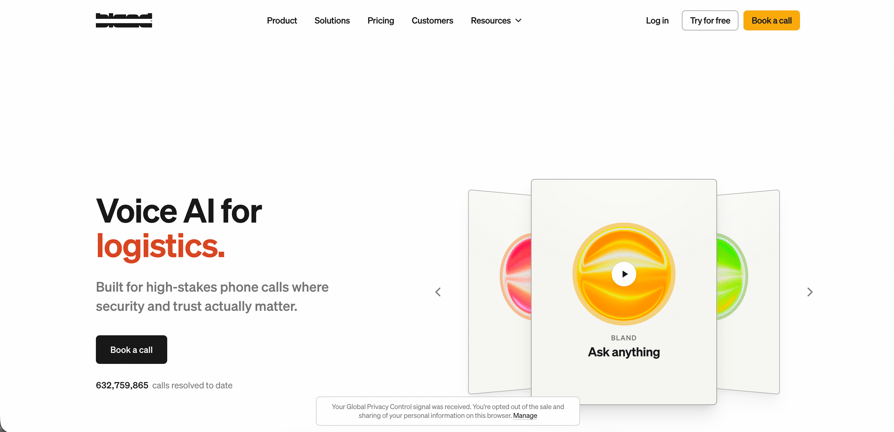
Bland is an enterprise voice AI platform aimed at regulated industries including healthcare, insurance, financial services and logistics. Its pitch is control: it can run entirely on your own infrastructure, every model is built for phone calls, and data does not pass through third parties.
Why Is Bland AI a Strong Pick for Automated Payment Reminders?
- On-prem and VPC deployment is available on Enterprise. No other vendor in this comparison publishes that option, and for some operators it is the only thing that matters.
- Version lock keeps a reviewed agent reviewed. Bland commits that the model, pricing and terms do not change under you, so an agent that passed compliance sign-off does not shift behavior after a model swap. Per-minute pricing is all-in, with speech-to-text, the LLM and text-to-speech inside the rate.
What Are the Pros and Cons of Bland AI?
| Pros | Cons |
|---|---|
| The only vendor here offering on-prem and VPC deployment, with version lock on an approved agent | Infrastructure rather than a collections product: no mini-Miranda handling, cadence engine or CFPB-ready export |
| All-inclusive per-minute pricing with no token charges or pass-throughs | Requires engineering, and published compliance is thin: BAA, SSO and data residency are Enterprise-only |
What Is the Pricing of Bland AI?
Start (developers): $0.14/minute, no platform fee, 10 concurrent calls, 100 calls a day, no card required. See the full Bland AI pricing breakdown by tier.
Build: $0.12/minute plus $299/month, 50 concurrent calls. Scale: $0.11/minute plus $499/month, 100 concurrent calls. Enterprise: custom, contracted to volume.
What Do Customers Say About Bland AI?
Bland AI's G2 reviews live on its product page, not the seller overview page sometimes cited for it, and the two show different numbers. Its homepage counter reads "620,087,028 calls resolved to date," an unaudited company figure.
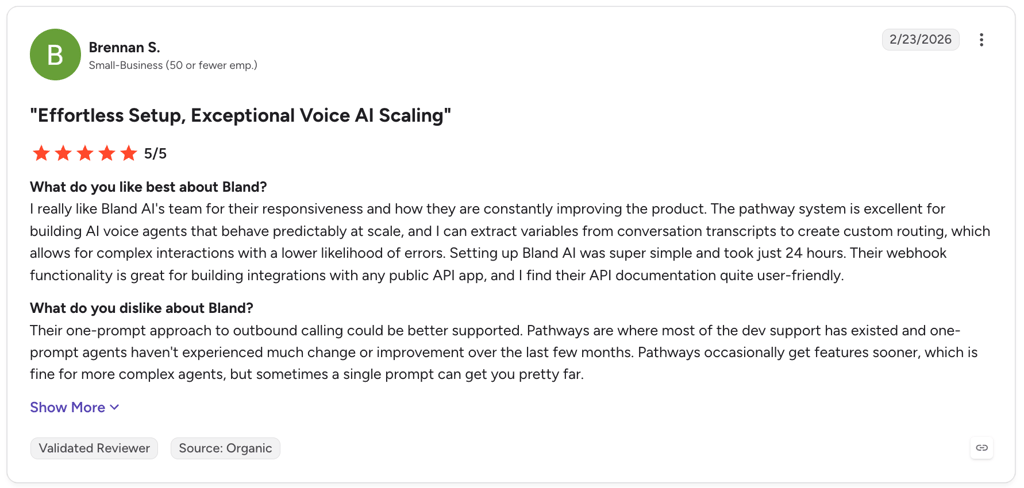
G2 rating: 5.0 out of 5 (11 reviews), per Bland's G2 product page.
When Should You Use Bland AI, and When Should You Not?
Use it when your security posture requires on-prem or VPC deployment and engineers will own the build. Do not use it if you need collections logic out of the box, or you are trying to get a campaign live this quarter.
Our scores (1 to 5): collections compliance 2 · RPC verification 2 · pricing transparency 5 · integration and write-back 3 · time to first live campaign 4
9. PolyAI: Best for Brand-Sensitive, High-Value Reminder Calls
What Is PolyAI?
PolyAI builds what it calls "the world's most lifelike voice AI agents", sold to enterprises. It publishes a billing and payments use case built on securely taking payments over the phone, and names financial services and insurance among its industries. Voice realism is the thesis, backed by a named dialog model, Dialog-RSN-1.
Why Is PolyAI a Strong Pick for Automated Payment Reminders?
- On-call payment capture is published, not inferred. "Securely take payments over the phone" has its own use-case page, which is more than any other vendor here states.
- How the call sounds is treated as the commercial risk it is. When the person 12 days late is worth six figures a year, tone is a commercial variable, not a cosmetic one. Maintenance sits inside the rate, with a 24/7/365 emergency line, a 99.9% uptime SLA and ongoing tuning in the per-minute price.
What Are the Pros and Cons of PolyAI?
| Pros | Cons |
|---|---|
| The clearest published on-call payment capability in this comparison, with monitoring and 24/7 support inside the rate | No published price of any kind, and an enterprise sales motion |
| Voice realism is the product thesis, with a named model and published (vendor-run) benchmarks | Not a collections product, and it names ISO 27001, SOC 2 Type II, HIPAA, PCI-DSS and GDPR rather than any collections-specific control |
What Is the Pricing of PolyAI?
Not publicly listed. PolyAI's pricing page says ongoing use is priced per minute, with performance improvements, maintenance and 24/7 support included, but publishes no number; our own PolyAI pricing breakdown covers what is knowable. There is no free trial, and like Skit.ai and Prodigal it cannot be slotted into a cost-per-resolved-account model until you are already in a sales process.
What Do Customers Say About PolyAI?
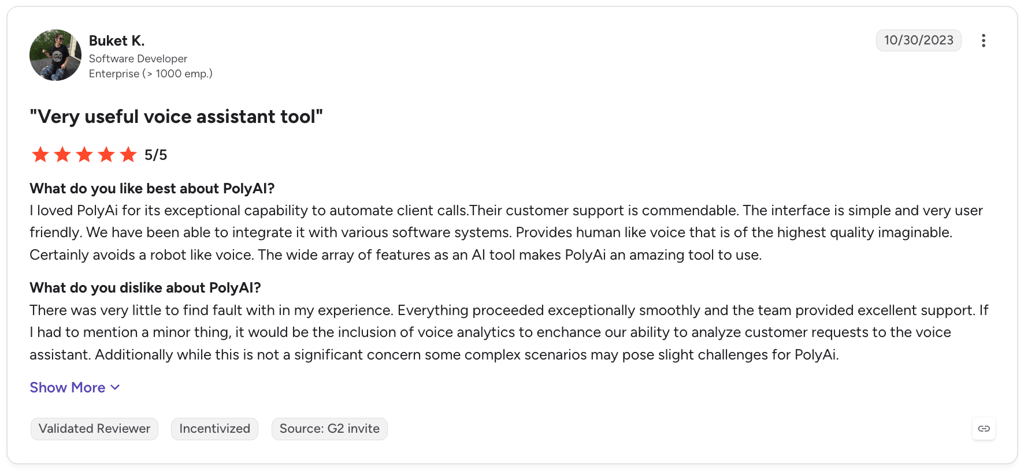
PolyAI's G2 rating is a perfect score, for whatever a 12-review sample is worth. Its published dialog benchmarks are still the company's own, not third-party evaluations.
G2 rating: 5.0 out of 5 (12 reviews), per PolyAI's G2 product page.
When Should You Use PolyAI, and When Should You Not?
Use it when the reminder call is a customer-experience event as much as a collections one and you need card capture on the call. Do not use it if you need a published price, a trial or documented FDCPA controls; its certifications cover general enterprise security, not collections-specific requirements.
Our scores (1 to 5): collections compliance 2 · RPC verification 3 · pricing transparency 1 · integration and write-back 3 · time to first live campaign 2
How to Choose the Right AI Voice Agent for Automated Payment Reminders
Six questions separate a reminder program that survives an audit from one that generates complaints. Work through them in order; the first changes the answer to the rest.
Map the Regulations Before You Map the Workflow
Start with the rules that apply to you, then put one question to every vendor: can the platform block a non-compliant call outright? Discouraging it in a settings note, or flagging it in a report the next morning, is a different product.
Under 12 CFR § 1006.6(b)(1)(i), a debt collector must not call at an inconvenient time, and absent knowledge to the contrary, before 8:00 a.m. or after 9:00 p.m. local time at the consumer's location is inconvenient. The commentary works the multi-time-zone case: a consumer with an Eastern-time mobile and a Pacific-time address can only be called after 11:00 a.m. and before 9:00 p.m. Eastern. Your platform needs to know that, not your operations lead.
Frequency has its own rule. Under 12 CFR § 1006.14(b)(2)(i), a collector is presumed to comply with the harassment prohibition if it places calls neither more than seven times in seven days, nor within seven days after a conversation about that debt. That is a rebuttable presumption, not a license for seven calls.
Disclosure is separate again. Under 12 CFR § 1006.18(e), the initial communication must disclose that you are collecting a debt and that information obtained will be used for that purpose; every later one must disclose it comes from a debt collector. It has to be in the same language as the rest of the conversation, with any translation "complete and accurate", which constrains a bilingual agent.
On top sits the TCPA. The FCC's February 2024 declaratory ruling confirmed AI-generated voices are "artificial" and require prior express consent. Consumers can revoke by any reasonable method and you must honor it within 10 business days; one prong, covering revocations applied to unrelated future messages, sits under an FCC waiver extended to 31 January 2027. And nobody needs one-to-one consent any more: a court nullified that rule and the FCC formally repealed it, effective 29 August 2025, via a Federal Register rule reinstating the pre-2023 version of the consent regulation.
State law bites too. Utah S.B. 226, effective 7 May 2025 and codified at Utah Code § 13-75-103, requires a supplier using generative AI in a consumer transaction to say so when asked, with a prominent verbal disclosure at the start of a verbal interaction in regulated occupations.
One precision point, because vendors get it wrong: STIR/SHAKEN is an obligation on your voice service provider, not on you. You can't "have STIR/SHAKEN"; you can confirm your provider signs your traffic with full attestation and that your numbers are not in a mitigation-flagged range.
Test Right-Party Contact Verification on Your Actual Portfolio
Ignore accuracy percentages. Nobody in this category publishes an audited one, and the numbers that circulate are marketing.
Ask an architectural question instead: when a customer reads back a date of birth or the last four of an account number, is the match done by deterministic back-end logic, or is the language model parsing the digits? Model-driven parsing fails intermittently even when the customer answers correctly, and differently depending on whether they read the number whole or digit by digit. Engineering teams end up asking for discrete values passed to a back-end match. It is one reason an AI voice agent for debt collection is harder to ship than an appointment reminder: verification is load-bearing.
Then test it on your own data. Take 200 accounts from your real portfolio, in your real language mix, and count verification failures where the customer was in fact the right party. That number, not a vendor slide, is your baseline.
Calculate True Cost per Recovered Dollar, Not Cost per Minute
Treat a per-minute quote as one input to a model, never as the price. The output that matters is cost per resolved account, and your non-contact rate dominates it. Collections buyers push back hardest on per-minute billing for this reason: on a book where a large share of dials never reach a person, it charges you for the vendor's failure to connect.
Build the model before the demo. Take your attempt volume, connect rate, average handle time and average recovery per resolved account, then run every vendor's pricing through it. Fini's $0.89 per answered call, Lorikeet's 1.50 credits per voice resolution and Retell's $0.07 to $0.31 per minute give very different answers at a 20% connect rate than at 60%.
Then test the cost controls specifically:
- Does the agent use answering machine detection to hang up before a billable increment elapses, or does it read a 40-second script to voicemail at full rate?
- Does retry logic avoid immediately redialing a number that just went to voicemail?
- Do repeat-voicemail numbers drop into a different treatment list, or keep absorbing attempts at the same cost?
Connect rate is a carrier problem too. IMS kept spam labeling under 1% across hundreds of numbers with CloudTalk, which moves the same denominator every per-minute quote depends on. Read the IMS story.
Can the Agent Reason Inside Hard Business Limits?
Every vendor here answers yes to "can it reason?", so the question sorts nobody. What sorts them is whether the agent reasons inside hard, pre-approved limits, and whether it escalates cleanly at the edge of them.
An agent that improvises an arrangement your business cannot honor has created a problem no recovery lift compensates for. Define the boundary: which payment dates it may offer, which instalment splits, which hardship codes, and what happens the instant a customer asks for something outside that set. Escalation has to be warm transfer with context, not a dropped call and a callback queue.
Script-driven platforms like Bland's Conversational Pathways give deterministic control at the cost of flexibility, the same trade-off as a call flow designer. Reasoning-first platforms give natural conversation but need tighter guardrails. Pick based on how much variance your compliance team can live with.
Which Outcomes Get Labeled, and What Gets Written Back to Your CRM?
This is the criterion nobody on page one covers, and the one that breaks reminder programs six weeks after launch.
If your platform records a voicemail connection as a successful outbound call, your collections reporting is fiction. Ask for the outcome taxonomy in writing: real conversation, voicemail, no answer, busy, hang-up during disclosure, wrong party, refusal, dispute, promise to pay. Then ask what happens to a promise to pay: structured data with an amount and a date, or free text in a summary nobody parses?
Write-back fidelity is the other half. The agent has to return the record identifier for the account it called. A phone number on its own leaves nobody able to update the right account afterward. Ask to see a sample payload and the workflow automation rules that fire it. If the vendor can't produce one before you sign, you're building the reconciliation yourself.
Does the Audit Trail Answer a Regulator and a Monday Morning?
An audit trail has two jobs, and most vendors design for one.
The regulatory job is familiar: retention long enough to satisfy a records request, retrievability on demand, and an export a regulator will accept. Skit.ai is the only vendor here publishing a specification, at seven years, immutable and consumer-searchable. Everyone else has something; ask what it is.
Allycom (financial services) achieved 100% reliable call recording across 100 countries on CloudTalk, which is the unglamorous half of an audit trail: the recording has to exist before anyone can retrieve it. Read the Allycom story.
The operational job is underestimated. Nobody has headcount to listen to AI call volume by hand, so you need continuous automated evaluation confirming the agent stayed inside its script and delivered its disclosures. CloudTalk's conversation intelligence software covers post-call QA on that pattern, always as a paid add-on rather than part of a plan. Retell ships AI Quality Assurance, Lorikeet prices QA per ticket, Prodigal ships proInsight. If a vendor has no automated QA story, you're the QA process.
And a counter-case worth naming. If you run hundreds of thousands of attempts a day against an older, low-quality portfolio where value per account is small and raw volume is the strategy, a predictive dialer is still cheaper per attempt, and the reasoning depth you would pay for has nothing to work with. The AI case gets strong when the conversation is worth having: newer accounts, higher balances, first-party relationships.
Quick Answers
Is It Legal to Use an AI Voice Agent for Payment Reminder Calls?
Yes, with consent. The FCC's February 2024 ruling confirmed AI-generated voices are "artificial" under the TCPA, so these calls need prior express consent. You still owe FDCPA disclosures, Regulation F windows and frequency limits, and any state AI disclosure rule. The platform automates the controls; the liability stays with you.
Can an AI Voice Agent Take a Payment on the Call?
Some can. PolyAI publishes a dedicated payments use case for taking payments securely over the phone, and Prodigal states that proAgent accepts payments directly across voice, text or email. Skit.ai's PCI-DSS design includes tokenized card capture, though it's framed as a security control rather than a headline feature. Most others here do not state on-call card capture at all, routing the customer to a payment link or IVR payments flow instead. Don't infer capture from a Stripe integration; ask for a current PCI-DSS Attestation of Compliance.
What Recovery Lift Should You Expect From AI Payment Reminders?
Nobody credible publishes an audited figure, and the numbers on vendor pages are uncited. What is verifiable is adoption: TransUnion's 2025 Debt Collection Industry Report2 found the share of collections companies adopting or exploring AI rose from 73% in 2024 to 93% in 2025. Model your own case with an AI voice agent ROI calculator.
How Fast Can an AI Payment Reminder Agent Go Live?
Building an agent is fast; going live compliantly isn't. CloudTalk publishes self-service configuration in under 10 minutes, Dapta advertises "2 min to first AI agent", and Fini's pages say 14 to 30 days. Add legal sign-off, consent cleanup, suppression lists and a pilot, and a realistic first campaign is four to eight weeks, as our guide to implementing an AI voice agent sets out.
How Does the Agent Handle a Dispute or a "Stop Calling" Request?
That depends on configuration, and it's the thing to test first. Under the TCPA, consumers can revoke consent by any reasonable method and you must honor it within 10 business days. Ask whether opt-out propagates across every channel and applies instantly to in-flight campaigns, and whether a dispute triggers a hard escalation.
What Does AI Payment Reminder Software Cost?
Published entry points range from $99/month for Dapta's Pro plan to $3,600/month for Fini's Growth plan, with Retell and Bland at $0.07 and $0.14 per minute. Skit.ai, Prodigal and PolyAI publish no pricing. CloudTalk's AI Voice Agents add-on starts at $99/month for 200 minutes on top of a platform plan.
What Do Real Users Say About AI Payment Reminder Software?
Community discussion of this category is thin and often outdated, so treat what follows as directional. In conversations with collections and AR teams evaluating these platforms, four themes recur more than anything on a feature list.
Pricing model beats price. Buyers rarely object to the headline number. They object to per-minute billing on books where most attempts end in voicemail or no answer, and push for per-second billing or a voicemail carve-out.
Compliance has to be enforced, not documented. Teams want prohibited days and hours, holiday calendars, internal no-contact days, time-zone gating and per-campaign attempt caps built in. Relying on operational discipline is what they are trying to stop doing.
Reporting granularity is the first disappointment. Counting a voicemail as a successful call is the complaint that surfaces after launch, along with promise-to-pay data arriving as free text and account identifiers that never reach the system of record. Granular call center analytics and reporting separates a pilot you can evaluate from one you cannot.
Generic demos do not close. Before committing, buyers want to hear the agent in their own language and accent, running their own account scenario.
Top AI Voice Agents by G2 Reviews and Ratings
Vendor-rendered badges on a company's own homepage do not count toward what's below, which is why Fini's "4.9/5" and Dapta's "4.7" stay out even where the G2 number happens to land close by. For a wider view of the category, we keep a general roundup of the best AI voice agents.
| Provider | G2 Rating | Reviews | What Reviewers Highlight |
|---|---|---|---|
| CloudTalk | 4.4/5 | 1939+ | Not verified |
| Skit.ai | 0.0 | 0 | No reviews posted yet |
| Prodigal | 4.9 | 55 | Not verified |
| Fini | 4.9 | 8 | Not verified |
| Lorikeet | 0.0 | 0 | No reviews posted yet |
| Dapta | Not verified | Not verified | Not verified |
| Retell AI | 4.8 | 2,600+ | Easy to customize and iterate on call flows without heavy overhead |
| Bland AI | 5.0 | 11 | Fast to stand up a working voice flow; structured-output extraction takes iteration |
| PolyAI | 5.0 | 12 | Voice realism ("human like voice") and ease of automating client calls |
Thin review coverage is normal for a category this young, which is one more reason to weight your own pilot over anyone else's stars.
Deployment Checklist: Going Live With AI Payment Reminder Calls
Four phases. Don't compress them, and don't let a vendor tell you phase one is their job.
Phase 1: Legal and Data Foundation (Weeks 1 to 2)
- Confirm you hold prior express consent for every number you intend to call with an artificial voice, and document where it came from.
- Have legal draft and sign off the AI disclosure, the recording notice and the mini-Miranda wording, in every language you will call in, and check whether call recording is legal in each jurisdiction. This is a legal deliverable, not a copy task.
- Decide per use case which calls get recorded and processed, and configure it that way rather than defaulting to everything.
- Load your suppression lists: DNC, cease-communication requests, disputes, bankruptcies and attorney representation.
- Map time zones to the consumer's location, not the area code, and encode the Regulation F windows.
Phase 2: Configure the Controls, Then the Conversation (Weeks 2 to 4)
- Set the hard limits first: calling windows and business hours, holidays, internal no-contact days, per-day and per-campaign attempt caps, and the Regulation F frequency presumption.
- Build the identity verification flow and confirm matching happens in deterministic back-end logic, not in the model.
- Define the negotiation boundary: allowed payment dates, allowed splits, and the exact trigger for escalation to a human.
- Configure the outcome taxonomy and the write-back payload, including the account identifier and structured promise-to-pay fields.
- Turn on voicemail detection and retry segmentation before you turn on the campaign, not after the first invoice.
Phase 3: Pilot on Your Own Portfolio (Weeks 4 to 6)
- Run 200 to 500 real accounts from your actual book, in your actual language mix and accents. A vendor demo on someone else's data proves nothing about yours.
- Measure four things: verification failure rate on right parties, connect rate, cost per resolved account and escalation quality.
- Have a compliance reviewer listen to a random sample by hand once, using call monitoring. After that automated QA takes over, but the first sample should be human.
- Compare cost per resolved account against your current process, including the fully loaded cost of the humans doing it today.
Phase 4: Scale, Monitor and Reconcile (Week 6 Onward)
- Turn on automated scoring against script adherence and disclosure delivery with quality monitoring software, and set an alert threshold someone will respond to.
- Reconcile promise-to-pay records against actual payments weekly for the first month, so write-back gaps surface while they are small.
- Review complaint volume and opt-out volume as leading indicators, not lagging ones.
- Re-test the calling-window logic whenever you add a state, a country or a language.
Get those four phases right and the vendor choice matters less than you'd think.
Conclusion: Which AI Payment Reminder Software Should You Choose?
Nine platforms, sorted into the five buying situations they fit.
Which Tool Fits First-Party Collections and Billing Teams?
Prodigal, if your book is large enough that scoring, payments and QA belong in the same system as the calling. CloudTalk if you also need a business phone system, because the reminder agent runs on the numbers, routing and CRM records your team already uses.
Which Tool Fits a Pure-Play Collections Agency?
Skit.ai, without much argument. It is the only vendor here whose entire product is collections, and the only one publishing a state rule engine, automatic mini-Miranda delivery and a seven-year immutable audit trail. Budget for a sales cycle: no published price, no trial.
What Should You Use for Brand-Sensitive, High-Value Reminder Calls?
PolyAI. If a clumsy reminder call could cost you the account rather than the invoice, this is the one vendor built around how the call sounds, and the only one publishing secure payment capture on the call. Get its certifications in writing first.
Which Platform Suits an Engineering-Led Team Building Custom Flows?
Bland AI if your security review requires on-prem or VPC deployment and you want version lock on a compliance-approved agent. Retell AI for a faster, cheaper first build, with the caveat that per-minute billing needs modeling against your real connect rate.
Where Should Most Teams Start With Automated Payment Reminders?
CloudTalk or Dapta, depending on one question: do you already need a business phone system? If yes, CloudTalk's pre-built payment-reminder agent gives you reminder calling, 14 days to test it and the first 50 AI Voice Agent minutes free, inside the system your team already works in. If no, and your book is small and bilingual, Dapta gets you calling for $99/month with no sales cycle.
Whichever way you go, the sequence matters more than the shortlist. Get legal to own the consent and disclosure language, make the platform enforce the calling rules rather than trusting your process, and pilot on your own portfolio before signing anything longer than a month.
FAQ
Sources:
- Consumer Financial Protection Bureau
- TransUnion
Frequently asked questions
Point an agent at an aging bucket with consent-cleared numbers, a script boundary and a payment link. It confirms status, answers questions and escalates anything outside its limits: one of the busiest entries in any AI voice agent use case library.
Quiet-hour and cadence enforcement, deterministic identity verification, voicemail detection, structured promise-to-pay capture and CRM write-back. Without call tagging mapped to your process, you cannot tell a resolved account from a voicemail.
Most connect through native connectors, an API or webhooks, but coverage varies. Confirm the agent writes back the account identifier, not only the number. CloudTalk's call center integrations start on Essential.
It's better at the conversation, not the notification. Voice handles "I can pay Friday" and disputes in one pass; SMS automation is cheaper for the nudge. Most teams run both.
An auto dialer places calls and connects a human. An AI voice agent places the call and holds the conversation, verifying identity and logging an outcome with nobody on the line.
Yes, but watch what it says. A voicemail conveying information about a debt is a communication under Regulation F and triggers disclosure duties; a limited-content message does not. Configure a compliant voicemail drop.
Warm your numbers, keep attempts per number low, register for branded calling and monitor labels. Carrier-level spam protection matters more than script quality: a "Scam Likely" call never gets answered.