12 Best AI Voice Agents for Sales & Outbound Calling in 2026
SUMMARY:
The best AI voice agent for sales and outbound calling depends on what you're actually trying to fix: speed to lead, rep capacity, CRM workflow, or coverage across time zones. We evaluated 12 platforms against conversation quality and latency, lead qualification depth, CRM integration, campaign controls, pricing transparency, and compliance posture.
12 best AI voice agents for sales and outbound calling by use case:
- 01CloudTalk – best for SMB and mid-market sales teams that want an AI voice agent living inside a full outbound-calling and CRM stack
- 02Vapi – best for developer-led teams that want full programmatic control over the voice AI stack
- 03Bland AI – best for high-volume outbound in regulated industries
- 04Synthflow AI – best for no-code teams and agencies launching voice campaigns fast
- 05Thoughtly – best for revenue teams sequencing voice, SMS, and email follow-up in one cadence
- 06Kixie – best for CRM-first sales teams bolting AI-assisted dialing onto an existing CRM
- 07Convoso – best for high-volume predictive-dialing contact centers that need built-in compliance controls
- 08Aloware – best for teams that want power dialing and AI conversation intelligence embedded natively in HubSpot or Salesforce
- 09PolyAI – best for large enterprises that need a fully managed, white-glove voice AI deployment
- 10Cognigy – best for enterprises running multilingual conversational AI across voice, chat, and messaging on one governed platform
- 11Observe.AI – best for enterprises extending an existing conversation-intelligence program into autonomous voice agents
- 12Retell AI – best for teams that need a production-ready, developer-accessible platform for full-stack outbound automation
Best AI Voice Agent for Sales and Outbound Calling: Comparison Table
Pricing on AI-native platforms (Vapi, Bland AI, Retell AI) is usage-based and stacks a platform fee on top of per-minute model and telephony costs.
That makes it hard to compare directly against CloudTalk's flat per-seat pricing or enterprise annual contracts. Treat the "Starting Price" column as a floor, not a full cost estimate.
| Provider | Best For | Voice Quality | Latency | API Access | Languages | Qualification & Booking | CRM/Calendar Integrations | Campaign/Batch Calling | Voicemail Detection | Human Transfer | Compliance | Free Trial/Credits | Starting Price |
|---|---|---|---|---|---|---|---|---|---|---|---|---|---|
| CloudTalk | SMB/mid-market full outbound stack | Neural voices, vendor states sub-800ms latency | Sub-800ms (vendor claim) | Yes (Essential plan and up) | 60+ languages | Yes, via function calling | 100+ integrations | Yes (Power/Progressive/Parallel dialing) | Yes, ~1.5s detection | Yes | GDPR, SOC 2, HIPAA-aligned | First 50 AI Voice Agent minutes free (month 1) | Platform from $25/user/month; AI Voice Agent add-on from $99/200 min/month |
| Vapi | Developer-led voice AI builds | Depends on chosen TTS provider | Not vendor-published; depends on stack chosen | Full, API-first | Depends on STT/TTS provider chosen | Buildable via custom logic | Via API/webhooks, no native catalog | Supported via orchestration | Buildable, not native | Supported via API config | SOC 2/HIPAA as paid add-ons | No published free credits | $0.05/min platform fee + model costs |
| Bland AI | High-volume regulated-industry outbound | Vendor claims self-hosted, sub-second latency | Sub-second (vendor claim) | Full, programmable pathways | Not clearly published | Buildable via pathways | Via API, no native CRM catalog | Yes, tiered volume pricing | Not confirmed | Yes, billed separately | Positioned for regulated industries | 2 free credits + inbound number | $0.14/min talk time, $0 platform fee |
| Synthflow AI | No-code campaign launch | ElevenLabs-powered voices | Not published | Yes, no-code builder + API | Not itemized in public materials | Yes, via conversation branching | Supported, not itemized | Yes, enterprise call volume | Not confirmed | Supported | Not detailed publicly | Not clearly itemized | Enterprise contracts from $30,000/year |
| Thoughtly | Voice + SMS + email cadence | Voice cloning on every plan | Not published | REST API on Flex plan | 34+ languages | Yes | 200+ integrations, two-way sync | Yes, 100+ concurrent (Scale) | Not confirmed | Supported | SOC 2 Type II + TCPA review (Scale+) | Not confirmed | $500/month (Flex) |
| Kixie | CRM-first AI-assisted dialing | N/A (human-agent dialer) | N/A | Native CRM-first; open API not detailed | N/A | Human-led with AI call routing | Deep native CRM integration | Yes, PowerDialer | Yes, AI-driven | N/A (not a voice AI agent) | DNC add-on available | Not confirmed | Pricing inconsistently published |
| Convoso | High-volume predictive dialing + compliance | N/A (human-agent dialer) | N/A | Open API | Not detailed | Human-led with dynamic scripting | Via open API | Yes, predictive dialer | Not confirmed | N/A (not a voice AI agent) | Built-in DNC scrubbing | Not confirmed | Custom quote |
| Aloware | HubSpot/Salesforce-native power dialing | N/A (human-agent dialer + AI analytics) | N/A | Not detailed publicly | Not detailed | Human-led with AI-assisted analytics | Native HubSpot (uPro+), Salesforce (xPro) | Yes, Power Dialer (uPro+) | Not confirmed | N/A (not a voice AI agent) | Positioned as compliant phone system | 7-day free trial | $30/user/month (iPro + AI, 10-user minimum) |
| PolyAI | Enterprise managed voice AI | Rated the strongest of the group by reviewers (small sample) | Not published | Integrates into CCaaS (Genesys, Salesforce Service Cloud) | Not detailed publicly | Managed-service configured per deployment | Via CCaaS integration | Primarily inbound-focused | Not confirmed | Yes | Not detailed publicly | None (no self-serve tier) | Custom annual contract, enterprise-only |
| Cognigy | Enterprise multilingual CX | Strong NLU per reviewers | Not published | Visual flow builder + integration library | 100+ languages | Configurable via flow builder | Broad CCaaS/contact-center library | Not detailed (inbound CX focus) | Not confirmed | Yes | Not detailed publicly | Not confirmed, enterprise-only | Custom, not publicly published |
| Observe.AI | Extending CI into voice agents | Built for overtalk/interruption handling | Not published | Not detailed publicly | Not detailed | Task-based, priced per completed task | Not detailed publicly | Not detailed (CX/QA focus) | Not confirmed | Yes | Governance/orchestration for CX ops | None, 100-seat minimum | Enterprise, typically $60K-$180K/year |
| Retell AI | Production-ready developer platform | Reviewers cite strong voice quality | Not vendor-published; reviewers cite low latency | Full, transparent modular pricing | Limited non-English voice options per reviewers | Yes, full-stack qualification/booking/transfer | Via API, no native CRM catalog surfaced | Yes, 20 concurrent (PAYG), uncapped Enterprise | Not confirmed | Yes | PII redaction, HIPAA/BAA on Enterprise | $10 in free credits | $0.07-$0.31/minute, model-dependent |
Nearly half of sales reps say cold calling is the worst part of their job.
According to 1 Salesforce's 2026 State of Sales research, 48% report they don't have the bandwidth to do enough outreach, even though they already spend close to a full day a week on prospecting.
Every one of those unworked leads is pipeline that ages out, a follow-up that never happens, or a prospect who books with a competitor because nobody called back fast enough.
Most teams respond by hiring more reps or adding another IVR layer, and both create their own drag: headcount takes months to ramp and IVR menus frustrate callers who just want a person.
See how CloudTalk handles instant lead follow-up the moment a form comes in. Start free and test it against your own inbound volume.
Customer story: Hiredly, a recruitment and HR services platform, cut its deal cycles from two months to two weeks and hit 100% lead follow-up after automating outbound follow-up. Read the Hiredly story.
An AI voice agent automates the repetitive first-touch and follow-up work, then hands the conversation to a human rep once a prospect is qualified:
- An inbound qualifying call the moment a form comes in
- A reminder before an appointment
- A follow-up after a demo
It doesn't replace your sales team. It makes sure your sales team spends its time on people worth talking to.
This guide reviews 12 of those platforms, from no-code builders to developer-first frameworks to fully managed enterprise deployments, so you can match the tool to the job instead of picking whichever one ranked itself first on its own blog.

See CloudTalk's AI Voice Agent in action — watch how an AI voice agent, an AI sales dialer, and your CRM work off the same call record

Our Methodology
We built this list by evaluating each platform against the criteria that actually determine whether an AI voice agent works for outbound sales, not just whether it has an impressive demo:
- Conversation quality and latency. Does the agent handle interruptions, accents, and objections without an awkward pause, and does the vendor publish (or avoid publishing) a real latency figure?
- Lead qualification and booking depth. Can the agent actually qualify a prospect and book a meeting, or does it just transcribe and route?
- CRM and calendar integration. Does the platform write dispositions, summaries, and bookings back to the systems your team already uses?
- Campaign and batch-calling controls. Can you run outbound at volume, with voicemail detection and re-queueing, or is this strictly an inbound tool?
- Pricing transparency. Is the real cost (platform fee, per-minute rate, model/voice provider stacking) disclosed anywhere, or is it quote-gated?
- Compliance posture. Does the vendor address consent, disclosure, and recording rules, or is that left entirely to the customer?
We excluded one widely-cited platform, Air.ai. Its Trustpilot rating sits around 1.2/5, with recurring, well-documented complaints about:
- Deceptive sales tactics
- A large gap between its demo and its production performance
A list built to be genuinely useful doesn't include a tool we can't recommend in good conscience.
For deeper platform-level and buyer-behavior data across this category, browse CloudTalk's research and reports hub.
Why Trust Our Software Reviews?
We've helped over 30,000+ professionals find and implement smarter business communication tools, reviewing 200+ software tools across industries in the process. Our research draws on:
- Verified customer reviews from G2, Capterra, Trustpilot, and TrustRadius
- Real user discussions on Reddit and Quora
- Each vendor's own pricing and product pages, checked directly
Every review-count or rating claim below is flagged as a vendor claim, a third-party estimate, or a verified figure, so you know exactly how much weight to put on it. Learn more about our content integrity and our software review methodology.
What Is the Best AI Voice Agent for Sales and Outbound Calling in 2026?
There's no single best AI voice agent for every sales team. The right pick depends on whether you need no-code speed, full developer control, native CRM workflows, or enterprise-grade governance:
- No-code speed: Synthflow AI is the strongest choice for teams that want to launch a voice campaign without writing code.
- Developer control: Vapi and Retell AI lead for teams that want to own the full pipeline.
- CRM-connected outbound: CloudTalk and Kixie fit teams that want AI voice capability living inside the dialer and CRM stack they already run.
- Enterprise governance: PolyAI and Cognigy are built for large enterprises that need a managed, governed deployment rather than a self-serve tool.
The comparison table above breaks down all 12 by the criteria that matter most for outbound sales specifically.
Our broader roundup of the best AI voice agents across every use case, not just outbound sales, is worth a look if your needs span support or scheduling too.
The 12 Best AI Voice Agents for Sales & Outbound Calling in 2026
1. CloudTalk: Best for SMB/Mid-Market Full Outbound Stack
What Is CloudTalk?
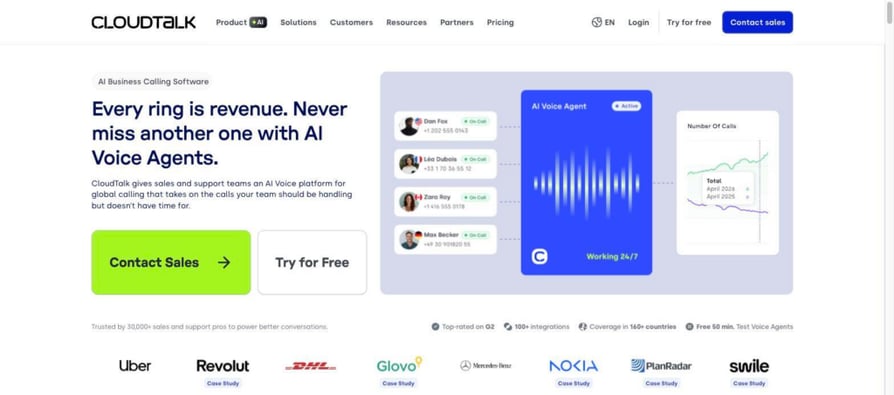
CloudTalk is a global AI business calling platform built for SMB and mid-market growth, combining three things on the same telephony infrastructure rather than shipping as a standalone voice-AI point solution:
- A full cloud phone system
- An AI Sales Dialer
- An AI Voice Agent (branded CeTe / VoiceAgents)
A call started by the AI and finished by a human rep shows up as one continuous record in the CRM.
Key Features of CloudTalk
- AI Voice Agent (CeTe) holds a free-flowing, two-way conversation instead of following a rigid menu: it understands intent, asks follow-up questions, pulls answers from a knowledge base, and executes actions like booking a meeting or updating a CRM record before escalating to a human only when needed.
- AI Sales Dialer with Power Dialer, Progressive, and Parallel dialing modes, AI-driven voicemail detection, local-presence dialing, and automatic call disposition, all packaged for outbound teams running high-volume campaigns.
- AI Conversation Intelligence, sold as a separate add-on, that turns every recorded call into a transcript, an AI summary, a sentiment score, and a set of tags so managers can review calls at scale without listening to every recording.
What Is the Pricing of CloudTalk?
CloudTalk's plans and add-ons break down as:
- Starter: $25/user/month
- Essential: $29/user/month
- Expert: $49/user/month, the only plan that includes Power Dialer at no extra cost (Starter and Essential can add it separately)
- Custom: quote-based
All platform plans are billed annually. The AI Voice Agent is always a usage-based add-on, never bundled into any plan, starting at $99 per 200 minutes/month with the first 50 minutes free in month one.
AI Conversation Intelligence is a separate add-on at $9/user/month, also never included in a base plan.
CloudTalk Pros and Cons
| Pros | Cons |
|---|---|
| Ease of use and CRM integration depth are called out repeatedly in reviews | Occasional connection issues surface as a recurring complaint |
| Reliable call quality cited as a direct productivity driver | AI Voice Agent and Conversation Intelligence are separate add-ons, not bundled into any plan |
| Full stack combines telephony, dialer, and AI voice agent on one CRM record | Native DNC list scrubbing (TPS/CTPS-style) is not currently offered |
What Do Customers Say About CloudTalk?
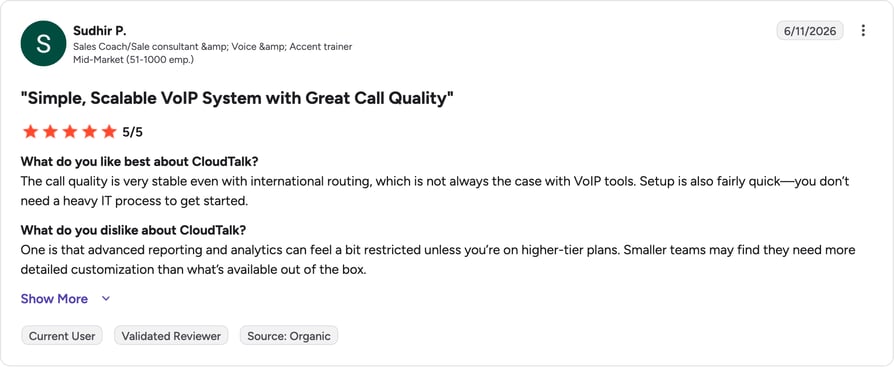
Reviewers point to CRM integration depth and ease of use as reasons the platform sticks, with reliable call quality cited as a direct driver of day-to-day productivity.
The most consistent complaint is occasional connection issues, worth asking about during a trial.
What Is CloudTalk's G2 Rating?
4.4/5 on G2, from 1930+ reviews.
2. Vapi: Best for Developer-Led Voice AI Builds
What Is Vapi?
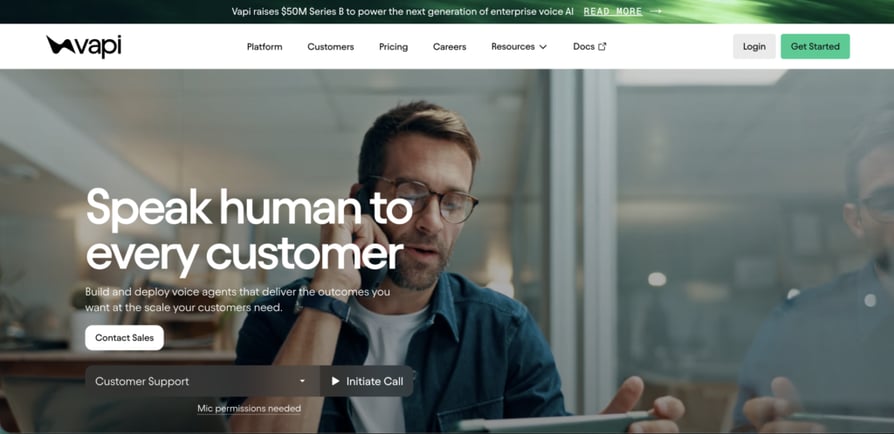
Vapi is a developer platform for building conversational voice AI, not a packaged sales tool. Its own positioning line, "the platform for developers creating conversational voice AI," is accurate.
You choose the components, then Vapi orchestrates the pipeline between them:
- Speech-to-text engine
- Language model
- Text-to-speech voice
- Telephony provider
Key Features of Vapi
- Modular, bring-your-own-model architecture across STT, LLM, and TTS providers, so teams aren't locked into one vendor's voice quality or reasoning model.
- Usage-based orchestration billing with granular per-component cost visibility, useful for engineering teams that want to optimize cost per call rather than pay a flat platform fee.
- 10 included concurrent call lines on the Build plan, with paid scaling at $10 per additional line per month for teams running higher-volume outbound.
What Is the Pricing of Vapi?
Vapi's pricing breaks down by plan:
- Build: $0.05/minute in platform fees plus model and voice-provider costs, with 10 concurrent calls included and $10/month per additional line.
- Scale: adds SSO, RBAC, and SOC 2, with HIPAA at $2,000/month and Zero Data Retention at $1,000/month.
- Enterprise: custom annual contract.
The $0.05/minute headline isn't the real cost: stack a speech-to-text engine, a language model, and a voice provider on top, and teams commonly land at $0.07 to $0.30 or more per minute. See Vapi pricing for the full itemized breakdown.
Vapi Pros and Cons
| Pros | Cons |
|---|---|
| Full control over which STT/LLM/TTS providers power the agent | Requires engineering resources to configure and maintain |
| Granular, itemized billing per pipeline component | Effective cost per minute is higher than the $0.05 headline rate once providers stack |
| Deep customization for teams with specific compliance or model requirements | No packaged CRM integrations; everything is built via API |
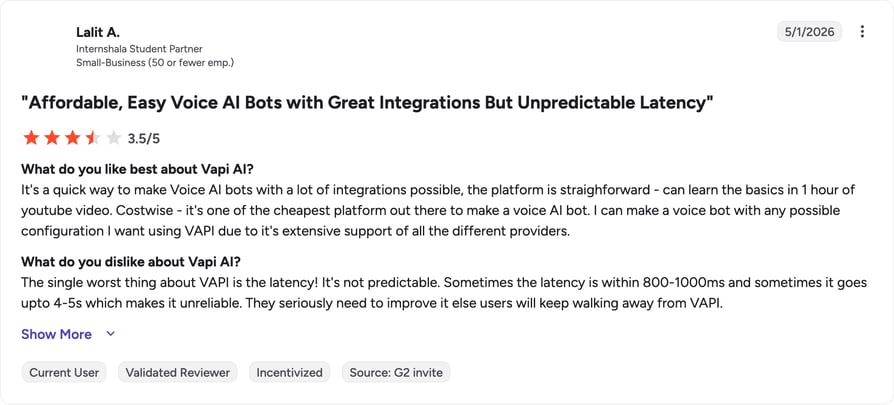
What Do Customers Say About Vapi?
Vapi doesn't have a large enough public G2 review base yet to draw reliable sentiment patterns from, which is typical for a developer-first tool this early in its adoption curve, not a red flag on its own.
What Is Vapi's G2 Rating?
Vapi does not currently have a statistically meaningful G2 review volume. Check Vapi's G2 profile directly for the current count before treating any rating as representative.
3. Bland AI: Best for High-Volume Regulated-Industry Outbound
What Is Bland AI?
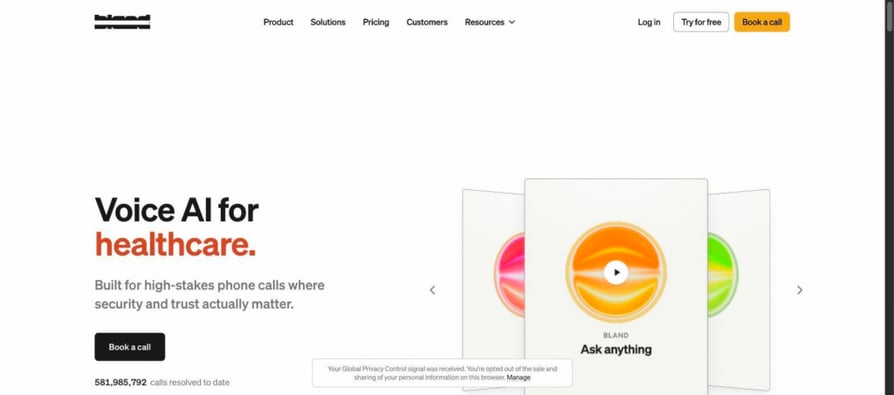
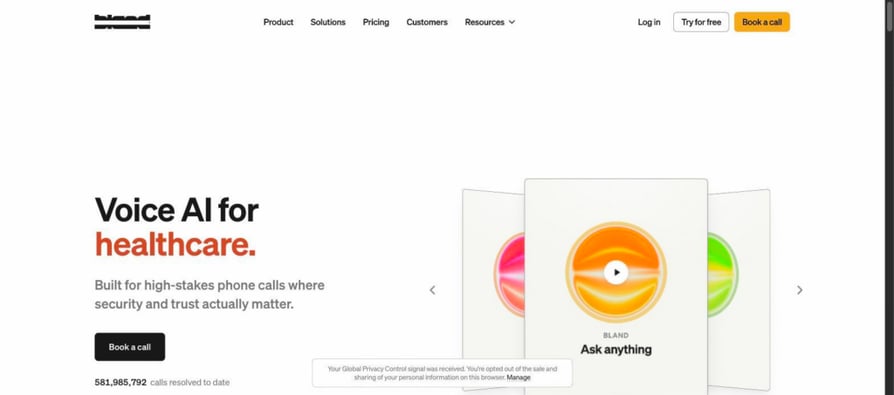
Bland AI positions itself as an "enterprise voice AI platform for phone agents," with a specific focus on regulated industries including healthcare, insurance, financial services, and logistics.
It's built for teams that want a self-hosted, programmable voice pipeline rather than a no-code interface.
Key Features of Bland AI
- Self-hosted models with a sub-second latency claim (a vendor claim, not independently verified), aimed at teams that need consistent response times at scale.
- Programmable conversation pathways and voice cloning so outbound campaigns can run a consistent, branded voice across thousands of AI sales calls.
- Volume-based pricing tiers where the per-minute talk-time rate falls as call volume increases, which rewards teams running large campaigns.
What Is the Pricing of Bland AI?
Bland AI's pricing scales down per-minute as volume increases:
- Start: $0.14/minute talk time, no platform fee, plus 2 free credits and an inbound number worth roughly $15/month.
- Build: $0.12/minute plus a $299/month platform fee and $0.04/minute transfer time.
- Scale: the lowest per-minute rate, $0.11/minute plus $499/month, for teams with volume to justify the higher fixed cost.
- Enterprise: custom pricing.
See Bland AI pricing for the tier-by-tier breakdown.
Bland AI Pros and Cons
| Pros | Cons |
|---|---|
| Per-minute rate drops meaningfully at higher volume tiers | Public G2 and Trustpilot review volume is too small to be statistically meaningful (2 reviews on each) |
| Positioned specifically for regulated industries | Compliance and disclosure details aren't fully published |
| Programmable pathways allow custom outbound logic | Requires engineering effort similar to Vapi |
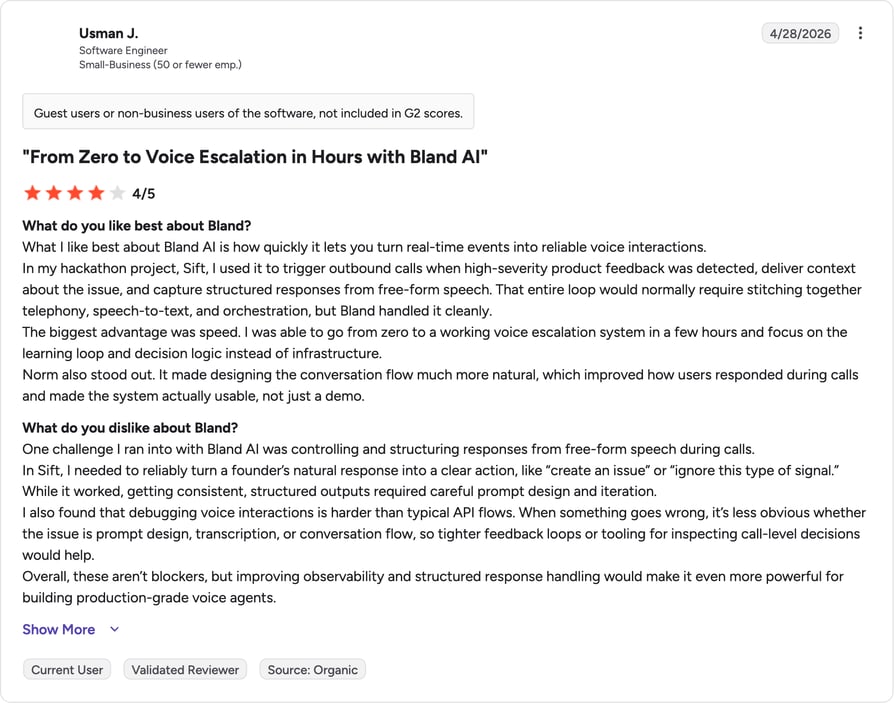
What Do Customers Say About Bland AI?
Bland AI's public review base is too thin to generalize from: 2 reviews on G2 and 2 on Trustpilot as of this research, not enough to point to a real pattern either way.
What Is Bland AI's G2 Rating?
Bland AI shows just 2 reviews on G2, a sample too small to treat as a meaningful rating. Its Trustpilot page shows 2.9/5 from the same 2 reviews, which carries the same caveat.
4. Synthflow AI: Best for No-Code Campaign Launch
What Is Synthflow AI?
Synthflow AI describes itself as building "enterprise-ready voice AI agents for automated phone calls," aimed squarely at teams that want to launch a voice campaign without a development team. Its no-code visual builder is the core of the product.
Key Features of Synthflow AI
- No-code visual builder for conversational logic, variables, and API connections, letting non-technical marketers and agencies stand up a campaign without engineering support.
- ElevenLabs-powered voices with conditional, dynamic conversation branching that adapts based on what the caller says.
- Enterprise contracts scoped to call volume and concurrency, for teams that need to run automation at scale once they've validated the approach.
What Is the Pricing of Synthflow AI?
Synthflow's pricing runs across two tiers:
- Enterprise: contracts starting at $30,000/year, scoped to expected call volume and concurrency.
- Self-serve: referenced on the pricing page but not itemized publicly.
Synthflow AI Pros and Cons
| Pros | Cons |
|---|---|
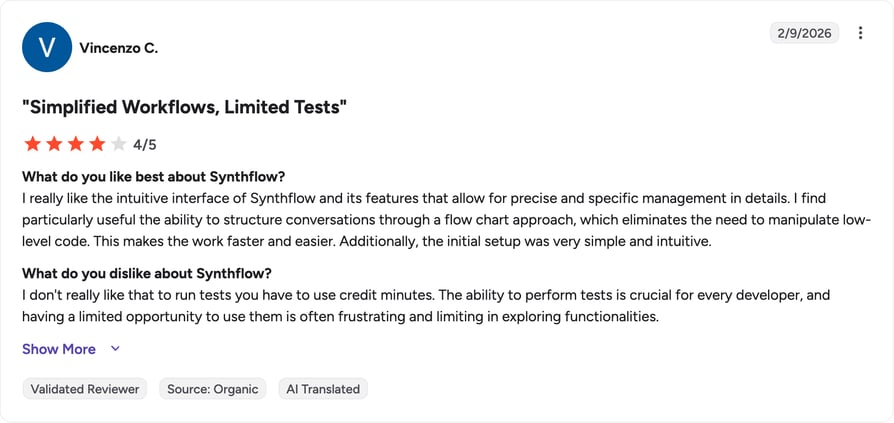
| Delivers on the no-code promise; reviewers cite designing logic and API connections without writing code | "Expensive" is the single most common complaint, mentioned in 145 reviews |
| Natural-sounding voices, particularly when paired with ElevenLabs | Cost at scale is a recurring concern, cited in 97 reviews |
| Praised for ease of onboarding non-technical teams | Learning curve (59 mentions) and vendor lock-in on voice/AI provider choice also recur |
What Do Customers Say About Synthflow AI?
Reviewers praise the no-code builder for letting them design conversation logic and connect APIs without touching code, and call out natural-sounding voice quality as a standout.
Cost is the dominant complaint:
- "Expensive" appears in 145 reviews
- Cost at scale in 97 reviews
- Learning curve in 59 reviews
What Is Synthflow AI's G2 Rating?
4.5/5 on G2, from 950+ reviews, consistent with Synthflow's own claim of over 1,000 reviews across review platforms.
5. Thoughtly: Best for Voice + SMS + Email Cadence
What Is Thoughtly?
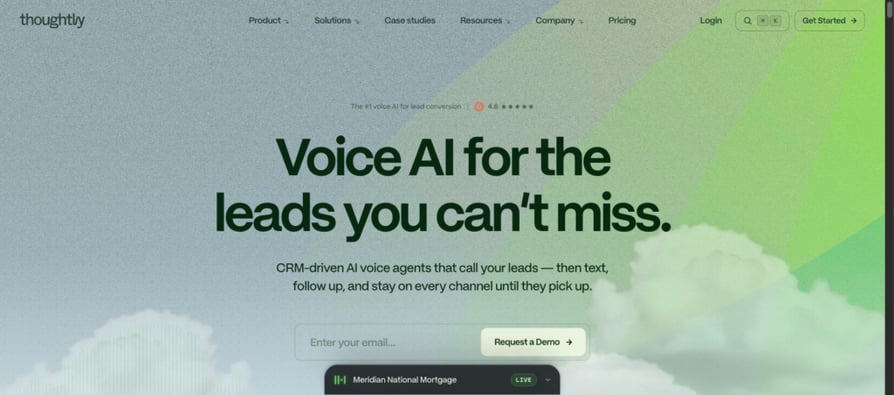
Thoughtly's positioning, "every lead, every channel, all the time," describes a platform built around sequenced outbound: voice, SMS, and email working together in one cadence rather than voice calling in isolation.
It's aimed at revenue teams that need follow-up to happen across channels without manual coordination.
Key Features of Thoughtly
- Unified voice, SMS, and email workflows with 200+ integrations and two-way sync into HubSpot, Salesforce, and Zoho, so outcomes write back to the CRM automatically.
- 34+ languages with voice cloning included on every plan, not gated behind a higher tier the way some competitors handle it.
- Auto-QA and evaluation on every conversation starting at the Scale plan, alongside SOC 2 Type II reporting and an SMS and TCPA compliance review.
What Is the Pricing of Thoughtly?
Thoughtly's pricing runs in three tiers:
- Flex: $500/month for unlimited usage across channels, 200+ integrations, and REST API access, per the current live pricing page.
- Scale: custom quote that adds 100+ concurrent calls, auto-QA and evaluations, SOC 2 Type II plus a TCPA review, and a dedicated customer success manager.
- Enterprise: custom pricing that adds a custom LLM, HIPAA/BAA support, dedicated infrastructure, and a named technical account manager available around the clock.
Older third-party citations of a "$30/month Starter" tier are out of date: $500/month is the current Flex entry price.
Thoughtly Pros and Cons
| Pros | Cons |
|---|---|
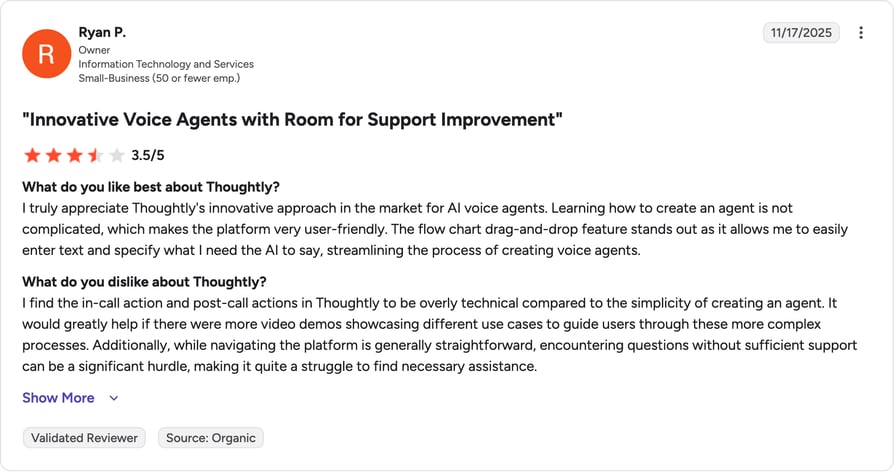
| Drag-and-drop flow builder described by reviewers as "not complicated" | Limited voice variants is a recurring complaint |
| Customer support praised as helpful during setup | Steep learning curve for building more advanced flows |
| Efficient AI integration credited with saving outreach time | In-call and post-call action configuration described as "overly technical" relative to basic agent setup |
What Do Customers Say About Thoughtly?
Reviewers describe the drag-and-drop builder as approachable and credit the AI integration with real time savings on outreach, praising the support team for guiding setup.
The recurring frustration is a mismatch in complexity: basic agent creation is simple, but configuring in-call and post-call actions is described as more technical than it needs to be.
What Is Thoughtly's G2 Rating?
Thoughtly's own review-aggregation page cites approximately 4.7/5 from 42 reviewers. A separate third-party aggregator, AppSumo, shows a notably lower 3.11/5 from a different and smaller review pool.
We're flagging that discrepancy rather than picking one number silently. Check Thoughtly's G2 page directly to confirm the current G2-specific figure.
6. Kixie: Best for CRM-First AI-Assisted Dialing
What Is Kixie?
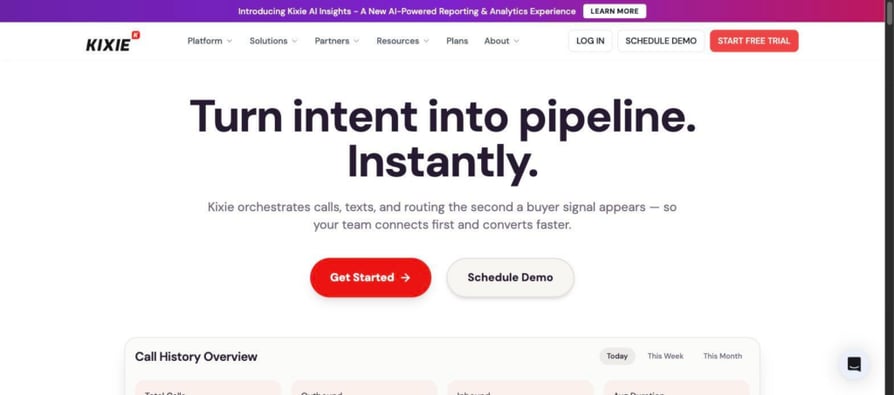
Kixie, marketed as "better sales made simple," is a sales dialer with AI-assisted call routing and voicemail detection bolted onto deep CRM integration.
It's worth naming an important distinction here: Kixie is not a conversational AI voice agent that holds autonomous phone conversations.
It's a human-agent dialer where AI handles routing, voicemail detection, and call scoring around the rep, not the conversation itself.
Key Features of Kixie
- PowerDialer, in both single-line and multi-line configurations, with AI-driven call routing and automatic voicemail detection to keep reps talking to live prospects.
- Deep native CRM integration and click-to-call, so reps dial straight from the CRM record they're already looking at.
- Local presence dialing that rotates the outbound caller ID to a number local to the recipient, aimed at lifting pickup rates.
What Is the Pricing of Kixie?
Kixie's pricing isn't consistently published. Third-party trackers cite these tiers:
- Integrated: around $35/user/month
- Professional: around $65/user/month
- Outbound PowerCall: around $95/user/month billed quarterly, climbing to $145-$215/user/month once AI Human Voice Detection and multi-line tiers are added
Add-ons like ConnectionBoost, Conversation Intelligence, and DNC management (roughly $20-$50/user/month each per third-party sources) stack on top, with calling minutes metered separately.
Check Kixie pricing and verify current tiers directly with Kixie before treating any of these as confirmed.
Kixie Pros and Cons
| Pros | Cons |
|---|---|
| Ease of use and CRM integration depth are the most consistent praise themes | Call and connection issues are the most repeated complaint |
| Users report a large jump in daily live conversations without adding headcount | Pricing opacity and stacking add-on costs are a recurring frustration |
| Fast calling speed is the standout draw reviewers mention | Some reviewers report total costs doubling or tripling unexpectedly once add-ons are included |
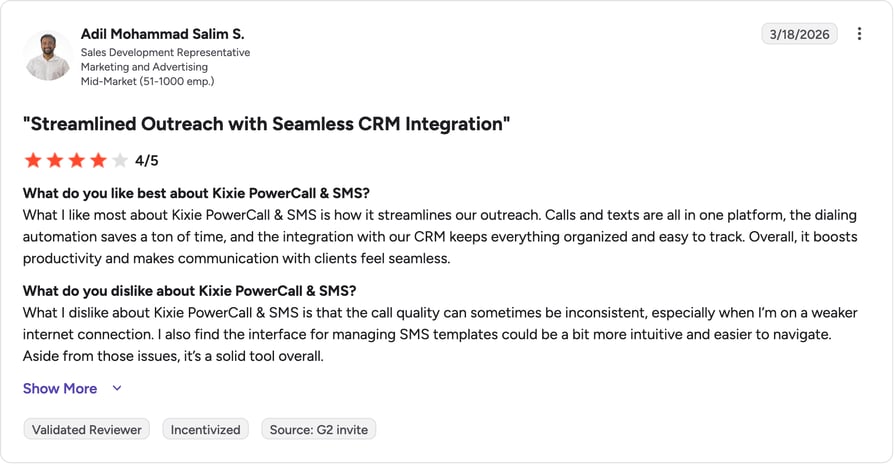
What Do Customers Say About Kixie?
Reviewers cite ease of use and CRM integration as Kixie's strongest points, with several describing a jump in daily live conversations without hiring more reps.
The recurring complaint is reliability: call and connection issues come up often, plus pricing opacity as add-on costs stack.
What Is Kixie's G2 Rating?
4.8/5 on G2, from 850+ reviews.
7. Convoso: Best for High-Volume Predictive Dialing + Compliance
What Is Convoso?
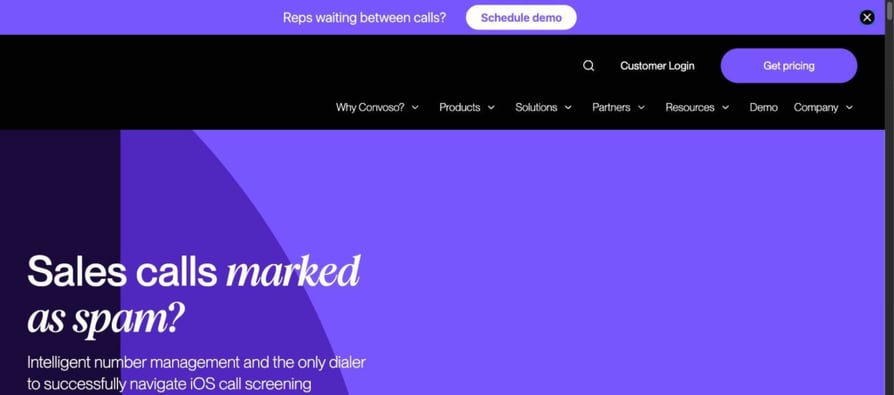
Convoso markets itself as "leading AI-powered call center software & dialers," with messaging built around a specific pain point: "sales calls marked as spam?"
It's a predictive-dialing platform for high-volume outbound contact centers, with compliance controls built in rather than bolted on afterward.
Key Features of Convoso
- Predictive dialer with dynamic scripting and list management, built to keep a contact center's call volume high without overwhelming available agents.
- Advanced reporting and intelligent call routing, giving supervisors visibility into which lists, scripts, and agents are converting.
- Open API for integrations, letting contact centers connect Convoso into their existing tech stack rather than requiring a full platform switch.
What Is the Pricing of Convoso?
Convoso's pricing isn't publicly published:
- Model: custom quote only; the pricing page doesn't expose plan pricing, suggesting it's gated behind a sales conversation.
- Third-party estimates: roughly $90 to $150 per user per month.
- Extra fees: carrier fees, DID management, and SMS typically billed separately, adding another 10-30% on top.
See Convoso pricing and treat these as estimates until you've gotten a quote directly.
Convoso Pros and Cons
| Pros | Cons |
|---|---|
| Intuitive interface that eases training and live-call navigation | Sudden logouts and three-way call difficulties recur as complaints |
| Predictive dialing, list management, and dynamic scripting improve productivity | Setup and initial learning curve is steep |
| Quality of support rated highly (9.1) by reviewers; open API praised for easy integration | Users flag paying separately for added features and per-agent licenses as a cost frustration |
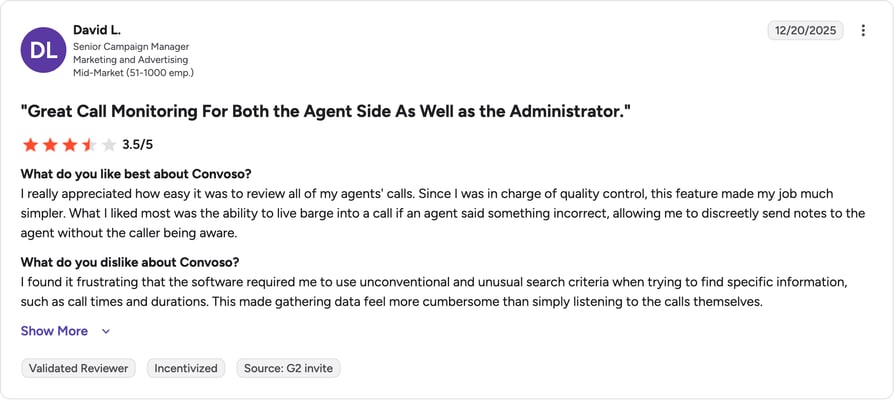
What Do Customers Say About Convoso?
Reviewers praise the intuitive interface for making training and live calls easier to manage, and single out support quality (rated 9.1) and the open API as genuine strengths.
The recurring frustration is call handling reliability: sudden logouts and three-way call issues, plus complaints about paying separately for features and per-agent licenses.
What Is Convoso's G2 Rating?
4.5/5 on G2, from 250+ reviews.
8. Aloware: Best for HubSpot/Salesforce-Native Power Dialing
What Is Aloware?
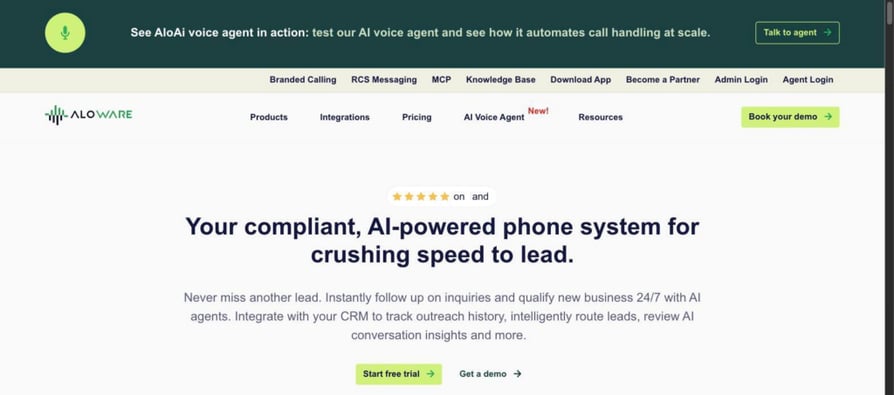
Aloware positions itself as a "top-rated contact center software, built for your favorite CRM," with a specific emphasis on native HubSpot and Salesforce integration alongside power dialing.
It's built for teams that want AI-assisted calling embedded directly inside the CRM they already use daily, rather than as a separate tool.
Key Features of Aloware
- AI-powered dialer tiers (iPro, uPro, xPro) with AloAi Voice Analytics minutes bundled per tier, so AI conversation analysis scales with the plan a team is on.
- HubSpot workflow triggers on calls and texts starting at the uPro tier, with Salesforce integration available at xPro.
- Unlimited inbound and outbound minutes plus SMS bundled into every plan, removing per-minute anxiety from day-to-day usage.
What Is the Pricing of Aloware?
Aloware's pricing runs across three AI-enabled tiers:
- iPro + AI: $30/user/month, 10-user minimum, 7-day free trial.
- uPro + AI: $60/user/month (5-user minimum), adds HubSpot workflows, Power Dialer, and AI call transcription, summaries, and sentiment analysis.
- xPro + AI: $85/user/month (5-user minimum), adds Salesforce integration.
AloAi voice bot usage beyond bundled minutes starts at $0.10/minute. Third-party trackers note the effective cost floor runs higher than the $30 headline once the seat minimum and add-ons like Local Presence (around $300/month) are factored in.
See Aloware pricing for the full tier breakdown.
Aloware Pros and Cons
| Pros | Cons |
|---|---|
| Intuitive interface and CRM integration, especially with HubSpot, are the most consistent praise themes | Call quality is the #1 complaint across reviews |
| Unlimited minutes and SMS bundled into every plan remove usage anxiety | Occasional glitches and slow performance, particularly on the mobile app |
| Native HubSpot workflow triggers keep CRM data current automatically | Seat minimums and add-ons push the effective cost above the headline price |
What Do Customers Say About Aloware?
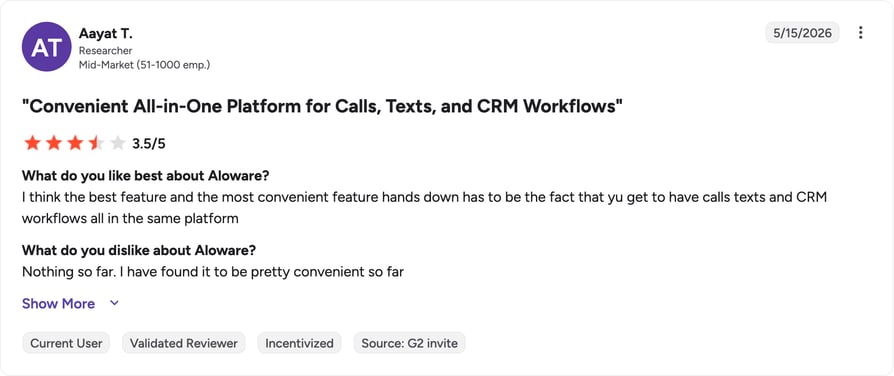
Across 822 reviews on G2, the interface and CRM integration, particularly with HubSpot, are the most consistent praise themes.
Call quality is the single most common complaint, with occasional glitches and slower performance flagged on the mobile app.
What Is Aloware's G2 Rating?
4.1/5 on G2, from 800+ reviews.
9. PolyAI: Best for Enterprise Managed Voice AI
What Is PolyAI?
PolyAI describes itself as building "the world's most lifelike voice AI agents" on an enterprise platform where dialog agents "get built, run, adapt, and iterate in real time."
Unlike most of the platforms on this list, PolyAI isn't self-serve: its own team designs, deploys, and maintains the voice agent for you.
Key Features of PolyAI
- Managed-service deployment model, where PolyAI's team builds and maintains the agent rather than handing a customer a self-serve builder, aimed at large organizations that want a white-glove rollout.
- Integration into existing CCaaS platforms like Genesys and Salesforce Service Cloud, so PolyAI slots into contact-center infrastructure that's already in place.
- Per-minute enterprise billing that includes ongoing performance improvements and around-the-clock support as part of the contract, rather than as a separate line item.
What Is the Pricing of PolyAI?
PolyAI's pricing is enterprise-only:
- Model: no public rate card, free tier, or self-serve option.
- Third-party estimates: typical contracts start around $150,000 per year and scale with call volume. PolyAI doesn't publish this figure itself, so treat it as directional rather than confirmed.
See PolyAI pricing for more context on how enterprise voice AI contracts are typically structured.
PolyAI Pros and Cons
| Pros | Cons |
|---|---|
| Voice quality and caller experience are rated highest of any tool on this list | Review sample is small enough (about 12 reviews) that it's hard to identify recurring pain points |
| Fully managed deployment removes build-and-maintain burden from internal teams | No self-serve option or published pricing for smaller buyers to evaluate |
| Deep CCaaS integration fits existing enterprise contact-center stacks | Enterprise-only positioning puts it out of reach for SMB and mid-market teams |
What Do Customers Say About PolyAI?
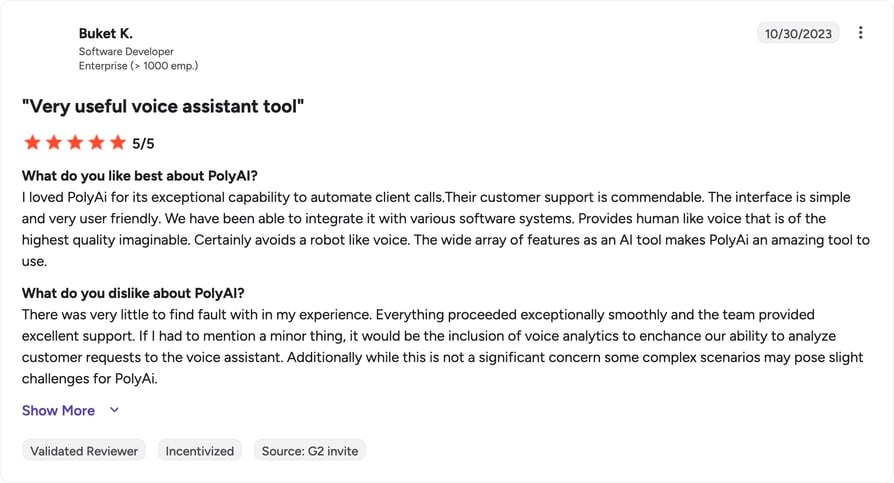
The reviewers who have rated PolyAI on G2 consistently call out voice quality and caller experience as the strongest they've used.
That said, the sample is small, around 12 reviews, so treat the sentiment as a useful signal rather than a statistically robust conclusion.
What Is PolyAI's G2 Rating?
5.0/5 on G2, based on a small sample of about 12 reviews. A perfect score from this few respondents is a useful signal, not a statistically confident rating, so weigh it accordingly.
10. Cognigy: Best for Enterprise Multilingual CX
What Is Cognigy?
Cognigy, now part of NiCE, describes its mission as "AI-first CX, made real," building generative and conversational AI agents for customer service across voice, chat, and messaging.
It's built for large enterprises that need one governed platform spanning multiple channels rather than a voice-only point solution.
Key Features of Cognigy
- Visual flow builder for designing and deploying AI agents consistently across channels, so the same underlying logic can power a voice call, a chat session, or a messaging conversation.
- Strong natural language understanding engine, frequently praised in reviews for accurate intent handling even on complex requests.
- Broad out-of-the-box integration library with existing contact-center infrastructure, reducing the custom integration work enterprises typically face.
What Is the Pricing of Cognigy?
Cognigy's pricing is enterprise-only and not publicly published:
- Limited pilots: third-party estimates start around $2,500 to $5,000 per month.
- Larger deployments: $100,000 to $350,000 or more per year with licenses, usage, and professional services included, averaging around $115,000/year by those estimates.
Cognigy doesn't disclose these figures itself, so confirm current pricing directly.
Cognigy Pros and Cons
| Pros | Cons |
|---|---|
| Easy to use and quick to learn, per reviewers, with fast time-to-first-solution | Learning curve is the most consistent complaint despite the "easy to learn" praise |
| Strong out-of-the-box integration library with contact-center infrastructure | Lack of ready-made templates slows initial virtual-assistant development |
| NLU quality praised specifically, with reviewers citing a 9.7 accuracy score for intent handling | Small review sample (about 13 reviews) limits how much weight to put on any single theme |
What Do Customers Say About Cognigy?
Reviewers describe Cognigy as easy to use and quick to build initial solutions with, praising the natural language understanding engine specifically, citing a 9.7 score for accurate intent handling.
The consistent complaint despite that ease-of-use praise: a real learning curve past the basics, plus a lack of ready-made templates.
What Is Cognigy's G2 Rating?
4.6/5 on G2, based on a relatively small sample of about 13 reviews. Worth confirming against a larger, more current review count before treating it as conclusive.
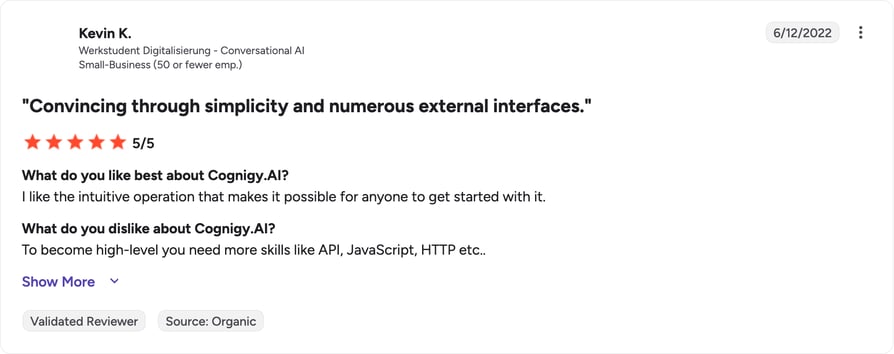
11. Observe.AI: Best for Extending CI Into Voice Agents
What Is Observe.AI?
Observe.AI describes itself simply as "purpose-built AI agents, one CX platform."
It launched autonomous VoiceAI Agents in March 2025, extending a product that was originally built around conversation intelligence and QA scoring rather than starting as a voice-agent company from day one.
Key Features of Observe.AI
- VoiceAI Agents, priced per completed task, designed specifically to handle overtalk, interruptions, and background noise, which matters for high-volume, noisy call environments.
- Real-time frontline agent assist running alongside post-call conversation analytics and QA scoring, so the same platform supports both human agents and autonomous ones.
- Governance and orchestration built for complex, multi-workflow CX operations rather than a single simple use case.
What Is the Pricing of Observe.AI?
Observe.AI's pricing is enterprise-only:
- AWS Marketplace module: around $69 per agent per month (roughly $828/year), a partial-module data point, not Observe.AI's full published price.
- Typical 100-seat deployment: $60,000 to $180,000 per year depending on modules and contract terms, with a 100-seat minimum and annual commitment required.
Observe.AI Pros and Cons
| Pros | Cons |
|---|---|
| Ease of use and coaching workflows are the top praise themes | Transcription accuracy is the #1 complaint across review sites |
| Extends an established conversation-intelligence and QA product into autonomous agents | 100-seat minimum puts it out of reach for smaller teams |
| Real-time agent assist runs on the same platform as autonomous VoiceAI Agents | Accuracy and transcript-inaccuracy mentions are the most common negative theme in the review data |
What Do Customers Say About Observe.AI?
Reviewers praise ease of use and the coaching workflows Observe.AI enables for QA teams.
The most common negative theme by a clear margin is transcription accuracy, with accuracy issues and transcript-inaccuracy mentions appearing repeatedly.
What Is Observe.AI's G2 Rating?
4.6/5 on G2, from 200+ reviews; 97% of reviewers rate it 4 stars or higher.
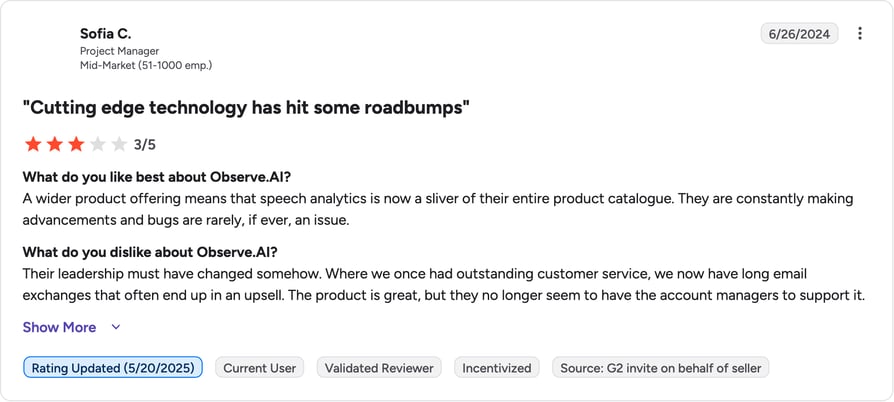
12. Retell AI: Best for Production-Ready Developer Platform
What Is Retell AI?
Retell AI calls itself the platform to "build, test, deploy, and monitor production-ready AI voice agents at scale." It's the most consistently-recurring pure-play competitor across this entire category.
It's built for teams that need a developer-accessible voice AI platform they can actually ship to production, not just prototype.
Key Features of Retell AI
- Full, itemized cost breakdown across voice infrastructure, TTS provider, LLM choice, and telephony, which is genuinely rare among AI-native competitors and makes budgeting far easier than Vapi's or Bland AI's pricing pages.
- 20 concurrent calls included on the pay-as-you-go plan, uncapped on Enterprise, letting outbound campaigns scale without renegotiating a contract first.
- Built-in safety guardrails and PII redaction, with HIPAA and BAA support available on Enterprise for regulated use cases.
What Is the Pricing of Retell AI?
Retell AI's pricing breaks down by plan:
- Pay-as-you-go: free to start, with $10 in free credits and rates of $0.07 to $0.31 per minute for AI Voice Agents depending on the model and voice selected.
- Enterprise: custom pricing that includes a dedicated server, uncapped concurrency, a named account manager, and custom MSA/DPA/BAA agreements for regulated industries.
See Retell AI pricing for the per-model rate breakdown.
Retell AI Pros and Cons
| Pros | Cons |
|---|---|
| Voice quality and low latency mentioned constantly and positively by reviewers | Limited voice options for international and non-English support, cited in 67 reviews |
| User-friendly interface and fast movement from testing to production | Steep learning curve, cited in 46 reviews |
| Transparent, modular pricing rare among AI-native competitors | Pricing complexity for small teams (41 mentions) and documented German-voice-quality issues (37 mentions) |
What Do Customers Say About Retell AI?
Voice quality and low latency come up constantly and positively, alongside a user-friendly interface that reviewers say lets them move from testing to production quickly. The complaints cluster around international support:
- Limited voice options outside English (67 mentions)
- A learning curve (46 mentions)
- Pricing complexity for smaller teams (41 mentions)
- German-voice quality issues (37 mentions)
What Is Retell AI's G2 Rating?
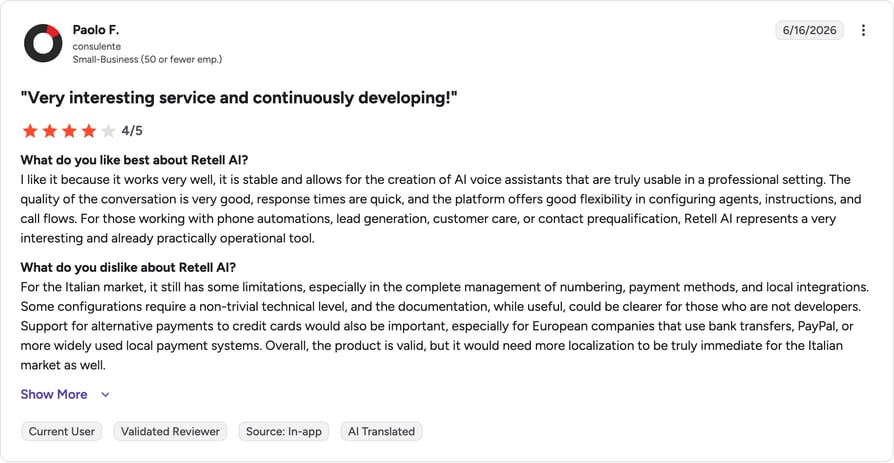
Approximately 4.8/5 on G2, with review counts reported inconsistently across sources, roughly in the 1,700+ range as of this writing. Confirm the exact current count directly on Retell AI's G2 page before citing a precise figure.
How to Choose the Right AI Voice Agent for Outbound Calling
Match the Platform to Your Actual Use Case
Start with what you're trying to fix, not which tool has the flashiest demo:
- A no-code launch calls for Synthflow AI.
- Full control over the model and voice pipeline points to Vapi or Retell AI.
- A team already living inside HubSpot or Salesforce that wants AI voice bolted onto that CRM should look at CloudTalk, Kixie, or Aloware.
- Enterprise governance across multiple channels points toward PolyAI or Cognigy.
Buying on the demo rather than your actual workflow is the most common reason these deployments underdeliver.
Our breakdown of the best use cases for AI voice agents goes deeper on matching a specific workflow to a specific platform type.
Conversation Quality, Latency, and Objection Handling
Ask any vendor to demo a call with real interruptions, an accent outside the "default" American English, and at least one objection.
Vendor-published latency numbers (CloudTalk's sub-800ms claim, Bland AI's "sub-second" claim) are marketing figures until tested on your own call flow, script, and expected volume.
Ask specifically how the agent is trained to handle sales objections rather than just detecting a pause and moving on.
Lead Qualification, Booking, and Human Handoff
The difference between a voice agent that transcribes and one that qualifies is whether it can ask follow-up questions, capture structured answers, and hand a genuinely qualified prospect to a rep with context attached.
Run a real qualification script through the platform and check whether the data reaching your CRM is something a rep could act on immediately.
Customer story: MadRent, a real estate and property management company, put AI on lead qualification and freed its team to focus on sales. Read the MadRent story.
CRM and Calendar Integrations
An agent that qualifies a lead but doesn't write the outcome back to your CRM creates a second job for someone to manually re-enter that data. Confirm what specifically syncs:
- Call disposition
- Transcript
- Summary
- Booked meeting
Also confirm whether that sync happens in real time or in batches.
If your team runs on Salesforce specifically, compare platforms against CloudTalk's own guide to Salesforce integrations before assuming feature parity.
Telephony Controls: Number Reputation and Campaign Management
Outbound at volume runs into spam labeling and dropped connections if number reputation isn't actively managed.
Look for local-presence dialing, STIR/SHAKEN signing, and voicemail detection with automatic re-queueing, since these directly affect how many dials connect to a live person.
Cost Per Connected and Qualified Call
Usage-based platforms like Vapi, Bland AI, and Retell AI look inexpensive at the headline rate and considerably less so once you calculate cost per qualified lead rather than cost per minute.
Model the full stack, platform fee, per-minute rate, and model or voice-provider costs, against your actual connect and qualification rate using a consistent cost model rather than comparing headline per-minute rates directly.
Before automating outbound calling, one more filter matters more than any of the five above: compliance.
It's the area every platform in this category, including CloudTalk, treats less thoroughly than conversation quality or pricing, which is why it gets its own section below.
What Real Users Say About AI Voice Agents for Outbound Calling
Review platforms like G2 and Trustpilot capture structured star ratings. Reddit and Quora threads about AI outbound calling tools tend to surface a rawer, less curated version of the same themes.
Excitement about no-code speed and voice quality shows up alongside real frustration with:
- Pricing opacity
- Learning curves
- The gap between a polished demo and actual production performance
That's the same tension that shows up across the G2 reviews cited throughout this guide.
Top AI Voice Agents by G2 Reviews and Ratings
Based on G2 reviews and ratings, CloudTalk is among the top AI voice agent platforms with 1930+ reviews and a 4.4/5 rating.
That's more total reviews than every other platform on this list except Retell AI, whose review count is reported too inconsistently across sources (roughly 1,500-2,200+, depending on the source) to confirm a clear lead either way.
We excluded Retell AI from the table below for that reason, rather than force a comparison the underlying numbers don't clearly support.
If you're also weighing dialer-first tools outside this list, our best AI sales dialer software roundup covers that adjacent category.
| Provider | G2 Rating | G2 Review Count |
|---|---|---|
| CloudTalk | 4.4/5 | 1930+ |
| Synthflow AI | 4.5/5 | 950+ |
| Kixie | 4.8/5 | 850+ |
| Aloware | 4.1/5 | 800+ |
| Convoso | 4.5/5 | 250+ |
| Observe.AI | 4.6/5 | 200+ |
| Thoughtly | ~4.7/5 | 42 |
| Cognigy | 4.6/5 | ~13 (small sample) |
| PolyAI | 5.0/5 | ~12 (small sample) |
| Bland AI | not meaningful | 2 (too small to be meaningful) |
| Vapi | not meaningful | not statistically meaningful |
Cognigy, PolyAI, Bland AI, and Vapi all lead CloudTalk on raw review count technically, since their samples are so small.
But the sample sizes are too thin to treat the rating itself as a meaningful signal. See each platform's entry above for that caveat in context.
Start your 14-day free trial, no credit card required, and see where CloudTalk's AI Voice Agent fits into your outbound stack.
Compliance Risks Before Automating Outbound Sales Calls
Every platform on this list makes conversation quality and pricing easy to compare. Compliance is where the real risk hides, and it's the area competing buyer's guides in this space cover the least.
Consent and Do-Not-Call Requirements
Outbound calling, automated or not, is still subject to Do-Not-Call registry rules and prior-consent requirements that vary by jurisdiction and by whether the call is a sales pitch or an existing-customer follow-up.
Confirm how each platform captures, stores, and enforces consent before a campaign goes live, and check your program against current autodialer laws in each state or country you call into.
AI Voice and Disclosure Rules
The FCC ruled in February 2024 that an AI-generated voice on a call legally counts as "an artificial or pre-recorded voice" under the Telephone Consumer Protection Act.
That means an AI voice agent can't sidestep TCPA consent, disclosure, and opt-out requirements just because no human is speaking.
Platforms marketed as TCPA-compliant dialers build consent and disclosure logic in by default. It's worth asking whether an AI-native platform does the same before you rely on it.
If a vendor doesn't address disclosure directly, ask them how they handle it before you sign anything.
Call Recording and Data Protection
Recording consent laws differ by state and country, and several require all-party consent rather than one-party.
Confirm how each platform handles call recording notifications, storage, and retention.
Also confirm whether its compliance posture (SOC 2, GDPR, HIPAA where relevant) covers the AI voice product specifically, not just the core calling infrastructure.
Calling Windows, Suppression Lists, and Contact Preferences
Outbound campaigns need to respect calling-hour restrictions, honor internal suppression lists, and track contact preferences, including SMS opt-in status, without relying on a human to remember all of it manually.
Ask whether the platform enforces these rules automatically or leaves it entirely to campaign configuration. The latter means a misconfigured campaign is the only thing standing between you and a violation.
Number Reputation and Spam Labeling
High-volume automated outbound is exactly the pattern carriers flag for spam labeling, and a number can get flagged as spam even when every call is fully compliant.
STIR/SHAKEN signing, anti-spam number registration, and local-presence dialing all help, but none fully protects a number dialing at a volume and pattern carriers associate with robocalling.
Ask any vendor how they monitor and manage number reputation over time, not just at launch.
Choosing the Right AI Voice Agent for Your Sales Team
The 12 platforms above solve genuinely different problems, so the right answer depends on what's actually slowing your outbound motion down.
Best AI Voice Agent for No-Code Sales Teams
Synthflow AI is the clearest fit if you want to launch a voice campaign without a development team behind it.
The trade-off is cost: reviewers flag pricing as the top complaint, so model your expected call volume against Synthflow's enterprise contract structure before committing.
Our best automated voice agents for lead generation roundup covers more no-code options if that structure doesn't fit.
Best AI Voice Agent for Developer-Led Teams
Vapi gives you the most granular control over the voice AI pipeline, choosing your own STT, LLM, and TTS providers rather than accepting a bundled stack.
If you want that level of control with a faster path to production and a track record of shipped deployments, Retell AI is the stronger alternative.
It offers transparent per-component pricing, and reviewers specifically praise how quickly they moved from testing to live calls.
Best AI Voice Agent for High-Volume Outbound Campaigns
Convoso is built specifically for high-volume predictive dialing with compliance controls, including DNC scrubbing, built into the core product rather than bolted on.
If your volume needs skew toward AI-native conversation rather than human-agent dialing, Bland AI's tiered per-minute pricing structure is designed to reward exactly that kind of scale.
See our guide to running outbound call campaigns at volume for the operational side of that decision.
Best AI Voice Agent for CRM-Connected SMB Sales Teams
This is where CloudTalk fits most naturally: an AI voice agent, an AI sales dialer, and native CRM integrations running on the same telephony infrastructure.
A lead qualified by CeTe and handed to a rep shows up as one continuous record, rather than data spread across disconnected tools.
Aloware is worth a direct comparison if your team is specifically built around HubSpot or Salesforce workflows first and voice AI second.
For a closer look at how this fits a real outbound motion, see our guide to AI voice agents for outbound sales calls.
Customer story: Trevo reached 20x more customers per campaign after adding CloudTalk's AI Voice Agent to its outbound calling. Read the Trevo story.
Best Starting Use Case for Most Businesses
Most sales teams don't have a dedicated engineering team to stitch together a voice AI stack from separate STT, LLM, TTS, and telephony vendors, and don't need enterprise-scale governance across ten channels either.
For that majority, the more practical starting point is a platform that already bundles calling infrastructure, CRM integration, and an AI voice agent add-on. It gets a working deployment live in days rather than months.
Our guide to the AI voice sales agent category breaks down exactly what "bundled" should include before you buy.
Add a specialized point solution later, once you've identified a specific gap the bundled platform doesn't cover.
Get a walkthrough of CloudTalk's AI Voice Agent and AI Sales Dialer, built around your actual call volume and CRM
Frequently asked questions
It depends on your use case: Synthflow AI fits no-code teams, Vapi and Retell AI fit developers, and CloudTalk fits CRM-connected SMB teams via its AI voice solutions.
Costs range from usage-based per-minute rates (Vapi, Bland AI, Retell AI) to CloudTalk's add-on starting at $99 per 200 minutes. See AI voice agent pricing for the full breakdown.
Most platforms offer free credits, not free tiers: Retell AI gives $10 in credits, CloudTalk gives 50 free AI Voice Agent minutes, and its phone system has a 14-day free trial.
Yes, under the same consent rules as human calls. The FCC ruled AI voices count as automated calls under the TCPA. See our outbound calling rules.
Yes, platforms like CloudTalk, Retell AI, and Synthflow AI can ask qualifying questions and handle appointment scheduling, not just transcribe calls.
Most do, but depth varies: Thoughtly and CloudTalk write dispositions and summaries back automatically, while Vapi and Bland AI need custom API work; compare options in our CRM tools guide.
The stronger platforms can, using scripted logic and live objection handling, then hand qualified prospects to a human rep with context attached.
CloudTalk bundles its AI Voice Agent with a phone system, AI Sales Dialer, and CRM sync, unlike standalone platforms like Vapi or Retell AI, which need separate tools.