Synthflow AI Review 2026: Pricing, Features and Alternatives
Synthflow builds better demos than almost anything else in this category. The question this review answers is what happens after the demo – when you ask what it costs, when you measure the pause before it speaks, and when you need a phone number outside three countries.
Synthflow AI: The Verdict Before You Scroll
| Field | Verdict |
|---|---|
| One-line verdict | A genuinely strong no-code voice agent builder with excellent voices and a real testing framework – now sold almost exclusively as an enterprise contract, with no published prices. |
| Overall rating | 3.3 / 5 – the product is better than the buying experience. |
| Best for | Funded mid-market and enterprise teams |
| Not good for | SMBs and self-serve buyers |
| Starting price | From $30,000 a year. That is the only figure on Synthflow’s pricing page today. Component rates from their own blog: ~$0.09/min voice engine + $0.02–$0.05/min LLM, telephony billed separately. |
| Free tier? | You can build for free and pay at launch. No trial length or free-minute allowance is published anywhere. The widely repeated “14-day trial” traces to a 2024 social post, not a current page. |
| Setup time | Under an hour for a basic agent – genuinely. Reviewers repeatedly confirm this and it is the platform’s single strongest quality. |
| Standout pro | Speed from zero to a working agent. “Ease of use” is the most-mentioned theme across a thousand G2 reviews. |
| Standout con | Cost, and the disappearance of any way to find out what it is. Pricing is the largest complaint cluster on G2. |
| User sentiment | Warm on the product, cold on the commercials. 4.5/5 on G2 from roughly 1,010 reviews and 4.4–4.5 on Trustpilot from 211 – but the low-star reviews cluster hard on support response times and platform stability. |
| CloudTalk verdict | Choose CloudTalk when you need published per-minute pricing, local numbers in more than three countries, and a phone system underneath the agent rather than beside it. |
Synthflow looks like a dream in the demo. The no-code builder is fast, the ElevenLabs voices are convincing, and the integration list reads well. The question is how it holds up in production and at scale – and, in 2026, whether you can even find out what it costs without booking a sales call.
This review covers what synthflow ai actually does, what it really costs, how fast it responds under measurement rather than marketing, what a thousand real users say, where it breaks, and which synthflow ai alternatives are worth a look. Every figure here was checked on 14 August 2026 against a primary source, and anything we could not verify is labelled as such rather than repeated.
Synthflow AI Scorecard: Our Honest Ratings
Scores are based on Synthflow's own documentation and changelog, its live pricing page, verified user reviews on G2 and Trustpilot, and independent third-party latency testing. Where the evidence is thin, the score is conservative and we say why.
| Dimension | Rating /5 | Why |
|---|---|---|
| Overall | 3.3 | A capable product wrapped in a buying process that has become opaque. The build experience earns its reputation; the commercials no longer match the SMB audience that built that reputation. |
| Ease of setup | 4.3 | The strongest thing about the platform. “Ease of use” is the single most-cited theme on G2, with one reviewer live and debugging “within an hour”. The Simulation Test Center is a real differentiator most rivals lack. |
| Call quality & latency | 3.2 | Voice naturalness is genuinely praised and deserved. But the widely quoted “400–500ms” is not end-to-end latency, and the two independent hands-on tests we found measured 800–1,200ms and roughly 2,000ms. Trustpilot also carries stability complaints. |
| Pricing clarity | 2.0 | The lowest score, and the most defensible. Every self-serve tier has been withdrawn. The pricing page now shows one line – contracts from $30,000 a year – with no minutes, no concurrency and no overage rate published. |
| Features & capabilities | 4.0 | Broad and real: three distinct transfer modes including an AI-generated summary whispered to the human, mid-call language switching, a chat and messaging layer, and an MCP server. Marketing does run ahead of documentation in places. |
| Integrations | 3.5 | Solid where it exists – HubSpot, Salesforce, GoHighLevel, Twilio, Telnyx, Vonage, Cal.com, Zapier, Make. But several integrations widely attributed to Synthflow are not on its own list, and SIP is gated behind Enterprise. |
| Support & docs | 2.8 | The documentation is genuinely good – detailed, current and honest about limits. Support is the problem. Trustpilot's one-star reviews are dominated by response times, including one user waiting four days and another reporting two months of silence. |
What Is Synthflow AI?
Synthflow is a no-code platform for building AI phone agents – inbound receptionists and outbound callers you configure by dragging nodes around rather than writing code. It was founded in 2023, is headquartered in Berlin under the legal entity AgentFlow AI GmbH, and raised a $20M Series A led by Accel in June 2025, bringing total funding to roughly $30M. Its agents run on large language models from OpenAI, with Anthropic and Azure OpenAI also supported.
The core jobs it handles are the standard set for this category: answering inbound calls, running outbound campaigns, scheduling appointments, qualifying leads, routing by intent, and detecting voicemail.
A note on the scale figures you will see quoted
Synthflow's own materials cite 65 million+ calls handled. That is a self-reported number, and the identical figure appears unchanged in their December 2025, April 2026 and August 2026 materials – so treat it as a marketing constant rather than a live counter. The frequently repeated “1,000+ enterprise deployments” sits awkwardly beside their own April 2026 announcement of “more than 100 enterprise customers”. And a “~5 million calls per month” figure circulates widely but we could not trace it to any source at all. Publicly named customers do check out: Freshworks, Thryv, YMCA and Mathnasium.
Who Synthflow AI Is Best Suited For
Historically the answer was startups, SMBs and agencies that needed 24/7 call handling without hiring or engineering. That is still who the product suits. It is no longer who the pricing suits. With self-serve tiers withdrawn and contracts starting at $30,000 a year, the realistic buyer today is a funded mid-market or enterprise team with a defined call volume, a procurement process, and someone who can run a vendor negotiation.
How Does Synthflow AI Work?
The BELL Framework (Build, Evaluate, Launch, Learn)
BELL is Synthflow's own framework, launched 2 December 2025. Build is the no-code Flow Designer. Evaluate is the Simulation Test Center, where a persona agent calls your agent and scores the result against criteria you define – accuracy, script compliance, handling an angry caller, task completion – up to 25 test cases per suite. Launch deploys onto Synthflow's own telephony. Learn covers analytics and an “Auto-QA” layer.
Evaluate is the genuinely differentiated step. Most rivals in this bracket give you a chat window and a live test call; a scored simulation suite is closer to what an engineering team would build for itself, and it is the main reason the setup score above is high. Auto-QA is the weak link – named prominently at launch, but we found no documentation of how it scores a call or how configurable it is. Underneath, the voice loop is the standard three-stage pipeline: Deepgram for transcription by default, with Synthflow's in-house STT recommended for non-English, then an LLM, then ElevenLabs or Synthflow's own twelve-voice engine.
No-Code Visual Builder (Flow Studio)
You design an agent in plain language: its purpose, its personality, the greeting it opens with, the actions it is allowed to take, and the voice it uses. Branch nodes handle conditional logic, step and jump nodes handle navigation, and Subflows let you break a complicated agent into modular pieces. Allowed actions include call transfers, real-time booking, in-call messaging, and Custom Actions – arbitrary HTTP calls to any API, chainable so one action's output feeds the next.
The honest caution: reviewers who push past simple flows hit a ceiling. One four-star G2 reviewer put it precisely – “some advanced customisation options are still limited. While the core functionality is easy to use, more complex workflows can require workarounds or aren't as flexible as more mature tools.”
Call Flows, Integrations and Human Handoff
Mid-call, the agent can look up a CRM record, log a note, update a lead status or hit your own endpoint, then carry on talking. Concurrency is no longer published – Synthflow's documentation states plainly that the old fixed per-plan limits belonged to the discontinued Pro, Growth and Agency plans, and that concurrency is now scoped per contract.
Human handoff is a genuine strength, and more sophisticated than most rivals. Three documented modes: a cold transfer over SIP REFER with no briefing; a warm transfer with message, where a short pre-written whisper plays to the human first; and a warm transfer with summary, where an AI-generated summary – guided by a prompt you write, so you can demand account numbers, issue category and caller sentiment – is read to the human before connection. A Human Detection step confirms a real person picked up first.
What Are the Key Features of Synthflow AI?
Multilingual Support and Voice Cloning
What it is: Synthflow's AI Transparency Statement claims support for 50+ languages, and a single agent can detect the caller's language and switch mid-conversation while holding its personality constant.
What it means for you: one agent covers multiple markets instead of one agent per market, which is a real operational saving.
Honest caution: the marketing number and the documented list disagree. The dedicated languages page enumerates around 34, not 50+. Nothing distinguishes production-ready from beta, and Synthflow's own docs quietly recommend switching to their in-house transcription “for non-English languages for optimal accuracy” – which tells you the default was weaker. On voice cloning, note the mechanics: cloning does not happen on Synthflow. You create the clone in your own separate ElevenLabs account and import it. That is a second vendor relationship and a second bill.
Inbound and Outbound Call Handling
What it is: an AI receptionist for inbound, and proactive outbound campaigns for reminders, follow-ups, qualification and surveys.
Honest caution: basic voicemail classification exists in the analytics, but advanced voicemail and IVR detection with DTMF tone navigation is still an open feature request – posted around two years ago, marked “In Progress”, with 76 upvotes. If your outbound campaigns need to navigate a phone tree, this is not solved.
AI IVR, Smart Routing and Appointment Booking
What it is: natural-speech intent routing with no button pressing, plus a native Real-Time Booking node. Cal.com is a first-class, co-announced integration.
Honest caution: Google Calendar is not a native Synthflow integration. It works through Zapier or Make. If you assumed a direct Google Calendar connection because a comparison table said so, check that assumption before you buy.
Omnichannel: WhatsApp, SMS and Chat
What it is: Synthflow Chat launched in December 2025 via API and an embeddable widget, with WhatsApp and SMS added through Twilio in 2026 and cross-channel memory so an agent remembers context between voice and messaging.
Honest caution, and it is a big one for European buyers: WhatsApp and SMS are US-region only. Synthflow's own documentation says EU support is not available “because Twilio does not currently offer EU data residency”. Chat via API and widget is global; the messaging channels are not.
Developer Tools, Testing Sandbox and Post-Call Analytics
What it is: a REST API with roughly 44 configurable agent properties, streaming and WebSocket endpoints, post-call and inbound webhooks with retry logic, Custom Actions for arbitrary HTTP, the Simulation Test Center, and an MCP server added around May 2026. The analytics dashboard covers call volume, outcome breakdown with end-reason detail, per-agent comparison, sentiment trend and action-execution frequency, refreshed hourly.
Honest caution: there is no official Python or JavaScript SDK. Synthflow's public GitHub organisation has four repositories, and none of them is a language SDK – you integrate with raw REST. No API rate limits are published at any tier. And on analytics depth, a four-star G2 reviewer was blunt: “It doesn't help me have better control or a clear tracking of all the conversations we have with our prospects and clients.”
Taken together the synthflow ai features list is broader than most no-code rivals – the gap is between what the marketing site claims and what the documentation confirms, which is why every section above carries a caution.
Synthflow AI Pricing Breakdown
Plans and Included Minutes
This is the section where most reviews of Synthflow are now out of date, so read it carefully. As of 14 August 2026, synthflow.ai/pricing shows exactly one offer. There is no Starter tier, no Pro, no Growth, no Agency. There is an Enterprise plan, a line stating that contracts start at $30,000 annually, and a button to contact sales. No included minutes, no concurrency figure and no overage rate appear anywhere on the page.
This is not a rendering glitch or a regional variation. Synthflow's own documentation confirms it: “Earlier Pro, Growth, and Agency plans were issued with fixed concurrency limits. These plans are no longer available for new subscriptions.” The pay-as-you-go documentation page now redirects to the pricing page, and the sales page offers a call only to teams doing 20,000+ minutes a month.
Synthflow Pricing: Published vs Widely Repeated
| Source | What it says | Status |
|---|---|---|
| synthflow.ai/pricing (live) | Enterprise only. “Enterprise contracts start at $30,000 annually.” Scoped to volume, concurrency, telephony, integrations and security. | Current |
| Synthflow docs | Pro, Growth and Agency “no longer available for new subscriptions”. Concurrency now scoped per contract. | Current |
| Capterra / TrustRadius | Starter $29, Pro $450, Growth $900, Agency $1,400 | Stale |
| Other review blogs | Starter $29, Pro $99 or $375, Growth $449 or $750, Agency $899 or $1,250 | Stale and mutually contradictory |
| Phone numbers | $1.50 per number per month, available natively in the US, Canada and Australia only. Everywhere else, bring Twilio or another SIP provider. | Current, from Synthflow docs |
| SIP / bring your own carrier | Twilio, Telnyx, RingCentral, Vonage and generic SIP – but requires an Enterprise account | Current, from Synthflow docs |
There is a real tension buried in those last two rows. Native numbers exist in three countries. Everywhere else you need SIP. SIP requires Enterprise. Enterprise starts at $30,000. So for a European or Asian buyer, the entry price for a working phone number is effectively the enterprise contract.
The Real Cost: All-In Per-Minute and Overages
With no rate card published, the closest thing to an official number comes from Synthflow's own blog of 12 May 2026, which breaks the cost into components: voice engine $0.09 a minute, LLM $0.02–$0.05 a minute or bring your own, telephony billed separately – landing at “around $0.14/min before telephony”. An older post from August 2025 quoted bundled pricing from $0.08 a minute, with enterprise as low as $0.07.
Add telephony and the commonly cited all-in range of $0.13–$0.24 a minute is plausible. Premium voices and premium models push you toward the top of it. Various third-party write-ups also cite add-ons – roughly $0.04 a minute for Performance Routing, another $0.04 for Global Low Latency Edge, around 30% uplift for a HIPAA BAA, and about $2,000 a month for white-label – but we could not find any of those figures on a Synthflow-owned page, and they recur across sites that may simply be citing each other. Treat them as directional.
Two billing mechanics are documented and worth knowing. Voice is billed per second from connection to termination, rounded up – and an unanswered call or a voicemail hangup still bills a flat five seconds. For messaging channels, five AI-generated messages count as one usage minute. Simulation runs in the Test Center are metered separately and may be billable depending on your workspace, though failed runs are not charged. If you want to sanity-check any quote you receive, our breakdown of how much voice AI costs works through the same arithmetic across vendors, and our page on synthflow ai pricing tracks changes as they happen.
Is Synthflow AI Free? Free Trial and Free Tier Details
Short answer: you can build for free, but nothing is published about calling for free. Synthflow's homepage FAQ says you can “start and build your AI agent for free using our library of industry templates,” with charges beginning once the agent is launched. That is the entire published position.
- No trial length is publishedThe “14-day free trial” you will see quoted across the web traces back to a Synthflow social post from around mid-2024. No current page repeats it. Do not plan around it.
- No free-minute allowance is publishedA partner-facing document mentions a configurable 200-minute trial cap, but that is a setting resellers apply to their own sub-accounts – not an allowance Synthflow gives you.
- Testing consumes paid minutes, and users noticeA G2 reviewer: “to run tests you have to use credit minutes... having a limited opportunity to use them is often frustrating.” Another: “The trial minutes are very limited so it's hard to fully test before committing to a paid plan.”
What Real Users Say About Synthflow AI Pricing on G2, Reddit and Quora
Pricing is the largest single complaint cluster on G2, with around 145 mentions. The specific shape of the complaint is not “it is expensive” so much as “the steps are wrong and the good parts are locked away”.
- The gaps between plans, when plans existedG2: “pricing steep... no suitable middle option between plans.” That complaint predates the move to enterprise-only, which has made the step considerably larger.
- Core capability behind the enterprise wallG2: “I don't like how you can't import twilio numbers without paying the enterprise plan.” Trustpilot, from an otherwise positive review: “the tools you actually need are locked behind their absurdly overpriced enterprise plan.”
- Paying to find out whether it worksBecause test simulations draw on the same metered minutes, evaluation has a direct cost. Several reviewers say they could not test thoroughly before committing.
Synthflow AI Review on 6 Must-Have Business Requirements
1. Call Quality, Latency and Reliability
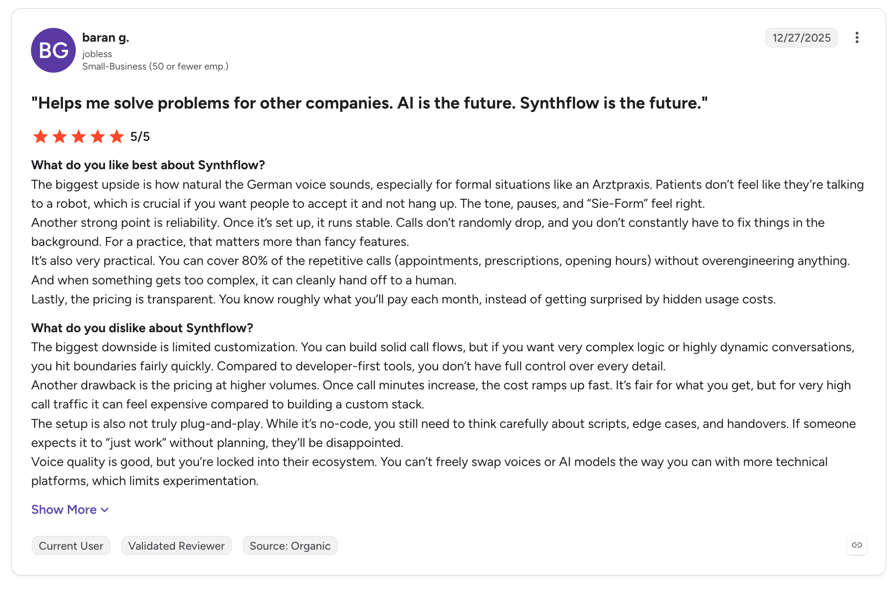
Voice naturalness is the thing Synthflow gets right, and reviewers volunteer it – “remarkably natural” on G2, “I love how natural the voice sounds” on Trustpilot. Latency is where marketing and measurement part company, as set out above. Two further reliability themes: reviewers say the agent handles a caller interrupting it poorly, and Trustpilot carries blunt stability complaints – “glitchy and doesn't work half the time”, “their bot is suddenly just disconnecting calls.” Minority reports against a 4.4–4.5 average, but specific enough to test for.
2. Usability and Interface
A purpose-built operator product, not a developer tool with a thin UI – and the clearest reason to shortlist it. A non-technical operator has a working agent inside an hour, and the Simulation Test Center makes debugging structured rather than guesswork. The ceiling arrives with multi-step branching and dynamic variables, where reviewers start describing workarounds.
3. Developer Capabilities
Adequate for extending a no-code build, thin for a production engineering team. You get REST, webhooks with retry and backoff, streaming and WebSocket endpoints, Custom Actions with chaining and pre-built auth for Salesforce, HubSpot and GoHighLevel, and an MCP server. Against that: no official SDK in any language, no published rate limits, apparently synchronous-only Custom Actions, and bring-your-own-key gated behind account enablement. If your team wants provider freedom, this is not the platform – Vapi is.
4. Language Support
Mid-call detection and switching genuinely works and is documented, which puts synthflow ai languages ahead of most no-code rivals. The gap between the claimed 50+ and the roughly 34 enumerated in the documentation is the thing to probe, along with the absence of any production-versus-beta labelling. One G2 reviewer on Chinese: “Not good enough on Chinese, the tone is monotone and the accent is weird.” If a specific non-English market matters to you, test that language specifically rather than trusting the headline count.
5. Integrations
Confirmed native synthflow ai integrations, from Synthflow's own integrations documentation:
Synthflow Integrations Ecosystem
| Category | Confirmed native | Commonly claimed, not confirmed |
|---|---|---|
| CRM | HubSpot, Salesforce, GoHighLevel | Pipedrive – via Zapier only. Sync depth on HubSpot is also undocumented. |
| Telephony | Twilio, Telnyx, Vonage, SIP/PBX including Asterisk and 3CX | Contact-centre platforms are listed as “community-validated” and Enterprise-tier |
| Calendar & booking | Cal.com | Google Calendar – Zapier or Make only. No Outlook or Microsoft calendar found. |
| Automation | Zapier, Make, Bubble | n8n – a community-maintained node, not a first-party integration |
| Help desk | Zendesk, Freshworks | Intercom – not found in Synthflow's own docs |
| AI & LLM | OpenAI, Azure OpenAI, Anthropic, ElevenLabs, Deepgram | Self-hosted or arbitrary open-source model endpoints |
6. Customer Support
The pattern is a support cliff after onboarding. Two independent write-ups describe the same mechanic – a private Slack channel for the first 30 days, then tickets – though we could not confirm the 30-day figure in a primary review, and one of those sources is a direct competitor. The symptom, though, is confirmed. G2: “Support is really hard to come by unless you pay for a higher level account. Email support sometimes takes days.” Trustpilot, one star: “I've been waiting on a solution now for four days,” and “I am trying to contact them from 2 Months and NO RESPONSE from ANYWHERE.” In fairness it is not uniform – others report replies within a business day. Documentation quality is a genuine strength throughout.
Synthflow Real User Reviews: What Real Users Say About Synthflow AI
Read the ratings alongside the review counts, because the counts vary wildly and one platform has no evidence at all.
Synthflow AI Ratings Across Review Platforms
| Platform | Rating (reviews) | How much weight to give it |
|---|---|---|
| G2 | 4.5 / 5 (~1,010) | A lot. This is a genuinely large sample and the strongest evidence base of any platform in this category. |
| Trustpilot | 4.4–4.5 / 5 (211) | Meaningful, and worth reading rather than averaging – the one-star reviews here are far more specific than the five-star ones. |
| Capterra | No reviews (0) | None. The listing exists with every sub-score blank. |
| Product Hunt | 4.0 / 5 (4) | Almost none. Four reviews is not a signal. |
| Gartner Peer Insights | Not retrieved | Unknown. A page exists; we could not read it and will not guess. |
What Users Love
- Speed of deploymentThe dominant theme by volume, with roughly 364 G2 mentions of ease of use and 148 of easy setup. “Implementation is simple and ready to start debugging and testing within an hour.”
- Voice qualityConsistent across both G2 and Trustpilot. “The quality is outstanding, with low latency and reliable performance.”
- Automation-tool integrationsAround 143 mentions, weighted heavily toward Make.com and Zapier – which is telling, since it suggests users route around the native integration list rather than relying on it.
- Measurable business impactReviews get specific rather than vague: “We don't need to have a cold-calling team, and we're saving costs because of that.”
Where Users Are Frustrated
- Pricing and what sits behind the paywallThe largest complaint cluster, ~145 G2 mentions, and now compounded by the withdrawal of self-serve tiers.
- Support response times after onboardingThe sharpest language anywhere in the review set sits here, and it is concentrated on Trustpilot's low-star reviews.
- Testing costs real minutesEvaluation is metered, so buyers report committing before they were confident.
- Advanced branching hits a ceilingComplex multi-step flows with dynamic variables require workarounds – confirmed by four-star reviewers, not just detractors.
- Analytics depthSentiment and outcome tracking exist; conversation-level control and tracking is where reviewers say it falls short.
- Platform stability and white-label leakageNot in most summaries but present in the reviews: calls disconnecting unexpectedly, and one agency reporting “Synthflow's logos remained visible” despite assurances. One reviewer also noted there is no way to close an account from the dashboard.
Who Should (and Should Not) Use Synthflow AI
Best Fit: Buyer Profiles Where This Tool Shines
- Funded mid-market teams running US, Canadian or Australian call volumeYou can absorb a $30,000 annual floor, and native numbers exist in your markets so you never hit the SIP-requires-Enterprise trap.
- Operations-led teams with no engineering capacityThis is the strongest case for Synthflow. A non-technical operator genuinely can ship a working agent in an afternoon, and the simulation suite means they can validate it without a developer.
- Multilingual inbound where callers switch languageMid-call language detection and switching is documented and works – a real advantage over rivals that need one agent per market.
- Agencies deploying similar agents across many clientsTemplates plus white-label make repeat deployment fast. Two cautions: verify white-label branding actually disappears, and note that Stripe-based reselling is being discontinued in September 2026.
- Regulated teams that need HIPAA and can pay enterpriseA BAA is offered, and EU data residency for sensitive personal data is explicitly stated – Synthflow is a German company and it shows in the privacy posture.
Poor Fit: When You Should Look Elsewhere
- SMBs and solo operatorsThe audience that made Synthflow popular can no longer buy it on published terms. If you want a card-swipe voice agent under €100 a month, this is now the wrong shortlist.
- Teams outside the US, Canada and Australia without SIP appetiteNative numbers cover three countries. Everywhere else means bringing a carrier, which means Enterprise. Price that reality in before you fall for the demo.
- Engineering teams that want provider freedomNo official SDK, no published rate limits, gated BYOK and no arbitrary custom-model endpoint. Vapi is the honest recommendation here.
- European teams that need WhatsApp or SMSBoth are US-region only, by Synthflow's own documentation, because of Twilio EU data residency. This one catches people out.
Synthflow AI: Industry Fit
Where Synthflow Fits, and Where It Strains
| Industry / use case | Fit assessment |
|---|---|
| Healthcare (HIPAA required) | Strong, at enterprise. BAA offered and healthcare is a named vertical. Ask which tier the BAA attaches to and what the uplift is – neither is published. |
| Real estate (high-volume inbound) | Strong. Inbound receptionist plus Cal.com booking is the platform's best-supported path, and setup speed suits a small office. |
| SaaS sales (outbound qualification) | Mixed. Outbound works and CRM writeback is real, but no DTMF navigation for phone trees and no published concurrency make campaign sizing a negotiation. |
| E-commerce (order support) | Mixed. Custom Actions can hit your order API, but cross-channel WhatsApp and SMS – the natural companion here – are US-only. |
| Financial services (compliance-heavy) | Proceed carefully. PCI DSS and ISO 27001 are stated but self-asserted, and we found no confirmation that SOC 2 progressed beyond the Type I process begun in late 2024. Ask for the Trust Vault documents. |
| Agencies (white-label needed) | Was strong, now uncertain. Stripe-based reselling ends 15 September 2026, and at least one agency reports Synthflow branding persisting. Get the branding guarantee in writing. |
| SMB without dev resources | Weak, on price alone. The product is ideal for this buyer. The commercials no longer are. |
Security, Compliance and Data Privacy of Synthflow AI
Compliance Certifications
Synthflow's pages list SOC 2, ISO 27001:2022, PCI DSS v4.0.1, GDPR and HIPAA. The distinction that matters to a security reviewer is between certified and stated, and here the evidence is uneven. The only dated evidence we found on SOC 2 is a December 2024 announcement that Synthflow had “commenced its SOC 2 Type I certification process” after engaging Vanta. Current pages say “SOC 2” with no type and no completion date. That is not evidence of failure – it is simply not evidence of a completed Type II attestation, which is what most enterprise security reviews ask for. ISO 27001 and PCI DSS are stated without a named auditor. A Trust Vault exists and is the right place to ask; we could not read it. CCPA is not mentioned anywhere.
On access control: role-based permissions and TOTP two-factor are platform-wide, but SSO and SAML are Enterprise-only. We found no dedicated admin audit-log feature as distinct from call and API logs. There is no on-premise or private-cloud option.
Data Handling Practices
This is where Synthflow is genuinely strong, and being a Berlin company is the reason. The privacy policy commits to GDPR and the German Federal Data Protection Act, names a Data Protection Officer, and states that “sensitive personal data is stored exclusively on servers hosted in the EU.” Default retention is 90 days, with a 30-day automatic deletion option for recordings and transcripts, and retention configurable by contract.
What Are the Pros and Cons of Synthflow AI?
Synthflow AI: the honest balance sheet
- Fastest no-code build in its classRoughly 364 G2 mentions of ease of use, and reviewers debugging live agents within the first hour. If time-to-first-agent is your metric, Synthflow wins it.
- A real evaluation framework, not just a test buttonThe Simulation Test Center scores persona-driven test calls against your own criteria across up to 25 cases. Almost nothing else at this price point offers it.
- Three-mode human handoff, including AI-summary whisperA prompt-guided summary read to the human before connection, with Human Detection to confirm a person picked up. Genuinely better than most rivals.
- Voice quality that reviewers volunteer unpromptedThe ElevenLabs relationship delivers, and mid-call language switching is documented and working.
- EU data residency from a German companySensitive personal data stored on EU servers, named DPO, 90-day default retention with a 30-day option. Better than most US-headquartered rivals.
And the five things that should give you pause
- Pricing is unknowable without a sales call, from a $30,000 floorNo minutes, no concurrency, no overage rate published. Every third-party tier table you will find is stale, and they contradict each other.
- The latency numbers in circulation are not end-to-endSub-100ms is telephony, sub-200ms is text-to-speech. Independent hands-on tests measured 800–1,200ms and roughly 2,000ms per turn.
- Support falls off after onboarding“Email support sometimes takes days” on G2; four-day and two-month waits reported on Trustpilot. Not universal, but the pattern is consistent enough to plan around.
- Native numbers in three countries, and SIP needs EnterpriseUS, Canada and Australia only, at $1.50 a number. For everyone else the cheapest working phone number arrives attached to an enterprise contract.
- Integration gaps a contact-centre buyer will hitNo native Pipedrive, no native Google Calendar or Outlook, no confirmed Intercom, n8n community-maintained only, and no official SDK in any language.
The Best 4 Synthflow AI Alternatives in 2026
One table, four tools, capabilities down the side. A note on the fourth: Zeeg is not really a peer. It is a scheduling product in the Calendly bracket that has added an AI answering feature, priced per seat rather than per minute. It appears here because buyers do shortlist it, but do not read its column as a like-for-like.
Synthflow Alternatives Compared on Voice-Agent Capability
| Capability | CloudTalk | Vapi | Bland AI | Zeeg |
|---|---|---|---|---|
| Best for | AI inside a real phone system | Developer-led custom builds | High-volume regulated outbound | Booking-first SMBs |
| Build model | No-code + API | API-first | No-code chat builder + API | No-code only |
| Entry price | €0 with 50 free minutes; €99/mo for 200 minutes | $0.05/min platform fee plus STT, LLM and TTS at provider cost | $0.14/min, no platform fee; $0.11/min on $499/mo Scale | Free tier; €12–€40 per user/month |
| Pricing model | Published tiers, all minutes and overage rates visible | Published, but you assemble the bill from components | Published and all-inclusive of models – the clearest in the set | Per seat; no voice minute pricing published |
| Latency | ~1.5–1.6s per turn, measured end to end internally | Median 1,558ms / p95 2,008ms, third-party measured | Claims 400ms; third-party measured median 1,520ms | Not published |
| Concurrency | Unlimited | 10 included, +$10 per extra line | 10 / 50 / 100 by tier, published | Not published |
| Inbound / outbound | Both | Both | Both, outbound-weighted | Inbound; outbound thinly documented |
| Languages | Auto-detects and answers in the caller's language; 160 countries covered | 40+ natively, far more via chosen providers | 40+ native, real-time translation in 23 | Not published for the voice agent |
| Model flexibility | GPT-4o, GPT-4.1, Anthropic and Gemini included; GPT-5 billed extra | Full bring-your-own for LLM, STT and TTS, plus custom endpoints | Closed proprietary stack; no documented BYO | Not published |
| Human handoff | Transfer with full context; safe transfer returns unanswered calls to the agent | Assistant-based warm transfer with configured context | Warm transfer with context – Enterprise tier only | Live transfer claimed; context-carrying not documented |
| Testing before launch | 50 free minutes on a real line | Test Suites and Simulations, billed at call rates | Chat, voice mode, live call and node-level unit tests – the deepest here | A live demo call only |
| Integrations | HubSpot, Salesforce, Pipedrive, Zoho and 100+ more, native two-way | Salesforce, HubSpot, Zapier, Make, Google Calendar, Zendesk, Genesys, Five9 | 17+ including Genesys, Five9, NICE CXone, Talkdesk, Amazon Connect | Calendars and CRMs; no telephony or contact-centre integrations found |
| Compliance | GDPR-aligned call handling – see our security page | SOC 2, GDPR, CCPA, PCI DSS v4.0.1; HIPAA is a $2,000/mo add-on or Enterprise | SOC 2 Type II independently audited, HIPAA with BAA, GDPR, PCI DSS v4.0 | GDPR and EU hosting; no SOC 2 or HIPAA found |
| Support model | Self-serve on Receptionist; CSM and solutions consultant on Specialist | Email and Discord; 24/7 engineers on Enterprise | Standard support; forward-deployed engineers and Slack on Enterprise | Help centre; priority support on Scale |
Why CloudTalk AIVA Is Worth Considering
The trade-off in one sentence: Synthflow optimises for building a voice agent quickly; CloudTalk optimises for running one inside a phone system you already need anyway. If you have no telephony problem and only an automation problem, Synthflow's builder is excellent. If your agents have to share numbers, routing, recordings and reporting with human agents, the calculus changes.
Feature and Capability Comparison
Synthflow AI vs CloudTalk AIVA
| Capability | Synthflow AI | CloudTalk AIVA |
|---|---|---|
| Primary focus | Voice agent builder | Calling platform with agents inside it |
| Entry price | $30,000/year contract | €0 with 50 free minutes, then €99/mo |
| Minimum term | Not published; annual implied | One month on every Receptionist tier; three on Specialist |
| Overage rate | Not published | €0.50 down to €0.30, printed on the pricing page |
| Native phone numbers | US, Canada, Australia | 160 countries |
| Time to a live agent | Under an hour to build; procurement sets the real date | Minutes on the Receptionist; 1–2 weeks for a Specialist build |
| Handoff sophistication | Ahead here. Three modes including a prompt-guided AI summary whispered to the human | Transfer with full context, plus safe transfer. No prompt-configurable whisper summary |
| Supervisor barge-in on an agent call | Not supported | Not supported on agent calls either – available on human calls |
| Simulation testing | Ahead here. Scored persona simulations, up to 25 cases per suite | Live testing on 50 free minutes; no scored simulation suite |
| Humans and AI on one system | Separate product beside your phone system | Same call flows, same routing, one analytics report across both |
| WhatsApp and SMS | Available, US region only | SMS follow-up from the agent; not a full messaging suite |
Synthflow AI vs CloudTalk: Pricing and Scalability Compared
Work a real number. A team needing 2,500 agent minutes a month pays €699 on CloudTalk's AI Receptionist with a €0.35 overage rate and a one-month commitment, or €749 on the AI Specialist if the workflow needs building. Both figures are published, both can be cancelled inside a quarter, and both include the phone numbers and routing.
The equivalent Synthflow figure cannot be stated, because Synthflow no longer publishes one. What is published is the floor: $30,000 a year, roughly €2,300 a month before you have negotiated anything. For a 2,500-minute workload that is a large multiple, and it is why synthflow ai cost has become the deciding factor for mid-market buyers rather than a footnote. The full synthflow vs cloudtalk breakdown works through more volume scenarios.
Where CloudTalk Fits Better
- You can read the price before you talk to anyoneEvery tier, every minute allowance, every overage rate and every contract length is published. That is not a small thing when the alternative starts at $30,000 and shows you nothing.
- Local numbers where your customers actually are160 countries with carrier-grade infrastructure, versus native numbers in three. No SIP-behind-Enterprise trap.
- AI and humans in one telephony systemThe agent lives inside the Call Flow Designer, not beside it. Same routing, same recordings, one analytics report covering agent and human calls together.
- Native two-way CRM sync, not automation glueHubSpot, Salesforce, Pipedrive, Zoho and 100+ more connect directly. Worth noting that Synthflow's own users cite Make and Zapier as a top strength – which is really a comment on the native list.
- Month-to-month means you can actually leaveEvery AI Receptionist tier is a one-month minimum. Reversibility is a feature when you are buying into a category this young.
Final Verdict: Is Synthflow AI Worth It?
So, is synthflow ai worth it? As a product, yes – the build experience is the best in its class and the review evidence backs that up across a thousand users. As a purchase, it depends entirely on which side of the $30,000 line you sit. The uncomfortable truth is that the platform's reputation was built by exactly the buyers it no longer serves.
Good Fit For
- Funded mid-market and enterprise teams with US, Canadian or Australian call volume and a procurement process
- Operations-led teams with no engineering capacity who need an agent shipped this week
- Multilingual inbound operations where callers switch language mid-conversation
- Regulated teams needing a HIPAA BAA and EU data residency, who can pay for the enterprise tier
Not a Good Fit For
- SMBs, solo operators and anyone who wants to buy without a sales call
- Teams outside three countries who do not want SIP configuration attached to an enterprise contract
- Developers who want provider freedom, an SDK and published rate limits – Vapi is the better answer
- European teams that need WhatsApp or SMS alongside voice
- Anyone who needs predictable flat-rate billing and call-centre operations in one place
Synthflow AI: Frequently Asked Questions
Everything buyers ask, answered against sources we checked on 14 August 2026.
Enterprise contracts start at $30,000 a year, and that single line is the only price Synthflow publishes today. Included minutes, concurrency limits and overage rates are all scoped per contract and appear nowhere public. Synthflow's own blog gives component rates – roughly $0.09 a minute for the voice engine plus $0.02–$0.05 for the LLM, landing around $0.14 a minute before telephony. Any tier table you find listing Starter at $29 or Pro at $375 is describing plans that have been withdrawn.
You can build an agent for free from their template library and pay once you launch it. Beyond that, no free tier, trial length or free-minute allowance is published on any current Synthflow page. The “14-day free trial” repeated across the web traces to a company social post from around mid-2024 and is not confirmed by anything current. Testing also consumes metered minutes, which several G2 reviewers flag as a barrier to evaluating properly before committing.
The data-privacy posture is strong: EU-hosted storage for sensitive personal data, a named Data Protection Officer, GDPR and German federal data protection commitments, 90-day default retention with a 30-day deletion option. The certification picture is less settled. SOC 2, ISO 27001:2022 and PCI DSS v4.0.1 are all listed, but the only dated evidence we found described SOC 2 Type I as having “commenced” in late 2024, and no auditor or certificate is named for ISO or PCI. Request the Trust Vault documents during evaluation, and ask specifically whether call data is used for model training – that is not disclosed publicly.
Synthflow offers a Business Associate Agreement and markets healthcare as a named vertical, so a HIPAA-covered deployment is possible. What is not published is which plan tier the BAA attaches to or what it costs – third-party sources suggest roughly a 30% uplift, but we could not confirm that on any Synthflow page. Get both answers in writing before you scope a healthcare project.
For a funded team calling into the US, Canada or Australia that wants a no-code agent live this week, yes – the build experience is the best in its class and 4.5/5 from roughly 1,010 G2 reviewers is a real endorsement. For an SMB, a European team needing local numbers, or a developer wanting provider freedom, no. The product did not get worse; the commercial floor moved out from under a large part of its audience.
It depends what pushed you away. If it was price opacity or country coverage, look at an ai voice agent built into a full calling platform like CloudTalk, where every tier is published. If it was the lack of provider freedom, Vapi gives you full bring-your-own for models, transcription and voices. If you run high-volume regulated outbound and want all-inclusive per-minute billing, Bland AI publishes the clearest rate card of anyone here and holds an independently audited SOC 2 Type II. Zeeg is worth a look only if your real problem is booking rather than telephony.
The product is excellent for small businesses. The pricing is not. Small teams are precisely who made Synthflow popular – the no-code builder, the fast setup, the natural voices all suit an operator with no engineering support. But with self-serve tiers withdrawn and a $30,000 annual floor, a small business cannot buy it on published terms. If that is you, this is now the wrong shortlist.
Under an hour for a basic agent, and this is the platform's genuine strength rather than a marketing claim – one G2 reviewer was “ready to start debugging and testing within an hour”, and ease of setup is the most-mentioned theme across the review base. Complex multi-step flows with dynamic variables take considerably longer, and reviewers describe hitting workarounds there. The real timeline for most buyers now is set by procurement, not by the builder.
Yes – outbound campaigns for reminders, follow-ups, qualification and surveys are all supported, with CRM writeback. Two caveats worth knowing before you scope a campaign. Advanced voicemail and IVR detection with DTMF tone navigation is still an open feature request, marked in progress for roughly two years, so agents cannot reliably navigate a phone tree. And concurrency is no longer published as a number, so campaign throughput is something you negotiate rather than look up.
Yes, Salesforce is a confirmed native integration, alongside HubSpot and GoHighLevel, with pre-built authentication helpers for Custom Actions. What Synthflow does not document is the sync depth – which fields are readable, which are writable, and whether the sync is genuinely bidirectional. Worth asking during evaluation. Note also that Pipedrive is not native despite frequently appearing in comparison tables; it works through Zapier.
Not the number you have probably been quoted. Synthflow publishes “sub-100ms” for telephony network round-trip, “sub-200ms” for its text-to-speech component, and “sub-500ms” on a homepage FAQ with no methodology. None of those is end-to-end turn latency – the pause between a caller finishing a sentence and the agent replying. The two independent hands-on tests we found measured 800–1,200ms and roughly 2,000ms. For context, independent benchmarking across five major platforms found none with a median below one second, so this is a category-wide issue rather than a Synthflow failing. Test it on your own line.
The AI Transparency Statement claims 50+, while the dedicated languages documentation enumerates around 34. Nothing labels which are production-ready versus experimental. Mid-call detection and language switching genuinely works and is documented, which is a real advantage. Quality varies by language though – Synthflow's own docs recommend switching to their in-house transcription for non-English calls, and one reviewer found Chinese output “monotone” with a “weird” accent. Test the specific language you need.
Synthflow is a voice agent builder; CloudTalk is a calling platform with agents built into it. Practically, that means CloudTalk publishes every price, offers local numbers in 160 countries against Synthflow's three, runs AI and human agents through the same call flows and one shared analytics report, and starts at €0 with 50 free minutes on a one-month minimum. Synthflow is ahead on two things worth naming: its scored simulation testing suite, and a more sophisticated three-mode handoff that can whisper a prompt-guided AI summary to the human before connecting. Neither platform delivers sub-second end-to-end latency today.