Conversation Intelligence for Healthcare: Use Cases & HIPAA
TL;DR: What Is Conversation Intelligence for Healthcare?
Conversation intelligence for healthcare is software that records, transcribes and analyzes patient calls to find patterns, gaps and risks. Teams use it to hear every call instead of a small sample, so they can fix what blocks patients from getting care.
- 01Where it works first: Patient access and scheduling lines, QA and staff coaching, billing and insurance calls, and payer contact centers.
- 02What it measures: Why patients call, whether the call ended with a booked appointment or a clear next step, script adherence, sentiment and repeat calls.
- 03HIPAA basics: Get a signed business associate agreement (BAA) that covers recordings and transcripts, then control who can access calls and how long you keep them.
- 04How to start: Pick one queue, take a baseline, use one scorecard and review flagged calls every week for 30 days.
Bottom Line: It shows you why patients call and where they get stuck, as long as the vendor signs a BAA and your team sets up access and retention properly.
Conversation intelligence for healthcare gives patient access teams a view of every call, not just the few a manager has time to hear. Your front desk takes calls about scheduling, billing, referrals and prescriptions all day. You listen to a handful each week and guess at the rest: why patients called back three times, why a new-patient call did not end in a booking, or why the billing line is always busy.
Those calls also take up most of your staff's time. In a March 2026 MGMA Stat poll (294 responses), medical practice leaders named eligibility and prior authorization as the most time-consuming phone task (45%), followed by scheduling (31%). Healthcare conversation intelligence turns those calls into data you can act on. This guide explains how it works, where it helps first, what to check for HIPAA and how to start small.
What Is Conversation Intelligence for Healthcare?
Conversation intelligence for healthcare is software that uses AI to record, transcribe and analyze conversations between patients and staff, mainly phone calls. It shows why people call, how each call went and what needs fixing. Some tools also analyze chat and text messages.
It is easy to confuse with tools you may already have:
| Tool | What it does | What it tells you |
|---|---|---|
| Call recording | Stores the audio of each call | What was said, if someone listens |
| IVR (phone menu) | Routes callers by the option they press | Which menu option the caller chose |
| Conversation intelligence | Transcribes and analyzes each call | Why the patient called, how they felt and how the call ended |
Recording and IVR give you raw material. Healthcare conversation intelligence reads meaning, intent and sentiment across all of it, so you see patterns without listening to hours of audio.
Conversation Intelligence vs Conversational AI
The two names sound alike but do different jobs. Conversational AI holds the conversation: a chatbot or a voice agent that answers patients, books appointments or routes urgent calls. If that is what you need, see how conversational AI for healthcare works as an AI answering service. Conversation intelligence analyzes conversations that people or bots already had. You will also see the spelling healthcare conversational intelligence: it means the same thing as conversation intelligence.
How Does Conversation Intelligence Work in a Healthcare Setting?
Most platforms follow four steps:
- Capture the call. The phone system records the conversation. If recording is built into your phone system, there is no separate recorder to connect.
- Turn speech into text. A speech-to-text engine creates a call transcription with speaker labels, so you can tell the patient from the staff member.
- Analyze the conversation. Healthcare call analytics detects the call reason, sentiment, topics and whether required phrases were said, such as an identity check.
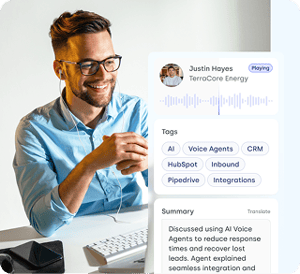
- Deliver the results. Summaries, scores and alerts go to the team, the CRM or the practice system, so managers know which calls to review first. A typical summary lists the call reason, what was agreed and the next step, such as "rescheduled to Tuesday, insurance card to be emailed".
Most conversation intelligence reviews a call after it ends. Some vendors also offer live guidance during the call. Ask which one a vendor means when they say "real-time", because the two need different setups and budgets.
One note on scope: tools that write clinical notes during a visit, often called ambient scribes, are a different category. This article covers phone calls and patient communication, not clinical documentation.
Automated vs Human Transcription
Automated transcription is fast and cheap, and it covers every call. It can still miss drug names, strong accents and words on a noisy line. Check a sample of transcripts each month, and have a person review any transcript used for a clinical or legal decision.
Key Use Cases for Conversation Intelligence in Healthcare
Patient Access and Scheduling Calls
Patient access lines lose people in ways nobody sees: calls that drop on hold, new-patient calls that end without a booking, and callers bounced between departments. Conversation intelligence groups calls by reason, flags repeat callers and shows the exact moment a booking falls apart, such as an unclear insurance answer. Patient access leads can then fix routing, scripts or staffing for the real problem. For example, if many new-patient calls stall at the same insurance question, a short answer in the script and a list of accepted plans can fix it in a week. If you run a larger team, see how a healthcare call center setup handles routing and queues.
Quality Assurance and Staff Coaching
Most QA teams score a small manual sample of calls each week. With conversation intelligence, every call can be scored against your checklist: greeting, identity check, correct information and a clear next step. Searchable transcripts make coaching specific, because a supervisor can play the exact moment a call went wrong instead of giving general feedback. Pair it with call monitoring software for live listening on new hires.
Billing, Insurance and Referral Calls
Billing lines often answer the same questions every day: an unclear statement, a prior authorization that stalled or a coverage question. Conversation intelligence counts how often each reason comes up, so you can fix the root cause once, for example by rewriting a confusing bill or adding a status update to the referral process. Fewer repeat calls free up staff for the calls that need them. Practice leaders in the MGMA poll named eligibility and prior authorization as the most time-consuming phone task, so this line is often where the biggest time savings are.
Follow-Up and Care Coordination Calls
Post-visit and reminder calls matter for outcomes, but nobody checks them at scale. Conversation intelligence shows whether staff gave the instructions, confirmed understanding and booked a next step. AI call summaries and tags make each call easy to review in a few seconds.
- For primary care teams: Review medication adherence and chronic care follow-up calls to see where patients struggle, such as refill delays or missed lab work. Conversation intelligence analyzes these calls. It does not give clinical advice.
Telemedicine, Virtual Care and Health Insurance Contact Centers
Telemedicine support lines handle connection problems, scheduling and follow-up questions. Conversation intelligence for telemedicine shows which issues come up most, such as a login step that confuses patients, so product and support teams can fix it before the next visit.
Payer and health plan contact centers handle member questions, enrollment periods and complaints at high volume. Conversation intelligence for health insurance spots complaint trends early and checks that agents give required disclosures on every call.
Benefits of Conversation Intelligence and How to Measure Them
Each benefit should come with a number you can track. Take a baseline before you switch anything on, so you can compare after 30 days.
| Benefit | What changes | Number to track |
|---|---|---|
| Every call reviewed | QA covers all calls, not a sample | QA coverage (share of calls scored) |
| Faster, more consistent coaching | Feedback uses real call moments and one scorecard | Score trend per staff member |
| Fewer repeat calls | Common call reasons get fixed at the source | Repeat-call rate |
| More booked appointments | Lost bookings get spotted and fixed | Booking rate from calls |
| Earlier compliance flags | Missed identity checks or disclosures surface the same week | Compliance incidents |
Patients benefit through faster, clearer calls and fewer callbacks. Staff benefit through less after-call work and clearer feedback.
To build the baseline, pull the last 30 days from your phone system reports and score 20 calls by hand with the same checklist you plan to automate. That gives you a fair before-and-after comparison, and it shows staff what the scorecard measures before any automated scores appear.
Other KPIs to baseline before you start:
- Answer rate and abandonment rate.
- First-call resolution.
- Average handle time.
HIPAA, Privacy and Consent: What to Check
Call recordings and transcripts can contain protected health information (PHI), such as names, dates of birth and diagnoses. That makes HIPAA compliant call recording the starting point for any conversation intelligence project. Check these items before any patient call is analyzed:
- BAA: A signed business associate agreement with the vendor, plus BAAs with any AI sub-processor that touches recordings or transcripts.
- BAA scope: Written confirmation that recordings, transcripts and AI summaries are covered.
- Access: Role-based access and a unique login for every user, with no shared accounts.
- Audit logs: A record of who played, downloaded or exported each call.
- Encryption: Encryption of recordings and transcripts in storage and in transit.
- Retention: Clear rules for how long you keep calls and when they are deleted.
- Recording notice: A message that tells callers the call is recorded.
- Patient requests: A process for handling requests to access or delete recordings.
HIPAA has no official certification. The U.S. Department of Health and Human Services does not recognize private HIPAA certifications, so a badge on a vendor's website proves nothing. Ask for the BAA and read its scope instead.
Recording consent laws also apply. Some U.S. states require consent from one party on the call, and others require consent from everyone, so check the rules for each state you call. This is general information, not legal advice. For details, see our guides to a HIPAA-compliant call center and HIPAA telephone rules.
Keep patient details out of text messages. Standard SMS is generally not considered a HIPAA-compliant channel because it does not support end-to-end encryption, so send generic reminders and handle details on the call.
CloudTalk's security controls and policies comply with HIPAA, and CloudTalk can sign BAAs with healthcare customers. Its healthcare phone system page states that recordings and transcripts are covered by the BAA. CloudTalk does not support HIPAA-compliant text messaging.
How to Choose a Healthcare Conversation Intelligence Platform
Practice managers and CIOs should check six things before they buy healthcare conversation intelligence software:
- BAA and its scope: The vendor signs a BAA, and it covers recordings, transcripts and AI features.
- System fit: It works with your phone system and your EHR or CRM. Ask exactly which fields sync and where.
- Accuracy: It handles medical terms, drug names and your callers' accents. Test it on your own calls.
- Scorecards: You can build scorecards for your own scripts and checklists.
- Languages: It transcribes every language your patients speak.
- Total cost: Per-seat price, minimums and add-ons, not just the starting price.
In a demo, ask three questions that cut through the sales pitch:
- Can you run 20 of our own calls? Accuracy on your callers and your medical terms matters more than a polished sample.
- Can we see your BAA before we sign? Read which data and which sub-processors it covers.
- Who sees recordings by default? The answer shows how much access control work your team will have to do.
Platforms fall into three types:
| Type | Examples | Best for | Watch out for |
|---|---|---|---|
| Healthcare-specialized analytics | Authenticx, Marchex, Patient Prism | Deep healthcare call analysis for health systems and multi-location groups | Usually separate from your phone system, and priced for larger teams |
| Phone-system-native | CloudTalk | Analysis inside the system that already places and records the calls | Fewer healthcare-specific reports than specialized tools |
| General sales conversation intelligence | Gong | Sales teams analyzing deals and revenue calls | Built for sales, not for patient access workflows |
In CloudTalk, conversation intelligence is a paid add-on that analyzes calls after they end. It sends insights to HubSpot, Pipedrive and Zoho today. EHR syncing for conversation intelligence is not a native feature, so check your EHR workflow with the CloudTalk team before you commit.
Fit depends on size. A small practice needs call summaries, a scorecard and a BAA. A hospital system also needs EHR integration, data governance and an enterprise security review.
Conversation intelligence vs call tracking: With call tracking, healthcare marketing teams count calls and attribute them to sources, such as which ad made the phone ring. Conversation intelligence analyzes what was said on those calls.
How to Start, and the Limits to Know
A 30-Day Start on One Queue
Pick one queue, such as the front desk line or the billing line, and follow this plan:
- Week 0: Sign the BAA, add the recording notice and take a baseline of your KPIs.
- Week 1: Set up one scorecard with four or five checks, such as greeting, identity check and next step.
- Weeks 2 and 3: Review flagged calls every week and coach on one or two patterns at a time.
- Week 4: Compare your KPIs to the baseline, then decide whether to add the next queue.
Limits to Know
- Transcripts: They can misread medical terms and drug names.
- Summaries: They can be wrong, so staff should check them before acting.
- Sentiment: It is a signal for sorting calls, not a verdict on a patient or a staff member.
- Staff trust: Staff may distrust call review, so explain that it is for fixing processes and coaching, not for punishment.
- Clinical use: Conversation intelligence is not clinical decision support.
Turn Patient Calls Into Better Access
Conversation intelligence for healthcare records, transcribes and analyzes patient calls so you can see why people call and where they get stuck. It helps first on patient access lines, in QA and coaching, on billing and insurance calls and in payer contact centers.
Before you analyze a single call, get a BAA that covers recordings, transcripts and AI features, and set up access, retention and a recording notice. Then start with one queue and one scorecard for 30 days. To see how calls, recordings and BAA coverage work together, explore CloudTalk's phone system for healthcare.


Sources:
Frequently asked questions
No software is HIPAA compliant on its own. Compliance depends on the vendor signing a BAA that covers recordings, transcripts and AI features, and on your own setup, including access controls, retention rules and staff training.
Call tracking shows which marketing source made the phone ring and how many calls came in. Conversation intelligence shows what was said on each call, why the patient called and how the call ended.
Yes. A small practice can use call summaries and one scorecard to find lost bookings and coach front desk staff, without a data team. Choose a tool built into your phone system to keep setup simple.
Some platforms do, but many sync only with CRMs or connect to an EHR through an API. Ask each vendor which EHR it supports and which fields it writes to, and test it before you sign.
No. It scores calls and flags patterns, but people still decide what to coach and what to change. It does not give clinical advice or replace a clinician's judgment.