Vapi AI Plans & Pricing: Full Guide for 2026
TL;DR:
Vapi AI charges $0.05 per minute. That is the whole published price, and it is also the smallest number on your bill. Vapi is orchestration: it does not include the speech-to-text, the language model, the voice, or the phone line. You buy those four separately, from four other vendors, and Vapi passes them through at cost.
What the $0.05 hides: a realistic assembled stack lands between roughly $0.12 and $0.24 per minute before the language model is counted, plus $10 per month for every concurrent line past the tenth, $2 per phone number, 14-day call history on the Build plan, and $2,000 per month if you need HIPAA. For a regulated team running 5,000 minutes a month, the compliance add-on alone costs more than the calls.
Summary of Vapi AI Pricing Plans
| Plan | Price | Best For |
|---|---|---|
| Build (usage-based) | $0.05 /minute + provider costs | Developers prototyping a voice agent, with Discord and email for support. |
| Scale (annual contract) | Volume-based, quoted | Production deployments that need SOC 2, SSO, RBAC and an account team. |
| HIPAA add-on | $2,000 /month | Any healthcare use case, on either plan. |
| Zero Data Retention add-on | $1,000 /month | Teams that cannot let transcripts persist, on either plan. |
$0.05 a minute is the orchestration fee, not the phone call.
How Much Does Vapi AI Cost?
Vapi publishes two plans. Build is usage-based at $0.05 per minute of call time and $0.005 per SMS or chat message, with 10 concurrent lines included and $10 per month for each line after that. Scale is an annual contract with volume-based rates, custom concurrency, and the compliance and access controls that Build does not carry natively.
Read the pricing page carefully and the model becomes clear. Vapi bills for hosting and orchestration. The four things that actually produce a conversation, transcription, the language model, voice synthesis and telephony, are charged at cost with no Vapi margin, or cost you nothing on Vapi's side if you bring your own API keys. That is genuinely honest pricing. It is also why the advertised number tells you almost nothing about your bill.
Here is how the two plans compare:
| Feature | Build | Scale |
|---|---|---|
| Call pricing | $0.05 /min, prorated to the second | Volume based, quoted annually |
| SMS and chat | $0.005 /message | Volume based |
| Transcription, model, voice | At cost, or $0 with your own API keys | At cost, or $0 with your own API keys |
| Telephony | Charged by the provider, not Vapi | Charged by the provider, not Vapi |
| Call concurrency | 10 included, then $10 /line/month | Custom |
| Call history retention | 14 days | Custom |
| Chat history retention | 30 days | Custom |
| Compliance and access control | No native SSO, RBAC or SOC 2 | SOC 2, HIPAA, PCI, SSO, RBAC |
| Support | Community Discord and email | Dedicated account team |
The thing to internalise: Vapi is priced as infrastructure, not as a product. There are no seats, no feature tiers, and nothing that resembles a plan you can hand to finance. What you are buying is a framework and a bill that assembles itself from five sources. For an engineering team building something custom, that is exactly right. For a business that wants an agent answering the phone next week, it is the first sign you are shopping in the wrong aisle.
What Real Users Say About Vapi AI's Pricing
Vapi AI holds 4.2/5 on G2, though from only three reviews, so treat that score as an anecdote rather than a verdict. What the reviews do agree on is the shape of the product. Reviewers call it one of the cheapest ways to build a voice bot and praise the breadth of provider support. The complaints are about unpredictable latency and a dashboard that reviewers describe as overwhelming, with one asking outright for a basic mode alongside the advanced one.
Notice what nobody is reviewing: a phone system. Vapi is a developer platform, and the people reviewing it are developers. If your evaluation team does not include someone comfortable wiring together four provider accounts and reading token-level cost logs, the reviews are describing a different job than the one you are hiring for.
Vapi Build: The Pay-as-You-Go Plan
What Is Vapi Build?
The self-serve plan: $0.05 per minute of call time, billed to the second, with no monthly commitment and no contract. New accounts get free starter credits, and Vapi's pricing page notes 60+ minutes included to get you started. You connect your own transcription, model, voice and telephony providers, and Vapi orchestrates them.
What's included in Vapi Build?
- Orchestration of the full voice pipeline at $0.05 per minute, prorated to the second.
- 10 concurrent call lines, with more at $10 per line per month.
- Provider costs passed through at cost, or nothing at all if you bring your own API keys.
- Phone numbers bought through Vapi at $2 per month each.
- Support through community Discord and email.
Who is Vapi Build best for?
Engineering teams prototyping a custom voice agent, where someone owns the provider accounts, the prompt engineering, and the cost monitoring as part of their actual job.
What you need to know about Vapi Build:
Two limits catch business buyers off guard. Call history is kept for 14 days, so any quality review, dispute or coaching workflow that runs on a monthly cycle has already lost the recording. And Build has no native SSO, RBAC or SOC 2, which in most companies means it cannot pass a security review no matter how well the agent performs. Both are solved by moving to Scale, which means an annual contract and a sales conversation.
Vapi Scale: The Annual Contract
What Is Vapi Scale?
The production plan, sold as an annual contract with volume-based per-minute rates rather than the flat $0.05. It adds the things a company needs before a voice agent touches real customers: SOC 2, HIPAA, PCI, SSO, RBAC, custom data retention, an uptime SLA and a dedicated account team.
What's included in Vapi Scale?
- Volume-based call and message rates, negotiated against committed usage.
- Custom call concurrency instead of the 10-line default.
- SOC 2, HIPAA, PCI, SSO and RBAC, plus custom data retention.
- A dedicated account team and a custom support SLA.
Who is Vapi Scale best for?
Companies running voice agents in production at volume, with an engineering team to own the deployment and a procurement process that can absorb an annual commitment.
What you need to know about Vapi Scale:
Vapi publishes no figure for Scale, so budgeting means a sales call before you can put a number in a spreadsheet. Note also what Scale does not change: the provider stack is still yours to assemble and still billed at cost, and HIPAA remains a $2,000 per month add-on on Scale exactly as it is on Build. You are buying compliance controls and a support relationship, not a bundled price.
Compliance shouldn't be a $2,000 line item.
What Are Vapi AI's Additional Costs?
Vapi's $0.05 is real and Vapi adds no margin to anything else. That transparency is the point, and it is also why almost your entire bill sits outside Vapi's pricing page. Here is what actually joins the invoice.
| Extra cost | Amount | When it hits |
|---|---|---|
| Speech-to-text provider | From about $0.005 /min | Every minute of every call, both channels |
| Language model provider | Per token, varies widely | Every turn. Driven by your system prompt length |
| Voice synthesis provider | From about $0.05 to $0.36 /min | Every word the agent speaks |
| Telephony provider | About $0.0085 to $0.014 /min | Phone calls only, not web calls |
| Extra call concurrency | $10 /line/month | Every simultaneous call past the tenth |
| Phone numbers | $2 /month via Vapi | Per number, ongoing |
| HIPAA add-on | $2,000 /month | Any healthcare workload, on either plan |
| Zero Data Retention add-on | $1,000 /month | When transcripts cannot persist, on either plan |
The Vapi Cost Trap: What a Minute Actually Costs
Stack the published list prices and the picture changes. Vapi takes $0.05. Deepgram's Nova-3 streaming transcription lists at $0.0077 per minute. Twilio charges $0.014 per minute for outbound US local calls and $0.0085 inbound. Voice is the swing factor: ElevenLabs advertises low-latency speech as low as 5 cents a minute, but only on its $990 per month Business tier, with the lower tiers landing nearer $0.17 to $0.36 per extra minute.
So the floor is roughly $0.12 per minute, and only if you are already paying $990 a month for the voice tier that unlocks it. On a mid-tier voice plan the same minute is closer to $0.24. Neither number includes the language model, which Vapi's own documentation calls the largest cost you can control, driven by system prompt length and roughly five model requests per conversational turn. That is the honest read on Vapi pricing: a $0.05 headline sitting on a stack that multiplies it by three to five before anyone has written a prompt. Worth reading next to what voice AI actually costs across the market. Explore CloudTalk AI Voice Agent plans for the version where one number covers the whole pipeline.
One number. Four fewer vendor accounts.
What Will Vapi AI Actually Cost You?
Here is what three realistic deployments cost per month, stack included, because that is the only honest way to count it. Figures use the published list rates above at a mid-tier voice plan of about $0.24 per minute all-in, and exclude the language model and any engineering time.
| Deployment | Cost basis | Monthly | Annual |
|---|---|---|---|
| After-hours reception, 500 min/month | ~$0.24 /min | ~$122 | ~$1,464 |
| Support deflection, 5,000 min/month, 20 lines | ~$0.24 /min + $100 concurrency | ~$1,302 | ~$15,624 |
| Regulated team, 5,000 min/month + HIPAA | ~$0.24 /min + $100 + $2,000 | ~$3,302 | ~$39,624 |
Scenario 1: After-hours reception (500 minutes a month)
A clinic or agency wants calls answered outside office hours. Five hundred minutes at roughly $0.24 plus a $2 number comes to about $122 a month. Cheap, and genuinely so. What the number leaves out is the setup: four provider accounts to open, four sets of credentials to manage, four invoices to reconcile, and someone who can write and tune the prompt. At this volume the software is not the cost. The person configuring it is.
Scenario 2: Support deflection (5,000 minutes a month)
A support team routes repetitive inbound calls to an agent. Five thousand minutes at $0.24 is $1,200, and 20 concurrent lines adds $100, so roughly $1,302 a month, $15,624 a year. Still competitive against headcount. The catch is the 14-day call history on Build: a quality programme that reviews last month's calls has nothing left to review, so this deployment is really a Scale contract, priced by quote.
Scenario 3: The regulated team (5,000 minutes plus HIPAA)
Same volume, healthcare data. Add the $2,000 per month HIPAA add-on and the bill becomes roughly $3,302 a month, $39,624 a year. Read that again: the compliance line item costs more than every minute of every call combined, and it is priced identically on Build and Scale, so committing to an annual contract does not soften it. If your use case touches protected health information, HIPAA is not an add-on decision. It is the decision.
The real-world read:
Vapi is excellent value for engineering teams building something custom, where assembling providers is the job and $0.05 of orchestration is a bargain. The economics invert for business buyers: the provider stack triples the headline rate, compliance costs $2,000 a month flat, call history disappears after 14 days on the self-serve plan, and none of it includes the person who has to build and maintain the thing.
Do the stack math on your own use case, free.
Which Alternatives Are Better and Cheaper Than Vapi AI?
Vapi answers one question well: "how do we build a custom voice agent on our own stack?" If your question is closer to "how do we get an AI agent answering our phones without hiring an engineer for it," the market splits into packaged platforms and other developer frameworks. Each one below has its own pricing breakdown if you want the detail.
| Platform | Best for | Pricing model |
|---|---|---|
| Vapi AI | Developers building custom agents | Orchestration only. You assemble and pay four providers |
| CloudTalk AI Voice Agents | Sales and support teams that want it running this month | Packaged. Speech, model, voice and telephony in one price |
| Retell AI | Teams wanting a developer platform with more bundled | Per-minute, with more of the pipeline included than Vapi |
| Bland AI | High-volume outbound calling | Per-minute on a self-hosted stack |
| Synthflow | No-code builders | Monthly plans with included minutes |
If you are still deciding between building and buying, our guide to AI call center software covers what packaged platforms include, and the Vapi AI alternatives comparison puts the developer frameworks side by side.
CloudTalk: Best for Teams That Want the Agent Live, Not Assembled
What is CloudTalk?
CloudTalk is an AI-powered business calling platform for sales and support teams, with AI Voice Agents built on top of a working phone system rather than beside one. The speech recognition, the model, the voice and the telephony are already connected, and the numbers, routing, CRM sync and reporting your team needs on the human side of the call are in the same product. Coverage runs across 160+ countries with 160 national numbers.
Why is CloudTalk better than Vapi AI?
- One vendor, one invoice: no transcription account, no model account, no voice account, no carrier account, and no reconciling four bills to answer what a call cost.
- No engineer required: agents are configured, not coded, which means the team that owns the phone queue can own the agent.
- Compliance in the platform: one contract and one security review, rather than a $2,000 per month add-on plus separate agreements with each provider.
- A phone system underneath: when the agent hands off, there is a queue, a routing rule and a human with call history, plus 100+ integrations to log it all in your CRM.
What is CloudTalk's AI Voice Agent pricing?
- AI Receptionist: from free, with 50 minutes to test, for front desk, peak and after-hours cover across 60+ languages.
- AI Specialist: 1,000 minutes a month with expert implementation, identity authentication, real-time workflows and calendar sync included.
- Custom: from about 15 cents a minute above 10,000 minutes a month.
- On the human side, CloudTalk plans start at $25/user/month, with Essential at $29 and Expert at $49. Full detail on the CloudTalk pricing page.
CloudTalk pricing vs. Vapi AI pricing
Compare like for like and the gap is smaller than either headline suggests. Vapi's $0.05 becomes roughly $0.12 to $0.24 a minute once the stack is assembled, before the language model, and before anyone has been paid to assemble it. CloudTalk's per-minute rate covers the same pipeline with implementation included, and drops toward 15 cents at volume. Vapi wins when you want control over every component and have the team to exercise it. CloudTalk wins when the agent needs to be answering calls in weeks rather than quarters, and when the answer to "what did that call cost" has to fit on one line.
CloudTalk reviews
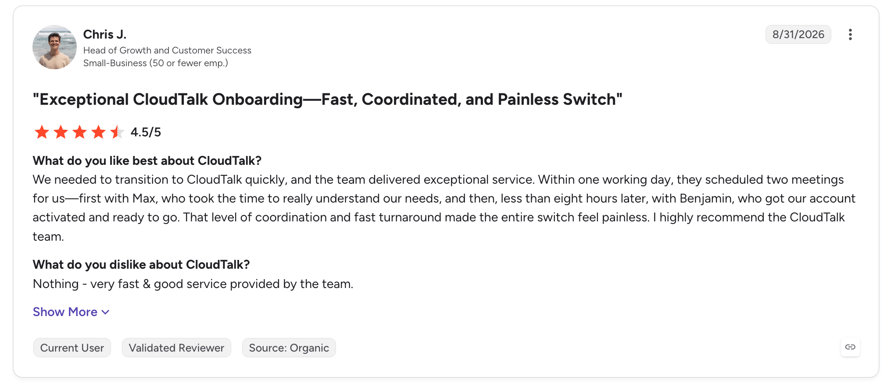
CloudTalk holds a 4.4/5 rating on G2 from 1,702+ reviews, with users repeatedly calling out call quality, onboarding and integrations.
Skip the build. Keep the agent.
What Are Vapi AI's Best Features?
Pricing only matters next to what you get. These are the things that make Vapi the right call for the teams it fits.
- Provider costs at cost, with no markup. Vapi states plainly that it adds no margin to transcription, model, voice or telephony charges. Very few platforms will say that.
- Bring your own API keys. Use your existing provider contracts and negotiated rates, and Vapi's side of those costs drops to zero.
- Component-level control. Swap the transcriber, the model or the voice independently, and tune each one for latency or cost.
- Billing prorated to the second. No minimum call length rounding, which matters when most calls are short.
- Transparent cost tooling. Vapi documents how each component is metered and surfaces per-call cost estimates, so the bill is at least explainable.
What Are the Pros and Cons of Vapi AI's Pricing?
The honest ledger, focused on what a business buyer pays:
| Pros | Cons |
|---|---|
| No markup on provider costs, stated openly | The $0.05 headline is orchestration only. The real stack runs roughly $0.12 to $0.24 a minute |
| No seats, no minimums, no contract on Build | Four separate provider accounts to open, monitor and reconcile |
| Free starter credits and second-level billing | HIPAA costs $2,000/month and Zero Data Retention $1,000/month, on both plans |
| Full control over every pipeline component | Build keeps only 14 days of call history and 30 days of chat |
| Scale adds SOC 2, HIPAA, PCI, SSO and RBAC | Scale is quote-only, so there is no published number to budget against |
Your voice agent shouldn't need a procurement project.
Is Vapi AI the Right Call for Your Team?
Vapi is a genuinely good product for the buyer it was designed for: an engineering team building a custom voice agent, with opinions about which model and which voice to use, and the appetite to own four provider relationships. For that team, $0.05 a minute of orchestration with no markup on anything else is close to unbeatable, and the free starter credits make it free to prove.
Just price the stack, not the headline. Transcription, the model, the voice and the phone line are all yours to buy, and together they run three to five times the $0.05. Concurrency past ten lines is $10 each. Call history vanishes after 14 days on Build. HIPAA is $2,000 a month whichever plan you are on. And Scale, the plan a real deployment needs, has no published price at all.
The honest question is who is going to build this. If you have an engineer whose job includes voice infrastructure, Vapi hands them the best set of controls on the market and charges very little for the privilege. If the person asking for an AI agent is a support lead or a sales manager, the per-minute rate was never the expensive part. The build was. That is the same calculation behind usage-based pricing models generally: the cheap unit rate is only cheap if someone else is absorbing the work around it.
So here is the decision rule. Choose Vapi if you are building and you want control over every component. Choose a no-code builder if you want to assemble something yourself without writing code. And if you want an AI agent answering real customer calls on your real numbers next month, choose a platform that ships the whole pipeline: CloudTalk gives sales and support teams AI Voice Agents on top of a phone system that already works, at one price you can forecast.

Scale your call volume, not your vendor list.

Frequently asked questions
Vapi charges $0.05 per minute for orchestration, prorated to the second. Transcription, the language model, the voice and telephony are billed separately by their providers, which typically brings the real rate to roughly $0.12 to $0.24 per minute.
Vapi's own fee is one of the cheapest in the category. The total is not, because you also pay four providers and, for regulated work, $2,000 a month for HIPAA. Cost depends far more on the stack you assemble than on Vapi.
There is no monthly plan fee on Build. You pay for usage, plus $10 per month for each concurrent line past the tenth and $2 per phone number. A 500-minute month costs roughly $122 all in; 5,000 minutes with 20 lines costs around $1,300.
Per minute. Vapi has no seats and no per-user pricing at all, which makes it hard to compare directly with per-seat platforms. Messages are billed separately at $0.005 each.
The Build plan includes 10 concurrent call lines, with additional lines at $10 per line per month. Scale customers get custom concurrency negotiated in the contract.
HIPAA is available as a $2,000 per month add-on on both the Build and Scale plans. Note that your transcription, model, voice and telephony providers each handle data too, so compliance covers more than Vapi alone.
Yes. New accounts get free starter credits with no card required, and Vapi's pricing page lists 60+ minutes included on the usage-based plan. Provider costs still apply unless you bring your own API keys.
The Build plan retains 14 days of call history and 30 days of chat history. Scale customers get custom retention. Zero Data Retention is available on both plans as a $1,000 per month add-on.
It depends on who is building it. Developer teams comparing frameworks should look at Retell AI and Bland AI. Business teams that want an agent live without engineering work should look at packaged platforms like CloudTalk, where the full pipeline sits behind one price.