RingCentral Plans & Pricing: Full Guide for 2026
TL;DR:
RingCentral pricing runs from $20 to $35 per user/month across three RingEX plans (Core, Advanced, Ultra) when billed annually, or $30 to $45 billed monthly. Unlike most phone systems, RingEX is standalone: there is no base suite license underneath it. The catch sits somewhere else, in what the plans meter and what they push into add-ons.
What the sticker price hides: texts capped at 25 per user on Core, toll-free minutes capped at 100, call recording that is on-demand only until you reach Advanced, Business Analytics Pro sold as an add-on on every single plan, Conversational Intelligence from $60 per user/month, AI Receptionist from $39/month, and two line items on every invoice (a Compliance and Administrative Cost Recovery Fee plus an E911 fee) whose amounts RingCentral does not publish anywhere.
Summary of RingCentral Pricing Plans
| Plan | Price (billed yearly) | Best For |
|---|---|---|
| RingEX Core | $20 /user/month | Small teams that need a working phone line and nothing else. |
| RingEX Advanced | $25 /user/month | The plan most businesses actually buy: auto call recording and real queue routing. |
| RingEX Ultra | $35 /user/month | Heavy internal use: 10,000 toll-free minutes and unlimited storage. |
| RingCX (contact center) | Quote-based | Formal contact centers. Sold separately from RingEX, priced per agent. |
The plan is $20. The invoice is a different number.
How Much Does RingCentral Cost?
RingCentral pricing covers three RingEX plans: Core at $20, Advanced at $25, and Ultra at $35 per user/month on annual billing. Pay monthly instead and the same plans cost $30, $35 and $45. RingCentral advertises savings of up to 33% for paying annually, which is exactly the gap on Core, and every new subscriber gets a 14-day free trial covering up to 20 phone lines.
Two things separate RingCentral from most of the phone systems it competes with. First, it is genuinely standalone: no Microsoft 365 or Google Workspace license is required underneath, and unlimited domestic calling in the US and Canada is included on all three plans. Second, the plans do not compete on calling. They compete on volume caps and on which management features are switched on, which is where most RingCentral budgets go sideways.
Here is how the three plans stack up:
| Feature | Core | Advanced | Ultra |
|---|---|---|---|
| Price (billed yearly) | $20 /user/mo | $25 /user/mo | $35 /user/mo |
| Price (billed monthly) | $30 /user/mo | $35 /user/mo | $45 /user/mo |
| Unlimited domestic calling (US & CA) | Yes | Yes | Yes |
| Toll-free minutes included | 100 | 1,000 | 10,000 |
| SMS per user/month | 25 | 100 | 200 |
| Call recording | On-demand only | Automatic & on-demand | Automatic & on-demand |
| Call queues | Basic | Advanced rules and routing | Advanced rules and routing |
| Video participants | Up to 100 | Up to 100 | Up to 200 |
| File, message & recording storage | Limited | Limited | Unlimited |
| Business Analytics Pro | Add-on | Add-on | Add-on |
| Conversation Intelligence & AI Receptionist | Add-on | Add-on | Add-on |
| Ideal for | Basic business lines | Teams that record and route calls | Toll-free heavy, storage heavy setups |
Read that table twice and the pricing logic becomes clear. Every plan can make calls. Only the expensive ones can prove what happened on those calls, and none of them include the analytics layer, because Business Analytics Pro is an add-on at every tier. For a team that uses the phone occasionally, that is a fair trade. For a sales or support team measured on call outcomes, the features you most need are the ones sitting outside the price you were quoted.
What Real Users Say About RingCentral's Pricing
RingEX holds a 4.2/5 on G2 from more than 1,470 reviews. The praise is consistent and earned: reviewers call out reliability, call quality, and the relief of having calls, texts, video and CRM logging in one app instead of four.
The complaints are just as consistent, and they are almost entirely about money. Reviewers describe RingEX as expensive next to other providers, flag that the AI and analytics tools they wanted sit behind higher tiers or paid add-ons, and report bills coming in "higher than planned" after blowing past the monthly per-user text limit. A recurring theme: features that feel like they should be in the base subscription are billed separately. That is not a broken product. It is a pricing model that makes a good product hard to forecast, which is the entire reason knowing how to evaluate VoIP pricing is worth an afternoon before you sign.
RingEX Core
What Is RingEX Core?
The $20/user/month entry plan: a full business phone system with unlimited domestic calling in the US and Canada, IVR, basic call queues, and RingCentral's personal AI assistant for call notes and transcription. Recording is on-demand only, texts are capped at 25 per user per month, and toll-free usage stops at 100 minutes.
What's included in RingEX Core?
- Unlimited domestic calling in the US and Canada, plus a business number and extensions.
- IVR, basic call queues, voicemail, and 100 toll-free minutes.
- Personal AI assistant across phone, video, SMS and team messaging.
- Video meetings for up to 100 participants and 25 SMS per user/month.
Who is RingEX Core best for?
Small offices replacing a landline: reception, a shared main number, a handful of extensions, and calls that nobody needs to review afterwards.
What you need to know about RingEX Core:
Twenty-five texts per user per month is roughly one text per working day. Any team that confirms appointments, chases replies, or sends delivery updates by SMS will hit that ceiling in the first week and pay for the overage or add the $25/month Business SMS Booster. On-demand recording is the other quiet limit: someone has to press record, which means the calls you most want to review later are usually the ones nobody captured.
RingEX Advanced
What Is RingEX Advanced?
The $25/user/month middle plan and the one most businesses end up on. It adds the two things Core withholds: automatic call recording and advanced queue rules and routing. Toll-free minutes jump to 1,000 and SMS to 100 per user.
What's included in RingEX Advanced?
- Everything in Core, plus automatic call recording.
- Advanced call queue rules and routing instead of basic queues.
- 1,000 toll-free minutes and 100 SMS per user/month.
- CRM and app integrations for logging calls automatically.
Who is RingEX Advanced best for?
Teams with an inbound queue or a compliance reason to record: support desks, service businesses, offices where more than one person answers the same number.
What you need to know about RingEX Advanced:
Advanced records the calls but does not analyse them. Business Analytics Pro is still an add-on here, and so is Conversation Intelligence at $60 per user/month, which is where call scoring, sentiment and coaching live. Budget $25 for the plan and understand what it buys: a recorded call in a folder, not an answer about why deals are stalling.
RingEX Ultra
What Is RingEX Ultra?
The top RingEX plan at $35/user/month. The features are largely the same as Advanced. What changes is headroom: 10,000 toll-free minutes, 200 SMS per user, unlimited file, message and recording storage, and video for up to 200 participants.
What's included in RingEX Ultra?
- Everything in Advanced, with the caps lifted.
- 10,000 toll-free minutes and 200 SMS per user/month.
- Unlimited storage for files, messages and call recordings.
- Video meetings for up to 200 participants.
Who is RingEX Ultra best for?
Organisations with a toll-free number carrying real inbound volume, or a retention policy that requires keeping every recording indefinitely.
What you need to know about RingEX Ultra:
Do the arithmetic before upgrading. Ultra costs $10 per user/month more than Advanced, so a 25-person team pays $3,000 a year for extra toll-free minutes, extra storage and 100 more texts each. If your toll-free line is quiet, that money buys nothing you will notice. And at $35 per user you are still not getting analytics or conversation intelligence: those remain add-ons at the top of the range, which is the moment most buyers start pricing enterprise VoIP options side by side.
RingCX and RingCentral Contact Center Pricing
What Is RingCX?
RingCX is RingCentral's AI-first contact center, sold separately from RingEX and priced per agent. It bundles voice, digital channels and RingSense AI into the seat rather than selling them as premium tiers, which is a real advantage over the RingEX add-on model. RingCentral no longer publishes a per-agent rate on its site: pricing comes through a quote.
What is RingCX's pricing?
Independent contact center advisories place RingCX in the region of $50 to $92 per agent/month, with roughly $65 per agent/month the figure most commonly cited for annual commitments. Treat that as a market estimate, not a published price: your quote depends on agent count, term length and which channels you turn on. RingCentral also sells a quote-based Contact Center Enterprise product above RingCX.
What you need to know about RingCX pricing:
RingCX is a second product, not a plan upgrade. Moving a support team from RingEX Advanced to RingCX roughly triples the per-seat cost, and mixed deployments mean two contracts, two admin surfaces and two renewal dates. Price it against dedicated contact center pricing before assuming the same vendor is the cheapest path.
Queue routing and analytics shouldn't cost a second product.
What Are RingCentral's Additional Costs?
RingEX plan prices are clean and easy to read. The invoice is where the surprises live. Here is what actually joins it.
| Extra cost | Amount | When it hits |
|---|---|---|
| Business Analytics Pro | Add-on pricing | An add-on on Core, Advanced and Ultra alike |
| Conversation Intelligence | From $60 /user/month | Call scoring, sentiment and coaching |
| AI Receptionist | $39 /month as an add-on, $49 standalone | 100 minutes included, then $0.50 per minute |
| Call Queues Booster | $35 /month | Better routing, callbacks and queue insights |
| Business SMS Booster | $25 /month | Shared inbox, templates and compliance tools |
| SMS and toll-free overages | Per-message and per-minute rates | Past 25 to 200 texts and 100 to 10,000 minutes |
| Compliance & Administrative Cost Recovery Fee | Amount not published | On every invoice. RingCentral states it is not a tax |
| E911 emergency service fee | Amount not published | A monthly recurring per-line service charge |
The RingCentral Cost Trap: Annual Lock-In vs. Monthly Flexibility
The 33% annual discount is real, and it is also the trap. Paying monthly on Core costs $30 per user instead of $20, so a 20-person team pays $7,200 a year rather than $4,800. That $2,400 gap is the price of not committing. Commit, and you are on an annual term at a seat count you guessed in month one, which is uncomfortable for any team that hires in waves or runs seasonal peaks. Add the SMS and toll-free caps on top and RingCentral rewards accurate forecasting and punishes growth: exactly the pattern behind most complaints about usage-based pricing models. Explore CloudTalk plans and add-ons for the version where the number you sign is the number you pay.
One price. No add-on catalogue.
What Will RingCentral Actually Cost You?
Here is the RingCentral cost per month for four realistic setups, add-ons included, because that is the only honest way to count it. (Figures exclude hardware, taxes and the two unpublished fees above.)
| Team | Cost per user | Monthly | Annual |
|---|---|---|---|
| 3 users, Core (annual billing) | $20 /user | $60 | $720 |
| 10 users, Advanced + SMS Booster | $27.50 /user effective | $275 | $3,300 |
| 20 reps, Advanced + Conversation Intelligence | $85 /user ($25 + $60) | $1,700 | $20,400 |
| 50 agents, RingCX (at a quoted ~$65) | ~$65 /agent | ~$3,250 | ~$39,000 |
Scenario 1: The three-person office (Core, annual)
RingCentral's best-case story. Three people, one main number, unlimited domestic calling: $60/month, $720/year. Competitive with anything on the market, provided nobody sends more than a text a day and nobody needs to listen back to a call that wasn't manually recorded.
Scenario 2: The 10-person support desk (Advanced + SMS Booster)
A support team needs automatic recording and real queue routing, so Core is out and Advanced is in at $25 per user. Add the $25/month Business SMS Booster because 100 texts per agent runs out mid-month, and the bill lands at $275/month, $3,300/year. Still reasonable. Note what is missing: no analytics, because Business Analytics Pro is an add-on even here.
Scenario 3: The 20-rep sales team (Advanced + Conversation Intelligence)
This is where RingCentral pricing turns against the buyer. A sales team wants call scoring and coaching, which means Conversation Intelligence at $60 per user on top of the $25 plan: $85 per rep, $1,700/month, $20,400/year. The AI layer costs more than twice the phone system it sits on, and there is still no power dialer in the box. Twenty reps paying $85 each is not a business phone budget any more. It is a platform budget.
The real-world read:
RingCentral is strong value for small teams that call domestically and text rarely. The economics invert the moment calls become the work: analytics is an add-on at every tier, conversation intelligence costs $60 per user, real contact center features live in a separate product, and the caps on texts and toll-free minutes punish exactly the teams doing the most volume.
Do the add-on math on your own team, free.
Which Alternatives Are Better and Cheaper Than RingCentral?
RingCentral answers one question well: "how do we replace every phone, fax and conference line in the company with one vendor?" If your question is closer to "what is the best phone system for a team that sells and supports over the phone," one of these four fits better. CloudTalk leads the comparison, followed by three other popular options.
| Provider | Best for | Starting price | Model |
|---|---|---|---|
| RingCentral | All-round UCaaS in one app | From $20 /user/mo | Per user, unlimited US/CA calling, paid add-ons |
| CloudTalk | Scaling sales & support teams | From $25 /user/mo | Per user, all-in, 160+ countries |
| Microsoft Teams Phone | Microsoft 365 workplaces | From $10 /user/mo + base licence | Add-on to Microsoft 365, metered minutes |
| Zoom Phone | Teams already living in Zoom | From $15 /user/mo | Per user, unlimited US/CA on entry plan |
| Dialpad | Built-in AI on a budget | From $15 /user/mo | Per seat, AI transcription on all plans |
CloudTalk: Best for Sales & Support Teams That Want Calling Power Without the Add-On Bill
What is CloudTalk?
CloudTalk is an AI-powered business calling platform built for sales and support teams that live on the phone. It pairs a full cloud phone system (160 national numbers, coverage across 160+ countries, and 100+ calling features) with AI that summarises, tags and routes every conversation. The features RingCentral sells as boosters and intelligence add-ons are plan features here.
Why is CloudTalk better than RingCentral?
- Built for calling teams: power dialer, smart queuing, skills-based routing and call analytics, instead of a $60 per user intelligence add-on and an analytics upsell at every tier.
- International-first: local numbers in 160+ countries and rates built for daily cross-border calling, not a US and Canada bundle with international billed on the side.
- One predictable price: no separate contact center product to graduate into when your support queue grows up.
- Fits the stack you have: 100+ native integrations sync calls, notes and AI summaries straight into your CRM.
What is CloudTalk's pricing?
CloudTalk plans start at $25/user/month billed annually, with Starter at $25, Essential at $29 and Expert at $49. AI features start at $9/user/month, so you add intelligence only where it pays for itself. See the full breakdown on the CloudTalk pricing page.
CloudTalk pricing vs. RingCentral pricing
Compare like for like. A 20-rep sales team on RingEX Advanced with Conversation Intelligence pays $85 per rep. CloudTalk Expert at $49 includes the dialers, routing and analytics that stack costs on RingCentral, and adds AI from $9 per user if you want it. Below 10 seats with light texting, RingCentral Core at $20 is genuinely hard to beat. Above that, the add-on catalogue is what closes the gap, which is why CloudTalk sits at the top of most lists of the best RingCentral alternatives.
CloudTalk reviews
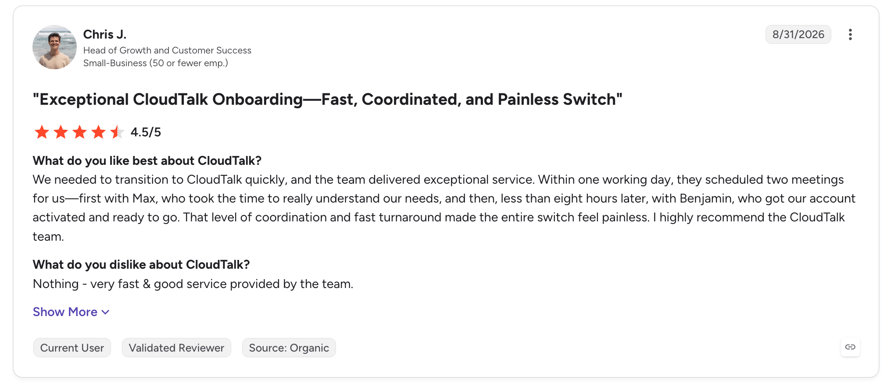
CloudTalk holds a 4.4/5 rating on G2 from 1,702+ reviews, with users repeatedly calling out call quality, onboarding and integrations.
Stop paying per feature. Start paying per user.
Microsoft Teams Phone: Best for Companies Already Paying for Microsoft 365
What is Microsoft Teams Phone?
Teams Phone turns Microsoft Teams into a phone system: call control, voicemail, auto attendants and call queues inside the app your company already opens every morning. It is an add-on rather than a standalone product, so every user also needs a Teams or Microsoft 365 licence underneath.
Why is Microsoft Teams Phone better than RingCentral?
- Marginal cost: if you already pay for Microsoft 365, adding calling starts at $10 per user rather than a new $20 to $35 platform.
- No adoption battle. The phone appears next to chat and meetings, in a client everyone already uses.
- Three routes to the phone network: Microsoft calling plans, Operator Connect, or Direct Routing with negotiated per-minute rates at scale.
What is Microsoft Teams Phone's pricing?
- Teams Phone Standard: $10/user/month, billed yearly. No number and no minutes: bring your own carrier.
- Teams Phone with Calling Plan: $17/user/month with a number and domestic minutes included.
- Both need a Teams licence underneath, from Teams Essentials at $4/user/month up to a full Microsoft 365 plan. Full detail in our Microsoft Teams Phone pricing guide.
Microsoft Teams Phone pricing vs. RingCentral pricing
On stickers Teams Phone wins, at $17 all-in against $20 for RingEX Core. Count the stack and it flips: $17 assumes a licence underneath, so a company on Microsoft 365 E3 is really at $53 per user for phones. RingCentral is the better buy for anyone not already committed to Microsoft, and the better phone system besides, with unlimited domestic calling instead of metered minutes. Teams Phone wins when the Microsoft bill is already paid and calling is occasional. Compare both directly in our Microsoft Teams Phone vs. RingCentral breakdown.
Microsoft Teams Phone reviews
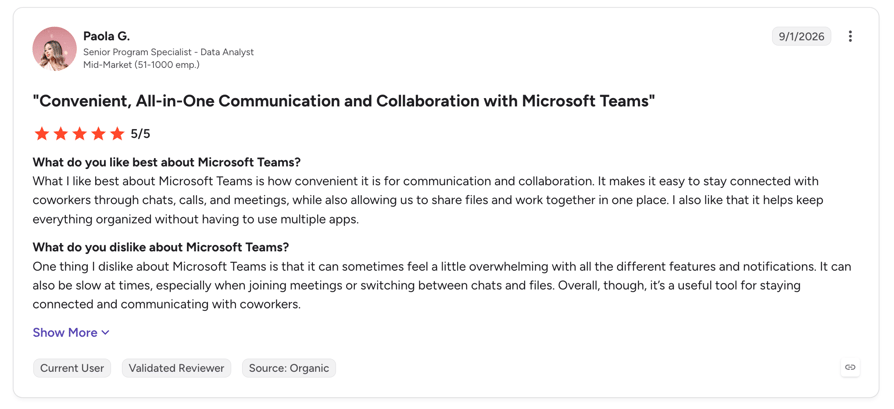
Microsoft Teams holds a 4.4/5 on G2 across more than 19,000 reviews, though the praise is about collaboration rather than calling. The friction users report is licensing: working out which combination of base licence, Phone add-on and calling plan they actually need.
Keep Teams for meetings. Get a real calling platform for revenue.
Zoom Phone: Best for Teams That Already Run on Zoom
What is Zoom Phone?
Zoom Phone is the calling arm of Zoom Workplace: a clean cloud phone system bolted onto the meetings platform millions already use. Structurally it is the same pitch as Teams Phone, with one difference that matters. Zoom Phone is sold as a standalone licence, so there is no separate suite subscription required underneath it.
Why is Zoom Phone better than RingCentral?
- Lower entry price: unlimited US and Canada calling starts at $15 against RingCentral's $20.
- Post-call AI summaries are part of the entry plan rather than a per-user intelligence add-on.
- Meetings and calling come from one licence, which suits companies already standardised on Zoom.
What is Zoom Phone's pricing?
- US & Canada Unlimited: from $15/user/month, with unlimited domestic calling, SMS/MMS and monthly fax pages.
- Pro Plus and Business Plus bundles add Zoom Workplace tiers on top, moving into the high teens and low twenties per user.
- International calling is metered unless you add a global calling plan. Full breakdown in our Zoom Phone pricing guide.
Zoom Phone pricing vs. RingCentral pricing
Zoom undercuts RingCentral by $5 per user at the entry point and both include unlimited domestic calling, so the decision is not really about price. It is about depth. RingCentral has the deeper telephony catalogue: better queue routing, more granular admin control, a real contact center product. Zoom is the simpler, cheaper choice for a team that mostly meets and occasionally calls.
Zoom Phone reviews
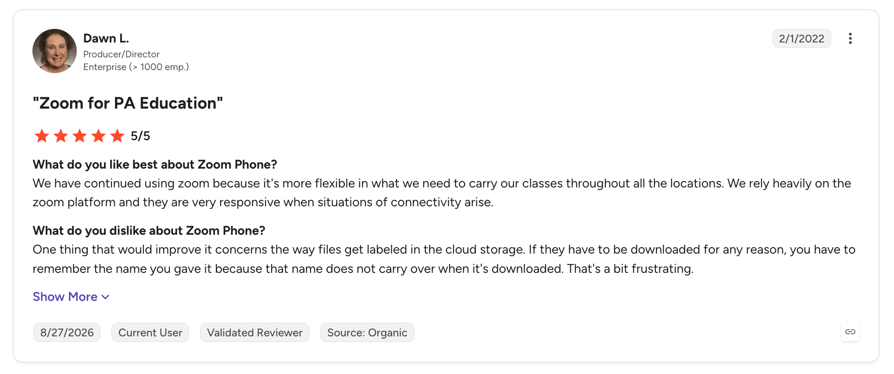
Zoom Phone is reviewed on G2 under Zoom Workplace, which holds a 4.5/5 across 56,000+ reviews, though most of that volume reflects the meetings product. Reviewers praise reliability and ease of use. Analytics depth is the recurring gap for calling teams.
Cheap entry or deep calling? Pick both.
Dialpad: Best for Teams That Want the Cheapest Built-In AI
What is Dialpad?
Dialpad is an AI-powered communications platform bundling calling, messaging and video into one app, with AI transcription and call summaries in every plan. Where RingCentral sells conversation intelligence at $60 per user, Dialpad ships transcription and summaries on its $15 tier.
Why is Dialpad better than RingCentral?
- AI transcription and call summaries included at $15, with no intelligence add-on to buy.
- $5 per user cheaper than RingEX Core at the entry point, with unlimited domestic calling on both.
- A 14-day free trial and separate Sell and Support products for teams that need contact center depth.
What is Dialpad's pricing?
- Connect Standard: $15/user/month annually, or $27 monthly. Unlimited calling, AI transcription and summaries, SMS/MMS.
- Connect Pro: $25/user/month annually, or $35 monthly. Adds CRM integrations, 24/7 support and multiple numbers.
- Dialpad Sell from $39/user/month and Dialpad Support from $80/user/month for outbound and contact center teams. See the full Dialpad pricing breakdown.
Dialpad pricing vs. RingCentral pricing
For any team that wants AI on calls, Dialpad wins on arithmetic: $15 with transcription included against $25 plus $60 for the RingCentral equivalent. RingCentral answers with breadth, including fax, a mature admin console and RingCX behind it. Dialpad's own contact center tiers climb fast, from $80 per user on Support, so the saving narrows once you need real queue depth.
Dialpad reviews
Dialpad Connect holds a 4.4/5 on G2 from more than 4,000 reviews, with users praising the AI transcription and clean interface while flagging occasional call-quality dips.
AI notes are table stakes. What about the rest of the call?
What Are RingCentral's Best Features?
Pricing only matters next to what you get. These are the features that make RingCentral the right call for the teams it fits.
- Unlimited domestic calling on every plan. No minute meters on US and Canada calls, at any tier, including the $20 entry plan.
- One app for calls, texts, video and fax. The deepest communications catalogue in the category, which is why RingCentral wins single-vendor consolidations.
- Genuinely standalone. No Microsoft 365 or Google Workspace licence required underneath, unlike Teams Phone.
- Personal AI assistant included. Call notes, transcription and summaries ship on all three RingEX plans rather than only the top one.
- A real contact center path. RingCX bundles digital channels and RingSense AI into the seat instead of selling them as premium tiers.
What Are the Pros and Cons of RingCentral's Pricing?
The honest ledger, focused on calling and value for money:
| Pros | Cons |
|---|---|
| Standalone product: no base suite licence underneath | Business Analytics Pro is an add-on on all three plans, including $35 Ultra |
| Unlimited US and Canada calling on every tier | Conversation Intelligence costs $60 per user, more than twice the Advanced plan |
| Up to 33% cheaper on annual billing, and a 14-day free trial | SMS capped at 25 to 200 per user and toll-free at 100 to 10,000 minutes |
| Deep UCaaS catalogue: phone, SMS, video and fax in one app | Core records calls on demand only, so the calls worth reviewing often aren't captured |
| Rated 4.2/5 on G2 across 1,470+ reviews | Two fees on every invoice (compliance recovery and E911) with no published amounts |
Your phone bill shouldn't need a spreadsheet.
Is RingCentral the Right Call for Your Team?
RingCentral is a genuinely sensible buy for the company it was designed for: one that wants a single vendor for phone, text, video and fax, calls mostly within the US and Canada, and treats the phone as infrastructure rather than the engine of revenue. For that buyer, $20 per user with unlimited domestic calling and no suite licence underneath is close to unbeatable, and the 14-day trial makes it free to confirm.
Just price the invoice, not the plan. Analytics is an add-on at every tier. Conversation Intelligence costs $60 per user. Texts stop at 25 a month on Core, toll-free at 100 minutes. Monthly billing costs 33% more than annual, and annual means committing to a seat count you guessed in month one. Two fees appear on every invoice with no published amount. Ask for a sample bill at your seat count before you sign.
The honest question is what your phones are for. If calls are logistics, scheduling, reception, the occasional supplier, RingCentral handles them well and nothing here should talk you out of it. If calls are revenue, outbound sales, support SLAs, international pipelines, you will feel the missing dialer, the metered texts and the add-on bill within a quarter. Worth checking against what call center software costs overall before you commit.
So here is the decision rule. Choose RingCentral if you want one vendor for all communication and you call domestically. Choose Teams Phone or Zoom Phone if you are already standardised on Microsoft or Zoom and calling is light. And if calling drives your revenue, choose a platform built for it: CloudTalk gives sales and support teams the dialers, routing, analytics and international numbers RingCentral charges extra for, at one per-user price you can forecast.

Scale your revenue, not your invoices.

Frequently asked questions
RingEX costs $20 (Core), $25 (Advanced) or $35 (Ultra) per user/month on annual billing, and $30, $35 or $45 billed monthly. Add-ons like Conversation Intelligence at $60 per user sit on top.
Three RingEX plans: Core at $20, Advanced at $25 and Ultra at $35 per user/month billed annually. RingCX, the contact center product, is priced per agent by quote and sold separately.
Yes. New subscribers get a 14-day free trial covering up to 20 phone lines. SMS is not available during the trial, and any trial hardware must be returned within 21 days of cancellation to avoid charges.
Annually, by up to 33%. Core drops from $30 to $20 per user/month, Advanced from $35 to $25, Ultra from $45 to $35. The trade-off is committing to a fixed seat count for the year.
Every invoice carries a Compliance and Administrative Cost Recovery Fee and a monthly E911 service fee. RingCentral confirms both but publishes no amounts, so request a sample invoice at your seat count.
RingCX is quote-based. Independent advisories put it around $50 to $92 per agent/month, with roughly $65 the figure most often cited for annual commitments. Contact Center Enterprise sits above it, also by quote.
Partly. The personal AI assistant for notes and transcription is included on all RingEX plans. Conversation Intelligence starts at $60 per user/month and AI Receptionist at $39/month for 100 minutes, then $0.50 per minute.
25 SMS per user/month on Core, 100 on Advanced and 200 on Ultra. Beyond that you pay per message or add the $25/month Business SMS Booster. Reviewers cite this cap as a common source of unexpected bills.
It depends on what you need. CloudTalk starts at $25/user/month against RingCentral's $20, and includes dialers, routing and analytics that RingCentral sells as add-ons, so calling teams pay less overall. Compare both on a per-feature basis before you sign.