How to Evaluate VoIP Pricing: Questions Every Small Business Must Ask Before Signing a Contract
“How much will VoIP cost you? It can be tough to know for sure", says a review by Tech.co¹, one of the top experts in tech solutions.
We get it. VoIP pricing can feel like a maze. Monthly fees, per-user rates, annual billing, call minute bundles, feature add-ons… depending on the provider you choose, it’s easy to lose track of what you're actually paying for.
And for small businesses, this hits even harder. When every dollar matters, there’s no room for billing surprises.
Let’s fix that. This guide will help you break it all down, cut through the fluff, and finally get clear on what you’re really paying for.
TL;DR: How to Evaluate VoIP Pricing (Without Getting Burned)
VoIP pricing can look simple—until it’s not. Small businesses need to understand what’s really behind those monthly rates to avoid budget creep and hidden fees.
Here's what to watch out for:
- Pricing isn’t one-size-fits-all: Costs depend on users, numbers, features, minutes, and billing terms.
- “Unlimited” doesn't always mean unlimited: Always check fair use policies and overage fees.
- Watch for the fine print: Setup fees, porting costs, or post-promo price jumps can add up fast.
- Ask the right questions: Clarify what’s included, what’s extra, and how contracts renew.
- Negotiate your quote: You don’t accept the first price—ask for matched rates, waived fees, or longer lock-ins.
- Plan for growth: Budget for future users, international numbers, and extra minutes.
Still comparing VoIP providers?
Why VoIP Pricing Is So Confusing (and Why It Pays to Understand It)
If your attention isn’t fully on this article yet, this might do the trick: Gartner studies² show that up to 85% of telecom and VoIP invoices contain billing errors, leading companies to overspend by 12–20% every month. That's money wasted. Your money, to be exact.
And that’s why it pays to understand how VoIP pricing works—especially if you’re a small business without cash to burn on bad decisions. You’ve got to know what to look for, tailor the plan to your team, and take full control of every dollar you spend.
Now the question: why is VoIP pricing so tricky to navigate?
Well, what might look like a simple monthly rate is actually shaped by a whole ecosystem of moving parts. You’ll need to consider how many users are on your team, how many phone numbers you’ll need, and whether you’re making local or international calls—just to name a few. Don't worry; we’ll break all of it down in the next section.
The challenge is that many of these details are easy to overlook—and some providers like to bury them in the fine print. That’s why buyers often run into “sticker shock” when the final price includes extra charges for add-on features, minute overages, or some bizarre clause like exceeding your “talking while walking in circles” limit. (They’re getting creative.)
But it doesn’t have to be that way. CloudTalk is known for doing things differently—with clear, transparent pricing and no hidden surprises. Each plan is laid out in detail, so you know exactly what you’re getting (and paying for) from day one.
CloudTalk is very straightforward and user-friendly to use. It's a great quality service for good pricing. I love that there is a contact search. Our team likes it so far.
Key Factors That Influence VoIP Pricing for Small Businesses
That $20/month plan you see on the websites? That's a baseline. That number will likely change once you start adding users, features, numbers, or minutes. If you don’t know what really drives the VoIP provider costs, you’re setting yourself up for budget creep.
What to consider when choosing your VoIP plan:
- 01User-Based vs. Line-Based Billing Models
- 02Monthly vs. Annual Contract Commitment
- 03Essentials vs. Advanced Features Set
- 04Quantity & Type of Numbers
- 05Unlimited Minutes vs. Pay-As-You-Go Plans
- 06Onboarding, Support, and Training Fees
If you are not in the mood to read, here’s a video that covers the essentials.
Let’s break down the key factors that shape your final bill—so you can stay in control and get the most value for your money.
1. User-Based vs. Line-Based Billing Models
This is one of those pricing details that seems small—until it’s not. Most VoIP license pricing is charged either by user or by line, and if you don’t know the difference, you could end up paying for more than you need.
Here’s the deal:
- User-based pricing charges you per person who needs access to the system.
- Line-based pricing charges based on the number of call paths (lines).
Real-life Scenario
If you have 10 agents but only need 3 people on calls at the same time, line-based pricing might be a reasonable option. But if you want everyone to have the freedom to jump on a call whenever they need to, a per-user model gives you that flexibility.
Since we are being completely transparent, here’s the problem with line-based pricing: it puts your team on a leash. You’re basically asking people to schedule when they’re allowed to talk to customers. But deals don’t wait for an open slot. And if you’re managing a remote team? Good luck coordinating who gets to dial when.
That’s why CloudTalk doesn’t play that game. We use user-based pricing—because your team should never have to share a phone like it’s the office microwave. Everyone gets full access, all the time. It’s simple, predictable, and built for teams that don’t want to miss a beat.
2. Monthly vs. Annual Contract Commitment
VoIP pricing isn’t just about what you pay—it’s about how often you pay it. Most providers offer monthly plans for flexibility or annual contracts for a lower rate. Seems like a small choice, but it can seriously shape your budget and flexibility.
Here’s how it works:
- Monthly plans give you flexibility, but you’ll usually pay more per user.
- Longer contracts come with lower rates, but they lock you in.
Real-life Scenario
Let’s say a provider charges $35/user on a monthly plan, but drops that to $25/user if you sign a 12-month deal. That’s a solid discount—if you’re confident you’ll stick with the tool long-term. But if your team’s still evolving, it might cost more in the end.
Commitment is smart—when it’s on your terms. A long-term contract can be a great move for teams that have been running for a while and know what they need. But if your business is still new or you're not quite sure how things will look in six months, flexible VoIP contracts might be the safer starting point.
CloudTalk gives you both options: flexibility when you need it, and savings when you're ready to commit. And to make it even easier, we offer a 14-day free trial—so you can test the waters before making any decision.
Choosing wrong can be expensive. Trying CloudTalk isn’t.
3. Essentials vs. Advanced Features Set
VoIP pricing plans can look similar on the surface—until you dig into what’s actually included. Basic plans can get your team up and running, and sometimes that’s all you need. But it’s crucial to understand which tools actually drive efficiency, helping your team work smarter and close deals faster.
That’s why you need to be clear on the trade-offs. Cutting costs by choosing an entry-level plan could be a smart move, but pay attention to see if this will not sacrifice tools that directly impact your team’s performance.
So, when evaluating VoIP contracts, don’t just look at the number on the invoice. Look at what it enables. Value comes from empowering your team to perform—not from stripping things down to the cheapest option.
Real-life Scenario
You pick a basic plan, thinking you’re saving money. A week later, your team’s wasting hours logging calls manually and flying blind without CRM integration. Now you’re either upgrading fast—or paying in lost productivity.
At CloudTalk, we don’t tuck key features behind vague paywalls. Every plan clearly shows what’s included. With 100+ powerful features available, we distribute them smartly across tiers, so you can scale your operation as you grow—without stretching your budget.
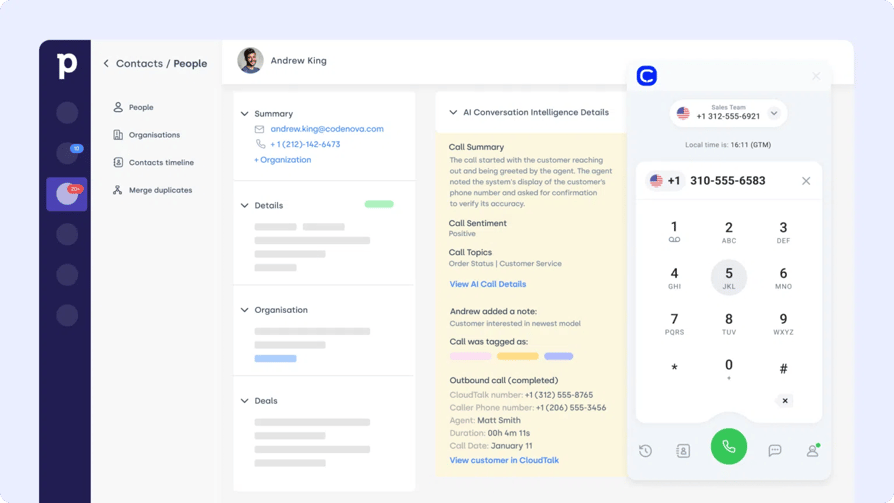
What I like best about CloudTalk is its seamless integration with our CRM and the ability to automate call workflows. It makes it easy to route calls intelligently, record conversations for quality assurance, and track performance with detailed analytics. CloudTalk really empowers our remote team to operate like we're in the same office.
4. Quantity & Type of Numbers
Need just one number for your business? That’s simple. But if you’re serving customers across borders or expanding into new markets, having international numbers in each region helps you build trust and increase answer rates. It makes your business feel local, even when it’s not.
But here’s the thing: numbers cost money, and they can stack up fast.
Most providers charge monthly fees per number, plus a one-time activation fee. Pricing varies significantly by region—from as low as $6/month in well-regulated markets, to up to $250/month in countries with stricter telecom controls or limited carrier availability.
Real-life Scenario
You add local numbers in five countries to boost pickup rates. Most cost under $10—but one comes in at $180/month due to strict telecom rules. Suddenly, your budget’s blown by a single number you didn’t price-check.
And it’s not just about where—it’s about what type of number you choose. Each serves a different purpose and comes with its own price tag:
- Local Numbers: Appear to callers as standard in-country numbers.
- National Numbers: Not tied to a specific city or region but still local to the country.
- Toll-Free Numbers: Free (or very low cost) for the caller, but you foot the bill for every inbound call.
- Vanity Numbers: Customizable numbers like 1-800-FLOWERS. Easy to remember.
- Mobile Numbers: Mobile-format usually used for cell phones and linked to SIM cards.
CloudTalk makes it simple to stay in control with our global country coverage and a clear number pricing list.
5. Unlimited Minutes vs. Pay-As-You-Go Plans
Call volume also matters—a lot. And how your provider charges for minutes can seriously affect your monthly bill. Some businesses need nonstop calling power. Others? Not so much.
Here’s the breakdown:
- Unlimited plans let your team make as many calls as they need for a fixed monthly fee. Just keep in mind: unlimited usually applies to a set group of countries or destinations.
- Pay-as-you-go or minute bundles are a better fit for teams with lighter or seasonal call volumes. You only pay for what you use, making it better for low call-volume operations.
Real-life Scenario
You just launched a new product feature—and suddenly your support lines are blowing up. This month, your team’s been deep in back-and-forth calls with customers. That’s when you realize you picked a pay-as-you-go plan. Guess where a chunk of this month’s profits is going? Yep—your phone bill.
At CloudTalk, we help you match your call plan to your actual usage. If your team lives on the phone—sales, support—you’ll likely benefit from unlimited minutes. If your call volume is light or sporadic, you cal also chose to purchase a set number of call minutes in advance.
Either way, we’ll help you stay lean and efficient without overpaying.
Cloud talk is simple to use with intuitive features that are easy to grasp and get started using. They have an affordable pricing scheme and it takes no time to get started. Their customer support team is superb and helpful and always gets us working again.
6. Onboarding, Support, and Training Fees
You found the perfect plan, the pricing looks good—and then the setup fees hit. Some VoIP providers charge extra just to help you get started. Others tack on costs for support, training, or anything beyond basic FAQs.
Here’s the difference:
- Some providers charge extra for onboarding and support—often added on top of your plan and, in some cases, multiplied by the number of users.
- Others include onboarding and support in their pricing, with the level of service varying by tier. In this model, what you see is what you get
Real-life Scenario
You sign up thinking, “This looks easy enough—we’ve got this.” Fast forward to setup day, and suddenly your team has a dozen questions the FAQ doesn’t even come close to answering. So you call for help. Now you're burning through your minute bundle and getting billed just to talk to someone.
At CloudTalk, we believe great customer service shouldn’t feel like a hidden upgrade. We offer guided onboarding, robust help center content, and responsive support—so your team gets the help they need.
The support team deserves a special mention—responsive, knowledgeable, and genuinely eager to help. Switching to CloudTalk has not only improved our communication but also given our team more confidence in handling customer calls. Highly recommended for any business looking to upgrade their phone system.
The Hidden VoIP Costs You Need to Watch Out For
So, you’ve done a VoIP cost comparison, picked your features, and the price looks solid. But before you hit “buy,” take a closer look at the fine print. After 10 years in this industry, we’re still surprised by how creative our competitors can be with sneaky fees that often get glossed over in the sales pitch.
Let’s unpack the most common ones.
1. Setup and Activation Fees You Didn’t See Coming
That shiny “$0 setup” claim? Not always true. Some providers quietly tack on activation, setups or onboarding fees; others offer that as a benefit for clients that exceed a certain number of seats.
At CloudTalk, setup is fast and straightforward—it usually takes just a few minutes, and you can do it yourself during the onboarding. We only charge a setup fee if you require a specific API customization tailored to your system.
And when it comes to number activation fees, those costs typically go to the carrier responsible for provisioning the number in that country, not the VoIP providers. Even so, you need to be aware of the prices to avoid being fooled.
2. Price Increases After a (Not Explicit) Promotional Period
Some deals look too good to pass up—because they are. That ultra-low monthly rate you saw on the pricing page might only last a few months. And hey, we get it—promos are doing their job.
We offer one too: 50% off your first month. The difference is, we’re upfront about it. The problem is when providers aren’t clear about when the clock runs—and your price quietly jumps after a few months with little to no warning. That’s not a discount. That’s a trap.
Get 50% Off Your First Month — No Fine Print, We Swear.
3. The Fine Print Behind “Unlimited” Calling
In the VoIP industry, you will notice that unlimited doesn’t always mean unlimited. Many “unlimited” plans come with fair use policies, and if your team blows past those thresholds, surprise charges can start stacking up.
The same goes for pay-as-you-go or bundled minute plans—once you pass your limit, you’re into premium per-minute pricing. That’s when some sketchy providers see an opportunity to twist the knife and squeeze out a little extra bonus for the shareholders.
Always check where the cap is—and exactly what happens when you hit it.
4. When “Global” Means Paying Extra
Spending an hour on the phone with someone overseas is fine—if it’s your grandma once a month. It’s a different story when it’s your clients in London and you're talking to them daily. That’s when you start watching your budget bleed.
International calling is one of the fastest ways to send your bill through the roof—especially if you’re not set up with the right plan. Even common destinations like Europe or LATAM can trigger fees if they’re outside your coverage.
That’s why having virtual local numbers in the regions where you do business is essential. It keeps your operations looking local and your costs under control—because no one wants to pay international rates to talk to their own customers.
5. Porting Fees When Moving Numbers In (or Out!)
You picked your VoIP provider after a long, painful search (we know how it is). Now, of course, you want to bring your existing number with you. After all, you’ve built your brand around it—your customers know it, trust it, and dial it without thinking.
And by now, you’ve probably guessed right: this isn't free. But if you want to keep costs low—and avoid getting caught off guard—there are a few things you need to check.
Start with your current contract. Some phone systems have cancellation or release fees. Then there’s the porting process itself, which usually involves charges from the carrier that owns the number. These fees vary by country and network.
At CloudTalk, we work with a broad network of global carriers to make number porting as smooth and transparent as possible. All associated costs are clearly listed on our Help Center page. There's no vague promises; just the numbers—plain and simple.
Must-Ask Questions Before You Sign Any VoIP Contract
Now that you know all the moving parts behind VoIP pricing, you might be wondering—is it even worth the switch from my landlines?
Here’s the answer: ABSOLUTELY. Businesses that migrate to cloud-based solutions can slash their communication costs by up to 75%³. That’s not just a small upgrade—it’s a big win for your budget.
So yes, finding the right VoIP provider takes a little effort. But the savings (and flexibility) are more than worth it. To help you find the best VoIP pricing for small businesses, we’ve lined up key questions every smart buyer should ask. (Our team is ready for all of them—try us.)
Use them to uncover what you're really signing up for.
- 01What exactly is included in the monthly price? Make sure you understand what you're paying for—users, numbers, minutes, and core features.
- 02What features or services cost extra? Identify which tools aren’t included in the base plan so you can anticipate real monthly costs.
- 03Are there setup/activation or porting fees? Clarify any one-time charges for starting service or bringing in your current numbers.
- 04What happens after the promotional/discount period? Find out when the promo ends and what your new monthly price will be.
- 05How flexible is the contract? What are cancellation terms? Know your commitment, cancellation policy, and whether the plan auto-renews.
- 06What are the “fair use” or minute limits? What if I go over? Confirm if there are thresholds and what the overage charges look like.
- 07Are there options for upgrading/downgrading users? How are pricing changes handled? Check if you can scale your team easily without overcomplicating billing.
- 08What support is included? Is premium support extra? Clarify what kind of support you get at your tier—and what costs extra.
- 09Can you provide a complete pricing breakdown with all taxes, fees, and potential add-ons? Ask for a detailed, written quote that reflects your actual setup and usage.


How to Compare and Negotiate VoIP Provider Prices
Once you’ve gathered quotes from a few providers, it’s time to compare. But, as we said before, don’t focus solely on the numbers. A cheaper plan on paper can quickly become a more expensive one once your needs are not met.
Lay the quotes out side-by-side. Break them down by the same criteria: number of users, included minutes, features, setup fees, and ongoing support. That’s where you’ll spot what’s missing, what’s marked as “extra,” and where long-term costs might sneak in.
To make things easier, we’ve stripped down and analyzed the real pricing structures of several leading VoIP providers—side-by-side with CloudTalk. Here are a few we’ve reviewed:
And yes—you can negotiate. Especially if you're a growing business or bringing multiple users. Ask if they can match a competitor’s offer, waive setup fees, or lock in your rate for longer. The first quote is rarely the final word.
If a provider won’t give you straight answers or dodges your questions about pricing transparency, that’s a red flag. You're not just buying software—you're building a communication system your business will rely on daily. Clarity is non-negotiable.
See How CloudTalk Stacks Up Against the Rest
And if you haven’t seen CloudTalk’s pricing plans yet, here’s an overview of our main tiers.
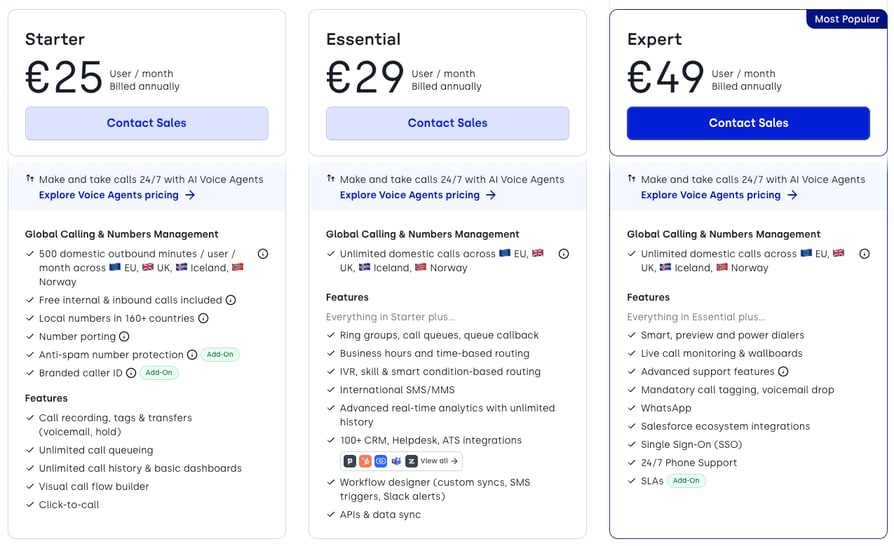
Budget Planning Tips to Avoid VoIP Cost Surprises
We know VoIP providers—ourselves included—share a big part of the responsibility for how pricing is structured in this industry. But we’re also aware that some cost factors are simply out of our hands. What we can do is help you avoid surprises and stay in control.
So here are a few smart planning tips to keep your budget on track.
- Plan for future users—not just current ones: If you expect your team or your call volume to grow, account for that in your monthly pricing estimate.
- Build in a buffer for minute overages: If you go for minute bundle plans, consider a fat to burn. Even with a good estimate, teams occasionally go over.
- Check contract renewal terms: Set reminders before auto-renewal dates hit so you have time to renegotiate or cancel if needed—without penalty.
- Factor in international calling and number expansion: If you plan to expand globally, account for local numbers and potential international surcharges in your forecast.
While you compare quotes, clean up your billing workflow too. Use a free invoice generator to simplify your monthly invoicing for telecom services, usage add-ons, and support retainers—auto-save customer details, reuse templates, and export/share PDFs fast. Streamlined invoices make month-end reconciliation easier and help you spot VoIP overcharges before they snowball.
Pricing Clarity = Better Decisions and More Money (In YOUR Pocket)
The truth is: confusing pricing is a feature for some providers. The less you know, the more they can charge. But you’re smarter than that. And now you’ve got the right questions in hand, the red flags in mind, and a better sense of what real value actually looks like.
At CloudTalk, we believe clarity wins. That’s why we don’t hide fees in footnotes or nudge you toward upgrades you didn’t ask for. Everything’s on the table—pricing, features, usage, support.
We’re confident CloudTalk offers the best VoIP pricing for small businesses—but don’t take our word for it. Book a demo, ask every tough question you’ve got, and see for yourself if we’re the right fit. No pressure. Just answers.
A 15-minute call. Zero cost. All the answers you need
Sources:
Frequently asked questions
Expect to spend around $20–$50 per user/month, depending on features, call volume, and contract terms. When it comes to value for money, CloudTalk offers the best VoIP pricing in the market.
Yes—VoIP is typically more affordable, with lower setup costs, better scalability, and more features for the price.
If your team relies on calls to sell or support, yes. Features like analytics, CRM sync, and smart call routing boost efficiency and ROI.
Absolutely. Most providers, including CloudTalk, let you scale users and features as your business grows—without disruption.
You can usually port your numbers and data, but check for contract terms and porting fees before switching to avoid surprises.