What Is an International Phone Number and How to Get One?
Summary
- International numbers help you appear local in multiple countries—no physical office needed.
- Choose between local or toll-free formats, both designed to boost trust and customer access.
- VoIP international numbers are virtual, internet-based, and far more affordable than traditional lines.
- They reduce costs, increase answer rates, and require no extra hardware to manage.
- Costs vary by provider, country, and plan. VoIP services like CloudTalk start as low as $6 per number.
An international phone number is a phone number with a country code prefix — like +1 for the US or +44 for the UK — that lets businesses make and receive calls across borders at local rates. With a virtual number, even the smallest company can build an international presence without opening a single foreign office.
Demand keeps growing: the international calling apps market is forecasted to grow from $1.4 billion in market value in 2020 to $1.8 billion by 2028. Internet telephony gives businesses of any size unlimited access to cheap global calling.
Below, we break down what international phone numbers are, how they work, what they cost in 2026, and how to get one.
What Is an International Phone Number?
An international phone number is a standard phone number with a country code prefix. The prefix identifies each country or region and allows you to call — and be called — from anywhere in the world.
We will discuss international number formats in more depth later on, but for now, here are a few examples:
- USA: +1
- UK: +44
- Spain: +34
- Germany: +49
- Australia: +61
- Japan: +81
- Brazil: +55
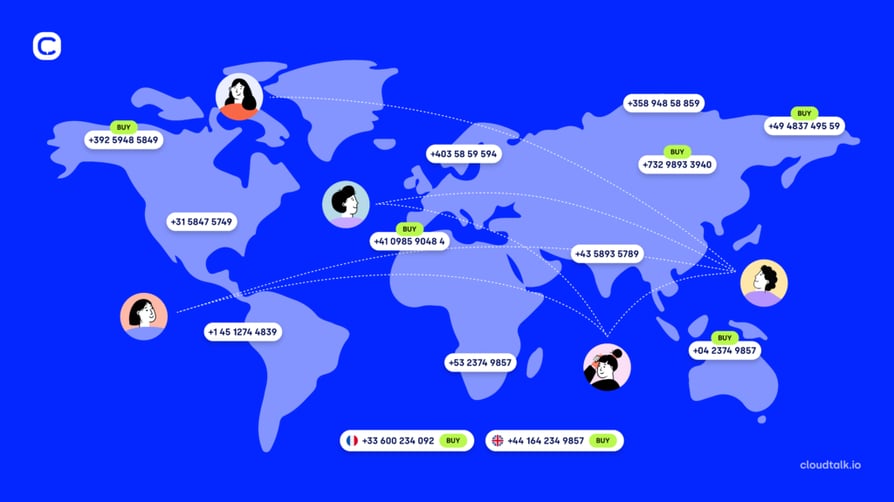
You can call a foreign number from a standard mobile phone using the international number format, but it will cost you.
For example, AT&T’s basic mobile calling rates from the US to Canada cost $1.55 per minute. From the US to Mexico, the rate grows to $3.65 per minute. And if you want to contact someone in China, you'll pay a staggering $5 per minute.
VoIP (Voice over Internet Protocol) international numbers eliminate these fees. You can call as if you were in the same country as the recipient — and customers can call you the same way.
These numbers look just like any other phone number with a country code prefix, allowing you to perform a background check by phone number just as you would with a traditional line, but they are virtual — i.e., associated with a VoIP calling software. To use them, you pay a monthly subscription and a small one-time fee for each specific international number.
How Do International Phone Numbers Work?
International phone numbers work through call forwarding. When a customer dials your international number, the call is automatically redirected to your primary line — but it still acts, and is billed, like a local call. The phone system treats you as if you were in the same country as the caller.
Here's a practical example:
Let's say your business is located in Australia. A customer calls you from the US. Normally, an international call like this would cost a fortune. But luckily, you have a US international number with the “+1” prefix.
The customer dials it, and the call is automatically redirected to your main call center number. Their rate equals a phone call made within the US, so they won't break the bank over contacting you.
To help you imagine the significance of international numbers, here's how much the customer would pay to call Australia from the US if you didn't have one:
| Service Provider/Carrier | Landline Cost | Mobile Cost |
|---|---|---|
| AT&T | $3.64/min | $3.64/min |
| Boost Mobile | $0.25/min | $0.25/min |
| Credo Mobile | $2.29/min | $2.29/min |
| Mint Mobile | $0.01/min | $0.01/min |
| Page Plus | $0.06/min | $0.06/min |
| T-Mobile | $3.00/min | $3.00/min |
| US Cellular | $3.22/min | $3.22/min |
| Verizon | $2.49/min | $2.49/min |
International VoIP numbers look identical to standard phone numbers. The difference is that VoIP numbers work over the internet. Instead of being associated with a physical address, they are linked to an IP address and hosted in a virtual phone system, usually cloud-based.
How to Call an International Number?
To call an international number, you dial four elements in order: the “+” sign or exit code, the country code, the area code, and the local number. Calling a virtual international number works exactly the same way as calling any other number.
Here's a step-by-step example — calling a business partner in Barcelona, Spain:
- Start with “+” or your exit code. The “+” can be replaced with “00” in most of the world or “011” in the US and Canada.
- Add Spain's country code (34). So far, you have: +34 / 0034 / 011 34.
- Add the local area code. For Barcelona, that's 93: +34 (93). If you were calling a toll-free number instead, you'd use an 8XX prefix: +34 (8XX).
- Add your business partner's subscriber number. Spanish phone numbers have 9 digits in total, including the area code.
The final number should look like this:
- Local number: +34 (93) 123 45 67
- Toll-free number: +34 (800) 123 456
Don't know what your area code is? <a href="https://www.nationsonline.org/oneworld/international-calling-codes.htm" target="_blank" rel="noreferrer noopener nofollow"><strong>Here's a handy source</strong></a>.
Do you know which 3 countries make the most international calls? It's the US, Germany, and the UK. We offer international numbers for all three at as little as $6 per piece.
What Are the Types of International Phone Numbers?
There are 2 types of international phone numbers: local (geographic) numbers and toll-free numbers. You should get familiar with both to fully understand how calling abroad works.
What Are Local Phone Numbers?
Local numbers, also called geographic numbers, are phone numbers with a digit structure linked to a specific geographical area. They let you target major regions or cities, such as London or Madrid, with a phone number identical to their local ones.
Let's use Madrid as an example. The Spanish country code is +34, and the local area code for Madrid is 91.
The phone number for calling Madrid would therefore look like this: +34 (91) 123 45 67
If you want to call London, you'd dial: +44 (20) 1234 5678 (the leading “0” of the UK area code is dropped when calling internationally).
It works the same way for US states. They not only have different local area codes for each state but also for different regions inside the states. Major metropolises, such as New York, even have different area codes for city districts.
Here are a few examples:
- Montana: +1 (406) 123 4567
- Maine: +1 (207) 123 4567
- Delaware: +1 (302) 123 4567
- New York City (all boroughs): +1 (917) 123 4567
- New York City (borough of Manhattan): +1 (212), +1 (646), or +1 (332) 123 4567
What Are Toll-Free Phone Numbers?
A toll-free number is a phone number customers can dial without being charged for the call. Instead, the cost is paid by the number's owner — the call receiver. Depending on the type of toll-free number, the cost can also be split between the caller and the receiver.
Numbers where the receiver pays the full price are called green toll-free numbers. Numbers where the cost is split are known as blue toll-free numbers.
You can recognize a toll-free number by its format. It includes specific 3-digit prefixes starting with 8, the most common being 800.
The main point of toll-free numbers is to make your business contact memorable. They also create a bridge between you and your customers. By giving them an option to call you without worrying about expensive long-distance charges, you evoke a feeling of trust.
Here are a few examples of a toll-free international number format:
- UK: +44 (8XX) 123 456
- US: +1 (8XX) 123 4567
- Spain: +34 (8XX) 123 456
- Germany: +49 (8XX) 123 456


What Are the Benefits of International Phone Numbers?
International phone numbers save calling costs, build local trust in foreign markets, and scale without hardware. Here's a deep dive into the most impactful benefits:
#1 Save Costs for You and Customers
The strongest benefit is that neither you nor your customers have to worry about expensive international calling fees. Callers can contact you as if they were calling a local number in their country and vice versa.
And we are not talking about saving cents here. At the $5-per-minute carrier rates mentioned above, a 60-minute call can cost as much as $300.
Virtual international numbers therefore make your business more accessible. People will feel more confident to call you, knowing they won't spend a fortune. You can build an image of a trustworthy, fair company and elevate your customer loyalty. But more on that in a minute.
Main business advantage for:
Customer Support (inbound calling)
What did Glovo achieve with CloudTalk?

#2 Grow Revenue With a Trustworthy Global Presence
Did you ever get a phone call from a foreign number and refuse to take it? If so, it was likely because you either thought it would cost you a fortune (we solved that one above) or were afraid that it was a scam call.
People simply tend not to trust phone calls from abroad. That's why international numbers give you the unique opportunity to be local anywhere without actually being present there.
And this brings us back to the loyalty aspect.
From a customer support standpoint, trusting your phone number empowers the customer base to contact you. That goes hand in hand with better customer experience, leading to your own network of loyal brand ambassadors.
But mainly, you will significantly boost sales pickup rates, because people aren’t hesitant to answer a familiar phone number — especially in a time when unfamiliar numbers are often checked through a quick phone number lookup. It means more customers, higher conversion rates, and better revenue flow.
Main business advantage for:
Sales (outbound calling)
What did PlanRadar achieve with CloudTalk?

#3 Add and Remove Numbers Flexibly
When it comes to regular phone numbers, there's usually a limit on how many numbers you can have. Maybe you don't want to spend too much money on buying additional hardware equipment. Or you just don't have time for tons of paperwork.
With virtual international phone numbers, there is no hardware to buy or paperwork to fill out. You’ll have all the numbers incorporated in a single cloud phone system, and you can add or remove them as you please. Your VoIP provider will do all the heavy lifting for you.
Main business advantage for:
Company-wide
#4 Keep Your Data Safe
Cost saving, business success, flexible growth. Those are things that any business leader thinks of first. And it makes sense. But there's one aspect connected to calling that people tend to overlook, and that's security.
A data breach can ruin your business, especially if you are dealing with sensitive information. According to Forbes, a data breach costs an average of $4.45 million!
Or even worse, it may get you into serious legal trouble.
VoIP international number providers encrypt calls, making sure no third party can intrude on your phone line and listen to your conversations. There are also regular security updates and protocols in place, protecting your customers' data.
So, when choosing a calling software provider, keep security in mind!
Main business advantage for:
Company-wide
#5 BONUS: Boost Productivity With VoIP Features
Since virtual international numbers come as a part of VoIP calling software, they come with so much more than affordable, convenient calling. You can significantly boost your productivity, which you'll now definitely need, with the higher volume of inbound calls and broader sales outreach.
With software like CloudTalk, you get 70+ advanced calling, automation, performance, and compliance features, as well as advanced AI tools. For example, you can automate your outbound calling with smart dialers, track overall performance to improve strategies, boost agent performance by monitoring their calls, follow customer sentiment to foster effective communication, and much more.
Main business advantage for:
Company-wide
How Much Does an International Number Cost?
An international number typically costs a small one-time purchase fee plus a monthly subscription, with VoIP plans ranging from $10 to $200 per user/month. The final price depends on 2 main factors: which provider and plan you choose, and how many numbers you need — and from where.
#1 Which Provider and Plan You Choose
Which provider you select has a great impact on the price of international calling.
The first factor here is whether you want a standard number via carriers like AT&T or a virtual one via VoIP software. Overall, VoIP calls have lower rates compared to traditional phone calls. In fact, VoIP fees can be as low as 2 cents per minute.
Furthermore, the price of obtaining international numbers also depends on which specific provider you choose. VoIP software pricing plans vary significantly, from as little as $10 per user/month to as much as $200 per user/month.
So, you have to choose which software best fits your needs and budget and which of their plans works best for you.
For example, CloudTalk offers 3 plans, ranging from $25 to $49 per user/month. You'll also get one phone number for free.
| Plan | Annual Billing (per user/month) | Monthly Billing (per user/month) |
|---|---|---|
| Starter | $25 | $34 |
| Essential | $29 | $39 |
| Expert | $49 | $69 |
Flexible Pricing Plans to Scale with You
Compare our plans
So, regarding choosing the provider, the cost depends on:
- What type of provider you want (traditional carrier vs. VoIP)
- Which specific provider you decide for
- Which of their plans you want to go with
#2 How Many Numbers You Need and From Where
When obtaining a virtual international phone number via a VoIP provider, you pay a one-time purchase fee for each number you choose. Prices vary from provider to provider and country to country. The final cost, therefore, depends on how many international numbers you need and which ones you are interested in.
However, VoIP international numbers are really affordable. Usually, numbers from mainstream markets like Germany, Spain, or the UK are cheaper than less frequently demanded ones — for example, Montenegro or Morocco.
Choose your numbers from our pricing list.
How to Get an International Phone Number With CloudTalk
Getting an international phone number with CloudTalk takes 3 steps: order the number from the dashboard, let our team review the request, and start calling once it's added to your account. You are free to choose any provider you want — but we hope that at this point, you are at least considering doing so via CloudTalk.
Here's the full walkthrough of how to obtain a virtual international number with us:
#1 Order Your International Number
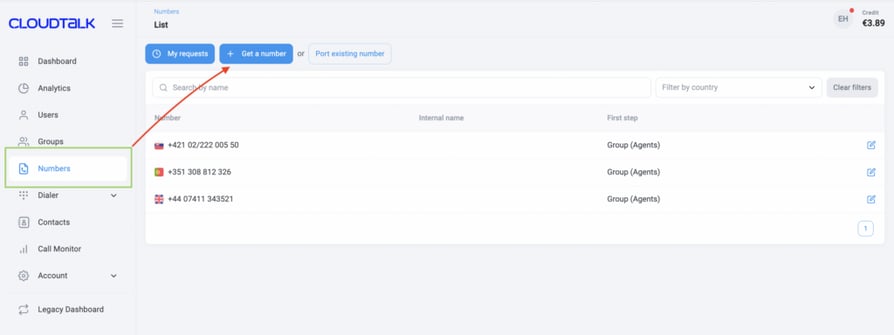
From the CloudTalk Dashboard, you'll navigate to the “Numbers” tab.
Then, you'll click “Get a number”.
- On our Legacy Dashboard, there is “Buy New Number” instead. Don't worry - you won't be automatically charged if you just want to exchange a number.
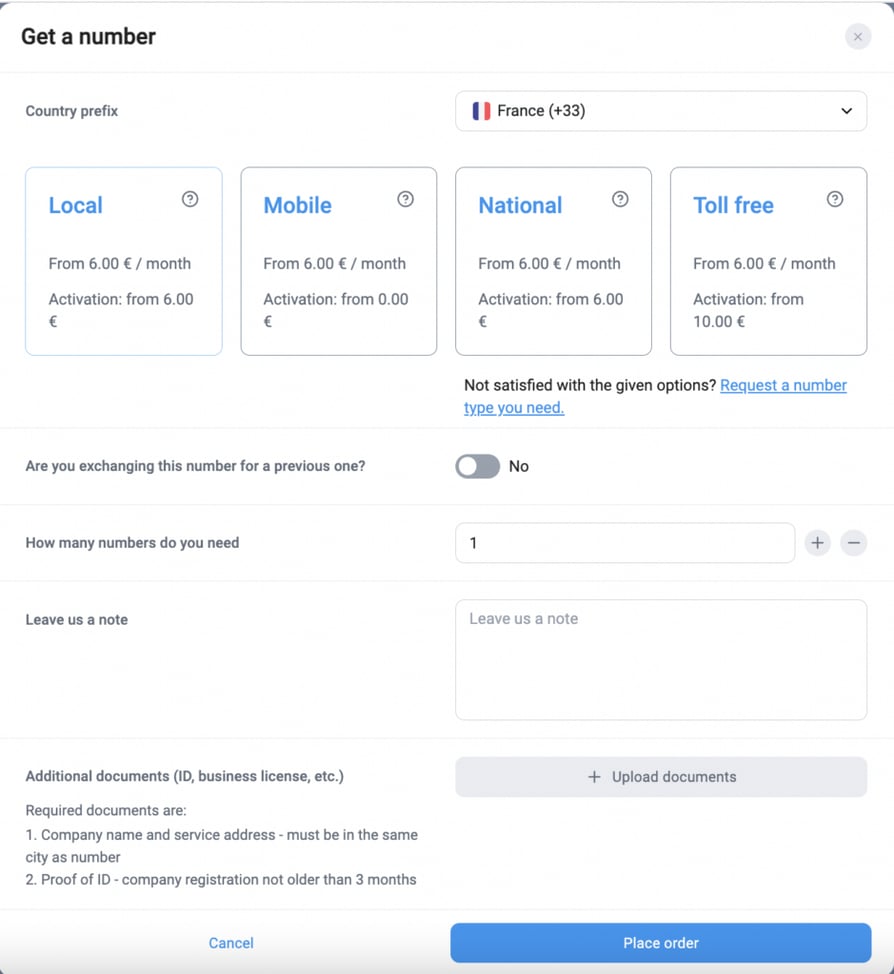
Then, you'll select a country and specify the type of number you need.
In the bottom section "Additional documents (ID, business license, etc.)", you will see the requirements per number and you'll be able to upload them into the form.
If the section is blank, it means that there are no requirements.
In case you'd be using our Legacy Dashboard:
- If you are exchanging an existing number for a new one, you should mention this in a "Want to add something?" box.
The order form does not have a ‘requirement section’, but you can check all our number requirements by country and number type.
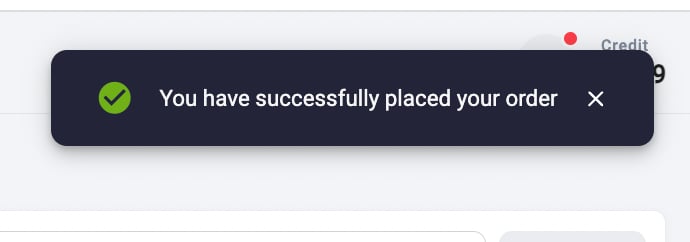
Next, after sending your request, you will see an order confirmation banner in the top corner. You will also receive a confirmation to your account email address.
#2 We Will Review Your Request
The numbering team either adds the number or, if we need any additional documents or information from you, we will follow up in the confirmation email.
#3 We Will Add the Number to Your Account
Our team will include billing for the number and send a final confirmation email.
Here's what different status stages mean:
- New: we have received your request, but an agent has not processed it yet. We typically respond within 8-24 hours.
- Waiting for information: we have reviewed your request but need more information or additional documents. If you see this status, you should check your CloudTalk email.
- Processing: our team has everything they need for the request and is in the process of activating the number with our operator.
- Completed: the number has been added to your CloudTalk account. Our agent will clarify which specific number was added.
- Canceled: the request was canceled by your team.
- Expired: if a request stays in the “Waiting for information” stage for 2+ business days without a response from your side, we may close your request and mark it as expired.
Embrace Affordable Global Growth
Global expansion isn't a big-players' privilege anymore. Thanks to international phone numbers, even the smallest businesses can afford to build a worldwide presence worth an enterprise. What's more, you'll improve CX, close more deals, and grow revenue.
That all while saving costs for both you and your customers.
With a VoIP calling provider, such as CloudTalk, obtaining an international number is straightforward and efficient. If you're new to internet calling, here's how to start using VoIP telephony in your business.
So, leave all the hassle on us and focus on the true purpose of getting one – growing beyond borders.
Start calling abroad now!
Frequently asked questions
The cost of an international call depends on the method you use. Traditional international calls using local SIM cards can be quite expensive, often costing several dollars per minute. However, using VoIP (Voice over Internet Protocol) services with virtual international numbers can significantly reduce these costs. For example, VoIP call rates can be as low as 2 cents per minute.
International phone numbers start with a country code, followed by the local area code and the individual phone number. The format is as follows: + [Country Code] [Area Code] [Local Number]. For example, a number in Spain would be formatted as “+34 (91) 123 45 67”, where +34 is the country code for Spain, 91 is the area code for Madrid, and “123 45 67” completes the 9-digit Spanish number. For other countries, you can generate example numbers with our random phone number generator.
To call an international number, start by dialing the international access code (e.g., "+" or 00, or 011 for the US and Canada), followed by the country code, the area code (if applicable), and the local phone number. For example, to call a number in Barcelona, Spain from the US, you would dial “011 34 (93) 123 45 67” or “+34 (93) 123 45 67”.
You can identify an international phone number by its country code prefix, which appears at the beginning of the number. This prefix typically starts with a "+" sign followed by one to three digits that specify the country. For example, +1 indicates the USA, +33 indicates France, and +49 indicates Germany.
No, +1 and 011 are not the same, but they serve related purposes: +1 is the country code for the United States and Canada, used in the international number format. 011 is the international access code used in North America to dial out of the country. When calling from the US, you would dial 011 before the country code and number, whereas "+" can replace the international access code when using a mobile phone.
+44 is the country code for the United Kingdom. It indicates that the phone number following this code is based in the UK. When dialing a UK number from abroad, you would start with +44 followed by the local number, omitting the initial zero of the local area code.
An international standard phone number adheres to the E.164 format, which ensures global compatibility. This format includes a "+" followed by the country code, area code (if applicable), and the local subscriber number — the same structure every virtual phone number follows. For example, a standard international phone number format for a London number would be “+44 (20) 1234 5678”.