TL;DR
Nextiva sells three small-business plans: NEXT Core at $15, NEXT Engage at $25 and NEXT Scale at $75 per user per month on annual billing. Monthly billing costs 35% to 50% more. This replaced the old four-tier lineup of Digital, Core, Engage and Power Suite, so most pricing guides online are describing packaging Nextiva no longer sells.
The plans differ by volume, not features. Voice, video, call recording and skills-based routing are on all three. What changes as you move up is allowance: SMS, toll-free minutes and AI runs.
Four things the advertised price does not tell you:
- Every line carries $5.45 a month in fixed fees. A $3.95 Regulatory Recovery Fee plus a $1.50 E911 fee, neither of which is a government tax.
- Federal USF adds another 7% to 12% of your invoice, reset quarterly.
- On Nextiva's own sample invoice, fees added 48.4%. An 11-user account billed $175.45 in service and $84.95 in fees.
- Cancelling needs 30 days' written notice before your term ends, or it auto-renews for another full year.
Here is the whole picture at a glance. For a published-price comparison, CloudTalk pricing lists every plan up front.
| Plan | Best For | Annual Price | Monthly Price | Toll-Free |
|---|---|---|---|---|
| NEXT Core | Small teams needing reliable voice and video | $15/user/mo | $23/user/mo | Add-on |
| NEXT Engage | Customer-facing teams needing chat and toll-free | $25/user/mo | $50/user/mo | 1 number, 2,000 min |
| NEXT Scale | Sales and service teams at contact-centre volume | $75/user/mo | Not published | 3 numbers, 10,000 min |
| Contact Center Essential | 100+ agents | From $75/agent/mo | Contact Sales | Varies |
| XBert AI Employee | Adding AI to an existing helpdesk | $99/month | $99/month | n/a |
Add $5.45 per line in fixed fees, plus USF and state tax, to every row above.
How Much Does Nextiva Cost in 2026?
Nextiva costs $15 to $75 per user per month on annual billing, across three small-business plans: NEXT Core at $15, NEXT Engage at $25 and NEXT Scale at $75. Monthly billing runs $23 for Core and $50 for Engage, which is 35% to 50% more. Contact centre plans start at $75 per agent.
Those are subscription rates, not your bill. Nextiva adds a fixed $5.45 per line each month in Regulatory Recovery and E911 fees, then federal USF at roughly 7% to 12% of the invoice, then state and local telecom taxes that vary widely by location. Budget 25% to 50% above the advertised rate.
Annual pricing is only available to new customers with 1 to 100 employees who sign a 12-month or longer agreement. If you are comparing quotes across providers, our guide to evaluating VoIP pricing covers which line items to ask about before signing.
Note: figures verified against Nextiva's published pricing page and feature matrix on the date of writing. Nextiva repackaged its small-business plans in early 2026, so older guides describe tiers that no longer exist.
Nextiva Plans and Pricing at a Glance
The table below is built from Nextiva's own feature matrix. The most useful thing to know about its lineup is that the tiers differ by volume, not capability. Voice, video, call recording, skills-based routing, ticketing and Salesforce sync are on all three plans. What you buy as you move up is headroom.
| Feature | NEXT Core $15 | NEXT Engage $25 | NEXT Scale $75 |
|---|---|---|---|
| Monthly billing | $23 | $50 | Not published |
| Unlimited voice and video | Yes | Yes | Yes |
| Call recording | Yes | Yes | Yes |
| Priority and skills-based routing | Yes | Yes | Yes |
| Smart call routing (simple IVR) | Yes | Yes | Yes |
| SMS per user | 100 | 500 | Unlimited |
| Toll-free number | Add-on | 1 | 3 |
| Toll-free inbound minutes | Add-on | 2,000 | 10,000 |
| Live chat and chatbot | No | Yes | Yes |
| AI transcriptions | 50 | 200 | Unlimited |
| AI summarizations | 50 | 200 | Unlimited |
| AI answer assist conversations | 50 | 200 | Unlimited |
| Shared inboxes | 1 shared, 1 personal | 3 shared, 1 personal | 10 shared, 1 personal |
| Virtual fax | Add-on | Yes | Yes |
| Single sign-on | No | Yes | Yes |
| Supervisor monitoring | No | No | Yes |
| Dedicated onboarding | No | No | Yes |
This matters when you are choosing a tier. Do not ask which plan has call recording, because they all do. Ask how many texts your team sends, how many toll-free minutes you take, and how many calls you want transcribed. Those three numbers decide your plan.
One correction worth making, because two widely-read pricing guides get it wrong: call recording is included on NEXT Core. Guides that list it as a Core add-on are describing the retired packaging. For what recording should cover at any price point, see our guide to call recording services.
NEXT Core, NEXT Engage and NEXT Scale in Detail
Nextiva consolidated its small-business lineup in early 2026, moving from four tiers to three. The old Digital at $20, Core at $30, Engage at $40 and Power Suite at $60 are all retired, and the current plans sit at different price points with different contents.
NEXT Core: $15 per User/Month
Core is the entry plan at $15 per user per month on annual billing, or $23 monthly. It is not a stripped-back tier: you get unlimited voice and video calling, call recording, skills-based routing, a simple IVR, team chat, ticketing, mobile and desktop apps, and Salesforce and Outlook sync.
What Core limits rather than removes:
- 100 business text messages per user per month
- 50 AI transcriptions, 50 summarizations and 50 answer-assist conversations
- One shared inbox plus one personal inbox
- Toll-free numbers and minutes are a paid add-on
- Virtual fax is a paid add-on
- No live chat or chatbot, and no single sign-on
NEXT Engage: $25 per User/Month
Engage is Nextiva's most popular tier at $25 per user per month annually, or $50 monthly. The monthly rate is double the annual one, which is the steepest annual discount in the lineup at 50%.
Everything in Core, plus:
- 500 business text messages per user per month
- A toll-free number with 2,000 inbound minutes included
- Live chat and chatbot
- 200 AI transcriptions, summarizations and answer-assist conversations
- Three shared inboxes plus one personal
- Virtual fax, and single sign-on via Okta or Microsoft Entra ID
NEXT Scale: $75 per User/Month
Scale is the contact-centre tier at $75 per user per month annually. Nextiva does not publish a monthly rate for it.
Everything in Engage, plus:
- Unlimited business text messages
- Three toll-free numbers with 10,000 inbound minutes
- Unlimited AI transcriptions, summarizations and answer-assist conversations
- Supervisor monitoring
- Directory sync and a dedicated onboarding team
- Ten shared inboxes plus one personal
Nextiva's AI Pricing: XBert and NextIQ
Nextiva prices AI three different ways, and only one of them is included in your seat cost.
Per-plan allowances. Transcriptions, summarizations and answer-assist conversations are capped at 50 on Core, 200 on Engage and unlimited on Scale. These are per user per month.
XBert AI Employee, $99 per month. An AI agent that answers calls, chats and texts, takes action in your systems and routes to a human when needed. It attaches to an existing helpdesk, so you can buy it without moving your phone system.
XBert AI at $1.50 per conversation. This is the line to watch. It is usage-based, it sits on top of every plan, and packages start at 100 conversations per month. A team handling 1,000 AI conversations a month is looking at $1,500 on top of seats, which can exceed the subscription itself.
Per-conversation billing is a different cost model from per-seat, and it scales with how well the AI works rather than how many people you employ. Our rundown of key VoIP features for a small business phone system covers which of these capabilities are worth paying a meter for. Model it against your actual inbound volume before switching it on across a busy queue.
Nextiva's Hidden Fees: What the Advertised Price Leaves Out
This is where the $15 plan stops costing $15. Nextiva's advertised rates exclude several mandatory charges, and together they routinely add 25% to 50% to a bill.
Fixed Per-Line Fees
Every line carries two provider-imposed fees. Nextiva states explicitly that these are not government taxes: they cover its own compliance and fraud-prevention costs.
| Fee | Standard line | Virtual number |
|---|---|---|
| Regulatory Recovery Fee | $3.95/month | $0.99/month |
| E911 Fee | $1.50/month | $0.38/month |
| Combined | $5.45/month | $1.37/month |
On a 50-line account that is $272.50 a month, or $3,270 a year, before a single minute of usage.
Federal and State Charges
Federal Universal Service Fund contributions are set quarterly by the FCC and typically pass through at 7% to 12% of your total invoice. State and local telecom taxes vary sharply by location: roughly $1 to $3 per line in low-tax states, $3 to $6 in mid-range states, and $6 to $10 or more in California, New York and Illinois.
What This Looks Like on a Real Invoice
Nextiva publishes a sample invoice for an 11-user account, documented by procurement tracker CheckThat. The base service charge is $175.45. The fees are:
| Line item | Amount |
|---|---|
| Regulatory Recovery Fee | $44.25 |
| E911 Fee | $13.75 |
| Federal USF (VoIP) | $10.91 |
| State E-911 | $8.25 |
| State Communications Service Tax | $7.62 |
| Federal FCC Regulatory Fee | $0.17 |
| Total fees | $84.95 |
| Total invoice | $260.40 |
Fees added 48.4% to the base cost. Nextiva's own guidance suggests taxes and regulatory fees "generally increase the total by 15% to 25%", so its published invoice runs at roughly double its own estimate.
Overages and Add-Ons
- Toll-free minutes: 2.5 cents per inbound minute beyond your allowance. A team using 5,000 minutes on Engage pays $75 a month in overage.
- SMS: capped at 100 per user on Core and 500 on Engage. Per-message overage rates are not published.
- Toll-free numbers and virtual fax: paid add-ons on Core.
- Professional services: an add-on on every plan, including implementation for complex deployments.
For context on what a line should cost before fees, see our breakdown of business phone line costs and the wider business phone system cost guide.
Nextiva Contact Center and Enterprise Pricing
Organisations above 100 employees, or any team needing formal contact-centre capability, move to Nextiva's enterprise track where pricing becomes less transparent.
Contact Center Essential starts at $75 per agent per month. It covers voice and web chat, up to five smart routing rules, one real-time dashboard, recording and monitoring, basic self-service bots, and SOC 2, ISO 27001 and HIPAA compliance.
Professional and Premium are quote-only. Professional adds email and SMS channels, up to ten routing rules, dynamic scripting, progressive and predictive dialling, PCI secure payment assist, supervisor dashboards and full API access. Premium adds unlimited channels and routing rules, workforce management included rather than as an add-on, advanced CX analytics and single screen recording.
Procurement trackers report two alternative pricing models for the Essential tier, at roughly $0.018 per agent-minute or $129 per concurrent seat. Those come from third-party sources rather than Nextiva's published page, so treat them as a negotiating reference and confirm which model you are being quoted.
If you are comparing this against dedicated contact centre platforms, our guide to call center software costs sets the benchmark.
Contract Terms: Annual Commitments and the Cancellation Window
Three contract mechanics decide whether Nextiva's headline price is available to you at all.
- Annual pricing requires a 12-month minimum term, and is offered to new customers with 1 to 100 employees, per Nextiva's own pricing footnote. Monthly billing has no lock-in but costs 35% more on Core and 100% more on Engage.
- Cancellation requires written notice at least 30 days before the current term expires. Miss that window and the agreement auto-renews for another full term. This is the single most expensive detail on the page: a missed email costs a year.
- Per-user pricing scales linearly, with no published volume breaks on the small-business tiers, so a seasonal team pays for seats it is not using.
Put a calendar reminder 45 days before your renewal date on the day you sign. If you later decide to move, porting your Nextiva number is the practical first step.
What Do G2 Users Rate Nextiva?
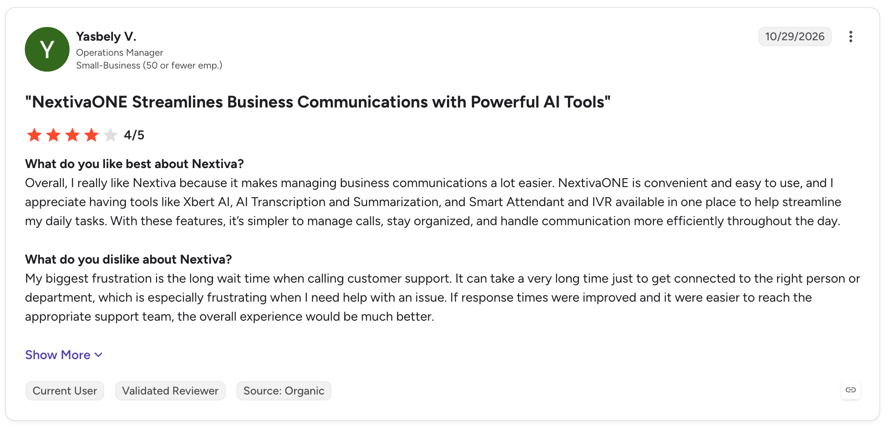
Nextiva is rated 4.5/5 by 3,600+ verified users on the platform. Although the score is high, and people praise Nextiva and its many benefits, reviewers consistently raise three things: the mobile app is the weakest part of the product, with reports of slow notifications and inconsistency against desktop; billing surprises are the most common complaint, which the fee structure above explains; and 24/7 support is the most praised feature.
Nextiva Alternatives Compared
Since you're at a decision making stage, checking out a few more providers before making the final call can turn out to be a great choice:
CloudTalk: Best for Teams Calling Internationally
What Is CloudTalk?
CloudTalk is a cloud phone system built for sales and support teams, with dialers, call routing, recording and analytics included in the plan rather than sold alongside it. It offers local and toll-free numbers in 160 countries, against Nextiva's focus on the US and Canada.
Key Features
- Local and toll-free numbers in 160 countries
- IVR and skill-based routing from the entry plan
- Call recording, with unlimited storage from Essential upward
- Power Dialer and Smart Dialer for outbound teams
- 95+ CRM and helpdesk integrations
- Call monitoring, VIP queues and real-time analytics
How Much Does CloudTalk Cost?
Flexible Pricing Plans to Scale with You
Compare our plans
Pros and Cons
| Pros | Cons |
|---|---|
| Numbers in 160 countries, not just US and Canada | Not a social media or review-management platform |
| Every plan and add-on price published | AI features are add-ons rather than plan inclusions |
| 14-day free trial, no 12-month lock-in required | Built for voice teams rather than omnichannel marketing |
| Dialers included on Expert | Fewer native chat and chatbot tools than Nextiva |
What G2 Users Say About CloudTalk
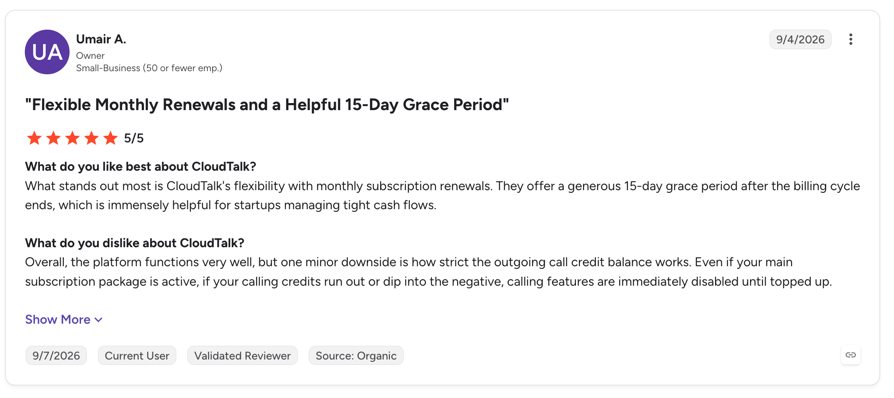
CloudTalk holds 4.4/5 on G2 from 1960 reviews, with call quality, setup speed and CRM integration depth the themes reviewers raise most often.
Other providers worth checking out
Is Nextiva Worth It? Who Should Buy It
You are a US-focused small business that wants voice, video, chat, social and email on one platform, and you will use more than the phone. Engage at $25 is the sweet spot, and the plans are genuinely more generous than they were under the old packaging: call recording and skills-based routing now sit on the $15 entry tier. The 24/7 support is consistently well reviewed, and the platform replaces several separate tools.
You call internationally, since coverage is built around the US and Canada. Also if you cannot absorb a 12-month commitment, if your volumes push past the SMS and toll-free caps, or if a predictable monthly number matters more than feature breadth. The fee structure makes Nextiva hard to budget precisely, and that is a real cost for a small finance team.
FAQs: Nextiva Pricing
Nextiva costs $15 per user per month on NEXT Core, $25 on NEXT Engage and $75 on NEXT Scale, all with annual billing. Monthly billing costs $23 and $50 for Core and Engage respectively. Add roughly 25% to 50% for regulatory fees and taxes.
Three small-business plans: NEXT Core, NEXT Engage and NEXT Scale. This replaced the earlier four-tier lineup of Digital, Core, Engage and Power Suite, which is retired. Contact Center Essential, Professional and Premium sit on a separate enterprise track starting at $75 per agent.
Yes. Every line carries a $3.95 Regulatory Recovery Fee and a $1.50 E911 fee, which Nextiva states are not government taxes. Federal USF adds 7% to 12% of the invoice, plus state and local telecom taxes. On Nextiva's published sample invoice, fees added 48.4% to the base cost.
A $3.95 per line per month charge, or $0.99 for a virtual number, that Nextiva applies to cover its own compliance, reporting and fraud-prevention costs. Nextiva states explicitly that it is not a tax assessed by any government agency, so it is a provider charge rather than a pass-through.
Yes, on all three small-business plans including NEXT Core at $15. Several pricing guides still list it as a Core add-on, but those describe the retired packaging. Our guide to call recording benefits covers what to expect from it.
Nextiva leads with a demo rather than a self-serve free trial, and its public pricing page routes every plan to "Get a Demo" with no credit card required for the demo itself. By contrast, CloudTalk offers a 14-day free trial you can start without talking to sales.
You must give written notice at least 30 days before your current term expires. Miss that window and the contract auto-renews for another full term. Set a reminder 45 days ahead of your renewal date, and start porting your number early if you are moving provider.
International calls bill per minute and vary by destination country, and often by mobile versus landline within the same country. Nextiva's plans are built around US and Canada calling. If international is central to your operation, compare providers that include international phone numbers in the plan.
Contact Center Essential starts at $75 per agent per month. Professional and Premium are quote-only. Essential covers voice and web chat with up to five routing rules; Professional adds email, SMS, predictive dialling and PCI payment assist; Premium adds workforce management and advanced analytics.
It depends on what you need. For international calling, CloudTalk starts at $25 per user per month with numbers in 160 countries and publishes every plan price. For integration breadth, RingCentral is the usual comparison. Our small business phone plans guide covers the wider market.