
TL;DR:
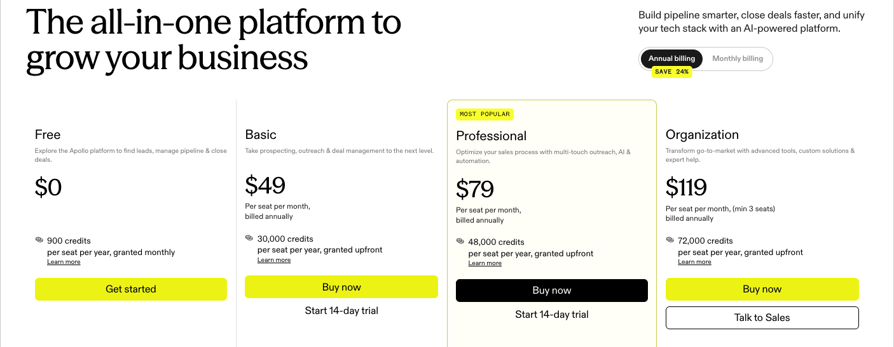
Apollo has a free plan, then Basic at $49, Professional (Apollo Pro) at $79 and Organization at $119 per user per month billed yearly. Billed monthly, Basic costs $65 and Professional $99; Organization is sold yearly only and needs at least 3 users ($357/month).
Every plan runs on credits that the whole team shares and that expire at the end of each billing cycle. Phone numbers, dialer minutes, extra mailboxes and add-ons like the Advanced Dialer all cost extra, so your real bill depends on how you use the credits.
| Plan | Billed yearly | Billed monthly | Credits per user | Best For |
|---|---|---|---|---|
| Free | $0 | $0 | 75/month (900/year) | Founders testing Apollo with light prospecting |
| Basic | $49/user/month | $65/user/month | 2,500/month (30,000/year) | Individual sellers doing regular outbound email |
| Professional | $79/user/month | $99/user/month | 4,000/month (48,000/year) | Full-time reps who need more credits, AI and call recording |
| Organization | $119/user/month (3-user minimum) | Yearly only | 6,000/month (72,000/year) | Teams of 3+ that need SSO, admin controls and advanced reporting |


What Pricing Plans Does Apollo Offer?
Apollo io pricing has four self-serve tiers: Free, Basic, Professional and Organization, plus a Custom plan for larger teams that need custom volumes, SSO and API access. The official list prices below were checked in October 2026 and are per user per month.
Here's how the Apollo pricing plans split into three pricing verticals:
- Seats: a per-user subscription, cheaper on yearly billing (up to 24% on Basic, about 20% on Professional)
- Credits: a shared team pot that pays for emails, phone numbers, enrichment, AI research and dialer minutes
- Add-ons: Advanced Dialer, Inbound and extra credits, priced per team on top of seats
What Changed in Apollo Pricing in 2026?
Apollo pricing 2026 looks different from most guides you'll find, including the older version of this page. If you're comparing numbers across sites, this is why they disagree:
- Basic monthly price is now $65 (older guides show $59)
- Free plan credits are now 75 a month (older guides show 100)
- Credit allotments moved to a single shared pool, at 2,500, 4,000 and 6,000 credits per user per month
- Parallel and power dialing, international calling and local presence now need the paid Advanced Dialer add-on
- Organization now has a 3-user minimum and is sold on yearly billing only
What Do Real Users Say About Apollo Pricing?
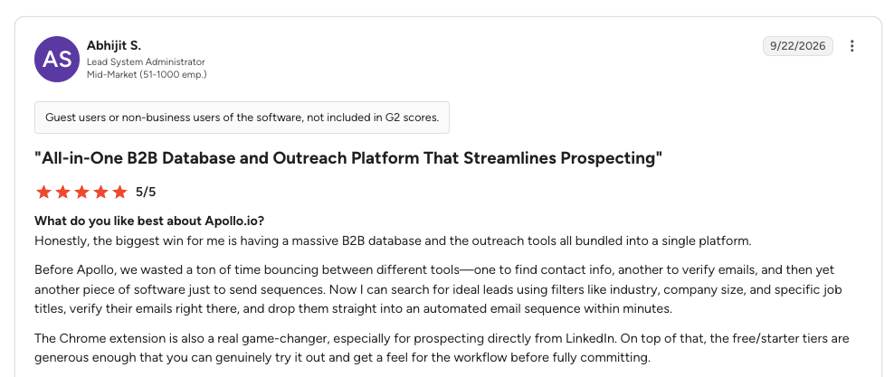
G2 reviewers rate Apollo 4.7/5 from about 9,800 reviews, and the free plan gets a lot of credit. One Lead System Administrator says the free and starter tiers are "generous enough that you can genuinely try it out." Several founders say Apollo replaces a separate database and outreach tool, which is where the value comes from.
The takeaway: Apollo is good value while you stay inside your credits. Plan your phone reveals and dialer minutes before you pick a tier.
Apollo Plan Comparison Table
| Free | Basic | Professional | Organization | |
|---|---|---|---|---|
| Yearly billing | $0 | $49/user/month | $79/user/month | $119/user/month |
| Monthly billing | $0 | $65/user/month | $99/user/month | Yearly only |
| Credits per user | 75/month | 2,500/month | 4,000/month | 6,000/month |
| Minimum users | 1 | 1 | 1 | 3 |
| Sequences | 2 | Unlimited | Unlimited | Unlimited |
| Email accounts | Gmail only | Gmail, Microsoft and others | Gmail, Microsoft and others | Gmail, Microsoft and others |
| Call recording and AI features | Limited | Limited | Yes | Yes |
| SSO and advanced admin | No | No | No | Yes |
What Is Apollo's Free Plan?
The Free plan costs $0 with no time limit. It's built for exploring Apollo or very light prospecting. The Apollo pricing free plan official limits are tight, which we cover in the free plan and trial section below.
What's included in Apollo's Free Plan?
- 75 credits a month (900 a year)
- 2 sequences
- Gmail mailbox connection only
- 1 free warm-up mailbox
- 5 AI Assistant chats and a small AI research allowance
- Chrome extension for prospecting
What you need to know about Apollo's Free Plan:
75 credits is about 9 phone numbers or 75 verified emails a month. It's enough to test filters and run a small sequence, not to run outbound.
What Is Apollo's Basic Plan?
Basic is Apollo's entry paid plan for individual sellers doing regular outbound. It costs $49 per user per month billed yearly ($588 a year), or $65 billed monthly.
What's included in Apollo's Basic Plan?
- 2,500 credits per user per month (30,000 a year)
- Unlimited sequences
- Core CRM integrations (Salesforce, HubSpot)
- Microsoft and other email providers
- US dialer (minutes use credits)
- 6 intent topics
What's not included in Apollo's Basic Plan?
- Call recording and the higher-tier AI features
- Advanced CRM integrations
- Advanced reporting and admin controls
- Parallel or power dialing (Advanced Dialer add-on)
What you need to know about Apollo's Basic Plan:
The jump from $49 yearly to $65 monthly is a 33% premium. If you're sure you'll stay a year, yearly billing saves $192 per user.
What Is Apollo's Professional Plan (Apollo Pro)?
Apollo Pro is the Professional plan, built for full-time reps who need higher credit limits, AI features, call recording and advanced CRM integrations. It costs $79 per user per month billed yearly ($948 a year), or $99 billed monthly.
What's included in Apollo's Professional Plan (Apollo Pro)?
- Everything in Basic
- 4,000 credits per user per month (48,000 a year)
- Call recording, transcripts and AI call summaries
- AI agents and AI lead scoring
- Advanced CRM integrations
- More mailboxes and workflows
Is the dialer still included in Apollo Pro?
Partly. The basic US dialer is included on paid plans, but every minute uses credits. Parallel and power dialing, international calling and local presence need the Advanced Dialer add-on, even on Professional.
What Is Apollo's Organization Plan?
Organization is Apollo's top self-serve plan for teams that need admin control. It costs $119 per user per month billed yearly, with a 3-user minimum. The monthly toggle shows $149, but the plan is sold yearly only.
What's included in Apollo's Organization Plan?
- Everything in Professional
- 6,000 credits per user per month (72,000 a year)
- SSO and advanced security settings
- Custom reports and Salesforce custom objects
- 12 intent topics
- Option to use your own LLM API key
What you need to know about Apollo's Organization Plan:
The minimum spend is 3 × $119 = $357 a month, or $4,284 a year, paid upfront. A two-person team still pays for three seats.
Apollo Add-Ons and Extra Credits
- Advanced Dialer: about $119 per team per month billed yearly, $149 monthly. Adds parallel and power dialing, international calling and local presence.
- Inbound: from about $119 per team per month billed yearly. Apollo labels both add-on prices "introductory."
- Extra credits: bought with a slider in settings, charged immediately and renewed every cycle until you set them back to zero. Apollo doesn't publish a per-credit rate; third-party guides report about $0.025 down to $0.015 per credit at volume. See how credits work.
- AI: Apollo AI pricing is mostly baked into the plans. AI research costs about 1 credit per run, and the AI Assistant is capped on Free.
How Do Apollo Credits Work, and What Does Each Action Cost?
Credits are why Apollo usually costs more than the plan price. Each user adds credits to a pot the whole team shares. The pot resets at the end of each billing cycle, unused credits don't roll over (including purchased ones), and you can buy more on any paid plan. Yearly plans release the full year of credits upfront. Older accounts may still have separate email, mobile and export credits. Here's what Apollo credits pricing looks like per action:
| Action | Credits | Notes |
|---|---|---|
| Verified email | 1 | Charged only if Apollo verifies it; never more than 1 per contact |
| Mobile or direct phone number | 8 | Charged once per contact when a number is found |
| Data enrichment | 1 to 8 | Depends on the data returned |
| Phone waterfall enrichment | 8 to 25 | 45+ in some setups |
| AI research | About 1 per run | |
| US dialer | About 2 per minute | Connected calls; 1 credit per 30 seconds |
| International dialer | Varies by region | Needs the Advanced Dialer add-on |
| Extra warm-up mailboxes | Monthly credits | First mailbox free |
In plain numbers, Professional's 4,000 credits per user per month buys about 500 phone numbers, or 2,000 US dialer minutes, or 4,000 verified emails. It's one pot, so a phone-heavy month leaves less for everything else. At $0.015 to $0.025 per extra credit, each extra phone number costs about $0.12 to $0.20.
That's also the real answer to Apollo leads pricing: an email lead costs 1 credit, a lead with a phone number costs 9. Apollo API pricing uses the same pot. Enrichment and search endpoints cost credits (people enrichment is 1 credit, plus 8 if a mobile is returned), while create and update endpoints are free. Apollo ties full API access to its Custom plan, so check your rate limits with sales.
What Are Apollo's Additional Costs?
The seat price is the floor. Here's what sits on top.
| Additional Cost | Amount | Notes |
|---|---|---|
| Extra credits | About $0.015 to $0.025 each (reported) | Renew every cycle until removed; expire unused |
| Advanced Dialer | $119/team/month yearly, $149 monthly | Parallel, power, international, local presence |
| Inbound add-on | From $119/team/month yearly | Introductory pricing |
| Dialer minutes | About 2 credits/minute (US) | International varies by region |
| Extra mailboxes and domains | Credits (mailboxes monthly, domains yearly) | First warm-up mailbox free |
| Organization minimum | $357/month | 3 users, yearly only |
Extra Credits and Phone Numbers
Phone numbers are the fastest way to drain the pot at 8 credits each. Bought credits renew automatically every cycle until you set the slider back to zero, so a one-off top-up becomes a recurring charge.
Calling and the Advanced Dialer
Every dialer minute costs credits. If your reps need parallel or power dialing, add $119 to $149 a month per team on top. For a deeper look at multi-line dialing, see our guide to the best parallel dialers.
Mailboxes, Warm-Up and Domains
One warm-up mailbox is free. Additional mailboxes cost credits every month, and domains bought through Apollo are charged yearly.
Per-User Pricing and the 3-User Minimum
Every seat adds a full subscription. On Organization you pay for 3 seats even with 2 users.
Annual Commitment and Refunds
Yearly plans are paid upfront and can't be cancelled mid-term. See the contract terms below.
Does Apollo Have a Free Plan, a Trial or a Startup Discount?
Apollo Free Plan
Yes. The Free plan gives you 75 credits a month, 2 sequences per team and a Gmail connection, with no time limit. It suits founders and anyone testing filters before buying.
Apollo Free Trial
You can start a 14-day trial of Basic or Professional from a free account. There's no Organization trial. Trial credits are limited (Apollo's help center says 100 credits) and expire when the trial ends.
Apollo Startup Discount
Apollo for Startups gives 50% off Basic or Professional for 12 months, for up to 5 seats. You need fewer than 20 employees, no current Apollo subscription and an affiliation with one of Apollo's startup partners (accelerators, VCs or communities).
Apollo Contract Terms
- Yearly plans are paid upfront; you can switch to monthly only at renewal
- Apollo's terms (updated August 2026) ask for written notice of non-renewal at least 30 days before the term ends
- Fees are non-refundable, and you can't reduce seats mid-term for a refund
- Monthly plans can be cancelled anytime, effective at the end of the cycle
What Will Apollo Actually Cost?
These scenarios use list prices and the credit costs above. They're illustrative, so re-check them against your own usage.
Scenario 1: Solo Founder, Free or Basic Plan
| Cost Item | Cost |
|---|---|
| Free plan | $0 (75 credits/month) |
| Or Basic, billed yearly | $49/month ($588/year) |
| Or Basic, billed monthly | $65/month ($780/year) |
| Total | $0 to $65/month |
Verdict: Free works for testing; Basic is the cheapest real outbound seat. Calling with CloudTalk: 1 user on Starter at $25/user/month with unlimited US and Canada calls.
Scenario 2: 5-Person SDR Team, Professional Plan
| Cost Item | Monthly Cost |
|---|---|
| 5 × Professional, yearly | $395 ($4,740/year) |
| Or 5 × Professional, monthly | $495 |
| Credit pot | 20,000 credits/month (5 × 4,000) |
| 2,000 emails | 2,000 credits |
| 1,000 phone numbers | 8,000 credits |
| 3,000 US dialer minutes | 6,000 credits |
| Total | $395/month yearly, 16,000 credits used (inside the pot) |
Verdict: a normal month fits. Calling with CloudTalk: 5 users on Expert at $49/user/month, power dialer included, no credits per minute.
Scenario 3: Same Team, Heavier Month
| Cost Item | Monthly Cost |
|---|---|
| 5 × Professional, monthly billing | $495 |
| 3,000 emails | 3,000 credits |
| 1,800 phone numbers | 14,400 credits |
| 5,000 US dialer minutes | 10,000 credits |
| Over the 20,000 pot | 7,400 credits = $111 to $185 |
| Advanced Dialer (if you need parallel/power) | $149 |
| Total | $606 to $829/month |
Verdict: on yearly billing the annual pool absorbs a single spike, but if every month looks like this you'll need about 88,800 extra credits a year ($1,332 to $2,220). Calls are the line that grows fastest.
Scenario 4: 15-Person Team, Organization Plan
| Cost Item | Monthly Cost |
|---|---|
| 15 × Organization, yearly | $1,785 ($21,420/year) |
| Credit pot | 90,000 credits/month (15 × 6,000) |
| Advanced Dialer | $119 |
| Total | $1,904/month, billed upfront yearly |
Verdict: the 3-user minimum is long met, but you're committing over $22,000 upfront. Calling with CloudTalk: 15 users on Essential at $29/user/month or Expert at $49/user/month, with calling outside the data budget.
The Bottom Line on Real Costs
Apollo's seat price is predictable. Credits aren't. Phone reveals and dialer minutes are what push a team past its pot, and those are exactly the things a phone-first team does all day.
Apollo vs CloudTalk, ZoomInfo and Lusha: Which Costs Less?
Apollo, ZoomInfo and Lusha sell contact data. CloudTalk sells the calling layer. So the cheapest tool depends on the job you're paying for: finding prospects, calling them, or both. Here's how they compare, with a quick pick at the end.
| CloudTalk | Apollo | ZoomInfo | Lusha | |
|---|---|---|---|---|
| Pricing model | Flat per user, public | Per user, public, shared credits | Custom quote, not published | Per user plus credits, public |
| Entry price | $25/user/month (Starter, yearly) | Free; Basic $49 yearly / $65 monthly | Reported from about $15,000/year | Free (40 credits); Starter $49.90/month |
| Credits or usage | No credits for calls; unlimited US & Canada (fair use) | 2,500 / 4,000 / 6,000 credits per user/month | Contract based | 400 / 600 / 3,400 credits/month (Starter / Pro / Premium) |
| Free plan or trial | 14-day free trial | Free plan, 14-day trial | Demo only | Free plan |
| Dialer | Power dialer included on Expert ($49); parallel add-on | Credits per minute; advanced dialing is an add-on | Via add-on | No dialer |
| Prospect database | No | Yes | Yes | Yes |
| Best for | Phone-first sales and support teams | Data plus outreach on a budget | Enterprise data and intent | Direct dials, light use |
Prices checked October 2026. ZoomInfo figures are reported by third parties, not published by ZoomInfo.
Apollo vs CloudTalk Pricing: Which Is Cheaper for Calling?
If most of your pipeline moves by phone, this is the comparison that matters.
What is CloudTalk, and how is it different from Apollo?
CloudTalk is an AI business phone system and sales dialer for sales and support teams, with local numbers in 160+ countries. It has no prospect database, so it does the calling that Apollo only does in a basic way.
How do Apollo's credit-based calls compare with CloudTalk's flat per-user price?
- Apollo: US dialer calls cost about 2 credits per minute, international calls vary by region, and parallel or power dialing needs the Advanced Dialer add-on ($119 a month per team, yearly).
- CloudTalk: one price per user with unlimited US and Canada calling (fair use). The power dialer is included on Expert and available as an add-on on other plans.
| 5-user stack (yearly prices) | Monthly cost | Calls use credits? |
|---|---|---|
| Apollo Professional (5 × $79) + Advanced Dialer ($119) | $514 | Yes |
| Apollo Basic (5 × $49) + CloudTalk Expert (5 × $49) | $490 | No |
These aren't like-for-like. The second stack gives you a separate calling platform and keeps Apollo for data and email, with fewer credits per user.
Which features does CloudTalk include that Apollo charges extra for or lacks?
- Call recording and live call monitoring
- IVR and Call Flow Designer for inbound routing
- Power and smart dialing without per-minute credits
- Local numbers in 160+ countries
- AI call summaries and transcription with Conversation Intelligence ($9/user/month add-on)
- Where Apollo is better: prospect data and email sequences
Who should choose CloudTalk over Apollo, and who should use both?
Choose CloudTalk if your team makes many calls a day, runs support lines or calls internationally. Use both if your reps need Apollo's data and a stronger dialer: push contacts into CloudTalk through Zapier or a CSV import, and route them with lead routing rules.
”CloudTalk has made it incredibly easy to manage and track all my sales and customer calls in one place. I love how seamlessly it integrates with CRMs like HubSpot and Apollo. The call quality is reliable, and features like call recording and analytics make it easy to review performance and improve conversations.”

Bottom line: if calls drive your revenue, pay for calling per user and keep Apollo for data.
Apollo vs ZoomInfo Pricing
ZoomInfo is the enterprise data option, and the price gap is large.
How much does ZoomInfo cost compared with Apollo?
ZoomInfo doesn't publish prices. Reported figures put Professional at about $14,995 a year for up to 3 seats, with a median contract around $33,500 a year (Vendr data, reported, not official). For 5 seats, Apollo Professional costs $4,740 a year and Organization $7,140 a year. On Apollo vs ZoomInfo pricing, Apollo is the clear budget pick.
What does ZoomInfo include that Apollo charges extra for or does less well?
ZoomInfo is stronger on intent data (Streaming Intent is a usage-priced add-on) and enterprise integrations. Apollo has basic intent topics and keeps outreach and dialing in the same tool.
Which teams fit ZoomInfo, and which fit Apollo?
ZoomInfo fits enterprise and multi-office teams with a budget for deep data. Apollo fits SMB and mid-market teams that want public pricing. For more options, see our sales intelligence software roundup. Bottom line: unless you need enterprise intent data, Apollo costs a fraction of ZoomInfo.
Apollo vs Lusha Pricing
Lusha is the light, phone-focused data option.
How does Lusha's pricing compare to Apollo?
Lusha's list prices (October 2026, monthly billing): Free with 40 credits, Starter $49.90 for 400 credits a month, Pro $69.90 for 600 and Premium $399.90 for 3,400, with lower yearly promo prices (Starter from about $37.45). A phone number costs 5 credits on Lusha and 8 on Apollo, but Apollo gives far more credits per seat. On list prices, a phone number works out to about $0.62 on Lusha Starter and about $0.20 on Apollo Professional.
Does Lusha include anything that Apollo charges extra for?
Lusha is known for direct dials and a light Chrome extension, and unused credits on monthly plans roll over (up to twice the plan limit). Apollo bundles sequences, a larger database and a dialer.
Who should pick Lusha and who should pick Apollo?
Lusha suits reps who mostly need phone numbers at low volume. Apollo suits teams that also send sequences. Bottom line: per contact, Apollo is usually cheaper; Lusha is simpler.
Apollo vs Hunter.io Pricing
Hunter focuses on finding and verifying emails. Its plans run Free (50 credits), Starter $49/month ($34 yearly, 2,000 credits), Growth $149/month ($104 yearly, 10,000 credits) and Scale $299/month ($209 yearly, 25,000 credits). Apollo adds a phone database, sequences and a dialer, so it covers more of the workflow for a similar entry price. Pick Hunter if email is all you need.
Quick Pick by Team Type
| Your team | Likely lowest-cost sensible choice | Why |
|---|---|---|
| Solo or testing | Apollo Free | Public free plan; check the credit limits |
| Small team that sends email | Apollo Basic or Hunter.io | Lowest per-user price with sequences |
| Phone-first sales or support team | CloudTalk (add Apollo or Lusha for data) | Calls are flat per user, not credits per minute |
| Needs direct dials, low volume | Lusha | Phone-focused data on a light plan |
| Enterprise, multi-office, deep intent data | ZoomInfo | Custom contracts and the deepest data |
Want to see what calling costs for your team? Check CloudTalk pricing.
What Are Apollo's Best Features?
Apollo's value comes from putting data and outreach in one tool. Here's what each feature costs you in plans and credits.
Contact Database and Filters
- Search a large B2B database with detailed filters
- Available on every plan, including Free
- Every email or phone reveal uses credits
Email Sequences and AI Email Writer
- Multi-step sequences: 2 on Free, unlimited from Basic
- Apollo AI email writer pricing is included in the plans, with AI research at about 1 credit per run
- Gmail only on Free; Microsoft and others on paid plans
Dialer, AI Call Scripts and Call Insights
- Basic US dialer on paid plans, about 2 credits per minute
- Call recording, transcripts and AI call summaries on Professional and up
- Apollo AI call scripts pricing follows the plan; call minutes still cost credits and parallel or power dialing needs the Advanced Dialer
Intent Topics and Signals
- 1 intent topic on Free, 6 on Basic and 12 on Organization
- Apollo intent topics pricing is part of the plan; enriching the accounts you find still uses credits
CRM Sync and Integrations
- Apollo has basic contact and deal management, but it isn't a full CRM
- Salesforce and HubSpot sync from Basic; advanced CRM integrations from Professional
- Apollo CRM pricing is therefore the plan price; there's no separate CRM fee
What Are the Pros and Cons of Apollo?
| Pros | Cons |
|---|---|
| Public pricing: list prices from $49 per user per month | Credits drive the real cost: and they expire every cycle |
| Free plan: 75 credits a month, no time limit | Per-user pricing: every seat adds a full subscription |
| Large database: emails and phone numbers in one place | 3-user minimum: on Organization, yearly only |
| Data plus outreach: sequences and a dialer in one tool | Basic calling: minutes cost credits; advanced dialing is an add-on |
| Much cheaper than ZoomInfo: a fraction of reported enterprise contracts | Price changes and contracts: several 2026 changes; 30-day non-renewal notice |
On AI calling, Apollo's dialer is built for outbound: its help center doesn't cover call routing, ring groups or IVR, and every minute is paid in credits. CloudTalk adds AI call summaries and transcription with Conversation Intelligence, a power dialer on Expert and inbound routing on its plans.
Is Apollo Worth the Money for Your Team?
Yes, for most small and mid-size outbound teams that live in email and LinkedIn. Apollo gives you data and sequences for $49 to $79 per user per month, which is a fraction of what ZoomInfo charges.
The value drops when calls become the main channel. Phone reveals at 8 credits, dialer minutes at about 2 credits and the Advanced Dialer add-on all stack up, and credits expire every cycle. Budget for top-ups once your team is past a few reps.
What Apollo Pricing Plan Is Best for My Company?
- Solo or testing: Free
- 1 to 2 reps who need CRM sync: Basic
- A small SDR team that emails and calls: Professional
- 3+ users who need SSO and advanced admin: Organization
- Teams that mainly need phone calls: a dedicated phone system such as CloudTalk, with Apollo for data if you need it
FAQs: Apollo Pricing
Apollo costs $0 on Free, $49 per user per month on Basic and $79 on Professional when billed yearly. Billed monthly, Basic is $65 and Professional is $99. Organization is $119 per user per month, billed yearly only, with a 3-user minimum.
Apollo Pro costs $79 per user per month billed yearly ($948 a year) or $99 billed monthly. It includes 4,000 credits per user per month.
For email-led outbound teams, yes: data and sequences for $49 to $79 per user per month (yearly). For phone-heavy teams, credits for phone numbers and dialer minutes add up fast, so a dedicated dialer is often cheaper.
Free for testing, Basic for 1 to 2 reps who need CRM sync, Professional for SDR teams that email and call, and Organization for 3+ users who need SSO. Teams that mainly make calls are better served by a phone system.
Yes. The Free plan includes 75 credits a month, 2 sequences and a Gmail connection, with no time limit. You can also start a 14-day trial of Basic or Professional.
Each user adds credits to a shared team pot (2,500, 4,000 or 6,000 per month on Basic, Professional or Organization). An email costs 1 credit and a phone number 8. Credits expire at the end of each billing cycle and don't roll over.
Yes, in credits. US dialer calls cost about 2 credits per minute, international rates vary by region, and parallel or power dialing needs the Advanced Dialer add-on ($119 a month per team billed yearly, $149 monthly).
Apollo publishes prices from $49 per user per month (yearly). ZoomInfo is quote-only, with reported contracts from about $15,000 a year and a median around $33,500.
Lusha starts at $49.90 a month (monthly billing) for 400 credits, where a phone number costs 5 credits. Apollo Basic costs $65 a month (monthly billing) for 2,500 credits, where a phone number costs 8, so Apollo is usually cheaper per contact.