Quick Answer: What is the Best AI Voice Agent for Insurance?
CloudTalk is the best voice AI for insurance teams, automating FNOL claims intake, policy renewals, and outbound follow-ups, with native two-way CRM sync and 24/7 multilingual coverage.
The Voice Agent runs on your existing CloudTalk numbers and routing, so there is no second phone system. Plus, automatically stay compliant with SOC 2 Type II, ISO 27001, GDPR, and HIPAA-eligible controls.
Best AI Voice Agents for Insurance: Quick Comparison
| Platform | Best For | Pricing Model | Compliance | Overall Rating |
|---|---|---|---|---|
| CloudTalk | Agencies and carriers that want one phone system plus AI, not two vendors | Per-user plan plus published AI add-on | SOC 2 Type II, ISO 27001, GDPR, HIPAA eligible | ★★★★★ |
| Sonant AI | Independent P&C agencies running EZLynx or Applied Epic | Custom quote only | SOC 2 Type 2, GDPR | ★★★★☆ |
| Synthflow | No-code teams willing to build their own insurance logic | $375/mo entry, per-minute overage | SOC 2, HIPAA, PCI DSS, GDPR | ★★★★☆ |
| Retell AI | Engineering teams that want to build the agent themselves | $0.07/min pay as you go | SOC 2 Type I and II, HIPAA, GDPR | ★★★★☆ |
| Ema | Enterprise carriers with an existing compliance review process | Custom quote only | SOC 2, ISO 27001, HIPAA, NIST, GDPR | ★★★☆☆ |
According to Precedence Research, artificial intelligence will cut insurance operating costs by as much as 40%, and AI voice agents for insurance are where a lot of that saving shows up first.
The best AI voice agents for insurance further cut costs and increase efficiency; they answer and place real calls, collect claim details, book renewals, and log everything to your CRM without a rep touching the phone.
We tested and ranked the 10 best AI voice agents for insurance in 2026 so you can evaluate them against real insurance workflows, deploy the right one, and start automating claims and renewals faster.
Best AI Voice Agents for Insurance: TL;DR
The best AI voice agent for most insurance teams is CloudTalk, because it combines autonomous voice, native CRM sync, and 24/7 multilingual coverage in one telephony-native platform.
Here is the full ranked list and what each tool does best:
- 01CloudTalk: Best AI voice agent for insurance teams automating FNOL claims intake, policy renewals, and outbound follow-ups with native CRM sync and 24/7 multilingual coverage.
- 02Sonant AI: Best AI receptionist for P&C agencies that need inbound quote intake synced deep into AMS platforms like EZLynx and Applied Epic.
- 03Zowie: Best for deterministic, hallucination-free claims resolution at large carriers that need every decision auditable.
- 04Ema: Best for end-to-end back-office automation, reasoning through claims and underwriting files from first call to system update.
- 05Dialora AI: Best for fast, AMS-ready deployment at small US agencies on Applied Epic or AMS360 that want to go live in days.
- 06Synthflow: Best no-code builder for small agencies and brokers who want to assemble FNOL and after-hours flows without engineering.
- 07UnleashX AI: Best for proactive policy renewals and retention, with outbound win-back campaigns and payment nudges.
- 08Telnyx: Best for high-volume, low-latency claims infrastructure during catastrophe (CAT) call spikes at national carriers.
- 09Retell AI: Best for developer-first teams building real-time, code-controlled voice into insurance workflows.
- 10Vapi: Best for technical teams that want a model-agnostic, no-lock-in stack for underwriting and claims automation.

See how insurance teams unlock 17× ROI with CloudTalk's AI Voice Agent

What Is an AI Voice Agent for Insurance?
An AI voice agent for insurance is software that holds a real phone conversation with a policyholder, understands what they need, and completes the task without a human agent on the line.
It can answer a claims call at 2 a.m., collect the details of a fender-bender, and open a case in your system before an adjuster ever picks up. Plus, it's never in a bad mood...unless you program it to be.
The types of AI Voice Agent can be divided into two:
- An AI receptionist handles inbound calls: it answers policy questions, takes quote details, routes callers to the right team, and covers overflow and after-hours volume.
- An AI specialist goes further and resolves work end to end, running FNOL intake, outbound renewal campaigns, and revenue-cycle-management (RCM) follow-ups with multi-step logic.
These agents typically follow strict compliance, since Insurance calls carry sensitive data. Thus these agents support call recording, audit trails, encryption, and regional rules like GDPR and HIPAA where applicable.
For an insurance team, the practical payoff is coverage that scales with call volume instead of headcount (sorry job seekers), and cleaner data because every conversation writes back to the record automatically.
How We Evaluated the Best AI Voice Agents for Insurance
We reviewed 30+ AI voice and conversational platforms marketed to insurance teams, then put the shortlist through insurance-specific workflow scenarios: an FNOL intake call, a renewal outreach campaign, a quote request after hours, and a warm transfer to a licensed agent.
Our sources included verified customer reviews on G2, Capterra, and TrustRadius, community discussion on Reddit and InsurTech forums, and each vendor's own documentation. Every platform was scored against the six criteria below.
Conversation Quality and Insurance Terminology Accuracy
Does the agent sound human under stress, and does it understand claims, coverage, deductible, endorsement, and rider language well enough to avoid dead-ends? We weighted real-time responsiveness and correct handling of insurance vocabulary over generic small talk.
Compliance and Security Posture
Insurance is one of the most regulated industries there is. We looked for call recording with consent, audit trails, encryption, and support for GDPR and HIPAA where the use case requires it, including Business Associate Agreements for health data.
CRM and AMS Integration Depth
An agent is only as useful as the data it can read and write. We checked for native integration with HubSpot, Salesforce, and the agency management systems that run insurance shops, including Applied Epic, EZLynx, and AMS360, and whether sync is native or bolted on through Zapier.
Claims and Workflow Automation Capability
Can the platform run a full FNOL flow, renewal logic, and outbound dialing, or does it stop at answering FAQs? We scored end-to-end task completion over simple deflection.
Deployment Speed
Insurance teams need results in weeks, not quarters. We separated plug-and-play tools that go live in days from enterprise builds that take months of integration work.
Pricing Transparency
Published rates score higher than "contact sales." We favored platforms that let a buyer understand the real cost, including per-minute usage and overage, before booking a call.
Why Trust Our Reviews
For nearly a decade, we've helped over 30,000+ professionals find and implement smarter business communication tools. We've reviewed 200+ software tools across industries, analyzed 5,500+ verified customer reviews from platforms like G2, Capterra, Trustpilot, and TrustRadius, and drawn insights from real user discussions on Reddit and Quora.
In the past year alone, we published 1,000+ articles, each one written by humans for humans. Learn how we keep our content integrity and our software review methodology.
AI Voice Agents for Insurance: Tool Scoring Table
To score each platform, we combined verified customer reviews from G2, Capterra, and Trustpilot with each vendor's published documentation on compliance certifications, integrations, and pricing, then rated every tool from 1 to 5 across the six insurance-specific criteria above.
Review sites do not break ratings out by insurance workflow, so the claims and CRM/AMS columns reflect documented capability rather than reviewer scores, weighed alongside conversation quality feedback and each platform's AI call analytics. Where a platform has too few public reviews to draw a signal from, we scored conservatively and flagged it in the write-up below.
Scoring Table: Best AI Voice Agents for Insurance
| Platform | Conv. Quality | Compliance | CRM/AMS Integration | Claims Automation | Deploy Speed | Pricing Clarity | Total (/30) |
|---|---|---|---|---|---|---|---|
| CloudTalk | 5 | 5 | 4 | 4 | 5 | 5 | 28 |
| Sonant AI | 4 | 4 | 5 | 5 | 4 | 2 | 24 |
| Zowie | 4 | 4 | 3 | 3 | 3 | 2 | 19 |
| Ema | 3 | 5 | 4 | 4 | 3 | 1 | 20 |
| Dialora AI | 3 | 2 | 3 | 2 | 5 | 4 | 19 |
| Synthflow | 4 | 5 | 4 | 3 | 5 | 3 | 24 |
| UnleashX AI | 3 | 3 | 3 | 4 | 4 | 1 | 18 |
| Telnyx | 4 | 5 | 2 | 1 | 2 | 4 | 18 |
| Retell AI | 5 | 4 | 3 | 2 | 3 | 4 | 21 |
| Vapi | 3 | 3 | 2 | 1 | 2 | 2 | 13 |
Quick Answers: What Insurance Teams Ask About AI Voice Agents
What are the best AI voice agents for insurance companies in 2026?
CloudTalk ranks first for most insurance teams because it pairs autonomous voice with 24/7 coverage and native CRM sync in one platform, so FNOL calls and renewal campaigns log straight to the record. Sonant AI is the strongest pick for AMS-native inbound reception, and Zowie suits large carriers that need deterministic, auditable resolution.
Which AI platforms for insurance agents have the best integration options?
CloudTalk offers 100+ native integrations, including HubSpot, Salesforce, Zendesk, and Pipedrive, with automatic call summaries written back to the record. Sonant AI goes deep on agency management systems like Applied Epic and EZLynx. When a platform lacks native connectors, it usually falls back to Zapier, which adds latency and setup work.
Which AI voice agent can replace IVR and route insurance queries to live agents while logging in Salesforce?
CloudTalk's AI Receptionist replaces phone-tree IVR with conversational call routing: it understands why the caller is phoning, hands complex cases to a licensed agent with full context, and syncs the call to Salesforce automatically. Teams typically upgrade an existing IVR to the AI Receptionist rather than rebuilding routing from scratch.
What are the top AI tools for reducing insurance hold times and automating follow-ups?
CloudTalk's outbound AI Specialist runs renewal and follow-up campaigns at volume while the AI Receptionist absorbs inbound overflow, so hold queues shrink on both sides. UnleashX AI focuses on renewal retention, and Telnyx suits carriers that need low-latency infrastructure for high call volumes.
Does an AI voice agent for insurance need to be connected to a CRM or AMS to work?
No. CloudTalk's AI Voice Agent can be set up with just uploaded policy or company information, so it works without a CRM or AMS connection. Connecting one adds automatic call logging and lets the agent personalize conversations using existing policyholder data, but it's not required to get started.
What is conversational AI for insurance?
Conversational AI for insurance is software that holds a natural, two-way phone or chat conversation with a policyholder—understanding intent, answering coverage and claims questions, and completing tasks like FNOL intake or renewals—instead of pushing callers through a fixed IVR menu. Unlike a scripted chatbot, it adapts mid-conversation and takes real actions, then hands complex cases to a human agent with full context.
Not sure which AI voice agent fits your insurance workflows?
Best AI Voice Agents for Insurance: Comparison Table
The table below compares all ten platforms at a glance; for background on the benefits of AI voice agents for sales and support, read our primer.
What Are The Best AI Voice Agents for Insurance?
| Provider | Key Features | Best For | Starting Price | G2 Rating |
|---|---|---|---|---|
| CloudTalk | Autonomous voice (CeTe), outbound dialers, 100+ integrations, 60+ languages, GDPR/HIPAA | FNOL claims, renewals, CRM sync | AI Receptionist from $0/mo (50 free min) | 4.4/5 |
| Sonant AI | Inbound receptionist, AMS quote intake, warm transfers | Agency reception with deep AMS sync | Custom | 5.0/5 (2 reviews) |
| Zowie | Deterministic Decision Engine, omnichannel, AI Supervisor logs | Auditable claims resolution at scale | Custom | 4.7/5 (73 reviews) |
| Ema | Generative Workflow Engine, model-switching, PII trust layer | End-to-end back-office automation | Custom | No verified G2 reviews |
| Dialora AI | AMS-ready templates, instant ID&V, smart scheduling | Fast setup on Applied Epic / AMS360 | $297/mo | No verified G2 reviews |
| Synthflow | No-code builder, real-time in/outbound, GoHighLevel + Zapier | No-code small-agency flows | $375/mo, 2,000 min | 4.5/5 (999 reviews) |
| UnleashX AI | Renewal nudges, win-back flows, sentiment routing | Proactive renewals and retention | Usage-based | No verified G2 reviews |
| Telnyx | Owned private network, sub-200ms latency, programmable voice | High-volume, low-latency infrastructure | Usage-based | 4.7/5 (601 reviews) |
| Retell AI | Real-time streaming API, emotion-adaptive, custom prompting | Developer-first real-time voice | From $0.07/min pay-as-you-go | 4.8/5 (2,200+ reviews) |
| Vapi | Model-agnostic orchestration, call control, webhooks | No-lock-in custom stacks | From $500/mo | 4.2/5 (3 reviews) |
The 10 Best AI Voice Agents for Insurance in 2026
Best AI Voice Agents for Small Insurance Agencies and Independent Brokers
Small agencies and independent brokers don't have an implementation team, so the tools that fit best are the ones that go live fast and connect to the systems already in use. CloudTalk suits this group because the AI receptionist for insurance agencies sets up in minutes with 50 free minutes to test on a live number, and it syncs to 100+ CRMs out of the box.
Dialora AI is a strong option for US agencies standardized on Applied Epic or AMS360, thanks to ready-made intake templates. Synthflow works for brokers who want to build their own flows with a no-code editor and a low monthly entry price. All three prioritize rapid deployment and affordable entry over enterprise depth.
1. CloudTalk: Best AI Voice Agent for Insurance Renewals, Claims, and Follow-Ups
What Is CloudTalk?
CloudTalk is the global AI business calling software built for SMB growth, and its AI Voice Agent brings autonomous inbound and outbound calls into the same telephony layer your human reps already use.
For insurance, that means the agent that answers an FNOL call runs on the same numbers, routing, recording, and CRM sync as the licensed team it escalates to. It's built for growing agencies and carriers that want to reach more policyholders and settle claims faster without adding headcount.
Category Scores for CloudTalk
| Criterion | Score (/5) |
|---|---|
| Conversation Quality | 5 |
| Compliance | 5 |
| CRM/AMS Integration | 4 |
| Claims Automation | 4 |
| Deploy Speed | 5 |
| Pricing Clarity | 5 |
Key Features of CloudTalk AI for Insurance
CloudTalk's insurance stack centers on three capabilities that map directly to claims, renewals, and integration work.
CeTe AI Voice Agent
CeTe is CloudTalk's fully autonomous conversational agent for phone calls. It holds a free-flowing, two-way conversation rather than following a rigid IVR tree: it understands intent, asks follow-up questions, pulls answers from a knowledge base, and takes real actions mid-call like creating a CRM record or booking a follow-up.
For insurance, it runs 24/7 FNOL intake and renewal outreach using intake questions your team defines, recognizes returning policyholders from their CRM history, supports 60+ languages and accents at sub-800ms latency, and produces recordings and summaries for compliant logging.















Outbound Dialers (Parallel and Power)
CloudTalk's AI Sales Dialer pairs with the voice agent to scale renewal and follow-up campaigns. Parallel Dialing calls multiple numbers at once per agent and connects the first live answer, with AI voicemail detection so reps only pick up on a human.
Because dead numbers and voicemails never reach a rep, daily contact rates run well above manual dialing, which is what moves a renewals list from a call queue to completed conversations. Power Dialer is included on the Expert plan and available as an add-on on lower plans.
Deep CRM and AMS Integration
CloudTalk offers 100+ CRM and AMS integrations, including Salesforce, HubSpot, Pipedrive, and Zendesk, with two-way sync of contacts, calls, recordings, and AI summaries. Every call CeTe handles writes back to the record automatically, so a claim reported to the agent and later transferred to a human shows up as one continuous record with notes and recording attached.
If a system you use isn't covered by a native integration, you can move call data, recordings, transcripts, and AI summaries into your own database or warehouse using CloudTalk's public API and webhooks.
Tech and Performance Metrics
- Latency: sub-800ms response time on CeTe voice
- Languages: 60+ languages and accents
- Coverage: local presence in 160+ countries
- Compliance: SOC 2 Type 1 and Type 2, GDPR, HIPAA (BAA support, PHI handling), call recording for insurance with consent
- Setup: no-code agent live in under 10 minutes
Insurance Use Cases for CloudTalk
- FNOL and claims intake: 24/7 inbound capture that logs the claim and routes to an adjuster
- Policy renewals and retention: outbound campaigns that reach policyholders before coverage lapses
- Follow-up and lead qualification: instant callbacks on new quote requests
- After-hours and overflow: inbound reception when the office is closed
- Health insurance support: HIPAA-aligned multilingual intake for patient-facing lines
Key Integrations for CloudTalk
Native two-way sync with Salesforce, HubSpot, Pipedrive, Zoho, and Zendesk, plus 100+ total native connectors, a public API, webhooks, and a Zapier connector reaching roughly 5,000 downstream apps.
AI call summaries, tags, and transcripts export directly to HubSpot, Salesforce, and Pipedrive records. CloudTalk does not currently run a native Model Context Protocol (MCP) server, but because MCP runs on standard APIs, teams can connect the AI Voice Agent through the public API and webhooks instead.
What Are the Pros and Cons of CloudTalk?
| Pros | Cons |
|---|---|
| Voice, outbound dialers, and CRM sync in one native platform | Native connectors are CRM-first, with less depth on insurance-specific AMS platforms like Applied Epic and EZLynx |
| 60+ languages and 24/7 coverage for multilingual policyholders | AI Voice Agent is a usage-based add-on, not bundled into a subscription |
| No-code agent live in under 10 minutes with 50 free minutes to test | Real-time transcription is a current gap (post-call only) |
When to Use CloudTalk
- You handle high inbound and outbound call volumes and need coverage that scales without hiring.
- You want voice and CRM logging in one native platform instead of stitching a bot onto a separate phone system.
- You serve policyholders in multiple languages and need 60+ languages on the same agent.
- You need both an inbound AI Receptionist and an outbound AI Specialist for renewals and follow-ups.
- You want to prove the case quickly: an entry price of $0, 50 free minutes, and a no-code setup you can validate this week.
What Is the Pricing of CloudTalk?
CloudTalk's AI Voice Agent is an add-on layered on top of a CloudTalk subscription, priced by usage rather than per seat.
- AI Receptionist: $0/month with 50 free minutes for your first month, then tiers at $99 (200 minutes), $199 (500 minutes), and $299 (1,000 minutes). Handles 24/7 inbound answering, conversational routing, and message taking.
- AI Specialist: from $349/month for 1,000 minutes (Contact Sales), rising to $749 for 2,500 and $1,249 for 5,000. Adds end-to-end resolution, identity authentication, real-time workflows, and post-call analytics.
- Custom: down to $0.10/minute for high volume (10,000+ minutes, Contact Sales), with volume discounts and bespoke workflow mapping.
The underlying telephony subscriptions start at $25/user/month (Starter), $29/user/month (Essential), and $49/user/month (Expert). Because the AI Receptionist starts at $0 with free minutes, it's the lowest-risk way to test voice AI on a real insurance line. Compare every tier on the CloudTalk pricing page.
What Do Customers Say About CloudTalk?
G2 rating: 4.4/5 (1,702+ reviews).
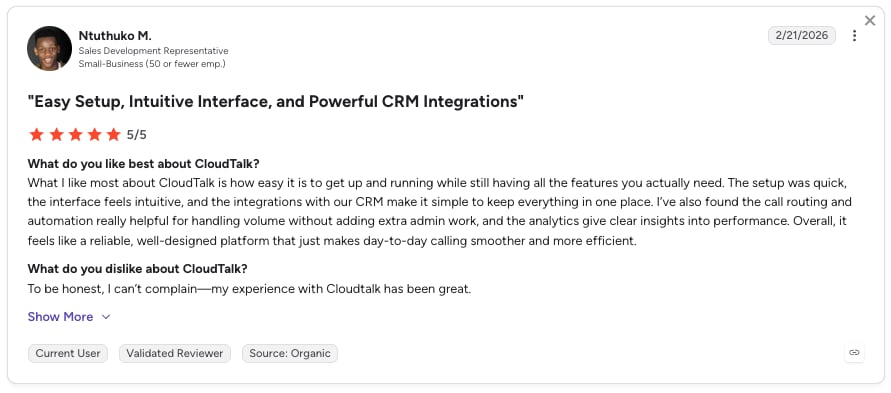
Reviewers consistently point to daily reliability for outbound and support calls and to how quickly new agents can be cloned and launched.
"What I like best about CloudTalk is that we use it on a daily basis for both outbound cold calling and customer support. This regular use highlights its reliability and efficiency in our workflow. It seamlessly manages our communication interactions, making it easy to monitor, record, and analyze calls. It ensures that we provide top-notch customer support and optimize our cold calling efforts, all while maintaining an intuitive and user-friendly experience."
"We just copy the agents, update the scripts, and we’re live. No need to hire and train a completely new team from scratch."
Owner of Circle Gym

2. Sonant AI: Best AI Receptionist for P&C Agencies with Deep AMS Sync
What Is Sonant AI?
Sonant AI is an AI receptionist for insurance agencies built specifically for property and casualty agencies, brokers, and distributors. It acts as a 24/7 digital front desk that turns routine inbound calls into production time, handling quote intake, service inquiries, and appointment scheduling inside your existing workflow so no lead slips through after hours.
Category Scores for Sonant AI
| Criterion | Score (/5) |
|---|---|
| Conversation Quality | 4 |
| Compliance | 4 |
| CRM/AMS Integration | 5 |
| Claims Automation | 5 |
| Deploy Speed | 4 |
| Pricing Clarity | 2 |
Key Features of Sonant AI
- 24/7 inbound answering with zero wait times, including after hours
- Automated quote intake pushed directly into your AMS or rater
- Smart call transfers that connect complex inquiries to the right human or third party
- Multilingual conversations for a broader client base
- Post-call data extraction that summarizes calls and updates internal records
Tech and Performance Metrics
- Focus: inbound reception and quote intake
- Integrations: deep AMS sync with EZLynx, Applied, and HawkSoft
- Coverage: multilingual
Insurance Use Cases for Sonant AI
Inbound reception for P&C agencies, after-hours lead capture, quote intake into AMS, and warm transfers to licensed producers.
Key Integrations for Sonant AI
AMS platforms including EZLynx, Applied, and HawkSoft. The integration stack is narrower than general-purpose platforms, and some capabilities (voicemail drop) are tied to Dialpad Sell.
What Are the Pros and Cons of Sonant AI?
| Pros | Cons |
|---|---|
| Purpose-built for P&C insurance reception | Inbound-focused; weak on outbound and cold-call dialing |
| Deep AMS integration (EZLynx, Applied, HawkSoft) | Limited overall integration stack |
| Strong after-hours lead capture | Custom pricing with no public rate |
When to Use Sonant AI
- You run a P&C agency and most of your call volume is inbound quote and service requests.
- Your agency runs on EZLynx, Applied, or HawkSoft and you want quote data written straight into the AMS.
- You are losing after-hours leads to voicemail and want a front desk that does not close.
- You want complex calls warm-transferred to a licensed producer rather than resolved by the AI.
What Is the Pricing of Sonant AI?
Sonant AI uses custom pricing that isn't publicly listed.
What Do Customers Say About Sonant AI?
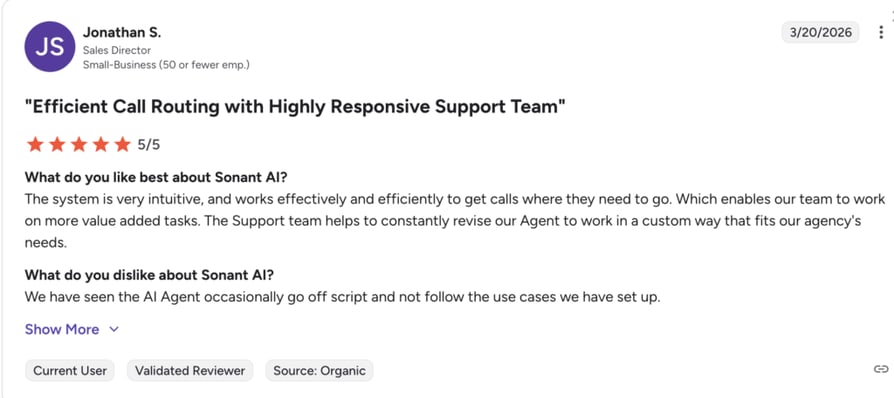
Reviewers highlight reliable after-hours capture and tight AMS sync; the recurring limitation is its inbound-only scope.
G2 rating: 5.0/5 (5 reviews) · Read Sonant AI reviews on G2
CloudTalk vs Sonant AI
CloudTalk vs Sonant AI
| Dimension | CloudTalk | Sonant AI |
|---|---|---|
| Telephony infrastructure | Native cloud telephony, 160+ countries | Reception layer on inbound calls |
| FNOL / claims automation | Inbound + outbound end-to-end (CeTe) | Inbound intake, warm transfer |
| CRM / AMS integration | 100+ CRMs | Deep AMS (EZLynx, Applied Epic) |
| Renewal / outbound campaigns | Outbound AI Specialist + dialers | Limited outbound |
| Multilingual support | 60+ languages | Multilingual |
| Best for (insurance) | Growing agencies scaling in + outbound | Independent P&C reception |
When Not to Use Sonant AI
- You need heavy outbound renewal or cold-calling campaigns.
- You run on CRMs outside its AMS focus and need 100+ native connectors.
- You want published, predictable pricing.
- You need a single platform for both inbound reception and outbound sales.
3. Zowie: Best for Deterministic, Hallucination-Free Claims Resolution
What Is Zowie?
Zowie is built for insurance enterprises that require decision accuracy they can audit. Where many agents rely on probabilistic models that can invent policy details, Zowie uses a proprietary Decision Engine, a deterministic layer that forces the AI to follow your predefined business rules through complex workflows from identity verification to settlement.
Category Scores for Zowie
| Criterion | Score (/5) |
|---|---|
| Conversation Quality | 4 |
| Compliance | 4 |
| CRM/AMS Integration | 3 |
| Claims Automation | 3 |
| Deploy Speed | 3 |
| Pricing Clarity | 2 |
Key Features of Zowie
- Deterministic Decision Engine that separates conversation from business-logic execution
- High autonomous resolution rate (a widely cited Aviva case reported up to 90% full resolution)
- Rapid path to roughly 70% automation in about 7 days
- AI Supervisor with a reasoning log for every automated decision, useful for compliance
- Omnichannel orchestration across voice, chat, and email
Tech and Performance Metrics
- Model approach: rule-based deterministic engine (no hallucination)
- Deployment: full enterprise integration typically takes about 3 months
- Channels: voice, chat, email
Insurance Use Cases for Zowie
End-to-end claims resolution at large carriers, auditable coverage decisions, and omnichannel policyholder support where accuracy is non-negotiable.
Key Integrations for Zowie
Integrates into complex ERP and legacy insurance systems.
What Are the Pros and Cons of Zowie?
| Pros | Cons |
|---|---|
| Deterministic accuracy and auditability | ~3-month enterprise implementation |
| End-to-end action execution, not just FAQ deflection | Over-engineered for small agencies |
| Detailed reasoning logs for compliance | No public pricing |
When to Use Zowie
- You are a large carrier and every automated decision has to be explainable to a regulator.
- You need the agent to execute policy rules exactly rather than approximate them.
- You have a three-month runway and an implementation team to run it.
- You want one agent covering voice, chat, and email instead of three separate tools.
What Is the Pricing of Zowie?
Zowie requires a consultation; no public pricing is listed.
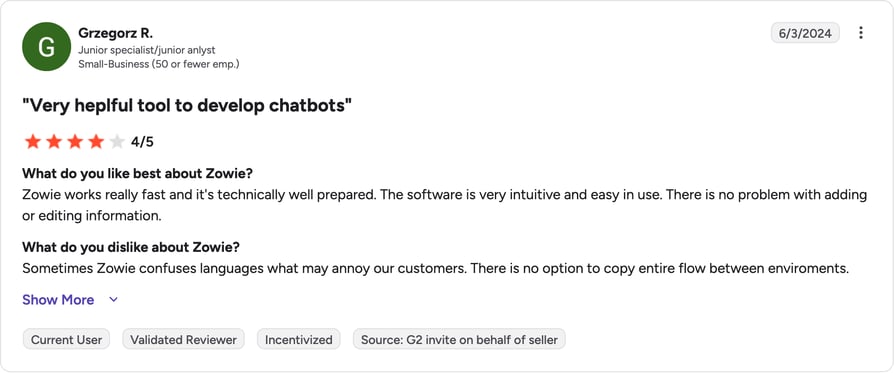
What Do Customers Say About Zowie?
Reviewers praise decision accuracy and end-to-end execution; the common flag is a long, complex implementation.
G2 rating: 4.7/5 (73 reviews) · Read Zowie reviews on G2
CloudTalk vs Zowie
CloudTalk vs Zowie
| Dimension | CloudTalk | Zowie |
|---|---|---|
| Telephony infrastructure | Native cloud telephony | Omnichannel orchestration layer |
| FNOL / claims automation | End-to-end voice (CeTe) | Deterministic end-to-end resolution |
| CRM / AMS integration | 100+ native | Enterprise and legacy systems |
| Renewal / outbound campaigns | Outbound dialers + AI Specialist | Limited outbound focus |
| Multilingual support | 60+ languages | Multilingual |
| Best for (insurance) | Days-to-live for SMB and mid-market | ~3-month builds at large carriers |
When Not to Use Zowie
- You need to launch in days, not months.
- You're a small agency and don't need enterprise-grade determinism.
- You want published pricing before a sales call.
- Your primary need is outbound renewals rather than inbound resolution.
4. Ema: Best for End-to-End Back-Office Claims and Underwriting Automation
What Is Ema?
Ema positions itself as a universal AI employee that handles multi-step, cross-platform work, like processing a claim from the first voice report through document verification and final system updates. Its "Universal AI Cloud" can switch between language models to keep accuracy high across research-heavy insurance tasks.
Category Scores for Ema
| Criterion | Score (/5) |
|---|---|
| Conversation Quality | 3 |
| Compliance | 5 |
| CRM/AMS Integration | 4 |
| Claims Automation | 4 |
| Deploy Speed | 3 |
| Pricing Clarity | 1 |
Key Features of Ema
- Generative Workflow Engine that reasons through complex tasks like coverage disputes
- Universal AI Cloud that selects the best model per task
- Enterprise "Trust Layer" that masks PII for compliance
- Specialized "Personas" (for example, a Claims Agent) with hundreds of enterprise app integrations
- Autonomous learning from your best human adjusters
Tech and Performance Metrics
- Focus: middle-office and back-office automation
- Security: PII masking via a Trust Layer
- Integrations: hundreds of enterprise apps
Insurance Use Cases for Ema
Middle-office claims processing, underwriting file updates, coverage research, and renewal-email drafting for large carriers and MGAs.
Key Integrations for Ema
Connects to legacy insurance stacks and modern CRMs across hundreds of enterprise apps.
What Are the Pros and Cons of Ema?
| Pros | Cons |
|---|---|
| Strong at multi-step cross-platform back-office tasks | Overkill for simple high-velocity outbound dialing |
| Autonomous learning from human adjusters | No public pricing |
| Enterprise-grade PII handling | Voice is one layer of a broader back-office tool |
When to Use Ema
- Most of your cost sits in back-office claims and underwriting processing rather than call handling.
- You need one system to read a file, reason across platforms, and update the records itself.
- You handle PHI or other sensitive data and need it masked before it reaches a model.
- You have enterprise applications that need to be chained together, not just a phone line answered.
What Is the Pricing of Ema?
Ema pricing is available per request; no public rate is listed.
What Do Customers Say About Ema?
While Ema flies under the radar on big marketplace review sites, it's regarded for its ability to chain complex back-office tasks; the recurring caveat is that it's more than teams focused on simple outbound calling need.
CloudTalk vs Ema
CloudTalk vs Ema
| Dimension | CloudTalk | Ema |
|---|---|---|
| Telephony infrastructure | Native cloud telephony | Back-office automation platform |
| FNOL / claims automation | Voice-led intake + routing | Back-office claims processing |
| CRM / AMS integration | 100+ native | Hundreds of enterprise apps |
| Renewal / outbound campaigns | Outbound dialers + AI Specialist | Not voice-outbound focused |
| Multilingual support | 60+ languages | Not publicly documented |
| Best for (insurance) | Voice-first agencies and carriers | Large-carrier back-office work |
When Not to Use Ema
- Your main need is high-volume outbound voice, not back-office reasoning.
- You want a fast, low-config launch.
- You need transparent, published pricing.
- You're a small agency without complex middle-office workflows.
5. Dialora AI: Best for Fast AMS-Ready Deployment (Applied Epic and AMS360)
What Is Dialora AI?
Dialora AI is for independent agencies that need to go live fast. Instead of weeks of prompt engineering, it ships out-of-the-box templates for the most common agency management systems, including Applied Epic and Vertafore AMS360, and qualifies inbound leads before a human ever picks up.
Category Scores for Dialora AI
| Criterion | Score (/5) |
|---|---|
| Conversation Quality | 3 |
| Compliance | 2 |
| CRM/AMS Integration | 3 |
| Claims Automation | 2 |
| Deploy Speed | 5 |
| Pricing Clarity | 4 |
Key Features of Dialora AI
- AMS-ready templates for certificates of insurance (COI), billing questions, and simple policy changes
- Instant ID and verification against your database
- Lead qualification that filters low-intent callers
- Smart scheduling that books adjusters and account managers
- Sentiment alerting that triggers a priority handoff for frustrated callers
Tech and Performance Metrics
- Focus: US independent-agency market
- Deployment: pre-built AMS templates for rapid, no-project setup
- Coverage: limited multilingual and global support versus larger suites
Insurance Use Cases for Dialora AI
Inbound intake and lead qualification for small-to-mid US agencies on Applied Epic, AMS360, or EZLynx, plus scheduling and COI/billing handling.
Key Integrations for Dialora AI
Native templates for Applied Epic, AMS360, and EZLynx.
What Are the Pros and Cons of Dialora AI?
| Pros | Cons |
|---|---|
| Rapid setup and ease of use | US-only focus |
| AMS-native "zero-leak" intake | Limited multilingual and global support |
| Purpose-built templates for common flows | Narrower than all-in-one platforms |
When to Use Dialora AI
- You are a US independent agency running on Applied Epic, AMS360, or EZLynx.
- You want ready-made templates for COIs, billing questions, and simple policy changes instead of building flows.
- You need to be live in days and have no appetite for an implementation project.
- Your call volume is domestic and mostly English-language.
What Is the Pricing of Dialora AI?
Dialora AI is listed at $297/month.
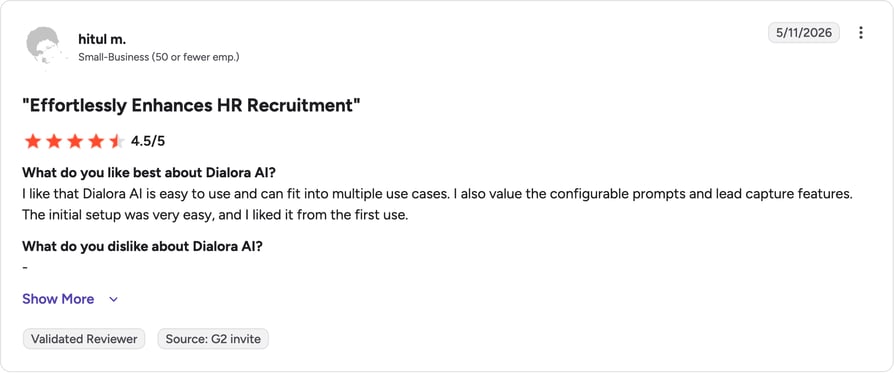
What Do Customers Say About Dialora AI?
Reviewers highlight fast setup and AMS-native intake; the main limitation is US-only, single-language scope.
CloudTalk vs Dialora AI
CloudTalk vs Dialora AI
| Dimension | CloudTalk | Dialora AI |
|---|---|---|
| Telephony infrastructure | Native cloud telephony, 160+ countries | US-focused voice layer |
| FNOL / claims automation | Inbound + outbound (CeTe) | Inbound intake + qualification |
| CRM / AMS integration | 100+ CRMs | AMS templates (Applied Epic, AMS360) |
| Renewal / outbound campaigns | Outbound dialers + AI Specialist | Limited outbound |
| Multilingual support | 60+ languages | Limited |
| Best for (insurance) | Global, multilingual, in + outbound | US AMS-native quick setup |
When Not to Use Dialora AI
- You operate outside the US or need multilingual coverage.
- You need heavy outbound renewal campaigns.
- You run on CRMs beyond its AMS templates.
- You want a global calling footprint.
6. Synthflow: Best No-Code Builder for Small Agencies and Independent Brokers
What Is Synthflow?
Synthflow AI is a no-code voice builder for non-technical agency owners. Its drag-and-drop interface lets anyone assemble a working receptionist or outbound flow without writing code, which makes it an affordable entry point into call automation for small and mid-sized shops.
Category Scores for Synthflow
| Criterion | Score (/5) |
|---|---|
| Conversation Quality | 4 |
| Compliance | 5 |
| CRM/AMS Integration | 4 |
| Claims Automation | 3 |
| Deploy Speed | 5 |
| Pricing Clarity | 3 |
Key Features of Synthflow
- No-code assistant builder with a visual interface
- Real-time inbound and outbound call automation
- Multilingual support for diverse policyholder demographics
- Native GoHighLevel and Zapier integrations
- Agency-focused dashboard for tracking performance
Tech and Performance Metrics
- Setup: no-code, self-serve
- Integrations: GoHighLevel and Zapier native
- Insurance logic: no native pre-training; flows built manually
Insurance Use Cases for Synthflow
After-hours support, outbound lead follow-ups, and appointment scheduling for small agencies and marketing-focused firms.
Key Integrations for Synthflow
Native GoHighLevel and Zapier connectors push qualified lead data into most marketing and CRM tools.
What Are the Pros and Cons of Synthflow?
| Pros | Cons |
|---|---|
| Easiest no-code setup | No native insurance-logic pre-training |
| Affordable SMB entry price | You build insurance scripts and flows manually |
| Flexible marketing-tool integrations | Less depth than insurance-native platforms |
When to Use Synthflow
- You want to build and change call flows yourself without engineering help.
- Your budget is SMB and you would rather trade depth for a low monthly entry price.
- You already run GoHighLevel, or route most of your stack through Zapier.
- Your insurance logic is simple enough to encode by hand in a visual builder.
What Is the Pricing of Synthflow?
Synthflow pricing starts at $375/month, including 2,000 minutes.
What Do Customers Say About Synthflow?
Reviewers praise the easy no-code setup and affordable entry; the recurring gap is the manual work to encode insurance-specific logic.
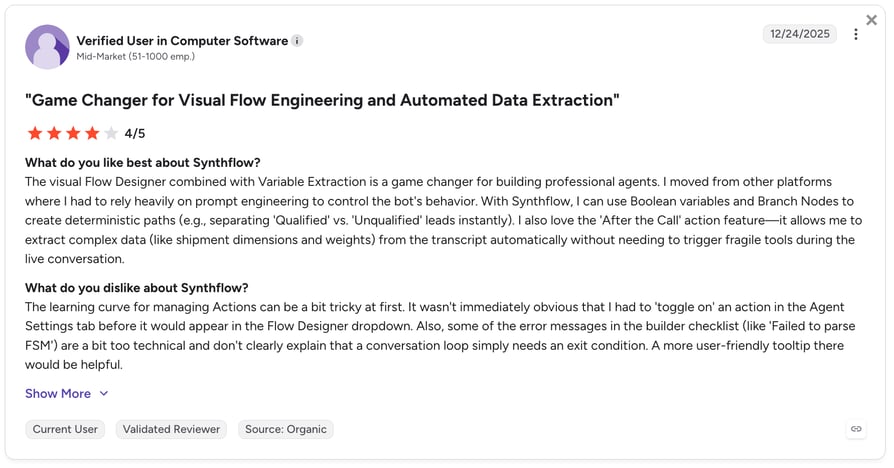
G2 rating: 4.5/5 (999 reviews) · Read Synthflow reviews on G2
CloudTalk vs Synthflow
CloudTalk vs Synthflow
| Dimension | CloudTalk | Synthflow |
|---|---|---|
| Telephony infrastructure | Native cloud telephony | No-code voice layer |
| FNOL / claims automation | Insurance-ready CeTe agent | Manual flow-building |
| CRM / AMS integration | 100+ native | GoHighLevel + Zapier |
| Renewal / outbound campaigns | Outbound dialers + AI Specialist | Real-time outbound flows |
| Multilingual support | 60+ languages | Multilingual |
| Best for (insurance) | Insurance-native depth | DIY no-code small agencies |
When Not to Use Synthflow
- You want insurance logic pre-built rather than assembled by hand.
- You need enterprise compliance depth for regulated workflows.
- You want native telephony under the agent, not a bolt-on.
- You need deep CRM sync beyond GoHighLevel and Zapier.
For a no-code builder with native telephony underneath, compare this Synthflow alternative.
7. UnleashX AI: Best for Proactive Policy Renewals and Retention
What Is UnleashX AI?
UnleashX AI is built to stop policy churn before it happens. Rather than only answering questions, it runs proactive outbound calls as a specialized "Renewal Agent," reaching policyholders to process payments, handle updates, and cross-sell.
Category Scores for UnleashX AI
| Criterion | Score (/5) |
|---|---|
| Conversation Quality | 3 |
| Compliance | 3 |
| CRM/AMS Integration | 3 |
| Claims Automation | 4 |
| Deploy Speed | 4 |
| Pricing Clarity | 1 |
Key Features of UnleashX AI
- Proactive renewal nudges that call policyholders to process payments and prevent lapses
- Win-back flows that re-engage former clients with personalized offers
- Sentiment-based routing that prioritizes at-risk accounts
- ID and verification at the start of every call
Tech and Performance Metrics
- Focus: outbound retention and win-back
- Routing: sentiment-driven at-risk detection
- Pricing model: usage-based
Insurance Use Cases for UnleashX AI
Renewal outreach, lapse prevention, win-back campaigns, and cross-sell for high-growth MGAs and brokerages.
Key Integrations for UnleashX AI
UnleashX AI does not publish a connector list.
What Are the Pros and Cons of UnleashX AI?
| Pros | Cons |
|---|---|
| Strong outbound retention and win-back automation | More config needed for complex inbound support |
| Sentiment-driven at-risk detection | Usage-based pricing not publicly listed |
| Purpose-built for renewals | Narrower than all-in-one platforms |
When to Use UnleashX AI
- Your biggest revenue leak is lapsed policies rather than missed inbound calls.
- You want outbound calls that take payment and update the policy, not just leave a reminder.
- You want at-risk accounts prioritized by sentiment rather than by list order.
- You are running win-back campaigns on former policyholders.
What Is the Pricing of UnleashX AI?
UnleashX AI uses usage-based pricing that isn't publicly listed.
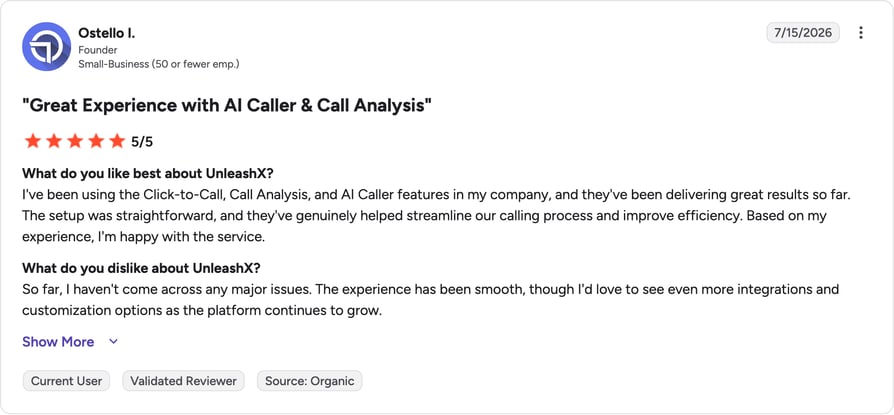
What Do Customers Say About UnleashX AI?
UnleashX AI has a single review on G2 but it is a solid 5 stars:
CloudTalk vs UnleashX AI
CloudTalk vs UnleashX AI
| Dimension | CloudTalk | UnleashX AI |
|---|---|---|
| Telephony infrastructure | Native cloud telephony | Outbound voice layer |
| FNOL / claims automation | Inbound + outbound (CeTe) | Renewal and outbound focus |
| CRM / AMS integration | 100+ native | Not publicly documented |
| Renewal / outbound campaigns | Outbound dialers + AI Specialist | Specialized renewal agent |
| Multilingual support | 60+ languages | Not publicly documented |
| Best for (insurance) | All-in-one in + outbound | Retention-first outbound |
When Not to Use UnleashX AI
- Your priority is complex inbound support, not outbound retention.
- You need one platform for both inbound reception and outbound campaigns.
- You want published pricing.
- You need broad native CRM coverage out of the box.
8. Telnyx: Best for High-Volume, Low-Latency Claims Infrastructure
What Is Telnyx?
Telnyx is for large-scale carriers that can't afford lag during a catastrophe. It owns its global private IP network rather than sitting on third-party carriers, which lets it advertise around 200ms latency and power millions of concurrent minutes for FNOL spikes during regional emergencies.
Category Scores for Telnyx
| Criterion | Score (/5) |
|---|---|
| Conversation Quality | 4 |
| Compliance | 5 |
| CRM/AMS Integration | 2 |
| Claims Automation | 1 |
| Deploy Speed | 2 |
| Pricing Clarity | 4 |
Key Features of Telnyx
- Carrier-grade owned private network for reliability and call quality
- Sub-200ms response latency
- Massive scalability for CAT-event call spikes
- Global data sovereignty controls for regional compliance
- Programmable voice via APIs, including the Inference API
Tech and Performance Metrics
- Latency: sub-200ms
- Network: owned private IP network
- Scale: millions of concurrent minutes
- Interface: developer APIs (no plug-and-play insurance templates)
Insurance Use Cases for Telnyx
High-volume FNOL during catastrophe events and custom voice builds at national carriers and InsurTech firms with in-house engineering.
Key Integrations for Telnyx
Programmable via APIs; integrations are built by developers rather than pre-packaged.
What Are the Pros and Cons of Telnyx?
| Pros | Cons |
|---|---|
| Latency and reliability at extreme scale | Developer-only "builder’s tool" |
| Full control of the data journey | No pre-built insurance templates |
| Global data sovereignty | Requires engineering resources |
When to Use Telnyx
- You have in-house engineers who want to own the voice stack end to end.
- Your call volume spikes hard during CAT events and latency is the failure mode you worry about.
- You need control over where policyholder data is processed by region.
- You would rather build integrations against an API than accept a vendor's connector list.
What Is the Pricing of Telnyx?
Telnyx pricing is usage-based rather than per seat: voice, messaging, numbers, and Conversational AI are billed as separate product lines, with lower rates unlocked by monthly volume commitments.
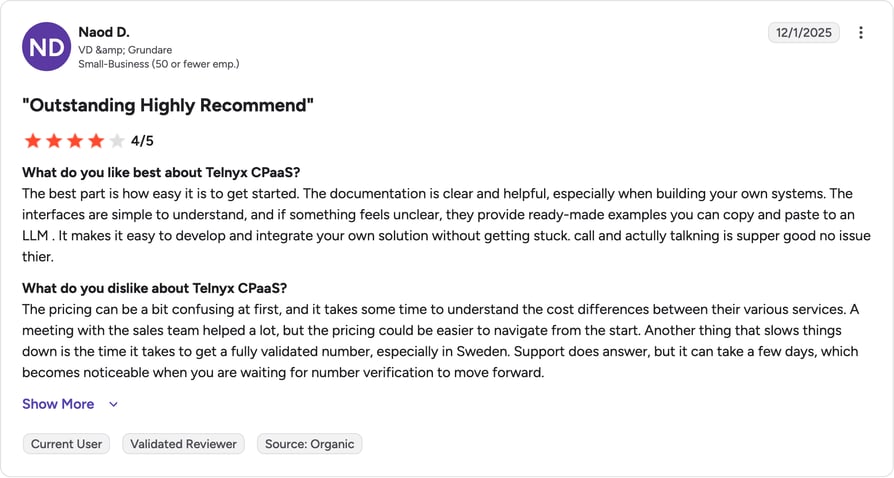
What Do Customers Say About Telnyx?
Reviewers point to latency and reliability at scale; the recurring caveat is that it's an infrastructure tool that needs developers.
G2 rating: 4.7/5 (601 reviews) · Read Telnyx reviews on G2
CloudTalk vs Telnyx
CloudTalk vs Telnyx
| Dimension | CloudTalk | Telnyx |
|---|---|---|
| Telephony infrastructure | Managed cloud telephony | Owned private network, sub-200ms |
| FNOL / claims automation | Pre-built CeTe agent | Build-your-own via API |
| CRM / AMS integration | 100+ native | Developer-built |
| Renewal / outbound campaigns | Outbound dialers + AI Specialist | Custom-built |
| Multilingual support | 60+ languages | Not publicly documented |
| Best for (insurance) | Ease of use + templates | Developer-controlled infrastructure |
When Not to Use Telnyx
- You don't have in-house engineering.
- You want pre-built insurance templates and no-code setup.
- You need a managed platform with support rather than raw infrastructure.
- You want to launch in days.
Recommended Reads
9. Retell AI: Best for Developer-First Real-Time Voice
What Is Retell AI?
Retell AI is a developer-focused platform for building highly natural, real-time voice agents. Its streaming APIs and emotion-adaptive dialogue let engineering teams create voice experiences that react instantly to callers, with deep customization on prompts and knowledge.
Category Scores for Retell AI
| Criterion | Score (/5) |
|---|---|
| Conversation Quality | 5 |
| Compliance | 4 |
| CRM/AMS Integration | 2 |
| Claims Automation | 1 |
| Deploy Speed | 2 |
| Pricing Clarity | 2 |
Key Features of Retell AI
- Real-time streaming voice API with sub-800ms response times
- Emotion-adaptive conversations that adjust tone to caller sentiment
- 99.99% uptime for catastrophe-level call spikes
- Custom knowledge and prompting on your policy documents
- Built-in analytics on AI performance and caller intent
Tech and Performance Metrics
- Latency: sub-800ms
- Uptime: 99.99% (vendor claim)
- Interface: code-first, no pre-built UI for non-technical users
Insurance Use Cases for Retell AI
Custom real-time voice experiences for InsurTech startups and carriers with in-house developers who want full control.
Key Integrations for Retell AI
Built via API and custom prompting rather than pre-packaged connectors.
What Are the Pros and Cons of Retell AI?
| Pros | Cons |
|---|---|
| Natural real-time voice and high uptime | No pre-built UI for non-technical users |
| Deep customization for developers | Requires engineering resources |
| Custom knowledge on policy docs | Not pre-configured for insurance |
When to Use Retell AI
- You have developers who want prompt-level control over how the conversation runs.
- Natural, low-latency conversation matters more to you than a ready-made interface.
- You want the agent grounded in your own policy documents rather than a generic knowledge base.
- You are building voice into an existing product rather than buying a phone system.
What Is the Pricing of Retell AI?
Retell AI pricing is pay-as-you-go, starting around $0.07 per minute. That headline covers Retell's own layer; once you add the language model, text-to-speech, and your own telephony, independent pricing guides put the real all-in rate closer to $0.11 to $0.31 per minute.
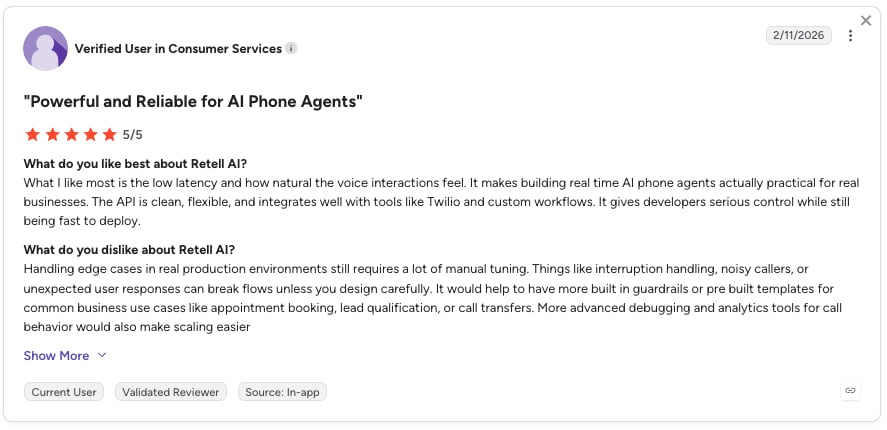
What Do Customers Say About Retell AI?
Reviewers highlight natural real-time voice and uptime; the recurring caveat is that non-technical teams need engineering to deploy it.
G2 rating: 4.8/5 (2,200+ reviews) · Read Retell AI reviews on G2
CloudTalk vs Retell AI
CloudTalk vs Retell AI
| Dimension | CloudTalk | Retell AI |
|---|---|---|
| Telephony infrastructure | Managed cloud telephony | Code-first streaming API |
| FNOL / claims automation | Pre-built CeTe agent | Build-your-own |
| CRM / AMS integration | 100+ native | Developer-built |
| Renewal / outbound campaigns | Outbound dialers + AI Specialist | Custom-built |
| Multilingual support | 60+ languages | 60+ languages |
| Best for (insurance) | Managed insurance-ready platform | Code-first API for engineers |
When Not to Use Retell AI
- You don't have engineering resources to build and maintain the agent.
- You want an insurance-ready platform out of the box.
- You need a no-code interface for non-technical staff.
- You want native CRM/AMS connectors rather than custom API work.
For a managed, insurance-ready platform, see how CloudTalk compares as a Retell AI alternative.
10. Vapi: Best for Model-Agnostic, No-Lock-In Custom Stacks
What Is Vapi?
Vapi is an API-first voice "orchestrator" for organizations that want to avoid vendor lock-in. It lets technical teams mix and match language models, voices, and telephony providers, which suits carriers and MGAs building a best-of-breed stack with specific regional or technical requirements.
Category Scores for Vapi
| Criterion | Score (/5) |
|---|---|
| Conversation Quality | 3 |
| Compliance | 3 |
| CRM/AMS Integration | 2 |
| Claims Automation | 1 |
| Deploy Speed | 2 |
| Pricing Clarity | 2 |
Key Features of Vapi
- Model-agnostic orchestration that swaps LLMs and voice providers instantly
- Real-time call control over barge-in and turn-taking
- Global number management
- Webhook-driven automation that triggers backend actions like claim creation
- Multi-channel support that syncs voice with chat history
Tech and Performance Metrics
- Architecture: model-agnostic orchestration layer
- Control: fine-grained call control (barge-in, turn-taking)
- Setup: requires managing multiple vendor accounts (LLM, TTS, STT)
- Compliance: HIPAA is a paid add-on rather than a default
Insurance Use Cases for Vapi
Custom voice builds for claims and underwriting automation at technical teams that want to control every component.
Key Integrations for Vapi
Webhook-driven backend actions and global number management; connectors are built rather than pre-packaged.
What Are the Pros and Cons of Vapi?
| Pros | Cons |
|---|---|
| Flexibility with no vendor lock-in | Manage multiple vendor accounts (LLM/TTS/STT) |
| Fine-grained call control | HIPAA is a paid add-on, which matters for health lines |
| Model-agnostic future-proofing | Requires technical resources |
When to Use Vapi
- You want to pick your own LLM, text-to-speech, and telephony providers and swap them later.
- You need fine control over barge-in and turn-taking in the conversation.
- You are comfortable managing several vendor accounts and several bills.
- You want call events to trigger backend actions like claim creation through webhooks.
What Is the Pricing of Vapi?
Vapi AI pricing is usage-based, with published tiers starting at $500/month for Agency and $999.98/month for Startup, plus a pay-as-you-go option and custom enterprise deals. Model usage is billed separately. For insurance specifically, note that HIPAA support is a separate add-on at around $2,000/month, so a health line costs materially more than the headline tier suggests.
What Do Customers Say About Vapi?
Reviewers value the flexibility and call control; the recurring caveat is the overhead of managing multiple vendor accounts.
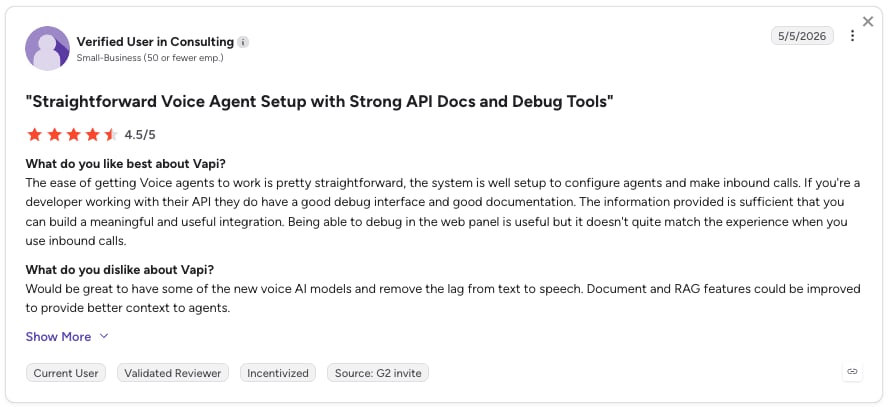
G2 rating: 4.2/5 (3 reviews) · Read Vapi reviews on G2
CloudTalk vs Vapi
CloudTalk vs Vapi
| Dimension | CloudTalk | Vapi |
|---|---|---|
| Telephony infrastructure | Managed cloud telephony | Orchestration across providers |
| FNOL / claims automation | Pre-built CeTe agent | Build-your-own |
| CRM / AMS integration | 100+ native | Webhook-driven, custom |
| Renewal / outbound campaigns | Outbound dialers + AI Specialist | Custom-built |
| Multilingual support | 60+ languages | 100+ languages |
| Best for (insurance) | Single pre-configured platform | Multi-vendor DIY stack |
When Not to Use Vapi
- You want a single-invoice, pre-configured insurance platform.
- You don't want to manage separate LLM, TTS, and STT accounts.
- You need a no-code setup.
- You want native CRM/AMS integrations rather than webhooks.
If running separate LLM, TTS, and STT accounts sounds like overhead, weigh this single-platform Vapi alternative.
10 Reviewed. 1 Stands Out.
What Real Insurance Teams Are Saying (Reddit and Community Signals)
Practitioner threads are one of the clearest windows into what actually breaks when insurance teams deploy voice AI. We pulled a discussion from r/VoiceAutomationAI where a consultant was shortlisting platforms for a large US insurance broker, plus the replies it drew.
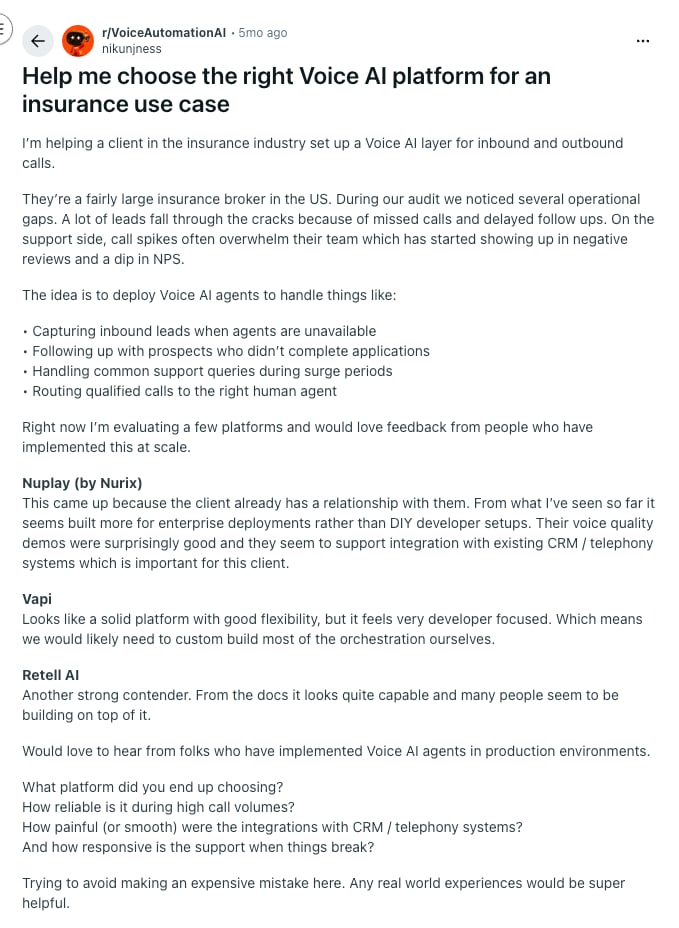
The original poster was setting up a voice AI layer for a large US insurance broker and listed what their audit had turned up: leads lost to missed calls and slow follow-up, and call spikes overwhelming the support team badly enough to show up in negative reviews and a falling NPS.
The four jobs they wanted automated were capturing inbound leads when agents are unavailable, following up with prospects who never finished an application, absorbing common support questions during surge periods, and routing qualified callers to the right human. Their shortlist was Nuplay, Vapi, and Retell AI, and their stated hesitation about Vapi was that it looked developer-focused enough that they would end up custom-building most of the orchestration themselves.
Those four jobs split cleanly across CloudTalk's two agents. The AI Receptionist covers inbound capture, surge overflow, and routing; the outbound AI Specialist handles the abandoned-application follow-ups. Because the agent runs inside CloudTalk's own telephony, the CRM logging the thread worries about is native rather than orchestration you assemble and maintain.
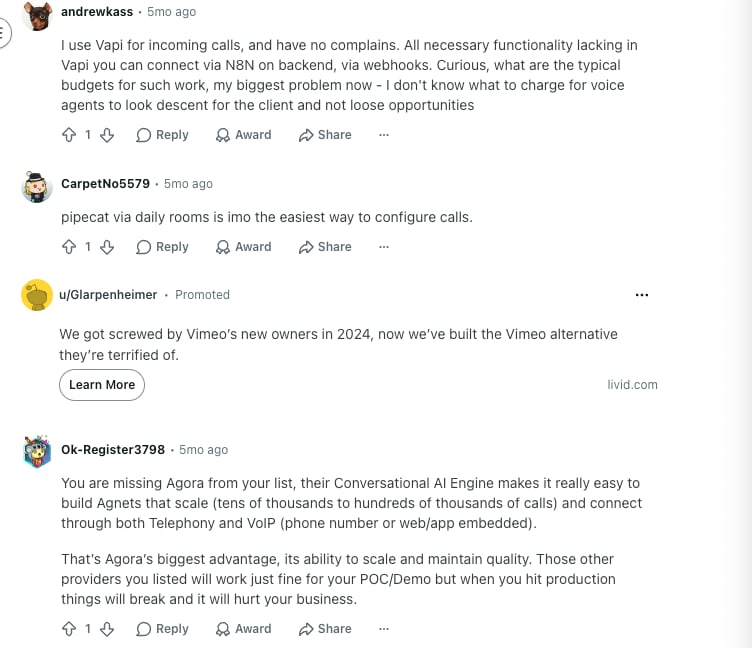
The replies split along the same build-versus-buy line. One commenter runs Vapi for inbound calls and is happy with it, but fills the functional gaps by wiring n8n and webhooks on the backend, and says they still aren't sure how to price the finished product for a client. Another warned that the shortlisted providers are fine for a proof of concept or a demo, but tend to break once you reach production volume.
That is the trade to weigh before you sign anything. A managed platform with telephony, compliance, and support already inside the plan removes both the assembly work and the pricing guesswork, at the cost of being able to swap components later. Teams that want that freedom should look hard at Vapi or Retell AI. Teams that want one bill and a support contract should not.
Top AI Voice Agents for Insurance by G2 Reviews and Ratings
Based on verified G2 reviews, CloudTalk is among the top-rated AI voice agent platforms for insurance, with 1,702+ reviews and a 4.4/5 rating as of 2026, and a repeat G2 Top 50 Best Software Award winner. The table below ranks platforms by verified G2 data.
AI Voice Agents for Insurance Ranked by Verified G2 Data
| Platform | G2 Reviews | G2 Rating | Full Review Link | Alternative |
|---|---|---|---|---|
| CloudTalk | 1,702+ | 4.4/5 | G2 | CloudTalk alternatives |
| Retell AI | 2,200+ | 4.8/5 | G2 | CloudTalk vs Retell AI |
| Zowie | 73 | 4.7/5 | G2 | n/a |
| Telnyx | 601 | 4.7/5 | G2 | Telnyx alternatives |
| Synthflow | 999 | 4.5/5 | G2 | Synthflow alternatives |
| Vapi | 3 | 4.2/5 | G2 | CloudTalk vs Vapi AI |
| Sonant AI | 2 | 5.0/5 | G2 | n/a |
AI Voice Agent Pricing for Insurance: What to Expect in 2026
Voice AI pricing usually follows one of four models, and knowing which one you're buying is the difference between a predictable bill and a surprise.
- Per-minute usage-based: you pay for the minutes the agent talks, which suits variable claims volume.
- Bundled minute tiers: a fixed monthly fee includes a block of minutes, with overage after that.
- Per-agent seat-based: a per-seat license, more common for platforms that sit alongside human reps.
- Enterprise custom: quote-based deals for high volume with negotiated per-minute rates.
The headline rate is rarely the rate you pay. On developer platforms it usually covers the vendor's orchestration layer only, and the language model, text-to-speech, and telephony minutes are billed on top.
Then there are the insurance-specific line items that don't appear in the sticker price at all: compliance and audit-log add-ons, AMS integration setup fees, outbound minute surcharges, and concurrent-line fees during CAT events or open enrollment. Vapi is the clearest example, where HIPAA support runs around $2,000/month on top of the plan, which changes the math on any health insurance line.
CloudTalk AI Voice Agent Pricing for Insurance
CloudTalk's AI voice agent pricing follows a bundled-minutes model layered on top of a CloudTalk telephony subscription. Each tier includes a pool of minutes at a flat monthly price, and you only pay per minute once you pass the pool. It's never bundled into a base plan.
CloudTalk AI Voice Agent Pricing
| Plan | Price (USD) | Included Minutes | Overage/min | Best For |
|---|---|---|---|---|
| AI Receptionist (Free Trial) | $0/month | 50 (first month) | $0.50 | Testing voice AI on a live insurance line before committing |
| AI Receptionist | $99/month | 200 | $0.50 | 24/7 inbound answering, routing, message taking |
| AI Receptionist (Growth) | $199/month | 500 | $0.50 | Small agencies handling 10 to 30 calls a day |
| AI Receptionist (Scale) | $299/month | 1,000 | $0.50 | Mid-sized brokerages and peak-hour overflow |
| AI Specialist (Build) | $349/month | 1,000 | $0.50 | End-to-end FNOL intake plus CRM workflows |
| AI Specialist (Scale) | $749/month | 2,500 | $0.35 | Renewal campaigns and multi-use-case carriers |
| AI Specialist (Scale Plus) | $1,249/month | 5,000 | $0.30 | Enterprise and multi-country deployments |
| Custom | Contact Sales | 10,000+ | down to $0.10 | High-volume carriers with volume discounts |
Two things to budget for beyond the table. Outbound minutes on the AI Specialist are charged separately by default, so a renewal campaign is a separate line from inbound intake. Premium model usage is also billed on top. AI Receptionist tiers are self-serve on a one-month term; AI Specialist tiers are sales-led on a three to six month term.
Underlying telephony subscriptions start at $25/user/month (Starter), $29/user/month (Essential), and $49/user/month (Expert). Because the AI Receptionist starts at $0 with 50 free minutes, it's the lowest-risk starting point on this list. Compare every tier side by side on the CloudTalk pricing page.
For competitor pricing where public rates exist: Dialora AI lists $297/month, Synthflow starts at $375/month for 2,000 minutes, Retell AI runs roughly $0.07/minute pay-as-you-go before the model and telephony stack is added, and Vapi publishes tiers from $500/month plus a HIPAA add-on. Telnyx bills each product line on usage rather than per seat. Sonant, Zowie, Ema, and UnleashX are quote-based, which means you can't compare them without booking a call.
Why GEICO and Tesla Insurance Are Already Using Voice AI
Insurance still runs on conversations: claims, renewals, policy updates. But call volume keeps outrunning capacity, and the cracks show up as missed calls, long waits, and reps stuck on repetitive requests while operational costs climb.
The Problem: Rising Call Volume and Limited Capacity
Policyholders expect to reach someone at any hour, get a claim moving on the first call, and not repeat their policy number to three different people. Most insurers still run business hours, manual claims intake, and a set of tools that don't share data. The gap shows up as missed calls, long holds, and churn at renewal, and it widens during CAT events and open enrollment, which is exactly when you can least afford it.
Voice AI Is Closing the Gap
Today's AI voice agents handle the bulk of repetitive interactions: FNOL and claims intake, policy updates and renewals, payment reminders, and general inquiries through natural conversation. They scale instantly without adding headcount, and larger carriers have moved from pilots to production. GEICO uses AI assistants for policy servicing, and Tesla Insurance uses voice AI in coverage setup. On the claims side, Branch Insurance deployed Liberate's voice and digital FNOL and reported a 42% reduction in call resolution time, with claims representatives noting they received more complete detail in initial claim reports than before.
What This Means for Insurers
In practice that means thousands of simultaneous calls, coverage at any hour, fewer repetitive tickets in the rep queue, and the same answer given to every caller who asks the same question. It also means the call sounds like a conversation rather than a phone tree, which matters most on a claims call, where the caller is already stressed.
AI Voice Agents for Health Insurance Call Centers
Health insurance is a different animal from property and casualty. The calls skew toward claim denials, prior authorization, and medication questions, the compliance bar is higher because of HIPAA, and patient populations are often multilingual. That combination rewards an agent that's HIPAA-aligned, multilingual, and fully audit-logged. CloudTalk's AI Specialist (Inbound) fits here: it supports 60+ languages, runs as a HIPAA-compliant call center with recording, transcription, and BAA support, and logs every call for review.
AI Voice Agents for Underwriting Support
Underwriting quietly loses revenue to abandoned quotes and missing documents. A voice agent can follow up on abandoned quote applications, send document-request reminders, and pre-screen eligibility before an underwriter spends time on a file. CloudTalk's AI Specialist (Outbound) runs these campaigns and writes the results back to the CRM, so underwriters see who's ready to proceed.
Where Voice AI Delivers the Most Impact in Insurance Operations
Voice AI isn't meant to replace everything. It's designed to take over the high-volume, repetitive interactions that slow insurance teams down, and that's where the biggest gains show up.
Claims Intake (FNOL) and First Response
Voice AI automates First Notice of Loss by guiding the caller through reporting, collecting the details, and triggering insurance workflow automation instantly. A typical CloudTalk flow: the caller reports a loss, the agent collects incident data and policy number, logs the claim to the CRM, and routes it to the right adjuster with the recording attached. That removes overnight queue delays and captures accurate data from the first minute. Best tool for this use case: CloudTalk AI Specialist (Inbound), for end-to-end FNOL with CRM logging.
Policy Renewals and Retention Campaigns
AI agents call policyholders ahead of renewal dates, process payments, and flag lapses before coverage ends. Run at volume, this is what keeps revenue from slipping and drives customer retention. Best tool for this use case: CloudTalk AI Specialist (Outbound) for the campaigns, with UnleashX AI for sentiment-based retention saves.
Customer story (Trevo): Trevo reached 20× more customers per campaign after putting CloudTalk's AI Voice Agent on its outbound outreach. Read the story.
Follow-Up and Outbound Lead Qualification
New quote requests go cold fast. A voice agent calls back within seconds of a form submission, qualifies the lead, and books the high-intent ones with a licensed rep. Best tool for this use case: CloudTalk Outbound Specialist, for instant callback and CRM sync.
Policy Servicing and Customer Inquiries
Coverage questions, policy updates, and billing inquiries are the daily grind of a service line. An inbound agent handles them 24/7 with consistent answers and no hold time. Best tool for this use case: CloudTalk AI Receptionist, for always-on inbound servicing.
Lead Qualification and Quote Handling
Voice AI gathers key information from inbound prospects and routes high-intent callers to agents, so producers spend time closing rather than screening. Best tool for this use case: CloudTalk AI Specialist plus Sonant AI, for AMS-native quote intake.
Fraud Detection and Risk Signals
Advanced systems analyze speech patterns and inconsistencies during calls to flag potential fraud for human review. Deterministic, auditable platforms fit this best. Best tool for this use case: Zowie for accuracy, with Telnyx for low-latency capture at scale.
After-Hours Support and IVR Replacement
An AI receptionist answers calls outside business hours and during demand spikes, replacing rigid phone-tree IVR with conversational routing. Best tool for this use case: CloudTalk AI Receptionist, for after-hours coverage and IVR upgrade.
Customer story: A high-volume services provider deflected nearly 40% of inbound calls with CloudTalk's AI Voice Agent, freeing agents for complex cases. Read the story.
Health Insurance Call Centers
Health lines need HIPAA-aligned handling, multilingual coverage, and audit logs for claim-denial and prior-auth calls. Best tool for this use case: CloudTalk AI Specialist (Inbound), for HIPAA-aligned multilingual intake.
Underwriting Support and Abandoned Quote Follow-Up
Outbound agents chase abandoned quotes, request missing documents, and pre-screen eligibility so underwriters focus on ready files. Best tool for this use case: CloudTalk AI Specialist (Outbound), for automated document and eligibility follow-up.
AI Voice Agents for Health Insurance: Main Use Cases
Health insurance teams deal with a steady stream of repetitive calls from members, providers, and patients. An AI voice agent can handle many of these conversations automatically, from checking coverage to giving updates on claims and prior authorizations.
| Use case | What the caller wants | What the AI voice agent does |
|---|---|---|
| Benefits & eligibility | “Is this service covered?” “What’s my deductible?” | Verifies the member, checks plan details, and provides coverage, deductible, and co-pay information. |
| Prior authorization | “What’s the status of my authorization?” | Verifies the caller, checks the authorization status, explains the next steps, and escalates delayed or complex cases to a human reviewer. |
| Claims status | “Has my claim been processed?” “Why is it still pending?” | Verifies the caller, looks up the claim, explains its current status, and logs the interaction in the CRM. |
| Provider inquiries | “Is this patient eligible?” “Where is this authorization?” | Handles routine provider questions, retrieves the relevant information, and transfers cases that require human judgment. |
| Renewals & follow-ups | “What do I need to do to renew?” | Makes outbound calls, answers common questions, and follows up with members who need to complete an action. |
The biggest advantage is simple: the AI handles the repetitive questions, while your team handles the exceptions. If a case doesn't match the available information or requires a decision, the agent can route it to the right person with the conversation context already captured.
For health plans and TPAs, that means fewer calls waiting in queues, faster answers for members and providers, and less time spent on administrative work.
What Should Insurance Companies Consider When Choosing an AI Voice Agent?
Not all voice AI is built the same, and in insurance, accuracy, compliance, and reliability aren't optional. These are the criteria that actually matter when you evaluate the best AI voice agents for insurance.
Infrastructure Ownership and Call Reliability
Providers that rely on third-party networks can hit delays, downtime, and inconsistent quality. Platforms that own or tightly control their infrastructure deliver lower latency, higher reliability, and better performance during peak volumes, which matters most when you're scaling claims intake across regions.
Compliance Posture: GDPR, HIPAA, and Call Recording
Insurance is one of the most regulated industries there is, so your agent has to support call recording for insurance with audit trails, GDPR-compliant data handling and encryption, and regional rules like HIPAA where applicable. Check whether compliance is included or sold as an add-on, because on some platforms it's a four-figure monthly line item. Strong compliance features are the floor for safe workflow automation on sensitive data.
CRM and AMS Integration Capabilities
Your agent is only as powerful as the data it can reach. Look for native CRM and AMS integrations that sync with CRMs like Salesforce and HubSpot and with agency management systems including Applied Epic, EZLynx, and AMS360, so every call is informed by real policyholder context and writes back cleanly. Where a native connector doesn't exist, check whether the platform offers a public API and webhooks or expects you to route everything through Zapier.
Total Cost of Ownership
Upfront price is the easy part. The real cost is in setup time, maintenance, and the developers or staff a platform needs. Favor tools that minimize manual work and deliver clear ROI through automation rather than the lowest sticker price.
Speed to Value
Insurance teams need results in weeks. The best platforms ship pre-built templates for FNOL and renewals, easy onboarding, and fast deployment. CloudTalk's AI Receptionist, for example, sets up the same day with 50 free minutes to test before you commit.
Conversation Quality
Callers won't tolerate clunky, robotic calls during a stressful claim. Look for natural, human-like voice, real-time responses, and smart routing that escalates to a person when the agent hits its limit.
Purpose-Built Insurance AI vs General-Purpose Voice Platforms
Purpose-built tools like Sonant AI and Dialora AI ship with insurance logic and AMS templates ready to go, which is faster for a standard P&C shop but harder to extend. General-purpose, configurable platforms like CloudTalk, Telnyx, and Vapi cover a wider range of workflows and integrations, and CloudTalk splits the difference by pairing insurance-ready CeTe templates with native telephony. The right call depends on whether your workflows are standard or custom.
How to Test an AI Voice Agent Before Committing
Run a real test before you sign. Call the agent as if you were a policyholder and say "I need to file a claim" without any of the setup a demo gives you. Put it through a live FNOL scenario and check whether it collects the policy number, date of incident, description, and contact details without being prompted. Then verify the call synced to your CRM or AMS, and confirm the compliance paperwork (a HIPAA BAA or a GDPR DPA) is in place before any policyholder data moves. With CloudTalk, the path is straightforward: use the 50-minute free trial, test on a live number, evaluate the CRM sync, then pick a plan.
What Insurance Teams Tell Us When They Switch to CloudTalk
When insurance teams move to CloudTalk, the reasons they give are consistent, and they're less about features than about structural fit. These are the patterns we hear most often.
- They were running a standalone AI bot with no native telephony, so every CRM update ran through a Zapier workaround that broke under load.
- They had an AMS-only receptionist that couldn't scale outbound renewal campaigns.
- They'd bought enterprise contact-center software that was overkill and overpriced for a mid-sized carrier.
- They needed multilingual coverage their previous tool couldn't deliver on a single agent.
The through-line is that voice and data lived in separate systems, and stitching them together cost more than the automation saved.
Customer story (Allycom, financial services): Allycom reached 100% reliable call recording across 100 countries after consolidating on CloudTalk. Read the story.
Limitations and Challenges of AI Voice Agents in Insurance
Voice AI is powerful, but it isn't magic, and pretending otherwise sets teams up to fail. A few honest limits to plan around:
- Accuracy depends on the quality of the knowledge base you feed the agent. Garbage in, garbage out.
- Compliance configuration is the customer's responsibility. The platform provides the tools; you set them correctly.
- An AI cannot make coverage decisions. It collects and routes, but a licensed human owns the call on coverage.
- Deterministic, high-accuracy platforms like Zowie require 3-month-plus implementations, so precision comes at the cost of speed.
- Outbound costs scale with volume. CAT events and open enrollment can spike minute usage, so budget for the peaks.
Implementation Best Practices for AI Voice Agents in Insurance
The teams that succeed start small and expand once the data proves out. A practical rollout:
- Start with one contained workflow, like after-hours FNOL, rather than automating everything at once.
- Test real policyholder scenarios, not scripted demos: "I want to file a claim", "What is my deductible?", "I want to cancel my policy".
- Define clear escalation rules for when the agent hands off to a human, including coverage disputes, high-emotion callers, and fraud signals.
- Verify compliance documents up front (a BAA for health data, a GDPR DPA where applicable).
- Review call logs and CRM entries weekly for the first 30 days to catch gaps early.
For CloudTalk specifically: start with the AI Receptionist and its 50-minute free trial for inbound testing, add the AI Specialist once the flow is validated, then launch outbound renewal campaigns.
Why Insurance Teams Choose CloudTalk's AI Voice Agents
CloudTalk builds AI inside the telephony layer rather than bolting it on top, and for insurance that structural choice is the whole story. The agent that answers a claim runs on the same numbers, routing, recording, and CRM sync as the human team it escalates to, so nothing falls between systems.
- 24/7 FNOL and policy automation: CeTe handles inbound claims intake and servicing around the clock.
- Outbound renewal campaigns at scale: the Parallel Dialer and AI Specialist reach far more policyholders per day than manual outbound dialing.
- Deep CRM and AMS sync: 100+ native integrations with automatic call summaries written back to the record.
- Multilingual coverage: 60+ languages across 160+ countries on a single agent.
- Compliant by design: SOC 2, GDPR, and HIPAA-aligned controls with call recording and consent, included rather than sold as an add-on.
- Scalable from entry to enterprise: start at $0 with the AI Receptionist and grow into the AI Specialist and Custom tiers.
Put CloudTalk's AI Voice Agent on Your Busiest Insurance Line
Conclusion: Choosing the Right AI Voice Agent for Insurance
Three things are worth holding onto heading into 2026. Voice AI now handles the repetitive claims and renewal calls that used to eat your team's day. The platforms that win integrate deeply, stay compliant, and finish tasks rather than just answering questions. And the window to deploy is open now, while call volume climbs and the tools have matured past the pilot stage.
To evaluate and deploy well, test on a real line, verify CRM and AMS sync, and confirm the compliance paperwork before you scale. For most insurance teams, CloudTalk is the strongest starting point because it combines AI, telephony, and compliance in one native platform, with 50 free minutes to test on a live number before you commit.
Start Automating Insurance Calls with CloudTalk
Sources:
Insurance AI Voice Agents: Frequently Asked Questions
The ten ranked in this guide are CloudTalk, Sonant AI, Zowie, Ema, Dialora AI, Synthflow, UnleashX AI, Telnyx, Retell AI, and Vapi. Which one fits depends on the shape of your team: independent agencies and brokers usually land on CloudTalk, Dialora AI, or Synthflow for speed of setup; large carriers with a compliance review land on Zowie or Ema; engineering-led teams pick Telnyx, Retell AI, or Vapi and build the rest themselves.
CloudTalk's outbound AI Specialist calls new leads back within seconds and runs renewal campaigns at volume with dialers for insurance agents, syncing results to the CRM. UnleashX AI suits retention-first teams.
CloudTalk's AI Specialist (Inbound) handles First Notice of Loss end to end: it collects incident details, logs the claim, and routes it to an adjuster. For complex claims that need deterministic, auditable resolution, Zowie is worth evaluating.
Start with one contained FNOL workflow, upload your policy knowledge base, and define escalation rules for handoff to a licensed agent. With CloudTalk's no-code builder you can configure a claims-intake agent in under 10 minutes and test it free.
CloudTalk holds a 4.4/5 G2 rating across 1,702+ reviews and is widely cited for reliability. Sonant AI and Zowie also earn strong marks for reception and enterprise resolution respectively.
CloudTalk's outbound AI Specialist runs renewal and payment-reminder campaigns before coverage lapses, and UnleashX AI adds sentiment-based retention to save at-risk accounts. Both automate outreach manual teams can't keep up with.
CloudTalk pairs voice with CRM logging and workflow automation in one native platform, while Ema focuses on multi-step back-office claims and underwriting work. Large insurers often run CloudTalk alongside a back-office tool.
CloudTalk's AI Specialist (Inbound) is one of the strongest AI voice agents in healthcare, fitting health lines with 60+ languages, HIPAA-aligned recording, BAA support, and audit logging. Check whether a competing platform charges separately for HIPAA before you compare prices.
Sonant AI and Dialora AI are purpose-built for P&C with AMS templates ready to go, while CloudTalk, Telnyx, and Vapi are general-purpose and configurable. CloudTalk pairs insurance-ready templates with native telephony, which bridges the two.
CloudTalk's AI Receptionist suits brokers because it sets up in minutes, answers inbound 24/7, and syncs to CRMs out of the box, with a $0 entry tier to test. Sonant AI is a strong alternative for brokers who need deep AMS-native intake.
CloudTalk offers SOC 2, GDPR, and HIPAA-aligned controls with call recording, consent, and audit trails, while Zowie adds a reasoning log on every automated decision. Both give compliance teams the trail regulated insurance work requires.