Quick Summary:
- What it is: Vapi is a developer-first voice AI orchestration platform. It coordinates speech-to-text, an LLM, text-to-speech and telephony into one real-time call over an API. You supply all four.
- Ratings: 4.9/5 Product Hunt, 4.2/5 G2, 2.4/5 Trustpilot. A 2.5-star spread across three platforms, and the gap is the most useful thing in this review.
- Pricing: $0.05/minute platform fee, with speech, model, voice, and telephony billed separately. All-in cost lands at $0.30 to $0.33/minute. HIPAA is a $2,000/month add-on.
- Best for: Developer-led teams building a voice AI product, who can own four to six vendor relationships.
- Not good for: Non-technical teams, anyone who needs one predictable invoice, and buyers who need a support SLA.
- Verdict: Build on Vapi if voice AI is your product. If you just need your phone answered, a finished product like CloudTalk's AI Voice Agents is the better-shaped buy.
Introduction
Vapi's public status page monitors eight third-party providers as dependencies of the platform: OpenAI, Anthropic, Google Gemini, Daily.co, Cartesia, Deepgram, ElevenLabs, and Gladia. Vapi publishes its own supply chain, and eight companies are on it.
That page is the honest starting point for any Vapi review, because it tells you what you are actually buying. Not a product. A coordination layer over other people's products, each of which can fail on its own schedule and bill you on its own cycle.
The $0.05 per minute on the pricing page is real. It is also Vapi's slice only. Everything that makes a call happen sits underneath it, sold by someone else, and the accuracy and limitations of voice AI stop being abstract the moment a customer is on the line and one of those eight has a bad afternoon.
This review scores Vapi on six buying dimensions, rebuilds the real cost per minute from primary documents, and reads its three review-platform profiles against each other, because they disagree sharply and the disagreement is informative.
Vapi AI Review at a Glance
Quick Rating With Reasoning
| One-line verdict | A genuinely strong orchestration layer with the best published latency figure in the category. The advertised $0.05/minute is a platform fee, not a price: four to six other providers carry the rest of the call. |
| Our rating | Based on our thorough evaluation, we give Vapi AI a score of 3.2 / 5 |
| Best for | Developer-led technical teams building a voice AI product or feature |
| Not suitable for | Non-technical business teams, and anyone who needs a single predictable invoice |
| Starting price | $0.05/minute platform fee on the self-serve Build plan. Speech-to-text, LLM, text-to-speech and telephony bill separately, taking the realistic all-in cost to $0.30 to $0.33/minute per CloudTalk's research |
| Free tier | No ongoing free tier. The Build card lists 60+ included minutes, and a one-time trial credit widely reported at $10. That credit covers Vapi's layer only, not the providers you still pay to complete a call |
| Setup time | An engineering project. Expect provider accounts, API keys and fallback logic before the first production call |
| Standout pro | Claimed sub-500ms average latency with WebRTC streaming, plus bring-your-own-model freedom at every layer of the stack |
| Standout con | Accountability spreads across a supply chain. Vapi's own status page names eight providers as platform dependencies |
| User sentiment | 4.9/5 on Product Hunt (25 reviews), 4.2/5 on G2 (3 reviews), 2.4/5 on Trustpilot (15 reviews). Developers rate the build experience highly; buyers who hit a billing or support problem rate it very low |
| Our verdict | Build on Vapi if voice AI is the product. Buy something finished if you want one bill and one number to call at 3am |
Vapi AI Scorecard: Our Honest Ratings
Our Vapi AI ratings run across the six dimensions that decide most voice AI purchases. Every score below comes from Vapi's own pricing page and enterprise documentation, its public status page, its G2, Trustpilot, and Product Hunt profiles, plus our own research into Vapi's cost per minute.
Why trust our reviews?
Over the last decade, CloudTalk has helped 30,000+ professionals find and implement smarter business communication tools. Read our content integrity statement and our software review methodology.
CloudTalk's Rating
| Dimension | Rating /5 | Why |
|---|---|---|
| Ease of setup | 2.5 | Vapi handles orchestration. You choose, contract and wire up every provider underneath it. G2 reviewers call the first agent quick and the production deployment slow. |
| Call quality & latency | 4.5 | Vapi's strongest dimension on paper: sub-500ms average with WebRTC streaming, the best published figure in the category. Held off 5.0 because it is Vapi's own claim, and Trustpilot reviewers report multi-second pauses in production. |
| Pricing clarity | 2.0 | The $0.05/minute headline is accurate and incomplete. Model costs are billed at cost and transport is charged by the provider, not Vapi. Both lines are on the pricing page, and most buyers stop at the number on top. |
| Features & capabilities | 4.5 | Bring-your-own-model at every layer, plus a workflow builder, webhooks, custom voices, automated test suites and broad language coverage. Genuinely strong for technical builders. |
| Integrations | 3.5 | Flexible through the API and webhooks, and almost nothing is bundled. No native CRM or helpdesk connector: every business-tool connection is development work plus another vendor. |
| Support & reputation | 2.0 | Build gets email and the community Discord, with no SLA, named engineer or account manager. Support is the single most-repeated complaint on Trustpilot, where the profile sits at 2.4/5. |
| Overall | 3.2 | A strong buy for engineering-led teams building a voice product, a poor buy for a business that wants its calls handled next week. |
What Is Vapi AI?
Vapi AI is a voice AI orchestration platform for developers. It coordinates speech-to-text, a large language model, text-to-speech, and telephony into one real-time pipeline you drive through an API, so a caller holds a two-way conversation with software instead of pressing 1 for sales. That is the basic job of any AI voice agent.
The nuance any honest Vapi AI software review has to get right is what Vapi supplies: the orchestration layer, the real-time audio handling, and the developer tooling. Not the models, and not the phone lines. Bessemer Venture Partners, which led Vapi's $20 million Series A in December 2024, described the job as abstracting away the complexity of managing real-time infrastructure, including orchestration of third-party speech, language, and voice models.
So what does Vapi AI do in practice? Engineers use it to build:
- 01Phone support agents
- 02Outbound qualification call
- 03Appointment booking
- 04IVR-style branching flows
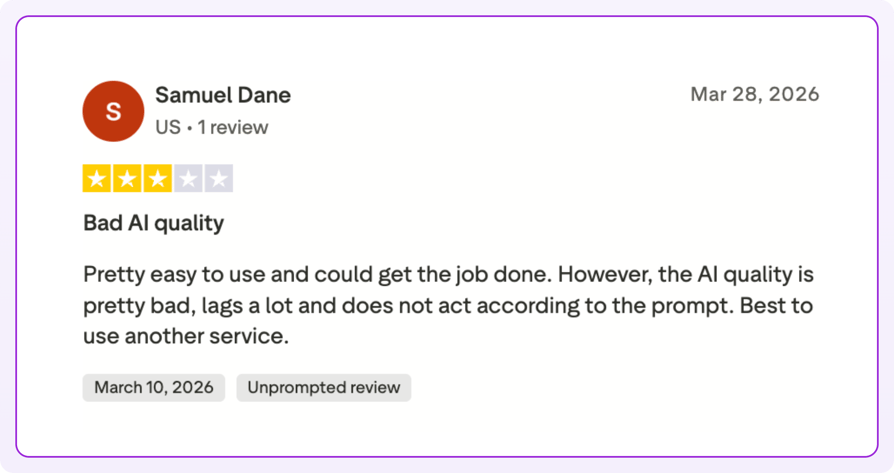
See what some of Vapi AI's users think about Vapi's AI voice bot quality:
Signature Capability
See CloudTalk’s AI Voice Agent in Action!
CeTe is an AI that talks like a human: no breaks, no training, no time off. It makes and answers calls, updates CRMs, books meetings, and loops in a human only when needed.
Press play to hear it. Want a wow moment? Get a free test call and try it live.

Who Is Vapi AI Best Suited For?
Vapi buyers share three conditions:
- 01Developers on the teamSomeone has to pick the models, hold the API keys and write the fallback logic.
- 02A reason to want model-level controlEither voice is the product, or latency is a hard requirement you are willing to engineer for.
- 03Capacity to carry vendor relationshipsFour to six contracts, four to six invoices, four to six support queues.
How Does Vapi AI Work?
Vapi works by sitting between your application and four other services, moving audio and text between them fast enough that the caller does not hear the handoffs. A single call runs through four stages:
- 01Speech-to-textA transcriber you choose turns the caller's audio into text in real time.
- 02Language modelAn LLM you choose reads that text, decides what to say, and calls any tools it needs.
- 03Text-to-speechA voice provider you choose turns the reply back into audio.
- 04TelephonyA carrier or transport provider you choose moves the audio to and from the phone network.
Vapi AI's model in a nutshell:
1. The Orchestration Layer (Bring Your Own Everything)
Vapi moves audio and conversation state between whichever providers you have chosen, fast enough that the caller does not hear the machinery. You pick the transcriber, the model, and the voice; Vapi keeps them in sync mid-call. Flexibility at the model layer means responsibility at the contract layer.
Read the status page for a second reason:
- Trailing 90-day uptime for the Vapi API sits at 99.890%
- The SIP gateway is at 99.911%
What this means:
It means that across 90 days, 99.890% works out to roughly 2 hours 23 minutes of downtime, under the 99.9% uptime figure Vapi publishes for enterprise clients on its homepage.
2. The Visual Workflow Builder
Vapi's workflow builder lets developers lay out branching paths and hook in tools and APIs without hand-writing logic for every route. For qualification or booking flows, it saves real time. It is still a convenience layer on a developer product: someone defines the tools it calls and decides what happens when a provider times out mid-sentence.
3. The Real Engineering Lift
Builders in the Vapi voice AI community talk about a "90/10 rule":
- Roughly 90% of shipping a working voice agent is engineering and integration
- About 10% is the AI itself
What Are the Key Features of Vapi AI?
Vapi AI's key features are its claimed:
- Sub-500ms latency
- Bring-your-own-model flexibility at every layer
- Developer tooling
- Visual workflow builder
- HIPAA sold as a paid add-on
The Vapi AI features below are the ones that change a buying decision.
How Fast Is Vapi AI? The Sub-500ms Latency Claim
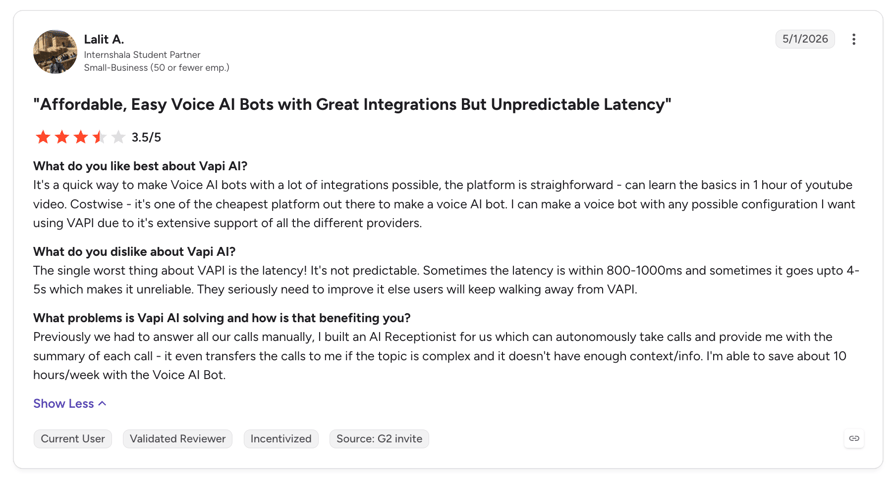
Vapi advertises under 500ms average latency with WebRTC streaming. That is Vapi's own claim rather than an independently measured benchmark, and taken at face value, it is the best published number in the category. In a call, it shows up as natural turn-taking instead of walkie-talkie pauses.
Two caveats, and the second one matters more than the first.
- 01Real latency depends on the transcriber, model, and voice you pair with Vapi, so the headline assumes an optimized stack.
- 02Production reports diverge sharply from it: G2 and Trustpilot reviewers describe pauses running to several seconds between turns.
Our suggestion:
Benchmark your own stack before you treat sub-500ms as a number you can sell internally.
Can You Bring Your Own Model to Vapi AI?
Yes, at every layer. You choose your large language model (LLM), transcriber, and voice provider rather than accepting one vendor's opinion, with custom voices and broad language coverage. When a better model ships next quarter, you swap it in. Bring your own API key for a provider, and Vapi stops billing you for it: that provider bills you directly instead.
The cost of this freedom:
Contracting and paying four to six providers is your job, as is working out which one degraded when call quality drops.
How Developer-Friendly Is Vapi AI's Infrastructure?
Vapi's documentation, monitoring, webhooks, and SDK coverage are public, current, and detailed enough to evaluate before you sign up. Automated test suites let you simulate conversations and score the outcomes before a real caller hits the agent.
How Well Does Vapi AI Scale?
Vapi's homepage talks about scaling to millions of calls, which is total volume, not concurrency. Its enterprise docs offer "unlimited concurrency and higher rate limits" without a number, and Build includes 10 concurrent calls, with extra lines at $10 per line per month.
Is Vapi AI HIPAA Compliant?
Yes, for a price. HIPAA support exists at Vapi, and it is neither free nor Enterprise-gated. Vapi's pricing page lists it as a $2,000 per month add-on on both Build and Scale, with Zero Data Retention a separate $1,000 per month add-on. A second cost never reaches that page: you need a Business Associate Agreement with every provider in the chain, not just Vapi, a line item familiar to anyone who has worked through HIPAA call center requirements.

Come to a platform with superb quality, security, and reliability.

Vapi AI Pricing Breakdown
Vapi AI pricing is where most reviews of this platform go wrong in one of two directions: either they quote $0.05 a minute and stop, or they call it hidden pricing. Neither is right. Vapi publishes the structure honestly. It just has six invoices in it. Our separate Vapi AI pricing guide models the cost in more detail; every figure below comes from the source named beside it.
The Headline Rate vs the Real Cost
How much does Vapi cost per minute? The platform fee is $0.05, and the platform fee is not the price of a call.
| Layer | What it costs | Who bills you |
|---|---|---|
| Vapi platform (calls) | $0.05/minute | Vapi |
| Vapi platform (SMS/chat) | $0.005/message | Vapi |
| Speech-to-text, LLM, text-to-speech | At cost, $0 with your own key | Each model provider |
| Transport/telephony | Variable | The provider, not Vapi |
| Extra concurrent lines (Build) | $10/line/month above the 10 included | Vapi |
| HIPAA add-on | $2,000/month, on Build and Scale | Vapi |
| Zero Data Retention add-on | $1,000/month, on Build and Scale | Vapi |
| Realistic all-in cost | $0.30 to $0.33/minute | Per CloudTalk's research |
The Real Cost: Required Third-Party Add-Ons
CloudTalk's research breaks the per-minute stack into:
- 01Telephony at $0.01 to $0.05 plus number fees
- 02Voice synthesis at $0.05 to $0.15
- 03LLM inference at $0.10 to $0.30 by model
- 04Transcription at $0.008 to $0.02
If you are assuming this gets cheaper on its own, hold onto one number. Stanford HAI's 2025 AI Index Report found inference costs for a GPT-3.5-level system fell more than 280-fold between November 2022 and October 2024. The model layer keeps getting cheaper, and the all-in cost has not followed, because the expensive part was never the model. It was the integration.
The CloudTalk Way
For a like-for-like number on the other side of the build-or-buy line, CloudTalk pricing starts at $25/user/month with AI Voice Agents as a separate usage-based add-on. See all plans.
Is Vapi AI Free? Trial Details
No. Vapi is paid, with a little trial usage and no ongoing free tier. The Build card lists 60+ included minutes, and new accounts get a one-time trial credit widely reported at $10.
The catch is what that credit covers. It pays for Vapi's own $0.05 layer, not the transcriber, model, voice and carrier you still need to complete a single call. Budget the trial as a way to measure your real per-minute cost, not as free usage.
What Real Users Say About Vapi AI Pricing on Trustpilot, G2 and Reddit
The recurring theme in any Vapi AI pricing review is not that Vapi is expensive. At $0.30 a minute, an autonomous agent still pays for itself in most contact centers. It is that the advertised number and the invoice are different documents, and reviewers keep discovering that in production rather than in evaluation.
Three themes repeat across the platforms:
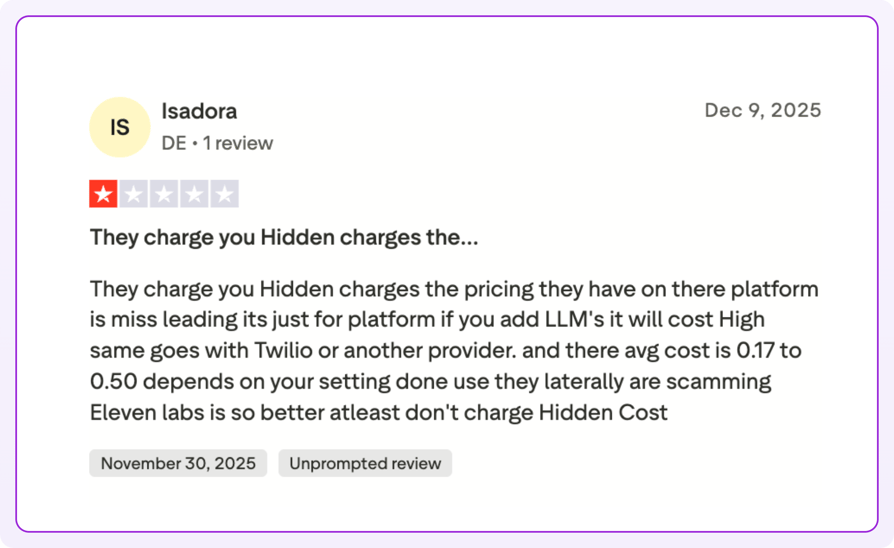
- 01The headline rate reads as the priceThe most-repeated Trustpilot complaint about cost is that the platform fee is presented as the cost of a call. One reviewer put their real effective rate at roughly $0.17 to $0.50 a minute depending on configuration, which brackets CloudTalk's own $0.30 to $0.33 estimate.
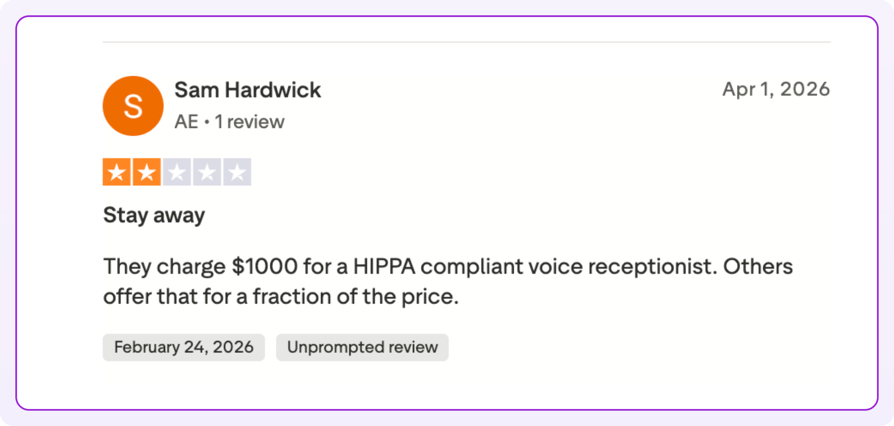
- 02Compliance pricing surprises smaller buyersA 2026 Trustpilot reviewer quoted above objected specifically to paying four figures a month for a HIPAA-compliant receptionist, on the grounds that packaged competitors include it. That is the $2,000/month add-on doing its work on a buyer who was sized for self-serve.
- 03Forecasting, not price, is the actual painWhen four vendors bill you on four cycles, budgeting turns into reconciliation, and finance notices before engineering does.
Know exactly what you will pay before you commit
Vapi AI Review on 6 Must-Have Business Requirements
We scored Vapi against the call center software requirements most buyers put in an evaluation matrix.
How Good Is Vapi AI's Call Quality and Latency?
Call quality is Vapi's strongest category on paper and its most contested in practice. Vapi publishes sub-500ms average latency; reviewers on both G2 and Trustpilot describe pauses of two to five seconds on live calls, and attribute the variance to the provider chain rather than to Vapi's own layer. Both things can be true, which is exactly the problem with a stack you assemble yourself. Benchmark your own combination before you promise anyone a number.
How Hard Is Vapi AI to Set Up?
Hard enough to need a developer, and Vapi does not pretend otherwise. Reviewers consistently split the experience in two: the first working agent is genuinely quick, and the production deployment is a project. Production means vendor accounts, key management, and fallback behavior for the afternoon a provider has trouble.
What Developer Capabilities Does Vapi AI Offer?
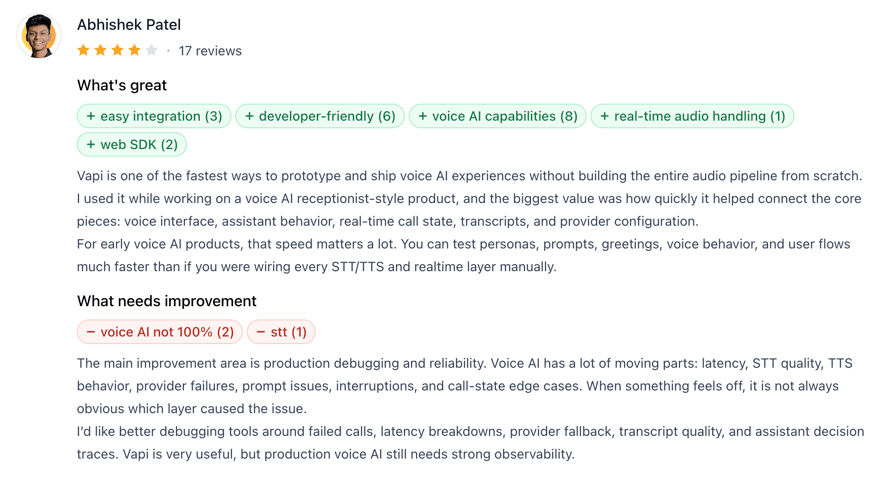
Vapi offers documentation, webhooks, monitoring, automated test suites, and model swapping, which give an engineering team room to build something specific. This is the one category where all three review platforms agree without qualification, and it is Vapi's strongest claim to a technical buyer.
What Languages Does Vapi AI Support?
Vapi advertises support for over 100 languages at the platform level. Language quality comes from the transcriber and voice you choose, not from Vapi, so verify which languages are production-ready with your specific stack rather than trusting the platform-level number.
What Does Vapi AI Integrate With?
Nothing, out of the box. Vapi's integration surface is flexible and unbundled: no native customer relationship management (CRM) or helpdesk connector waits for you, and every connection is custom development plus another vendor. That is the opposite of what buyers picture when they ask how easy it is to integrate voice AI.
The CloudTalk Angle:
CloudTalk supports over 100+ integrations and CRMs. Click here to view the full list of integrations.
| Category | Who supplies it, who bills you |
|---|---|
| Speech-to-text | Deepgram, AssemblyAI, Whisper, Gladia. Your provider, billed separately |
| LLM | GPT, Claude, Gemini, Mistral. Your provider, billed separately |
| Text-to-speech | ElevenLabs, Cartesia, PlayHT, Azure. Your provider, billed separately |
| Telephony / transport | Twilio, Telnyx, Daily.co. Charged by the provider, not Vapi |
| Developer surface | REST API, webhooks, WebRTC, SDKs, test suites. Included |
| CRM and business tools | None native. Custom development |
What Customer Support Does Vapi AI Provide?
On Build, support is email plus the community Discord, with no SLA, named engineer or account manager. Scale adds a dedicated account team, priority support and a custom support SLA.
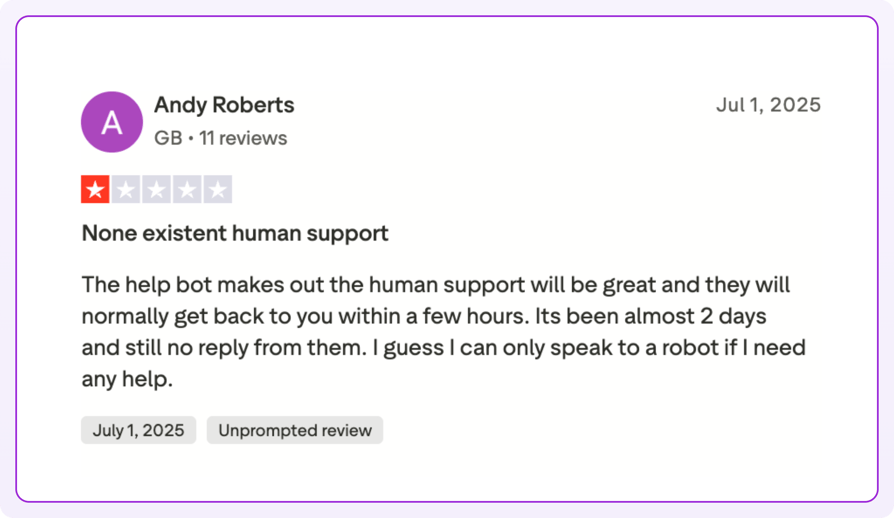
This is the weakest link in the product, and the review platforms are blunt about it. Support is the single most-repeated complaint on Trustpilot, with reviewers describing waits of days to over a week on production incidents. One five-star reviewer describes the opposite experience, an engineer calling them back on a Saturday night, which suggests the problem is consistency rather than indifference. Decide which version you are willing to bet a live phone line on.
Vapi AI Real User Reviews
Vapi user reviews are unusually hard to summarize in one number, because Vapi's three review profiles disagree more sharply than almost any product we have scored. All figures verified on 2 September 2026.
| Platform | Rating | Reviews | Notes |
|---|---|---|---|
| Product Hunt | 4.9/5 | 25 | Developer and early-adopter audience. Winner of a 2024 Golden Kitty Award |
| G2 | 4.2/5 | 3 | Small review count. Reviews from verified user accounts. |
| Trustpilot | 2.4/5 | 15 | Rated "Poor". 67% one-star. Unclaimed profile, and Vapi has never invited customers to review, so the sample skews to people with a complaint |
What Do Users Love About Vapi AI?
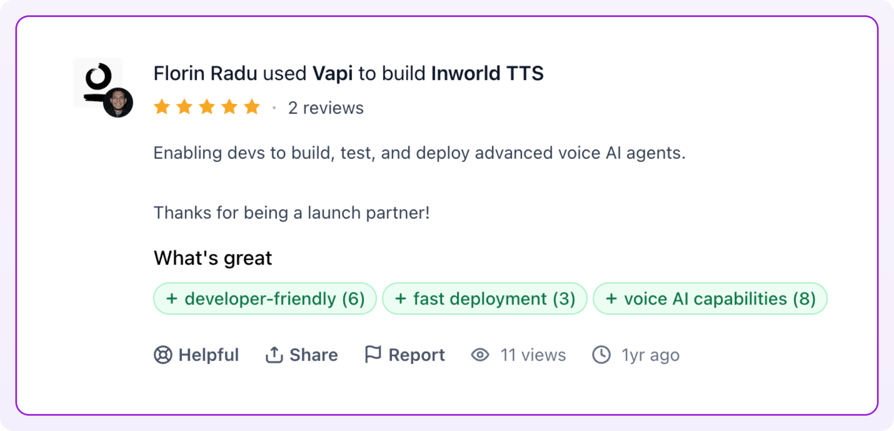
- Developer experience. The API, the docs and the debug interface come up on every platform, and they are the reason reviewers pick Vapi over a bundled competitor.
- Speed to a first agent. Reviewers repeatedly describe getting a working voice agent running faster than expected, without writing the telephony layer themselves.
- Model flexibility. Choosing your own transcriber, LLM and voice, and swapping any of them later, is the differentiator technical teams name explicitly.
- Real production use. One G2 reviewer runs automated trip reminders and status calls to drivers, and reports latency low enough that the calls feel natural rather than robotic.
What Do Users Complain About?
| Support. The dominant Trustpilot theme. Multi-day waits on production incidents, and no SLA below Enterprise to escalate against. |
| Latency in production. Reviewers on G2 and Trustpilot report multi-second pauses between turns, against a published sub-500ms claim. |
| Cost beyond the headline. Reviewers describe discovering the real per-minute rate after deployment rather than during evaluation. |
| Dashboard reliability. Several reviewers report configuration changes not persisting between screens, which turns agent setup into rework. |
| Non-developer usability. Even positive reviewers note the dashboard presents far too many options for anyone without engineering context. |
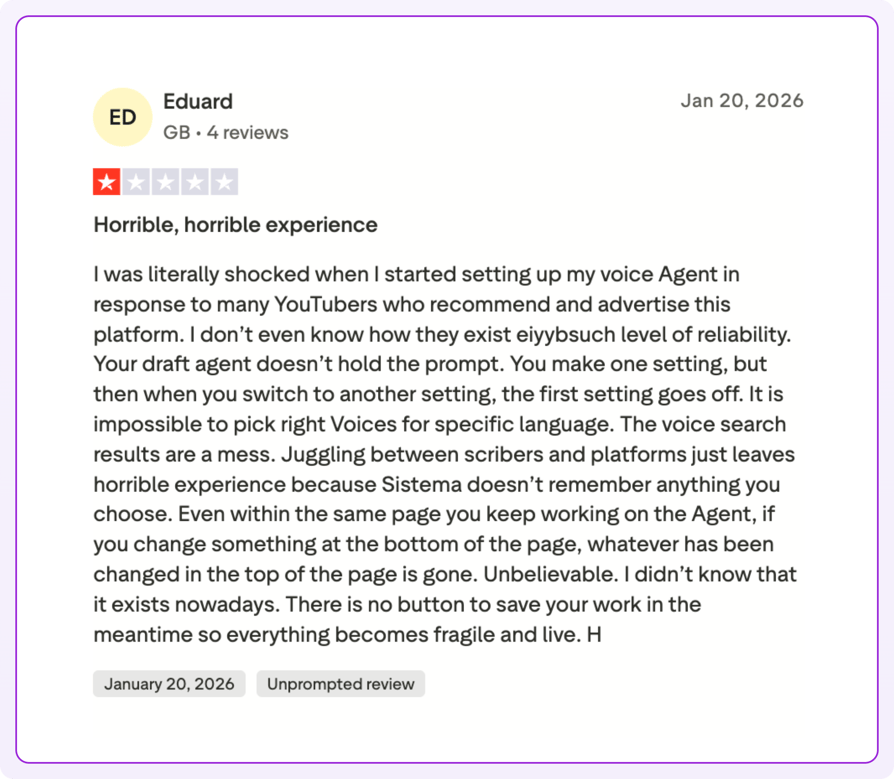
...or choose thousands of positive user reviews.
Who Should (and Should Not) Use Vapi AI
Salesforce's 7th State of Service report, published in 2025 from a survey of 6,500 service professionals, found teams already route around 30% of cases through AI and expect 50% by 2027. The question is not whether to automate voice. It is whether to build it or buy it.
Who Should Use Vapi AI?
- Developer-led startups building a voice AI product. The conversation is the product, so owning every layer is the point rather than the cost.
- Technical teams that swap models often. If you expect to change LLM or voice provider twice a year, lock-in costs more than vendor sprawl.
- Teams where latency is a hard requirement. Vapi's published figure is the strongest in the category, provided you engineer the stack to hit it.
- Companies with spare engineering capacity. Someone owns this integration permanently, not just through launch.
- Buyers who already hold provider contracts. If you are already paying OpenAI, Deepgram and ElevenLabs, Vapi adds orchestration on top without a second bundle.
Who Should Avoid Vapi AI?
| Non-technical businesses. No configuration-only path runs from signup to a working agent, which is the gap a packaged AI voice agent for small business exists to fill. |
| Teams that need one predictable invoice. Usage-based billing across four to six providers is genuinely hard to forecast. |
| Buyers who need a support SLA. Below Enterprise, Vapi publishes none, and support is its most-criticized dimension. |
| Teams without spare developer hours. CloudTalk's research puts ongoing maintenance at 40 to 80 hours a month. |
Vapi AI: Use-Case Fit
| Use case | Fit |
|---|---|
| SaaS building a custom voice feature | Strong. This is the core use case |
| Technical team wanting maximum model flexibility | Strong. A genuine differentiator |
| Lowest latency decides the deal | Strong on Vapi's own claim, but benchmark your stack first |
| Non-technical buyer wanting a ready-made agent | Weak. No business-user path exists |
| Predictable single-vendor billing | Weak. Four to six providers, four to six invoices |
| Human support on a modest budget | Weak. No SLA below Enterprise |
| Regulated buyer needing HIPAA on a small footprint | Weak. $2,000/month add-on plus a BAA per provider |
Is Vapi AI Legit? Does It Still Exist?
Yes, Vapi is legit and actively operating. Bessemer Venture Partners announced in December 2024 that it was leading Vapi's $20 million Series A, naming founders Jordan Dearsley and Nikhil Gupta. Vapi is Y Combinator-backed, the platform is live, the documentation is current, and the status page reports uptime by component. The company is headquartered in San Francisco.
Legitimacy and reliability are separate questions, though, and a fair assessment has to hold both. Uptime is the part buyers under-check, and working out whether a voice provider is reliable means reading the status page instead of the homepage.
Credentials are checkable. So is a phone system, on a live call.
Security, Compliance & Data Privacy of Vapi AI
Deloitte's 2026 State of AI in the Enterprise report, a survey of 3,235 respondents, found only one in five companies has a mature governance model for autonomous AI agents. A Vapi deployment tests that, because governance does not stop at Vapi's boundary.
HIPAA & Enterprise Compliance
The $2,000 per month HIPAA add-on and the $1,000 per month Zero Data Retention add-on both sit on Build and Scale. Everything else a security review asks for does not. SOC 2 Type II, single sign-on (SSO) for Okta, Azure AD, SAML and OIDC, and role-based access control are Enterprise contract items, and Vapi's docs hedge that those "can include, depending on your negotiated contract". On Build, SSO, RBAC and SOC 2 are listed as unavailable.
Data Flow Across Multiple Vendors
One call's audio and transcript pass through:
- 01A transcriber
- 02A model provider
- 03A voice provider
- 04A carrier
Each with its own retention and residency policy. All of a sudden, how secure your data is when using voice AI becomes four answers instead of one.
What Are the Pros and Cons of Vapi AI?
Vapi AI's main strengths are:
- Latency
- Model-level control
- Developer tooling
Its main weaknesses, as reviewers describe them, are:
- The all-in cost
- The engineering load
- The absence of support SLA below Enterprise
- Unreliable AI voice agent quality
- Unstable latency
Read those weaknesses as work somebody inherits rather than a list of flaws. Most guides to how much voice AI costs price the platform and stop there.
| Pros | Cons |
|---|---|
| Claimed sub-500ms average latency, the strongest published figure in the category | Real cost near $0.30 to $0.33/minute against a $0.05 headline, per CloudTalk's research |
| Bring-your-own-model flexibility across transcription, LLM and voice, with zero markup on your own keys | Needs real engineering capacity. No path exists for a non-technical team |
| Strong API docs, webhooks, automated test suites and an active developer community | No support SLA, named engineer or priority support on Build, and support is the most-repeated complaint on Trustpilot |
| Real venture backing: a $20 million Series A led by Bessemer, plus Y Combinator | 99.890% trailing 90-day API uptime, under Vapi's own published 99.9% figure |
| An itemized pricing page that names exactly what it does not cover | Four to six contracts, bills and BAAs, plus $2,000/month for HIPAA and 14-day call history on Build |
Compare the packaging, not just the platform
The Best 4 Vapi AI Alternatives in 2026
The Vapi AI alternatives worth shortlisting split along one question: do you want to own the stack, or do you want the calls handled?
| CloudTalk | Retell AI | Lindy | Synthflow | |
|---|---|---|---|---|
| Best for | No-code AI calling inside a business phone system | Faster deployment with more bundled than Vapi | Non-technical voice plus workflow automation | No-code agents for SMBs and agencies |
| Setup model | No-code, ready to use | Low-code, developer-friendly | No-code builder | No-code builder |
| Pricing model | Per-user plans plus a usage-based AI add-on | Usage-based from $0.07/min, $0.13 to $0.31 all-in | Credit-metered subscription, $49.99 to $199.99/month | Per-minute pay-as-you-go, roughly $0.13 to $0.20 configured |
| Vendor management | Single vendor, single bill | Single vendor | Single vendor | Single vendor |
| Published latency | Sub-800ms (CloudTalk's own figure) | Around 620ms (Retell's own figure) | Not published | Not published |
| Technical skill required | None | Low | None | None |
| Trustpilot | 4.1 (782 reviews) | 4.9/5 (814 reviews) | 1.7 (39 reviews) | 4.1/5 (215 reviews) |
| Free entry | 14-day free trial | $10 trial credit | 7-day trial, no free plan | Pay-as-you-go, no monthly minimum |
Want the head-to-head detail rather than a grid?
Recommended articles
Why CloudTalk AIVA Is Worth Considering
The concession first, because it is a real one. Vapi claims sub-500ms average latency; CloudTalk publishes sub-800ms for its AI Voice Agents. Vapi wins that comparison on the published numbers, and if 300 milliseconds decides whether your product ships, go build on Vapi. Vapi also wins on model-level control and on the freedom to build something nobody else has.
For most businesses, the deciding number is not latency. It is who picks up when a call fails at 3 am.
Vapi AI vs CloudTalk: Feature & Capability Comparison
| Capability | Vapi AI | CloudTalk AI Voice Agents |
|---|---|---|
| Starting price | $0.05/minute platform fee | Plans from $25/user/month, plus AI Voice Agents as a separate add-on |
| Realistic cost per minute | $0.30 to $0.33, per CloudTalk's research | AI Voice Agents from $99/month for 200 minutes, usage-based |
| Setup | Engineering project across four to six vendors | Self-service configuration. A non-technical user builds an agent in under 10 minutes |
| HIPAA | $2,000/month add-on, plus a BAA per provider | HIPAA compliant with BAA support, under one vendor |
| Technical requirement | Developers required | None |
| Support | Email and community Discord on Build, no SLA | 24/7 multi-language human support |
| Billing | Four to six invoices | One vendor, one invoice |
| Integrations | None native. Custom development per connection | 100+ native integrations, plus public API, webhooks and Zapier |
| Ideal use case | Building a custom voice AI product | Running a voice operation on a phone system you already have |
Vapi AI vs CloudTalk: Pricing & Total Cost Compared
Vapi's cost is a formula whose variables you do not control. CloudTalk's is a line item:
- 01Starter: $25/user/month billed annually
- 02Essential: $29/user/month billed annually
- 03Expert: $49/user/month billed annually
- 04AI Voice Agents: A separate add-on from $99/month for 200 minutes, never bundled into a plan
Flexible Pricing Plans to Scale with You
Compare our plans
The full side-by-side sits here:
Recommended articles
Always know what you're paying for.
Where CloudTalk Fits Better
- One vendor, one contract, one BAA. Against a status board naming eight dependencies, single-vendor accountability is the whole argument.
- No engineering project. CloudTalk ships pre-built agent templates for lead qualification, appointment scheduling and healthcare intake, so you adapt one instead of writing prompts from scratch.
- Human support with a person attached. 24/7 multi-language support, average chat response under a minute, against Vapi's community Discord.
- It runs on the phone system you already have. The AI Voice Agent uses the same routing, recording, and analytics as your human agents, on numbers in 160+ countries. A call transferred from the agent to a person stays one record.
Final Verdict: Is Vapi AI Worth It?
Is Vapi AI worth it? At 3.2/5, yes, for a specific buyer. Vapi built an excellent orchestration layer, and its own pricing page is honest about everything that layer does not include. Read that page as a bill of materials rather than a price, decide whether you want to own the supply chain, and the rest of the decision makes itself.
So once again, to sum everything up:
| Vapi Is a Good Fit For | Vapi Isn't a Good Fit For |
|---|---|
| Developer-led teams building a custom voice AI product from scratch. | Non-technical businesses without engineering resources. |
| Technical founders who want to swap models at will, without a markup. | Teams that need one predictable invoice they can forecast. |
| Businesses where lowest-possible latency is a non-negotiable requirement. | Businesses that need a support SLA rather than a community channel. |
| Teams that can own four to six vendor relationships permanently. | Teams that cannot commit 40 to 80 developer hours a month to maintenance. |
The fair summary from these Vapi reviews 2026:
The platform is better than its Trustpilot score and harder than its Product Hunt score. If you would rather not own the supply chain at all, an AI virtual receptionist built for small businesses reaches the same outcome without the contracts.
After all this reading, why not try CloudTalk?
Frequently Asked Questions About Vapi AI
Vapi AI is paid. There is no ongoing free tier: the Build card lists 60+ included minutes and a one-time trial credit widely reported at $10. That credit covers Vapi's $0.05 platform layer only, not the transcription, model, voice and telephony providers you still pay to complete a call, so the DIY vs paid voice AI math still applies.
Vapi costs $0.05 per minute in platform fees, and $0.30 to $0.33 all-in once speech-to-text, LLM, text-to-speech and telephony bill you separately. CloudTalk's AI voice agent pricing folds those layers into one rate.
Vapi AI orchestrates speech-to-text, an LLM, text-to-speech and telephony into one live call over an API. It runs the usual AI voice agent use cases, including support lines, outbound qualification and appointment booking, but you supply the models.
Yes. Vapi AI is a developer product: you wire up providers, keys and fallbacks yourself. Reviewers consistently say the first agent is quick and the production deployment is a project. No-code tools start you from a template instead, like AI appointment scheduling.
Vapi AI offers HIPAA as a $2,000/month add-on on both Build and Scale, plus a BAA with every provider in your chain. SOC 2, SSO and RBAC are Enterprise-only, and Build keeps call history for 14 days, which is thin for a HIPAA call center.
Vapi AI is worth it if you want model-level control; Retell AI and Synthflow trade some of that for faster setup and score far higher on Trustpilot (4.9/5 and 4.1/5 against Vapi's 2.4/5). Judge conversational AI platforms on who carries the integration work.
Yes, if you have engineers. Vapi AI runs support and sales calls well once built, though support and latency are its most-criticized dimensions in production. Most AI voice agents for customer support arrive with that work already done.
CloudTalk ships the finished product: no-code setup, one invoice, 24/7 human support, and voice AI for customer service on the phone system you already run. Vapi AI wins on latency and model-level control. CloudTalk wins on everything that happens after launch.