CloudTalk vs Vapi AI: Which AI Voice Agent Platform Wins in 2026?
TL;DR:
- 01CloudTalk ships a no-code AI Voice Agent inside a working call center: numbers, CRM sync, routing, live-agent handoff, and analytics are already there. Agents go live in days, run by ops or CX teams, from $99/month with 200 minutes included.
- 02Vapi AI is developer infrastructure: a $0.05/min orchestration layer where you pick every component (LLM, voice, transcription, telephony) and your engineers build and maintain the rest. Real all-in cost lands at $0.13–$0.33/min.
- 03The decision in one line: a production-ready agent inside an operational platform vs. maximum control for teams with engineers to spend.
- 04Healthcare note: Vapi's HIPAA compliance is a paid add-on reported at $1,000–$2,000/month; CloudTalk includes HIPAA tooling across plans.
CloudTalk and Vapi AI both put an AI voice agent on your phone line — and that's roughly where the similarity ends. Vapi sells the engine: a flexible, developer-first API where every component is your choice and your responsibility. CloudTalk sells the car: an AI Voice Agent that inherits numbers, CRM sync, routing, and human handoff from the call platform it lives in. This comparison prices both honestly, including the costs that never appear on a pricing page.

Hear a CloudTalk AI agent handle a real call.

CloudTalk vs Vapi AI: 12 Dealbreaker Dimensions
| Dimension | CloudTalk | Vapi AI | Winner |
|---|---|---|---|
| Setup type | No-code builder inside a call platform | API/webhook configuration by developers | CloudTalk (for non-dev teams) |
| Time to production | Days — templates + existing numbers | Weeks — build, integrate, test, maintain | CloudTalk |
| Pricing model | Flat monthly tiers with included minutes | Per-minute components stacked per call | CloudTalk (predictability) |
| Headline vs real cost | $99/mo = $99/mo | $0.05/min advertised; $0.13–$0.33/min real | CloudTalk |
| Custom LLM / voice provider choice | Managed stack | Full BYO — swap any component | Vapi |
| Telephony & numbers | Included, 160+ countries | Bring your own (Twilio/SIP), billed separately | CloudTalk |
| Native CRM sync | Shared with platform — HubSpot, Salesforce, Pipedrive, Zendesk | Build it yourself via API/webhooks | CloudTalk |
| Live-agent handoff | Native — routes to your human team with context | Possible, but custom integration work | CloudTalk |
| Language support | 60+ languages | Depends on chosen providers | CloudTalk (out of the box) |
| Latency tuning | Managed | Deep control for engineering teams | Vapi |
| Billing complexity | One invoice | Platform + LLM + voice + telephony bills | CloudTalk |
| Ideal team type | Ops/CX/sales teams without engineers | Engineering-led teams building custom products | Depends on you |
CloudTalk Features vs. Vapi AI Features
What Are CloudTalk AI Voice Agent (AIVA) Features?
AIVA is built inside CloudTalk's existing call center platform, so it inherits phone numbers, CRM sync, routing rules, and analytics rather than requiring them to be built separately. Your AI agent and your human team share the same infrastructure, the same data, and the same dashboard.
What CloudTalk's AIVA Does Well
- No-code agent builder: Ops and CX teams launch and iterate agents without touching an engineering sprint.
- Native CRM sync shared with the platform: Every AI call lands in HubSpot, Salesforce, Pipedrive, or Zendesk with a summary attached — zero integration work.
- Live-agent handoff with full context: When the AI escalates, the call routes to your human team through the same routing engine, transcript included.
- 60+ languages out of the box: Multilingual coverage without shopping for voice providers.
- Runs inside an already-compliant, already-supported platform: GDPR DPA, SOC 2 Type II, HIPAA tooling, and 24/7 support come with the platform, not as projects.
Where CloudTalk Has Limits: AIVA is a managed stack - you don't pick the LLM or clone components, and per-minute rates above included bundles ($0.15/min on Custom) can exceed a carefully tuned Vapi budget stack at very high volume. Teams building a voice product (rather than operating a contact center) will hit the platform's edges.
What Are Vapi AI Features?
Vapi is a voice-agent orchestration layer for developers: you bring your own LLM, transcription, voice, and telephony providers, and Vapi coordinates them into a working agent via API. It's the maximum-control option, and everything about it — pricing, setup, maintenance — follows from that.
What Vapi AI Does Well
- Full component choice: Swap ElevenLabs, Deepgram, Cartesia, OpenAI, Anthropic, or Azure per agent — optimize each flow for cost or quality.
- Lowest published platform fee: $0.05/min orchestration with no mandatory subscription; $10 in free credits (~150–200 minutes) to test.
- Deep engineering control: Latency tuning, squads of chained agents, and webhook-driven logic for teams building custom conversational products.
- No vendor lock-in: Because every component is yours, migrating pieces of the stack stays feasible.
Where Vapi AI Falls Short
- No bundled call center: CRM sync, routing, and live-agent handoff must be built or integrated separately — that's engineering time on every one.
- Engineering dependency: Configuration is API/webhook-driven; setup and ongoing maintenance need dedicated developer resources.
- Real cost stacks fast: Once transcription (~$0.01), LLM ($0.02–$0.20), voice (~$0.04), and telephony (~$0.01) join the $0.05 platform fee, production setups run $0.13–$0.33/min.
- Multi-vendor billing overhead: Four to six provider invoices per month, each with its own rate changes to track.
Feature-by-Feature Comparison
| Feature | CloudTalk | Vapi AI |
|---|---|---|
| Setup type | No-code builder, templates | API/webhook configuration |
| Bundled telephony & numbers | ✅ Included, 160+ countries | ❌ BYO Twilio/SIP, billed separately |
| Native CRM sync | ✅ HubSpot, Salesforce, Pipedrive, Zendesk | ❌ Custom build via API |
| Live-agent handoff | ✅ Native, context-preserving | ⚠️ Possible via custom integration |
| Language support | 60+ built in | Provider-dependent |
| Custom LLM/voice choice | ❌ Managed stack | ✅ Full BYO flexibility |
| Testing tools | 14-day platform trial | $10 free credits (~150–200 min) |
| Analytics dashboard | ✅ Shared with call platform | Logs + API; dashboards are your build |
| Compliance tooling | GDPR DPA, SOC 2 Type II, HIPAA tooling across plans | SOC 2/GDPR claims; HIPAA as paid add-on |
Live-Agent Handoff & Operational Readiness: CloudTalk vs. Vapi AI
The moment an AI agent hits its limit is the moment your customer decides how they feel about the whole experience. A clean handoff — human picks up, already knows who's calling and why — keeps the caller. A dropped or context-free transfer loses them. This is structurally harder on a pure infrastructure platform: on Vapi, the handoff path, the agent routing behind it, and the context transfer are all custom builds your team owns. On CloudTalk, the AI agent and your human team run on the same routing engine, so escalation is a rule, not a project.
| Dimension | CloudTalk | Vapi AI |
|---|---|---|
| Native live-agent handoff | ✅ Built in | ❌ Custom integration |
| Shared CRM/call context at handoff | ✅ Transcript + caller record travel with the call | ⚠️ Only what your integration passes along |
| Integration work required | None | Telephony + routing + CRM builds |
| Agent routing after handoff | ✅ Skill-based, business-hours, VIP rules | ❌ Your system's responsibility |
What Is the Total Cost of Ownership: CloudTalk vs. Vapi AI
Both headline prices understate reality, in different directions. Vapi's $0.05/min covers orchestration only — the working agent costs $0.13–$0.33/min once components stack, plus the engineering hours no invoice shows. CloudTalk's flat tiers include the platform, but volume above the bundle bills at the Custom rate. Here's the honest side-by-side:
| Cost Component | CloudTalk | Vapi AI |
|---|---|---|
| Base/entry cost | AI Receptionist $99/mo (200 min); AI Specialist $349/mo (1,000 min) | $0.05/min platform fee, no subscription |
| Cost structure | Flat tiers; Custom from $0.15/min at 10K+ min | Platform + STT + LLM + TTS + telephony, per minute |
| Typical real all-in rate | Bundled — effective ~$0.35/min on Specialist, dropping with volume | $0.13–$0.33/min depending on stack |
| Notable add-ons | None for core agent operation | HIPAA reported $1,000–$2,000/mo; ZDR $1,000/mo; +$10/mo per concurrent line beyond 10 |
| Engineering cost not on the invoice | None — no-code | Build + maintenance hours across 4–6 vendor relationships |
| Estimate: small team, ~1,000 AI-agent min/mo | $349/mo all-in (AI Specialist — numbers, CRM sync, handoff included) | ~$130–$330/mo usage + numbers + engineering time (+ HIPAA add-on if healthcare) |
Get a fixed monthly price for your call volume.
CloudTalk Integrations vs. Vapi AI Integrations
What Are CloudTalk Integrations?
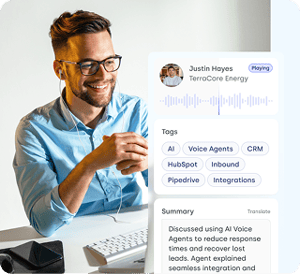
AIVA shares CloudTalk's existing native CRM and helpdesk integrations — HubSpot, Salesforce, Pipedrive, Zendesk, Intercom, and others — so an AI-handled call logs to the CRM the same way a human-handled call does: summary, recording, disposition, and tags attached, no separate integration work.
What Are Vapi AI Integrations?
Vapi's ecosystem strength is on the provider side — ElevenLabs, Deepgram, Cartesia, Azure, OpenAI, Anthropic, and more plug in as components. Business-system integration (CRM, helpdesk, calendar) is API- and webhook-driven: flexible, but every connection is built and maintained by the team deploying it.
Integration Capability Compared
| Integration Capability | CloudTalk | Vapi AI |
|---|---|---|
| Native CRM integrations | 100+ shared with the platform | None native — API/webhook builds |
| Telephony/numbers included | ✅ 160+ countries | ❌ BYO carrier |
| Voice/LLM provider choice | Managed | ✅ Full ecosystem (ElevenLabs, Deepgram, OpenAI, Anthropic…) |
| Developer requirement | None — admin self-serve | Required for setup and maintenance |
| Workflow automation | Native HTTP + CRM actions | Webhooks — logic is your code |
Security & Compliance: CloudTalk vs. Vapi AI
CloudTalk Security & Compliance
- GDPR DPA available with SFTP export for EU data residency.
- SOC 2 Type II covering the full platform AIVA runs on.
- HIPAA tooling across plans — recording consent management, audit logs, access controls — not gated to enterprise.
- WebRTC encryption by default, TLS for SIP signaling, 2FA on all paid plans, SSO via SAML on enterprise plans.
Vapi AI Security & Compliance
- SOC 2 and GDPR per current published claims — verify specifics directly on vapi.ai before relying on them contractually.
- HIPAA is a paid add-on, reported at $1,000–$2,000/month, with Zero Data Retention at $1,000/month — healthcare teams should price this into the business case from day one.
- Enterprise (Scale) tier adds SSO, dedicated support, and compliance configurations under annual contracts.
Security & Compliance Compared
| Security & Compliance | CloudTalk | Vapi AI |
|---|---|---|
| GDPR | DPA available, SFTP export | Compliant per published claims |
| SOC 2 | Type II, full platform | Claimed; enterprise-tier scope |
| HIPAA | Tooling included across plans | Paid add-on ($1,000–$2,000/mo reported) |
| Encryption | WebRTC default, TLS for SIP | Provider-dependent across the stack |
| SSO / SAML | Enterprise plans; 2FA all paid plans | Enterprise tier |
Usability & Developer Experience: CloudTalk vs. Vapi AI
CloudTalk Usability
- No-code from start to production: Ops and CX teams deploy agents without engineering; the builder starts from use-case templates.
- Same onboarding and support as the platform: Dedicated CSM on most plans, 24/7 support — the agent isn't a separate product to learn.
- Iterate from transcripts: Real call data feeds agent refinement inside the same dashboard your team already checks.
Vapi AI Usability
- API/webhook-driven configuration: There's no full no-code path — building and changing agents is developer work.
- Ongoing engineering ownership: Model updates, provider changes, and integration maintenance stay with your team long after launch.
- Excellent for its actual audience: Teams with dedicated developer resources building custom conversational products get depth no managed platform matches.
Usability & Scalability Compared
| Dimension | CloudTalk | Vapi AI |
|---|---|---|
| Setup time | Days (templates, existing numbers) | Weeks (build + integrate + test) |
| Technical skill required | None — admin-level | Developer required |
| Ongoing maintenance owner | CloudTalk (managed) | Your engineering team |
| Ideal team size/type | SMB–midmarket ops, sales, support | Engineering-led teams and product builders |
CloudTalk Reviews vs. Vapi AI Reviews on G2
G2 is the most widely used peer review platform for B2B software, and here the samples aren't comparable — worth stating plainly. CloudTalk holds 4.4/5 across 1,700+ verified reviews, with call quality, CRM sync reliability, and support responsiveness the most repeated themes. Vapi's public G2 footprint is comparatively small for its market presence; the more substantive Vapi feedback lives in developer communities, where the pattern is consistent: praise for flexibility and control, friction around cost stacking and the engineering load. Treat Vapi's review scores as directional, not statistical — and weigh sample size as heavily as the number.
Test a live AI agent on your own number this week.
Which Team Fits Which Platform?
Fit depends on one question: do you want a production-ready agent inside an existing call center, or a fully custom build with engineering resources behind it?
| CloudTalk is the right call for... | Vapi AI still works if... |
|---|---|
| Teams that want an AI agent live this month without engineering | Teams with dedicated developer resources and time to build |
| Teams that need live-agent handoff with full caller context | Teams that need a specific LLM + voice provider combination |
| Teams already running CloudTalk (or any CRM-connected call center) for calling | Teams building a custom conversational product, not operating a contact center |
| Regulated teams that want compliance tooling included, not added on | Teams that prioritize avoiding vendor lock-in above all else |
CloudTalk vs. Vapi AI: The Verdict
Everything above reduces to a build-vs-operate decision. Vapi gives engineering teams a superb engine and full control, priced per component. CloudTalk gives operating teams a working agent inside the phone system their business already runs on, priced as one number.
When to Choose CloudTalk?
Choose CloudTalk if you:
- Want an AI voice agent in production within days, run by non-engineers
- Need every AI call synced to HubSpot, Salesforce, Pipedrive, or Zendesk automatically
- Need clean escalation to human agents with the transcript attached
- Serve callers in multiple languages (60+ included)
- Operate in a regulated industry and want HIPAA tooling without a four-figure monthly add-on
- Want one predictable invoice instead of four to six provider bills
When to Choose Vapi AI?
Choose Vapi AI if...
- Have dedicated engineers who will own the agent as a product
- Need a specific LLM, voice, or transcription provider combination
- Are building a custom conversational product rather than running a contact center
- Want per-component cost control and can manage a multi-vendor stack
- Rank avoiding vendor lock-in above time-to-production
The bottom line: CloudTalk wins for businesses that want a working AI voice agent inside an operational call center without engineering overhead. Vapi wins for engineering-led teams that want maximum control and no lock-in — and have the developer hours to pay for it.
Launch your first AI voice agent without a single sprint.
Frequently asked questions
CloudTalk is a no-code AI voice agent built inside a full call center platform — numbers, CRM sync, routing, and human handoff included. Vapi is developer infrastructure: an API-driven orchestration layer where your engineers assemble and maintain the agent from components you choose.
The advertised $0.05/minute covers Vapi's orchestration layer only. Add transcription (~$0.01), the LLM ($0.02–$0.20), voice generation (~$0.04), and telephony (~$0.01), and real production setups land between $0.13 and $0.33 per minute — before compliance add-ons or engineering time.
HIPAA compliance is available on Vapi but as a paid add-on, reported at $1,000–$2,000 per month, with Zero Data Retention at $1,000/month. Healthcare teams should include that in the business case from day one. CloudTalk includes HIPAA tooling across plans without a separate compliance fee.
Realistically, no. Vapi's configuration is API- and webhook-driven, and production deployments involve integrating and maintaining 4–6 providers. Teams without dedicated engineering resources are the exact audience no-code platforms like CloudTalk's AI Voice Agent are built for.
AI Receptionist starts at $99/month with 200 minutes included, AI Specialist at $349/month with 1,000 minutes, and a Custom plan runs from $0.15/minute at 10,000+ minutes. Numbers, CRM sync, routing, and live-agent handoff are included — there's no component stack to price separately.
On raw usage, yes — a budget Vapi stack at ~$0.13/minute undercuts CloudTalk's bundles if you have engineers to build and maintain it and don't need compliance add-ons. Once you count developer hours, multi-vendor billing, and handoff/CRM builds, the total cost picture usually flips for operating teams.