
Retell AI is a strong choice if you have a developer-led technical team and need to have full control over voice, LLM, and telephony to keep costs down. It's not a good choice if you need predictable, all-in pricing out of the box. Plan for a real per-minute cost of $0.13 to $0.31, not the $0.07 advertised price.
| Field | Verdict |
|---|---|
| One-line verdict | A fast, developer-first voice agent platform with strong latency and transparent per-component pricing, but the "stacking" cost model and code-heavy setup make it a builder's tool, not a turnkey product. |
| Overall rating | 3.5/5. Genuinely good voice AI infrastructure for teams that have engineers to build and maintain it. |
| Best for | Developer-led teams |
| Not good for | Non-technical ops teams |
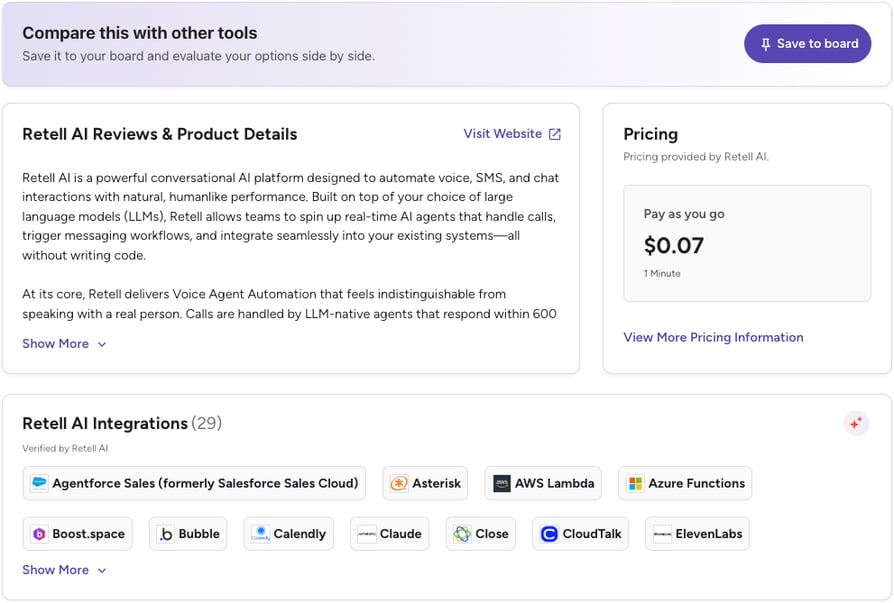
| Starting price | From ~$0.07/min advertised; real all-in ~$0.13–$0.31/min once LLM + voice + telephony are added |
| Free tier? | Trial only. $10 in free credits, 20 free concurrent calls, 10 free Knowledge Bases; no ongoing free tier |
| Setup time | Basic prototype in hours; a production agent takes weeks of engineering |
| Standout pro | Low latency and natural voice quality (~600ms end-to-end, Retell's own claim) |
| Standout con | Component "stacking" pricing is hard to forecast; production needs developers |
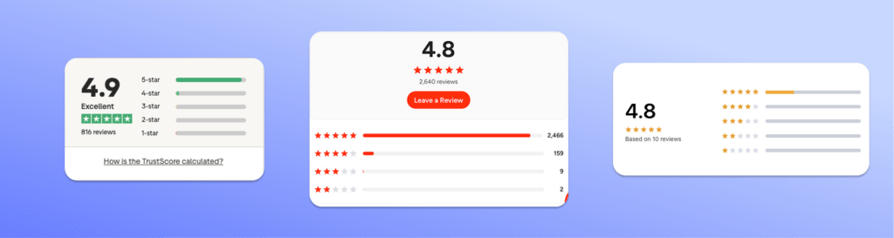
| User sentiment | Developers rate the API and voice quality highly; ops buyers flag cost forecasting and support. Product Hunt 4.8/5 (10 reviews, confirmed live); G2 ~4.8/5 reported. |
| CloudTalk verdict | Choose CloudTalk's AI Voice Agent when you want production voice calling without engineering overhead and with predictable, per-seat platform pricing. |
About Retell AI
Retell AI's own pricing page lists $0.07 to $0.31 per minute for voice agents. That range matters, because the real production cost lands well above the $0.07 headline once you stack an LLM, a premium voice engine, and telephony on top of the base rate.
For a team running thousands of calls a month, the difference between the headline and the real bill can be several thousand dollars.
Most teams try to control this by picking cheaper components or promising to optimize later. This is called taking a shortcut, and shortcuts don't typically lead to longtime success. You'll likely end up with a robotic sounding agent and angry customers.
So the honest questions are about true all-in cost and whether you can operate the platform without a developer on standby. Retell AI is one of the most-searched AI voice agent platforms, so there's a lot of information to look at.
In this review, we've compiled everything you need to know about its features, real per-minute pricing with a worked example, latency and performance, developer experience, security, what real users say, and the alternatives worth weighing.
Do your own research alongside it, especially on pricing, since Retell updates its rates.

See what production-ready voice AI looks like without the engineering bill

Retell AI Scorecard: Our Honest Ratings
We score each dimension out of 5 based on hands-on testing, product documentation, and verified user reviews, the same lens we apply to any AI call center technology. The ratings below reflect what Retell does and does not do well.
| Dimension | Rating /5 | Why |
|---|---|---|
| Ease of setup | 2.5/5 | The visual flow builder helps for simple flows, but production agents are code-heavy and lean on engineers. Steep for non-technical teams. |
| Call quality & latency | 4.5/5 | A genuine strength. Roughly 600ms end-to-end (Retell's claim), natural turn-taking, and multiple premium voice engines. |
| Pricing clarity | 3/5 | There's pricing for pay-as-you-go customers (~$0.7–$0.31/min), but Enterprise pricing requires you to contact sales. |
| Features & capabilities | 4/5 | LLM flexibility, simulation testing, post-call analytics, batch calling, and SMS/chat agents. |
| Integrations | 3.5/5 | CRM, telephony, and automation (Twilio, Vonage, Make, n8n, GoHighLevel) plus API and webhooks; some connectors are partner-built. |
| Support & docs | 3/5 | Strong docs, but the base plan relies on Discord and email, and users report slow support and breaking API changes. |
Retell AI overall rating: 3.5/5. It's excellent voice AI infrastructure if you have the engineering resources to build on it, and a poor fit if you need a product your ops team can run alone.
What Is Retell AI?

Retell AI is for the developers. Founded in 2023, it provides the building blocks that developers need to create a voice agent. Unlike easy, plug-and-play setup models, Retell gives developers minute control over every single aspect—from the LLM reasoning (the AI's "brain") to the text-to-speech engine.
In fact if you're not a developer...jump to our top Retell AI alternatives. Otherwise read on.
While Retell requires technical heavy lifting to set up, it gives teams the flexibility to build high-performing agents for inbound and outbound calls, appointment scheduling, lead qualification, and customer support—with newer SMS and chat capabilities alongside voice. That sheer breadth makes it a staple on most AI voice agent shortlists today.
On paper, Retell boasts a 4.8/5 G2 rating, support for 60+ languages, and a 99.99% uptime—solid credibility signals, though it’s always smart to verify the latest vendor claims directly on their site.
What's the difference between Retell and plug-and-play?
1. It eliminates the "AI Lag" (Ultra-Low Latency)
In human conversation, we naturally expect a reply within 200 to 400 milliseconds.
- Plug-and-Play: Many ready-made systems take 2 to 3 seconds to respond because they process the whole conversation in batches (listen → finish transcribing → think → start talking). This results in awkward silences that make callers say, "Hello? Are you still there?".
- Retell AI: Because developers can stream the data continuously, Retell hits an end-to-end response time of around 600 to 800 milliseconds. It cuts in so fast that the person on the other end often forgets they are talking to a robot.
2. Natural "Barge-In" Handling
- Plug-and-Play: If a ready-made AI is reading out a long list of calendar times, and you interrupt with, "Wait, no, actually Friday doesn't work," a standard system will often keep talking right over you until its pre-written script finishes.
- Retell AI: It features highly sensitive Voice Activity Detection (VAD). The exact millisecond you open your mouth, the AI stops talking, listens to your interruption, changes its train of thought, and adapts to what you just said instantly.
3. Complex Branching Logic (Not just linear scripts)
- Plug-and-Play: Most simple tools follow a rigid flowchart (If yes, go to step A. If no, go to step B). If a customer throws a curveball or asks a multi-part question, the system breaks or loops back to the start.
- Retell AI: Developers can build "multi-prompt" or "conversation flow" architectures. The AI can cross-reference your live CRM database mid-sentence, check custom inventory rules, apply complex logic, and seamlessly transition the conversation from a casual FAQ answer straight into a strict, legally compliant data-collection sequence without missing a beat.
In short: A plug-and-play agent feels like an advanced, voice-activated phone menu. A high-performing Retell agent feels like talking to a real assistant who is actively listening and thinking in real time.
Who Retell AI Is Best Suited For
Retell fits developers, technical teams, and SaaS products that want to embed custom voice agents with control over every component. If you care about picking your own LLM, voice provider, and telephony, and you have the engineering time to wire them together, this is the kind of platform that rewards that control.
It also suits teams that put low latency and voice quality first and have people who can build, test, and maintain conversation flows over time. The strength here is a real developer experience, so the buyers who thrive treat that control as an asset rather than overhead.
How Does Retell AI Work?
Retell's build model is worth understanding before you commit, because it explains both the quality and the engineering dependency.
The Voice Pipeline (STT → LLM → TTS)
Every Retell call runs a real-time loop: speech-to-text captures what the caller says, an LLM reasons about the response, and text-to-speech speaks it back, all streamed over WebSockets and APIs to keep latency low (roughly 600ms end-to-end, per Retell).
You choose the parts. Retell supports several voice providers (its own voices plus ElevenLabs, Cartesia, OpenAI, MiniMax, and Fish) and multiple LLMs (GPT, Claude, Gemini, or a custom model over WebSocket). That lets you trade quality against cost per component, which suits engineers and frustrates anyone trying to predict a monthly bill.
Building & Deploying an Agent (Visual Builder + Code)
Retell ships a node-based flow builder for simpler conversations: IVR menus, call routing, transfers, and webhook steps. It's useful for structured flows. The catch is that production agents, prompt tuning, and edge cases usually pull you back into code and the API or SDKs (Node.js, Python).
Deployment runs through telephony you connect yourself: Twilio, Vonage, or your own SIP number. Concurrency starts at 20 free concurrent calls, with more available at a per-line cost.
Testing, Monitoring & Integrations
Retell includes simulation testing so you can validate an agent before it goes live, plus post-call analytics, live transcription, latency tracking, and shareable call logs for debugging. That tooling is a real plus for technical teams who want to catch problems pre-launch.
On the integration side, Retell connects to CRM, telephony, and automation tools (n8n, GoHighLevel, Make) through its API and webhooks. The honest caveat: some connectors are partner-built or unofficial, so the implementation effort varies by tool. Getting from a working prototype to a monitored production agent is the part that takes real time.
What Are the Key Features of Retell AI?
Here are the seven capabilities that define Retell in practice. For each, what it is, what it means for you as a buyer, and the honest caveat.
Low-Latency, Real-Time Voice (Core Strength)
What it is: Roughly 600ms end-to-end streaming with natural turn-taking and smart interruption handling, so the agent can be talked over and recover gracefully.
What it means for you: Routine calls feel live. Fewer awkward pauses and fewer callers hanging up because the bot lagged.
Honest caveat: Real latency depends on the STT, LLM, and TTS you pick and whether you pay for the "Fast Tier" (roughly 1.5–2x the cost). An un-optimized setup can still feel robotic.
LLM Flexibility & Voice Engine Choice
What it is: Bring or choose your LLM (GPT, Claude, Gemini) and your voice provider (ElevenLabs, Cartesia, OpenAI, and others), mixing for quality versus cost.
What it means for you: You're not locked into one model's quirks or pricing. Engineers love this.
Honest caveat: Ops leaders who want stability rarely love it, because every LLM-plus-voice combination has its own per-minute price, which adds cost complexity to every forecast.
No-Code Visual Builder (with limits)
What it is: A node and transition flow builder for structured conversations, reusable components, and IVR trees.
What it means for you: Simple flows are approachable without heavy code.
Honest caveat: Reviewers keep saying there's no true no-code path. Production changes still route back to engineers, so CX and ops teams can't fully self-manage the agent.
Simulation Testing & Post-Call Analytics
What it is: Simulate conversations and A/B test flows before launch, then track transcription, latency, sentiment, and outcomes on dashboards.
What it means for you: You can catch failure modes before customers hit them, which is rare for call center analytics at this stage of a build.
Honest caveat: Larger teams want deeper enterprise reporting and stronger prompt and version management than what's available today.
Integrations, Telephony & Concurrency
What it is: Twilio, Vonage, or BYO SIP for telephony; CRM and automation through n8n, GoHighLevel, and HubSpot; 20 free concurrent calls with scalable concurrency; and batch outbound dialing.
What it means for you: You can plug Retell into an existing stack and scale call volume when a campaign demands it.
Honest caveat: Some integrations are partner or unofficial, and concurrency plus add-ons carry separate costs that don't show up in the headline rate.
Multilingual Support, SMS & Chat
What it is: Support for 60+ languages, plus SMS and chat agents that extend beyond voice.
What it means for you: One platform can cover multiple channels and markets.
Honest caveat: "60+ languages" is a vendor claim that appears in blogs more than on the core product page. Confirm which languages are production-ready before you build for a specific market.
Security & Enterprise Controls
What it is: SOC 2 Type I and II, HIPAA readiness, GDPR, and PII redaction.
What it means for you: The baseline compliance most buyers ask for is in place.
Honest caveat: Users flag missing enterprise controls. Role-based access control is Enterprise-only, and third-party reviews note no ISO 27001, no audit logs, and no EU data residency.
Retell AI Pricing Breakdown
Pricing is the single biggest reason people search for a Retell review, so this section goes deep. For a side-by-side with CloudTalk's own numbers, see our Retell AI pricing breakdown. Every figure here should be confirmed against Retell's live pricing page before you rely on it, because rates change.
Plans and What's Included
Retell runs two tracks: self-serve pay-as-you-go and custom Enterprise.
| Track | Rate | What's included | Notes |
|---|---|---|---|
| Pay-as-you-go | From ~$0.07/min for voice agents; $0.001+/msg for chat | Full platform access, agent templates, call analytics and transcripts, simulation testing, webhooks and API, community and email support | $10 in free credits, 20 free concurrent calls, no platform fee, no contract |
| Enterprise | Custom pricing | Everything above plus dedicated implementation (add-on), custom MSA/DPA, RBAC, dedicated server, custom SSO, high concurrency, 24/7 support | Contact sales |
Concurrency starts at 20 free concurrent calls on every account, with additional lines around $8 per concurrent call per month. Secondary sources suggest organizations hit the Enterprise threshold around $3,000+/month, with white-glove managed implementation starting near $8,000/month, and very high volume negotiable toward ~$0.05–$0.07/min all-in.
The Real Cost: Component "Stacking" Per-Minute
Here's the part most reviews hand-wave. The advertised ~$0.07/min covers one layer. Real production configs land closer to $0.13–$0.31/min once you add the LLM, a premium voice, and telephony.
The cost drivers to watch:
- LLM tier: roughly $0.003 to $0.50+/min depending on the model. Retell's own calculator lists rates like gemini-2.5-flash-lite at $0.006, gpt-5-mini at $0.012, gpt-4.1-mini at $0.016, and gemini-2.5-flash at $0.035.
- Premium voices: engines like ElevenLabs cost more than the base option (MiniMax voices show at $0.015 on Retell's calculator).
- Telephony: roughly $0.015/min through Retell or Twilio, billed during ring, hold, and silence too; $0 with your own SIP.
- Fast Tier: roughly 1.5–2x the base cost for lower latency.
- Add-ons: Knowledge Base overages (~$8/KB/month after 10 free), AI QA (~$0.10/min after 100 free minutes), concurrency (~$8/line), branded caller ID, and batch dialing (~$0.005/dial).
There's also an "engineering tax" that never appears on the invoice: the setup, configuration, and ongoing maintenance of the stack. That's real budget, just paid in salaries instead of usage fees.
Real world example
Say you run 10,000 minutes a month with a mid-tier config: gpt-4.1-mini for the LLM ($0.016/min), a premium voice, and Retell telephony (~$0.015/min).
At the ~$0.07 headline, you'd expect $700/month. In practice, a realistic blended rate of ~$0.12–$0.18/min puts the bill around $1,200–$1,800/month.
Add extra concurrency for a busy campaign, a few Knowledge Bases past the free 10, and AI QA on your calls, and the true all-in can climb past $2,000.
Retell isn't overpriced for what it does. The catch is that the headline rate is only a floor, and your real bill depends on the components you stack on top of it.
Is Retell AI Free? Free Credits & Trial Details
Retell is not free on an ongoing basis. New accounts get $10 in free credits (roughly 67–90 minutes at realistic rates), 20 free concurrent calls, and 10 free Knowledge Bases, but there's no permanent free tier.
Those credits burn faster than people expect. Premium voices, higher LLM tiers, the Fast Tier, and add-ons all draw down the $10 quickly, so plan a realistic test rather than assuming the credits cover a full pilot.
What Real Users Say About Retell AI Pricing on G2, Reddit, and Quora
One thing that comes up in reviews is that they love the customization and flexibility, but it is a it complicated to set up.
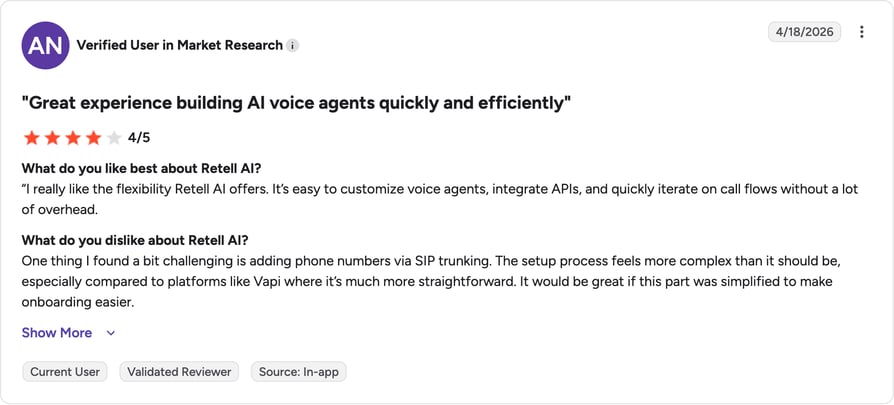
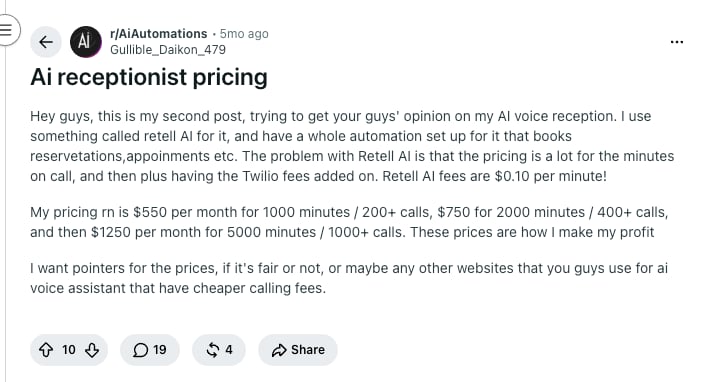
Pricing sentiment splits cleanly. Developers tend to accept the per-component model because it maps to how they think about infrastructure.

Buyers on the ops and finance side are the ones who push back, and their complaint is consistent: the stacking model makes it hard to predict what a given month will cost, and the bill grows faster than the headline rate suggests at scale.
If forecastable cost matters more to you than component-level control, CloudTalk's AI voice agent pricing is built around a flat platform fee plus clearly priced minutes rather than a per-component stack. Start your 14-day free trial to test that predictability against your own call volume.
Retell AI Review on 6 Must-Have Business Requirements
This is the practical evaluation: how Retell holds up on the dimensions that decide whether a deployment succeeds or stalls.
Call Quality, Latency & Reliability
Latency and natural turn-taking are Retell's headline strengths. Roughly 600ms end-to-end (Retell's claim) with clean barge-in handling makes routine calls feel close to live. Just remember that the number you actually get depends on your STT, LLM, and TTS choices and whether you're paying for the Fast Tier. Retell also cites a ~99.99% uptime figure worth confirming on its status page.
Usability & Interface
The dashboard and visual builder are fine for simple flows, and onboarding is self-serve thanks to the $10 in starter credits. Simulation testing is a real usability win. The honest verdict is that this is a developer tool with a thin operations layer on top, not a turnkey product. A non-technical operator faces a steep learning curve the moment they move past a basic flow.
Developer Capabilities
This is where Retell is strongest. The API is deep, WebSockets and webhooks are first-class, and the SDKs (Node.js, Python) are well regarded for type safety. You can bring a custom LLM over WebSocket, choose between single-prompt and conversation-flow agents, and validate everything with simulation testing before launch. Rate limits and concurrency scale by tier. If you're a technical team, this is the reason to look at Retell.
Language Support
Retell advertises 60+ languages, but that headline needs scrutiny. Confirm which languages are production-ready versus experimental, how well STT handles non-English accents, whether a single agent can switch language mid-call, and which TTS voices exist per language, since that's provider-dependent. The breadth is a selling point; the depth varies by language.
Integration
Retell covers the main categories: CRM (HubSpot, GoHighLevel, Salesforce), telephony (Twilio, Vonage, BYO SIP), and automation (n8n, Make, Zapier via webhooks). Sync depth matters here, so check whether each connector is read-only or bidirectional before you assume it fits your workflow. Some connectors are partner or unofficial, which affects both setup complexity and long-term reliability. For contrast, CloudTalk ships native call center integrations that are built and maintained in-house.
Here's the ecosystem at a glance:
| Category | Notable integrations / notes |
|---|---|
| CRM | HubSpot, GoHighLevel, Salesforce; confirm read-only vs bidirectional sync |
| Telephony | Twilio, Vonage, BYO / SIP support |
| Automation | n8n, Make, Zapier; webhook coverage |
| Calendar & booking | Cal.com, Google Calendar |
| AI & LLM providers | OpenAI (GPT), Anthropic (Claude), Gemini, custom LLM via WebSocket |
| Voice engines | Retell, ElevenLabs, Cartesia, OpenAI, MiniMax, Fish |
| Channels | Voice + SMS + chat agents |
| API access | REST API, WebSockets, webhooks; SDKs (Node.js, Python) |
Customer Support
Support tracks with your tier. The base plan leans on Discord and email; Enterprise adds a dedicated Slack channel and a success team. Documentation is a strength. The recurring complaint is that real-world response times lag the promise, and some users report breaking API changes that arrive with little warning. The docs and agency ecosystem help fill the gap, but post-onboarding support is where base-plan users feel the thinnest.
Retell AI Real User Reviews: What Real Users Say About Retell AI
Retell's reviews skew positive among developers and more mixed among operators. The ratings below were checked live for this review; platforms that blocked automated access are flagged so you can confirm them yourself.
| Platform | Rating (reviews) |
|---|---|
| Product Hunt | 4.8/5 (10 reviews) |
| G2 | ~4.8/5 (~1,755+ reviews) |
| Trustpilot | 4.9/5 (~815 reviews) |
What users love:
- Low latency and natural call quality
- LLM flexibility and bring-your-own keys
- Fast prototyping (an active bot in minutes)
- Strong integrations, especially n8n and GoHighLevel
- Useful post-call analysis and transcripts
Where users are frustrated:
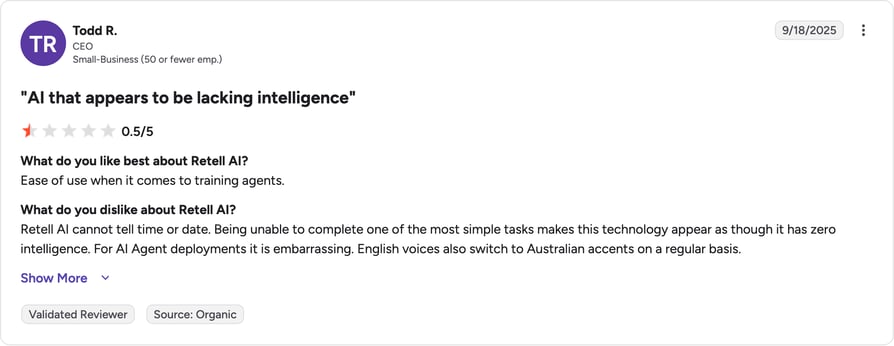
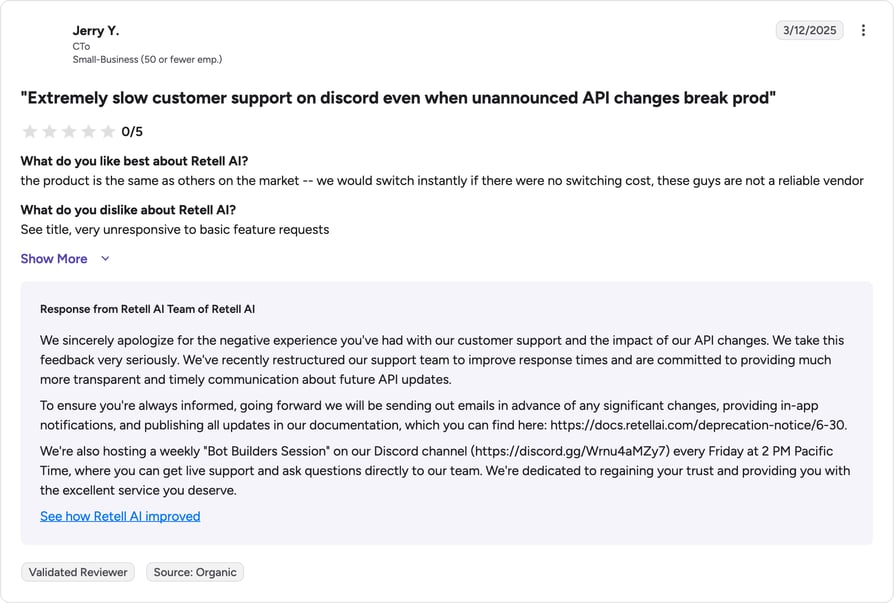
- Component "stacking" pricing and cost at scale
- No true no-code path, so agents need engineers
- Slow support and occasional breaking API changes
- Missing enterprise controls (RBAC, audit logs, ISO 27001)
- Unclear GDPR handling and no EU data residency
The recurring "needs engineers" critique is exactly what a no-code platform removes. CloudTalk's AI Voice Agent shows how to implement an AI voice agent in minutes rather than weeks. Start a 14-day free trial to build one against your own call flows.
Who Should (and Should NOT) Use Retell AI
Fit matters more than features here, because Retell rewards one kind of buyer and frustrates another. The best use cases for AI voice agents look different depending on whether you have engineers on hand.
Best Fit: Buyer Profiles Where This Tool Shines
- Engineering-led SaaS teams embedding voice. You're building voice into a product and want control over the LLM, voice, and telephony. Retell gives you that control without forcing you to build the real-time pipeline from scratch.
- Technical outbound teams with dev resources. You run high-volume outbound and have engineers to build and maintain flows. Batch dialing and scalable concurrency fit that model well.
- Latency-and-quality-first buyers. Voice naturalness is a hard requirement and you have the people to tune the stack. This is exactly where Retell's strengths pay off.
- Teams comfortable modeling variable costs. You're fine forecasting a component-based per-minute rate and treating it like cloud infrastructure spend.
- Developers prototyping fast. You want a first agent live quickly and value the API, SDKs, and simulation testing over a polished ops UI.
Poor Fit: When You Should Look Elsewhere
- Non-technical ops and CX teams. If you need to build and adjust agents without engineers, the lack of a true no-code path will stall you. This is where a platform like CloudTalk fits better.
- Teams needing predictable, flat billing. Component stacking is variable by design, so a fixed monthly number is hard to guarantee.
- Buyers wanting a turnkey, fast launch. If you want to go live without engineering overhead, Retell asks for more build time than you'll want to spend.
- Regulated or EU-based teams. If you require RBAC, audit logs, ISO 27001, or EU data residency, Retell's current gaps are a real blocker.
Retell AI: Industry Fit
| Industry / use case | Fit assessment |
|---|---|
| Dev-led SaaS embedding voice into a product | Strong (core strength) |
| High-volume outbound sales (with eng resources) | Strong for teams with engineers to build and maintain |
| Non-technical front desks (HVAC, medspa, dental) | Weak (not turnkey, needs engineers) |
| Contact center ops teams (self-managed) | Weak (no true no-code path) |
| Healthcare (HIPAA-required) | HIPAA readiness (verify BAA and controls; missing RBAC/audit logs) |
| Finance/insurance (compliance-heavy) | Gaps (no ISO 27001/RBAC/audit logs) |
| EU-based teams (data residency) | Weak (no EU data residency / unclear GDPR) |
Security, Compliance & Data Privacy of Retell AI
Retell's baseline compliance is solid, but the enterprise and regional controls are where careful buyers should look hard.
Compliance Certifications
Retell states it's compliant with SOC 2 (Type I and II), HIPAA, and GDPR, offers PII redaction, and runs a Trust Center. HIPAA is offered without an extra per-minute charge. The gaps third-party reviews flag are worth naming plainly: no ISO 27001, no audit logs or audit trail, and role-based access control available only on the Enterprise plan rather than for self-serve users. Confirm each of these on Retell's live Trust Center before you rely on it.
Data Handling & Residency
Retell encrypts data in transit and at rest and handles call recordings and transcripts through its platform. Whichever vendor you shortlist, weigh it against the common VoIP security risks that affect any cloud calling platform. The consideration for European teams is data residency: Retell does not currently operate its services within the EU, and some users report unclear answers on GDPR specifics. If EU residency is a hard requirement, treat this as a blocker until Retell confirms otherwise.
What Are the Pros and Cons of Retell AI?
Retell's pros and cons are typical of a standalone voice agent versus an integrated system: deep control, at the cost of assembly and ongoing upkeep.
| Pros | Cons |
|---|---|
| Low latency and natural voice quality make routine calls feel live (~600ms, Retell's claim) | Component "stacking" pricing is hard to forecast and grows at scale |
| Transparent per-component pricing you can inspect and tune | No true no-code path, so production changes need engineers |
| LLM and voice-engine flexibility (bring your own) | Slow support on the base plan and occasional breaking API changes |
| Simulation testing and post-call analytics before launch | Missing enterprise controls (RBAC for all users, audit logs, ISO 27001) |
| Strong integrations plus built-in telephony options | No EU data residency and unclear GDPR specifics |
The Best 4 Retell AI Alternatives in 2026
If Retell's developer-first model isn't the right shape for your team, here are the best Retell AI alternatives worth weighing. Because Retell is a builder's tool, the most useful contrast is an operations-ready, predictable-pricing platform, which is where CloudTalk fits. Verify every competitor cell against live sources before publishing.
| Capability | CloudTalk | Vapi | Bland AI | Synthflow |
|---|---|---|---|---|
| Best for | Ops teams wanting predictable, no-code AI calling | Developer-first programmable voice | High-volume dev-led outbound | No-code voice agents (SMB/agency) |
| Build model | No-code + integrations | API-first (code) | API-first (code) | No-code |
| Pricing model | Predictable per-seat platform + usage-based AI Voice Agent add-on | Component usage + provider costs | ~$0.09/min | Tiered subscription + overages |
| Real per-minute clarity | Predictable | Low (stacking) | Medium | Medium (overages) |
| Latency | Low | ~500–800ms (config) | ~800ms avg | ~400–500ms |
| No-code friendliness | High | Low (devs) | Low (devs) | High |
| Inbound / outbound | Both | Both | Both (outbound focus) | Both |
| Languages | Wide (AI Voice Agent supports 60+) | Provider-dependent | English-centric | 50+ |
| Integrations | Native call-center + 100+ CRM/helpdesk | Via API / webhooks | CRM + custom tools | HubSpot, Twilio, etc. |
| Enterprise controls | RBAC, analytics, SOC 2, GDPR, HIPAA | Higher plans | Limited | Enterprise tier |
| Support model | Dedicated 24/7 support | Docs + community | Discord; enterprise terms | Slack (30 days) then tickets |
| Best-fit vs Retell | When you want production voice without engineers | When you want even deeper component control | When outbound volume is the priority | When you want no-code but still voice-specific |
Want the head-to-head detail? See Retell AI vs Vapi, Retell AI vs Bland AI, and Retell AI vs Synthflow.
Feature & Capability Comparison
Here's CloudTalk vs Retell AI across the capabilities that decide most deployments:
| Capability | Retell AI | CloudTalk |
|---|---|---|
| Primary focus | Developer voice-agent infrastructure | AI business calling for sales and support teams |
| Build model | API-first (code) | No-code + native integrations |
| Pricing model | Component stacking (per-minute) | Predictable per-seat platform + AI Voice Agent add-on |
| Entry price | From ~$0.07/min, real all-in ~$0.13–$0.31/min | Starter from $25/user/month |
| Real all-in clarity | Hard to forecast | Predictable |
| Latency | ~600ms (Retell's claim) | Low, on decentralized SIP infrastructure |
| Concurrency | 20 free, then per-line fees | Native call-center concurrency |
| Languages / voice | 60+ languages claimed | AI Voice Agent supports 60+ languages |
| Warm transfer / IVR | Via flow builder and code | Native IVR and skill-based routing (from Starter) |
| Testing / simulation | Simulation testing (strong) | Testing via platform config |
| Post-call analytics / QA | Post-call analytics; AI QA add-on | AI Conversation Intelligence (add-on) |
| Integrations | CRM, telephony, automation via API | 100+ native integrations |
| Compliance | SOC 2, HIPAA, GDPR; gaps: ISO 27001, audit logs, EU residency | SOC 2, GDPR, HIPAA |
| Support & onboarding | Discord/email base; dedicated on Enterprise | Dedicated 24/7 support |
| Time to production | Weeks (engineering) | Days, no engineering required |
Retell AI vs CloudTalk: Pricing & Scalability Compared
The core difference is forecastability. Retell's cost is the sum of components (base voice, LLM, premium voice, telephony) plus add-ons, so your per-minute rate moves with every configuration choice, and it climbs as volume and concurrency grow. CloudTalk sells a flat per-seat platform, with plans from $25/user/month (Starter), $29/user/month (Essential), and $49/user/month (Expert), and the AI Voice Agent as a usage-based add-on starting at $99/month for 200 minutes.
As call volume scales, the contrast sharpens. With Retell, more minutes and more concurrent lines mean a bigger, harder-to-predict bill plus the ongoing engineering time to maintain the stack. With CloudTalk, the platform cost is a known per-seat number and the AI Voice Agent minutes are a separate, straightforward line, so finance can model it without a spreadsheet full of component rates. Note that CloudTalk's AI Voice Agent and AI Conversation Intelligence are always add-ons, never bundled into a plan.
Customer story: CloudTalk's own team reached 17x ROI by putting an AI prequalification agent on long-tail leads. That kind of return only lands when the cost is predictable enough to model up front. Read how they did it.
Where CloudTalk Fits Better
- No-code ops ownership. CloudTalk's AI Voice Agent (CeTe) lets non-technical users build an agent in under 10 minutes by defining an identity, choosing a language and voice, attaching skills, and uploading reference content as its knowledge base. No engineers required to launch or adjust.
- Predictable pricing. A per-seat platform plus a clearly priced AI Voice Agent add-on removes the component-stacking guesswork.
- Global coverage. CloudTalk offers virtual numbers in 160+ countries on a multi-carrier network built for call quality.
- Native call-center features. IVR and skill-based routing (from the Starter plan), real-time analytics, and call recording are native, with Smart Dialer on Essential and Power Dialer on Expert.
- Enterprise controls and scale. SOC 2, GDPR, and HIPAA compliance, real-time analytics, and a platform trusted by 5,500+ customers, with a G2 rating of 4.4/5 across 1,702+ reviews.
Customer story: Trevo reached 20x more customers per campaign after deploying CloudTalk's AI Voice Agent, with no engineering team standing by. Read the Trevo story.
If a no-code, forecastable setup is what you're really after, start your 14-day free trial. No credit card required.
Final Verdict: Is Retell AI Worth It?
Retell AI is worth it for the right team. It's a strong voice-agent platform with excellent latency, real component flexibility, and a developer experience that rewards technical ownership. The catch is that "the right team" has engineers, tolerance for variable per-minute costs, and no hard requirement for EU residency or full enterprise controls. Model the true all-in cost before you commit, and confirm the current rates on Retell's live pricing page.
Good Fit For
- Developers and technical teams building custom voice agents who want component-level control
- Teams prioritizing low latency and voice quality with engineering resources to build and maintain
- SaaS products embedding voice via API or SDK
- Teams comfortable modeling variable, component-based per-minute costs
Not a Good Fit For
- Non-technical ops and CX teams that need to build and adjust agents without engineers (a no-code platform like CloudTalk that brings AI voice agents to sales and support fits better here)
- Teams needing predictable, flat-rate billing rather than variable component stacking
- Businesses wanting a turnkey, fast launch without engineering overhead
- Regulated or EU teams needing RBAC, audit logs, ISO 27001, or EU data residency
Ready to compare Retell AI with a no-code alternative?
Recommended articles
Sources:
FAQ
Yes, if you have engineers. Retell delivers strong latency and voice quality for developer-led teams comfortable with variable component pricing. Non-technical ops teams needing predictable billing and no-code setup will find it a poor fit.
Retell advertises from about $0.07/min, but real production configs land closer to $0.13–$0.31/min once you add an LLM, a premium voice, and telephony. Always confirm current rates on Retell's live pricing page before you budget.
You'll want developers. Retell's visual builder handles simple flows, but production agents, edge cases, and changes route back to code and the API. Non-technical teams are better served by a no-code AI voice agent they can build and adjust alone.
Reviews are mixed. Developers praise the docs and API, but base-plan users report slow responses (Discord and email only) and occasional breaking API changes. Enterprise plans add a dedicated Slack channel and a success team.
Retell states it's SOC 2 (Type I and II), HIPAA, and GDPR compliant with PII redaction. Gaps to check: no ISO 27001, no audit logs, RBAC is Enterprise-only, and no EU data residency. Confirm each on Retell's Trust Center.
Retell claims about 600ms end-to-end; commonly reported figures put Vapi near 500–800ms and Bland AI near 800ms, though real latency depends on your STT, LLM, and voice choices. See our CloudTalk vs Bland AI breakdown for a closer look.