11 Best AI Voice Agents for Customer Service & Support in 2026
TL;DR
The right AI voice agent depends on what your team actually needs: CloudTalk is the strongest fit for SMB and mid-market support teams that want the AI agent built into a full call-center platform instead of a separate piece of infrastructure; Retell AI and Vapi lead on pure conversational quality for teams that want to build; Synthflow gets a no-code agent live the fastest; and PolyAI, Cognigy, Decagon, Sierra, Regal.ai and Cresta serve enterprise contact centers with deeper pockets and longer implementation timelines.
Here are the 11 best AI voice agent solutions to consider this year:
- 01CloudTalk: best for growing SMB and mid-market support teams that want the AI voice agent built into a full phone system.
- 02Retell AI: best for developer teams that want full API control over the voice stack.
- 03Synthflow: best for SMBs and agencies that need a no-code agent live fast.
- 04Vapi: best for developers who want code-level control of every component in the pipeline.
- 05Bland AI: best for ops-heavy enterprise teams running regulated call workflows.
- 06PolyAI: best for large, multilingual enterprise contact centers.
- 07Cognigy.AI: best for enterprise contact centers that want a broader conversational AI for customer service platform, not just voice.
- 08Decagon: best for enterprise support orgs that want one AI agent running across every channel.
- 09Sierra: best for large consumer brands that want a premium, outcome-priced AI layer.
- 10Regal.ai: best for B2C teams weaving voice AI into a broader, event-driven customer journey.
- 11Cresta: best for high-volume contact centers pairing AI agents with real-time human coaching.
Gartner predicts that by 2029, agentic AI will autonomously resolve 80% of common customer service issues without human intervention. The opportunity is clear — but choosing the right AI voice agent is what determines whether your business delivers faster resolutions, lower support costs, and better customer experiences.
In this guide, we compare the 11 best AI voice agents for customer support, evaluating their features, use cases, and pricing to help you find the best fit for your team.

See an AI voice agent handle a real support call

Why Trust Our Software Reviews?
Over the last decade, we've helped over 30,000 professionals find and implement smarter business communication tools: 200+ software tools reviewed, 5,500+ verified customer reviews analyzed across G2, Capterra, Trustpilot and TrustRadius, and real user discussions on Reddit and Quora factored in. Read more on our content integrity and our software review methodology.
What Is the Best AI Voice Agent for Customer Service & Support in 2026?
For most customer service teams, CloudTalk is the best AI voice agent for support and service because it combines AI-powered conversations with a complete business phone system.
That said, the best choice depends on your team's requirements. Developer-focused teams that need maximum customization may prefer platforms like Retell AI or Vapi. Businesses looking for a no-code AI agent builder may find Synthflow a better fit, while large enterprises with complex contact center needs may consider solutions like PolyAI, Cognigy, Decagon, Sierra, Regal.ai, or Cresta.
Our Methodology for Ranking the Best AI Voice Agents
We built this list using public product information, G2 and Trustpilot reviews, and vendor pricing pages. We cross-checked key details across multiple sources and marked any estimates where review data couldn't be verified directly.
We compared each AI voice agent across six areas: conversation quality, response speed, integrations, ease of setup, pricing transparency, and compliance. For teams looking for an AI phone agent for customer service they can launch without developer support, we gave extra weight to setup simplicity, pricing clarity, and overall conversation quality. No vendor paid to be included or ranked in this list.
Best AI Voice Agents for Customer Support and Service: Comparison Table
Before choosing an AI voice agent for customer support, compare the top providers side by side to see how they differ in features, pricing, integrations, and ease of use.
| Software Name | Best For | Voice Quality | Latency | Languages | Free Trial/Credits | Starting Price |
|---|---|---|---|---|---|---|
| CloudTalk | Growing SMB and mid-market support teams | Natural-sounding, sub-800ms response latency | Sub-800ms | 60+ | First 50 minutes free | From $99/month for 200 minutes (add-on) |
| Retell AI | Developer teams needing full API control | Realistic, low-latency voice, praised in reviews | ~600ms | 31+ | $10 free credits, 20 free concurrent calls | Usage-based, $0.07–$0.31/min |
| Synthflow | SMBs and agencies wanting a no-code agent fast | Solid for simple flows | Sub-500ms | 30+ | Build for free; PAYG after launch | Quote-based |
| Vapi | Developers wanting code-level pipeline control | Advertised sub-500ms pipeline with interruption handling | Sub-500ms | 100+ | $10 in free credits | Usage-based from $0.05/min (orchestration layer only) |
| Bland AI | Ops/engineering teams needing regulated workflows | Consistent call quality cited by developer reviewers | Sub-400ms | 40+ | Not available | $0.14/min |
| PolyAI | Large, multilingual enterprise contact centers | Advanced and natural-sounding | Sub-300 ms | 75+ | Not available | Quote-based |
| Cognigy.AI | Enterprise contact centers wanting a broader CX platform | Strong NLU | Not publicly detailed | 100+ | Available | Quote-based |
| Decagon | Enterprise orgs wanting one agent across every channel | High-performing and natural-sounding | Not publicly detailed | 100+ | Not available | Quote-based |
| Sierra | Large consumer brands wanting outcome-priced AI | Natural, accurate conversations | Not publicly detailed | 58+ | Not available | Quote-based |
| Regal.ai | B2C teams building event-driven voice journeys | High-quality, human-like voice performance | Sub-300ms | 30+ | Not available | Quote-based |
| Cresta | High-volume contact centers pairing AI with live coaching | High-quality, production-ready enterprise voice AI | Not publicly detailed | 30+ | Not available | Quote-based |
Best AI Voice Agents for Customer Support and Service: Top 11 Picks
Choosing the best AI voice agent for customer service comes down to finding the right balance between capabilities, ease of use, integrations, and pricing. Below, we break down the 11 top platforms, highlighting what each tool does best, its limitations, and which teams it's best suited for.
1. CloudTalk: Best For Growing SMB and Mid-Market Support Teams
What Is CloudTalk?
CloudTalk is a cloud-based business calling platform designed for growing support and sales teams. Its AI Voice Agent, CeTe, is built directly into the platform alongside calling features like business numbers, call routing, recordings, and CRM integrations.
What Are CloudTalk's Key Features?
- Handles complete customer requests instead of sending callers through rigid IVR menus. It can answer questions, book appointments, update CRM records, or transfer calls to the right agent when needed.
- Supports 60+ languages and accents with fast response times and natural-sounding AI voices.
- Connects with popular tools like HubSpot, Salesforce, Zendesk, Pipedrive, Zoho CRM, and Intercom, keeping AI and human-handled conversations in one customer record.
- Easy setup for non-technical teams: create an AI agent with a voice, language, skills, and knowledge base in minutes using ready-made templates for common use cases like scheduling, lead qualification, and customer intake.
What Are the Pros and Cons of CloudTalk?
| Pros | Cons |
|---|---|
| Built-in global VoIP—no third-party telephony needed | Solo users may not need its collaboration and routing depth |
| No-code Call Flow Designer for instant routing changes | No support for on-premises landline (PBX) hardware |
Who Is CloudTalk Best For?
Growing SMB and mid-market support teams that want a production-ready AI voice agent inside a full business phone system, without a custom developer build.
How Much Does CloudTalk Cost?
- AI Voice Agent (CeTe): from $99/month for 200 minutes (first 50 minutes free in month one). Always a usage-based add-on, never bundled into a plan.
- Starter ($25/user/month): core calling, call recording, basic analytics.
- Essential ($29/user/month): advanced analytics, IVR, skill-based routing, integrations and open API.
- Expert ($49/user/month): Power Dialer, Smart Dialer, VIP queues, WhatsApp messaging, call monitoring.
- Custom (varies): tailored onboarding, unlimited outbound calls with flat rates, enterprise-level security, developer support.
- AI Conversation Intelligence add-on: $9/user/month.
See the full breakdown of plans and add-ons on CloudTalk's pricing page.
What Do Customers Say About CloudTalk?
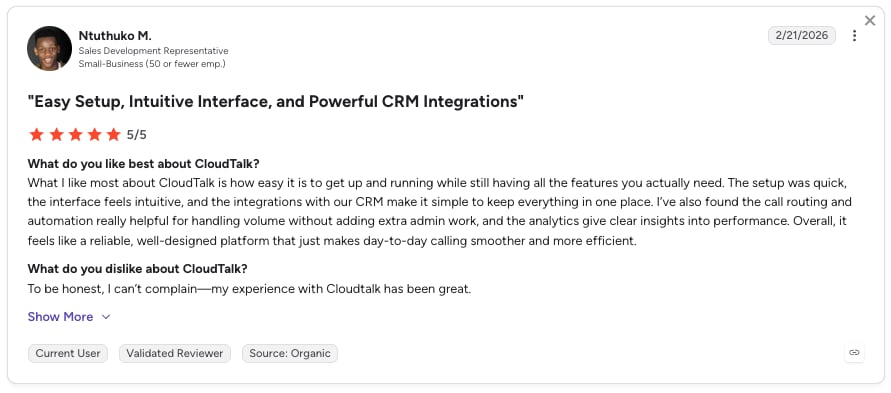
CloudTalk users consistently highlight the ease of use, intuitive interface, and affordability.
How Do G2 Users Rate CloudTalk?
CloudTalk's current G2 rating is 4.4/5, out of 1928+ verified user reviews.
When Should You Use CloudTalk?
CloudTalk is the right choice if your support team needs to:
- Automate repetitive support requests, such as order status, appointment scheduling, account questions, FAQs, or basic troubleshooting.
- Reduce wait times during peak call volumes by letting AI handle overflow while human agents focus on complex cases.
- Support customers in multiple languages with natural conversations across 60+ languages and accents.
- Route callers to the right team automatically based on their intent, language, or urgency instead of relying on IVR menus.
Turn missed calls into resolved requests.
2. Retell AI: Best For Developer Teams Needing Full API Control
What Is Retell AI?
Retell AI is an API-first platform for building, deploying and managing voice agents that interact like humans. It's built for developer-led teams that want to own the orchestration layer between telephony, the LLM and the voice model, rather than working inside a no-code drag-and-drop builder.
What Are Retell AI's Key Features?
- A proprietary voice orchestration layer with roughly 600ms latency and interruption handling built in
- Support for 31+ languages
- Concurrent-calling support for scaling simultaneous calls, plus a dashboard for non-orchestration settings
What Are the Pros and Cons of Retell AI?
| Pros | Cons |
|---|---|
| Fast to deploy, intuitive workflow builder | Limited built-in VoIP infrastructure |
| Enterprise-grade compliance (SOC 2, HIPAA, GDPR) | Fewer native CRM integrations than full phone systems |
Who Is Retell AI Best For?
Developer-led teams that want full control over the voice, LLM and telephony stack, and that have the engineering time to build and maintain that stack themselves.
How Much Does Retell AI Cost?
Retell AI pricing includes two plans:
- Pay-as-you-go, roughly $0.05–$0.12/minute depending on model and volume
- Custom enterprise pricing available.
What Do Customers Say About Retell AI?
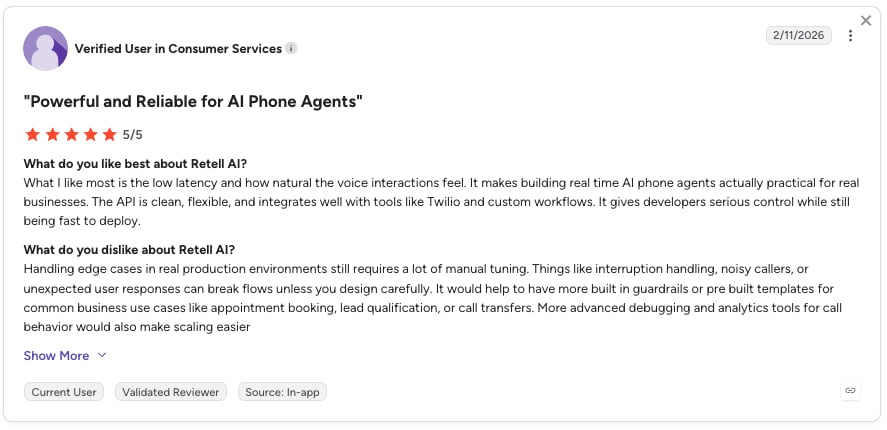
Retell AI customers highlight that they can go from idea to a working voice agent quickly, thanks to an intuitive interface and clear workflow builder, but note the platform struggles with highly complex or dynamic conversational logic compared to more developer-first tools.
What Is Retell AI's G2 Rating?
Retell AI's current G2 rating is 4.8/5, out of 2,640+ verified user reviews.
When Should You Use Retell AI?
Use Retell AI if you have engineering resources and want granular control over every part of the voice pipeline.
When Shouldn't You Use Retell AI?
Avoid it if you need a no-code launch or a predictable flat monthly bill; its stacked, usage-based pricing is hard to forecast for a non-technical buyer.
3. Synthflow: Best For SMBs and Agencies Wanting a No-Code Agent Fast
What Is Synthflow?
Synthflow is a no-code platform for building voice AI assistants that handle cold calling, inbound calls and appointment scheduling. It's aimed at SMBs and agencies that want a phone agent live without writing code or hiring a developer.
What Are Synthflow's Key Features?
- A no-code visual editor for building phone agents and conversation flows
- 30+ languages and dialects with real-time translation
- Voicemail detection, call routing, live-agent handoff, SMS follow-ups and CRM integrations with HubSpot, Zoho, Zapier and Make.com
What Are the Pros and Cons of Synthflow?
| Pros | Cons |
|---|---|
| No-code builder lowers the barrier to launching a first voice agent | Less customization depth than developer-first platforms for advanced use cases |
| End-to-end Voice AI platform with its own in-house telephony infrastructure | Pricing can become expensive as call minutes increase |
Who Is Synthflow Best For?
SMBs and agencies that want to launch a voice AI agent fast, without engineering help, and that are comfortable with usage-based pricing instead of a flat monthly fee.
How Much Does Synthflow Cost?
Synthflow pricing is usage and tier-based; no confirmed flat monthly figure. Contact Synthflow directly for the current rate card.
What Do Customers Say About Synthflow?
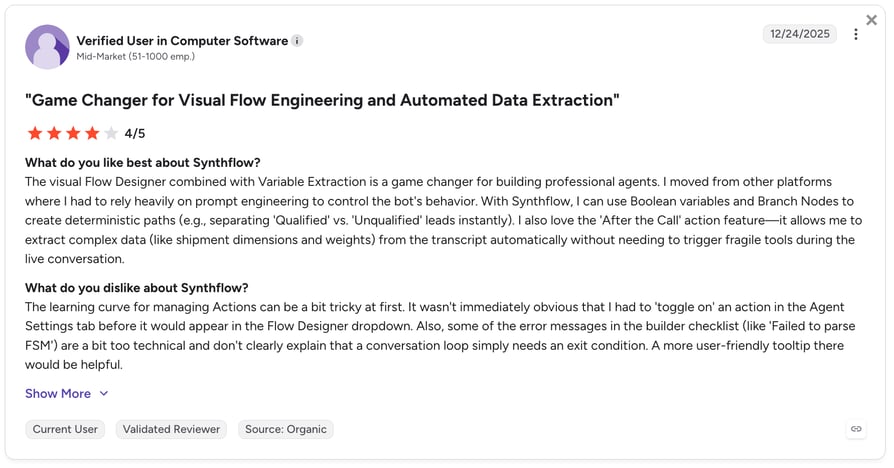
Synthflow customers consistently highlight fast deployment but also point to two key limitations: a learning curve when moving beyond simple setups and a ceiling on advanced customization.
What Is Synthflow's G2 Rating?
Synthflow’s current G2 rating is 4.5/5 out of 1,015+ reviews.
When Should You Use Synthflow?
Use Synthflow if speed to launch matters more than deep customization and you don't have engineering resources on hand.
When Shouldn't You Use Synthflow?
Avoid it if you're running high call volumes on a tight budget; usage-based pricing on top of a per-minute voice engine adds up fast.
4. Vapi: Best For Developers Wanting Code-Level Pipeline Control
What Is Vapi?
Vapi is a developer-first voice agent platform that sits between telephony and AI models, letting engineering teams deploy production-ready voice agents in minutes and customize every interaction as they scale.
What Are Vapi's Key Features?
- A bring-your-own-model architecture: choose your LLM (GPT-4, Claude, Gemini) and TTS provider (ElevenLabs, Azure, Play.ht) independently
- A real-time call pipeline advertised at sub-500ms, with interruption handling, backchanneling and tool calls
- 200+ integrations, custom SIP support, warm transfers and DTMF support
What Are the Pros and Cons of Vapi?
| Pros | Cons |
|---|---|
| Deep API-level control over the voice stack | Limited no-code tooling for non-technical teams |
| Works with multiple LLM providers | Real cost can run higher than advertised once telephony and LLM usage are added |
Who Is Vapi Best For?
Developer teams that want granular, code-level control over turn-taking logic and provider choice, and that are prepared to tune the pipeline themselves rather than take a managed default.
How Much Does Vapi Cost?
Vapi AI pricing is usage-based, starting at $0.05 / min.
What Do Customers Say About Vapi?
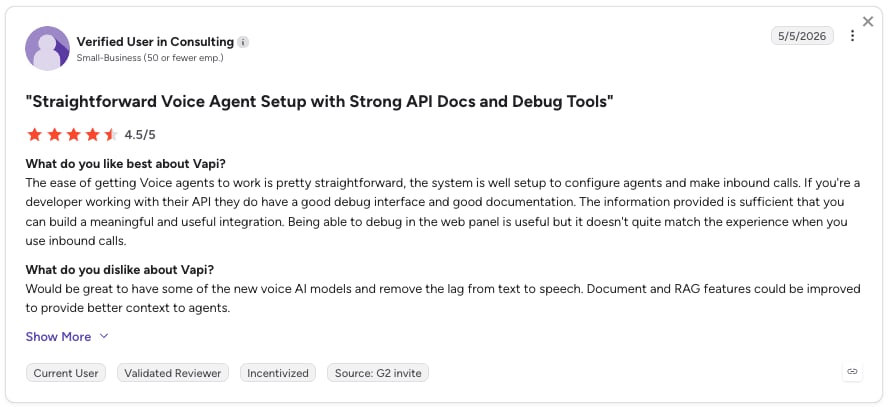
Vapi customers highlight ease of setup and flexibility for building voice AI agents, but report issues with latency, unreliable performance, additional costs, and inconsistent support.
What Is Vapi's G2 Rating?
Vapi has limited G2 review volume just one review at 4.5/5, since it's a developer-focused API
When Should You Use Vapi?
Use Vapi if you want to assemble your own best-of-breed voice stack and have the engineering time to tune latency and turn-taking yourself.
When Shouldn't You Use Vapi?
Avoid it if you need a plug-and-play tool for non-technical staff, or if you need to lean on G2 reviews to validate the decision; there aren't enough of them yet.
5. Bland AI: Best For Ops/Engineering Teams Needing Regulated Workflows
What Is Bland AI?
Bland AI is an enterprise voice AI platform for building, running and monitoring AI phone agents that hold real conversations at scale, both inbound and outbound, on Bland's own infrastructure.
What Are Bland AI's Key Features?
- A sub-400ms latency claim, self-hosted models, and "conversational pathways" designed for regulated workflows
- Drop-in compatibility with existing telephony via SIP, Twilio, Genesys, NICE or any provider emitting standard telephony events
- PII redaction in transcripts, configurable retention, BAA availability for healthcare, and tamper-resistant call logs
What Are the Pros and Cons of Bland AI?
| Pros | Cons |
|---|---|
| Powerful conversational capabilities | Not a full telephony platform |
| High concurrency for large outbound volumes | Steep learning curve for complex call flows |
Who Is Bland AI Best For?
Ops and engineering-heavy enterprise teams that need regulated-workflow voice agents with low latency and self-hosted model options, and that have the internal capacity to manage a multi-line billing structure.
How Much Does Bland AI Cost?
Bland AI pricing includes four pricing plans:
- Start: $0.14/min
- Build: $0.12/min
- Scale: $0.11/min
- Enterprise: Custom. See
What Do Customers Say About Bland AI?
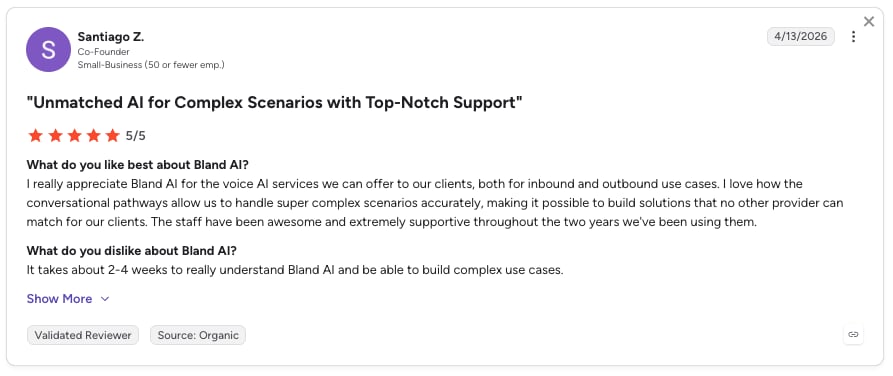
Bland AI customers highlight its ease of use and powerful conversational voice capabilities, but note a learning curve and complexity when moving beyond basic use cases.
What Is Bland AI's G2 Rating?
Bland AI's current G2 rating is 5/5, based on 11+ verified user reviews.
When Should You Use Bland AI?
Use Bland AI if you need self-hosted models and hard compliance guarantees for a regulated industry, and you have engineering staff to monitor for the reliability issues reviewers describe.
When Shouldn't You Use Bland AI?
Avoid Bland AI if you need a no-code platform or an all-in-one business phone system. It's built for engineering-led teams that want maximum control over their voice infrastructure, not for businesses looking to deploy AI agents quickly with minimal technical effort.
6. PolyAI: Best For Large, Multilingual Enterprise Contact Centers
What Is PolyAI?
PolyAI is a conversational AI platform built for enterprise customer service, designing lifelike voice assistants meant to understand callers naturally across multiple languages.
What Are PolyAI's Key Features?
- Multilingual support and customizable AI personas
- Real-time reporting and analytics
- Dialogue management and IVR integration
What Are the Pros and Cons of PolyAI?
| Pros | Cons |
|---|---|
| Voice output among the best in the industry | Pricing is fully quote-based, with no published starting rate |
| Simple, user-friendly interface | Doesn’t run its own VoIP infrastructure |
Who Is PolyAI Best For?
Large, multilingual enterprise contact centers — such as banks, hotels, casinos and healthcare systems — that need inbound call automation at real volume and have the budget for a custom enterprise contract.
How Much Does PolyAI Cost?
PolyAI pricing is custom-based only, determined by business needs and interaction volume.
What Do Customers Say About PolyAI?
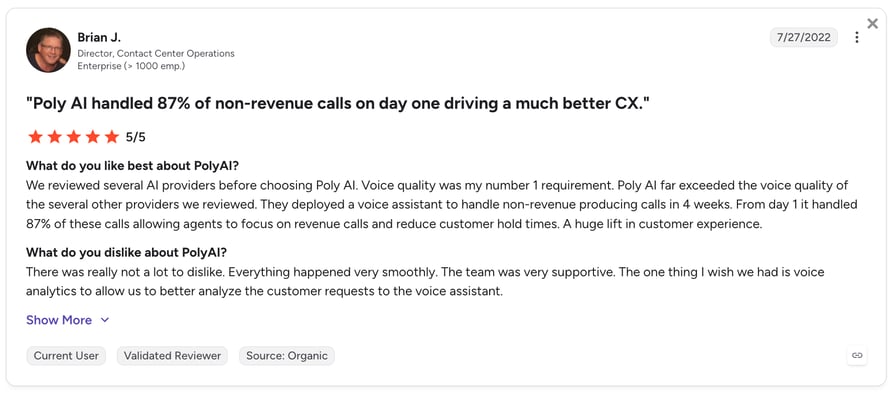
PolyAI customers praise its human-like voice and enterprise reliability, but cite limited analytics, custom pricing, and third-party telephony as common limitations.
What Is PolyAI's G2 Rating?
PolyAI’s current G2 rating is 5/5 out of 12+ reviews.
When Should You Use PolyAI?
Use PolyAI if you run a large, multilingual contact center and can commit to a six-figure annual contract for top-tier conversational quality.
When Shouldn't You Use PolyAI?
Avoid it if you need self-serve pricing, a fast pilot, or a phone system and voice AI in a single product rather than a standalone AI layer.
7. Cognigy.AI: Best For Enterprise Contact Centers Wanting a Broader CX Platform
What Is Cognigy.AI?
Cognigy is an enterprise-grade conversational AI platform that automates and enhances customer service across voice and chat, combining structured automation with large language models.aaS stack.
What Are Cognigy.AI's Key Features?
- Voice Gateway and generative AI integration
- Multichannel support and real-time translation
- Low-code flow builder
What Are the Pros and Cons of Cognigy.AI?
| Pros | Cons |
|---|---|
| Wide, enterprise-grade CRM and helpdesk integration catalog | Pricing is fully quote-based |
| Combines structured automation with generative AI for more flexible conversations | Deployment is enterprise-led rather than self-serve—not a same-day setup |
Who Is Cognigy.AI Best For?
Enterprise contact centers that want a broader conversational-AI platform with strong NLU and deep system integrations, typically deployed alongside an existing CCaaS stack rather than as a replacement for it.
How Much Does Cognigy.AI Cost?
Custom pricing only, based on business needs and interaction volume.
What Do Customers Say About Cognigy.AI?
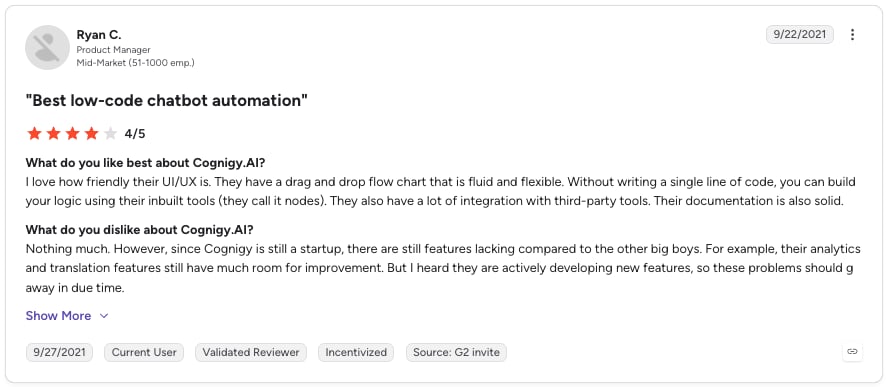
Cognigy reviewers on G2 consistently highlight ease of use and an intuitive low-code interface, while limited analytical capabilities are the most common criticism.
What Is Cognigy.AI's G2 Rating?
Cognigy's current G2 rating is 4.6/5 out of 13+ reviews.
When Should You Use Cognigy.AI?
Use Cognigy.AI if you already run a CCaaS stack and want an agentic AI layer with strong NLU on top of it.
When Shouldn't You Use Cognigy.AI?
Avoid it if you want to see pricing without going through an enterprise sales proces or if you need same-day, self-serve deployment rather than a longer rollout.
8. Decagon: Best For Enterprise Orgs Wanting One Agent Across Every Channel
What Is Decagon?
Decagon is an enterprise conversational AI platform for customer support across chat, email, voice and SMS, run from a single agent logic layer instead of separate tools per channel. The company brands itself "the AI concierge for every customer."
What Are Decagon's Key Features?
- Agent Operating Procedures (AOPs): non-technical teams define AI agent workflows in natural language instead of code
- A single agent logic layer operating consistently across chat, email, voice and SMS
- Handles account actions like shipment tracking, address updates, password resets and balance checks, plus knowledge-base-driven product and policy questions
What Are the Pros and Cons of Decagon?
| Pros | Cons |
|---|---|
| Fast implementation relative to expectations, with a responsive vendor team, per reviewers | Missing features like user roles and audit logs |
| Reviewers describe it as improving over time and integrating well with existing systems | Limited customization |
Who Is Decagon Best For?
Enterprise customer-support organizations that want one AI agent, defined in natural language, running consistently across every channel rather than a voice-only deployment.
How Much Does Decagon Cost?
Decagon's pricing is quote-based, with no public pricing page, no self-serve tier and no free trial.
What Do Customers Say About Decagon?
Customers praise Decagon for its fast implementation, intuitive interface, and strong AI performance. The main drawbacks are limited customization, some missing enterprise features, and a learning curve for more advanced workflows.
What Is Decagon's G2 Rating?
Decagon holds a 4.8/5 rating on G2 across 22+ reviews.
When Should You Use Decagon?
Use Decagon if you want to automate customer support across chat, email, voice, and SMS with a single AI agent, especially for enterprise teams handling high volumes of repetitive customer requests.
When Shouldn't You Use Decagon?
Avoid Decagon if you only need an AI voice agent or prefer a self-serve platform with transparent pricing and a quick setup.
9. Sierra: Best For Large Consumer Brands Wanting Outcome-Priced AI
What Is Sierra?
Sierra, co-founded by Bret Taylor and Clay Bavor, is an AI agent platform for customer experience that chats, answers phone calls, speaks multiple languages and takes action inside a company's systems of record.
What Are Sierra's Key Features?
- A multi-channel AI agent (chat and voice) with built-in guardrails and system-of-record write-back
- Human-like conversations and task automation
- Built-in optimization and monitoring
What Are the Pros and Cons of Sierra?
| Pros | Cons |
|---|---|
| Accurate, natural conversations and a responsive implementation team | Not a complete telephony system |
| Outcome-based pricing aligns cost to results rather than usage | No published pricing at all, so buyers can't self-qualify budget fit without a sales conversation |
Who Is Sierra Best For?
Sierra is one of the best conversational AI platforms for customer service for large consumer brands that want a premium, outcome-based AI layer across chat and voice.
How Much Does Sierra Cost?
Sierra's pricing is quote-based and outcome-based; the company doesn't publish a per-outcome rate.
What Do Customers Say About Sierra?
Customers praise Sierra for its natural conversations, ease of use, and seamless integrations. Common criticisms include limited customization, pricing transparency, and the need for human intervention in more complex conversations.
What Is Sierra's G2 Rating?
Sierra holds a 4.4/5 rating on G2 across 35+ reviews.
When Should You Use Sierra?
Use Sierra if you want to automate customer support across voice and digital channels with one AI agent that can handle complex customer requests and take action in your business systems.
When Shouldn't You Use Sierra?
Avoid Sierra if you only need an AI voice agent or prefer a self-serve platform with transparent pricing and a simple setup.
10. Regal.ai: Best For B2C Teams Building Event-Driven Voice Journeys
What Is Regal.ai?
Regal (Regal.ai) is an enterprise voice AI agent platform that lets companies build, deploy, and manage autonomous AI agents for inbound and outbound voice, SMS, and chat across customer support, sales, and operations.
What Are Regal.ai's Key Features?
- Journey Builder: a no-code, multi-step, cross-channel sequence triggered by customer actions like a missed payment or an abandoned cart
- Voice agents trained on your brand and use case for both outbound and inbound calls, with TCPA-compliant guardrails
- Integrations with CCaaS and CRM platforms, plus APIs and webhooks
What Are the Pros and Cons of Regal.ai?
| Pros | Cons |
|---|---|
| Exceptional and responsive customer support | Reporting and analytics are described as limited |
| Ease of use | Fully custom pricing with no public rate card, so buyers can't self-qualify cost before a sales call |
Who Is Regal.ai Best For?
Enterprise and high‑growth companies that run large volumes of customer calls and need AI agents that can act on real‑time data across voice, SMS, and chat.
How Much Does Regal.ai Cost?
Regal.ai's pricing is quote-based with no public rate card.
What Do Customers Say About Regal.ai?
Customers praise Regal for its ease of use, flexible journey automation, and responsive support, while noting that reporting, real-time analytics, and some admin features could be more mature.
What Is Regal.ai's G2 Rating?
Regal.ai holds a 4.7/5 on G2 out of 45+ reviews.
When Should You Use Regal.ai?
Use Regal.ai if you want AI agents that orchestrate customer journeys across voice, SMS, and chat, especially for high-volume inbound and outbound customer interactions.
When Shouldn't You Use Regal.ai?
Avoid Regal.ai if you only need a standalone AI voice agent or prefer a self-serve platform with transparent pricing and a simple setup.
11. Cresta: Best For High-Volume Contact Centers Pairing AI With Live Coaching
What Is Cresta?
Cresta combines autonomous voice and chat AI agents with real-time agent-assist and conversation-intelligence analytics, aimed at large contact centers. The company describes its mission as building "AI agents for every customer conversation."
What Are Cresta's Key Features?
- An LLM-native hybrid architecture (large language models plus structured business logic) for voice and chat AI agents
- Real-time Agent Assist, giving live in-call guidance, and a Knowledge Agent that surfaces answers during live calls
- Quality Management that auto-scores 100% of conversations, instead of the traditional sampling approach, using generative AI behavioral models
What Are the Pros and Cons of Cresta?
| Pros | Cons |
|---|---|
| Real-time coaching is the most consistently praised feature | AI can misinterpret customer intent |
| Ease of use | Quote-based pricing only |
Who Is Cresta Best For?
High-volume enterprise contact centers, typically 100 or more human agents, that want AI voice agents deployed alongside real-time coaching and QA for the humans still on the phones.
How Much Does Cresta Cost?
Cresta's pricing is quote-based with no public rate card.
What Do Customers Say About Cresta?
Customers praise Cresta for its real-time coaching, call analysis, and AI-driven insights, while noting that the platform can struggle with accuracy, understanding customer intent, and requires time to adapt to specific business needs.
What Is Cresta's G2 Rating?
Cresta holds a 4.2/5 rating on G2 across 43+ reviews.
When Should You Use Cresta?
Use Cresta if you manage a large contact center and want to combine AI agents with real-time coaching, automated QA, and conversation analytics to improve agent performance.
When Shouldn't You Use Cresta?
Avoid Cresta if you need a lightweight AI support tool or don't have enough call volume to justify an enterprise-grade platform and implementation effort.
How to Choose the Right AI Voice Agent for Your Customer Support Team?
Not every AI voice agent is built for customer support. Before choosing a platform, evaluate the factors below to find a solution that delivers accurate, reliable, and scalable customer service.
Evaluate Conversation Quality and Natural Language Understanding
The best AI voice agents sound natural, not robotic. They should understand interruptions, follow-up questions, and changes in topic without losing track of the conversation. When they can handle real conversations, they resolve more issues without transferring callers to a human agent.
Do This Before You Buy:
Don't rely on scripted demos. Ask vendors to show live, unscripted calls so you can see how the AI performs in real customer interactions.
Reduce Latency for Better Customer Experiences
Response speed has a direct impact on customer satisfaction. If callers have to wait more than a second for every reply, conversations quickly start to feel awkward and unnatural. This is exactly why evaluating voice AI for customer service has to include latency data from live production traffic, not a quiet demo environment
Do This Before You Buy:
Ask vendors about real-world latency, not just benchmark results from ideal testing environments. Production performance is a much better indicator of the experience your customers will actually have.
Integrate Your CRM and Helpdesk
Your AI voice agent should automatically update your CRM and helpdesk after every conversation. Otherwise, agents end up switching between systems and manually copying information.
Do This Before You Buy:
Look for native, two-way integrations that keep customer data synchronized. Native, two-way sync is what turns AI customer service automation into a single continuous record instead of two disconnected ones.
Verify Compliance and Security Requirements
If your business handles sensitive customer information, security should be a key part of your evaluation—not an afterthought.
Do This Before You Buy:
Check whether the vendor supports the certifications your industry requires, such as HIPAA, SOC 2, or GDPR compliance. Confirm these capabilities before signing a contract to avoid costly surprises later.
Compare Pricing Models Based on Your Call Volume
The cheapest option today isn't always the cheapest as your business grows. Some vendors charge per minute, others per user, while some price based on completed outcomes.
Do This Before You Buy:
Estimate your expected call volume and compare what each pricing model would cost over time. It's also worth asking how pricing changes if your call volume doubles or grows fivefold, so you can avoid unexpected costs as your support team scales.
Ready to evaluate AI voice for your support team?
Quick Answers to Common Questions About AI Voice Agents for Customer Support
What Is an AI Voice Agent for Customer Support?
An AI voice agent is a form of intelligent customer service software that holds a real, two-way phone conversation with a caller, understanding intent and free-form speech rather than routing them through a keypad menu. It can answer questions, look up account information, book appointments and complete other tasks on its own, escalating to a human agent only when the request genuinely needs one.
Can AI Voice Agents Replace Human Customer Service Agents?
Not entirely. AI voice agents excel at handling routine customer inquiries and repetitive tasks, but they can't replace the empathy, critical thinking, and decision-making required for more complex situations. Most organizations use AI to automate common requests while human agents manage the conversations that need a personal touch.
How Much Does an AI Voice Agent Cost for Customer Service?
Costs vary widely by provider and model. Developer-first platforms like Retell AI, Synthflow and Vapi charge per minute, typically $0.05–$0.31/min depending on the stack. CloudTalk's AI Voice Agent starts at $99/month for 200 minutes. Enterprise contact-center platforms like PolyAI, Cognigy, Decagon, Sierra and Cresta are quote-based, with entry contracts commonly starting in the six figures per year.
What Is the Average Call Resolution Rate for AI Voice Agents?
There isn't a single industry-wide resolution rate because results vary depending on the types of calls, the quality of your knowledge base, and how each vendor defines a "resolved" issue. While many vendors publish their own resolution or containment rates, it's best to validate those numbers with a pilot before using them to compare providers.
What Is the Difference Between an AI Voice Agent and an IVR?
A traditional IVR guides callers through pre-set menus using keypad selections or simple voice commands. It can route calls to the right department, but it usually can't solve the customer's issue.
An AI voice agent understands natural conversations, keeps track of context, and can complete tasks on its own—such as rescheduling an appointment, checking an order status, or answering common questions—without transferring the caller to a human agent.
What Reddit Users Say About AI Voice Agents for Customer Service
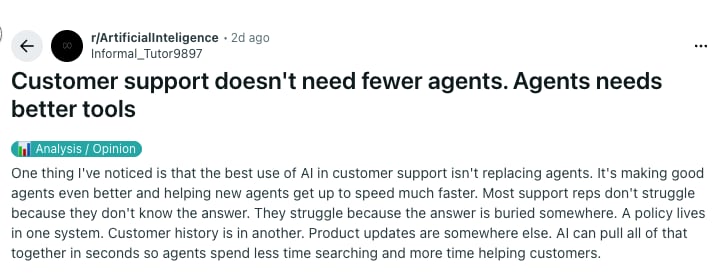
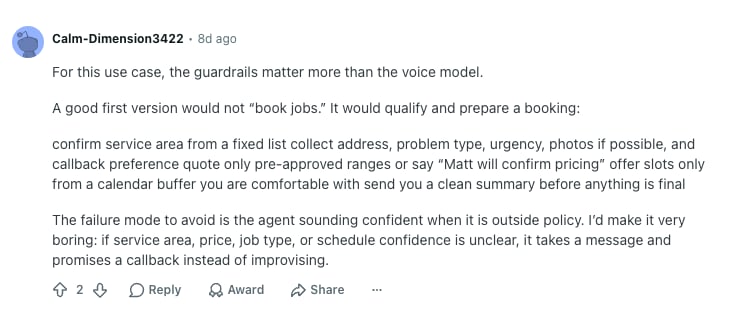
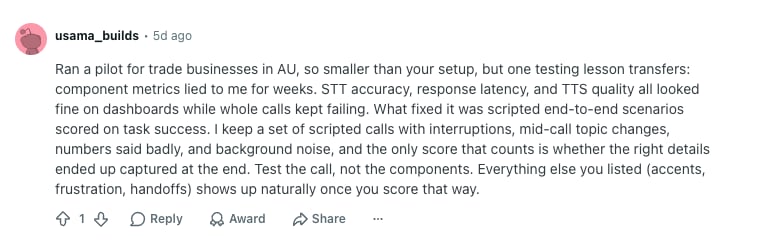
Reddit discussions show that businesses are interested in AI voice agents for reducing repetitive calls and improving response times, but users emphasize that reliability matters more than full automation.
Key takeaways from the discussions include:
- Focus on guardrails, not just automation: Users recommend starting with clearly defined limits. AI agents should handle common questions and collect information, but avoid making decisions about pricing, policies, or complex cases unless they have the right data.
- Test real-world scenarios: Reddit users highlight that demos often fail to reflect real customer conversations. Interruptions, topic changes, background noise, frustrated callers, and smooth human handoffs are some of the most important scenarios to test before going live.
- Use AI to support human agents: Many users see the biggest value in helping support teams rather than replacing them completely. AI can handle repetitive requests and surface relevant information, allowing human agents to focus on more complex conversations.
The Overall Consensus:
A successful AI voice agent is not the one that handles every conversation alone—it’s the one that resolves routine requests reliably and knows when to involve a human.
Which AI Voice Agent Should You Choose?
The best AI voice agent depends on your team's size, technical resources, and customer support goals. Here’s a quick breakdown:
For SMBs and Growing Support Teams
- Choose CloudTalk if you need an AI voice agent that works alongside your phone system, CRM integrations, and existing workflows without requiring developer resources.
- Consider Synthflow if you want a fully no-code solution and don't need built-in telephony capabilities.
For Developer-Led Teams
- Choose Retell AI or Vapi if you want full control over the voice, LLM, and telephony stack and have the technical resources to build and maintain it.
- Consider Bland AI if you need more control over deployment, including self-hosted options, but review reliability feedback before committing.
For Enterprise Contact Centers
- Choose PolyAI or Cognigy for advanced conversational AI, multilingual support, and complex enterprise workflows.
- Choose Decagon if you want AI agents across multiple channels.
- Choose Sierra if outcome-based automation fits your business model.
- Choose Regal.ai for event-driven customer journeys.
- Choose Cresta if your priority is combining AI automation with real-time agent assistance and coaching.
Still deciding which AI voice agent is right for your team?
Frequently Asked Questions
It transfers the call to a human agent along with the full conversation transcript and context, so the caller doesn't have to repeat themselves or start over.
Some are. CloudTalk's AI Voice Agent, for example, runs on top of a HIPAA-compliant phone system, but compliance varies by vendor, so confirm certifications in writing before you deploy in a regulated environment.
It ranges from under 10 minutes with a templated, self-service setup to several months for a custom enterprise build with dedicated professional services.
Most do, though accuracy varies widely by language. Always confirm which languages a vendor has actually tested for multilingual customer support, not just listed, before relying on it for live calls.
Track containment rate, average handle time and customer satisfaction, and keep monitoring your customer support after launch rather than relying only on a vendor's own resolution-rate claims.
Increasingly, yes. A growing number of regulations require clear AI disclosure at the start of a call, so confirm your vendor supports a compliant opening script before you launch.