Summary of PolyAI Pricing
| Pricing Element | PolyAI | Notes |
| Pricing model | Custom, usage-based (per minute) | No public rate card; quote only |
| Starting cost | ~$150,000+/year (estimated) | Six-figure annual contracts with minimum spend |
| Free option | No free tier or free trial | Every evaluation starts with a sales call and demo |
| Best for | Large enterprises with high call volumes | Banking, telecom, travel, retail, healthcare |
TL;DR
PolyAI doesn't publish prices. It's a custom, usage-based model billed per minute through annual enterprise contracts, and third-party estimates put the starting point at around $150,000 a year, shaped by your call volume, integrations, languages, and compliance needs.
- 01There's no free tier, no free trial, and no self-serve signup, so every path to a price runs through a conversation with their sales team.
- 02However, the price includes maintenance, upgrades, and 24/7 support.
- 03The catch: telephony, CRM integration, and compliance work usually land on a separate invoice, so the headline number rarely tells the whole story.
So is PolyAI worth it? Yes, if you're a massive enterprise fielding millions of calls, then yes, genuinely; it's built for exactly that, and it's excellent at it.
BUT if you're a smaller or growing team, you'll want a more personal, hands-on touch, from a platform like CloudTalk that builds easy-to-set-up AI voice agents into a full phone system, with transparent pricing and a free trial you can start today.


What Pricing Plans Does PolyAI Offer?
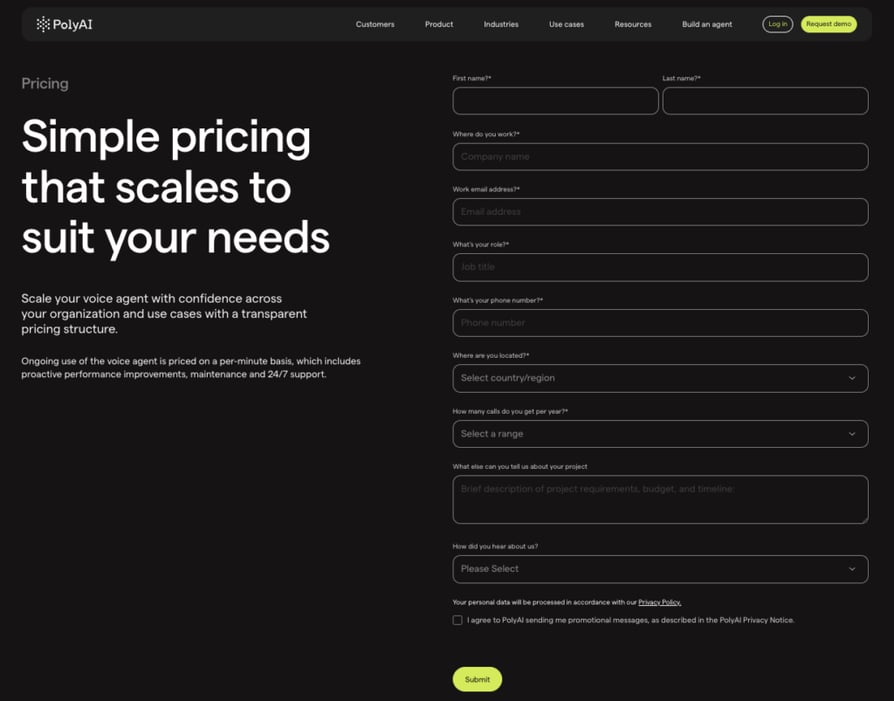
PolyAI offers no public pricing plans; there is one custom, usage-based enterprise model, quoted per client and billed per minute. There is no Starter, no Pro, no Max, and no published rate.
As for how much does PolyAI cost in practice: nobody outside a signed contract knows the exact number. The published AI voice agent pricing page confirms billing happens per minute and that the rate includes proactive performance improvements, maintenance, and 24/7 support, but it lists no rates and no minimums.
Based on third-party estimates, contracts typically start around $150,000 per year and go up from there. In other words, the PolyAI pricing plans you'd normally compare on a vendor page simply don't exist; the PolyAI price is firmly enterprise-tier, aimed at banks, telecoms, hotels, insurers, and retailers handling thousands of calls a day, not at startups testing their first voice agent.
What Do Real Users Say About PolyAI's Pricing?
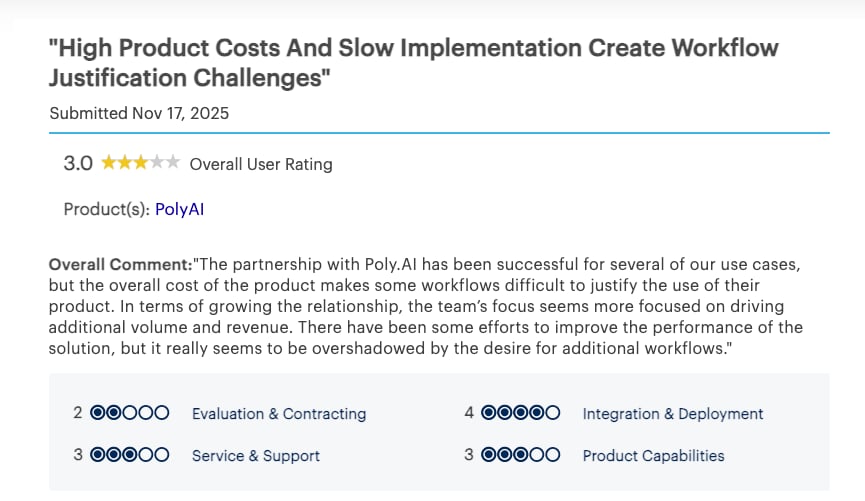
Gartner Peer Insights reviewers rate PolyAI 4.6, but some reviewers note particularly high costs.
Reviewers in hospitality and finance praise how human the assistant sounds and how much call volume it absorbs; one notes the voice doesn't sound robotic. Pricing barely comes up in the reviews themselves, which is telling: the people writing them are large enterprises for whom the spend was already justified.
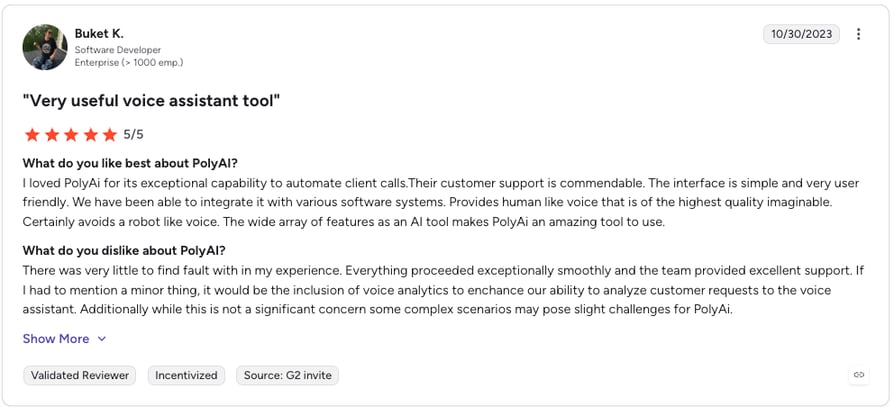
The recurring critique sits outside the review platforms: a lack of pricing transparency. Across Trustpilot and analyst commentary, the consistent theme is that you cannot model costs until you are deep in a sales process, and that the six-figure floor rules PolyAI out for most mid-market teams—just kidding! The reviewers on Truspilot seem to have mistaken PolyAI for one of the many sex-chat AIs whose name seem to begin with 'Poly'.
On the upside, buyers cite a Forrester study commissioned by PolyAI that found a 391% three-year ROI for large enterprise clients, so the investment is justified.
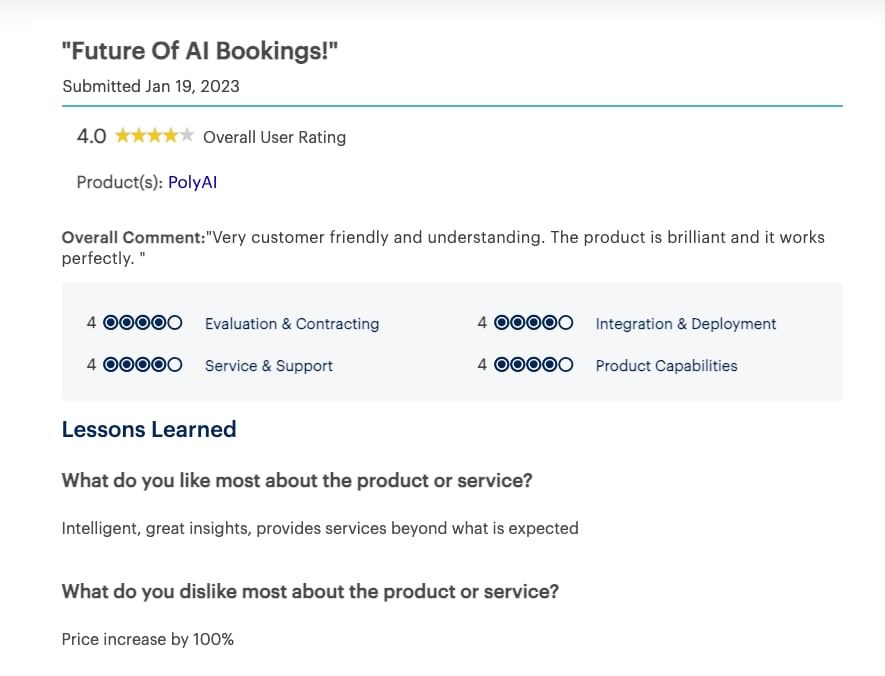
The takeaway: PolyAI receives an A+ for performance, but if you're a fan of upfront prcing - you might not like the contract-only must-speak-with-sales-first-pricing-model.
What Is PolyAI's Pricing Model?
The PolyAI pricing model is usage-based: you pay for the minutes the voice agent spends on calls, not per seat or per user. There are no license tiers to choose between. Instead, your annual cost is shaped by call volume, peak concurrency, the number of languages you deploy, and how many systems the agent has to integrate with.
What's included in PolyAI's per-minute rate?
- Ongoing use of the voice agent, billed per minute of conversation
- Proactive performance improvements and model maintenance
- 24/7 support, including a web ticket portal and an emergency support phone line
- Security and compliance coverage, with audits and testing
- A published uptime SLA (99.9% on phone lines) and continuous monitoring
- Upgrades to the latest features as the platform evolves
PolyAI's pricing model: who is it best for?
The model fits enterprises that run high, fairly predictable call volumes and want a vendor-managed deployment with support and SLAs baked into a single rate. If your monthly minutes are large and consistent, bundling maintenance and support into the per-minute price removes a lot of line-item negotiation.
What you need to know about PolyAI's pricing model:
Because billing is per minute, call duration mechanics matter. Reviewers note that automated rounding (often to 30-second increments) can push billed minutes above actual talk time, so your effective cost per call can run higher than a back-of-envelope estimate suggests. Ask for the rounding rules in writing before you sign.
What Is PolyAI's Enterprise Pricing?
Enterprise is effectively the only way to buy PolyAI. PolyAI enterprise pricing takes the form of a custom annual (often multi-year) contract with a minimum spend commitment, negotiated against your projected call volume and deployment scope. Third-party estimates place the floor at roughly $150,000 per year.
What's included in PolyAI's Enterprise contract?
- Platform access plus everything in the per-minute rate (support, maintenance, upgrades, SLA)
- A managed delivery model: PolyAI's team co-designs the dialogue logic and knowledge retrieval with you
- A dedicated onboarding specialist and integration team during setup
- Enterprise security and governance: SOC 2, HIPAA, GDPR, and PCI DSS as standard
- An ongoing customer relationship manager focused on improving success metrics over time
PolyAI's Enterprise contract: who is it best for?
It is best for mid-size to large organizations in regulated, call-heavy industries: banks, insurers, telecoms, hotels, and large retailers where conversation quality and compliance are non-negotiable and the call volume is big enough to absorb a six-figure commitment.
What you need to know about PolyAI's Enterprise pricing:
The minimum spend is the catch. Because contracts come with a floor, lower-volume teams end up paying for capacity they may not use, which is why PolyAI rarely makes sense below enterprise scale. Get the minimum commitment, contract length, and any annual uplift terms clarified early, since these define the real poly ai subscription price far more than the headline per-minute number does.
What Is PolyAI's Voice Assistant Pricing?
PolyAI voice assistant pricing comes down to how minutes are consumed, because minutes are the meter. Three things move that meter the most: how long calls run, how many calls happen at once (concurrency), and how many languages and add-on capabilities you switch on.
What's included in PolyAI's voice assistant pricing?
- Per-minute billing tied to speech recognition (ASR) minutes processed on each call
- Concurrency capacity for simultaneous calls, which scales with your contract
- Core language support at the model level (24+ languages)
- Conversation analytics and call-outcome data as part of the platform
PolyAI's voice assistant pricing: who is it best for?
It suits teams whose call patterns are voice-first and high-volume, where the per-minute economics beat staffing equivalent live agents. The more transactional calls you can automate end to end, the better the value.
What you need to know about PolyAI's voice assistant pricing:
Some of the things that make voice agents impressive are priced as separate enterprise workstreams. Regional dialect tuning, code-switching, voice cloning, and deep analytics pipelines often sit outside the base contract. If those matter to you, get them quoted up front so they don't surface as change orders later.
What Are PolyAI's Additional Costs?
The base contract is only part of the total PolyAI cost. Because PolyAI is a managed, enterprise-grade deployment, several costs sit outside the per-minute rate and tend to surface during implementation rather than in the initial quote. Here's what to budget for.
| Additional Cost | Estimated Amount | Notes |
|---|---|---|
| Telephony / carrier fees | Varies by carrier | PSTN call routing is billed outside PolyAI, based on concurrency |
| CRM & integration setup | Internal engineering time | Connecting Salesforce, Genesys, or custom APIs to the agent |
| Compliance engineering | Project-based | PCI and secure payment handling add a separate security workstream |
| Multi-language expansion | Custom per language | New languages may require additional model training and tuning |
| Conversation iteration | Consulting cycles | Updating flows without a self-serve prompt sandbox |
| Add-on capabilities | Custom pricing | Voice cloning, deep analytics, dialect-specific tuning |
PolyAI's Per-Minute Billing: The Hidden Variable
The cost most teams underestimate is how quickly minutes accumulate once an agent is live across your call volume. Billing is tied to speech-recognition minutes, and reviewers flag that automated rounding can inflate billed transcription minutes beyond actual talk time. At enterprise volume, even a small per-call overage multiplies into a meaningful monthly difference, so it pays to pressure-test the rounding rules and model your minutes conservatively.
PolyAI Implementation and Setup Costs for Enterprise
PolyAI's managed model means setup is a project, not a signup. Onboarding and integration support are included in the contract, but the surrounding work is not free: connecting your telephony and CRM stack, building and reviewing dialogue flows, and meeting compliance requirements all draw on internal engineering and project time.
For regulated industries, the compliance architecture alone can be a significant line item. Realistically, expect a multi-week to multi-month rollout before the agent is handling production calls.
Does PolyAI Have a Free Plan?
No. PolyAI has no free plan, no free trial, and no self-serve option. PolyAI does require a subscription in the form of an annual enterprise contract, and the only way to evaluate it is through a sales call and a custom demo. If a no-commitment trial is important to you, that alone may steer you toward an alternative with self-serve access.
What Will PolyAI Actually Cost?
At realistic enterprise volumes, PolyAI costs an estimated $12,500 to $28,000+ per month, anchored to a contract minimum estimated around $150,000 per year.
Ask how much is PolyAI and the precise answer is always "it depends," because PolyAI doesn't publish rates; but we can model PolyAI pricing per month using the widely cited ~$150,000/year starting estimate and typical enterprise usage patterns. Treat the figures below as informed estimates, not quotes; your actual number depends on volume, languages, integrations, and negotiation.
Scenario 1: Mid-Market Team Testing a Single Use Case
Profile: A support team automating one inbound use case (for example, booking changes) at roughly 8,000–10,000 minutes per month. Low complexity, single language.
| Cost Item | Monthly Cost |
|---|---|
| Annual contract minimum (est.) | ~$150,000/year |
| Effective monthly cost (est.) | ~$12,500/mo |
| Telephony / carrier fees | Separate (varies) |
| Implementation & onboarding | Included in contract |
| Estimated total | ~$12,500+/mo |
Verdict: At this volume the six-figure minimum dominates, so the effective cost per minute is high. PolyAI's quality is real, but a single low-volume use case is hard to justify against the floor. This is the scenario where is PolyAI worth it most often comes out as "not yet."
Scenario 2: Growing Support Org, Production Deployment
Profile: A support organization running one or two use cases at scale, around 50,000 automated minutes per month, with a CRM integration.
| Cost Item | Monthly Cost |
|---|---|
| Annual contract (est.) | ~$150,000–$250,000/year |
| Effective monthly cost (est.) | ~$12,500–$20,800/mo |
| Telephony / carrier fees | Separate (varies) |
| CRM integration | Internal engineering time |
| Estimated total | ~$15,000–$22,000+/mo |
Verdict: This is where the economics start to work. At 50,000 minutes, automating calls that would otherwise need a full shift of live agents makes the contract defensible, provided containment rates hold up for your use cases.
Scenario 3: Large Enterprise, Multi-Use-Case, Multilingual
Profile: A large enterprise running several use cases across multiple languages and departments, 150,000+ automated minutes per month, with PCI requirements.
| Cost Item | Monthly Cost |
|---|---|
| Annual contract (est.) | $300,000+/year |
| Effective monthly cost (est.) | ~$25,000+/mo |
| Multi-language tuning | Custom per language |
| Compliance (PCI, etc.) | Project-based |
| Estimated total | $28,000+/mo |
Verdict: At this scale PolyAI is built to deliver, and the Forrester-cited 391% three-year ROI becomes plausible. Just budget conservatively for the add-on layers; multilingual tuning and compliance work can move the total well beyond the base contract.
Scenario 4: PolyAI vs. Hiring Human Call Center Agents
Profile: An operation handling roughly 50,000 calls a month, deciding between PolyAI and staffing up live agents.
| Option | Annual Cost |
|---|---|
| PolyAI (estimated annual) | ~$150,000–$250,000/year |
| 15–20 human agents (fully loaded) | ~$700,000–$1,000,000/year |
| Cost behavior | AI scales sub-linearly; headcount scales linearly |
| Verdict | AI wins at high, steady volume |
Verdict: When PolyAI displaces 15–20+ agents you'd otherwise hire, it's clearly cheaper. Below that headcount threshold, the six-figure floor is the thing that decides whether it pays off.
The Bottom Line on Real Costs
PolyAI's true poly ai cost is a function of scale. For large, voice-heavy operations replacing significant headcount, the numbers can work and the ROI case is strong. For everyone else, the minimum commitment, opaque quoting, and add-on layers make it an expensive and unpredictable place to start. If you want enterprise-grade AI calling without the six-figure entry point, it's worth comparing more transparent options before you commit.
Which Alternatives Are Better and Cheaper Than PolyAI?
The strongest alternatives to PolyAI are CloudTalk, Synthflow, Vapi AI, and Bland AI; each is cheaper to start, faster to launch, and more transparent than PolyAI's enterprise contract. PolyAI is genuinely excellent at what it does, but the enterprise-only model, opaque pricing, and slow time-to-launch leave a lot of teams looking for something better matched to their budget and timeline. Here's how the four voice AI alternatives compare, starting with the one built for teams that want to be live without a six-figure commitment.
| Platform | Starting Price | Minimum Commitment | Best For |
|---|---|---|---|
| PolyAI | Custom (est. ~$150K/year) | Six-figure annual | Large enterprises with high call volumes |
| CloudTalk | From $19/user/mo; AI agents $99/200 min | None; 14-day free trial | AI calling plus a full phone system, transparent pricing |
| Synthflow | From $0.08/min (PAYG) | None for pay-as-you-go | SMBs and startups wanting no-code agents fast |
| Vapi AI | $0.05/min platform fee | None | Technical teams wanting full stack control |
| Bland AI | $0.14/min (or $299/mo Build plan) | None | Teams wanting all-inclusive per-minute pricing |
1. CloudTalk: Best for Teams That Want Enterprise-Grade AI Calling Without Enterprise Pricing
Signature Capability
See CloudTalk’s AI Voice Agent in Action!
CeTe is an AI that talks like a human: no breaks, no training, no time off. It makes and answers calls, updates CRMs, books meetings, and loops in a human only when needed.
Press play to hear it. Want a wow moment? Get a free test call and try it live.

What is CloudTalk?
CloudTalk is an AI-powered business phone system built for sales and support teams that live on the phone. Where PolyAI is a managed, enterprise-only deployment, CloudTalk gives you AI voice agents, a full calling stack, and transparent published pricing you can sign up for today, with 160+ country coverage and a 14-day free trial.
Why CloudTalk is Better than PolyAI
Here's the fair version: PolyAI is genuinely good, but it does one thing, voice agents. CloudTalk is a full communications stack, a complete business phone system with inbound and outbound calling, intelligent dialers, routing, conversation intelligence, and 100+ tool integrations, that also includes AI voice agents you can set up yourself in 60+ languages.
The two are also built for different buyers: PolyAI targets the largest enterprises with six-figure budgets and managed, multi-week rollouts, while CloudTalk is built for SMBs and growing teams that want to be live this week, with 24/7 support and transparent pricing instead of a custom quote.
- A full business phone system, not just a voice bot: inbound and outbound calling, IVR, routing, and analytics in one platform
- AI voice agents included, with no-code setup in minutes across 60+ languages and accents
- Power dialer, smart dialer, and predictive dialer for outbound teams
- Conversation intelligence: call summaries, transcripts, sentiment analysis, and topic extraction
- 100+ native integrations with HubSpot, Salesforce, Pipedrive, Zendesk, and more
- 160+ country coverage with local numbers
- Published, flat-rate pricing, 24/7 support, and a 14-day free trial, with no six-figure minimum
PolyAI is the better fit if you're a global enterprise that wants a managed voice deployment and nothing else. But if you want AI voice agents inside a complete calling platform, live in days rather than quarters, CloudTalk is built for you.
What is CloudTalk's Pricing?
- Lite: $19/user/month
- Essential: $29/user/month
- Expert: $49/user/month
- AI Voice Agents: $99/200 minutes
- 14-day free trial included, no credit card required
Reviewers Say About CloudTalk
Here's what real customers have to say:
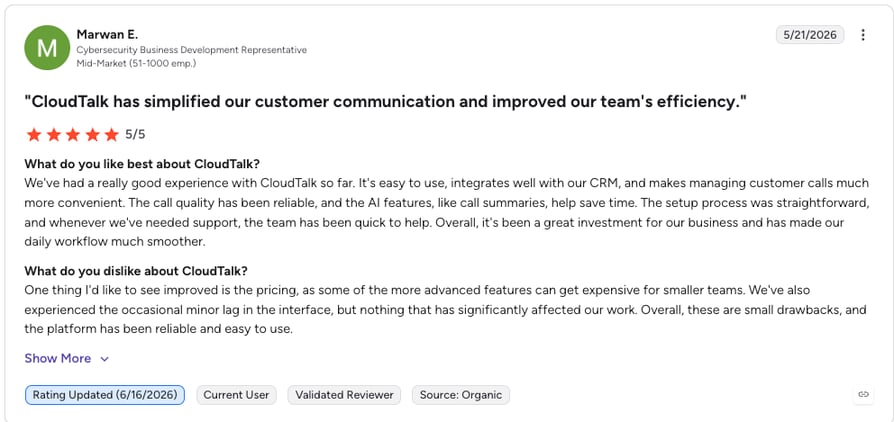
"CloudTalk has made it incredibly easy to manage and track all my sales and customer calls in one place. I love how seamlessly it integrates with CRMs like HubSpot and Apollo. The call quality is reliable, and features like call recording and analytics make it easy to review performance and improve conversations."

"We just copy the agents, update the scripts, and we're live. No need to hire and train a completely new team from scratch."
Owner of Circle Gym

Bottom line: If you need AI-powered calling but can't justify a six-figure contract or a months-long rollout, CloudTalk gives you the same outcomes with transparent pricing and a free trial you can start today.
2. Synthflow: Best for SMBs and Startups That Want No-Code Voice Agents Live Fast
What is Synthflow?
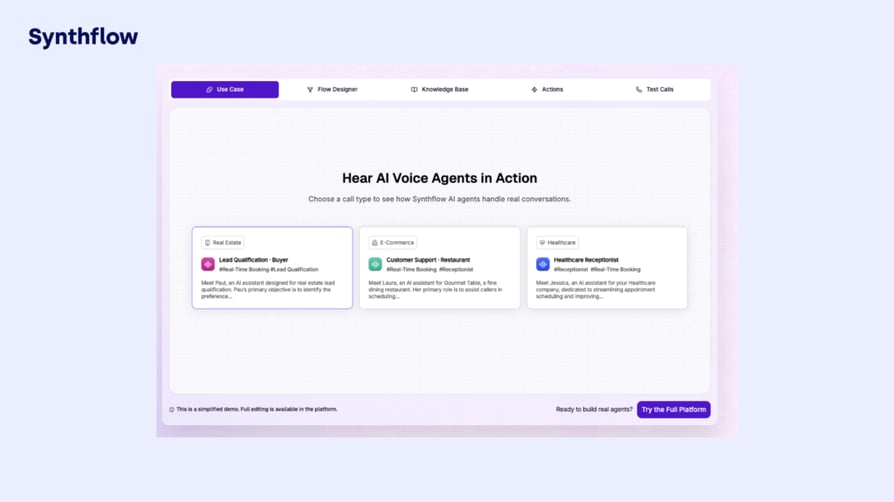
Synthflow is a no-code AI voice agent platform built for speed. You drag and drop a conversation flow, connect your tools, and go live without engineering help, the opposite of PolyAI's managed, consultative rollout. It's aimed squarely at small businesses and startups that want voice automation working in days, not quarters.
Why Synthflow is Better than PolyAI
Synthflow wins on accessibility. There's a self-serve plan, usage-based pricing, and no six-figure floor, so a team can start building agents for the cost of a few thousand minutes rather than a six-figure contract. It also bundles SOC 2, HIPAA, PCI, and GDPR compliance into its enterprise plan, which removes a common blocker for smaller regulated teams.
- No-code, drag-and-drop builder; live in days without developers
- Usage-based pricing with a self-serve entry point
- 60+ languages and native CRM integrations
- SOC 2, HIPAA, PCI, and GDPR compliance available
What is Synthflow's Pricing?
- Pay-as-you-go: usage-based, starting around $0.08/minute with no platform fee
- Enterprise: custom pricing with a minimum annual commitment, SLAs, and unlimited concurrency
- Effective rates often land between $0.11 and $0.24/minute once voice engine, LLM, and telephony choices are added
Worth knowing: Synthflow's headline per-minute rate doesn't include every component, so model your real effective rate before committing. It also holds a solid score on G2, though it's a younger platform than PolyAI.]
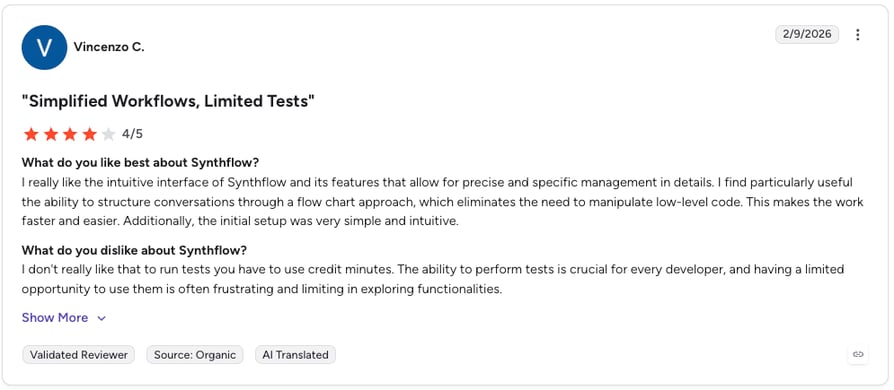
Synthflow Reviews
See what customers say about Synthflow:
3. Vapi AI: Best for Technical Teams That Want Full Control of the Voice Stack
What is Vapi AI?
Vapi AI is a developer-first voice orchestration platform. Instead of a managed deployment, it gives technical teams the building blocks to assemble their own voice agents, choosing their own speech-to-text, language model, and voice providers. It trades PolyAI's white-glove delivery for low base rates and maximum flexibility.
Why Vapi AI is Better than PolyAI
For teams with engineering resources, Vapi is dramatically cheaper to start and infinitely more configurable. There's no minimum contract, you pay per minute as you go, and you control the entire stack. The trade-off is that you also assemble and maintain that stack yourself, which is exactly the work PolyAI does for you.
- Self-serve, pay-as-you-go usage with no contract minimum
- Full control over STT, LLM, and voice provider choices
- Sub-500ms latency and developer-grade customization
- Custom Enterprise plan with unlimited concurrency and HIPAA options
What is Vapi AI's Pricing?
- Platform fee: $0.05/minute (orchestration only)
- Real all-in cost: typically $0.15–$0.40/minute once LLM, STT, TTS, and telephony are added
- Enterprise: custom; production deployments commonly run $40,000–$70,000/year
Worth knowing: the $0.05/minute headline is just the platform fee. See our full breakdown of Vapi AI pricing for what a production stack actually costs once every provider is switched on.
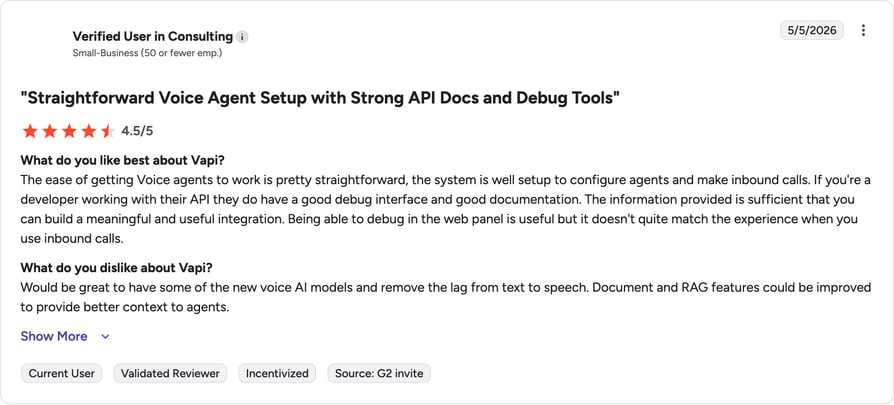
Vapi Reviews
See wht G2 reviewers say about Vapi:
4. Bland AI: Best for Teams That Want All-Inclusive Per-Minute Pricing
What is Bland AI?
Bland AI is an all-inclusive AI calling platform. Unlike Vapi's bring-your-own-providers model, Bland bundles speech, language, and voice into a single per-minute rate, so you don't manage separate API keys. It sits between PolyAI's managed enterprise approach and Vapi's developer toolkit, offering predictable per-minute pricing with far less setup than either.
Why Bland AI is Better than PolyAI
Bland is far easier to budget for and to launch. You get a transparent per-minute rate, no six-figure minimum, and no juggling of third-party providers. For teams that want one number to plan around and a fast path to production, it's a much lower-friction entry into AI voice for smaller and growing teams than PolyAI's contract model.
- All-inclusive per-minute pricing; no separate API keys to manage
- Inbound and outbound, no-code, with setup in minutes
- Built-in dashboards, rep performance, and call tagging
- Per-minute rate drops as you move up tiers
What is Bland AI's Pricing?
- Start: $0.14/minute, no monthly fee
- Build: $299/month, dropping the rate to ~$0.12/minute
- Higher tiers: per-minute rate falls toward ~$0.11/minute with volume
- HIPAA compliance: available as a ~$1,000/month add-on
Worth knowing: watch the extras; transfers, failed calls, and voice cloning carry additional fees, and at low volume the monthly plan fee raises your effective rate. Our Bland AI pricing guide breaks down where those costs land.
Bland AI Reviews
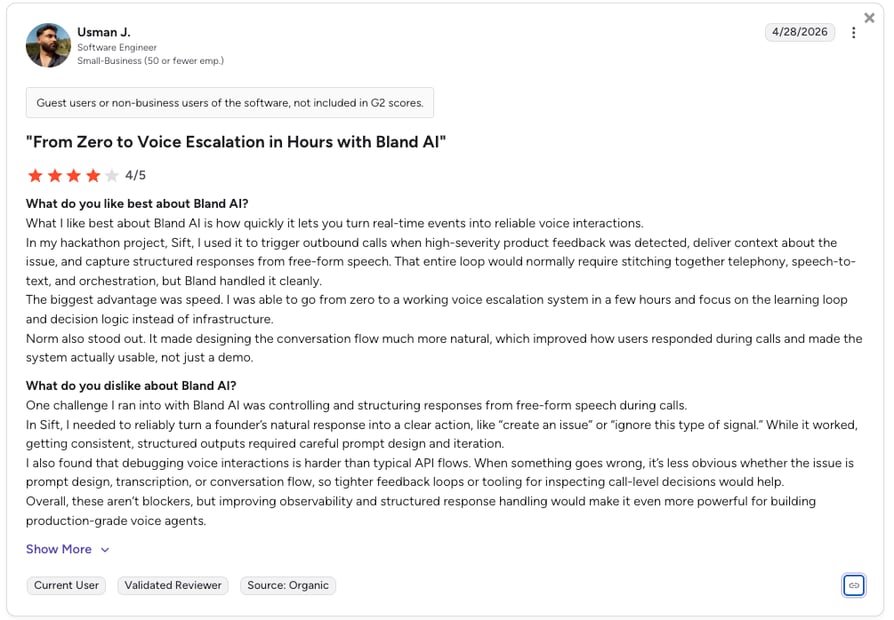
Here's what people say about Bland AI:
What Are PolyAI's Best Features?
Whatever you make of the PolyAI price, the product is strong. PolyAI's value isn't breadth; it's depth in enterprise phone conversations. Here are the features that genuinely stand out, with an honest note on where each could be better.
Lifelike Voice Quality and Natural Conversation
PolyAI's biggest strength is how human the agent sounds. Powered by its proprietary Raven model, trained on a billion-plus enterprise conversations, it handles interruptions (barge-in), topic changes, accents, and emotional cues far better than legacy IVR. Because it's trained on phone-quality audio, it copes well with background noise that breaks lesser systems; in some deployments, a sizable share of callers don't realize they're talking to a machine.
Where it could be better: that quality is gated behind enterprise access. There's no way to try it on a small project, and bespoke voice and dialect work sits in custom workstreams rather than the base contract.
High Call Containment and Autonomous Resolution
PolyAI is engineered to resolve, not just route. In the right use cases, such as bookings, authentication, and verification, it can fully handle a high share of transactional calls without escalating to a human, which is where the cost savings come from. Retrieval-augmented generation keeps answers grounded in your own documents, reducing the risk of the agent inventing information.
That plays out at scale in production. PG&E's PolyAI agent, for instance, reaches 67% call containment across the utility's roughly 16 million annual calls and has saved 35,000 agent hours. In hospitality, Golden Nugget automates 87% of its PBX operator calls end to end.
Where it could be better: containment varies by use case and implementation. Complex, judgment-heavy calls still need a human, so results depend heavily on how well your flows are designed during onboarding.
Enterprise Security, Compliance, and Managed Delivery
PolyAI ships with SOC 2, HIPAA, GDPR, and PCI DSS as standard, plus a 99.9% uptime SLA and 24/7 support folded into the per-minute rate. The managed model means PolyAI's team co-designs your dialogue logic and tunes performance over time, which is a meaningful advantage for teams without in-house conversational AI talent.
Where it could be better: managed delivery is also a dependency. Without a self-serve testing sandbox, iterating on conversations often runs through consulting cycles rather than your own team, which slows changes.
Multilingual Support and Conversation Analytics
PolyAI supports 24+ languages at the model level and surfaces rich conversation data, giving enterprises the analytics to shape strategy and the reach to serve global customers from one platform. For AI customer service at international scale, that breadth is a real differentiator.
Where it could be better: regional dialect tuning and code-switching are only available through custom enterprise agreements, and deeper analytics pipelines can be a separate paid layer rather than included by default.
What Are the Pros and Cons of PolyAI?
| Pros | Cons |
|---|---|
| Best-in-class voice realism — Raven model handles barge-in, accents, and emotional cues | No public pricing — custom quotes only; no cost clarity until late in the sales process |
| High call containment — resolves a large share of transactional calls without a human | Six-figure minimum — annual contracts estimated from ~$150K; out of reach for SMBs |
| Bundled enterprise services — maintenance, upgrades, 24/7 support, and SLA in one rate | No free trial or self-serve — every evaluation starts with a sales call and demo |
| Enterprise security — SOC 2, HIPAA, GDPR, and PCI DSS as standard | Hidden cost layers — telephony, CRM integration, compliance, and language tuning billed on top |
| Validated ROI — a Forrester study found 391% three-year ROI for large clients | Slow time-to-launch — managed rollouts take weeks; iteration relies on consulting cycles |
Is PolyAI usage-based or seat-based pricing?
PolyAI is usage-based, not seat-based. You pay per minute of automated conversation rather than per agent or per user, so your cost scales with call volume instead of headcount. That suits high-volume contact centers, but it also means the only lever for lowering your bill is handling fewer or shorter automated calls, not removing seats.
What is the typical ROI timeline for PolyAI?
PolyAI points to a Forrester Total Economic Impact study that found a 391% return over three years for large enterprise clients, with $10.3 million in agent labor savings and payback in under six months for its composite organization. In practice, your own payback depends on call volume and labor costs: the higher your current cost per call, the faster automation pays for itself, while lower-volume deployments take longer to clear the six-figure contract minimum.
Is PolyAI the Right Solution for Your Team?
PolyAI is a genuinely premium product for a specific buyer: the large enterprise running thousands of calls a day, with the budget and timeline to deploy a managed, white-glove voice solution. For that buyer, the quality is hard to beat and the ROI case is strong. But "the right fit" depends entirely on your scale and how much pricing clarity you need.
PolyAI makes sense if:
- You're a large enterprise in a regulated, call-heavy industry (banking, telecom, insurance, hospitality, retail)
- Your call volume is high enough that automating it would otherwise mean hiring 15–20+ agents
- You want a vendor-managed deployment with support, SLAs, and compliance bundled in
- A six-figure annual commitment fits your procurement process and budget cycle
PolyAI is probably not the right fit if:
- You're an SMB or mid-market team without a six-figure budget for voice AI
- You need transparent, published pricing you can model before talking to sales
- You want a free trial or self-serve access to test before committing
- You need to be live in days, not after a multi-week managed rollout
- You want one platform that combines AI voice agents with a full business phone system
So is a PolyAI subscription worth it? At true enterprise scale, often yes. Below that, the minimum commitment and opaque quoting usually tip the math toward a more transparent, faster-to-launch option. If you want enterprise-grade AI calling, published pricing, and a free trial, CloudTalk gives you a complete AI-powered calling platform with 160+ country coverage, built for sales and support teams that live on the phone.
FAQs: PolyAI Pricing
PolyAI builds voice-first AI assistants that answer enterprise phone calls and hold natural conversations with customers. Powered by its proprietary Raven model and retrieval-augmented generation grounded in your own documents, the agent understands callers regardless of how they phrase things, handles interruptions and accents, and resolves transactional requests like bookings, authentication, and account changes without a human, escalating only when judgment is needed.
PolyAI is concentrated in call-heavy, regulated sectors: banking and financial services, telecom, insurance, hospitality (hotels and restaurants), retail, and travel. Well-known deployments include hotels handling reservations, logistics companies fielding "where is my package" calls, and utilities managing outage-driven call surges.
Yes. PolyAI supports 24+ languages at the model level, which is part of why it appeals to global enterprises. Keep in mind that regional dialect tuning, code-switching, and language-specific voice work are typically handled as custom enterprise workstreams, and each additional language can add model training and tuning costs on top of the base contract.
No. The enterprise PolyAI platform has no free tier, no free trial, and no self-serve signup; it requires a subscription in the form of a custom annual contract, and every evaluation starts with a sales call and demo. (Note: this is different from PolyBuzz, formerly Poly.ai, a separate consumer character-chatbot app with free chat and optional paid features, which is unrelated to the enterprise voice product covered here.)
PolyAI is reviewed on G2, Gartner Peer Insights, and Capterra. Reviews skew very positive on voice quality and conversational performance; because reviewers are mostly large enterprises, pricing specifics rarely appear, so use the review sites for capability signals and a sales conversation for cost.
PolyAI is a managed, enterprise-only voice AI deployment with custom six-figure pricing and a multi-week rollout. CloudTalk is an AI-powered calling platform with published, flat-rate pricing, AI voice agents, a full business phone system, and a 14-day free trial you can start today. If you're a large enterprise that wants white-glove delivery, PolyAI fits; if you want enterprise-grade AI calling with transparent pricing and no six-figure commitment, CloudTalk is the more accessible choice.
PolyAI's per-minute rate bundles in proactive performance improvements, maintenance, 24/7 support, security and compliance coverage, monitoring, and a 99.9% uptime SLA. The costs that surprise teams sit outside that rate: telephony carrier fees, CRM and telephony integration work, compliance engineering such as PCI, and each additional language can require separate budget. Clarify exactly what your quote includes before signing.
PolyAI bills per minute of automated conversation, tied to the speech-recognition minutes processed on each call. Because PolyAI doesn't publish its rounding rules, reviewers note that automated rounding, often to 30-second increments, can push billed minutes above actual talk time. Ask how partial minutes are rounded before you commit, since it directly affects your effective cost per call.
PolyAI doesn't publish contract terms, so any multi-year discount is negotiated case by case as part of a custom quote. Most enterprise deployments involve annual or multi-year commitments with a minimum spend, so it's worth asking about volume tiers, multi-year pricing, and any annual price uplift during procurement.