Best Voice AI for Enterprise Call Management: Top Picks 2026
TL;DR
In case you only have a minute, here's the short list:
- 01CloudTalk - Best overall enterprise voice AI for global sales and support teams that need a full call center plus AI voice agents in one platform.
- 02Genesys Cloud CX - Best for large, regulated enterprises that need deep workforce engagement and omnichannel governance.
- 03NICE CXone Mpower - Best for workforce optimization and analytics-led enterprise contact centers.
- 04Talkdesk - Best for mid-market to enterprise teams that want AI-native CX automation with faster deployment.
- 05Five9 - Best for outbound-heavy enterprises and sales contact centers.
- 06Amazon Connect - Best for AWS-native enterprises that want usage-based, pay-as-you-go pricing.
- 07Cognigy - Best enterprise conversational AI platform for complex, multilingual automation flows.
- 08PolyAI - Best for ultra-natural, human-like inbound voice automation in enterprise CX.
- 09Quiq - Enterprise teams in retail, ecommerce, travel, financial services, and customer support
- 10Retell AI - Best for developer-led teams that want to build and ship custom voice agents
Enterprise contact centers move millions of calls a day, and every second of delay costs revenue. When global teams handle support, renewals, and outbound prospecting across time zones, a 30-second hold can drag down CSAT and send prospects to competitors.
That's why voice AI has moved past the "pilot project" line item. Gartner forecasts conversational AI will cut $80 billion in contact center labor costs in 2026, and 67% of Fortune 500 companies already run production voice AI. Adoption tripled in 12 months, the global market crossed $22.5 billion this year (34.8% CAGR), and 78% of the top 50 banks have deployed production voice agents - up from 34% in 2024.
Traditional IVR, manual routing, and static scripts can't absorb the volume or expectations enterprises now face. The teams winning in 2026 pair their CCaaS stack with voice AI that routes faster, summarizes calls automatically, qualifies leads around the clock, and frees human agents for the calls that matter.
This guide ranks the 10 best voice AI platforms for enterprise call management in 2026 - what each does best, what to watch for, what it costs, and how to choose.
What Is Enterprise Voice AI for Call Management?
Enterprise voice AI for call management is software that uses speech recognition (ASR), natural language understanding (NLU), large language models, and text-to-speech (TTS) to automate inbound and outbound voice interactions at enterprise scale. Unlike traditional IVR - which forces callers through menu trees - enterprise voice ai listens, interprets intent, and responds conversationally.
Modern enterprise voice AI solutions handle four core jobs in a contact center:
- Inbound deflection and resolution - Answering routine questions (order status, account balance, password reset, appointment booking) without a human agent.
- Intelligent routing - Understanding caller intent and routing to the right agent, queue, or self-service path - far more accurately than keyword-based IVR software.
- Outbound automation - Running scripted and dynamic outbound campaigns: lead qualification, appointment confirmations, collections, renewal outreach, and surveys.
- Agent assist and post-call automation - Real-time prompts and knowledge surfacing for human agents, plus automatic transcription, summarization, sentiment scoring, and CRM logging after the call.
The category sits between core enterprise VoIP infrastructure (the dial tone) and broader AI customer service tooling. The best enterprise voice AI solutions integrate both layers so you don't have to stitch them together yourself.
Why Are Enterprises Adopting Voice AI Right Now?
The shift from pilot to production happened fast. According to recent studies, 87.5% of builders are now actively building voice agents rather than just researching them. Six reasons explain why enterprise voice automation moved from "interesting" to "mandatory" in the last 12 months:
- Elevated customer experience. Customers don't want hold music. Voice AI cuts queue times by up to 50% and reduces average handle time by 35%. 89% of customers say they prefer brands that offer voice AI support.
- Operational efficiency at scale. Voice AI handles tier-one volume end to end - typically 40–70% of inbound calls in mature deployments - freeing human agents for complex, high-value conversations.
- Significant cost savings. Voice AI costs roughly $0.40 per call versus $7–$12 for a human agent - a 90–95% cost reduction per automated interaction. Gartner forecasts $80 billion in agent labor savings in 2026 alone.
- Managing high call volumes. Spikes that used to require seasonal hiring (Black Friday, open enrollment, tax season) are now absorbed by AI capacity that scales elastically.
- 24/7 coverage. Voice AI doesn't sleep. Enterprises with global customers can offer round-the-clock support without staffing overnight shifts.
- Data-driven decision making. Every call becomes structured data - transcripts, sentiment, topics, outcomes. Conversation intelligence surfaces patterns that used to disappear into voicemail and post-call notes.
- Proven ROI. Forrester's research shows voice AI deployments deliver 331–391% three-year ROI, with payback under six months and an average $10.3 million in agent labor savings for a composite enterprise organization.
How We Chose the Best Voice AI for Enterprise Call Management
We didn't pick these tools off a press release. The 8 platforms below were shortlisted by cross-referencing real buyer signals - G2 and Gartner Peer Insights ratings. enterprise customer logos, third-party benchmark reports (Opus Research, Forrester, MarketsandMarkets), and hands-on product testing across inbound, outbound, and multilingual call flows.
Each tool had to clear four bars to make the list:
- Enterprise scale - Proven deployments handling thousands of concurrent calls without latency or concurrency degradation.
- Real voice AI capability - Not just IVR with a voice skin. Genuine ASR + LLM-driven turn-taking, sentiment, and reasoning.
- Integration depth - Connection to major CRMs, helpdesks, and contact center stacks (Salesforce, HubSpot, Zendesk, ServiceNow, MS Dynamics).
- Security and compliance posture - SOC 2 Type II, ISO 27001, GDPR, HIPAA where applicable, and documented data residency options.
Why Trust Our Software Reviews?
CloudTalk's team has reviewed and benchmarked call center software since 2016, and our editorial team works directly with enterprise buyers evaluating voice AI stacks daily.
Learn how we keep our content integrity and our software review methodology.
8 Best Voice AI for Enterprise Call Management
Here's the quick comparison before we dive into the full reviews:
| Software | Best for | Standout strength | Watchouts | Starting Price |
| CloudTalk | SBMs / sales & support teams | AI Voice Agents (CeTe) + 160+ country coverage in one stack | Paid AI add-ons (transparently) | $25/user/mo |
| Genesys Cloud CX | Enterprise contact centers | Deep workforce engagement + omnichannel routing | Expensive, complex setup, $2,000/mo minimum | $75–$240/user/mo |
| NICE CXone Mpower | Workforce optimization-led enterprises | Enlighten AI + best-in-class WFM | Steeper learning curve, premium price | ~$110/user/mo |
| Talkdesk | Mid-to-large enterprises wanting fast AI-native deployment | Autopilot/Copilot AI + visual flow builder | 3-year contract minimums common | ~$85/user/mo |
| Five9 | Outbound-heavy and sales-led enterprises | Predictive dialer + AI virtual agents | High pricing for full AI suite | ~$119/user/mo |
| Amazon Connect | AWS-native enterprises | Pay-as-you-go, usage-based pricing | DIY assembly required; engineering-heavy | $0.018/min + telephony |
| Cognigy | Complex multilingual automation flows | Branching conversational workflows at enterprise scale | Six-figure annual contracts | Custom (enterprise) |
| PolyAI | Natural-sounding inbound voice automation | Human-like voice quality, white-glove deployment | 4–6 week build cycle, no self-serve | Custom (enterprise) |
Now, let's break down each one.
1. CloudTalk - Best Overall Voice AI for Enterprise Call Management
What is CloudTalk?
CloudTalk is a cloud-based business phone system and enterprise voice assistant platform that combines a full call center stack - global numbers in 160+ countries, intelligent routing, IVR, parallel dialing - with AI Voice Agents (branded as CeTe), AI Conversation Intelligence, automated call summaries, and sentiment analysis. Founded in 2016, it serves over 30,000 sales and support professionals at companies like Revolut, Glovo, Nokia, and DHL.
CloudTalk sits at the intersection of a robust call center solution for market leaders and modern voice AI - so enterprise teams don't have to stitch together CCaaS, telephony, and AI tooling from different vendors.
Best for: SMBs, sales, support, and ops teams that need an enterprise-grade call management system plus AI voice automation in one platform - without enterprise pricing or rip-and-replace complexity.
What Are CloudTalk’s Strengths?
- AI Voice Agents (CeTe) handle inbound and outbound calls 24/7 in 60+ languages with no-code visual flow building
- AI Conversation Intelligence transcribes, summarizes, and scores every call - customers cite 80% reduction in manager review time and ~5 minutes saved per call on after-call work
- Integrations with 100+ tools including Salesforce, HubSpot, Zendesk, Pipedrive, MS Dynamics, and Freshdesk
- 99.99% uptime SLA, SOC 2 Type II, ISO 27001, GDPR, CCPA compliance, and HIPAA eligibility
- Sophisticated routing including skills-based, IVR, callback queues, and VIP queues
- 14-day free trial (and 50 AI Voice Agent free of charge)
Cloudtalk’s Limitations
- AI capabilities are sold as a paid add-on, not bundled with base plans
- Primarily voice-first - teams that need heavy email or chat automation will need to layer in additional tools
CloudTalk Plans and Pricing
| Plan | Pricing |
| Starter | $25/user/month |
| Essential | $29/user/month |
| Expert | $49/user/month |
| AI Voice Agents | AI Receptionist: $99/200 mins/month AI Agent: 349/1000 mins/month |
| Custom | $0.15/per minute / > 10,000 mins |
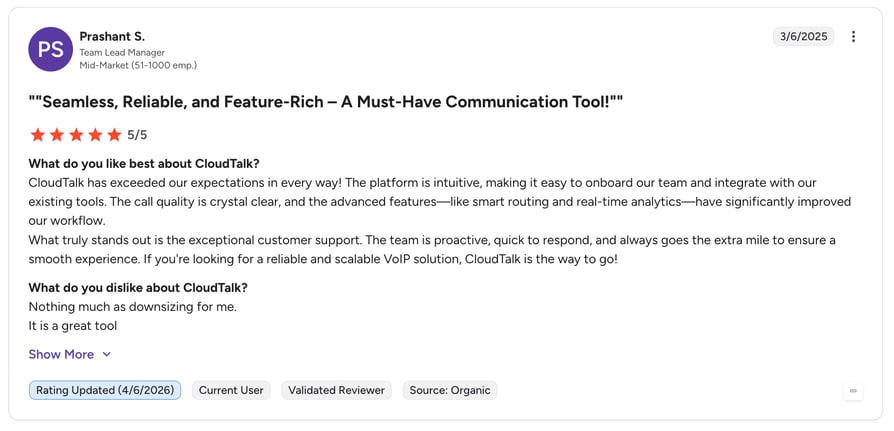
What Are Users on G2 Saying About CloudTalk?
Cloudtalk is rated at 4.4/5 by 1,700+ verified users across G2.
2. Genesys Cloud CX - Best for Large, Regulated Enterprise Contact Centers
What is Genesys Cloud CX?
Genesys Cloud CX is one of the most established enterprise voice AI solutions on the market - a full omnichannel contact center suite with built-in AI for routing, automation, virtual agents, and workforce engagement. It's the platform large regulated enterprises (banking, insurance, healthcare) standardize on when governance and compliance discipline matter as much as automation.
Best for: Fortune 1000 enterprises with 1,000+ agents that need consistent QA, compliance, and workforce management across global operations.
What Are Genesys Cloud CX’s Strengths?
- Microservices architecture with 99.999% uptime
- Deep workforce engagement management - scheduling, forecasting, quality monitoring
- Hundreds of pre-built integrations via AppFoundry marketplace
- Strong governance and audit trails for regulated industries
What Are Genesys Cloud CX’s Limitations?
- Expensive: CX 4 (full AI suite) is $240/user/month - for 200 agents, that's $576,000/year in licensing alone
- $2,000/month minimum spend regardless of seat count
- Implementation fees are separate and can be substantial
- Workforce management tools are often cited as rigid compared to NICE or Verint
Genesys Cloud CX’s Plans and Pricing
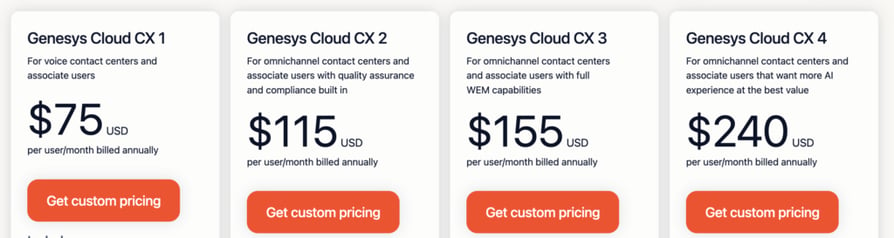
You can check their whole offering here.
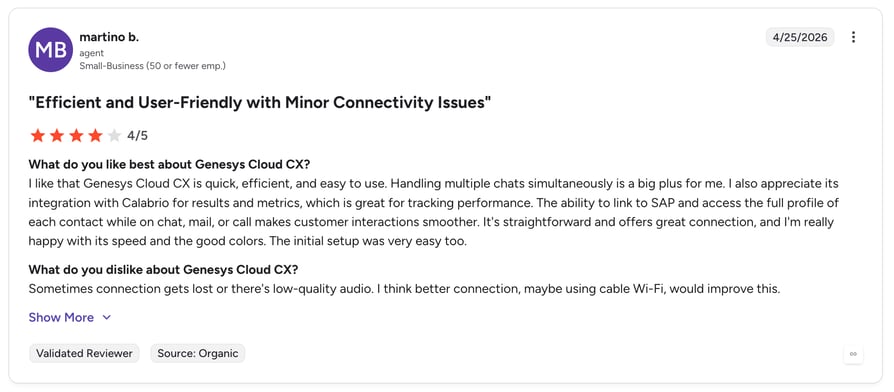
What Are Users on G2 Saying About Genesys Cloud CX?
Genesys is rated at 4.4/5 by 1,500+ verified users across G2.
3. NICE CXone Mpower - Best for Workforce Optimization-Led Enterprises
What Is NICE CXone Mpower?
NICE CXone is the gold standard for enterprises that lead with workforce optimization and analytics. The platform pairs AI-powered virtual agents, agent assist, and post-call summaries with the deepest WFM and quality management stack on the market - Enlighten AI for interaction analytics is widely considered category-leading.
Best for: Enterprise contact centers in finance, healthcare, and insurance where compliance, agent performance, and analytics discipline matter most.
What Are NICE CXone Mpower’s Strengths?
- Enlighten AI is unmatched for interaction analytics and behavioral coaching
- Strong workforce management suite
- 60-day free trial available (rare in this tier)
What Are NICE CXone Mpower’s Limitations?
- Premium pricing - CXone Mpower Ultimate is $135+/user/month
- Concurrency caps and analytics latency cited in some large rollouts
- Steeper learning curve than mid-market alternatives
NICE CXone Mpower’s Plans and Pricing

You can read more on their offering here.
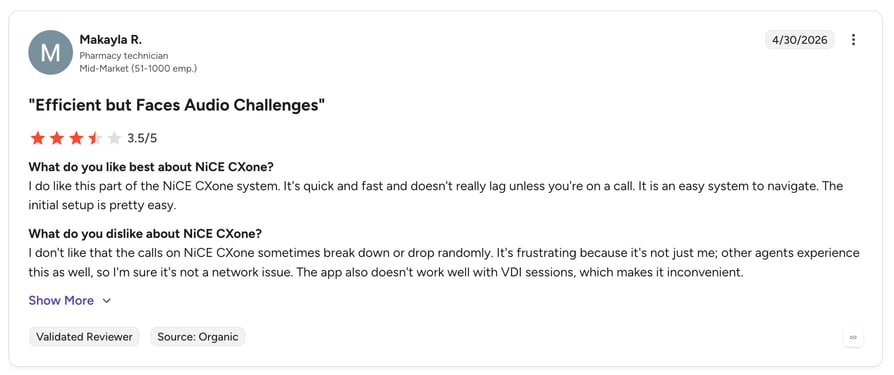
What Are Users on G2 Saying About NICE CXone Mpower?
NICE CXone is rated at 4.4/5 by 1,500+ verified users across G2.
4. Talkdesk - Best for Ai-Native Mid-Market and Enterprise Deployments
What Is Talkdesk?
Talkdesk is a cloud-native contact center platform built around what they call Customer Experience Automation (CXA). Its Autopilot (autonomous AI agents), Copilot (agent assist), and Navigator (workflow orchestration) tools coordinate human and AI agents in real time, distributing work dynamically based on context - making it one of the most credible enterprise conversational AI platforms for teams that want AI-native architecture without legacy stitching.
Best for: Fast-growing mid-market and enterprise teams that want enterprise features with faster deployment and modern UX.
What Are Talkdesk’s Strengths?
- Deploys in weeks rather than months
- Modern, intuitive interface - admin changes don't require IT tickets
- Strong vertical solutions (healthcare, financial services, retail)
- AI-native architecture rather than bolted-on modules
What Are Talkdesk’s Limitations?
- Minimum 3-year contract commitments common
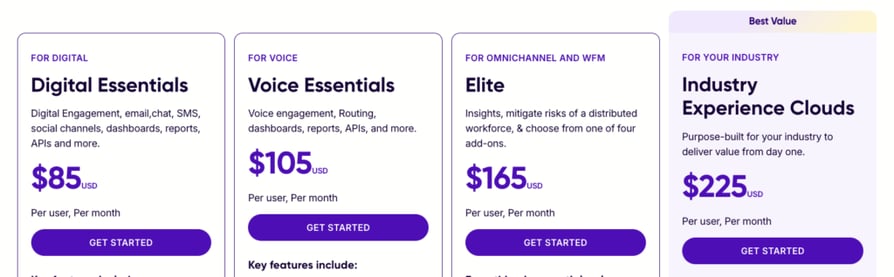
- AI and voice automation modules push annual spend to $30K–$250K
Talkdesk Plans and Pricing
You can read more on their offering here.
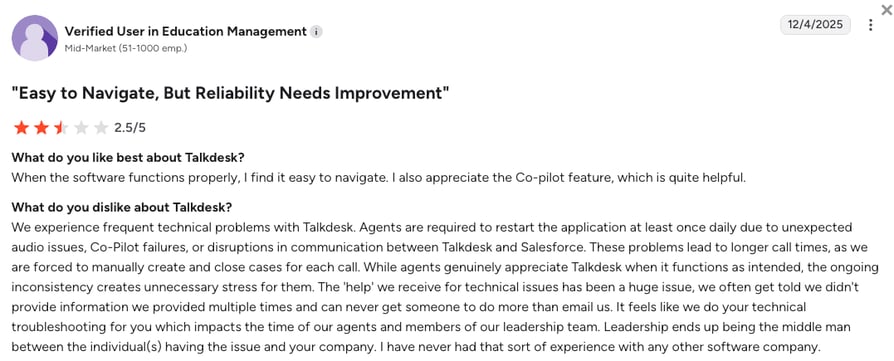
What Are Users on G2 Saying About Talkdesk?
Talkdesk is rated at 4.4/5 by 2,500+ verified users across G2.
5. Five9 - Best for Outbound-Heavy and Sales-Led Enterprises
What Is Five9?
Five9 is an AI-driven cloud contact center built for enterprise-sized sales and support operations. It combines predictive dialing, AI virtual agents, speech analytics, and omnichannel routing - making it particularly strong for outbound campaigns and high-volume telesales.
Best for: Fast-growing mid-market and enterprise teams that want enterprise features with faster deployment and modern UX.
What Are Five9 Strengths?
- AI-powered predictive dialing significantly boosts connection rates
- Strong speech analytics for compliance and performance tracking
- Mature omnichannel coverage across voice, chat, email, social
What Are Five9 Limitations?
- Higher pricing than some competitors makes it less attractive for SMBs
- AI capabilities can require multiple add-on modules
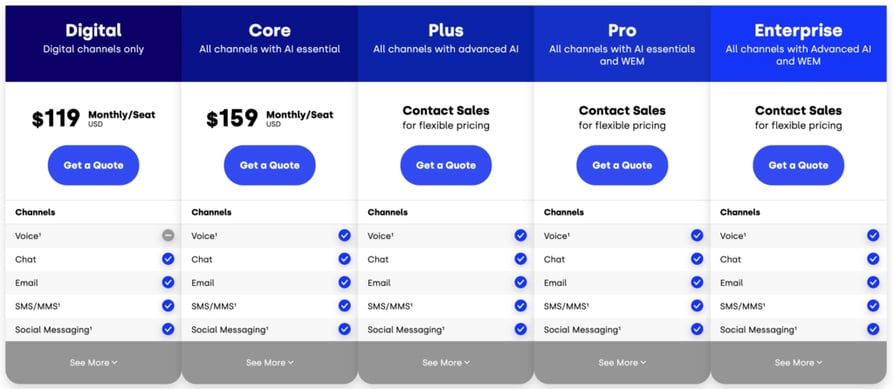
You can read about their full offering here.
What Are G2 Users Saying About Five9?
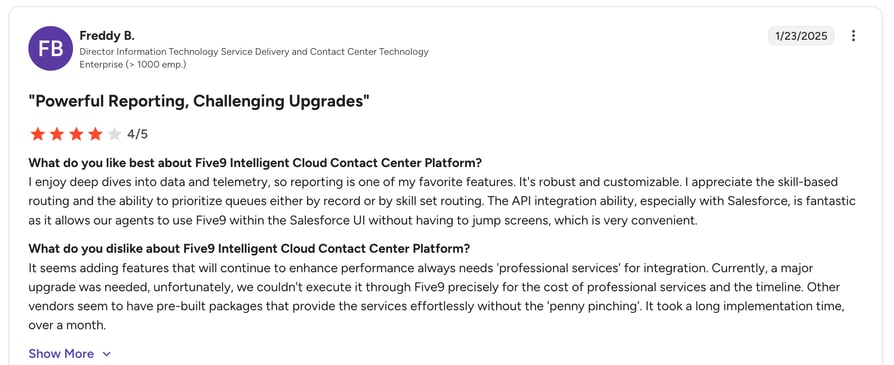
Five9 is rated at 4.1/5 by 600+ verified users across G2.
6. Amazon Connect - Best for AWS-Native Enterprises
What Is Amazon Connect?
Amazon Connect is AWS's usage-based cloud contact center, with AI layers from Amazon Lex (conversational AI), Contact Lens (analytics), and Q in Connect (agent assist). It's a strong fit when you're already deep in AWS and prefer composable infrastructure over an end-to-end suite.
Best for: AWS-native enterprises with strong engineering teams that want flexible, pay-as-you-go enterprise AI call management software.
What Are Amazon Connect Strengths?
- Pay-as-you-go pricing - no per-seat licensing
- Deep AWS ecosystem integration (Lambda, Kinesis, S3, Lex)
- 12-month AWS Free Tier (90 minutes/month included)
- Scales elastically with demand
What Are Amazon Connect Limitations?
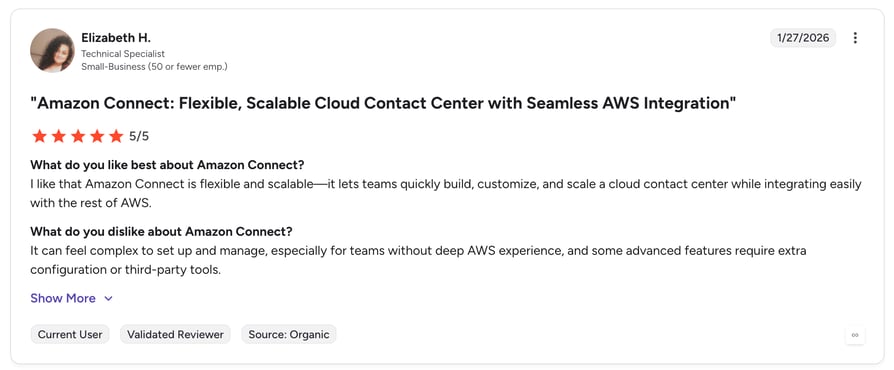
- DIY assembly model - significant engineering effort to stand up
- Cost predictability harder than per-seat platforms
- AI capabilities require pulling in multiple AWS services
Amazon Connect Plans and Pricing
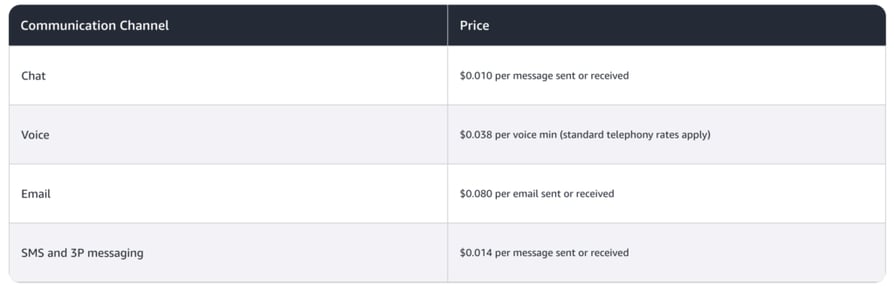
You can read more on their offering here.
What Are G2 Users Saying About Amazon Connect?
Amazon Connect is rated at 4.5/5 by 70+ verified users across G2.
7. Cognigy - Best Enterprise Conversational AI Platform for Complex Flows
What Is Congigy?
Cognigy.AI is a leading enterprise conversational AI platform built for large-scale automation across voice and chat. Its visual flow builder lets enterprise teams design long, branching dialog flows that mix scripted and generative responses, with strong NLU and LLM reasoning under the hood. Cognigy is one of the more credible options for enterprise voice automation when you need both depth and governance.
Best for: Large enterprises with complex, multilingual automation use cases that need a single conversational AI layer across voice, chat, and messaging.
What Are Cognigy’s Strengths?
- Best-in-class for structured, branching flows
- Strong multilingual support (100+ languages)
- Tight integration with major CCaaS platforms (Genesys, NICE, Five9, Amazon Connect)
What Are Cognigy’s Limitations?
- Most buyers end up in six-figure annual contracts plus usage fees
- Less fluid than newer agentic platforms for open-ended conversation patterns
- Build cycles are longer than no-code voice agent platforms
Cognigy Plans and Pricing
Cognigy's pricing is available upon request, based on volume and deployment scope.
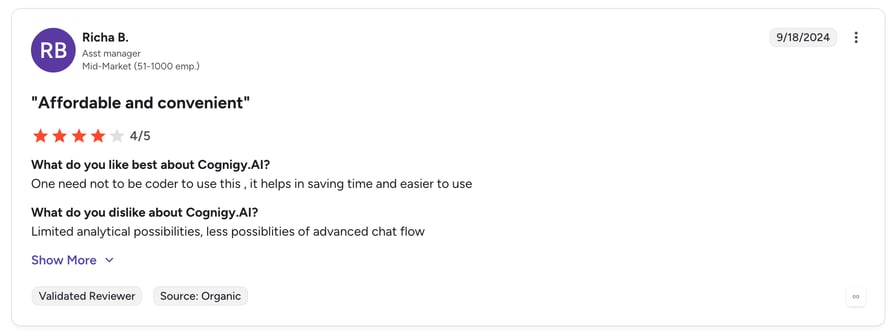
What Are G2 Users Saying About Cognigy?
Cognigy is rated at 4.6/5 by 10+ verified users across G2.
8. PolyAI - Best for Natural-Sounding Inbound Voice Automation
What Is Poly AI?
PolyAI builds ultra-realistic, human-like AI voice agents for enterprise inbound CX - used by Marriott, Volkswagen, and other global brands. Founded by Cambridge researchers, it specializes in voice agents for regulated industries (healthcare, banking, hospitality) with a fully managed deployment model.
Best for: Enterprises that prioritize naturalness and brand voice in inbound CX over fast iteration.
What Are Poly AI's Strengths?
- Industry-leading voice naturalness - handles accents, interruptions, multi-turn conversations
- White-glove managed service: PolyAI's team builds and deploys for you
- Strong compliance posture for regulated industries (healthcare, banking)
- Multilingual coverage including Mandarin, Russian, Spanish, and more
What Are Poly AI's Limitations?
- 4–6 week deployment cycle - no self-serve or quick experimentation
- No public pricing; expect per-minute pricing wrapped in larger platform fees
- Less flexible for teams that want to iterate quickly
Poly AI Plans and Pricing
Although Poly AI plans and pricing aren't publically stated, you can check them out here.
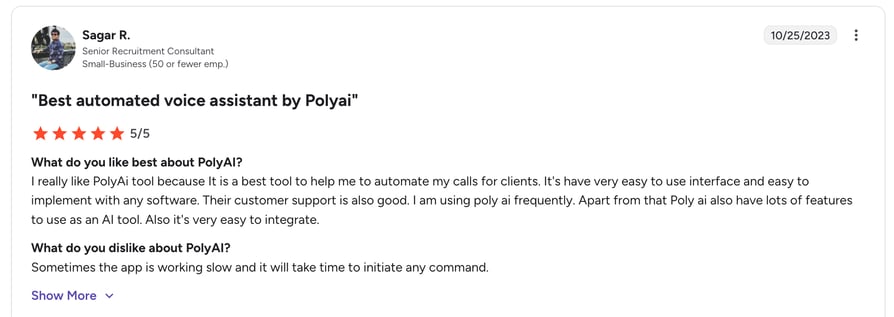
What Are G2 Users Saying About Poly AI?
Poly AI is rated at 5/5 by 10+ verified users across G2.
9. Quiq, Best for Enterprise Voice AI Across Service and Sales
What is Quiq?
Quiq is an enterprise conversational AI platform built for customer service, support, and sales teams. It offers voice AI agents, chat automation, SMS, messaging, agent assistance, and a digital contact center, which makes it a strong fit for enterprises that want voice automation connected to their wider customer conversation strategy.
Best for: Enterprise teams in retail, ecommerce, travel, financial services, and customer support that want voice AI, digital messaging, and human agent support in one platform.
What are Quiq’s strengths?
- Voice AI agents can handle natural customer conversations over the phone
- Omnichannel support covers voice, chat, SMS, and messaging channels
- Agent assistance helps live teams respond faster and with better context
- Enterprise integrations include tools such as Salesforce, Zendesk, Oracle Service, Freshdesk, Kustomer, NetSuite, and Microsoft 365
- Usage based pricing means companies pay based on actual conversations rather than fixed seat tiers
What are Quiq’s limitations?
- Pricing is not listed as fixed public tiers, so buyers need to speak with sales
- Best suited to enterprise use cases, so smaller teams may find it more than they need
- Third-party review sites list starting pricing around $6,000 per month, though Quiq’s own pricing page describes a usage-based model
- Some users mention that reporting could be improved
- Implementation may require more planning than lightweight voice bot tools
Quiq’s plans and pricing
Quiq uses usage-based pricing for its AI agent platform. The company says customers pay for the conversations they use rather than seats or fixed feature tiers. Third-party software directories list pricing from around $6,000 per month, but buyers should confirm directly with Quiq because pricing depends on use case, volume, and setup.
You can read more on their offering here.
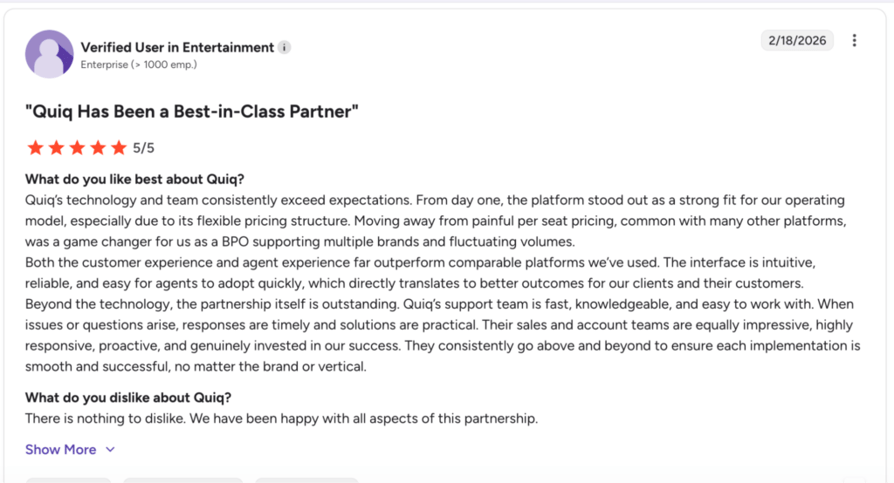
What are users on G2 saying about Quiq?
Quiq has a 4.7 out of 5 rating from 45 verified reviews on G2. Users often praise its ease of use, customer support, and ability to manage customer conversations, while some reviewers say the reporting features could be better.
10. Retell AI - Best for Developer-Led Teams Building Custom Voice Agents
What Is Retell AI?
Retell AI is a voice-first platform for building, deploying, and monitoring LLM-powered phone agents that handle both inbound and outbound calls. It's aimed at teams that want to design their own agents rather than buy a packaged contact center.
Retell positions itself as third-generation voice AI - LLM-driven reasoning rather than the intent-and-menu logic of legacy IVR - and hands off to a human agent when the call moves past what the agent can resolve.
What Are Retell AI's Strengths?
- Proprietary turn-taking model with ~600ms response latency.
- Drag-and-drop agent builder with batch calling, call transfer, appointment booking, IVR navigation, and streaming knowledge-base (RAG) retrieval that auto-syncs
- Flexible telephony - bring your own numbers or SIP trunk.
- Multiple Integrations - HubSpot, Salesforce, Amazon Connect, Zapier, etc.
- SOC 2 Type II, HIPAA, and GDPR compliance, with SSO and role-based access.
What Are Retell AI's Limitations?
- Developer-first: standing up a production-grade agent takes technical resources, not a no-code afternoon or a managed white-glove team
- Composable, usage-based pricing (voice infrastructure + text-to-speech + LLM + telephony + add-ons) makes total cost harder to forecast at high call volume
- Not a full contact center - no built-in workforce management or omnichannel suite, so you assemble the surrounding CCaaS stack yourself
Retell AI Plans and Pricing
Retell AI runs on usage-based, pay-as-you-go pricing: roughly $0.07-$0.31 per minute for voice agents depending on the voice engine and LLM you choose, billed as separate line items (Retell's voice infrastructure at $0.055/min, text-to-speech, the model, and telephony at about $0.015/min).
New accounts get $10 in free credits and 20 concurrent calls. The Enterprise plan moves to custom pricing with a dedicated server, SSO, unlimited concurrent calls, and 24/7 support.
What Are Users on G2 Saying About Retell AI?
Retell AI is rated 4.8/5 by 2,600+ verified users across G2.
How to Choose the Best Voice AI for Enterprise Call Management
Picking the right enterprise voice AI isn't about chasing the fanciest demo. It's about matching the platform to how your contact center actually runs at peak load. Here are the seven criteria enterprise buyers should score every shortlist against:
Performance and Accuracy
Demo latency and production latency are different numbers. Ask for production benchmarks under real concurrency - P90 end-to-end latency, ASR accuracy on your audio samples, and behavior on interruptions and turn-taking. Sub-300ms response time is the floor for natural conversation.
Integration Capabilities
Your voice AI is only as good as its connection to your CRM, helpdesk, and data warehouse. Look for native connectors to Salesforce, HubSpot, Zendesk, ServiceNow, and MS Dynamics - plus robust REST APIs and webhooks for custom systems. A great place to start is making sure your voice AI plugs into your enterprise VoIP backbone cleanly.
Scalability and Concurrency
Most platforms maintain quality under demo conditions and fail under real load. Ask vendors specifically: how many concurrent calls have they supported in production? What happens to latency at 1,000+ concurrent sessions?
Reliability and Uptime
Enterprise telephony demands 99.9%+ uptime SLAs, redundant infrastructure, and documented disaster recovery. The best platforms publish 99.99% or 99.999% uptime - and pay credits when they miss it.
Language and Accent Support
If your enterprise operates globally, voice AI needs to handle 30–60+ languages, regional accents, code-switching, and accent-agnostic ASR. This is also where modern voice AI dramatically outperforms legacy IVR software - accent handling has improved more in the last two years than the previous ten.
Security and Compliance
SOC 2 Type II is the baseline. HIPAA for healthcare, PCI-DSS Level 1 for payments, GDPR with EU data residency, and increasingly ISO 42001 (AI management) for regulated industries. Always ask for the full audit reports, not just badges.
Total Cost of Ownership
Look past the headline per-seat price. Map base licensing, AI add-ons, telephony usage, implementation fees, and ongoing managed services. Per-minute platforms run $0.05–$0.31; per-seat platforms run $75–$155; resolution-based pricing aligns cost with outcomes. Compare apples-to-apples on a 3-year TCO basis.
For a deeper look at how to operationalize these criteria, see our guide to AI customer service solutions and our breakdown of the best call scheduling software.
Why Enterprises Choose CloudTalk for AI-Powered Call Management
Enterprise contact centers don't fail because of bad AI. They fail because the AI doesn't fit inside how the business actually runs - disconnected from the CRM, brittle under concurrency, opaque to managers, or stitched to a CCaaS that wasn't built for it.
CloudTalk solves the integration problem at the foundation. Sales and support teams at Revolut, Glovo, Nokia, and DHL chose CloudTalk because it isn't a voice AI bolted onto a phone system - it's a single platform where global telephony, intelligent routing, AI Voice Agents, conversation intelligence, and CRM sync run from the same dashboard.
Here's what enterprise teams get with CloudTalk's voice AI for enterprise call management:
- AI Voice Agents (CeTe) that take and make calls 24/7 in 60+ languages, with no-code visual flow building and your data plugged in directly
- AI Conversation Intelligence with auto-transcription, sentiment, topic extraction, call scoring, and AI Notes that log to your CRM automatically
- Global voice infrastructure with numbers in 160+ countries, 99.99% uptime, crystal-clear quality, and fallback routing
- Intelligent routing including skills-based, IVR, callback, VIP queues, and condition-based routing - all configurable without engineering tickets
- Integrations with Salesforce, HubSpot, Pipedrive, Zendesk, MS Dynamics, Freshdesk, and 90+ more
- Enterprise security - SOC 2 Type II, ISO 27001, GDPR, CCPA, HIPAA eligible, 256-bit encryption, AWS and GCP infrastructure
- Spring 2026 G2 Leader badges in Mid-Market, Small Business, and Momentum Leader categories
Customer outcomes are concrete: one enterprise customer increased trial bookings from 4 to 10 per day while saving 20 hours per week with 24/7 AI voice agents. Another cut manager review time by 80% with AI conversation intelligence.
Conclusion
Enterprise call management has changed permanently. Call volumes keep climbing, customer expectations keep tightening, and traditional IVR-and-headcount models can't keep up. Voice AI for enterprise call management is now the operational layer that lets enterprises scale support, cut costs, and deliver consistent customer experiences without expanding the org chart.
The platforms in this guide each solve part of the problem. Genesys, NICE, and Five9 win on enterprise depth and workforce tooling. Talkdesk wins on AI-native architecture and deployment speed. Amazon Connect wins on AWS-native flexibility. Cognigy and PolyAI win on conversation depth in specific use cases.
CloudTalk wins on what most enterprises actually need: one platform where AI Voice Agents, conversation intelligence, global telephony, and CRM integration just work together - with the scale and security posture enterprises require, and the speed of deployment SMBs love. Intelligent AI call answering systems aren't just deflecting support tickets anymore. They're turning every call into structured data, every routine inquiry into a containment opportunity, and every customer interaction into a revenue-generating touchpoint.
Faster response times, stronger retention, higher containment, and lower cost per interaction - without growing headcount. That's the competitive advantage of getting enterprise call automation right in 2026.
Frequently Asked Questions
Voice AI drives revenue by: capturing demand 24/7 with AI agents answering missed calls (2–3x more conversions); qualifying leads instantly via outbound callbacks; reducing churn.
Our 2026 evaluation ranks CloudTalk best overall, uniting AI Voice Agents, conversation intelligence, global telephony, and CRM in one platform. Genesys Cloud CX and NICE CXone suit large regulated enterprises; Talkdesk leads for fast AI-native deployments.
Per-seat platforms run $75–$240/user/month; usage-based $0.05–$0.31/min; resolution-based $0.69+. Enterprise TCO typically hits $100K–$500K+/year. CloudTalk pricing starts at $25/user/month, with AI Conversation Intelligence at $9 and AI Voice Agents from €350/month.
Voice AI handles 40–70% of tier-one inbound volume (FAQs, status checks, scheduling, basic troubleshooting) but doesn't replace humans. It's augmentation, not replacement: 87% of consumers prefer a hybrid model combining human empathy with AI efficiency.
Timelines vary: no-code platforms (CloudTalk, Synthflow) deploy in days to weeks; mid-market (Talkdesk, Five9) takes 2–6 weeks; enterprise suites (Genesys, NICE) and managed services (PolyAI, Cognigy) run 6–16+ weeks. CloudTalk typically goes live in under two weeks.