In 2026, the virtual receptionist service market is worth $17.84B and is on track to reach $49.55B by 2035. The AI part of it is growing more than twice as fast, at 27.8% a year. The demand is easy to explain: only 56% of callers to businesses reach a person, and 82% of consumers will call a competitor when nobody picks up.
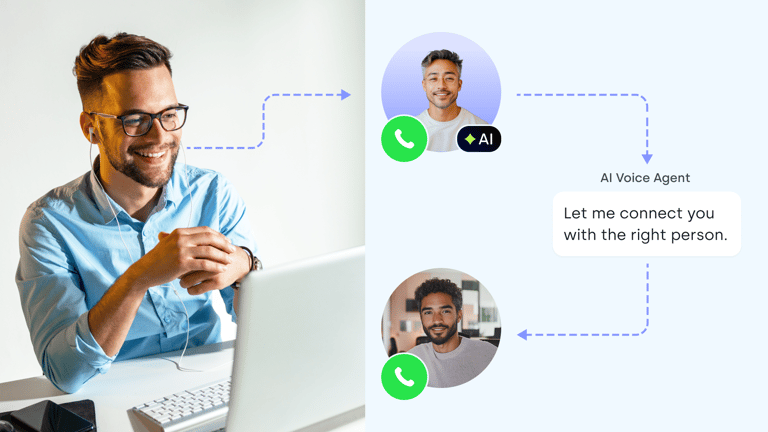
What's changing is who answers. Businesses are moving from human answering services to AI-first answering with a human escalation path: the AI picks up every call, handles the routine questions and hands the rest to a person. Every number below links to its original source and is free to cite.
Virtual receptionists are a $17.84B market in 2026, growing 12% a year, with AI receptionists growing 27.8% a year. The main driver is missed calls: almost half of business calls never reach a person, and most of those callers go to a competitor.
TL;DR: Key Virtual Receptionist Statistics at a Glance
The 13 numbers that matter most in 2026, one per row. Every source was opened and checked on October 20, 2026.
| Category | Statistic | Source |
|---|---|---|
| Market | The virtual receptionist service market is worth $17.84B in 2026 and is forecast to reach $49.55B by 2035 (12.02% CAGR) | Business Research Insights, Sep 2026 |
| Market | The AI receptionist market was $2.7B in 2025 and is forecast to reach $31.3B by 2035 (27.8% CAGR) | Market.us, Aug 2026 |
| Market | Conversational AI will reach $41.39B by 2030 (23.7% CAGR) | Grand View Research, 2025 |
| Adoption | 51% of US small businesses already use AI in customer service | Talkdesk, Oct 2025 |
| Adoption | 20% of EU enterprises used AI in 2025, up from 13.5% in 2024 | Eurostat, Dec 2025 |
| Adoption | RingCentral's AI Receptionist reached 16,400 customers in Q2 2026, up 400% year over year | No Jitter, Jul 2026 |
| Missed calls | Only 56% of callers to businesses reach a person | Invoca Lead Conversion Benchmarks, 2026 |
| Missed calls | 82% of consumers will call a competitor if you don't answer | CallRail, Sep 2025 |
| Missed calls | 75% of US consumers have hung up after being on hold too long | Invoca, Jun 2026 |
| Cost | A US receptionist earns a median 38,010ayear(18.27/hour) | BLS, 2026 |
| Cost | Live virtual receptionists start at $245/month for 50 minutes (Ruby) or $300/month for 30 calls (Smith.ai) | Ruby, Smith.ai |
| Customers | Only 37% of US consumers noticed afterwards that they had been talking to AI | Invoca B2C Buyer Experience Report, 2026 |
| Industry | 19% of medical group practices use a chatbot or virtual assistant for patient communication | MGMA, Apr 2025 |
Connect agents, customers and other software, together in the cloud
Discover how CloudTalk can provide you with unparallel control over your customer’s experience and start matching their expectations today
Methodology: Where Our Virtual Receptionist Statistics Come From
Every statistic on this page links to the organization that produced it: market research firms, government statistics offices, industry associations and the original survey reports. We don't cite other blogs' summaries of those numbers.
- Original sources only. Each figure was traced back to the report, survey or dataset it came from. If we couldn't find the original, the number didn't make the page.
- Checked by hand. All sources were opened and read on October 20, 2026. Most are from 2025 or 2026; anything older is marked with its year so you can judge it yourself.
- Vendor data is labelled. Some numbers come from companies that sell answering services, including us. Where that's the case, we say so next to the stat.
- Small samples are flagged. Surveys with fewer than 300 respondents are marked as directional.
- CloudTalk's own data. Results from CloudTalk Labs and customer stories are clearly attributed. CloudTalk Labs describes its own experiment results as "directional rather than statistically certain", and we keep that caveat next to every Labs number.
How Big Is the Virtual Receptionist Market? 12% Annual Growth Through 2035
The virtual receptionist service market is worth $17.84B in 2026 and is forecast to grow 12.02% a year to $49.55B by 2035. AI receptionists are growing more than twice as fast, at 27.8% a year, while live human answering services grow slowest, at 9.6%.
| Market | Current | Forecast | Source |
|---|---|---|---|
| Virtual receptionist services | $17.84B (2026) | $49.55B (2035) | Business Research Insights, Sep 2026 |
| Live virtual receptionist services | $1.64B (2025) | $3.42B (2033) | Verified Market Research, May 2026 |
| AI receptionists | $2.7B (2025) | $31.3B (2035) | Market.us, Aug 2026 |
| Voice AI agents | $2.4B (2024) | $47.5B (2034) | Market.us, Aug 2025 |
| Conversational AI | n/a | $41.39B (2030) | Grand View Research, 2025 |
Why do the estimates disagree so much?
Because each firm measures a different thing. Verified Market Research counts only live, human answering services (1.64B).Market.uscountsAIreceptionistsoftware(2.7B). Business Research Insights counts virtual receptionist services as a whole ($17.84B). The base years and forecast horizons differ too, so the numbers can't be added up or compared one to one. When you quote a market size, quote the definition with it.
- North America holds 41% of the virtual receptionist service market, and Europe holds 28%. (Business Research Insights, 2026)
- UK outsourced call answering was worth £144M in 2022, about 9% of a £1.7B addressable market. (HMT LLP) It's older data, but it's the only Europe-specific market figure we found.
- The US has about 947,500 receptionist jobs, and that number is projected to fall 2% by 2035. (BLS, 2026)
What Changes When a Virtual Receptionist Answers Every Call?
Short answer: A virtual receptionist answers every call, including after hours and at peak times, routes it to the right person and logs it to your CRM. Calls that used to go to voicemail become conversations. In CloudTalk's own field test, the AI receptionist went from a 60 to 70% off-hours miss rate to answering 100% of inbound calls.
| Benefit | Proof point | Source |
|---|---|---|
| No missed calls after hours | Before CloudTalk's AI receptionist went live, 60 to 70% of off-hours inbound calls were missed or unanswered. Afterwards, the AI handled 100% of inbound calls.* | CloudTalk Labs, AI Voice Agents report, Jan 2026 |
| Fewer missed calls | Bit2Me cut missed calls from 80% to 16% and wait time from 20+ minutes to 3 to 4 minutes | CloudTalk: Bit2Me |
| Higher answer rate | Booking Host raised its answer rate from 70% to 90%+ across 8,000 to 10,000 calls a month | CloudTalk: Booking Host |
| Less load on live teams | With AI as the first touchpoint, 37.5% of calls were deflected and human handle time fell from 25 to 14 minutes (44% less) | CloudTalk: high-volume services provider |
| Multilingual coverage | More than a third of inbound calls switched language mid-conversation in CloudTalk's AI receptionist experiment* | CloudTalk Labs, Jan 2026 |
Virtual Receptionist Statistics 2026: Adoption, Missed Calls, Cost and AI vs Human
This is the core of the page: 35+ statistics grouped by the questions buyers actually ask. Each group opens with a short answer you can quote and closes with what it means for you.
How Many Businesses Use Virtual Receptionists?
Short answer: Most businesses already use AI somewhere, and customer service is one of the first places it lands. Half of US small businesses use AI in customer service today.
- 51% of US small businesses already use AI in customer service, and 94% expect to keep or grow their service teams. (Talkdesk, Oct 2025)
- 88% of organizations use AI in at least one business function, up from 78% a year earlier. (McKinsey, State of AI 2025)
- 85% of customer service leaders planned to explore or pilot customer-facing conversational GenAI in 2025. (Gartner, Dec 2024)
- RingCentral's AI Receptionist grew from 2,000 organizations in June 2025 to 16,400 customers in Q2 2026. (RingCentral, 2025; No Jitter, Jul 2026)
Takeaway:
One vendor's AI receptionist went from 2,000 organizations to 16,400 customers in about a year. That shows where the market is heading. Answering calls is one of the easiest jobs to hand to AI first.
How Many Business Calls Go Unanswered?
Short answer: Only 56% of callers to businesses reach a person. Most missed calls never get a callback, and most callers won't leave a voicemail.
- Only 56% of callers to businesses speak with a person, based on 70M+ calls. (Invoca Lead Conversion Benchmarks, 2026)
- 69% of missed business calls get no callback within 48 hours, based on 16.7M missed calls. (Quo, Aug 2026)
- 82% of consumers will call a competitor if you don't answer, and 78% have abandoned a business after an unanswered call. (CallRail, Sep 2025)
- Only 42% of consumers leave a voicemail. (CallRail, Sep 2025)
- 28.5% of calls arrive outside business hours, and 34.8% of after-hours callers show buying intent, based on 1.45M calls. (NextPhone, 2026) Vendor data.
Takeaway:
If more than half of the callers who don't reach you won't leave a message, voicemail is where leads go to disappear. Every unanswered call is a decision you've made for the caller.
How Long Will Callers Wait Before Hanging Up?
Short answer: Not long. Three in four US consumers have hung up on a hold queue, and 41% give up after one or two minutes.
- 75% of US consumers have hung up after being on hold too long, a 26-point increase in a year. (Invoca, Jun 2026)
- 41% hang up after just 1 to 2 minutes on hold. (CallRail, Sep 2025)
- 27% switch to a competitor when a response is too slow. (Invoca B2C Buyer Experience Report, 2026)
- 41% of consumers prefer calling when they have a problem, up from 32% in 2022. (Invoca, 2026)
Takeaway:
More people want to call, and fewer are willing to wait. The phone line is getting more valuable and less forgiving at the same time.
How Much Does a Virtual Receptionist Cost?
Short answer: An in-house receptionist in the US costs about $3,168 a month before benefits. Live virtual receptionists start around $245 to $300 a month for a small bundle of minutes or calls. AI receptionists cost a fraction of that per minute and answer 24/7.
- An in-house US receptionist earns a median $38,010 a year ($18.27/hour), before benefits. (BLS, 2026)
- In Slovakia, receptionists earn €985 to €1,677 a month gross, and in Czechia 25,329 to 41,903 CZK (middle 80% of salaries). (Platy.sk, Platy.cz)
- Ruby's live virtual receptionists start at $245 a month for 50 minutes, or $1,695 for 500 minutes. (Ruby)
- Smith.ai's human receptionists start at $300 a month for 30 calls, while its AI receptionist costs $0 to $500 a month (about $1.67 to $3 per call). (Smith.ai, Smith.ai AI)
- The 2026 US benchmark price for telephone answering services is $2.54 a minute. (IBISWorld, 2026)
Virtual receptionist cost comparison: in-house vs live virtual vs AI
| In-house receptionist | Live virtual receptionist | AI receptionist (CloudTalk AI Voice Agent) | |
|---|---|---|---|
| Typical monthly cost | About $3,168/month (US median, before benefits); €985 to €1,677 gross in Slovakia | From $245/month (Ruby, 50 min) or $300/month (Smith.ai, 30 calls) | €0 to start (AI Receptionist, 50 min); €99/month (200 min); €349/month (AI Specialist, 1,000 min) |
| Pricing model | Annual salary plus benefits | Bundles of minutes or calls | Monthly minute bundles on top of a phone plan (from €25/user/month, billed annually) |
| Effective unit cost | $18.27/hour | About $3.39 to $4.90/min (Ruby); about $10/call (Smith.ai); $2.54/min industry benchmark | About €0.35 to €0.50/min; as low as €0.15/min above 10,000 min |
| Availability | Office hours, one call at a time | Extended hours or 24/7, depending on plan | 24/7, many calls at once |
| Scales with call volume | Only by hiring more people | Cost rises with every minute or call | Larger bundles lower the per-minute rate |
| Best fit | A high-touch front desk with on-site duties | Small teams that want a human voice without hiring | Teams with high or after-hours call volume that need routing, FAQs and lead capture |
Takeaway:
Per minute, AI answering costs roughly a tenth of a live answering service. The real difference is availability: AI answers every call at 3 am on a Sunday, and the price doesn't double when two people call at once.
Do Customers Accept AI Answering Their Calls?
Short answer: Mostly, as long as it's fast. Only 37% of US consumers noticed they'd been talking to AI, and more than a third pick AI to skip a hold queue. A large group still prefers a human, which is why escalation matters.
- Only 37% of US consumers noticed afterwards that they had been talking to AI (UK: 30%). (Invoca, 2026 US; Invoca, 2026 UK)
- More than 1 in 3 consumers choose AI specifically to avoid a hold queue. (Invoca, 2026)
- 39% of consumers are comfortable with AI agents scheduling appointments for them. (Salesforce, Apr 2025)
- Half of consumers have already used voice AI. (Zendesk CX Trends 2025)
- 52% of consumers see AI assistants after hours as a sign of superior service. (CallRail, Sep 2025)
- The other side: 64% of customers would prefer companies didn't use AI for service (Gartner, Jul 2024), and 83% of UK customers prefer speaking to a real person (8x8, Oct 2025).
Takeaway:
Callers care more about getting an answer fast than about who gives it. AI-first answering with a clear route to a human covers both groups: the caller who wants speed and the caller who wants a person.
Is AI Replacing Receptionist Jobs?
Short answer: Slowly, if at all. US receptionist jobs are projected to shrink just 2% over ten years, and almost every small business plans to keep its service team.
- US receptionist employment is projected to fall 2% from 2025 to 2035 (16,000 fewer jobs), with about 105,100 openings a year. (BLS, 2026)
- 94% of small businesses expect to keep or grow customer service teams alongside AI. (Talkdesk, Oct 2025)
Takeaway:
AI takes the repetitive calls and the after-hours shift. People keep the conversations that need judgment.
How Fast Is Virtual Receptionist and AI Adoption Growing in Europe?
Short answer: One in five EU enterprises used AI in 2025, up from 13.5% a year earlier. In Spain and France the share nearly doubled in a single year, and in Slovakia it rose by two thirds.
- 20% of EU enterprises used AI in 2025, up from 13.5% in 2024. Adoption rises with size: 17% of small businesses, 30.4% of medium and 55% of large ones. (Eurostat, Dec 2025)
- 8.8% of EU enterprises use AI to generate written or spoken language, and 7.2% use speech-to-text. (Eurostat)
- 37% of UK adults would abandon a business call within 60 seconds, and only 6% would leave a voicemail rather than wait. (YouGov for answer-4u, Jun 2026)
- 76% of consumers prefer buying with information in their native language. (CSA Research, 2020)
Takeaway:
European businesses are catching up fast, and they answer calls in more languages than most US-built tools expect. A virtual receptionist for Europe has to switch languages mid-call.
Your AI agents talk to 1000s of leads, so your team can close the best ones

Virtual Receptionist Adoption by Industry: Who's Winning and Where
Industries with high call volume, after-hours demand and booking-heavy calls are adopting virtual receptionists first.
- 01Healthcare & dental: 19% of medical practices use a virtual assistant for patient communication.
- 02Legal: 27% of AI-using solo lawyers use virtual receptionists.
- 03Trades & home services: 52% of blue-collar business owners use AI day to day.
- 04Real estate: 41% of REALTORS® use AI.
- 05Automotive: 57% of dealership staff use AI.
- 06Hospitality & travel: 61% of travelers would use AI voice check-in.
- 07Fitness, education & e-commerce: one AI agent replaced four seasonal hires.
#1 Healthcare & Dental
- 19% of medical group practices use a chatbot or virtual assistant for patient communication, and 81% don't yet. (MGMA Stat, Apr 2025)
- 10.1% of US dentists use AI for reception or front-desk check-in, and 43.3% use AI for at least one task. (ADA Health Policy Institute, Jul 2026)
Best use case: appointment booking, rescheduling and after-hours patient calls. Learn more about the healthcare AI answering service.
The power dialer has been a game-changer for managing our call volume. Since we implemented the feature, about 90% of our agents are using it to automate dialing, saving time. The power dialer makes handling both new and old leads easier. It’s been crucial for our growth — our call volume has seen a 2.5X increase in just 8 months.
#2 Legal
- 27% of solo lawyers and 16% of small firms that use AI use virtual receptionists. (Clio Legal Trends for Solo & Small Firms, 2025)
Best use case: intake calls and qualifying new clients before a lawyer picks up.
“When we looked at the breakdown, almost 60% of our calls were related to status checks and refunds. Those are exactly the types of calls that shouldn’t require a long human conversation.”
#3 Trades & Home Services
- 52% of blue-collar business owners use AI day to day, and another 27% plan to within a year. (Jobber 2026 Home Service Trends Report)
- 39% of contractors use AI for customer service and communication. (ServiceTitan 2025 AI in the Trades Report, Dec 2025)
- 34% of contractors cite off-hours support as a reason for trying AI. (ServiceTitan 2026, via Finviz)
- 53% of homeowners are comfortable with AI handling their first inquiry. (Housecall Pro, Jun 2026) Small sample (248 respondents), so treat it as directional.
Best use case: answering calls while the team is on site, and booking jobs after hours.
Calls that ring in now pull up their CRM record instantly, so we know exactly who they are. And if we don’t recognize the number, agents can run a custom playbook to verify the caller and update their record.
#4 Real Estate & Property
- 41% of REALTORS® use AI, 20% use it daily, and 7% use chatbots for lead capture or client communication. (NAR 2025 Technology Survey)
Best use case: capturing buyer and renter leads and answering property questions 24/7. Learn more about the real estate AI answering service.
“We were able to find that we reduced the number of calls with those topics in them with our support team by 66%.”
#5 Automotive
- 57% of dealership staff use AI, rising to 70% of executives. Customer communication and scheduling are the top uses. (Reynolds and Reynolds, Q1 2026)
Best use case: service appointment booking and routing sales calls to the right person.
#6 Hospitality & Travel
- 61% of travelers would skip the front-desk line with AI voice check-in. (Telnyx, Apr 2026) Small opt-in sample (122 respondents), so treat it as directional.
Best use case: reservations, check-in questions and multilingual guest calls.
Thanks to CloudTalk, we managed to greatly improve our team’s cost and efficiency. The script feature allows us to lead the calls in a much more systematic way, as well as all the action buttons to trigger actions directly into our backend.
#7 Fitness, Education & E-commerce
- Circle Gym (Spain): trial bookings rose from 4 to 10 a day (+150%), and the team saved 20+ hours a week.
- Oxford Royale Academy (UK): 1 AI agent replaced 4 seasonal hires, working in 5 languages.
- Meble Furnio (Poland): 37 missed leads recovered in 3 months, and revenue grew 4%.
Best use case: seasonal call spikes, class and trial bookings, and order questions in several languages.
Test Drive CloudTalk AI Sales Dialer. First 14 Days Are on Us.
How CloudTalk Customers Use Virtual Receptionists
Three CloudTalk customers, three different call problems, one pattern: the AI takes the first call so people get the ones that need them.
| Company | Challenge | Result |
|---|---|---|
| Bit2Me | Most support calls went unanswered | Missed calls fell from 80% to 16%; wait time dropped from 20+ minutes to 3 to 4 minutes |
| Booking Host | 8,000 to 10,000 calls a month at peak | Answer rate rose from 70% to 90%+ |
| Autenti | Live teams overloaded with calls | An AI agent in Polish and English raised the pickup rate by 20% and took about 40% of calls off live teams |
Takeaway:
None of these teams replaced their people. They stopped asking them to answer every call, and their answer rates went up.
Recommended Articles
What the 2026 Virtual Receptionist Numbers Mean for Your Business
The market is growing fast, but how big it is depends on who's counting. Estimates for 2025 and 2026 run from $1.64B for live answering services to $17.84B for virtual receptionist services as a whole, so check the definition before you quote a number.
The caller side is much clearer. Only about half of callers reach a person, most won't leave a voicemail, and 82% will try a competitor instead. Every missed call is a lead someone else gets to answer.
Callers care more about speed than about who picks up. That's why AI-first answering with a human escalation path is becoming the default: the AI answers every call in seconds, and people take the conversations that need them.
Europe is catching up quickly. AI use in enterprises nearly doubled in a single year in Spain and France and rose by two thirds in Slovakia, and multilingual answering matters more here than anywhere else.
Your phone rings after hours, too. Let AI Receptionist answer it.
CloudTalk's AI Receptionist answers every call 24/7, books appointments, answers FAQs and hands callers to your team when they need a person. Start with 50 free minutes.
Frequently Asked Questions
The virtual receptionist service market is worth $17.84B in 2026 and is forecast to reach $49.55B by 2035, growing 12.02% a year (Business Research Insights). AI receptionists are a smaller but faster-growing part of it: $2.7B in 2025, heading for $31.3B by 2035 at 27.8% a year (Market.us).
A US in-house receptionist earns a median $38,010 a year before benefits (BLS). Live virtual receptionist services start at $245 a month for 50 minutes (Ruby) or $300 a month for 30 calls (Smith.ai). CloudTalk's AI Receptionist starts with 50 free minutes, and paid AI plans work out at about €0.35 to €0.50 per minute.
Only 56% of callers to businesses reach a person, according to Invoca's analysis of 70M+ calls (Invoca, 2026). And 69% of missed calls get no callback within 48 hours (Quo, 2026).
Most don't notice: only 37% of US consumers realized afterwards that they had talked to AI (Invoca, 2026), and 39% are comfortable with AI booking appointments for them (Salesforce, 2025). Still, 64% of customers would prefer companies didn't use AI for service (Gartner, 2024), so a quick route to a human matters.
20% of EU enterprises used AI in 2025, up from 13.5% in 2024 (Eurostat). Growth was fastest in Spain (11.3% to 20.3%), France (9.9% to 18.2%) and Slovakia (10.8% to 18.0%), while Germany leads at 26.0%.