6 Best AI Bilingual Virtual Receptionists for Business in 2026 — Ranked & Compared
TL;DR:
The best bilingual virtual receptionist answers every call 24/7 in your customer’s preferred language—and in 2026, that capability is no longer optional. With 67M+ U.S. residents speaking a language other than English at home, a bilingual AI receptionist (also called a multilingual AI receptionist) is how SMBs stop losing customers to language barriers.
Best bilingual virtual receptionist services we reviewed:
- CloudTalk – Best overall bilingual AI receptionist: 70+ languages, CRM sync, 24/7 coverage.
- Smith.ai – Best for AI + human hybrid: English & Spanish with live receptionist backup.
- Nextiva – Best UCaaS suite with receptionist add-ons: primarily English + limited Spanish.
- Upfirst.ai – Best budget pick with 90+ languages and no-code setup.
- Goodcall – Best for bookings & intake, ~7 languages, scheduling-focused.
- RingCentral – Best for multilingual routing inside a UCaaS platform.
Language shouldn’t be the reason you lose a customer. 76% of consumers are more likely to buy again when support is offered in their own language¹, yet 80% of callers sent to voicemail won’t leave a message¹. Add a language barrier, and that lost opportunity gets even harder to recover.
That's why SMBs are investing in multilingual customer support solutions—including answering services that respond 24/7 in the caller's preferred language. In this guide, we’ll compare the best bilingual and multilingual virtual receptionists for 2026—including CloudTalk, Smith.ai, and Upfirst.ai—and show you how to choose and set one up.
Answer Every Call. In Every Language.
Quick Answers: What Businesses Ask About Bilingual Virtual Receptionists
Who offers bilingual or multilingual virtual receptionist support?
In 2026, the providers that offer bilingual and multilingual virtual receptionist support are CloudTalk (AI-first, 70+ languages, automatic language detection, CRM sync), Smith.ai (AI + human hybrid for English and Spanish), and Upfirst.ai (90+ languages at a budget price). CloudTalk fits businesses that want fully automated coverage across many languages; Smith.ai suits teams that want live human receptionists on complex calls; Upfirst.ai works for startups watching costs.
What are the best multilingual AI receptionists for small businesses?
For small businesses, the strongest options are Upfirst.ai ($24.95/mo, 90+ languages), CloudTalk ($99/mo AI Receptionist, 70+ languages, CRM sync, plus a free trial), and Goodcall ($49/mo, ~7 languages, scheduling-focused). Upfirst.ai wins on price and language count, CloudTalk on CRM integration and room to scale, and Goodcall on bookings and intake.
Which AI receptionist offers multilingual support for a diverse local customer base?
CloudTalk is the best pick for a diverse local customer base—salons, clinics, real estate offices, and home services—with 70+ languages, automatic language detection, CRM sync, and 24/7 coverage. Upfirst.ai is a solid lower-cost alternative with 90+ languages if you need entry-level pricing.
What are the best call answering services with bilingual support in 2026?
The best bilingual AI answering services in 2026 are CloudTalk (AI, 70+ languages), Smith.ai (AI + human hybrid, English + Spanish), Upfirst.ai (90+ languages, budget), and Goodcall (~7 languages, scheduling). CloudTalk leads for automated multilingual coverage; Smith.ai for a human touch.
Answer Every Call. In Every Language.
What Is an AI Bilingual Virtual Receptionist?
An AI bilingual virtual receptionist is an AI-powered phone answering service that picks up and manages your business calls in more than one language.
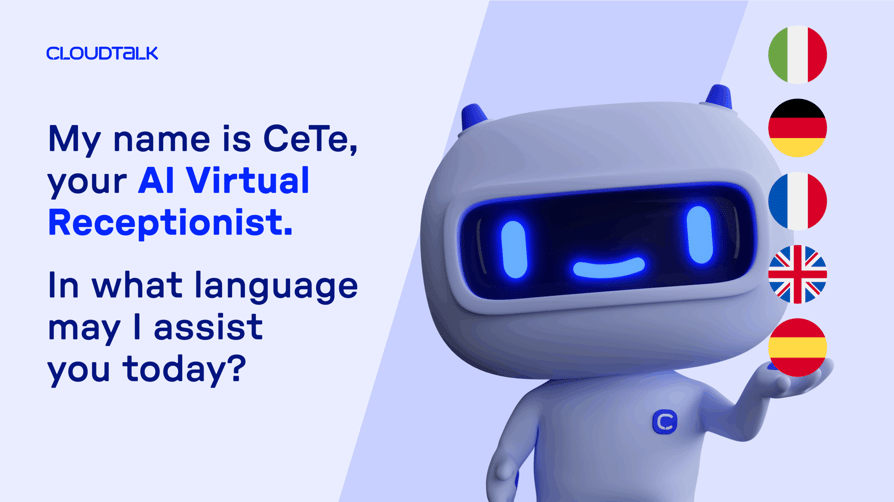
Using AI and automation, it greets callers, takes messages, and sends them to the right person so that every customer gets help in the language they prefer.
Here’s what a bilingual receptionist can do:
- Answer calls 24/7, including nights, weekends, and holidays.
- Routes callers quickly to the right person or department.
- Handle simple requests like booking appointments or sharing business hours.
- Capture caller details like names, numbers, and reasons for calling.
- Greet and serve customers in their preferred language from the very first hello.
In short, it does everything a regular AI virtual receptionist does—but makes it available in multiple languages instead of just one.
Best AI Bilingual Virtual Receptionists for Small Businesses — Affordable Options
Small businesses and startups serving multilingual communities need bilingual reception that doesn’t break the budget. Here are the best affordable options in 2026:
- Upfirst.ai ($24.95/mo, 90+ languages, no-code setup) — the cheapest way to answer calls in almost any language.
- Goodcall ($49/mo, ~7 languages, scheduling-focused) — best if your front desk revolves around bookings and intake.
- CloudTalk ($99/mo AI Receptionist, 70+ languages, CRM sync, 50 free minutes to test) — the best balance of coverage, integrations, and room to grow.
For most small businesses that plan to scale, CloudTalk offers the strongest mix of language coverage and CRM integration; for the tightest budgets, Upfirst.ai is hard to beat.
How We Chose The Best AI Bilingual Virtual Receptionists
There are plenty of options, but most fall into three main categories:
- AI-first platforms built for SMBs and scale (multilingual, automation-driven).
- AI + human hybrid solutions built for service-based SMBs.
- Enterprise UCaaS platforms with receptionist features bundled in.
We scored every provider against five criteria that matter specifically for bilingual and multilingual call handling:
- Language Coverage — the number and quality of languages supported, not just a count on a spec sheet.
- Real-Time Language Detection — how fast and how accurately the receptionist identifies the caller’s language.
- Call Routing by Language — whether you can set language-aware rules that send callers to the right team.
- CRM Integration — how cleanly calls, notes, and transcripts log into your CRM across languages.
- Pricing Transparency — per-minute, flat rate, or per-call, and whether you can see it without a sales call.
To capture that full range, we included five providers that best represent today’s market. Some lean fully into AI, others balance AI with live agents, and a few bundle receptionist features into larger communication suites. Together, they show the main approaches businesses actually compare.
Why Trust Our Software Review?
For nearly 10 years, we’ve been helping more than 30,000 professionals with our solutions. Along the way, we’ve worked closely with experts across customer support, sales, and operations—listening to their challenges and following market trends.
To support better software decisions, we’ve reviewed over 200 software tools across industries. In the process, we’ve analyzed 5,500+ verified customer reviews from platforms like G2, Gartner, Capterra, and TrustRadius, plus real discussions on Reddit and Quora.
In the last year alone, we published over 1,000 articles—each one written by humans for humans, with care and a deep understanding of our customers’ needs. The reviews are based on trustworthy data, with one clear goal: to provide reliable insights and answers for you.
Bilingual Receptionist Scorecard: How the 6 Tools Compare
To score each platform, we tested live multilingual call-handling workflows, reviewed verified G2 and Capterra data, and benchmarked against six bilingual-specific criteria (scored 1–5).
Bilingual Receptionist Scorecard
| Tool | Language Count | Detection Speed | Routing Logic | CRM Sync | 24/7 Coverage | Pricing Clarity | Total |
|---|---|---|---|---|---|---|---|
| CloudTalk | 5 | 5 | 5 | 5 | 5 | 5 | 30/30 |
| Upfirst.ai | 5 | 4 | 3 | 3 | 5 | 4 | 24 |
| RingCentral | 4 | 4 | 3.5 | 3.5 | 5 | 3 | 23 |
| Nextiva | 2 | 4 | 4 | 3.5 | 5 | 2 | 20.5 |
| Smith.ai | 2 | 3 | 4 | 4 | 5 | 2 | 20 |
| Goodcall | 3 | 2 | 3 | 2 | 5 | 3.5 | 18.5 |
The 6 Best AI Bilingual Virtual Receptionists for Business in 2026
Once you understand the key features to look for, the next step is clear: choosing the right bilingual virtual receptionist for your business.
Here’s a quick overview of the best bilingual virtual receptionist providers:
6 Best Bilingual Virtual Receptionist Providers
| Platform | Who It’s Best For | Language Coverage | G2 Rating | Starting Price |
|---|---|---|---|---|
| CloudTalk | Best multilingual AI answering service for SMBs, phone answering 24/7, global scaling | 70+ languages, including English, Spanish, German, Italian, and French | 4.4/5 (1,702+ reviews) | $99/mo (200 min) |
| Smith.ai | Hybrid AI + human receptionist for service-heavy SMBs | English + Spanish English + Spanish (with real-time detection + human fallback) | 4.8/5 for AI receptionist (30+ reviews) | $0/mo (25 calls); $150/mo (75+ calls) |
| Nextiva | Enterprise UCaaS with receptionist add-ons | Primarily English; add-on support for limited languages | 4.5/5 (3,631+ reviews) | $99/mo (100 interactions) |
| Upfirst | AI-first receptionist for SMBs/startups with quick setup | 90+ languages, including English and Spanish | 4.9/5 (26+ reviews) | From $24.95/month (30 calls included) |
| RingCentral | Voice-first AI solution crafted to manage incoming calls | Structured call handling with multilingual routing | 4.4/5 (33+ reviews) | $49/month (100 calls) |
1. CloudTalk — Best Overall Bilingual Virtual Receptionist
What It Is
CloudTalk offers the most complete AI-powered VoIP virtual receptionist for growing businesses. It combines automation, CRM integration, and a multilingual receptionist that speaks 70+ languages, making it a true fit for companies that want to scale globally without missing leads or sacrificing CX.
Unlike bolt-on receptionist features, CloudTalk is purpose-built for AI and automation. It combines multilingual coverage, global scalability, and deep integrations in one platform—making it the best all-around option for businesses that want to grow without adding headcount.
Category Scores
Category Scores (1–5)
| Language Count | Detection Speed | Routing Logic | CRM Sync | 24/7 Coverage | Pricing Clarity | Total |
|---|---|---|---|---|---|---|
| 5 | 5 | 5 | 5 | 5 | 5 | 30/30 |
Language Coverage
CloudTalk covers 70+ languages with automatic detection and regional dialect handling, and logs every call to your CRM in your team’s primary language.
Language Coverage
| Languages Supported | Detection Method | Regional Dialects | CRM Language Handling |
|---|---|---|---|
| 70+ (EN, ES, FR, DE, IT, PT, ZH, JA, AR, HI, and more) | Automatic (first 2–3 words) | Yes — Latin American Spanish, Brazilian Portuguese, Mandarin/Cantonese | Logged in team’s primary language |
Key Features
- A human-sounding multilingual AI voice agent that answers calls 24/7 and handles routine requests at scale.
- Multilingual call answering system that greets and serves callers in their preferred language, ideal for global reach.
- Native integrations with 100+ CRMs and helpdesk tools, including Salesforce, HubSpot, Zendesk, and more.
- AI Smart Notes and AI Call Summaries that offer invaluable coaching insight (available with Conversation Intelligence add-on).
- Call spike management with callback flows and overflow routing.
- Your virtual receptionist call flows are fully customizable, so you can capture the custom details you define and use it for outbound calling too.
Real-Time Language Detection in 70+ Languages
CloudTalk detects the caller’s language from the first two or three words and switches instantly—no phone menu, no manual setup per call. It distinguishes regional dialects, too, separating Latin American from Castilian Spanish, handling Brazilian Portuguese, and telling Mandarin from Cantonese. Every interaction is logged to your CRM in your team’s primary language automatically, so your reps read notes in the language they work in while each caller hears their own.
Language-Aware Smart Routing
Route every call by detected language to the right team, department, or agent. Define custom routing rules for each language pair—Spanish callers to bilingual staff, English callers to standard dispatch—and layer time-of-day rules on top. The result is genuine 24/7 multilingual coverage without hiring overnight bilingual receptionists or maintaining a separate phone tree for every market you serve, so no lead hits a dead end after hours.
Outbound Multilingual Capability
CloudTalk doesn’t stop at answering inbound calls. It runs outbound lead qualification, follow-up surveys, and appointment reminders in 60+ languages, so the same agent that greets a caller can also chase a quote or confirm a booking in that caller’s language. It’s the only tool on this list with full inbound and outbound multilingual coverage—which matters when your pipeline depends on proactive, language-matched follow-up rather than waiting for the phone to ring.
Best For (Bilingual Context)
Growing SMBs and scale-ups—SaaS, e-commerce, healthcare, real estate, and more—that serve customers across several languages and want multilingual reception wired into their CRM.
Pricing
CloudTalk pricing begins with your first 50 minutes free, and then scales with you from $99/month. For businesses that also need a full telephony stack, plans start at $25/user/month, with the option to add on the AI receptionist. Full pricing details are available on the CloudTalk pricing page.
G2 Rating
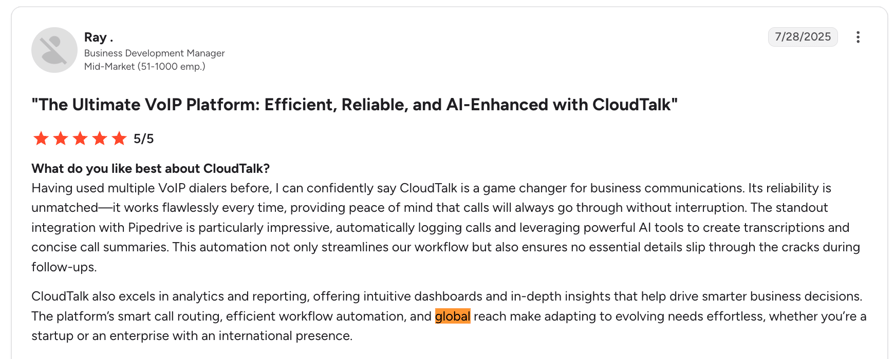
G2 rating: 4.4/5/5 (1,702++ reviews).
When to Use CloudTalk
- Your business serves customers who speak 3+ languages and you want one platform for all of them—CloudTalk covers 70+ without separate tools per language.
- You need bilingual AI reception + CRM logging in one place—CloudTalk pushes transcripts, smart notes, and contact data to HubSpot, Salesforce, or Pipedrive in your team’s primary language.
- You need both inbound answering and outbound multilingual follow-up—CloudTalk is the only tool here that covers both.
- You want to test before committing—CloudTalk’s AI Receptionist includes 50 free minutes to run live calls in your market’s languages before paying.
2. Smith.ai — Best for Bilingual English + Spanish with Human Backup
What It Is
Smith.ai blends AI call answering with live agent support, making it a strong fit for service-heavy businesses that value a personal touch, such as law firms or finance.
The AI instantly detects whether a caller speaks English or Spanish, with bilingual human receptionists available to handle more complex or sensitive calls.
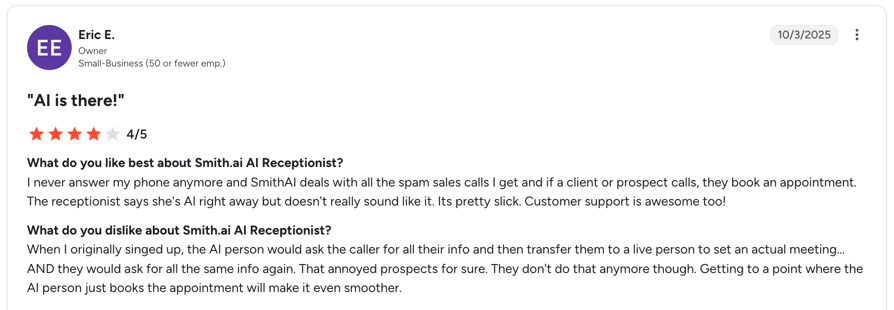
Smith.ai delivers a human + AI hybrid model, giving service-driven companies the reassurance of live bilingual receptionists, backed by the efficiency of AI.
Category Scores
Category Scores (1–5)
| Language Count | Detection Speed | Routing Logic | CRM Sync | 24/7 Coverage | Pricing Clarity | Total |
|---|---|---|---|---|---|---|
| 2 | 3 | 4 | 4 | 5 | 2 | 20 |
Language Coverage
Smith.ai covers English and Spanish with real-time detection, backed by live human receptionists in either language.
Language Coverage
| Languages Supported | Detection Method | Regional Dialects | CRM Language Handling |
|---|---|---|---|
| English + Spanish | Automatic detection | Limited (US Spanish primarily) | English CRM logging |
Key Features
- AI-assisted call answering with human backup.
- 24/7 bilingual coverage in English and Spanish.
- Appointment scheduling and client intake workflows.
- Outbound lead qualification and follow-ups.
Platform Limitations for Multilingual Use
- Live bilingual coverage is limited to English and Spanish—callers in other languages aren’t served by a human agent.
- There’s no automatic detection across a broad language set the way AI-first tools offer.
- Per-call human answering costs climb as multilingual call volume grows.
Best For (Bilingual Context)
Professional services—law firms, consultancies, agencies—that need English/Spanish coverage with the reassurance of live human receptionists on complex or sensitive calls.
Pricing
Smith.ai pricing offers three plans:
- Enterprise: From $500/mo — $1.30–$1.67/call, 300+ calls/month
- Free: $0/mo — 25 calls/month
- Pro: From $150/mo — $1.60–$2.00/call, 75+ calls/month
G2 Rating
G2 rating: 4.8/5 (30+ reviews).
CloudTalk vs. Smith.ai
Feature Comparison
| Dimension | CloudTalk | Smith.ai |
|---|---|---|
| Languages covered | 70+ | English + Spanish |
| Agent type | AI-first | AI + human hybrid |
| Starting price | from $99/mo (AI Receptionist) | from $0-$150/mo |
| CRM integration | Native, 100+ CRMs | Yes, more limited |
| 24/7 availability | Yes | Yes |
| Outbound capability | Yes (AI Specialist) | Limited |
When to Use Smith.ai
- You want live bilingual (English/Spanish) human receptionists for complex or sensitive calls.
- You run a professional-services firm—law, finance, consulting—where a human touch closes deals.
- You prefer a hybrid model over full automation.
When Not to Use Smith.ai
- You need more than English and Spanish.
- You want fully automated AI coverage at scale.
- You’re cost-conscious about per-call human answering pricing.
Recommended Reads
3. Nextiva — Best for Enterprises Already on UCaaS
What It Is
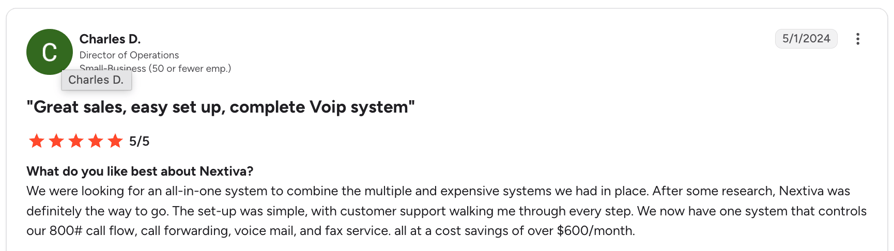
Nextiva is best known as a unified communications (UCaaS) platform, bundling phones, video, messaging, and receptionist tools. Its receptionist features come included in the suite, though multilingual AI is limited to English and basic Spanish support.
Nextiva works best if you’re an enterprise already on UCaaS and want receptionist features as part of a broader ecosystem. For heavy multilingual AI coverage, however, it’s less flexible than the AI-first providers on our list.
Category Scores
Category Scores (1–5)
| Language Count | Detection Speed | Routing Logic | CRM Sync | 24/7 Coverage | Pricing Clarity | Total |
|---|---|---|---|---|---|---|
| 2 | 4 | 4 | 3.5 | 5 | 2 | 20.5 |
Language Coverage
Nextiva is primarily English with limited Spanish support; multilingual depth is shallow compared with AI-first tools.
Language Coverage
| Languages Supported | Detection Method | Regional Dialects | CRM Language Handling |
|---|---|---|---|
| English + limited Spanish | Manual routing rules | No | Primarily in English |
Key Features
- UCaaS suite (voice + video + messaging).
- Call routing and receptionist console.
- Enterprise-scale compliance and admin controls.
Platform Limitations for Multilingual Use
- Multilingual support is limited to English and basic Spanish, with no automatic detection across many languages.
- Regional dialects aren’t handled distinctly.
- The receptionist is a UCaaS add-on rather than a purpose-built multilingual AI agent.
Best For (Bilingual Context)
Enterprises and mid-market teams already on Nextiva’s UCaaS suite that want built-in receptionist features and are English-dominant with light Spanish needs.
Pricing
Receptionist pricing starts at $99/month per 100 interactions, then $0.99 per interaction
G2 Rating
G2 rating: 4.5/5 (3,631+ reviews).
CloudTalk vs. Nextiva
Feature Comparison
| Dimension | CloudTalk | Nextiva |
|---|---|---|
| Languages covered | 70+ | English + limited Spanish |
| Agent type | AI-first | UCaaS bundle |
| Starting price | from $99/mo (200 min) | $99/mo (100 interactions) |
| CRM integration | Native, deep integrations | Enterprise, English-centric |
| 24/7 availability | Yes | Yes |
| Outbound capability | Yes | Limited |
When to Use Nextiva
- You’re already on Nextiva’s UCaaS suite and want receptionist features inside it.
- You’re an enterprise that needs voice, video, and messaging in one platform.
- Multilingual coverage is a nice-to-have, not your priority.
When Not to Use Nextiva
- You need heavy multilingual AI coverage beyond basic Spanish.
- You want an AI-first standalone receptionist.
- You serve callers across many languages and markets.
4. Upfirst.ai — Best Budget Multilingual Receptionist (90+ Languages)
What It Is
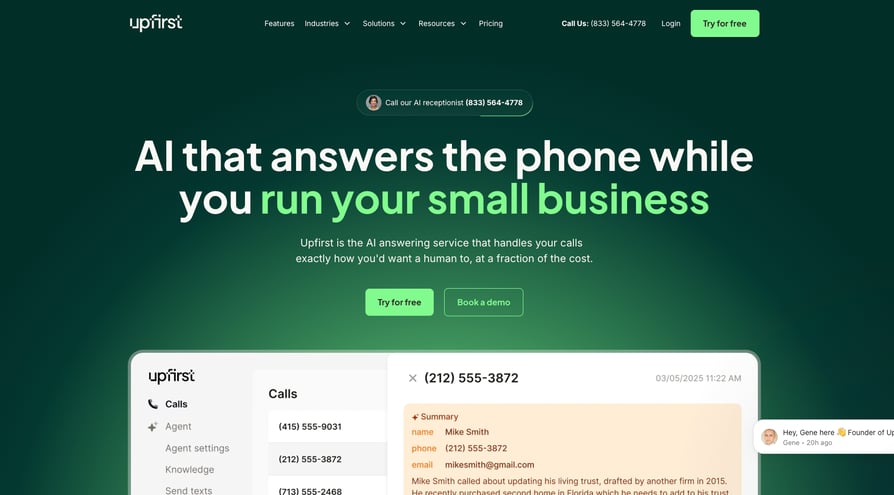
Upfirst.ai is an AI-first receptionist designed for SMBs and startups that want multilingual coverage without the high price tag.
With support for 90+ languages, Upfirst is one of the most accessible receptionist tools for multilingual startups—but with limited integrations and analytics.
Upfirst delivers massive language coverage at an entry-level price, making it a top choice for SMBs that serve diverse communities but must keep costs low.
Category Scores
Category Scores (1–5)
| Language Count | Detection Speed | Routing Logic | CRM Sync | 24/7 Coverage | Pricing Clarity | Total |
|---|---|---|---|---|---|---|
| 5 | 4 | 3 | 3 | 5 | 4 | 24 |
Language Coverage
Upfirst.ai supports 90+ languages—the broadest raw count on this list—though regional dialect handling isn’t clearly documented.
Language Coverage
| Languages Supported | Detection Method | Regional Dialects | CRM Language Handling |
|---|---|---|---|
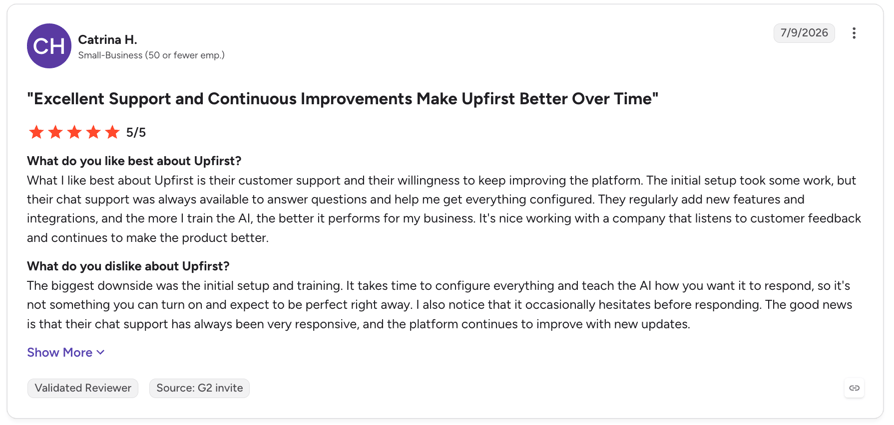
| 90+ languages | Automatic detection | Australian, Scottish, Southern/Texan and more | Automatically detects languages based on what the caller speaks |
Key Features
- 24/7 multilingual call answering.
- Simple setup with no-code workflows.
- Affordable, usage-based plans that scale.
Platform Limitations for Multilingual Use
- CRM integrations and analytics are limited, so multilingual call data is harder to action.
- Enterprise controls and reporting are thinner than platforms built for scale.
Best For (Bilingual Context)
Budget-conscious SMBs and startups serving diverse communities that need broad language coverage at the lowest entry price.
Pricing
- Starter: $24.95/month
- Premium: $59.95/month
- Pro: $159.95/month
- Scale: $299/month
- Custom: Custom pricing
G2 Rating
G2 Rating: 4.9/5 (26+ reviews)
CloudTalk vs. Upfirst.ai
Feature Comparison
| Dimension | CloudTalk | Upfirst.ai |
|---|---|---|
| Languages covered | 70+ | 90+ |
| Agent type | AI-first | AI-first (budget) |
| Starting price | from $99/mo (200 min) | from $24.95 (30 calls) |
| CRM integration | Native, enterprise-grade | Limited integrations/analytics |
| 24/7 availability | Yes | Yes |
| Outbound capability | Yes | Limited |
When to Use Upfirst.ai
- You’re a startup or SMB on a tight budget.
- You need broad language coverage (90+) at the lowest entry price.
- You want fast, no-code setup.
When Not to Use Upfirst.ai
- You need deep CRM integrations and analytics.
- You need enterprise reliability and reporting.
- You need outbound calling and advanced language-aware routing.
5. Goodcall — Best for Multilingual Bookings & Intake
What It Is
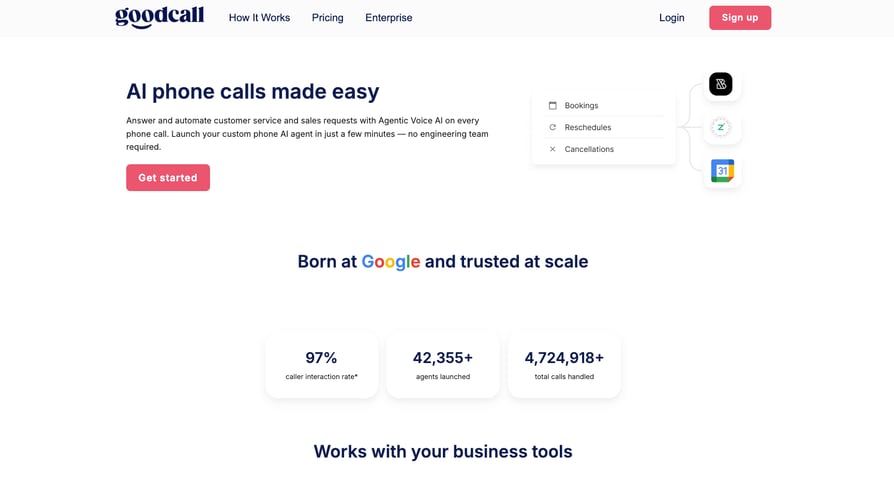
Goodcall is positioned as an AI phone agent and receptionist with a focus on appointments and intake workflows, making it an ideal choice for industries like healthcare. It supports around 7 languages, covering the most common use cases for U.S. businesses.
Goodcall is ideal if your receptionist needs revolve around bookings and customer intake. While its multilingual range is narrower, its focus on scheduling makes it valuable for service industries.
Category Scores
Category Scores (1–5)
| Language Count | Detection Speed | Routing Logic | CRM Sync | 24/7 Coverage | Pricing Clarity | Total |
|---|---|---|---|---|---|---|
| 3 | 2 | 3 | 2 | 5 | 3.5 | 18.5 |
Language Coverage
Goodcall does not currently publish its language coverage. However, according to third-party estimates, it covers around 7 languages—enough for common U.S. use cases, but narrow for diverse markets.
Language Coverage
| Languages Supported | Detection Method | Regional Dialects | CRM Language Handling |
|---|---|---|---|
| ~7 (EN, ES, FR + others) | Direct language requests | Not public | Limited |
Key Features
- AI-powered scheduling and intake.
- FAQ answering for front-desk workflows.
- Integrations with Google Calendar, Boulevard, and more.
Platform Limitations for Multilingual Use
- Language coverage tops out around 7 languages, which is narrow for diverse markets.
- The product is scheduling-first, so advanced language-aware routing is limited.
- Businesses serving many language communities will outgrow its multilingual range.
Best For (Bilingual Context)
Service SMBs—medical, salons, home services—whose front desk revolves around bookings and intake, with lighter multilingual requirements.
Pricing
- Starter: $66/month per agent
- Growth: $108/month per agent
- Scale: $208/month per agent
G2 Rating
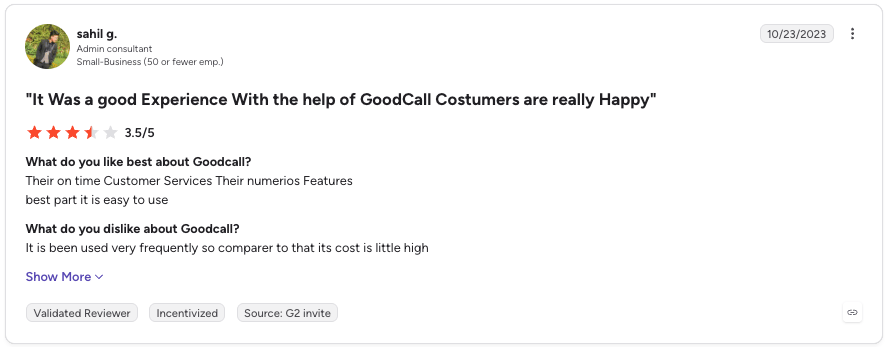
G2 rating: 3.5/5 (1 review).
CloudTalk vs. Goodcall
Feature Comparison
| Dimension | CloudTalk | Goodcall |
|---|---|---|
| Languages covered | 70+ | ~7 |
| Agent type | AI-first | AI (scheduling-focused) |
| Starting price | from $99/mo (AI Receptionist) | from $66/agent/mo |
| CRM integration | Native, 100+ integrations | Mostly via Zapier |
| 24/7 availability | Yes | Yes |
| Outbound capability | Yes | Limited |
When to Use Goodcall
- Your core need is bookings, appointments, and intake.
- You run a service SMB—salon, clinic, or home services.
- You want scheduling-first workflows over broad language coverage.
When Not to Use Goodcall
- You need coverage beyond ~7 languages.
- You need advanced routing, analytics, and outbound.
- You operate across many languages and markets.
Recommended Reads
6. RingCentral AI Receptionist — Best for Enterprise Multilingual Call Routing
What It Is
RingCentral’s AI Receptionist (AIR) is a voice-first AI solution crafted to manage incoming calls, collect caller details, and smartly direct conversations before a human takes over. Seamlessly integrated into RingCentral’s communications platform, it empowers businesses to create a consistent and professional first impression—without the need to hire extra receptionists.
AIR captures context during the call intake process and shares it with employees or agents, ensuring that conversations don’t start from square one. For businesses catering to a diverse range of customers, this structured approach to intake guarantees smoother, more precise call routing and enhances the overall caller experience.
Category Scores
Category Scores (1–5)
| Language Count | Detection Speed | Routing Logic | CRM Sync | 24/7 Coverage | Pricing Clarity | Total |
|---|---|---|---|---|---|---|
| 4 | 4 | 3.5 | 3.5 | 5 | 3 | 23 |
Language Coverage
ingCentral AI Receptionist supports English, French, Spanish, Italian, German, and Portuguese, including regional variants. It can also automatically switch languages mid-call when it detects a change, making it useful for multilingual businesses.
Language Coverage
| Languages Supported | Detection Method | Regional Dialects | CRM Language Handling |
|---|---|---|---|
| Config-dependent | Via routing rules | UK, Australian, Canadian French and Latin American Spanish | Automatic detection |
Key Features
- Automated answering and smart call routing.
- Lead capture and call screening workflows.
- Appointment scheduling and handling FAQs.
- Context-rich handoffs to employees or contact center agents.
- Native integration with RingCentral RingEX and RingCX.
Platform Limitations for Multilingual Use
- Limited language coverage.
- Fewer options for global teams.
- Gaps in Asian and Middle Eastern languages.
Best For (Bilingual Context)
Growing businesses, multi-location teams, and enterprises with high inbound volume that want AI intake inside a full UCaaS and contact-center ecosystem.
Pricing
From $49/month as a standalone add-on (includes 100 minutes).
G2 Rating
G2 rating: 4.3/5 (RingCentral platform overall).
CloudTalk vs. RingCentral
Feature Comparison
| Dimension | CloudTalk | RingCentral |
|---|---|---|
| Languages covered | 70+ languages and accents | 10+ languages and accents |
| Agent type | AI-first | UCaaS / contact center |
| Starting price | from $99/mo (200 min) | from $49/mo (100 min) |
| CRM integration | Native, deep integrations | RingEX / RingCX ecosystem |
| 24/7 availability | Yes | Yes |
| Outbound capability | Yes | Limited |
When to Use RingCentral
- You’re an enterprise expecting growth in call volume and complexity.
- You want AI intake inside a full UCaaS and contact center (RingEX, RingCX).
- You run multi-location teams on one platform.
When Not to Use RingCentral
- You want a standalone, AI-first multilingual receptionist.
- You’re an SMB that wants quick setup.
- Multilingual coverage is your top priority.
Recommended Reads
Our Top Pick: CloudTalk
While all five providers bring something to the table, CloudTalk stands out as the best bilingual virtual receptionist for SMBs and scaling companies.
It’s AI-first, built to scale globally, and covers 70+ languages with deep integrations with the best CRMs.
That combination makes it the most complete option for teams that want to capture every lead and deliver a consistent customer experience—without adding headcount.
Here’s how CloudTalk’s bilingual receptionist compares directly with the others:
- CloudTalk vs. Smith.ai: Smith.ai is strong if you need live bilingual agents, but language coverage is limited to English and Spanish. CloudTalk offers 70+ languages with fully automated AI coverage.
- CloudTalk vs. Nextiva: Nextiva works best for enterprises that already use its UCaaS suite. But its receptionist tools are basic and mostly English-only. CloudTalk delivers full AI + multilingual coverage as a core product.
- CloudTalk vs. Upfirst.ai: Upfirst is appealing for budget buyers with its 90+ languages, but it lacks CloudTalk’s deep integrations, insights, and reliability.
- CloudTalk vs. Goodcall: Goodcall is great for bookings and intake, but its 7 languages are limiting. CloudTalk offers broader multilingual reach plus advanced routing, analytics, and outbound flows.
The #1 Multilingual Virtual Receptionist
Bilingual Virtual Receptionist Use Cases by Industry
Best Bilingual AI Receptionist for Law Firms and Legal Services
Legal is one of the biggest bilingual receptionist verticals. CloudTalk is the best fit for law firms: it handles client intake in the caller’s language across 70+ languages, syncs to your CRM, and runs customizable intake scripts. Smith.ai is a strong alternative when you want bilingual (English/Spanish) human receptionists with a live backup for complex intake. Legal-specific needs it covers: intake in the caller’s language, conflict-check questions in both languages, multilingual scheduling for consultations, and strict confidentiality. See our guide to the best virtual receptionist for law firms.
Best Bilingual AI Receptionist for English + Spanish Markets
English + Spanish is the most common bilingual requirement for US businesses—and the language pair most buyers ask about first. Best tools: CloudTalk (automated English/Spanish detection, including Latin American and Castilian Spanish), Smith.ai (native English/Spanish human receptionists for a hybrid model), and Upfirst.ai ($24.95/mo entry, English/Spanish plus 88 others). If you want to handle English/Spanish inbound calls without a live rep, CloudTalk is the strongest pick—it detects, answers, and routes in both languages automatically.
Best Bilingual AI Receptionist for Field Services and Dispatch Teams
HVAC companies, plumbers, electricians, and landscapers in multilingual markets like California, Texas, and Florida face a specific bilingual challenge: callers speak Spanish, the dispatch team speaks English, and the technician may speak either. CloudTalk solves it with language-aware routing—Spanish-speaking callers go to bilingual dispatchers, English callers to standard dispatch, and AI handles overflow in both, including after-hours call handling.
Best Multilingual AI Call Center for Enterprise Seasonal Peaks
Enterprises that need multilingual AI call center software to scale during seasonal peaks—e-commerce holiday rushes, tax season, enrollment periods—need unlimited concurrency plus consistent language quality at volume. CloudTalk handles unlimited concurrent calls in 70+ languages and adds outbound follow-up during peaks, giving you real call spike management across English, Spanish, and French. RingCentral is worth a look for enterprises already inside its ecosystem.
Bilingual AI Receptionist Pricing — What to Expect in 2026
Virtual receptionist cost for bilingual AI coverage in 2026 depends on three variables: how many languages you need, whether you want AI-only or AI + human backup, and how many calls you receive per month.
Bilingual AI Receptionist Pricing by Tier
| Tier | Price Range | Tools | Languages | Best For |
|---|---|---|---|---|
| Entry | $24.95-$49/mo | Upfirst.ai, Goodcall | 7-90+ | Solo businesses, startups — basic bilingual answering |
| SMB | $95-$150/mo | Smith.ai (AI), CloudTalk AI Receptionist | 2 (EN+ES) / 70+ | Professional services, growing teams — CRM sync included |
| Full Platform | $300-$400/mo | Smith.ai (hybrid), CloudTalk full platform | 2 / 70+ | Multi-team — inbound + outbound + CRM analytics |
| Enterprise | $500+/mo or custom | RingCentral, Nextiva | Configuration-dependent | UCaaS ecosystem, multi-location, enterprise SLA |
CloudTalk’s 50 free minutes are the strongest differentiator in a market where most bilingual answering services require a sales call before revealing pricing. Compare plans on our bilingual AI receptionist pricing page.
How Do AI Virtual Receptionists Handle Multiple Languages and Dialects?
AI virtual receptionists handle multiple languages automatically—no phone-tree menus, no separate line per language. Here’s how it works, step by step:
- Language detection: The AI identifies the caller’s spoken language from the first 1-3 words using a language identification model. No configuration is needed per call.
- Instant switch: The AI switches to the detected language within 500ms—before the caller finishes their first sentence.
- Dialect and accent handling: Modern AI receptionists (CloudTalk, Upfirst.ai) handle regional dialects—Latin American vs. Castilian Spanish, UK vs. Australian English—without separate language settings.
- CRM logging: Conversation data, notes, and transcripts sync to the CRM in the team’s primary language (for example, English), regardless of the call language.
Behind the scenes, this runs on multilingual AI voice agents and multilingual call routing that send each caller to the right place in their own language.
What Can an AI Bilingual Virtual Receptionist Do for Your Business?
An AI-powered bilingual virtual receptionist acts as the first touchpoint for your business. Beyond answering calls, it eliminates language barriers that can otherwise cost you leads and trust.
Here’s what it typically handles:
- Warm greetings in the caller’s language: Builds instant comfort and rapport.
- Answers routine questions: Hours, pricing, or availability delivered without delay.
- Message-taking with zero friction: Caller details captured and synced into your CRM.
- Handles common use cases: Appointments or bookings are handled automatically, without back-and-forth.
- Smart call routing: Connects callers to the right person or department in real time.
- Multilingual FAQs: Handles order status, location details, or other common queries in multiple languages.
Bottom line:
Your receptionist does more than just pick up phones. Your always-on sidekick ensures every caller feels heard and supported from the very first hello.
Start Free Trial
Key Features of the Best AI Bilingual Virtual Receptionist Software
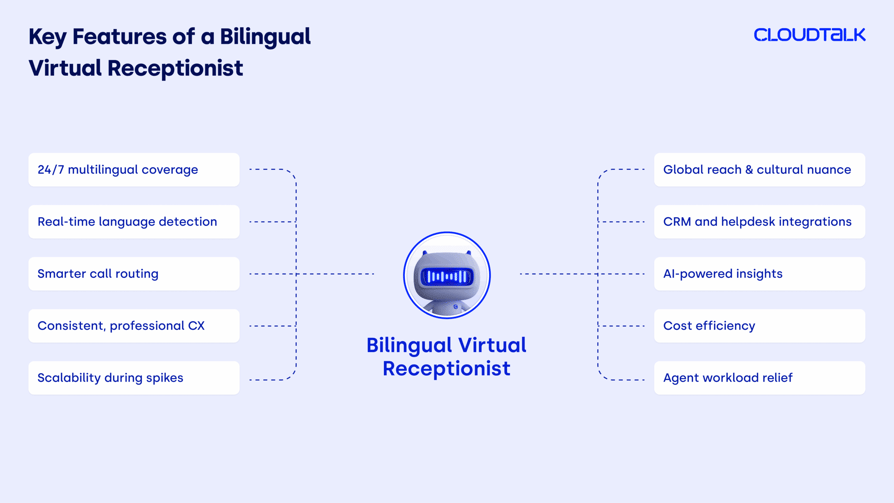
More than 67 million people in the U.S. speak a language other than English at home², and over 60% of customers say fast response times are the most important part of good service³.
Put those two facts together, and the risk is clear: if your receptionist can’t answer quickly and in the caller’s preferred language, opportunities slip away.
That’s why the right provider matters. When choosing a bilingual virtual receptionist, look for these must-have features:
- 24/7 multilingual coverage: Answer every call, during or after hours, including nights, weekends, and holidays. This way, your customers don’t feel ignored, and you don’t lose leads.
- Real-time language detection: Make customers feel understood from the first word with instant recognition of their preferred language.
- Smarter call routing: Send callers to the right person or workflow quickly, guided by language-aware rules that remove friction.
- Consistent, professional CX: Present a polished brand voice on every call with clear greetings and reliable call quality, no matter the language.
- Scalability during spikes: Stay responsive during promotions, seasonal peaks, or outages by handling call surges across languages without extra staff.
- Global reach & cultural nuance: Build trust internationally with support for regional dialects and cultural cues that make interactions feel local.
- CRM and helpdesk integrations: Keep customer data flowing automatically with calls, notes, and transcripts logged in both the caller’s language and English.
- AI-powered insights: Turn conversations into strategy by tracking sentiment, keywords, and trends across languages.
- Cost efficiency: Scale support without scaling payroll by replacing full-time bilingual hires with predictable monthly or per-minute pricing.
- Agent workload relief: Free your team to focus on complex cases while routine multilingual FAQs are handled automatically. It’s a great way to prevent agent burnout.
Bottom line:
The best bilingual virtual receptionist ensures every caller feels heard and supported—while you cut costs, gain insights, and expand globally without extra overhead.
CloudTalk’s Bilingual Receptionist Has It All
How to Set Up an AI Bilingual Virtual Receptionist (Step-by-Step Guide)
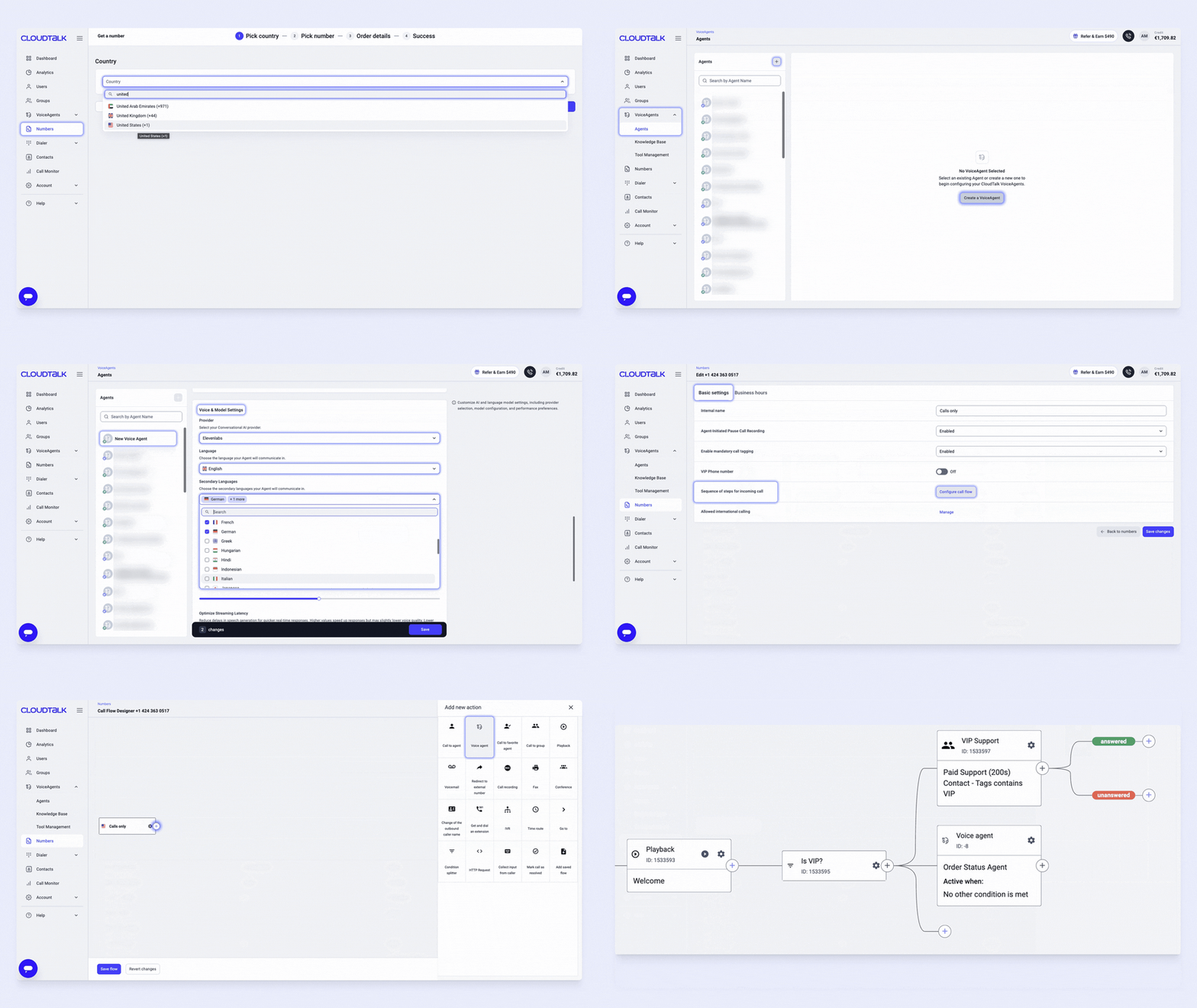
Setting up CloudTalk’s bilingual receptionist takes just a few minutes—no technical skills required.
Here’s exactly how it works inside the CloudTalk dashboard:
Quick summary:
Step 1: Create Your CloudTalk Account
Head over to cloudtalk.io and sign up for a new account. Choose the plan that best fits your team size, call volume, and feature needs. Then, throw in the AI Voice Agent add-on, and you’re ready to set up your bilingual virtual receptionist.
Not Ready to Commit Yet? Try It out for Free
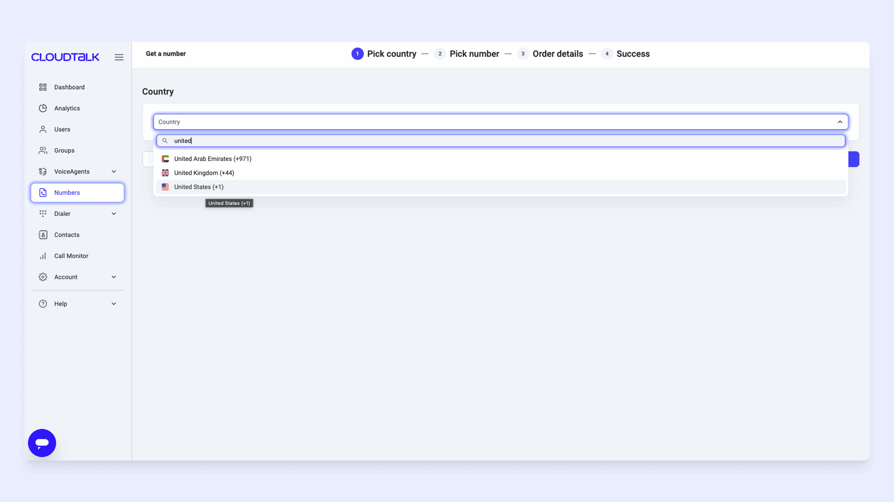
Step 2: Add Local or International Phone Numbers
From the dashboard, go to Numbers → Get a Number. Select the countries or regions where you operate and purchase international numbers for each. These numbers will become the entry points for your bilingual receptionist.
Step 3: Create a New AI Receptionist (Voice Agent)
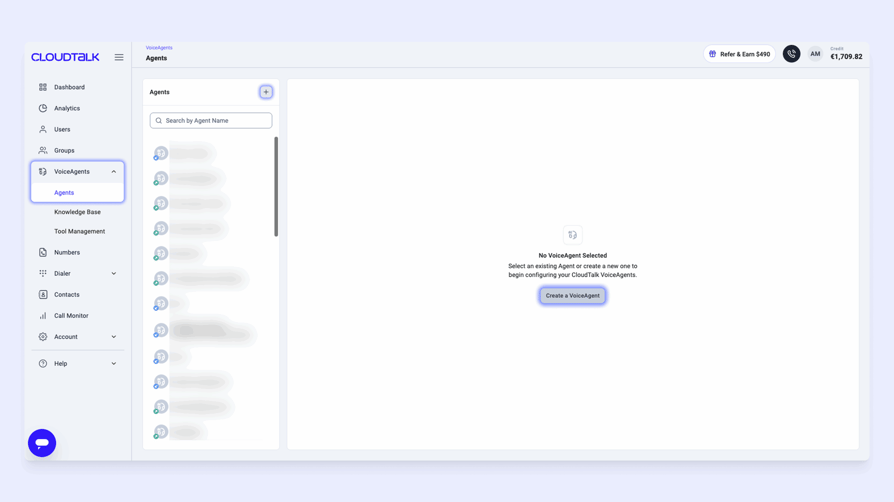
In the left-hand menu, select AI Voice Agents → Agents. Then, click the “Create a VoiceAgent” button to set up your first virtual receptionist, or hit the “+” button to add more.
When setting up your bilingual receptionist, you can either:
- Start from scratch, or
- Use a prebuilt template (e.g., Support Bot, Sales Bot).
Pro Tip:
Step 4: Set Languages for the Agent
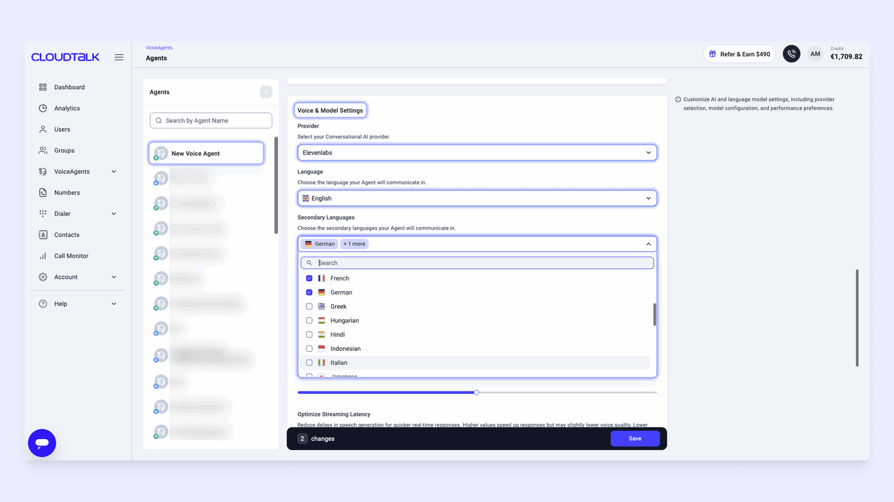
Once your receptionist is created, click on it in the AI Voice Agents list to open the configuration view.
Go to the Voice & Model Settings section.
Here, you’ll:
- Choose the voice model provider (we recommend ElevenLabs for natural multilingual voices)
- Set your Primary Language and one or more Secondary Languages
Your virtual receptionist will automatically detect the caller’s spoken language from the first words and switch to the caller's language—as long as it's one of the languages you've selected.
Step 5: Configure Your Receptionist
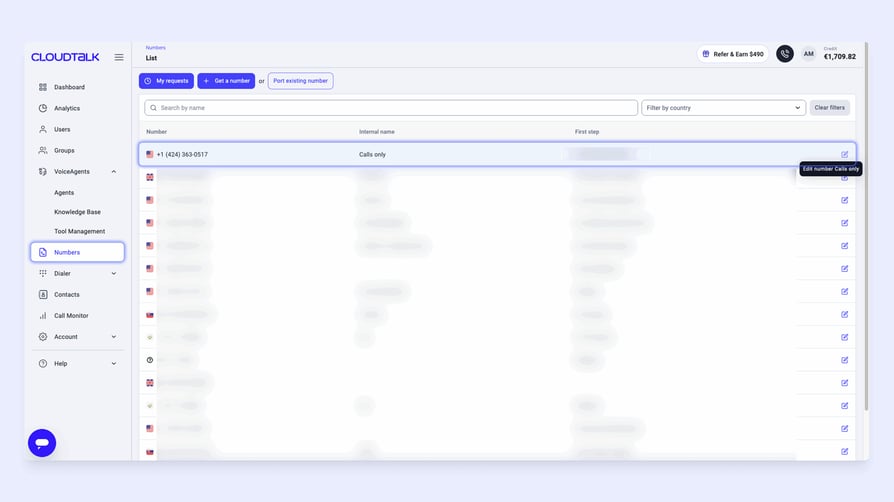
From the Dashboard, go to the Numbers tab. Find the number that should activate your bilingual receptionist and click the blue pencil icon to configure it.
Step 6: Open the Call Flow Designer
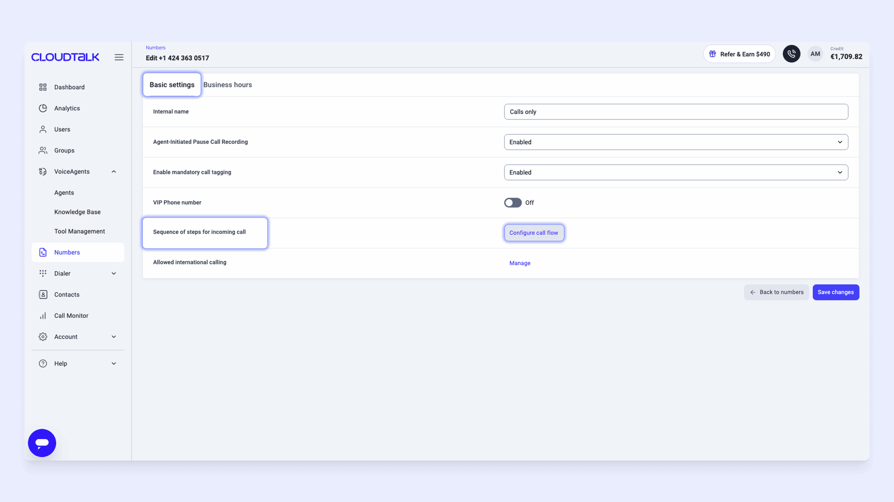
Inside the number settings, scroll to the incoming call section and click Configure call flow. This opens the Call Flow Designer.
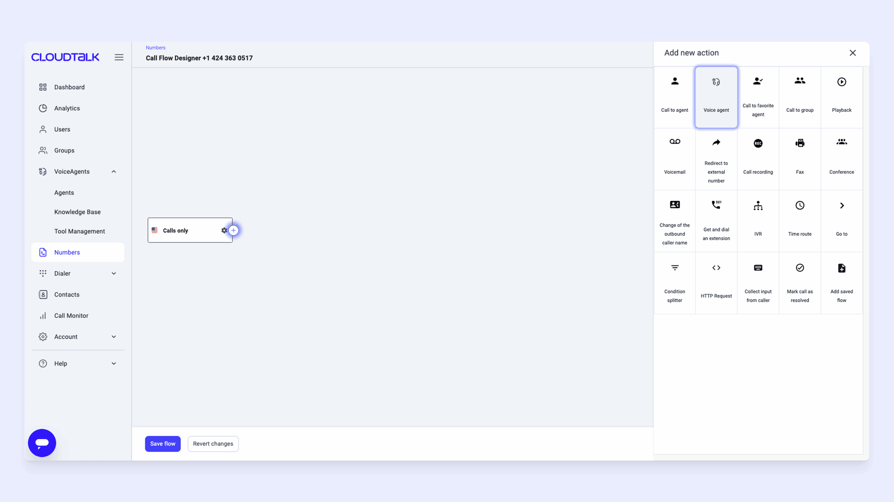
Step 7: Add the VoiceAgent Step
In the flow, click the + icon where you want the VoiceAgent to take over. Choose VoiceAgent from the action menu.
In the setup panel:
- (Optional) Name the step
- Select the VoiceAgent you created earlier
Important: Remember that your virtual receptionist (VoiceAgent) should be the final step in its branch.
Step 8: Save and Activate Your Flow
Customize your flow for the selected number/receptionist further. Then click Save at the bottom of the Call Flow Designer to activate the updated routing.
That’s it. Your bilingual virtual receptionist that handles calls in 70+ languages is now live!
And here’s what a sample virtual receptionist call flow could look like:
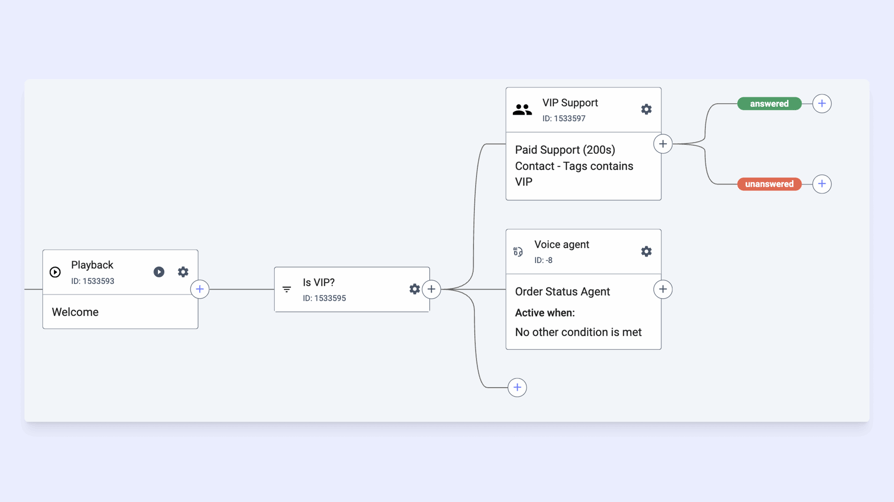
Your bilingual virtual receptionist is now live. For the first 7 days, monitor call logs to verify correct language detection and routing. If a language is mis-detected, update the secondary language list in Voice & Model Settings.
Why Businesses Are Switching to AI-Powered Bilingual Receptionists in 2026
Hiring and managing full-time bilingual staff is expensive and hard to scale. That’s why businesses in multilingual markets are moving toward AI-powered bilingual virtual reception solutions that offer:
- Lower costs: Replace the expense of bilingual hires with predictable usage-based pricing.
- Consistent experiences: Every caller receives the same professional, language-appropriate response.
- Effortless scalability: Handle high call volumes without scrambling for staff.
- Always-on availability: An after-hours virtual receptionist covers nights, weekends, and global time zones automatically—no overnight hires required.
- Seamless integrations: Calls, notes, and transcripts flow directly into your CRM or helpdesk.
- Global trust: Customers feel respected in their own language, strengthening loyalty.
Bottom line:
AI-powered bilingual receptionists deliver reliability, cost savings, and trust—without the staffing challenges of traditional approaches. For most businesses, that makes them absolutely worth it.
What ROI Can You Expect From a Bilingual AI Receptionist?
The return shows up fast, because two numbers work in your favor. 76% of consumers are more likely to buy again when support is offered in their own language¹, and 80% of callers sent to voicemail won’t leave a message⁴. A bilingual AI receptionist that answers in the caller’s language captures the calls an English-only setup would push to voicemail—and turns first-time Spanish-speaking callers into repeat customers. Instead of paying for full-time bilingual hires, you pay predictable usage-based pricing and keep every lead that would otherwise hang up.
Test Drive #1 Multilingual Virtual Receptionist
Recommended Articles
Stop Losing Leads to Language Gaps
Two things to remember: (1) The best bilingual virtual receptionist in 2026 detects the caller’s language instantly, answers 24/7 in 70+ languages, and syncs everything to your CRM—without adding headcount. (2) CloudTalk leads the category with AI-first multilingual coverage, transparent pricing, and 50 free minutes to test.
Missed calls already hurt—80% of callers sent to voicemail won’t leave a message⁴. Add a language barrier, and the chance to save the call disappears completely.
The problem is that every unanswered or misunderstood call is a chance lost to a competitor who makes the customer feel understood.
That’s why a basic answering service isn’t enough in 2026. You need a bilingual virtual receptionist that blends AI, automation, and integrations to truly impact your business, revenue, and customer experience.
CloudTalk gives you that edge. Its AI-first bilingual virtual receptionist answers calls around the clock and adds real business value with:
- 24/7 availability so no lead slips away.
- Smart routing and CRM sync for seamless experiences.
- Global reach in 70+ languages to build trust across markets.
- AI insights that turn calls into strategy.
The businesses that win this year won’t be the ones taking the most calls—they’ll be the ones turning every call, in any language, into an opportunity. CloudTalk makes sure you’re one of them.


Sources:
Frequently asked questions
CloudTalk is the best bilingual virtual receptionist in 2026 for most businesses: it answers calls 24/7 in 70+ languages, detects the caller’s language automatically, and syncs every call to your CRM.
The best call answering providers with bilingual support are CloudTalk (AI-first, 70+ languages, real-time detection, CRM sync), Smith.ai (AI plus live human receptionists in English and Spanish), and Upfirst.ai (90+ languages at an entry price).
CloudTalk is the best AI receptionist with multilingual support for most teams: it handles calls in 70+ languages, detects the caller’s language from the first few words, routes by language, and logs everything to your CRM in your team’s primary language.
For English + Spanish specifically, CloudTalk automatically detects and answers in both, including Latin American and Castilian Spanish, and routes Spanish-speaking callers to the right team. Smith.ai offers native English/Spanish human receptionists for a hybrid model, and Upfirst.ai covers English, Spanish, and 88 other languages from $24.95/mo. CloudTalk is the best pick if you want automated English/Spanish answering without a live rep.
For law firms, CloudTalk is the best bilingual virtual receptionist: it handles client intake in the caller’s language across 70+ languages, syncs to your CRM, and supports customizable intake scripts. Smith.ai is a strong alternative for firms that want bilingual (English/Spanish) human receptionists with a live backup for complex or sensitive legal intake. Both cover multilingual appointment scheduling for consultations—see the best virtual receptionist for law firms.
For small businesses, the best affordable multilingual AI receptionists are Upfirst.ai ($24.95/mo, 90+ languages, no-code setup), Goodcall (~$&&/mo, ~7 languages, scheduling-focused), and CloudTalk ($99/mo AI Receptionist, 70+ languages, CRM sync, with 50 free minutes to test). CloudTalk offers the best balance of language coverage, CRM integration, and room to scale as call volume grows.
A bilingual AI receptionist typically costs between $24.95/mo and $400+/mo in 2026, depending on language coverage, call volume, and whether you want AI-only or AI + human backup.
CloudTalk is the best fit for enterprises needing multilingual AI call center software that scales during seasonal peaks: it handles unlimited concurrent calls in 70+ languages and adds outbound follow-up during rushes, so English, Spanish, and French volume is covered without hiring seasonal staff.
CloudTalk is the best AI-first alternative to Moneypenny for bilingual and multilingual call handling: it answers in 70+ languages 24/7, syncs to your CRM, and handles outbound follow-up—at a fraction of the cost of a human answering service. If you specifically want human receptionists in multiple languages, Smith.ai is the closest hybrid alternative.
Yes, a bilingual virtual receptionist is worth it—especially if you operate in multilingual markets or plan to expand internationally. It’s more than a cost-saver; it’s a growth enabler. Here’s what it gives you:
- Revenue protection: Every caller feels understood, so fewer opportunities are lost.
- Customer trust: Multilingual support builds stronger relationships and loyalty.
- Scalability: Grow into new markets without hiring full-time bilingual staff.
- Cost savings: Replace staffing expenses with predictable, usage-based pricing.
Any industry that serves multilingual customers can benefit greatly from a bilingual virtual reception. A receptionist speaking multiple languages helps businesses capture leads, reduce churn, and build trust. For example:
- Doctors taking care of English and Spanish patients
- Law firms working with diverse local communities
- Real estate agents expanding into new markets
- Hospitality and travel brands welcoming international guests
- Logistics and service providers handling cross-border operations
For example, CloudTalk’s bilingual virtual receptionist supports English, Spanish, French, German, Portuguese, and 70+ other languages. Coverage adapts to caller needs. For example:
- Real-time language detection on the first utterance
- Automatic fallback to English if unclear
- Regional dialect support for Spanish, French, and German
- Flexible configuration for custom greetings in any language
Yes. Bilingual receptionists connect directly with your CRM, helpdesk, and scheduling apps. This keeps customer data consistent across tools. For example:
- Calls, notes, and transcripts logged in Salesforce or HubSpot
- Appointment scheduling synced with Google or Outlook calendars
- AI Smart Notes stored in Zendesk or Pipedrive records
- Automated follow-ups triggered without manual input
Absolutely. Unlike a single front desk agent, AI receptionists scale instantly to handle call spikes. For example:
- Parallel call handling with no wait time
- Overflow routing during promotions or seasonal peaks
- Callback options when live staff are busy
- Analytics dashboards to monitor performance in real time
Voicemail rarely converts leads. A bilingual receptionist ensures calls are answered immediately, so opportunities aren’t lost. For example:
- Live greeting in the caller’s preferred language
- Message capture and instant CRM logging
- SMS or email follow-up when staff are unavailable
- Always-on coverage that voicemail can’t match
Call transcripts and AI Smart Notes appear in the caller’s original language, with optional English translation. For example:
- Spanish conversations logged in Spanish, with English side-by-side
- Auto-tagging of keywords in both languages
- Sentiment analysis available regardless of language
- Consistent formatting across all supported CRMs
Costs depend on usage, not on hiring extra staff. CloudTalk offers AI receptionist pricing that scales with your business, starting at $99/month for 200 minutes.
Yes. AI call routing detects Spanish immediately and directs callers to the right agent or workflow. For example:
- Dynamic routing to a Spanish-speaking AI receptionist
- Bilingual menus for English/Spanish IVR flows
- Fallback to human staff when escalation is needed
- Smooth customer journey without manual transfers
Yes. Modern AI receptionists can handle multiple languages reliably, not just basic greetings.
The best AI receptionists:
- detect the caller’s language automatically (no menu needed)
- respond in that language from the first interaction
- keep the conversation consistent from start to finish
Tools like CloudTalk, Upfirst, and Smith.ai already do this in production for English, Spanish, French, and more.
To handle multilingual calls, most virtual receptionists follow the same flow:
- Language detection: The system identifies the caller’s language as soon as they start speaking.
- Conversation handling: The receptionist continues in that language, answers questions, or collects details.
- Routing and logging: The call is routed correctly, and key details are saved. In many systems, transcripts can be stored in the original language with optional English summaries.
For example, CloudTalk can log calls and create AI summaries that your team can review even if they do not speak the caller’s language.
The main difference is the language scope. A bilingual virtual receptionist supports two languages, most often English and Spanish. A multilingual virtual receptionist supports multiple languages across regions and markets. However, most “bilingual virtual receptionists” you’ll find on the market actually speak many more languages than just two.
If you only serve one bilingual audience, bilingual may be enough. If you operate across countries or serve diverse markets, multilingual is usually the better long-term choice.
Yes, AI bilingual receptionists scale well, even during seasonal call spikes. This is also one of the main reasons businesses switch to AI receptionists.
They can handle multiple calls at the same time and stay available outside business hours, which helps during promotions, seasonal peaks, or sudden increases in demand.
Often, yes. In many setups, an AI bilingual receptionist can replace most menu-heavy IVR flows by letting callers speak naturally, detecting their language, and guiding them based on what they need.
That said, IVRs still have clear value in a few common cases:
- Compliance or required disclosures where you need a fixed, repeatable message
- After-hours routing (for example, “Press 1 for emergency, press 2 to leave a message”)
- Very simple directory routing when you want the fastest possible path to a department
In practice, many businesses use a hybrid setup: a short IVR for the few things it does best, then an AI receptionist to handle everything else.
AI receptionists aren’t necessarily better than human receptionists—they’re better suited to certain tasks.
AI bilingual virtual receptionists (like CloudTalk’s) are best for repetitive, high-volume calls: they can answer multiple callers at once, handle routine questions, capture details, and route or log everything automatically. That takes admin and “boring” calls off your reps, so humans can focus on complex, sensitive, or revenue-driving conversations where judgment and empathy matter.
For small businesses, AI is frequently the better revenue choice because it can cover after-hours and peak periods without hiring additional staff just to fill shifts.
Yes. Small businesses benefit the most from a multilingual AI answering service; it handles phone answering in 70+ languages, covers after-hours calls, and scales customer coverage without adding headcount.
A bilingual virtual receptionist for small business helps you:
- answer every call, including after hours
- serve multilingual customers professionally
- handle busy periods by taking multiple calls at once
- avoid the cost of hiring extra staff just to cover shifts, peaks, or new languages