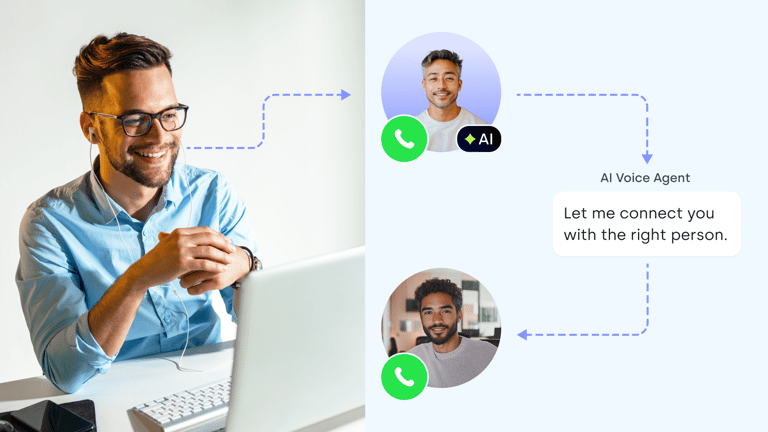
A healthcare AI answering service is voice AI that picks up patient calls, understands what callers say in their own words, and handles the routine ones: office hours, directions, booking and rescheduling. It takes structured messages and transfers urgent or clinical calls to your staff, 24/7.
Key takeaways
- It answers every call around the clock, including nights, weekends and lunch breaks.
- It handles routine admin calls so your front desk can focus on patients in the room.
- It hands urgent and clinical calls to a person and never gives medical advice.
- A signed Business Associate Agreement (BAA) is non-negotiable before it touches patient data.
Tools covered
- CloudTalk: best for AI and staff on one phone system
- Assort Health: best for specialty groups that want EHR-connected scheduling
- Phreesia VoiceAI: best for groups already on Phreesia intake
- healow Genie: best for practices on eClinicalWorks
- RingCentral AI Receptionist: best for practices already on RingCentral
- Retell AI: best for teams with developers who want to build their own agent
- Ruby: best for practices that want live human receptionists
It's 8:15 on a Monday. Two patients are checking in, a third is asking about parking, and the phone has rung four times. By lunch, calls roll to voicemail, and after 5 pm the weekend's messages are already stacking up for tomorrow.
According to a March 2026 MGMA Stat poll of medical practice leaders¹, scheduling is the most time-consuming phone task for 31% of practices, behind eligibility and prior authorization at 45%. That time comes out of a front desk of two or three people who also handle email, walk-ins and texts.
Most practices deal with the onslaught of calls with Interactive Voice Response phone trees, a recorded after-hours message or a shared remote assistant. A healthcare AI answering service picks up instead, deals with the routine request on the spot and passes the rest to your team with notes attached.
In this guide, you'll learn what these services do, where they must stop, what to check for HIPAA, and how seven tools compare for clinics and practices.
Why trust our reviews
For nearly a decade, we've helped over 30,000 professionals find and set up business communication tools. We've reviewed 200+ software tools and analyzed 5,500+ verified customer reviews from platforms like G2, Capterra, Trustpilot and TrustRadius, plus real user discussions on Reddit and Quora. In the past year alone, we published 1,000+ articles, each written by humans for humans. Read our content integrity statement and software review methodology.

See an AI receptionist answer your patient calls

What Is a Healthcare AI Answering Service?
A healthcare AI answering service is voice AI that answers your practice's phone line. It understands natural speech, answers routine questions from your own information, collects caller details, and routes or transfers everything else. Patients talk to it the way they'd talk to your receptionist. It's the same idea as any AI answering service, tuned for patient calls and healthcare rules.
The difference from older phone tools is that the caller doesn't have to fit your menu. They say "I need to move my Thursday appointment" and the AI works out what to do next.
AI vs. Traditional Medical Answering Services
A traditional medical answering service works like a phone answering service for small business: human agents take messages for your practice, usually billed per call or per minute of agent time. An AI service answers instantly and can take many calls at the same time, so there's no queue at peak hours.
Human agents still have a place. A frightened caller, a complex billing dispute or a grieving family member often needs a person, and a good setup sends those calls to one.
| Traditional medical answering service | Healthcare AI answering service | |
|---|---|---|
| Availability | 24/7, depends on staffing | 24/7 |
| Simultaneous calls | Limited by agents on shift | Many at once |
| Cost model | Monthly plan with call or minute limits | Per minute or minute bundles |
| Consistency | Varies by agent | Same answers every time, from your documents |
| Languages | Depends on bilingual agents | Many languages, often on the same call |
| Handoff | Takes a message or patches through | Transfers with a call summary, or creates a task |
AI Answering vs. IVR and Voicemail
Voicemail records messages.
An IVR menu has a fixed set of options the caller can choose from.
An AI answering service holds a conversation like an actual human and acts based on the specific needs of the caller. If the need to schedule an appointment, the AI can do that. If they need to speak with a human, the AI can transfer them to your staff, all within the same call flow.
Why Healthcare Practices Are Switching to AI Answering
The case for an AI answering service for healthcare comes down to four problems most practices recognize from their own phones.
Missed Calls Mean Missed Patients
Healthcare practices lose business when calls go unanswered. Here are the most common situations:
- Small front desks: calls get missed at predictable busy times (morning, lunch, just before closing).
- Multi-location groups: a few high-traffic clinics get most of the calls, and their phones ring out because staff can't keep up.
- Referral-based providers: if a referring office calls and nobody picks up, the referral often goes to the next provider on their list.
- Home care agencies: there's a second problem on top of lost business. If a caregiver calls about a last-minute cancellation and gets voicemail, a patient may end up without a visit.
- Dental offices: new-patient calls get missed when the front desk staff are helping chairside. That's why dental practices often start with a dental AI answering service.
After-Hours Coverage Without Overnight Staff
Night and weekend call volume is usually low, but the calls that come in matter. Paying someone to wait by the phone for a handful of calls is hard to justify, and a recorded "we're closed" message turns every weekend into a Monday backlog.
An AI answering service covers those hours on its own. Staff keep business hours, and anything urgent overnight still reaches the on-call provider.
Giving Staff Time Back From Repetitive Calls
Most practice calls are predictable: hours, directions, parking, which services you offer, and booking or moving appointments. Each one a nurse or medical assistant answers is time they're not spending with the patient in front of them.
When the AI takes those calls, your team handles fewer interruptions and gets the calls that need their judgment.
Serving Bilingual Patients
According to the US Census Bureau's 2018 to 2022 American Community Survey2, 21.7% of people age 5 and older speak a language other than English at home, and Spanish accounts for 61.1% of them. For many practices, English and Spanish demand is a daily reality.
Covering every shift with bilingual staff is expensive. A modern AI answering service detects the caller's language and can switch on the same call, so a patient who starts in English and moves to Spanish isn't transferred or put on hold.
CloudTalk's AI Receptionist answers every call 24/7, handles many calls at once and supports 70+ languages with automatic language detection.
What a Healthcare AI Answering Service Should (and Shouldn't) Do
Healthcare phone answering automation works best when you give it clear instructions. These are the jobs buyers most often hand over to an AI voice agent for healthcare, and the line it must not cross.
Answer FAQs 24/7
The AI answers from your practice's own documents and website: hours, location, parking, services offered, which insurances you accept, and what to bring to a first visit. If the answer isn't in your knowledge base, it should say so and offer a callback or transfer instead of guessing.
Book, Reschedule and Confirm Appointments
For simple schedules, the AI can book straight into a calendar while the patient is on the line. Multi-provider or multi-chair schedules are harder, and that's where pre-booking works better: the AI captures the request, the reason for the visit and the patient's preferred times, and your staff confirm the slot.
Capture Messages and Create Follow-Up Tasks
For every call it doesn't resolve, the AI should record the caller's name, callback number, reason for calling, urgency and caller type. That message goes into your CRM or helpdesk as a task, so staff start the day with a sorted list instead of a voicemail inbox.
Check that each message lands with the right person. A note about a late arrival should reach the provider's team, and a refill question should reach whoever handles refills, without someone forwarding it by hand.
Route Urgent Calls to a Human
The AI should identify who's calling (patient, referring office, caregiver or pharmacy) and how urgent it is, then transfer the call with context so the caller doesn't repeat themselves. Practices that do this well set simple rules, such as "medical concern = transfer now" and "referral = capture details and notify the office manager."
CloudTalk's AI Receptionist routes calls by intent and transfers with context. The AI Specialist goes further, running intake and scheduling workflows through APIs with CRM sync. If you send a text after the call, keep it to non-sensitive information such as a confirmation, a link or your office hours, because CloudTalk SMS is not a HIPAA-compliant channel. Our guide to HIPAA-compliant SMS covers what can and can't go in a text.
Where AI Must Stop: No Clinical Advice
A healthcare AI answering service never diagnoses, triages symptoms or gives medical advice. When a caller describes a clinical concern, it transfers to staff or the on-call provider. When a caller describes an emergency, it tells them to hang up and dial 911.
Test this before you go live. Call the AI yourself, describe symptoms, ask what dose to take, and fake an emergency. It should refuse and hand off every time.
HIPAA and Patient Data: What to Check Before You Buy
HIPAA is the first question practices ask about any healthcare AI answering service, and doctors share the worry. In the AMA's 2026 Physician Survey on Augmented Intelligence4, patient privacy was the only area where more physicians expected AI to do harm than help. Patient calls carry protected health information (PHI): names, dates of birth, symptoms and appointment details.
Why You Need a Signed BAA
HIPAA requires a Business Associate Agreement with every vendor that creates, receives, maintains or transmits PHI on your behalf. The HHS Office for Civil Rights guidance on HIPAA and cloud computing3 says this applies even if the vendor stores encrypted data it can't read. The "conduit" exception, which exempts services that only pass data along (like a phone carrier), doesn't cover vendors that store it.
On a phone system, PHI sits in call recordings, transcripts, AI summaries and messages. So the BAA has to cover the service that stores them, the same rule that applies to a HIPAA-compliant call center or a HIPAA-compliant virtual receptionist. Some tools on the market state publicly that they aren't HIPAA compliant and can't handle PHI, so check before you sign anything.
CloudTalk's HIPAA policy: "Our security controls and policies comply with the Health Insurance Portability and Accountability Act (HIPAA), ensuring the security and confidentiality of patient-related information shared during calls. This means we can sign the Business Associate Agreements with our clients and fully support their HIPAA compliance."
Questions to Ask Every Vendor
- Will you sign a BAA with our practice?
- Which parts of your AI stack does the BAA cover: voice, transcription, the AI model, recordings, messaging?
- Where are recordings and transcripts stored, for how long, and who can access them?
- Can we control what the AI is allowed to say, and what it must hand off?
- Which channels, such as SMS, aren't covered for patient information?
- Do you keep audit logs of calls and of who accessed them?
- Do you have SOC 2, and how long have you worked with healthcare practices?
There's no such thing as "HIPAA certification." No government body certifies vendors. A vendor can only comply with the rules and sign a BAA, so treat "HIPAA certified" as a red flag rather than a credential.
Common Concerns About AI Answering in Healthcare
Skeptical about AI answering? Good, it's not appropriate for every situation, and shouldn't replace humans. However there are some concerns that we can help quiet:
"Will It Sound Robotic to Patients?"
No, not if the provider offers quality voice AI. Modern AI voices sound natural, and you can set tone, speed, accent and language. Older AI and IVR systems set a low bar; a conversational virtual receptionist today holds a natural back-and-forth.
Still, test it with your patients in mind. Make a live test call before you buy, and listen for how it handles names, pauses and older callers who speak slowly. Pick a voice and pace your oldest patients can follow.
"Will It Work With Our EHR and Scheduling System?"
It can, with healthcare-specific software (Assort Health) or an API + custom workflow automation (CloudTalk).
Ask each vendor to demo your specific system, not a generic one. If you're uneasy about AI writing into medical records, start with message capture and handoff, and limit what the AI can read or change.
"Can It Handle Our Complex Scheduling?"
If you have several providers, chairs or appointment types with different lengths, start with pre-booking. The AI collects the request and preferred times, and your staff confirms.
Once you trust its accuracy, automate more appointment types one at a time.
"Is It Cheaper Than a Human Answering Service?"
To estimate what an AI answering service would cost you, start with your monthly minutes:
calls per month × average call length in minutes = monthly minutes
Price those minutes on the vendor's plan, whether it charges per minute or sells bundles of minutes. Then compare that total with what you pay now: your current answering service bill, or the cost of the staff hours spent answering the phone.
Check the billing terms, because they can raise the total:
- Rounding and minimums: some vendors round every call up to the next minute or charge a minimum per call, so a 30-second call can be billed as a full minute.
- Voicemail: ask whether time spent taking voicemails is billed.
- Setup fees: a one-time charge some vendors add at the start.
- Overage rates: what you pay per minute once you go past your bundle.
You can keep minutes down by having the AI answer only after hours or when staff are busy, while staff handle calls during business hours.
How to Choose a Healthcare AI Answering Service
When every vendor's demo sounds the same, score them against the same list:
- BAA, and which parts of the AI stack it covers
- Non-clinical guardrails and clear escalation rules you can edit
- Natural voice in the languages your patients speak
- Human handoff with context, so callers never repeat themselves
- Integrations with your calendar, CRM and practice systems via API
- Control over when AI answers: after hours, overflow, or on and off by schedule
- Simultaneous call capacity for your busiest hour, so you're answering high call volume without a queue
- Clear pricing, a free trial or pilot, and setup help from the vendor
- One platform or another vendor: will the AI run on your phone system, or sit beside it?
The tools below were scored on these criteria.
Best Healthcare AI Answering Services in 2026
We compared each healthcare answering service, from healthcare-only tools to general AI voice agents, on the criteria above, using what each vendor states publicly about HIPAA, integrations and pricing. Prices were checked on each vendor's own pricing page on 5 October 2026.
Healthcare AI Answering Service: Comparison Table
| Tool | Best for | BAA available | Human handoff | Integrations | Starting price | Free trial |
|---|---|---|---|---|---|---|
| CloudTalk | AI and staff on one phone system | Yes | Yes, with context | HubSpot, Salesforce, Pipedrive, Zoho; API and webhooks | Free to start (50 min), then from $99/month for 200 min | 50 free minutes |
| Assort Health | Specialty groups wanting EHR-connected scheduling | Not stated publicly | Not stated publicly | 15+ EHR/PM platforms, incl. athenahealth | Quote-based | Not stated |
| Phreesia VoiceAI | Groups already on Phreesia intake | Not stated publicly (HITRUST, SOC 2 Type 2) | Yes, urgent calls to on-call | 16+ PM/EHRs natively | Quote-based | Not stated |
| healow Genie | Practices on eClinicalWorks | Not stated publicly | Yes, on-call alerts by text | eClinicalWorks / healow | From $249/seat/month | Not stated |
| RingCentral AI Receptionist | Practices already on RingCentral | Yes, listed in RingCentral's BAA | Yes | Salesforce, HubSpot, Zoho | From $49/month for 100 min | 14 days |
| Retell AI | Teams building their own agent | Enterprise plan only | Yes, warm transfer | HubSpot, calendars, Twilio, SIP, API | $0.07 to $0.31/min | $10 credits |
| Ruby | Live human receptionists | Yes | Human agents | Approved scheduling tools | From $250/month for 50 min | Not stated |
1. CloudTalk: Best for practices that want AI and staff on one phone system.
What Is CloudTalk?
CloudTalk is a cloud phone system with AI voice agents built into it. The AI Receptionist answers and routes calls, and the AI Specialist resolves multi-step requests end to end, both inside the same call flow your staff use.
Key Features of CloudTalk for Healthcare
- Every call answered, 24/7: the AI Receptionist picks up nights, weekends and overflow, and takes many calls at once, so patients don't wait in a queue.
- FAQs from your own documents: upload your hours, services and policies, and the AI answers from them instead of guessing.
- Routing by intent, transfer with context: urgent and clinical calls go to the right person with a summary, so the caller doesn't start over.
- Calendar booking and 70+ languages: patients book while on the line, in the language they start in.
- AI only when you want it: the AI lives in the Call Flow Designer, so you can give it after-hours or overflow calls only.
For deeper workflows, the AI Specialist runs intake and scheduling through APIs and syncs with HubSpot, Salesforce, Pipedrive and Zoho. Setup takes 1 to 2 weeks with a CloudTalk consultant; the AI Receptionist sets up in minutes.
Does CloudTalk Sign a BAA?
Yes. In CloudTalk's words: "Our security controls and policies comply with the Health Insurance Portability and Accountability Act (HIPAA), ensuring the security and confidentiality of patient-related information shared during calls. This means we can sign the Business Associate Agreements with our clients and fully support their HIPAA compliance." Keep patient details out of SMS, which isn't a HIPAA-compliant channel.
What Does CloudTalk Integrate With?
HubSpot, Salesforce, Pipedrive and Zoho, plus an open API, webhooks and Zapier for practice and scheduling systems.
What Is the Pricing of CloudTalk?
AI Voice Agents are an add-on to any CloudTalk plan, billed by minutes:
- AI Receptionist: free to start with 50 minutes in your first month, then from $99/month for 200 minutes
- AI Specialist: from $349/month for 1,000 minutes, with dedicated technical consulting
- Volume discounts at higher usage
Flexible Pricing Plans to Scale with You
Compare our plans
Pros and Cons of CloudTalk
| Pros | Cons |
|---|---|
| AI and staff share one call flow and dashboard | Practice-system connections are API-based, not plug-and-play EHR connectors |
| Choose which calls AI takes (after hours, overflow) | SMS can't carry patient details |
| 50 free minutes to test on real calls |
Who is CloudTalk Best for?
CloudTalk has the best healthcare AI answering service for practices that want AI and staff on one phone system.
What Do Customers Say About CloudTalk?
One G2 reviewer, an account executive at a small business, singled out the call flow setup:
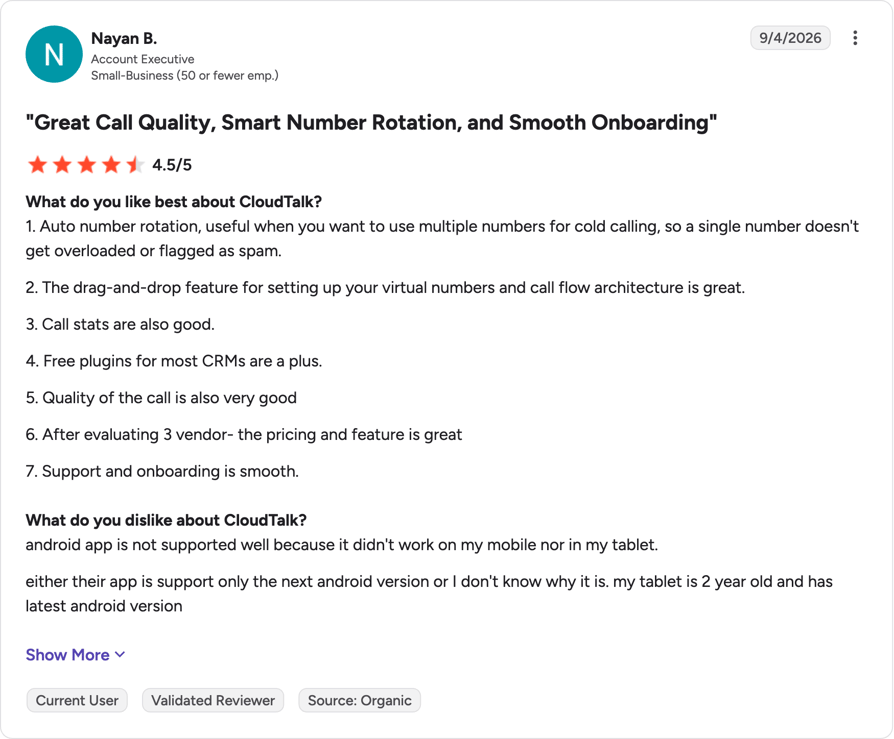
CloudTalk is rated 4.4/5 on G2 (1938+ reviews).
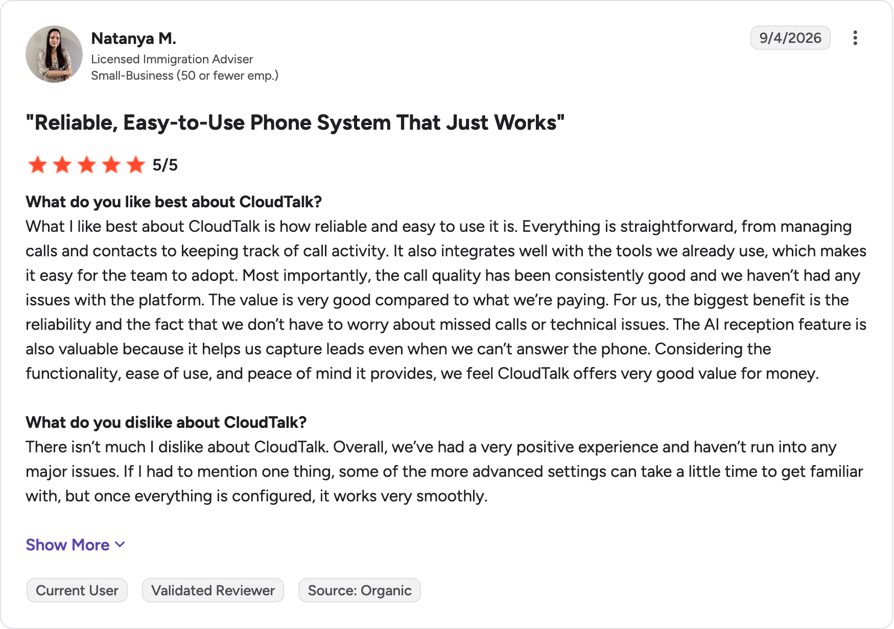
Another mentions how easy it is to use:
2. Assort Health: Best for specialty groups that want AI scheduling connected to their EHR.
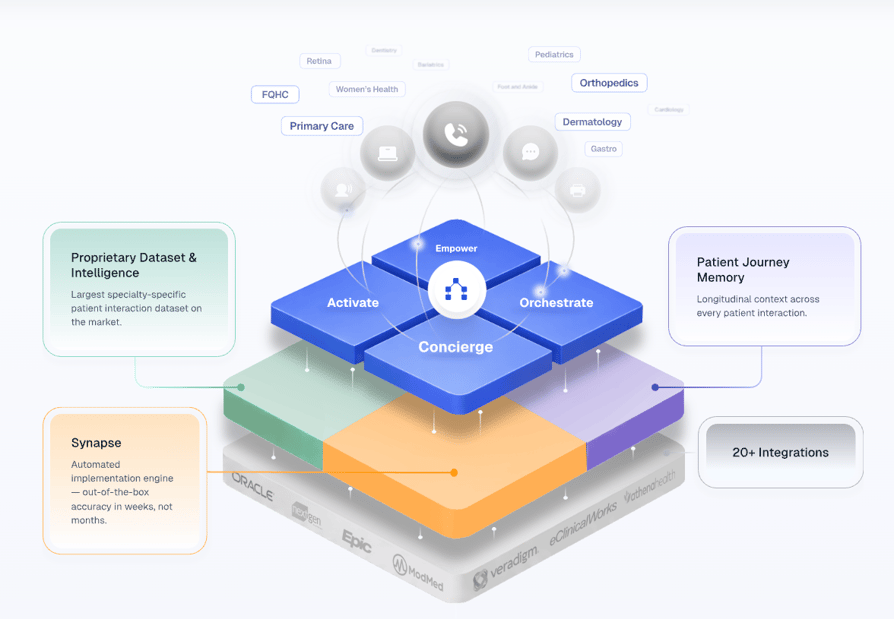
Assort Health illustrates how its product works
What Is Assort Health?
Assort Health builds AI voice agents for healthcare that handle scheduling, intake, triage routing, referrals and follow-up. It says it covers 23+ specialties, including orthopedics, dermatology and cardiology.
Key Features of Assort Health for Healthcare
- 24/7 scheduling and management: patients book and change visits without waiting for staff.
- Insurance and eligibility checks: fewer surprises at check-in.
- Fax and referral automation: referrals get processed instead of sitting in a tray.
- Refills, lab requests and waitlists: routine requests handled on the call.
Does Assort Health Sign a BAA?
Assort Health doesn't state its HIPAA or BAA terms on its website. Ask for its BAA and security documentation in the demo.
What Does Assort Health Integrate With?
It says it integrates with 15+ EHR and PM platforms, with athenahealth as its lead integration, and its blog names Epic, athenahealth and Oracle Health.
What Is the Pricing of Assort Health?
Pricing isn't published. Expect a custom quote.
Pros and Cons of Assort Health
| Pros | Cons |
|---|---|
| Built only for healthcare, by specialty | No public pricing |
| Deep EHR/PM integrations | HIPAA and BAA terms not published |
| Runs alongside your phone system rather than replacing it |
3. Phreesia VoiceAI: Best for medical groups already using Phreesia for patient intake
What Is Phreesia VoiceAI?
Phreesia VoiceAI is an AI voice agent from Phreesia, the patient intake company. It answers inbound calls and runs outbound campaigns, and Phreesia says it handles 80% of calls end to end.
Key Features of Phreesia VoiceAI for Healthcare
- Scheduling, billing, refills and records requests: handled without staff and documented in the patient chart.
- After-hours urgent routing: urgent calls go to the on-call provider with real-time mobile alerts.
- Outbound campaigns: reminders, payment collection, refill outreach and recalls.
- Multiple languages: calls in the patient's preferred language.
Does Phreesia VoiceAI Sign a BAA?
Phreesia states it's "HITRUST CSF, SOC 2 Type 2 and PCI Level 1 certified" and offers HIPAA-compliant two-way texting. Its product and pricing pages don't mention BAA terms, so confirm them in the sales process.
What Does Phreesia VoiceAI Integrate With?
Phreesia says it "talks to 16+ PM/EHRs natively," without listing them on the VoiceAI page.
What Is the Pricing of Phreesia VoiceAI?
Pricing is customized "based on factors like your size, workflows and the products you use." No public price.
Pros and Cons of Phreesia VoiceAI
| Pros | Cons |
|---|---|
| Writes call outcomes to the patient chart | No public pricing |
| Strong security attestations | Best value if you already use Phreesia |
| Inbound and outbound in one tool |
What Do Customers Say About Phreesia VoiceAI?
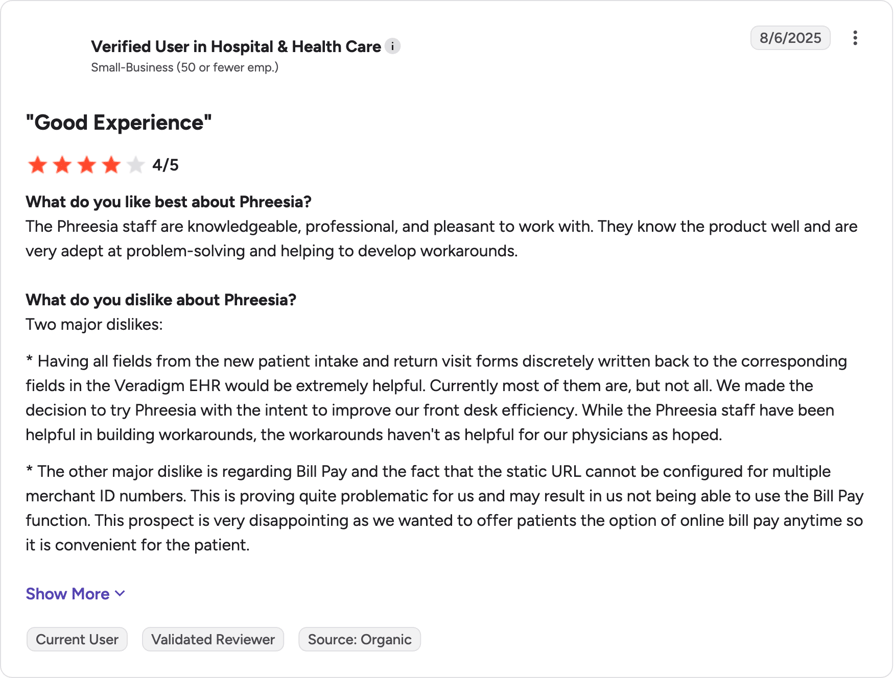
Phreesia is rated 3.9/5 on G2 (45 reviews). The listing covers Phreesia's whole platform, and its reviews are mostly about intake rather than VoiceAI.
4. healow Genie: Best for practices on eClinicalWorks that want AI after-hours coverage
What Is healow Genie?
healow Genie is an AI contact center from healow, the eClinicalWorks patient engagement brand. Its after-hours service answers patient calls 24/7/365 and replaces a traditional after-hours call center.
Key Features of healow Genie for Healthcare
- After-hours answering: confirms the patient's identity and collects their information.
- On-call routing: urgent cases reach the on-call provider through a text alert.
- Transcripts and summaries: providers get a ready summary for follow-up.
- Callback notices: patients hear when to expect a callback.
Does healow Genie Sign a BAA?
The after-hours page lists the question "Is the after-hours service HIPAA compliant?" but doesn't show an answer publicly. Ask for BAA terms directly.
What Does healow Genie Integrate With?
It's built around eClinicalWorks and healow. Support for other EHRs isn't stated on the page.
What Is the Pricing of healow Genie?
healow lists Genie from $249 per seat per month. After-hours service pricing isn't listed separately.
Pros and Cons of healow Genie
| Pros | Cons |
|---|---|
| Native fit for eClinicalWorks practices | Priced per seat, from $249/month |
| Built for after-hours and on-call | Support for other EHRs not stated publicly |
5. RingCentral AI Receptionist: Best for practices already on RingCentral that want an AI front desk
What Is RingCentral AI Receptionist?
RingCentral AI Receptionist (AIR) is an AI agent that answers calls for a RingCentral phone system or as a standalone plan. It replaces a phone tree with a conversation and routes callers to your team.
Key Features of RingCentral AI Receptionist for Healthcare
- 24/7 answering without a menu: patients state what they need.
- Routing and scheduling: callers reach the right person or book.
- Language switching mid-call: useful for bilingual patients.
- Handoff to your team: complex calls go to staff.
Does RingCentral AI Receptionist Sign a BAA?
Yes. RingCentral's March 2026 HIPAA document lists RingCentral AI Receptionist and AIR Pro among the products its BAA covers.
What Does RingCentral AI Receptionist Integrate With?
RingCentral references Salesforce, HubSpot and Zoho.
What Is the Pricing of RingCentral AI Receptionist?
See our full breakdown of RingCentral pricing.
- Standalone: from $49/month, including 100 minutes
- Add-on to RingEX: from $39/month, including 100 minutes
- Overage: $0.50 per minute, billed in 30-second increments
- 14-day free trial
Pros and Cons of RingCentral AI Receptionist
| Pros | Cons |
|---|---|
| Covered by RingCentral's BAA | 100 included minutes, then $0.50/min |
| Low entry price | Overage billed in 30-second increments |
| 14-day trial |
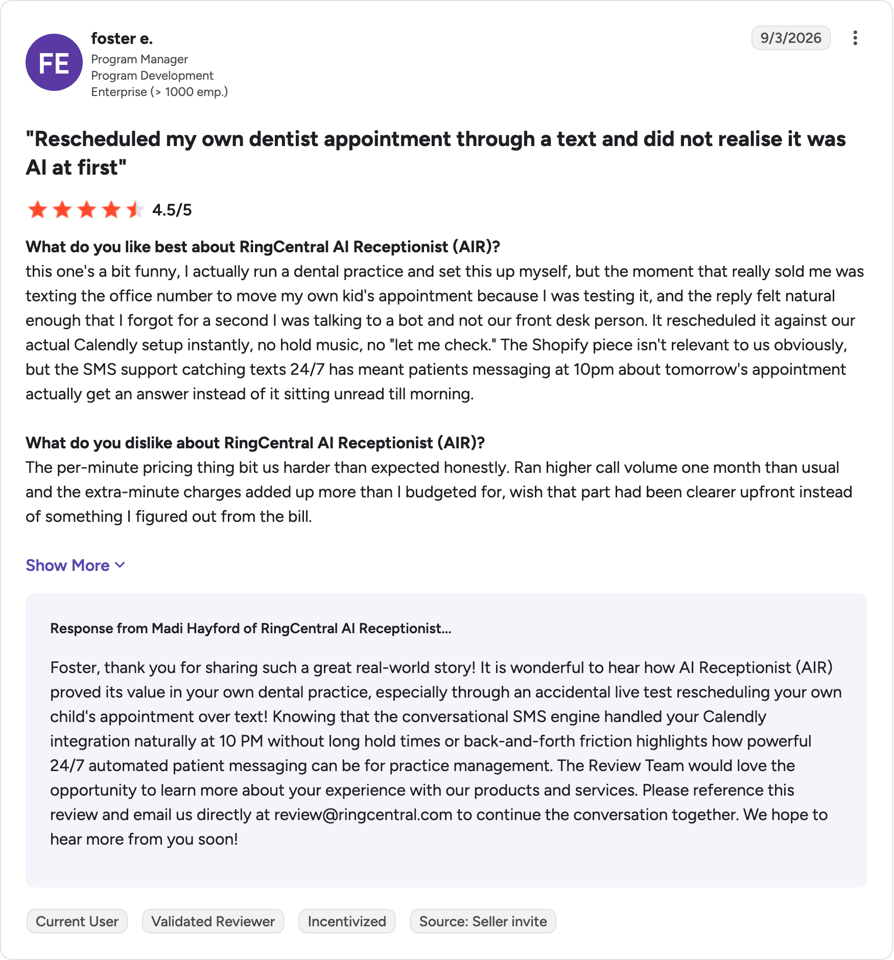
What Do Customers Say About RingCentral AI Receptionist?
RingCentral AI Receptionist (AIR) is rated 4.3/5 on G2 (40 reviews). One reviewer who runs a dental practice wrote that he was sold when he rescheduled his kids appointment through the AI:
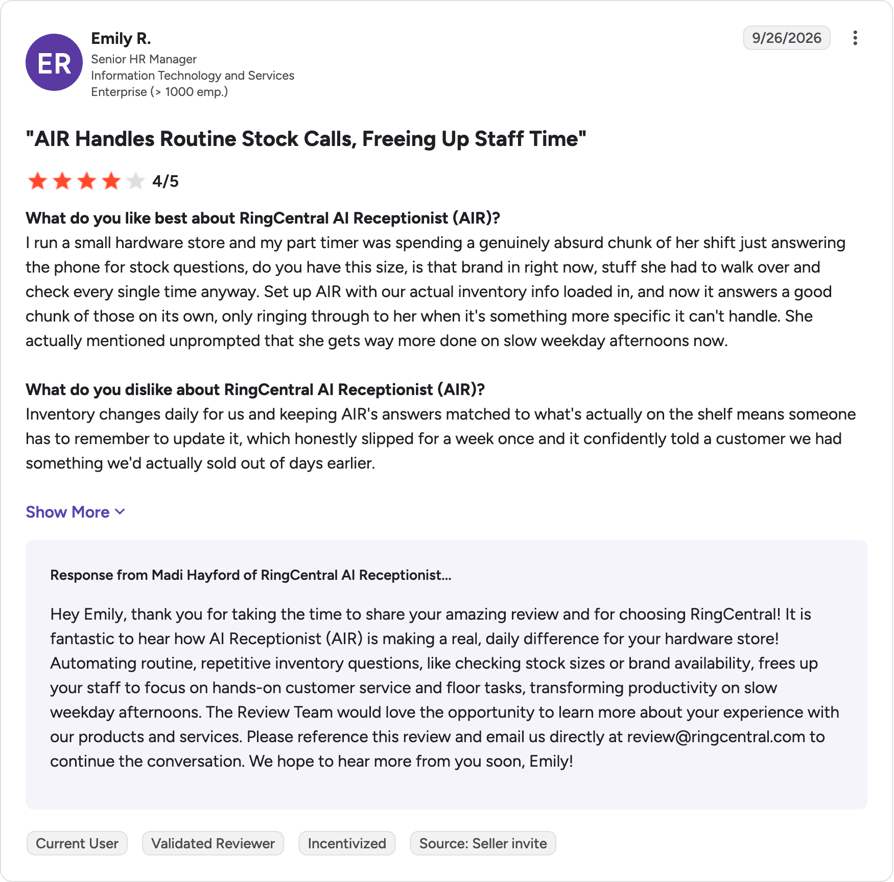
This reviewer uses the receptionist for easy-answer questions for their small hardware store:
6. Retell AI: Best for practices or health-tech teams with developers who want to build their own agent
What Is Retell AI?
Retell AI is a platform for building AI voice agents that handle phone calls. You design the agent, connect your telephony and systems, and pay per minute.
Key Features of Retell AI for Healthcare
- Build-your-own agents: full control over prompts and call logic.
- Warm transfer: the agent briefs a human before connecting the caller.
- Live listen and takeover: staff can step in mid-call.
- Bring your telephony: SIP trunking, Twilio or Vonage.
Does Retell AI Sign a BAA?
Retell says it's "fully compliant with HIPAA, SOC2 Type II, GDPR and ISO 27001." Its pricing table lists HIPAA/BAA on the Enterprise plan only, not on pay-as-you-go.
What Does Retell AI Integrate With?
HubSpot, calendar tools and custom APIs, plus SMS and chat channels.
What Is the Pricing of Retell AI?
See our full breakdown of Retell AI pricing.
- Pay-as-you-go: $0.07 to $0.31 per minute, depending on the AI model and voice
- Free credits: $10 at signup
- Enterprise: custom pricing, includes HIPAA/BAA
Pros and Cons of Retell AI
| Pros | Cons |
|---|---|
| Low per-minute rates | You assemble numbers, routing and handoffs yourself |
| Full control over agent design | BAA only on Enterprise |
| Needs technical skills to build and maintain |
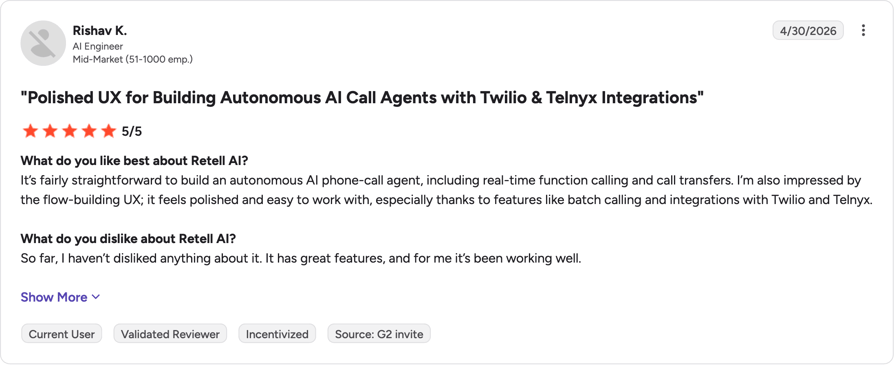
What Do Customers Say About Retell AI?
Retell AI is rated 4.8/5 on G2 (2,600+ reviews). One AI engineer at a mid-market company commented on how straightforward building the voice agent is:
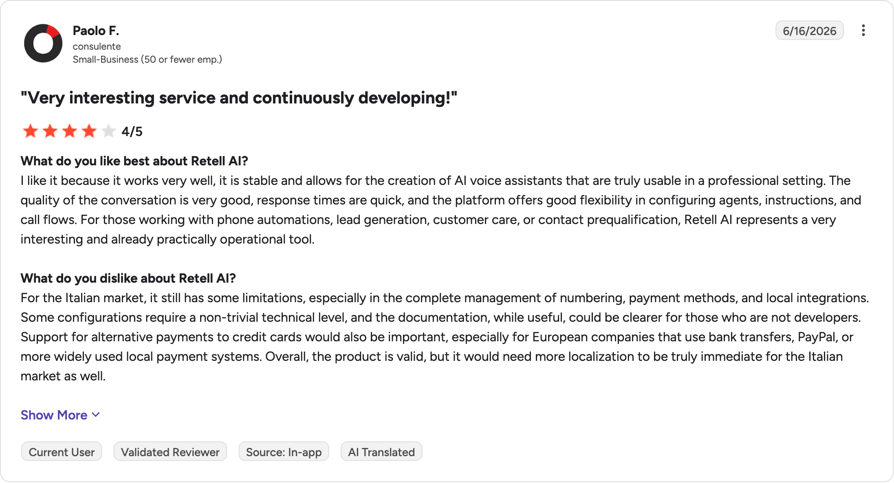
Another praises the professional AI assistants:
7. Ruby: Best for practices that want live human receptionists on every call
What Is Ruby?
Ruby is a virtual receptionist service staffed by US-based people that uses AI to streamline workflows. It answers calls for your practice 24/7/365 and sends messages through its app and portal.
Key Features of Ruby for Healthcare
- Live receptionists around the clock: a person answers every call.
- Messages through a secure app: not by email or SMS.
- Bilingual support: available on all plans.
- Works with approved scheduling tools: for booking.
Does Ruby Sign a BAA?
Yes. Ruby says a team member will "provide a Business Associate Agreement (BAA)" after you sign up for HIPAA-compliant service, at no extra charge.
What Does Ruby Integrate With?
Scheduling platforms. Ruby notes that some, such as Calendly, aren't HIPAA compliant.
What Is the Pricing of Ruby?
See our full breakdown of Ruby pricing, including how minutes are billed.
- Starter: $250/month for 50 minutes
- Professional: $395/month for 100 minutes
- Business: $720/month for 200 minutes
- Enterprise: $1,725/month for 500 minutes
Pros and Cons of Ruby
| Pros | Cons |
|---|---|
| Real people on every call | $250/month buys 50 minutes |
| BAA at no extra cost | Plans above 500 minutes need a sales quote |
| Bilingual on all plans |
What Do Customers Say About Ruby?
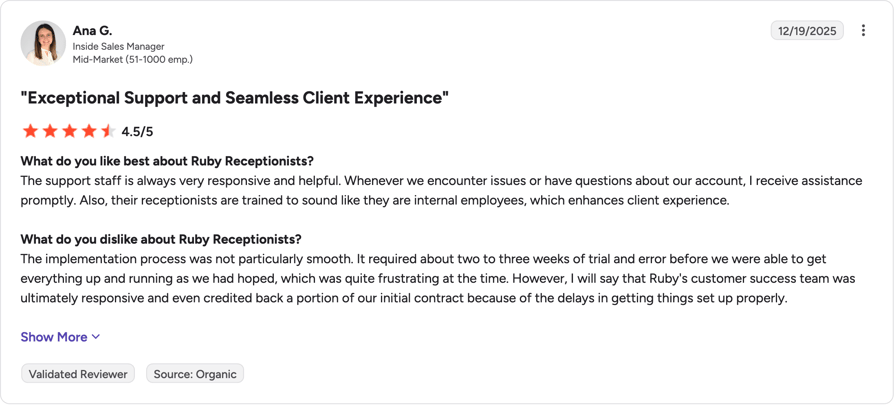
Ruby Receptionists is rated 3.8/5 on G2 (12 reviews). One inside sales manager wrote that their receptionists enhance the client experience:
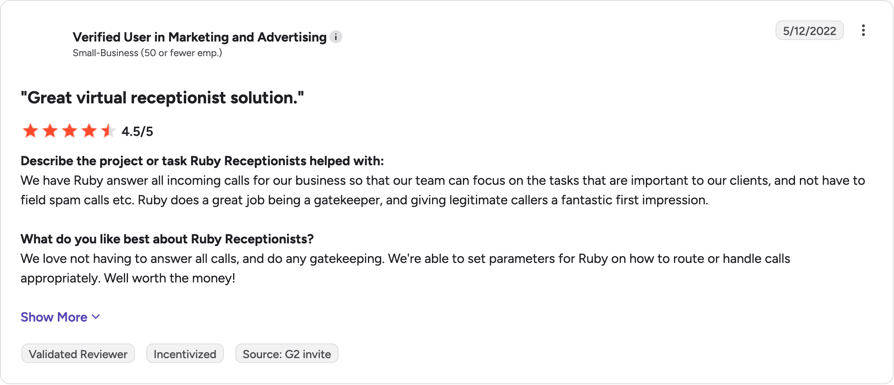
And another says that Ruby lets their team focus on more important tasks:
How to Roll Out an AI Answering Service in Your Practice
A phased roll-out keeps risk low and gives you evidence for management sign-off. This plan works for any phone answering service for healthcare.
- 01Map your calls. List call types, monthly volumes and peak times, and estimate what share is routine.
- 02Start with after-hours and overflow only. Staff keep business hours; the AI covers what they can't reach.
- 03Load your knowledge base and write escalation rules. Spell out what always goes to a human: clinical questions, emergencies, upset callers.
- 04Test like a skeptic. Ask clinical questions, fake an emergency, and give it hard-to-spell names.
- 05Pilot for a few weeks. Review transcripts weekly and tune the agent's answers and routing.
- 06Expand. Add more call types, or outbound calls such as appointment confirmations. Our list of AI voice agent use cases in healthcare has ideas for what to automate next.
With CloudTalk, the AI Receptionist sets up in minutes, and the AI Specialist takes 1 to 2 weeks with a CloudTalk consultant. Routing changes happen in the same Call Flow Designer your staff calls already use. Start your demo now.
Start With the Calls You're Missing Today
Missed calls cost you patients, and voicemail hides how many. A healthcare AI answering service covers the routine layer, the hours, directions and bookings, while your staff keep the conversations that need a person. Start with after-hours calls, test it hard, and expand once it has earned your trust.
Cover your after-hours calls first
Sources:
- 01MGMA
- 02US Census Bureau
- 03US Department of Health and Human Services (HHS)
- 04American Medical Association (AMA)
Frequently asked questions
It depends on the vendor. A healthcare AI answering service is only usable with patient data if the vendor signs a BAA that covers the parts of its AI stack holding PHI: voice, transcription, recordings and messages. There's no official "HIPAA certification." CloudTalk's security controls and policies comply with HIPAA, and CloudTalk can sign BAAs with its clients; see how HIPAA call recording requirements apply too.
An AI answering service can usually book into a calendar, but booking straight into an EHR needs an API integration, and older EHRs can make that hard. Ask each vendor to demo your specific system. Many practices start with pre-booking, where the AI captures the request and staff confirm it, then follow a plan like this one to implement an AI voice agent step by step.
The AI never gives medical advice. When a caller describes an emergency, it tells them to hang up and dial 911, and it transfers clinical concerns to staff or the on-call provider based on rules you set. Test this with fake emergencies before go-live, and map the transfer paths in your call flow for healthcare.
Most tools charge per minute or by minute bundles. To estimate, multiply your monthly calls by their average length in minutes, then compare plans, and check for minimum billed minutes per call, voicemail minutes and setup fees. CloudTalk's AI Receptionist starts with 50 free minutes, then CloudTalk pricing runs from $99/month for 200 minutes.
Yes, most modern tools handle Spanish. CloudTalk supports 70+ languages, detects the caller's language, and can switch on the same call, so a patient who moves from English to Spanish isn't transferred. Test it with a live call in both languages, the same way you'd check a HIPAA-compliant voicemail greeting before patients hear it.
No. AI takes routine calls such as hours, directions and bookings so your front desk can focus on patients in the room. Complex, emotional and clinical calls stay with people. Most practices use it as a call answering virtual receptionist for after-hours and overflow, while staff keep business hours.
A basic AI receptionist can be live in minutes to a few days. Integrated workflows that connect to scheduling or practice systems take 1 to 2 weeks. Start with a pilot on after-hours calls, review transcripts for a few weeks, then expand, following healthcare call center best practices for escalation and QA.