Best GoodCall Alternatives: TL;DR
The best GoodCall alternative for most growing teams is CloudTalk, because it pairs an autonomous AI Voice Agent with a full cloud phone system and seat-based pricing; no surprises!
However, if you're looking to go full dev mode or want to outsource human receptionists, then this list has some good calls for every team.
- CloudTalk: best overall for international sales and support teams that want AI answering plus a real phone system (Editor's Pick).
- Smith.ai: best for law firms and professional-services teams that want human agents backing up the AI on sensitive calls.
- Synthflow: best for agencies and teams building custom no-code voice-agent flows.
- Retell AI: best for developers who want usage-based, per-minute voice AI.
- Bland AI: best for engineering teams building high-volume voice agents over an API.
- Rosie: best for small local service businesses that want flat-rate answering.
- Gong: best for enterprise sales revenue intelligence
- Dialzara: best for SMBs that want simple flat-rate AI answering.
- Allo: best for budget-conscious small businesses that want a phone system with AI built in.
- Vapi: best for builders who want maximum API-level control over voice agents.
Best GoodCall Alternative: Quick Comparison Table
CloudTalk carries the Editor's Pick because it is the only tool here that combines an AI Voice Agent with real telephony, global numbers, 24/7 service, satisfied global customers like Pipedrive, Glovo, and Revolut and myriad native CRMs on one bill.
Best GoodCall Alternatives: Quick Comparison
| Provider | Key Features | Best For | Starting Price | G2 Rating |
|---|---|---|---|---|
| CloudTalk (Editor's Pick) | AI Voice Agent, cloud phone system, 100+ native integrations, Conversation Intelligence | International sales & support teams | $25/user/mo (Starter) | 4.4/5 (1,702+ reviews) |
| Smith.ai | Hybrid AI + human receptionists, intake, booking | Law & professional services | From $95/mo (AI Receptionist); $292.50/mo (human) | 4.6 (73+ reviews) |
| Synthflow | No-code voice-agent builder, white-label | Agencies & custom flows | From ~$450/mo (Pro) | 4.9 (1,000+ reviews) |
| Retell AI | Voice-agent builder, knowledge base, per-minute | Developers & tech teams | From $0.07/min (pay-as-you-go) | 4.8 (1,200+ reviews) |
| Bland AI | API-first programmable voice agents | Engineering / high-volume | $0.11–$0.14/min (plan-based) | Too few G2 reviews |
| Rosie | Flat-rate AI answering, message taking | Small local service firms | $49/mo | No G2 reviews yet |
| RevSquared AI | Self-improving receptionist, no caller caps | Service businesses | $147/mo | No G2 reviews yet |
| Dialzara | Flat-rate AI virtual receptionist | SMBs | $29/mo (60 min) | No G2 reviews yet |
| Allo | Phone system + AI answering | Budget small businesses | From $18/user/mo (annual) | Limited G2 reviews |
| Vapi | API-first voice AI orchestration | Developers / builders | $0.05/min platform fee | Too few G2 reviews (~4.2) |
Skip the Reading. See It Live.
Introduction
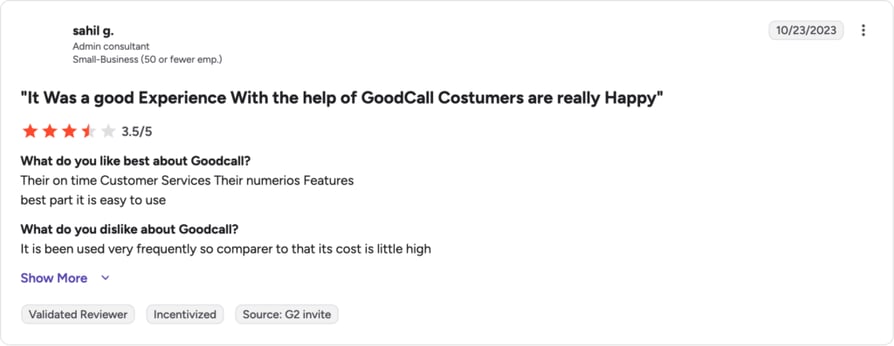
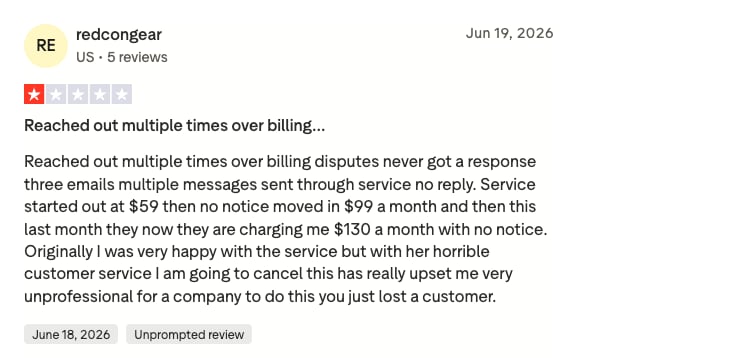
Goodcall is not winning any popularity contests. It has few reviews on sites like TrustPilot and G2, with an average of 2.6 and 3.5, respectively.
According to Salesforce's 2025 State of Service research, AI already handles about 30% of customer service cases, and service teams project that will climb to 50% by 2027, so the AI calling tool you pick now is one you will lean on far more heavily in a year.
For a sales, CX, or RevOps lead, GoodCall's unique-customer model turns growth into a penalty. With GoodCall, there's a plan cap for users/agents/seats. If you go above this, that's an extra $0.50 you're adding to the bill.
Land a busy week of inbound, and the tool that was supposed to save you money bills you for every new person who calls. Add the Zapier-only integrations and a G2 profile that has sat inactive for over a year, and you are running a core customer channel on a tool you cannot fully see into or forecast.
Most teams try to fix this by jumping up a GoodCall tier or bolting on a second point tool for the phone system they still need. That trades one ceiling for a higher one and splits your call data across two vendors that do not talk to each other.
An AI calling platform that charges per seat, includes real telephony, and writes back to your CRM natively removes the caps and the second bill at once. In this guide, we reviewed the 10 best GoodCall alternatives for 2026.
You will learn which tool fits your team size, your integrations, and your call volume, and how each one compares to GoodCall on price and features.
Why You Can Trust Our Reviews
For nearly a decade, we've helped over 30,000+ professionals find and implement smarter business communication tools. We've reviewed 200+ software tools across industries, analyzed 5,500+ verified customer reviews from platforms like G2, Capterra, and Trustpilot, and drawn insights from real user discussions on Reddit and Quora. In the past year alone, we published 1,000+ articles, each one written by humans for humans.
Why Are Teams Searching for a GoodCall Alternative?
GoodCall does one job well: it answers inbound phone calls with AI and captures basic lead details for small local businesses. The reasons teams start shopping around show up once call volume grows or once the business needs more than answering.
The market backdrop matters here too. Per Zendesk's 2025 CX Trends Report, 75% of CX leaders expect 80% of customer interactions to be resolved without human intervention in the next few years, which pushes teams toward platforms that resolve and route calls rather than only answering them.
People looking for GoodCall alternatives usually do so because of pricing; as seen in reviews on G2 and Trustpilot.
What Are the Main Cons of GoodCall?
6 Main Cons of GoodCall That Make Teams Look Elsewhere
- Per-unique-customer pricing punishes growthGoodCall bills by unique customer, not by minute or seat. Plans start at $79/month for 100 unique customers, then charge $0.50 for every additional one. A high-traffic month means a higher invoice, which makes forecasting hard.
- Zapier-dependent integrationsGoodCall leans on Zapier for most connections rather than shipping deep native CRM integrations, so two-way sync with Salesforce, HubSpot, or Pipedrive is thinner than teams expect.
- US-centric coverageGoodCall is built around US small businesses and does not offer the international number footprint that distributed or global teams need.
- It is an answering bot, not a phone systemThere is no full dialer, IVR builder, or call-routing layer for a team that also makes outbound calls or runs a support queue.
- Thin support for a channel this criticalWhen a phone line is the front door to your business, you want a human on the other end of support fast. GoodCall's self-serve, SMB-focused model leaves little in the way of hands-on onboarding or priority help when a number needs porting or a flow breaks.
- Stale review presenceGoodCall's G2 profile has reportedly been inactive for over a year, which makes it hard to judge current product quality from verified reviews.
What Is the Best Alternative to GoodCall?
CloudTalk is the best alternative to GoodCall. It delivers the same 24/7 AI call answering through its AI Voice Agent, then adds a full cloud phone system, phone numbers in 160+ countries, and 100+ native integrations.
Seat-based pricing starts at $25/user/month with no per-caller cap, and a 99.999% uptime SLA keeps the line up when a busy month arrives, so both your costs and your call quality stay predictable as volume grows.
G2 reviewers give CloudTalk across 1,800+ verified reviews, and switchers consistently call out the instant setup and the time the CRM sync saves their reps.
Why Do Users Consider CloudTalk the Best GoodCall Alternative?
5 Main Pros of CloudTalk and Why Businesses Switch from GoodCall
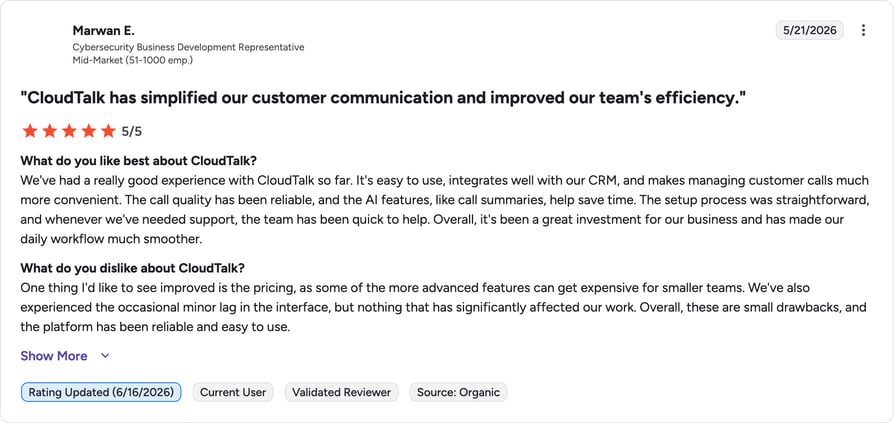
- Call stability and visual routingA full cloud phone system with a drag-and-drop Call Flow Designer, IVR, and skill-based routing sits on the same infrastructure as the AI Voice Agent, backed by a 99.999% uptime SLA. That fixes the hard ceiling of an answering bot that can only pick up and take a message.
- True two-way CRM sync100+ native integrations into HubSpot, Salesforce, Pipedrive, and Zoho write call data to the right record automatically, so you get real two-way sync instead of the shallow, one-way logging a Zapier chain leaves you with.
- Borderless global footprintVirtual numbers and local-presence dialing across 160+ countries replace GoodCall's US-centric coverage, so distributed and international teams are not boxed in by geography.
- Transparent, flat seat-based pricingYou pay per user from $25/user/month, not per unique caller, so a busy month never triggers a $0.50-per-head overage. The price you sign up for is the price you keep as volume grows.
- Live, human technical supportReal onboarding help and 24/7 support mean a broken flow or a number-porting question reaches a person, not an automated loop.
Customer Story: MadRent
MadRent (Real Estate & Property Management) put CloudTalk's AI Voice Agent on lead qualification (60,000+ outbound minutes per month), freeing its team to focus on sales instead of screening every inbound call.
Set It Up Today, Not Next Quarter
How We Chose the Best GoodCall Alternatives and Competitors
We built this list to be useful to a buyer comparing tools, not to rank our own product by default (although it's a pretty good pick for most teams). We aggregated real user experiences from G2, Capterra, and Trustpilot, plus discussions on Reddit and Quora, and pressure-tested each tool against six evaluation benchmarks.
- Call stabilityHow reliably the tool answers, routes, and holds a call under load, and whether it is backed by a real uptime guarantee rather than best-effort answering.
- Overall costsThe true cost as volume grows, not just the sticker price. We pulled starting prices from each vendor's own pricing page and flagged per-caller, per-minute, or overage models that punish a busy month. Where a figure could not be confirmed this cycle, we marked it for verification rather than guessing.
- CRM deep-syncWhether the tool writes call data back to HubSpot, Salesforce, Pipedrive, or Zoho natively and both ways, versus shallow one-way logging through a Zapier chain.
- Global footprintNumber coverage and local-presence dialing beyond the US, which rules out US-only tools for distributed or international teams fast.
- Support responseHow quickly a real person picks up when a flow breaks or a number needs porting, versus automated loops and long delays.
- AI productivityHow much the AI actually offloads, from autonomous answering to call summaries and sentiment, rather than a bot that only takes a message.
CloudTalk leads the list, and we are transparent about that. The rest of the ranking is built on the benchmarks above so you can pick the tool that fits your situation. For the full picture, read how we protect our content integrity and our software review methodology.
GoodCall vs. the Top Alternatives: The Feature-Kill Matrix
Before the individual profiles, here is the head-to-head grid buyers ask for most. It sets GoodCall against CloudTalk and three of the strongest rivals on the row that decide the bill and the reliability of the line. Competitor cells marked VERIFY are pending confirmation against each vendor's live pricing page for this cycle.
GoodCall Alternatives: Feature-Kill Matrix
| Feature | CloudTalk | GoodCall | Smith.ai | Synthflow | Retell AI |
|---|---|---|---|---|---|
| Starting price | $25/user/mo | $79/mo (100 unique customers) | From $95/mo (AI Receptionist); $292.50/mo (human) | From ~$450/mo (Pro) | From $0.07/min (pay-as-you-go) |
| Minimum seats | 1 | N/A (billed per unique customer) | N/A (billed per call) | N/A (subscription plan) | N/A (usage-based) |
| Visual routing | Yes (Call Flow Designer, IVR) | No | No (managed service) | Yes (no-code builder) | Partial (developer-built flows) |
| Included queue analytics | Yes | No | No (dashboard reporting only) | No (agent analytics only) | No (call analytics only) |
| Call drop prevention | Yes (99.999% uptime SLA) | No stated SLA | 99.95%+ uptime (AI Receptionist) | 99.99% uptime SLA (Enterprise) | 99.9%+ uptime (enterprise SLA) |
| AI summaries pricing | Paid add-on ($9/user/mo) | Limited | Included | Included in plans | Included (usage-based) |
| Free trial | 14-day free trial | 14-day free trial | No (30-day money-back) | Free tier (limited minutes) | No trial; $10 free credits |
The GoodCall Cost Trap
GoodCall's headline price looks gentle at $79/month, but that only covers 100 unique customers. Every caller past that adds $0.50, so a single busy month of 300 new callers turns a $79 plan into $179, and a breakout quarter can double it again. The meter rewards a quiet month and punishes exactly the growth you are paying software to create. Seat-based pricing removes the caller cap entirely: you add a user when you hire one, not when your marketing works. Run your own numbers against a flat plan before you commit.
The 10 Best GoodCall Alternatives in 2026
We ranked each tool on price transparency, integration depth, and how it holds up when call volume spikes and reducing average handle time matters. Every entry below pairs a short overview with a head-to-head comparison against GoodCall.
1. CloudTalk: The #1 GoodCall Alternative (Editor's Pick)
What Is CloudTalk?
CloudTalk is the global AI business calling software built for SMB growth, trusted by over 5,500+ customers across 160 countries. It combines a cloud phone system with an AI Voice Agent, AI Conversation Intelligence, and an AI Sales Dialer, so one platform covers inbound answering, outbound calling, and post-call analytics. It is built for international sales and support teams that want more than a standalone answering bot.
Why Is CloudTalk a Strong GoodCall Alternative?
- Predictable seat-based pricingYou pay per user, with no per-unique-customer cap or $0.50 overage, so a high-volume month does not blow up your bill the way GoodCall's model can.
- Global reach GoodCall lacksVirtual numbers and local-presence dialing across 160+ countries, versus GoodCall's US-centric footprint.
- Native CRM depth100+ native integrations including HubSpot, Salesforce, Pipedrive, and Zoho, so call data syncs automatically rather than relying on Zapier.
- More than an answering botCall Flow Designer, IVR, and skill-based routing sit alongside the AI Voice Agent on the same infrastructure.
Key Features of CloudTalk
- A fully autonomous conversational AI for phone calls that handles both inbound and outbound workflows, supports 60+ languages and accents with sub-800ms response latency, and escalates to a human only when needed. It is a paid add-on, not bundled into a plan.
- Cloud phone systemVirtual numbers in 160+ countries, IVR, call queues, ring groups, business hours, recording, and a Call Flow Designer.
- Transcripts, AI call summaries, sentiment analysis, topic detection, and transcript search. Always a paid add-on.
- AI Sales DialerPower, Preview, and Parallel dialing modes for outbound teams, with local-presence dialing and voicemail detection.
- 100+ native integrationsAcross CRM, helpdesk, and e-commerce tools, plus a public API and webhooks.
Customer Story: Autenti
Autenti (SaaS & IT Services) put CloudTalk's AI voice agents on inbound support, where they handled approximately 30% of inbound support calls.
What Is the Pricing of CloudTalk?
CloudTalk uses seat-based plans, so pricing scales with team size rather than caller count.
CloudTalk Pricing Plans
| Plan | Price (annual billing) | Notes |
|---|---|---|
| Lite | $19/user/mo | Available only in North America and Latin America |
| Starter | $25/user/mo | Billed annually |
| Essential | $29/user/mo | Billed annually |
| Expert | $49/user/mo | Includes the Power Dialer |
| Custom | Contact Sales | For larger or bespoke deployments |
AI Add-On Pricing at a Glance
AI Voice Agent add-on: from $99/month for 200 minutes (VERIFY). AI Conversation Intelligence add-on: $9/user/month, billed annually. Both are always add-ons, never bundled into a plan.
Against GoodCall's $79 to $249/month unique-customer plans, CloudTalk removes the caller cap, so the cost you sign up for is the cost you keep as volume grows. CloudTalk also offers a 14-day free trial.
What Are the Pros & Cons of CloudTalk?
| Pros | Cons |
|---|---|
| No per-caller or per-minute cap; predictable seat-based pricing | AI Voice Agent and Conversation Intelligence are paid add-ons, not bundled |
| Global coverage with numbers in 160+ countries | Lite tier is Americas-only and feature-limited |
| Native CRM depth (HubSpot, Salesforce, Pipedrive, Zoho) | Full platform is more than a business needing only basic answering may require |
What Do Customers Say About CloudTalk?
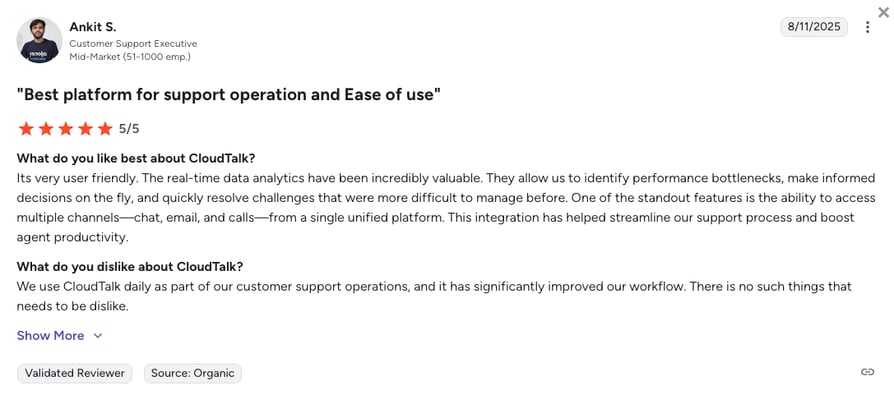
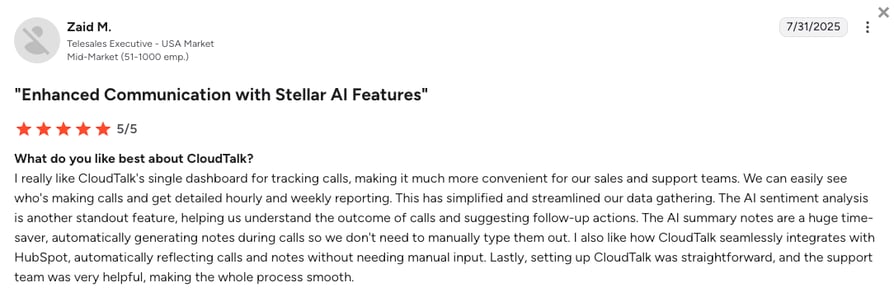
Reviewers praise the call quality, the breadth of native integrations, and how quickly non-technical users can set up call flows. Some note that the most advanced AI features sit in paid add-ons rather than the base plans.
How Do G2 Users Rate CloudTalk?
G2 reviewers give CloudTalk 4.4/5 across 1,702+ verified reviews.
CloudTalk vs. GoodCall
CloudTalk vs. GoodCall
| Dimension | CloudTalk | GoodCall |
|---|---|---|
| Pricing model | Per user/seat, no caller cap | Per unique customer, $0.50 overage |
| Country coverage | 160+ countries | US-centric |
| Integrations | 100+ native (HubSpot, Salesforce, Pipedrive, Zoho) | Mostly via Zapier |
| Scope | Full phone system + AI Voice Agent | AI answering bot |
Test CloudTalk Against Your Real Call Volume
2. Smith.ai: Best for Professional Services
What Is Smith.ai?
Smith.ai is a hybrid answering service that pairs AI with trained North American human receptionists. The AI handles routine calls, and a person steps in for complex or sensitive conversations. It is built for law firms, medical practices, and professional-services teams that need human judgment on client intake.
Why Is Smith.ai a Strong GoodCall Alternative?
- Human backup on sensitive callsTrained agents take over when a caller needs judgment, which GoodCall's pure-AI model does not offer.
- Purpose-built intake and bookingLead intake, appointment scheduling, and call screening designed for client-heavy service firms.
- CRM and calendar integrationsRoute qualified leads into existing pipelines.
Key Features of Smith.ai
- Hybrid AI-plus-human receptionist modelAI for routine calls, humans for complex ones.
- Lead intake, appointment booking, and call screeningBuilt for client-heavy service firms.
- CRM and calendar integrationsSync qualified leads into your pipeline.
What Is the Pricing of Smith.ai?
Smith.ai uses a per-call pricing model rather than a flat subscription. Per-call pricing has been observed at roughly $8.50 to $11.50 per call, with higher plan tiers reaching around $810/month. (VERIFY current entry plan on smith.ai/pricing.) Against GoodCall's unique-customer model, per-call pricing can cost more at high volume but adds a human safety net GoodCall does not provide.
What Are the Pros & Cons of Smith.ai?
| Pros | Cons |
|---|---|
| Human agents handle complex or sensitive calls | Per-call pricing can climb quickly at volume |
| Strong fit for legal and professional-services intake | Less suited to outbound or high-throughput sales calling |
| Bilingual receptionists broaden caller coverage | No full phone system or IVR for your own agents to use |
What Do Customers Say About Smith.ai?
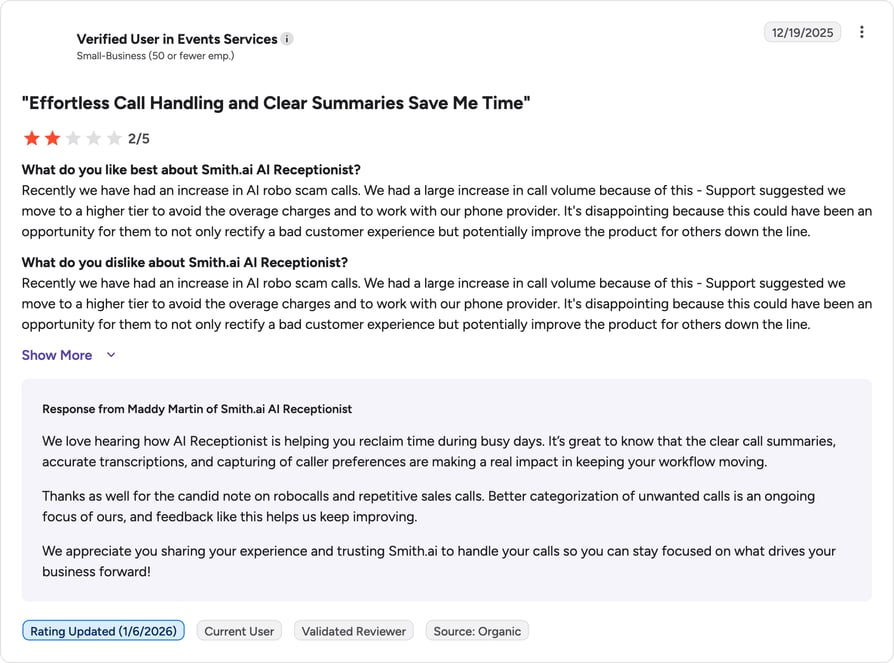
Reviewers tend to single out the quality of the human receptionists and the reassurance of a real person handling client intake, which is the whole reason services firms pick it. The recurring caution is cost: teams with heavy call volume note that per-call billing adds up faster than they expected, and a few mention wanting more control over how the AI hands off to a person. (Sentiment themes pending verification against current G2 reviews.)
How Do G2 Users Rate Smith.ai?
G2 rating: TODO/VERIFY. Read verified reviews on Smith.ai's G2 profile.
Smith.ai vs. GoodCall
Smith.ai vs. GoodCall
| Dimension | Smith.ai | GoodCall |
|---|---|---|
| Model | Hybrid AI + human agents | Pure AI answering |
| Pricing | Per call (VERIFY) | Per unique customer |
| Best for | Legal & professional services | Small local businesses |
3. Synthflow: Best for No-Code Voice-Agent Builders
What Is Synthflow?
Synthflow is a no-code AI voice-agent builder that lets teams assemble custom voice workflows with a drag-and-drop interface. It is aimed at agencies, resellers, and teams that want to design their own multi-language agents without writing code.
Why Is Synthflow a Strong GoodCall Alternative?
- Custom flows without developersA visual builder for teams that outgrow GoodCall's fixed answering behavior.
- White-label optionsFor agencies reselling voice agents to clients.
- Multi-language voice agentsWorkflow automation beyond basic answering.
Key Features of Synthflow
- Drag-and-drop no-code agent builderAssemble voice workflows visually.
- Multi-language voice agentsWith workflow automation.
- CRM and tool integrationsWith white-label options.
What Is the Pricing of Synthflow?
Synthflow offers tiered plans with a low entry point. The entry plan has been observed at roughly $29/month, with higher tiers above that. (VERIFY the full pricing ladder on synthflow.ai.) If you would rather compare turnkey options, our roundup of the best AI voice agents covers the alternatives.
What Are the Pros & Cons of Synthflow?
| Pros | Cons |
|---|---|
| No-code builder gives full control over call flows | Building complex flows takes setup time |
| White-label options suit agencies | Less turnkey than a fixed answering service |
| Multi-language agents out of the box | You still supply your own telephony layer for a full phone system |
What Do Customers Say About Synthflow?
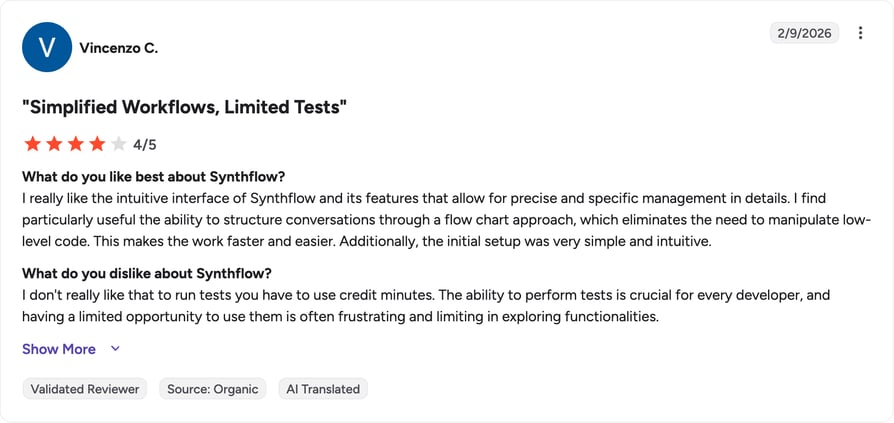
Users who like Synthflow tend to praise how far the visual builder gets them without code, and agencies value the white-label path to reselling agents. The common flip side is that flexibility carries a learning curve: the more custom the flow, the more configuration and testing it takes before it is production-ready. (Sentiment themes pending verification against current G2 reviews.)
How Do G2 Users Rate Synthflow?
G2 rating: TODO/VERIFY. Read verified reviews on Synthflow's G2 profile.
Synthflow vs. GoodCall
Synthflow vs. GoodCall
| Dimension | Synthflow | GoodCall |
|---|---|---|
| Approach | No-code custom builder | Fixed answering bot |
| Best for | Agencies & custom flows | Small local businesses |
| Customization | High | Low |
4. Retell AI: Best for Developers Who Want Per-Minute Voice AI
What Is Retell AI?
Retell AI is a platform for building, testing, and deploying production-ready AI voice agents. It gives developers and technical teams the pieces to assemble custom flows, connect a knowledge base, and integrate with a CRM.
Why Is Retell AI a Strong GoodCall Alternative?
- Usage-based pricingPay per minute instead of per unique caller, which suits variable or spiky call patterns.
- Custom flows with a knowledge baseFor teams that want the agent grounded in their own content.
- Multilingual supportScalable concurrency for growing volume.
Key Features of Retell AI
- Voice-agent builderWith knowledge base and CRM integrations.
- Usage-based per-minute pricingWith scalable concurrency.
- Multilingual supportHandle callers across languages.
What Is the Pricing of Retell AI?
Retell AI uses pay-as-you-go, per-minute pricing from roughly $0.07 to $0.08 per minute, depending on the voice engine and configuration. (VERIFY the current rate on retellai.com/pricing.) To sanity-check usage-based math against flat plans, see how much a voice AI agent costs.
What Are the Pros & Cons of Retell AI?
| Pros | Cons |
|---|---|
| Usage-based pricing scales with actual call minutes | Per-minute cost can be hard to predict at volume |
| Developer control over flows and knowledge base | Requires technical setup, unlike a turnkey bot |
| Knowledge-base grounding keeps answers on-brand | No bundled phone system or CRM depth of a full platform |
What Do Customers Say About Retell AI?
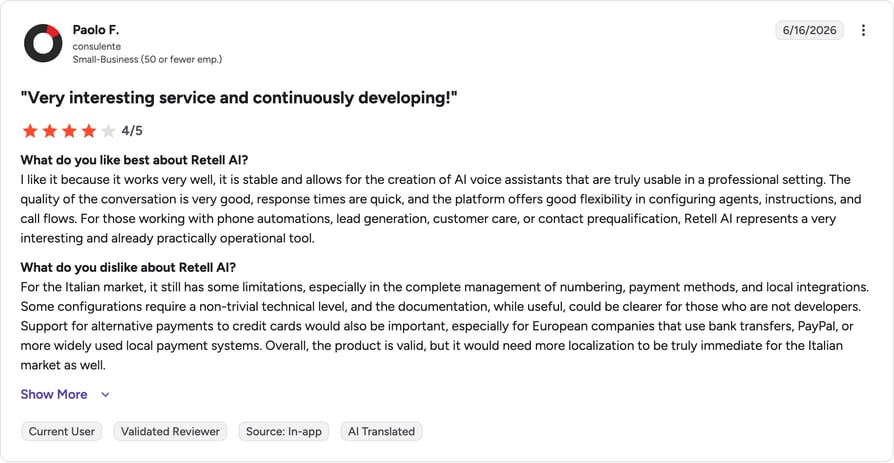
Technical teams tend to rate Retell AI well on the quality of its voice output and how much control the builder gives them over each step of a call. The trade-off users raise most is predictability: per-minute billing is efficient for spiky traffic but harder to forecast, and non-developers report that getting to a polished agent takes real engineering time. (Sentiment themes pending verification against current G2 reviews.)
How Do G2 Users Rate Retell AI?
G2 rating: TODO/VERIFY. Read verified reviews on Retell AI's G2 profile.
Retell AI vs. GoodCall
Retell AI vs. GoodCall
| Dimension | Retell AI | GoodCall |
|---|---|---|
| Pricing | Per minute | Per unique customer |
| Audience | Developers | Non-technical SMBs |
| Setup | Custom, technical | Turnkey |
5. Bland AI: Best for High-Volume API Voice Agents
What Is Bland AI?
Bland AI is programmable AI phone-calling infrastructure built for developers and enterprises. It exposes voice agents through an API so engineering teams can build custom, high-call-volume calling workflows.
Why Is Bland AI a Strong GoodCall Alternative?
- API-first controlFor teams that want to embed voice AI into their own product or systems.
- Function calling and custom workflowsGo well beyond fixed answering scripts.
- Enterprise language coverageFor high-volume, multi-market calling.
Key Features of Bland AI
- API-first programmable voice agentsBuild calling into your own systems.
- Custom workflows and function callingBeyond fixed scripts.
- Enterprise-grade language coverageFor multi-market volume.
What Is the Pricing of Bland AI?
Bland AI is commonly reported to use usage-based, per-minute pricing, reported around $0.09 per minute. (VERIFY on bland.ai/pricing.) For a full breakdown, see our guide to Bland AI pricing.
What Are the Pros & Cons of Bland AI?
| Pros | Cons |
|---|---|
| Deep API control for custom builds | Requires engineering resources to deploy |
| Built for high-volume calling | Not a turnkey option for non-technical teams |
| Function calling connects agents to your own systems | Thin verified review presence to judge from |
What Do Customers Say About Bland AI?
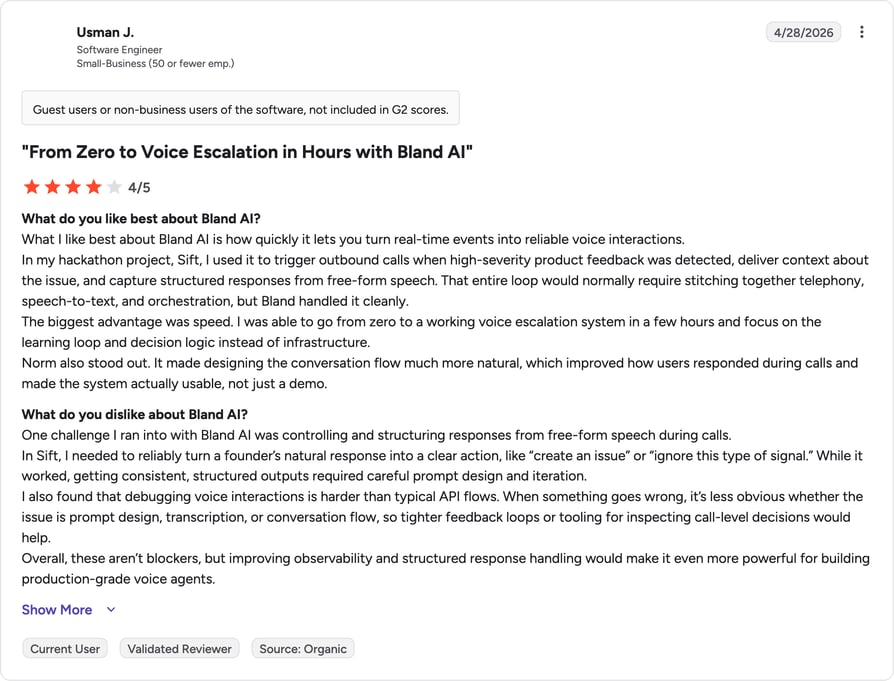
Engineering-led teams tend to value how much raw control Bland AI hands them and how well it holds up at high call volume once a build is dialed in. The consistent caveat is that this is infrastructure, not a product: it expects developer time to stand up, and its public review footprint is still thin, so buyers lean on their own testing more than on peer feedback. (Sentiment themes pending verification against current G2 reviews.)
How Do G2 Users Rate Bland AI?
Read reviews on Bland AI's G2 profile.
Bland AI vs. GoodCall
Bland AI vs. GoodCall
| Dimension | Bland AI | GoodCall |
|---|---|---|
| Delivery | API / infrastructure | Packaged answering bot |
| Best for | Engineering teams | Small local businesses |
| Volume | High | Low to moderate |
6. Rosie: Best for Small Local Service Businesses
What Is Rosie?
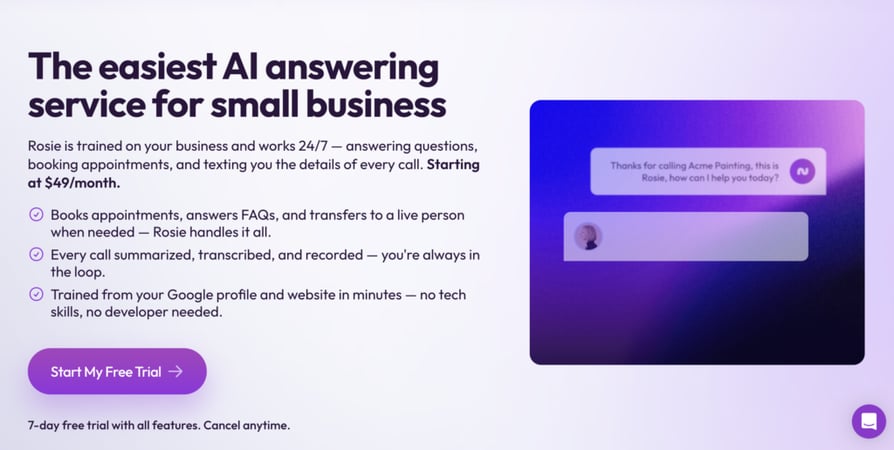
Rosie is a flat-rate AI answering service built for small and local service businesses, such as restaurants and neighborhood shops. It answers calls, takes messages, and books appointments with a setup simple enough for a non-technical owner.
Why Is Rosie a Strong GoodCall Alternative?
- Flat monthly pricingNo per-caller overage, which keeps costs predictable where GoodCall's model does not.
- Simple setupFor owners who do not have time to configure a complex tool.
- Message taking and appointment bookingAimed at local service work, from clinics to neighborhood shops.
Key Features of Rosie
- AI call answering and message takingCaptures caller details automatically.
- Appointment bookingSchedules directly from the call.
- Flat monthly pricingNo per-caller overage.
What Is the Pricing of Rosie?
Rosie uses flat monthly tiers at $49/month, $149/month, and $299/month. (Confirm inclusions and any minute caps per tier.) Rosie's flat rate is a direct answer to GoodCall's per-unique-customer overage.
What Are the Pros & Cons of Rosie?
| Pros | Cons |
|---|---|
| Flat rate with no per-caller overage | Built for basic answering, not full telephony |
| Easy setup for non-technical owners | Limited outbound or routing capability |
| Handles message taking and appointment booking | No international number footprint for multi-market teams |
What Do Customers Say About Rosie?
Small-business owners who choose Rosie tend to like how quickly it goes live and the comfort of a predictable flat bill with no caller meter running. The limits users acknowledge are scope rather than quality: it is an answering and booking tool, so teams that later need outbound calling or real routing tend to outgrow it. (Sentiment themes pending verification against current G2 reviews.)
How Do G2 Users Rate Rosie?
Rosie has no verified G2, Capterra, or Trustpilot reviews; it has handled 3M+ calls for 1,900+ businesses but its review presence hasn't caught up to its growth.
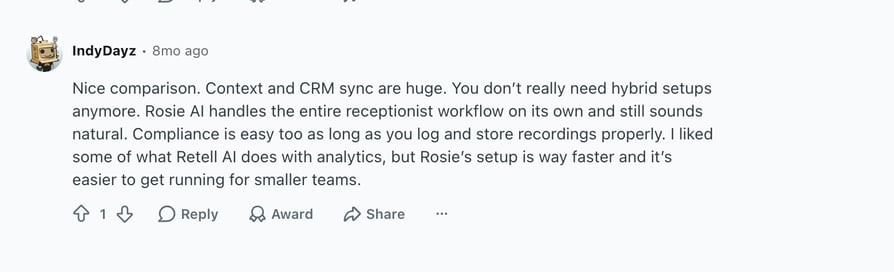
It is talked about on Reddit in a positive light:
Rosie vs. GoodCall
Rosie vs. GoodCall
| Dimension | Rosie | GoodCall |
|---|---|---|
| Pricing | Flat monthly, no overage | Per unique customer, $0.50 overage |
| Best for | Small local service firms | Small local businesses |
| Scope | Answering & booking | Answering & lead capture |
7. Gong: Best for Enterprise Sales Revenue Intelligence
What Is Gong?
Gong is a revenue intelligence platform that records, transcribes, and analyzes sales calls so revenue leaders get a searchable view of every deal. It is the category leader for B2B sales conversation intelligence, trained on billions of sales interactions. It is built for sales teams, not contact centers, which is the key distinction when comparing it to GoodCall Gong analyzes the sales motion, while GoodCall analyzes service and support QA.
With no public pricing and a reported ~$5,000 platform fee plus roughly $1,600/user/year, Gong is an enterprise investment. A 2025 restructure split features into paid modules (Foundation, Engage, Forecast). It is one of the most capable tools like Observe.AI for revenue teams, but the cost and sales-team focus make it a poor fit for support QA.
Why Gong Is a Strong Observe.AI Alternative
- Deepest sales conversation analyticsTrained on billions of sales calls, Gong surfaces objections, competitor mentions, and buying signals more precisely than general-purpose tools.
- Strong deal and pipeline intelligenceDeal boards flag stalled deals and silent stakeholders, useful for complex enterprise sales cycles.
- Automatic CRM syncRecords, transcribes, and pushes structured insights into Salesforce or HubSpot with no manual rep effort.
Key Features of Gong
- Conversation intelligenceTranscription, talk-time ratios, sentiment, and topic tracking across sales calls.
- Deal intelligenceDeal boards and risk scoring across the pipeline.
- Ask Anything AINatural-language search across all recorded calls.
- CRM integrationBi-directional sync with Salesforce and HubSpot.
What Are the Pros & Cons of Gong?
| Pros | Cons |
|---|---|
| Best-in-class sales conversation analytics — Earned its 4.7/5 G2 rating across 6,500+ reviews. | No public pricing, high platform fee — ~$5,000 platform fee plus ~$1,600/user/yr; effective cost runs 2 to 3x the seat rate. |
| Powerful deal and pipeline visibility — Strong for enterprise sales orgs with RevOps support. | Built for sales, not contact-center QA — Not designed for support quality assurance or compliance scoring. |
| Automatic capture, no rep behavior change — Runs in the background once deployed. | No self-serve trial — You cannot test it without going through a full sales process. |
What Are Gong's Plans & Pricing?
Gong pricing is quote-only, with no self-serve plan. Based on verified buyer reports, expect a structure like this:
Gong Pricing Plans
| Plan | Price | Key Features |
|---|---|---|
| Platform fee | ~$5,000/yr flat | Required regardless of team size |
| Foundation (per user) | ~$1,600/user/yr | Conversation intelligence, call library, coaching, CRM sync |
| Add-on modules | Custom | Engage (sequencing) and Forecast (pipeline analytics), bundled on top |
What Are Gong's Customers Saying?
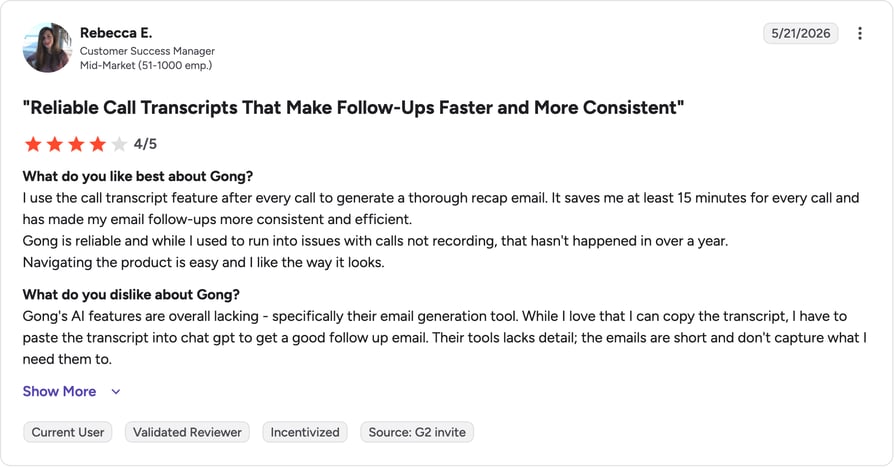
Gong users praise the transcription accuracy and the searchable call library, calling it a step up from generic note-takers. The most consistent complaints are sticker shock, forced module bundling, and auto-renewal price increases of 5 to 15% per year.
How Do G2 Users Rate Gong?
Gong holds a 4.7/5 rating on G2, based on 6,500+ verified reviews. Read more on Gong's G2 reviews page.
Gong vs. GoodCall
Gong vs. GoodCall
| Category | Gong | GoodCall |
|---|---|---|
| Built-in calling | No, analyzes existing calls | Yes, telephony platform |
| Primary use case | B2B sales revenue intelligence | Contact center support QA |
| Starting price | ~$1,600/user/yr + platform fee | 0$/user/month (with limits) |
| Free trial | No | Yes |
| G2 rating | 4.7/5 | 3.6/5 |
8. Dialzara: Best for Simple Flat-Rate SMB Answering
What Is Dialzara?
Dialzara is an AI virtual receptionist for small business teams, built around flat-rate plans with no per-customer overage. It answers calls, captures leads, and routes them without the caps that come with usage-based models.
Why Is Dialzara a Strong GoodCall Alternative?
- Flat-rate plansKeep the bill steady as call volume moves.
- Lead capture and routingFor SMBs that need more than a voicemail.
- Straightforward setupAimed at non-technical owners.
Key Features of Dialzara
- AI call answering and lead captureCaptures caller details.
- Call routingDirects callers to the right place.
- Flat monthly plansNo per-customer overage.
What Is the Pricing of Dialzara?
Dialzara offers flat monthly plans, reported from around $29/month. (VERIFY on dialzara.com/pricing.)
What Are the Pros & Cons of Dialzara?
| Pros | Cons |
|---|---|
| Flat-rate plans with no per-customer overage | Feature set is lighter than a full platform |
| Simple setup for SMBs | Review presence is limited (VERIFY) |
| Lead capture and routing beyond a voicemail box | No outbound dialer or international coverage |
What Do Customers Say About Dialzara?
Users who pick Dialzara tend to want exactly what it offers: a flat monthly bill and a setup simple enough to launch without help. The recurring note is that the feature set stays deliberately narrow, so teams expecting a fuller phone system or a deep review history to research tend to look elsewhere. (Sentiment themes pending verification against current G2 reviews.)
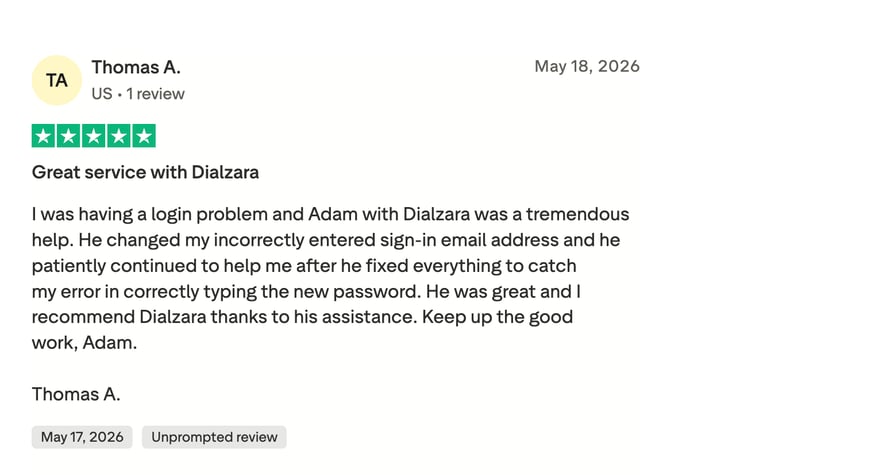
How Do TrustPilot Users Rate Dialzara?
Read reviews on Dialzara's Trustpilot profile.
Dialzara vs. GoodCall
Dialzara vs. GoodCall
| Dimension | Dialzara | GoodCall |
|---|---|---|
| Pricing | Flat monthly | Per unique customer |
| Best for | SMBs | Small local businesses |
| Overage | None | $0.50 per extra customer |
9. Allo: Best for Budget-Conscious Small Businesses
What Is Allo?
Allo is an affordable AI phone answering service with a phone system built in, aimed at small businesses that want calls, texts, and AI handling on one low-cost plan. It bundles a phone system with AI answering rather than selling answering alone.
Why Is Allo a Strong GoodCall Alternative?
- Low entry priceFor small businesses watching their budget.
- Phone system plus AI answering in one toolSo calls and texts live together.
- Per-user Business tierFor teams that need more than a single line.
Key Features of Allo
- Full phone system with AI answeringCalling plus AI in one place.
- Calls and texts in one placeUnified communication for small teams.
- Per-user Business tierUnlimited calls and texts.
What Is the Pricing of Allo?
Allo starts at a low per-user rate. Starter is reported from around $18/month; Business around $30/user/month with unlimited calls, texts, and AI. (VERIFY the full ladder on withallo.com/pricing.)
What Are the Pros & Cons of Allo?
| Pros | Cons |
|---|---|
| Low entry price with a phone system included | AI depth is lighter than dedicated voice-agent tools |
| Calls, texts, and AI in one plan | Newer product with a thinner review history |
| Per-user Business tier scales past a single line | Limited native CRM depth compared with a full platform |
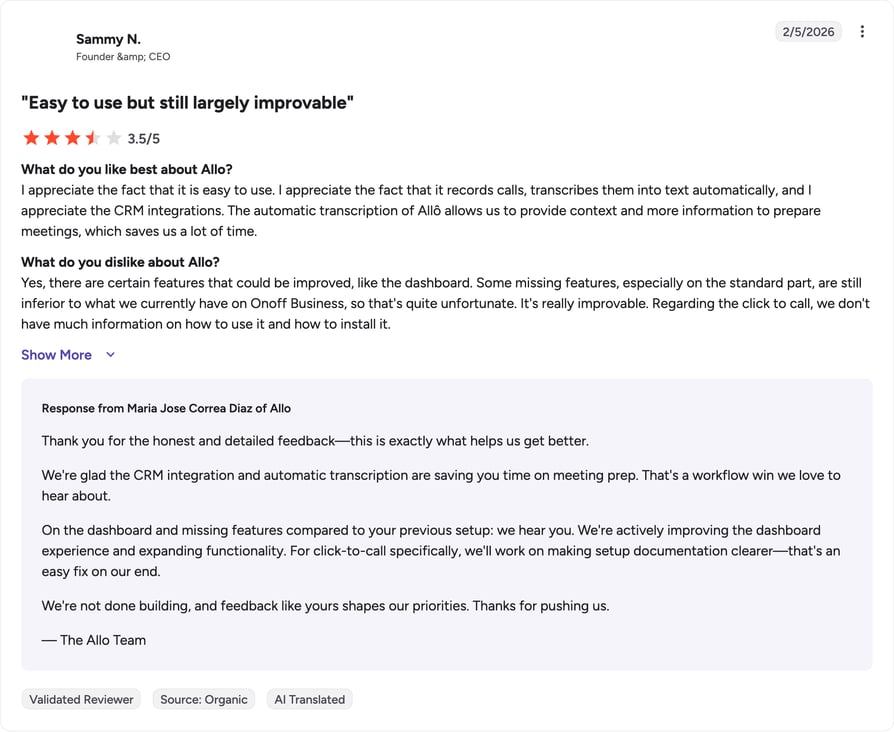
What Do Customers Say About Allo?
Budget-minded small businesses tend to appreciate getting a phone system, texting, and AI answering bundled at a low per-user price rather than paying for answering alone. The trade-off users flag is depth: the AI is lighter than dedicated voice-agent platforms, and the product is new enough that verified reviews are still sparse. (Sentiment themes pending verification against current G2 reviews.)
How Do G2 Users Rate Allo?
Read reviews on Allo's G2 profile.
Allo vs. GoodCall
Allo vs. GoodCall
| Dimension | Allo | GoodCall |
|---|---|---|
| Scope | Phone system + AI answering | AI answering bot |
| Starting price | ~$18/mo (VERIFY) | $79/mo |
| Best for | Budget small businesses | Small local businesses |
10. Vapi: Best for API-First Voice AI Control
What Is Vapi?
Vapi is a developer platform with an API and SDK for building, testing, and deploying voice AI agents. It gives builders maximum control, including the ability to bring their own model and voice.
Why Is Vapi a Strong GoodCall Alternative?
- Maximum API-level controlFor teams building voice AI into their own products.
- Bring-your-own model and voiceWhich fixed answering services do not allow.
- Usage-based billingScales with actual usage rather than caller count.
Key Features of Vapi
- API-first voice agent orchestrationFull programmatic control.
- Bring-your-own model and voiceChoose your own stack.
- Usage-based billingPay for what you use.
What Is the Pricing of Vapi?
Vapi uses usage-based billing, reported around $0.05 per minute in platform fees, plus underlying provider costs. (VERIFY on vapi.ai/pricing.) For a full breakdown, see our guide to Vapi pricing. If you would rather skip the build and implement an AI voice agent that is ready out of the box, a turnkey platform is the faster route.
What Are the Pros & Cons of Vapi?
| Pros | Cons |
|---|---|
| Full API control and model flexibility | Requires developer resources to build and maintain |
| Usage-based pricing | Not a turnkey option for non-technical teams |
| Bring-your-own model and voice | Platform fee sits on top of underlying provider costs |
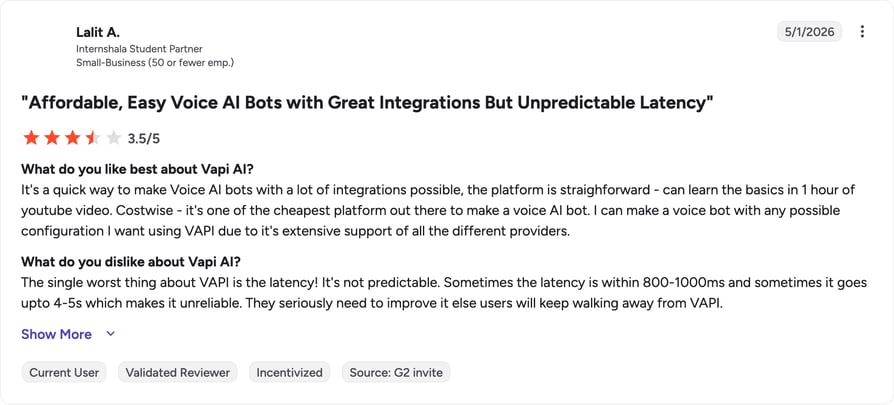
What Do Customers Say About Vapi?
Builders tend to rate Vapi highly for the sheer amount of control it exposes, down to swapping in their own model and voice. The consistent counterpoint is total cost and effort: the platform fee stacks on top of underlying provider bills, and it expects real developer time, so teams wanting something ready out of the box look at turnkey options instead. (Sentiment themes pending verification against current G2 reviews.)
How Do G2 Users Rate Vapi?
Read reviews on Vapi's G2 profile.
Vapi vs. GoodCall
Vapi vs. GoodCall
| Dimension | Vapi | GoodCall |
|---|---|---|
| Delivery | API / SDK platform | Packaged answering bot |
| Best for | Developers & builders | Small local businesses |
| Control | Maximum | Minimal |
What Users Are Really Saying About GoodCall Alternatives and Competitors
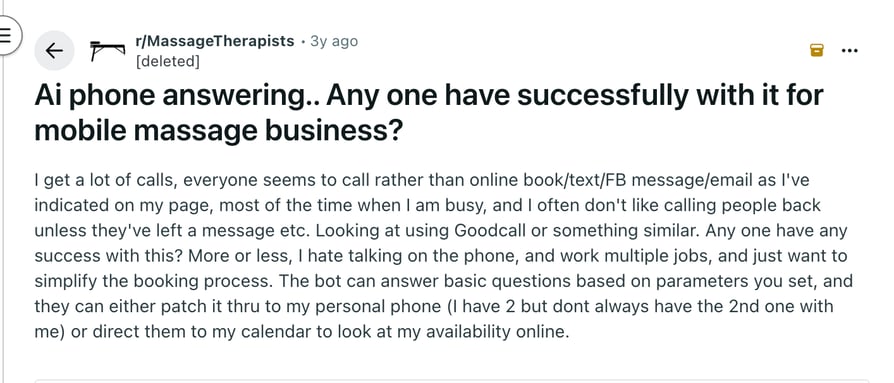
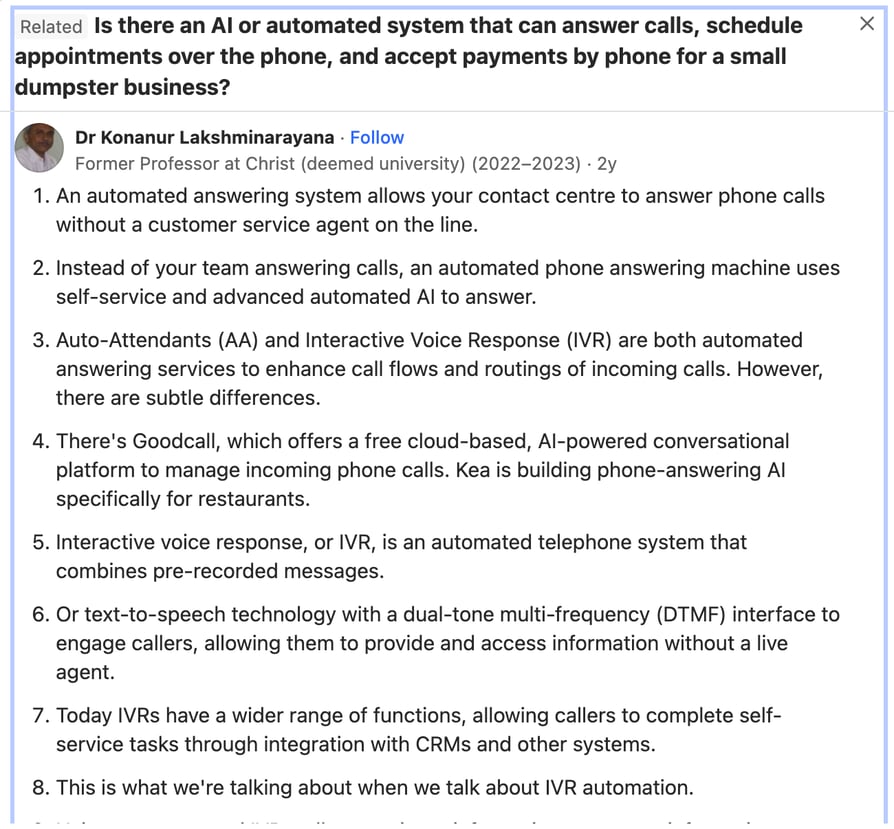
Buyers comparing these tools tend to raise the same questions in public threads: which tool stays affordable as call volume grows, which integrates with their CRM without a Zapier chain, and which can handle outbound as well as inbound calls. We prioritized threads that mention CloudTalk and the tools above.
What Redditors Are Saying
In subreddits like r/VOIP and r/smallbusiness, the recurring theme is cost predictability: owners who started on a per-caller or per-minute tool describe watching a good month turn into a surprise invoice, and they push each other toward flat-rate or seat-based options once volume climbs. The second thread that comes up often is integration depth, with users warning that a Zapier chain is fine until it silently breaks. (Specific threads and screenshots pending capture and verification.)
What Quora Users Are Asking
Quora questions skew toward the buying decision itself: whether an AI answering bot can replace a full phone system, how the per-unique-customer model actually adds up at 200 or 300 callers a month, and which tools serve callers outside the US.
The consensus answer is that pure answering services fit a single-location shop, while growing or international teams need routing, outbound, and native CRM sync. (Specific threads and screenshots pending capture and verification.)
CloudTalk Features vs. GoodCall Features: Detailed Comparison
This table sets CloudTalk's platform against GoodCall's answering-focused product across the dimensions buyers ask about most, from pricing to IVR and outbound dialing.
CloudTalk vs. GoodCall: Detailed Feature Comparison
| Feature | CloudTalk | GoodCall |
|---|---|---|
| Pricing model | Per user/seat, no caller cap | Per unique customer, $0.50 overage |
| Starting price | $25/user/mo (Starter); Lite $19/user/mo in NAM/LATAM only | $79/mo (100 unique customers) |
| AI Voice Agent | Yes (paid add-on), 60+ languages, sub-800ms latency | Yes, core product |
| Full cloud phone system | Yes (IVR, routing, queues, recording) | No |
| Outbound dialer | Yes (AI Sales Dialer; Power Dialer included in Expert) | No |
| Country coverage | 160+ countries | US-centric |
| Native integrations | 100+ (HubSpot, Salesforce, Pipedrive, Zoho) | Mostly via Zapier |
| Conversation Intelligence | Yes (paid add-on): transcripts, summaries, sentiment | Limited |
| Free trial | 14-day free trial | See GoodCall (VERIFY) |
| G2 rating | 4.4/5 (1,702+ reviews) | TODO/VERIFY (profile reportedly inactive) |
How to Choose the Right GoodCall Alternative for Your Team?
The right pick depends on how your calls behave and what else the tool needs to do. Work through these questions before you commit.
- Is your call volume predictable?If a busy month should not cost more, avoid per-unique-customer models and favor seat-based or flat-rate pricing.
- Do you need a phone system too?If your team also makes outbound calls or runs a support queue, a full platform beats a standalone answering bot.
- How deep do your integrations need to go?Native CRM sync saves the maintenance of Zapier chains once volume grows.
- Do you serve customers outside the US?International coverage rules out US-only tools quickly, and a bilingual virtual receptionist matters if your callers switch between languages.
- Who is setting it up?Developer platforms give control but need engineering time; turnkey services trade control for speed.
Which GoodCall Alternative Is Right for Your Team?
What Is the Best Alternative for Predictable Billing?
CloudTalk. Seat-based pricing from $25/user/month means you add cost when you hire, not when a busy month arrives, so there is no per-caller overage to forecast around. Flat-rate answering tools like Rosie or Dialzara also avoid overages if you only need basic answering.
Which Has the Best CRM Sync?
CloudTalk. Its 100+ native integrations write call data both ways into HubSpot, Salesforce, Pipedrive, and Zoho, so records update automatically instead of relying on a Zapier chain you have to maintain.
Which Is Best for Serving Customers Outside the US?
CloudTalk. Virtual numbers and local-presence dialing across 160+ countries cover distributed and international teams, where GoodCall and most flat-rate answering tools are US-centric.
Which GoodCall Alternative Should You Choose?
| If you are... | Consider |
|---|---|
| An international sales or support team wanting AI plus a phone system | CloudTalk |
| A law firm or professional-services team needing human backup | Smith.ai |
| An agency building custom no-code voice flows | Synthflow |
| A developer team wanting per-minute or API control | Retell AI, Bland AI, or Vapi |
| A small local service business wanting flat-rate answering | Rosie, RevSquared AI, or Dialzara |
| A budget-conscious small business wanting a phone system with AI | Allo |
Ready to Make the Switch from GoodCall?
GoodCall works for a small business that only needs its calls answered. The moment you need predictable pricing, a real phone system, or integrations that reach into your CRM without a workaround, the caps and the Zapier chains start to cost more than they save.
CloudTalk gives you the AI answering GoodCall provides, plus the phone system, the global numbers, and the native integrations it does not, all on seat-based pricing that does not punish a busy month. That is why it leads this list. Scale your revenue, not your invoices.
- No more dropped callsA full cloud phone system with visual routing and a 99.999% uptime SLA keeps the line up when volume spikes.
- Clear, predictable billingSeat-based pricing from $25/user/month, with no per-caller cap and no $0.50 overage.
- Fast customer supportReal human help 24/7, not an automated loop, when a flow breaks or a number needs porting.
- Automated, logged notesAI call summaries and native CRM sync write every call to the right record automatically.
Customer Story: Yanolja
Yanolja (Travel, Hospitality & Restaurants) reduced missed calls by 30 to 40% after switching to CloudTalk.
See How CloudTalk Fits Your Calling Setup
Frequently Asked Questions about GoodCall Alternatives
Answers to the most common questions about GoodCall competitors, pricing, and switching to a better AI calling platform in 2026.
Its per-unique-customer pricing. Plans start at $79/month for 100 callers, then add $0.50 each, so a busy month spikes the bill. Teams that want a predictable cost favor seat-based or flat answering service pricing instead.
CloudTalk suits teams that also need a phone system; Rosie and Dialzara offer flat-rate answering. For salons and similar shops, look for an AI receptionist built for appointment-driven local businesses.
They range from usage-based (~$0.07/min, Retell) to flat plans ($49 to $299/mo, Rosie) to seat-based (CloudTalk from $25/user/mo). Match the pricing model to how your call volume behaves.
Most teams go live in days. The main variable is number porting, which depends on your carrier; brand-new numbers activate almost instantly.
Most tools offer trials rather than permanent free plans. CloudTalk includes a 14-day free trial; its AI Voice Agent is a paid add-on. Compare AI Voice Agent pricing before you commit.
Mostly through Zapier, not deep native syncs. CloudTalk ships native CloudTalk integrations with HubSpot, Salesforce, Pipedrive, and Zoho for two-way data.