Bland AI Review 2026: Features, Pricing, Pros & Cons
Bland AI is a strong choice if you have engineers and want programmatic control over a fast, self-hosted voice agent for high-volume calls. It is a weak choice if you need a full phone system or predictable flat billing. Plan for a real cost of $0.11 to $0.14 per minute plus a monthly platform fee and separately metered telephony, not a single headline rate.
| Field | Verdict |
|---|---|
| One-line verdict | A fast, developer-first voice-agent platform with proprietary low-latency models and serious compliance, but per-minute "stacking" pricing and an engineering-heavy setup make it a builder's tool, not a full phone system. |
| Overall rating | 3/5. Genuinely capable voice AI for teams with engineers; the friction is cost forecasting, phone-system gaps, and thin support below Enterprise. |
| Best for | Developer-led teams |
| Not good for | Non-technical ops teams |
| Starting price | Free Start plan at $0.14/min; Build $299/mo at $0.12/min; Scale $499/mo at $0.11/min; telephony billed separately |
| Free tier? | Free Start plan (100 calls/day, 10 concurrent) but no free minutes; usage billed from $0.14/min |
| Setup time | Basic prototype in minutes via the "Norm" builder; a production agent takes real engineering time |
| Standout pro | Low latency on proprietary self-hosted models (~400ms, Bland's own claim) plus SOC 2, HIPAA, GDPR, and PCI DSS compliance |
| Standout con | Per-minute "stacking" bills are hard to forecast, and there is no full phone system (no softphone, IVR, ACD, or queues) |
| User sentiment | Developers praise voice quality and speed; ops buyers flag cost forecasting, support, and off-script handling. G2 sits near 3.3/5 across limited reviews. |
| CloudTalk verdict | Choose CloudTalk when you want AI voice calling plus a real phone system on predictable per-seat pricing, with no engineering overhead. |
About Bland AI
Bland AI looks like a dream in the demo: describe an agent in plain language, connect a number, and watch a natural-sounding bot handle calls in seconds. The real question is how it holds up in production and at scale, and that is where the honest trade-offs live.
The advertised headline is one number. The real bill is a monthly platform fee, a per-minute connected rate, transfer minutes, and separately metered telephony stacked on top. For a team running thousands of calls a month, the gap between the pitch and the invoice can be several hundred to a few thousand dollars.
So the honest questions are about the true all-in cost and whether your team can run the platform without a developer on standby. Bland is one of the most-searched AI voice agents, so there is plenty to sort through.
This Bland AI review walks through the features, real per-minute pricing with a worked example, latency and performance, developer experience, security, what real users say, and the alternatives worth weighing. Do your own research alongside it, especially on pricing, since Bland has already changed its model once.

See what a full phone system adds to AI voice

Bland AI Scorecard: Our Honest Ratings
We score each dimension out of 5 based on hands-on testing, product documentation, and verified user reviews, the same lens we apply to any AI call center technology. The ratings below reflect what Bland does and does not do well.
| Dimension | Rating /5 | Why |
|---|---|---|
| Ease of setup | 3/5 | The "Norm" builder and Pathways editor make a prototype genuinely fast, but production tuning, integrations, and live testing pull you back to code, and live testing is limited on lower tiers. |
| Call quality & latency | 4/5 | A real strength. Bland runs proprietary self-hosted models and claims roughly 400ms latency, though independent tests report closer to 800ms and occasional spikes. |
| Pricing clarity | 2.5/5 | Tiered plans are readable, but a monthly platform fee plus per-minute rates plus transfer minutes plus separate telephony makes the true bill hard to forecast at volume. |
| Features & capabilities | 4/5 | Broad and deep: voice cloning, omnichannel with unified memory, booking, transfers, live translation, Testbed and Evals, and a full developer surface. |
| Integrations | 3.5/5 | Salesforce, HubSpot, Cal.com, Calendly, Slack, Zapier, Make, Pipedream, Twilio and SIP, plus REST API, webhooks, and an MCP server, though depth is largely developer-configured. |
| Support & docs | 2.5/5 | Docs are decent, but self-serve support leans on a Discord community and a form until Enterprise, and users report a support cliff after onboarding. |
Bland AI overall rating: 3/5. It is a capable, fast voice-agent platform for teams with engineering resources, and a poor fit for teams that need a full phone system or predictable, flat billing.
What Is Bland AI?
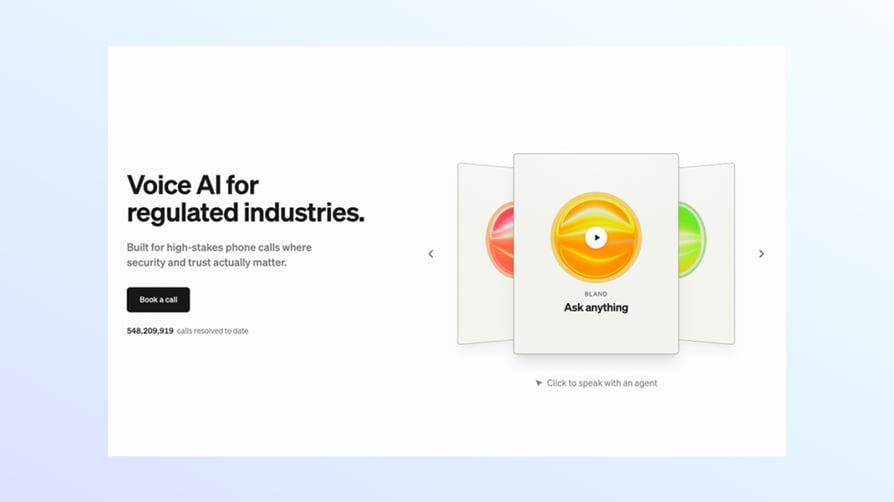
Bland AI is a voice-AI platform for building automated phone agents. You describe the agent you want, connect a phone number, and it handles calls end-to-end using Bland's own speech models. It is aimed mostly at developers and teams automating high-volume AI phone calls in regulated industries.
A bit about Bland
Founded in San Francisco in 2023 by Isaiah Granet and Sobhan Nejad and backed by Y Combinator, Bland has raised more than $100M to date, including a $50M Series C led by Dell Technologies Capital in June 2026 (reported by Fortune). That funding backs one clear technical bet: every model in the stack is proprietary and self-hosted, so customers cannot plug in OpenAI or Anthropic models the way many other AI voice agents allow.
With Bland you trade model choice for speed and control. Bland advertises around 400 ms response latency on its in-house voice models and reports 546M+ calls resolved on the platform to date (both vendor figures). Because the models run on Bland's own infrastructure, call data stays out of third-party hands, which supports a compliance posture that is strong for a company this size.
It is priced per minute rather than per seat, which changes how you budget for voice AI cost compared with a subscription phone system. And it is an AI-agent platform, not a phone system: there is no softphone for human reps and no IVR, ACD, or queues for a live team. That distinction drives most of the trade-offs in this review.
- Founded: 2023, San Francisco, CA (Isaiah Granet and Sobhan Nejad; Y Combinator)
- Team size: Not officially disclosed (~100, estimated)
- Country coverage: No owned number inventory; bring-your-own telephony (Twilio or any SIP trunk); data residency in the US, EU, and APAC on Enterprise
- G2 rating: ~3.3/5 across limited reviews (confirm live)
- Starting price: $0.14/min on the free Start plan ($0 platform fee, no card required)
Who Bland AI Is Best Suited For
Bland fits developers, technical teams, and startups or agencies that want programmatic control over an AI phone agent and do not mind wiring up telephony, integrations, and testing themselves. If you run high-volume outbound and have engineers to build and maintain call flows, the API-first design and high concurrency reward that control.
It is a weaker fit for teams that need a full business phone system with human agents, local numbers, and turnkey CRM sync, and for non-technical teams that want to launch lead qualification without a developer on hand.
Prefer AI voice without the engineering bill?
How Does Bland AI Work?
Bland's build model is worth understanding before you commit, because it explains both the quality and the engineering dependency.
Proprietary, Self-Hosted Voice Pipeline
Every Bland call runs on the company's own speech-to-text, language, and text-to-speech models, tuned for phone calls and run on Bland's own infrastructure. That vertical integration is how Bland claims roughly 400 ms latency and keeps call data off third-party providers. The trade-off is that you cannot bring your own OpenAI, Anthropic, or Gemini model the way you can with Bland AI alternatives like Retell or Vapi.
Building & Deploying an Agent ("Norm" + Conversational Pathways)
You start by describing the agent to "Norm," Bland's natural-language builder, which spins up a working call flow fast. From there you shape branching logic in a visual Conversational Pathways editor: prompts, decision nodes, call routing, webhook steps, and function calls. It is genuinely quick to prototype. The catch is that production agents, edge cases, and integrations usually route back into code, the REST API, and the SDKs.
Testing, Telephony & Integrations
Bland ships Testbed, Scenarios, and Evals so you can run edge-case test calls and monitor live ones for QA, although live testing is gated on lower tiers. Deployment runs through telephony you connect yourself (Twilio or your own SIP trunk); Bland has no owned number inventory. On the integration side it connects to CRM, scheduling, and automation tools through its API and webhooks, with copy-paste connections for Salesforce, HubSpot, and Calendly. Getting from a working prototype to a monitored production agent is the part that takes real time.
What Are the Key Features of Bland AI?
Here are the seven capabilities that define Bland in practice. For each, what it is, what it means for you as a buyer, and the honest caveat. These are the Bland AI features that show up most in day-to-day call handling.
Proprietary, Self-Hosted Voice Models (Core Strength)
What it is: Bland builds and runs its own speech-to-text, text-to-speech, and language models tuned for phone calls, advertising roughly 400 ms latency versus a claimed industry average north of a second.
What it means for you: Routine calls feel fast and natural, and your call data never touches a third-party model provider, which matters for regulated work.
Honest caveat: Independent tests report real-world latency closer to 800 ms with occasional spikes, and you are locked to Bland's models with no option to bring GPT, Claude, or Gemini.
Conversational Pathways and the "Norm" Builder
What it is: Describe an agent in plain language to Norm, then shape branching call flows in a visual Pathways editor with decision nodes, tools, and webhooks.
What it means for you: A first working agent is up in minutes, which is great for prototyping and demos.
Honest caveat: Reviewers consistently note that once flows get multi-step or hit edge cases, tuning routes back to engineers, so non-technical teams cannot fully self-manage the agent.
Voice Cloning and Bland TTS
What it is: Create custom voice clones, with one clone on the entry plan scaling to more on higher tiers and unlimited (plus a custom voice actor) on Enterprise.
What it means for you: You can match a brand voice or a specific persona across every call.
Honest caveat: Third-party reviews describe voice cloning as still maturing, and some listeners still clock the voice as synthetic on longer, dynamic conversations.
Omnichannel with Unified Memory
What it is: One agent works across Voice, SMS, iMessage, and Web Chat, carrying context between channels so a caller is not starting over each time.
What it means for you: You can run a consistent agent across the channels a customer actually uses.
Honest caveat: This is a real differentiator, but it is still an agent layer, not a contact-center suite; there is no live-agent softphone or queue behind it.
Testbed, Scenarios & Evals
What it is: Run edge-case test calls, replay scenarios, and evaluate agent behavior before and after you ship.
What it means for you: You can catch failure modes before customers hit them, which is rarer than it should be at this stage of a build.
Honest caveat: Live testing and deeper evaluation are limited on lower tiers, so smaller teams get less of this than the marketing implies.
Developer Tooling
What it is: A REST API, signed webhooks, function-calling tools, live API calls mid-conversation, a CLI, a Web Agent SDK, an MCP server for Claude Code and Cursor, and SSO.
What it means for you: Engineers get a deep surface to embed voice into a product and manage agents like code.
Honest caveat: This depth is the point, and it is also the barrier: almost everything past a basic flow assumes engineering time.
Booking, Transfers & Live Translation
What it is: Scheduling nodes, Cal.com and Calendly connections, warm and live transfers, in-call SMS, and live translation.
What it means for you: One agent can book meetings, hand off to a human, and text a follow-up without extra tooling.
Honest caveat: Several of the transfer and compliance features (warm transfers, live transfers, guardrails, in-call SMS nodes, BAA, SSO) are Enterprise-gated, so the entry plans are thinner than the feature list suggests.
One agent is not a phone system
Bland AI Pricing Breakdown
Pricing is the single biggest reason people search for a Bland review, so this section goes deep. For a side-by-side with CloudTalk's own numbers, see our Bland AI pricing breakdown. Confirm every figure against Bland's live pricing page before you rely on it, because Bland already moved from a flat rate to this tiered model in December 2025.
Plans and Included Minutes
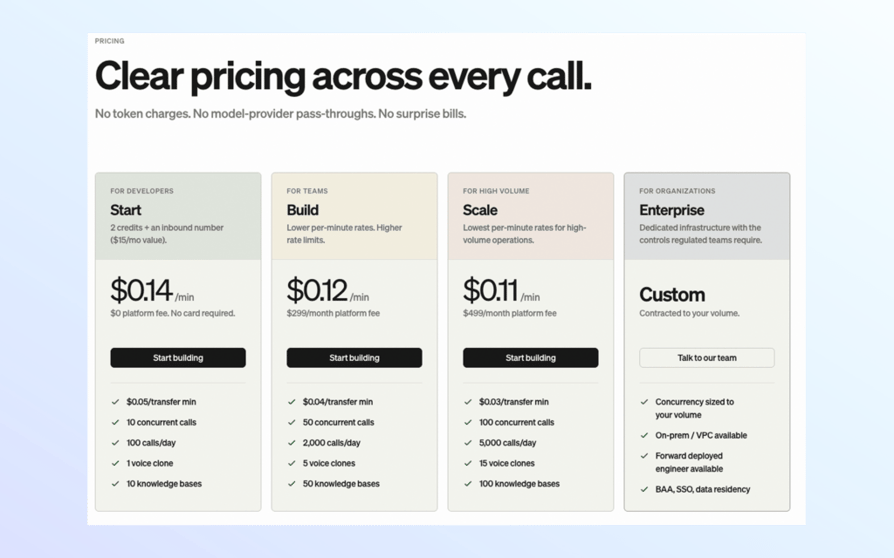
Bland runs four tracks. Higher monthly fees unlock lower per-minute rates, and crucially, no plan includes free minutes: you pay the platform fee, then pay usage on top.
| Plan | Rate | What's included | Notes |
|---|---|---|---|
| Start (For Developers) | Free platform; $0.14/min | Full API access, Norm builder, Pathways, 100 calls/day, 100 calls/hour, up to 10 concurrent calls | No card required; highest per-minute rate; no free minutes |
| Build (For Teams) | $299/month; $0.12/min | Everything in Start plus webhooks, multilingual support, live transfers, higher concurrency, lower TTS pricing | Monthly fee does not include minutes |
| Scale (For High Volume) | $499/month; $0.11/min | Everything in Build plus higher limits and concurrency for high-volume campaigns | Best per-minute rate on self-serve; minutes billed on top |
| Enterprise (For Large Orgs) | Custom pricing | Everything above plus unlimited voice clones, dedicated support engineer, BAA/SSO, guardrails, VPC/on-prem deployment | Contact sales |
The Real Cost: Per-Minute "Stacking"
Here is the part the pricing page does not shout about. The connected per-minute rate ($0.11 to $0.14 by plan) is only one layer. Transfers, telephony, and add-ons stack on top, which is what makes the Bland AI cost hard to forecast.
- Connected minutes: $0.11 to $0.14/min depending on plan, billed by the second for connected call time.
- Outbound attempts: a minimum of about $0.015 per outbound or failed call under ~10 seconds.
- Transfers: both agents bill at your connected rate while active, and the merged call bills at a separate transfer rate (~$0.03 to $0.05/min); bring-your-own-Twilio can waive the surcharge.
- Telephony: carrier and number costs are separate, since Bland has no owned number inventory.
- Add-ons: SMS (~$0.02/message), premium TTS pricing, extra voice clones, and higher concurrency are priced separately.
Real world example
Say you run 10,000 connected minutes a month on the Scale plan at $0.11/min. That is $1,100 in usage, plus the $499 platform fee, for $1,599 before anything else.
Add normal failure rates, transfer minutes, SMS follow-ups, and separate telephony, and reviewers report real totals landing around $1,800 to $2,100 for that same 10,000 minutes.
Bland is not overpriced for what it does. The catch is that the headline per-minute rate is a floor, and your real bill depends on the components you stack on top of it.
Is Bland AI Free? Free Trial & Free Tier Details
Bland is not free on an ongoing basis. The Start plan has a $0 platform fee and needs no credit card, and new accounts get a small amount of credit to test with, but there is no permanent pool of free minutes: usage bills from $0.14/min the moment you go past the starter credit. Plan a realistic paid test rather than assuming a free tier will cover a pilot.
What Real Users Say About Bland AI Pricing on G2, Reddit, and Quora
Bland does not have a deep review footprint on G2 or Trustpilot for its size, so the most useful signal is on Reddit, where technical users get specific about the bill.
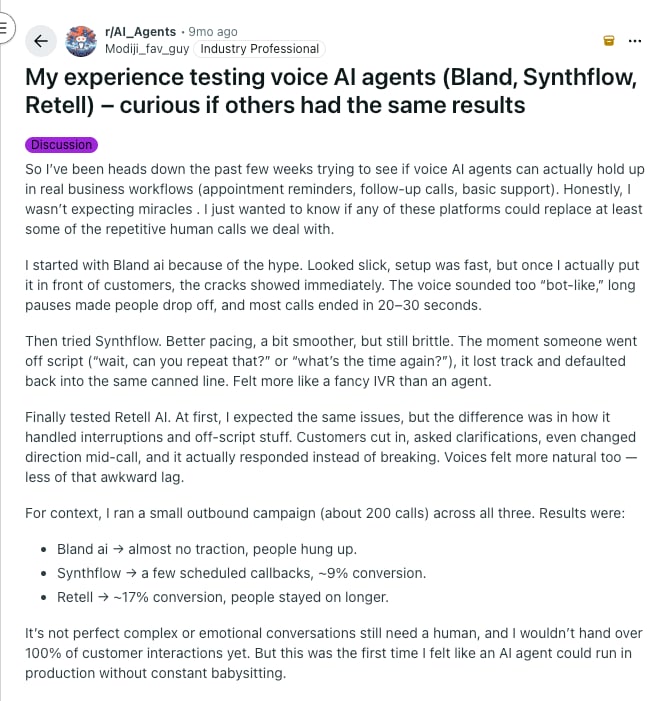
Pricing sentiment splits cleanly. Developers tend to accept the per-minute model because it maps to how they think about infrastructure, and they rate the voice quality and speed highly. In the Bland AI review Reddit threads, the recurring win is speed of deployment and how natural the calls sound.
Buyers on the ops and finance side push back for a consistent reason: the platform fee plus per-minute plus transfer minutes plus separate telephony makes a given month hard to predict, and the bill grows faster than the headline rate suggests at scale. If forecastable cost matters more to you than provider-level control, CloudTalk's AI voice agent pricing is built around flat per-seat plans plus clearly priced minutes rather than a stack. Start your 14-day free trial to test that predictability against your own call volume.
Stop guessing what next month's voice bill will be
Bland AI Review on 6 Must-Have Business Requirements
This is the practical evaluation: how Bland holds up on the dimensions that decide whether a deployment succeeds or stalls.
Call Quality, Latency & Reliability
Latency is Bland's headline strength. It advertises around 400 ms on its proprietary models, which is genuinely fast, and reviewers single out how natural the calls feel. The honest counterpoint on Bland AI latency: independent tests have measured real-world figures closer to 800 ms with occasional spikes toward 2.5 seconds, and barge-in and off-script handling are the weaker moments users mention. The number you actually get depends on your setup and call complexity.
Usability & Interface
The Norm builder and Pathways editor are approachable for a first agent, and onboarding is self-serve. Testbed and Scenarios are a real usability win. The honest verdict is that this is a developer tool with a capable UI on top, not a turnkey operator product. A non-technical operator faces a steep learning curve the moment they move past a basic flow, and live testing is limited on lower tiers.
Developer Capabilities
This is where Bland is strongest. The REST API is deep, webhooks are signed, function calling and live API calls mid-conversation are first-class, and there is a CLI, a Web Agent SDK, and an MCP server for Claude Code and Cursor. You can manage agent configs programmatically and scale concurrency by tier. If you are a technical team, this surface is the reason to look at Bland.
Language Support
Bland markets multilingual and omnichannel support, but scrutinize the depth on Bland AI languages. Third-party reviews note that English is by far the strongest, that broad multilingual coverage leans on higher tiers and Enterprise agreements, and that transcription quality can drop for non-English accents. No-code competitors like Synthflow advertise 50+ production languages, so confirm which languages are production-ready before you build for a specific market.
Integration
Bland covers the main categories through its API and webhooks. Sync depth matters here, so check whether each connector is read-only or bidirectional before you assume it fits your workflow. The honest note on Bland AI integrations: most connections are developer-configured rather than plug-and-play, and there is no live-agent CTI screen-pop. For contrast, CloudTalk ships native call center integrations that are built and maintained in-house. Here is Bland's ecosystem at a glance:
| Category | Notable integrations / notes |
|---|---|
| CRM | Salesforce, HubSpot (copy-paste into Pathways); confirm read-only vs bidirectional sync |
| Telephony | Twilio, BYO / SIP trunk (no owned number inventory) |
| Scheduling | Cal.com, Calendly |
| Automation | Zapier, Make, Pipedream; webhook coverage |
| Communications | Slack, Notion |
| Channels | Voice + SMS + iMessage + Web Chat (unified memory) |
| AI & LLM providers | Proprietary self-hosted models only (no BYO OpenAI, Anthropic, or Gemini) |
| API access | REST API, signed webhooks, CLI, Web Agent SDK, MCP server |
Customer Support
Support tracks with your tier. The self-serve plans lean on a Discord community and a support form; a dedicated support engineer, onboarding help, BAA, and SSO are Enterprise features. Documentation is reasonable, but the recurring complaint is a support cliff after onboarding, with slow responses on lower tiers. The docs and community help fill the gap, but base-plan users feel the thinnest here.
Bland Real User Reviews: What Real Users Say About Bland AI
Bland's reviews skew positive among developers and more mixed among operators, and its third-party footprint is thin for a company its size. The figures below were checked for this review; platforms with limited or unverified Bland presence are flagged so you can confirm them yourself.
| Platform | Rating (reviews) |
|---|---|
| G2 | ~3.3/5 (limited reviews; ~11 listed) |
| Trustpilot | Limited / unverified at publication (confirm live) |
| Capterra | Limited / unverified at publication (confirm live) |
| Product Hunt | Limited / unverified at publication (confirm live) |
For a more civilized data point than a Reddit flame thread, we hopped on G2 to see what customers are actually saying:
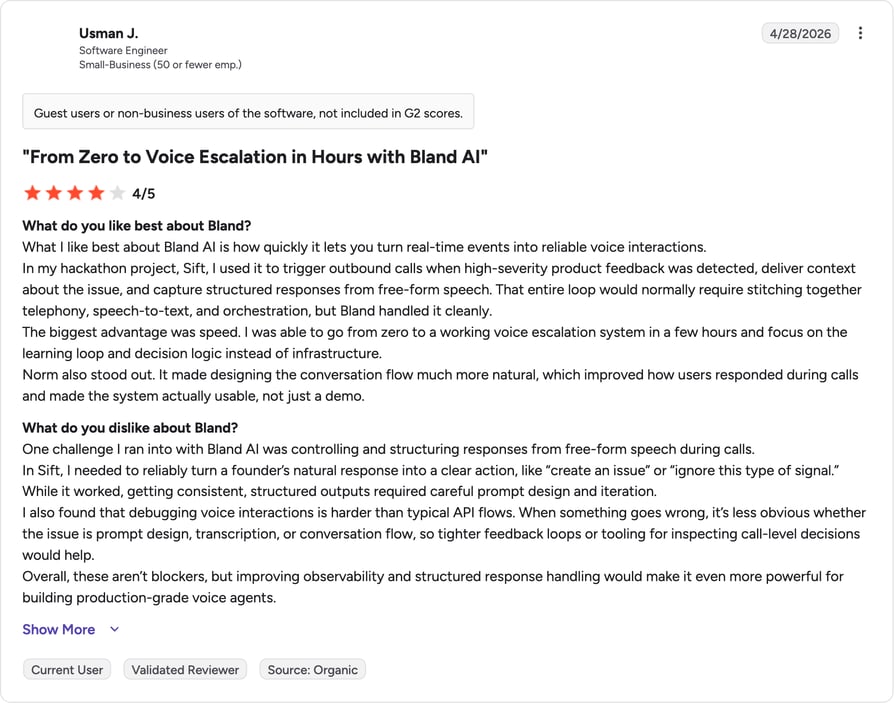
What users love:
- Voice quality and low latency on Bland's own models
- Quick prototyping, an active agent in minutes via Norm
- Serious compliance for its size (SOC 2, HIPAA with BAA, GDPR, PCI DSS v4.0)
- Omnichannel with unified memory across voice, SMS, and chat
- A deep developer surface (API, webhooks, SDK, MCP)
Where users are frustrated:
- Per-minute "stacking" pricing and cost at scale
- No true no-code path, so production agents need engineers
- A support cliff after onboarding below Enterprise
- Off-script and barge-in handling, plus latency spikes in real use
- No full phone system (no softphone, IVR, ACD, or queues) and bring-your-own telephony
On Reddit and Quora, the summary is consistent: technical users defend Bland for its flexibility and speed, while non-technical operators warn others off unless they have a developer on staff. The friction is structural, not about basic call handling.
Reviews say Bland needs engineers. A no-code platform removes that.
Who Should (and Should NOT) Use Bland AI
Fit matters more than features here, because Bland rewards one kind of buyer and frustrates another. The best AI voice agents look different depending on whether you have engineers on hand.
Best Fit: Buyer Profiles Where This Tool Shines
- Engineering-led SaaS teams embedding voice. You are building voice into a product and want programmatic control. Bland gives you a deep API and self-hosted models without building the real-time pipeline from scratch.
- Technical outbound teams with dev resources. You run high-volume outbound and have engineers to build and maintain flows. High concurrency and batch calling fit that model well.
- Regulated teams that value data control. Because models are self-hosted, call data stays off third-party providers, which suits healthcare and finance teams that can reach the Enterprise tier for BAA and SSO.
- Startups and agencies prototyping fast. You want a first agent live quickly and value Norm, Pathways, and the SDK over a polished ops UI.
- Teams comfortable modeling variable costs. You are fine forecasting a component-based per-minute rate and treating it like cloud infrastructure spend.
Poor Fit: When You Should Look Elsewhere
- Non-technical ops and CX teams. Without engineers to build and adjust agents, the lack of a true no-code path will stall you. A platform like CloudTalk fits better here.
- Teams needing a full phone system. If you need a softphone for human reps, IVR, ACD, queues, and native routing, Bland is an agent layer, not a phone system.
- Teams needing predictable, flat billing. Platform fee plus per-minute plus transfers plus telephony is variable by design, so a fixed monthly number is hard to guarantee.
- Very small businesses with low volume. At low call counts, the per-minute model and platform fee rarely pencil out against a per-seat plan.
Bland AI: Industry Fit
| Industry / use case | Fit assessment |
|---|---|
| Dev-led SaaS embedding voice into a product | Strong (core strength) |
| High-volume outbound sales (with eng resources) | Strong for teams with engineers to build and maintain |
| Non-technical front desks (HVAC, medspa, dental) | Weak (not turnkey, needs engineers, no full phone system) |
| Contact center ops teams (self-managed) | Weak (no softphone, IVR, ACD, or queues) |
| Healthcare (HIPAA-required) | Strong on paper (HIPAA with BAA on Enterprise; verify controls) |
| Finance/insurance (compliance-heavy) | Moderate (SOC 2, PCI DSS v4.0; confirm audit scope) |
| EU-based teams (data residency) | Moderate (EU residency on Enterprise; confirm) |
Security, Compliance & Data Privacy of Bland AI
Bland's compliance posture is strong for its size, largely because it self-hosts its own models and keeps call data off third-party providers.
Compliance Certifications
Bland lists SOC 2 (Type I and II), HIPAA with a signed BAA, GDPR, and PCI DSS v4.0 as audited. Several controls that matter to careful buyers, including the BAA, SSO, and guardrails, are Enterprise-gated rather than available to self-serve users. Confirm each of these on Bland's live trust materials before you rely on it, especially the BAA scope if you handle protected health information.
Data Handling & Residency
Because Bland runs proprietary, self-hosted models, call recordings and transcripts are handled on Bland's own infrastructure rather than passed to an external model provider, which is a genuine privacy advantage. Whichever vendor you shortlist, weigh it against the common VoIP security risks that affect any cloud calling platform. For European teams, the consideration is residency: Bland offers US, EU, and APAC data residency on Enterprise, so treat EU residency as an Enterprise-tier requirement to confirm rather than a default.
What Are the Pros and Cons of Bland AI?
Bland's pros and cons are typical of a standalone voice agent versus an integrated system: deep control and speed, at the cost of assembly, forecasting, and ongoing upkeep.
| Pros | Cons |
|---|---|
| Low latency and natural voice on proprietary self-hosted models (~400ms, Bland's claim) | Per-minute "stacking" pricing (platform fee plus minutes plus transfers plus telephony) is hard to forecast |
| Strong compliance for its size: SOC 2 I/II, HIPAA with BAA, GDPR, PCI DSS v4.0 | No true no-code path, so production agents and changes need engineers |
| Omnichannel with unified memory across voice, SMS, iMessage, and web chat | Not a full phone system: no softphone, IVR, ACD, or queues, and bring-your-own telephony |
| Deep developer surface (API, signed webhooks, SDK, CLI, MCP server) | Support cliff after onboarding below Enterprise; users report slow responses |
| Fast prototyping via Norm and visual Conversational Pathways | English is strongest; broad multilingual and key transfer features are Enterprise-gated |
The Best 4 Bland AI Alternatives in 2026
If Bland's developer-first, per-minute model is not the right shape for your team, here are the best Bland AI alternatives worth weighing. Because Bland is a builder's tool without a full phone system, the most useful contrast is an operations-ready, predictable-pricing platform, which is where CloudTalk fits.
| Capability | CloudTalk | Vapi | Retell AI | Synthflow |
|---|---|---|---|---|
| Best for | Ops teams wanting predictable AI calling plus a full phone system | Developer-first programmable voice | Low-latency dev-led voice agents | No-code voice agents (SMB/agency) |
| Build model | No-code + native integrations | API-first (code) | API-first (code) | No-code |
| Pricing model | Predictable per-seat platform + usage-based AI Voice Agent add-on | Component usage + provider costs (~$0.05/min +) | Component usage (~$0.07 base, ~$0.13-$0.31 real) | Tiered subscription + overages |
| Real per-minute clarity | Predictable | Low (stacking) | Low (stacking) | Medium (overages) |
| Latency | Low | ~500-800ms (config) | ~600ms (Retell's claim) | ~400-500ms |
| No-code friendliness | High | Low (devs) | Low (devs) | High |
| Inbound / outbound | Both | Both | Both | Both |
| Languages | Wide (AI Voice Agent supports 60+) | Provider-dependent | 31+ (provider-dependent) | 50+ |
| Integrations | Native call-center + 100+ CRM/helpdesk | Via API / webhooks | CRM, telephony via API | HubSpot, Twilio, etc. |
| Enterprise controls | RBAC, analytics, SOC 2, GDPR, HIPAA | Higher plans | SOC 2, HIPAA, GDPR (gaps: ISO 27001, audit logs) | Enterprise tier |
| Support model | Dedicated 24/7 support | Docs + community | Discord/email base; dedicated on Enterprise | Slack (30 days) then tickets |
| Best-fit vs Bland | When you want production voice plus a real phone system, no engineers | When you want the deepest provider control | When low-latency dev-led voice is the priority | When you want no-code but still voice-specific |
Want the head-to-head detail? See CloudTalk vs Bland AI, plus our full Bland AI alternatives guide.
Bland AI vs Retell AI: How Do They Compare?
Retell AI is the alternative people weigh against Bland most often, because both are developer-first voice-agent platforms rather than full phone systems. The short version: Retell leans on a low-code builder and ultra-low latency for mid-market technical teams, while Bland is built for enterprise developers running mass-volume outbound with deep API control. Here is how they line up on the dimensions that decide most builds.
| Retell AI | Bland AI | |
|---|---|---|
| Best for | Developer-first, ultra-low latency, human-like turn-taking; mid-market technical teams | Enterprise developers needing mass-volume outbound and deep API hooks |
| Build model | Low-code visual builder; most CRM and telephony workflows are API-driven | Conversational Pathways logic; native connectors often need manual API setup |
| Starting price | $0.07/min base | $0.14/min on the free plan, or $299/mo to unlock $0.12/min |
| Latency | ~600ms | ~400ms |
| HIPAA / compliance | SOC 2, HIPAA, GDPR | SOC 2; HIPAA available as a $1,000/mo add-on |
Neither wins outright — Retell is the easier on-ramp for a technical team that wants natural turn-taking without rebuilding telephony, and Bland is the stronger fit for high-throughput scripted outbound at enterprise scale.
Why CloudTalk AIVA Is Worth Considering
The core difference is what you get for the money. Bland is an AI voice agent billed per minute; CloudTalk is a full phone system with human calling, native routing, and AI add-ons on predictable per-seat plans. If your team needs both a bot and a real phone system, that is the trade-off to weigh.
Feature & Capability Comparison
Here is Bland vs CloudTalk across the capabilities that decide most deployments:
| Capability | Bland AI | CloudTalk |
|---|---|---|
| Primary focus | Developer voice-agent platform (self-hosted models) | AI business calling plus a full phone system for sales and support |
| Build model | API-first (code), Norm and Pathways | No-code + native integrations |
| Pricing model | Per-minute + monthly platform fee ("stacking") | Predictable per-seat platform + AI Voice Agent add-on |
| Entry price | Free Start at $0.14/min; Build $299/$0.12; Scale $499/$0.11 | Starter from $25/user/month |
| Real all-in clarity | Hard to forecast (minutes + transfers + telephony) | Predictable |
| Latency | ~400ms (Bland's claim); ~800ms in third-party tests | Low, on a multi-carrier network built for call quality |
| Concurrency | 10 free on Start; scales high on Enterprise | Native call-center concurrency |
| Languages / voice | Multilingual claimed; English strongest; voice cloning | AI Voice Agent supports 60+ languages |
| Warm transfer / IVR | Transfers yes (warm/live Enterprise-gated); no native IVR/ACD/queues | Native IVR and skill-based routing (from Starter) |
| Testing / simulation | Testbed, Scenarios, Evals (limited on lower tiers) | Testing via platform config |
| Post-call analytics / QA | Call analysis and data extraction | AI Conversation Intelligence (add-on) |
| Integrations | CRM, scheduling, automation via API/webhooks | 100+ native integrations |
| Compliance | SOC 2 I/II, HIPAA (BAA), GDPR, PCI DSS v4.0 | SOC 2, GDPR, HIPAA |
| Support & onboarding | Discord + form base; dedicated engineer Enterprise-only | Dedicated 24/7 support |
| Time to production | Days to weeks (engineering) | Days, no engineering required |
Bland AI vs CloudTalk: Pricing & Scalability Compared
The core difference is forecastability. Bland's cost is a monthly platform fee plus per-minute usage plus transfer minutes plus separate telephony, so your effective rate moves with every call and climbs as volume and concurrency grow. CloudTalk sells a flat per-seat platform, with plans from $25/user/month (Starter), $29/user/month (Essential), and $49/user/month (Expert), and the AI Voice Agent as a usage-based add-on starting at $99/month for 200 minutes.
As call volume scales, the contrast sharpens. With Bland, more minutes and more transfers mean a bigger, harder-to-predict bill plus the ongoing engineering time to maintain the stack. With CloudTalk, the platform cost is a known per-seat number and the AI Voice Agent minutes are a separate, straightforward line, so finance can model it without a spreadsheet full of component rates.
Having our own solution was expensive. We had to always check everything, the technical stuff, and we still had to order numbers and pay per minute. We are not at the moment where AI can read emotions and figure out what the person on the other side really needs. But I can call 20 times more people. So even if it's twice less efficient, the math works.
Where CloudTalk Fits Better
- Predictable pricing. Flat per-seat plans from $25/user/month mean your bill does not swing with call volume the way a per-minute model does.
- A real phone system, not just an agent. IVR and skill-based routing from Starter, ACD, Call Flow Designer, ring groups, and queues, with AI Voice Agents available as an add-on on top.
- Global numbers with local presence. Local and international numbers in 160+ countries with local-presence dialing to lift answer rates, versus Bland's bring-your-own telephony.
- Native, two-way integrations. 100+ native integrations with CTI screen-pops for HubSpot, Salesforce, Pipedrive, Zendesk, and more, mostly plug-and-play.
- Enterprise controls and support. SOC 2, GDPR, and HIPAA compliance, real-time analytics, 24/7 support, and a platform trusted by 5,500+ customers, with a G2 rating of 4.4/5 across 1,702+ reviews.
It was a combination of dropped calls, long connection times, and support that just wasn't available when we needed it. I could quickly glance at the summary of the call, but more so even just the questions that were asked, which was really easy for me to do, and it saved me hours.
If a no-code, forecastable setup on a real phone system is what you are really after, start your 14-day free trial. No credit card required.
Final Verdict: Is Bland AI Worth It?
Bland AI is worth it for the right team. It is a fast voice-agent platform with proprietary low-latency models, strong compliance for its size, and a developer experience that rewards technical ownership. The catch is that the right team has engineers, tolerance for a variable per-minute bill, and no hard requirement for a full phone system. Model the true all-in cost before you commit, and confirm current rates on Bland's live pricing page.
Good Fit For
- Developers and technical teams building custom voice agents who want programmatic control
- Startups and agencies that need 24/7 call handling and can wire up telephony and integrations
- Regulated teams that value self-hosted models and can reach the Enterprise tier for BAA and SSO
- Teams comfortable modeling variable, component-based per-minute costs
Not a Good Fit For
- Non-technical ops and CX teams that need to build and adjust agents without engineers (a no-code platform like CloudTalk that brings AI voice agents to sales and support fits better here)
- Teams that need a full phone system with human agents, IVR, ACD, and queues, not just an agent layer
- Teams needing predictable, flat-rate billing rather than a per-minute stack
- Very small businesses with low, unpredictable call volume where per-minute cost does not pencil out
Ready to compare Bland AI with a full phone system?
Sources:
- Bland.ai (pricing and features)
- G2.com (verified reviews)
- Reddit.com (user discussion)
- Fortune.com (funding)
FAQ
Yes, if you have engineers. Bland delivers fast, natural voice on proprietary self-hosted models for developer-led teams comfortable with variable per-minute pricing. Non-technical teams needing predictable billing and a full phone system will find it a poor fit.
Bland AI is usage-based on a tiered model: $0.14/min on the free Start plan, $0.12/min on Build ($299/mo), or $0.11/min on Scale ($499/mo), plus transfer minutes and separately billed telephony. See the full Bland AI pricing breakdown, and confirm current rates on Bland's live pricing page.
No. Bland AI has no permanent free tier of minutes. The Start plan has a $0 platform fee and a small amount of starter credit, then usage bills from $0.14/min, so your voice AI cost scales with call volume.
You'll want developers. Norm and Pathways handle simple flows, but production agents, edge cases, and integrations route back to code and the API. Non-technical teams are better served by a no-code AI voice agent they can build and adjust alone.
Bland lists SOC 2 Type I and II, HIPAA with a signed BAA, GDPR, and PCI DSS v4.0 as audited, and self-hosts its own models so call data stays off third-party providers. Note that the BAA and SSO are Enterprise-gated; confirm scope on Bland's trust materials.
Bland advertises around 400 ms on its proprietary, self-hosted voice models, which is genuinely fast. Independent tests report real-world figures closer to 800 ms with occasional spikes, so expect the number to depend on your setup. Low latency is a shared strength across the best AI voice agents.
The top options include full phone systems like CloudTalk plus voice-AI tools like Vapi, Retell AI, and Synthflow. See the full shortlist in the Bland AI alternatives guide.
Bland AI is a developer-led AI voice-agent platform billed per minute. CloudTalk is a full phone system with human calling, routing, and AI add-ons on predictable per-seat plans. See the CloudTalk vs Bland AI breakdown.