TL;DR: CloudTalk vs Synthflow
| Question | Quick Answer |
|---|---|
| Which one should you buy? | CloudTalk, if you need a local number outside three countries and a human rep sitting on the same platform as the agent. Synthflow, if you already run your own SIP trunk or PBX and can sign an annual contract. |
| How much does Synthflow cost? | Enterprise contracts start at $30,000 a year, and Enterprise is the only tier Synthflow publishes. It publishes no per-minute rate and no monthly billing option. |
| How much does CloudTalk's AI Voice Agent cost? | $0 for the first month with 50 minutes included, then from $99/month for 200 minutes, on top of a plan from $25/user/month. It's a paid add-on on every tier. |
| Which one is cheaper? | CloudTalk at the entry point, by a wide margin. At high volume, unknowable: Synthflow publishes no per-minute rate and scopes every contract individually. |
| What countries does Synthflow support? | You can buy numbers in the U.S., Canada and Australia. For a local number anywhere else you bring your own carrier or Twilio numbers, and importing a SIP or PBX number needs an Enterprise account. |
| Does Synthflow support outbound calling? | Yes. Single calls run through its API, and bulk campaigns of up to 10,000 recipients are Enterprise-only. |
| Can Synthflow hand a call to a live human? | Yes, including a warm transfer that plays an AI-generated summary to the rep first. What differs is where that rep sits: inside CloudTalk, or in a separate system you buy and run yourself. |
| Which one sounds better on the phone? | Neither, on published evidence. Both use ElevenLabs voices and Deepgram speech-to-text, both self-report responses under 800 ms, and no independent benchmark exists for either. |
| What changed this year? | Synthflow retired its self-serve Pro, Growth and Agency plans and now publishes one Enterprise tier. Most CloudTalk vs Synthflow 2026 comparisons still price it per minute on a plan you can no longer buy. |
| Is CloudTalk a real Synthflow replacement? | For any team below enterprise scale, it's the best Synthflow alternative on published evidence: one seat to start, setup in minutes, and local numbers in 160+ countries. |
CloudTalk and Synthflow both do the same core job: they put a working AI voice agent on a phone line. The split is commercial. CloudTalk sells the agent as an add-on to a full, AI-powered business phone system you can buy with a card today. Synthflow sells one Enterprise contract from $30,000 a year. For most buyers, CloudTalk vs Synthflow is settled right there, before a single feature gets compared.
Synthflow's real advantage sits in the builder: Flow Designer, a Test Center that scores simulated calls before launch, and a sandbox you can roll back. CloudTalk's own Call Flow Designer covers call routing, but its AI agent is built by assigning skills, not drawn on a canvas, and it has no scored test calls. The catch is who that advantage suits: a team that already owns its telephony and can sign an annual contract.
CloudTalk's AI Voice Agent fits teams that want numbers, agents and reps in one place, while Synthflow fits teams that already own the stack. Dive deeper and see which one fits your needs best.
Want a Third Data Point Before You Shortlist?
How We Compared CloudTalk and Synthflow
We pulled every Synthflow number on this page straight from synthflow.ai and its documentation in August 2026, and every CloudTalk number from cloudtalk.io at the same time. And let's name the obvious upfront: you're reading this on CloudTalk's website, and CloudTalk is one of the two products being compared. That's exactly why we gave ourselves rules.
No claim about Synthflow that its own documentation doesn't support. CloudTalk's cons listed as plainly as Synthflow's. Synthflow named the winner on every row where it wins. And where a vendor doesn't publish a number, this page says "Not published" instead of guessing. And here's what we actually scored:
- Pricing you can forecast past month oneWhat the entry number hides: seat minimums, annual commitments, separate purchases.
- Feature depth, not feature countBuilder architecture, retrieval, testing loops, and what a missing figure means for your rollout.
- What happens at the moment of handoffNot whether an agent can transfer a call, but which system the receiving human works in afterwards.
- Integration reality over logo wallsA connector in a directory and a sync your CRM admin trusts are different things, so we recounted both claims.
- Compliance you can hand to legalWhich certifications each vendor names, on which page, in which exact words.
Why CloudTalk's AI Voice Agent Is Better Than Synthflow
CloudTalk wins on what you can verify before you sign: where the agent can get an international number, what happens when a caller asks for a person, and what the first month costs. Synthflow takes the builder and testing rows, which matter later, once the decision is made.
CloudTalk AI Voice Agent's Core Advantages Over Synthflow
CloudTalk's Core Advantages Over Synthflow
| Advantage | Why It Matters |
|---|---|
| Local numbers in 160+ countries, on every plan | Synthflow sells in-platform numbers in three countries only: the U.S., Canada and Australia. Everywhere else you supply the carrier, and importing a SIP or PBX number requires an Enterprise account. |
| The human stays on the same platform | CeTe, CloudTalk's AI agent, layers onto a CloudTalk number, so a transferred call lands in the same routing, the same queue and the same CRM record, with the transcript attached. Synthflow's transfer target is a phone number or SIP endpoint in whatever system you run separately. |
| You can start this week for the price of one seat | A plan from $25/user/month, a one-license minimum on Starter, and the AI Receptionist free for your first month at 50 minutes. Synthflow's published floor is a $30,000 annual contract. |
| Native CRM write-back without an integration project | CeTe syncs transcripts and notes to Salesforce or HubSpot through native integrations or the API, so a qualified call updates the record with no developer involved. Synthflow lists CRM connectors but doesn't publish write-back depth per connector. |
| 70+ languages and accents | More than double Synthflow's published 30+, and you set the language when you build the agent, meaning it isn't tied to the number you bought. That matters the first time your support hours cross a border. |
What CloudTalk's AI voice agent looks like in production:
One high-volume services provider running CeTe now deflects nearly 40% of its inbound calls to the agent.















Test the Coverage Claim Before You Trust It
At a Glance: CloudTalk AI Voice Agent vs. Synthflow, Key Differences
This grid is the whole CloudTalk AI voice agent vs Synthflow comparison on one screen. Read down the Winner column first, then jump to the section behind whichever row decides your purchase: country coverage, the handoff, or pricing.
CloudTalk AI Voice Agent vs. Synthflow: Key Differences
| Dimension | CloudTalk | Synthflow | Winner |
|---|---|---|---|
| Local number coverage | 160+ countries with local numbers, on every plan tier | Buy in the U.S., Canada and Australia; elsewhere, bring your own carrier or Twilio number | CloudTalk |
| Entry price and time to first call | AI Receptionist comes at $0 for month one, capped at 50 minutes, plenty of time to test it out. If you like it, the bundles start at $99/month (200 mins), and it goes live in under 10 minutes | $30,000 a year, scoped with sales + roughly a 3-week deployment | CloudTalk |
| Monthly billing | Yes, on every plan, cancel anytime | Not published. Its own comparison page lists an annual commitment as required | CloudTalk |
| Where the human sits after a transfer | Same platform: same routing, same queue, same CRM record | A phone number or SIP endpoint in a system you run separately | CloudTalk |
| Handoff mechanics | Warm transfer with the context and the transcript attached | Cold, warm-with-message and warm-with-summary, with human detection, retries and fallback | Tie – both document warm transfer |
| Visual builder depth | Skills assigned in a no-code wizard | Flow Designer with subflows and conditional logic | Synthflow |
| Pre-launch testing | Not published | Test Center simulations scored against your KPIs, plus a sandbox with rollback | Synthflow |
| Knowledge base depth | Retrieval-augmented generation (RAG) over website URLs and PDFs you upload | RAG plus scheduled site crawls, Zendesk import, and retrieval visible in call logs | Synthflow |
| Bring your own carrier or PBX | Not published; the agent runs on your CloudTalk numbers | Documented over SIP, into Cisco, Avaya, Genesys, Five9, Talkdesk, RingCentral or 3CX | Synthflow, on Enterprise |
| Language support | 70+ languages and accents | 30+ languages, 33 entries enumerated in its docs | CloudTalk |
| Voice and speech-to-text | ElevenLabs voices, Deepgram transcription | ElevenLabs voices, Deepgram or its own speech-to-text | Tie – same suppliers |
| Response latency | Under 800 ms, self-published | Under 800 ms, sub-500 ms and sub-100 ms in three different places, all self-published | Neither – no independent benchmark |
| Certifications named | SOC 2 Type 2, ISO 27001, GDPR, CCPA, HIPAA and PCI DSS, all on one page | Three different lists across three pages; no single page names all five | CloudTalk |
| Pricing transparency | Per-user plans and per-minute add-on rates published | One tier, "Contact Sales", and no per-minute rate anywhere | CloudTalk |
| Fit for a team of 1 to 5 | One license minimum on Starter | No published route in below an annual enterprise contract | CloudTalk |
| Fit for an enterprise that already owns its telephony | The agent runs on CloudTalk numbers | In-house telephony plus BYOC, forward-deployed engineers, scoped rollout | Synthflow |
CloudTalk AI Voice Agent Features vs. Synthflow Features
Salesforce's seventh State of Service report, a 2025 survey of 6,500 service professionals, puts AI at 30% of cases today and projects 50% by 20271. At that share, feature gaps stop being a spec-sheet argument and start showing up in your queue. Both platforms cover the jobs an AI voice agent handles on a call. The split is how far each one goes with them.
CloudTalk AI Voice Agent Features
CeTe, CloudTalk's AI Voice Agent, handles inbound and outbound workflows from one build. It answers routine questions, qualifies leads, books and reschedules appointments, and updates the CRM automatically, all configured from the UI with no code. It runs on CloudTalk's own telephony, so it uses the numbers, routing and analytics your reps already use.
What CloudTalk's AI Voice Agent (CeTe) Does Well
- 24/7 coverage in 70+ languages and accentsAfter-hours and overflow calls get answered instead of dropping into voicemail, at the same standard on a Sunday night as a Tuesday morning.
- Warm handoff with the context attachedWhen a call needs a person, the agent hands the caller and the transcript to a rep, and it stays one continuous CRM record.
- Real CRM write-backTranscripts and notes sync to Salesforce or HubSpot through native integrations or the API, so a booked meeting lands in the record without anybody retyping it.
- Local numbers in 160+ countries, including the U.S., Canada, and AustraliaThe agent runs on virtual phone numbers you already hold, so coverage is something your plan includes and not a separate procurement project.
- Live in minutesSelf-guided setup runs under 5 minutes, and CloudTalk publishes under 10 minutes to go live for basic intake (note: the AI receptionist tier), 1 to 2 weeks when custom systems are involved (note: the AI Specialist tier).
1,000 Qualification Calls a Day, Handled by the Agent:
MadRent, a vehicle rental company, runs CeTe on 60,000+ outbound minutes a month, handling up to 1,000 lead qualification calls on a busy day. The agent delivers around 100 qualified leads daily, roughly double what MadRent's five-person validation team used to manage on its own. And those five people? They all spend their days closing deals now, not chasing them.
Synthflow AI Voice Agent Features
Synthflow is a voice AI platform built around a visual, no-code Flow Designer and its own telephony network, with a four-stage build-evaluate-launch-learn framework it markets as BELL. It aims at enterprise and business process outsourcing (BPO) rollouts: scoped implementation, forward-deployed engineers, a published 3-week deployment.
Where Synthflow Falls Short
- Numbers you can buy cover three countriesIts docs are explicit: you buy U.S., Canadian and Australian numbers directly. For local numbers elsewhere you import a custom number from your own carrier or bring Twilio numbers, and that import path needs an Enterprise account.
- There's no published way in below an annual contractOne tier, $30,000 a year, scoped with sales. Its own docs confirm the old self-serve Pro, Growth and Agency plans are retired, so pilots have no listed entry point.
- Bulk outbound sits behind the same gateCampaigns are Enterprise-only per its docs, and so are custom number import and voice-provider failover.
- The human side of handoff lives elsewhereSynthflow transfers the call out to a phone number or SIP endpoint, so the receiving rep's queue, desktop and CRM record belong to a system you run separately.
Feature-by-Feature Comparison
Asked as Synthflow vs CloudTalk features, the split is breadth of telephony and reach against depth of control in the builder.
Feature-by-Feature Comparison
| Feature | CloudTalk | Synthflow |
|---|---|---|
| Inbound call handling | Yes. AI Receptionist covers a 24/7 front desk, triage and routing | Yes. Inbound agents are a first-class deployment channel |
| Outbound call handling | Yes. CeTe runs lead qualification, reminders and follow-up outreach | Yes, single calls through the Platform API |
| Bulk outbound campaigns | Not published for the AI agent. CloudTalk's Smart, Power and Parallel dialers are separate products for human reps | 1 to 10,000 recipients per request, with calling windows and reserved concurrency to protect inbound. Enterprise only |
| Live-agent handoff | Warm transfer with the context and the transcript, assigned as a skill in the wizard | Cold, warm-with-message and warm-with-summary, to a number, SIP URI, webhook-resolved destination or phone book |
| Language support | 70+ languages and accents | 30+ languages; 33 entries in the docs, plus a multilingual mode across ten of them |
| Local numbers | 160+ countries, on every plan | U.S., Canada and Australia in-platform at $1.50 per number per month; elsewhere, bring your own carrier |
| Native CRM sync | Transcripts and notes sync to Salesforce or HubSpot via native integrations or API | Connectors for Salesforce, HubSpot, Zoho, Pipedrive, GoHighLevel, Freshworks and ten vertical CRMs. Write-back depth per connector is Not published |
| Voice and transcription | ElevenLabs voices, Deepgram transcription | ElevenLabs by default, plus its own text-to-speech and speech-to-text, plus voice cloning |
| Knowledge base | RAG over website URLs and PDFs you upload | RAG over PDFs, typed docs, single URLs, scheduled site crawls with include and exclude paths, and Zendesk Help Center import |
| Pre-launch testing | Not published as a simulation environment | Test Center runs simulated calls scored against your KPIs; the sandbox adds versioning and rollback |
| Concurrency | "Infinite simultaneous calls" in CloudTalk's own wording, with no numeric cap published | Not published. Concurrency and call attempts per second are scoped per contract |
Nobody Wins the Voice Row, and Be Suspicious of Pages That Say Otherwise
Both CloudTalk and Synthflow run ElevenLabs voices and both offer Deepgram for speech-to-text, so a caller can't tell them apart by supplier. Latency can't be scored at all: CloudTalk publishes under 800 ms, and Synthflow's own properties quote under 800 ms on its comparison page, sub-500 ms in its homepage FAQ and sub-100 ms round-trip in its docs. All self-reported, and no independent benchmark exists for either. Two pages currently ranking for this keyword publish "CloudTalk 23 ms" and "Synthflow 2300 ms", figures neither vendor has ever claimed.
None of these rows tells you what happens in the two seconds after a caller asks for a person, and that's where most of these deals get decided.
AI + Live-Agent Handoff: One Workflow vs. Two Separate Tools
According to Salesforce's 2025 Agentic Enterprise Index, escalations to human agents rose from 22% in the first quarter of 2025 to 32% in the second, because the agents got better at pinpointing when a human was needed2. Handoff volume climbs as the AI improves, so the transfer path carries real weight.
Synthflow documents that path properly, and any page telling you otherwise hasn't read the docs. It offers a cold transfer over SIP REFER, a warm transfer with a whisper message, and a warm transfer that plays an AI-generated summary to the rep first. Human detection comes with a configurable timeout, retries and a fallback.
The difference is architectural, and it shows up after the transfer completes. CloudTalk's agent hands the call to a rep inside CloudTalk, so the transfer lands in the queue, the desktop, the routing rules and the CRM record your team already works in, and the transcript rides along. Synthflow's destination is an E.164 number, a SIP URI, a runtime-resolved value or a phone-book entry, so the receiving human works in a system you buy and operate yourself.
Live-Agent Handoff Compared
| Dimension | CloudTalk | Synthflow |
|---|---|---|
| Native live-agent handoff | Yes, assigned as a skill in the no-code wizard | Yes. Four destination types and three transfer modes, all documented |
| Context passed at handoff | The call and the transcript go to the rep, and the interaction stays one continuous CRM record | Warm-with-summary plays an AI-generated summary to the recipient. What reaches the CRM depends on the system taking the call |
| Telephony and CRM on one platform | One product: number, routing, queue, agent desktop and CRM sync | Synthflow runs its own telephony, but the receiving human sits in a separate system |
| Setup effort for handoff logic | Assign a skill | Configure the transfer action. Dynamic routing needs a pre-call webhook or a custom action endpoint returning candidate destinations |
What the same-platform handoff looks like in production:
Autenti, a SaaS company, has CeTe handling roughly 30% of its inbound support calls. The other 70% reach a human without ever leaving the platform, landing in the same queue, with the same CRM record.
Two fine-print details are worth knowing before you build around Synthflow's transfer. A warm transfer opens a new call leg, so your rep sees the agent's number instead of the caller's unless you override caller ID, and Synthflow only confirms number-based transfers with Twilio and Telnyx. On our side, one honest gap: CloudTalk's agent runs on your CloudTalk numbers, and bringing a third-party carrier number to it isn't published, so ask before you plan around it.
Handoff assumes the call reached you at all, which comes down to having a number in your caller's country.
Global Reach: Where Can Your AI Voice Agent Take Calls?
The Synthflow country coverage question has two halves, and nearly every comparison page collapses them into one wrong answer. Half one is where you can buy a number inside the platform: the U.S., Canada and Australia, at $1.50 per number per month. Synthflow's own guidance is to bring numbers from Twilio or another SIP provider for production. Half two is where it can deliver calls: its pricing page claims 65M+ voice calls a month across 30+ countries.
Both are true at once, and conflating them is how the "3-country limit" myth spreads. The commercial version is narrower: a local number in Germany or Brazil means supplying your own carrier, and importing a custom SIP or PBX number needs an Enterprise account.
Global Reach Compared
| Dimension | CloudTalk | Synthflow |
|---|---|---|
| Countries with local number support | 160+, listed on every plan tier | Three to buy in-platform: U.S., Canada, Australia. Anywhere else you import your own carrier, trunk or PBX number, which needs an Enterprise account |
| Toll-free numbers | 800 and 888 numbers are a listed plan row | Not published on the pricing page, the telephony overview or the phone-numbers doc |
| Number provisioning speed | Not published as an SLA. Agent setup is published at under 10 minutes | Purchased numbers are immediate for testing; Australian numbers need a validated address. Custom numbers are available immediately after upgrading to Enterprise |
| Calls delivered versus numbers sold | The published figure is local-number coverage in 160+ countries | "65M+ voice calls every month in 30+ countries" on the pricing page. That's delivery volume, not local-number availability |
What CloudTalk's AI agent looks like across borders:
Oxford Royale Academy stopped hiring 4 seasonal staff every year. Instead, the agent now calls every new lead within 5 minutes, in 5 auto-detected languages, across a student base spanning 176 countries.
Coverage decides what you can buy. Price decides whether you can buy anything at all.
Pricing: Synthflow vs. CloudTalk
The CloudTalk vs Synthflow pricing comparison is the least ambiguous part of this page, because one vendor publishes numbers and the other publishes a floor and a phone call. Deloitte Digital's 2026 service survey found 64% of service leaders reporting higher agent productivity from AI, but only 39% reporting a lower cost per contact3. Cost per contact depends on what you signed.
CloudTalk Pricing
CloudTalk sells per user per month, with three published plans and a custom tier.
- Starter, $25/user/month annually ($34/user/month billed monthly), minimum one license. Covers the basics: unlimited inbound and internal calls, a 500-minute outbound calling bundle, call queues, transfers and click-to-call, with international numbers in 160+ countries.
- Essential, $29/user/month annually ($39/user/month billed monthly), minimum one license. Where IVR (interactive voice response), smart routing and the 95+ standard CRM, helpdesk and ATS integrations start, with unlimited call recording retention.
- Expert, $49/user/month annually ($69/user/month billed monthly), minimum three licenses. Adds Power, Smart and Preview Dialers as included features, the Salesforce Ecosystem integration and 24/7 phone support.
- Custom: contact sales.
The AI Voice Agent is a paid add-on on every one of those tiers, and its pricing is identical on each. It's free for your first month at 50 minutes, then AI Receptionist starts at $99/month for 200 minutes and AI Specialist at $349/month for 1,000 minutes, with a custom rate from $0.15/minute above 10,000 minutes a month. AI Conversation Intelligence is always an add-on too, at $9/user/month. Nothing about the AI comes bundled into a plan, on any tier.
Synthflow Pricing
Synthflow publishes one tier. Its pricing page states that Enterprise contracts start at $30,000 annually, with final pricing scoped around call volume, concurrency, telephony setup, integrations, security needs and launch support. Its enterprise comparison page repeats the figure as "from $30K" and lists an annual commitment as required. The only button is Contact Sales, and its docs call the model sales-led, with usage measured in calls, chat and simulations.
The one other price published anywhere on its properties is $1.50 a month for a phone number bought in-platform. We track changes to that model on our dedicated Synthflow pricing page rather than rebuilding it here.
The Catch With Synthflow Pricing
- The floor is an annual commitment, not a monthly bill. $30,000 a year is roughly $2,500 a month, but no monthly-only option is published, so you're comparing a signature to a card payment.
- There's no rate card to model against. Per-minute pricing, concurrency and call attempts per second are scoped with the Synthflow team and never published, so you can't forecast month 13.
- Everything sits inside Enterprise, so "gated" is the whole product. Outbound campaigns, SIP and PBX integration, custom number import and voice failover are all Enterprise features, and Enterprise is the only tier.
- Its own site disagrees with itself. The homepage FAQ still says you can build your agent for free and then pay per call, while the pricing page shows Enterprise only and no pay-as-you-go rate appears anywhere. Ask which one applies to you, in writing.
Pricing Compared Line by Line
Pricing Compared Line by Line
| Pricing Dimension | CloudTalk | Synthflow |
|---|---|---|
| Lowest published entry price | $25/user/month annually, plus the AI agent free for month one at 50 minutes | $30,000 per year |
| Seat minimum | 1 on Starter, 1 on Essential, 3 on Expert | Not published. Synthflow doesn't sell per seat publicly |
| True minimum spend to get started | One Starter seat at $34/user/month billed monthly, with the AI agent free for the first month | $30,000, committed annually |
| Monthly billing option | Yes on every plan, cancel anytime | Not published. Its own comparison page lists an annual commitment as required |
| Published per-minute rate | From $0.15/minute above 10,000 minutes a month | Not published |
| AI included in the plan | No. AI Voice Agents is a paid add-on on every tier, and AI Conversation Intelligence is always an add-on at $9/user/month | No, for a different reason. The agent is the whole product, but it only sells inside an Enterprise contract |
| Dialer included | Power Dialer included on Expert, or a $15/user/month add-on on any plan. Smart and Preview Dialers are Expert only. Parallel Dialer is a $39/user/month add-on on every plan, Expert included | No dialer product. Outbound at volume is the Campaigns API |
| Free trial | 14-day free trial, with 50 AI Voice Agent minutes included | Not published on the pricing page. The homepage FAQ still describes building free and paying per call |
The Full Cost of CloudTalk's AI Voice Agent
Month one is $0 with 50 minutes included on the AI Receptionist bundle. After that, AI Receptionist is from $99/month for 200 minutes, AI Specialist from $349/month for 1,000 minutes, and volume above 10,000 minutes a month from $0.15/minute. Those figures are identical on Starter, Essential, Expert and Custom, because the AI is an add-on, not a tier feature. Add the plan itself, from $25/user/month, and month two for a one-seat team is that plan price plus $99. The caveat: 200 minutes disappears fast on a busy line, so model your own before you compare that figure to anything.
A price list assumes the agent talks to your CRM on day one. That cost sits on neither vendor's pricing page.
Synthflow Integrations vs. CloudTalk Integrations
Connector counts are where both vendors' marketing gets loudest, so here's what each one actually runs.
CloudTalk Integrations
CloudTalk's voice agent doesn't need an integration layer of its own, because it inherits the platform's. That means the same one-click native integrations into HubSpot, Salesforce, Pipedrive, Zendesk and Intercom that human agents use, with call outcomes logged and CRM fields updated automatically, plus the Workflow Automation Designer for custom syncs and Slack alerts. One detail decides whether that works for you: the 95+ standard CRM, helpdesk and ATS integrations start on Essential, not Starter, and Salesforce Ecosystem sits on Expert.
Synthflow Integrations
Synthflow markets 200+ enterprise apps across CRM and vertical CRM, CCaaS, telephony, calendars, sales tooling, support, developer tools and automation platforms. The automation coverage is broad: Zapier, Make, ActivePieces, n8n, Bubble and Azure, plus custom actions and webhooks. Its telephony integrations are tiered into natively validated and community-validated carriers, which is honesty most vendors skip.
Why Connector Count Is the Wrong Number to Compare
We counted the public directory on Synthflow's integrations page: 59 listings, 58 unique apps, with RingCentral in two categories and one category rendering "No items found." That doesn't make 200+ false. It does mean 59 is the number you can verify yourself, and that a directory is a marketing surface, not an API contract.
CloudTalk has the same shape of gap on its own pricing page: the trust bar says 100+ integrations while the plan feature lists say 95+ standard CRM, helpdesk and ATS integrations. We use the plan-level figure here, because that's the number tied to something you can buy.
Compare the two or three connectors your team will use, at the field level, and ignore the totals. Ask whether a call outcome writes back without a middleware step, whether the sync is two-way, and who owns it when a field changes.
Integration Capability Compared
| Integration Capability | CloudTalk | Synthflow |
|---|---|---|
| Native CRM integrations | 95+ standard CRM, helpdesk and ATS integrations from Essential up; Salesforce Ecosystem on Expert | Connectors for the major CRMs plus ten vertical ones. Field-level write-back depth per connector is Not published |
| Telephony and number provisioning | Numbers, routing and the AI agent are one product | Its own in-house telephony plus BYOC over SIP, with carriers tiered into validated and community-validated |
| Calendar and scheduling | Google Calendar, Salesforce and HubSpot sync; AI Specialist adds calendar sync and automated rescheduling | Cal.com, Google Calendar, Microsoft Calendar |
| Workflow automation | Workflow Automation Designer for custom syncs, SMS triggers and Slack alerts | Zapier, Make, ActivePieces, n8n, Bubble and Azure, plus custom actions and webhooks |
| Developer requirement | None published for setup. Under 10 minutes for basic intake, 1 to 2 weeks for custom system integrations | None for the builder. API work for campaigns and dynamic transfers, SIP knowledge for BYOC. Synthflow supplies forward-deployed engineers and publishes a 3-week deployment |
Legal review is the other thing that stalls a rollout, and it has less patience than your CRM admin.
Security & Compliance: CloudTalk AI Voice Agent vs. Synthflow
In Salesforce's 2025 State of Service report, 51% of service leaders said security concerns have delayed or limited their AI initiatives1. What usually stalls a rollout is a certification that exists somewhere but can't be produced in the form your legal team asked for.
CloudTalk Security & Compliance
CloudTalk's security page names all of it in one place: SOC 2 Type 2, ISO/IEC 27001, GDPR, CCPA, HIPAA, PCI DSS, and participation in the EU-US Data Privacy Framework. Data lives in AWS and Google Cloud across 9 locations globally, each with SOC 2 Type 2 and ISO 27001 certifications. Encryption is 256-bit over TLS-only endpoints, with an A+ rating on Qualys SSL Labs.
Read the wording closely, because we'd want you to do that to a competitor: the word on our page is "compliant", not "certified", for everything except the data centers. CloudTalk doesn't publish an audit report on the open web either. Ask us for it, the same way you should ask Synthflow.
Synthflow Security & Compliance
All five certifications a buyer usually asks about appear somewhere on Synthflow's site, and no single page carries all five. Its homepage says certified across SOC 2, HIPAA, PCI DSS and GDPR, with no ISO 27001. Its homepage FAQ names HIPAA and GDPR only. Its enterprise comparison page names SOC 2, HIPAA, GDPR and ISO 27001, with PCI DSS only as a separate table row. SOC 2 type isn't specified anywhere public, and CCPA is Not published.
Synthflow does run a trust center that would settle all of this, but it sits behind an access request, so ask for it directly.
Security & Compliance Compared
Security and Compliance Compared
| Security and Compliance | CloudTalk | Synthflow |
|---|---|---|
| SOC 2 | Named as SOC 2 Type 2 on the security page | Named on the homepage and the enterprise comparison page, absent from the homepage FAQ answer about security. Type is Not published |
| ISO 27001 | Named as ISO/IEC 27001 | Named on the enterprise comparison page only |
| HIPAA | Named | Named on all three pages we read |
| GDPR | Named | Named on all three pages, plus a dedicated GDPR page |
| PCI DSS | Named as PCI-DSS compliant | Named on the homepage; the comparison table carries a PCI DSS Level 1 row |
| CCPA | Named | Not published |
| Data residency | AWS and Google Cloud across 9 locations, each SOC 2 Type 2 and ISO 27001 certified | Region-based hosting, regional points of presence and regional SIP access controls. No published residency guarantee or region list |
| Encryption | 256-bit in transit, TLS-only endpoints, A+ on Qualys SSL Labs, HSTS, Perfect Forward Secrecy | "Full" and "end-to-end" encryption. Cipher strength and key management are Not published |
| Whether your call data trains models | Not published | Not published. Its homepage says fine-tuning will let enterprises improve accuracy using their own conversation data, which reads as roadmap |
Four things to ask both vendors in writing, before the security review starts: the SOC 2 report type and scope, which regions your call data sits in, whether that data trains any model, and whether toll-free numbers are available in your markets. Every one is Not published by at least one vendor here.
Certificates are a procurement problem. Getting the agent built is a separate one.
Usability & Setup: CloudTalk AI Voice Agent vs. Synthflow
CloudTalk AI Voice Agent Usability
You create an agent, define its role, then pick a language and voice. Attach the skills it needs, such as message taking, transfer, appointment scheduling and knowledge lookup, upload reference content as its knowledge base, and connect it to a number. CloudTalk publishes self-guided setup in under 5 minutes and going live in under 10 for basic intake, 1 to 2 weeks when custom systems are in scope. Support is 24/7 chat and email, the same team the rest of the platform uses.
One honest limit: the agent's skills get assigned in a wizard rather than drawn on a canvas, and there's no published way to test the agent against difficult callers before it answers a real one.
Synthflow Usability
This is where Synthflow earns its rows. Flow Designer is a real drag-and-drop canvas with subflows that behave like specialist agents, conditional logic, templates and a marketplace. Test Center runs simulated calls and scores them against your own KPIs before launch, and the sandbox adds versioning and rollback, so you can revert a bad prompt change instead of debugging it live.
The trade is time and skill. Its own comparison page publishes a 3-week deployment, campaigns and dynamic transfers need API work, and BYOC needs somebody comfortable with SIP.
Usability Compared
Usability and Setup Compared
| Dimension | CloudTalk | Synthflow |
|---|---|---|
| Published setup time | Under 5 minutes self-guided; live in under 10 minutes for basic intake, 1 to 2 weeks for custom system integrations | 3 weeks deployment on its own comparison table; measurable ROI claimed in the first 60 days |
| Technical skill required | None published for setup | None for the builder. API work for campaigns and dynamic transfers, SIP knowledge for BYOC |
| Visual builder depth | Skills get assigned in a wizard. No published flow canvas for the AI agent | Flow Designer with subflows, conditional logic, templates and a marketplace |
| Testing before launch | Not published | Test Center simulations before launch, plus a versioned sandbox you can revert |
| Support model | 24/7 chat and email, the same support desk as the rest of the platform | Enterprise SLA and support terms scoped in the contract, with implementation, training and launch support included |
| Ideal team size | One seat upward on Starter; Expert needs three | Enterprise. Its own comparison page frames the fit as $30K to $100K rollouts |
That's both vendors' account of the work. Peer reviews are where you check it. So let's do just that now.
CloudTalk AI Voice Agent Reviews vs. Synthflow Reviews on G2
G2 is the most widely used peer review platform for B2B software, which makes it the first place most buyers check a vendor's story. On the CloudTalk vs Synthflow reviews question both products score well, so read the ratings next to what each vendor prints about itself.
G2 Ratings Compared
| Review Dimension | CloudTalk | Synthflow |
|---|---|---|
| G2 rating | 4.4/5 from 1,850+ reviews | 4.5/5 from 1,000+ reviews |
| Trustpilot rating | Not in our verified dataset | 4.4/5 from 210+ reviews |
| Rating the vendor publishes about itself | "Top-rated on G2" in the pricing-page trust bar, with no number attached | "4.5 / 1,000+ reviews on G2" on its own pricing page, plus a G2 Grid Leader badge on its own reviews page |
One row deserves a closer look: a rating a vendor prints on its own pricing page is a marketing asset, not a peer score. Synthflow's own reviews page still republishes a testimonial quoting 130 tools and pricing from $29/month, both of which contradict what Synthflow sells today. Verified G2 and Trustpilot numbers are the ones to trust, and even those move fast on products this young.
What Real Users Say About CloudTalk AI Voice Agent on G2
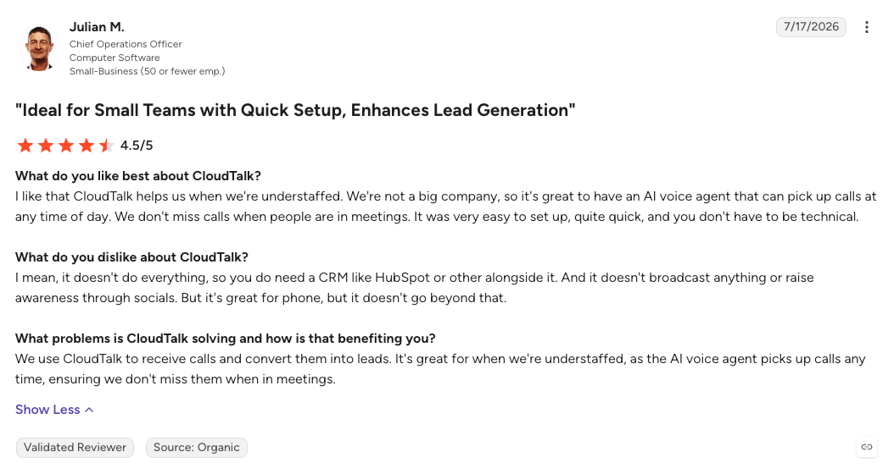
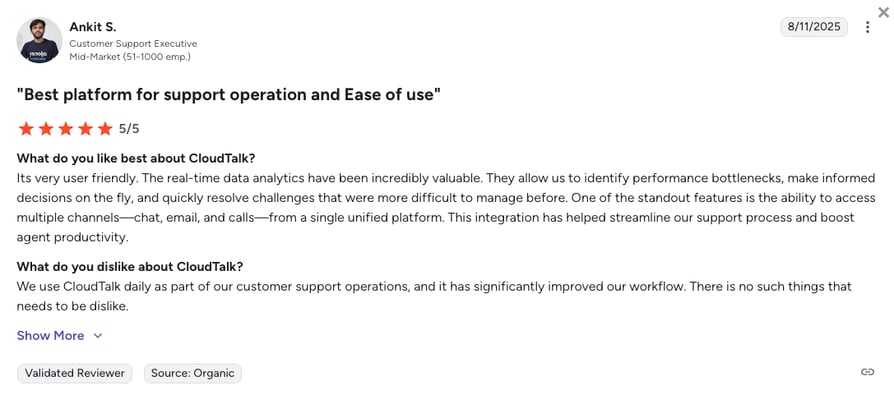
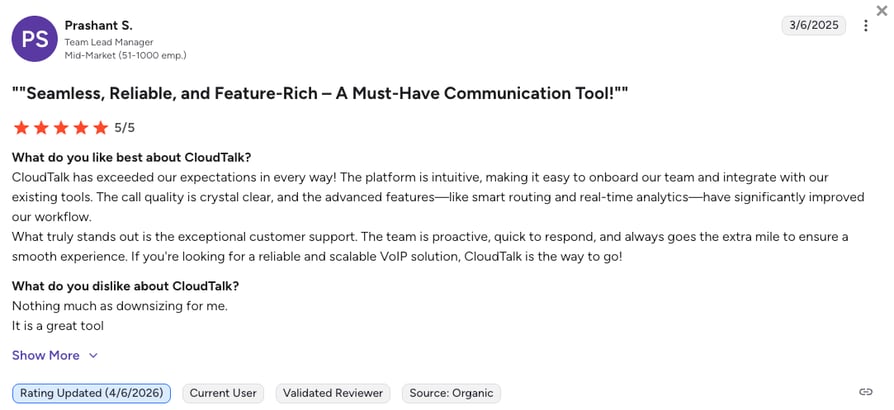
CloudTalk's current G2 rating is 4.4/5, out of 1,850+ verified user reviews. Across those reviews, a few patterns keep repeating:
- Setup comes up first, almost every time: Reviewers describe getting live without any technical help, and smaller teams lean on the AI voice agent to catch after-hours and overflow calls that used to die in voicemail, so a missed call becomes a logged lead instead.
- The daily drivers are call quality, analytics and CRM sync: Clear calls that hold up on international routing, real-time dashboards, and the HubSpot, Pipedrive and Salesforce connections earn the most consistent praise from support and sales teams alike.
- The complaints are real too: A smaller group of reviewers reports occasional connectivity hiccups and app slowdowns, and some find the bill climbs once add-ons stack up. Read a few critical reviews before you buy anything, ours included.
What Real Users Say About Synthflow on G2
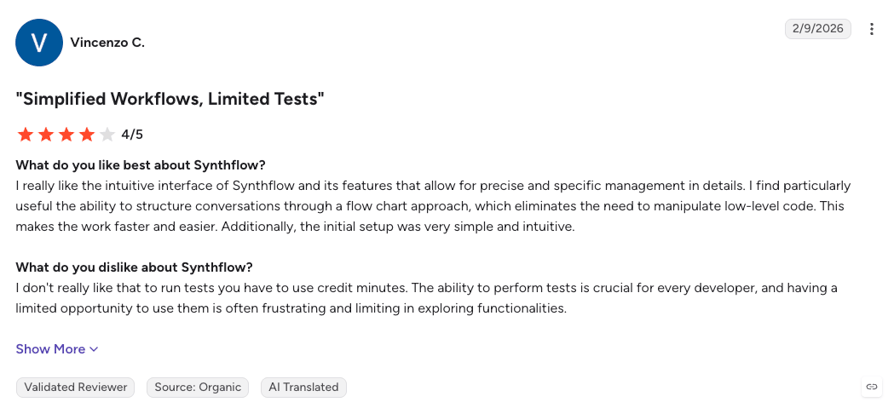
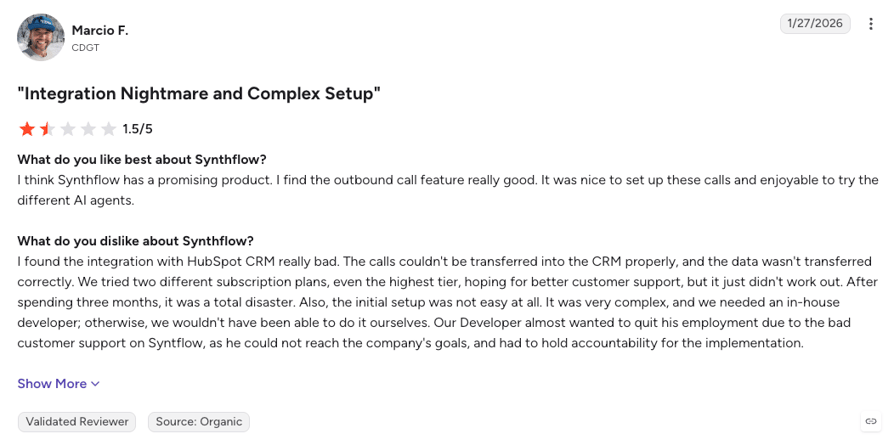
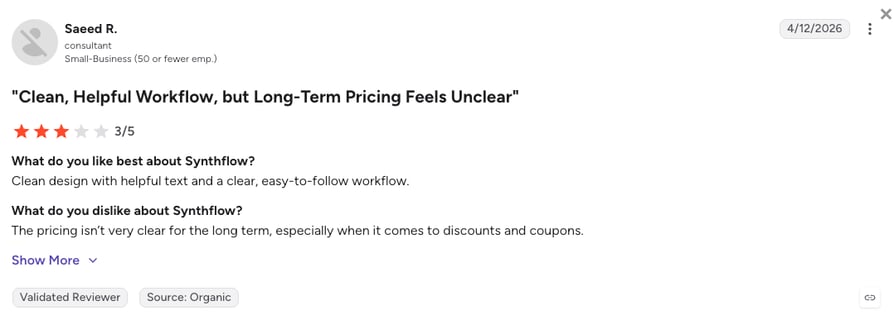
Synthflow's current G2 rating is 4.5/5, out of 1,000+ verified user reviews. Synthflow's reviews tell a story that matches what we've discussed here:
- The builder earns its reputation: Ease of use and quick setup are by far the most common praise, and reviewers call the flow-chart approach intuitive enough to structure whole conversations without writing code.
- Pricing is the most common complaint: Reviewers describe the plans as expensive and inflexible for evaluation, and even test calls burn paid credit minutes, which stings when you're still deciding.
- Integrations split the crowd: Plenty of reviewers praise the Make and Zapier connections, while others describe CRM syncs that never worked right, setups that needed a developer after all, and support that didn't rescue the rollout.
What Redditors Are Saying About Synthflow and Voice AI Agents
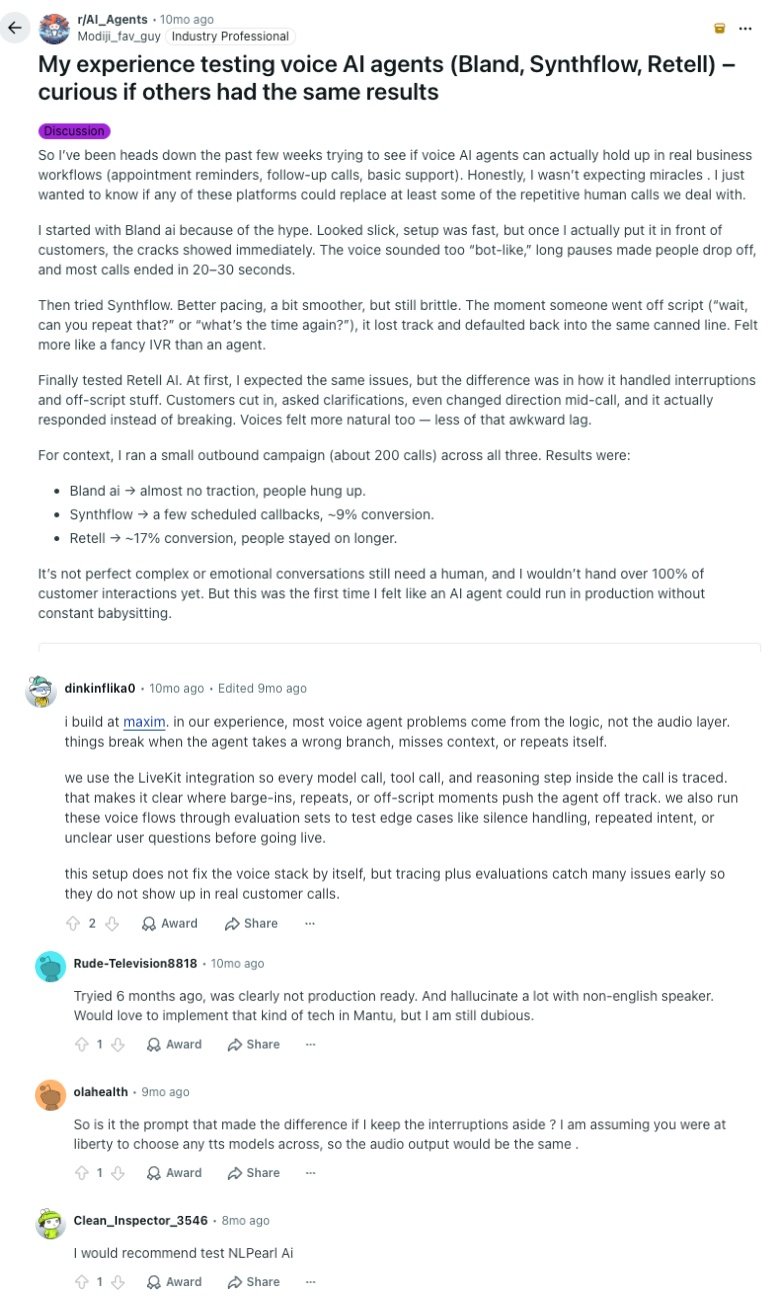
Reddit is where operators post the numbers they didn't plan to share: how many calls they ran, what converted, which workaround they ended up buying. That beats a star rating for a category this young, where the list of the best AI voice agents reads differently every quarter. Two threads stood out, both written by people running voice agents on real calls rather than demo scripts.
- Synthflow reads as "a fancy IVR" once callers go off script: In r/AI_Agents, an operator ran roughly 200 outbound calls (appointment reminders, follow-ups, basic support) across Bland, Synthflow, and Retell. Synthflow paced well but lost track the moment someone asked "wait, can you repeat that?", converting around 9% of calls. The operator's caveat is the axis this whole page turns on: complex or emotional conversations still need a human, so the handoff path decides the experience.
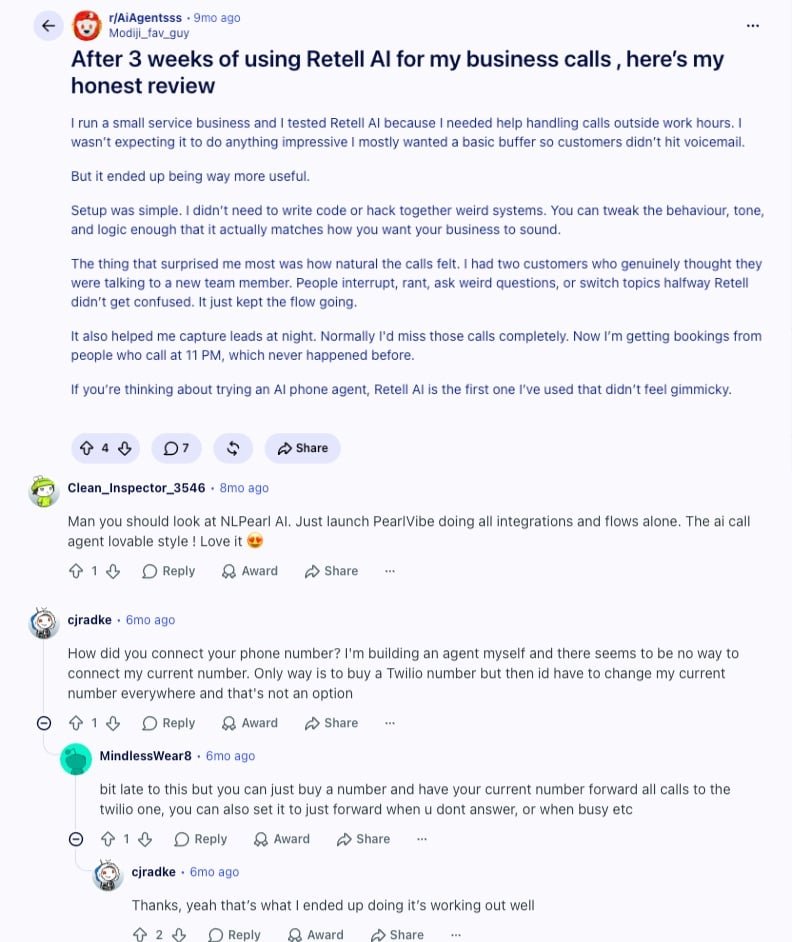
- The question under every voice-agent thread is how to connect an existing business number: In r/AiAgentsss, a service business owner's setup thread drew one practical question above the rest: how to put the agent on the number customers already call. The community's answer was to buy a Twilio number and forward calls to it, which is also Synthflow's own documented path for local numbers outside the U.S., Canada and Australia. That workaround is exactly the gap CloudTalk closes: CeTe answers on the numbers you already run, because the phone system and the agent are the same platform.
CloudTalk AI Voice Agent Pros & Cons vs. Synthflow Pros & Cons
Both tables below draw on each vendor's own published documentation, not review sentiment.
CloudTalk AI Voice Agent Pros & Cons
| Pros | Cons |
|---|---|
| Local numbers in 160+ countries, on every plan tier | The AI Voice Agent is a paid add-on on every tier, never bundled, and Expert itself carries a three-license minimum |
| Warm transfer to a rep who works inside the same platform, with the transcript attached | Priced by minutes, so it assumes real call volume. 200 minutes a month goes fast on a busy line |
| Free for your first month at 50 minutes, then a published $99/month rate you can model | Bringing a third-party carrier number to the AI agent is Not published; the agent runs on CloudTalk numbers |
| Monthly billing with a one-license minimum on Starter | No published simulation environment for testing an agent before launch, and no published visual flow canvas for the agent itself |
| 70+ languages and accents, set when you build the agent | |
| Native CRM write-back to Salesforce and HubSpot with no developer involved | |
| SOC 2 Type 2, ISO 27001, GDPR, CCPA, HIPAA and PCI DSS all named on one page |
Synthflow Pros & Cons
| Pros | Cons |
|---|---|
| Flow Designer with subflows and conditional logic, for teams that want to draw the conversation | One published tier, Enterprise, from $30,000 a year, on an annual commitment with no monthly option |
| Test Center scores simulated calls against your KPIs before launch, and the sandbox rolls back a bad change | In-platform numbers cover three countries; local numbers elsewhere need your own carrier, and importing a SIP or PBX number requires Enterprise |
| RAG knowledge base with scheduled site crawls, Zendesk import, and retrieval visible in call logs | The transfer target is a number or SIP endpoint, so the receiving rep's queue, desktop and CRM record live in a separate system |
| Its own telephony network plus BYOC over SIP into Cisco, Avaya, Genesys, Five9, Talkdesk, RingCentral or 3CX | Bulk outbound campaigns are Enterprise-only, as are custom number import and voice-provider failover |
| Outbound campaign controls including calling windows and reserved concurrency to protect inbound traffic | Its own pages disagree with each other: 200+ integrations against 59 in the directory, latency quoted three ways, three different certification lists |
| 30+ languages, backed by an enumerated list in its own docs, not marketing alone |
Most teams recognize themselves in one column or the other within a row or two. If you didn't, the scenarios below are more specific.
Two Columns of Tradeoffs Only Get You So Far
Which Team Fits Which Platform?
Neither platform is universally better. The deciding factors are narrow: how far your customers are spread, whether a human ever takes the call, who owns the build, and what your finance team will sign. If you're a team of five, our shortlist of the best AI calling software for small business is the faster read, because most platforms in this category price for volume you don't have yet.
Which Team Fits Which Platform
| CloudTalk's AI Voice Agent Is the Right Call For... | Synthflow Still Works If... |
|---|---|
| Teams that need a local number outside the U.S., Canada and Australia | You already own your telephony: a SIP trunk, a PBX or a contact-center platform (CCaaS) you're keeping |
| Anyone who wants the AI and the humans on one platform, so a transferred call keeps its queue, its desktop and its CRM record | Your rollout has an engineering owner who wants to draw flows, score simulated calls and roll back a bad prompt |
| Teams already running CloudTalk for calling, since the agent layers onto numbers you hold | Your budget is already scoped for a $30K to $100K annual program with a multi-week implementation |
| Anyone asking the CloudTalk vs Synthflow for small business question, where one seat and a cancel-anytime plan beat flow tooling | Every customer you call sits inside the U.S., Canada or Australia, or you're bringing your own numbers anyway |
| Support lines that cross borders and languages, at 70+ languages and accents | You need outbound campaign controls at volume and can activate them on an Enterprise contract |
What CloudTalk's AI agent looks like on outbound:
Trevo reached 20x more customers per campaign after putting CloudTalk's agent on its outbound calling.
The verdict comes down to two buyer profiles, not a score.
CloudTalk vs. Synthflow: The Verdict
Across sixteen dimensions we could source to a vendor's own page, CloudTalk took eight, Synthflow took five, two were ties and one was unknowable. Synthflow's wins are builder and telephony rows, and they matter to a team with engineers and an existing stack. CloudTalk's wins decide whether the project starts at all: coverage, entry cost, billing terms, and where the human sits when the AI runs out of road.
Choose CloudTalk If You...
- Need local numbers outside the U.S., Canada and Australia, in any of 160+ countries
- Want the caller who asks for a person to reach a rep in the same platform, transcript attached
- Are a team of one to five and need to start on a single seat, not an annual contract
- Want your first AI invoice to be $0 and your second to be $99, with no procurement cycle in between
- Need the call outcome in Salesforce or HubSpot without building a middleware step
- Run support in more than a handful of languages and need 70+ covered
- Want SOC 2 Type 2, ISO 27001, GDPR, CCPA, HIPAA and PCI DSS on one page you can send to legal
- Already run CloudTalk for calling, so the agent layers onto numbers you have today
Choose Synthflow If You...
- Already own your telephony and want the agent to sit on your SIP trunk, PBX or CCaaS platform
- Have an engineering owner who wants a flow canvas, subflows and version control over prompts
- Need scored simulated calls before launch, which CloudTalk doesn't offer today
- Have budget scoped for a $30K to $100K annual program and room for a three-week rollout
- Call only into the U.S., Canada or Australia, or are supplying your own numbers regardless
The Bottom Line
Choose Synthflow if all three of these are true: you already own your telephony, you have an engineer to run the build, and you have $30,000+ a year approved. You're buying a scoped enterprise rollout, and its Flow Designer and Test Center will reward that setup.
For everyone else, CloudTalk gets an agent answering your calls this week, not next quarter. Start on one seat, test the AI Receptionist free for your first month with 50 minutes included, run it on local numbers in 160+ countries, and let it pass tricky callers to your team with the transcript attached, inside the platform your reps already use. If it works, month two is $99 plus your plan. If it doesn't, cancel and you've spent nothing.
Whichever way you lean, re-check both vendors' live pages before you sign, because Synthflow changed its whole pricing model inside a year.
Still Working Out Where the Human Sits?
Sources:
- Salesforce, State of Service Report
- Salesforce, Agentic Enterprise Index
- Deloitte Digital, Global Contact Center Survey
Frequently Asked Questions About CloudTalk vs. Synthflow
Direct answers to the questions buyers ask most when comparing CloudTalk and Synthflow.
CloudTalk is better than Synthflow for most teams, and Synthflow is better for a narrow one. CloudTalk wins on what you can check before you sign: where you can buy a number, what the first month costs, whether you can pay monthly, and where the human sits after a transfer.
Synthflow wins on the build: a flow canvas, scored test calls, and telephony you already own. Underneath the whole question is whether you want a standalone voice agent or one built into the phone system your reps already use, because that decides who owns the call once the AI hands it over.
Synthflow supports local phone numbers in three countries: the U.S., Canada and Australia, per its own phone-numbers docs. Anywhere else, you import a number from your own carrier, trunk or Twilio, and that import path needs an Enterprise account. Its pricing page separately claims 65M+ voice calls a month across 30+ countries, which is where calls get delivered, not where you can buy a number, and those two figures get conflated constantly. CloudTalk sells virtual phone numbers in 160+ countries on every plan tier.
Synthflow costs from $30,000 a year. Enterprise is the only tier it publishes, and the only button on the pricing page is Contact Sales. Synthflow scopes your final number around call volume, concurrency, telephony setup, integrations, security needs and launch support, so there's nothing to model against CloudTalk's published plans until a quote arrives. No per-minute rate, seat price or monthly billing option appears anywhere on its properties, and the old self-serve Pro, Growth and Agency plans are retired, which is why other comparison pages still quote a price you can no longer buy.
CloudTalk's AI Voice Agent is no-code. You build it in the UI: name its role, pick a language and voice, attach the skills it needs, upload its knowledge base, and point it at a number. CloudTalk publishes under 5 minutes for self-guided setup and under 10 minutes to put a basic AI Receptionist live. Two honest limits: skills get assigned in a wizard rather than drawn on a canvas, and custom system integrations still take 1 to 2 weeks.
CloudTalk is the best Synthflow alternative for any team below enterprise scale. You start on one license, the agent is free for your first month at 50 minutes, and you get local numbers in 160+ countries instead of three. It's also the closest match in shape, because AI voice agents for smaller teams run inside the phone system your reps already use rather than beside it. One exception: if you want to draw the agent's conversation on a canvas and run scored call simulations before launch, Synthflow keeps that advantage, since CloudTalk's Call Flow Designer covers routing, not the agent's conversation.
Synthflow supports outbound calling as well as inbound. Single calls go through its Platform API, and bulk campaigns take 1 to 10,000 recipients per request, with weekly calling windows and a reserved-concurrency setting that keeps inbound traffic protected. The catch is the gate: its docs put campaigns on Enterprise plans, and Enterprise is the only tier, so outbound AI calling at volume starts at a $30,000 annual commitment.
CloudTalk's voice AI is the safer pick for HIPAA-regulated industries like healthcare, though both vendors name HIPAA. CloudTalk names SOC 2 Type 2, ISO/IEC 27001, GDPR, CCPA, HIPAA and PCI DSS on one security page you can forward to legal. Synthflow spreads three different lists across three pages, never states its SOC 2 type, and keeps its trust center behind an access request. Neither vendor publishes an audit report openly, so HIPAA compliance comes down to what each one will put in writing. Ask both for the SOC 2 report type and scope before the security review starts, not after.
Synthflow's AI agent can hand a call to a live human, the same as CloudTalk's. Its docs cover a cold transfer, a warm transfer with a whisper message, and a warm transfer where the AI reads the rep a summary first. The difference is where that rep sits: Synthflow dials out to a phone number or SIP endpoint in a system you buy and run yourself, while CloudTalk's agent passes the caller to someone in the same call queue, with the transcript on the record. One detail from Synthflow's own docs: a warm transfer opens a new SIP leg, so your rep sees the agent's number rather than the caller's unless you override caller ID.