TL;DR: 10 Best Kore.ai Alternatives and Competitors
In this list of 10 Kore.ai competitors, there's a solution for everyone, for teams big and small, whether yours loves to code or prefers something a bit more plug-and-play.
| # | Platform | Best for | Starting Price | G2 Rating |
|---|---|---|---|---|
| 1 | CloudTalk | Small to medium sales and support teams that want easy and fast AI agent setup on top of a comprehensive business phone system and contact center platform. | $25/user/month. AI receptionist first 50 minutes free, then $99/month for 200 minutes/AI Specialst $349/month for 1000 minutes minutes | 4.4/5 (1,702+) reviews |
| 2 | Retell AI | Teams that want low-code agent build, but to choose the LLM, voice, and carrier independently, and have basic post-call analysis | $0.07 to $0.31/min, pay as you go | 4.8/5 (2,638 reviews) |
| 3 | Cognigy | Enterprises replacing Kore.ai like for like, especially on Genesys, Avaya, Amazon Connect, or NiCE CXone | $43,080/year (60,000 conversations) | 4.6/5 (13 reviews) |
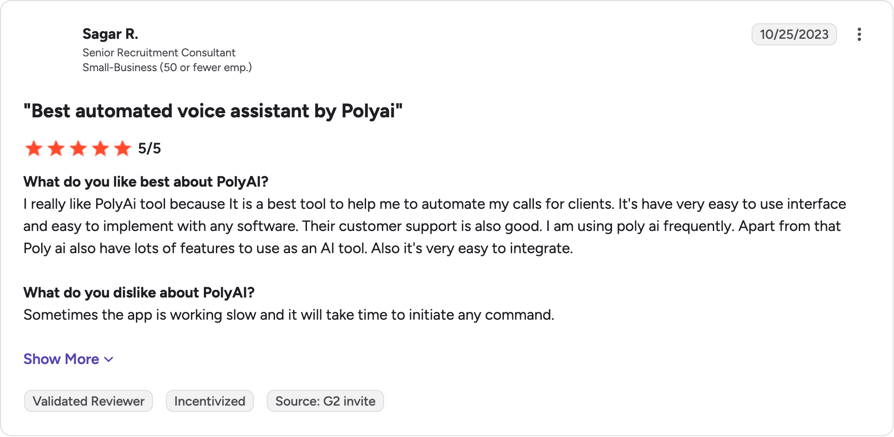
| 4 | PolyAI | Enterprises that want to build highly customized agents with optimal voice quality | Quote only, billed per minute | 5.0/5 (12 reviews) |
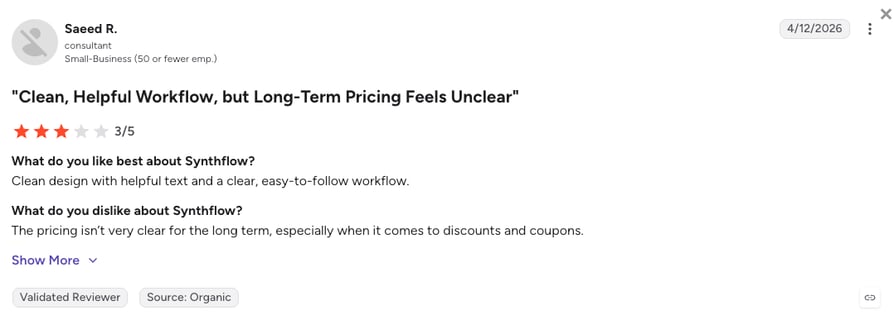
| 5 | Synthflow AI | Contact centers and BPOs that want a no-code builder running on the vendor's own telephony stack | From $30,000/year, enterprise only | 4.5/5 (1,015 reviews) |
| 6 | Bland AI | Engineering teams in regulated industries that need on-prem or VPC deployment and their own SIP trunk | $0.14/min, no platform fee | 5.0/5 (11 reviews) |
| 7 | Vapi | Developers who want to assemble their own stack from 25+ pluggable model and telephony providers | $0 free tier, $29/month Core + $0.05/min | 4.2/5 (3 reviews) |
| 8 | Voiceflow | Design and CX teams that want a shared visual canvas and will hand the finished agent to engineering | Usage-based credits, prices behind a demo | 4.6/5 (113 reviews) |
| 9 | Google Dialogflow CX | Engineering teams already on Google Cloud that need 90+ languages and EU data residency | $0.007/request chat, $0.001/second voice | 4.4/5 (144 reviews) |
| 10 | Amazon Lex | AWS-native teams building an IVR brain to sit on top of Amazon Connect or their own telephony | $0.004 per speech request, $0.00075 per text request | 4.2/5 (43 reviews) |
You chose Kore.ai because you wanted a highly customizable AI voice solution for your dev team to build. But (and these pain points come straight from G2 reviews), it's loading slowly, full of bugs, hard to scale, and even your nerdiest developers are finding it not so user-friendly.
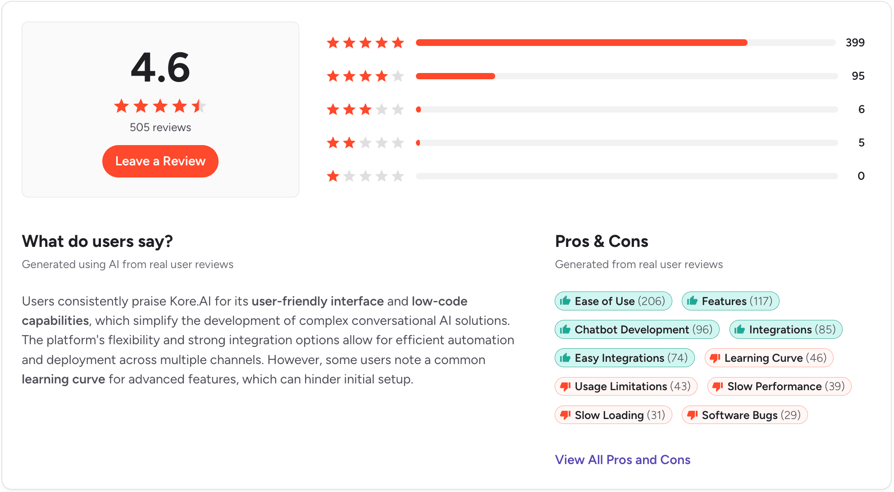
Six months later, your developers are still building the call flow, dealing with lag time and a hefty bill. On G2, "steep learning curve" is the single most-cited complaint about Kore.ai, named in 46 reviews, ahead of missing features (23) and complexity (20).
So whether your dev team is chomping at the bit for a challenge or you just want something fast and easy that your reps can set up themselves, let's get you up and running with an AI voice solution that works best for your team.
Skip the six-month build. See an AI agent answering calls.
Why Teams Are Searching for a Kore.ai Alternative
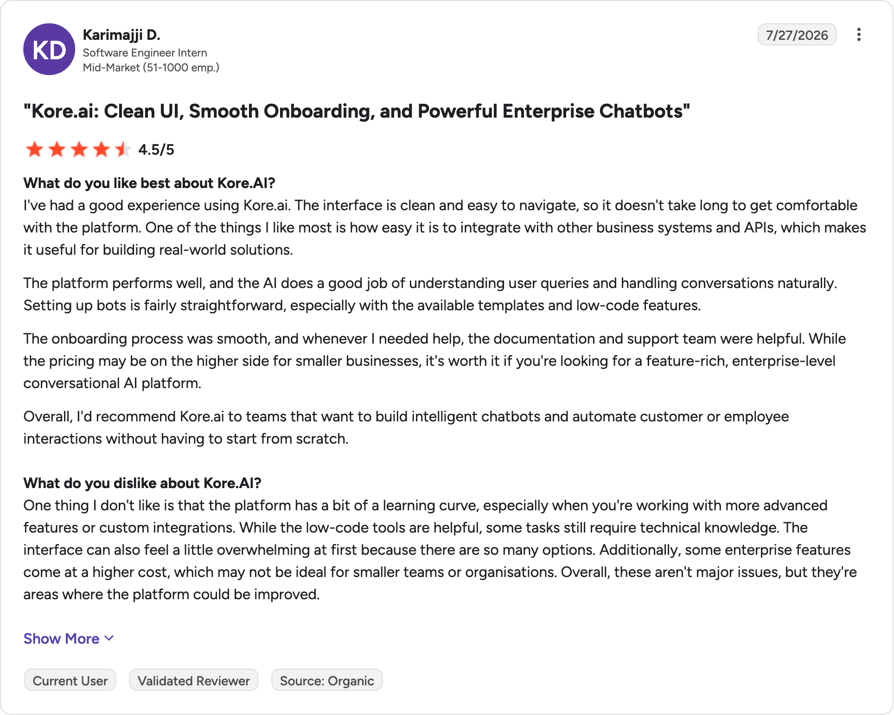
Kore.ai is a Leader in the Gartner Magic Quadrant (essentially a glorified, but trusted product review) for Conversational AI Platforms, its fourth consecutive commendation. The platform is not the problem; dev guys and gals love it. But it's really not for everyone. Kore.ai is engineered for organizations with an in-house AI team, and teams without one complain about the following:
Based on 505 verified G2 reviews, Capterra, and 178 Gartner Peer Insights ratings, here is what reviewers report:
5 Main Cons of Kore.ai: Based on Real User Reviews
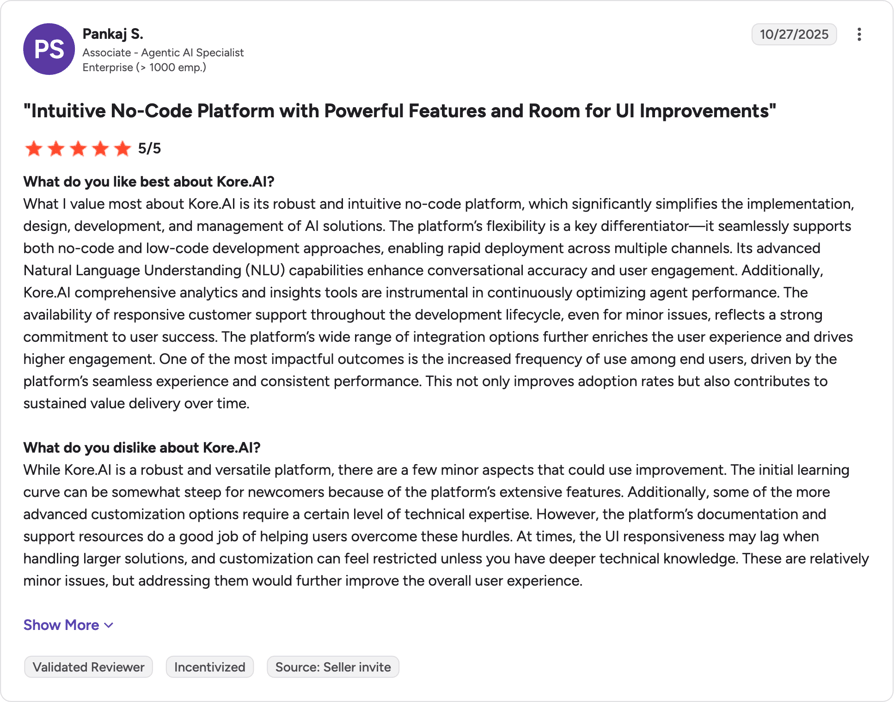
- The Steepest Learning Curve in the CategoryG2 tags 46 reviews with a steep learning curve, making it Kore.ai's most-cited weakness, more than missing features (23) or complexity (20). Capterra reviewers describe "too many properties and features" that become difficult to keep in mind and maintain. Mastering conversation flows, NLP tuning, and integrations takes months of specialist time, not weeks. (This is actually a major complaint among developors as well).
- Latency That Shows Up in Complex Workflows39 G2 reviews report slow performance and 31 more report slow loading times. The pattern reviewers describe is specific: the platform lags when a bot pulls data from several integrations at once, or handles longer multi-turn conversations. Several of those complaints come from reviewers who still rated Kore.ai 5 stars overall.
- Bugs and Version Instability29 G2 reviews cite software bugs causing loading issues. One enterprise reviewer reported "several bugs in the latest version of XO"; another described things that worked yesterday and stopped working today "without any particular reason," followed by long waits for Support. A Capterra reviewer flags that there is "no mechanism to rollback to earlier versions."
- Documentation That Trails the Product27 G2 reviews name poor documentation as a major issue, specifically around integration details, and it is the one complaint that appears consistently across G2, Capterra, and Gartner alike. A Gartner reviewer running a private instance noted they "were always a few versions behind" and had to open several tickets to resolve bugs in the newer GenAI features.
- Pricing You Cannot ForecastKore.ai bills Automation AI in 15-minute sessions, rounded up: a 31-minute conversation is three sessions, and a caller who hangs up after 20 seconds is still a full one. Three plan tiers carry no published price, six add-ons read "usage based pricing, call us," and no overage rate is published anywhere. Budgeting means modelling call length before you have any calls.
What Is the Best Alternative to Kore.ai?
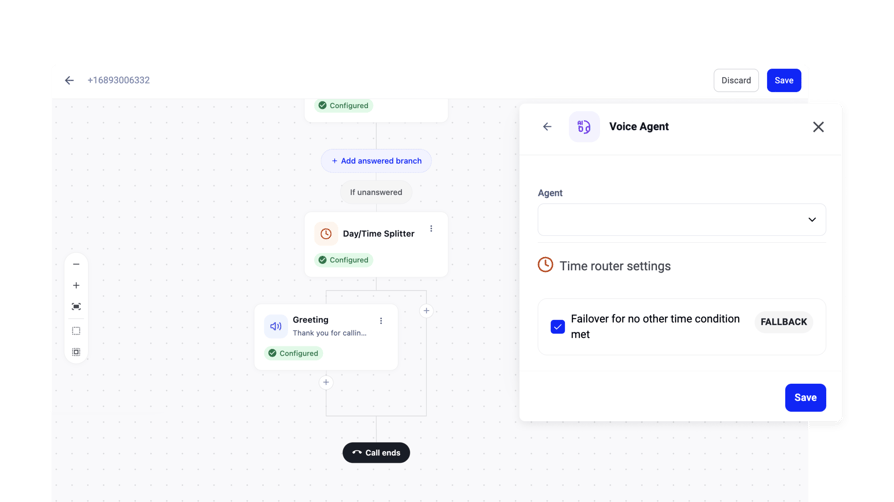
CloudTalk is the best alternative to Kore.ai for sales and support teams that want an AI voice agent, but with easy, intuitive, fast setup. Where Kore.ai bills conversations in 15-minute sessions and needs developer time before a it goes live, CloudTalk is already a working phone system: an AI voice agent is a step you drop into the same drag-and-drop call flow your human agents route through.
Additionally with CloudTalk you get local numbers cover 160+ countries, plans start at $25/user/month, and every account gets 50 free AI Receptionist minutes to test with.
That is the answer for most teams, not for all of them. If you need to replace Kore.ai's full conversational AI stack across chat, voice, and agent assist, Cognigy is the closest like-for-like swap.
If your developers want to own the stack component by component, Retell AI and Vapi price every part separately. If voice quality on a poor phone line is the entire project, PolyAI built its own speech models for that job.
The profiles below say who each one suits.
Here's Why Users Consider CloudTalk the Best Kore.ai Alternative
5 Main Pros of CloudTalk: Based on Real User Reviews
- Easy, Fast SetupSet up your voice agent by clicking 'add a new voice agent'. Choose a template, set some rules, personalize, connect your knowledge base, and test it out. Then add it to your call flow.
- The AI Agent Lives Inside Your Call FlowA voice agent is a step on the same visual Call Flow Designer canvas as your IVR menus, business hours, and ring groups. It can hand a caller to a human mid-call with full context, instead of running as a separate system added onto the phone line.
- Per-Seat Pricing You Can ForecastPlans are a flat price per user per month starting at $25, with AI minute packages published up front.
- Global Numbers Without a Telephony ProjectLocal, mobile, national, and toll-free numbers across 160+ countries come with the platform. Most AI agent platforms expect you to bring your own carrier or SIP trunk before the first call connects.
- Calls and AI Data Land in the CRMNative integrations with HubSpot, Salesforce, Pipedrive, and Zoho log the call, duration, recording, and tagged outcome automatically. On Salesforce, AI summaries write into dedicated structured fields you can report on.
In the video below, our very own Product Marketing team shows you how to set up your AI Voice Agent step by step:
Your AI agent can be answering calls before Friday.
Our Selection Methodology: How We Compared the Best Kore.ai Alternatives
We've created a list that Kore.ai users would actually be interested in. The following are all either conversational AI platforms that match its scope, voice AI platforms that do the calling half better, and phone systems with AI agents built in. Every price below was read from the vendor's own pricing page, not from a comparison roundup so they are the latest prices.
Our Selection Criteria and Testing Methodology
- Pricing transparency: whether a buyer can price a deployment from the public site, and whether the advertised rate is the all-in cost once LLM, speech, and telephony are added on top.
- Time to a working agent: how much engineering the platform requires between signing up and answering a real call, the thing Kore.ai reviewers complain about most.
- Telephony included or bring your own: whether the platform sells you a number and connects the call, or expects you to supply a carrier, SIP trunk, or contact center underneath it.
- Verified review evidence: G2, Capterra, Trustpilot, and Gartner Peer Insights ratings, always reported with the review count, because a 5.0 from 11 reviewers is not a 4.8 from 2,600.
- CRM integration depth: whether calls, recordings, call outcomes, and AI output reach HubSpot, Salesforce, or Pipedrive as structured data rather than pasted text.
- Compliance and data residency: SOC 2, ISO 27001, HIPAA, PCI DSS, and GDPR, checked against each vendor's own trust page rather than its marketing pages.
- Migration path from Kore.ai: how much of an existing flow, integration map, and reporting baseline survives the move.
Quick Comparison: Top Kore.ai Alternatives at a Glance in 2026
The comparison table below shows the top Kore.ai alternatives, beginning with CloudTalk, Retell AI, and Cognigy.
Kore.ai Competitors Compared
| Platform | Starting Price | Billing Unit | G2 Rating (reviews) | Free Trial | Key Differentiator |
|---|---|---|---|---|---|
| CloudTalk (Editor's Pick) | $25/user/month. AI Receptionist first 50 minutes free, and AI Specialist starting at $349/month. | Per seat + AI/month | 4.4/5 (1,702+) | 14 days + 50 AI Receptionist minutes | A working phone system with the AI agent as a step in the call flow |
| Kore.ai (baseline) | $60/month + $0.05/session | Per 15-minute session, rounded up | 4.6/5 (505) | 14 days (30 for Contact Center AI) | Breadth: chat, voice, agent assist, and enterprise search on one platform |
| Retell AI | $0 to start, $0.07 to $0.31/min | Per minute, itemized by component | 4.8/5 (2,638) | $10 free credits | Swap the LLM, voice, and carrier independently, each priced separately |
| Cognigy | $43,080/year (60,000 conversations) | Per conversation, 12-month contract | 4.6/5 (13); Gartner 4.8/5 (156) | Sales-gated | Pre-built integrations with Genesys, Avaya, Amazon Connect, NiCE CXone, and 8x8 |
| PolyAI | Quote only | Per minute, bundled with tuning and support | 5.0/5 (12); Gartner 4.6/5 (29) | Demo only | Proprietary Raven LLM and Owl ASR, trained for noisy phone audio |
| Synthflow AI | From $30,000/year | Annual enterprise contract | 4.5/5 (1,015) | None published | Runs its own SBCs and media servers rather than reselling a carrier |
| Bland AI | $0.14/min, no platform fee | Per minute + optional $299/month tier | 5.0/5 (11) | 2 credits, no card | Owns its LLM, STT, and TTS stack; on-prem and VPC deployment available |
| Vapi | $0 free, $29/month Core | $0.05/min hosting + pass-through model costs | 4.2/5 (3) | $5 free credits | 25+ pluggable model and telephony providers, assembled by you |
| Voiceflow | Free tier; paid prices behind a demo | Seat + credits ($0.05/min phone, $0.005/message) | 4.6/5 (113) | Free plan, no card | Collaborative visual canvas; provisions US and Canada numbers directly |
| Google Dialogflow CX | $0.007/request, $0.001/second voice | Per API request and per audio second | 4.4/5 (144) | $600 to $1,000 in credits, 12 months | 90+ languages and named EU data-residency regions |
| Amazon Lex | $0.004/speech request | Per request, voice and text priced apart | 4.2/5 (43) | $200 AWS credits | Native to AWS, Lambda, and Amazon Connect |
How to read these ratings:
Star ratings in this category are not comparable without their review counts. Bland AI has 5 stars, but those are only based on 11 reviews. PolyAI has just 12. Retell AI on the other hand, has 4.8 stars based on 2,638 reviews and Kore.ai's 4.6 on 505.
A perfect score from a dozen reviewers usually means the product is new and its earliest customers are enthusiasts, not that it outperforms a platform rated a tenth of a point lower by thousands. Where a vendor has a larger sample on Gartner Peer Insights than on G2, we have given both.
Nine billing models, one thing you actually want to know.
The Top 10 Alternatives to Kore.ai for 2026
1. CloudTalk: Best Kore.ai Alternative for AI Voice + a Full Calling Platform
What Is CloudTalk?
CloudTalk is an AI cloud phone system for small- to mid-market sales and support teams, used by 5,500+ businesses, with AI voice agents built into the platform rather than sold as a separate product to integrate. It handles the parts Kore.ai leaves to you: buying numbers, routing calls, queueing them, recording them, and syncing the result to your CRM. The AI agent answers, qualifies, and hands off inside that same system.
Why Is CloudTalk a Strong Kore.ai Alternative?
- Setup measured in minutes, not months. An AI Receptionist goes live by uploading your knowledge base and completing a few simple steps, compared with the time and fuss that Kore.ai's 46 learning-curve reviews describe
- Telephony is included, not assumed. Local, mobile, and toll-free numbers in 160+ countries come with the platform, where most AI agent platforms need you to bring a carrier or SIP trunk first
- Flat per-seat pricing from $25/user/month on a single seat, with AI minute packages published up front.
- One canvas for AI and human routing. The Call Flow Designer puts the voice agent, IVR menus, business hours, and ring groups on the same drag-and-drop flow, so a handover carries full context
- 100+ integrations including HubSpot, Salesforce, Pipedrive, and Zoho, logging calls, recordings, and call outcomes without a rep typing anything
- Rated 4.4/5 on G2 from 1,702+ verified reviews, with SOC 2 Type 2, ISO/IEC 27001:2022, and PCI DSS attestations available through the Trust Center
What Are the Key Features of CloudTalk?
- AI Receptionist: answers every inbound call 24/7, captures name and intent, answers FAQs from your uploaded documents, books meetings, and routes to the right agent or group.
- AI Specialist: a custom agent that owns a defined process end-to-end, inbound or outbound, triggered by API from HubSpot, Zapier, or your own systems, with skills for extracting information and transferring to a human.
- Call Flow Designer: drag-and-drop routing with IVR menus, day and time splitters, condition splitters, HTTP requests mid-call, and the voice agent as a step like any other.
- Conversation Intelligence: transcripts, AI call summaries, sentiment analysis, topic tagging, talk-ratio reporting, and AI call scoring, as a $9/user/month add-on on any plan. See how it compares in our roundup of the best conversation intelligence software.
- Power and Parallel dialers: Power dialing is included on Expert; Parallel dialing runs up to five concurrent lines with automatic voicemail detection and drop, as an add-on on any plan.
- International numbers: local, mobile, national, and toll-free numbers across 160+ countries, with local caller ID so prospects recognise the code.
- Real-time dashboard and wallboards: live queue, agent, and call-volume reporting covering AI and human calls in one view, shareable by link.
- Number porting: CloudTalk's Carrier Operations team runs the carrier side, typically two to four weeks for a full port and three to seven business days when your numbers sit on a shared carrier.
What Are the Pros & Cons of CloudTalk?
| Pros | Cons |
|---|---|
| AI agent and phone system in one: no telephony layer to source, no separate contact center underneath. | Not a conversational AI development platform: if you need to build complex multi-channel bots across chat, email, and social, Cognigy or Kore.ai fit better. |
| Numbers in 160+ countries with local, mobile, and toll-free options. | Conversation Intelligence is an add-on: transcripts, summaries, and scoring cost $9/user/month and are not included in any base plan. |
| Forecastable pricing: flat per-seat plans plus published AI minute packages, with no session rounding. | Salesforce sits on Expert: the deepest CRM sync is not available on the lower tiers. |
| Voice agent as a routing step, so handovers to humans carry the full call context. | |
| 50 free AI Voice Receptionist minutes on every account, before you commit to a package. |
CloudTalk Pricing vs. Kore.ai Pricing
The two platforms do not charge for the same thing. CloudTalk pricing is a flat seat cost plus a published AI minute package. Kore.ai charges a platform fee plus a per-session rate, where a session is any conversation up to 15 minutes, rounded up.
Flexible Pricing Plans to Scale with You
Compare our plans
What Are CloudTalk Customers Saying?
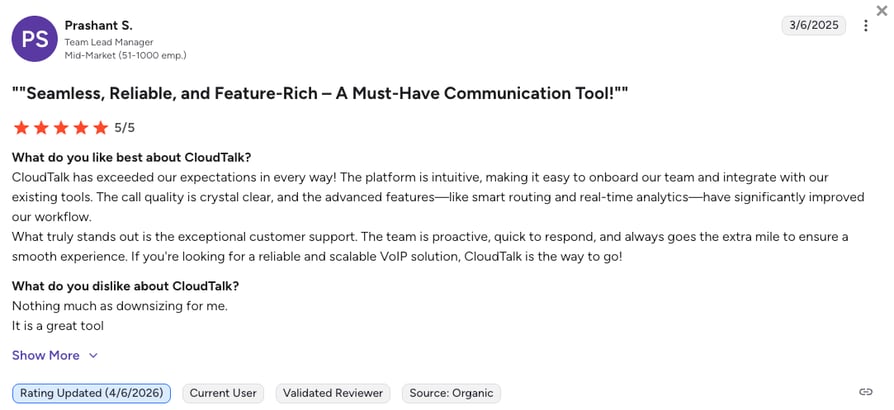
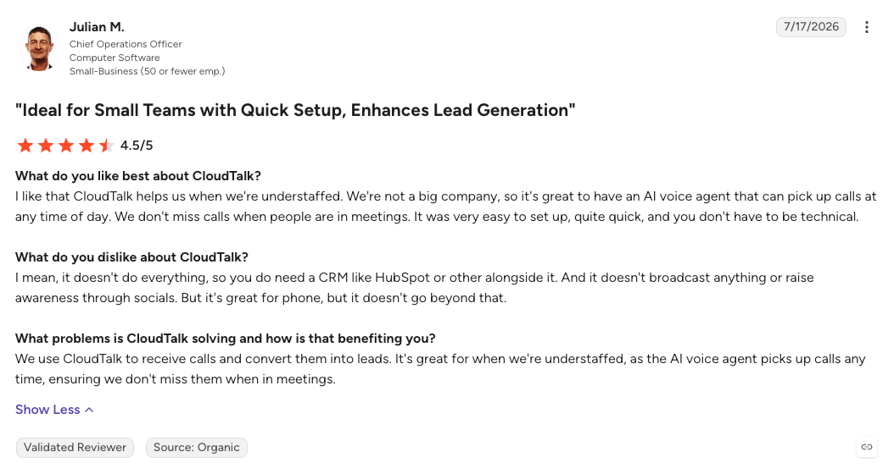
CloudTalk reviewers praise the platform for its easy setup, clear call quality, CRM sync and more:
- Fast, self-serve setup: reviewers describe buying a number, pointing it at a call flow, and having reps taking calls the same day — no consultant, no onboarding week.
- Clear call quality: reviewers highlight consistent audio across international routes as the reason they moved.
- Support that answers: the support team is repeatedly described as proactive and quick, rather than a ticket queue.
- AI that removes note-taking: teams using Conversation Intelligence cite call summaries and sentiment as the features that keep CRM records clean.
- Operations visibility: managers use the real-time dashboard to see queues, agents, and AI calls in one place.
See why this customer made the switch to CloudTalk from their previous provider:
CloudTalk AI Voice Agent Customer Story: Oxford Royale Academy
Oxford Royale Academy offers summer programs to families in 176 countries, and reps have 5 minutes to follow up with every new lead. That was a difficult task, considering that they had to call across various time zones. It also meant that Oxford had to hire agents on a seasonal basis just to reach all of the hot leads.
Then they found CloudTalk and now one AI voice agent calls every lead within minutes in 70+ languages including English, Spanish, French, Arabic, or Mandarin, and books the meeting while syncing to HubSpot. Wayne Smith, Head of Systems and Processes, sums it up:
“Last year, we recruited four people to just call hot leads. This year, we haven't recruited any of those four. The voice agent is doing all that.”
Head of Systems and Processes, Oxford Royale Academy

How do G2 Users Rate CloudTalk?
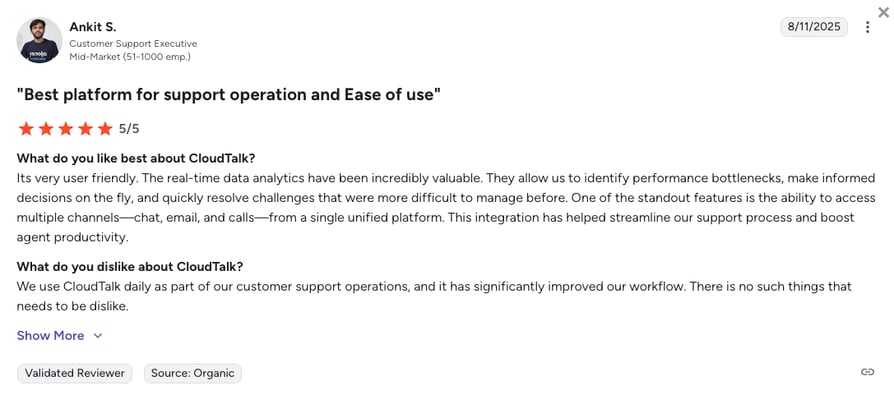
CloudTalk holds 4.4/5 on G2 from 1,702+ verified reviews. The recurring themes in those reviews are real-time analytics, setup speed, call quality, and support responsiveness.
CloudTalk vs. Kore.ai: Which Is Better for AI Calling?
| Category | CloudTalk | Kore.ai |
|---|---|---|
| Starting price | $25/user/month, AI Receptionist 50 minutes free, AI Specialist $349 (1000 minutes) | $60/month + $0.05 per 15-minute session |
| Telephony | Included: numbers in 160+ countries | XO Voice Gateway, usage-based, quoted separately |
| Time to first answered call | Same day, self-serve | Weeks to months; 46 G2 reviews cite a steep learning curve |
| Who builds it | An admin, a rep, you; in a drag-and-drop canvas | Developers and conversation designers |
| Channel breadth | Voice and SMS, plus WhatsApp on Expert | 19 digital channels plus voice (the wider platform) |
| G2 rating | 4.4/5 (1,702+ reviews) | 4.6/5 (505 reviews) |
The honest take:
Kore.ai is the broader platform and rates higher on G2. If your requirement is one AI brain serving chat, social, email, voice, agent assist, and enterprise search across a Global 2000 organization, it does more than CloudTalk does.
CloudTalk wins on a narrower question: getting an AI agent answering real phone calls, in a system your team already runs, without engineering time. Pick by which of those two sentences describes your project.
Test it on your own calls, with 50 AI minutes on the house.
9 More Kore.ai Competitors Worth Considering for AI Calling in 2026
The nine below split into three groups: platforms that replace Kore.ai's full scope, voice AI platforms that do the calling half better, and cloud services you build on. Each entry says which group it belongs to and what it costs before you call sales.
2. Retell AI (Voice AI First): Best Kore.ai Alternative for Itemized, Pay-As-You-Go Voice Pricing
What Is Retell AI?
Retell AI is a voice agent platform for automating inbound and outbound phone conversations, built as a no-code workflow studio on top of a documented API layer. It sells to mid-market and enterprise teams in healthcare, financial services, insurance, and logistics, and it prices every component of the stack separately so you can swap the LLM, the voice, or the carrier without changing platforms.
Why Is Retell AI a Strong Kore.ai Alternative?
- Transparent, per-minute pricing with no platform fee on the entry tier, against Kore.ai's three unpriced plan tiers
- Reports 620ms average end-to-end response in its own lab testing, where Kore.ai publishes no latency figure at all
- SIP trunking to your existing carrier carries no Retell surcharge
- Ease of use is cited in 494 G2 reviews, the exact dimension Kore.ai reviewers flag most often as a weakness
What Are the Key Features of Retell AI?
- Component-priced stack: voice infrastructure, TTS, LLM, and telephony each billed on their own line, so you see what each choice costs per minute.
- 92 supported language codes across its TTS and ASR tables, each requiring both a voice and an ASR provider that covers it.
- AI Quality Assurance: automated QA on up to 100% of calls at $0.10/min, with the first 100 minutes a month free.
- Compliance: HIPAA, SOC 2 Type II, GDPR, and ISO 27001, with SSO, custom RBAC, PII redaction, and an on-prem option.
- Pre-deployment simulation: test scenarios against an agent before it takes a live call.
What Are the Pros & Cons of Retell AI?
| Pros | Cons |
|---|---|
| Ease of use is the dominant review theme, named in 494 G2 reviews | 87 reviews cite per-call cost at scale; one reports upwards of $1 for a 4-5 minute call |
| Transparent, itemized rate card with no minimum commitment | 116 reviews cite missing features, including international number gaps |
| 119 reviews praise integrations with n8n, GoHighLevel, Twilio, and Telnyx | 80 reviews report a steep curve once workflows get advanced |
What Are Retell AI's Plans & Pricing?
Retell AI pricing is pay-as-you-go with no monthly platform fee on the entry tier, starting at $0 with $10 in free credits. For a fuller view of how this model compares across the category, see our guide to the best AI voice agents.
- Voice agents - $0.07 to $0.31/minute depending on the LLM and TTS you pick
- Chat agents - from $0.002/message
- Telephony - $0.015/min in most countries, free with your own SIP trunk
- Phone numbers - $2.00/month each; extra concurrency $8.00 per call/month
- Enterprise - custom, contact sales
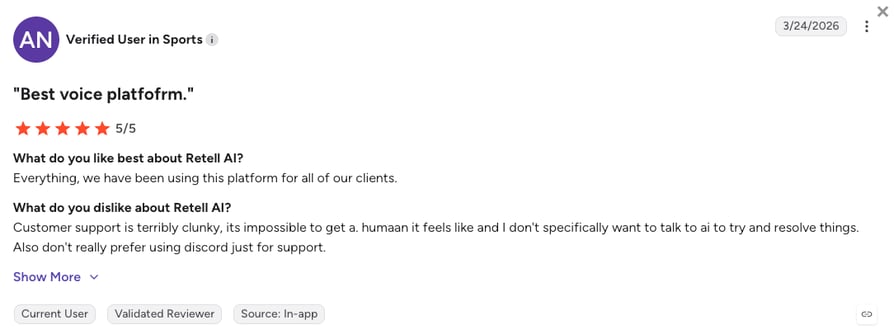
How G2 Users Rate Retell AI?
Retell AI's current G2 rating is 4.8/5, from 2,638 verified reviews, the largest review base of any platform in this list.
| Category | Retell AI | Kore.ai |
|---|---|---|
| Pricing model | Per minute, itemized, published in full | Per 15-minute session, three tiers unpriced |
| Telephony | Managed numbers or free SIP trunking | XO Voice Gateway, quoted separately |
| Channels | Voice and chat | 19 digital channels plus voice |
| G2 rating | 4.8/5 (2,638 reviews) | 4.6/5 (505 reviews) |
3. Cognigy: Best Like-for-Like Kore.ai Replacement for Enterprise Contact Centers
What Is Cognigy?
Cognigy is an enterprise conversational and agentic AI platform for large contact centers, automating service across voice, chat, and messaging. NiCE acquired it in September 2025 and it now trades as NiCE Cognigy, though NiCE committed publicly to keeping it available as a standalone product as well as inside CXone. Where Kore.ai builds its own stack, Cognigy orchestrates pluggable third-party LLM, speech-to-text, and text-to-speech vendors behind a low-code Flow Editor.
Why Is Cognigy a Strong Kore.ai Alternative?
- Beats Kore.ai on the exact dimension its reviewers complain about: G2 scores Cognigy 9.6 on ease of use against Kore.ai's 9.1, and 9.3 on ease of setup against 9.0
- Pre-built integrations with Genesys, Avaya, Amazon Connect, NiCE CXone, Microsoft, and 8x8, so it drops into an existing contact center
- Publishes real list prices through AWS Marketplace, where Kore.ai shows "no pricing available" on every G2 comparison page
- Documented on-premises deployment with configurable media routing for compliance requirements
What Are the Key Features of Cognigy?
- 30+ omnichannel connectors across phone, digital, live chat, and agent desktop, plus 100+ prebuilt tools and a marketplace.
- 100+ languages in its NLU, with 28 fully supported and a universal locale covering the rest for intent detection and slot extraction.
- Pluggable speech vendors: Google Cloud STT, Deepgram, ElevenLabs, and Speechmatics, swapped through the Voice Gateway.
- Compliance breadth: SOC 2, GDPR, HIPAA, CCPA, ISO 9001, ISO 27001, and EcoVadis.
- Cognigy Insights for analytics, with customizable KPIs and data-warehouse exports.
What Are the Pros & Cons of Cognigy?
| Pros | Cons |
|---|---|
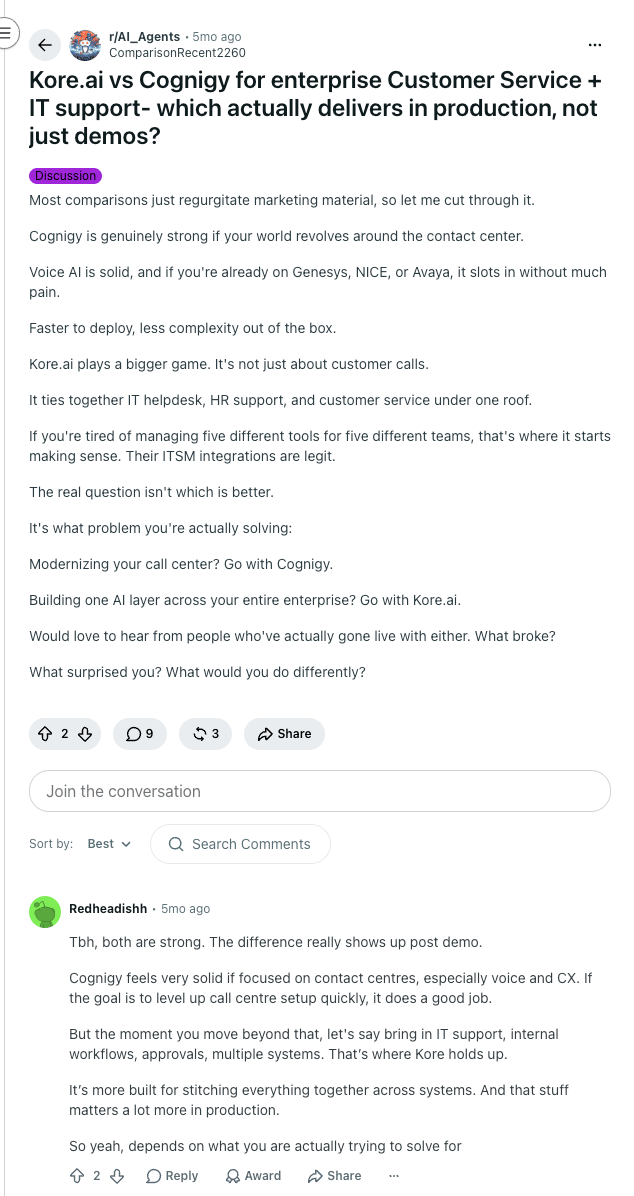
| Production flows can be built without code; reviewers call the Flow Editor quick to learn | Analytics depth draws the sharpest criticism, with reviewers citing "limited analytical possibilities" |
| Deepest contact center integration library of any platform here | One enterprise reviewer reports it "does not support an extensive workflow," forcing splits across files |
| 4.8/5 from 156 Gartner Peer Insights ratings, the largest verified enterprise sample in this list | Reviewers voice open uncertainty about the platform's direction under NiCE ownership |
What Are Cognigy's Plans & Pricing?
Cognigy has no public pricing page, but its AWS Marketplace listing publishes real 12-month list prices, billed per conversation:
- Basic 5K pm - $43,080 per 12 months, 60,000 conversations a year
- Basic 5K pm + Voice Gateway - $53,916 per 12 months, plus 5 Voice Gateways
- Enterprise License Agreement - $1,000,000 per 12 months, up to 10M conversations
- Billed separately: concurrent Voice Gateway lines, Knowledge AI queries and chunks
Check which conversation definition your contract uses:
Cognigy's own docs now carry two. The standard model counts up to 50 user inputs in 24 hours as one conversation. The NiCE CXone model counts up to 50 end-user messages in 24 hours for digital, and up to 10 minutes per call for voice. Which paper you sign changes what a conversation costs you.
How Users Rate Cognigy?
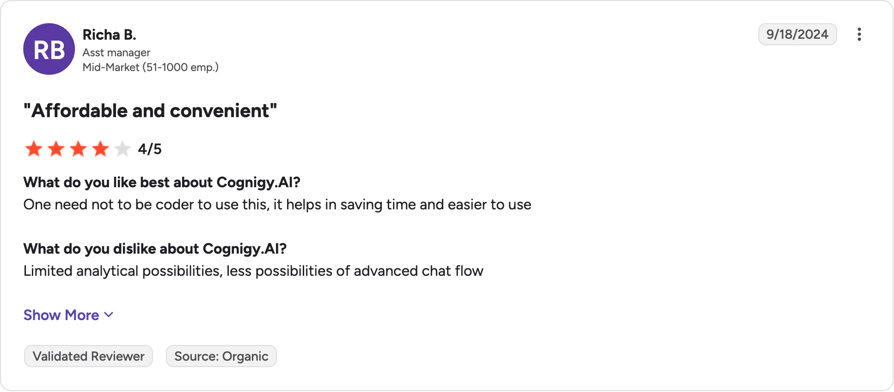
Cognigy holds 4.6/5 on G2 from 13 reviews, and 4.8/5 from 156 ratings on Gartner Peer Insights. The Gartner sample is the one to weigh.
| Category | Cognigy | Kore.ai |
|---|---|---|
| Pricing model | Per conversation, 12-month contract, list prices public via AWS | Per 15-minute session, three tiers unpriced |
| Ease of use (G2) | 9.6 | 9.1 |
| Deployment | SaaS, private SaaS, documented on-premises | SaaS and private instance |
| Gartner Peer Insights | 4.8/5 (156 ratings) | 4.3/5 (178 ratings) |
4. PolyAI: Best Kore.ai Alternative for Voice Quality on Real Phone Lines
What Is PolyAI?
PolyAI builds enterprise voice agents that replace IVR and front-line phone support for large consumer brands including Caesars, PG&E, Marriott, and Volkswagen. It is the most vertically integrated platform in this list: it runs its own Raven LLM, trained on over a billion enterprise conversations, and its own Owl ASR, built specifically to handle static, accents, and background noise on a phone line.
Why Is PolyAI a Strong Kore.ai Alternative?
- Purpose-built speech models for poor call audio, where Kore.ai routes voice through a gateway layered onto a chat-native platform
- Per-minute pricing bundles ongoing tuning, maintenance, and 24/7 support rather than billing them as professional services at $100/hour
- 75+ languages on a single agent, with mid-conversation language switching
- Gartner reviewers score it 4.9/5 on service and support and 4.8/5 on integration and deployment
What Are the Pros & Cons of PolyAI?
| Pros | Cons |
|---|---|
| Voice quality is the single most-cited strength; one contact center director reports the agent handled 87% of calls | Gartner reviewers report high product costs creating budget-justification difficulty |
| Launches without pulling in IT resources, according to enterprise reviewers | Slow implementation timelines with limited visibility into progress |
| Speech recognition robustness described as "exceptional" and more human-like than other systems | No published pricing anywhere, including its own Azure Marketplace listing |
What Are PolyAI's Plans & Pricing?
PolyAI is priced per minute, bundled with performance improvements, maintenance, and 24/7 support. Access is demo-first and sales-led. Every engagement includes a 99.9% uptime SLA, system monitoring, and automatic feature upgrades.
How Users Rate PolyAI?
PolyAI holds 5.0/5 on G2 from 12 reviews, and 4.6/5 from 29 ratings on Gartner Peer Insights. With a dozen G2 reviews, the Gartner figure is the more meaningful one.
| Category | PolyAI | Kore.ai |
|---|---|---|
| Pricing model | Per minute, quote only, tuning and support bundled | Per 15-minute session, plus separate services at $100/hour |
| Speech stack | Proprietary Raven LLM and Owl ASR | Third-party speech via XO Voice Gateway |
| Languages | 75+, switchable mid-call | Not published |
| Gartner Peer Insights | 4.6/5 (29 ratings) | 4.3/5 (178 ratings) |
5. Synthflow AI: Best Kore.ai Alternative for Contact Centers That Want Owned Telephony
What Is Synthflow AI?
Synthflow AI is an end-to-end voice AI platform for inbound and outbound calls, aimed at BPOs, contact centers, healthcare providers, and financial services running high volumes. Its differentiator is infrastructure: it owns and runs its own session border controllers, media servers, and regional points of presence rather than reselling a third-party carrier, and it interoperates with Asterisk, Cisco, Avaya, Genesys, and carrier SIP trunks.
Why Is Synthflow AI a Strong Kore.ai Alternative?
- Owns the telephony layer end to end, reporting under 100ms regional network round-trip time on its own infrastructure
- No-code Flow Designer with multi-agent subflows; 364 G2 reviews name ease of use as the standout
- 200+ integrations including HubSpot, Salesforce, Cisco, Avaya, Genesys, and RingCentral
- SOC 2, HIPAA, GDPR, PCI DSS, and ISO 27001, with deployment positioned in weeks rather than months
What Are the Pros & Cons of Synthflow AI?
| Pros | Cons |
|---|---|
| Drag-and-drop builder gets complex flows live in days, per reviewer reports | Cost is the top complaint: 145 G2 reviews cite pricing, 97 more cite inflexible plans |
| Onboarding described as fast and needing minimal training | Trustpilot reviewers report billing continuing after cancellation and no way to close an account from the dashboard |
| Reviewers report low latency and reliable performance in production | 29 G2 reviews cite poor customer support; Trustpilot sits at 4.1/5 against G2's 4.5/5 |
What Are Synthflow AI's Plans & Pricing?
Synthflow pricing now shows a single enterprise tier with one published figure: enterprise contracts start at $30,000 annually, on an annual term. Any comparison article still showing Synthflow Starter, Pro, or Agency monthly tiers is out of date. Price is scoped per deal around call volume, concurrency, telephony setup, integration complexity, and launch support. No free tier or trial is published, and the page does not disclose whether LLM and speech costs are bundled or passed through.
How G2 Users Rate Synthflow AI?
Synthflow AI's current G2 rating is 4.5/5 from 1,015 verified reviews. Its Trustpilot score is 4.1/5 from 215 reviews, where the negatives cluster on billing and support rather than the product.
| Category | Synthflow AI | Kore.ai |
|---|---|---|
| Entry cost | $30,000/year floor, enterprise only | $60/month plus per-session usage |
| Telephony | Owned SBCs and media servers, or bring your own SIP | XO Voice Gateway, usage-based |
| Build model | No-code Flow Designer | Low-code, developer-led |
| G2 rating | 4.5/5 (1,015 reviews) | 4.6/5 (505 reviews) |
6. Bland AI: Best Kore.ai Alternative for Regulated Industries Needing On-Prem Control
What Is Bland AI?
Bland AI is a voice AI platform for automating outbound and inbound calls, sold to developers and engineering teams in healthcare, insurance, financial services, and logistics. Like PolyAI it is vertically integrated, running its own LLM, speech-to-text, and text-to-speech behind a single per-minute price with no model-provider pass-throughs, and it offers self-hosted and on-premises deployment for buyers who cannot send call audio to a vendor cloud.
Why Is Bland AI a Strong Kore.ai Alternative?
- One published per-minute rate covers the LLM, STT, and TTS, with no token charges stacked on top
- On-prem and VPC deployment, plus US, EU, and APAC data residency for sovereign workloads
- Bring your own number, carrier, or SIP trunk, working with the dialer, IVR, and number pool you already run
- SOC 2 Type II, HIPAA with BAA, GDPR, PCI DSS v4.0, and FedRAMP 20X Class A
What Are the Pros & Cons of Bland AI?
| Pros | Cons |
|---|---|
| Reviewers single out script adherence: "It actually stays on script. Most AI voice tools fall apart there" | One co-founder reports it takes 2-4 weeks to understand the platform well enough to build complex use cases |
| Fast setup and smooth integration with public APIs and external tools | Access is via REST, JavaScript, CLI, or MCP. There is no no-code path |
| Engineering support described as responsive by product-manager reviewers | Only 11 G2 reviews, all 5-star, with no Capterra or Gartner profile to triangulate against |
What Are Bland AI's Plans & Pricing?
Bland AI pricing is published in full and self-serve, billed per minute of talk time:
- Start - $0.14/min talk time, $0/month platform fee, 10 concurrent calls, 100 calls a day
- Build - $0.12/min talk time, $299/month platform fee, 50 concurrent calls, 2,000 calls a day
- Enterprise - custom, contracted to your volume, with on-prem or VPC, BAA, SSO, and data residency
- Transfer minutes billed separately at $0.05/min (Start) or $0.04/min (Build). 99.9% uptime SLA on all tiers
How G2 Users Rate Bland AI?
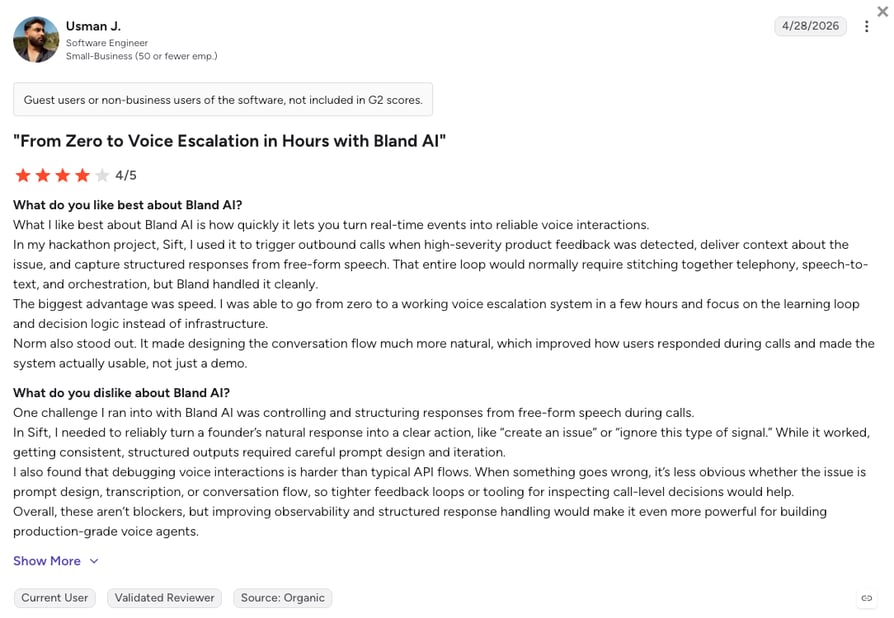
Bland AI's current G2 rating is 5.0/5 from 11 verified reviews. Eleven reviews with no lower-star entries is not a comparable sample to Kore.ai's 505. Treat it as early-adopter enthusiasm, not a verdict.
| Category | Bland AI | Kore.ai |
|---|---|---|
| Pricing model | $0.14/min all-in, no platform fee on entry tier | $60/month plus $0.05 per 15-minute session |
| Deployment | Cloud, VPC, or on-prem with US, EU, APAC residency | SaaS and private instance |
| Build model | Code only: REST, JavaScript, CLI, MCP | Low-code builder plus developer tooling |
| G2 rating | 5.0/5 (11 reviews) | 4.6/5 (505 reviews) |
7. Vapi: Best Kore.ai Alternative for Developers Assembling Their Own Stack
What Is Vapi?
Vapi is a developer platform for building, testing, and deploying voice AI agents. It is API-native by design: rather than shipping a bundled pipeline, it gives you 25+ pluggable LLM, transcription, voice, and telephony providers to assemble yourself. That makes it the most configurable option in this list and the least turnkey.
Why Is Vapi a Strong Kore.ai Alternative?
- Full self-serve pricing published, with the platform fee stated explicitly rather than folded into a quote
- 25+ provider integrations across OpenAI, Anthropic, Gemini, Groq, ElevenLabs, Deepgram, and AssemblyAI
- Telephony integrations with Twilio, Telnyx, Five9, Genesys, and Avaya
- $29/month Core tier gets a real SLA-backed support commitment, against Kore.ai's $1,000/month standard support floor
What Are the Pros & Cons of Vapi?
| Pros | Cons |
|---|---|
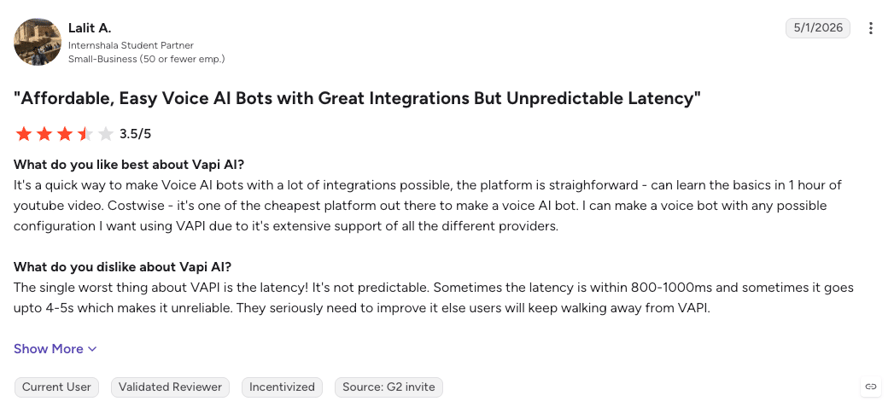
| Fast path to a working bot with unusually broad provider choice | Latency is the loudest complaint and contradicts the vendor's own sub-500ms claim: one reviewer reports unpredictable 4-5 second gaps |
| Straightforward initial setup and integration for engineering teams | Reviewers say you "have to be a developer" to use the dashboard |
| Competitive headline pricing with a genuine free tier | HIPAA is a $2,000/month paid add-on, and Trustpilot sits at 2.4/5 from 15 reviews |
What Are Vapi's Plans & Pricing?
Vapi pricing charges a $0.05/minute hosting fee on top of pass-through model costs:
- Free - $0, $5 in credits, 4 concurrent calls, 14-day data retention
- Core - $29/month, 10 concurrent calls, 30-day retention, 2-business-day support SLA
- Pro - 10% of the hosting fee with a $999/month minimum, 30 concurrent calls, 99% uptime SLA
- Premier - custom, with SSO, 99.9% uptime SLA, and a 1-hour P0 response
- Billed on top: transcription $0.0095-$0.0099/min, LLM $0.0077-$0.0452/min, voice $0.0146-$0.0238/min, HIPAA $2,000/month
How G2 Users Rate Vapi?
Vapi's G2 rating is 4.2/5 from just 3 reviews, and it does not appear on G2's AI Voice Assistants category page. Its Trustpilot score is 2.4/5 from 15 reviews. Both samples are too small to draw conclusions from, and they point in different directions.
| Category | Vapi | Kore.ai |
|---|---|---|
| Pricing model | $0.05/min hosting + pass-through model costs | $60/month + $0.05 per 15-minute session |
| Who can build on it | Developers only; no documented no-code path | Low-code builder, but 46 reviews cite a steep curve |
| HIPAA | $2,000/month add-on | Claimed in healthcare marketing, not listed in the Trust Center |
| Review base | 3 on G2, 15 on Trustpilot | 505 on G2, 178 on Gartner |
8. Voiceflow: Best Kore.ai Alternative for Teams That Design Agents Together
What Is Voiceflow?
Voiceflow is a collaborative agent design and deployment platform. Teams import data into a RAG knowledge base, build logic on a drag-and-drop canvas or through natural-language playbooks, and deploy to web chat, phone, or a custom interface via the Dialog API. It is model-agnostic rather than tied to one cloud's NLU, which makes it the usual pick for CX and design teams who want to own the conversation and hand the build to engineering.
Why Is Voiceflow a Strong Kore.ai Alternative?
- G2 comparison data puts Voiceflow ahead of Kore.ai on self-serve access: a free plan and free trial against Kore.ai's "no pricing available"
- Provisions US and Canada phone numbers directly, handling inbound, outbound, and SMS without a carrier account
- 58 G2 reviews name the intuitive no-code canvas, the largest single praise cluster of any platform here
- Model-agnostic: works with any AI vendor including OpenAI and Anthropic, with LLM fallback models on higher tiers
What Are the Pros & Cons of Voiceflow?
| Pros | Cons |
|---|---|
| 58 reviews praise the intuitive drag-and-drop build experience | 16 reviews find the credit system opaque: "how credits are used is hard to untangle" |
| 34 reviews cite easy integrations and simple API connection | 18 reviews cite missing features, including voice transcription tooling |
| 28 reviews highlight strong customer support and an active community | Reviewers specifically criticise voice quality; it is an agent platform, not a phone system with queues or an agent desktop |
What Are Voiceflow's Plans & Pricing?
Voiceflow's live pricing page no longer displays plan prices. It shows a free trial, usage-based billing, and a "request pricing" CTA, with current figures visible only inside the product. The plan names are Free, Pro, Business, and Enterprise. What is published, and what determines the bill, is the credit rate card:
- Phone orchestration - $0.05 per minute
- Chat orchestration - $0.005 per message
- Speech-to-text - $0.0024/min (Soniox) to $0.02/min (Google), billed separately
- Text-to-speech - $0.000625 to $0.09 per 1,000 characters depending on the voice provider
- LLM tokens - billed per model per 1,000 tokens on top of all of the above
How G2 Users Rate Voiceflow?
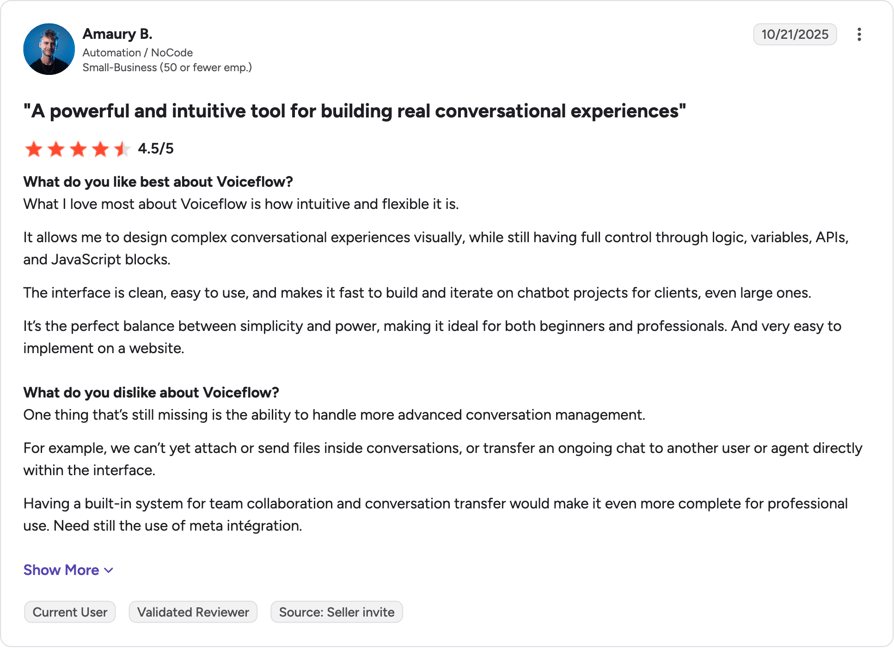
Voiceflow's current G2 rating is 4.6/5 from 113 verified reviews, the same score as Kore.ai, on a fifth of the sample.
| Category | Voiceflow | Kore.ai |
|---|---|---|
| Pricing model | Seat plus usage credits; plan prices behind a demo | Per 15-minute session; three tiers unpriced |
| Free access | Free plan, no credit card | 14-day trial (30 days for Contact Center AI) |
| Phone numbers | Provisions US and Canada numbers directly | Voice Gateway, quoted separately |
| G2 rating | 4.6/5 (113 reviews) | 4.6/5 (505 reviews) |
9. Google Dialogflow CX: Best Kore.ai Alternative for Language Coverage and EU Data Residency
What Is Google Dialogflow CX?
Dialogflow CX, now marketed as Conversational Agents, is Google Cloud's NLU and conversation orchestration service. It combines a deterministic state-machine builder (Flows: pages, intents, entities) with an LLM-driven generative mode (Playbooks) inside the same agent. It is consumed as a metered API rather than bought as a seat-based product, and the buyer is typically an enterprise developer or contact center architect already on Google Cloud.
Why Is Dialogflow CX a Strong Kore.ai Alternative?
- 90+ languages and locales, against a language count Kore.ai does not publish for voice at all
- Named single-region deployments across five EU locations, with data at rest kept in-region, the strongest published residency story in this list
- Published per-request and per-second rates, so you can model cost from the pricing page rather than a sales call
- One-click telephony partners including AudioCodes, Avaya, Twilio, and Voximplant, plus $600 to $1,000 in trial credits valid 12 months
What Are the Pros & Cons of Dialogflow CX?
| Pros | Cons |
|---|---|
| Strong integration with contact center providers, cited in 9 reviews | Escalating cost is the top complaint: "cost can escalate quickly for high-traffic bots" |
| Dual architecture lets deterministic flows and generative playbooks mix per turn | Documentation "lacks depth for advanced use cases," though reviewers also praise the breadth of resources |
| Multilingual NLP quality praised across 6 reviews | Steep learning curve cited in 4 reviews; beginners describe it as overwhelming |
What Are Dialogflow CX's Plans & Pricing?
Dialogflow CX is metered, and the rate depends on whether a turn runs through a deterministic Flow or a generative Playbook:
- Flows - $0.007 per chat request, $0.001 per voice second
- Playbooks - $0.012 per chat request, $0.002 per voice second
- Data Store index storage - 10 GiB free per month, then $5.00 per GiB
- Free credits - $600 for Flows, $1,000 for Playbooks, valid 12 months
The billing trap to model before you commit:
If a Flow calls a Playbook, turns are charged by type. But if a Playbook calls a Flow, every turn is charged at the Playbook rate. For voice, that means the entire conversation bills at the higher price. Google also bills the full duration of generated audio even when playback is interrupted, so a caller who talks over the agent still pays for the whole sentence.
How G2 Users Rate Dialogflow?
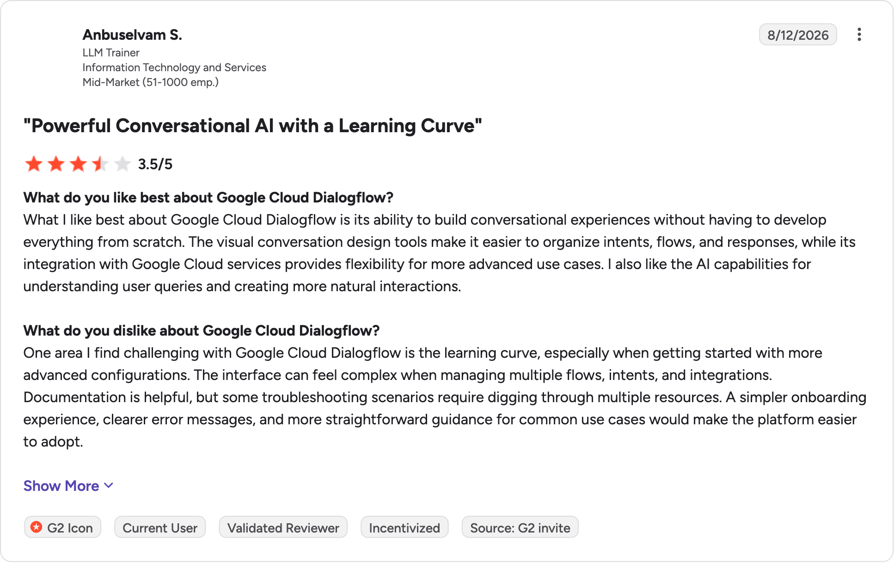
Dialogflow's current G2 rating is 4.4/5 from 144 verified reviews. G2 lists it as "Google Cloud Dialogflow" and pools CX and the legacy ES edition into one score.
| Category | Dialogflow CX | Kore.ai |
|---|---|---|
| Pricing model | Per API request and per audio second, published | Per 15-minute session, three tiers unpriced |
| Languages | 90+ locales (Playbooks tested for ~30) | Not published for voice |
| Data residency | 15+ named regions including 5 in the EU | Private instance available, regions not published |
| Telephony | US-only starter number; partners for production | XO Voice Gateway plus IVR integrations |
10. Amazon Lex: Best Kore.ai Alternative for AWS-Native IVR Builds
What Is Amazon Lex?
Amazon Lex is a managed AWS service for building conversational interfaces from intents, slots, and utterances, using the same speech recognition and language understanding stack as Alexa, with business logic delegated to Lambda. It is the most infrastructural option here: the buyer is an AWS-native engineering team building an IVR brain to sit on top of Amazon Connect or a third-party contact center.
Why Is Amazon Lex a Strong Kore.ai Alternative?
- Pay-per-request pricing with no platform fee, published in full on the AWS pricing page
- 75 languages and locales, 27 of them with unrestricted voice support
- Eight Bedrock-powered generative features, including a Descriptive Bot Builder that populates intents and slots from a plain-language description
- Native to Lambda, CloudWatch, IAM, and Amazon Connect, so it inherits your existing AWS controls and billing
What Are the Pros & Cons of Amazon Lex?
| Pros | Cons |
|---|---|
| Seamless AWS integration across Lambda, CloudWatch, and IAM | Documentation is its sharpest weakness: reviewers report relying on docs that are "not very helpful" and at times conflicting |
| Scales automatically with low-latency responses | Costs rise with traffic and pricing is described as hard to understand |
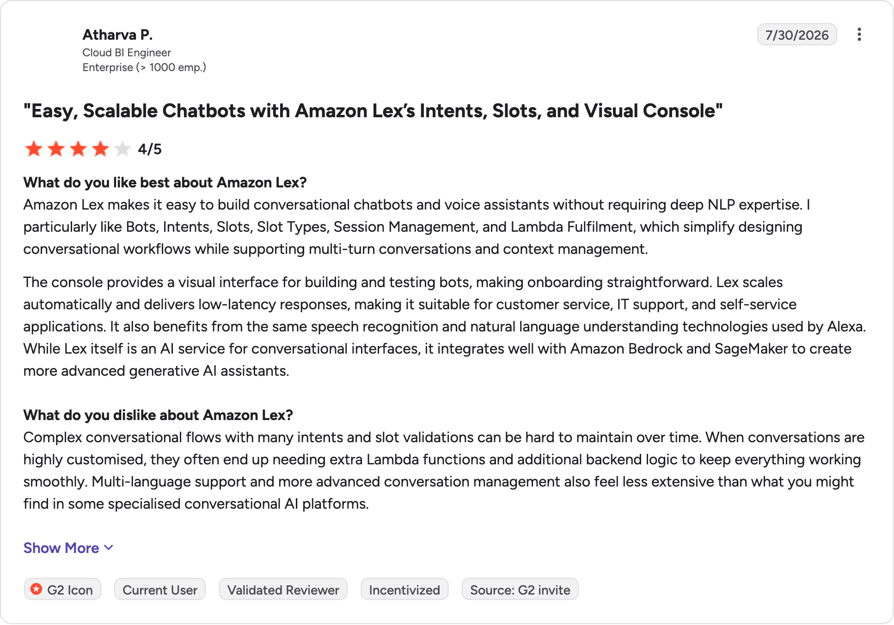
| Powerful NLP and ASR inherited from Alexa, across voice and text | Complex flows are hard to maintain and need extensive Lambda work; only three prebuilt messaging channels exist |
What Are Amazon Lex's Plans & Pricing?
Amazon Lex has no plans. It bills per request, and the voice and text rates differ by more than five times:
- Speech requests - $0.004 each
- Text requests - $0.00075 each
- Automated Chatbot Designer - $0.50 per minute of transcript analysis
- Free tier - up to $200 in AWS Free Tier credits for new accounts
- Not included - telephony, Polly, Transcribe, and Lambda all bill separately, and the Lex pricing page does not mention them
How G2 Users Rate Amazon Lex?
Amazon Lex's current G2 rating is 4.2/5 from 43 verified reviews, the lowest score in this list.
| Category | Amazon Lex | Kore.ai |
|---|---|---|
| Pricing model | Per request: $0.004 speech, $0.00075 text | Per 15-minute session |
| Telephony | None. Requires Amazon Connect, Chime SDK, or Twilio | XO Voice Gateway, usage-based |
| Prebuilt channels | Three: Facebook, Slack, Twilio | 19 digital channels plus voice |
| G2 rating | 4.2/5 (43 reviews) | 4.6/5 (505 reviews) |
Ten platforms, and only some of them answer a phone.
What Users Are Really Saying About Kore.ai Alternatives on Reddit and G2
Vendor pages agree on everything and settle nothing. These are the places buyers argue about Kore.ai in public.
What Redditors Are Asking About Kore.ai Alternatives
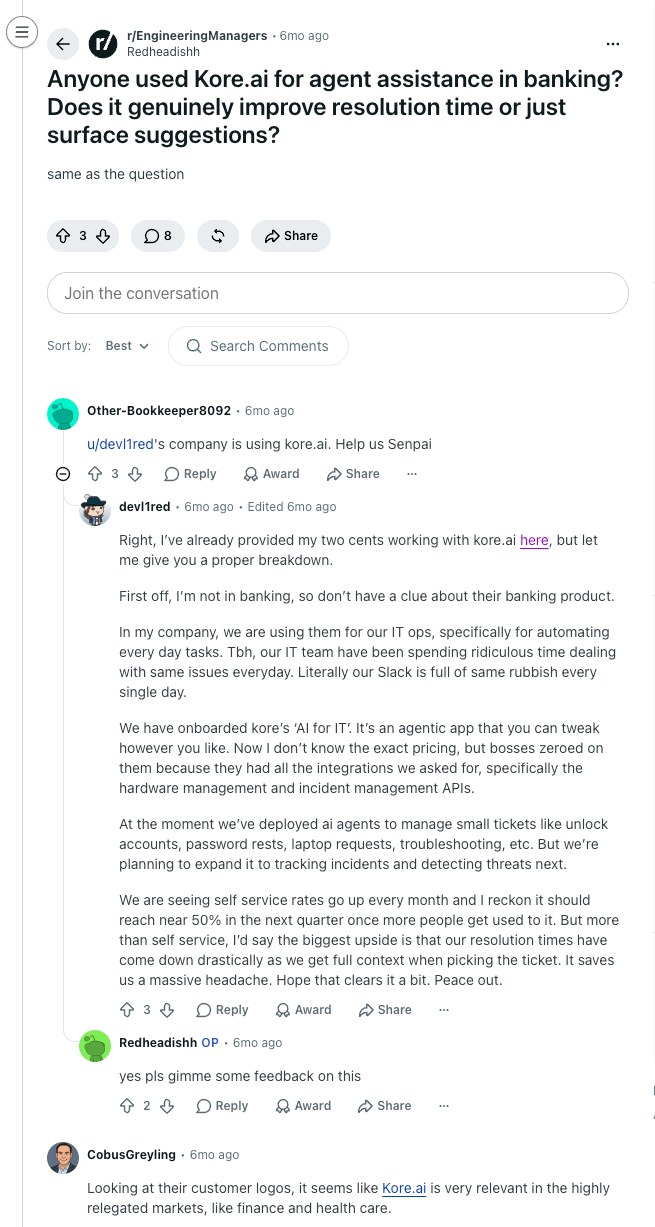
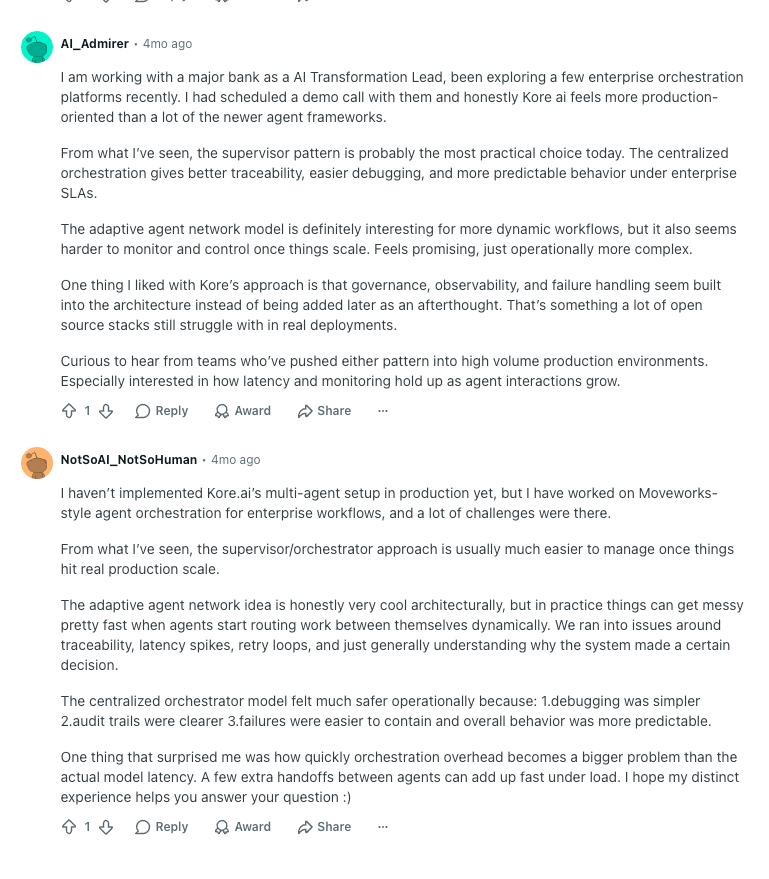
Reddit discussion of Kore.ai is thin and concentrated in AI engineering subreddits rather than customer service ones, which is itself a signal about who evaluates the platform. The most active thread, in r/AI_Agents, asks how Kore.ai compares with Cognigy for enterprise customer service and IT support, and draws seven answers. The recurring shape of the question is telling: buyers are not asking which platform has more features, they are asking which one their team can actually operate after go-live.
What Verified G2 Reviewers Say About Alternaties to Kore.ai
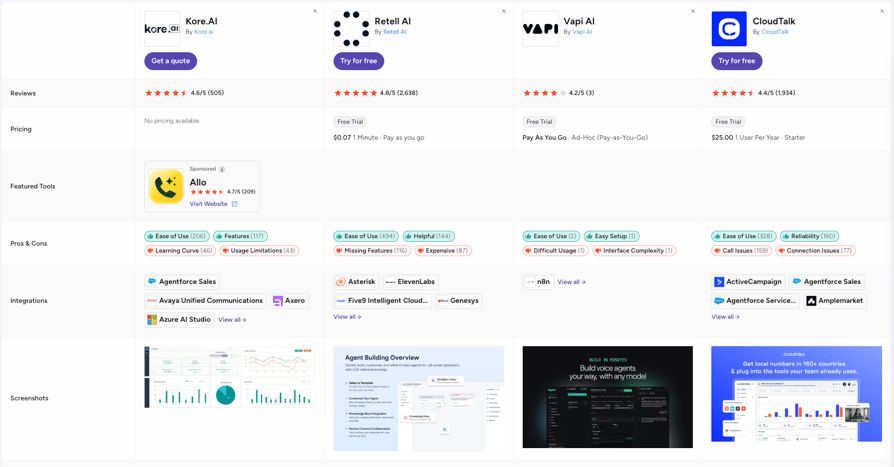
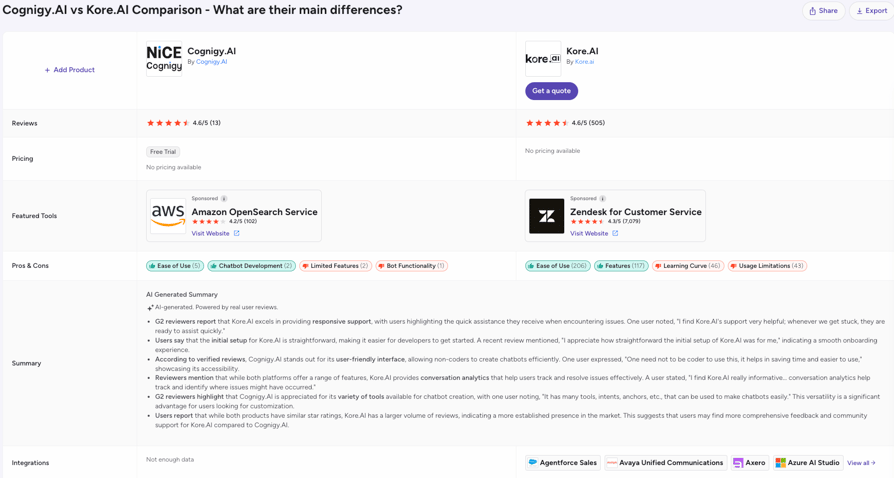
G2's head-to-head comparison pages are the richest source here, because they quantify where Kore.ai loses and to whom:
- Ease of use is where it loses, not capability. Against Cognigy, both platforms rate 4.6 overall, but Cognigy leads 9.6 to 9.1 on ease of use and 9.3 to 9.0 on ease of setup. Kore.ai's counter-strength is integrations, mentioned in 85 reviews against Cognigy's 1.
- Smaller buyers self-select away. Kore.ai's G2 review base is 43.3% enterprise. Voiceflow's is 69.4% small business and Rasa's 72.7%. The complexity and the absent pricing page are doing the filtering.
- Documentation is the best-triangulated complaint. It is the one theme that shows up on G2 (27 reviews), Capterra ("integration configurations can be very messy"), and Gartner ("always a few versions behind") alike. Everything else appears on one site and not the others.
CloudTalk vs. Kore.ai for AI Calling: A Detailed Feature Comparison
The two platforms answer different questions. Kore.ai answers "how do we automate conversations across every channel we have?" CloudTalk answers "how do we get AI answering our phone this month?" Here is the side-by-side on the categories that decide a phone project.
CloudTalk vs. Kore.ai: Final Head-to-Head Comparison
The core split is simple: Kore.ai is an enterprise conversational AI platform done at scale, covering 19 digital channels plus voice, built for organizations with developers on staff and a Global 2000 problem to solve. CloudTalk is the AI calling platform a sales or support team actually works from, with the agent, the seats, the dialers, and the CRM sync on the same line.
The table calls it straight. Kore.ai wins five rows outright, and they matter to a specific kind of business. CloudTalk takes the rest.
CloudTalk vs. Kore.ai: Final Head-to-Head
| Feature | CloudTalk | Kore.ai | Winner |
|---|---|---|---|
| Starting price | $25/user/mo (Starter, annual) | From $29/mo (Contact Center AI); $60/mo + $0.05/session (Automation AI) | Tie |
| Free tier |  Trial plus 50 AI minutes Trial plus 50 AI minutes | 14-day trial, 30 days on Contact Center AI | Kore.ai |
| Billing you can forecast |  Flat per seat + published AI minute packs Flat per seat + published AI minute packs | Per 15-minute session, rounded up; three tiers unpriced | CloudTalk |
| Phone system for human agents | Included from Starter | Bring your own | CloudTalk |
| AI receptionist setup | No-code, minutes, 50 free minutes to test | Low-code; 46 G2 reviews cite a steep learning curve | CloudTalk |
| Outbound AI calls | AI Specialist, from $349/mo | XO Voice Gateway, no published rate | CloudTalk |
| Human dialers | Four dialer modes | None | CloudTalk |
| CRM integrations | 100+ from Essential | Its top-praised strength, cited in 85 G2 reviews | Kore.ai |
| Channels | Voice and SMS, plus WhatsApp on Expert | 19 digital channels plus voice | Kore.ai |
| Handoff to a human | Same platform, transcript attached, no meter | Agent AI, licensed per agent seat | CloudTalk |
| HIPAA / BAA | BAA on request | On its healthcare page, not among the certifications in its Trust Center | CloudTalk |
| Global numbers and languages | 160+ countries, AI in 70+ languages | Country coverage and voice language count not published | CloudTalk |
| Customer support | 24/7 chat and email, phone on Expert | Standard Support from $1,000/mo | CloudTalk |
| Enterprise scale | SMB and mid-market; Custom plan from 25 seats | 500+ Global 2000 customers, 20B+ interactions a year | Kore.ai |
| G2 rating | 4.4/5 (1,702+ reviews) | 4.6/5 (505 reviews) | Kore.ai |
The row that matters is the one about your team.
How to Choose the Right Kore.ai Alternative for Your Team
We'll go over specific use cases below, but here are the primary questions to ask before deciding:
1. Who is going to build and maintain this after launch?
This is the question Kore.ai's 46 learning-curve reviews are really about. Count the people who will still be maintaining flows in a year. If the answer is a sales ops person or a support lead rather than a developer, rule out Vapi, Amazon Lex, and Bland AI immediately. All three are code-first by design. If you have a dedicated conversation design team, that same constraint becomes an advantage and the developer platforms give you more control.
2. Are you buying an AI platform or a phone system?
Most tools like Kore.ai are agent layers, not phone systems. Amazon Lex has no telephony at all. Dialogflow CX will host one US number under quota and then route you to AudioCodes, Avaya, Twilio, or Voximplant. Voiceflow sells you a US or Canada number but has no queue, ring group, or agent desktop behind it. If your team needs to answer calls a human might take over, you need a cloud phone system with AI inside it, not an AI platform with telephony bolted on.
3. What does one real customer call cost on each billing model?
Take your actual average call length and model it. On Kore.ai's 15-minute sessions, a 16-minute call costs double a 14-minute one. On Cognigy, the conversation definition in your contract decides whether voice is capped at 10 minutes or 50 inputs. On Vapi and Voiceflow, the headline rate excludes LLM, speech-to-text, and text-to-speech, which land on top. On a per-seat model, none of this applies. Build the same 1,000-call month on each and compare totals, not list prices.
4. How many channels do you genuinely need on day one?
Kore.ai's real strength is breadth: 19 digital channels plus voice. If you are paying for that breadth and using two of them, most of your invoice is buying optionality. Be honest about whether the Instagram, WeChat, and Line connectors are on a roadmap or in a pitch deck. Teams that only need voice and SMS can cut their bill substantially by moving to a platform built for those two.
5. What does your compliance team actually require in writing?
Check the trust page, not the industry landing page. The two often disagree. Kore.ai's Trust Center lists SOC 2 Type 2, ISO/IEC 27001:2022, and PCI DSS, while HIPAA appears on its healthcare marketing page rather than among its audits and certifications. On Vapi, HIPAA is a $2,000/month add-on. Bland AI publishes FedRAMP 20X Class A alongside SOC 2 Type II and PCI DSS v4.0. If you need a BAA or EU data residency, confirm it in writing before the demo, not after.
6. How much of your current Kore.ai build actually needs to survive?
Audit what is live before you price a replacement. Teams routinely discover that three or four flows carry almost all their volume and the rest were built for a launch that never scaled. If that is true for you, a like-for-like platform swap is overkill and you should be shortlisting on time-to-first-call instead of feature parity.
Which Kore.ai Replacement Fits Your Team?
| If this is your team | Start with | Why |
|---|---|---|
| SMB or mid-market sales and support team that needs AI answering the phone | CloudTalk | The only option here that is already a phone system; live in days from $25/user/month |
| Enterprise contact center replacing Kore.ai feature for feature | Cognigy | Matches the scope, beats it on ease of use, and integrates with Genesys, Avaya, and NiCE CXone |
| Consumer brand replacing an IVR where voice quality decides the project | PolyAI | Purpose-built speech models for noisy phone lines; 75+ languages on one agent |
| Team that wants to control cost per component | Retell AI | Full published rate card, no platform fee, free SIP trunking |
| Regulated business that cannot send call audio to a vendor cloud | Bland AI | On-prem and VPC deployment, US, EU and APAC residency, BAA and FedRAMP 20X Class A |
| Engineering team that wants to own the whole stack | Vapi | 25+ pluggable providers and a $0 entry tier, but expect to write code |
| Already on Google Cloud, need many languages and EU residency | Google Dialogflow CX | 90+ locales and 15+ named regions, five of them in the EU |
| AWS-native team building an IVR on Amazon Connect | Amazon Lex | Cheapest per request and native to Lambda, IAM, and CloudWatch |
What Is the Best Kore.ai Alternative for AI Phone Answering, AI Receptionists, and AI Voice Agents?
CloudTalk is the best Kore.ai alternative for AI phone answering, AI receptionists, and AI voice agents, all on the same platform. because you simply add the AI Agent to your call flow, rather than purchasing a completely different software. It answers calls after hours, follows up fast with hot leads, and hands anyone who needs a person to your team on the same platform.
50 free minutes on every account let you hear it on your own number first with the AI Receptionist. Retell AI is the pick if your engineers want to build the agent themselves, Synthflow if you're an enterprise buying a scoped program.
Signature Capability
See CloudTalk’s AI Voice Agent in Action!
CeTe is an AI that talks like a human: no breaks, no training, no time off. It makes and answers calls, updates CRMs, books meetings, and loops in a human only when needed.
Press play to hear it. Want a wow moment? Get a free test call and try it live.

No matter what AI Voice tool yoou choose, you should always check:
- Latency and Streaming: Ensure real-time response feels instantaneous with low-latency streaming rather than a choppy stop-and-go delay.
- Speech Accuracy (STT/TTS): Test how well the speech-to-text handles background noise, accents, and industry-specific jargon, and check if the text-to-speech sounds natural.
- Human Handoff: Check how cleanly it escalates calls to a human agent while passing full conversation context so customers do not have to repeat themselves.
The best AI voice agents have low latency, high speech accuracy and know exactly when to handoff to a human, and the conversational AI software behind them lets you customize the greeting, the pace, and the fallback yourself. Here's how an AI receptionist and a human one handle the same call:
What this means for you:
You don't have to choose between the two. On CloudTalk the AI takes begins the call and your people take over the calls that need human judgment, on one line, with the transcript already on their screen.
What Is the Best Kore.ai Alternative for Healthcare?
CloudTalk is the best Kore.ai alternative for healthcare. It supports HIPAA compliance by offering a Business Associate Agreement (BAA) for phone calls, audio recordings, and transcripts, alongside SOC 2 Type II and GDPR certifications.
Clinics can quickly deploy a healthcare AI voice agent to handle routine tasks like scheduling, rescheduling, and location inquiries. BAA setup for the AI voice agent is handled during onboarding, though PHI should remain off SMS unless specifically covered by your agreement.
Other notable options:
- Vapi: Includes HIPAA compliance only as a $2,000/month add-on.
- Smith.ai: Best for clinics that need human receptionists to handle complex intake calls alongside automated responses.
- Retell, and Bland: Reserve BAA coverage exclusively for high-tier enterprise plans.
What this means for a clinic:
The receptionist in the video runs on the same platform that signs your BAA, so patient calls, bookings, and recordings stay under one agreement rather than split across an AI vendor and a phone vendor. See which AI voice agents handle patient calls, booking, and reminders with compliance in mind.
Which Kore.ai Alternative Is Best for Call Centers and Inbound Support Teams?
CloudTalk is the top alternative to Kore.ai for inbound support teams.
- How it works: An AI receptionist answers incoming calls, handles basic questions, and passes complex issues to human agents—complete with a full call transcript.
- Easy management: Managers see both AI and human call stats in one simple dashboard instead of switching between tools.
- Core phone tools included: Comes built-in with call queues, skill-based routing, IVR, and live manager listening or assistance.
Other good choices:
- Dialpad Connect: Best for automatic call notes and live coaching for human agents.
- Aircall: Best if your team already relies heavily on Zendesk or Intercom.
The main issue with Kore.ai: While it handles automated chats well, transferring a caller to an engineer or specialist requires jumping through extra software and messy handoffs.
Autenti Cut Live Support Calls by About 40% With Nine Voice Agents
The e-signature company runs nine AI voice agents across three teams and two languages on CloudTalk, and live teams now pick up about 40% fewer calls while the pickup rate rose 20%. Its support lead had hoped for a 10% drop.
What Is the Best Kore.AI AI Alternative for Appointment Setting and Virtual Reception?
CloudTalk is the top alternative to Kore.ai for handling appointments and front-desk calls. Its AI receptionist connects directly to your live calendar, books appointments during the call, and sends text confirmation right away. It also logs key details—like the caller's name, reason for calling, and phone number—directly into your CRM instead of relying on missed voicemails.
Other Options:
- Smith.ai: Best if you need real human receptionists backing up the AI for detailed intake.
- Goodcall: A solid pick if you need unlimited call minutes more than software integrations.
Why swap from Kore.ai? While Kore.ai offers deep enterprise features, setting up simple calendar bookings often requires complex builds and secondary software setups, increasing both costs and technical overhead.
Circle Gym Lifted Trial Bookings 150% by Booking on the Call
Instead of texting a scheduling link, the gym's AI voice agent asks what time works and books it, and trial bookings rose 150%, from four a day to ten, while the owner saved 20+ hours a week.
What's Better Than Kore.ai for Outbound Sales and Automated Dialing at Scale?
CloudTalk is the top alternative to Kore.ai for outbound sales and automated calling because it combines two key tools on one platform. Its AI Specialist calls leads immediately after they fill out a form, qualifies them, and books meetings. Meanwhile, its sales dialer helps reps power through call lists with built-in spam prevention, answering machine detection, and voicemail drop.
How other options compare:
- Bland AI: Best for developer teams running tens of thousands of scripted calls daily.
- Retell AI: Best when outbound sales logic requires heavy custom coding.
The Bottom Line on Value: Judge your ROI on cost per actual conversation rather than cost per minute—an AI agent that reaches 20x more people still wins the campaign, even if it's slightly less persuasive than a human.
Cost Note: CloudTalk's AI Specialist plan starts at $349/month. Small two-person teams should start with the lower-tier AI Receptionist plan ($99/month) and upgrade to the Specialist once they hire their first sales rep. Kore.ai often requires complex enterprise setups just to launch simple outbound dialing.
Trevo Reached 20x More Customers per Campaign
The retailer's 50-person call center could reach about 5% of its database in a season. On CloudTalk's AI voice agent, every campaign now reaches 20x more customers, returning customers finish in under 30 seconds, and the human team moved to the calls worth their time.
Trevo Reached 20x More Customers per Campaign. See the Agent That Did It.
Which Kore.ai Alternative Has the Best CRM and Scheduling Integrations?
If you're moving away from Kore.ai, both CloudTalk and Aircall offer top-tier CRM and scheduling connections, but they serve different needs:
- Aircall: Connects with over 250 apps on its starter plan, making it the best pick if your team relies on niche software or less common helpdesks.
- CloudTalk: Focuses on 100+ core tools used daily by sales and support teams—including HubSpot, Salesforce, Pipedrive, Zendesk, Zoho, Intercom, and Shopify. Two-way syncing pulls up caller details before a call starts and automatically logs recordings, transcripts, and AI summaries afterward for both human and AI calls. Any extra apps can connect through API, Zapier, or Make.
Scheduling built-in: Unlike Kore.ai—which often restricts integrations to expensive enterprise tiers—CloudTalk's AI Receptionist lets callers book straight into Google Calendar or your preferred scheduling tool on the basic plan.
What this means for you:
Pick Aircall if one specific app on its list is non-negotiable. Pick CloudTalk if you want the AI's captured lead to become a CRM record on its own, with no webhook recipe to maintain.
How to Switch From Kore.ai Without Losing Momentum
Most teams delay switching because they assume migration is a months-long project. In practice, if you know what to export and what to prioritise, most teams are live on a new platform in two to three weeks.
- Audit your current Kore.ai setup first. List what you are actually using (flows, integrations, NLP training data, reporting) against what you are paying for and not using. Most teams find their volume concentrated in three to five flows. Don't migrate dead weight.
- Export your conversation flows and intents. Most alternatives, CloudTalk included, can replicate flows manually faster than you would expect, because the logic is usually simpler than the builder makes it look. Rebuild your highest-volume flows first and leave the long tail for later.
- Map your integrations before you touch anything. CRM connections, ticketing tools, and webhooks break more migrations than call logic does. Document every active integration and confirm your new platform supports it before you start, not when a flow fails in production.
- Port your numbers while both systems run. CloudTalk's Carrier Operations team handles the carrier side once you submit the request. A full port typically takes two to four weeks; if your numbers already sit on a shared carrier, an internal migration takes three to seven business days. Keep Kore.ai active until the transfer completes.
- Run both platforms in parallel for two to four weeks. Don't hard-cut. Use the overlap to QA call quality, test routing logic, and train your team without pressure. Pull three to six months of key metrics out of Kore.ai before you close the account, so you have a benchmark to measure the new platform against.
Ready to Try the Best Kore.ai Alternative?
If you came here because Kore.ai is too much platform for the job you actually have, the fix is not a different platform to build on. It is a phone system that already works, with the AI agent as one step in it.
- No session maths: flat per-seat pricing from $25/user/month and published AI minute packages, instead of 15-minute sessions rounded up and three tiers priced "call us."
- Nothing to build: an AI Receptionist goes live by uploading your documents and assigning it to a number, against the months of specialist time Kore.ai reviewers describe.
- Telephony included: local, mobile, and toll-free numbers in 160+ countries, with no carrier or SIP trunk to source first.
- Test it free: 14 days of the full platform and 50 AI Voice Agent minutes on every account, no credit card.
Let our team plan your move off Kore.ai.
Frequently Asked Questions About Kore.ai Alternatives
Answers to the most common questions businesses ask about Kore.ai, its pricing, and its competitors.
Kore.ai is an enterprise conversational AI platform covering chat, voice, agent assist, and enterprise search, used by more than 500 Global 2000 organizations and named a Leader in the July 2026 Gartner Magic Quadrant for Conversational AI Platforms. Teams look for alternatives when the platform outgrows their team rather than the reverse: 46 G2 reviews cite a steep learning curve, 39 report slow performance, 29 report bugs, and 27 name poor documentation. Pricing adds to it: conversations bill in 15-minute sessions rounded up, and three plan tiers carry no published price at all.
CloudTalk is the best Kore.ai alternative for sales and support teams, because it is a working phone system with AI voice agents built in rather than a platform you build a phone system on. It starts at $25/user/month on a single seat, includes local numbers in 160+ countries, and gives every account 50 free AI Voice Agent minutes. For enterprises that need Kore.ai's full multi-channel scope, Cognigy is the closest like-for-like replacement and scores higher than Kore.ai on ease of use and ease of setup on G2.
Kore.ai's Automation AI starts at $60/month plus $0.05 per session, where a session is any conversation up to 15 minutes, rounded up. Contact Center AI starts at $29/month for up to 30 agents. Add-ons are priced separately: Proactive Outbound Campaigns at $300 per 3,000 messages, Workforce Management at $30/agent/month, and professional services at $100/hour beyond the 20 hours included annually. Voice Gateway and several other add-ons show "usage based pricing, call us." Our full Kore.ai pricing breakdown walks through what a real monthly bill looks like.
For phone-first sales and support teams, yes. CloudTalk includes telephony in 160+ countries, goes live in days without developers, and prices per seat instead of per session. For organizations automating conversations across 19 digital channels with an in-house AI team, Kore.ai is the broader platform and rates 4.6/5 on G2 from 505 reviews against CloudTalk's 4.4/5. The right answer depends on whether your project is a phone project or a platform project.
Kore.ai competitors split into three groups. Enterprise conversational AI platforms: Cognigy, PolyAI, Google Dialogflow CX, and Amazon Lex. Voice AI platforms: Retell AI, Synthflow AI, Bland AI, and Vapi. Phone systems with AI built in: CloudTalk. G2's own alternatives page also surfaces Fin, yellow.ai, Genesys Cloud CX, and Botpress as products buyers evaluate alongside it.
Kore.ai does voice, but its channel list shows where the platform's weight sits: 19 digital channels against one native voice channel, the XO Voice Gateway, with everything else handled through third parties like Twilio Voice, Amazon Alexa, and IVR bridges. The company was founded in 2014 and launched its Voice Gateway on Genesys AppFoundry in October 2023. Its billing definition still describes a session as "a conversation between a user and the AI chatbot." If voice is your primary channel, a voice-first platform will usually fit better.
PolyAI and Cognigy are the strongest enterprise Kore.ai replacements for voice. PolyAI runs its own Raven LLM and Owl ASR built specifically for noisy phone audio, supports 75+ languages on a single agent, and holds 4.6/5 from 29 Gartner Peer Insights ratings. Cognigy holds 4.8/5 from 156 Gartner ratings, publishes real list prices via AWS Marketplace, and integrates natively with Genesys, Avaya, Amazon Connect, and NiCE CXone. Bland AI is the pick where on-premises or VPC deployment is mandatory.
Kore.ai's Trust Center lists SOC 2 Type 2, ISO/IEC 27001:2022, and PCI DSS under audits and certifications, and names GDPR, CCPA, and the EU AI Act as compliance frameworks. HIPAA appears on its healthcare marketing page but not among the certifications listed in its Trust Center, so confirm the position in writing if you handle protected health information. Among the alternatives, Retell AI, Synthflow AI, Cognigy, PolyAI, and Bland AI all list HIPAA directly; on Vapi it is a $2,000/month add-on.
The pattern reviewers describe is specific rather than general. 39 G2 reviews report slow performance and 31 report slow loading times, and the recurring trigger is a bot pulling data from several integrations at once, or handling longer multi-turn conversations. Kore.ai publishes no numeric latency figure, describing its voice infrastructure only as "low latency." Retell AI reports 620ms average end-to-end in its own testing, Bland AI claims 400ms on its homepage, and PolyAI claims sub-second. All are vendor figures, none independently benchmarked.
Steep enough that it is Kore.ai's single most-cited weakness on G2, tagged in 46 reviews, more than missing features (23) or complexity (20). Capterra reviewers describe "too many properties and features" that become difficult to maintain. On the no-code side, ease of use is the top praise cluster for the alternatives: 494 reviews for Retell AI, 364 for Synthflow AI, and 58 for Voiceflow. G2's head-to-head data scores Cognigy 9.6 on ease of use against Kore.ai's 9.1.
Yes. CloudTalk, Synthflow AI, Voiceflow, and Cognigy are all built around visual, no-code builders an admin can operate. CloudTalk is the shortest path for a phone team, because the AI agent is configured by uploading documents and dropped into the same Call Flow Designer canvas as your IVR menus and ring groups. Avoid Vapi, Bland AI, and Amazon Lex if nobody on the team writes code. All three are API-first and reviewers say so plainly.
For a small team that needs the phone answered, CloudTalk at $25/user/month on a single seat is the lowest all-in cost, because telephony and numbers are included rather than bought separately. Retell AI ($0 to start), Vapi ($0 free tier), and Voiceflow (free plan) are cheaper on paper, but each expects you to add telephony, model costs, or engineering time on top. Synthflow AI and Cognigy are out of reach entirely at this size, with floors of $30,000 and $43,080 a year.