Summary of Kore.AI Pricing Plans
| Plan | Price | Best For |
| Essential | Usage-based (no public price; $0.20/session) | Small teams testing automation or running simple, low-traffic chatbots |
| Advanced | Usage-based (no public price; higher limits) | Growing teams that need higher limits, voice, and more advanced automation |
| Enterprise | Custom pricing (contact sales) | Large organizations with high-volume contact centers and strict compliance needs |
In a Nutshell
Kore.AI pricing is built around three tiers — Essential, Advanced, and Enterprise.
The problem is that Kore.AI does not publish exact prices for any of them. When people search for Kore AI pricing, what they really need to understand is that Kore.AI runs on a usage-based, pay-as-you-go model.
Based on what is available, we know that new accounts get $500 in free credits, and each conversation is billed at $0.20 per 15-minute session. Contact Center AI and Agent AI are billed per agent seat instead, and voice, support, and add-ons are billed separately — which is why the real Kore AI cost is hard to predict.

What Pricing Plans Does Kore.AI Offer?
Kore.AI does not publish a clean, plan-by-plan pricing page. Instead, its documentation explains how billing works rather than how much you pay, and most production deployments require a custom quote. That opacity is exactly why Kore.AI pricing is so hard to research. Based on Kore.AI's own documentation, the platform's pricing plans break down into three named tiers — Essential, Advanced, and Enterprise — sitting on top of a usage-based billing engine.
The structure matters because the price of Kore.AI you see quoted up front rarely reflects your final bill. Kore.AI uses a mixed billing model:
- Automation AI & Search AI — billed per 15-minute billing session (every 15 minutes of bot interaction, including idle time, counts as one session)
- Contact Center AI & Agent AI — billed per agent seat (named or concurrent)
- Add-ons — voice gateway, premium support, analytics, and integrations are billed separately from the base plan
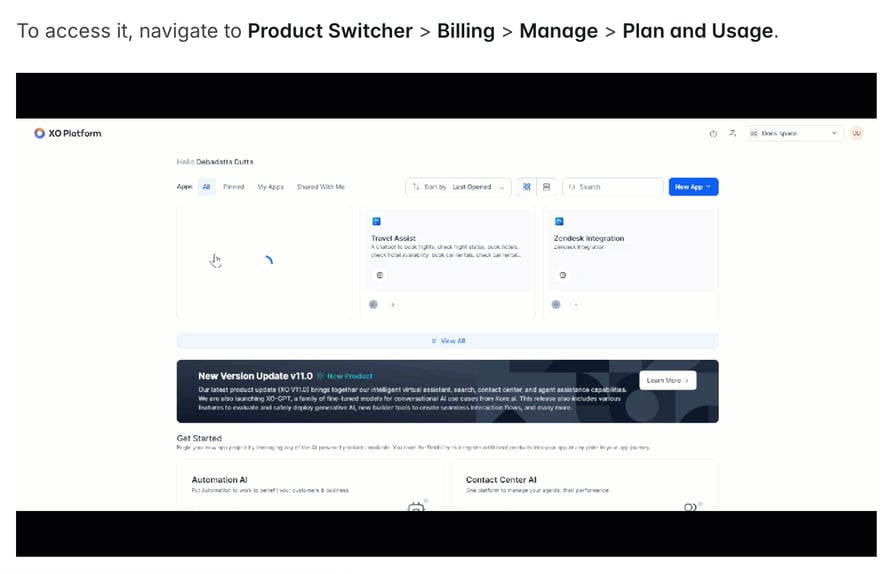
All three tiers run on a pay-as-you-go foundation. There is no permanent free plan — new accounts start on a Standard pay-as-you-go workspace with $500 in free credits for evaluation, after which you fund the account or move to a custom Enterprise contract.
This is what their official website states:
What Do Real Users Say About Kore.AI Pricing?
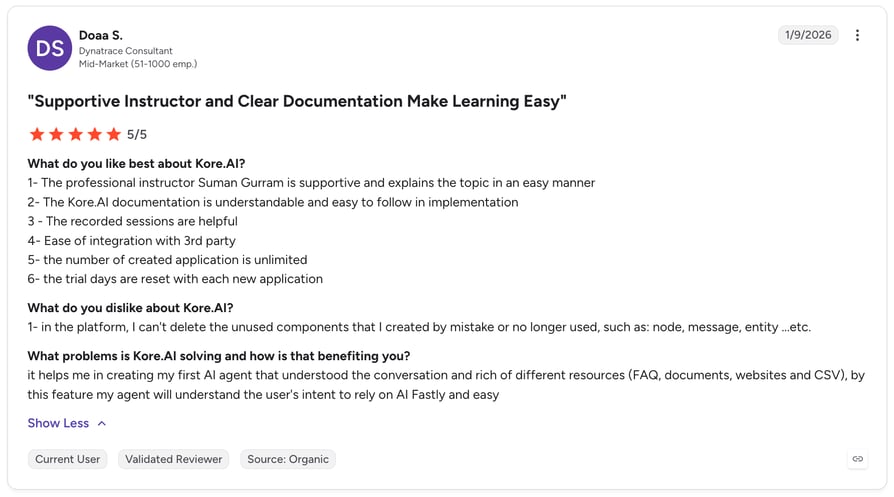
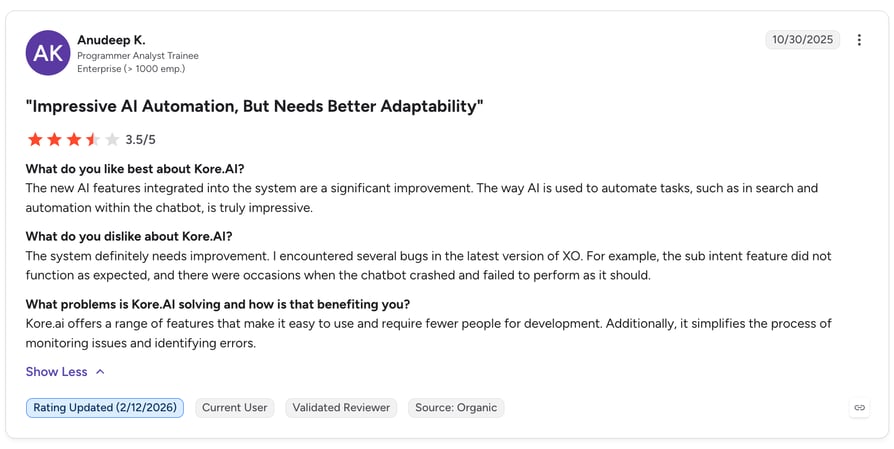
Reviewers consistently praise Kore.AI's depth — and just as consistently flag its complexity and cost. On G2, developers describe the platform as powerful for building end-to-end AI agents, but note a steep learning curve and a feature set so broad it becomes hard to maintain. The recurring theme across G2, Capterra, and Trustpilot is the same: great capability, but pricing and complexity that are tough for non-technical teams to navigate.
What Is Kore.AI's Essential Plan?
The Essential plan is Kore.AI's entry-level paid tier. It's the first step beyond the free-credit sandbox and is built for simple, mostly static chatbot use cases — basic IVR and chat assistants that don't need voice, advanced analytics, or role-based access controls.
How much does Kore.AI's Essential Plan cost?
Kore.AI does not publish a flat monthly price for the Essential plan. Instead, it bills on a pay-as-you-go basis: every conversation handled by your bot is billed at $0.20 per 15-minute session, drawn first from your $500 in free signup credits and then from paid credits you add. So your real subscription cost on this tier is driven almost entirely by conversation volume rather than a fixed subscription fee.
What's included in Kore.AI's Essential Plan?
- Core chatbot and IVR functionality for simple, static conversation flows
- Standard Automation AI session-based billing (15-minute sessions)
- Basic support (community, Academy, and documentation access)
- Restricted session volumes and lower platform limits
- No advanced features such as A/B testing or role-based access controls
Kore.AI's Essential Plan: Who is it best for?
Kore.AI's Essential Plan is best for startups, single-department pilots, or teams processing fewer than ~500 conversations a month. Most teams outgrow it quickly once conversations get longer or voice enters the picture.
What you need to know about Kore.AI's Essential Plan:
The paid Standard Support upgrade starts at $1,000/month, and once your $500 free credits run out, you'll need to add paid credits to keep bots running. Voice capabilities are limited at this tier, so heavy voice use pushes you toward Advanced.
What Is Kore.AI's Advanced Plan?
The Advanced plan is where Kore.AI starts to resemble a complete automation platform. It adds higher limits and the more sophisticated features growing teams need — including the kind of voice and integration capabilities that simple chatbots can't deliver. This is also where the Kore.AI voice agent pricing conversation begins in earnest, since voice channels are far more resource-intensive than chat. Teams comparing options here often look at dedicated AI cold calling tools to benchmark what voice should cost.
How much does Kore.AI's Advanced Plan cost?
Kore.AI does not publish a public price for the Advanced plan either. It sits on the same pay-as-you-go foundation as Essential — the same $0.20 per 15-minute session billing applies — but unlocks higher limits and more advanced features. For voice-heavy deployments, the usage component (sessions plus the separately billed Voice Gateway) typically becomes the dominant line item on your invoice, regardless of tier.
What's included in Kore.AI's Advanced Plan?
- Everything in Essential, plus significantly higher platform limits
- More advanced automation features and conversation logic
- Access to voice channels (subject to separate voice/ASR/TTS billing)
- Better support for multi-step flows and richer integrations
- Room to grow before a custom Enterprise contract becomes necessary
Kore.AI's Advanced Plan: Who is it best for?
Kore.AI's Advanced Plan is best for growing support and sales teams that need voice, deeper automation, and higher volumes — but aren't yet ready for an enterprise contract. Watch the Kore.AI's pricing per minute voice costs closely here, as they can quietly overtake the rest of your usage. Benchmarking against transparent AI voice agent pricing can show whether Kore.AI's metered model is competitive for your volume.
What you need to know about Kore.AI's Advanced Plan:
The Voice Gateway add-on (STT/TTS and concurrent call handling) is billed separately on usage, and premium support, analytics, and reporting add-ons stack on top. Exceeding session limits triggers additional per-session charges, so monitor usage as you scale.
What Is Kore.AI's Enterprise Plan?
Enterprise is Kore.AI's flagship offering and where most serious deployments land. It removes the platform restrictions of the self-serve tiers and supports complex automation, deep integrations, and high-volume contact center environments — all under a custom contract negotiated with Kore.AI's sales team.
How much does Kore.AI's Enterprise Plan cost?
Enterprise pricing is fully custom — Kore.AI requires you to create a contract with their team, and no public figure is available. What Kore.AI does confirm is the underlying model: Enterprise is pay-as-you-go on the same $0.20-per-15-minute-session basis, customizable to your volume and administration needs, with seat-based billing for Contact Center AI and Agent AI and add-ons (such as the Voice Gateway) billed separately. To get an actual number, you need to contact Kore.AI's sales and negotiate based on your usage.
What's included in Kore.AI's Enterprise Plan?
- Everything in Advanced, plus enterprise-grade features and the highest platform limits
- Custom session and data-ingestion allowances (up to 1 GB by default, contract-adjustable)
- Named or concurrent seat licensing for Contact Center AI and Agent AI
- Enterprise administration, governance, and compliance controls
- Custom contract terms, volume discounts, and dedicated account support
Kore.AI's Enterprise Plan: Who is it best for?
Large enterprises and regulated industries (finance, healthcare, telecom) with dedicated IT teams, big budgets, and complex, long-term AI projects that need governance, compliance, and high-volume automation across many channels and languages.
What Are Kore.AI's Additional Costs?
The plan tier is the smallest part of the Kore.AI bill. Because billing is metered across sessions, seats, voice, and add-ons, the Kore.AI features pricing reality is that several separate line items stack on top of your usage. For teams used to predictable sales automation software pricing, this metered approach takes some adjustment. Here are the cost components Kore.AI documents officially.
| Cost Component | Amount | Notes |
|---|---|---|
| Conversations (Automation AI / Search AI) | $0.20 per 15-min session | A 31-minute conversation counts as 3 sessions, not 1 |
| Voice Gateway (STT/TTS) | Billed separately (contact sales) | Voice sessions are metered apart from standard sessions |
| Agent seats (Contact Center / Agent AI) | Per named or concurrent seat | Scales directly with agent headcount |
| Standard Support | From $1,000/month | Basic support (community/docs) is included by default |
| Other add-ons (e.g. Advanced RAG) | Billed separately | Activated and invoiced on top of the base plan |
| Paid credits | Top-ups (up to $20,000 per transaction) | Added once your $500 free credits run out |
The 15-Minute Billing Session: The Hidden Variable
The single biggest driver of unexpected Kore.AI's pricing per month spend is the session model. Their bills Automation AI in 15-minute blocks that include idle time, so a conversation's length — not just its volume — determines your cost.
- A 14-minute chat = 1 session ($0.20)
- A 31-minute chat = 3 sessions, $0.60 (0–15, 16–30, 31–end)
- Idle time counts too — a session is 15 minutes of interaction including inactivity
For teams with long, high-engagement conversations, this is exactly the kind of variable that makes budgeting unpredictable — and it's the most common complaint in community discussions about Kore.AI's pricing voice and automation costs.
Kore.AI Voice Agent Pricing: What Voice Actually Costs
Voice is billed separately from standard sessions. Kore.AI's documentation confirms that voice sessions — covering speech-to-text (STT), text-to-speech (TTS), and calls through the Voice Gateway — are metered apart from Automation AI sessions and tracked as their own line item on the Plan & Usage dashboard. However, because Kore.AI does not publish a public per-minute voice rate, the exact AI voice agent cost requires a quote. Teams weighing this against transparent options often start with a clear breakdown of how much voice AI costs before comparing vendors.
Does Kore.AI Have a Free Plan?
There is no permanent free tier, but Kore.AI gives every new account $500 in free credits at the workspace level. You draw those credits down at $0.20 per session, and once they're exhausted, you must add paid funds (or move to an Enterprise contract) to keep publishing and running bots. In practice, the free credits function as a sandbox for evaluation rather than a usable production plan.
What Will Kore.AI Actually Cost?
Because Kore.AI is usage-based with no public flat plan fee, the honest way to estimate the pricing per month total is to model conversation volume against the one rate Kore.AI publishes: $0.20 per 15-minute session. Here are four scenarios. Where a cost depends on a rate Kore.AI doesn't publish (voice and agent seats), we flag it as "quote required" rather than guessing.
Scenario 1: Small Team, Simple Chatbot, Text Only
Profile: A startup running a single FAQ/IVR chatbot handling ~500 short (under-15-minute) conversations a month, no voice, basic support.
| Cost Item | Monthly Cost |
|---|---|
| Sessions (500 × $0.20) | $100 |
| Voice | $0 (not used) |
| Support | $0 (basic/community included) |
| Total | ~$100/mo (first $500 covered by free credits) |
Scenario 2: Growing Support Team, Longer Conversations + Voice
Profile: A support team handling ~3,000 conversations a month. Many run past 15 minutes (counting as multiple sessions), about a third route to voice, and the team adds paid support.
| Cost Item | Monthly Cost |
|---|---|
| Sessions (~4,500 incl. long-call multipliers × $0.20) | $900 |
| Voice Gateway (STT/TTS) | Quote required (billed separately) |
| Standard Support | From $1,000 |
| Total | $1,900+/mo before voice |
Scenario 3: Sales + Support Org, Contact Center AI, Seat-Based
Profile: A 25-agent contact center using Contact Center AI and Agent AI (seat-based) plus Automation AI for deflection.
| Cost Item | Monthly Cost |
|---|---|
| Agent seats (25 named or concurrent) | Quote required (per-seat rate not public) |
| Automation sessions (deflection) | $0.20 per 15-min session |
| Voice Gateway | Quote required (billed separately) |
| Standard Support | From $1,000 |
| Total | Quote required — seat rate drives the bill |
Scenario 4: Enterprise Deployment, Custom Contract
Profile: A large enterprise running high-volume voice and digital automation across multiple departments, with compliance and dedicated support.
| Cost Item | Cost |
|---|---|
| Enterprise license | Custom contract (no public price) |
| Sessions | $0.20 per 15-min session (volume-negotiable) |
| Agent seats + Voice Gateway | Quote required |
| Standard Support | From $1,000/month |
| Total | Custom — set entirely by your negotiated contract |
The Bottom Line on Real Costs
The gap between Kore.AI's entry pricing and your actual bill widens the moment you add voice, longer conversations, and agent seats. For a tiny static chatbot, usage stays low and the $500 credit can carry you for months. For anything resembling a real contact center, expect sessions, seats, and add-ons to dwarf the rest — and budget for the unpredictability the session model introduces.
Which Alternatives Are Better and Cheaper Than Kore.AI?
Kore.AI is genuinely powerful, but its session-based billing, seat licensing, and opaque enterprise contracts make it overkill — and overpriced — for many teams. If your priority is predictable cost and strong voice capabilities, these four alternatives offer better value depending on your use case.
CloudTalk: Best for Teams That Need Voice-First AI Calling at a Predictable Price
What is CloudTalk?
CloudTalk is an AI-powered business phone system built for sales and support teams that live on the phone. Where Kore.AI is a broad conversational-AI development platform priced by sessions and seats, CloudTalk delivers inbound and outbound calling at scale with AI conversation intelligence, real-time analytics, and 160+ country coverage — at a flat per-user rate.
Why CloudTalk is Better than Kore.AI
Kore.AI charges separately for voice, sessions, seats, and add-ons. CloudTalk bundles the capabilities that voice teams actually use into a single predictable subscription:
- Flat per-user pricing — no 15-minute sessions, no per-minute voice surprises
- AI call summaries, transcripts, sentiment analysis, and topic extraction
- AI agent assist for real-time guidance during live calls
- Power, parallel, and smart dialers for outbound sales
- Skills-based routing, IVR, and call flow designer for inbound support
- Native integrations with HubSpot, Salesforce, Pipedrive, Zendesk, and 100+ more
- 14-day free trial, no credit card required
What Is CloudTalk's Pricing?
Flexible Pricing Plans to Scale with You
Compare our plans
What Do CloudTalk Reviews Say?
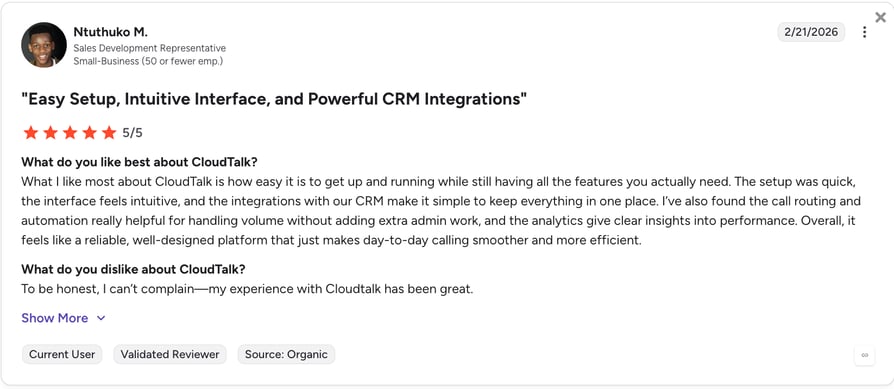
”CloudTalk has made it incredibly easy to manage and track all my sales and customer calls in one place. I love how seamlessly it integrates with CRMs like HubSpot and Apollo. The call quality is reliable, and features like call recording and analytics make it easy to review performance and improve conversations.”

Who Is CloudTalk Best For?
SMBs and mid-market sales and support teams that need real voice capability without enterprise contracts.
Synthflow: Best for No-Code Voice AI Agents at Startup Scale
What is Synthflow?
Synthflow is a no-code voice-AI platform for building inbound and outbound phone agents quickly. Unlike Kore.AI's developer-heavy XO platform, it's designed for non-technical teams who want a voice agent live in days, not months. Teams comparing options often look at the Synthflow alternative landscape to weigh voice depth against price.
Why Synthflow is Better than Kore.AI
- No-code builder — no engineering team required to launch a voice agent
- Voice-native architecture rather than voice bolted onto a chat platform
- Transparent, published pricing instead of custom enterprise quotes
- Faster time-to-value for SMBs that don't need enterprise governance
What is Synthflow's Pricing?
- Entry plans start in the low hundreds per month, with included call minutes
- Per-minute overage rates apply beyond plan allowances
- Scaling and enterprise tiers available for higher volumes
Who Is Synthflow Best For?
SMBs and startups that want a voice agent live fast without Kore.AI's implementation overhead.
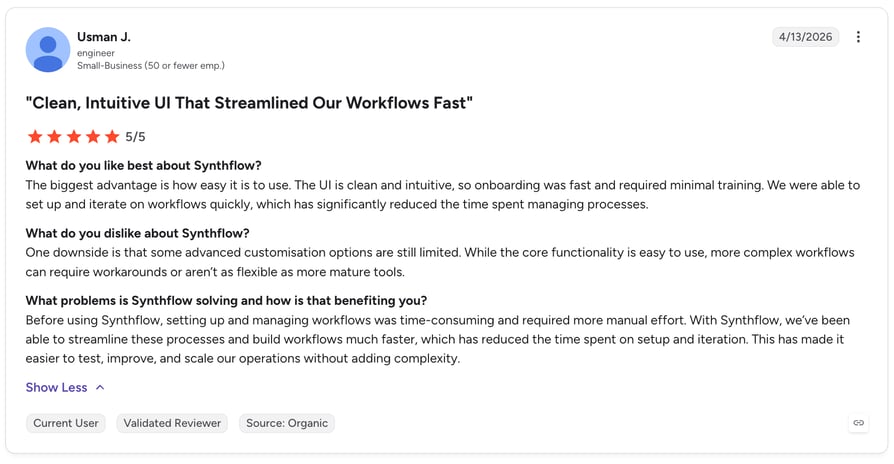
What Do Synthflow Reviews Say?
Vapi: Best for Developers Who Want Granular, Usage-Based Voice Infrastructure
What is Vapi?
Vapi is a developer-focused voice-AI infrastructure platform that lets engineering teams assemble their own STT, LLM, and TTS stack with fine-grained control. It appeals to teams that want to build, not buy — and that prefer transparent per-minute pricing. Many teams evaluate the Vapi alternative options when they want voice power without managing the full stack themselves.
Why Vapi is Better than Kore.AI
- Transparent per-minute pricing rather than bundled sessions and seats
- Full control over models and call logic for custom builds
- No mandatory enterprise contract to access core capabilities
- Pay only for what you use, with no seat minimums
What is Vapi's Pricing?
- Core platform billed per minute of voice usage
- Underlying LLM, STT, and TTS providers billed separately (BYO keys)
- Enterprise plans available for volume and support
Who Is Vapi Best For?
Developer-led teams and technical ops functions that want to compose their own voice stack with usage-based costs.
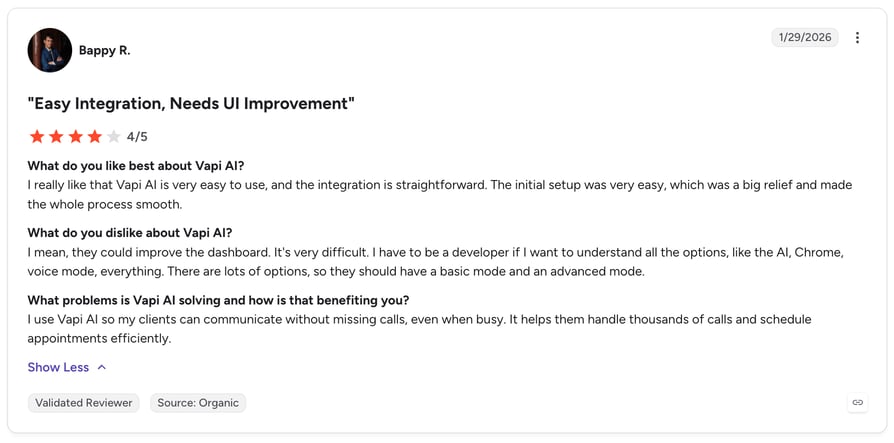
What Do Vapi Reviews Say?
PolyAI: Best for Enterprise Voice Assistants Without Kore.AI's Build Burden
What is PolyAI?
PolyAI builds enterprise-grade voice assistants for customer service, with a focus on natural, human-like conversation in the contact center. It targets the same large-enterprise buyers as Kore.AI but leans more managed-service than build-it-yourself. Buyers frequently weigh the PolyAI alternative field when comparing enterprise voice options.
Why PolyAI is Better than Kore.AI
- Purpose-built for enterprise voice rather than general conversational AI
- More managed delivery, reducing the in-house engineering burden
- Strong natural-language voice quality for high-volume contact centers
- Focused scope can mean faster deployment than a full XO platform build
What is PolyAI's Pricing?
- Custom, enterprise-only pricing (quote required)
- Typically usage- and volume-based, like Kore.AI's enterprise tier
- Best evaluated against Kore.AI for large voice deployments specifically
Who Is PolyAI Best For?
Large enterprises that want a voice-first assistant for the contact center without building everything on a developer platform. For teams that also want predictable pricing, it's worth comparing against the best conversation intelligence software before committing.
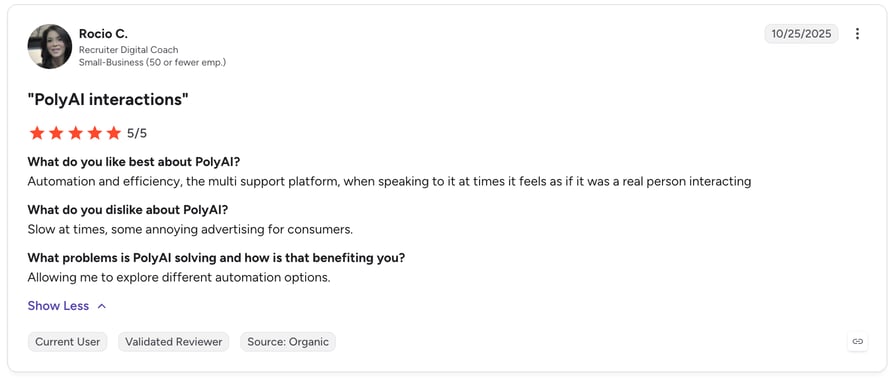
What Do PolyAI Reviews Say?

Try CloudTalk's 14-day free trial and elevate your business today.
What Are Kore.AI's Best Features?
Understanding Kore.AI's pricing means understanding what you're paying for. The platform's strength is breadth and enterprise depth. Here are the four capabilities that most justify the cost, with an honest note on where each could be better. If your priority is voice specifically, it's worth comparing against dedicated automated voice agents to judge whether Kore.AI's generalist depth is overkill for your needs.
No-Code XO Platform and Bot Builder
Kore.AI's XO Platform lets you design, train, deploy, and analyze virtual assistants in one environment, with pre-built connectors for CRMs, ITSMs, and telephony providers. It handles multi-intent conversations, interruptions, and entity extraction at a level few generalist tools match.
Enterprise-Grade NLU and Multilingual Support
Kore.AI offers strong natural-language understanding with sentiment analysis, 30+ languages across chat and voice, and a generative-AI layer built on top of large language models. For global contact centers, that linguistic depth is a genuine differentiator.
Contact Center AI and Agent Assist
Kore.AI's Contact Center AI claims substantial reductions in call volume after deflection, and Agent AI reports meaningful decreases in average handle time through real-time assistance. Seat-based licensing gives predictable per-agent budgeting once rates are set.
Deep Integrations and Data Governance
Built-in connectors for Salesforce, Zendesk, Genesys, MS Dynamics, and more, combined with role-based access controls and compliance tooling, make Kore.AI a fit for regulated industries. Its model-, cloud-, and data-agnostic architecture adds deployment flexibility.
What Are the Pros and Cons of Kore.AI?
| Pros | Cons |
|---|---|
| Enterprise depth — Handles complex, multi-channel automation at scale | No public pricing — No flat plan prices; most deployments need a sales quote |
| Strong NLU — Multi-intent handling, sentiment analysis, 30+ languages | Session-based billing — 15-minute blocks make costs unpredictable |
| Broad integrations — Pre-built connectors for major CRMs and telephony | Steep learning curve — Hard for non-technical teams to deploy |
| Compliance-ready — Governance and role-based access for regulated industries | Stacked add-ons — Voice, support, and analytics billed separately |
| Proven at scale — Used by Fortune 2000 brands and large contact centers | Implementation-heavy — Needs dedicated technical resources to deploy |
Is Kore.AI Worth the Price for Your Team?
Kore.AI is a strong fit for a specific type of buyer: the large, well-resourced enterprise. If you're a Fortune 2000 brand or a regulated organization with a dedicated IT team, deep budget, and complex automation needs across many channels and languages, Kore.AI can absolutely deliver — and the Kore.AI's voice assistant pricing 2026 model, while complex, is designed for exactly that scale.
Kore.AI makes sense if:
- You're a large enterprise or regulated business with in-house technical resources
- You need multi-channel, multilingual automation at high volume
- You can absorb usage-based billing and budget for add-ons and implementation
- Compliance, governance, and enterprise administration are non-negotiable
Kore.AI is probably not the right fit if:
- You're a small or mid-sized team without dedicated engineering support
- You need predictable, flat-rate pricing instead of sessions and seats
- Your core need is voice calling rather than broad conversational AI
- Billing transparency and fast time-to-value matter more than maximum configurability
The key cost considerations are consistent: total spend grows with usage, voice and add-ons stack on top, and the final price depends entirely on a custom quote. If that unpredictability is a dealbreaker — and especially if your business runs on phone calls — a flat-rate, voice-native platform is the better call. For most SMB and mid-market teams, a purpose-built AI voice agent platform like CloudTalk delivers the calling capability you need at a price you can actually forecast.
If calling is core to your business, CloudTalk gives you a complete AI-powered calling platform with flat-rate pricing, real-time analytics, and 160+ country coverage, built specifically for sales and support teams that live on the phone.
FAQs: Kore.AI Pricing
Kore.AI is an enterprise conversational AI software platform for building, deploying, and managing AI agents and virtual assistants across chat and voice channels. Its XO Platform combines no-code tools, natural-language understanding, and pre-built connectors for CRMs and telephony, and it's used by Fortune 2000 brands for large-scale customer service and internal automation.
Kore.AI's chatbot (Automation AI) is billed on usage, not a flat monthly fee. Kore.AI's own documentation puts the rate at $0.20 per 15-minute conversation session, with $500 in free credits for new accounts. So 500 short conversations a month is roughly $100; a 31-minute conversation counts as three sessions ($0.60). Voice and agent seats are billed separately and require a sales quote, and Standard Support starts at $1,000/month. Teams that mainly need call handling often find a flat-rate AI receptionist easier to budget for.
For large enterprises with technical resources, strict compliance needs, and high-volume, multi-channel automation, Kore.AI can be worth it. For smaller teams — or teams whose main need is voice calling — the session-based billing, seat licensing, add-ons, and steep learning curve often make a flat-rate, voice-native alternative the better value. Comparing Kore.AI against a focused voice platform, as in this CloudTalk vs. Retell AI breakdown, is a useful way to judge the trade-off.
Kore.AI doesn't publish a fixed, plan-by-plan pricing page. Its documentation explains how billing works (sessions, seats, add-ons) rather than how much it costs, because real deployments are quoted per use case. The mixed model — session-based for Automation AI, seat-based for Contact Center AI, plus separately billed voice and add-ons — also makes a single sticker price impractical. If you want a transparent point of comparison, CloudTalk publishes its VoIP pricing openly.
The custom, usage-based Kore.AI pricing model is best suited for large corporations — particularly in regulated industries like finance, healthcare, and telecom — that have substantial budgets, dedicated IT teams, and complex, long-term AI projects. These organizations can absorb usage-based billing and have the resources to manage implementation and ongoing optimization. Businesses at this scale often evaluate it alongside a dedicated enterprise call center solution.
Smaller teams can start on the self-serve Standard plan with $500 in free evaluation credits and the lower-cost Essential tier, but consistent, official details on these tiers are limited, and usage-based billing applies. Because the platform is geared toward enterprise deployments, smaller teams often find better value — and far more predictable costs — with transparent, flat-rate alternatives such as CloudTalk's AI voice agents for SMBs.