TL;DR: Synthflow vs Vapi AI at a Glance
- 01Synthflow is a no-code, visual voice AI platform now sold as an enterprise package: bundled pricing from $30,000/year, 200+ integrations, and launch support included.
- 02Vapi AI is a developer-first, API-driven platform: $0.05/minute hosting plus at-cost model fees, full control over the LLM, voice and telephony stack, no visual builder.
- 03There is no universal winner. The right pick depends on your team's technical resources and how fast you need to go live, not on a ranking.
- 04A third option: CloudTalk's AI Voice Agents ship no-code and are already wired into a full business phone system, from $99/month on top of a $19/user/month plan.
Both platforms are strong at what they were built for.
Synthflow, founded in Berlin in 2023 and backed by a $20M Accel-led Series A, runs 65M+ voice calls a month in 30+ countries and holds a 4.5/5 on G2 from 1,000+ reviews, with customers like Freshworks and Hostinger.
Vapi AI, a San Francisco Y Combinator company that raised a $50M Series B in 2026, powers voice agents for Amazon Ring, Intuit, and ServiceTitan and claims a developer community in the hundreds of thousands.
The split is clean. Synthflow fits non-technical business and ops teams that want a visual builder, bundled billing, and same-day deployment. Vapi fits engineering-led teams that want the lowest headline rate and API-level control over every layer of the stack, and are happy to build and maintain it themselves.
Below we work through the Synthflow vs Vapi AI 2026 decision layer by layer — strengths, features, latency, pricing, integrations, security, usability and reviews — or jump straight to the key differences table.

Want a voice agent without running the stack yourself?

Synthflow vs. Vapi AI: Core Strengths of Each Platform
Both platforms solve the same problem — getting a working AI voice agent live — but they optimize for different priorities. Synthflow optimizes for fast no-code launch and predictable, bundled billing. Vapi optimizes for developer control and raw cost efficiency. Neither approach is wrong; they serve different teams.
Where Synthflow Shines
| Strength | Why it matters |
|---|---|
| No-code visual workflow builder | Non-technical teams design, test and launch call flows without writing code — often the same day. |
| Bundled pricing | Speech-to-text, voice and LLM usage are included in one contract, so one bill covers the whole stack. |
| 200+ integrations and templates | Native connections to HubSpot, Salesforce, GoHighLevel and calendars, plus pre-built flows for common use cases. |
| Launch and account support | Enterprise contracts include implementation, onboarding, testing, training and ongoing optimization. |
| Well-defined call flows | Booking, reception, qualification and support flows follow proven templates instead of being built from scratch. |
Where Vapi AI Shines
| Strength | Why it matters |
|---|---|
| Lowest headline base rate | $0.05/minute platform hosting, with model provider costs passed through at cost — or $0 if you bring your own API keys. |
| Full API-level control | Developers choose and tune the LLM, speech-to-text and text-to-speech providers for every agent. |
| BYOK model avoids lock-in | Bring-your-own-key support means you keep direct relationships with model providers and can swap them out. |
| Complex conversation logic | Custom prompts, webhooks and tools support conversation designs that outgrow template-driven builders. |
| Transparent modular pricing | Each layer of the stack is a visible line item, so engineering teams can optimize cost per component. |
At a Glance: Synthflow vs. Vapi AI, Key Differences
Every synthflow vs vapi comparison eventually reduces to the dimensions below. Use this table to identify what matters most for your use case, then jump to the relevant section for detail.
| Dimension | Synthflow | Vapi AI | Best suited for |
|---|---|---|---|
| Builder type | No-code visual workflow builder | API-first, no visual interface | Synthflow: business teams / Vapi: engineering teams |
| Pricing model | Bundled enterprise contract, from $30,000/year | Modular usage-based, $0.05/min hosting + model costs | Budget owners vs. cost optimizers |
| Language support | 30+ languages and accents claimed; core set fully supported, ~two dozen in beta per docs | Depends on chosen STT/TTS providers; configured per agent | Multilingual teams should test their exact languages |
| Integrations | 200+ native and template integrations | API/webhook-driven; built per connection | CRM-centric teams vs. custom stacks |
| Provider choice | Managed stack; Synthflow selects and bundles providers | Full choice: ElevenLabs, Deepgram, Cartesia, Azure and more, with BYOK | Teams with strong provider preferences |
| Latency | Vendor claims sub-100ms platform latency | Vendor targets p50 <500ms; independent tests measured ~720ms median | Both claims are vendor-published — run your own test calls |
| Support model | Implementation and account support scoped into contracts | Discord community + email on Build; dedicated team on Scale | Hands-held rollouts vs. self-serve builders |
| Ideal team | Mid-market and enterprise ops, CX and BPO teams | Startups and product teams with in-house engineers | Match the platform to the team you already have |
Synthflow Features vs. Vapi AI Features
The Synthflow vs. Vapi AI features question is less about what each platform can do — both can run an inbound receptionist, qualify leads, book appointments, and hand calls to humans — and more about how much of it arrives pre-built. Synthflow sells assembled capability; Vapi sells the parts and the freedom to assemble them differently.
Synthflow Features
Synthflow packages the whole voice stack behind a visual workflow builder: speech-to-text, voices and LLM usage are bundled, and booking, transfer and voicemail-detection workflows ship built in. It's the shape of product teams pick for receptionist-style work, from an AI receptionist for insurance agencies to an after-hours virtual receptionist.
What Synthflow Does Well
- Drag-and-drop visual builder.Non-technical users design and launch agents without engineering time.
- Bundled STT and transcription.No separate per-minute transcription line item to track.
- 200+ integrations.Native CRM, telephony, CCaaS and calendar connections, plus Zapier and Make.
- Built-in workflows.Appointment booking, call transfer and voicemail detection work out of the box.
- Template marketplace.Pre-built flows for common use cases shorten time from signup to first live call.
Where Synthflow Falls Short
| Complexity ceiling. Reviewers report the platform feels limiting once workflows grow past its prebuilt patterns. |
| Conflicting language claims. Marketing cites 30+ (in places 50+) languages, while Synthflow's own docs list a smaller fully supported core with roughly two dozen more in beta. Test your languages before you commit. |
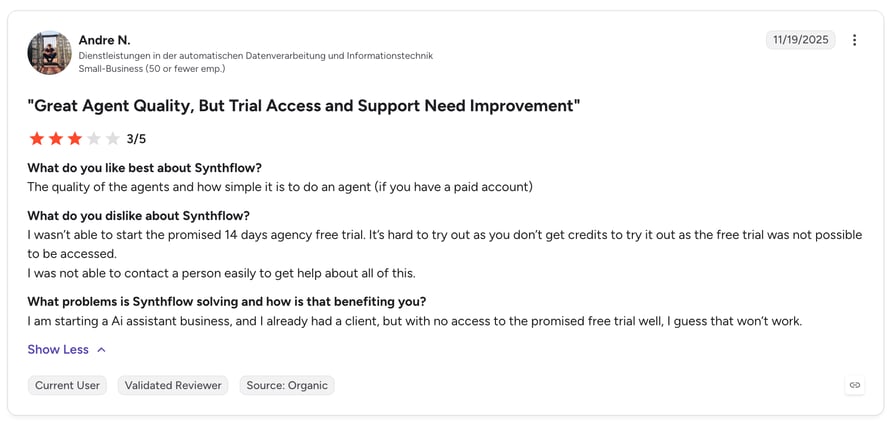
| Cost at scale. "Expensive" is the single most-mentioned complaint theme in Synthflow's G2 reviews, and entry now starts at enterprise contract level. |
| Customization below developer-first platforms. You work within Synthflow's managed stack rather than choosing your own providers. |
Vapi AI Features
Vapi is fully API-driven: there is no visual interface, and every agent is assembled in code from your choice of LLM, speech-to-text and text-to-speech providers. That synthflow vs vapi api difference is the whole product philosophy — Vapi gives you the primitives and stays out of the way.
What Vapi AI Does Well
- Deep configurability.Model, voice and telephony choices are tunable per agent, per use case.
- BYOK avoids lock-in.Bring your own API keys and pay model providers directly, at their prices.
- Lowest headline rate.$0.05/minute platform hosting is the cheapest entry point in this comparison.
- Custom conversation logic.Webhooks, tools and prompt control support genuinely complex agent behavior.
- Broad provider ecosystem.ElevenLabs, Deepgram, Cartesia, Azure and more plug into the same stack.
Where Vapi AI Falls Short
| No visual interface. Every element is configured via API and webhooks; non-developers are locked out. |
| Engineering dependency. Prompt engineering, integration builds and LLM tuning all need developer time — at launch and for every change after. |
| Separate model billing. STT, TTS and LLM usage are billed on top of the platform fee, each as its own line item. |
| Less predictable all-in cost. The real per-minute price depends on your provider mix and can drift well above the $0.05 headline. |
Feature-by-Feature Comparison
| Feature | Synthflow | Vapi AI |
|---|---|---|
| Builder type | No-code visual builder | API and SDK only |
| STT/transcription | Bundled in contract | Separate line item, at provider cost |
| Integrations | 200+ native and template | Webhook/API, built per connection |
| Template marketplace | Yes | No — examples and docs instead |
| Provider/model choice | Managed by Synthflow | Full choice, including BYOK |
| Language support | 30+ claimed; core set fully supported | Provider-dependent, configured per agent |
| Built-in workflows (booking, transfer) | Yes, out of the box | Built via API and webhooks |
| Testing tools | In-builder test calls | Test suites and simulated calls for developers |
Try everything CloudTalk has in store - free for 14 days.
Latency & Voice Quality: Synthflow vs. Vapi AI
Latency decides whether a voice agent feels like a conversation or a walkie-talkie. Anything much past a second between the caller finishing and the agent replying reads as robotic, drives interruptions, and kills trust in the first ten seconds of a call. On Synthflow vs Vapi AI latency, be careful with the numbers: both figures below come from vendor marketing, each measured under conditions the vendor chose. Synthflow advertises sub-100ms platform latency; Vapi publishes targets of p50 under 500ms, while independent testing of an optimized Vapi setup measured around 720ms median. Neither number is independently audited — treat both as claims, not benchmarks, and run test calls on your own numbers.
| Dimension | Synthflow | Vapi AI |
|---|---|---|
| Claimed latency | Sub-100ms platform latency (vendor marketing) | p50 under 500ms target (vendor); ~720ms median in independent testing |
| Voice provider model | Bundled default voices, managed stack | Full provider choice (ElevenLabs, Cartesia, Azure and more) |
| Consistency at high concurrency | Concurrency planned into enterprise contracts | 10 concurrent lines included, $10/line/month beyond |
| Tuning effort for best performance | Low — managed by the platform | High — provider selection and tuning are on your team |
Synthflow Pricing vs Vapi AI Pricing
This is where the synthflow vs vapi pricing comparison has changed most in the past year, so ignore anything quoting old self-serve tiers.
Synthflow Pricing
Synthflow no longer publishes self-serve plans. As of 29 July 2026, its pricing page lists a single enterprise model: contracts starting at $30,000 annually, scoped around call volume, concurrency, telephony setup, integrations, security requirements and launch support. Older third-party articles still quote $29–$375/month subscription tiers or a ~$0.13/minute Pro rate — those tiers no longer appear on Synthflow's own pricing page. Speech-to-text, voices and LLM usage remain bundled into the contract price. Our Synthflow pricing breakdown tracks the details.
Vapi AI Pricing
Vapi's Build tier is usage-based with no monthly subscription: $0.05/minute platform hosting, plus model provider costs (speech-to-text, LLM and text-to-speech) passed through at cost — or $0 if you bring your own API keys. SMS runs $0.005/message, 10 concurrent call lines are included with extra lines at $10/line/month, and new accounts get free starter credit. Real-world blended costs are commonly reported at $0.13–$0.30/minute once provider fees are added. HIPAA is a $2,000/month add-on and Zero Data Retention $1,000/month; the Scale tier moves to an annual contract with volume-based rates. Full teardown in our Vapi pricing guide.
What to Budget for Beyond the Base Rate (Both Platforms)
- Synthflow's bundled pricing is simpler to budget — one contract covers the stack — but the $30,000 annual floor prices out smaller teams entirely.
- Vapi's modular pricing has a lower headline rate, but knowing your real cost means tracking platform, STT, TTS and LLM bills separately — and compliance add-ons can exceed the usage bill.
- Model the full year, not the first month. Our guide to how much voice AI costs walks through the math for all three pricing models.
Pricing Compared Line by Line
| Pricing dimension | Synthflow | Vapi AI | CloudTalk |
|---|---|---|---|
| Headline rate | From $30,000/year (enterprise contract) | $0.05/min hosting + model costs | AI Voice Agent from $99/200 minutes |
| Pricing model | Bundled contract | Modular, usage-based | Transparent, subscription + minute bundles, full phone system included, purchasable add-ons |
| STT/transcription | Included in contract | Billed separately, at provider cost | Included in AI add-on pricing |
| Free trial / credit | Demo-led; no public self-serve trial | Free starter credit for new accounts | 14-day free trial, no credit card required |
| Typical minimum spend | $30,000/year | None — pay as you go | One seat |
| Billing predictability | High — fixed contract | Low — varies with provider mix and volume | High — published plan and add-on prices |
Read the table by failure mode, not by smallest number. Synthflow's risk is paying an enterprise floor for volume you never reach; Vapi's is a headline rate that quietly triples once provider fees land; a bundled per-seat model like CloudTalk's trades some ceiling for a bill you can predict in January for December.
Now, compare it to CloudTalk's transparent and predictable pricing, so you always know what you're paying for.
Flexible Pricing Plans to Scale with You
Compare our plans
Synthflow Integrations vs. Vapi AI Integrations
A voice agent that can't read or write your CRM is a demo, not a deployment. Every booking it takes, lead it qualifies and call it summarizes has to land in the systems your team already works in, so integration depth decides how much of each platform's promise you actually collect.
Synthflow Integrations
Synthflow claims 200+ integrations spanning CRM (HubSpot, Salesforce, GoHighLevel), telephony, contact-center stacks and calendars like Cal.com, most of them pre-built and configurable without code. Zapier and Make extend the reach further. Enterprise contracts scope custom integration work into the rollout, so deeper connections are a delivery item rather than a DIY project.
Vapi AI Integrations
Vapi takes the opposite approach: integrations are primarily API- and webhook-driven. There is no native CRM catalog to browse — your developers build each connection, which makes anything possible and nothing automatic. That's fine for product teams embedding voice into their own software, and expensive for business teams that just need calls logged in the CRM.
Integration Capability Compared
| Integration capability | Synthflow | Vapi AI |
|---|---|---|
| Total native integrations | 200+ claimed | None native; API/webhook only |
| CRM sync depth | Pre-built for major CRMs | As deep as your developers build it |
| Telephony / SIP / BYOC | Native telephony, SIP trunking, enterprise telephony options | Supported, configured in code |
| Developer requirement | Optional | Mandatory |
| Workflow automation | Visual builder + Zapier/Make | Webhooks and custom tools |
Security & Compliance: Synthflow vs. Vapi AI
Voice agents record calls, transcribe them and push the contents into other systems, which makes compliance a buying criterion rather than paperwork. The two platforms handle it differently: Synthflow bundles certifications into its enterprise posture, while Vapi prices several compliance capabilities as separate add-ons and tiers. Verify certificates directly in each vendor's trust portal rather than trusting badges — this is the section where marketing runs furthest ahead of documentation.
Synthflow Security & Compliance
- Certifications displayed: SOC 2, GDPR, HIPAA and ISO 27001 badges on the live site, with a dedicated security portal (security.synthflow.ai) for verification.
- Data residency: EU and US hosting options are advertised.
- Enterprise controls: MSA/DPA support, data-handling review and workspace controls are scoped into enterprise contracts.
Vapi AI Security & Compliance
- Tier-gated compliance: SOC 2, SSO and RBAC are listed on the Scale (annual contract) tier, not on the self-serve Build tier.
- HIPAA is a paid add-on at $2,000/month on either tier — a specific, factual difference, not an overall weakness.
- Zero Data Retention costs a further $1,000/month; standard Build-tier call history is retained 14 days.
- Data residency: available on the Scale tier.
Security & Compliance Compared
| Security & compliance | Synthflow | Vapi AI |
|---|---|---|
| Named certifications | SOC 2, ISO 27001, GDPR, HIPAA | SOC 2 on Scale tier; HIPAA as $2,000/month add-on |
| Data residency | EU and US hosting | Scale tier only |
| Access controls | Workspace controls in enterprise contracts | SSO and RBAC on Scale tier |
| Data retention | Scoped in contract | 14-day call history on Build; Zero Data Retention $1,000/month |
Usability & Developer Experience: Synthflow vs. Vapi AI
Usability is where the two platforms stop being comparable products and become different job descriptions: on Synthflow the agent is configured by the team that owns the calls; on Vapi it's built by the team that owns the codebase. Neither is wrong — but pick the one that matches people you actually employ.
Synthflow Usability
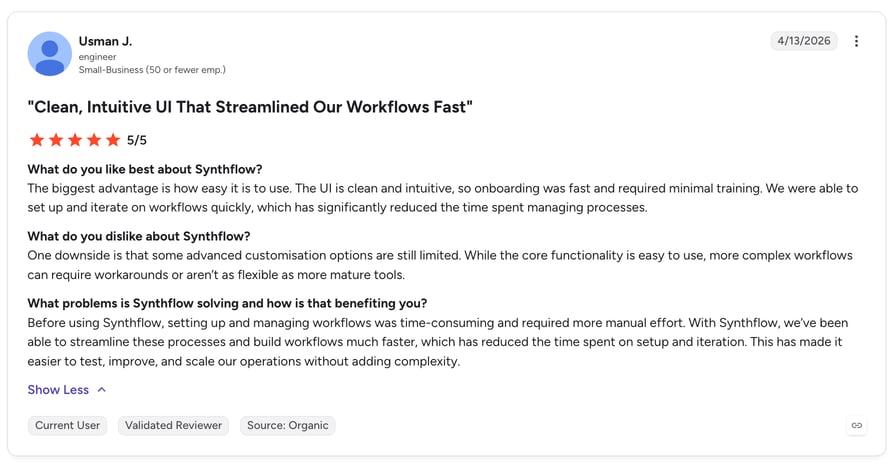
- Drag-and-drop builder and guided setup — ease of use is the single most-praised theme in Synthflow's G2 reviews.
- Same-day launch — most teams are handling calls the day they start, per current claims and reviews.
- Onboarding included — implementation, testing and training are part of enterprise contracts.
Vapi AI Usability
- Fully API-driven — no visual interface exists; the dashboard is for configuration and monitoring, not flow building.
- Developers required — prompt engineering, webhook setup, LLM tuning and integration builds are all engineering work.
- The learning curve buys control — for vapi vs synthflow for developers, Vapi is the clear preference in reviews: deeper docs, more knobs, fewer guardrails.
Usability & Scalability Compared
| Dimension | Synthflow | Vapi AI | CloudTalk |
|---|---|---|---|
| Setup time | Same day (with contracted onboarding) | Days to weeks, engineering-led | Under an hour, self-serve |
| Technical skill required | None | Developer required | None |
| Visual builder | Yes | No | Yes — agent builder + call flow designer |
| Customization ceiling | Template-bound | Effectively unlimited | High within the platform; no code to maintain |
| Ideal team | Enterprise ops and CX teams | Product and engineering teams | SMB and mid-market sales/support teams |
Synthflow Reviews vs. Vapi AI Reviews on G2
For Synthflow vs. Vapi AI reviews, G2 is the most useful shared reference — though the two review bases differ wildly in size, and candid user sentiment on Reddit often cuts sharper than either vendor's marketing.
G2 Ratings Compared
| Review dimension | Synthflow | Vapi AI |
|---|---|---|
| G2 rating | 4.5/5 | 4.2/5 |
| Review base | 1,000+ reviews | Very small review base — treat the average as directional |
| Most-praised themes | Ease of use, setup ease, easy integrations | Flexibility, documentation, customization depth |
| Most-flagged complaints | Cost ("expensive" is the top complaint theme), learning curve, limits at complexity | Steep learning curve, complex setup, limited support for non-developers |
What Real Users Say About Synthflow On G2
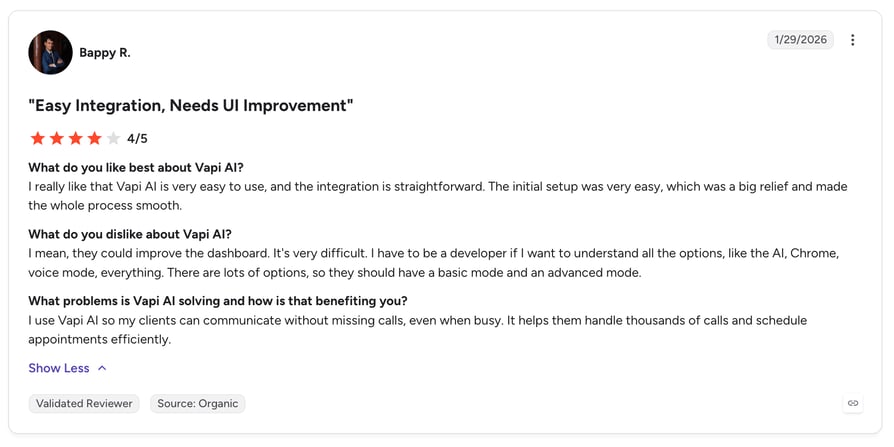
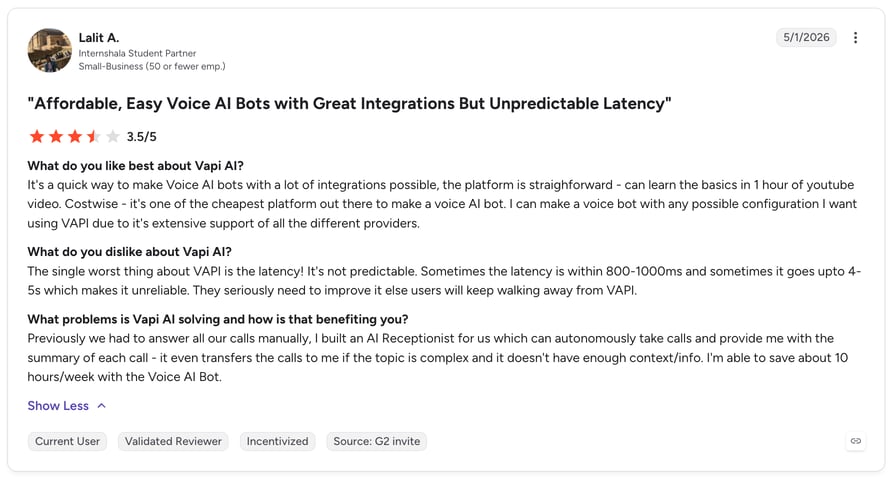
What Real Users Say About Vapi AI On G2
Synthflow Reviews vs. Vapi AI Reviews on Reddit
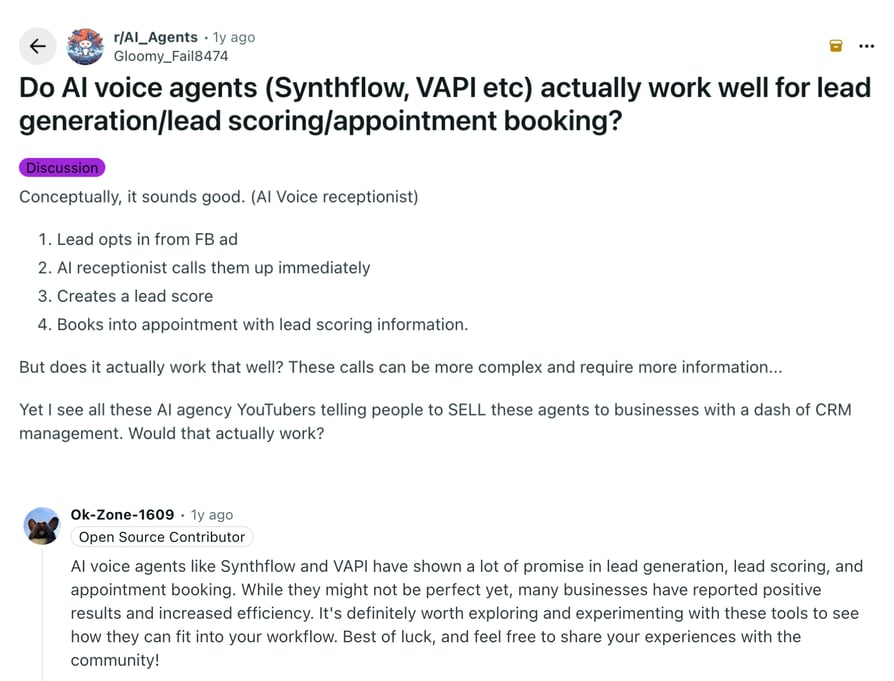
What Real Users Say About Synthflow On Reddit
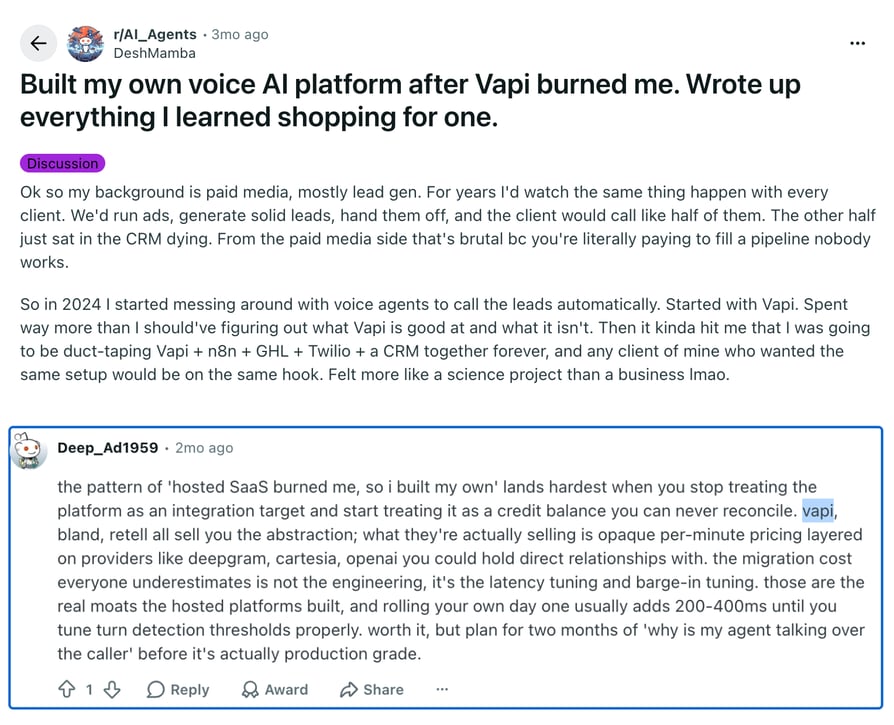
What Real Users Say About Vapi AI On Reddit
Synthflow Pros & Cons vs. Vapi AI Pros & Cons
Synthflow Pros & Cons
| Pros | Cons |
|---|---|
| No-code visual builder with same-day launch | Feels limiting as workflow complexity grows |
| Bundled pricing covers STT, voice and LLM in one contract | Conflicting language-support claims across marketing and docs |
| 200+ integrations and a template marketplace | Cost is the top G2 complaint theme, and entry now starts at $30,000/year |
| Implementation and launch support included in contracts | Customization ceiling below developer-first platforms |
| 4.5/5 on G2 from 1,000+ reviews | No self-serve entry point for small teams anymore |
Vapi AI Pros & Cons
| Pros | Cons |
|---|---|
| Lowest headline rate at $0.05/minute hosting | No visual interface; every element is configured via API |
| Full control over LLM, voice and telephony providers | Requires developers to launch and to maintain |
| BYOK model avoids vendor lock-in | STT, TTS and LLM billed separately, so real cost is less predictable |
| Strong fit for custom, complex conversation logic | HIPAA costs $2,000/month extra; SOC 2 sits on the contract tier |
| Backed by a $50M Series B, with Amazon Ring and Intuit as customers | Community-and-email support only on the self-serve tier |
...or choose the 3rd option and skip the dilemma completely.
Which Team Fits Which Platform?
Fit depends on technical resources, team size and how much control versus speed you need — not on which platform is "better." The fastest way to a wrong decision is buying the platform your favorite reviewer liked instead of the one your team can operate on a Tuesday afternoon.
| Synthflow is the right fit for... | Vapi AI is the right fit for... |
|---|---|
| Non-technical business and ops teams with enterprise budgets | Teams with dedicated engineering resources |
| BPOs and agencies that need fast, templated deployment | Teams that need a specific LLM/voice/telephony combination |
| Teams that want one predictable, bundled bill | Teams chasing the lowest headline cost and willing to track multiple provider bills |
| Straightforward, well-defined call flows at volume | Highly custom conversation logic and product-embedded voice |
Synthflow vs. Vapi AI: The Verdict
The Vapi AI vs. Synthflow decision comes down to your team's technical resources and use case, not platform quality. Both do exactly what they promise — for different buyers.
Choose Synthflow if you…
- Run an ops, CX or BPO team with no developers to spare
- Have enterprise budget and want implementation done for you
- Need to be live this week, not this quarter
- Want one bundled bill instead of four provider invoices
- Run well-defined flows: reception, booking, qualification, support
Choose Vapi AI if you…
- Have in-house engineers who own voice as a product
- Need a specific LLM, voice or telephony provider combination
- Want the lowest headline rate and can manage modular billing
- Are building conversation logic no template can express
- Prefer BYOK control over managed convenience
Book a demo to see exactly how CloudTalk can elevate your business.
Frequently Asked Questions About Synthflow vs Vapi AI
Neither is universally better. Synthflow is stronger for non-technical teams that want a no-code builder with launch support; Vapi is stronger for engineering teams that want API-level control. Compare both against the wider field of the best AI voice agents before deciding.
Vapi is cheaper to start: $0.05/minute hosting plus model costs, versus Synthflow's $30,000/year contract floor. At scale the gap narrows, since Vapi's provider fees push real costs to a reported $0.13–$0.30/minute. For a bundled middle path, see CloudTalk's AI Voice Agent pricing.
Yes. Vapi has no visual workflow interface — agents, integrations and handoffs are configured through APIs and webhooks, so you need developer time for launch and for every change afterward. No-code alternatives include Synthflow's builder and CloudTalk's visual call flow designer.
Synthflow's marketing claims 30+ (in places 50+) languages, while its documentation lists a smaller fully supported core with roughly two dozen more in beta. Test your exact languages on a trial call before committing — the same advice applies to any multilingual customer support setup. For reference, CloudTalk's AI Voice Agents cover 60+ languages and accents.
On paper: Synthflow claims sub-100ms platform latency, Vapi targets a p50 under 500ms, and independent testing measured an optimized Vapi setup around 720ms median. Both headline figures are vendor-published and measured differently, so run test calls on your own numbers — the way CloudTalk publishes its load-tested call quality methodology.
It depends on why you're leaving. If it's the $30,000 contract floor, CloudTalk is the strongest Synthflow alternative — the same no-code approach, from $19/user/month with the AI agent as an add-on. If you want deeper technical control, Vapi is the developer-first route.
For teams that hit Vapi's engineering requirement, the best Vapi AI alternative is a platform where the voice agent ships pre-integrated: CloudTalk pairs a no-code agent with numbers, call routing and CRM sync out of the box. Synthflow is the alternative if you specifically want a managed enterprise rollout.
Vapi's free native numbers are US-focused; for international calling you typically import numbers from Twilio, Telnyx or Vonage or bring your own SIP trunk, which is more configuration work. Synthflow offers native telephony and SIP options scoped into its contracts. If global coverage is the priority, CloudTalk provides local international numbers in 160+ countries with the agent already attached.