12 Best AI Voice Agents for Healthcare in 2026 — Expert-Tested & Ranked
TL;DR
The best AI voice agent for healthcare in 2026 is CloudTalk, because it puts AI voice, HIPAA-ready CRM logging, and multilingual patient support inside one native calling platform instead of bolting AI onto a separate tool. We tested and ranked 12 platforms against real patient-call workflows.
Here is every tool we cover, and who each one fits:
- 01CloudTalk: Best AI voice agent for healthcare teams that need 24/7 patient call automation, HIPAA-ready CRM sync, and multilingual support in one native platform.
- 02Thoughtly: Best for quickly building no-code voice workflows for scheduling and patient intake.
- 03Hyro.ai: Best for automating patient self-service with deep, EHR-native integration.
- 04ElevenLabs: Best for the most natural, human-sounding patient voice quality.
- 05Retell AI: Best for launching lightweight AI calling workflows fast with per-minute pricing.
- 06Syllable: Best for large health systems automating patient access with EHR-synced scheduling.
- 07Replicant: Best for high-volume patient contact centers under strict compliance.
- 08Voiceflow: Best for teams that want to design and own their own voice and chat workflows.
- 09Talkdesk: Best for mid-market to enterprise healthcare CCaaS with agentic AI.
- 10Genesys: Best for enterprise omnichannel orchestration across voice and digital.
- 11NICE CXone: Best for large health systems needing AI plus workforce management at scale.
- 12Five9: Best for enterprise contact centers blending automation with live agents.

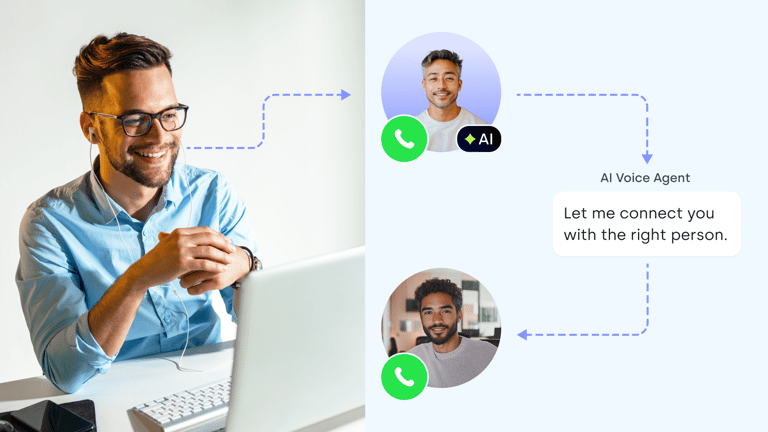
See CloudTalk's AI Voice Agent answer patient calls live

According to Tebra’s 2026 Cost of Missed Appointments report, medical practices lose an average of $22,872 per year to cancellations and no-shows, and providers face roughly 14 missed appointments a month. Behind most of those gaps is a phone that rang while the front desk was already on another call.
For a clinic, every unanswered call is a patient who books elsewhere or a refill that becomes an ER visit. For a hospital network or RCM team, it multiplies across thousands of daily interactions and lands in revenue and patient-satisfaction scores.
Most teams try to fix this by hiring more front-desk staff or adding another IVR menu, but headcount is expensive and still clocks out at 5 p.m., and a longer phone tree just moves the frustration around.That gap is what the best AI voice agents for healthcare are built to close—whether a voice calling AI agent for healthcare handling overflow after hours or voice AI systems for patient call automation running around the clock. It is why voice ai healthcare adoption is climbing fast. According to Grand View Research, the AI voice agents in healthcare market is growing at a 37.79% compound annual rate through 2030.
In this guide, we tested and ranked the 12 best AI voice agents for healthcare in 2026—from top voice assistants for healthcare patient support to leading voice AI for healthcare call centers—against real patient-call workflows, so you can pick the right tool, evaluate it on compliance and EHR integration, and start reducing missed patient calls. If you are also weighing the underlying telephony, our guide to the best AI phone system for businesses is a useful companion read.
What Is an AI Voice Agent for Healthcare?
An AI voice agent in healthcare is conversational AI software that answers and makes patient phone calls on its own, holding a natural spoken conversation instead of reading from a rigid menu. A patient can ask to reschedule in their own words, and the agent understands the request, checks the calendar, and books it.
That is the difference from a traditional IVR, which waits for you to press 1 for scheduling. A voice agent understands free speech, responds conversationally, and takes action: it books, routes, captures details, and logs the call to the patient record.
In healthcare that means 24/7 call handling, appointment scheduling, prescription refill requests, and triage routing that never sends an after-hours caller to voicemail. HIPAA compliance and secure data handling are a baseline here, so a Business Associate Agreement and encrypted recording should be table stakes. The result: patients get answered instantly, admin work drops, and fewer appointments slip through.
How We Evaluated the Best AI Voice Agents for Healthcare
We reviewed 30+ AI voice agent platforms, from standalone voice AI tools to full contact-center suites with AI built in. For each we ran patient-call test scenarios (scheduling, refills, after-hours triage, escalation), then cross-checked against verified feedback on G2, Capterra, TrustRadius, and real user discussions on Reddit and Quora. We scored the finalists across six healthcare-specific criteria.
Conversation Quality in Clinical Contexts
Response latency, handling of medical terminology and medication names, recovery from interruptions and non-linear speech, and accent coverage.
HIPAA, GDPR, and Compliance Posture
Whether the vendor signs a Business Associate Agreement, holds SOC 2 Type II, supports PCI DSS, and gives clear control over data retention and audit logs, the hallmarks of a genuinely HIPAA-compliant call center.
EHR and Clinical System Integrations
How the tool connects to systems like Epic, Cerner, Salesforce Health Cloud, and HubSpot, and whether those connections are native or lean on a Zapier bridge.
Multilingual Patient Support
Language count, automatic detection, and quality in non-English medical conversations. According to the U.S. Census Bureau, nearly 68 million U.S. residents speak a language other than English at home, so this is not optional.
Deployment Speed and Setup Complexity
Whether you can self-serve and launch the same day, or need a weeks-long enterprise implementation.
Pricing Transparency
Published rates versus “contact sales” walls, and whether pricing is per-minute, per-user, or bundled.
Why Trust Our Software Reviews?
For nearly a decade, we’ve helped over 30,000+ professionals find and implement smarter business communication tools. We’ve reviewed 200+ software tools across industries, analyzed 5,500+ verified customer reviews from platforms like G2, Capterra, and Trustpilot, and drawn insights from real user discussions on Reddit and Quora.
In the past year alone, we published 1,000+ articles, each one written by humans for humans. Learn how we keep our content integrity and our software review methodology.
AI Voice Agent for Healthcare: Tool Scoring Table
To score each platform, we analyzed hundreds of verified G2 customer reviews and rated each tool across six healthcare-specific criteria on a 1–5 scale (1 = consistently poor, 3 = mixed, 5 = consistently excellent).
| Tool | Conv. Quality | HIPAA/Compliance | EHR Integration | Multilingual | Deploy Speed | Pricing Clarity | Total |
|---|---|---|---|---|---|---|---|
| CloudTalk | 5 | 5 | 5 | 5 | 5 | 5 | 30/30 |
| Thoughtly | 4 | 3 | 3 | 3 | 5 | 2 | 20/30 |
| Hyro.ai | 4 | 5 | 5 | 4 | 3 | 2 | 23/30 |
| ElevenLabs | 5 | 4 | 3 | 4 | 3 | 3 | 22/30 |
| Retell AI | 4 | 5 | 3 | 4 | 5 | 5 | 26/30 |
| Syllable | 3 | 4 | 4 | 4 | 3 | 4 | 22/30 |
| Replicant | 4 | 5 | 3 | 3 | 3 | 2 | 20/30 |
| Voiceflow | 3 | 4 | 3 | 3 | 3 | 3 | 19/30 |
| Talkdesk | 4 | 5 | 4 | 5 | 3 | 4 | 25/30 |
| Genesys | 4 | 5 | 4 | 4 | 2 | 3 | 22/30 |
| NICE CXone | 4 | 5 | 4 | 4 | 2 | 3 | 22/30 |
| Five9 | 4 | 5 | 4 | 4 | 2 | 2 | 21/30 |
Quick Answers: What People Ask About AI Voice Agents in Healthcare
What is an AI voice agent for healthcare?
Software that answers patient phone calls, holds a natural spoken conversation, and takes action such as booking an appointment or routing an urgent case. Unlike a phone menu, it understands free speech and works 24/7. CloudTalk’s CeTe agent handles intake, scheduling, and triage routing with HIPAA-ready call logging.
Which AI voice agent handles multilingual patient scheduling?
CloudTalk handles it in 60+ languages with automatic detection, so a caller is understood without pressing a “for Spanish” prompt. Syllable and Hyro.ai also support multilingual patient communication for large health systems. For diverse populations, automatic detection matters more than raw language count.
Which AI voice service handles refill requests and triage questions?
For triage routing, CloudTalk’s AI Specialist captures the request, applies urgency rules, and passes complex cases to clinical staff with full context. For EHR-native prescription refill workflows, Hyro.ai reads and updates patient data directly. Many teams pair inbound triage with outbound refill campaigns.
What are the top AI voice tools used in healthcare communication?
CloudTalk (AI voice plus native telephony and compliance in one platform—the go-to voice AI for healthcare contact centers), Hyro.ai (EHR-native patient self-service), Syllable (enterprise patient-access automation), and Retell AI (fast, developer-friendly deployment). The right pick depends on call volume, EHR depth, and launch speed.
See how CloudTalk handles peak-hour patient call volume before you compare the list below: start free with 50 AI Voice Agent minutes.
What is the best voice AI for automating patient intake calls?
CloudTalk's AI voice agent captures insurance details, reason for visit, and patient demographics over the phone and automatically writes the record to your CRM—no manual data entry. Thoughtly is a strong alternative for no-code intake, and Retell AI suits teams that want per-minute pricing on a lightweight pilot.
Best AI Voice Agents for Healthcare: Comparison Table
| Provider | Key Features | Best For | Starting Price | G2 Rating |
|---|---|---|---|---|
| CloudTalk | AI Voice Agent (CeTe), Smart Routing, Call Flow Designer, CRM sync, AI Smart Notes, outbound dialers | High-volume clinics and hospital networks needing AI + telephony + compliance in one platform | Phone system from $25/user/mo; AI Voice Agents add-on from $99/mo for 200 min | 4.4/5 (1,702+ reviews) |
| Thoughtly | No-code voice builder, inbound/outbound automation, CRM integrations, live handoff | Clinics launching fast without technical staff | Quote-based | 4.6/5 |
| Hyro.ai | Pre-built healthcare workflows, omnichannel voice AI, EHR integration, data-less training | Hospitals automating patient access at scale | Quote-based | 4.9/5 |
| ElevenLabs | Ultra-realistic voices, voice cloning, 32+ languages, enterprise security | Teams wanting the most natural voice quality | Quote-based (agents) | 4.5/5 |
| Retell AI | Real-time low-latency voice AI, flow builder, analytics, compliance support | SMB/growing teams wanting fast deployment | From $0.07/min | 4.8/5 |
| Syllable | EHR-integrated voice AI, multilingual support, real-time scheduling, analytics | Large health systems automating patient access | From $2.40/hour | No G2 reviews yet |
| Replicant | Omnichannel automation, HIPAA/SOC 2/PCI DSS, PII redaction, QA automation | Enterprise patient contact centers under strict compliance | Quote-based | 4.7/5 |
| Voiceflow | Visual flow builder, multi-skill agents, RAG knowledge base, multimodal | Teams designing and owning their own workflows | Quote-based/tiered | 4.5/5 |
| Talkdesk | Autopilot AI agents, Data Cloud context, multichannel automation, 59+ languages | Mid-market to enterprise CCaaS | From $85/user/mo (+ quote-based AI) | 4.4/5 |
| Genesys | Intent Miner, human handoff, omnichannel orchestration, visual builder | Enterprise omnichannel orchestration | From $85/user/mo (+ tokens) | 4.4/5 |
| NICE CXone | Agentic AI, omnichannel, deep CXone ecosystem, WFM | Large systems needing AI + workforce tools | From $110/agent/mo | 4.3/5 |
| Five9 | Intelligent Virtual Agents, Agent Assist, auto summaries, industry templates | Enterprise centers blending automation + live agents | Quote-based | 4.1/5 (625+ reviews) |
The 12 Best AI Voice Agents for Healthcare in 2026
The 12 tools below hold up in real healthcare workflows, ranked so you can match one to your team.
Best AI Voice Agents for Small Healthcare Practices
Small practices care about getting live fast, no IT team, and predictable pricing. CloudTalk, Retell AI, and Thoughtly are the strongest picks. CloudTalk lets you test on 50 free AI Voice Agent minutes and configure an agent in under 10 minutes, Retell AI offers per-minute pricing from $0.07/minute, and Thoughtly’s no-code builder ships a booking-and-intake agent without engineering help. All three cut call wait times without adding front-desk headcount.
1. CloudTalk
Best for: High-call-volume, phone-heavy healthcare teams that need AI voice, HIPAA-ready CRM logging, and multilingual support in one native platform.
CloudTalk is AI-powered business calling software that builds its CloudTalk AI Voice Agent into the telephony layer instead of bolting a separate tool onto an existing phone system, so one platform answers patient calls, routes by urgency, and logs every interaction to the CRM.
CloudTalk Category Scores
| Conv. Quality | EHR/CRM Integration | Multilingual | Deploy Speed | Pricing Clarity | Total |
|---|---|---|---|---|---|
| 5 | 5 | 5 | 5 | 5 | 30/30 |
Key Features of CloudTalk
CeTe AI Voice Agent
CeTe is CloudTalk’s fully autonomous conversational AI for phone calls. It understands intent, asks follow-up questions, pulls answers from a knowledge base, and executes actions in connected systems such as booking an appointment or creating a record, escalating to a human only when needed. On inbound it handles routine questions, schedules and confirms appointments, captures intake details using questions your practice defines, recognizes returning patients from their CRM history, and routes by urgency 24/7, so after-hours and overflow calls stop going to voicemail.
Smart Routing and Call Flow Designer
The Call Flow Designer is a visual drag-and-drop builder for incoming call flows, with condition-based routing and branching logic. You set rules around patient intent and urgency so critical cases reach clinical staff quickly while routine requests get resolved by the agent. Skill-based routing and IVR logic are available from the Starter plan.
Deep CRM and System Integrations
CloudTalk ships 100+ native integrations with two-way sync into CRMs and helpdesks like Salesforce, HubSpot, and Zendesk, no Zapier bridge required. Every call produces an automatic call transcription and AI Smart Notes on the patient record, so a call answered by CeTe and later passed to a human reads as one continuous record.
CloudTalk Performance and Technical Specs
- Latency: sub-800ms neural voices designed to be hard to distinguish from a human.
- Languages: 60+ with automatic detection.
- Compliance: HIPAA compliant (Q1 2025) with BAA support, plus SOC 2 Type II and GDPR.
- Reliability: 99.999% uptime on a decentralized SIP architecture; virtual numbers in 160+ countries.
Healthcare Use Cases for CloudTalk
Inbound patient support, appointment scheduling and reminders, after-hours triage routing, and outbound post-discharge, refill, and claims campaigns. Pre-built CeTe templates include healthcare intake and appointment scheduling.
Key Integrations for CloudTalk
Salesforce (including Health Cloud), HubSpot, Pipedrive, Zoho, and helpdesks like Zendesk and Freshdesk, all with native two-way sync; a public API, webhooks, and Zapier cover the rest.
How Complex Is CloudTalk to Set Up?
Low to moderate. Self-Service Configuration lets non-technical staff build an agent in under 10 minutes; deeper AI Specialist workflows take longer.
CloudTalk Pros and Cons
| Pros | Cons |
|---|---|
| AI voice, telephony, and compliance in one native platform, no third-party bridge | AI Voice Agents are a paid add-on on top of the seat plan, not bundled |
| 60+ languages with automatic detection | Deeper AI Specialist workflows need setup time (budget 1–2 weeks) |
| Native two-way CRM sync with automatic transcripts and AI Smart Notes | Real-time transcription and always-on voice isolation are still gaps |
What Is the Pricing of CloudTalk?
CloudTalk separates its phone-system plans from the AI Voice Agents add-on, which is never bundled into a subscription plan.
- Phone-system plans (per user/month, billed annually): Starter $25, Essential $29, Expert $49, Custom (Contact Sales).
- AI Voice Agents add-on: AI Receptionist from $99/month for 200 minutes (first 50 free), AI Specialist from $349/month for 1,000 minutes.
- IVR and call routing start on Starter; native integrations start on Essential.
What Do Customers Say About CloudTalk?
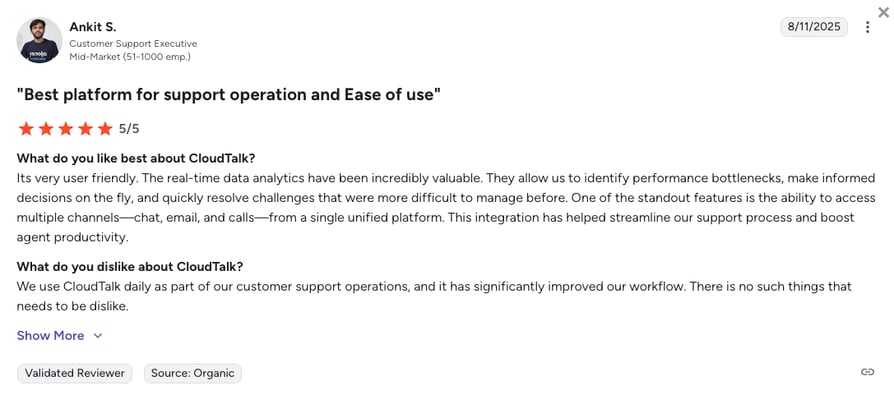
Reviewers praise the call quality, native CRM sync, and how fast non-technical teams get an agent live; some note the AI Voice Agents add-on is a separate line item and that advanced workflows take configuration time.
When to Use CloudTalk
- You handle 20+ patient calls a day and cannot afford missed calls at peak or after hours.
- You need AI voice calling and HIPAA-ready CRM logging in one native platform, no Zapier.
- You need to scale from one clinic to a multi-location network without switching platforms.
- You want inbound patient support and outbound campaigns from the same system.
- You serve multilingual populations and need automatic detection across 60+ languages.
- You want to prove ROI quickly using the 50 free AI Voice Agent minutes.
Test CloudTalk against your real call volume with a 14-day free trial.
2. Thoughtly
Best for: Clinics that want to launch AI voice automation fast without in-house technical resources.
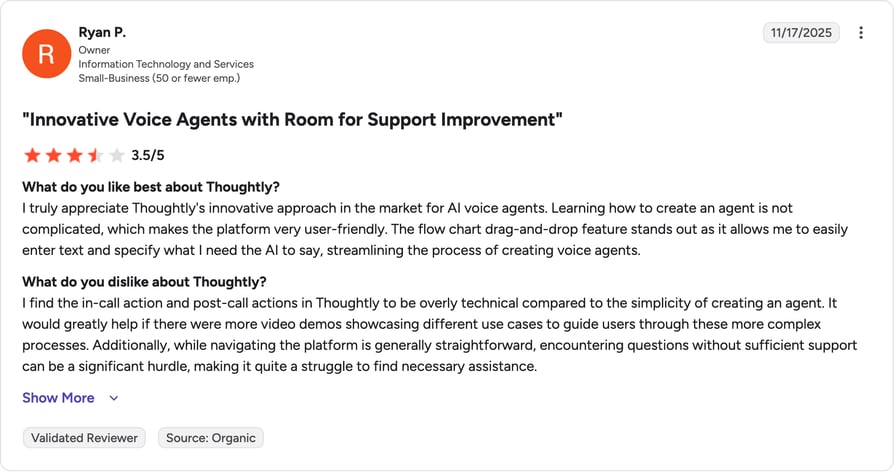
Thoughtly is a no-code AI voice agent builder for inbound and outbound call automation, used in healthcare to stand up agents for appointment requests, intake, and FAQs without building from scratch.
Key Features of Thoughtly
- No-code builder for booking, intake, and FAQs.
- Inbound and outbound automation, including reminders and follow-ups.
- CRM and scheduling integrations, such as Salesforce.
- Live agent handoff that passes context to staff.
Thoughtly Performance and Technical Specs
Healthcare Use Cases for Thoughtly
Fast-deploy appointment booking, intake, and reminder or follow-up calls for clinics without a technical team.
Key Integrations for Thoughtly
Salesforce and common scheduling tools.
How Complex Is Thoughtly to Set Up?
Low to moderate. The no-code builder simplifies launch; multi-step triage or deeper integrations need configuration.
Thoughtly Pros and Cons
| Pros | Cons |
|---|---|
| Fast, no-code deployment for non-technical staff | Quote-only pricing, hard for small practices to budget |
| Inbound and outbound in one builder | Small review base to date |
| Live handoff with context | Multi-step triage needs configuration |
What Is the Pricing of Thoughtly?
Usage-based and not public. You contact Thoughtly’s sales team for a custom quote based on call volume.
What Do Customers Say About Thoughtly?
Reviewers highlight fast no-code launch and builder flexibility; some flag the opaque pricing and small review base as reasons to test carefully first.
G2 rating: 4.6/5 (~42 reviews).
CloudTalk vs Thoughtly
| Dimension | CloudTalk | Thoughtly |
|---|---|---|
| Telephony Infrastructure | Native VoIP in 160+ countries, AI embedded in the call stream | No-code agent layer; relies on connected calling |
| HIPAA Compliance & BAA | HIPAA compliant, BAA available, secure recording and transcription | |
| EHR / CRM Integration | Native two-way sync (Salesforce, HubSpot, helpdesks), no Zapier | CRM and scheduling integrations (e.g. Salesforce) |
| Patient AI Features | CeTe: 24/7 intake, scheduling, triage routing + outbound campaigns | Inbound/outbound agents for booking and intake |
| Multilingual Support | 60+ languages with auto-detection | |
| Best For (Healthcare) | High-volume clinics needing AI + telephony + compliance in one platform | Clinics wanting the fastest no-code launch |
When to Use Thoughtly
- You want a patient-facing agent live in days with no engineering help.
- Your workflows are mostly booking, intake, and FAQs.
- You are comfortable requesting a custom quote.
When Not to Use Thoughtly
- You need native telephony and compliance in the same platform.
- You require published pricing to budget.
- You need deep EHR write-back or complex triage out of the box.
3. Hyro.ai
Best for: Hospitals and large health systems automating patient access at scale with deep EHR integration.
Hyro is a conversational AI platform built specifically for healthcare, covering call center, scheduling, and patient access across voice and digital, with a “data-less” approach to faster deployment and EHR-native handling of patient data.
Key Features of Hyro.ai
- Pre-built healthcare workflows for scheduling, provider search, refills, and FAQs.
- Omnichannel voice AI across phone, chat, and SMS.
- EHR integrations that securely retrieve and update patient data.
- “Data-less” AI training for faster deployment.
Hyro.ai Performance and Technical Specs
Healthcare Use Cases for Hyro.ai
EHR-native refill workflows, provider search, and patient self-service scheduling at hospital scale.
Key Integrations for Hyro.ai
EHR systems and clinical scheduling platforms.
How Complex Is Hyro.ai to Set Up?
Moderate. Pre-built templates speed things up, but EHR integration and customization usually need IT involvement.
Hyro.ai Pros and Cons
| Pros | Cons |
|---|---|
| Purpose-built for healthcare with strong EHR integration | Enterprise-oriented; EHR integration needs IT resources |
| Omnichannel consistency across voice, chat, and SMS | No transparent public pricing |
| Handles patient self-service at scale | Workflow customization takes time |
What Is the Pricing of Hyro.ai?
Quote-based, tailored to enterprise deployment scale.
What Do Customers Say About Hyro.ai?
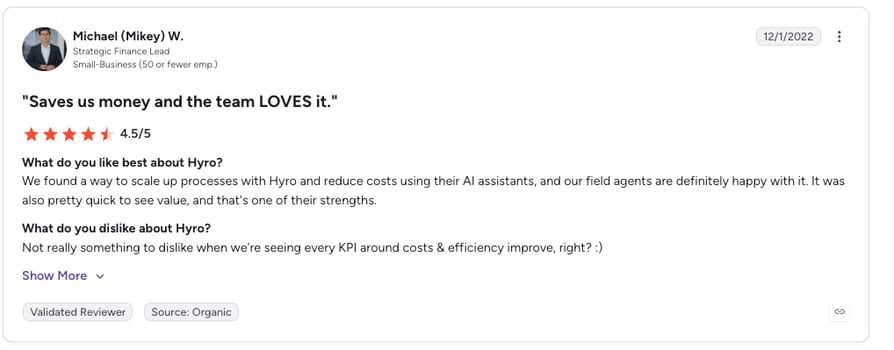
Reviewers value the healthcare-specific workflows, EHR depth, and channel consistency; some cite the enterprise focus and lack of public pricing as barriers for smaller practices.
CloudTalk vs Hyro.ai
| Dimension | CloudTalk | Hyro.ai |
|---|---|---|
| Telephony Infrastructure | Native VoIP in 160+ countries, AI in the call stream | Conversational AI layered over healthcare channels |
| HIPAA Compliance & BAA | HIPAA compliant, BAA available | Healthcare-focused compliance |
| EHR / CRM Integration | Broad native CRM/helpdesk ecosystem, two-way sync | Deep EHR-native retrieve/update |
| Patient AI Features | 24/7 intake, scheduling, triage routing + outbound campaigns | Pre-built scheduling, refills, provider search |
| Deployment Speed | Self-serve, agent live in under 10 minutes | Enterprise deployment with IT involvement |
| Best For (Healthcare) | Clinics to networks needing AI + telephony + CRM in one platform | Large systems needing deep EHR self-service |
When to Use Hyro.ai
- You are a hospital or health system with deep EHR integration needs.
- You want pre-built healthcare workflows across voice and digital.
- You have IT resources to support implementation.
When Not to Use Hyro.ai
- You are a small practice needing published pricing and same-day launch.
- You want native telephony and CRM logging in one platform.
- You need outbound sales-style campaigns alongside inbound.
4. ElevenLabs
Best for: Healthcare and digital-health teams that want the most natural-sounding patient-facing voice.
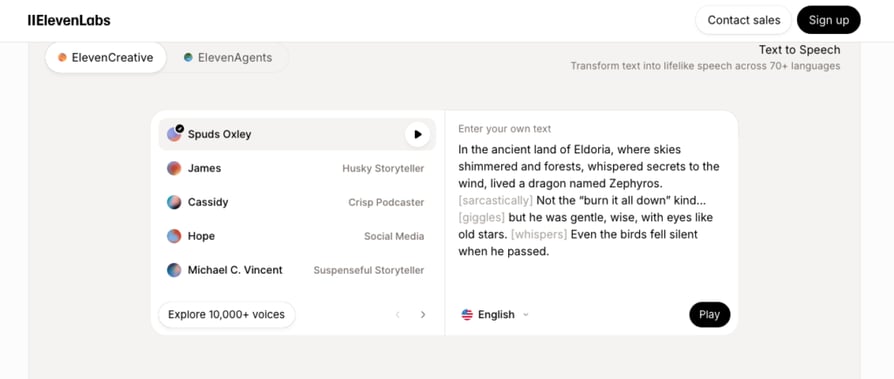
ElevenLabs is a voice AI platform known for ultra-realistic speech synthesis, now extended into conversational agents, and used in healthcare to make automated patient interactions sound natural rather than robotic.
Key Features of ElevenLabs
- Hyper-realistic voice generation for natural, expressive speech.
- Voice cloning and branded voice customization.
- Multilingual support across 32+ languages with automatic switching.
- Enterprise security with encryption and SOC 2, HIPAA, and GDPR support.
ElevenLabs Performance and Technical Specs
- Languages: 32+ with automatic switching.
- Compliance: SOC 2, HIPAA, and GDPR support with encryption.
- Not a telephony or contact-center platform on its own.
Healthcare Use Cases for ElevenLabs
Powering the voice layer of patient-facing agents where natural, human-sounding speech reduces friction.
Key Integrations for ElevenLabs
Wired into a separate calling stack via API.
How Complex Is ElevenLabs to Set Up?
Low to moderate for the voice layer, but you connect it to call infrastructure and compliance wrapping yourself.
ElevenLabs Pros and Cons
| Pros | Cons |
|---|---|
| Best-in-class voice realism that reduces robotic friction | Not a telephony or contact-center platform |
| Broad multilingual coverage and voice cloning | Must be wired into call infrastructure |
| Enterprise security posture | Healthcare-agent pricing is not transparent |
What Is the Pricing of ElevenLabs?
Public self-serve tiers exist for text-to-speech; healthcare conversational-agent use is quote-based.
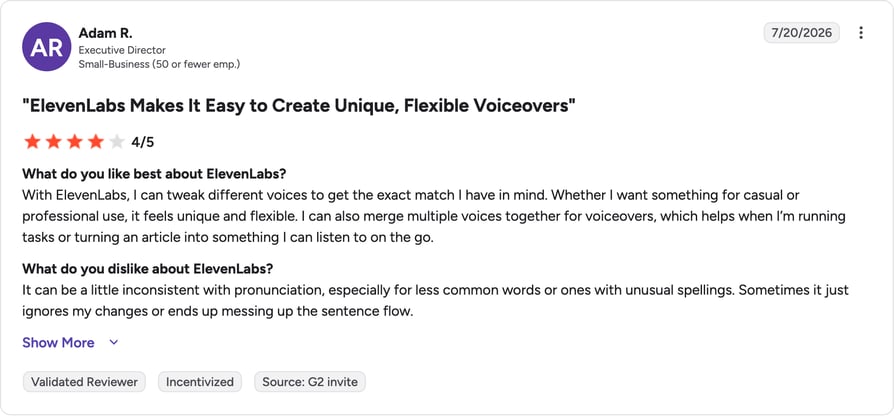
What Do Customers Say About ElevenLabs?
Reviewers rave about the voice quality and language range; some note it is a voice engine rather than a full patient-calling solution, so it needs telephony and compliance tooling around it.
G2 rating: 4.5/5 (~1,140 reviews).
CloudTalk vs ElevenLabs
| Dimension | CloudTalk | ElevenLabs |
|---|---|---|
| Telephony Infrastructure | Native VoIP in 160+ countries, AI in the call stream | None; voice engine wired into external calling |
| HIPAA Compliance & BAA | HIPAA compliant, BAA available, secure recording | HIPAA/SOC 2/GDPR support for the voice layer |
| EHR / CRM Integration | Native two-way sync, no Zapier | API-level; you build the connections |
| Patient AI Features | Full inbound/outbound agent: intake, scheduling, triage | Voice generation for agents built elsewhere |
| Multilingual Support | 60+ languages with auto-detection | 32+ languages with auto-switching |
| Best For (Healthcare) | End-to-end patient calling in one platform | Adding the most natural voice to an existing stack |
When to Use ElevenLabs
- You already have a calling and compliance stack and want a superior voice.
- Voice realism is your top patient-experience priority.
- You have engineering resources to integrate it.
When Not to Use ElevenLabs
- You need a complete patient-calling platform out of the box.
- You want native telephony, routing, and CRM logging included.
- You need transparent, published pricing for a healthcare agent.
5. Retell AI
Best for: SMBs and growing healthcare teams that want quick, low-overhead AI voice deployment.
Retell AI is a developer-friendly, real-time voice AI platform for launching lightweight calling workflows fast, focused on low-latency conversations with light setup that suit smaller teams experimenting with automation.
Key Features of Retell AI
- Real-time, low-latency voice AI for smooth patient calls.
- Conversation flow builder to control call progression.
- Performance analytics on call outcomes and quality.
- SOC 2, HIPAA, and GDPR compliance support.
Retell AI Performance and Technical Specs
- Strong real-time latency for responsive conversations.
- Compliance: SOC 2, HIPAA, GDPR support.
Healthcare Use Cases for Retell AI
Lightweight intake, appointment handling, and outbound campaigns for SMB practices and pilots, including AI voice agents for clinical trial screening and recruitment.
Key Integrations for Retell AI
Configurable connectors; may require setup.
How Complex Is Retell AI to Set Up?
Low to moderate. Built for fast deployment with minimal overhead; some integrations need configuration.
Retell AI Pros and Cons
| Pros | Cons |
|---|---|
| Fast, lightweight deployment with strong real-time latency | More developer-oriented than turnkey |
| Transparent per-minute pricing | Not a full contact-center suite |
| Flexible flow builder | Integrations may require configuration |
What Is the Pricing of Retell AI?
For a CloudTalk comparison, see our Retell AI pricing breakdown.
- Voice agents: pay-as-you-go from $0.07+/minute.
- Chat agents: from $0.002+/message.
- Enterprise: custom.
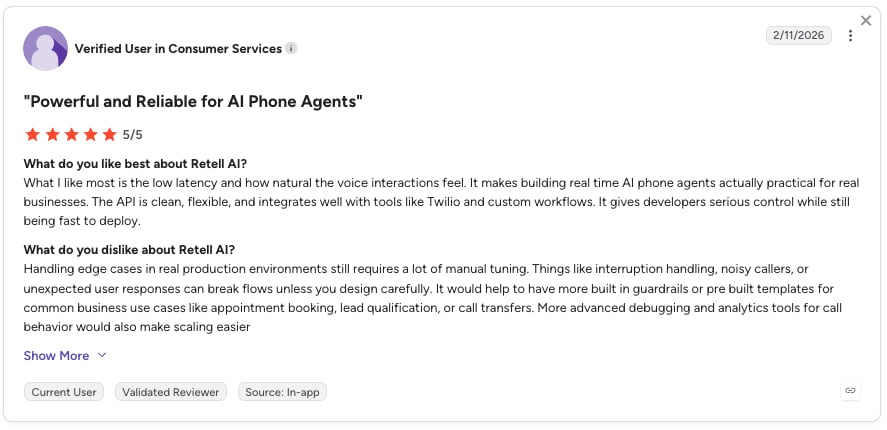
What Do Customers Say About Retell AI?
Reviewers like the fast deployment, low latency, and transparent per-minute pricing; some note it leans developer-focused and is not a full contact-center suite, so complex operations may outgrow it.
CloudTalk vs Retell AI
| Dimension | CloudTalk | Retell AI |
|---|---|---|
| Telephony Infrastructure | Native VoIP in 160+ countries, AI in the call stream | Real-time voice AI; developer-wired calling |
| HIPAA Compliance & BAA | HIPAA compliant, BAA available | HIPAA/SOC 2/GDPR support |
| EHR / CRM Integration | Native two-way sync, no Zapier | Configurable; may require setup |
| Patient AI Features | Full inbound/outbound agent + campaigns | Real-time agents via flow builder |
| Deployment Speed | Self-serve, agent live in under 10 minutes | Fast, developer-friendly launch |
| Best For (Healthcare) | Clinics to networks needing an all-in-one platform | SMBs wanting a quick, low-cost pilot |
When to Use Retell AI
- You want a fast, cheap pilot with per-minute pricing.
- You have some developer capacity to wire integrations.
- Your use cases are lightweight rather than full contact-center.
When Not to Use Retell AI
- You need a full contact-center suite with routing and WFM.
- You want native telephony and CRM logging without engineering.
- You need turnkey EHR integration.
If you have outgrown a lightweight pilot, see our Retell AI alternative comparison.
6. Syllable

Best for: Large health systems and hospitals automating high call volumes and patient access across departments.
Syllable, through its ActiumHealth product, is a healthcare-focused AI “virtual front desk” that automates patient communication at scale, handling calls, scheduling, questions, and routing with real-time EHR and scheduling sync.
Key Features of Syllable
- EHR and scheduling integration with real-time updates.
- Multilingual voice support (English, Spanish, Mandarin, and more).
- Low-latency, human-like responses.
- Real-time analytics and monitoring.
Syllable Performance and Technical Specs
- Multilingual across several languages including Spanish and Mandarin.
- Low-latency responses.
Healthcare Use Cases for Syllable
High-volume patient access, scheduling, and triage routing across departments in large systems.
Key Integrations for Syllable
EHR and clinical scheduling systems.
How Complex Is Syllable to Set Up?
Moderate. Low-code tools help, but full EHR implementation typically requires IT coordination.
Syllable Pros and Cons
| Pros | Cons |
|---|---|
| Purpose-built for clinical scale with EHR/scheduling sync | Little third-party review evidence to date |
| Hour-based pricing is unusually transparent for enterprise | Full EHR implementation needs IT coordination |
| Multilingual patient support | Enterprise-oriented, less suited to small clinics |
What Is the Pricing of Syllable?
- Syllable Scale: $2.40/hour.
- Syllable Enterprise: $3.60/hour.
What Do Customers Say About Syllable?
With little presence on public review platforms, buyer feedback is limited; health systems that use it point to EHR-synced scheduling and multilingual coverage, and the thin review base is the main caution.
CloudTalk vs Syllable
| Dimension | CloudTalk | Syllable |
|---|---|---|
| Telephony Infrastructure | Native VoIP in 160+ countries | Healthcare voice automation layer |
| HIPAA Compliance & BAA | HIPAA compliant, BAA available | Healthcare-focused |
| EHR / CRM Integration | Broad native CRM/helpdesk ecosystem, two-way sync | Real-time EHR/scheduling sync |
| Patient AI Features | Inbound + outbound agent, triage routing, campaigns | Virtual front desk: calls, scheduling, routing |
| Deployment Speed | Self-serve, fast launch | Moderate; IT coordination for EHR |
| Best For (Healthcare) | Clinics to networks needing all-in-one AI + telephony | Large systems automating patient access |
When to Use Syllable
- You are a large health system with high call volumes across departments.
- You need real-time EHR and scheduling sync.
- You value hour-based pricing transparency.
When Not to Use Syllable
- You want a strong public review track record before buying.
- You are a small practice needing quick, low-cost setup.
- You need broad CRM and outbound campaign tooling.
7. Replicant
Best for: Large healthcare organizations and enterprise contact centers automating routine patient calls under strict compliance.
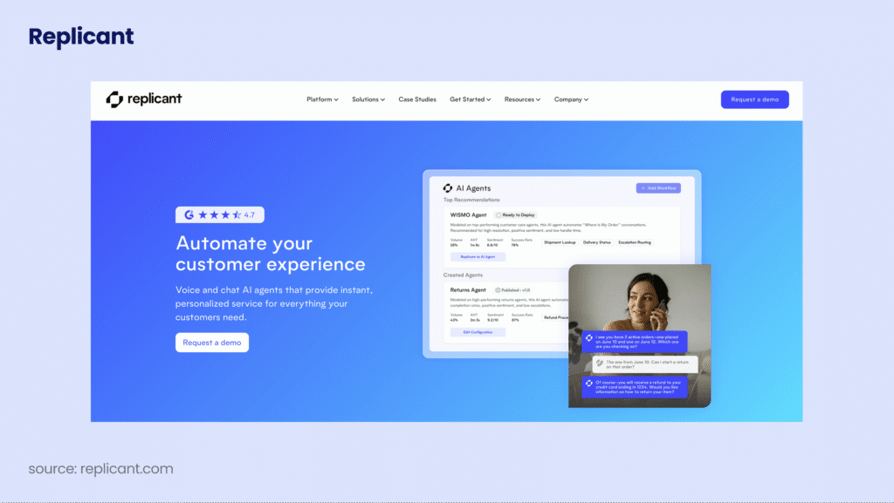
Replicant is an enterprise conversational AI (“Contact Center AI”) that automates high-volume voice, chat, and SMS interactions, handling routine healthcare calls like appointment requests, FAQs, and follow-ups while holding a strong compliance posture.
Key Features of Replicant
- Conversation automation across voice, chat, and SMS.
- Compliance: SOC 2, HIPAA, PCI DSS, GDPR, with automatic PII redaction and audit visibility.
- CCaaS and CRM integrations that augment your existing stack.
- Conversation intelligence and QA automation across 100% of interactions.
Replicant Performance and Technical Specs
- Compliance depth: SOC 2, HIPAA, PCI DSS, GDPR; automatic PII redaction; audit trails.
- 100%-interaction QA and analytics.
Healthcare Use Cases for Replicant
Automating routine, high-volume patient calls and RCM/payer interactions where audit trails and PII redaction matter, the kind of load usually carried on enterprise VoIP for healthcare systems.
Key Integrations for Replicant
CCaaS platforms and CRM systems (augments rather than replaces).
How Complex Is Replicant to Set Up?
Moderate to high. Enterprise-oriented, with significant upfront investment but managed support for scale.
Replicant Pros and Cons
| Pros | Cons |
|---|---|
| Strong compliance posture with PII redaction and audit trails | Enterprise-oriented with significant upfront setup |
| 100%-interaction QA and analytics | Opaque, quote-based pricing |
| Augments an existing CCaaS/CRM stack | Overkill for small clinics |
What Is the Pricing of Replicant?
Quote-based, depending on scale, usage, and integrations.
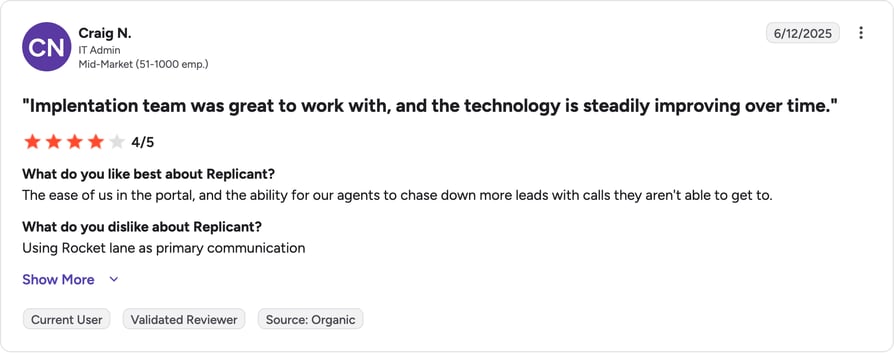
What Do Customers Say About Replicant?
Reviewers praise the compliance safeguards and depth of QA analytics for regulated contexts; some cite the enterprise setup effort and lack of pricing transparency as trade-offs.
G2 rating: 4.7/5 (~45 reviews).
CloudTalk vs Replicant
| Dimension | CloudTalk | Replicant |
|---|---|---|
| Telephony Infrastructure | Native VoIP in 160+ countries, AI in the call stream | Contact Center AI over existing infrastructure |
| HIPAA Compliance & BAA | HIPAA compliant, BAA available | SOC 2, HIPAA, PCI DSS, GDPR; PII redaction |
| EHR / CRM Integration | Native two-way sync, no Zapier | Augments existing CCaaS/CRM |
| Patient AI Features | Inbound + outbound agent, triage routing, campaigns | High-volume automation across voice/chat/SMS |
| Deployment Speed | Self-serve, fast launch | Enterprise deployment, longer setup |
| Best For (Healthcare) | Clinics to networks needing all-in-one platform | Enterprise centers under strict compliance |
When to Use Replicant
- You run an enterprise contact center with strict compliance needs.
- You need PII redaction and full audit trails for RCM/payer calls.
- You want 100%-interaction QA analytics.
When Not to Use Replicant
- You are a small or mid-sized clinic wanting quick setup.
- You need published pricing.
- You want native telephony and CRM in one platform rather than an overlay.
8. Voiceflow
Best for: Healthcare teams that want to design and control their own voice and chat workflows.
Voiceflow is a visual builder for AI agents across voice and chat, using drag-and-drop conversation design, and healthcare teams use it to build structured flows like appointment booking, triage, and patient FAQs while owning the logic.
Key Features of Voiceflow
- Visual drag-and-drop conversation builder.
- V4 Agent Framework: a single agent with multiple “skills.”
- Knowledge Base (RAG) for accurate real-time answers.
- Multimodal by default: the same logic powers web chat and voice.
Voiceflow Performance and Technical Specs
Healthcare Use Cases for Voiceflow
Designing and controlling custom scheduling, triage, and FAQ flows across web chat and voice.
Key Integrations for Voiceflow
API-based; you supply the calling and compliance layer.
How Complex Is Voiceflow to Set Up?
Moderate. The visual builder is accessible, but advanced logic has a learning curve, and you provide the telephony layer.
Voiceflow Pros and Cons
| Pros | Cons |
|---|---|
| Highly flexible, controllable, multimodal design | Not a telephony platform; you supply calling/compliance |
| Good for teams that want to own conversation logic | Advanced logic has a learning curve |
| Same logic across chat and voice | Healthcare compliance wrapping is on you |
What Is the Pricing of Voiceflow?
Tiered by usage and features; public self-serve tiers exist for building, with higher tiers quote-based. For a CloudTalk comparison, see our Voiceflow pricing breakdown.
What Do Customers Say About Voiceflow?
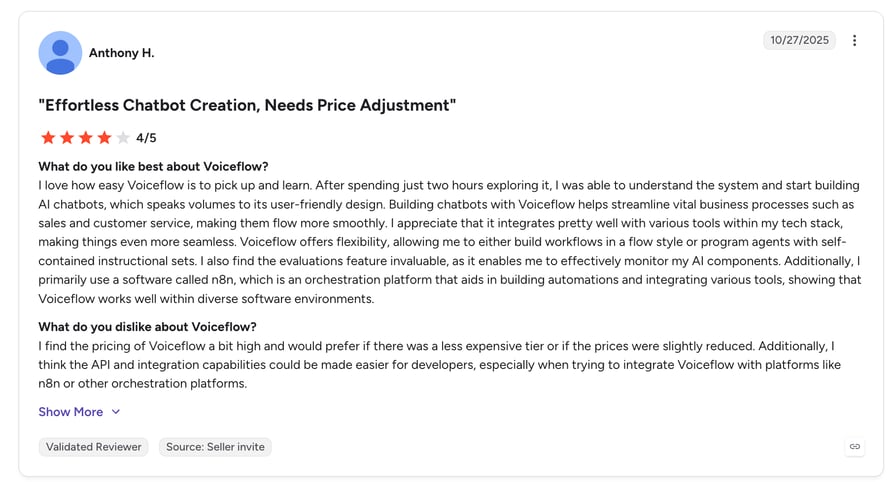
Reviewers value the flexibility, control, and multimodal design; some note it is not a calling platform, so healthcare teams add telephony and compliance separately.
CloudTalk vs Voiceflow
| Dimension | CloudTalk | Voiceflow |
|---|---|---|
| Telephony Infrastructure | Native VoIP in 160+ countries, AI in the call stream | None; you supply the calling layer |
| HIPAA Compliance & BAA | HIPAA compliant, BAA available | You wrap compliance yourself |
| EHR / CRM Integration | Native two-way sync, no Zapier | API-based; you build connections |
| Patient AI Features | Full inbound/outbound agent | Design-your-own voice and chat flows |
| Multilingual Support | 60+ languages with auto-detection | |
| Best For (Healthcare) | All-in-one patient calling platform | Teams that want to own conversation design |
When to Use Voiceflow
- You want full control over conversation design across chat and voice.
- You have engineering support for telephony and compliance.
- You need multimodal agents sharing one logic.
When Not to Use Voiceflow
- You need calling, routing, and compliance in one platform.
- You want a turnkey healthcare deployment.
- You lack resources to build and maintain the calling layer.
9. Talkdesk
Best for: Mid-market to enterprise healthcare organizations automating patient interactions at scale with control and visibility.
Talkdesk is a cloud contact center platform with built-in agentic AI (Talkdesk Autopilot) whose voice agents resolve patient requests end-to-end across voice and digital channels, backed by the Talkdesk Data Cloud for context.
Key Features of Talkdesk
- Talkdesk Autopilot AI voice agents for end-to-end request resolution.
- Context-aware conversations via Talkdesk Data Cloud.
- Multichannel AI automation across voice, chat, and messaging.
- Multilingual support across 59+ languages.
Talkdesk Performance and Technical Specs
- Languages: 59+ with accent and language-switching support.
- Mature enterprise CCaaS scalability.
Healthcare Use Cases for Talkdesk
Automating patient interactions at scale in mid-market and enterprise settings with strong visibility and control.
Key Integrations for Talkdesk
CCaaS ecosystem and CRM connectors.
How Complex Is Talkdesk to Set Up?
Moderate to high. Requires setup and integration, but offers strong scalability once implemented.
Talkdesk Pros and Cons
| Pros | Cons |
|---|---|
| Mature enterprise CCaaS with multichannel and multilingual | Moderate-to-high setup and integration effort |
| Autopilot resolves requests end-to-end | AI voice pricing is quote-based on top of seats |
| Strong control and visibility | Overhead heavy for small clinics |
What Is the Pricing of Talkdesk?
See our Talkdesk pricing breakdown for the full plan detail.
- Cloud contact center plans from $85/user/month.
- Talkdesk Autopilot (AI voice): quote-based.
What Do Customers Say About Talkdesk?
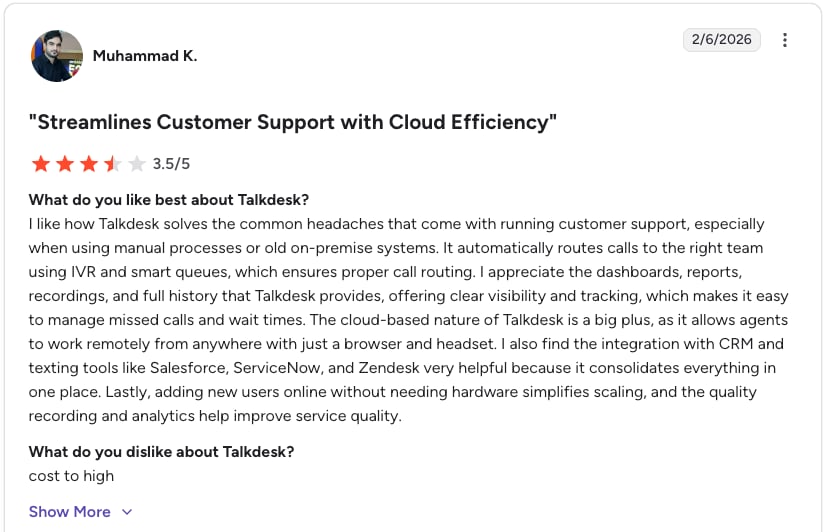
Reviewers cite the mature platform, multichannel breadth, and multilingual support; some flag the setup effort and quote-based AI pricing layered on top of seat costs.
G2 reviewers give Talkdesk4.4/5.
CloudTalk vs Talkdesk
| Dimension | CloudTalk | Talkdesk |
|---|---|---|
| Telephony Infrastructure | Native VoIP in 160+ countries, AI in the call stream | Enterprise CCaaS with Autopilot AI |
| HIPAA Compliance & BAA | HIPAA compliant, BAA available | |
| EHR / CRM Integration | Native two-way sync, no Zapier | CRM/CCaaS connectors |
| Patient AI Features | 24/7 intake, scheduling, triage + campaigns | Autopilot end-to-end resolution |
| Deployment Speed | Self-serve, fast launch | Moderate-to-high, integration-heavy |
| Pricing Transparency | Published plans + add-on rate | Seat price published, AI quote-based |
When to Use Talkdesk
- You are mid-market or enterprise and want a mature CCaaS.
- You need multichannel automation with strong control.
- You have resources for a longer implementation.
When Not to Use Talkdesk
- You are a small clinic wanting fast, low-overhead setup.
- You need transparent AI voice pricing upfront.
- You want AI and telephony in a single, lighter-weight platform.
If enterprise setup is more than you need, see our Talkdesk alternative comparison.
10. Genesys (Genesys Cloud CX)
Best for: Large healthcare organizations managing high patient-call volume across voice and digital.
Genesys Cloud CX is an enterprise CX and contact-center platform with AI voicebots and omnichannel orchestration; its voice assistants answer patient calls, understand needs, and resolve or route them without losing context.
Key Features of Genesys
- Intent Miner for data-driven voicebot improvement.
- Human handoff that keeps full context.
- Omnichannel orchestration across voice and digital.
- Visual flow builder for conversation design.
Genesys Performance and Technical Specs
- Rapid no-code voicebot deployment claim.
Healthcare Use Cases for Genesys
Enterprise patient-call handling and omnichannel orchestration across large systems.
Key Integrations for Genesys
Broad enterprise integration ecosystem.
How Complex Is Genesys to Set Up?
Low for basic voicebots per its no-code claim, but enterprise deployments carry real overhead.
Genesys Pros and Cons
| Pros | Cons |
|---|---|
| Deep omnichannel orchestration and mature AI tooling | Token-based AI pricing can be unpredictable at scale |
| Rapid no-code voicebot deployment claim | Enterprise complexity for small clinics |
| Full-context human handoff | Setup overhead beyond basic bots |
What Is the Pricing of Genesys?
See our Genesys pricing breakdown for how the plans compare.
- From $85/user/month depending on plan.
- Token-based system for AI features; heavy usage may require buying more tokens.
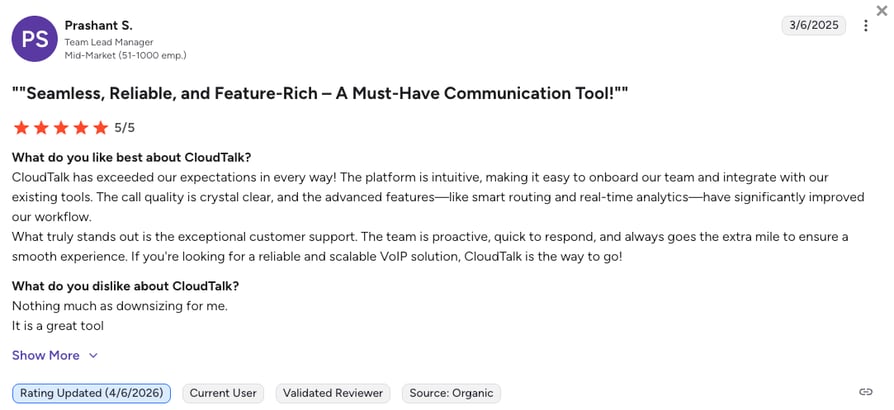
What Do Customers Say About Genesys?
Reviewers value the omnichannel orchestration and mature tooling; some point to token-based AI pricing that makes per-interaction cost hard to predict at scale.
CloudTalk vs Genesys
| Dimension | CloudTalk | Genesys |
|---|---|---|
| Telephony Infrastructure | Native VoIP in 160+ countries, AI in the call stream | Enterprise CX platform with voicebots |
| HIPAA Compliance & BAA | HIPAA compliant, BAA available | |
| EHR / CRM Integration | Native two-way sync, no Zapier | Enterprise integration ecosystem |
| Patient AI Features | 24/7 intake, scheduling, triage + campaigns | Voicebots + omnichannel orchestration |
| Pricing Transparency | Published plans + add-on rate | Seat price published; token-based AI cost |
| Best For (Healthcare) | Clinics to networks in one platform | Large enterprise omnichannel operations |
When to Use Genesys
- You are a large enterprise needing omnichannel orchestration.
- You want mature AI tooling and full-context handoff.
- You can manage token-based AI cost planning.
When Not to Use Genesys
- You are an SMB clinic that finds enterprise overhead excessive.
- You want predictable per-interaction AI pricing.
- You need a lighter all-in-one AI + telephony tool.
Teams that want predictable pricing often shortlist our Genesys alternative comparison.
11. NICE CXone (Mpower)
Best for: Large health systems managing high patient-interaction volume with strong control and workforce tools.
NICE CXone Mpower is an enterprise contact-center platform combining AI, automation, and workforce management at scale, with AI voice sitting inside a broader ecosystem of routing, analytics, and WFM.
Key Features of NICE CXone
- Agentic AI automation with data-driven optimization.
- Omnichannel voice and digital support.
- Deep CXone ecosystem integration (routing, analytics, WFM).
- Enterprise scalability and security/compliance controls.
NICE CXone Performance and Technical Specs
- Enterprise scalability with WFM and analytics built in.
Healthcare Use Cases for NICE CXone
Coordinating high patient-interaction volumes across large systems with a dedicated healthcare package.
Key Integrations for NICE CXone
Deep CXone ecosystem plus enterprise connectors.
How Complex Is NICE CXone to Set Up?
Moderate to high. Setup requires planning and integration, with strong control and scalability once in place.
NICE CXone Pros and Cons
| Pros | Cons |
|---|---|
| Full enterprise suite: AI + WFM + analytics | Highest entry price of the set |
| Dedicated healthcare package | Setup requires planning and integration |
| Deep control at scale | Overkill for SMB clinics |
What Is the Pricing of NICE CXone?
See our NICE CXone pricing breakdown for the full detail.
- Plans from $110/agent/month depending on configuration.
- Healthcare package “The Ultimate Healthcare Experience” from $249/agent/month (plus ~$0.25/session).
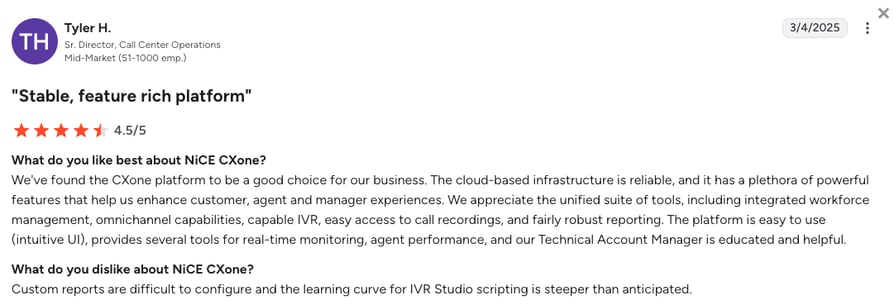
What Do Customers Say About NICE CXone?
Reviewers highlight the breadth of the suite and the healthcare package; some cite the high entry price and setup planning as barriers, especially for smaller organizations.
CloudTalk vs NICE CXone
| Dimension | CloudTalk | NICE CXone |
|---|---|---|
| Telephony Infrastructure | Native VoIP in 160+ countries, AI in the call stream | Enterprise CCaaS with agentic AI |
| HIPAA Compliance & BAA | HIPAA compliant, BAA available | Enterprise compliance controls |
| EHR / CRM Integration | Native two-way sync, no Zapier | Deep CXone ecosystem + connectors |
| Patient AI Features | 24/7 intake, scheduling, triage + campaigns | Agentic AI within a WFM-heavy suite |
| Entry Price | From $25/user/mo (phone system) | From $110/agent/mo |
| Best For (Healthcare) | Clinics to networks in one platform | Large systems needing AI + WFM |
When to Use NICE CXone
- You are a large system needing AI plus workforce management.
- You want a dedicated healthcare package.
- You can absorb a higher entry price and setup effort.
When Not to Use NICE CXone
- You are an SMB clinic where the suite is overkill.
- You want a lower entry price and faster launch.
- You need AI and telephony in one lightweight platform.
For a lighter-weight, faster-to-launch option, see our NICE CXone alternative comparison.
12. Five9
Best for: Large healthcare organizations and contact centers blending automation with live agents.
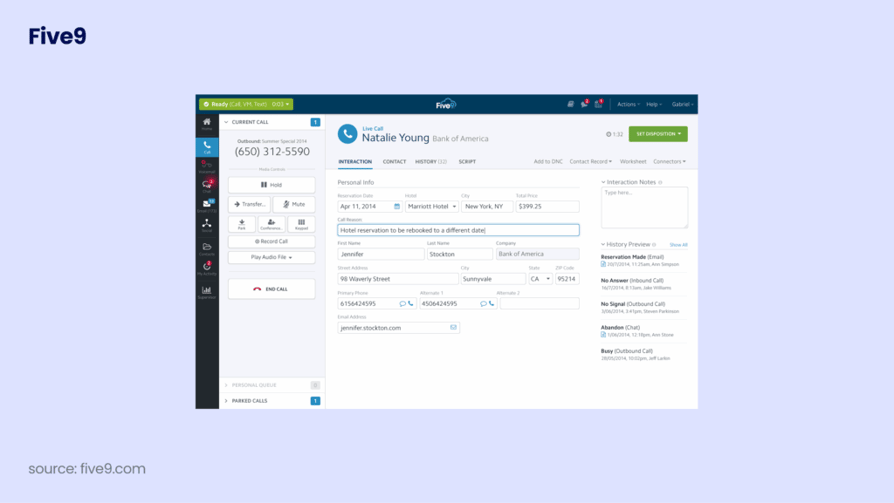
Five9 is a cloud contact center built for large-scale “Agentic CX,” where AI and human agents work together, automating routine patient interactions while supporting live teams on complex conversations.
Key Features of Five9
- Intelligent Virtual Agents (IVA) across voice, SMS, and WhatsApp.
- Agent Assist for real-time coaching and summaries.
- Automatic summary node with multi-language support.
- Pre-built industry templates.
Five9 Performance and Technical Specs
- Broad channel coverage and mature scalability.
Healthcare Use Cases for Five9
High-volume patient-call handling that combines automation with human support at enterprise scale.
Key Integrations for Five9
Enterprise CCaaS integrations.
How Complex Is Five9 to Set Up?
High. Powerful features come with a complex setup that often needs dedicated implementation resources.
Five9 Pros and Cons
| Pros | Cons |
|---|---|
| Mature, scalable enterprise platform | High setup complexity |
| Strong agent-assist tooling | Often needs implementation resources |
| Broad channel coverage | Quote-based pricing with no transparency |
What Is the Pricing of Five9?
Quote-based, depending on usage, features, and deployment scale. See our Five9 pricing breakdown for how it compares.
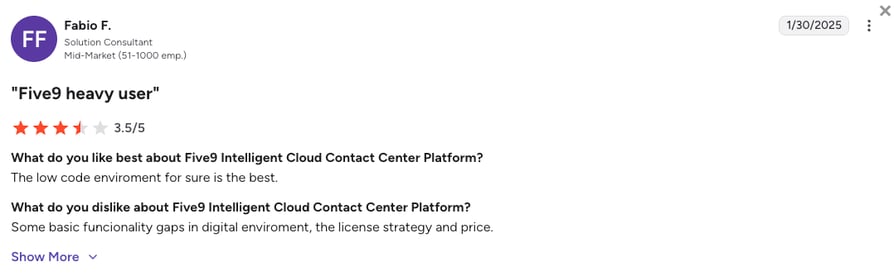
What Do Customers Say About Five9?
Reviewers value the mature platform and agent-assist tooling; some flag the setup complexity and lack of pricing transparency.
CloudTalk vs Five9
| Dimension | CloudTalk | Five9 |
|---|---|---|
| Telephony Infrastructure | Native VoIP in 160+ countries, AI in the call stream | Enterprise CCaaS with IVAs |
| HIPAA Compliance & BAA | HIPAA compliant, BAA available | |
| EHR / CRM Integration | Native two-way sync, no Zapier | Enterprise connectors |
| Patient AI Features | 24/7 intake, scheduling, triage + campaigns | IVAs + Agent Assist for live teams |
| Deployment Speed | Self-serve, fast launch | High complexity, implementation-heavy |
| Pricing Transparency | Published plans + add-on rate | Quote-based |
When to Use Five9
- You are an enterprise blending automation with a large live-agent team.
- You need broad channel coverage and agent-assist tooling.
- You have implementation resources.
When Not to Use Five9
- You want fast, low-overhead deployment.
- You need transparent, published pricing.
- You want a single platform for AI voice and telephony without heavy setup.
What Real Healthcare Teams Are Saying (Reddit & Community Signals)
Healthcare operators talk candidly about AI voice agents in communities like r/healthIT, r/medicine, and r/MedicalBilling, where the recurring themes are HIPAA-compliant calling, patient scheduling automation, and whether call logs actually sync back to the EHR or CRM.
Top AI Voice Agents for Healthcare by G2 Reviews and Ratings
Based on verified G2 reviews, CloudTalk is the top-rated all-in-one AI voice platform for healthcare with 1,702+ reviews and a 4.4/5 rating as of 2026. Reviewers repeatedly cite its call quality, native CRM sync, and Advanced AI Call Analytics.
AI Voice Agent Pricing for Healthcare: What to Expect in 2026
Healthcare AI voice pricing falls into four models, and knowing which one you are buying prevents surprises at scale.
- Per-minute usage-based: you pay for the minutes the agent talks. Predictable for pilots and low volume.
- Bundled minute tiers: a monthly plan includes a block of minutes with an overage rate above it.
- Per-agent/user seat-based: common for full contact-center platforms where AI sits on top of seat licenses.
- Enterprise custom: quote-based, for high volume, deep integration, or dedicated compliance terms.
Watch for hidden costs regardless of model: HIPAA BAA or compliance fees, EHR integration setup charges, premium LLM model upcharges, concurrent-line fees, and audit-log storage.
CloudTalk AI Voice Agent Pricing for Healthcare
CloudTalk’s AI Voice Agents are a paid add-on, priced separately from the phone-system plans and never bundled into a subscription. All prices are in USD.
| Tier | Included Minutes | Starting Price | Best For |
|---|---|---|---|
| AI Receptionist (free trial) | 50 minutes | Free | Testing with real patient calls before committing |
| AI Receptionist | 200 minutes | From $99/month | Small clinics needing 24/7 answering, triage, and routing |
| AI Specialist | 1,000 minutes | From $349/month | Patient intake + EHR/CRM workflows and multi-step resolution |
The phone-system plans underneath start at $25/user/month (Starter), with IVR and call routing on Starter and native integrations from Essential; see the full AI voice agent pricing breakdown for current tiers. The 50 free minutes are the strongest entry point for buyers who want to validate HIPAA readiness before committing.
Why Healthcare Teams Choose AI Voice Agents
A few clear wins explain why more healthcare teams are adopting AI voice agents.
24/7 Instant Patient Response Without Adding Headcount
Patients don’t call on a schedule, and a missed call often means delayed care or a booking that goes to another clinic. Voice AI answers every call instantly, morning, night, or weekend, so patients book, reschedule, or get information without waiting on hold. For automating patient intake calls, this is the biggest, fastest win.
Reduced Administrative Burden
Front-desk teams spend much of the day repeating the same answers, which drives burnout and errors. According to McKinsey & Company, about 28% of U.S. healthcare administrative spending, roughly $265 billion, could be reduced or automated without compromising patient care. Voice agents absorb the top automatable tasks: refill requests, insurance checks, and post-discharge follow-up.
Personalized, Multilingual Communication
Serving diverse populations at scale is hard for a human front desk. According to the U.S. Census Bureau, nearly 68 million U.S. residents speak a language other than English at home. CloudTalk covers 60+ languages with automatic detection, so a caller is understood without picking a menu option.
In practice: Oxford Royale Academy (Education) replaced its seasonal-hiring dependency with multilingual AI voice calls.
Fewer No-Shows and More Predictable Schedules
Missed appointments leave gaps in care and, according to Tebra’s 2026 Cost of Missed Appointments report, cost practices an average of $22,872 per year. Voice agents reach out with reminders and rescheduling options, and CloudTalk sends SMS patient reminders and WhatsApp messages automatically after an AI-booked appointment.
Compliance and Security by Default
Patient data carries strict requirements, so any serious tool is built around HIPAA-aligned controls, encryption, and secure recording. Just as important for regulated teams is the audit trail: every interaction is logged, and complex cases escalate to human RCM staff with the full record attached.
Managing High-Volume Patient Communications at Scale
“Scale” in healthcare voice AI means many concurrent calls, absorbing peak-hour spikes, and routing across departments without dropping context, which is where a full platform beats a single-purpose tool. CloudTalk handles high concurrent volume, and its AI Receptionist and AI Specialist run in parallel across departments, so a system grows from 50 free minutes to enterprise volume on one platform. For leading voice AI in healthcare call centers, that unbroken scale path is the point.
In practice: a high-volume services provider deflected nearly 40% of its inbound calls with CloudTalk’s AI Voice Agent.
AI Voice Agents for Healthcare Contact Centers
A standalone AI voice tool automates calls but leaves routing, queueing, and analytics to another system. CloudTalk is a full contact center with AI in the call stream, so Smart Call Routing, skill-based routing, queue management, and analytics work alongside the AI Voice Agent instead of being bolted on afterward.
What Are the Key Use Cases of AI Voice Agents in Healthcare?
AI voice agents earn their place wherever calls are repetitive, time-sensitive, or high-volume. These are the workflows healthcare teams lean on today, with the best-fit tool for each.
Appointment Scheduling and Rescheduling
The agent books, confirms, and reschedules appointments in a natural conversation, then writes the result back to the calendar and patient record. It is the highest-volume, fastest-payback use case for most clinics. Best tool for this use case: CloudTalk AI Receptionist, which books and syncs appointments in one platform.
24/7 Patient Support and Inbound Call Handling
After-hours and overflow calls that would hit voicemail get answered, routine questions resolved, and urgent cases routed to staff, so patients get a response at 2 a.m. without a night shift. Best tool for this use case: CloudTalk AI Receptionist for 24/7 answering with urgency-based routing.
In practice: SaaS provider Autenti had AI voice agents handle roughly 30% of its inbound support calls.
Post-Discharge Follow-Up and Claims
Outbound campaigns check in on discharged patients, catch complications early, and chase billing and claims follow-ups that staff rarely have time for. Best tool for this use case: CloudTalk AI Specialist (Outbound) for reminder and follow-up campaigns with two-way CRM and EHR integrations and automatic write-back.
Prescription Refill Requests
Refill requests are repetitive and high-volume, ideal for automation whether inbound (“I need a refill”) or as outbound reminder campaigns, with the agent logging each against the patient record. Best tool for this use case: Hyro.ai for EHR-native refill workflows; CloudTalk AI Specialist for outbound refill campaigns.
Patient Triage and Symptom Screening
An agent collects symptoms, applies urgency rules, and routes the caller to the right level of care, always escalating complex or high-risk cases to a clinician. The goal is safe routing, not clinical judgment. Best tool for this use case: Syllable or Hyro.ai for clinical triage; CloudTalk for initial routing and escalation.
Clinical Trial Screening and Patient Recruitment
Recruitment means calling large lists to pre-screen candidates against eligibility criteria, the kind of high-volume outbound work that stalls when done by hand. Best tool for this use case: CloudTalk AI Specialist (Outbound) for recruitment campaigns; Retell AI for a lightweight pilot.
In practice: healthcare firm Convergence scaled its recruiting calls across 150 nursing homes with CloudTalk.
Medical Device Support Hotlines
Device makers field repetitive support calls about setup, troubleshooting, and warranty. An inbound agent resolves the common questions and routes technical cases to specialists with context. Best tool for this use case: CloudTalk AI Specialist (Inbound), which resolves routine device questions and escalates cleanly.
AI Voice Agents for GP and Primary Care Practices
GP and primary-care practices juggle scheduling, refills, and triage on one overloaded front desk. A single agent covers all three, answering routine calls and passing urgent ones to staff. Best tool for this use case: CloudTalk AI Receptionist for scheduling, refills, and triage routing in one setup.
How to Choose the AI Voice Agents for Your Healthcare Team
Beyond basic automation, you need a tool that handles sensitive data, connects to clinical systems, and holds a real patient conversation without adding friction. Weigh these factors before you commit.
Prioritize HIPAA, GDPR, and Compliance Posture
Compliance is the baseline, not a differentiator. Confirm a signed Business Associate Agreement, SOC 2 Type II, strong encryption, and clear data-retention and audit-log policies for GDPR-compliant data handling before any patient data flows through the system.
Verify EHR and Clinical System Integrations
An agent that can’t read and update patient data in real time creates more work than it saves. Look for native integrations with your EHR and CRM, real-time scheduling and documentation sync, and minimal manual data entry rather than a fragile Zapier bridge.
Check Accuracy and Medical Language Understanding
Healthcare calls are harder than standard support calls. Test for high transcription accuracy on medical terminology and medication names, reliable intent detection, and the ability to handle interruptions and non-linear speech.
Prioritize Natural, Low-Latency Conversations
Patients shouldn’t feel like they’re fighting a machine about their health. Look for strong natural-language understanding, fast low-latency responses, multilingual support, and a calm, human tone.
Start With One High-Impact Use Case
Automating everything at once usually fails. Begin with a repeatable, high-volume workflow like appointment reminders or after-hours FAQs, prove it, then expand into triage or engagement programs.
Ensure Smooth Escalation to Human Staff
AI should support your team, not wall patients off from it. The system must transfer to a live agent with full context (summary, patient details, intent), require no repetition from the patient, and follow clear escalation rules for urgent cases.
How to Test an AI Voice Agent Before Healthcare Deployment
Before you commit, run the agent through the calls your patients actually make.
- Place a test call with a non-native accent and check whether it understands natural speech.
- Interrupt the agent mid-sentence to see if it recovers or restarts its script.
- Verify HIPAA BAA availability before any real data is processed.
- After a call, check that it logged correctly in your CRM or EHR on both sides.
- With CloudTalk, use the 50 free AI Voice Agent minutes to run live test calls before choosing a plan.
Voice Agent EHR and CRM Integration: What Healthcare Teams Need
Which voice AI solutions work with major EHR systems decides most healthcare purchases, because logging a call timestamp is not the same as updating a patient record. Look for genuine two-way sync where the outcome updates the record, AI summaries pushed to the EHR or CRM the moment the call ends, trigger-based workflows (a missed appointment schedules a reschedule call the next day), and native connections to Epic, Cerner, Salesforce Health Cloud, and HubSpot rather than Zapier-dependent ones.
What Healthcare Teams Tell Us When They Switch to CloudTalk
These are the patterns we hear most from clinics and hospital networks moving to CloudTalk, in their words rather than ours.
- “We were using a standalone AI tool, but every call log had to be moved into our CRM by hand.” Native two-way sync removes that step.
- “Our enterprise contact center did everything, and it was too much for a three-clinic group.” A right-sized platform beats an over-built one for SMB healthcare.
- “The cheaper tool couldn’t sign a BAA, so legal killed it.” A signed BAA is non-negotiable, and it’s available with CloudTalk.
- “We wanted inbound patient support and outbound reminders, but that meant two vendors.” Running both from one platform is why teams consolidate.
Limitations and Challenges of AI Voice Agents in Healthcare
AI voice agents are powerful, but honest buyers should plan around real constraints.
- Accuracy depends on knowledge-base quality: clinical FAQs and patient data must stay current, or the agent frustrates patients.
- HIPAA compliance is shared: the tool provides compliant infrastructure, but misconfiguration can still create violations.
- Voice AI cannot replace clinical judgment: triage tools need clear escalation rules for complex or urgent cases.
- Setup and script refinement take time, especially for AI Specialist deployments (budget one to two weeks minimum).
- Usage costs scale with call volume: watch overage risk during flu season, enrollment periods, or campaign spikes.
Implementation Best Practices for AI Voice Agents in Healthcare
A careful rollout is the difference between a tool your staff trusts and one they route around.
- Start with one low-risk call type (appointment reminders or after-hours FAQs) before moving to triage or refills.
- Review test-call transcripts with clinical staff before going live to confirm the agent understands your terminology.
- Define escalation rules upfront: which call types always route to a human, regardless of AI confidence.
- Review call logs and CRM/EHR entries weekly for the first 30 days to catch accuracy gaps early.
- Validate the HIPAA BAA with your vendor before any patient data is processed.
- With CloudTalk, activate the 50 free minutes, verify number setup, HIPAA settings, and CRM integration, then pick a plan based on real volume.
Why Healthcare Providers Choose CloudTalk's AI Voice Agent
The structural reason healthcare teams pick CloudTalk is simple: it builds AI inside the telephony layer instead of bolting it onto a separate tool. That makes global call quality, native routing, deep CRM integration, and AI-in-the-call-stream work together rather than through a brittle bridge.
- HIPAA-ready AI with secure call recording, transcription, and AI Smart Notes, with a BAA available.
- Fewer no-shows through automated reminders, rebooking campaigns, and SMS/WhatsApp outreach.
- Faster, more consistent patient experience via Smart Routing and predefined clinical workflows.
- Multilingual support across 60+ languages with automatic detection.
- Scalable architecture on one platform, from 50 free trial minutes to enterprise volume.
- Native AI plus telephony with no Zapier and no third-party bridge.
Start your 14-day free trial. No credit card required, and your first 50 AI Voice Agent minutes are on us.
Conclusion: Choosing the Right AI Voice Agent for Healthcare
Three takeaways carry the guide. First, AI voice agents give healthcare teams 24/7 patient coverage, fewer missed calls, and less admin work without adding headcount. Second, 2026 is the inflection point: with the market growing at a 37.79% annual rate per Grand View Research and no-shows costing practices an average of $22,872 a year per Tebra, the cost of a phone that rings unanswered is now measurable. Third, the right tool depends on your call volume, EHR depth, and launch speed, so match the platform to your team rather than chasing a feature list.
For most healthcare teams, CloudTalk is the strongest starting point: it is one of the leading voice AI solutions for healthcare appointment scheduling and patient communication, combining AI voice agent capabilities with native telephony and HIPAA-ready compliance in a single platform—with 50 free minutes to test on real patient calls.
Ready to stop missing patient calls?
Frequently Asked Questions
CloudTalk is the best overall: it combines AI voice, native telephony, and HIPAA-ready CRM logging in one platform, with 60+ languages and 24/7 patient-call automation. Hyro.ai suits deep EHR self-service; Retell AI suits fast, low-cost pilots.
For EHR-native refill workflows, Hyro.ai reads and updates patient data directly. For triage routing, CloudTalk’s AI Specialist captures the request, applies urgency rules, and passes complex cases to clinical staff with full context.
CloudTalk, Retell AI, and Thoughtly cut wait times fastest: they answer every call instantly, deploy without an IT team, and scale from a free trial upward. CloudTalk adds urgency-based routing so critical calls never sit in a queue.
CloudTalk handles high concurrent volume with full audit trails and RCM escalation. Replicant suits enterprise contact centers needing PII redaction and 100%-interaction QA. Both log every interaction for compliance review.
CloudTalk’s AI Specialist (Outbound) runs post-discharge check-ins, claims follow-up, and rebooking campaigns with CRM write-back. Retell AI works for lightweight outbound pilots. Both free staff from repetitive follow-up calls.
CloudTalk applies urgency rules and hands complex cases to human RCM staff with the full call record attached, preserving an audit trail. Replicant offers similar escalation with automatic PII redaction for regulated payer calls.
CloudTalk is fastest for most teams: non-technical staff configure an agent in under 10 minutes and test on 50 free minutes. Thoughtly’s no-code builder and Retell AI’s per-minute setup are also quick to launch.
CloudTalk handles it in 60+ languages with automatic detection, so callers are understood without a menu prompt. Syllable and Hyro.ai also support multilingual patient communication for large health systems.
CloudTalk’s AI Receptionist covers scheduling, refills, and triage routing in one setup for GP and primary-care practices, passing urgent calls to staff. Thoughtly suits practices wanting the fastest no-code launch.
CloudTalk syncs natively with CRMs and helpdesks like Salesforce Health Cloud and HubSpot; Hyro.ai and Syllable integrate directly with EHRs for real-time scheduling and refill workflows. Prefer native sync over Zapier bridges.
Yes. Retell AI’s per-minute pricing (from $0.07/min) suits small orthopedic practices, and CloudTalk’s 50 free AI Voice Agent minutes let you automate insurance follow-up before committing to a paid plan.
CloudTalk’s AI Voice Agent runs post-discharge check-ins, claims follow-up, and rebooking campaigns with CRM write-back. Retell AI works for lightweight outbound pilots. Both free staff from repetitive follow-up calls.
For EHR-native refill workflows, Hyro.ai reads and updates patient data directly. For triage routing, CloudTalk’s AI Specialist captures the request, applies urgency rules, and passes complex cases to clinical staff with full context.
CloudTalk and Replicant both handle compliance-sensitive, high-volume support lines. CloudTalk adds urgency-based routing and CRM call logging so that escalations reach the right team with full context; Replicant adds automatic PII redaction and 100% interaction QA for device manufacturers under strict regulatory audit requirements.