
PolyAI App Review: The TL;DR Verdict
| Verdict | Details |
|---|---|
| Overall Rating | We rate PolyAI 4.1 out of 5: the voice quality and PolyAI's enterprise track record are the real thing, but you still cannot build a budget without a sales call. |
| Best For | Large, regulated, high-volume contact centers running complex multi-turn phone conversations. |
| Starting Price | No published rate. PolyAI publishes the pricing model (per-minute, scoped to volume, use case and integrations) but not a single number. The only CTA on its pricing page is "Request a demo." |
| Free Tier? | In May 2026, PolyAI announced that it had opened its Agentic Dialog Platform to every builder, free for the first two months. |
| Setup Time | ~30 minutes for a self-serve agent. ~6 weeks for a governed enterprise deployment, on PolyAI's own numbers. |
| Standout Strength | Voice quality. PolyAI trained Raven on over a billion real business conversations, while its new Dialog-RSN-1 model is designed to better understand spoken conversations. |
| Biggest Limitation | Pricing isn’t public, telephony isn’t built in, and some users report analytics gaps. |
| User Sentiment | Very positive, but based on a small sample: users praise voice quality and automation, with some complaints about speed and analytics. |
| CloudTalk Verdict | If you need AI voice agents on a published price with a phone system included, CloudTalk is the business-ready pick. |
PolyAI is known for building highly realistic AI voice agents designed to handle natural, human-like conversations with customers. But how well do they actually perform in real business calls, and is PolyAI worth considering alongside other AI voice platforms?
We took a closer look to find out. This review covers PolyAI’s voice agents, key features, pricing, integrations, security, real user feedback, and the best AI voice agents for business if PolyAI isn’t the right fit. Do your own research too, since pricing and features can change quickly.
PolyAI Scorecard: Our Honest Ratings
We scored PolyAI’s enterprise Agentic Dialog Platform using its own product information, plus verified press releases and independent research. We use the same six criteria for every AI voice agent review to keep the scores consistent.
PolyAI Scorecard
| Dimension | Rating | Why |
|---|---|---|
| Voice Quality & Conversation Handling | 4.8/5 | PolyAI trained Raven on 1B+ real business conversations. Owl helps agents handle accents, background noise, and interruptions, while Dialog-RSN-1 helps them better understand spoken conversations. |
| Features & Platform Depth | 4.5/5 | Deep enterprise feature set covering complex call resolution, speech, multilingual support, and 130+ integrations. |
| Ease of Setup | 4.0/5 | A self-serve agent in 30 minutes is fast, while a production deployment takes around six weeks. |
| Integrations & Telephony | 4.3/5 | SIP or PSTN into the contact center platform (CCaaS) you already run, a self-serve Connect Portal with managed OAuth 2.0, and an AWS Marketplace listing. |
| Security & Compliance | 4.5/5 | SOC 2, ISO 27001, HIPAA, GDPR and PCI DSS, AWS hosting, third-party penetration testing. |
| Pricing Transparency & Value | 2.5/5 | PolyAI publishes the model and withholds the rate, so you still cannot build a budget without a call. |
PolyAI overall rating: 4.1/5. The voice quality is strong, the compliance standards are solid, and PolyAI has proven its value with enterprise customers. The score sits where it does because you still cannot answer the first question any buyer asks: what will this cost?
What Is PolyAI?
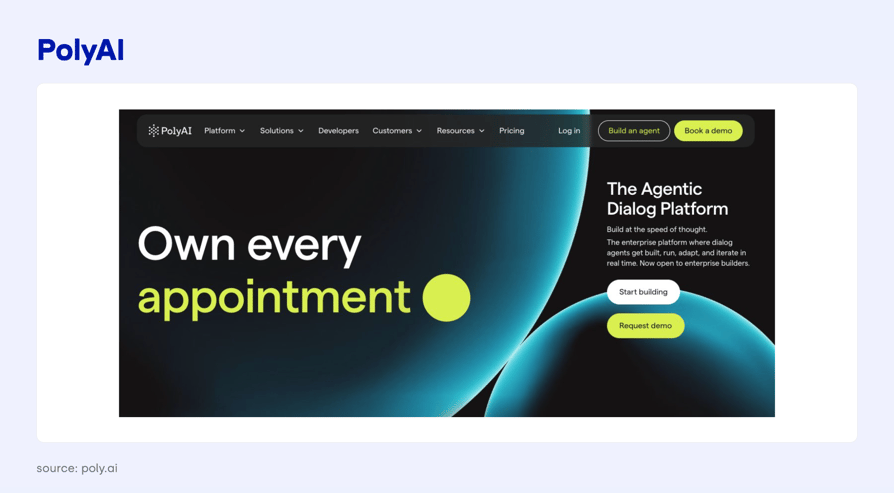
PolyAI is an enterprise AI voice platform built to handle customer calls. Its AI agents can have natural, back-and-forth conversations with callers, understand what they need, and take action to resolve the request—rather than simply guiding them through a menu.
The platform is designed mainly for large businesses with high call volumes, particularly in areas like customer service, sales, and support. PolyAI handles the AI conversation layer, while businesses can connect it to their existing systems and workflows.
The company has also built a strong track record with enterprise customers. PolyAI has raised more than $200M in funding and says its technology is used by 100+ enterprise customers across 25+ countries, with more than 2,000 deployments.
Here’s the important distinction: PolyAI is built for enterprise voice automation, not as a simple no-code business phone system. It’s a more specialized platform for companies that want highly realistic AI conversations and have the scale and infrastructure to support an enterprise deployment.
Who Is PolyAI Best Suited For?
PolyAI makes the most sense for businesses that handle a lot of complex calls, like hotels taking reservations, utilities dealing with billing or outages, or banks handling account requests.
The common thread is high call volume and costly customer service calls. If your team only handles a few hundred calls a month, PolyAI may be more than you need.
How Does PolyAI Work?
Conversation and Speech Technology
PolyAI uses its own AI models to power its voice agents. Raven handles the conversation and was trained on more than a billion real business calls, while Owl helps the agent understand speech, even with accents, background noise, or interruptions.
In July 2026, PolyAI also introduced Dialog-RSN-1, a new model designed to make voice conversations feel faster and more natural.
PolyAI has published sub-300ms response times, helping its voice agents keep conversations feeling fast and natural.
A Note on Latency Numbers
PolyAI’s <300ms figure refers to model latency, not the full call experience. Real-world response times also depend on speech generation, telephony, and network latency.
IVR, Routing, and Call Deflection
PolyAI replaces traditional press-1, press-2 IVR menus with a conversational voice agent. Callers can explain what they need naturally, and the agent can either resolve the request or route them to the right team.
- Understands intent: Handles natural language, follow-up questions, accents, interruptions, and complex requests.
- Resolves calls: Can handle FAQs, bookings, payments, authentication, and basic troubleshooting without a human.
- Routes intelligently: Identifies why someone is calling and sends them to the right team.
- Passes context: Collects relevant details and shares them with the human agent, so callers don’t have to repeat themselves.
- Reduces call volume: Can resolve routine requests, send information by SMS, and help during busy periods.
How Do You Build a PolyAI Voice Agent?
PolyAI gives you two main ways to build an AI voice agent:
- Agent Studio: A low-code/no-code builder where you can create an agent from a company URL, then use Studio Assistant to build flows, add knowledge, set behavior, create integrations, and configure handoffs using natural language.
- Agent Development Kit (ADK): A developer-focused option that lets teams build agents in their own IDE using code, version control, and tools like Cursor or Claude Code.
For most non-technical users, Agent Studio is the simpler option. You describe what you want, review the proposed changes, test the agent, and approve them. Changes are made on a separate branch first, so you can test before moving them to the live agent.
What Are the Key Features of PolyAI?
PolyAI’s key features include natural conversations, complex call handling, speech recognition, realistic voices, multilingual support, and enterprise integrations. Let’s take a closer look at what each of these features offers.
Natural, Human-Like Conversations and Voices
PolyAI is designed for conversations that don’t follow a script. Its agents can understand what callers mean, keep track of the conversation, handle interruptions, and ask follow-up questions when needed. As we've already mentioned, PolyAI has published sub-300ms response times, helping conversations feel fast and natural.
PolyAI also combines human voice recordings with AI-generated speech to create voices that sound natural and can be tailored to a company’s brand and personality.
Complex Call Resolution
PolyAI can handle many customer requests from start to finish, rather than simply answering questions. This includes ID checks, payments, bookings, FAQs, account management, and troubleshooting. By taking care of these routine tasks, the agents can reduce the number of calls that need a human.
Strong Speech Recognition
PolyAI’s Owl speech recognition model is built for real-world conversations. It can handle accents, background noise, static, and people talking over the agent, helping it understand callers even when the audio isn’t perfect.
Multilingual and Multimodal Support
PolyAI supports 75+ languages, allowing customers to communicate in their preferred language and even switch languages during a conversation. It also supports different communication channels, including voice and text.
Enterprise Integrations
PolyAI offers 130+ native integrations with contact center, telephony, CRM, and other business platforms. For systems that aren’t natively supported, businesses can use PolyAI’s API to build additional integrations and connect the agent to their existing tools.
PolyAI Integration Categories
| Category | Top Integrations | How You Connect It |
|---|---|---|
| Telephony | Twilio, Nice CXone, Five9, Genesys | SIP trunks, APIs or platform-native connectors |
| CRM integrations | Salesforce, HubSpot, Microsoft Dynamics 365, Zendesk CRM | API credentials + OAuth settings |
| Knowledge base | Gladly, Zendesk Knowledge Management, Salesforce Knowledge Management | PolyAI Agent Studio |
| Chat | SMS, chat handoff, WhatsApp | APIs |
Enterprise-Grade Security
PolyAI is built for enterprise environments where security and compliance are critical. Its platform is ISO 27001 and SOC 2 Type II certified and supports PCI DSS, GDPR, and HIPAA compliance, making it suitable for industries handling sensitive customer and payment data.
Skip the Procurement Cycle. Test a Voice Agent This Week.
PolyAI Pricing Breakdown
PolyAI pricing is not publicly disclosed. The platform charges per minute, with rates depending on factors such as call volume, use case, and integrations. Here's what we know about how PolyAI pricing works and what you get with the platform.
How Does PolyAI’s Pricing Model Work?
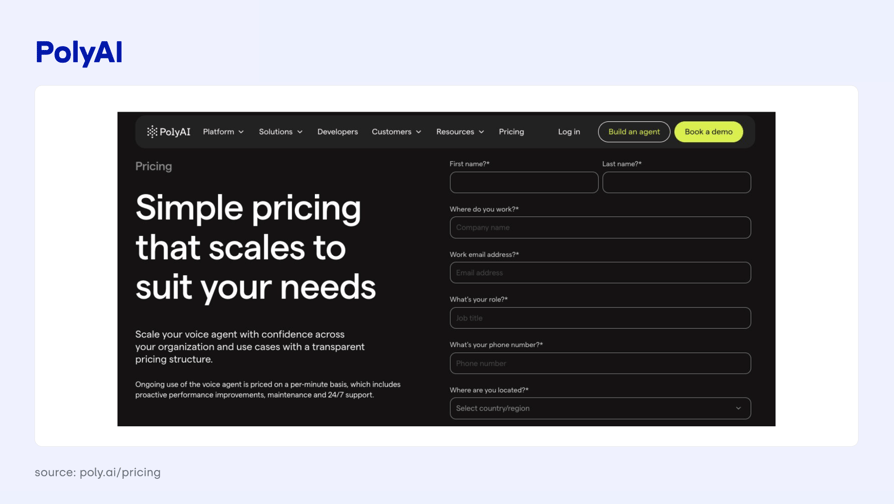
PolyAI charges per minute, with the final rate depending on factors such as call volume, use case, and integrations. The price also includes proactive performance improvements, maintenance, and 24/7 support. PolyAI does not publish a specific per-minute rate; instead, its pricing page directs buyers to request a demo.
What Changed for PolyAI in 2026?
On May 18, 2026, PolyAI announced via PR Newswire that its Agentic Dialog Platform was available to all builders for free for the first two months. The live site also offers a “Start building” option through Agent Studio, while the ADK provides self-serve API keys.
So, you can now build and test PolyAI without going through a sales process, but buying the platform for ongoing use still requires a sales conversation. PolyAI does not currently publish what you pay after the first two months or whether a credit card is required at signup, so it’s worth confirming before investing significant build time.
What Does Every PolyAI Contract Include?
According to PolyAI’s pricing page, every plan includes:
- 99.9% uptime SLA for phone lines
- 24/7/365 emergency support plus a web ticket portal
- Monitoring, maintenance, and feature upgrades
- 24/7 data infrastructure, compliance certificates, and regular audits and testing
The advantage of this model is that you're paying for more than just voice minutes. The contract also covers the infrastructure, support, maintenance, and ongoing improvements needed to run an enterprise voice agent.
The takeaway:
PolyAI’s pricing is flexible but not transparent. The per-minute model bundles support, maintenance, infrastructure, and ongoing improvements, but you can’t estimate your production costs without talking to sales. That makes it harder to compare PolyAI directly with platforms that publish their rates.
What Do Real PolyAI Users Say?
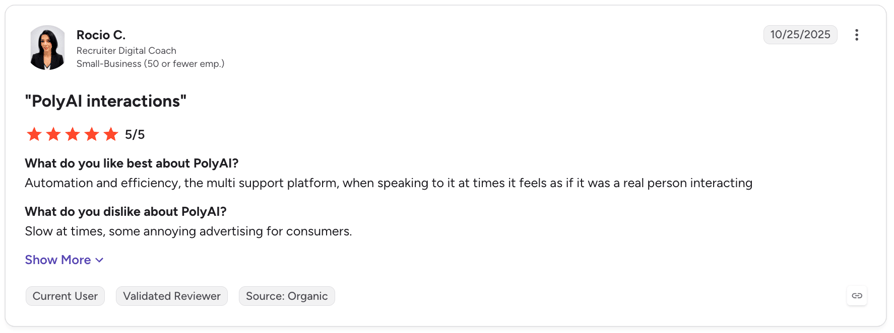
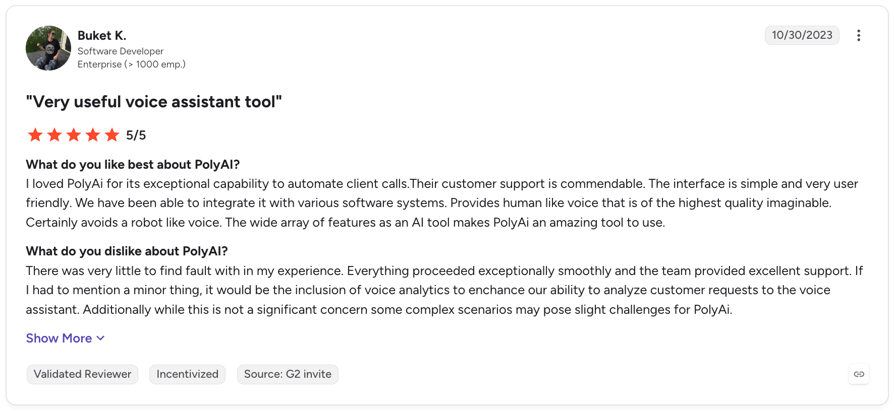
PolyAI gets very positive feedback, although there’s one important caveat: there are only 12 reviews on G2, so the sample is still pretty small. All 12 give PolyAI 5/5, with users mainly praising its human-like voice, automation, ease of integration, and overall conversational quality.
Reviews highlight how well PolyAI handles real conversations. Even a user mentioned that it can deal with digressions, stutters, ambiguity, and natural language better than other systems.
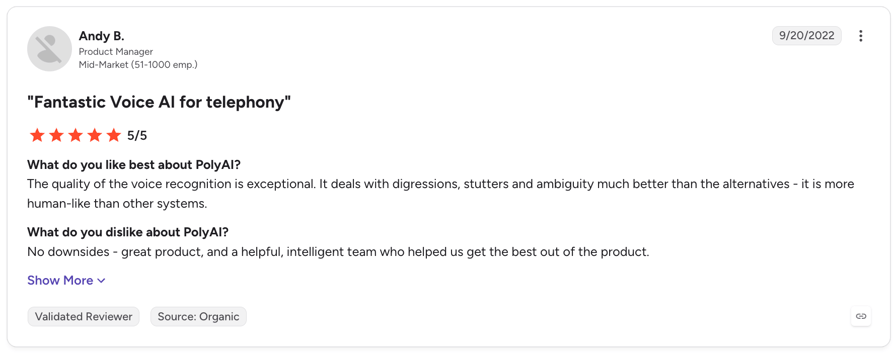
Other users praise how much work it can take off human teams. One customer, for example, said PolyAI handled 87% of non-revenue calls from day one.
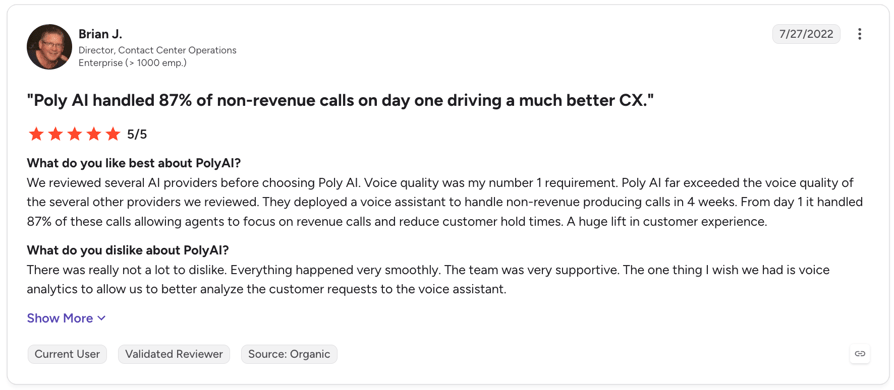
The main criticism? Analytics and speed. A user mentions that PolyAI can be slow or lag at times, while other reviewers also said they would like better voice analytics for understanding customer requests.
So, the overall picture is very positive, but the small number of reviews is worth keeping in mind.
And if you go looking for PolyAI on Trustpilot, watch out for PolyBuzz. Yes, it really is a different company—and judging by the reviews, apparently things can get a little… spicy. The PolyBuzz reviews talk about glitches, coins, and characters getting “too spicy,” so definitely don't use those reviews to judge PolyAI.
Rated 4.4/5 on G2. Try It on Your Own Calls.
PolyAI Review on 6 Must-Have Business Requirements
Six requirements decide most voice AI evaluations: voice quality, language coverage, integrations, analytics, security and support. PolyAI publishes enough detail to be scored on all six, and in a conversational IVR or voice AI evaluation the caveat column matters as much as the score.
PolyAI on 6 Must-Have Business Requirements
| Requirement | How PolyAI Performs | What to Watch |
|---|---|---|
| Voice quality and latency | Raven trained on 1B+ enterprise conversations, Owl ASR handling noise and interruptions, Dialog-RSN-1 at 280 to 500ms per PolyAI | Every figure is vendor-reported and model-level, not end to end |
| Language coverage | 75 languages claimed with native-speaker quality | Performance varies by model |
| Integrations and telephony | 130+ pre-built integrations, self-serve Connect Portal with managed OAuth 2.0 | Not every integration is self-service; custom integrations still require engineering |
| Analytics and QA | Supervisor Suite: Conversation analytics, custom dashboards, agent performance metrics & AI insights | Some reviewers report limited analytics |
| Security and compliance | SOC 2, ISO 27001-certified, HIPAA, GDPR, PCI DSS, AWS hosting | HIPAA & PCI-DSS compliance might vary by deployment. |
| Support and reliability | 99.9% uptime SLA on your phone lines, web ticket portal, 24/7/365 emergency phone line, monitoring and upgrades included | No published named-CSM or onboarding-specialist commitment |
Who Should (and Should NOT) Use PolyAI?
PolyAI is best suited to large enterprises handling high-volume, complex, or regulated customer conversations. Smaller teams, fast-moving businesses, or those looking for an all-in-one phone system may find other platforms a better fit.
Best Fit: Where PolyAI Shines
- High-volume, regulated contact centersEnterprises in hospitality, gaming, utilities, banking, healthcare and large-scale retail where a bad call costs a booking or a compliance headache.
- Organizations with complex, multi-turn conversationsWorkflows like hotel reservations, utility billing disputes, and bank account servicing that go beyond simple FAQ deflection.
- Teams that need PCI DSS, ISO 27001 and HIPAA in the baselinePolyAI's compliance stack is one of the stronger ones in the category and is included in every plan.
- AWS shops with committed spendAWS Marketplace procurement and a proven Amazon Connect integration shorten the buying cycle significantly.
- Buyers who can absorb a quote-based contractOrganizations that can commit budget before seeing a number, and that have the operational capacity for a governed rollout.
Poor Fit: When to Look Elsewhere
- Small teams that need a predictable monthly costIf you need a transparent, all-in bill you can see upfront, look at platforms that publish the whole number,.
- Teams that need production traffic running next weekA six-week controlled rollout is the reality for most of the cases. If speed matters more than scale, a turnkey platform gets you there faster.
- Anyone who needs a phone system, not just a voice AI layerPolyAI sits on top of the CCaaS you already pay for. If you need telephony included, look at platforms that bundle it.
- Buyers who require on-premise deploymentPolyAI does not document on-premises or private-cloud options on its public pages. Confirm before you build a compliance case around it.
PolyAI Fit by Industry
PolyAI Industry Fit
| Industry | PolyAI Fit | Evidence |
|---|---|---|
| Hospitality and restaurants | Strong | 3,000+ restaurants on the platform, Fogo de Chão reports 95% guest satisfaction |
| Utilities and energy | Strong | Appointment scheduling and outage calls are core published use cases |
| Banking and financial services | Strong | UniCredit reports NPS up 14 points and Metro Bank named |
| Healthcare | Good | Howard Brown Health named, HIPAA in the compliance baseline |
| Retail and delivery | Good | Foot Locker and FedEx named |
| SMB support teams | Weak | Free to evaluate since May 2026, but no published pricing, no SMB outcomes, and no self-serve production path |
Security, Compliance & Data Privacy of PolyAI
PolyAI has a strong security and compliance setup, with HIPAA, GDPR, and PCI DSS included as standard. Its security page also lists ISO 27001 certification, AWS hosting, regular audits, third-party penetration testing, and alignment with UK National Cyber Security Centre guidelines. In-call authentication is conversational rather than biometric.
For an enterprise security review, it’s still worth confirming a few details directly with PolyAI, especially around encryption, data residency, and deployment options.
If you are running a formal enterprise evaluation, ask:
- How is call data encrypted in transit and at rest, and who holds the keys?
- What data residency options are available?
- Is on-premise or private-cloud deployment available?
- What exactly does the 99.9% SLA cover, and what happens if it is missed?
- Which CRM, helpdesk, and workforce systems have production connectors today?
- What is the rate after the two free months, and what commitment does it require?
What Are the Pros and Cons of PolyAI?
PolyAI’s biggest strengths are its voice quality, strong enterprise track record, and broad compliance coverage. The main trade-offs are custom pricing and a more involved rollout, which may make it less appealing for smaller teams or businesses that need to get started quickly.
PolyAI Pros
- Human-Like Voice QualityReviewers consistently rank PolyAI's voice output among the best in the industry — authentic, warm, and easy to mistake for a real person on the line.
- Strong Multi-Turn Conversation HandlingUsers highlight how naturally the platform manages topic changes, interruptions, and casual speech, without breaking the flow of a call.
- Responsive, Hands-On Customer SupportG2 reviewers repeatedly call out PolyAI's support team as responsive and helpful, especially during implementation.
- Enterprise-Grade Reliability at ScaleBanks, telecoms, insurers, and hospitality brands rely on PolyAI to automate high call volumes around the clock without sacrificing consistency.
- Simple, User-Friendly InterfaceDespite its enterprise focus, PolyAI scores well on ease of use—reviewers note a clean interface that doesn't require extensive training to operate day to day.
PolyAI Cons
- Occasional Slow PerformanceSome users report that PolyAI can be slow to respond or process commands at times. While it isn't described as a frequent issue, reviewers say occasional delays can affect the overall experience.
- Limited Voice AnalyticsSeveral enterprise users would like more advanced voice analytics and reporting. They mention that stronger conversation insights would make it easier to analyze customer interactions and identify opportunities for improvement.
- Can Struggle With Complex ScenariosA few reviewers note that PolyAI performs well for most conversations but may face challenges in more complex or unusual customer interactions, where additional customization or human support may still be needed.
- No Public PricingIt's hard to compare costs because PolyAI doesn't publish its pricing. Every business needs to contact the sales team for a custom quote, making it difficult to know upfront whether it fits their budget.
- Telephony Isn't Built InPolyAI doesn't run its own VoIP infrastructure, so coverage and call quality depend on whichever telephony partner sits underneath it.
The Best 4 PolyAI Alternatives in 2026
The four strongest PolyAI alternatives are CloudTalk, Synthflow, Vapi and Retell AI. Here’s how they compare on pricing, setup, features, telephony, and enterprise readiness.
PolyAI Alternatives Compared
| Capability | CloudTalk | Synthflow | Vapi | Retell AI |
|---|---|---|---|---|
| Best for | AI voice agents plus a full business phone system on a published price | Enterprise buyers wanting a managed, scoped rollout | Developer-first, bring-your-own-model voice agents | Fast prototyping on true pay-as-you-go |
| Pricing transparency | Public: phone plans from $25/user/month, AI Voice Agents add-on from $99/month for 200 minutes | Partly public: one enterprise tier from $30,000/year, then scoped | Public: $0.05/min platform fee plus model costs at cost, Scale is contract-based | Public: $0.07 to $0.31/min with a published component breakdown |
| Self-serve / free tier | Yes, self-serve signup plus a 14-day free trial | Free to build; PAYG when live | Yes, self-serve, 60+ minutes included | Yes, self-serve, $10 in free credits and 20 free concurrent calls |
| Time to first agent | Under 10 minutes via Self-Service Configuration | Minutes (not specified) | Minutes (not specified) | First phone agent in 15 minutes |
| Latency | Sub-800ms response latency | < 500 ms | sub-500ms | ~600ms |
| Languages | 60+ languages and accents | 30+ | Provider-dependent (Azure alone: 100+) | 55+ |
| No-code friendliness | High | High | Low: API-first, built for developers | Medium |
| Enterprise compliance | SOC 2 Type 1 and Type 2, GDPR, HIPAA with BAA support, SSO via SAML | SOC 2, HIPAA, PCI DSS, GDPR, ISO 27001 | SOC 2, HIPAA, PCI, SSO, RBAC; HIPAA is a $2,000/month add-on | SOC 2 Type 1 and Type 2, GDPR, HIPAA with BAA support, GDPR |
| Phone system included | Yes | No | No | No |
Why CloudTalk AIVA Is Worth Considering
The problem with PolyAI isn’t access. It’s knowing what you’ll actually pay.
You can build an agent for free, but once it goes live, costs can get harder to predict—and you still need to pay for your CCaaS separately.
CloudTalk keeps everything in one place and on one bill. It combines a business phone system with AI voice agents, used by 5,500+ customers across 100+ countries, with numbers available in 160+ countries. Calls, numbers, routing, recording, transcription, analytics, and AI all run on the same platform—so you can see the full cost upfront.
PolyAI vs CloudTalk: Feature and Capability Comparison
PolyAI vs CloudTalk
| Dimension | PolyAI | CloudTalk |
|---|---|---|
| What you are buying | A voice AI layer for the contact center you already run | A phone system plus AI voice agents on the same infrastructure |
| Price visibility | Per-minute model, not published | Phone plans from $25/user/month, AI Voice Agents from $99/month for 200 minutes |
| Languages | 75+ claimed | 60+ languages and accents |
| Latency | 280 to 500ms model latency (PolyAI-reported) | Sub-800ms response latency |
| Who configures it | Plain-language Agent Builder, or the ADK for engineers | Self-Service Configuration: a non-technical user builds an agent in under 10 minutes |
| Compliance packaging | SOC 2 Type II, ISO 27001, HIPAA, GDPR, PCI DSS | SOC 2 Type 1 and Type 2, GDPR, HIPAA with BAA support and PHI handling, SSO via SAML, STIR/SHAKEN |
| Reliability | 99.9% uptime SLA on phone lines | 99.999% uptime SLA |
| Escalation to humans | Passes the full story to a human agent | Escalates with context to human agents on the same telephony, recording and analytics stack |
| Trial | Free for the first two months, self-serve | 14-day free trial, self-serve signup |
The Key Takeaway:
PolyAI is a strong voice AI layer, but CloudTalk gives you more of the stack in one place. You get transparent pricing, built-in telephony, and a 99.999% uptime SLA—without needing to add AI on top of a separate contact center.
What Does CloudTalk AIVA Cost?
CloudTalk publishes its full pricing, with AI Voice Agents starting at $99/month for 200 minutes and phone plans starting at $25/user/month.
CloudTalk Plans and Pricing
| Plan | Price (annual billing) | Key Features |
|---|---|---|
| Starter | $25/user/month | Unlimited inbound & internal calls, 500 outbound minutes (regional calling bundle), call queues, transfers, click-to-call, automatic call recording (1-month retention) |
| Essential | $29/user/month | Everything in Starter + IVR and smart routing, 100+ CRM/helpdesk integrations, workflow automation, unlimited recording retention |
| Expert | $49/user/month | Everything in Essential + Power, Smart & Preview Dialers, Salesforce integration, 24/7 phone support (3-seat min) |
| AI Voice Agent: Receptionist | From $99/month (200 min) | No-code inbound AI answering, routing, and logging; 50 free minutes to try; tiers up to $699/mo (2,500 min) |
| AI Voice Agent: Specialist | From $349/month (1,000 min) | Sales-led custom agents for complex inbound and outbound workflows; scales to $1,249/mo (5,000 min) |
Where Does CloudTalk Fit Better, and Where Does PolyAI Win?
PolyAI stands out for large enterprises with complex, high-volume contact centers. But for most sales and CX teams, CloudTalk is the simpler choice: you get the phone system and AI voice agents from one vendor, transparent pricing, built-in compliance, and self-service setup—without the overhead of a large enterprise rollout.
CloudTalk is a better fit for:
- Sales teams that want AI calling and telephony togetherInbound and outbound AI calls, Q&A, and scheduling without building or buying a separate CCaaS first.
- Businesses automating routine customer callsAI handles FAQs, appointment scheduling, qualification, and other repetitive conversations while humans handle more complex cases.
- Teams that need to get started quicklyBuild an AI agent without developers and launch it alongside your existing CloudTalk phone setup.
- Growing teams that need predictable costsPublished phone plans and AI Voice Agent pricing make it easier to budget before you buy.
- Companies that want AI and human agents on the same systemEscalate calls with context and keep telephony, recordings, analytics, and CRM data in one place.
"Originally, we sent a link for them to book online. Maybe 5% followed through. Now the AI just says: What time works for you? It is so simple, but it works. People reply, the AI locks it in, and we are done."
Owner of Circle Gym

Still Weighing PolyAI Against the Alternatives?
Final Verdict: Is PolyAI Worth It?
PolyAI earns its 4.1 out of 5. Its voice quality is a real strength, the compliance setup is solid, and its enterprise track record is well established. Since May 2026, you can also try the platform without going through a procurement process. The main drawback is pricing: you still can’t know what PolyAI will cost until you get a quote. And because PolyAI is an AI layer rather than a full phone system, teams may also need to account for the cost of their existing telephony or contact center.
PolyAI Is a Good Fit For:
- Contact centers running high volumes of complex, regulated phone conversationsThe platform was designed for exactly this buyer, and the published customer list proves it.
- Enterprises in hospitality, gaming, utilities, banking, healthcare and large-scale retailPolyAI's named customers and published outcomes cluster here.
- Teams that need PCI DSS, ISO 27001 and HIPAA in the compliance baselineThese are standard in every PolyAI plan rather than a paid add-on.
- Buyers who can absorb a quote-based contract and a multi-week rolloutThe two free months let you evaluate seriously. Buying still requires a sales conversation.
PolyAI Is Not a Good Fit For:
- Small teams that need a predictable monthly costIf you need a published, all-in bill before you commit, look at AI voice agents for SMBs instead.
- Anyone who needs a phone system, not just a voice AI layerPolyAI sits on top of the CCaaS you already run. The telephony bill does not go away.
- Teams that need production traffic running next weekIf you need to get your AI voice agent up and running fast, a turnkey platform is a better fit.
- Buyers who need pricing they can compare upfrontPolyAI doesn't publish a production rate. If you need to compare vendors or build a business case before talking to sales, transparent pricing is a better fit.
Bottom line: PolyAI makes the most sense for large enterprises with complex contact center needs. If you want AI voice agents and a business phone system you can set up and manage without a complex rollout, CloudTalk is the simpler choice.