Dentina AI Reviews 2026: Pricing, Pros & Cons for Dentists
TL;DR: Dentina AI at a Glance
| Field | Verdict |
|---|---|
| One-line verdict | A dental-only AI phone agent that answers calls 24/7 and runs outbound recall and reactivation campaigns, with the deepest practice management system coverage in its category. Annual-only billing, and almost no independent review trail. |
| Overall rating | 3.5/5 |
| Best for | Established US and Canadian practices |
| Not good for | European practices, monthly buyers, practices that need a phone system too. |
| Starting price | $299/mo (Standard Inbound) or $399/mo (Premium Inbound), billed annually per location. Outbound campaigns are a custom quote. |
| Free tier? | No free tier. 30-day free trial, no setup fee, cancel anytime. |
| Setup time | Not published. Get a go-live date in writing. |
| Standout pro | Eleven named PMS integrations, including Dentrix, Open Dental and Eaglesoft. |
| Standout con | No G2, Capterra or Trustpilot listing. Its SourceForge entry carries zero reviews. |
| User sentiment | Not measurable from public sources. Every testimonial we found sits on Dentina's own site. |
| Our verdict | Choose CloudTalk if you want monthly billing, GDPR coverage, or a phone system that serves more than the front desk. |


About Dentina AI
Dentina AI is a dental-only AI receptionist that answers patient calls 24/7, books into your practice management system, and runs outbound recall and reactivation campaigns. It was built by a practicing dentist, it serves US and Canadian practices, and it connects to eleven PMS platforms including Dentrix, Open Dental and Eaglesoft.
This review covers what Dentina does, what it costs, which systems it integrates with, its HIPAA posture, who it fits, and the alternatives worth comparing. Adoption across the category is moving fast, and the numbers behind AI voice agents in healthcare show why.
Dentina AI Scorecard: Our Honest Ratings
Scores come from Dentina's published documentation, cross-checked against third-party reviews and our own investigations.
| Dimension | Rating | Why |
|---|---|---|
| Ease of setup | 3.5/5 | No published onboarding timeline and no independent accounts of implementation. The 30-day trial offsets the risk. |
| Call quality and campaign execution | 4/5 | 24/7 answering with unlimited concurrent calls, and reactivation campaigns running up to 9 attempts per patient over roughly 90 days. Conversation quality is unverified. |
| Pricing clarity | 3/5 | Entry prices are published, which beats most of this category. Annual-only billing, outbound behind a quote, and third-party listings reporting very different numbers pull it down. |
| Features and capabilities | 4/5 | Focused and coherent: inbound answering, booking, recall, reactivation, confirmations. But transfer to staff only included on Premium plan. |
| Integrations | 4.5/5 | Eleven named practice management systems covering general practice, orthodontics and DSO platforms. The strongest part of the offering. |
| Support and reputation | 2.5/5 | A credible founder story and large self-reported usage figures, with nothing independent behind either. |
Dentina AI overall rating: 3.5/5. Best for an established US or Canadian practice on a named PMS with real call overflow, comfortable committing annually to a vendor it will mostly have to judge on a demo.
What Is Dentina AI?
The Dentina AI receptionist is a voice agent built for dental practices. It answers incoming patient calls, places outgoing ones, and connects directly to the practice's scheduling software.
It answers calls and books into your PMS after hours, overflow, during lunch and emergencies, with unlimited simultaneous calls. Outbound runs structured campaigns: recall reminders pulled from the PMS, appointment confirmations, reactivation sequences for dormant patients, and unscheduled-treatment follow-up.
"After COVID, staffing issues were causing us to miss 40% of our calls."
Dentina reports 2,000 or more dentists and DSOs using the product and over 2,800,000 calls handled.
The product serves US and Canadian practices and thus is not built for GDPR compliance required in the EU.
Who Dentina AI Is Best Suited For
Established practices running Dentrix, Open Dental or Eaglesoft get the most out of it, since the PMS connection does the heavy lifting. Practices losing calls to overflow or after hours are the clearest fit, though it is worth pricing a comprehensive dental phone system against it before assuming a standalone AI layer is the answer.
Practices with long lists of lapsed patients to go through will find the 9-attempt reactivation sequence especially useful. And if your team is spread around you can use one configuration across sites with a shared PMS.
How Does Dentina AI Work?
Campaign Types and Call Cadence
Dentina has 4 main calling campaigns:
- Recall Campaign: Finds patients due for their routine 6-month cleaning and calls them to book their visit.
Confirmation Campaign: Calls patients scheduled for upcoming appointments to confirm they are still coming (and groups family members into a single call).
Reactivation Campaign: Targets lapsed patients who haven't stepped foot in the office for 18+ months to win them back (using up to 9 automated call attempts over time).
Treatment Follow-Up Campaign: Reaches out to patients who had treatment recommended (like a crown or cavity filling) but left without scheduling the procedure.
Inbound answering runs alongside all of these, 24/7, with unlimited concurrency, so when more than one patient calls at the same time, they all get answered.
Language capabilities depend on the tier you choose:
- Standard Inbound: Covers English and Spanish.
- Premium Inbound: Expands coverage up to 57 languages (adds ~$100/month).
Cost-Saving Tip: If your practice currently relies on an after-hours voicemail as a fallback, review our guide of medical office voicemail greetings to optimize your low-cost setup before committing to a paid AI service.
Revenue & ROI Attribution
Dentina measures success by recovered revenue and staff time saved rather than total calls made.
- How the Model Works: It calculates potential ROI by estimating how many reachable patients will schedule each month multiplied by your average appointment value.
- The Catch: These figures are vendor projections based on Dentina's internal assumptions—not third-party audited customer results.
- What to Ask on a Demo: Ask sales reps what actual reactivation and scheduling rates look like for practices of your size using your specific PMS platform.
Data and PMS Access
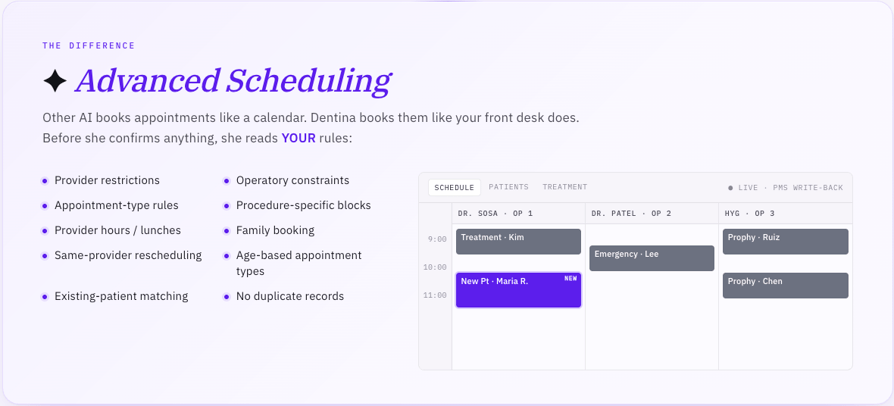
Eleven named systems: Dentrix, Dentrix Ascend, Dentrix Enterprise, Open Dental, Eaglesoft, Curve, Denticon, Cloud9, Dolphin, OrthoTrac and PracticeWorks. The list covers general practice, orthodontics and DSO-scale platforms, and runs longer than most dental AI vendors publish.
What the site does not specify is depth per system: real-time bidirectional write-back on all eleven, or read access plus booking on some. Ask which applies to your PMS, and watch it write a test appointment during the demo. We walked through building an AI receptionist for a dental practice end to end if you want to know what that demo should cover.
What Are the Key Features of Dentina AI?
24/7 Inbound Answering and Booking
Always-on call answering with direct booking into the PMS, unlimited concurrent calls, and up to 57 languages on the Premium tier. For a practice losing overflow and after-hours calls, this is the part that pays for itself.
The caution is emergency triage. Dental calls include genuine urgency, and how the agent separates a cracked molar at 11pm from a routine cleaning request is not documented publicly. Ask to hear that call during the demo.
Lapsed-Patient Reactivation
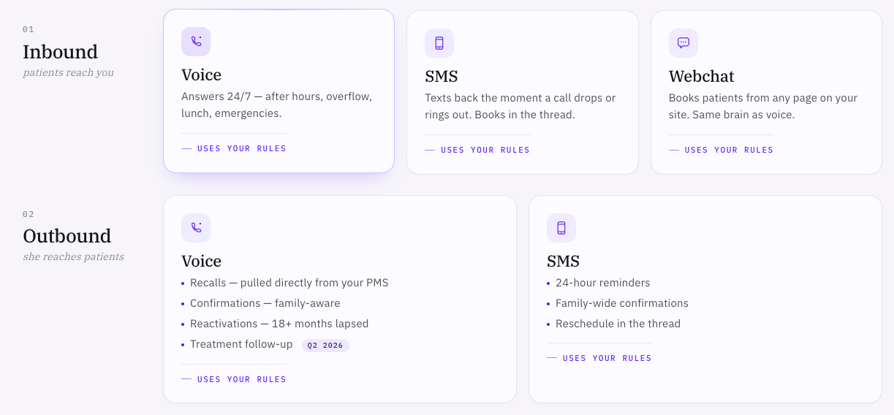
A structured sequence of up to 9 attempts per patient inactive 18 months or more. This targets a revenue leak most practices know about and have no staff hours to work systematically.
Its value depends entirely on how large and reachable your lapsed list actually is. A new practice, or one with strong existing recall compliance, will not generate enough volume to justify the cost. Nine calls is also a lot of calls: ask how the sequence handles opt-outs, how it spaces attempts, and what happens when a patient says they have changed practices.
Patient Recall and Treatment Follow-Up
Routine recall reminders for checkups and cleanings, plus follow-up on unscheduled treatment plans, each with a defined attempt cadence. This is the front-desk phone work that eats mornings.
Check the overlap with what you already pay for. Many practices run confirmations through their PMS or a separate patient-communications tool, and duplicate reminders annoy patients faster than they fill chairs. If scheduling is the main job to be done, compare against the wider field of AI voice agents for appointment scheduling rather than assuming a dental-only tool wins by default.
Revenue and ROI Reporting
Reporting ties campaign activity to revenue recovered and staff time saved rather than call volume, which makes it easier to justify the spend to practice ownership.
Dentina AI Pricing Breakdown

Dentina AI pricing is more transparent than most of this category, with one asterisk.
| Plan | Price | Billing | Included |
|---|---|---|---|
| Standard Inbound | From $299/mo | Annual, per location | 24/7 answering, PMS booking, English and Spanish |
| Premium Inbound | From $399/mo | Annual, per location | Standard, plus custom screening questions, advanced analytics, up to 57 languages |
| Outbound campaigns | Custom quote | Not published | Recall, confirmations, reactivation |
The Real Cost: What to Ask Before Committing
The annual structure puts the risk on you, so make the demo earn it:
- What does the outbound quote depend on: patient list size, minutes, campaign count, or seats?
- Is there a cap on inbound minutes or calls at $299, and what happens in a month that runs past it?
- What is the integration depth for my specific PMS, and can you write a test appointment right now?
- Has treatment follow-up shipped, or is it still on the roadmap?
- If we cancel at month 10, what happens to the remaining term?
Is Dentina AI Free? Trial Details
There is no free tier. Dentina advertises a 30-day free trial with no setup fee and cancel-anytime terms.
A 30-day trial materially changes the risk profile of an annual contract, and it is the best reason to take the demo seriously rather than dismissing the product over its billing terms. Get the terms in writing: whether the annual term begins at signup or when the trial ends, and whether the trial covers outbound campaigns or inbound only.
What Real Users Say About Dentina AI Pricing on Reddit, G2, Capterra and Facebook
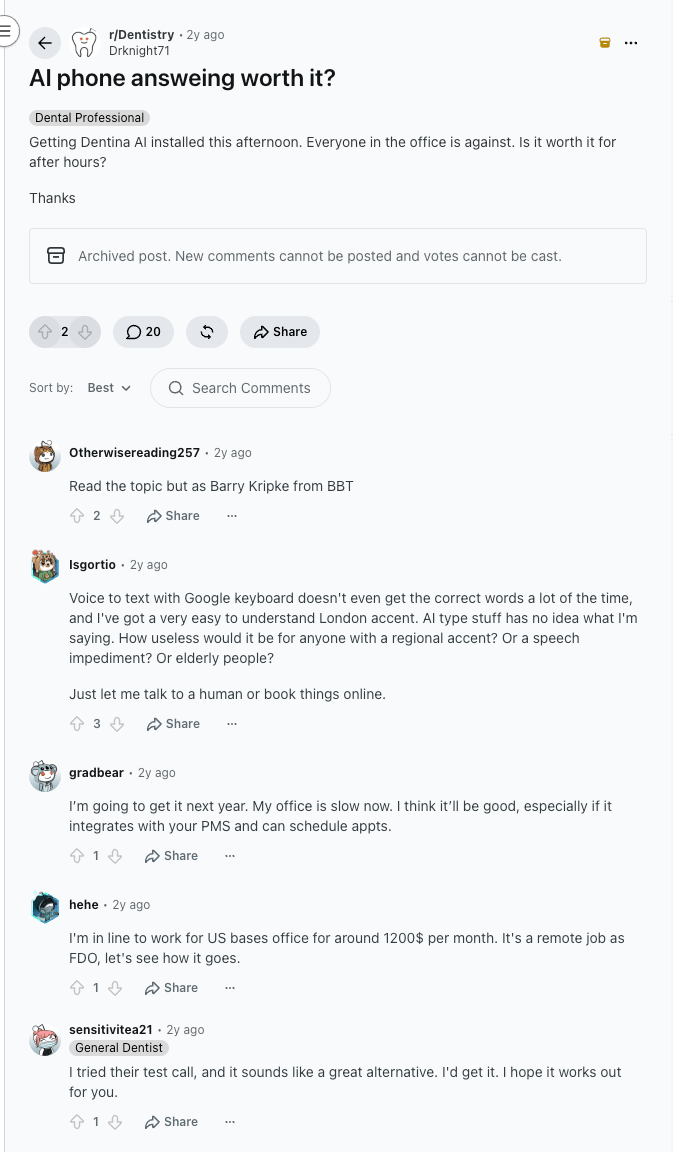
On genuine forums, dentists are debating AI phone tools as a category rather than Dentina specifically. But here's a debate on Reddit; and you can check to see if the price of hiring a a live human receptionist for 1200$/month vs an AI receptionist is worth it.
Try it before you commit to a year
Dentina AI Review on 6 Must-Have Business Requirements
1. Call Quality & Persistence
- Handles Heavy Call Volume: Answers multiple calls at once so patients never hit a busy signal or get sent straight to voicemail.
- Persistent Patient Outreach: Uses a 9-attempt call sequence to reach lapsed patients who are usually tough to get back in the chair.
- What to Test: Call quality is hard to judge from marketing claims. Call your own practice line at 9 PM during the 30-day trial and throw a messy, realistic scenario at it to see how it performs.
2. Onboarding & Setup
- Custom Setup Process: Dentina does not publish setup times or setup steps online.
- 11 PMS Integrations: Linking directly into systems like Dentrix, Eaglesoft, or Open Dental requires real configuration behind the scenes—not just filling out a quick signup form.
- What to Ask: Ask for a specific point person to guide your setup and get a clear, guaranteed launch date in writing.
3. Coverage (Inbound vs. Outbound)
- Two-Way Support: Manages both 24/7 inbound calls and outbound outreach campaigns.
- Mixed Pricing: Inbound plans have clear, upfront pricing ($299–$399/mo per location), while outbound campaigns are custom-quoted. You are buying one clearly priced core service and one custom package.
4. Language Support
- Standard Tier: Handles calls in English and Spanish.
- Premium Tier: Unlocks support for up to 57 languages for an extra ~$100/month.
- Who It Is For: If your practice serves a multilingual community, that extra $100/month is an easy call to make.
5. PMS Integration Depth
- Supported Platforms: Works with 11 major systems spanning general practice, orthodontics, and DSOs (e.g., Dentrix, Open Dental, Eaglesoft, Curve, Denticon).
- What to Ask: Don't just trust a list of logos on a website—ask the sales rep to write a live test appointment directly into your system during the demo.
6. Vendor Stability & Support
- Dentist-Founded: Created by a practicing dentist and claims substantial usage figures (2,000+ practices, 2.8M+ calls).
- Sparse Independent Reviews: Third-party customer feedback and day-to-day support quality are hard to verify online.
- What to Ask: Ask to speak with two active practices using your same practice management software before signing a contract.
Integrations Ecosystem
| Category | What Dentina reports |
|---|---|
| Practice management systems | Dentrix, Dentrix Ascend, Dentrix Enterprise, Open Dental, Eaglesoft, Curve, Denticon, Cloud9, Dolphin, OrthoTrac, PracticeWorks |
| Inbound calling | 24/7, unlimited concurrent calls, books into the PMS |
| Outbound calling | Recall, confirmations, reactivation. Custom quote |
| Reminders and confirmations | Included, with family-aware messaging |
| Treatment follow-up | Marked Q2 2026. Confirm availability |
| Reporting | Revenue attribution and staff-time-savings reporting. Depth not documented |
Try it before you commit to a year
Is Dentina AI Legit?
Yes, Dentina AI is a legitimate company with real reviews posted on their website (we verified user identity). Just be aware that it's an AI receptionist and not meant to replace your phone system or PMS.
Who Should (and Should NOT) Use Dentina AI
Best Fit: Buyer Profiles Where This Tool Shines
- Established practices on Dentrix, Open Dental or Eaglesoft. The PMS connection is the product's strongest asset and these are its best-supported platforms.
- Practices losing calls to overflow and after hours. Unlimited concurrency plus 24/7 answering targets the actual failure mode rather than a narrower version of it.
- Practices with a substantial lapsed-patient list. The 9-attempt sequence is built for work no front desk has hours for.
- Practices with Spanish-speaking or multilingual patients. Language coverage on the Premium tier is broader than most dental-only competitors publish.
- Multi-location groups on a shared PMS. One configuration replicates across sites, which fits per-location annual pricing.
Poor Fit: When You Should Look Elsewhere
- European practices. Dentina is built for US and Canadian compliance frameworks, and health data moving through a US vendor is not a detail you resolve after signing. CloudTalk covers GDPR natively.
- Buyers who need monthly billing. There is no month-to-month option after the trial.
- New practices. Recall and reactivation are half the product, and a new practice has neither list yet.
- Practices wanting one phone system. Dentina replaces the front desk's phone workload, not your telephony, your reporting, or your team's own calling.
Dentina AI: Use-Case Fit
| Use case | Fit |
|---|---|
| Established practice losing overflow and after-hours calls | Strong. Core use case |
| Large lapsed-patient list to reactivate | Strong. Purpose-built sequence |
| Running Dentrix, Open Dental or Eaglesoft | Strong. Best-supported integrations |
| Spanish-speaking or multilingual patient base | Strong on Premium, limited on Standard |
| New practice with no patient history | Weak. Half the product has nothing to work with |
| Practice with strong existing recall compliance | Weak. Limited additional revenue to recover |
| European practice with GDPR obligations | Poor. US and Canada only |
| Buyer who needs monthly billing | Poor. Annual only |
| Practice wanting one platform for all calling | Poor. Front-desk scope by design |
Security, Compliance and Data Privacy of Dentina AI
Is Dentina AI HIPAA Compliant?
Dentina says that it's HIPAA complaint, but that's like a bag of potato chips saying 'all natural'; what does it really mean? There is no such thing as HIPAA certification. HIPAA is a US law, not an audited standard, and any vendor can state compliance without an external body checking.
That means you need to ensure they will sign a Business Associate Agreement, the legal document defining how a vendor safeguards protected health information on your behalf, and as a covered entity you are required to have one with every vendor touching patient data. Dentina's site does not document BAA availability publicly. Get a written answer before the trial ends.
Our guide to HIPAA call recording requirements covers all this and more.
Also, if any part of the workflow you are buying texts patient information, read up on HIPAA-compliant SMS before turning it on.
Geographic Compliance Scope
Dentina is built for US and Canadian practices. We found no GDPR statement, no EU data residency option and no European offering. For a practice inside the EU or UK that is disqualifying rather than inconvenient, and a phone system for healthcare with explicit EU data handling is the safer starting point.
What Are the Pros and Cons of Dentina AI?
| Pros | Cons |
|---|---|
| Eleven named PMS integrations, broader than most dental AI vendors publish | No independent review base. Zero reviews on SourceForge, and no G2, Capterra or Trustpilot listing |
| Covers both directions: 24/7 inbound with unlimited concurrency, plus structured outbound campaigns | Annual, per-location billing with no monthly option. A three-site group commits to $10,764 a year minimum |
| Published entry pricing, which is rarer in this category than it should be | Outbound campaigns are quote-only, so full cost is unknowable before a sales call |
| 30-day free trial with no setup fee, which de-risks the annual term | Every usage and outcome figure is self-reported and unverified |
| Genuine dental specialisation, with campaign logic built around real dental recall intervals | US and Canada only, with no GDPR provision for European practices |
| Up to 57 languages on the Premium tier | Treatment follow-up is marked Q2 2026 on Dentina's own site |
The Best 4 Dentina AI Alternatives in 2026
Four products cover the realistic alternatives to Dentina AI. Our fuller roundup of dental AI virtual receptionist tools goes deeper on the dental-only field. Buyers comparing Voicify vs Dentina dental AI should note that Voicify is a conversational AI platform rather than a dental scheduling product, so it is not a like-for-like swap.
| Capability | CloudTalk | Arini | Viva AI | TrueLark |
|---|---|---|---|---|
| Best for | Inbound and outbound AI calling plus the whole team's phone system | Dental-only, solo practice through enterprise DSO | Dental front office with heavy multilingual needs | Practices already running Weave |
| Inbound calling | Yes | Yes, core focus | Yes, core focus | Yes, core focus |
| Outbound / reactivation | Yes | Yes | Yes, including no-show recovery | Mainly SMS and web chat |
| PMS integration depth | Via API and [cgv] integrations, no native dental write-back | Dental-native | Direct integrations with major PMS platforms | Via Weave |
| Pricing model | Published, from $99/mo | Not published, demo only | Published, from $349/mo credit-based | Not published, via Weave |
| Billing flexibility | Monthly available | Not published | Monthly available | Not published |
| Industry focus | Any industry, including dental | Dental only | Dental only | Appointment-based SMBs |
| Compliance scope | HIPAA with signed BAAs, GDPR, SOC 2 Type II | US and Canada | SOC 2 Type II | US |
For a dental-only tool with deep native scheduling, Arini and Viva AI are the direct substitutes. On Dentina AI vs TrueLark, the deciding factor is usually ecosystem: TrueLark has sat inside Weave since the acquisition completed in May 2025, so it makes sense if you already run Weave and much less sense if you do not.
Why CloudTalk AIVA Is Worth Considering
Dentina is a dental specialist with native PMS booking that CloudTalk does not replicate. CloudTalk is a full calling platform with an AI voice agent inside it, covering inbound and outbound for the whole practice rather than the front desk alone, on monthly terms.
Which one wins depends on whether native PMS write-back is your binding constraint. If it is, buy the dental tool.
Feature and Capability Comparison
| Capability | Dentina | CloudTalk |
|---|---|---|
| Inbound calling | 24/7, unlimited concurrent | 24/7, unlimited concurrent |
| Outbound / reactivation | Custom quote | Included, outbound minutes billed separately |
| PMS / CRM integration depth | Native, 11 named dental systems | Via API and workflow automation across [cgv] integrations. No native dental write-back |
| Pricing model and billing | From $299/mo, annual only, per location | AI Receptionist from $99/mo for 200 minutes, plus 50 free minutes. Monthly, one-month minimum |
| Industry breadth | Dental only | Any industry, [cgv] countries |
| Compliance scope | HIPAA stated. US and Canada | HIPAA with signed BAAs, SOC 2 Type II, GDPR, EU data storage |
| Revenue and ROI reporting | Revenue attribution on campaigns | Shared analytics across AI and human calls |
| Support model | Not documented publicly | Self-serve on AI Receptionist, assisted on higher tiers |
Dentina vs CloudTalk: One Tool or a Platform
The practical question is not feature-for-feature. It is whether the front desk is the whole problem.
A practice that needs booking written into Dentrix automatically, and nothing else, should weight Dentina's native integration heavily. A practice that also has treatment coordinators making outbound calls, a second location on a different number, and no visibility into any of it, is buying a narrow tool for a wide problem. Dentakay, a dental group running on CloudTalk, shows what the wider version looks like in practice.
Where CloudTalk Fits Better
- Monthly billing. AI Receptionist from $99/mo for 200 minutes on a one-month minimum, plus 50 free minutes before you pay anything, against Dentina's annual per-location commitment.
- European practices. GDPR, EU-based encrypted data storage and SOC 2 Type II certification, none of which Dentina offers.
- HIPAA with the paperwork. CloudTalk signs Business Associate Agreements covering call recordings and transcripts. One honest limit: it does not support HIPAA-compliant text messaging, so patient information should not move by SMS.
- The whole practice, not the front desk. Call routing, call flows, shared analytics across AI and human calls, and integrations with [cgv] business tools.
Dentina keeps its edge on native booking into eleven dental practice management systems and campaign logic built around dental recall intervals by someone who has worked a schedule. CloudTalk does not match that.
Final Verdict: Is Dentina AI Worth It?
The honest Dentina AI review verdict: a credible, well-specified dental product with the deepest published PMS coverage in its category, sold on terms that ask for a year of commitment with very little public evidence behind it. The 30-day trial is what makes that reasonable rather than reckless. Use every day of it, and get the BAA in writing before it expires.
Good Fit For
- Established US or Canadian practices running Dentrix, Open Dental or Eaglesoft.
- Practices losing real revenue to overflow and after-hours calls.
- Practices with a substantial lapsed-patient list worth working systematically.
- Practice owners who want revenue-attributed reporting to justify the spend.
- Multi-location groups comfortable with an annual, per-location commitment.
Not a Good Fit For
- European practices needing GDPR-native compliance. Consider CloudTalk.
- Practices whose primary need is a full phone system rather than a front-desk layer.
- New practices without an existing recall or reactivation list.
- Buyers who want monthly billing flexibility rather than an annual commitment.
FAQs: Dentina AI Reviews
Both. Inbound is the core productised offering at $299 or $399 a month, answering 24/7 with unlimited concurrent calls. Outbound campaigns for recall, confirmations and reactivation are sold separately on a custom quote. Some third-party pages still describe Dentina as outbound-only, which is not accurate.
Eleven: Dentrix, Dentrix Ascend, Dentrix Enterprise, Open Dental, Eaglesoft, Curve, Denticon, Cloud9, Dolphin, OrthoTrac and PracticeWorks. Integration depth per system is not published, so confirm what yours supports.
Dentina states it books directly into the practice management system rather than leaving messages. Ask for a live write during the demo.
Dentina states it is HIPAA compliant. BAA availability is not documented publicly. Since HIPAA certification does not exist, the BAA is what actually matters. Get it in writing before the trial ends.
Not knowable from public sources. Inbound starts at $299 or $399 a month billed annually per location, outbound is quoted individually, and third-party listings report anywhere from $319 to $1,499 a month.
Yes, 30 days, with no setup fee and cancel-anytime terms. There is no free tier and no monthly plan after the trial, so confirm whether the annual term starts at signup or when the trial ends.
Possibly not. At $3,588 a year minimum before outbound, the missed-call problem has to be costing more than that. A practice answering most of its own calls during business hours will struggle to justify it.
TrueLark was acquired by Weave in May 2025 and leans on SMS and web chat alongside voice. Dentina is independent, voice-first and dental-only. If you already run Weave, TrueLark is lower friction. If not, Dentina's PMS list is the stronger standalone offering.