LiveKit vs Vapi AI: The TL;DR
| Question | Quick Answer |
|---|---|
| What is LiveKit? | LiveKit is open-source real-time infrastructure: an Apache-2.0 WebRTC media server plus an Agents framework you assemble yourself, in Python or Node.js. You can self-host the whole thing, and Agent Builder now gives non-engineers a browser-based starting point that exports Python. |
| What is Vapi AI? | Vapi AI is a managed, telephony-first orchestration layer you configure rather than operate. There's no media server in your architecture diagram, phone numbers and SIP trunking are wired in from day one, and speech-to-text, the LLM and text-to-speech are billed at cost or at $0 with your own API keys. |
| Is LiveKit better than Vapi AI? | Neither wins outright, and platform quality isn't what settles it. Two questions do: how much of the infrastructure you want to own, and whether the use case is telephony-specific and likely to stay that way. |
| Which is cheaper? | LiveKit at low volume. Its Build tier is $0/month with 1,000 agent minutes against Vapi's $0.05/min hosting after 60+ free minutes. Both bill the model stack separately, so neither headline rate is what you pay: roughly $0.037/min of STT, LLM and TTS lands on top of either. |
| Which has lower latency? | Unknown, and any page ranking them is guessing. No independent head-to-head benchmark exists that we could verify at a primary source. LiveKit publishes turn-detector latency and a sub-250 ms transport goal; Vapi publishes no single voice-to-voice figure and its dashboard number excludes endpointing and transport, the two stages a caller actually feels. |
| Can you self-host either one? | LiveKit yes, Vapi no. LiveKit's SFU and Agents framework are Apache-2.0 with full deployment docs, though self-hosting costs you Agent Builder, Inference, adaptive interruption handling, Krisp and built-in observability. Vapi is managed with a closed core, so there's no escape hatch. |
| Does either work without engineers? | No. Both assume engineering, they just assume it in different places: LiveKit in agent code and, if self-hosted, the media stack; Vapi in prompts, provider selection, endpointing tuning and concurrency planning. The honest test is who still owns it in month six. |
| Which is stronger on compliance? | It depends how you buy. LiveKit bundles SOC 2 Type II and HIPAA into its $500/month Scale tier, with a standard DPA and encryption on every tier. Vapi prices HIPAA as a $2,000/month add-on and Zero Data Retention at another $1,000, with SOC 2, SSO and RBAC behind the annual Scale contract. |
| What changed this year? | The two products moved toward each other. Vapi retired its visual workflow builder on 18 August 2026 and consolidated on Squads, while LiveKit shipped Agent Builder, a no-code surface of its own. Most livekit vs vapi 2026 comparisons still describe the old split. |
| What's the best alternative to LiveKit and Vapi AI? | Pipecat, if you want another open-source framework. If what you actually want is a finished product rather than infrastructure, CloudTalk's AI Voice Agent is a no-code agent on a full call center, so escalations land in a staffed queue instead of a webhook you still have to build. |
When evaluating Vapi vs LiveKit, there is no universal winner. Both platforms offer different versions of the build-it-yourself voice AI agent. The right choice depends entirely on how much infrastructure control your engineering team wants to own, rather than a universal ranking. LiveKit provides open-source software that lets your team process and transmit live audio using your own servers. Vapi is a pre-built online service that automatically connects AI models directly to phone networks, so you do not have to write the integration code yourself.
Platform Strengths & Credibility
- LiveKit: An open-source platform built for teams that want full software ownership and complete control over how their AI models connect together. Founded in 2021 with a 4.5/5 G2 rating, LiveKit raised a $100M Series C at a $1B valuation in January 2026. Its audio transport technology handles massive live call volumes and powers real-time voice features for major platforms like OpenAI.
- Vapi AI: A managed platform that handles phone network connections, call routing, and AI model linking automatically. Designed to get voice agents running quickly without requiring raw backend development, Vapi was founded in 2023, holds a 3.6/5 G2 rating, and serves over 1 million registered developers. It raised a $50M Series B in May 2026, bringing total funding to $72M.
Who Each Platform Fits Best
LiveKit fits engineering teams building proprietary voice AI infrastructure, web-native WebRTC applications, or multi-modal systems that require strict data privacy, custom audio pipelines, or self-hosted deployment. Vapi AI fits developer-led product teams and fast-moving startups focused on inbound receptionists, outbound sales, or automated phone workflows that need a pre-configured telephony stack without managing media servers.
This article breaks down real-world latency benchmarks, per-minute cost structures, and media server ownership trade-offs.
Did You Know?
According to Salesforce's 2026 State of Service: AI Agents Edition report1, 66% of customer service organizations now use agentic AI, up from 39% a year earlier, a 1.7x jump in twelve months. Most teams have stopped debating whether to put AI voice agents in sales and support on the phone, and started deciding what to build them on.

See what a finished voice agent looks like

LiveKit vs. Vapi AI: Core Strengths of Each Platform
The core difference comes down to how much code you want to build yourself. Neither platform gives you a ready-to-use voice agent. LiveKit provides basic audio tools for developers to build on their own servers, while Vapi connects the AI models and phone networks together for you.
Where LiveKit Shines
Where LiveKit Shines
| Strength | Why it matters |
|---|---|
| An open-source core you can run yourself | livekit/livekit (the WebRTC selective forwarding unit, or SFU) and livekit/agents are both Apache-2.0, so the media layer can live in your own infrastructure instead of behind someone else's uptime target. |
| Agent Builder, a no-code surface that didn't exist a year ago | Browser-based, deploys straight to LiveKit Cloud, and emits LiveKit Agents Python code you can take over later. It carries no additional cost on your existing tier. |
| Turn-taking documented down to the model | LiveKit publishes its turn detector's model size, per-turn latency and per-language accuracy, and ships adaptive interruption handling that separates a real barge-in from "uh-huh" backchanneling. |
| Voice, video and multi-participant on one stack | Rooms are a first-class concept, so the same infrastructure carries a phone agent, a video session or several agents talking to each other. |
| Client SDK coverage almost everywhere | Web/JS, Swift, Android, Flutter, React Native, Unity, Python, Node.js, Rust, C++ and ESP32, which matters when the agent has to live inside an app you already ship. |
Where Vapi AI Shines
Where Vapi AI Shines
| Strength | Why it matters |
|---|---|
| A managed pipeline with no media server | Vapi hosts the entire real-time loop, so nobody on your team configures TURN servers, WebRTC edges or SFU scaling. |
| Telephony wired in from day one | Free US Vapi numbers (up to five per account), number import, and SIP trunking across Twilio, Telnyx, Plivo, DIDWW, didlogic, Zadarma and Amazon Chime. |
| Bring your own model keys | Speech-to-text (STT), the language model (LLM) and text-to-speech (TTS) are billed "at cost ($0 if you bring your own API key)" in Vapi's own wording, so you keep provider-level pricing and can swap vendors without re-architecting. |
| Endpointing you tune per assistant, in config | Five smart-endpointing providers, wait functions, numWords, voiceSeconds, backoffSeconds and transcriber fallback plans, all reachable without touching the transport layer. |
| A testing suite in the box | Test suites with hallucination detection, simulations, A/B testing, structured outputs and an analytics API ship with the platform rather than as a third-party add-on. |
At a Glance: LiveKit vs. Vapi AI, Key Differences
Over the last decade we've helped 30,000+ professionals choose business communication tools. Every figure below comes from a vendor's own pricing page or documentation, read on 26 August 2026, and where a vendor publishes no number we say so. The fourth column is a fit statement, not a scorecard.
LiveKit vs Vapi AI: Key Differences
| Dimension | LiveKit | Vapi AI | Best suited for |
|---|---|---|---|
| Architecture | Open-source WebRTC SFU plus an Agents framework you assemble | Managed orchestration layer you configure | Teams that want to own the media layer lean LiveKit; teams that want it operated for them lean Vapi. |
| Guided / no-code build surface | Agent Builder: browser-based, no-code, LiveKit Cloud only | Composer (labeled Alpha) and Squads. Workflows retired 18 Aug 2026 | A non-engineer prototyping this week lands more safely on Agent Builder; Squads suits teams happy to orchestrate handoffs in configuration. |
| Self-hosting | Yes, Apache-2.0, fully documented | No. Managed service, closed-source core | Anyone with a data-residency, air-gap or vendor-independence requirement. |
| Entry price | Build: $0/month, 1,000 agent session minutes | Build: usage-based, "60+ minutes included", $0.05/min hosting | Prototyping on either. Neither entry tier is a production posture. |
| Concurrency included | 5 / 20 / up to 600 concurrent agent sessions by tier | 10 concurrent call slots on every account, then $10 per line per month | Teams that can forecast peak load and buy the tier or line count to match it. |
| Behavior at the ceiling | Self-hosted concurrency planning and failover are yours to design | Calls wait rather than drop; the API returns concurrencyBlocked and remainingConcurrentCalls | Outbound campaigns that spike, where queueing behavior is a real requirement. |
| Compliance | SOC 2 Type II and HIPAA start at Scale, from $500/month | SOC 2, SSO and RBAC on Scale only (annual contract). HIPAA is a $2,000/month add-on; Zero Data Retention another $1,000/month | Regulated buyers, who should price compliance in before comparing per-minute rates. |
| Telephony | Native US local and toll-free numbers on Cloud, plus third-party SIP; DTMF, cold transfer via SIP REFER, agent-assisted warm transfer | Free US numbers, number import, SIP trunking with seven providers; blind, warm and assistant-based warm transfer | Phone-first projects. Both expect you to bring a trunk for international numbers. |
| Regional availability | Global edge network; region pinning from Scale | "Vapi's EU support and self-serve growth are frozen until 2027." New self-serve customers are directed to the US region | European buyers, who should read this row before any other. |
| Video and multi-participant | Yes. Rooms carry voice, video and multiple agents | No. Voice and chat | Any roadmap where the agent eventually appears in a video session. |
| Community and public code | 20,520 stars on livekit/livekit, 13,168 on livekit/agents | Closed core; the largest public repo is client-sdk-python at 126 stars. Vapi reports 1M+ developers and a Discord community | Teams that debug by reading source, versus teams that debug by opening a support ticket. |
We keep the same grid with a finished product in the third column in our CloudTalk vs Vapi AI breakdown.
LiveKit Features vs. Vapi AI Features
LiveKit Features
LiveKit started as WebRTC infrastructure and grew the agents layer on top. That order explains the product: transport and media quality are mature, and the agent is yours to compose out of parts.
What LiveKit Does Well
- Self-hosting that covers the whole product.Local, VM, Kubernetes and multi-region deployments are documented, including a self-hosted SIP server.
- Turn detection with published numbers.The open-weights text detector publishes its full accuracy table: 396 MB on disk, roughly 50 to 160 ms per turn, 99.3% true positive and 87.0% true negative in English. The audio detector covers 14 languages.
- Adaptive interruption handling.The agent separates a real interruption from backchanneling on acoustic signals, instead of waiting for a transcript.
- Agent Builder for the first draft.Build in the browser, deploy to Cloud, then export Python when the prototype outgrows the builder.
- Observability that ships with Cloud.Session recordings, traces, time-aligned transcripts and log drains to Datadog, CloudWatch or Sentry.
Where LiveKit Falls Short
- There's no finished agent.You supply STT, LLM and TTS, or use LiveKit Inference, and you write the agent yourself.
- Self-hosting costs you features.Agent Builder, LiveKit Inference, adaptive interruption handling, Krisp noise cancellation and built-in observability are Cloud only.
- Compliance starts at $500/month.SOC 2 Type II, HIPAA, region pinning and role-based access all begin at Scale, and SSO is Enterprise only.
- Self-hosted reliability belongs to you.One server per room, roughly 3,000 users per room, no uptime target. Cloud publishes 99.99%; your own cluster publishes whatever you can hold.
Vapi AI Features
Vapi started at the phone call and worked backwards, so telephony and provider swapping are the mature parts and the transport layer stays out of sight.
What Vapi AI Does Well
- Nothing to operate.Vapi hosts the whole real-time loop, so there's no media server in your architecture diagram.
- Squads for complex conversations.Specialized assistants hand off to each other, now Vapi's recommended pattern in place of the retired workflow builder.
- Provider freedom with cost control.Vapi advertises 100+ voice models and 4,000+ API configurations, and charges $0 for model provider cost when you bring your own keys.
- Interruption and endpointing exposed as settings.VAD-based detection fires in roughly 50 to 100 ms, transcription-based takes 200 to 500 ms, and both are tunable per assistant.
- Testing and analytics in the box.Hallucination detection, call simulations, A/B testing and an analytics API are part of the platform.
Where Vapi AI Falls Short
- No self-hosting, and the core is closed.The public GitHub org holds client SDKs, a CLI, docs and examples; the platform itself isn't available to run.
- Compliance is priced separately and steeply.HIPAA is a $2,000/month add-on that needs a signed BAA and applies org-wide. Zero Data Retention costs another $1,000/month, and SOC 2, SSO and RBAC need the annual Scale contract.
- Build-tier retention is short.Call history lasts 14 days and chat history 30, with custom retention on Scale only.
- The guided builder is mid-transition.Workflows stopped running on 19 August 2026, and Composer, the conversational replacement, carries an Alpha label.
Feature-by-Feature Comparison
LiveKit vs Vapi AI: Feature Comparison
| Feature | LiveKit | Vapi AI |
|---|---|---|
| Architecture | Open-source SFU plus Agents framework | Managed orchestration, closed core |
| Self-hosting | Yes, Apache-2.0 | No |
| Client SDKs | Web/JS, Swift, Android, Flutter, React Native, Unity, Python, Node.js, Rust, C++, ESP32 | Web, Flutter, React Native, iOS, Python, script tag, plus a less prominent Android SDK, server SDKs and a CLI |
| Agents framework languages | Python, Node.js | Not applicable. Configure assistants, then call the API |
| No-code build surface | Agent Builder (GA, Cloud only) | Composer (Alpha) and Squads |
| Telephony / SIP | Native US local and toll-free numbers on Cloud, third-party SIP trunks, WhatsApp Business and Twilio connectors | Free US numbers (max five), number import, SIP trunking with seven providers |
| Warm transfer to a human | Agent-assisted warm transfer, cold transfer via SIP REFER, DTMF | Blind, traditional warm and assistant-based warm transfer, plus availability routing via webhooks |
| Interruption handling | Adaptive interruption handling with backchannel detection (Cloud only), VAD fallback | VAD-based (~50-100 ms) or transcription-based (200-500 ms), configurable |
| Endpointing | Audio turn detector, v1 on Cloud and v1-mini locally, 14 languages | Five providers: livekit, vapi, krisp, deepgram-flux, assembly |
| Video / multi-participant | Yes | No |
| Testing tools | Agent testing support in the framework | Test suites, simulations, hallucination detection, A/B testing |
| Observability | Recordings, traces, aligned transcripts, log drains (Cloud only); OpenTelemetry hooks if self-hosted | Call logs, analytics API, dashboard latency breakdown |
| HIPAA / SOC 2 / GDPR | HIPAA and SOC 2 Type II from Scale ($500/mo); standard DPA and end-to-end encryption on all tiers | HIPAA $2,000/mo add-on; SOC 2 on Scale; GDPR compliance page published |
| Live agent seats, queues, routing | Not offered | Not offered |
| Public code footprint | 20,520 and 13,168 GitHub stars on the two core repos | 126 stars on the largest public repo |
Both Platforms Hand You a Transfer Primitive, Not a Human
Look again at the live agent seats row. Both platforms hand you a transfer primitive; neither hands you the human side of it: agent seats, presence, queues, skill-based routing, somewhere for the call to land. CloudTalk ships its AI Voice Agent on top of a full call center, so an escalation reaches a real queue instead of a webhook you still have to build.
A note on latency. No independent head-to-head benchmark of livekit vs vapi latency exists that we could verify at a primary source, so treat every number here as vendor-published. LiveKit publishes model-level accuracy and per-turn latency for its turn detector, plus a media transport goal of "worldwide in under 250 ms" on its pricing page.
Vapi declines to publish a single voice-to-voice figure. Its docs split latency into five stages, and the dashboard number sums median transcriber, model and voice latency while excluding endpointing and transport, both of which the caller feels. Vapi's own guidance is to "compare figures only when their scope and conditions match". One detail makes a blanket ranking incoherent: Vapi's voice-pipeline docs list "provider": "livekit" as a smart-endpointing option and recommend it for English conversations where Deepgram isn't the transcriber.
How to test conversation quality yourself. Neither number tells you what a caller hears, so run the same four tests on both platforms:
- Interrupt mid-sentence. Talk over the agent while it's speaking. Does it stop cleanly, or finish the sentence into your voice?
- Backchannel while it talks. Say "uh-huh" without meaning to interrupt. An agent that halts every time is as annoying as one that never halts.
- Give an ambiguous answer. "Sometime next month." Does it ask a clarifying question or invent a date?
- Add an accent and background noise. Call from a car or a speakerphone. That's where transcription quality stops being a benchmark and becomes your customer's experience.
Then check what each platform lets you change once you find a problem. LiveKit exposes turn detection and adaptive interruption as tunable primitives, the adaptive model being Cloud-only. Vapi exposes wait functions, numWords, voiceSeconds and backoffSeconds per assistant.
Total Cost of Ownership
Comparing livekit vs vapi pricing on the headline rate is the fastest way to get this wrong. Both entry tiers are priced for prototyping, not production. LiveKit's free Build tier gives you one agent deployment and five concurrent sessions. Vapi's Build tier carries no SOC 2, no SSO, no RBAC and no infrastructure SLA. Comparable capability sits higher up each range, where LiveKit's Scale tier starts at $500/month and Vapi's is an annual contract at a quoted price. The table shows what the money buys at the entry point, because that's where the difference lives.
LiveKit vs Vapi AI vs CloudTalk: Total Cost of Ownership
| Cost component | LiveKit (Build, $0/mo) | Vapi AI (Build) | CloudTalk (AI Voice Agent add-on) |
|---|---|---|---|
| Base / entry cost | $0/month, no credit card | $0/month platform fee, usage-based | $299/month for 1,000 minutes on AI Receptionist, or $349/month for 1,000 minutes on AI Agent, on top of a platform plan from $25/user/month |
| What the base actually covers | Session transport and orchestration. You still build the agent | Vapi hosting only, at $0.05 per call minute. Model provider costs are passed through | A configured voice agent plus the phone system underneath it: numbers, IVR, call routing and live-agent handoff, with CRM sync from the Essential plan |
| Included minutes and overage | 1,000 agent session minutes, then Ship at 5,000 and Scale at 50,000, both with $0.01/min overage. Inference credits ($2.50 on Build) run out well before the minutes do | "60+ minutes included", then $0.05/min hosting from there | 1,000 minutes at this tier. The AI Voice Agent ladder starts with the first 50 minutes free, then $99/month for 200 minutes. Volume pricing above 10,000 minutes/month |
| Deployments and concurrent sessions at that price | 1 agent deployment, 5 concurrent agent sessions. Agents are not always-on for instant responses; cold-start prevention starts on Ship ($50/mo) | 10 concurrent call slots, then $10 per line per month. A 100-line outbound campaign adds $900/month before a single minute is billed | Concurrency scales with your seat count and plan rather than per-line pricing |
| Compliance at that price, and the cost to add it | Standard DPA and end-to-end encryption on all tiers. SOC 2 Type II and HIPAA start at Scale, $500/month, which also brings 4 deployments and concurrency from 50 up to 600 | None on Build. HIPAA is a $2,000/month add-on, Zero Data Retention $1,000/month, and SOC 2 / SSO / RBAC need the annual Scale contract | SOC 2 Type 1 and Type 2, GDPR, and HIPAA compliance are part of the platform |
| Data retention at that price | No tier-level retention window published that we could verify | Call history 14 days, chat history 30 days. Custom retention on Scale only | Recording retention controls in the platform, roughly six months of recording retention from the Starter plan |
| AI provider stack (STT / LLM / TTS) | Yours to choose and pay for, or use LiveKit Inference. Roughly $0.037/min at LiveKit's published component rates | "At cost ($0 if you bring your own API key)", so you supply the keys and your providers bill you directly | Included in the per-minute price |
| Telephony and numbers | 1 free US number, then $1.00/month each; US toll-free $2.00/month plus $0.02/min inbound on Ship and Scale. International means bringing your own SIP trunk | Up to five free US numbers. International numbers must be imported and are not free | Virtual numbers in 160+ countries, included in the platform plan |
| Estimated all-in per minute | LiveKit's own calculator shows $0.0672/min for a phone agent on default model selection. Inside the free tier the marginal cost is the model stack alone, roughly $0.037/min | Not published. Vapi's calculator requires you to pick transport, STT, LLM and TTS yourself. Our estimate: $0.05 hosting plus roughly $0.037 models | $0.30/min on AI Receptionist or $0.35/min on AI Agent at this tier, falling with volume |
| Engineering cost not in the price | Build the agent, integrate STT/LLM/TTS, own scaling, failover and uptime if self-hosted | Configure the agent, own prompt design, testing, provider selection, endpointing tuning and concurrency planning | No engineers required. A non-technical admin configures the agent in the setup wizard |
| Estimated monthly total, ~1,000 agent minutes | ~$35 (Build) or ~$84 (Ship, $50 base) | ~$87 ($50 hosting plus ~$37 of model usage), or $50 plus your providers' own bills with BYOK | $299 (AI Receptionist) or $349 (AI Agent), plus platform seats from $25/user/month |
Read that last row straight: at 1,000 minutes a month CloudTalk is the most expensive line on the table, but that's because the numbers aren't measuring the same thing. Thirty-five dollars buys a platform bill and a build project; $299 or $349 buys a working agent with a call center underneath it. Which is better value depends on whether you have engineers.
Salesforce's 2026 State of Service: AI Agents Edition found 70% of organizations with AI service agents see measurable value within 60 days of deployment.
The line item neither pricing page captures is prompt and flow maintenance. Sparse instructions make agents improvise, ambiguous answers need handling, and booking logic across time zones breaks in ways nobody catches until a customer complains. Vapi's own reason for retiring Workflows is the best evidence here: current AI systems can't reliably hold node-level instructions plus every valid next step.
Run your own volumes through an AI voice agent ROI calculator before you commit to either rate card, then get four things in writing from any vendor:
- What exactly does the base fee cover, and what is billed on top of it?
- How many minutes are included, and what is the overage rate once they're gone?
- Is the model stack billed separately, and at whose rate?
- What happens at the concurrency ceiling: do calls queue, drop, or fail silently?
Developer Experience & Learning Curve
Both platforms assume engineering. The honest question is how much, and who's still doing it in month six. Stack Overflow's 2025 Developer Survey3 found 84% of developers using or planning to use AI tools, up from 76%, while trust fell to 29%, down 11 points year over year. More developers distrust the accuracy of AI output (46%) than trust it (33%). That gap is why testing, evaluation and observability belong in any comparison of livekit vs vapi for developers.
Building on LiveKit
You write Python or Node.js against the Agents framework, pick plugins for STT, LLM and TTS, and decide whether to deploy to LiveKit Cloud or run the SFU yourself. Agent Builder cuts the first day to an afternoon and emits code rather than trapping you in a canvas. Its documented limits are real, though: no workflows or handoffs, no vision, no realtime models, no tests.
Self-hosting is where the learning curve steepens. You take on the SFU, the SIP service, scaling and failover, and you give up Agent Builder, LiveKit Inference, adaptive interruption handling, Krisp and built-in observability.
Building on Vapi AI
You configure an assistant, attach tools, pick providers, and call the API. There's no transport layer to learn, which removes a whole category of work. What replaces it is configuration depth: endpointing providers, wait-function presets, interruption thresholds, fallback transcribers, squad handoff design and concurrency planning, each a decision you make once and then maintain.
The migration off Workflows adds a wrinkle for anyone evaluating right now. Squads ships today, with production users behind it. Composer, the conversational builder meant to replace the visual canvas, is labeled Alpha by Vapi itself. Worth knowing, not a reason to write the platform off.
Developer Experience Compared
LiveKit vs Vapi AI: Developer Experience
| Dimension | LiveKit | Vapi AI |
|---|---|---|
| Language you write in | Python or Node.js against the Agents framework | Configuration plus API calls, in any server language |
| Time to a first working agent | Hours with Agent Builder; days to weeks in code | Hours, with telephony already attached |
| Infrastructure you operate | None on Cloud; the SFU, SIP service and scaling if self-hosted | None. Managed throughout |
| Who owns this after launch | An engineer who knows the agent code and, if self-hosted, the media stack | An engineer or a technical ops person who owns prompts, provider choices and endpointing settings |
| Who owns concurrency planning and failover | You, on self-hosted. LiveKit Cloud's global mesh SFU versus your single-home deployment is the trade | Vapi, up to the published limit. Above it you buy lines or move to a custom plan |
| Prompt and flow maintenance | Yours, in code and under version control | Yours, in the dashboard and via the API |
| Docs and community | Extensive public docs plus a large open-source community reading the same source you are | Extensive docs, a Discord community, and support tiers that improve with the contract |
| Escape hatch if you outgrow it | Fork it. The core is Apache-2.0 | Export your configuration and rebuild elsewhere. The platform isn't available to run |
Neither column describes a no-engineer path. That's the gap CloudTalk fills for smaller teams adopting AI voice agents, where a non-technical admin defines the agent's identity, language, voice and knowledge base in a wizard.
LiveKit Reviews vs. Vapi AI Reviews on G2
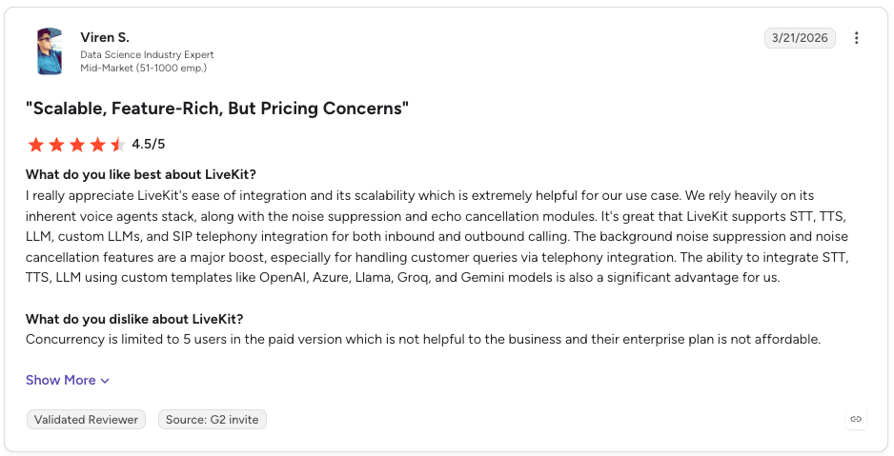
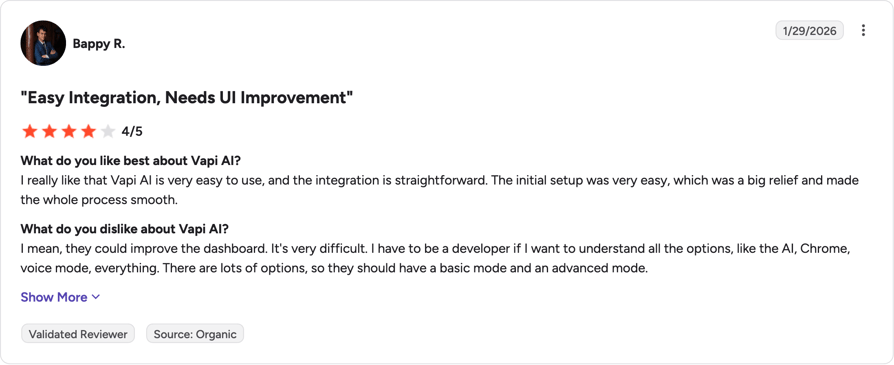
Both LiveKit and Vapi are developer infrastructure rather than AI call center software, a category with thin review volume. Any ratings here rest on a small sample, so read livekit vs vapi reviews as structured anecdote rather than a survey.
G2 Ratings Compared
LiveKit vs Vapi AI: G2 Ratings
| Platform | G2 rating | Reviews |
|---|---|---|
| LiveKit | 4.5 | 1 |
| Vapi AI | 3.6 | 6 |
| CloudTalk | 4.4 | 1,852 |
What LiveKit Users Say
What Vapi AI Users Say
LiveKit Reviews vs. Vapi AI Reviews on Reddit & Quora
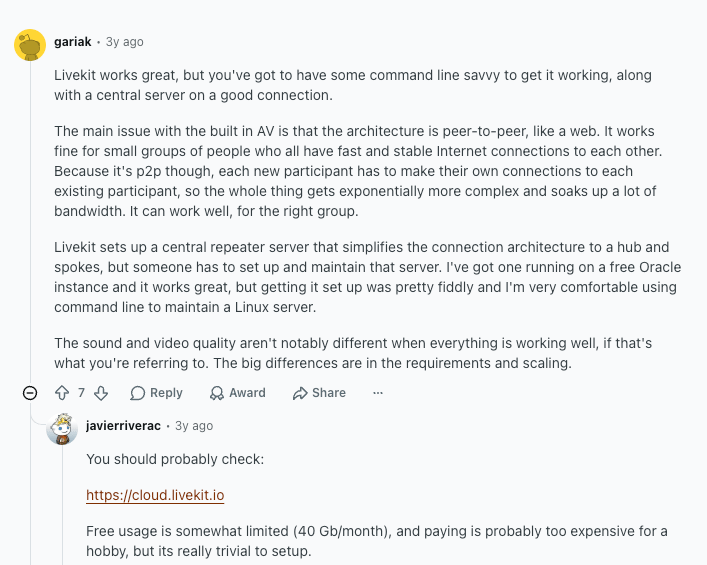
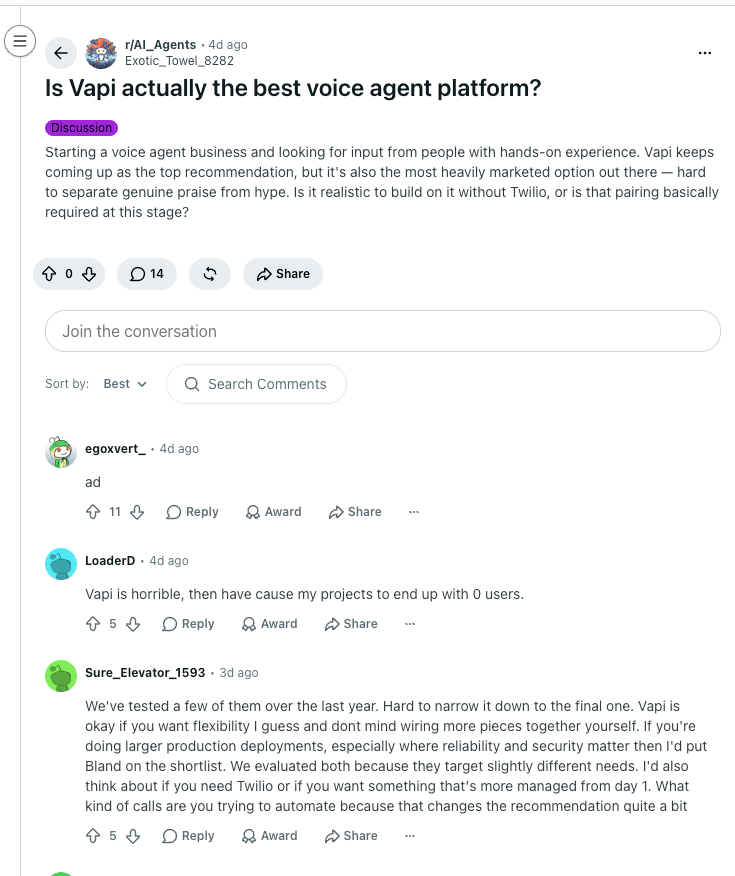
Developer forums surface what a review form never asks: what broke at scale, what the bill looked like in month four, how much call center software the team rebuilt by hand.
What Real Users Say About LiveKit On Reddit & Quora
What Real Users Say About Vapi AI On Reddit & Quora
LiveKit Pros & Cons vs. Vapi AI Pros & Cons
The trade underneath both tables separates a standalone voice agent from an integrated system: more control means more to own.
LiveKit Pros & Cons
| Pros | Cons |
|---|---|
| Apache-2.0 core, so self-hosting is a genuine option rather than a marketing line | No finished agent. STT, LLM and TTS integration is your project |
| Agent Builder gives non-engineers a real starting point and exports Python | Agent Builder, LiveKit Inference, adaptive interruption handling, Krisp and built-in observability are Cloud-only, so self-hosting costs you features |
| Turn detection and interruption handling are documented with published accuracy and latency figures | SOC 2 Type II and HIPAA start at the $500/month Scale tier |
| The broadest client SDK list of the two, including Android, Flutter, Unity and ESP32 | Self-hosted concurrency, failover and uptime are yours to own, with no uptime target |
| Voice, video and multi-participant on one stack, with 20,520 GitHub stars on the core repo | The free Build tier runs one agent deployment and five concurrent sessions, with no cold-start prevention until Ship |
Vapi AI Pros & Cons
| Pros | Cons |
|---|---|
| Nothing to operate. Vapi hosts the entire real-time loop | No self-hosting, and a closed-source core, so there's no escape hatch |
| Telephony is built in, with free US numbers and SIP trunking across seven providers | $0.05/min covers hosting only. The model stack is billed separately and no all-in figure is published |
| Model provider costs drop to $0 when you bring your own API keys | HIPAA costs $2,000/month and Zero Data Retention another $1,000/month; SOC 2, SSO and RBAC need the annual Scale contract |
| Endpointing, interruption and fallback transcribers are configurable per assistant | Build-tier call history is retained only 14 days |
| Test suites, hallucination detection and A/B testing ship with the platform | EU support and self-serve growth are frozen until 2027, and the visual workflow builder retired in August 2026 with Composer still in Alpha |
Not Sure Either Column Describes Your Team?
Which Team Fits Which Platform?
LiveKit fits teams with the engineering capacity to own infrastructure. Vapi AI fits teams with one technical owner who wants a phone agent answering calls quickly.
Which Team Fits Which Platform
| Teams that fit LiveKit | Teams that fit Vapi AI |
|---|---|
| You have Python or Node.js engineers with capacity, not just goodwill | You have one technical person who can own configuration and prompts |
| Data residency, air-gapping or vendor independence is a stated requirement | Speed to a live phone number matters more than owning the stack |
| The roadmap includes video or multi-participant sessions, not phone calls alone | The use case is phone-shaped and likely to stay that way |
| You want to read and modify the source when something behaves oddly | You'd rather open a support ticket than read an SFU trace |
| You're comfortable owning concurrency planning and failover design | You want published concurrency limits and documented queueing behavior |
| You're already paying for compliance at a level where $500/month is unremarkable | You're in the US, since EU self-serve is frozen until 2027 |
| Regional numbers will come from your own SIP trunk anyway | Free US numbers cover the pilot, and imports handle the rest |
On either path, carrier registration, per-region numbers and building your own CRM integrations for call-data write-back are still your work, and that work takes longer than teams expect.
The Verdict
Is LiveKit better than Vapi? There's no general answer, and any page that hands you one is selling something.
Choose LiveKit if you…
- Have engineers who'll still be maintaining this in a year, with the code under your control
- Need to self-host, for data residency, procurement or plain independence
- Are building beyond a phone call, including video or multi-agent sessions
- Want turn-taking and interruption handling as tunable primitives with published numbers
- Would rather start in Agent Builder and graduate to Python than commit to a canvas
- Can absorb the $500/month Scale tier when SOC 2 or HIPAA becomes a requirement
Choose Vapi AI if you…
- Want a phone agent answering calls this week, with no infrastructure to stand up
- Prefer configuration to code, and have someone who'll own that configuration
- Want to bring your own model API keys and keep provider-level pricing
- Need documented concurrency limits and defined behavior at the ceiling
- Are operating in the US, where self-serve is unfrozen and reserved concurrency is available
- Value first-party testing, simulation and analytics over assembling your own
The Third Answer: A Finished Product Instead of Infrastructure
There's a third answer, worth considering if the honest reply to "who owns this after launch" is nobody. Teams searching for a Vapi AI alternative or a LiveKit alternative usually want a finished product rather than infrastructure.
CloudTalk's AI Voice Agent is configured in a no-code wizard and runs on a full call center, so escalations land in a real queue with real people in it. It's a separately priced add-on, never bundled into a plan: first 50 minutes free, then $99/month for 200 minutes.
Bring your call flow to the demo
Sources:
- Salesforce
- Deloitte
- Stack Overflow
Frequently Asked Questions About LiveKit vs. Vapi AI
LiveKit is open-source real-time infrastructure plus an Agents framework you assemble and can self-host. Vapi AI is a managed, telephony-first layer you configure, with model costs passed through. Either way, you still implement an AI voice agent yourself.
LiveKit is cheaper at low volume. Its Build tier is $0/month with 1,000 agent minutes, while Vapi AI pricing starts at $0.05/min hosting after 60+ free minutes. Both bill the model stack separately, so past ~1,000 minutes LiveKit's $0.01/min overage undercuts Vapi.
No independent head-to-head benchmark of LiveKit vs Vapi AI latency exists that we could verify, so treat both vendors' figures as self-published. LiveKit publishes turn-detector latency and a sub-250 ms transport goal; Vapi's breakdown excludes endpointing and transport, which callers hear as a phone call quality problem.
Yes. LiveKit's SFU and Agents framework are Apache-2.0 with full deployment docs, though Agent Builder, Inference and observability stay Cloud-only. Vapi doesn't, being managed with a closed core. Compare each vendor's security and compliance posture if data residency drives it.
Vapi AI isn't free, but the on-ramp is close: Build includes 60+ minutes and up to five free US numbers, the first without a payment method. Past that it's $0.05/min hosting plus your model providers' bills, worth setting against fixed AI voice agent pricing.
Neither, categorically. Vapi abstracts telephony further, so a phone agent goes live faster; LiveKit gives SIP-level control plus native US numbers on Cloud. It's a control-versus-speed trade, and both expect you to bring your own trunk for international numbers.
LiveKit's client SDK list is materially longer: Web, Swift, Android, Flutter, React Native, Unity, Python, Node.js, Rust, C++ and ESP32. Vapi publishes Web, Flutter, React Native, iOS, Python and a script tag, plus server SDKs and a CLI.
Pipecat is the open-source framework closest to LiveKit's territory. On the managed side, a shortlist of the best AI voice agents runs to Retell, Synthflow and ElevenLabs. CloudTalk is the finished-product option, a no-code agent on a full call center.
CloudTalk sits in a different category. LiveKit and Vapi sell infrastructure; CloudTalk's AI Voice Agent is finished, with the call center already underneath it, so transfers land in a staffed queue. It's an add-on priced separately from any plan: first 50 minutes free, then $99/month for 200 minutes.