TL;DR: 10 Best Telnyx Alternatives
| # | Platform | Best for | Starting Price | G2 Rating |
|---|---|---|---|---|
| 0 | Telnyx (baseline) | Developers who want raw voice and SMS APIs on an owned network | ~$0.007/min, $0.004/SMS (usage-based) | 4.7/5 (500+ reviews) |
| 1 | CloudTalk | SMB to mid-market sales and support teams, no engineers needed | $25/user/month | 4.4/5 (1,900+ reviews) |
| 2 | Twilio | Dev teams that want every channel from one vendor | $0.0083/SMS, $0.014/min | 4.1/5 |
| 3 | Plivo | Developers cutting SMS and voice costs | Pay-as-you-go, ~$0.0077/SMS | 4.5/5 |
| 4 | Vonage Communications APIs | Engineering teams wanting long-established multi-channel APIs | $0.0081/SMS, $0.0145/min | 4.2/5 |
| 5 | Bandwidth | Enterprises needing direct network ownership | Custom | 4.4/5 |
| 6 | Sinch | Fintechs sending OTP and transactional SMS at scale | Custom (from ~$0.0078/SMS) | 3.9/5 |
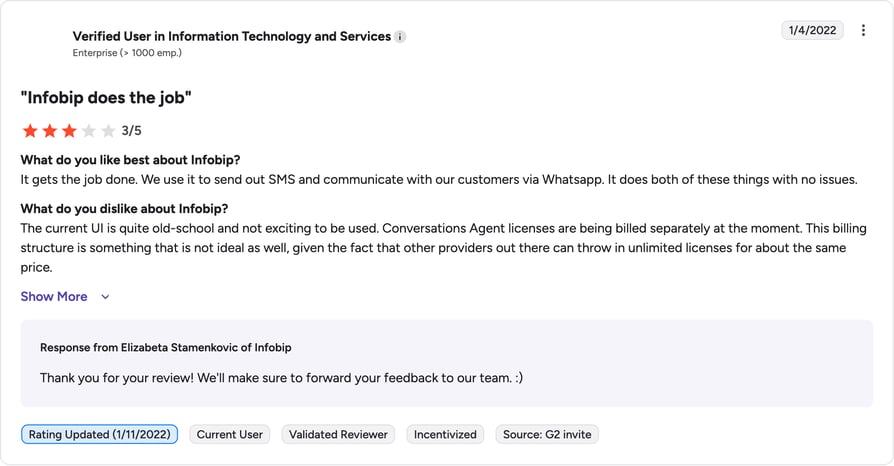
| 7 | Infobip | Multinational brands running omnichannel campaigns | From ~$41/mo | 4.3/5 |
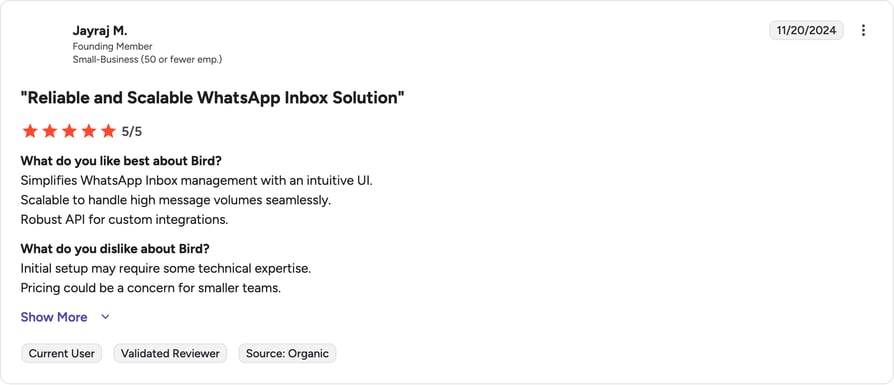
| 8 | Bird (MessageBird) | Marketing teams wanting an omnichannel inbox | From $0.0035/SMS + carrier fees | 3.9/5 |
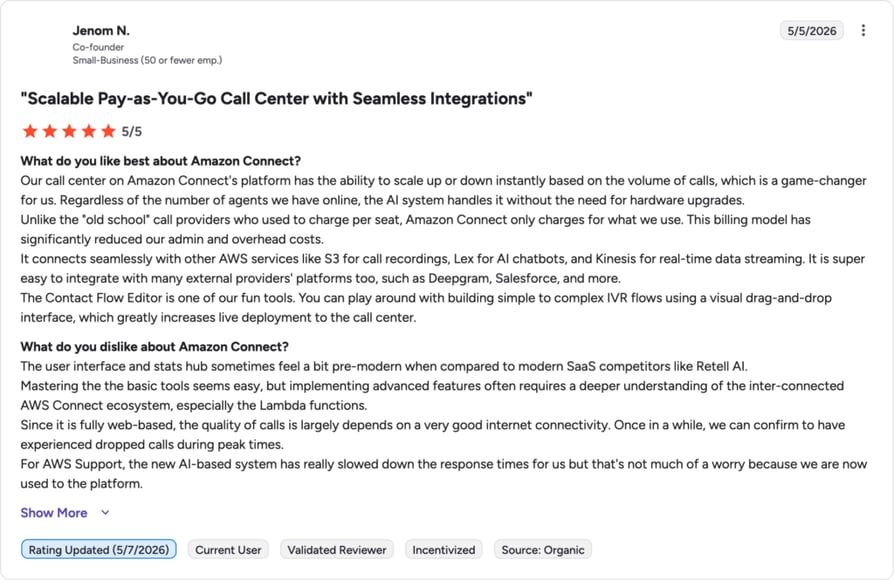
| 9 | Amazon Connect | Contact centers already built on AWS | $0.038/min (pay-as-you-go) | 4.5/5 |
| 10 | Vapi | Developers building custom AI voice agents | $0.05/min (orchestration only) | 4.2/5 |
Still on Row 0? See Row 1 Live in 15 Minutes.
These are the 10 best Telnyx alternatives for teams that are tired of the nonsense. Not sexy, not exciting. Useful, practical, reliable. Easy-to-setup voice and SMS, native CRM integrations, and scalable AI calling. The basics you were looking for before you got sucked into a DIY rabbit hole.
Why Teams Are Searching for a Telnyx Alternative
We compared 10 Telnyx alternatives on call quality, CRM depth, pricing transparency, AI calling, and support. First, though, the three things that send teams looking:
- The Promised Value vs. The Reality: You signed up for Telnyx expecting carrier-grade voice and SMS at half the price of Twilio. Instead, an unprovisioned number blocks your launch, support tickets bounce between agents, and your account gets flagged for re-verification right before go-live.
- The Telnyx Dilemma: It is a strong CPaaS (Communications Platform as a Service) that owns its carrier network, offers some of the lowest market rates, and gives developers fine-grained control over voice, messaging, and SIP. However, it is fundamentally a build-it-yourself platform.
- Recurring Scaling Gaps: As teams scale, they run into the same hurdles: thin support, verification friction, and the requirement to engineer everything yourself before a single call can connect.
What Are the Main Cons of Telnyx? (Based on Real User Reviews)
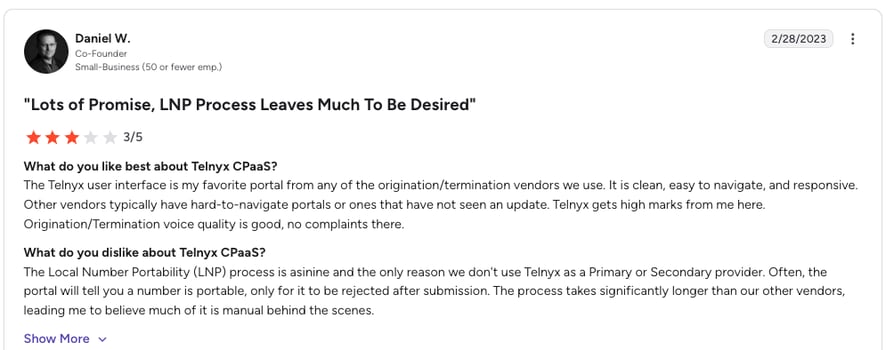
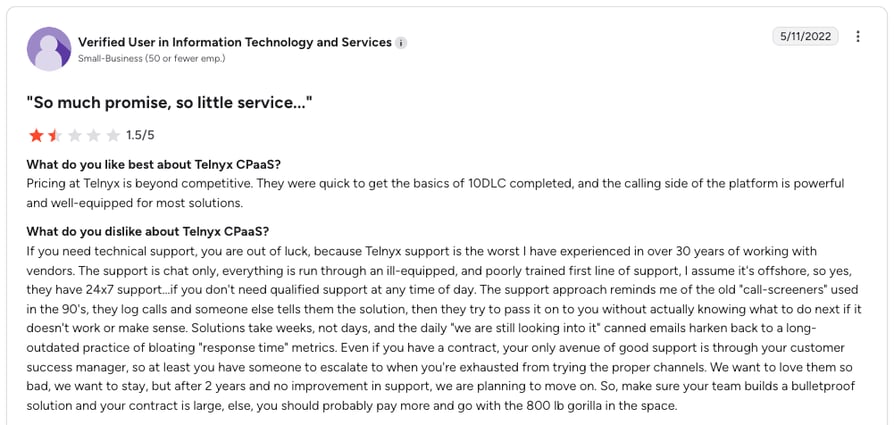
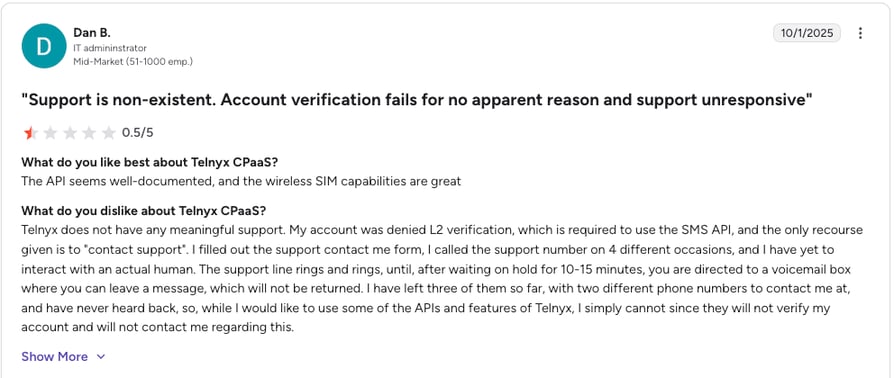
- Inconsistent, slow support with no ticket continuityThe most common complaint across G2 and Trustpilot is issues with support response time. Reviewers describe being handed between multiple agents who each request fresh logs, only for the logs to "expire" before anyone responds, restarting the cycle.
- Account verification & suspension frictionUsers report repeated ID and account verification requests, plus sudden account or number blocks. When verification fails right before go-live, teams are left scrambling.
- Number provisioning & availability gaps in some regionsPorting issues and limited number availability in certain countries come up repeatedly. One reviewer described a purchased local number that never delivered a single call due to a carrier-propagation failure, blocking an AI voice project for over three weeks.
- Developer-heavy: nothing works out of the boxTelnyx ships APIs, not a finished product. Building an IVR, a dialer, a CRM sync, or an AI agent means real engineering time. Non-technical sales and support teams can't self-serve, which makes Telnyx a poor fit for teams that just want to start calling.
- Usage-based costs are hard to forecastThe headline per-minute and per-message rates look cheap, but real bills include SIP-trunk channel fees, number rentals, carrier surcharges, and AI add-ons. Without per-seat pricing, finance teams struggle to model total cost of ownership before committing.
Where Telnyx Wins:
Despite these issues, plenty of teams still consider Telnyx the right call. It owns its network, publishes some of the lowest rates around, and gives developers full control over voice, SMS, and SIP. If a build is the plan anyway, Telnyx does its job. For many other use cases, though, you should consider choosing a better VoIP alternative.
What Is the Best Alternative to Telnyx?
CloudTalk is the best Telnyx alternative for sales and support teams that want carrier-grade calling and AI automation with super easy setup and no IT team needed. You can build your own AI voice agent or configure intelligent call routing in minutes.
Unlike Telnyx, CloudTalk is a turnkey platform: it covers 160+ countries with local virtual numbers, publishes transparent per-seat pricing from $25/user/month, includes AI Voice Agents for inbound and outbound calls, and from Essential syncs natively with HubSpot and Pipedrive (Salesforce on Expert), so there's no engineering project standing between you and your first call.
Why Do Users Consider CloudTalk the Best Telnyx Alternative?
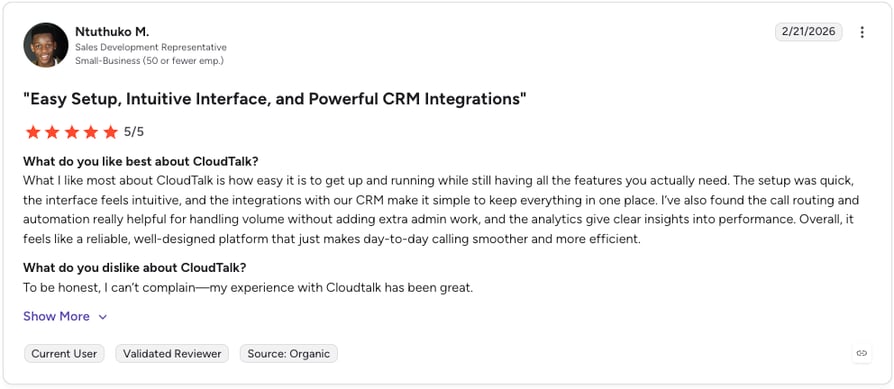
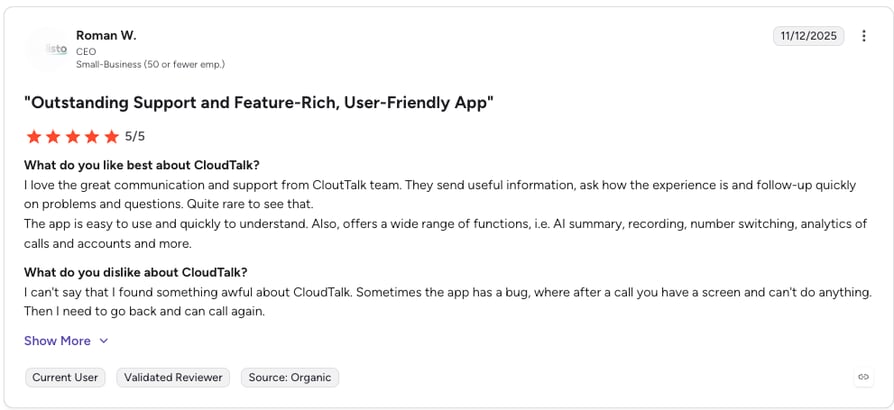
Users prefer CloudTalk to Telnyx because of its quick and easy setup, intuitive interface and always-there support.
5 Main Reasons Users Pick CloudTalk Over Telnyx
- Works out of the box: a finished calling platform rather than raw APIs. Teams are live in hours, not after the engineering project Telnyx requires.
- Native AI Voice Agents: automate inbound and outbound calls with AI call answering, summaries, and CRM logging, making it the best Telnyx alternative for AI calling for non-technical teams.
- 160+ countries covered with local virtual numbers and a globally distributed carrier network, so you get international reach without sourcing carriers yourself.
- 100+ native integrations, including Deep-Sync for HubSpot and Salesforce that logs calls, transcripts, and AI summaries automatically, with no webhooks to maintain.
- Transparent per-seat pricing from $25/user/month with a 4.4/5 G2 rating, predictable budgeting, and 24/7 support on every plan (phone on Expert).
How We Evaluated These Telnyx Alternatives
To find the best Telnyx alternatives for 2026, we checked each platform's live pricing, plan tables, help docs, and reviews, focused on the exact pain points that push teams to look for a Telnyx replacement: support responsiveness, verification and account friction, number availability, AI calling quality, and how much engineering is needed before you can place a call.
We cross-referenced every claim with verified user feedback on G2, Capterra, Trustpilot, and Reddit.
This guide is written for sales and customer support teams with 5 to 200 seats evaluating voice, SMS, and AI calling providers, whether you need a turnkey phone system, raw CPaaS APIs, or a developer-grade AI voice stack.
Our Selection Criteria and Review Methodology
- Feature checks on core calling, routing, messaging, and AI agent features against live vendor docs.
- Pricing transparency: advertised rate vs. real all-in cost with number rentals, carrier surcharges, and add-ons.
- G2, Capterra, and Trustpilot review analysis (we prioritized tools with a meaningful volume of verified reviews).
- International number coverage and call quality across multiple regions.
- AI and automation features: what's included vs. what requires a separate stack or enterprise tier.
- CRM integration depth, especially HubSpot, Salesforce, and Pipedrive.
- Customer support responsiveness and onboarding quality.
- Migration ease from Telnyx, including number porting and how much needs to be rebuilt.
Top 10 Telnyx Alternatives for Phone Calls, SMS, and AI Calling
The table below is the at-a-glance version: how the leading Telnyx competitors stack up on pricing model, AI calling, global coverage, and how much engineering each one asks of you. Under it, all ten Telnyx alternatives for phone calls, messaging, and AI-powered calls get a full breakdown, starting with CloudTalk: what each platform is, pricing, pros and cons, and what its users say.
Telnyx Alternatives Compared
| Feature | Telnyx | CloudTalk (Editor's Pick) | Twilio | Plivo | Vonage |
|---|---|---|---|---|---|
| Starting Price | ~$0.007/min, $0.004/SMS | $25/user/mo | $0.014/min, $0.0083/SMS | ~$0.0077/SMS | $0.0145/min, $0.0081/SMS |
| Pricing Model | Usage-based | Per seat + add-ons | Usage-based | Usage-based | Usage-based |
| G2 Rating | 4.7/5 (500+ reviews) | 4.4/5 (1,900+ reviews) | 4.1/5 (500+ reviews) | 4.5/5 (740+ reviews) | 4.2/5 (400+ reviews) |
| Turnkey (No-Code) Setup |  |  | | | |
| Built-in AI Voice Agents | Add-on (~$0.08/min) | Built in, from $99/mo (50 free min) | Build via API | Vibe (no-code builder) | Add-on (Virtual Assistant) |
| Native CRM Integrations | Via API | 100+ from Essential | Via API/webhooks | Via API | 50+ (CCaaS) |
| Global Number Coverage | Wide (gaps in some regions) | 160+ countries | 100+ countries | 190+ countries | 190+ countries |
| 24/7 Support | Chat-first, mixed reviews | Chat and email, all plans (phone on Expert) | Tiered | Tiered | Tiered |
| Free Trial | Trial credits | 14 days | $15 credit | Free trial | Free trial |
Five Columns of Trade-Offs. One Call Settles Yours.
1. CloudTalk: Best Telnyx Alternative for SMB to Mid-Market Sales & Support Teams
What Is CloudTalk?
CloudTalk is a cloud-based VoIP and AI voice platform built for small-business to mid-market sales and support teams that need global calling, intelligent automation, and deep CRM integrations without writing a line of code. Used by 5,500+ businesses worldwide, it bundles a full phone system with built-in AI Voice Agents, Power and Parallel dialers, and post-call transcription via Conversation Intelligence. Where Telnyx hands you APIs to build with, CloudTalk hands you a finished product, making it the best Telnyx alternative for AI calling when you don't have an engineering team to spare.
Why Is CloudTalk a Strong Telnyx Alternative?
- Covers 160+ countries with local virtual numbers and a globally distributed carrier network, so there's no sourcing carriers or chasing number availability like with Telnyx.
- 100+ native integrations from Essential, including Deep-Sync for HubSpot and Salesforce (Expert) that logs calls, transcripts, and AI summaries automatically with no webhooks to maintain.
- Transparent, published per-seat pricing from $25/user/month, with SMS billed per message on top, so you can forecast the bill instead of decoding Telnyx-style surcharges and channel fees.
- 99.999% uptime SLA, call recording on every plan, and 24/7 support on every plan (phone on Expert), with no tiered ticket queues or verification dead-ends.
What Are the Key Features of CloudTalk?
- AI Voice Agents: deploy conversational AI for inbound and outbound calls with no code.
- Power & Parallel Dialers: auto-cycle call lists and connect reps only to live answers (Power on Expert or a $15/user/month add-on, Parallel a $39/user/month add-on on any plan).
- Conversation Intelligence: post-call transcription, AI summaries, and sentiment analysis on every recorded call.
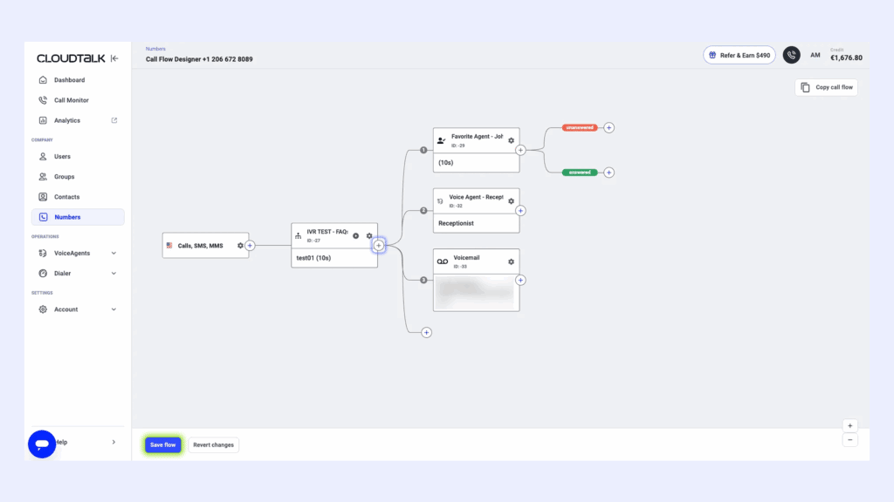
- Visual Call Flow Designer: drag-and-drop IVR builder, no IT ticket required.
- Virtual Numbers in 160+ Countries: local presence worldwide to lift outbound pickup rates.
- Call Recording & Monitoring: automatic recording, live listen-in, and whisper coaching.
What Are the Pros & Cons of CloudTalk?
| Pros | Cons |
|---|---|
| Turnkey, no engineering needed: Live in hours, not a build project. | Not a raw CPaaS: Less low-level control than Telnyx's APIs for custom telecom builds. |
| AI Voice Agents built-in: Inbound and outbound automation without code. | CRM integrations start on Essential: The $25 Starter plan is calling only. |
| Transparent per-seat pricing: Published plans from $25/user/month. | Conversation Intelligence is an add-on: $9/user/month on any plan. |
What Is CloudTalk's Pricing vs. Telnyx Pricing?
CloudTalk pricing is fully published and starts at $25/user/month (Starter, billed annually), predictable per-seat plans rather than Telnyx's usage-based model, where number rentals, SIP channel fees, carrier surcharges, and AI add-ons stack up. CloudTalk's plans include:
CloudTalk Plans and Pricing
| Plan | Price (annual billing) | Key Features |
|---|---|---|
| Starter | $25/user/mo | Unlimited inbound & internal calls, 500 outbound minutes (regional calling bundle), call queues, transfers, click-to-call, automatic call recording (1-month retention) |
| Essential | $29/user/mo | Everything in Starter + IVR and smart routing, 100+ CRM/helpdesk integrations, workflow automation, unlimited recording retention |
| Expert | $49/user/mo | Everything in Essential + Power, Smart & Preview Dialers, Salesforce integration, 24/7 phone support (3-seat min) |
| Custom | Quote-based | Enterprise security, dedicated onboarding, and custom terms for 25+ seats |
| Conversation Intelligence (add-on) | $9/user/mo | AI transcripts, call summaries, call scoring, sentiment analysis, and agent coaching insights |
| AI Receptionist (add-on) | From $99/mo (200 min) | Inbound AI call answering, routing, and logging, 50 free minutes on every account, tiers up to $699/mo (2,500 min) |
| AI Specialist (add-on) | From $349/mo (1,000 min) | Sales-led custom AI voice agents for inbound and outbound workflows, plans scale up to $1,249/mo (5,000 min) |
Telnyx vs. CloudTalk Pricing:
Telnyx's pay-as-you-go rates look cheaper line by line, but they're hard to forecast and assume you'll build the calling experience yourself. CloudTalk's published per-seat plans bundle the phone system, queues, recording, and support, so finance teams can model total cost of ownership from day one instead of reconstructing it from Telnyx pricing line items.
What Are CloudTalk Customers Saying?
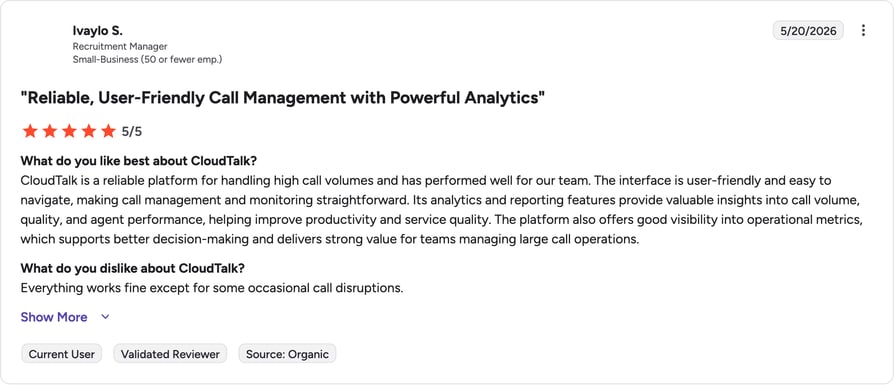
Based on 1,900+ verified G2 reviews, CloudTalk holds an average of 4.4/5, with customers consistently highlighting fast setup, reliable call quality, and AI tools that actually save time compared to assembling a stack on a raw CPaaS like Telnyx.
One Line on the Bill Instead of Eight.
2. Twilio: Best Telnyx Alternative for All-Channel CPaaS Coverage
What Is Twilio?
Twilio is the most widely adopted CPaaS on the market and the default alternative to Telnyx for teams that want one vendor for everything. Beyond programmable voice and SMS, it offers WhatsApp, email (via SendGrid), video, verification, and a huge integration ecosystem. It has the deepest documentation, the largest developer community, and the broadest channel coverage, at a premium price, which is where most Twilio vs Telnyx comparisons end: cheaper per unit on Telnyx's own network, or wider channels at Twilio's price.
Why Is Twilio a Strong Telnyx Alternative?
- Widest channel coverage: SMS, voice, WhatsApp, email, and video under one account, more than Telnyx's voice/SMS focus.
- The largest developer ecosystem: more SDKs, tutorials, and community answers than any other CPaaS.
- Mature, battle-tested APIs that scale to billions of messages without delivery issues.
- $15 free trial credit and no monthly minimums to start testing.
What Are the Key Features of Twilio?
- Programmable Messaging: SMS, MMS, and WhatsApp APIs with global reach.
- Programmable Voice: inbound/outbound calls, conferencing, and SIP.
- Twilio Flex: a fully programmable contact center built on the platform.
- Verify & Lookup: OTP, 2FA, and number-intelligence APIs.
- SendGrid email: transactional and marketing email under the same vendor.
What Are the Pros & Cons of Twilio?
| Pros | Cons |
|---|---|
| Unmatched channel and integration breadth from one vendor | Premium pricing, typically 10-30% above lower-cost CPaaS like Telnyx or Plivo |
| The most mature APIs and largest developer community | Real bills run 30-50% above estimates once carrier surcharges and compliance fees land |
| Reliable global delivery at very high volume | Setup and advanced features (SIP, recording) are complex for non-technical teams |
What Is Twilio's Pricing?
Twilio uses pay-as-you-go pricing with no minimums: US SMS starts around $0.0083/message and outbound voice at $0.014/minute, with local numbers from $1.15/month. A2P carrier surcharges and number rentals apply on top. For a deeper look at packaged products, see our Twilio pricing guide. Volume discounts are available at committed-spend tiers.
Twilio G2 Reviews
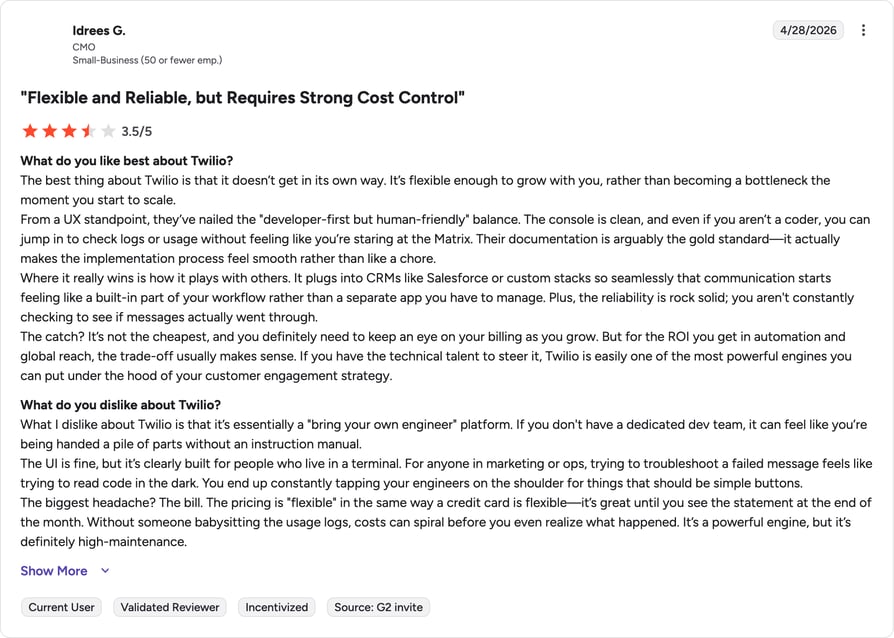
Twilio's current G2 rating is 4.1/5, out of 500+ verified user reviews.
3. Plivo: Best Telnyx Alternative for Budget-Conscious Developers
What Is Plivo?
Plivo is a developer-first CPaaS focused on cheap, reliable SMS and voice across 190+ countries, with a clean API and well-regarded documentation. It's the go-to alternative for Telnyx when cost is the primary concern, and it has recently added a no-code AI agent builder called Vibe, making it a credible option among Telnyx alternatives for AI-powered calls for technical teams on a budget. In a Plivo vs Telnyx decision, Plivo suits SMS-first teams chasing the lowest workable rates, while Telnyx suits teams that want an owned network and deeper SIP control.
Why Is Plivo a Strong Telnyx Alternative?
- Among the lowest SMS rates of any major CPaaS, frequently undercutting Twilio on US messaging.
- Open-source telephony stack: start on the cloud platform, then self-host at scale for wholesale rates.
- Vibe no-code AI agent builder: set up voice agent flows from a plain-language description.
- Clean, well-documented APIs with reliable delivery for OTP and transactional use cases.
What Are the Key Features of Plivo?
- SMS, MMS, and RCS APIs with competitive global rates.
- Voice API and SIP trunking across 190+ countries.
- PHLO visual builder: drag-and-drop workflow logic without deep coding.
- Vibe AI agent builder: voice-first AI agents with auto-generated flows.
- WhatsApp Business API for omnichannel messaging.
What Are the Pros & Cons of Plivo?
| Pros | Cons |
|---|---|
| Genuinely cheap SMS and voice, strong value for API-first teams | Real bills can run 40-60% above the headline rate after registration and carrier fees |
| High G2 rating (4.5/5) and reliable delivery | Dashboard and reporting are basic and less intuitive than some rivals |
| Open-source stack lets you self-host for wholesale pricing | Support response times can lag on lower tiers |
What Is Plivo's Pricing?
Plivo starts on pay-as-you-go with $10 in free credits and US SMS from about $0.0077/message, and its Enterprise plan starts at $1,000/month for volume pricing. Registration and carrier surcharges apply on top of the base rate, which is where most of the gap between the headline and the real Plivo pricing comes from.
Plivo G2 Reviews
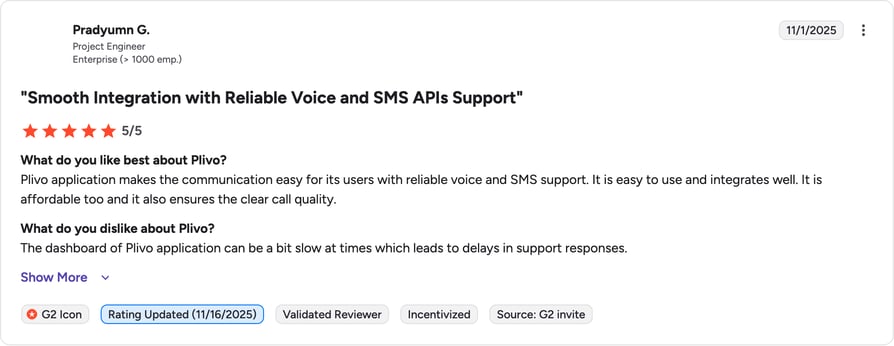
Plivo's current G2 rating is 4.5/5, out of 740+ verified user reviews.
4. Vonage Communications APIs: Best Telnyx Alternative for Mature Multi-Channel APIs
What Is Vonage Communications APIs?
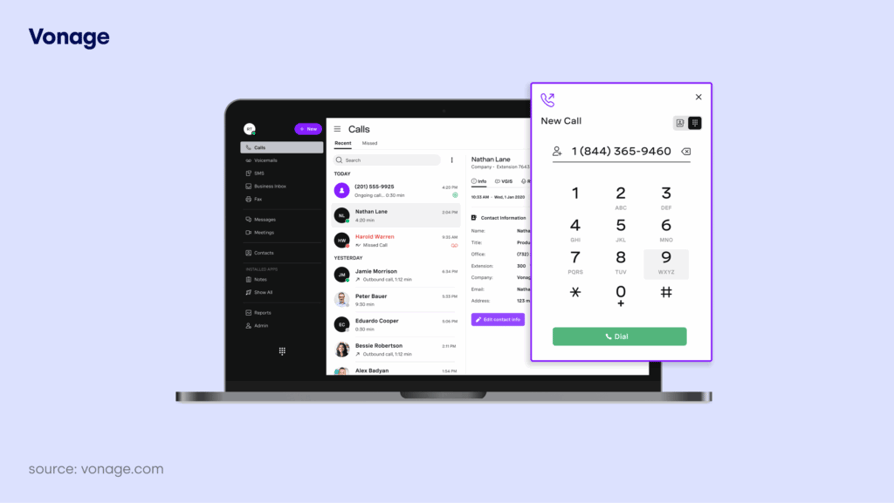
Vonage Communications APIs (formerly Nexmo, now part of Ericsson) is a mature, developer-respected CPaaS spanning voice, SMS, video, verification, and number-insight APIs. With 1.6M+ registered developers and coverage in 190+ countries, it's a solid Telnyx replacement for engineering teams that want a long-established, multi-channel API platform with no lock-in contracts.
Why Is Vonage a Strong Telnyx Alternative?
- Broad multi-channel API suite: voice, SMS, video, and verification beyond Telnyx's core focus.
- Mature and stable: long-tenured customers cite reliable HD voice and quick integration.
- Ericsson-backed network with global carrier relationships and 190+ country coverage.
- No lock-in contracts and a pay-as-you-go model for the API business.
What Are the Key Features of Vonage?
- Voice API: programmable calls, IVR, and conferencing.
- Messages & SMS API: SMS, MMS, and WhatsApp from one endpoint.
- Verify API: OTP and 2FA across SMS and voice.
- Video API: embeddable real-time video.
- Number Insight: number validation and fraud checks.
What Are the Pros & Cons of Vonage?
| Pros | Cons |
|---|---|
| Mature, widely respected APIs that integrate fast | Support quality rates lower than top CPaaS peers on G2 |
| Broad channel coverage (voice, SMS, video, verify) | Volume pricing is quote-based and not published |
| Ericsson-backed global network | Add-on fees and regulatory charges can push real costs well above base rates |
What Is Vonage's Pricing?
Vonage's Communications APIs are consumption-based, with voice from $0.0145/minute and US SMS from $0.0081/message, and no subscription minimums on core APIs. Regulatory fees and number rentals apply on top, and reviewers note real totals can run well above the base Vonage pricing.
Vonage G2 Reviews
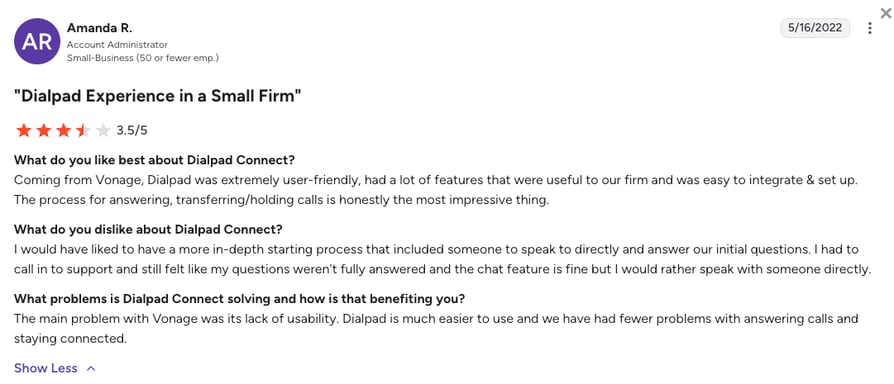
Vonage Communications APIs' current G2 rating is 4.2/5, out of 400+ verified user reviews.
5. Bandwidth: Best Telnyx Alternative for Direct Network Ownership
What Is Bandwidth?
Bandwidth is a global telecommunications company that provides direct-to-carrier SMS, MMS, and voice APIs on its own owned, tier-1 network. Like Telnyx, it owns its infrastructure, but it leans toward enterprises and regulated industries that need network control, E911 capabilities, and compliance assurance rather than the lowest possible self-serve price.
Why Is Bandwidth a Strong Telnyx Alternative?
- Owns its own tier-1 network: finer control over call quality and latency than reseller-based providers.
- Strong number management and porting: reviewers repeatedly cite easy local and toll-free porting.
- Enterprise-grade compliance: E911 and regulatory controls built for regulated industries.
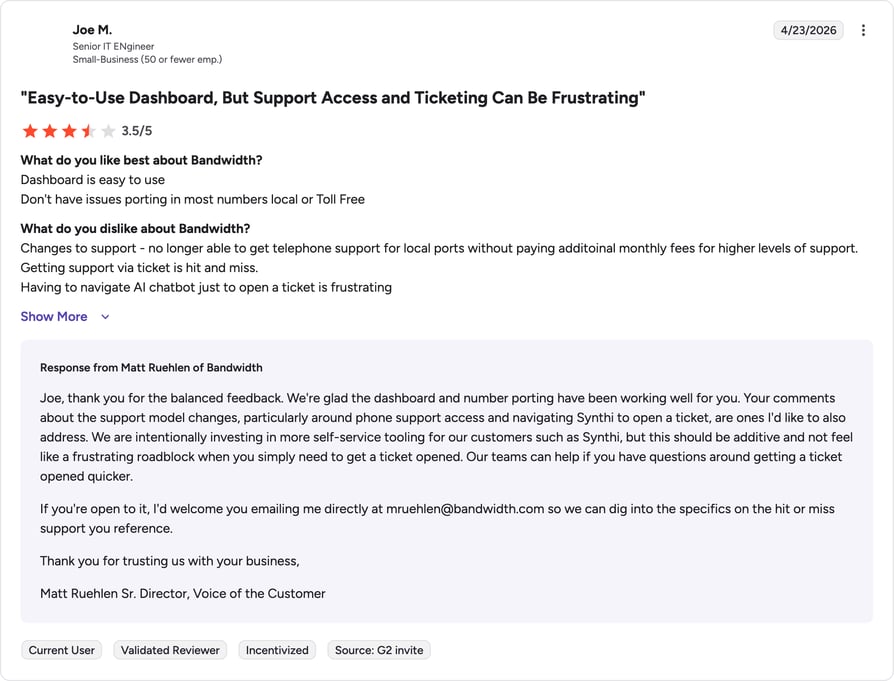
- Historically high support marks on G2 for responsiveness and partnership.
What Are the Key Features of Bandwidth?
- Direct-to-carrier voice & messaging APIs on an owned network.
- Number management & porting: bulk ordering, lookup, and easy ports.
- E911 / emergency calling: built-in support for compliance requirements.
- SIP trunking for connecting existing PBX and contact-center systems.
- Network monitoring tools for performance visibility.
What Are the Pros & Cons of Bandwidth?
| Pros | Cons |
|---|---|
| Owned network delivers reliable voice quality and low latency | No published pricing, everything is custom and quote-based |
| Excellent number porting and management experience | Phone support now gated behind higher paid support tiers |
| Strong compliance and E911 story for regulated industries | Enterprise-oriented, heavier than smaller teams may need |
What Is Bandwidth's Pricing?
Bandwidth does not publish standard rates. Pricing is custom and depends on traffic volume, regions, and compliance requirements, with higher support tiers carrying additional monthly fees. Enterprises should contact sales with projected volumes for a quote.
Bandwidth G2 Reviews
Bandwidth's current G2 rating is 4.4/5, out of 470+ verified user reviews.
Five Platforms In, and Four of Them Quote or Meter You.
6. Sinch: Best Telnyx Alternative for Global OTP & Transactional SMS
What Is Sinch?
Sinch is an enterprise-grade global CPaaS known for carrier-grade routing and deliverability in markets where other providers struggle, including India, Brazil, and Southeast Asia. It spans SMS, voice, WhatsApp, email, and verification, and is a strong Telnyx alternative for fintechs and marketplaces sending one-time passcodes and transactional messages at massive scale.
Why Is Sinch a Strong Telnyx Alternative?
- Deep carrier relationships: strong deliverability in emerging markets where others falter.
- OTP and transactional SMS specialist with AI-powered routing at scale.
- Broad omnichannel suite: SMS, voice, WhatsApp, email, and verification under one contract.
- Volume-tiered pricing tuned for high-throughput enterprise messaging.
What Are the Key Features of Sinch?
- Global SMS API with intelligent, carrier-grade routing.
- Verification API for OTP and 2FA at scale.
- Voice and elastic SIP for programmable calling.
- Omnichannel (WhatsApp, RCS, email) under one platform.
- Messaging analytics for deliverability monitoring.
What Are the Pros & Cons of Sinch?
| Pros | Cons |
|---|---|
| Excellent global reach and emerging-market deliverability | Pricing is quote-based, with no flat published US per-message rate |
| Carrier-grade routing built for OTP and transactional scale | Oriented toward larger deployments, heavy for small teams |
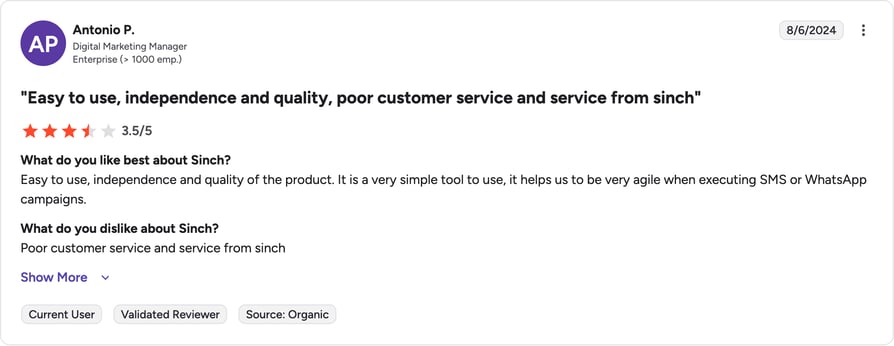
| Broad omnichannel suite under one contract | Support and ease-of-setup scores trail leaders on G2 |
What Is Sinch's Pricing?
Sinch uses a pay-as-you-go model with volume-tiered enterprise rates. US SMS starts around $0.0078/message plus carrier fees, but it does not publish a flat public rate, so enterprise customers negotiate pricing based on volume and routing needs. Contact sales for a quote.
Sinch G2 Reviews
Sinch's current G2 rating is 3.9/5, based on verified user reviews.
7. Infobip: Best Telnyx Alternative for Global Omnichannel Campaigns
What Is Infobip?
Infobip is a global omnichannel CPaaS that unifies SMS, WhatsApp, RCS, email, and voice with strong telco partnerships and 40+ data centers worldwide. Consistently ranked at the top of analyst CPaaS leaderboards, it's a strong Telnyx alternative for multinational brands running campaigns across many channels and regions from one platform.
Why Is Infobip a Strong Telnyx Alternative?
- 40+ global data centers and deep telco partnerships for worldwide reach.
- True omnichannel: SMS, WhatsApp, RCS, email, and voice in one platform.
- Native campaign and analytics tools reduce the need for external systems.
- Top analyst rankings: frequently placed ahead of Twilio and Sinch on CPaaS leaderboards.
What Are the Key Features of Infobip?
- Omnichannel messaging APIs: SMS, WhatsApp, RCS, Viber, and email.
- Moments: built-in customer-engagement and campaign automation.
- Answers: chatbot and conversational AI builder.
- Voice and number provisioning across global markets.
- CRM-friendly integrations for unified customer data.
What Are the Pros & Cons of Infobip?
| Pros | Cons |
|---|---|
| Best-in-class global omnichannel coverage and reliability | Slow support response times are a recurring complaint |
| Native campaign and chatbot tools reduce extra tooling | Enterprise-oriented, pricing is not transparent for smaller teams |
| Strong analyst recognition and telco partnerships | Broad platform has a learning curve for first-time users |
What Is Infobip's Pricing?
Infobip pricing starts around $41/month per published estimates, with US SMS rates near $0.0065/message, though most pricing is quote-based and scales with volume and channels. Contact sales for tailored enterprise rates.
Infobip G2 Reviews
Infobip's current G2 rating is 4.3/5, based on verified user reviews.
8. Bird (MessageBird): Best Telnyx Alternative for Omnichannel Marketing
What Is Bird (MessageBird)?
Bird, formerly MessageBird, is an omnichannel communications platform built around conversations and marketing across SMS, WhatsApp, email, and voice, with direct connections to 240+ carriers in 200+ countries. It now bundles a native CRM and automation tools, making it a Telnyx alternative aimed at marketing teams that want a ready-made engagement layer rather than raw APIs.
Why Is Bird a Strong Telnyx Alternative?
- Aggressive published SMS rates: frequently undercutting Twilio and Sinch on headline pricing.
- Omnichannel inbox: SMS, WhatsApp, Instagram, and email plus a shared inbox and automation.
- FlowBuilder: visual workflow automation that stands out among CPaaS tools.
- Native CRM layer adds customer data into conversations without a separate tool.
What Are the Key Features of Bird?
- Omnichannel APIs: SMS, WhatsApp, email, and voice.
- Shared inbox: manage all conversations from one view.
- FlowBuilder: drag-and-drop automation across channels.
- Native CRM & marketing tools for campaigns and segmentation.
- 240+ carrier connections across 200+ countries.
What Are the Pros & Cons of Bird?
| Pros | Cons |
|---|---|
| Competitive published pricing and broad channel support | Frequent product pivots (CPaaS to CRM to AI) create uncertainty |
| Omnichannel inbox and automation built in for marketing teams | Premium support tiers cost extra, and response times lag on non-enterprise accounts |
| Easy API integration and a no-code FlowBuilder | Lacks HIPAA and PCI DSS Level 1, unfit for healthcare/payments |
What Is Bird's Pricing?
Bird prices by volume rather than by seat: US SMS runs from $0.0035 per segment plus carrier fees, phone numbers are billed monthly, and enterprise pricing is quote-based.
Bird G2 Reviews
Bird's current G2 rating is 3.9/5, out of 70+ verified user reviews.
9. Amazon Connect: Best Telnyx Alternative for AWS-Native Contact Centers
What Is Amazon Connect?
Amazon Connect is AWS's pay-as-you-go cloud contact center, built omnichannel from the ground up with skills-based routing, real-time analytics, and tight integration into the AWS ecosystem (Lex, Bedrock, Pinpoint). For teams already deep in AWS, it's a powerful Telnyx alternative that trades turnkey simplicity for near-unlimited architectural flexibility.
Why Is Amazon Connect a Strong Telnyx Alternative?
- Native AWS integration: Lex, Bedrock, Lambda, and Pinpoint for custom AI and automation.
- Pay-as-you-go with no seat licenses: scale from a handful of agents to thousands.
- Strong reporting and analytics: detailed dashboards and Contact Lens conversation analytics.
- Omnichannel from the ground up: voice and chat on one routing engine.
What Are the Key Features of Amazon Connect?
- Skills-based routing for voice and chat.
- Contact Lens: conversational analytics, sentiment, and QA.
- Amazon Lex / Bedrock: build AI bots and agents on AWS models.
- Real-time & historical dashboards for performance monitoring.
- High-quality 16kHz audio over browser-based softphone.
What Are the Pros & Cons of Amazon Connect?
| Pros | Cons |
|---|---|
| Near-unlimited flexibility and AWS-native scalability | Steep learning curve, not for teams without AWS expertise |
| Pay-as-you-go with no seat minimums | Per-minute costs plus telephony and analytics add-ons get hard to forecast |
| Strong analytics and omnichannel routing | Requires dedicated technical resources to build and maintain |
What Is Amazon Connect's Pricing?
Amazon Connect is pay-as-you-go: voice from $0.038/minute, plus standard telephony rates (a US number runs about $0.03 per day) and Contact Lens analytics at about $0.015/min, which is why worked Amazon Connect pricing examples land well above the headline rate.
Amazon Connect G2 Reviews
Amazon Connect's current G2 rating is 4.5/5, based on verified user reviews.
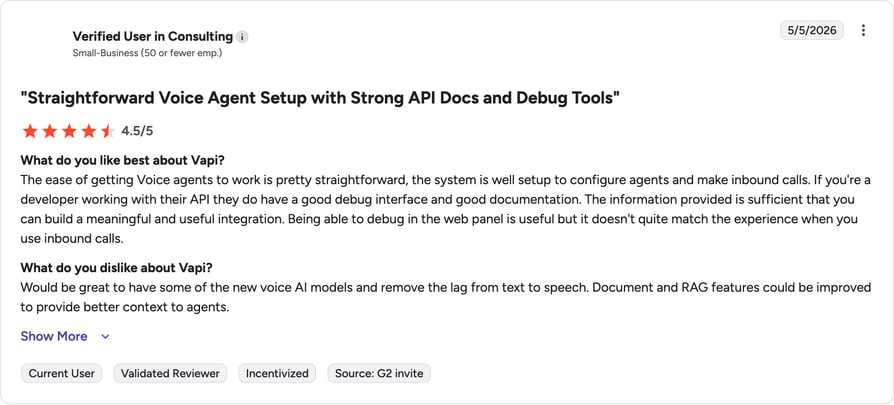
10. Vapi: Best Telnyx Alternative for Custom AI Voice Agents
What Is Vapi?
Vapi is an API-first AI voice platform for engineering teams that want granular control over every layer of a voice agent: speech-to-text, LLM, text-to-speech, and telephony. With a bring-your-own-stack model and 100+ language support, it's the developer-grade choice among Telnyx alternatives for AI-powered calls, especially for teams building custom, high-volume voice pipelines.
Why Is Vapi a Strong Telnyx Alternative?
- Lowest published base rate at $0.05/min for the orchestration layer.
- Bring-your-own components: swap STT, LLM, and TTS freely, with no single-vendor lock-in.
- 100+ language support and proven scale across hundreds of millions of calls.
- Real-time webhooks for custom workflow triggers and CRM updates during calls.
What Are the Key Features of Vapi?
- API-first architecture: full programmatic control over agent behavior.
- BYOC + BYO models: choose your own STT, TTS, LLM, and telephony provider.
- Automated testing tools to catch issues before production.
- Real-time webhooks for live CRM updates and triggers.
- 100+ language support for global inbound queues.
What Are the Pros & Cons of Vapi?
| Pros | Cons |
|---|---|
| Maximum model and component flexibility, not locked to a vendor | No no-code builder, so non-technical teams can't self-serve |
| Lowest published base orchestration rate at $0.05/min | Real costs reach $0.13-0.33/min once STT, LLM, TTS, and telephony stack up |
| Proven at high call volume with 100+ languages | HIPAA compliance adds $2,000/month, and its Trustpilot score on support and transparency is low |
What Is Vapi's Pricing?
Vapi charges $0.05/min for platform orchestration only. STT, LLM, TTS, and telephony are billed separately, pushing real costs to $0.13-0.33/min depending on your stack. New users get $5 in free credits, and HIPAA-eligible handling is a $2,000/month add-on, so the all-in Vapi pricing math matters more than the headline rate.
Vapi G2 Reviews
Vapi's current G2 rating is 4.2/5, based on verified user reviews.
Ten Platforms Later, Still Torn?
What Users Are Really Saying About Telnyx Alternatives
We went beyond pricing pages and docs to see what real users across Reddit, Quora, and G2 say about switching from Telnyx. The consensus: most teams leave over support friction, account/verification headaches, and the realization that a raw CPaaS still requires them to build the calling experience themselves.
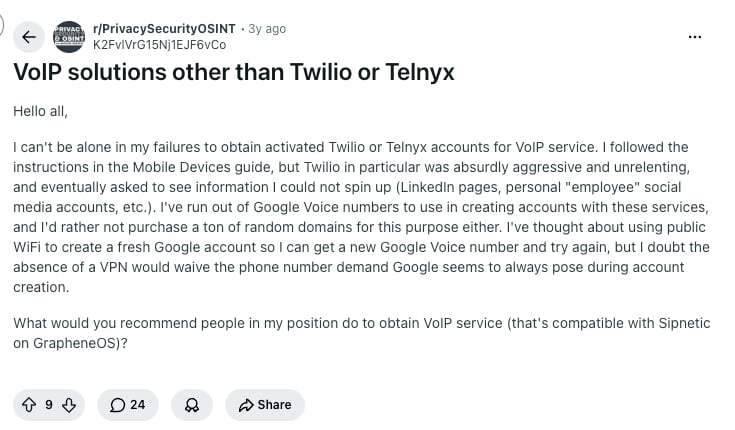
What Redditors Are Saying About Telnyx Alternatives
Across r/VoIP, r/Twilio, and r/SaaS, here are the recurring themes when developers and ops teams discuss Telnyx competitors:
- CloudTalk for turnkey AI calling: Teams that want AI voice agents, dialers, and HubSpot sync without building it recommend CloudTalk, citing published pricing and the visual call flow designer as key differentiators vs. Telnyx's API-only approach.
- Twilio for breadth: When teams need every channel under one vendor, Twilio is the default switch, though Reddit users warn its real bill runs well above estimates.
- Plivo for cost: Budget-focused developers move to Plivo for cheaper SMS, while noting registration and carrier fees inflate the headline rate.
- Common Telnyx complaints: Across threads, slow support, account verification friction, and number-provisioning failures are the top reasons teams look for a Telnyx replacement, regardless of where they land.
What Real People Say About Switching from Telnyx
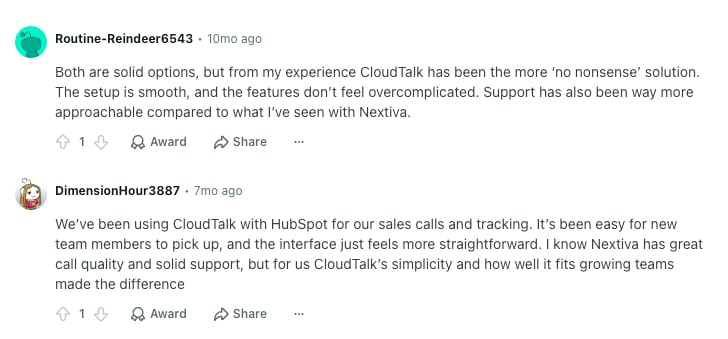
Verified G2 reviews show a consistent pattern: teams move away from Telnyx when support stalls a launch, when verification blocks an account, or when they realize they need a finished product rather than APIs. Here's what switchers say:
- CloudTalk (4.4/5): Teams switching from Telnyx highlight the turnkey setup, 24/7 support, and AI features that don't require an engineering project to configure. The 14-day free trial is frequently cited as the reason they tested before committing.
- Twilio (4.1/5): Switchers praise the breadth and documentation, but consistently flag pricing creep and complex setup.
- Plivo (4.5/5): Developers moving from Telnyx cite competitive SMS rates and reliable delivery, with a basic dashboard as the main trade-off.
CloudTalk vs. Telnyx: A Detailed Feature Comparison
When you compare CloudTalk vs. Telnyx directly, the differences come down to one question: do you want a finished calling platform, or a toolkit to build one?
| Category | CloudTalk | Telnyx | Winner |
|---|---|---|---|
| Product Type | Turnkey VoIP + AI platform | Raw CPaaS / APIs | CloudTalk |
| Starting Price | $25/user/mo (per seat) | ~$0.007/min usage-based | Depends on use case |
| Pricing Predictability | Published per-seat plans | Usage-based + surcharges | CloudTalk |
| Setup | No-code, live in hours | Engineering required | CloudTalk |
| AI Voice Agents | Built-in (no code) | Add-on (~$0.08/min), build yourself | CloudTalk |
| Native CRM Integrations | 100+ (Deep-Sync) | Via API | CloudTalk |
| Global Number Coverage | 160+ countries | Wide, gaps in some regions | Tie |
| Low-Level Telecom Control | Limited (managed) | Full (owned network, SIP) | Telnyx |
| 24/7 Support | Chat and email 24/7, phone on Expert | Chat-first, mixed reviews | CloudTalk |
| G2 Rating | 4.4/5 (1,900+ reviews) | 4.7/5 (500+ reviews) | Telnyx |
| Free Trial | 14 days | Trial credits | Tie |
Verdict: Telnyx wins on raw, low-level control. If you have engineers who want to build a bespoke telecom stack on an owned network, it's excellent and cheap per unit. For everyone else, meaning sales and support teams who want global calling, AI agents, and CRM sync working today, CloudTalk is the stronger fit and the better alternative to Telnyx.
Telnyx Won Two Rows. Feel What the Other Six Are Like.
How to Choose the Right Telnyx Alternative for Your Team
The right alternative depends on your team's specific bottleneck, not a generic feature checklist. Seven questions to answer before you commit.
1. Do you need a finished product or raw APIs?
No engineering bandwidth and you just want to start calling? Choose a turnkey platform: CloudTalk. Need call control at the API level, like custom SIP routing? Twilio, Plivo, or Vonage. JustCall isn't in our ten because it competes with CloudTalk, not Telnyx, but small SMS-heavy sales teams should look at it.
2. How important is AI calling?
Want AI voice agents without building them? Choose CloudTalk, the best Telnyx alternative for AI calling here, with an AI Receptionist from $99/month and 50 free minutes. Custom agent with full control? Vapi, at the cost of a multi-vendor stack.
Signature Capability
See CloudTalk’s AI Voice Agent in Action!
CeTe is an AI that talks like a human: no breaks, no training, no time off. It makes and answers calls, updates CRMs, books meetings, and loops in a human only when needed.
Press play to hear it. Want a wow moment? Get a free test call and try it live.

3. How predictable does your budget need to be?
If you need to forecast spend, choose published per-seat pricing: CloudTalk ($25/user/month). A CPaaS bill is line items: per-minute voice, per-message SMS plus carrier fees, numbers, recording, transfers. Telnyx and Plivo both publish every rate, so Plivo vs Telnyx comes down to routes and support, and neither tells you what next month costs. Ask any shortlist for its per-message rate sheet, carrier fees included.
4. How much global coverage do you need?
For international calling with local numbers, choose CloudTalk (160+ countries). For messaging-heavy global campaigns, Infobip or Sinch. Ask about latency for the countries you actually call: providers that own their network or peer directly in your markets sound better on the first call.
5. Do you need network ownership or compliance control?
If you need direct-to-carrier control, E911, or regulated-industry compliance, choose Bandwidth or Telnyx itself. For AWS-native flexibility, Amazon Connect fits.
6. How important is support?
If slow support is your main Telnyx pain point, choose 24/7 help on every plan: CloudTalk, with chat and email around the clock and phone on Expert. Most CPaaS providers gate faster support behind paid tiers.
7. Which Telnyx competitors fit the systems you already run?
Start from the tools your reps live in. For a CRM like HubSpot, Salesforce, or Pipedrive, CloudTalk is the pick: 100+ CRMs and helpdesks sync natively from Essential, Salesforce on Expert (3-seat minimum). ERP and inventory management systems rarely have native phone integrations, so check for Zapier and an open API, which CloudTalk has and Twilio and Vonage, the developer-side Telnyx competitors, leave to you.
| Team Profile | Primary Need | Best Fit |
|---|---|---|
| SMB sales/support team, HubSpot/Salesforce user | Turnkey calling + AI + CRM automation | CloudTalk |
| Team wanting every channel from one vendor | Widest CPaaS breadth + ecosystem | Twilio |
| Budget-focused developer team | Cheapest reliable SMS/voice APIs | Plivo |
| Enterprise needing network ownership/compliance | Owned network + E911 | Bandwidth |
| Global omnichannel / OTP at scale | Carrier-grade global messaging | Sinch or Infobip |
| Developers building custom AI voice agents | BYO model/voice/telephony control | Vapi |
Found Your Row in the Table? Put It on a Real Call.
Ready to Try the Best Alternative to Telnyx?
Telnyx is a capable CPaaS for engineering teams who want low-level control over an owned network. If you're hitting the wall on slow support, verification friction, number-provisioning failures, or the sheer amount of building before a call connects, the best Telnyx alternatives in 2026 fix exactly that. Here's what changes when you switch to CloudTalk:
- Support that answersTelnyx reviewers describe chat-only queues and tickets that expire between agents. CloudTalk gives you 24/7 chat and email on every plan, and phone support on Expert.
- Numbers that go live from the dashboardLocal numbers in 160+ countries, provisioned in the app, with porting for the ones you already own, so a launch stops hinging on a carrier ticket.
- Nothing to build before the first callA drag-and-drop call flow designer, 100+ CRM and helpdesk integrations from Essential, and an AI Receptionist from $99/month with 50 free minutes, all set up without a developer.
- A bill you can forecastOne seat price from $25/user/month with recording included on every plan, instead of per-minute, per-message, per-transfer, and per-number line items.
- Call quality you don't have to engineerA globally distributed carrier network backed by a 99.999% uptime SLA, without sourcing routes or tuning SIP yourself.
Join 5,500+ Businesses That Stopped Building Their Own Phone System
Frequently Asked Questions about Telnyx Alternatives
Find answers to the most common questions teams have when evaluating alternatives to Telnyx.
It depends on priorities. Telnyx is cheaper per minute and per message, owns its network, and rates higher on G2 (4.7/5) than Twilio (4.1/5). Twilio wins on breadth: more channels, the largest developer ecosystem, the most documentation. Choose Telnyx for cost and network control, Twilio for all-channel coverage. If you'd rather skip the build entirely, a turnkey platform like CloudTalk is the better alternative to Telnyx for most sales and support teams.
Telnyx is a communications platform-as-a-service (CPaaS). Developers use its APIs to add programmable voice, SMS/MMS, SIP trunking, number provisioning, and, more recently, AI voice agents to their own applications, all on Telnyx's owned carrier network. Typical builds: custom IVRs, call tracking, contact-center AI, two-way messaging, OTP verification. Because it's API-first, Telnyx suits teams with engineers rather than teams wanting a ready-made business phone system.
Yes. Telnyx, Plivo, and Bird (MessageBird) all publish lower per-message rates than Twilio's $0.0083/SMS, and Telnyx voice often runs about half of Twilio's per-minute rate on its owned network. All of them add carrier surcharges, registration fees, and number rentals, so compare the real all-in cost. If you value predictable budgeting over the lowest unit price, CloudTalk's published per-seat plans from $25/user/month are easier to forecast.
For enterprises, the best Telnyx alternative depends on the workload. Bandwidth is strongest for network ownership, E911, and regulated-industry compliance. Amazon Connect suits AWS-native contact centers. Infobip and Sinch lead for global omnichannel messaging and OTP at scale. For enterprise sales and support teams that want a managed, AI-ready calling platform with deep CRM sync, CloudTalk offers a Custom plan with enterprise security and dedicated onboarding.
Yes. For agencies and resellers that need white-label voice, Plivo's open-source telephony stack lets you self-host and rebrand, and several AI voice platforms (such as Synthflow) offer white-label deployments. Bandwidth and Sinch support reseller and carrier arrangements at the enterprise level. If you need a brandable, ready-to-deploy virtual phone system rather than infrastructure to white-label, ask managed platforms about their partner programs.
Generally, no. Telnyx is an API-first CPaaS, so building a usable phone system, dialer, IVR, or AI agent requires engineering work. Non-technical sales and support teams typically can't self-serve. If your team wants to start calling, route customers, and deploy AI voice agents without code, a turnkey platform like CloudTalk, with a visual call flow designer and built-in AI voice agents for small business, is a far better fit.
It depends on what you're replacing. For raw voice and SMS APIs, Twilio, Plivo, and Vonage are the direct Telnyx competitors, with Bandwidth if you want an owned network. For a finished phone system with AI and CRM sync, CloudTalk is the pick, and the wider set of VoIP alternatives covers phone systems that never competed with Telnyx at all.
Not directly. Apple doesn't sell iMessage access to phone platforms, and Telnyx doesn't offer it either. The closest route is Apple Messages for Business, which enterprise CPaaS vendors such as Bird can set up. CloudTalk doesn't support iMessage: it covers SMS and MMS plus WhatsApp from one inbox, on the numbers your team already calls from.
CloudTalk is the Telnyx alternative that works best with a CRM for most sales and support teams: 100+ native integrations from Essential, including two-way HubSpot and Pipedrive sync, with Salesforce on Expert (3-seat minimum). Calls, recordings, and AI summaries log to the contact automatically. Telnyx, Twilio, and Plivo hand you an API instead, so your developers build and maintain the CRM link.
For most sales and support use cases, yes. CloudTalk replaces Telnyx as a complete, managed calling platform: calls in 160+ countries, AI Voice Agents, dialers, IVR, SMS, and Deep-Sync CRM logging, all without the engineering build Telnyx requires, plus free number porting so you keep your numbers. The exception is teams that need raw, low-level telecom control (custom SIP routing on an owned network), where a CPaaS like Telnyx remains the better technical fit.