Twilio Flex Pricing 2026: What 10, 20 and 50 Agents Really Pay
TL;DR:
Twilio Flex pricing comes in three tiers: $1 per active user hour, a User + Usage model from $35 per monthly active user, and a Named User license at $150 per user/month. There's a generous free trial—5,000 active user hours, no card required—but you forfeit whatever's left the moment you pick a paid model. The licenses are only the entry ticket: every call, message, number, and recording is metered on top.
What the sticker price hides: implementation typically starts at $10,000+, support plans run $250–$5,000+ per month (or 4–8% of your Twilio spend), voice and SMS are billed per minute and per message, and almost every change to the platform needs a developer. The license is the cheapest line on the invoice.
Summary of Twilio Flex Pricing Plans
| Plan | Price (excl. usage fees) | Best For |
|---|---|---|
| Free Trial | $0 — 5,000 active user hours | Proof-of-concept builds and pilots (hours are forfeited once you go paid). |
| User + Usage | From $35 /monthly active user | Existing Twilio customers who want Flex on top of services they already pay for. |
| Active User Hour | $1 /active user hour | Seasonal, part-time, or highly variable teams. |
| Named User | $150 /user/month | Full-time contact center teams that want a fixed license cost (contract required). |
Three pricing models, one unpredictable bill?
What Pricing Plans Does Twilio Flex Offer?
Twilio Flex pricing looks simple from a distance: pick how you want to pay for the platform, then pay for what you use. Up close, it's three distinct models—$1 per active user hour, User + Usage from $35 per monthly active user, and a Named User license at $150 per user/month—and you have to commit to one. Twilio doesn't let you mix models across your team, so the choice you make on day one shapes every invoice after it.
Two things make Flex unlike the plan pages you're used to. First, the license never includes communication: voice minutes, SMS, phone numbers, recordings, and AI are all metered separately. Second, Flex is a programmable platform, not a finished product—the honest assumption is that developers will build your contact center on top of it. That's the superpower and the price tag in one sentence.
Here's how the three models (plus the trial) stack up:
| Feature | User + Usage | Active User Hour | Named User |
|---|---|---|---|
| Platform price | From $35 /monthly active user | $1 /active user hour | $150 /user/month |
| Billing basis | Users active that month + service usage | Hours agents spend logged in & active | Every named agent, supervisor & admin |
| Contract required | No (existing Twilio accounts only) | No — pay as you go | Yes |
| Voice, SMS & numbers included | No — metered | No — metered | No — metered |
| Cost predictability | Low — two variables | Low — scales with schedules | High license cost, variable usage |
| AI (Agent Copilot) | $0.035 /voice min, $0.005 /message add-on | $0.035 /voice min, $0.005 /message add-on | $0.035 /voice min, $0.005 /message add-on |
| Trial | 5,000 free active user hours | 5,000 free active user hours | 5,000 free active user hours |
| Ideal for | Teams already on Twilio APIs | Seasonal & part-time teams | Full-time contact centers |
The thing to internalize is that with Flex, the license is a platform fee, not a product price. Whichever model you choose, the real total is license + usage + implementation + maintenance. Keep that four-part lens as you read the plans below—it's the difference between the number on Twilio's pricing page and the number on your invoice.
What Real Users Say About Twilio Flex's Pricing
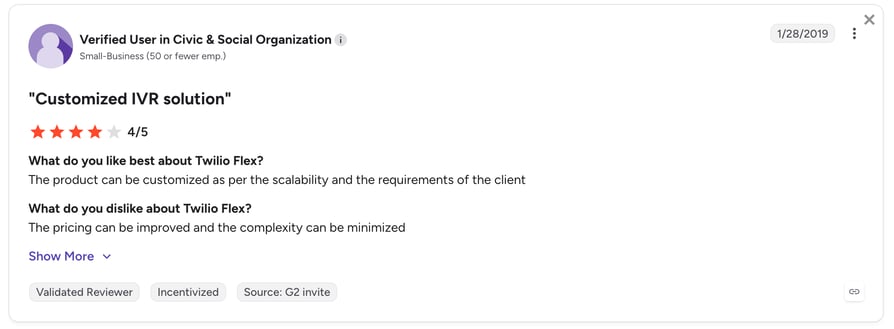
Twilio Flex holds a 4.1/5 on G2 across 36 reviews. The praise clusters around exactly what you'd expect: deep customizability, clean omnichannel handling, and an API-first architecture developers genuinely enjoy. If you have the engineering muscle, reviewers say, Flex will become whatever you need it to be.
The criticism clusters just as tightly—and it's a cost story even when nobody names a dollar figure. As one enterprise reviewer put it, "every little change needs engineering support." Out-of-the-box reporting and UI are thin, so customization isn't optional, and every developer hour is part of your true Twilio Flex cost. You're not just evaluating a price list; you're evaluating an ongoing engineering commitment.
Twilio Flex's Free Trial
What Is Twilio Flex's Free Trial?
Twilio gives new accounts 5,000 free active user hours of Flex—no credit card, no time limit until you pick a paid model. That's one of the most generous trials in the category: enough for a small team to run a serious multi-week pilot, not just a demo click-through.
What's included in Twilio Flex's Free Trial?
- 5,000 active user hours of the full Flex platform.
- Access to the drag-and-drop Studio flow builder and Flex UI.
- Omnichannel building blocks: voice, SMS, chat, WhatsApp, Messenger.
- No credit card and no expiry date—until you choose a billing model.
Who is Twilio Flex's Free Trial best for?
Teams with developer resources who want to prove a Flex build works before spending real money—and anyone trying to estimate what their usage bill will actually look like in production.
What you need to know about Twilio Flex's Free Trial:
The fine print matters: unused trial hours are forfeited the moment you select a paid pricing model. There's no banking 3,000 leftover hours against your first invoices. Treat the trial as a build-and-measure window, and instrument it well—it's the best free data you'll ever get on your future usage costs.
Twilio Flex's User + Usage Plan
What Is Twilio Flex's User + Usage Plan?
The quiet third option most pricing guides miss: from $35 per monthly active user, available only to existing Twilio accounts. You pay a lower per-user platform fee, and then—separately—for the underlying Twilio services Flex runs on: Conversations, TaskRouter, Studio, and Functions, each metered at its own rate.
What's included in Twilio Flex's User + Usage Plan?
- Flex platform access from $35 per monthly active user.
- Charged only for users active in a given month—dormant seats cost nothing.
- WhatsApp session and Facebook Messenger messages included; templates billed separately.
- Pay-as-you-go rates for Conversations, TaskRouter, Studio, and Functions on top.
Who is Twilio Flex's User + Usage Plan best for?
Teams already building on Twilio APIs who understand their usage patterns and want the lowest platform entry price—accepting that the total will float with how hard the underlying services work.
What you need to know about Twilio Flex's User + Usage Plan:
The $35 headline is the platform fee only, and it stacks a second variable (service usage) on top of the usual metered communications. It's the hardest of the three models to forecast, and it's gated to existing Twilio customers. If you can't confidently predict your TaskRouter and Studio volumes, budget with a wide margin—this is the model where knowing how to evaluate VoIP pricing pays for itself.
Twilio Flex's Active User Hour Plan
What Is Twilio Flex's Active User Hour Plan?
The pay-as-you-go option: $1 for every hour an agent is logged in and active (any status other than logged out counts). No contract, no minimums—your platform bill literally follows your schedule.
What's included in Twilio Flex's Active User Hour Plan?
- Full Flex platform access, billed per active hour.
- No contract and no named-seat commitment.
- Scales to zero: nobody logged in, nothing billed.
- Same omnichannel capabilities as the other models (usage still metered).
Who is Twilio Flex's Active User Hour Plan best for?
Seasonal ramp-ups, part-time coverage, and follow-the-sun teams whose staffing swings month to month. This is the one scenario where Flex pricing is genuinely hard to beat.
What you need to know about Twilio Flex's Active User Hour Plan:
Do the arithmetic before you fall in love with the $1. A full-time agent logs roughly 160–170 active hours a month—$160+ per agent, more than the $150 Named User license—for a bill that's harder to forecast. The hourly model rewards variability and quietly punishes full-time schedules—the classic trap of usage-based call center pricing models, and worth running against your actual roster before you commit.
Twilio Flex's Named User Plan
What Is Twilio Flex's Named User Plan?
The fixed-cost option: $150 per named user per month, contract required. Every person with a login—agents, supervisors, and administrators alike—needs their own license, whether they're on the phones eight hours a day or checking a dashboard once a week.
What's included in Twilio Flex's Named User Plan?
- Unlimited active hours for every licensed user.
- Predictable platform cost—the one line of the invoice that won't move.
- Covers agent, supervisor, and admin roles (each needs a license).
- Same programmable platform and omnichannel stack as the other models.
Who is Twilio Flex's Named User Plan best for?
Established, full-time contact centers that want at least the platform portion of their Twilio Flex cost locked down—and are ready to sign a contract to get it.
What you need to know about Twilio Flex's Named User Plan:
$150 per seat is premium territory—before a single call is made. A 20-person team is $3,000/month in licenses alone, and the supervisor-needs-a-license rule inflates headcount math in ways teams rarely budget for. It's also several times what most full-featured call center solutions charge per seat—so be sure the programmability is something you'll actually use.
Want the contact center without the $150 seat?
What Are Twilio Flex's Additional Costs?
This is the section that decides whether Flex fits your budget, because with Twilio Flex pricing, the license is the smallest promise on the page. Everything your contact center actually does—talk, text, record, get built, get supported—is billed on top.
| Extra cost | Amount | When it hits |
|---|---|---|
| Implementation & setup | From ~$10,000 one-time | Before launch — complex builds run far higher |
| Support plans | $250–$5,000+ /month or 4–8% of spend | If you want more than basic support |
| Voice calls (US) | ~$0.014 /min outbound, ~$0.0085 /min inbound | Every minute, every call |
| SMS / MMS | From ~$0.008 /SMS + carrier fees; $0.02 /MMS | Every message sent |
| Phone numbers | $1.15 /mo local; $2.15 /mo toll-free | Per number, monthly |
| Call recording + storage | $0.0025 /min + $0.0005 /min/month | If you record calls (most teams must) |
| Agent Copilot (AI) | $0.035 /voice min; $0.005 /message | When agents use AI assistance |
| Flex Mobile | $50 /user/month standalone | Mobile-only access without a full license |
The pattern worth flagging: almost every line above is usage-based, which means your bill has no ceiling by design. That's fine for teams that measure obsessively—and dangerous for teams that don't, because knowing what to check in a VoIP plan is the only thing standing between you and a bill that writes itself.
What Does Twilio Actually Charge Per Minute and Per Number?
The Flex licence is the entry ticket. Every call, number, recording and transcription is metered separately on Twilio's Programmable Voice rates, and those are what turn a $150 named-user seat into a variable bill. These are Twilio's published US rates, current as of August 2026.
Twilio Voice Rates in the US
| Connection type | To make calls | To receive calls |
|---|---|---|
| Local number | $0.0140 per minute | $0.0085 per minute |
| Toll-free number | $0.0140 per minute | $0.0220 per minute |
| Browser or app (WebRTC) | $0.0040 per minute | $0.0040 per minute |
| SIP interface | $0.0040 per minute | $0.0040 per minute |
| BYOC trunking | $0.0040 per minute | $0.0040 per minute |
The rate most people are looking for is $0.0140 per minute for outbound calls from a US local number. Answering in the browser rather than forwarding to a phone cuts the per-minute cost to $0.0040, which is a 71% difference on the same call.
How Much Does a Twilio Phone Number Cost?
| Number type | Monthly cost |
|---|---|
| US local number | $1.15 per month |
| US toll-free number | $2.15 per month |
| Emergency calling registration | $0.75 per month per number |
Twilio Add-On Service Rates
| Service | Rate |
|---|---|
| Call recording | $0.0025 per minute |
| Recording storage | $0.0005 per minute per month |
| Transcription | $0.0500 per minute |
| Conversation Intelligence, batch transcription | $0.024 per minute |
| Conversation Intelligence, streaming transcription | $0.027 per minute |
| Conference calls | From $0.0018 per participant per minute |
| Answering machine detection | $0.0075 per call |
| Branded calling | $0.12 per call |
| Media Streams | $0.0044 per minute |
| Conversation Relay | $0.07 per minute |
| Flex Agent Copilot, voice | $0.035 per minute |
| Flex Agent Copilot, digital messages | $0.005 per message |
What to watch. Transcription at $0.0500 per minute costs more than three times the call itself. A twenty-agent team transcribing 600 inbound minutes each per month spends $600 on transcription against roughly $102 on the calls. If transcription is a requirement rather than a nice-to-have, price it before you commit to a Flex licence model, or compare a platform where call transcription is part of the plan rather than a meter.
How Does Twilio Flex Compare to Amazon Connect and Genesys Cloud?
Flex is most often shortlisted against the other two build-it-yourself contact centre platforms. The pricing models are genuinely different, and the difference matters more than the headline rate.
| Platform | Pricing model | Entry rate | Engineering required |
|---|---|---|---|
| Twilio Flex | Per named user, per active user, or per active user hour, plus metered usage | $1 per active user hour, or $150 per named user per month | High: Flex is a framework you build on |
| Amazon Connect | Pay per minute of agent usage plus telephony, no seat licence | Usage-based, no per-seat fee | High: AWS configuration and integration |
| Genesys Cloud | Per named or concurrent user, tiered | Per-seat licence tiers | Medium: configuration rather than code |
| CloudTalk | Flat per user, calling included | $25 per user per month | None: configured in the dashboard |
The three-way question is really about where you want the cost to live. Flex and Amazon Connect move it into engineering time and metered usage; Genesys moves it into licence fees; a packaged platform moves it into a flat per-user rate. A CloudTalk seat includes the calling, routing and recording that Flex meters separately, which is why the comparison rarely comes down to the sticker price. See the full Twilio alternative breakdown for a like-for-like view.
How Implementation and Developer Hours Change the Total
Two costs move the real Twilio Flex price more than any usage meter. First, implementation: Flex ships as a toolkit, not a turnkey product, and professional builds typically start around $10,000—with complex, multi-channel deployments running several times that. Second, maintenance: because "every little change needs engineering support," you're either keeping developers on staff or paying a partner ongoing. Neither line appears on Twilio's pricing page, and both usually outweigh the license fee. When you compare Flex to anything, compare total cost of ownership, not per-seat stickers.
No usage meter. No percent-of-spend support fees.
What Will Twilio Flex Actually Cost You?
Sticker price and real invoice are different animals—with Flex, dramatically so. Here's the Twilio Flex pricing per month for four realistic setups. (Figures are platform licenses only, before usage fees, support plans, and the one-time implementation build.)
| Team | Model | Monthly | Annual |
|---|---|---|---|
| 10 part-time agents (20 hrs/wk) | Active User Hour | ~$800 | ~$9,600 |
| 10 full-time agents | Named User | $1,500 | $18,000 |
| 50 full-time agents | Named User | $7,500 | $90,000 |
| 50 agents, all-in estimate | Named User + usage + support | $9,000+ | $110,000+ (plus $10–50K build) |
Scenario 1: The seasonal or part-time team (Active User Hour)
Ten agents covering 20 hours a week each is roughly 800 active hours—about $800/month, and the bill shrinks automatically in quiet months. This is Flex's best pricing story: a retailer staffing up for the holidays, or a support line that only runs half-days, pays for exactly the coverage it uses. If your schedules are genuinely variable, the hourly model deserves a serious look.
Scenario 2: The ten-person full-time team (Named User)
Full-time schedules flip the math. Ten agents at 160+ active hours each would cost more per head on the hourly model than the $150 license, so you take Named User: $1,500/month, $18,000/year—before minutes, messages, numbers, recording, and the implementation build. For comparison, a full-featured platform at $30/user would run $300/month for the same team, apps included. That gap is the price of Flex's programmability.
Scenario 3: The fifty-agent contact center (all-in)
At 50 named users you're at $7,500/month in licenses alone—$90,000 a year. Add realistic call and SMS volumes, recording, a Business-tier support plan (6% of a bill that size), and the picture lands north of $9,000/month, plus a $10,000–$50,000 implementation before day one. At this scale, Flex only wins if you're extracting real value from customization no off-the-shelf platform can match—fifty seats puts you firmly in enterprise VoIP territory, where the deal you negotiate matters more than any pricing page.
The real-world read:
Flex is a bargain for variable schedules and a heavyweight for full-time teams. If your agents work regular hours and your workflows are standard, you're paying a programmability premium—licenses, usage, and engineering—for flexibility you may never use.
Do the math on your own team—free.
Which Alternatives Are Better and Cheaper Than Twilio Flex?
Flex is the right answer to a specific question: "we have developers and need a contact center nothing off-the-shelf can match." If your question is closer to "we need a great contact center, live soon, at a predictable price," one of these four will fit better. CloudTalk leads the comparison, followed by three other popular options.
| Provider | Best for | Starting price | Model |
|---|---|---|---|
| Twilio Flex | Fully custom builds | $1 /hr or from $35 /user/mo | Platform fee + metered usage + dev work |
| CloudTalk | Scaling sales & support teams | From $25 /user/mo | Per user, features included, 160+ countries |
| Five9 | Enterprise contact centers | From $119 /user/mo | Per seat, turnkey CCaaS |
| Aircall | SMB phone teams | From $30 /license/mo | Per license, 3-seat minimum |
| Dialpad | Cheapest built-in AI | From $15 /user/mo | Per seat, AI on all plans |
CloudTalk: Best for Teams That Want the Contact Center Without the Engineering Project
What is CloudTalk?
CloudTalk is an AI-powered business calling platform built for sales and support teams that live on the phone. It pairs a full-featured cloud phone system—160 national numbers, coverage across 160+ countries, and 100+ calling features—with AI that summarizes, tags, and routes every conversation. The difference from Flex in one line: CloudTalk is a product you configure, not a platform you build.
Why is CloudTalk better than Twilio Flex?
- Live in days, not months: IVR, skills-based routing, analytics, and dialers work out of the box—no $10,000+ implementation build.
- No developer dependency: admins change call flows in a visual designer; with Flex, "every little change needs engineering support."
- 100+ one-click integrations plus 100+ integration tools—your CRM connects without custom code.
- Predictable per-user pricing with AI available as an add-on from $9/user/mo, and a 14-day free trial to prove it.
What is CloudTalk's pricing?
CloudTalk plans start at $25/user/month billed annually, with popular tiers at $25 and $29, and Expert at $49. AI features start at $9/user/month, so you add intelligence only where you need it. See the full breakdown on the CloudTalk pricing page.
CloudTalk pricing vs. Twilio Flex pricing
A 10-person full-time team runs $1,500/month on Flex's Named User licenses—before usage, support, and the build. The same team on CloudTalk Essential is a few hundred dollars, calling features included, live within the week. Flex earns its premium only when you need customization no product can offer; for everyone else, the delta is pure overhead—which is exactly why CloudTalk leads most rankings of the best Twilio alternatives.
CloudTalk reviews
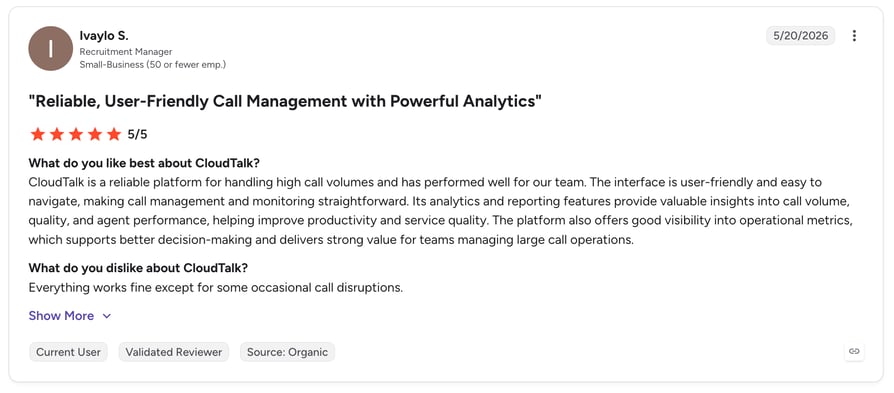
CloudTalk holds a 4.4/5 rating on G2 from 1,702+ reviews, with users repeatedly calling out call quality, onboarding, and integrations.
Building a contact center shouldn't need a backlog.
Five9: Best for Enterprise Contact Centers That Want Turnkey Power
What is Five9?
Five9 is a veteran enterprise CCaaS platform: omnichannel routing, predictive and power dialers, workforce management, and AI agents—delivered as a finished product rather than a programmable canvas. It's the closest thing to "Flex-scale capability without the Flex build."
Why is Five9 better than Twilio Flex?
- Enterprise features—WFM, quality management, advanced dialers—work out of the box, no engineering team required.
- Seat prices include the platform: no separate implementation project measured in tens of thousands.
- Predictable per-seat billing instead of a license + usage + support stack.
What is Five9's pricing?
- Digital — $119/user/mo: chat, email, SMS, and social (no voice).
- Core — $159/user/mo: voice with inbound/outbound and predictive/power dialers.
- Plus, Pro & Enterprise — quote-based: blended channels, AI, and workforce optimization.
- AI add-ons (Intelligent Virtual Agent, Agent Assist) are priced separately. Full details in our Five9 pricing guide.
Five9 pricing vs. Twilio Flex pricing
Five9's $119–$159 seats look pricier than Flex's $35 entry—until you remember Flex adds usage, support percentages, and a five-figure build on top. For a standard enterprise contact center, Five9's all-in number is usually lower and far easier to forecast; Flex wins only when deep custom work is the whole point. See the head-to-head in Five9 vs. Twilio.
Five9 reviews
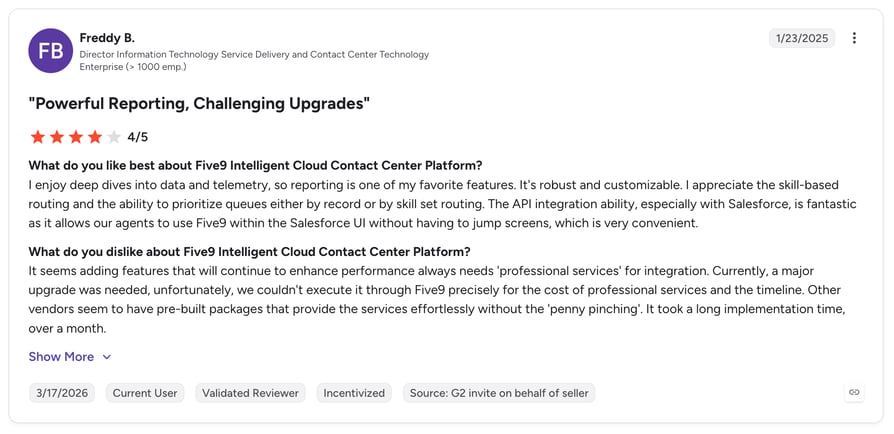
Five9 holds a 4.1/5 rating on G2, with users praising reliability and dialer power while flagging that add-on costs push the true price above the sticker.
Enterprise features without enterprise seat prices?
Aircall: Best for SMB Phone Teams That Want Simple Per-License Pricing
What is Aircall?
Aircall is a cloud phone system aimed squarely at small and mid-sized sales and support teams: quick setup, a large app marketplace, and per-license pricing with no code anywhere in sight. It trades Flex's infinite customizability for out-of-the-box simplicity.
Why is Aircall better than Twilio Flex?
- Deploys in days with zero developer involvement.
- Flat per-license pricing—no active-hour math, no usage-based platform fees.
- 100+ marketplace integrations that connect without custom API work.
What is Aircall's pricing?
- Essentials — $30/license/mo (annual): calling essentials, 3-license minimum.
- Professional — $50/license/mo: adds analytics, coaching, and AI Assist included.
- Custom — quote-based, 25-license minimum.
- AI add-ons from $9/license; 7-day free trial. Full breakdown in our Aircall pricing guide.
Aircall pricing vs. Twilio Flex pricing
An SMB team of five pays $150–$250/month on Aircall, apps included—roughly what a single Flex Named User seat costs before usage. The trade-off: Aircall's add-ons (analytics, extra numbers, AI tiers) can push real costs 30%+ above the sticker, and its 3-license minimum rules out solo operators. Still, for standard phone workflows it's radically simpler than a Flex build.
Aircall reviews
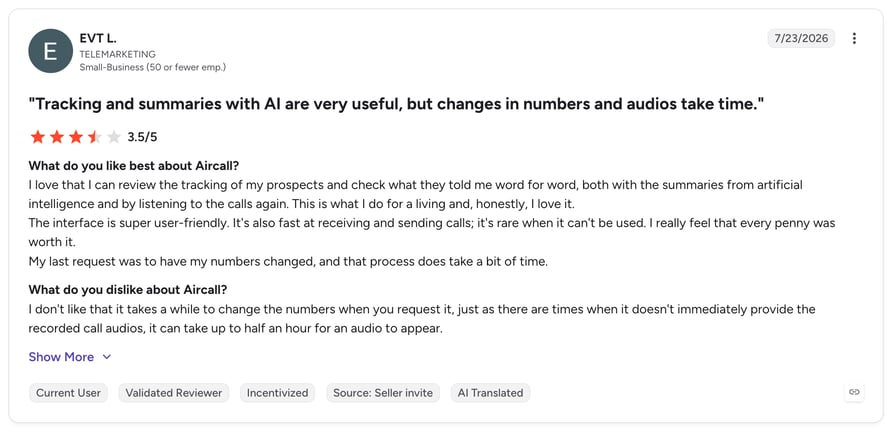
Aircall holds a 4.4/5 rating on G2, with reviewers praising ease of use and integrations while noting add-on costs and occasional call-quality dips.
Simple pricing and deeper calling features?
Dialpad: Best for Teams That Want the Cheapest Built-In AI Entry Point
What is Dialpad?
Dialpad is an AI-powered communications platform that bundles calling, messaging, and video into one app, with AI transcription and call summaries baked into every plan. Against Flex, it's the opposite philosophy: instead of building your own AI workflows on a programmable canvas, you get Dialpad's AI working on day one.
Why is Dialpad better than Twilio Flex?
- Lowest entry price in this lineup: $15/user/mo with AI transcription included.
- No metered AI: summaries and transcription don't bill per minute like Agent Copilot's $0.035.
- Full UCaaS—voice, SMS, and video in one seat—without any custom development.
What is Dialpad's pricing?
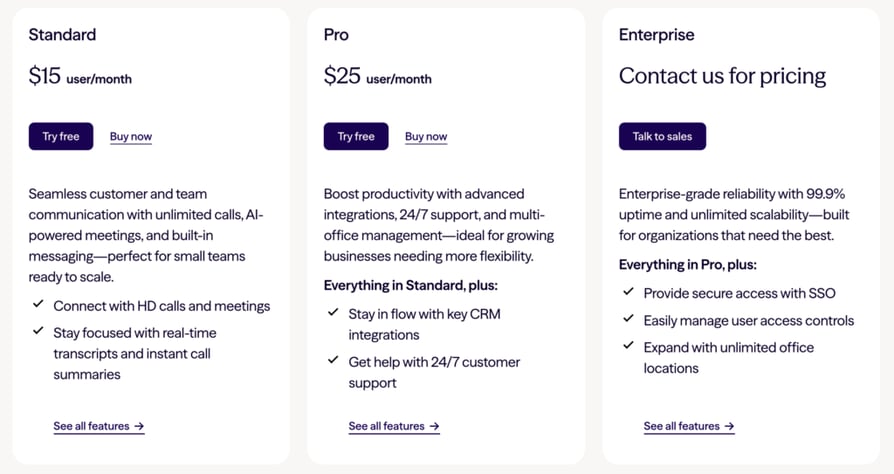
- Standard — $15/user/mo (annual) or $27 monthly: unlimited calling, AI transcription & summaries, SMS/MMS.
- Pro — $25/user/mo (annual): adds CRM integrations, 24/7 support, and multiple numbers.
- Enterprise — custom: SSO, SLA, and unlimited office locations.
- 14-day free trial. See the full Dialpad pricing breakdown.
Dialpad pricing vs. Twilio Flex pricing
Ten users on Dialpad Standard cost $150/month—the price of one Flex Named User seat. Flex counters with programmability and true contact-center routing that Dialpad's entry tiers don't attempt; Dialpad's contact-center plans climb to $80+/user, narrowing the gap at scale. For teams that just need calling plus AI notes, though, this comparison isn't close.
Dialpad reviews
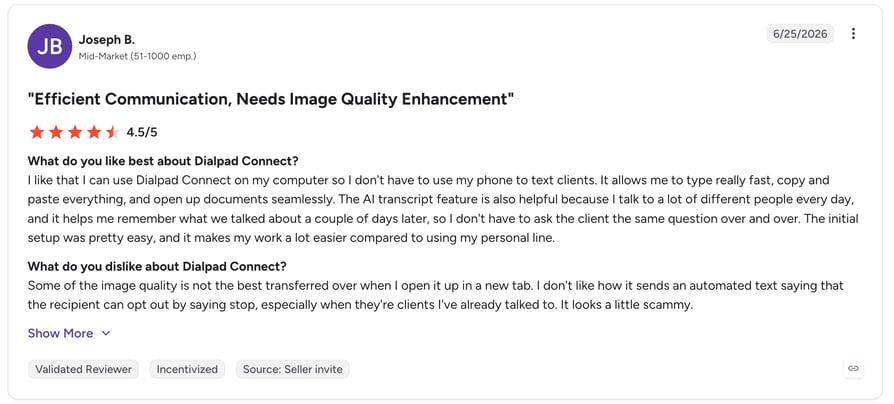
Dialpad Connect holds a 4.4/5 rating on G2 from 4,195 reviews, with users praising the AI transcription and clean interface while flagging occasional call-quality dips.
Built-in AI and a real call-center under one roof?
What Are Twilio Flex's Best Features?
Pricing only matters next to what you get. These are the features that justify the Twilio Flex price for the teams that swear by it.
- Total programmability. Every screen, workflow, and routing rule can be rebuilt to spec—Flex is the only platform here where "can it do X?" is almost always "yes, if you build it."
- True omnichannel on one canvas. Voice, SMS, WhatsApp, chat, and Messenger flow through a single agent interface with unified routing via TaskRouter.
- Studio's drag-and-drop flows. The visual builder takes real work out of IVR and routing changes—one of the few places non-developers can move fast.
- A genuinely great trial and an honest hourly model. 5,000 free active hours to prove your build, and per-hour pricing that seasonal teams can actually win with.
What Are the Pros and Cons of Twilio Flex?
The honest ledger, focused on cost and value for money:
| Pros | Cons |
|---|---|
| Unmatched customization for teams with developer resources | Implementation starts around $10,000, and 'every little change needs engineering support' |
| Three pricing models, including a flexible $1/hour option | Models can't be mixed—and the full-time math usually lands on $150/seat |
| 5,000 free active user hours—the most generous trial in the category | Unused trial hours are forfeited the moment you pick a paid model |
| True omnichannel with unified routing | Every call, message, number, and recording is metered on top of the license |
| Solid 4.1/5 G2 rating from technical users | Support costs extra: $250–$5,000+/month or 4–8% of your spend |
Get Flex-level capability without the engineering bill.
Is Twilio Flex the Right Call for Your Team?
Twilio Flex is a genuinely powerful platform with pricing that rewards one specific buyer: the team with engineering resources, unusual requirements, and the discipline to manage usage-based billing. If that's you—if your contact center is a competitive advantage worth custom-building—Flex's programmability is worth every metered cent, and 5,000 free hours is a risk-free way to prove it.
Just go in clear-eyed about total cost. The license—$1/hour, $35/user, or $150/seat—is the entry ticket, not the price. Layer on voice and SMS metering, numbers, recording, Agent Copilot's per-minute AI, a support plan that scales with your bill, and an implementation project that starts around $10,000, and the real number is often two to three times the sticker. Budget for the invoice, not the pricing page.
The way to make the call is to be honest about one question: do you need a contact center that's custom-built, or one that's excellent? If your workflows are unusual enough that off-the-shelf platforms genuinely can't serve them, Flex is the answer. If your workflows are standard—inbound routing, outbound dialing, CRM sync, analytics, AI notes—you're paying a programmability premium, in licenses and engineering hours, for flexibility you'll never use.
So here's the decision rule. Choose Twilio Flex if you have developers on staff and requirements nothing else can meet. Choose a turnkey enterprise platform like Five9 if you're large and standard. And if you're a scaling sales or support team that wants full contact-center power, live in days, at a predictable per-user price, a platform like CloudTalk will deliver more value per dollar—no build phase, no usage meter, no engineering backlog between you and a better call flow.

All the contact center, none of the $10,000 setup.

Frequently asked questions
Platform licenses run $1 per active user hour, from $35 per monthly active user (User + Usage), or $150 per named user/month—plus metered usage for calls, SMS, numbers, and recordings. See how that compares in our call center pricing model guide.
There's no permanent free plan, but new accounts get 5,000 free active user hours with no card required. Careful: unused hours are forfeited once you choose a paid model. Here's how to evaluate VoIP pricing during a trial.
Per-hour ($1) wins below roughly 150 active hours per agent per month; above that, the $150 Named User license is cheaper. User + Usage (from $35) can undercut both for existing Twilio customers with light service usage—but it's the hardest to forecast.
Nothing is hidden, but plenty is extra: voice (~$0.014/min), SMS, numbers, recording, Agent Copilot AI, support plans ($250–$5,000+/month or 4–8% of spend), and implementation from ~$10,000. Know what to check in a VoIP plan first.
Realistically, yes. Flex ships as a programmable platform, and G2 reviewers note that "every little change needs engineering support." If you don't have developers, consider one of the best Twilio alternatives instead.
Licenses scale linearly (50 seats = $7,500/month), but usage, support percentages, and maintenance scale with volume too—so the all-in cost grows faster than headcount. Larger teams should compare against enterprise VoIP options.
Yes — especially for sales and support teams without developers. CloudTalk delivers routing, analytics, dialers, and AI out of the box at a predictable per-user price, with no implementation project. See the best contact center software for mid-market teams.