Telnyx Plans & Pricing: Full Guide for 2026
Summary of Telnyx Pricing
| Component | Starting price (US, pay-as-you-go) | What it covers |
| Voice API (outbound) | ~$0.007/min ($0.002 control + SIP) | Programmatic calling |
| SIP Trunking (inbound local) | $0.0032/min | Connectivity for VoIP systems |
| SMS | $0.004/message part + carrier fee | A2P/P2P messaging |
| Phone numbers | $1/month (local & toll-free) | Number rentals |
| Conversational AI | $0.05/min (STT + TTS included) | Voice AI agents |
In a Nutshell
Telnyx doesn't sell seats or monthly plans. It runs on a pure pay-as-you-go model: you pay per minute, per message, per number, and per AI minute, with optional discounts once you sign a volume contract. That makes the headline rates look tiny: voice from $0.002/minute, SMS from $0.004/message, local numbers from $1/month, and Conversational AI from $0.05/minute.
The table above maps Telnyx pricing 2026 at a glance. Because there are no traditional Telnyx pricing plans to compare, the smart way to read this guide is component by component, then through four real-world cost scenarios.


What Pricing Plans Does Telnyx Offer?
Strictly speaking, Telnyx offers no plans at all. There is no Starter tier, no Pro tier, and no flat monthly Telnyx subscription that bundles a set of features for one predictable price. Where most business phone systems hand you a menu, Telnyx hands you a utility meter.
Instead you get pricing verticals (Voice, Messaging, Numbers, and Conversational AI), each billed independently on usage. You assemble what you need, pay only for what you consume, and unlock lower rates by committing to monthly volume. It's like an electricity bill: cheap per unit, flexible in theory, hard to forecast in practice.
This structure is exactly why Telnyx appeals to developers and frustrates everyone else. If you have engineers who can build on an API, the granularity is a feature. If you're a sales or support team that just wants to start calling, it's a project.
What Do Real Users Say About Telnyx Pricing?
On G2, Telnyx scores a strong 4.7 out of 5 across 525 reviews. Developers praise the value: one reviewer calls the pricing "very competitive for the level of capability you get." The common gripe is clarity, not cost. Another admits "the pricing can be a bit confusing at first," taking time to grasp the differences between options.
Trustpilot tells a harsher story, with Telnyx at just 3.2 out of 5 from 591 reviews. The recurring theme isn't the per-minute rate but what happens after you pay: numbers that show active yet never connect, top-up and verification friction, and slow ticket resolution. One user reported a number stuck "out of service" for over a week, eventually disputing the charge with their bank.
The honest takeaway: Telnyx's raw pricing is genuinely competitive, and technical teams who know what they're doing are happy. But the gap between the developer-friendly G2 score and the self-serve Trustpilot score signals that the "cheap" rate can carry operational overhead you should budget for.
How Much Is Telnyx Voice Pricing?
Voice is where most Telnyx bills begin, and it comes in two flavors: Elastic SIP Trunking for connecting existing VoIP systems, and the Voice API for building calling into your own applications.
Telnyx's voice rates on SIP Trunking, pay-as-you-go in the US, break down like this:
- Outbound international calls: from $0.005/minute
- Outbound toll-free: free
- Inbound local calls: from $0.0032/minute
- Inbound toll-free: from $0.015/minute
- Call recording: $0.002/minute (storage is free)
If you'd rather guarantee capacity than pay per inbound minute, Telnyx sells inbound channels: $12/month each for the first 10, dropping to $8/month above 250, where each channel supports one concurrent inbound call. For teams used to bundled unlimited concurrent calls, that per-channel math is an extra line item.
What's Included in Telnyx Voice API Pricing?
This Voice API layer sits on top of SIP Trunking. Call Control (the API that makes and manages calls) costs $0.002/minute, added to the underlying SIP rate. That's why Telnyx advertises Voice API "from $0.007/minute to make a call."
Here's what the Voice API includes and what costs extra:
- Make or receive calls: $0.002/minute of Call Control + the SIP Trunking fee
- Conference calls: $0.002/participant/minute
- Browser/app (WebRTC) calling: $0.002/minute
- Standard answering machine detection: $0.002/call; premium answering machine detection: $0.0065/call
- Call transfer: $0.10/invocation
- Secure media: free
That blended Telnyx voice pricing per minute of roughly $0.007 outbound is among the lowest you'll find anywhere. The catch is everything the price doesn't include: no dialer, no call flow designer, no agent interface. You're buying raw minutes and the freedom to build the rest.
What You Need to Know About Telnyx's Voice Rates
Because every feature is a separate per-use charge, a single outbound campaign can touch four or five meters at once: Call Control, SIP, recording, AMD, and transcription. The unit rate stays low, but the line items multiply. Teams running heavy campaigns should model total cost per call, not per minute.
How Much Is Telnyx SMS Pricing?
Telnyx's text-messaging rates are genuinely cheap at the unit level, and Telnyx claims customers typically save 30–70% on SMS and MMS when switching from another provider.
For Telnyx SMS pricing US, pay-as-you-go, you'll pay per message part:
- Outbound SMS: $0.004/part + carrier fee
- Inbound SMS: $0.004/part + carrier fee
- Outbound MMS: $0.015/part + carrier fee
- Inbound MMS: $0.005/part + carrier fee
The asterisk that matters is the carrier fee, added to every message and varying by network: AT&T adds $0.0035/part and T-Mobile $0.0045/part on outbound SMS. So the "$0.004" you budget is realistically closer to $0.0075–$0.0085 once surcharges land. Volume discounts drop outbound SMS as low as $0.0005/part above 100 million messages a month, but that's enterprise territory.
What You Need to Know About Telnyx's Messaging Rates
Per message, this is hard to beat. But if your use case is two-way business texting tied to your calls (confirmations, reminders, follow-ups), you'll build the workflow logic yourself, whereas a managed platform with built-in SMS bundles it into the seat price. Savings on the message can vanish into the cost of the build.
How Much Is Telnyx Phone Number Pricing?
Telnyx's number pricing is refreshingly simple compared to the usage meters, because numbers carry a fixed monthly rental:
- Local numbers: from $1/month
- Toll-free numbers: from $1/month
- 800 toll-free numbers: $500 one-time (covers a 12-month term) + $40/month after
- Short codes: $1,000/month
- Vanity short codes: $2,000/month
- Add SMS/MMS capability to a number: +$0.10/month
Buy in bulk and the per-number rate falls to as low as $0.25/month above 5,000 numbers. Telnyx also offers reputation monitoring ($100/month per enterprise) and per-number reputation checks ($0.10 each) for deliverability, the kind of spam protection a managed provider usually folds in.
What You Need to Know About Telnyx's Number Rentals
The $1 local number is a great deal. The trap is specialty inventory: one short code at $1,000/month dwarfs a small team's whole bill, and toll-free 800 numbers carry an upfront commitment. If you need only local presence and number porting, Telnyx is cheap; if you need high-throughput short codes, the cost profile changes fast.
How Much Is Telnyx Conversational AI Pricing?
This is the layer most teams are actually researching in 2026, and it's where Telnyx has gotten genuinely competitive. Telnyx's voice AI uses a single base rate for the real-time interaction and orchestration between your voice AI agent and the caller, then stacks the usual telephony and model costs on top.
The Telnyx Conversational AI pricing per minute starts at $0.05/minute for the base orchestration. Critically, two things that competitors often bill separately are included:
- Speech-to-Text (STT): included
- Text-to-Speech (TTS): included for Telnyx Natural, NaturalHD, Qwen3TTS, and Telnyx Ultra voices
What still costs extra:
- Telephony to connect the call: $0.002/minute Call Control + the SIP Trunking fee
- Large Language Model tokens, billed per million tokens (a Telnyx-hosted Qwen3-235B model runs $0.60 per million input tokens and $2.00 per million output tokens; OpenAI and Anthropic models are also available)
- Knowledge-base storage so the agent can reference your data: $0.006/GiB per month
So the realistic all-in figure for a Telnyx voice agent is the $0.05/minute base, plus a fraction of a cent for telephony, plus a variable LLM charge tied to how chatty your agent is. Telnyx claims customers save 45% versus other voice AI providers, believable on the base rate, but token costs make the total hard to pin down. For automated AI call answering without managing models, a bundled per-minute agent forecasts more easily.
What You Need to Know About Telnyx's Voice AI Rates
The "STT and TTS included" framing is real and valuable. But "included" stops at the model: every word your LLM generates is a metered token, and high-volume deployments can see LLM costs rival the base orchestration fee. Budget for tokens from day one.
What Are Telnyx's Additional Costs?
The base rates are only the opening bid. When you calculate your true Telnyx features pricing, several variables quietly inflate the monthly total. These are the costs that don't appear in the headline numbers.
| Hidden cost | What it is | Typical rate |
|---|---|---|
| Carrier fees | Per-message surcharges added to every SMS/MMS | $0.0025–$0.0045/part (varies by carrier) |
| Number rentals | Recurring monthly fee per number; short codes are the big one | $1/mo local · $1,000/mo short code |
| LLM tokens | Per-token model charges for every AI agent conversation | From $0.60/1M input tokens |
| Premium add-ons | Premium AMD, premium STT/TTS voices, noise suppression | $0.0065/call AMD · up to $0.027/min STT |
| Recording & storage | Recording is cheap; knowledge-base storage recurs monthly | $0.002/min · $0.006/GiB/mo |
| Emergency calling | Per-number monthly surcharge | $1.50/mo per number |
| Engineering time | Building and maintaining the dialer, routing, and UI Telnyx doesn't provide | Variable (often the largest real cost) |
| Volume contracts | The best rates require committing to monthly spend | Negotiated |
The pattern is consistent: the per-unit price is low, but the model assumes you'll absorb the integration and maintenance work a managed platform includes. For a non-technical team, that last row (engineering time) is usually the line item that dwarfs everything else.
What Will Telnyx Actually Cost?
The per-minute rates look deceptively simple, so here are four realistic scenarios that show what the Telnyx cost actually lands at once you add numbers, features, and scale. All figures are illustrative US pay-as-you-go estimates before any volume discount.
Scenario 1: Solo Founder or Developer, Light Project
Profile: One builder running a small voice-and-text project: 2 local numbers, about 600 outbound and 400 inbound minutes, and 300 SMS a month.
| Cost Item | Monthly Cost |
|---|---|
| 2 local numbers | $2 |
| 600 outbound min (~$0.007) | $4.20 |
| 400 inbound min (~$0.005) | $2.00 |
| 300 SMS (~$0.008 all-in) | $2.40 |
| Total | ~$10–11/month |
Verdict: This is Telnyx at its best: light, flexible, and genuinely cheap. The only real cost is your own time writing the code, which a solo developer is happy to spend.
Scenario 2: Growing 5-Rep Sales Team, Outbound-Heavy
Profile: Five reps making heavy outbound calls: 5 numbers, ~6,000 outbound minutes, call recording, premium answering machine detection on ~12,000 dials, and 3,000 SMS follow-ups.
| Cost Item | Monthly Cost |
|---|---|
| 5 local numbers | $5 |
| 6,000 outbound min × $0.007 | $42 |
| Call recording (6,000 × $0.002) | $12 |
| Premium AMD (12,000 × $0.0065) | $78 |
| 3,000 SMS (~$0.008) | $24 |
| Total (usage) | ~$160/month |
Verdict: The usage is cheap, but the number is misleading. Telnyx gives you no power dialer, no smart dialer, and no CRM sync, so your team builds and maintains all of it. For teams trying to improve cold calling with AI voice agents, the engineering overhead is the real price tag, not the $160.
Scenario 3: Support Team Running a Voice AI Agent
Profile: A support team handling ~4,000 AI-agent minutes a month, plus telephony, LLM tokens, a small knowledge base, and 3 numbers.
| Cost Item | Monthly Cost |
|---|---|
| 4,000 AI min × $0.05 | $200 |
| Telephony (4,000 × ~$0.005) | $20 |
| LLM tokens (~$0.02/min) | $80 |
| Knowledge-base storage | $5 |
| 3 local numbers | $3 |
| Total | ~$300/month + setup |
Verdict: The $0.05/minute base is competitive, but the LLM tokens and the build-it-yourself orchestration push the true cost well above the sticker. Teams that want AI voice agents running without managing models will find a bundled per-minute agent more predictable.
Scenario 4: High-Volume Enterprise Messaging + Voice
Profile: An enterprise sending 500,000 SMS parts a month, running one short code, 30 numbers, and 50,000 voice minutes.
| Cost Item | Monthly Cost |
|---|---|
| 500,000 SMS (~$0.008 all-in) | $4,000 |
| 1 short code | $1,000 |
| 30 numbers | $30 |
| 50,000 voice min × $0.007 | $350 |
| Total | ~$5,400/month (pre-discount) |
Verdict: At scale the meter runs fast. Telnyx will discount these rates, but only in exchange for a monthly commitment, trading away the flexibility that made pay-as-you-go attractive in the first place.
The Bottom Line on Real Costs
Telnyx's advertised rates are real, and for light or developer-led use they're hard to beat. But the gap between sticker and all-in cost widens with every number, feature, and AI conversation you add. The biggest hidden cost, engineering time, never shows up on the pricing page at all.
Which Alternatives Are Better and Cheaper Than Telnyx?
Telnyx is excellent raw infrastructure. But "raw" is the operative word: for teams that need to call and text customers this week, not build a platform, there are options that deliver more value with far less engineering. Here are three Telnyx alternatives, positioned by who they fit best.
CloudTalk: Best for Sales and Support Teams That Want Calling Without the Build
What is CloudTalk?
CloudTalk is a managed, AI-powered business phone system built for sales and support teams that live on the phone. Where Telnyx hands you an API and a bill, CloudTalk hands you a working call center (dialers, routing, analytics, and AI conversation intelligence) set up in minutes through a no-code dashboard.
Why CloudTalk is Better than Telnyx
The difference is flat-rate predictability versus a running meter. With CloudTalk you know your monthly bill in advance, and the features Telnyx expects you to build are included out of the box:
- Flat per-user pricing with no carrier surcharges or token meters to forecast
- AI conversation intelligence with call transcription, sentiment analysis, and summaries included
- Power, smart, and parallel dialers for outbound teams
- Skills-based routing, IVR, and a visual call routing builder for inbound support
- Native Salesforce and HubSpot integrations, plus 100+ more
- Local numbers and international numbers across 160+ countries
- 14-day free trial, no credit card required
For teams deploying AI voice agents as a strategic priority, whether automating lead generation or running them in regulated verticals like insurance, CloudTalk is purpose-built where Telnyx is a toolkit.
What is CloudTalk's Pricing?
- Starter: $25/user/month
- Essential: $29/user/month
- Expert: $49/user/month
- AI Voice Agents: $99/200 minutes
- 14-day free trial included, no credit card required
”CloudTalk has made it incredibly easy to manage and track all my sales and customer calls in one place. I love how seamlessly it integrates with CRMs like HubSpot and Apollo. The call quality is reliable, and features like call recording and analytics make it easy to review performance and improve conversations.”

“We just copy the agents, update the scripts, and we’re live. No need to hire and train a completely new team from scratch.”
Owner of Circle Gym

Bottom line: If phone calls drive your revenue, you don't want to build a phone system; you want to use one. CloudTalk gives you Telnyx-grade calling with flat-rate billing and zero engineering, and you can see full pricing without talking to sales.
Plivo: Best for Cost-Conscious Developers Who Still Want Raw CPaaS
What is Plivo?
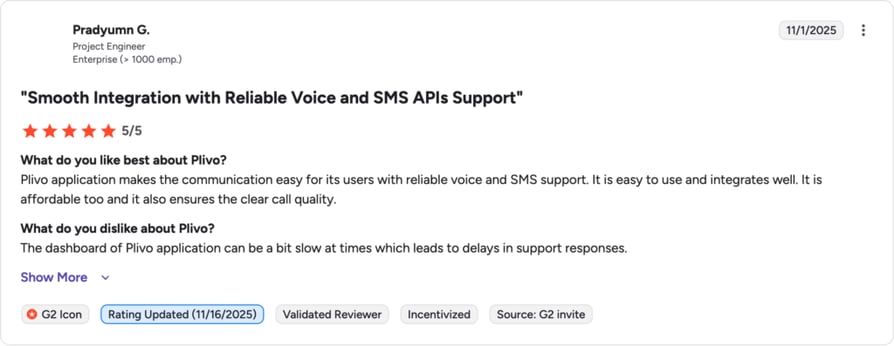
Plivo is a developer-first communications platform in the same category as Telnyx, offering APIs for voice, messaging, and AI agents. It has built a reputation as the budget-friendly option, with a generous list of features bundled in at no extra charge.
Why Plivo is Better than Telnyx
If you've decided you genuinely want raw CPaaS and engineering isn't a barrier, Plivo often comes in cheaper than Telnyx once you account for the add-ons Telnyx meters separately:
- SIP and browser calls from $0.0033/minute
- Voice AI agent at $0.030/minute, lower than building AI orchestration piecemeal
- Answering machine detection, call recording, conferencing, and multilingual TTS all included free
- Pay-as-you-go with $10 in free credits and no lock-in
What is Plivo's Pricing?
- Pay-as-you-go: usage-based, $10 free credits to start
- Voice (SIP/browser): from $0.0033/minute
- AI Voice agent: $0.030/minute
- Enterprise: from $1,000/month
G2 rating: 4.5/5 (747 reviews)
Bottom line: Plivo is the value pick for technical teams: cheaper per unit than Telnyx with more bundled free, though you're still buying infrastructure, not a finished product.
Twilio: Best for Enterprises That Want the Biggest Ecosystem
What is Twilio?
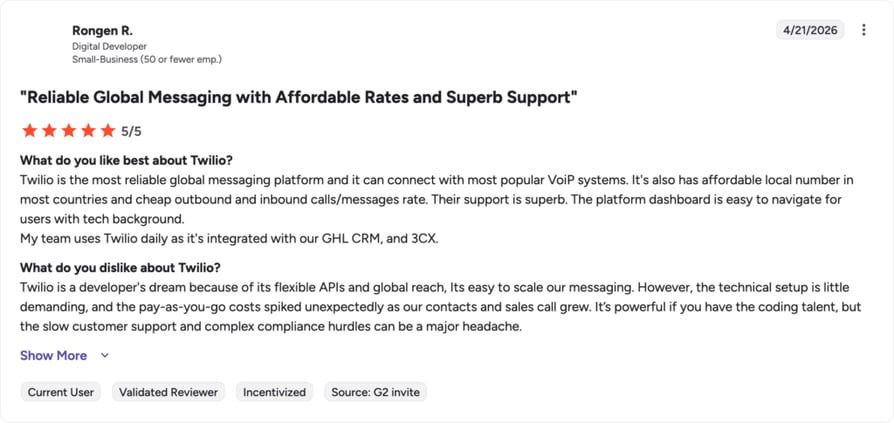
Twilio is the most established name in CPaaS, with the deepest documentation, the largest integration ecosystem, and the broadest global reach. It's the safe institutional choice, and it's priced accordingly.
Why Twilio is Better than Telnyx
Twilio isn't cheaper than Telnyx; in fact it's pricier on most units. But it wins on maturity, support depth, and the sheer size of its developer community and marketplace. For enterprises standardizing on one vendor, that ecosystem can be worth the premium.
- Vast, battle-tested API ecosystem and documentation
- Mature tooling for click-to-call providers and omnichannel
- Strong compliance and global carrier relationships
What is Twilio's Pricing?
- SMS (US long code): $0.0083/part + carrier fee
- Voice: outbound local $0.014/min, inbound $0.0085/min, SIP $0.004/min
- Phone numbers: local $1.15/month, toll-free $2.15/month
- Conversation Relay (AI): $0.07/minute
G2 rating: 4.1/5 (523 reviews)
Bottom line: Twilio is the enterprise default: broader and more proven than Telnyx, but more expensive and just as much a build-it-yourself platform. Want the ecosystem and can absorb the cost? It's the established pick. Want lower rates? Telnyx wins. Want a finished product? Neither fits. Compare the trade-offs in our Twilio alternative breakdown.
What Are Telnyx's Best Features?
Beyond price, Telnyx earns its reputation on a handful of genuinely strong capabilities. Here are the four that stand out, with an honest note on where each falls short.
Elastic SIP Trunking on a Private Global Network
Telnyx routes calls over its own private IP network rather than the public internet, which delivers low latency and high call quality, a real technical advantage for voice-heavy applications.
Where it could be better: You get the network, not the management layer. There's no agent interface or no-code control on top, so realizing that quality still requires building your own system.
Programmable Voice API and Call Control
The Voice API is flexible and granular, letting developers control every step of a call programmatically, ideal for custom IVRs, callback flows, and bespoke routing logic.
Where it could be better: That flexibility is also the cost. Every behavior you want is code you write and maintain, where a managed platform ships it as a toggle.
Conversational AI with STT and TTS Included
Bundling speech-to-text and text-to-speech into the $0.05/minute base rate is a real differentiator, and the model choice (Telnyx-hosted, OpenAI, or Anthropic) gives technical teams useful control.
Where it could be better: LLM tokens are still metered separately, so "included" only goes so far, and tuning a production-grade agent is non-trivial engineering work.
Global Messaging with Volume Discounts
Telnyx's SMS, MMS, and RCS coverage is broad and cheap per part, with steep discounts at high volume, strong for large-scale notification and campaign workloads.
Where it could be better: Carrier fees and message-part billing make the true cost harder to predict, and two-way conversational texting still needs to be built around the API.
What Are the Pros and Cons of Telnyx?
| Pros | Cons |
|---|---|
| Usage-based pricing: no per-seat licenses or minimums | Needs engineers: no native no-code call-center interface |
| Lowest per-unit rates: voice from $0.002/min, SMS from $0.004 | Hard to forecast: usage, carrier fees, and LLM tokens stack up |
| Private global network: low latency, high call quality | No sales tooling: dialers, routing, and CRM sync you build yourself |
| Broad developer API: voice, SMS, AI, numbers, and IoT | Contracts for discounts: best rates need long-term volume commitments |
| AI extras included: STT and standard TTS in Conversational AI | Support friction: number activation and ticket delays (Trustpilot 3.2/5) |
Is Telnyx the Right Choice for Your Team?
Telnyx is an outstanding fit for one specific kind of buyer: the developer or technical enterprise that wants raw, low-cost communication infrastructure and has the engineering resources to build on top of it. If that's you, the per-unit economics are excellent and the flexibility is real.
But "the right fit" depends on what your team actually does all day.
Telnyx makes sense if:
- You have developers who can build calling, routing, and AI workflows on an API
- Your priority is the lowest possible per-unit rate, not predictable monthly billing
- You're comfortable assembling voice, messaging, numbers, and AI as separate metered services
- You can commit to volume contracts to unlock the best discounts
Telnyx is probably not the right fit if:
- You're a sales or support team that needs to start calling immediately
- You want one predictable monthly price instead of a stack of usage meters
- You need dialers, routing, and CRM integrations included rather than built
- Budget predictability and a no-code interface are non-negotiable
Before you decide, weigh the cost reality: headline rates are low, but total cost grows fast once you add number rentals, carrier fees, LLM tokens, premium add-ons, and engineering time. For teams where calling drives revenue and predictability matters, a managed platform like CloudTalk (or another competitor) almost always delivers more value for less total spend than raw infrastructure you operate yourself. The decision is simple: do you want to build a phone system, or use one?
FAQs: Telnyx Pricing
Telnyx pricing is a pure pay-as-you-go utility model with no seats or monthly plans. You pay per minute for voice (from $0.002/minute on the Voice API), per message part for SMS (from $0.004), a monthly rental per phone number (from $1), and per minute for Conversational AI (from $0.05). Discounts are available, but they require committing to monthly volume on a contract.
A Telnyx voice AI agent starts at $0.05/minute for the base Conversational AI orchestration, which includes speech-to-text and standard text-to-speech. On top of that you pay telephony (about $0.002/minute plus the SIP fee) and large language model tokens billed per million tokens, so a realistic all-in figure depends on how much your agent talks. Knowledge-base storage adds $0.006/GiB per month.
Telnyx Cloud Storage (its S3-compatible object storage, used for things like call recordings and AI knowledge bases) starts at $0.006/GiB per month for standard storage, with an embedded, AI-enabled tier at $0.60/GiB per month. Call recording itself is $0.002/minute, and recording storage on SIP Trunking is free.
Telnyx Elastic SIP Trunking is pay-as-you-go: outbound international calls start at $0.005/minute, inbound local calls at $0.0032/minute, and inbound toll-free at $0.015/minute. If you prefer guaranteed capacity, inbound channels run $12/month each for the first 10, scaling down to $8/month above 250 channels. Volume-based contract pricing lowers these rates further.
It depends on your use case. For teams that want calling without building it, CloudTalk is the stronger choice: flat-rate pricing, built-in dialers and analytics, and a no-code setup. For cost-conscious developers who still want raw CPaaS, Plivo is often cheaper with more bundled free. For enterprises wanting the largest ecosystem regardless of price, Twilio leads. Telnyx wins only when you need low-cost raw infrastructure and have engineers to run it.
No. Telnyx has no free plan or flat subscription; you fund a pay-as-you-go balance and pay for actual usage. New accounts can top up and test with small amounts, but there's no permanent free tier and no bundled monthly allowance.
On most units, yes. Telnyx voice and SMS rates generally undercut Twilio (for example, Telnyx SMS from $0.004/part versus Twilio's $0.0083), and Telnyx bundles STT and TTS into its AI base rate. Twilio's advantage is ecosystem maturity and support depth, not price. Neither, however, is a finished phone system; both still require you to build on the API.