Kurzantwort: Was ist der beste KI-Sprachagent für Versicherungen?
CloudTalk ist der beste KI-Sprachagent für Versicherungsteams, die FNOL-Schadensaufnahmen, Verlängerungen von Policen und ausgehende Nachfassaktionen automatisieren, mit nativer bidirektionaler CRM-Synchronisierung und mehrsprachigem 24/7-Support.
Der Sprachagent läuft auf Ihren bestehenden CloudTalk-Nummern und Ihrer Weiterleitung, sodass kein zweites Telefonsystem erforderlich ist. Bleiben Sie außerdem automatisch konform mit SOC 2 Typ II, ISO 27001, DSGVO und HIPAA-konformen Kontrollen.
Die besten KI-Sprachagenten für Versicherungen: Kurzer Vergleich
| Plattform | Ideal für | Preismodell | Compliance | Gesamtbewertung |
|---|---|---|---|---|
| CloudTalk | Agenturen und Versicherer, die ein Telefonsystem plus KI wünschen, nicht zwei Anbieter | Pro-Benutzer-Plan plus veröffentlichtes KI-Add-on | SOC 2 Typ II, ISO 27001, DSGVO, HIPAA-berechtigt | ★★★★★ |
| Sonant AI | Unabhängige P&C-Agenturen, die EZLynx oder Applied Epic nutzen | Nur auf Anfrage | SOC 2 Typ 2, DSGVO | ★★★★☆ |
| Synthflow | No-Code-Teams, die ihre eigene Versicherungslogik aufbauen möchten | €375/Monat Einstieg, Gebühren pro Minute bei Überschreitung | SOC 2, HIPAA, PCI DSS, DSGVO | ★★★★☆ |
| Retell AI | Entwicklungsteams, die den Agenten selbst bauen möchten | €0.07/min Pay-as-you-go | SOC 2 Typ I und II, HIPAA, DSGVO | ★★★★☆ |
| Ema | Große Versicherer mit einem bestehenden Compliance-Überprüfungsprozess | Nur auf Anfrage | SOC 2, ISO 27001, HIPAA, NIST, DSGVO | ★★★☆☆ |
Laut Precedence Research wird künstliche Intelligenz die Betriebskosten von Versicherungen um bis zu 40 % senken, und KI-Sprachagenten für Versicherungen sind der Bereich, in dem sich ein Großteil dieser Einsparungen zuerst bemerkbar macht.
Die besten KI-Sprachagenten für Versicherungen senken die Kosten weiter und erhöhen die Effizienz; sie beantworten und tätigen echte Anrufe, sammeln Schadensdetails, buchen Verlängerungen und protokollieren alles in Ihrem CRM, ohne dass ein Mitarbeiter das Telefon berühren muss.
Wir haben die 10 besten KI-Sprachagenten für Versicherungen im Jahr 2026 getestet und bewertet, damit Sie sie anhand realer Versicherungsworkflows evaluieren, den richtigen bereitstellen und die Automatisierung von Schadenfällen und Verlängerungen schneller starten können.
Die besten KI-Sprachagenten für Versicherungen: TL;DR
Der beste KI-Sprachagent für die meisten Versicherungsteams ist CloudTalk, da er autonome Sprache, native CRM-Synchronisierung und 24/7-Support in mehreren Sprachen in einer telefonie-nativen Plattform vereint.
Hier ist die vollständige Rangliste und wofür jedes Tool am besten geeignet ist:
- 01CloudTalk: Bester KI-Sprachagent für Versicherungsteams, der die Aufnahme von FNOL-Ansprüchen, die Verlängerung von Policen und ausgehende Nachfassaktionen mit nativer CRM-Synchronisierung und 24/7 mehrsprachiger Abdeckung automatisiert.
- 02Sonant AI: Bester KI-Empfangsagent für P&C-Agenturen, die eine eingehende Angebotsaufnahme benötigen, die tief in AMS-Plattformen wie EZLynx und Applied Epic synchronisiert wird.
- 03Zowie: Am besten für eine deterministische, halluzinationsfreie Schadenregulierung bei großen Versicherern, die jede Entscheidung auditierbar benötigen.
- 04Ema: Am besten für die End-to-End-Back-Office-Automatisierung, die die Bearbeitung von Schaden- und Zeichnungsakten vom ersten Anruf bis zur Systemaktualisierung ermöglicht.
- 05Dialora AI: Am besten für eine schnelle, AMS-bereite Bereitstellung bei kleinen US-Agenturen, die Applied Epic oder AMS360 nutzen und innerhalb weniger Tage live gehen wollen.
- 06Synthflow: Bester No-Code-Builder für kleine Agenturen und Makler, die FNOL- und After-Hours-Flows ohne technischen Aufwand erstellen möchten.
- 07UnleashX AI: Am besten für proaktive Policenverlängerungen und Kundenbindung, mit Outbound-Rückgewinnungskampagnen und Zahlungserinnerungen.
- 08Telnyx: Am besten für hochvolumige, latenzarme Schadeninfrastruktur bei Katastrophen-Anrufspitzen (CAT) bei nationalen Versicherern.
- 09Retell AI: Am besten für entwicklerorientierte Teams, die Echtzeit-Sprachfunktionen mit Code-Steuerung in Versicherungsworkflows integrieren möchten.
- 10Vapi: Am besten für technische Teams, die einen modellunabhängigen, bindungsfreien Stack für die Underwriting- und Schadenautomatisierung wünschen.

Erfahren Sie, wie Versicherungsteams mit dem KI-Sprachagenten von CloudTalk einen 17-fachen ROI erzielen
Was ist ein KI-Sprachagent für Versicherungen?
Ein KI-Sprachagent für Versicherungen ist eine Software, die ein echtes Telefongespräch mit einem Versicherungsnehmer führt, dessen Bedürfnisse versteht und die Aufgabe ohne einen menschlichen Agenten am Telefon erledigt.
Er kann um 2 Uhr morgens einen Schadensanruf entgegennehmen, die Details eines Bagatellschadens erfassen und einen Fall in Ihrem System eröffnen, bevor ein Gutachter ihn überhaupt in die Hand nimmt. Außerdem ist er nie schlecht gelaunt ... es sei denn, Sie programmieren ihn so.
Die Arten von KI-Sprachagenten können in zwei Kategorien unterteilt werden:
- Ein KI-Empfangsagent bearbeitet eingehende Anrufe: Er beantwortet Fragen zu Policen, erfasst Angebotsdetails, leitet Anrufer an das richtige Team weiter und deckt Überlauf- und Feiertagszeiten ab.
- Ein KI-Spezialist geht weiter und löst Aufgaben Ende-zu-Ende, führt FNOL-Aufnahmen, ausgehende Verlängerungskampagnen und Revenue-Cycle-Management (RCM)-Nachfassaktionen mit mehrstufiger Logik durch.
Diese Agenten halten sich in der Regel an strenge Compliance-Vorschriften, da Versicherungsanrufe sensible Daten enthalten. Daher unterstützen diese Agenten die Anrufaufzeichnung, Audit-Trails, Verschlüsselung und regionale Vorschriften wie DSGVO und HIPAA, wo anwendbar, einschließlich Business Associate Agreements für Gesundheitsdaten.
Für ein Versicherungsteam ist der praktische Nutzen eine Abdeckung, die mit dem Anrufvolumen statt mit der Mitarbeiterzahl skaliert (sorry, Jobsuchende), und sauberere Daten, da jedes Gespräch automatisch in den Datensatz zurückgeschrieben wird.
Wie wir die besten KI-Sprachagenten für Versicherungen bewertet haben
Wir haben über 30 KI-Sprach- und Konversationsplattformen, die für Versicherungsteams vermarktet werden, überprüft und die engere Auswahl dann durch versicherungsspezifische Workflow-Szenarien geführt: einen FNOL-Aufnahmeanruf, eine Kampagne zur Verlängerung von Policen, eine Angebotsanfrage außerhalb der Geschäftszeiten und eine warme Weiterleitung an einen lizenzierten Agenten.
Unsere Quellen umfassten verifizierte Kundenbewertungen auf G2, Capterra und TrustRadius, Community-Diskussionen in Reddit- und InsurTech-Foren sowie die eigene Dokumentation der jeweiligen Anbieter. Jede Plattform wurde anhand der sechs unten genannten Kriterien bewertet.
Gesprächsqualität und Genauigkeit der Versicherungsterminologie
Klingt der Agent unter Stress menschlich, und versteht er Begriffe wie Schaden, Deckung, Selbstbeteiligung, Zusatzvereinbarung und Reiter gut genug, um Sackgassen zu vermeiden? Wir haben die Echtzeit-Reaktionsfähigkeit und die korrekte Handhabung des Versicherungsvokabulars höher bewertet als generischen Smalltalk.
Compliance und Sicherheitslage
Die Versicherungsbranche ist eine der am stärksten regulierten Branchen überhaupt. Wir suchten nach Anrufaufzeichnung mit Zustimmung, Audit-Trails, Verschlüsselung und Unterstützung für DSGVO und HIPAA, wo der Anwendungsfall dies erfordert, einschließlich Business Associate Agreements für Gesundheitsdaten.
Tiefe der CRM- und AMS-Integration
Ein Agent ist nur so nützlich wie die Daten, die er lesen und schreiben kann. Wir haben die native Integration mit HubSpot, Salesforce und den Agenturverwaltungssystemen überprüft, die in Versicherungsbüros zum Einsatz kommen, darunter Applied Epic, EZLynx und AMS360, und ob die Synchronisierung nativ oder über Zapier angebunden ist.
Fähigkeit zur Schaden- und Workflow-Automatisierung
Kann die Plattform einen vollständigen FNOL-Workflow, eine Verlängerungslogik und ausgehende Anrufe durchführen, oder beschränkt sie sich auf die Beantwortung von FAQs? Wir haben die End-to-End-Aufgabenerledigung höher bewertet als die einfache Weiterleitung.
Implementierungsgeschwindigkeit
Versicherungsteams benötigen Ergebnisse in Wochen, nicht in Quartalen. Wir haben Plug-and-Play-Tools, die innerhalb von Tagen live gehen, von Enterprise-Lösungen getrennt, deren Integration Monate dauert.
Preistransparenz
Veröffentlichte Preise schneiden besser ab als „Vertrieb kontaktieren“. Wir bevorzugten Plattformen, die es einem Käufer ermöglichen, die tatsächlichen Kosten, einschließlich der nutzungsabhängigen Gebühren pro Minute und Überschreitungen, vor der Buchung eines Anrufs zu verstehen.
Warum Sie unseren Bewertungen vertrauen können
Seit fast einem Jahrzehnt helfen wir über 30.000 Fachleuten dabei, intelligentere Business-Kommunikationstools zu finden und zu implementieren. Wir haben über 200 Softwaretools branchenübergreifend überprüft, über 5.500 verifizierte Kundenbewertungen von Plattformen wie G2, Capterra, Trustpilot und TrustRadius analysiert und Erkenntnisse aus echten Benutzerdiskussionen auf Reddit und Quora gewonnen.
Alleine im letzten Jahr haben wir über 1.000 Artikel veröffentlicht, die jeweils von Menschen für Menschen geschrieben wurden. Erfahren Sie, wie wir unsere Content-Integrität und unsere Software-Review-Methodik wahren.
KI-Sprachagenten für Versicherungen: Tool-Bewertungstabelle
Um jede Plattform zu bewerten, kombinierten wir verifizierte Kundenbewertungen von G2, Capterra und Trustpilot mit der veröffentlichten Dokumentation jedes Anbieters zu Compliance-Zertifizierungen, Integrationen und Preisen und bewerteten dann jedes Tool von 1 bis 5 anhand der sechs oben genannten versicherungsspezifischen Kriterien.
Bewertungsseiten unterteilen die Bewertungen nicht nach Versicherungsworkflows, daher spiegeln die Spalten „Schaden“ und „CRM/AMS“ die dokumentierten Fähigkeiten wider und nicht die Bewertungen der Rezensenten, gewichtet mit dem Feedback zur Gesprächsqualität und den KI-Anrufanalysen jeder Plattform. Wo eine Plattform zu wenige öffentliche Bewertungen hat, um ein Signal abzuleiten, haben wir konservativ bewertet und dies in der unten stehenden Beschreibung vermerkt.
Bewertungstabelle: Die besten KI-Sprachagenten für Versicherungen
| Plattform | Gesprächsqualität | Compliance | CRM/AMS-Integration | Schadensautomatisierung | Implementierungsgeschwindigkeit | Preistransparenz | Gesamt (/30) |
|---|---|---|---|---|---|---|---|
| CloudTalk | 5 | 5 | 4 | 4 | 5 | 5 | 28 |
| Sonant AI | 4 | 4 | 5 | 5 | 4 | 2 | 24 |
| Zowie | 4 | 4 | 3 | 3 | 3 | 2 | 19 |
| Ema | 3 | 5 | 4 | 4 | 3 | 1 | 20 |
| Dialora AI | 3 | 2 | 3 | 2 | 5 | 4 | 19 |
| Synthflow | 4 | 5 | 4 | 3 | 5 | 3 | 24 |
| UnleashX AI | 3 | 3 | 3 | 4 | 4 | 1 | 18 |
| Telnyx | 4 | 5 | 2 | 1 | 2 | 4 | 18 |
| Retell AI | 5 | 4 | 3 | 2 | 3 | 4 | 21 |
| Vapi | 3 | 3 | 2 | 1 | 2 | 2 | 13 |
Kurze Antworten: Was Versicherungsteams über KI-Sprachagenten fragen
Was sind die besten KI-Sprachagenten für Versicherungsunternehmen in 2026?
CloudTalk steht für die meisten Versicherungsteams an erster Stelle, da es autonome Sprachfunktionen mit 24/7-Abdeckung und nativer CRM-Synchronisierung in einer Plattform vereint, sodass FNOL-Anrufe und Verlängerungskampagnen direkt im Datensatz protokolliert werden. Sonant AI ist die beste Wahl für den AMS-nativen eingehenden Empfang, und Zowie eignet sich für große Versicherer, die eine deterministische, auditierbare Lösung benötigen.
Welche KI-Plattformen für Versicherungsagenten bieten die besten Integrationsoptionen?
CloudTalk bietet 100+ native Integrationen, darunter HubSpot, Salesforce, Zendesk und Pipedrive, mit automatischen Anrufzusammenfassungen, die im Datensatz vermerkt werden. Sonant AI bietet tiefergehende Integrationen für Agenturverwaltungssysteme wie Applied Epic und EZLynx. Fehlen einer Plattform native Konnektoren, greift sie normalerweise auf Zapier zurück, was Latenz und Einrichtungsaufwand mit sich bringt.
Welcher KI-Sprachagent kann IVR ersetzen und Versicherungsanfragen an Live-Agenten weiterleiten, während er diese in Salesforce protokolliert?
Der KI-Rezeptionist von CloudTalk ersetzt das Phone-Tree-IVR durch konversationsbasiertes Call Routing: Er versteht, warum der Anrufer anruft, übergibt komplexe Fälle mit vollständigem Kontext an einen lizenzierten Agenten und synchronisiert den Anruf automatisch mit Salesforce. Teams rüsten in der Regel ein bestehendes IVR auf den KI-Rezeptionisten um, anstatt das Routing von Grund auf neu aufzubauen.
Was sind die besten KI-Tools zur Reduzierung von Wartezeiten im Versicherungsbereich und zur Automatisierung von Nachfassaktionen?
Der ausgehende KI-Spezialist von CloudTalk führt Verlängerungs- und Nachfasskampagnen in großem Umfang durch, während der KI-Rezeptionist eingehende Überläufe abfängt, sodass die Warteschlangen auf beiden Seiten schrumpfen. UnleashX AI konzentriert sich auf die Kundenbindung bei Verlängerungen, und Telnyx eignet sich für Anbieter, die eine latenzarme Infrastruktur für hohe Anrufvolumen benötigen.
Sie wissen nicht, welcher KI-Sprachagent zu Ihren Versicherungsworkflows passt?
Beste KI-Sprachagenten für Versicherungen: Vergleichstabelle
Die folgende Tabelle vergleicht alle zehn Plattformen auf einen Blick; Hintergrundinformationen zu den Vorteilen von KI-Sprachagenten für Vertrieb und Support finden Sie in unserer Einführung.
Was sind die besten KI-Sprachagenten für Versicherungen?
| Anbieter | Hauptfunktionen | Ideal für | Startpreis | G2 Bewertung |
|---|---|---|---|---|
| CloudTalk | Autonome Sprachfunktionen (CeTe), Outbound-Dialer, 100+ Integrationen, über 60 Sprachen, DSGVO/HIPAA | FNOL-Ansprüche, Verlängerungen, CRM-Synchronisierung | KI-Rezeptionist ab €0/Monat (50 Freiminuten) | 4.4/5 |
| Sonant AI | Inbound-Empfang, AMS-Angebotserfassung, warme Weiterleitungen | Agenturempfang mit tiefer AMS-Synchronisierung | Kundenspezifisch | 5,0/5 (2 Bewertungen) |
| Zowie | Deterministische Entscheidungsmaschine, Omnichannel, KI-Supervisor-Protokolle | Prüfbare Schadensregulierung im großen Maßstab | Kundenspezifisch | 4,7/5 (73 Bewertungen) |
| Ema | Generative Workflow-Engine, Modellwechsel, PII-Vertrauensebene | End-to-End-Backoffice-Automatisierung | Kundenspezifisch | Keine verifizierten G2-Bewertungen |
| Dialora AI | AMS-bereite Vorlagen, sofortige ID&V, intelligente Terminplanung | Schnelle Einrichtung für Applied Epic / AMS360 | €297/Monat | Keine verifizierten G2-Bewertungen |
| Synthflow | No-Code-Builder, Echtzeit Inbound/Outbound, GoHighLevel + Zapier | No-Code-Workflows für kleine Agenturen | €375/Monat, 2.000 Min. | 4,5/5 (999 Bewertungen) |
| UnleashX AI | Erinnerungen für Verlängerungen, Rückgewinnungs-Workflows, Sentiment-Routing | Proaktive Verlängerungen und Kundenbindung | Nutzungsbasiert | Keine verifizierten G2-Bewertungen |
| Telnyx | Eigenes privates Netzwerk, Latenz unter 200ms, programmierbare Sprachfunktionen | Infrastruktur für hohes Volumen und geringe Latenz | Nutzungsbasiert | 4,7/5 (601 Bewertungen) |
| Retell AI | Echtzeit-Streaming-API, emotionsadaptiv, kundenspezifisches Prompting | Entwicklerzentrierte Echtzeit-Sprachfunktion | Ab €0,07/Min. im Pay-as-you-go-Modell | 4,8/5 (über 2.200 Bewertungen) |
| Vapi | Modellagnostische Orchestrierung, Anrufsteuerung, Webhooks | Kundenspezifische Stacks ohne Anbieterbindung | Ab €500/Monat | 4,2/5 (3 Bewertungen) |
Die 10 besten KI-Sprachagenten für Versicherungen im Jahr 2026
Beste KI-Sprachagenten für kleine Versicherungsagenturen und unabhängige Makler
Kleine Agenturen und unabhängige Makler haben kein Implementierungsteam, daher sind die am besten geeigneten Tools diejenigen, die schnell einsatzbereit sind und sich mit den bereits verwendeten Systemen verbinden lassen. CloudTalk ist für diese Gruppe geeignet, da der KI-Rezeptionist für Versicherungsagenturen in wenigen Minuten eingerichtet ist, 50 kostenlose Minuten zum Testen auf einer Live-Nummer bietet und sofort mit über 100 CRMs synchronisiert.
Dialora AI ist eine starke Option für US-Agenturen, die auf Applied Epic oder AMS360 standardisiert sind, dank vorgefertigter Erfassungsvorlagen. Synthflow eignet sich für Makler, die ihre eigenen Workflows mit einem No-Code-Editor und einem niedrigen monatlichen Einstiegspreis erstellen möchten. Alle drei legen Wert auf schnelle Bereitstellung und erschwinglichen Einstieg gegenüber umfassenden Unternehmensfunktionen.
1. CloudTalk: Bester KI-Sprachagent für Versicherungsverlängerungen, Schadensfälle und Nachverfolgungen
Was ist CloudTalk?
CloudTalk ist die globale KI-Business-Telefonsoftware, die für das Wachstum von KMU entwickelt wurde, und sein KI-Sprachagent integriert autonome Inbound- und Outbound-Anrufe in dieselbe Telefonieschicht, die Ihre menschlichen Mitarbeiter bereits nutzen.
Für Versicherungen bedeutet das, dass der Agent, der einen FNOL-Anruf entgegennimmt, mit denselben Nummern, Routing-, Aufzeichnungs- und CRM-Synchronisierungsfunktionen arbeitet wie das lizenzierte Team, an das er weiterleitet. Es wurde für wachsende Agenturen und Versicherer entwickelt, die mehr Versicherungsnehmer erreichen und Schadensfälle schneller abwickeln möchten, ohne zusätzliches Personal einstellen zu müssen.
Kategoriebewertungen für CloudTalk
| Kriterium | Bewertung (/5) |
|---|---|
| Gesprächsqualität | 5 |
| Compliance | 5 |
| CRM-/AMS-Integration | 4 |
| Schadensautomatisierung | 4 |
| Implementierungsgeschwindigkeit | 5 |
| Preisklarheit | 5 |
Hauptmerkmale von CloudTalk KI für Versicherungen
Der Versicherungs-Stack von CloudTalk konzentriert sich auf drei Funktionen, die direkt auf Schadensfälle, Verlängerungen und Integrationsaufgaben abzielen.
CeTe AI Voice Agent
CeTe ist der vollständig autonome Konversationsagent von CloudTalk für Telefonanrufe. Er führt eine frei fließende, wechselseitige Konversation, anstatt einem starren IVR-Baum zu folgen: Er versteht Absichten, stellt Nachfragen, ruft Antworten aus einer Wissensdatenbank ab und führt während des Anrufs tatsächliche Aktionen aus, wie das Erstellen eines CRM-Eintrags oder das Buchen eines Folgetermins.
Für Versicherungen übernimmt er die 24/7 FNOL-Erfassung und die Kontaktaufnahme für Verlängerungen, unterstützt über 60 Sprachen und Akzente mit einer Latenz von unter 800ms und erstellt Aufzeichnungen sowie Zusammenfassungen für eine konforme Protokollierung.















Outbound-Dialer (Parallel und Power)
CloudTalks KI-Sales-Dialer arbeitet mit dem Sprachagenten zusammen, um Verlängerungs- und Follow-up-Kampagnen zu skalieren. Parallel Dialing ruft mehrere Nummern gleichzeitig pro Agent an und verbindet mit der ersten Live-Antwort, wobei die KI-Mailboxerkennung sicherstellt, dass die Mitarbeiter nur bei menschlichen Anrufen abheben.
Da tote Nummern und Voicemails nie einen Mitarbeiter erreichen, liegen die täglichen Kontaktraten weit über denen der manuellen Anwahl, wodurch eine Verlängerungsliste von einer Anrufwarteschlange zu abgeschlossenen Gesprächen übergeht. Der Power Dialer ist im Expert-Plan enthalten und auf niedrigeren Plänen als Add-on verfügbar.
Tiefe CRM- und AMS-Integration
CloudTalk bietet über 100 CRM- und AMS-Integrationen, darunter Salesforce, HubSpot, Pipedrive und Zendesk, mit bidirektionaler Synchronisierung von Kontakten, Anrufen, Aufzeichnungen und KI-Zusammenfassungen. Jeder von CeTe bearbeitete Anruf wird automatisch im Datensatz hinterlegt, sodass ein dem Agenten gemeldeter und später an einen Menschen übertragener Schadensfall als ein durchgängiger Datensatz mit Notizen und Aufzeichnung erscheint.
Wenn ein von Ihnen verwendetes System nicht durch eine native Integration abgedeckt ist, können Sie Anrufdaten, Aufzeichnungen, Transkripte und KI-Zusammenfassungen mithilfe der öffentlichen API und Webhooks von CloudTalk in Ihre eigene Datenbank oder Ihr Data Warehouse verschieben.
Technische und Leistungsmetriken
- Latenz: Antwortzeit von unter 800ms bei CeTe Voice
- Sprachen: über 60 Sprachen und Akzente
- Abdeckung: lokale Präsenz in über 160 Ländern
- Compliance: SOC 2 Typ 1 und Typ 2, DSGVO, HIPAA (BAA-Unterstützung, PHI-Verarbeitung), Anrufaufzeichnung für Versicherungen mit Zustimmung
- Einrichtung: No-Code-Agent in weniger als 10 Minuten live
Anwendungsfälle von CloudTalk für Versicherungen
- FNOL und Schadensfallerfassung: 24/7 Inbound-Erfassung, die den Schadensfall protokolliert und an einen Sachbearbeiter weiterleitet
- Policenverlängerungen und Kundenbindung: Outbound-Kampagnen, die Versicherungsnehmer erreichen, bevor der Versicherungsschutz abläuft
- Nachverfolgung und Lead-Qualifizierung: sofortige Rückrufe bei neuen Angebotsanfragen
- Außerhalb der Geschäftszeiten und Overflow: Inbound-Empfang bei geschlossenem Büro
- Krankenversicherungs-Support: HIPAA-konforme mehrsprachige Erfassung für patientenbezogene Leitungen
Wichtige Integrationen für CloudTalk
Native bidirektionale Synchronisierung mit Salesforce, HubSpot, Pipedrive, Zoho und Zendesk, plus über 100 native Konnektoren insgesamt, eine öffentliche API, Webhooks und ein Zapier-Konnektor, der rund 5.000 nachgeschaltete Apps erreicht.
KI-Anrufzusammenfassungen, Tags und Transkripte werden direkt in HubSpot-, Salesforce- und Pipedrive-Datensätze exportiert. CloudTalk betreibt derzeit keinen nativen Model Context Protocol (MCP)-Server, aber da MCP auf Standard-APIs läuft, können Teams den KI-Sprachagenten stattdessen über die öffentliche API und Webhooks verbinden.
Was sind die Vor- und Nachteile von CloudTalk?
| Vorteile | Nachteile |
|---|---|
| Sprache, Outbound-Dialer und CRM-Synchronisierung in einer nativen Plattform | Native Konnektoren sind CRM-zentriert, mit weniger Tiefe bei versicherungsspezifischen AMS-Plattformen wie Applied Epic und EZLynx |
| Über 60 Sprachen und 24/7-Abdeckung für mehrsprachige Versicherungsnehmer | „AI Voice Agent“ ist ein nutzungsbasiertes Add-on, nicht in einem Abonnement enthalten |
| No-Code-Agent in unter 10 Minuten live mit 50 Gratisminuten zum Testen | Echtzeit-Transkription ist eine aktuelle Lücke (nur nach dem Anruf) |
Wann Sie CloudTalk nutzen sollten
- Sie bearbeiten hohe Mengen an eingehenden und ausgehenden Anrufen und benötigen eine skalierbare Abdeckung ohne Neueinstellungen.
- Sie möchten Sprach- und CRM-Protokollierung auf einer nativen Plattform, anstatt einen Bot an ein separates Telefonsystem anzubinden.
- Sie betreuen Versicherungsnehmer in mehreren Sprachen und benötigen über 60 Sprachen für denselben Agenten.
- Sie benötigen sowohl einen eingehenden KI-Rezeptionisten als auch einen ausgehenden KI-Spezialisten für Verlängerungen und Nachfassaktionen.
- Sie möchten den Fall schnell beweisen: ein Einstiegspreis von €0, 50 Gratisminuten und ein No-Code-Setup, das Sie diese Woche validieren können.
Was kostet CloudTalk?
CloudTalks „AI Voice Agent“ ist ein Add-on, das auf ein CloudTalk-Abonnement aufsetzt und nach Nutzung statt pro Arbeitsplatz abgerechnet wird.
- KI-Rezeptionist: €0/Monat mit 50 Gratisminuten im ersten Monat, danach Staffeln zu €99 (200 Minuten), €199 (500 Minuten) und €299 (1.000 Minuten). Handhabt eingehende Anrufe rund um die Uhr, konversationelles Routing und Nachrichtenaufnahme.
- KI-Spezialist: ab €349/Monat für 1.000 Minuten (Sales kontaktieren), steigend auf €749 für 2.500 und €1.249 für 5.000. Bietet End-to-End-Lösung, Identitätsauthentifizierung, Echtzeit-Workflows und Post-Call-Analysen.
- Benutzerdefiniert: bis zu €0.10/Minute für hohes Volumen (10.000+ Minuten, Sales kontaktieren), mit Mengenrabatten und maßgeschneiderter Workflow-Abbildung.
Die zugrunde liegenden Telefonie-Abonnements beginnen bei €25/Benutzer/Monat (Starter), €29/Benutzer/Monat (Essential) und €49/Benutzer/Monat (Expert). Da der KI-Rezeptionist bei €0 mit Gratisminuten beginnt, ist dies der risikoärmste Weg, Sprach-KI auf einer echten Versicherungsleitung zu testen. Vergleichen Sie jede Stufe auf der CloudTalk-Preisseite.
Was sagen Kunden über CloudTalk?
G2-Bewertung: 4.4/5 (1,702+ Bewertungen).
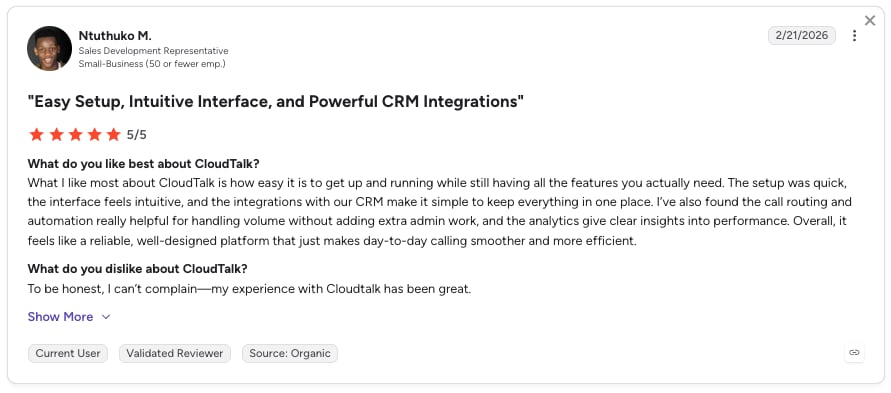
Bewerter heben durchweg die tägliche Zuverlässigkeit für ausgehende Anrufe und Supportgespräche hervor sowie die schnelle Klonung und Einführung neuer Agenten.
„Was mir an CloudTalk am besten gefällt, ist, dass wir es täglich sowohl für ausgehende Kaltakquise als auch für den Kundensupport nutzen. Diese regelmäßige Nutzung unterstreicht seine Zuverlässigkeit und Effizienz in unserem Workflow. Es verwaltet unsere Kommunikationsinteraktionen nahtlos und erleichtert die Überwachung, Aufzeichnung und Analyse von Anrufen. Es stellt sicher, dass wir erstklassigen Kundensupport bieten und unsere Kaltakquise-Bemühungen optimieren, während die Erfahrung intuitiv und benutzerfreundlich bleibt.“
„Wir kopieren einfach die Agenten, aktualisieren die Skripte und sind live. Es ist nicht nötig, ein komplett neues Team von Grund auf neu einzustellen und zu schulen.“
„Inhaber von Circle Gym“

2. Sonant AI: Bester KI-Rezeptionist für Sach- und Unfallversicherungsagenturen mit tiefer AMS-Synchronisierung
Was ist Sonant AI?
Sonant AI ist ein KI-Rezeptionist für Versicherungsagenturen, der speziell für Sach- und Unfallversicherungsagenturen, Makler und Distributoren entwickelt wurde. Er fungiert als digitaler Empfang rund um die Uhr, der routinemäßige eingehende Anrufe in Produktionszeit umwandelt, indem er die Angebotserfassung, Serviceanfragen und Terminplanung innerhalb Ihres bestehenden Workflows abwickelt, sodass nach Geschäftsschluss keine Leads verloren gehen.
Kategoriebewertungen für Sonant AI
| Kriterium | Bewertung (/5) |
|---|---|
| „Gesprächsqualität“ | 4 |
| „Compliance“ | 4 |
| „CRM/AMS-Integration“ | 5 |
| „Schadenautomatisierung“ | 5 |
| „Bereitstellungsgeschwindigkeit“ | 4 |
| „Preistransparenz“ | 2 |
Hauptmerkmale von Sonant AI
- „24/7 eingehende Anrufannahme ohne Wartezeiten, auch außerhalb der Geschäftszeiten“
- „Automatisierte Angebotserfassung, direkt in Ihr AMS oder Ihren Rater übertragen“
- „Intelligente Anrufweiterleitungen, die komplexe Anfragen mit dem richtigen Menschen oder Dritten verbinden“
- „Mehrsprachige Konversationen für einen breiteren Kundenstamm“
- „Post-Call-Datenextraktion, die Anrufe zusammenfasst und interne Aufzeichnungen aktualisiert“
Technische und Leistungsmetriken
- Fokus: eingehender Empfang und Angebotserfassung
- Integrationen: tiefe AMS-Synchronisierung mit EZLynx, Applied und HawkSoft
- Abdeckung: mehrsprachig
Anwendungsfälle für Sonant AI in der Versicherungsbranche
Eingehender Empfang für Sach- und Unfallversicherungsagenturen, Lead-Erfassung außerhalb der Geschäftszeiten, Angebotserfassung in AMS und warme Weiterleitungen an lizenzierte Produzenten.
Wichtige Integrationen für Sonant AI
AMS-Plattformen wie EZLynx, Applied und HawkSoft. Der Integrationsstack ist schmaler als bei Allzweckplattformen, und einige Funktionen (Voicemail-Drop) sind an Dialpad Sell gebunden.
Was sind die Vor- und Nachteile von Sonant AI?
| „Vorteile“ | „Nachteile“ |
|---|---|
| „Speziell für den Empfang von Sach- und Unfallversicherungen entwickelt“ | „Auf eingehende Anrufe fokussiert; schwach bei ausgehenden Anrufen und Kaltakquise-Anrufen“ |
| „Tiefe AMS-Integration (EZLynx, Applied, HawkSoft)“ | „Eingeschränkter Gesamtintegrationsstack“ |
| „Starke Lead-Erfassung außerhalb der Geschäftszeiten“ | „Kundenspezifische Preise ohne öffentliche Rate“ |
Wann Sie Sonant AI nutzen sollten
- Sie führen eine Sach- und Unfallversicherungsagentur und der Großteil Ihres Anrufvolumens besteht aus eingehenden Angebots- und Serviceanfragen.
- Ihre Agentur arbeitet mit EZLynx, Applied oder HawkSoft und Sie möchten Angebotsdaten direkt in das AMS schreiben.
- Sie verlieren Leads nach Geschäftsschluss an die Voicemail und möchten einen Empfang, der nicht schließt.
- Sie möchten, dass komplexe Anrufe an einen lizenzierten Produzenten warm weitergeleitet werden, anstatt sie von der KI lösen zu lassen.
Was kostet Sonant AI?
Sonant AI verwendet kundenspezifische Preise, die nicht öffentlich aufgeführt sind.
Was sagen Kunden über Sonant AI?
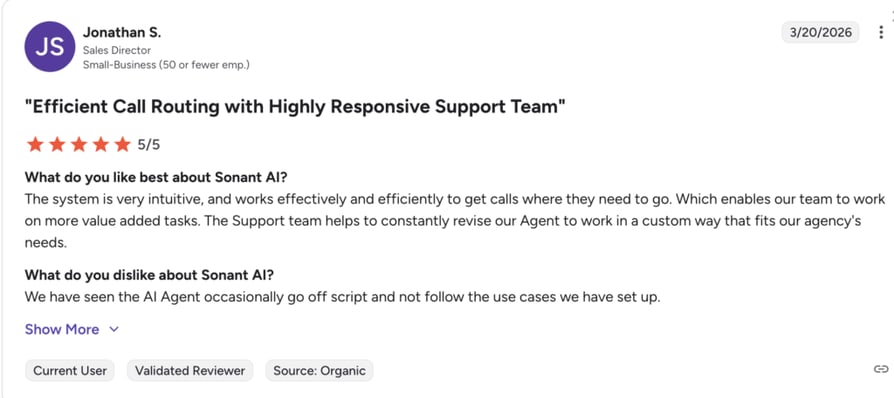
Bewerter heben die zuverlässige Erfassung außerhalb der Geschäftszeiten und die enge AMS-Synchronisierung hervor; die wiederkehrende Einschränkung ist der auf eingehende Anrufe beschränkte Umfang.
G2-Bewertung: 5.0/5 (5 Bewertungen) · Lesen Sie Sonant AI-Bewertungen auf G2
Lesen Sie die vollständige Bewertung
CloudTalk vs. Sonant AI
„CloudTalk vs. Sonant AI“
| Dimension | CloudTalk | Sonant AI |
|---|---|---|
| „Telefonie-Infrastruktur“ | „Native Cloud-Telefonie, 160+ Länder“ | „Empfangsschicht für eingehende Anrufe“ |
| „FNOL / Schadenautomatisierung“ | „Inbound + Outbound End-to-End (CeTe)“ | „Eingehende Erfassung, warme Weiterleitung“ |
| „CRM / AMS-Integration“ | „100+ CRMs“}]} ``` | Umfassendes AMS (EZLynx, Applied Epic) |
| Verlängerungs- / Outbound-Kampagnen | Outbound KI-Spezialist + Dialer | Begrenzter Outbound |
| Mehrsprachiger Support | Über 60 Sprachen | Mehrsprachig |
| Ideal für (Versicherungen) | Wachsende Agenturen mit Inbound- und Outbound-Skalierung | Unabhängiger Sach- und Unfallversicherungs-Empfang |
Wann Sonant AI nicht genutzt werden sollte
- Sie benötigen umfangreiche Outbound-Kampagnen zur Vertragsverlängerung oder Kaltakquise.
- Sie verwenden CRMs außerhalb des AMS-Fokus und benötigen 100+ native Konnektoren.
- Sie wünschen sich eine veröffentlichte, vorhersehbare Preisgestaltung.
- Sie benötigen eine einzige Plattform für Inbound-Empfang und Outbound-Vertrieb.
3. Zowie: Am besten für deterministische, halluzinationsfreie Schadenregulierung
Was ist Zowie?
Zowie wurde für Versicherungsunternehmen entwickelt, die eine überprüfbare Entscheidungsgenauigkeit benötigen. Während viele Agenten auf probabilistische Modelle angewiesen sind, die Vertragsdetails erfinden können, verwendet Zowie eine proprietäre Entscheidungs-Engine, eine deterministische Schicht, die die KI zwingt, Ihre vordefinierten Geschäftsregeln durch komplexe Arbeitsabläufe von der Identitätsprüfung bis zur Abwicklung zu befolgen.
Kategoriebewertungen für Zowie
| Kriterium | Bewertung (/5) |
|---|---|
| Gesprächsqualität | 4 |
| Compliance | 4 |
| CRM/AMS-Integration | 3 |
| Schadenautomatisierung | 3 |
| Bereitstellungsgeschwindigkeit | 3 |
| Preistransparenz | 2 |
Hauptmerkmale von Zowie
- Deterministische Entscheidungs-Engine, die Konversation von der Ausführung der Geschäftslogik trennt
- Hohe autonome Lösungsrate (ein oft zitierter Aviva-Fall meldete bis zu 90 % vollständige Regulierung)
- Schneller Weg zu etwa 70 % Automatisierung in etwa 7 Tagen
- KI-Supervisor mit einem Begründungsprotokoll für jede automatisierte Entscheidung, nützlich für die Compliance
- Omnichannel-Orchestrierung über Sprache, Chat und E-Mail
Technik und Leistungsmetriken
- Modellansatz: regelbasierte deterministische Engine (keine Halluzinationen)
- Bereitstellung: eine vollständige Unternehmensintegration dauert typischerweise etwa 3 Monate
- Kanäle: Sprache, Chat, E-Mail
Versicherungs-Anwendungsfälle für Zowie
End-to-End-Schadenregulierung bei großen Versicherern, überprüfbare Deckungsentscheidungen und Omnichannel-Policeninhaber-Support, wo Genauigkeit nicht verhandelbar ist.
Wichtige Integrationen für Zowie
Integriert sich in komplexe ERP- und Legacy-Versicherungssysteme.
Was sind die Vor- und Nachteile von Zowie?
| Vorteile | Nachteile |
|---|---|
| Deterministische Genauigkeit und Auditierbarkeit | Unternehmensimplementierung von ca. 3 Monaten |
| End-to-End-Aktionsausführung, nicht nur FAQ-Ableitung | Für kleine Agenturen überdimensioniert |
| Detaillierte Begründungsprotokolle für Compliance | Keine öffentliche Preisgestaltung |
Wann Zowie zu verwenden ist
- Sie sind ein großer Versicherer und jede automatisierte Entscheidung muss einem Regulator gegenüber erklärbar sein.
- Sie benötigen, dass der Agent die Policenregeln exakt ausführt, anstatt sie zu approximieren.
- Sie haben einen Zeitrahmen von drei Monaten und ein Implementierungsteam dafür.
- Sie wünschen sich einen Agenten, der Sprache, Chat und E-Mail abdeckt, anstatt drei separater Tools.
Wie ist die Preisgestaltung von Zowie?
Zowie erfordert eine Beratung; es ist keine öffentliche Preisgestaltung aufgeführt.
Was Kunden über Zowie sagen
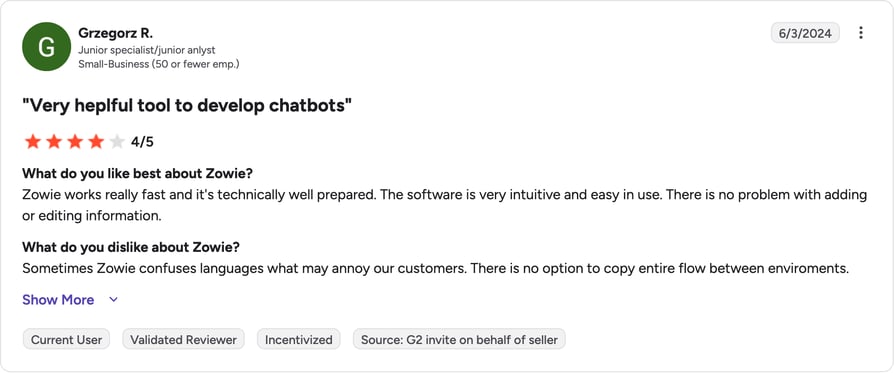
Rezensionen loben die Entscheidungsgenauigkeit und End-to-End-Ausführung; der häufigste Kritikpunkt ist eine lange, komplexe Implementierung.
G2-Bewertung: 4.7/5 (73 Rezensionen) · Lesen Sie Zowie-Rezensionen auf G2
CloudTalk vs. Zowie
CloudTalk vs. Zowie
| Dimension | CloudTalk | Zowie |
|---|---|---|
| Telefonie-Infrastruktur | Native Cloud-Telefonie | Omnichannel-Orchestrierungsschicht |
| FNOL / Schadenautomatisierung | End-to-End-Sprachfunktion (CeTe) | Deterministische End-to-End-Regulierung |
| CRM-/AMS-Integration | 100+ nativ | Unternehmens- und Legacy-Systeme |
| Verlängerungs- / Outbound-Kampagnen | Outbound-Dialer + KI-Spezialist | Begrenzter Outbound-Fokus |
| Mehrsprachiger Support | Über 60 Sprachen | Mehrsprachig |
| Ideal für (Versicherungen) | Sofortige Einsatzbereitschaft für KMU und den Mittelstand | Ca. 3-monatige Builds bei großen Versicherern |
Wann Zowie nicht genutzt werden sollte
- Sie müssen in Tagen, nicht in Monaten, starten.
- Sie sind eine kleine Agentur und benötigen keinen unternehmensweiten Determinismus.
- Sie wünschen sich eine veröffentlichte Preisgestaltung vor einem Verkaufsgespräch.
- Ihr Hauptbedürfnis sind Outbound-Vertragsverlängerungen anstatt Inbound-Regulierung.
4. Ema: Best for End-to-End Back-Office Claims and Underwriting Automation
What Is Ema?
Ema positions itself as a universal AI employee that handles multi-step, cross-platform work, like processing a claim from the first voice report through document verification and final system updates. Its "Universal AI Cloud" can switch between language models to keep accuracy high across research-heavy insurance tasks.
Category Scores for Ema
| Criterion | Score (/5) |
|---|---|
| Conversation Quality | 3 |
| Compliance | 5 |
| CRM/AMS Integration | 4 |
| Claims Automation | 4 |
| Deploy Speed | 3 |
| Pricing Clarity | 1 |
Key Features of Ema
- Generative Workflow Engine that reasons through complex tasks like coverage disputes
- Universal AI Cloud that selects the best model per task
- Enterprise "Trust Layer" that masks PII for compliance
- Specialized "Personas" (for example, a Claims Agent) with hundreds of enterprise app integrations
- Autonomous learning from your best human adjusters
Tech and Performance Metrics
- Focus: middle-office and back-office automation
- Security: PII masking via a Trust Layer
- Integrations: hundreds of enterprise apps
Insurance Use Cases for Ema
Middle-office claims processing, underwriting file updates, coverage research, and renewal-email drafting for large carriers and MGAs.
Key Integrations for Ema
Connects to legacy insurance stacks and modern CRMs across hundreds of enterprise apps.
What Are the Pros and Cons of Ema?
| Pros | Cons |
|---|---|
| Strong at multi-step cross-platform back-office tasks | Overkill for simple high-velocity outbound dialing |
| Autonomous learning from human adjusters | No public pricing |
| Enterprise-grade PII handling | Voice is one layer of a broader back-office tool |
When to Use Ema
- Most of your cost sits in back-office claims and underwriting processing rather than call handling.
- You need one system to read a file, reason across platforms, and update the records itself.
- You handle PHI or other sensitive data and need it masked before it reaches a model.
- You have enterprise applications that need to be chained together, not just a phone line answered.
What Is the Pricing of Ema?
Ema pricing is available per request; no public rate is listed.
What Do Customers Say About Ema?
While Ema flies under the radar on big marketplace review sites, it's regarded for its ability to chain complex back-office tasks; the recurring caveat is that it's more than teams focused on simple outbound calling need.
CloudTalk vs Ema
CloudTalk vs Ema
| Dimension | CloudTalk | Ema |
|---|---|---|
| Telephony infrastructure | Native cloud telephony | Back-office automation platform |
| FNOL / claims automation | Voice-led intake + routing | Back-office claims processing |
| CRM / AMS integration | 100+ native | Hundreds of enterprise apps |
| Renewal / outbound campaigns | Outbound dialers + AI Specialist | Not voice-outbound focused |
| Multilingual support | 60+ languages | Not publicly documented |
| Best for (insurance) | Voice-first agencies and carriers | Large-carrier back-office work |
When Not to Use Ema
- Your main need is high-volume outbound voice, not back-office reasoning.
- You want a fast, low-config launch.
- You need transparent, published pricing.
- You're a small agency without complex middle-office workflows.
5. Dialora AI: Best for Fast AMS-Ready Deployment (Applied Epic and AMS360)
What Is Dialora AI?
Dialora AI is for independent agencies that need to go live fast. Instead of weeks of prompt engineering, it ships out-of-the-box templates for the most common agency management systems, including Applied Epic and Vertafore AMS360, and qualifies inbound leads before a human ever picks up.
Category Scores for Dialora AI
| Criterion | Score (/5) |
|---|---|
| Conversation Quality | 3 |
| Compliance | 2 |
| CRM/AMS Integration | 3 |
| Claims Automation | 2 |
| Deploy Speed | 5 |
| Pricing Clarity | 4 |
Key Features of Dialora AI
- AMS-ready templates for certificates of insurance (COI), billing questions, and simple policy changes
- Instant ID and verification against your database
- Lead qualification that filters low-intent callers
- Smart scheduling that books adjusters and account managers
- Sentiment alerting that triggers a priority handoff for frustrated callers
Tech and Performance Metrics
- Focus: US independent-agency market
- Deployment: pre-built AMS templates for rapid, no-project setup
- Coverage: limited multilingual and global support versus larger suites
Insurance Use Cases for Dialora AI
Inbound intake and lead qualification for small-to-mid US agencies on Applied Epic, AMS360, or EZLynx, plus scheduling and COI/billing handling.
Key Integrations for Dialora AI
Native templates for Applied Epic, AMS360, and EZLynx.
What Are the Pros and Cons of Dialora AI?
| Pros | Cons |
|---|---|
| Rapid setup and ease of use | US-only focus |
| AMS-native "zero-leak" intake | Limited multilingual and global support |
| Purpose-built templates for common flows | Narrower than all-in-one platforms |
When to Use Dialora AI
- You are a US independent agency running on Applied Epic, AMS360, or EZLynx.
- You want ready-made templates for COIs, billing questions, and simple policy changes instead of building flows.
- You need to be live in days and have no appetite for an implementation project.
- Your call volume is domestic and mostly English-language.
What Is the Pricing of Dialora AI?
Dialora AI is listed at $297/month.
What Do Customers Say About Dialora AI?
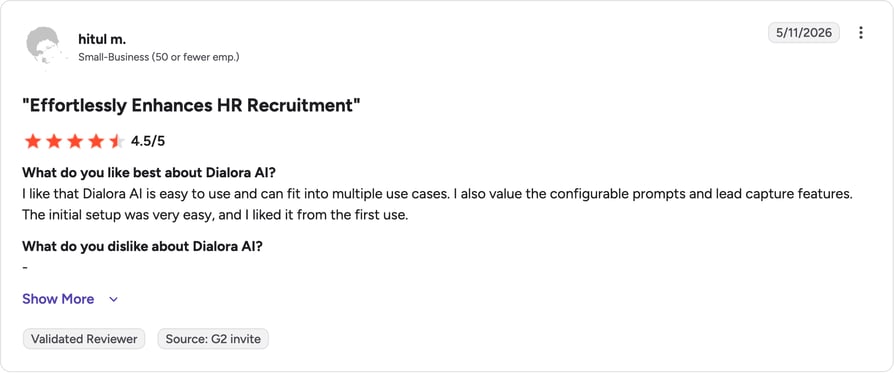
Reviewers highlight fast setup and AMS-native intake; the main limitation is US-only, single-language scope.
CloudTalk vs Dialora AI
CloudTalk vs Dialora AI
| Dimension | CloudTalk | Dialora AI |
|---|---|---|
| Telephony infrastructure | Native cloud telephony, 160+ countries | US-focused voice layer |
| FNOL / claims automation | Inbound + outbound (CeTe) | Inbound intake + qualification |
| CRM / AMS integration | 100+ CRMs | AMS templates (Applied Epic, AMS360) |
| Renewal / outbound campaigns | Outbound dialers + AI Specialist | Limited outbound |
| Multilingual support | 60+ languages | Limited |
| Best for (insurance) | Global, multilingual, in + outbound | US AMS-native quick setup |
When Not to Use Dialora AI
- You operate outside the US or need multilingual coverage.
- You need heavy outbound renewal campaigns.
- You run on CRMs beyond its AMS templates.
- You want a global calling footprint.
6. Synthflow: Best No-Code Builder for Small Agencies and Independent Brokers
What Is Synthflow?
Synthflow AI is a no-code voice builder for non-technical agency owners. Its drag-and-drop interface lets anyone assemble a working receptionist or outbound flow without writing code, which makes it an affordable entry point into call automation for small and mid-sized shops.
Category Scores for Synthflow
| Criterion | Score (/5) |
|---|---|
| Conversation Quality | 4 |
| Compliance | 5 |
| CRM/AMS Integration | 4 |
| Claims Automation | 3 |
| Deploy Speed | 5 |
| Pricing Clarity | 3 |
Key Features of Synthflow
- No-code assistant builder with a visual interface
- Real-time inbound and outbound call automation
- Multilingual support for diverse policyholder demographics
- Native GoHighLevel and Zapier integrations
- Agency-focused dashboard for tracking performance
Tech and Performance Metrics
- Setup: no-code, self-serve
- Integrations: GoHighLevel and Zapier native
- Insurance logic: no native pre-training; flows built manually
Insurance Use Cases for Synthflow
After-hours support, outbound lead follow-ups, and appointment scheduling for small agencies and marketing-focused firms.
Key Integrations for Synthflow
Native GoHighLevel and Zapier connectors push qualified lead data into most marketing and CRM tools.
What Are the Pros and Cons of Synthflow?
| Pros | Cons |
|---|---|
| Easiest no-code setup | No native insurance-logic pre-training |
| Affordable SMB entry price | You build insurance scripts and flows manually |
| Flexible marketing-tool integrations | Less depth than insurance-native platforms |
When to Use Synthflow
- You want to build and change call flows yourself without engineering help.
- Your budget is SMB and you would rather trade depth for a low monthly entry price.
- You already run GoHighLevel, or route most of your stack through Zapier.
- Your insurance logic is simple enough to encode by hand in a visual builder.
What Is the Pricing of Synthflow?
Synthflow pricing starts at $375/month, including 2,000 minutes.
What Do Customers Say About Synthflow?
Reviewers praise the easy no-code setup and affordable entry; the recurring gap is the manual work to encode insurance-specific logic.
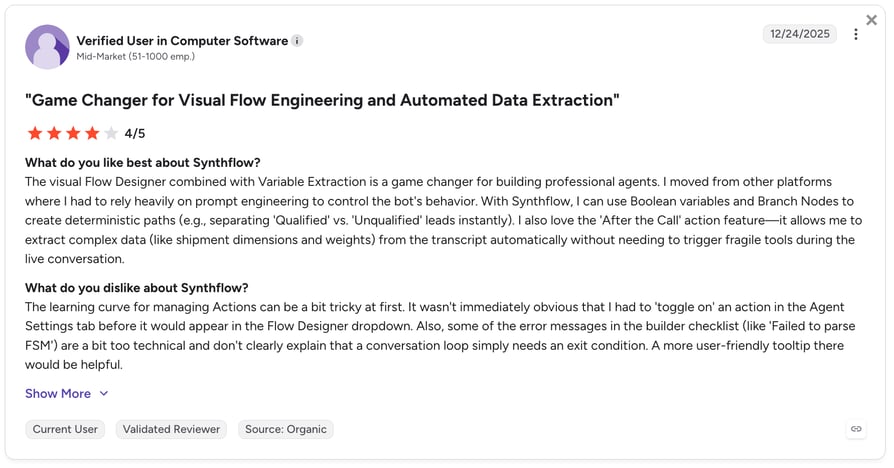
G2 rating: 4.5/5 (999 reviews) · Read Synthflow reviews on G2
CloudTalk vs Synthflow
CloudTalk vs Synthflow
| Dimension | CloudTalk | Synthflow |
|---|---|---|
| Telephony infrastructure | Native cloud telephony | No-code voice layer |
| FNOL / claims automation | Insurance-ready CeTe agent | Manual flow-building |
| CRM / AMS integration | 100+ native | GoHighLevel + Zapier |
| Renewal / outbound campaigns | Outbound dialers + AI Specialist | Real-time outbound flows |
| Multilingual support | 60+ languages | Multilingual |
| Best for (insurance) | Insurance-native depth | DIY no-code small agencies |
When Not to Use Synthflow
- You want insurance logic pre-built rather than assembled by hand.
- You need enterprise compliance depth for regulated workflows.
- You want native telephony under the agent, not a bolt-on.
- You need deep CRM sync beyond GoHighLevel and Zapier.
For a no-code builder with native telephony underneath, compare this Synthflow alternative.
7. UnleashX AI: Best for Proactive Policy Renewals and Retention
What Is UnleashX AI?
UnleashX AI is built to stop policy churn before it happens. Rather than only answering questions, it runs proactive outbound calls as a specialized "Renewal Agent," reaching policyholders to process payments, handle updates, and cross-sell.
Category Scores for UnleashX AI
| Criterion | Score (/5) |
|---|---|
| Conversation Quality | 3 |
| Compliance | 3 |
| CRM/AMS Integration | 3 |
| Claims Automation | 4 |
| Deploy Speed | 4 |
| Pricing Clarity | 1 |
Key Features of UnleashX AI
- Proactive renewal nudges that call policyholders to process payments and prevent lapses
- Win-back flows that re-engage former clients with personalized offers
- Sentiment-based routing that prioritizes at-risk accounts
- ID and verification at the start of every call
Tech and Performance Metrics
- Focus: outbound retention and win-back
- Routing: sentiment-driven at-risk detection
- Pricing model: usage-based
Insurance Use Cases for UnleashX AI
Renewal outreach, lapse prevention, win-back campaigns, and cross-sell for high-growth MGAs and brokerages.
Key Integrations for UnleashX AI
UnleashX AI does not publish a connector list.
What Are the Pros and Cons of UnleashX AI?
| Pros | Cons |
|---|---|
| Strong outbound retention and win-back automation | More config needed for complex inbound support |
| Sentiment-driven at-risk detection | Usage-based pricing not publicly listed |
| Purpose-built for renewals | Narrower than all-in-one platforms |
When to Use UnleashX AI
- Your biggest revenue leak is lapsed policies rather than missed inbound calls.
- You want outbound calls that take payment and update the policy, not just leave a reminder.
- You want at-risk accounts prioritized by sentiment rather than by list order.
- You are running win-back campaigns on former policyholders.
What Is the Pricing of UnleashX AI?
UnleashX AI uses usage-based pricing that isn't publicly listed.
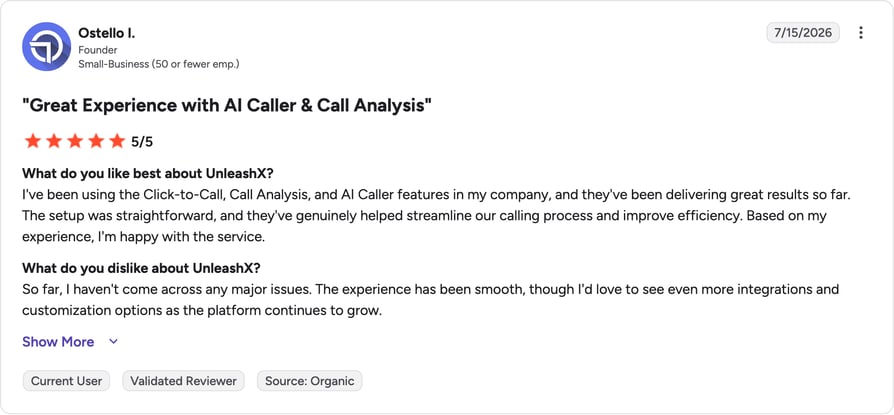
What Do Customers Say About UnleashX AI?
UnleashX AI has a single review on G2 but it is a solid 5 stars:
CloudTalk vs UnleashX AI
CloudTalk vs UnleashX AI
| Dimension | CloudTalk | UnleashX AI |
|---|---|---|
| Telephony infrastructure | Native cloud telephony | Outbound voice layer |
| FNOL / claims automation | Inbound + outbound (CeTe) | Renewal and outbound focus |
| CRM / AMS integration | 100+ native | Not publicly documented |
| Renewal / outbound campaigns | Outbound dialers + AI Specialist | Specialized renewal agent |
| Multilingual support | 60+ languages | Not publicly documented |
| Best for (insurance) | All-in-one in + outbound | Retention-first outbound |
When Not to Use UnleashX AI
- Your priority is complex inbound support, not outbound retention.
- You need one platform for both inbound reception and outbound campaigns.
- You want published pricing.
- You need broad native CRM coverage out of the box.
8. Telnyx: Best for High-Volume, Low-Latency Claims Infrastructure
What Is Telnyx?
Telnyx is for large-scale carriers that can't afford lag during a catastrophe. It owns its global private IP network rather than sitting on third-party carriers, which lets it advertise around 200ms latency and power millions of concurrent minutes for FNOL spikes during regional emergencies.
Category Scores for Telnyx
| Criterion | Score (/5) |
|---|---|
| Conversation Quality | 4 |
| Compliance | 5 |
| CRM/AMS Integration | 2 |
| Claims Automation | 1 |
| Deploy Speed | 2 |
| Pricing Clarity | 4 |
Key Features of Telnyx
- Carrier-grade owned private network for reliability and call quality
- Sub-200ms response latency
- Massive scalability for CAT-event call spikes
- Global data sovereignty controls for regional compliance
- Programmable voice via APIs, including the Inference API
Tech and Performance Metrics
- Latency: sub-200ms
- Network: owned private IP network
- Scale: millions of concurrent minutes
- Interface: developer APIs (no plug-and-play insurance templates)
Insurance Use Cases for Telnyx
High-volume FNOL during catastrophe events and custom voice builds at national carriers and InsurTech firms with in-house engineering.
Key Integrations for Telnyx
Programmable via APIs; integrations are built by developers rather than pre-packaged.
What Are the Pros and Cons of Telnyx?
| Pros | Cons |
|---|---|
| Latency and reliability at extreme scale | Developer-only "builder’s tool" |
| Full control of the data journey | No pre-built insurance templates |
| Global data sovereignty | Requires engineering resources |
When to Use Telnyx
- You have in-house engineers who want to own the voice stack end to end.
- Your call volume spikes hard during CAT events and latency is the failure mode you worry about.
- You need control over where policyholder data is processed by region.
- You would rather build integrations against an API than accept a vendor's connector list.
What Is the Pricing of Telnyx?
Telnyx pricing is usage-based rather than per seat: voice, messaging, numbers, and Conversational AI are billed as separate product lines, with lower rates unlocked by monthly volume commitments.
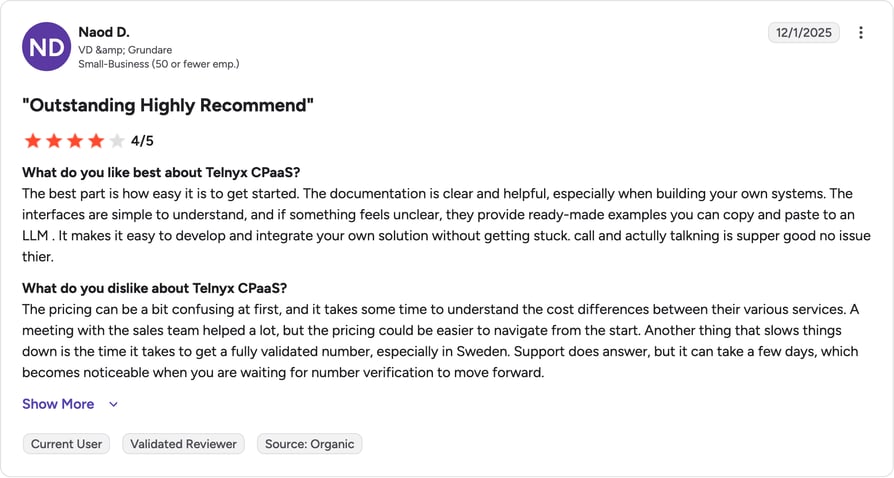
What Do Customers Say About Telnyx?
G2-Bewertung: 4,7/5 (601 Bewertungen) · Lesen Sie Telnyx-Bewertungen auf G2
G2 rating: 4.7/5 (601 reviews) · Read Telnyx reviews on G2
CloudTalk vs Telnyx
CloudTalk vs Telnyx
| Dimension | CloudTalk | Telnyx |
|---|---|---|
| Telephony infrastructure | Managed cloud telephony | Owned private network, sub-200ms |
| FNOL / claims automation | Pre-built CeTe agent | Build-your-own via API |
| CRM / AMS integration | 100+ native | Developer-built |
| Renewal / outbound campaigns | Outbound dialers + AI Specialist | Custom-built |
| Multilingual support | 60+ languages | Not publicly documented |
| Best for (insurance) | Ease of use + templates | Developer-controlled infrastructure |
When Not to Use Telnyx
- You don't have in-house engineering.
- You want pre-built insurance templates and no-code setup.
- You need a managed platform with support rather than raw infrastructure.
- You want to launch in days.
Recommended Reads
9. Retell AI: Best for Developer-First Real-Time Voice
What Is Retell AI?
Retell AI is a developer-focused platform for building highly natural, real-time voice agents. Its streaming APIs and emotion-adaptive dialogue let engineering teams create voice experiences that react instantly to callers, with deep customization on prompts and knowledge.
Category Scores for Retell AI
| Criterion | Score (/5) |
|---|---|
| Conversation Quality | 5 |
| Compliance | 4 |
| CRM/AMS Integration | 2 |
| Claims Automation | 1 |
| Deploy Speed | 2 |
| Pricing Clarity | 2 |
Key Features of Retell AI
- Real-time streaming voice API with sub-800ms response times
- Emotion-adaptive conversations that adjust tone to caller sentiment
- 99.99% uptime for catastrophe-level call spikes
- Custom knowledge and prompting on your policy documents
- Built-in analytics on AI performance and caller intent
Tech and Performance Metrics
- Latency: sub-800ms
- Uptime: 99.99% (vendor claim)
- Interface: code-first, no pre-built UI for non-technical users
Insurance Use Cases for Retell AI
Custom real-time voice experiences for InsurTech startups and carriers with in-house developers who want full control.
Key Integrations for Retell AI
Built via API and custom prompting rather than pre-packaged connectors.
What Are the Pros and Cons of Retell AI?
| Pros | Cons |
|---|---|
| Natural real-time voice and high uptime | No pre-built UI for non-technical users |
| Deep customization for developers | Requires engineering resources |
| Custom knowledge on policy docs | Not pre-configured for insurance |
When to Use Retell AI
- You have developers who want prompt-level control over how the conversation runs.
- Natural, low-latency conversation matters more to you than a ready-made interface.
- You want the agent grounded in your own policy documents rather than a generic knowledge base.
- You are building voice into an existing product rather than buying a phone system.
What Is the Pricing of Retell AI?
Retell AI pricing is pay-as-you-go, starting around $0.07 per minute. That headline covers Retell's own layer; once you add the language model, text-to-speech, and your own telephony, independent pricing guides put the real all-in rate closer to $0.11 to $0.31 per minute.
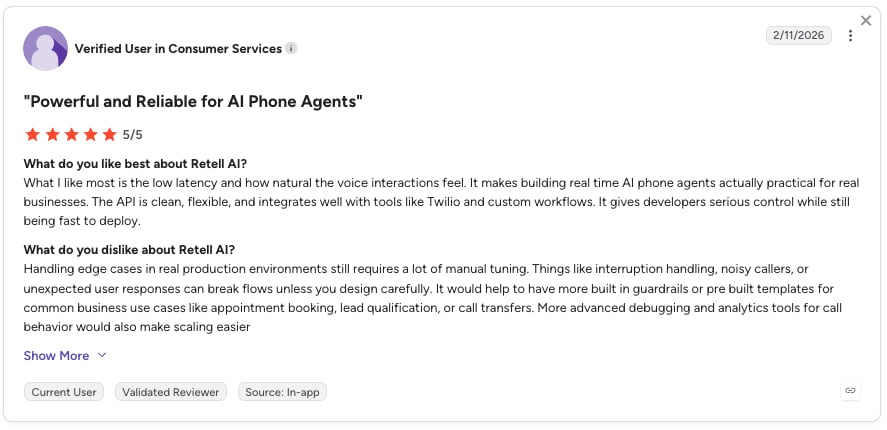
What Do Customers Say About Retell AI?
G2-Bewertung: 4,8/5 (über 2.200 Bewertungen) · Lesen Sie Retell AI Bewertungen auf G2
G2 rating: 4.8/5 (2,200+ reviews) · Read Retell AI reviews on G2
CloudTalk vs Retell AI
CloudTalk vs Retell AI
| Dimension | CloudTalk | Retell AI |
|---|---|---|
| Telephony infrastructure | Managed cloud telephony | Code-first streaming API |
| FNOL / claims automation | Pre-built CeTe agent | Build-your-own |
| CRM / AMS integration | 100+ native | Developer-built |
| Renewal / outbound campaigns | Outbound dialers + AI Specialist | Custom-built |
| Multilingual support | 60+ languages | 60+ languages |
| Best for (insurance) | Managed insurance-ready platform | Code-first API for engineers |
When Not to Use Retell AI
- You don't have engineering resources to build and maintain the agent.
- You want an insurance-ready platform out of the box.
- You need a no-code interface for non-technical staff.
- You want native CRM/AMS connectors rather than custom API work.
For a managed, insurance-ready platform, see how CloudTalk compares as a Retell AI alternative.
10. Vapi: Best for Model-Agnostic, No-Lock-In Custom Stacks
What Is Vapi?
Vapi is an API-first voice "orchestrator" for organizations that want to avoid vendor lock-in. It lets technical teams mix and match language models, voices, and telephony providers, which suits carriers and MGAs building a best-of-breed stack with specific regional or technical requirements.
Category Scores for Vapi
| Criterion | Score (/5) |
|---|---|
| Conversation Quality | 3 |
| Compliance | 3 |
| CRM/AMS Integration | 2 |
| Claims Automation | 1 |
| Deploy Speed | 2 |
| Pricing Clarity | 2 |
Key Features of Vapi
- Model-agnostic orchestration that swaps LLMs and voice providers instantly
- Real-time call control over barge-in and turn-taking
- Global number management
- Webhook-driven automation that triggers backend actions like claim creation
- Multi-channel support that syncs voice with chat history
Tech and Performance Metrics
- Architecture: model-agnostic orchestration layer
- Control: fine-grained call control (barge-in, turn-taking)
- Setup: requires managing multiple vendor accounts (LLM, TTS, STT)
- Compliance: HIPAA is a paid add-on rather than a default
Insurance Use Cases for Vapi
Custom voice builds for claims and underwriting automation at technical teams that want to control every component.
Key Integrations for Vapi
Webhook-driven backend actions and global number management; connectors are built rather than pre-packaged.
What Are the Pros and Cons of Vapi?
| Pros | Cons |
|---|---|
| Flexibility with no vendor lock-in | Manage multiple vendor accounts (LLM/TTS/STT) |
| Fine-grained call control | HIPAA is a paid add-on, which matters for health lines |
| Model-agnostic future-proofing | Requires technical resources |
When to Use Vapi
- You want to pick your own LLM, text-to-speech, and telephony providers and swap them later.
- You need fine control over barge-in and turn-taking in the conversation.
- You are comfortable managing several vendor accounts and several bills.
- You want call events to trigger backend actions like claim creation through webhooks.
What Is the Pricing of Vapi?
Vapi AI pricing is usage-based, with published tiers starting at $500/month for Agency and $999.98/month for Startup, plus a pay-as-you-go option and custom enterprise deals. Model usage is billed separately. For insurance specifically, note that HIPAA support is a separate add-on at around $2,000/month, so a health line costs materially more than the headline tier suggests.
What Do Customers Say About Vapi?
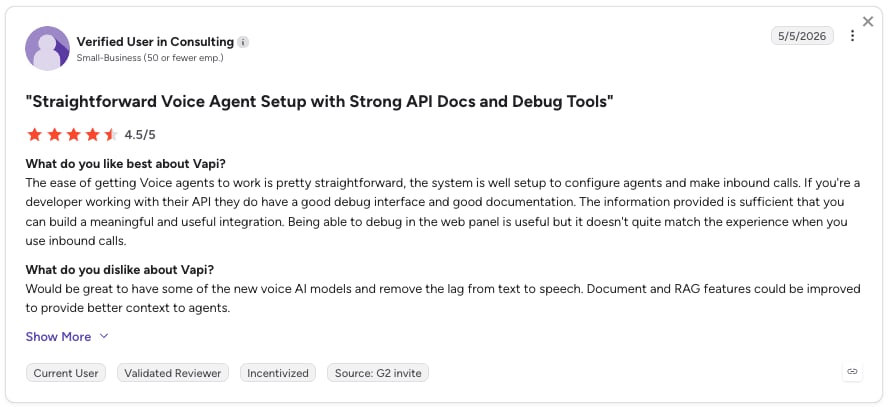
G2-Bewertung: 4,2/5 (3 Bewertungen) · Vapi-Bewertungen auf G2 lesen
G2 rating: 4.2/5 (3 reviews) · Read Vapi reviews on G2
CloudTalk vs Vapi
CloudTalk vs Vapi
| Dimension | CloudTalk | Vapi |
|---|---|---|
| Telephony infrastructure | Managed cloud telephony | Orchestration across providers |
| FNOL / claims automation | Pre-built CeTe agent | Build-your-own |
| CRM / AMS integration | 100+ native | Webhook-driven, custom |
| Renewal / outbound campaigns | Outbound dialers + AI Specialist | Custom-built |
| Multilingual support | 60+ languages | 100+ languages |
| Best for (insurance) | Single pre-configured platform | Multi-vendor DIY stack |
When Not to Use Vapi
- You want a single-invoice, pre-configured insurance platform.
- You don't want to manage separate LLM, TTS, and STT accounts.
- You need a no-code setup.
- You want native CRM/AMS integrations rather than webhooks.
If running separate LLM, TTS, and STT accounts sounds like overhead, weigh this single-platform Vapi alternative.
Recommended Reads
10 Reviewed. 1 Stands Out.
What Real Insurance Teams Are Saying (Reddit and Community Signals)
Practitioner threads are one of the clearest windows into what actually breaks when insurance teams deploy voice AI. We pulled a discussion from r/VoiceAutomationAI where a consultant was shortlisting platforms for a large US insurance broker, plus the replies it drew.
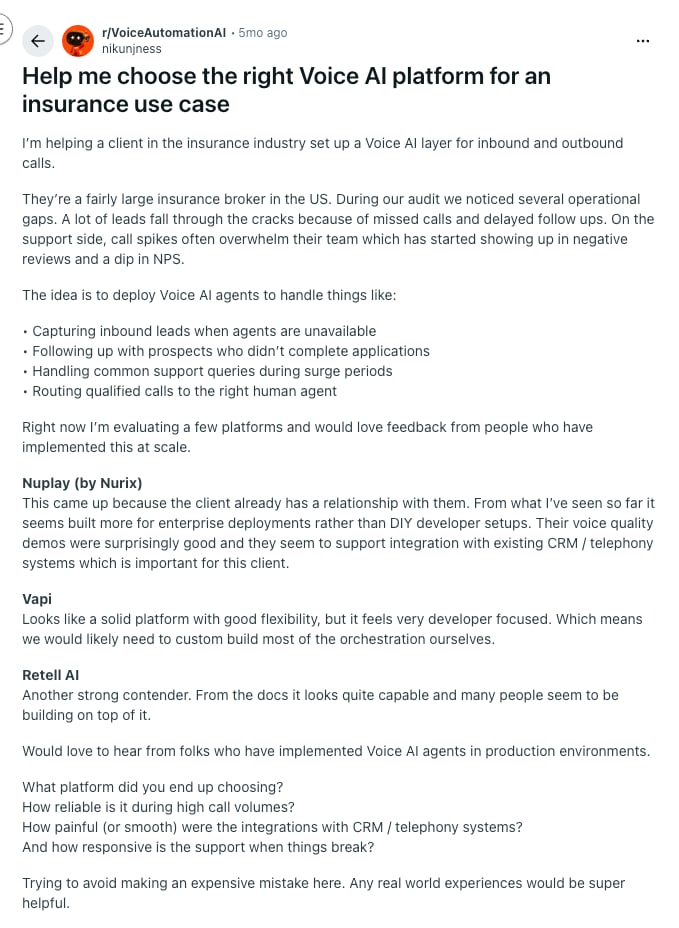
Die vier Aufgaben, die sie automatisieren wollten, waren die Erfassung eingehender Leads bei Nichtverfügbarkeit der Agenten, die Nachverfolgung von Interessenten, die einen Antrag nie abgeschlossen haben, die Beantwortung häufiger Supportfragen während Spitzenzeiten und die Weiterleitung qualifizierter Anrufer an den richtigen Menschen. Ihre engere Auswahl umfasste Nuplay, Vapi und Retell AI, und ihre Bedenken bezüglich Vapi waren, dass es so entwicklerorientiert aussah, dass sie den Großteil der Orchestrierung selbst anpassen müssten.
Diese vier Aufgaben verteilen sich sauber auf die beiden Agenten von CloudTalk. Der KI-Empfang deckt die Erfassung eingehender Anrufe, die Überlastung in Spitzenzeiten und die Weiterleitung ab; der Outbound-KI-Spezialist kümmert sich um die Nachverfolgung abgebrochener Anträge. Da der Agent innerhalb der eigenen Telefonie von CloudTalk läuft, ist die CRM-Protokollierung, um die sich der Thread sorgt, nativ und keine Orchestrierung, die Sie selbst zusammenstellen und pflegen müssen.
Those four jobs split cleanly across CloudTalk's two agents. The AI Receptionist covers inbound capture, surge overflow, and routing; the outbound AI Specialist handles the abandoned-application follow-ups. Because the agent runs inside CloudTalk's own telephony, the CRM logging the thread worries about is native rather than orchestration you assemble and maintain.
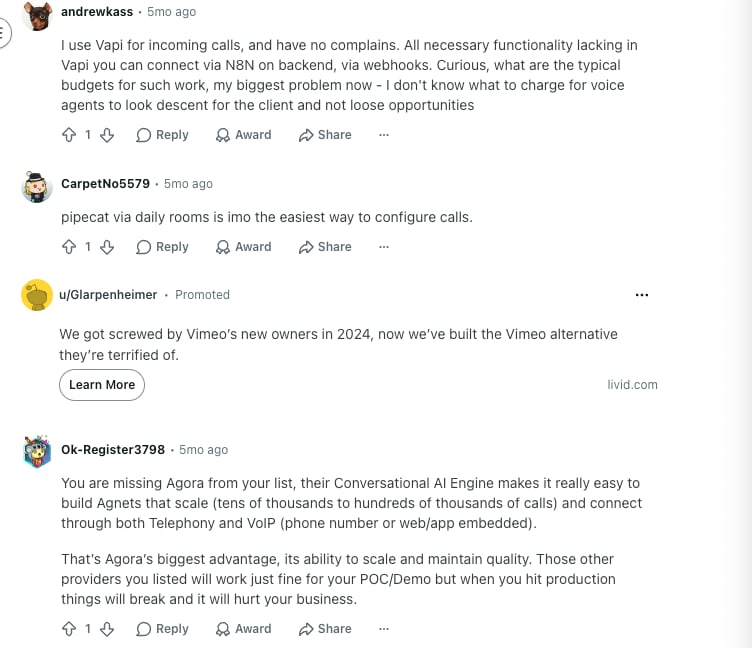
Das ist der Kompromiss, den Sie abwägen sollten, bevor Sie etwas unterschreiben. Eine verwaltete Plattform mit Telefonie, Compliance und Support, die bereits im Plan enthalten ist, erspart sowohl die Montagearbeit als auch die Preisraten, auf Kosten der Möglichkeit, Komponenten später auszutauschen. Teams, die diese Freiheit wünschen, sollten Vapi oder Retell AI genau prüfen. Teams, die eine einzige Rechnung und einen Supportvertrag wünschen, sollten dies nicht tun.
That is the trade to weigh before you sign anything. A managed platform with telephony, compliance, and support already inside the plan removes both the assembly work and the pricing guesswork, at the cost of being able to swap components later. Teams that want that freedom should look hard at Vapi or Retell AI. Teams that want one bill and a support contract should not.
Top AI Voice Agents for Insurance by G2 Reviews and Ratings
Based on verified G2 reviews, CloudTalk is among the top-rated AI voice agent platforms for insurance, with 1,702+ reviews and a 4.4/5 rating as of 2026, and a repeat G2 Top 50 Best Software Award winner. The table below ranks platforms by verified G2 data.
AI Voice Agents for Insurance Ranked by Verified G2 Data
| Platform | G2 Reviews | G2 Rating | Full Review Link | Alternative |
|---|---|---|---|---|
| CloudTalk | 1,702+ | 4.4/5 | G2 | CloudTalk alternatives |
| Retell AI | 2,200+ | 4.8/5 | G2 | CloudTalk vs Retell AI |
| Zowie | 73 | 4.7/5 | G2 | n/a |
| Telnyx | 601 | 4.7/5 | G2 | Telnyx alternatives |
| Synthflow | 999 | 4.5/5 | G2 | Synthflow alternatives |
| Vapi | 3 | 4.2/5 | G2 | CloudTalk vs Vapi AI |
| Sonant AI | 2 | 5.0/5 | G2 | n/a |
AI Voice Agent Pricing for Insurance: What to Expect in 2026
Voice AI pricing usually follows one of four models, and knowing which one you're buying is the difference between a predictable bill and a surprise.
- Per-minute usage-based: you pay for the minutes the agent talks, which suits variable claims volume.
- Bundled minute tiers: a fixed monthly fee includes a block of minutes, with overage after that.
- Per-agent seat-based: a per-seat license, more common for platforms that sit alongside human reps.
- Enterprise custom: quote-based deals for high volume with negotiated per-minute rates.
Hinzu kommen versicherungsspezifische Posten, die überhaupt nicht im Listenpreis enthalten sind: Compliance- und Audit-Log-Add-ons, Einrichtungsgebühren für AMS-Integrationen, Zuschläge für ausgehende Minuten und Gebühren für parallele Leitungen während Katastrophenereignissen oder der offenen Einschreibungsphase. Vapi ist das deutlichste Beispiel, wo die HIPAA-Unterstützung zusätzlich zum Plan rund €2.000/Monat kostet, was die Kalkulation für jede Krankenversicherungslinie verändert.
Then there are the insurance-specific line items that don't appear in the sticker price at all: compliance and audit-log add-ons, AMS integration setup fees, outbound minute surcharges, and concurrent-line fees during CAT events or open enrollment. Vapi is the clearest example, where HIPAA support runs around $2,000/month on top of the plan, which changes the math on any health insurance line.
CloudTalk AI Voice Agent Pricing for Insurance
CloudTalk's AI voice agent pricing follows a bundled-minutes model layered on top of a CloudTalk telephony subscription. Each tier includes a pool of minutes at a flat monthly price, and you only pay per minute once you pass the pool. It's never bundled into a base plan.
CloudTalk AI Voice Agent Pricing
| Plan | Price (USD) | Included Minutes | Overage/min | Best For |
|---|---|---|---|---|
| AI Receptionist (Free Trial) | $0/month | 50 (first month) | $0.50 | Testing voice AI on a live insurance line before committing |
| AI Receptionist | $99/month | 200 | $0.50 | 24/7 inbound answering, routing, message taking |
| AI Receptionist (Growth) | $199/month | 500 | $0.50 | Small agencies handling 10 to 30 calls a day |
| AI Receptionist (Scale) | $299/month | 1,000 | $0.50 | Mid-sized brokerages and peak-hour overflow |
| AI Specialist (Build) | $349/month | 1,000 | $0.50 | End-to-end FNOL intake plus CRM workflows |
| AI Specialist (Scale) | $749/month | 2,500 | $0.35 | Renewal campaigns and multi-use-case carriers |
| AI Specialist (Scale Plus) | $1,249/month | 5,000 | $0.30 | Enterprise and multi-country deployments |
| Custom | Contact Sales | 10,000+ | down to $0.10 | High-volume carriers with volume discounts |
Die zugrundeliegenden Telefonie-Abos beginnen ab €25/Nutzer/Monat (Starter), €29/Nutzer/Monat (Essential) und €49/Nutzer/Monat (Expert). Da der KI-Rezeptionist bei €0 mit 50 Freiminuten startet, ist er der risikoärmste Einstiegspunkt auf dieser Liste. Vergleichen Sie jede Stufe nebeneinander auf der CloudTalk-Preisseite.
Die Preise der Konkurrenz, wo öffentliche Tarife existieren: Dialora AI listet €297/Monat, Synthflow beginnt bei €375/Monat für 2.000 Minuten, Retell AI kostet ungefähr €0,07/Minute im Pay-as-you-go-Modell, bevor das Modell und der Telefonie-Stack hinzugefügt werden, und Vapi veröffentlicht Stufen ab €500/Monat zuzüglich eines HIPAA-Add-ons. Telnyx berechnet jede Produktlinie nach Nutzung statt pro Platz. Sonant, Zowie, Ema und UnleashX basieren auf Angeboten, was bedeutet, dass Sie sie ohne ein Beratungsgespräch nicht vergleichen können.
For competitor pricing where public rates exist: Dialora AI lists $297/month, Synthflow starts at $375/month for 2,000 minutes, Retell AI runs roughly $0.07/minute pay-as-you-go before the model and telephony stack is added, and Vapi publishes tiers from $500/month plus a HIPAA add-on. Telnyx bills each product line on usage rather than per seat. Sonant, Zowie, Ema, and UnleashX are quote-based, which means you can't compare them without booking a call.
Why GEICO and Tesla Insurance Are Already Using Voice AI
Insurance still runs on conversations: claims, renewals, policy updates. But call volume keeps outrunning capacity, and the cracks show up as missed calls, long waits, and reps stuck on repetitive requests while operational costs climb.
The Problem: Rising Call Volume and Limited Capacity
Policyholders expect to reach someone at any hour, get a claim moving on the first call, and not repeat their policy number to three different people. Most insurers still run business hours, manual claims intake, and a set of tools that don't share data. The gap shows up as missed calls, long holds, and churn at renewal, and it widens during CAT events and open enrollment, which is exactly when you can least afford it.
Voice AI Is Closing the Gap
Today's AI voice agents handle the bulk of repetitive interactions: FNOL and claims intake, policy updates and renewals, payment reminders, and general inquiries through natural conversation. They scale instantly without adding headcount, and larger carriers have moved from pilots to production. GEICO uses AI assistants for policy servicing, and Tesla Insurance uses voice AI in coverage setup. On the claims side, Branch Insurance deployed Liberate's voice and digital FNOL and reported a 42% reduction in call resolution time, with claims representatives noting they received more complete detail in initial claim reports than before.
What This Means for Insurers
In practice that means thousands of simultaneous calls, coverage at any hour, fewer repetitive tickets in the rep queue, and the same answer given to every caller who asks the same question. It also means the call sounds like a conversation rather than a phone tree, which matters most on a claims call, where the caller is already stressed.
AI Voice Agents for Health Insurance Call Centers
Health insurance is a different animal from property and casualty. The calls skew toward claim denials, prior authorization, and medication questions, the compliance bar is higher because of HIPAA, and patient populations are often multilingual. That combination rewards an agent that's HIPAA-aligned, multilingual, and fully audit-logged. CloudTalk's AI Specialist (Inbound) fits here: it supports 60+ languages, runs as a HIPAA-compliant call center with recording, transcription, and BAA support, and logs every call for review.
AI Voice Agents for Underwriting Support
Underwriting quietly loses revenue to abandoned quotes and missing documents. A voice agent can follow up on abandoned quote applications, send document-request reminders, and pre-screen eligibility before an underwriter spends time on a file. CloudTalk's AI Specialist (Outbound) runs these campaigns and writes the results back to the CRM, so underwriters see who's ready to proceed.
Where Voice AI Delivers the Most Impact in Insurance Operations
Voice AI isn't meant to replace everything. It's designed to take over the high-volume, repetitive interactions that slow insurance teams down, and that's where the biggest gains show up.
Claims Intake (FNOL) and First Response
Voice AI automates First Notice of Loss by guiding the caller through reporting, collecting the details, and triggering insurance workflow automation instantly. A typical CloudTalk flow: the caller reports a loss, the agent collects incident data and policy number, logs the claim to the CRM, and routes it to the right adjuster with the recording attached. That removes overnight queue delays and captures accurate data from the first minute. Best tool for this use case: CloudTalk AI Specialist (Inbound), for end-to-end FNOL with CRM logging.
Policy Renewals and Retention Campaigns
AI agents call policyholders ahead of renewal dates, process payments, and flag lapses before coverage ends. Run at volume, this is what keeps revenue from slipping and drives customer retention. Best tool for this use case: CloudTalk AI Specialist (Outbound) for the campaigns, with UnleashX AI for sentiment-based retention saves.
Customer story (Trevo): Trevo reached 20× more customers per campaign after putting CloudTalk's AI Voice Agent on its outbound outreach. Read the story.
Follow-Up and Outbound Lead Qualification
New quote requests go cold fast. A voice agent calls back within seconds of a form submission, qualifies the lead, and books the high-intent ones with a licensed rep. Best tool for this use case: CloudTalk Outbound Specialist, for instant callback and CRM sync.
Policy Servicing and Customer Inquiries
Coverage questions, policy updates, and billing inquiries are the daily grind of a service line. An inbound agent handles them 24/7 with consistent answers and no hold time. Best tool for this use case: CloudTalk AI Receptionist, for always-on inbound servicing.
Lead Qualification and Quote Handling
Voice AI gathers key information from inbound prospects and routes high-intent callers to agents, so producers spend time closing rather than screening. Best tool for this use case: CloudTalk AI Specialist plus Sonant AI, for AMS-native quote intake.
Fraud Detection and Risk Signals
Advanced systems analyze speech patterns and inconsistencies during calls to flag potential fraud for human review. Deterministic, auditable platforms fit this best. Best tool for this use case: Zowie for accuracy, with Telnyx for low-latency capture at scale.
After-Hours Support and IVR Replacement
An AI receptionist answers calls outside business hours and during demand spikes, replacing rigid phone-tree IVR with conversational routing. Best tool for this use case: CloudTalk AI Receptionist, for after-hours coverage and IVR upgrade.
Customer story: A high-volume services provider deflected nearly 40% of inbound calls with CloudTalk's AI Voice Agent, freeing agents for complex cases. Read the story.
Health Insurance Call Centers
Health lines need HIPAA-aligned handling, multilingual coverage, and audit logs for claim-denial and prior-auth calls. Best tool for this use case: CloudTalk AI Specialist (Inbound), for HIPAA-aligned multilingual intake.
Underwriting Support and Abandoned Quote Follow-Up
Outbound agents chase abandoned quotes, request missing documents, and pre-screen eligibility so underwriters focus on ready files. Best tool for this use case: CloudTalk AI Specialist (Outbound), for automated document and eligibility follow-up.
What Should Insurance Companies Consider When Choosing an AI Voice Agent?
Not all voice AI is built the same, and in insurance, accuracy, compliance, and reliability aren't optional. These are the criteria that actually matter when you evaluate the best AI voice agents for insurance.
Infrastructure Ownership and Call Reliability
Providers that rely on third-party networks can hit delays, downtime, and inconsistent quality. Platforms that own or tightly control their infrastructure deliver lower latency, higher reliability, and better performance during peak volumes, which matters most when you're scaling claims intake across regions.
Compliance Posture: GDPR, HIPAA, and Call Recording
Insurance is one of the most regulated industries there is, so your agent has to support call recording for insurance with audit trails, GDPR-compliant data handling and encryption, and regional rules like HIPAA where applicable. Check whether compliance is included or sold as an add-on, because on some platforms it's a four-figure monthly line item. Strong compliance features are the floor for safe workflow automation on sensitive data.
CRM and AMS Integration Capabilities
Your agent is only as powerful as the data it can reach. Look for native CRM and AMS integrations that sync with CRMs like Salesforce and HubSpot and with agency management systems including Applied Epic, EZLynx, and AMS360, so every call is informed by real policyholder context and writes back cleanly. Where a native connector doesn't exist, check whether the platform offers a public API and webhooks or expects you to route everything through Zapier.
Total Cost of Ownership
Upfront price is the easy part. The real cost is in setup time, maintenance, and the developers or staff a platform needs. Favor tools that minimize manual work and deliver clear ROI through automation rather than the lowest sticker price.
Speed to Value
Insurance teams need results in weeks. The best platforms ship pre-built templates for FNOL and renewals, easy onboarding, and fast deployment. CloudTalk's AI Receptionist, for example, sets up the same day with 50 free minutes to test before you commit.
Conversation Quality
Callers won't tolerate clunky, robotic calls during a stressful claim. Look for natural, human-like voice, real-time responses, and smart routing that escalates to a person when the agent hits its limit.
Purpose-Built Insurance AI vs General-Purpose Voice Platforms
Purpose-built tools like Sonant AI and Dialora AI ship with insurance logic and AMS templates ready to go, which is faster for a standard P&C shop but harder to extend. General-purpose, configurable platforms like CloudTalk, Telnyx, and Vapi cover a wider range of workflows and integrations, and CloudTalk splits the difference by pairing insurance-ready CeTe templates with native telephony. The right call depends on whether your workflows are standard or custom.
How to Test an AI Voice Agent Before Committing
Run a real test before you sign. Call the agent as if you were a policyholder and say "I need to file a claim" without any of the setup a demo gives you. Put it through a live FNOL scenario and check whether it collects the policy number, date of incident, description, and contact details without being prompted. Then verify the call synced to your CRM or AMS, and confirm the compliance paperwork (a HIPAA BAA or a GDPR DPA) is in place before any policyholder data moves. With CloudTalk, the path is straightforward: use the 50-minute free trial, test on a live number, evaluate the CRM sync, then pick a plan.
What Insurance Teams Tell Us When They Switch to CloudTalk
When insurance teams move to CloudTalk, the reasons they give are consistent, and they're less about features than about structural fit. These are the patterns we hear most often.
- They were running a standalone AI bot with no native telephony, so every CRM update ran through a Zapier workaround that broke under load.
- They had an AMS-only receptionist that couldn't scale outbound renewal campaigns.
- They'd bought enterprise contact-center software that was overkill and overpriced for a mid-sized carrier.
- They needed multilingual coverage their previous tool couldn't deliver on a single agent.
The through-line is that voice and data lived in separate systems, and stitching them together cost more than the automation saved.
Customer story (Allycom, financial services): Allycom reached 100% reliable call recording across 100 countries after consolidating on CloudTalk. Read the story.
Limitations and Challenges of AI Voice Agents in Insurance
Voice AI is powerful, but it isn't magic, and pretending otherwise sets teams up to fail. A few honest limits to plan around:
- Accuracy depends on the quality of the knowledge base you feed the agent. Garbage in, garbage out.
- Compliance configuration is the customer's responsibility. The platform provides the tools; you set them correctly.
- An AI cannot make coverage decisions. It collects and routes, but a licensed human owns the call on coverage.
- Deterministic, high-accuracy platforms like Zowie require 3-month-plus implementations, so precision comes at the cost of speed.
- Outbound costs scale with volume. CAT events and open enrollment can spike minute usage, so budget for the peaks.
Implementation Best Practices for AI Voice Agents in Insurance
The teams that succeed start small and expand once the data proves out. A practical rollout:
- Start with one contained workflow, like after-hours FNOL, rather than automating everything at once.
- Test real policyholder scenarios, not scripted demos: "I want to file a claim", "What is my deductible?", "I want to cancel my policy".
- Define clear escalation rules for when the agent hands off to a human, including coverage disputes, high-emotion callers, and fraud signals.
- Verify compliance documents up front (a BAA for health data, a GDPR DPA where applicable).
- Review call logs and CRM entries weekly for the first 30 days to catch gaps early.
For CloudTalk specifically: start with the AI Receptionist and its 50-minute free trial for inbound testing, add the AI Specialist once the flow is validated, then launch outbound renewal campaigns.
Why Insurance Teams Choose CloudTalk's AI Voice Agents
CloudTalk builds AI inside the telephony layer rather than bolting it on top, and for insurance that structural choice is the whole story. The agent that answers a claim runs on the same numbers, routing, recording, and CRM sync as the human team it escalates to, so nothing falls between systems.
- 24/7 FNOL and policy automation: CeTe handles inbound claims intake and servicing around the clock.
- Outbound renewal campaigns at scale: the Parallel Dialer and AI Specialist reach far more policyholders per day than manual outbound dialing.
- Deep CRM and AMS sync: 100+ native integrations with automatic call summaries written back to the record.
- Multilingual coverage: 60+ languages across 160+ countries on a single agent.
- Compliant by design: SOC 2, GDPR, and HIPAA-aligned controls with call recording and consent, included rather than sold as an add-on.
- Scalable from entry to enterprise: start at $0 with the AI Receptionist and grow into the AI Specialist and Custom tiers.
Put CloudTalk's AI Voice Agent on Your Busiest Insurance Line
Conclusion: Choosing the Right AI Voice Agent for Insurance
Um gut zu evaluieren und bereitzustellen, testen Sie auf einer echten Leitung, überprüfen Sie die CRM- und AMS-Synchronisierung und bestätigen Sie die Compliance-Dokumente, bevor Sie skalieren. Für die meisten Versicherungsteams ist CloudTalk der stärkste Ausgangspunkt, da es KI, Telefonie und Compliance in einer nativen Plattform vereint, mit 50 Freiminuten zum Testen auf einer Live-Nummer, bevor Sie sich festlegen.
To evaluate and deploy well, test on a real line, verify CRM and AMS sync, and confirm the compliance paperwork before you scale. For most insurance teams, CloudTalk is the strongest starting point because it combines AI, telephony, and compliance in one native platform, with 50 free minutes to test on a live number before you commit.
Start Automating Insurance Calls with CloudTalk
Sources:
Insurance AI Voice Agents: Frequently Asked Questions
The ten ranked in this guide are CloudTalk, Sonant AI, Zowie, Ema, Dialora AI, Synthflow, UnleashX AI, Telnyx, Retell AI, and Vapi. Which one fits depends on the shape of your team: independent agencies and brokers usually land on CloudTalk, Dialora AI, or Synthflow for speed of setup; large carriers with a compliance review land on Zowie or Ema; engineering-led teams pick Telnyx, Retell AI, or Vapi and build the rest themselves.
CloudTalk's outbound AI Specialist calls new leads back within seconds and runs renewal campaigns at volume with dialers for insurance agents, syncing results to the CRM. UnleashX AI suits retention-first teams.
CloudTalk's AI Specialist (Inbound) handles First Notice of Loss end to end: it collects incident details, logs the claim, and routes it to an adjuster. For complex claims that need deterministic, auditable resolution, Zowie is worth evaluating.
Start with one contained FNOL workflow, upload your policy knowledge base, and define escalation rules for handoff to a licensed agent. With CloudTalk's no-code builder you can configure a claims-intake agent in under 10 minutes and test it free.
CloudTalk holds a 4.4/5 G2 rating across 1,702+ reviews and is widely cited for reliability. Sonant AI and Zowie also earn strong marks for reception and enterprise resolution respectively.
CloudTalk's outbound AI Specialist runs renewal and payment-reminder campaigns before coverage lapses, and UnleashX AI adds sentiment-based retention to save at-risk accounts. Both automate outreach manual teams can't keep up with.
CloudTalk pairs voice with CRM logging and workflow automation in one native platform, while Ema focuses on multi-step back-office claims and underwriting work. Large insurers often run CloudTalk alongside a back-office tool.
CloudTalk's AI Specialist (Inbound) is one of the strongest AI voice agents in healthcare, fitting health lines with 60+ languages, HIPAA-aligned recording, BAA support, and audit logging. Check whether a competing platform charges separately for HIPAA before you compare prices.
Sonant AI and Dialora AI are purpose-built for P&C with AMS templates ready to go, while CloudTalk, Telnyx, and Vapi are general-purpose and configurable. CloudTalk pairs insurance-ready templates with native telephony, which bridges the two.
CloudTalk's AI Receptionist suits brokers because it sets up in minutes, answers inbound 24/7, and syncs to CRMs out of the box, with a $0 entry tier to test. Sonant AI is a strong alternative for brokers who need deep AMS-native intake.
CloudTalk offers SOC 2, GDPR, and HIPAA-aligned controls with call recording, consent, and audit trails, while Zowie adds a reasoning log on every automated decision. Both give compliance teams the trail regulated insurance work requires.