TL;DR: 10 Best Alternatives to Quo (OpenPhone)
| # | Platform | Best for | Starting Price (annual billing) | G2 Rating |
|---|---|---|---|---|
| 1 | CloudTalk | Growing SMB sales & support teams needing rock-solid global calls | $25/user/month | 4.4/5 |
| 2 | Aircall | Sales environments that rely heavily on customer databases | $30/user/month | 4.4/5 |
| 3 | Dialpad | Teams wanting live call transcripts and on-screen coaching | $15/user/month | 4.4/5 |
| 4 | Nextiva | Managing customer chats, social media, and calls in one place | $15/user/month | 4.5/5 |
| 5 | RingCentral | Large corporate offices needing massive, all-in-one phone systems | $20/user/month | 4.2/5 |
| 6 | JustCall | Teams doing high volumes of outgoing texts and automated sales | $29/user/month | 4.3/5 |
| 7 | Zoom Phone | Teams on a budget wanting flexible, pay-as-you-go calling plans | $10/user/month | 4.6/5 |
| 8 | Allo | Solo workers looking for a modern, shared team inbox | $18/user/month | 4.6/5 |
| 9 | Vonage | IT teams looking to build highly customized phone setups | $13.99/user/month | 4.3/5 |
| 10 | Ringover | International teams focusing heavily on the European market | $21/user/month | 4.6/5 |
Skip the reading. See it live.
Why Are Teams Searching for a Quo Alternative?
The platform you likely know as OpenPhone recently rebranded to Quo, shifting its focus from an affordable business phone system to an automated AI receptionist named Sona. While this pivot satisfies investors, it has created severe operational headaches for small and medium-sized businesses.
Real user reviews on Reddit and G2 (where Quo scores 4.7/5 out of 3,300+ reviews) reveal that sales and support teams are actively looking for a reliable alternative to OpenPhone. Forcing workspaces onto an AI-heavy setup has introduced serious daily risks, including sudden account lockouts from automated security filters and frustrating five-second audio delays.
If you are hunting for the best OpenPhone alternatives in 2026, your next system must prioritize three core elements: rock-solid call reliability, transparent pricing, and deep software connections.
5 Main Cons of Quo: Based on Real User Reviews
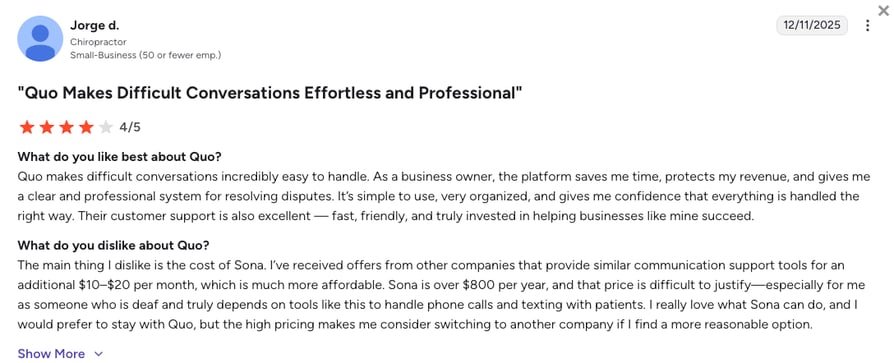
- Sudden Account Terminations:Overly strict automated security filters frequently mistake normal business texting for spam, freezing your entire workspace without any warning. Because customer support is only available through the app, locked-out users completely lose their ability to contact help and fix the issue.
- Constant Audio Delays:Frustrating audio delays of five to ten seconds happen constantly, especially when your phone switches between Wi-Fi and cellular data. This underlying software flaw disrupts the natural flow of business calls and deeply annoys the people trying to reach you.
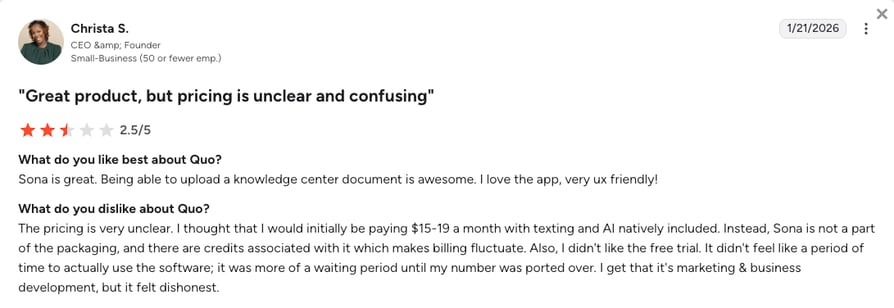
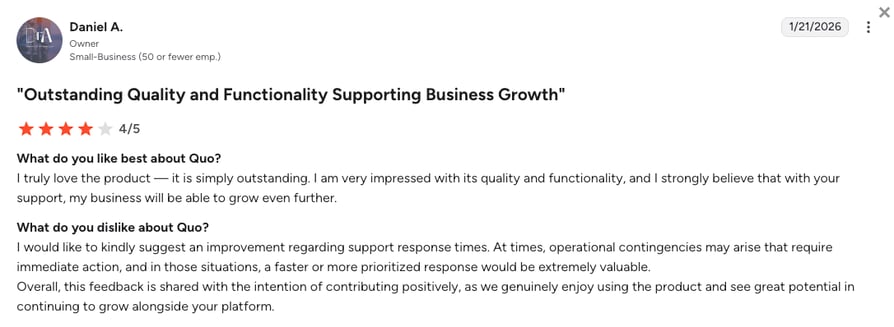
- Unpredictable AI Pricing:The Sona AI feature charges your account exactly 100 credits per call. Because a quick 20-second question costs the exact same as a long 5-minute conversation, this flat credit fee can cause monthly bills to jump unexpectedly if you receive a lot of brief customer calls.
- Features Locked on Lower Tiers:While Quo’s $15 starting price is very accessible, the Starter plan leaves out essential office tools like phone menus (IVR), call holding, and standard customer database integrations. Growing teams usually have to upgrade to the $23 Business tier just to get standard features.
- Unnatural AI Voices:The forced push toward using an automated AI receptionist means your business has to rely on a rigid, robotic voice that you cannot change. Customers complain that the voice often mispronounces website links and speaks in a strange rhythm that turns off real human callers.
What Is the Best Alternative to Quo?
CloudTalk is the top alternative to Quo, built specifically for growing businesses and busy sales and support teams that need their phone system to work flawlessly every single day. CloudTalk offers a highly predictable starting price of $25/user/month and completely avoids Quo's call delays by running on a massive, global network of top-tier phone carriers (plus, it guarantees a 99.999% uptime across all plans)
Instead of forcing you to use a confusing, credit-based AI receptionist, CloudTalk provides simple, flat-rate smart tools designed to help your human team work better. Features like a visual call flow builder, native automated dialers, and over a hundred direct connections to your customer databases easily replace Quo's restrictive and paywalled environment.
Why Do Teams Consider CloudTalk the Best Quo Alternative?
5 Main Pros of CloudTalk: Based on Real User Experience
- Massive & Reliable Global Reach:CloudTalk completely avoids the severe call drops common in lightweight phone apps by using a highly stable global network. Whether your team is working locally or spread across 160+ countries, this setup guarantees crystal-clear audio and keeps you connected.
- Predictable AI Pricing:Escape the skyrocketing costs of Quo’s credit system, where a brief call drains your balance as much as a long negotiation. CloudTalk's AI Conversation Intelligence is available as a predictable, flat-rate add-on for $9/user/month, giving you fixed monthly costs for automated call summaries and sentiment tracking.
- Strategic Software Integration:Rather than sealing off workflows, CloudTalk opens up access to over 95 standard CRM and helpdesk tools (like HubSpot and Pipedrive) natively starting on the Essential plan ($29/user/month), keeping data synced automatically without complex middleware.
- Safe and Fast Dialing:Quo's aggressive security filters often mistakenly flag normal outbound sales calls as spam, stopping your team in their tracks. CloudTalk solves this by providing built-in automated dialers right inside the app, letting your sales reps make high volumes of calls efficiently and safely.
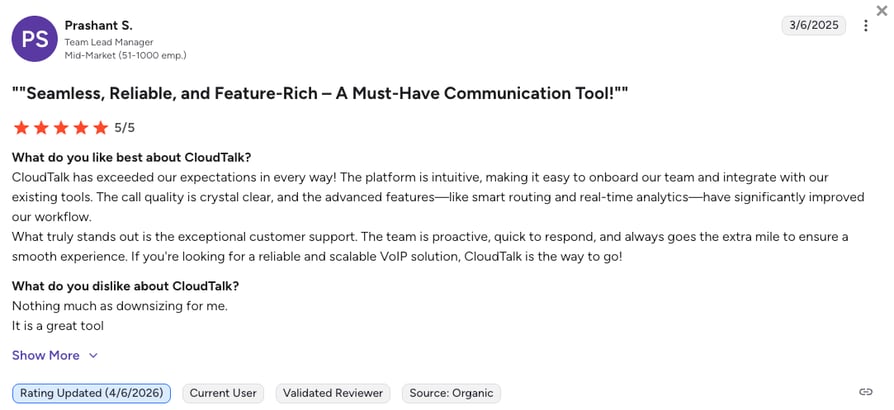
- Fast Human Support:CloudTalk treats customer service as a core part of the product, moving way past Quo's frustrating chat-only system. When urgent phone issues pop up, your team gets fast, human responses via chat, email, or priority phone lines, so your business never stops running (note: phone support available on the Expert plan and above).
How We Evaluated The Best Quo Alternatives and Competitors
To find the best Quo alternatives for 2026, we systematically looked at competitor technology, transparent pricing models, and real user feedback. We specifically prioritized platforms that solve the sudden account bans, constant audio delays, and confusing credit charges reported by teams leaving Quo.
Our research focused on six critical areas essential for a growing business:
- Call Reliability: We checked for strong networks that can easily prevent the frustrating five-to-ten-second audio delays that constantly plague Quo's core phone service.
- Smart Tools: We looked for systems that offer clear, flat-rate pricing for their smart features instead of hiding the true costs behind confusing, credit-based interactions.
- Customer Database Connections: We prioritized tools that offer deep, two-way data syncing on standard plans, getting rid of the artificial paywalls Quo places on basic software connections.
- Worldwide Reach: We looked at platforms built to support international teams, moving past Quo's heavy limitations that mostly restrict it to North America.
- Customer Service: We strongly favored companies that provide real, human technical help across multiple channels, ensuring you are never locked out of your account without a way to get immediate help.
- True Monthly Cost: We checked the actual price per user, stripping away flashy starting prices to show exactly what it costs to run a fully functional team.
The Top 10 Alternatives to Quo for 2026
Before looking at the detailed breakdowns of the best Quo competitors, here is a direct comparison of how our top recommendations easily beat Quo's paywalled pricing and rigid automated features.
Quo Competitors Compared
| Feature | Quo (OpenPhone) | CloudTalk | Aircall | Dialpad | RingCentral |
|---|---|---|---|---|---|
| Starting Price (Annual) | $15/user/month | $25/user/month | $30/user/month | $15/user/month | $20/user/month |
| Minimum Seats | 1 User | 1 User | 3 Users | 1 User | 1User |
| Local Numbers | Limited mostly to US/CA | 160+ Countries | 100+ Countries | 70+ Countries | 110+ Countries |
| CRM Sync Availability | Only 5 Native CRMs, rest through Zapier (Gated at $23 Business Tier) | 100+ CRM integrations open at Essential ($29/mo) | 250+ integrations open at Essentials ($30/mo) | Google/MS open at Standard (25/mo) | Google/MS open at Core (25/mo) |
| AI Automation Model | Metered (100 credits per call) | Native flat-rate add-on ($9/user/month) | Metered (Free blocks or $0.49/min pay-as-you-go) | Included Natively (Basic text transcripts on base) | Premium Add-on ($39/mo to $60/mo blocks) |
| Visual Call Flow Builder |  |  | (basic, clunky) | | (basic, clunky) |
| Free Trial | 7 Days | 14 Days | 7 Days | 14 Days | 14 Days |
Deconstructing the TCO:
While Quo markets an accessible $15 Starter tier, it artificially locks away essential functionalities like phone menus (IVR) and database syncing, forcing teams into the $23 tier immediately.
CloudTalk provides clear feature progression: core business features like multi-level IVR and 100+ CRM integrations unlock fully at the Essential tier ($29/user/mo), while advanced automation like native Power Dialers and Salesforce ecosystem sync are housed in the Expert tier ($49/user/mo).
1. CloudTalk: The #1 Quo Alternative for Growing Sales & Support Teams (SMB to Mid-Market)
What is CloudTalk?
CloudTalk is a highly reliable, AI-powered cloud phone system built specifically for fast-growing sales and customer service teams. It hits the perfect sweet spot for growing businesses, offering a massive upgrade for teams that need rock-solid call stability without the headaches of old, confusing corporate software.
Trusted by 5,500+ businesses worldwide, CloudTalk focuses on crystal-clear audio and deep software connections. CloudTalk is also widely recognized as the ultimate upgrade for serious scaling, making it the perfect choice for SMB to mid-market teams looking to escape Quo's sudden account blocks and audio delays.
Why Is CloudTalk a Strong Quo Alternative?
- Fixes Constant Audio Delays: CloudTalk completely avoids Quo’s frustrating five-to-ten-second audio lags by running on a massive global network of top-tier phone carriers. If one local connection drops, the system instantly switches to another, ensuring your calls stay perfectly clear and connected.
- Predictable AI Budgeting: Instead of charging an opaque 100 credits for a simple 20-second inbound call, CloudTalk runs its smart capabilities via a transparent, fixed-price Conversation Intelligence add-on and reasonably priced AI voice agent and AI receptionist bundles. You pay a single flat rate per month rather than watching your budget drain per interaction.
- Transparent Workflow Syncing: Quo restricts basic customer data synchronization behind arbitrary tier upgrades. CloudTalk introduces deep, bi-directional database syncing natively on the Essential tier ($29/mo), ensuring customer support desks can log call histories and sync all data in systems like HubSpot or Salesforce effortlessly.
- Intuitive, Visual Call Routing: Quo’s forced automation can make modifying call paths rigid and difficult. CloudTalk restores control to managers by featuring an intuitive, drag-and-drop call flow designer. Anyone can design custom phone menus, change ring orders, and set up business hours in minutes without needing an IT expert.
- Battle-Tested Reliability: CloudTalk is officially recognized as a G2 Spring 2026 Leader in sales and support, outranking almost all VoIP providers in user-rated categories like "Ease of Use," "Support Quality," and "Ease of Setup."
What Are the Pros & Cons of CloudTalk?
| Pros | Cons |
|---|---|
| Massive international reach: Provides high-quality local phone numbers in over 160 countries, easily beating Quo's North American focus. | No native video calling: Requires an external integration like Zoom. |
| Flawless software syncing: Connects perfectly with over 100 popular tools, automatically saving your calls and texts to save hours of manual typing. | No support for on-premises landline (PBX) hardware, it's fully cloud-based |
| Clear AI Add-ons: Add AI Voice Agents and AI Receptionists through set-price packages instead of dealing with unexpected per-call fees. | Requires a stable internet connection, as with any cloud-based calling platform |
| Advanced Dialing: Power, Preview, Smart, and Parallel dialers available to help maximize your team's outbound reach. | |
| Enterprise-grade Reliability: Proprietary multi-carrier network ensures 99.999% uptime with automatic failover routing. |
What Are CloudTalk's Plans & Pricing?
CloudTalk pricing starts at $25/user/month, and the platform offers the following plans:
CloudTalk Plans and Pricing
| Plan | Price (annual billing) | Key Features |
|---|---|---|
| Starter | $25/user/month | Unlimited inbound & internal calls, 500 outbound minutes (regional calling bundle), call queues, transfers, click-to-call, automatic call recording (1-month retention) |
| Essential | $29/user/month | Everything in Starter + IVR and smart routing, 100+ CRM/helpdesk integrations, workflow automation, unlimited recording retention |
| Expert | $49/user/month | Everything in Essential + Power, Smart & Preview Dialers, Salesforce integration, 24/7 phone support (3-seat min) |
| Custom | Quote-based | Everything in Expert + custom onboarding, unlimited outbound calls, enterprise security and SLA; built for 25+ seats |
| Conversation Intelligence (add-on) | $9/user/month | AI transcripts, call summaries, call scoring, sentiment analysis, and agent coaching insights |
| AI Receptionist (add-on) | From $99/month (200 min) | Inbound AI call answering, routing, logging; 50 free minutes on every account; tiers up to $699/mo (2,500 min) |
| AI Voice Agent (add-on) | From $349/month (1,000 min) | Custom AI agents for inbound and outbound workflows; plans scale up to $1,249/mo (5,000 min) |
What Are CloudTalk Customers Saying?
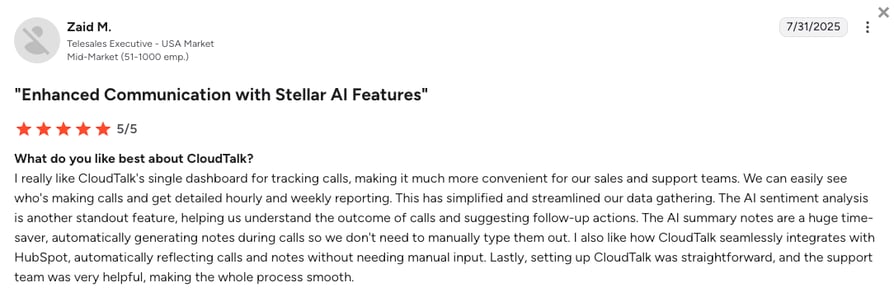
Customers who searched for OpenPhone alternatives for business constantly highlight the immediate fix to their audio problems and the massive amount of time saved on daily computer work.
- Crystal Clear Audio: Users report that switching immediately resolved the severe call delays, echoing, and random drops they experienced on cheaper platforms.
- Zero Manual Data Entry: Teams love that every single call and text saves perfectly into their customer database automatically, removing the need for manual typing.
- Visual Call Routing: Operations managers praise the drag-and-drop call flow designer, which lets them set up complex phone menus in minutes without needing an IT expert.
- Missing Video Tools: A few users mention they wish video meetings were built directly into the app so they wouldn't have to keep paying for a separate Zoom subscription.
How G2 Users Rate CloudTalk?
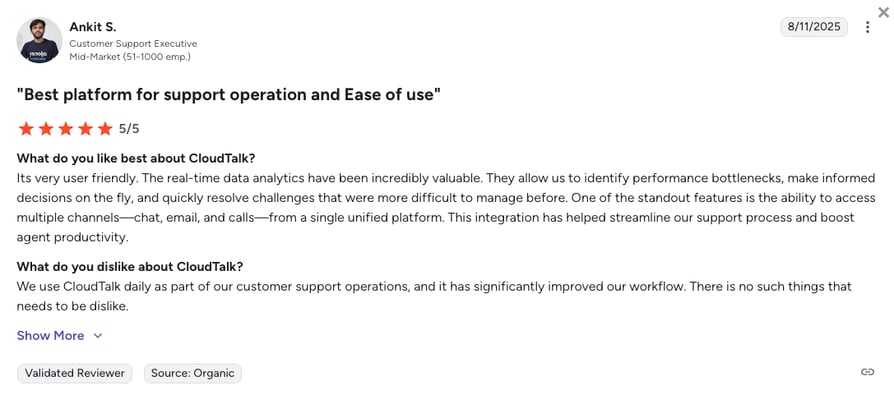
CloudTalk's current G2 rating is 4.4/5, out of 1,850+ verified user reviews.
The ultimate phone upgrade for growing SMBs
2. Aircall: Best for Sales Environments That Rely Heavily on Customer Databases
What is Aircall?
Aircall is a highly polished business phone system known for its massive app marketplace and incredibly easy-to-use screen. It is built specifically as a powerful support and sales tool that connects directly to the software you already use. If your team lives entirely inside HubSpot, Salesforce, or Intercom, Aircall is designed to connect to those platforms flawlessly.
Why Is Aircall a Strong Quo Alternative?
- Deep Software Connections: Aircall features over 250 direct software connections, easily getting you past Quo’s highly restricted and paywalled ecosystem.
- Structured Team Queues: Aircall moves past Quo's simple shared inbox model by offering complex call routing and manager oversight, making it a natural upgrade for real support desks.
- Clearer AI Pricing: Aircall bills for its AI tools by the minute rather than Quo's confusing credits per call system, giving busy teams a much clearer understanding of their monthly costs.
What Are the Pros & Cons of Aircall?
| Pros | Cons |
|---|---|
| Huge app library: Connects flawlessly to almost any customer database or helpdesk software your team is already using. | Strict 3-user minimum: The mandatory user minimum creates a $90/month starting floor that prices out solo workers. |
| Clean, modern design: Ditch confusing menus for an incredibly simple app that requires almost zero training for new hires. | Premium AI costs extra: Advanced features like automatic call summaries require additional monthly fees. |
| Fast, reliable setup: Teams can easily purchase numbers and build phone menus in minutes without needing an IT expert. | Lacks built-in mass texting: You will need to rely on third-party tools to send large-scale text message campaigns. |
What Are Aircall’s Plans & Pricing?
Aircall pricing starts at $30/user/month (billed annually, 3-user minimum), with the following plans:
- Essentials - $30/user/month
- Professional - $50/user/month
- Custom - Quote-based pricing
Mind the seat minimums:
Aircall requires a strict minimum of three users to even open an account. While $30 sounds affordable, your actual starting cost will be $90 per month on day one.
What Are Aircall Customers Saying?
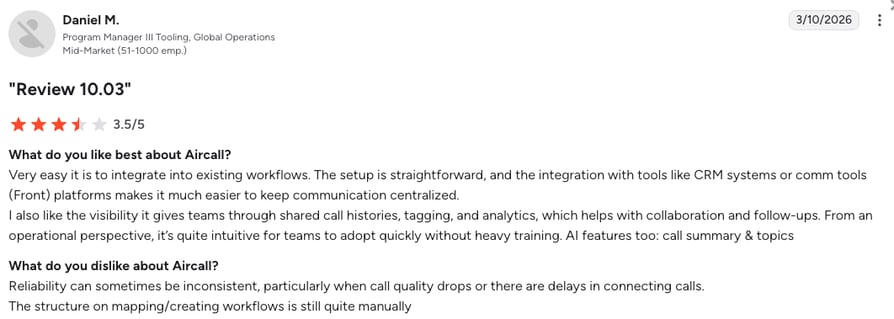
Aircall users frequently praise the software for its reliable connections to major databases, but sometimes voice frustration over strict contracts.
- Flawless Software Syncing: Users rave about how automatic connections save hours of manual typing compared to older, disconnected phone systems.
- Easy to Learn: New team members are able to start taking calls almost immediately, thanks to the incredibly clean and modern screen design.
- Rigid Contracts and Minimums: Smaller teams report frustration with being forced to pay for three seats even if they only have two employees on staff.
How G2 Users Rate Aircall?
Aircall's current G2 rating is 4.4/5, out of 1,500+ verified user reviews.
3. Dialpad: Best for Live Call Transcripts and On-Screen Coaching
What is Dialpad?
Dialpad is an all-in-one communication platform that heavily focuses on bringing artificial intelligence directly into your live conversations. It smoothly merges voice calls, high-definition video meetings, and internal team chat into a single, polished app. When comparing Dialpad vs OpenPhone, Dialpad is designed for forward-thinking teams that want AI to actively help their human workers answer questions in real time.
Why Is Dialpad a Strong OpenPhone Alternative?
- Helpful On-Screen Coaching: Instead of trying to replace human workers with an automated robotic voice like Quo's Sona, Dialpad uses AI to give your human team live coaching pop-ups and instant answers during a call.
- Built-in Smart Tools: Dialpad includes its core AI transcripts right in its standard plans, safely avoiding Quo’s unexpected, credit-based fees.
- True All-in-One Workspace: Dialpad goes way beyond Quo's voice-only focus by putting your team's video meetings, phone calls, and internal chats in one easy-to-use window.
What Are the Pros & Cons of Dialpad?
| Pros | Cons |
|---|---|
| Real-time call transcripts: Watch calls get typed out live on your screen, allowing reps to easily capture key details as they speak. | Expensive support upgrades: Basic plans do not include 24/7 support. You have to pay extra for around-the-clock help. |
| AI included normally: Smart tools are built directly into the foundation rather than acting as expensive, separate add-ons. | Costly inbound phone routing: Getting a fully functional call center setup forces you into an expensive Contact Center tier. |
| No mandatory minimums: Single users can sign up easily without being forced to buy empty seats they do not need. | Complex for tiny teams: Users switching from simple apps often find the massive feature list too much at first. |
What Are Dialpad’s Plans & Pricing?
Dialpad pricing starts at $15/user/month (billed annually), with the following plans:
- Standard - $15/user/month
- Pro - $25/user/month
- Enterprise - $35/user/month
Note: Dialpad Contact Center plans operate on a completely different pricing architecture, starting at a much steeper $95/user/month.
What Are Dialpad Customers Saying?
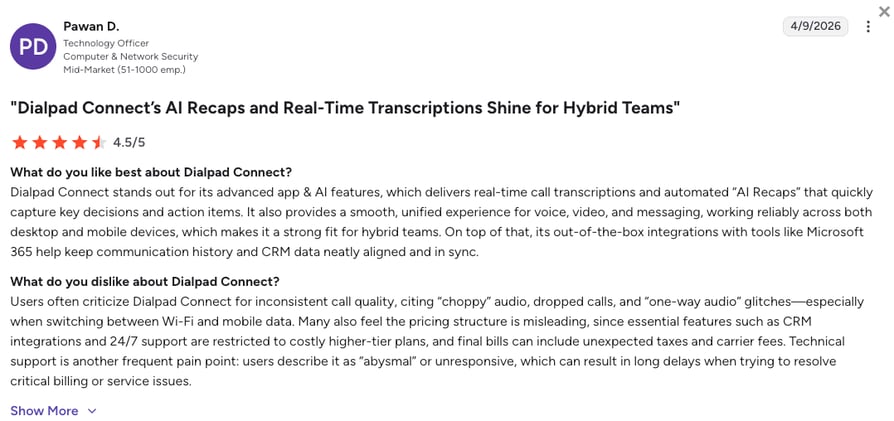
Dialpad customers love how the built-in AI improves their daily calls, but sometimes express frustration over the steep price jumps for basic customer service features.
- Incredible Live AI: Users constantly praise the real-time transcripts and automated coaching that help reps answer tough questions live on the phone.
- One App for Everything: The ability to jump from a phone call right into a video meeting without changing apps is a massive win for remote teams.
- Expensive Phone Menus: Small support teams complain that basic features like advanced phone routing are hidden behind very expensive premium tiers.
How G2 Users Rate Dialpad?
Dialpad's current G2 rating is 4.4/5, out of 5,500+ verified user reviews.
4. Nextiva: Best for Managing Customer Chats, Social Media, and Calls in One Place
What is Nextiva?
Nextiva is a real UCaaS (Unified Communications as a Service) giant built for mid-sized to enterprise-level businesses looking to break out of Quo’s basic voice and text limitations. It bridges the gap between old-school office phone lines and modern digital messaging, acting as a massive, cross-channel dashboard.
Why Is Nextiva a Strong OpenPhone Alternative?
- True Multichannel Routing: While Quo limits you to standard calling and SMS, Nextiva lets your business step up to website-embedded live chat, automated chatbots, and direct social media management.
- Consolidated Customer Journey: By bundling enterprise-grade voice networks with online review monitoring, it unifies your external touchpoints into a single command center.
- The Enterprise Fallback: Backed by an absolute 99.999% network uptime guarantee, it completely bypasses the erratic network connection drops and five-second UDP audio lags tied to Quo's lightweight setup.
What Are the Pros & Cons of Nextiva?
| Pros | Cons |
|---|---|
| All-in-one digital workspace: Packs core telephony, video, team chat, and digital chatbots into one system. | Widespread customer support failures: Known for severe administrative roadblocks, slow tech support, and massive ticketing delays. |
| Enterprise routing stability: High-fidelity global architecture ensures client calls don't drop mid-shift. | Rigid corporate contracts: Inflexible multi-year agreements and billing system glitches pose an operational risk. |
| Steers complex journeys: Ideal for mature offices that prioritize high-volume cross-channel messaging over basic apps. | Steep learning curve & paywalls: The backend interface is highly cluttered, and full tools require deep enterprise tier upgrades. |
What Are Nextiva’s Plans & Pricing?
Nextiva pricing starts at $15/user/month (billed annually), with the following main plans:
- Core - $15/user/month
- Engage - $25/user/month
- Scale - $75/user/month
- Professional - Quote-based (Enterprise plans)
The texting limitation:
Nextiva operates with an older corporate mindset regarding text messaging. Their lower tiers heavily restrict how many text messages you can send, which can be a shock for teams used to unlimited texting.
What Are Nextiva Customers Saying?
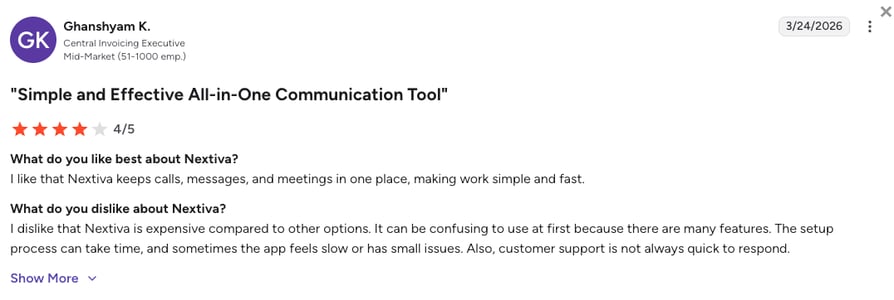
Nextiva customers love having all their messages in one place and praise the support team, but often mention that the software takes a while to learn.
- Rock-Solid Uptime: Reviewers frequently praise the clear audio and the peace of mind that comes with knowing the phones won't go down.
- Amazing Customer Support: Users constantly shout out the support team for actually answering the phone and fixing problems quickly.
- Confusing Backend: Managers frequently complain that changing simple phone rules requires too many clicks and reading through help articles.
How G2 Users Rate Nextiva?
Nextiva’s current G2 rating is 4.5/5, out of 3,400+ verified user reviews.
5. RingCentral (RingEX): Best for Large Corporate Offices Needing Massive Phone Systems
What is RingCentral?
RingCentral (operating its core product under the RingEX brand) is the traditional enterprise heavyweight of the cloud phone industry. It provides highly complex call routing, massive scalability, and strict security rules designed for traditional corporate offices.
If you are comparing RingCentral vs OpenPhone, RingCentral is the safest choice for large organizations that have dedicated tech departments capable of managing complex software.
Why Is RingCentral a Strong Quo Alternative?
- Absolute Network Stability: RingCentral’s highly secure global network provides incredible stability, completely bypassing the frustrating delays and audio echoing common in Quo.
- Strict Security Rules: RingCentral offers top-tier security and privacy rules like healthcare data compliance. This means you will never be locked out of your account by an aggressive, poorly programmed security bot.
- Advanced Manager Tools: It provides high-level tools like live call monitoring and private agent coaching, features that Quo’s simple, shared design simply cannot support.
What Are the Pros & Cons of RingCentral?
| Pros | Cons |
|---|---|
| All-in-one ecosystem: Combines corporate voice calls, large video meetings, team chat, and digital fax into one massive app. | Strict text messaging limits: The base plan limits users to a frustrating 25 text messages per month. |
| Elite reliability: Supported by an incredibly stable network that handles massive call volumes flawlessly every single day. | Outdated, bulky design: The screen feels like older software compared to modern, easy-to-use apps. |
| Advanced compliance: Top-tier security rules perfect for healthcare, finance, and other highly regulated industries. | Expensive AI upgrades: Unlocking smart AI tools requires a very costly premium upgrade. |
What Are RingCentral’s Plans & Pricing?
RingCentral pricing starts at $20/user/month (billed annually), with the following plans:
- Core - $20/user/month
- Advanced - $25/user/month
- Ultra - $35/user/month
The 25 SMS trap:
While the $20 base plan looks competitive, it acts more like a trial. It limits your team to sending just 25 text messages per month, forcing any team that texts clients into a more expensive upgrade immediately.
What Are RingCentral Customers Saying?
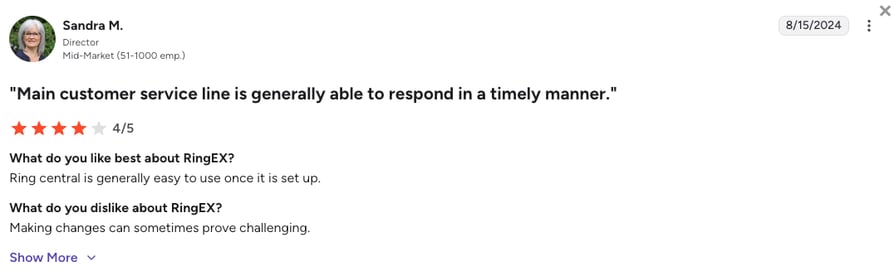
RingCentral users appreciate the undeniable stability of the platform but consistently report issues with the outdated design and complex settings.
- Corporate Reliability: IT managers love the uptime and the fact that the system easily grows to support thousands of employees globally.
- Deep Feature Set: Users like having a tool that can literally handle every single communication need, including sending older digital faxes.
- Clunky Admin Interface: Managers frequently complain that changing basic phone menus takes too much effort, and the app itself feels very bloated.
How G2 Users Rate RingCentral?
RingCentral’s current G2 rating for their RingEX suite is 4.2/5, out of 1,350+ verified user reviews.
6. JustCall: Best for High-Volume Outbound Texts and Automated Sales
What is JustCall?
JustCall is a specialized automation platform built specifically for fast-paced sales teams and marketing agencies. Instead of trying to be a general office phone for everyone, it functions perfectly as an OpenPhone dialer alternative. JustCall focuses heavily on increasing the number of conversations your reps can have each day through built-in auto-dialers and mass texting features.
Why Is JustCall a Strong Quo Alternative?
- Safe Automated Dialing: JustCall’s network is designed to handle high volumes of sales calls safely, bypassing the aggressive security bots that frequently ban Quo accounts.
- Bundled Texting Allowances: JustCall solves the fear of hidden fees by generously including up to 1,000 text segments into its standard monthly plans.
- Automated Follow-Ups: JustCall allows you to trigger automated text messages and customer database updates the second a call ends, a massive time-saver that Quo completely lacks.
What Are the Pros & Cons of JustCall?
| Pros | Cons |
|---|---|
| Built-in Predictive Dialer: Automates phone dialing for busy sales floors, easily doubling the amount of calls reps can make. | Mandatory seat minimums: A strict 2-user minimum creates a misleading starting price for single users. |
| Generous text bundling: Includes large text message allowances to prevent unexpected price spikes on your monthly bill. | Expensive AI agents: Advanced automated voice features are set up as costly add-ons that charge you by the minute. |
| Excellent CRM connections: Saves calls and messages perfectly into major databases to keep your sales data highly accurate. | Raw audio quality: Some users note that the underlying call quality can occasionally lag behind premium global networks. |
What Are JustCall’s Plans & Pricing?
JustCall pricing starts at $29/user/month (billed annually, 2-user minimum), with the following plans:
- Team - $29/user/month
- Pro - $49/user/month
- Pro Plus - $89/user/month
- Business - Custom quote-based pricing
Note on the entry price trap:
JustCall requires a strict 2-seat minimum. This means your actual starting cost out of pocket is $58 per month, making it too expensive for solo workers trying to replace a cheap app.
What Are JustCall Customers Saying?
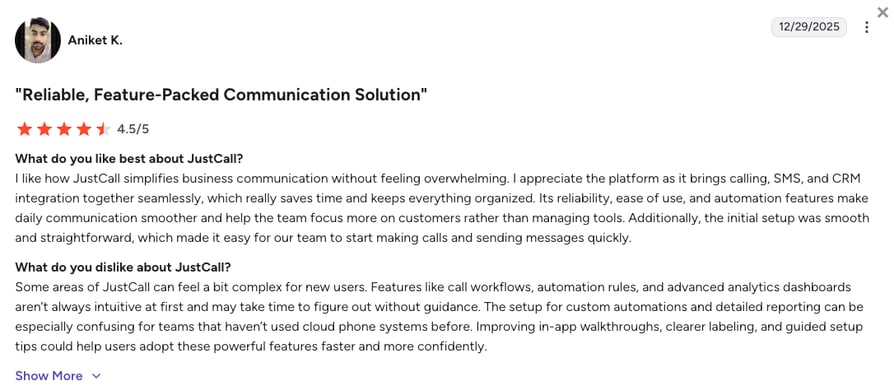
JustCall customers appreciate the powerful sales tools but frequently mention pricing hurdles when they need to scale up to more advanced smart features.
- High Dialing Speed: Sales managers love how the automated dialers keep their reps on the phone talking to live prospects instead of listening to ring tones.
- Time-Saving Automations: Users appreciate that calls and texts log seamlessly into their databases, saving hours of typing work.
- Expensive Feature Jumps: Users report frustration that unlocking basic AI tools requires jumping to a very expensive $89 pricing tier.
How G2 Users Rate JustCall?
JustCall's current G2 rating is 4.3/5, out of 2,300+ verified user reviews.
7. Zoom Phone: Best for Teams on a Budget Wanting Flexible, Pay-As-You-Go Plans
What is Zoom Phone?
Zoom Phone is a highly reliable, budget-friendly business phone system that lives directly inside the familiar Zoom video app. If you are searching for a solid Quo alternative, Zoom Phone leverages a massive video network to offer an incredibly stable phone extension. Zoom Phone is also perfect for teams looking to save money by only paying for the exact minutes they use.
Why Is Zoom Phone a Strong OpenPhone Alternative?
- Pay-As-You-Go Pricing: Zoom offers a unique calling plan starting at exceptionally low rates, preventing solo workers from overpaying for unlimited packages they don't actually need.
- Rock-Solid Network: By riding on Zoom's video technology, the phone service provides incredible stability, completely resolving the five-second audio delays common to Quo.
- Familiar Interface: For businesses already using Zoom for video meetings, adding the phone feature is a totally painless transition that requires zero employee training.
What Are the Pros & Cons of Zoom Phone?
| Pros | Cons |
|---|---|
| Highly affordable metered plans: Perfect for consulting businesses or tech support desks with very low outbound call needs. | Heavy reliance on add-ons: Important features are sold separately, which can quickly drive up your total costs. |
| Rock-solid call stability: Backed by Zoom's world-class global network technology. | Basic support costs extra: Base plan users are left relying entirely on self-service help articles instead of real human support. |
| Frictionless setup: If you already use Zoom, you simply click a new tab in your existing app to start making phone calls. | Not built for sales floors: Lacks the powerful automated dialing tools required by fast-paced sales teams. |
What Are Zoom Phone’s Plans & Pricing?
Zoom Phone pricing starts at $10/user/month (Metered, billed annually), with the following main plans:
- US & Canada Metered - $10/user/month (pay per minute for outgoing calls)
- US & Canada Unlimited - $15/user/month
- Global Select - $20/user/month
The support catch:
While the $10 entry price is fantastic, Zoom requires you to purchase expensive premium add-ons if you want guaranteed access to fast, live human customer service.
What Are Zoom Phone Customers Saying?
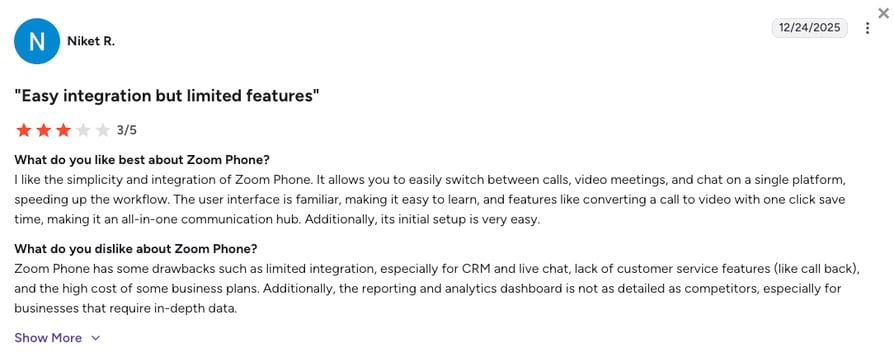
Zoom Phone customers love the ease of use and the low starting price, but note that it feels a bit basic compared to dedicated customer service software.
- Familiar and Easy: Users highlight how easy it is to adopt because everyone already knows how to use the standard Zoom app.
- Great Call Quality: Reviewers consistently praise the clear audio and the total lack of dropped connections.
- Add-on Costs: Managers note that while the base price is cheap, adding international numbers and advanced features makes the bill add up quickly.
How G2 Users Rate Zoom Phone?
Zoom Phone’s current G2 rating is 4.6/5, out of 2,600+ verified user reviews.
8. Allo: Best for Solo Workers Looking for a Modern, Shared Team Inbox
What is Allo?
Allo is a highly polished, modern phone system designed specifically for solo workers, creative agencies, and very small teams. It is built entirely around the concept of a collaborative, shared inbox. For teams exploring OpenPhone alternatives free of robotic interactions, Allo serves as a perfect direct replacement that feels entirely modern.
Why Is Allo a Strong OpenPhone Alternative?
- Maintains the Shared Inbox Feel: Allo perfectly matches Quo's clean visual design, ensuring all team members can easily see and reply to customer texts without confusing menus.
- Profound Technical Honesty: Like all business VoIP solutions, Allo registers numbers as standard business SMS lanes, meaning texts sent to clients will deploy as standard carrier messages rather than blue iMessages. Acknowledging this technical limitation upfront ensures your team can manage customer outreach expectations seamlessly.
- No Forced Robot Voices: Instead of forcing you to use an automated voice receptionist, Allo focuses on highly accurate AI call summaries that save directly into your databases.
- Safe Normal Dialing: User feedback indicates that Allo's network successfully manages normal, everyday dialing without triggering the aggressive spam flags currently plaguing Quo users.
What Are the Pros & Cons of Allo?
| Pros | Cons |
|---|---|
| Sleek modern design: Extremely user-friendly screen that requires absolutely zero training for your team to master. | Lacks complex routing: Not designed for larger teams that require intricate, multi-level phone menus. |
| Great shared inbox: Prevents duplicate text replies and ensures your team works together perfectly on customer issues. | No built-in auto dialers: Lacks the high-speed dialing tools needed by aggressive sales floors. |
| Reliable AI summaries: Useful smart tools are built in naturally without relying on annoying credit charges. | Limited global reach: Number options outside of North America are restricted compared to global leaders. |
What Are Allo’s Plans & Pricing?
Allo pricing starts at $18/user/month (billed annually), with the following main plans:
- Starter - $18/user/month
- Business - $32/user/month
The scalability warning:
Allo is brilliant for tiny teams. However, if you plan to rapidly grow into a 20+ person support desk with complex phone routing needs, you will eventually outgrow its simple design.
What Are Allo Customers Saying?
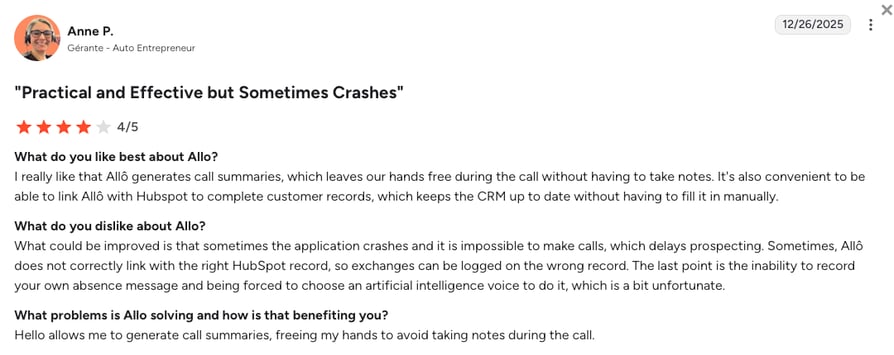
Allo users praise the platform for feeling exactly like a modern messaging app, though larger teams admit they eventually need more advanced tools.
- Great User Experience: Customers constantly rave about the clean, simple design that makes working from a smartphone a joy.
- Perfect Collaboration: Small teams love how easy it is to tag coworkers in a text thread and assign calls without confusion.
- Missing Contact Center Tools: Operations managers note that the platform lacks the deep reporting and complex routing required to run a massive support floor.
How G2 Users Rate Allo?
Allo’s current G2 rating is 4.6/5, out of 200+ verified user reviews.
9. Vonage: Best for IT Teams Looking to Build Highly Customized Phone Setups
What is Vonage?
Vonage Business Communications provides access to a highly reliable, globally established phone network. Rather than just offering a standard app, Vonage is famous for its flexible developer tools. If you are comparing OpenPhone competitors, Vonage is the premier choice for tech departments who want to build custom voice features directly into their own software.
Why Is Vonage a Strong Quo Alternative?
- Custom Phone Menus: Vonage’s flexible building blocks allow IT departments to create highly specific call routing setups that Quo's simple app simply cannot dream of handling.
- Extensive Global Presence: Vonage allows businesses to buy local phone numbers in dozens of countries globally, moving far past Quo's restrictive North American focus.
- Rock-Solid Foundation: It operates on a massive, proven corporate network, permanently solving the dropped calls and five-second audio delays you experience on lightweight apps.
What Are the Pros & Cons of Vonage?
| Pros | Cons |
|---|---|
| Incredible code flexibility: Developers can write custom code to trigger calls and texts directly from inside their own software. | Highly split pricing: Basic features are locked behind expensive, separate monthly add-on fees. |
| Stable global network: Excellent audio quality backed by robust, time-tested corporate technology. | Unpredictable monthly bills: The heavy reliance on extra fees makes the total cost very hard to predict. |
| Strong MS Teams connection: Works seamlessly inside Microsoft Teams, allowing corporate offices to keep their existing tools. | Slow customer service: Users frequently report that getting technical issues resolved can take several days of waiting. |
What Are Vonage’s Plans & Pricing?
Vonage pricing starts at $13.99/user/month (billed annually), but scales quickly based on add-ons:
- Mobile - $13.99/user/month
- Premium - $20.99/user/month
- Advanced - $27.99/user/month
The add-on fatigue:
Be extremely careful during Vonage setup. Essential features that are usually included on standard platforms like simple call queues or call recording often cost hundreds of extra dollars per month as separate add-ons.
What Are Vonage Customers Saying?
Vonage customers appreciate the underlying call quality and the ability to customize everything, but heavily criticize the company's billing practices.
- Great Audio Foundation: Users consistently rate the actual voice quality and network stability very highly.
- Customization Power: Developers love the ability to trigger automated texts and calls directly from their own company software.
- Add-On Frustrations: The biggest complaint is that standard features require paid add-ons, making the cheap starting price highly misleading.
How G2 Users Rate Vonage?
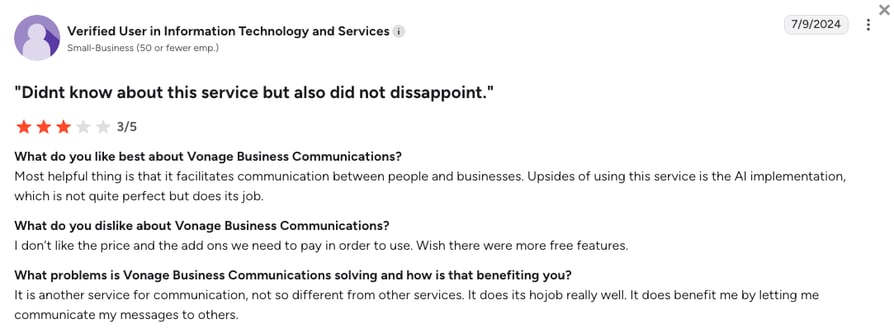
Vonage’s current G2 rating is 4.3/5, out of 500+ verified user reviews.
10. Ringover: Best for International Teams Focusing Heavily on the European Market
What is Ringover?
Ringover is a fast, European-focused cloud phone system that successfully blends standard phone capabilities with strong sales tools. It is heavily favored by mid-sized organizations, especially their recruitment teams operating across varied international borders. Ringover offers a much smoother transition for teams accustomed to Quo's clean design but who require a more UK- or Europe-centric focus.
Why Is Ringover a Strong Quo Alternative?
- Predictable International Calling: Ringover guarantees unlimited calling to 110+ destinations at a fixed monthly price, completely removing the anxiety of unpredictable international fees.
- True All-in-One Inbox: It successfully pulls phone calls, standard text messages, and WhatsApp conversations into a single screen, solving the communication roadblocks experienced on older systems.
- Unrestricted Setup Access: Ringover provides advanced tools like real-time call monitoring dashboards directly on standard plans, avoiding Quo's aggressive paywalls.
What Are the Pros & Cons of Ringover?
| Pros | Cons |
|---|---|
| Unlimited global calling: Removes international cost unpredictability by offering unlimited calls to over 110 countries. | Strict contract terms: Frequently requires strict 12-month upfront financial commitments to get the best rates. |
| All-in-one messaging inbox: Puts voice calls, WhatsApp, and social media perfectly in one place for busy support agents. | Expensive AI add-ons: Unlocking their smart AI tools requires a steep $39/user/month fee. |
| Live agent whispering: Managers can listen to calls and privately advise new agents in real-time without the customer hearing. | Occasional mobile lag: Some users report frustrating refresh issues and minor lag when using the smartphone app. |
What Are Ringover’s Plans & Pricing?
Ringover pricing starts at $21/user/month (billed annually), with the following plans:
- Smart - $21/user/month
- Business - $44/user/month
- Advanced - $54/user/month
Note the AI tax:
Ringover's smart tools are useful but incredibly expensive. Adding their AI tool to the standard Business tier pushes your cost well over $80 per user every month.
What Are Ringover Customers Saying?
Ringover users often praise the speed of setup and the predictable international billing, but note that the contracts can be quite strict.
- Fast Onboarding: Managers appreciate how quickly agents learn the system without needing heavy IT training or reading manuals.
- Great for Coaching: Sales teams love the integrated dialer and live listening tools that help train new recruits directly on the floor.
- Rigid Upfront Costs: Users note that the platform is great, but they disliked having to commit to a strict, upfront annual contract to get the advertised pricing.
How G2 Users Rate Ringover?
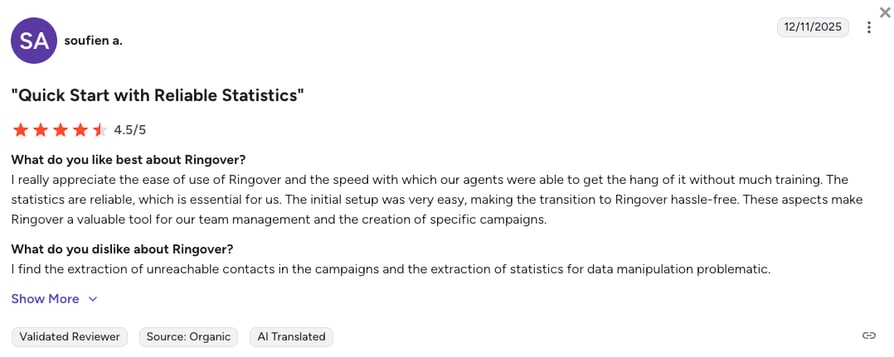
Ringover's current G2 rating is 4.6/5, out of 450+ verified user reviews.
What Users Are Really Saying About Quo Alternatives and Competitors
To give you a clearer picture of the market, we analyzed real conversations across Reddit, Quora, and G2 to understand exactly why growing teams are actively searching for the best Quo alternatives and apps like OpenPhone with more room to scale.
What we found is a clear trend: while Quo's setup works fine for solo workers needing a basic answering service, scaling businesses quickly hit an operational wall. Below is the consensus from managers and founders who had to upgrade their phone systems to protect their daily revenue.
What Redditors Are Asking and Saying about Quo Alternatives
Reddit is a fantastic place to find honest tech opinions. On forums like r/smallbusiness and r/PhoneSystem, users frequently discuss the painful transition away from Quo's service. Here is what they are saying:
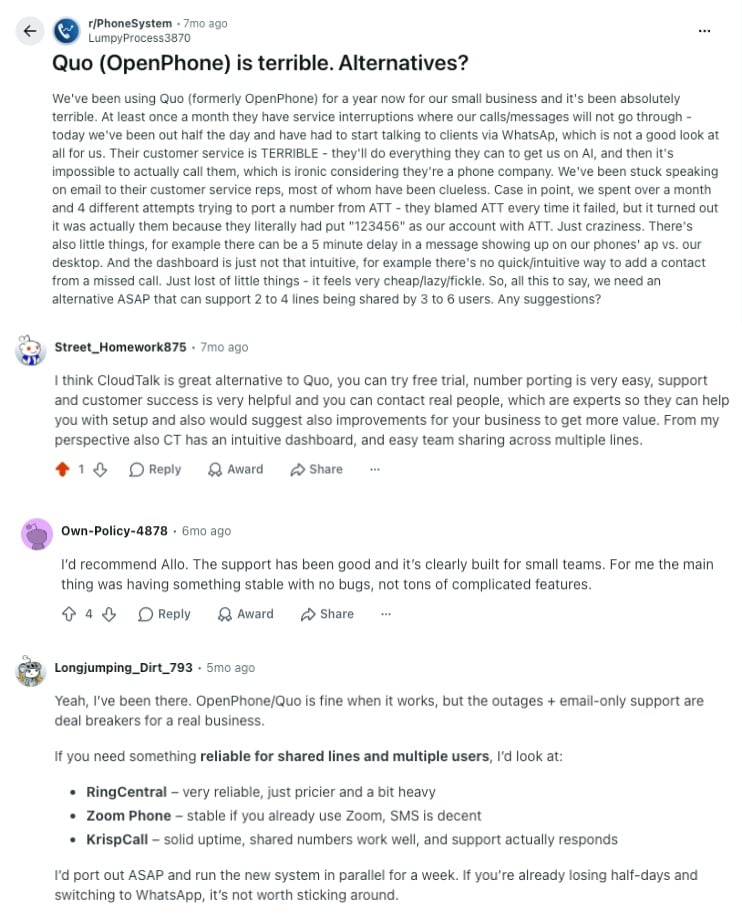
- Service Outages and App Delays: Users frequently report connection drops, 5-minute text syncing lags, and full-day outages that force them onto personal WhatsApp accounts. To fix these reliability issues, Redditors actively recommend switching to CloudTalk, RingCentral, or KrispCall for highly stable shared lines.
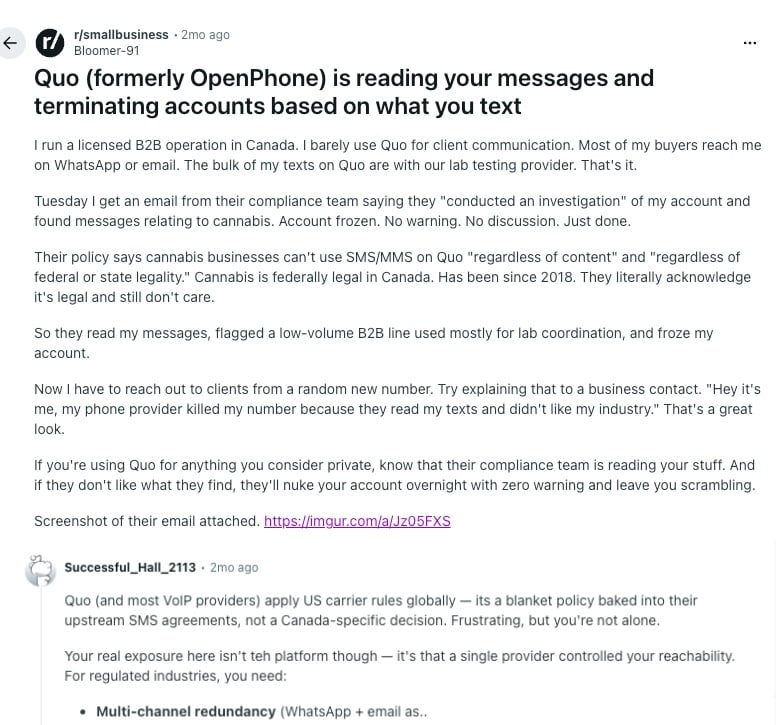
- Sudden Account Bans: Business owners are frustrated by automated compliance bots freezing accounts overnight without warning. While Quo is simply enforcing strict US carrier rules applied globally, the lack of human support leaves users stranded. This drives teams toward platforms with fairer, more transparent compliance policies.
- Poor Customer Service: When technical glitches occur, users report getting stuck in AI chatbot loops or dealing with email-only reps who mishandle simple tasks like number porting. This lack of accessibility pushes teams toward alternatives like CloudTalk and Allo, which offer intuitive setups and immediate access to human experts.
What Quora Users Are Asking about Quo and Its Alternatives
While Quora might not have as many deep technical threads as Reddit, the advice from small business owners looking for functional upgrades is incredibly clear. When looking at what users actually ask about Quo (OpenPhone) and its competitors, these major trends stand out:
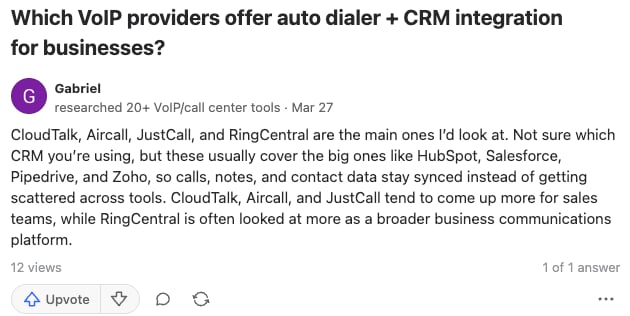
- The Need for Auto-Dialers and True CRM Sync: When sales teams outgrow basic calling apps, they immediately look for platforms with real outbound tools. Because Quo lacks native auto-dialers and locks CRM connections behind premium tiers, Quora experts actively recommend CloudTalk, Aircall, and JustCall. These platforms natively sync with HubSpot and Salesforce, ensuring call notes and contact data stay centralized instead of getting scattered across different apps.
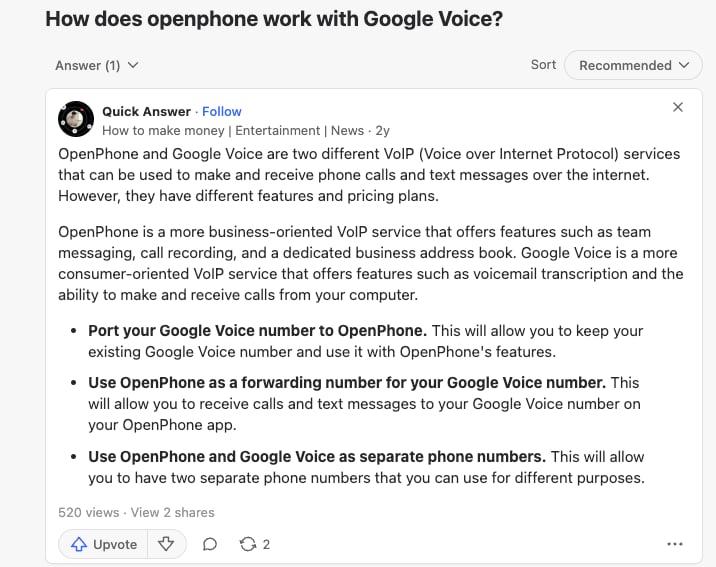
- Flexible Routing and Number Porting: Small business owners frequently ask how to connect OpenPhone (Quo) to external tools like Google Voice, looking for ways to forward calls or port their existing numbers away entirely. As businesses mature, patching together consumer apps becomes frustrating, driving users toward comprehensive platforms that handle business address books, complex routing, and team sharing natively.
What Verified G2 Reviewers Say about Switching from (or to) Quo
G2’s community of verified software buyers focuses heavily on real-world operational results. When analyzing recent reviews of Quo (OpenPhone), the core driver for switching providers is overwhelmingly tied to app instability and dropped calls.
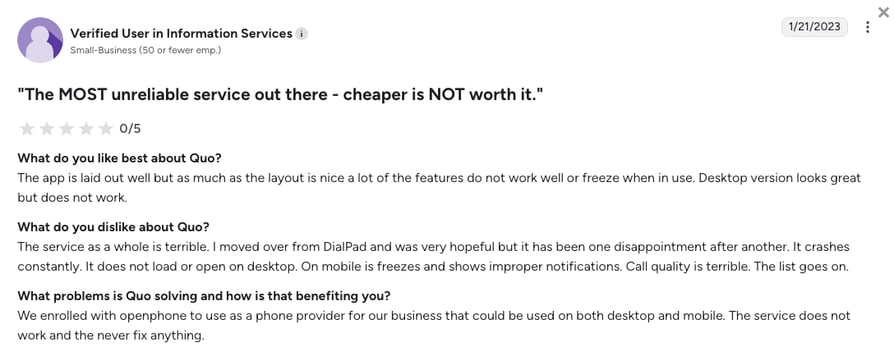
- Severe App Freezes and Regret: While Quo offers a nice layout, users report major foundational issues that disrupt the workday. One verified user who migrated to Quo from Dialpad noted the move was a massive disappointment, citing a desktop app that fails to open, a mobile app that constantly freezes, and terrible overall call quality. To avoid these daily glitches, businesses are actively encouraged to return to highly stable platforms like Dialpad to keep their team online.
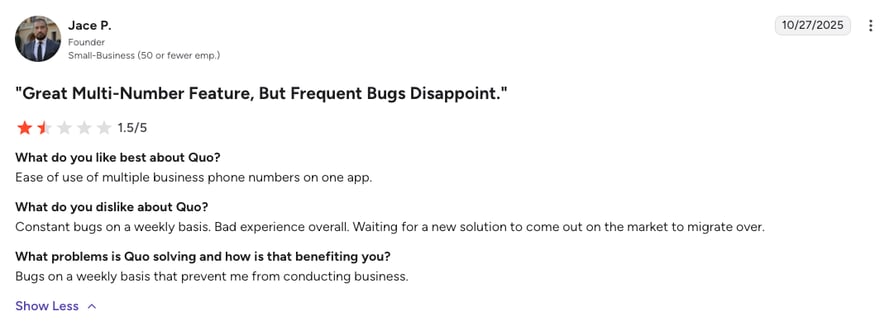
- Weekly Bugs Disrupting Operations: Constant technical issues force small business owners to halt their daily work. Another founder stated that weekly bugs physically prevent them from conducting business, leaving them actively waiting for a new solution to migrate over to. For leaders who cannot afford this level of downtime, upgrading to a rock-solid platform like CloudTalk is a much safer investment.
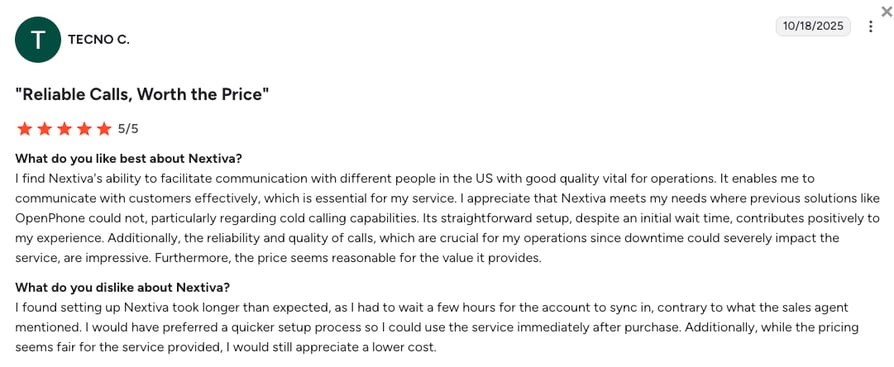
- Upgrading for Outbound Reliability: When users make the switch to enterprise-grade alternatives, the relief is immediate. For example, a user who successfully switched from OpenPhone to Nextiva highlighted that the move finally provided the reliable cold-calling capabilities their operations required. Escaping Quo's network instability for a platform like Nextiva or Aircall guarantees high-quality audio and protects daily revenue.
CloudTalk vs. Quo: Final Head-to-Head Comparison
When choosing between CloudTalk and Quo, the biggest difference comes down to the maturity of your business. Quo acts as a clean, shared inbox for a handful of local team members, while CloudTalk is purpose-built to act as a highly stable, powerful engine for growing sales and customer support desks globally.
Check out this direct, side-by-side comparison of how the two platforms stack up for scaling teams.
OpenPhone vs CloudTalk: The Final Comparison
| Category | CloudTalk | Quo (OpenPhone) | Winner |
|---|---|---|---|
| Ideal Use Case | Scaling SMB & mid-market teams | Solo workers & micro-teams | Depends on business size |
| Starting Price (annual billing) | $25/user/mo | $15/user/mo | Quo |
| Minimum Users | 1 user | 1 user | Tie |
| AI Pricing Model | Flat-rate Add-on ($9/mo) | Metered (100 credits/call) | CloudTalk (predictable budgeting) |
| Call Reliability | 99.999% uptime guarantee | Frequent reports of audio delays | CloudTalk |
| Global Reach | Numbers for 160+ countries | Numbers mostly in North America | CloudTalk |
| CRM Integrations | Native Sync & API (100+ integrations open at Essential tier for $29/mo) | Limited Native Apps & Zapier (Gated on the $23/mo plan) | CloudTalk (deeper sync) |
| Visual Call Flow Builder | Easy drag-and-drop designer | Rigid, basic menus | CloudTalk |
| Smart Auto Dialers | Smart, Preview, Power, and Parallel dialing modes available | Relies entirely on manual dialing | CloudTalk |
| Account Security | Fair, human-reviewed checks | Automated account bans | CloudTalk |
| Customer Service Quality | Fast, human support available (incl. phone on Expert or Custom plans) | Slow, in-app messaging only | CloudTalk |
| G2 Rating | 4.4/5 (1,700+ reviews) | 4.7/5 (3,000+ reviews) | Quo |
| Free Trial | 14 days | 7 days | CloudTalk |
Escaping the "Zapier tax":
Quo is a popular starting point for small setups, but growing teams need highly efficient workflows to scale successfully. Relying entirely on third-party connectors like Zapier to sync hundreds of daily calls creates fragile data paths and high task fees.
CloudTalk solves this challenge by building direct, native connections for major CRM and helpdesk platforms. By automatically passing call logs, tags, and notes straight into your primary tools, your expanding team can stay focused on closing deals and resolving customer problems instead of wasting hours on manual data entry.
How to Choose the Best Quo Alternative for Your Team?
When choosing the right OpenPhone alternative, you must think about your specific business roadblocks rather than just looking at a feature list. Based on community questions and search trends, here is how to match your business needs to the right platform:
1. What Is the Best Quo Alternative for Predictable Billing?
If you are tired of Quo charging your account credits every time an automated voice answers the phone, you need a platform with clear monthly plans.
- Top Picks: CloudTalk is the best alternative because it offers unlimited call summaries and sentiment tracking via a predictable, flat-rate monthly Conversation Intelligence add-on. Dialpad is also a great choice if you want live coaching tools built directly into your base price.
2. Which Quo Alternative Has the Best Customer Database Sync?
If your team is losing time manually typing notes because Quo locks basic database connections behind a paywall, you need a system with true two-way software syncing.
- Top Picks: CloudTalk is fantastic here, using advanced syncing technology on its standard plans to ensure every call saves perfectly into tools like HubSpot or Salesforce. Aircall is another strong option, offering a massive marketplace of easy-to-install app connections.
3. What Is the Best Quo Alternative for Global Calling?
If you are attempting to expand your operations outside of the US and Canada and find Quo's international number availability too restricted or expensive, several alternative platforms offer significantly deeper global routing options.
- Top Picks: CloudTalk wins this category easily, providing high-quality local phone numbers in over 160 countries backed by a robust, multi-carrier network that guarantees clear audio handoffs. Ringover is an excellent secondary option if your revenue desk focuses heavily on calling into the European market.
4. Are There Quo Alternatives Without Sudden Account Bans?
If Quo's automated security bots have wrongfully flagged your business texts as spam and locked your team out of the app, you need a platform that values real human support.
- Top Picks: CloudTalk completely replaces that automated nightmare with fair security checks and highly responsive human support teams. JustCall is also excellent for ensuring your team's outgoing text messages deliver safely without triggering network alarms.
5. Dialpad vs CloudTalk vs Quo: Which is Best for Sales?
If your main goal is aggressive outgoing sales and you are comparing Dialpad, CloudTalk, and Quo, you need a tool built for speed and automation.
- Top Picks: While Quo relies entirely on slow manual dialing, CloudTalk gives the best overall value for sales teams by offering built-in smart dialers that automatically queue up the next phone number. JustCall is another leading choice for fast-paced sales floors needing powerful automated texting features.
6. Overall, What Is the Best Quo Alternative Worth Switching To?
If you run a growing business looking to replace Quo's audio delays, hefty AI fees, and sudden account bans with a highly reliable phone system, CloudTalk is the clear choice.
- Top Picks: CloudTalk stands out as the ultimate Quo upgrade for small and mid-sized businesses. It gives your growing team the perfect mix of rock-solid reliability, clear pricing, and smart tools without the bloated costs of older corporate software.
Ready to Make the Switch from Quo?
As verified user reviews across platforms like G2, Reddit, and Quora clearly show, growing teams typically leave Quo because of three massive roadblocks. They face constant five-second audio delays, sudden automated account bans, and highly confusing AI credit charges.
Here’s what switching from Quo to CloudTalk gets you immediately:
- Rock-Solid Uptime: Move from Quo's delayed audio network to CloudTalk’s massive global network, securing a 99.999% uptime guarantee and perfect call clarity in over 160 countries.
- Predictable Billing: Stop stressing over confusing AI charges and unexpected paywalls. CloudTalk includes your essential call center tools and offers smart AI features as transparent, flat-rate add-ons, keeping your monthly invoices completely predictable.
- Zero Automated Lockouts: Replace Quo's frustrating automated account bans and chat-only help desk with a safe platform backed by a fast, 24/7 human support team.
- Automated Workflows: Ensure every call and text saves perfectly into your customer database without any manual typing from your reps, thanks to standard two-way software syncing.
Escape the unpredictable costs today
Frequently Asked Questions
about Quo (OpenPhone) Alternatives
Find quick, straightforward answers to the most common questions businesses have about Quo and its top competitors.
Quo is a shared mobile business phone app that recently changed its name from OpenPhone. While it started as a highly affordable shared inbox for solo workers, it has recently shifted heavily toward offering an automated, credit-based AI answering service.
Businesses switch from Quo to escape constant five-second audio delays, sudden account bans, and confusing AI charges. As teams grow, they need a highly stable platform like CloudTalk that guarantees clear calls. They also want to connect easily to their customer databases without paying unexpected fees.
CloudTalk is the best overall Quo alternative in 2026, especially for growing sales and support teams (SMB to mid-market). It replaces Quo's laggy audio with a highly reliable global network and provides flat-rate AI tools instead of charging credits per call. CloudTalk also offers local numbers in over 160 countries for growing international teams (note: Quo mainly offers numbers for North America).
Over time, CloudTalk offers a significantly lower Total Cost of Ownership (TCO) for active, expanding teams. While Quo leverages a low $15 entry price, it monetizes heavily through complicated per-call AI credit fees and forces immediate upgrades to access basic software links. CloudTalk relies on completely predictable, flat-rate tiers and fixed add-ons. By stepping up to CloudTalk's integrated plans, active teams avoid surprise metered invoices and additional data-logging penalties.
While we wouldn’t call them hidden fees, Quo runs its Sona AI feature (essentially an AI receptionist) on a highly confusing credit system. The platform charges exactly 100 credits for every single automated call regardless of how short the conversation is. This setup can rapidly drive up your monthly bill if you have high call volumes.
Yes, Quo is HIPAA-compliant, meaning it can protect healthcare data, but only under strict conditions. It requires businesses to upgrade past the basic Starter plan to the expensive Business or Scale plans. You must also formally request signed legal documents, making the cheap starting plan completely unprotected.
While no professional, enterprise-grade phone system is completely free of charge, budget-conscious teams frequently evaluate modular alternatives like Zoom Phone (starting at $10/user/mo) or modern setups like KrispCall (starting at $12/user/mo).
However, to secure true bi-directional CRM syncing, automated dialing, and clear audio paths without hitting credit paywalls, investing in a dedicated SMB and mid-market provider like CloudTalk is the safest way to protect your revenue pipelines.
CloudTalk and Aircall are the strongest competitors for Salesforce and HubSpot users. Both platforms use advanced, two-way syncing technology to ensure every call and text is saved automatically into your database. This completely removes the need for your workers to type notes manually.
Yes, you can absolutely move your existing business phone numbers away from Quo to a new platform like CloudTalk. The new provider handles all the complex technical transfer paperwork for you. This ensures your business does not lose service during number porting.
Transferring a number away from Quo typically takes between three to ten business days. You will need to log into Quo's support center to submit a specific transfer request form. This form must include your account email, your new provider details, and a transfer PIN to complete the process.
CloudTalk is widely considered better than OpenPhone for growing sales and support teams. It eliminates the audio delays and automated account bans that current OpenPhone users experience. CloudTalk also provides a much wider global reach and does not charge extra credits every time you use a smart AI feature.
Yes, Quo provides UK numbers, but their international coverage is heavily limited compared to other providers. If you need a reliable OpenPhone UK alternative or numbers in places like Australia, platforms like CloudTalk or Ringover are much better options. These virtual UK number providers offer extensive international calling without unexpected fees.
CloudTalk and Zoom Phone are excellent options for consultants who need reliable call recording. Unlike Quo, which can struggle with audio delays, these platforms ensure your client calls are recorded with perfect clarity. CloudTalk also automatically saves these recordings directly into your customer database.
Quo (formerly OpenPhone) is built for calling and texting from app-based numbers rather than automated outbound dialing, so high-volume teams work through call lists manually and often trip its spam-flagging filters. CloudTalk runs a native power dialer on the Expert plan and offers a parallel dialer as an add-on, both pulling numbers straight from your customer database.
CloudTalk suits front-desk teams that need shared lines and dependable routing without per-call AI charges. Its call flow designer builds ring groups, phone menus, and business-hours rules by dragging blocks into place, while the AI receptionist answers overflow calls for a fixed monthly fee instead of draining credits per interaction.