
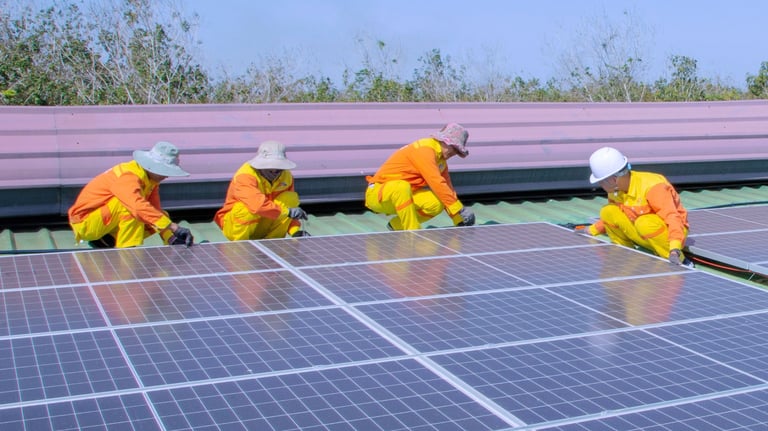
A solar installer knocks on a door outside Barcelona. The customer is interested, books a visit, then postpones it. The appointment lands in a database, gets a couple of days of follow-up, and goes cold.
Vira Energy exists to call those people back. Its SDRs used to do it one number at a time, clicking a phone number in Salesforce and dialling it in a separate tool.
Vira Energy is the outbound team for Spanish solar installer ESR. After moving to parallel dialing in CloudTalk's AI Sales Dialer, the same seven reps went from around 120 effective conversations a day to roughly 220, and lifted booked visits from about 20 a day toward 30.
About Vira Energy
Vira Energy is a commercial brand of ESR, a company with around eight years in Spain's photovoltaic market. ESR wins customers the hard way, door to door, neighbourhood by neighbourhood. That model creates a large pool of visits that never close: appointments postponed, cancelled, or held with no sale. All of it lands in the database and, historically, went cold after a couple of days of follow-up.
Vira Energy was created in November 2024 to change that.
A lead is worth gold.
Isaac coordinates Vira's SDR team, whose job is to reheat those cold leads, rebuild the conversation, and book the visit. He stood up the SDR function in June 2025, bringing five years of experience in database management, follow-up and phone-based booking.
Problem
The team already had a working process. It just wasn't fast enough. Reps clicked a phone number in Salesforce, then dialled it in a separate tool, one call at a time.
The old process worked, but you can always do better. It was click the number in the CRM and call, one call at a time.
Those few seconds between the CRM and the dialler added up across hundreds of calls. Vira needed a dialler that removed the dead time so reps could spend it talking to people instead.
Evaluation
The search didn't start with Isaac.
It wasn't me who found CloudTalk. Our IT lead, Jordi Zamora, brought it to us.
The team compared several providers offering a similar service before deciding to trial CloudTalk. Getting started took real work. Isaac made calls himself during the trial to learn how dispositions, tags and campaigns behaved, and to spot what still needed fixing.
Like any new system, there were things to fine-tune. It took about two weeks for everyone to adapt to handling several calls at once and to the new interface.
Solution
Vira runs CloudTalk's AI Sales Dialer with parallel dialing at two lines per rep, the sweet spot for their audience, where more lines started to hurt call quality. Seven of Vira's nine SDRs use CloudTalk daily; the other two work digital channels. It's wired into Salesforce, which stays Isaac's reporting hub through the integration.
Beyond the dialler, two features shape how Isaac runs the floor.
Call monitoring lets him coach in real time.
With call monitoring I can jump into a call, listen, step in and talk to the rep or to both. I use it a ton.
Team-based campaigns let him steer coverage.
I created a team for Barcelona and a team for Valencia, so I can move reps between campaigns depending on where I'm short on visits.
Results
Adding parallel dialing changed what Vira measures. The old metric was how many calls a rep could dial. The new one is how many people they actually talk to.
Effective conversations nearly doubled, with the same team.
We went from an average of 120 to an average of 220 effective calls a day, with the same team, simply by having parallel dialing.
Each rep talks to more people. Effective calls per rep rose from a ceiling of 20 to 23 a day to an average of 32, and dialling capacity reached around 500 calls a day per rep.
Booked visits followed. They moved from an average of about 20 a day toward 30, with 40 as the next target.
With the same number of people, we're talking to more people and booking more visits.
The next step is inbound. Vira plans to grow the SDR team to work the database harder, and Isaac is looking at CloudTalk's AI voice agents for the calls his outbound team can't catch today.
We only make outbound calls right now, and there are a lot of customers trying to call us back.
He sees AI handling those inbound calls, taking a message or booking a visit, while the human team keeps doing the warm, empathetic reheating of cold leads.