Aircall vs. FrontSpin: Which Sales Dialer Fits Your Team in 2026?
TL;DR: Aircall vs. FrontSpin
Aircall and FrontSpin solve different problems. Aircall is a general-purpose cloud phone system for sales and support teams that want calling, IVR, and 100+ integrations in one app. FrontSpin is a specialized outbound power dialer built around Salesforce and high-volume SDR workflows.
- Choose Aircall if you need one phone system for both inbound support and outbound sales, with published pricing from $30/user/month (3-seat minimum).
- Choose FrontSpin if you run a Salesforce-native outbound team and want a purpose-built power dialer with local presence and playbooks (pricing is quote-only).
- Consider CloudTalk if neither trade-off fits: it combines inbound support, outbound dialing (power + parallel), live coaching, and native Salesforce/HubSpot/Pipedrive sync from $25/user/month with no seat minimum.
On paper, Aircall and FrontSpin sit in the same category: software your reps use to make and manage sales calls. In practice, they're built for different teams. Aircall consolidates business telephony — shared inboxes, IVR, call routing, and a large integration marketplace — into a single platform used by sales and support alike. FrontSpin narrows in on one job: helping Salesforce-based SDR teams dial through outbound lists faster with playbooks, local presence, and one-click voicemail drop.
That difference in focus shapes everything downstream: pricing models, coaching tools, integrations, and which teams each product actually serves well. This comparison walks through features, coaching, pricing, integrations, security, usability, and real user reviews — so you can match the platform to your use case rather than to a marketing page. Where relevant, we also show how CloudTalk compares on the same dimensions, since it overlaps with both tools.

Outbound dialing, inbound support, and AI coaching in one platform—see CloudTalk live

Aircall Features vs. FrontSpin Features
Aircall Features
Aircall consolidates business calling for sales and support teams into one app: a shared call inbox, IVR and automated routing built with its Smartflows editor, and a marketplace of 100+ integrations spanning CRMs, helpdesks, and productivity tools. It's designed to be the phone layer for the whole company, not just the outbound floor.
What Aircall Does Well
- Shared call inbox and call notes: Teams see, assign, and comment on calls collaboratively, keeping follow-ups from slipping.
- IVR and automated routing (Smartflows): A visual call-flow builder lets admins set up menus and routing without developer help.
- 100+ integrations: Native connectors for Salesforce, HubSpot, Zendesk, Slack, and dozens of other tools across sales and support stacks.
- Works for inbound and outbound: One platform covers support queues, sales dialing, and everything between — rare among outbound-first dialers.
- Unlimited concurrent calls: No cap on simultaneous calls per number, useful for high-volume inbound periods.
Where Aircall Falls Short
- 3-seat minimum on every plan: A 1–2 person team still pays for 3 licenses — a true entry cost of $90/month before a single call.
- AI sold separately: Real-time coaching and live transcription require the AI Assist Pro add-on at $49/license/month — nearly the price of a second seat.
- No parallel dialer: The power dialer is gated to the Professional plan, and there's no multi-line parallel dialing at any tier.
- Basic analytics on core plans: Granular filters and unlimited history require the Analytics+ add-on ($15/license/month) or the 25-license Custom plan.
FrontSpin Features
FrontSpin is a cloud power dialer and sales communication platform built around Salesforce. Its architecture centers on playbooks — structured sequences combining calls, emails, and social touches — executed through a low-latency dialer designed to minimize the connection delay that hurts answer rates. Since February 2026, FrontSpin operates as a standalone business under TitanX, which acquired it to pair the dialer with its "phone intent" data engine.
What FrontSpin Does Well
- Local presence dialing: Calls display local numbers to prospects, a proven lever for lifting connect rates on cold outbound.
- One-click voicemail drop: Reps leave pre-recorded voicemails instantly and move to the next dial, saving 30+ seconds per unanswered call.
- Account-based playbooks: Multi-channel sequences (call, email, social) keep SDRs executing a consistent motion across target accounts.
- Native Salesforce sync: Real-time call logging and activity sync eliminate manual data entry — the most-praised theme in FrontSpin's reviews.
- Live whisper coaching: Managers can listen in and coach reps mid-call without the prospect hearing.
Where FrontSpin Falls Short
- Salesforce-first integration model: Documented integration depth outside Salesforce is limited — HubSpot- or Pipedrive-first teams should demo their specific stack before committing.
- Outbound-only focus: No meaningful inbound support use case — support queues, IVR trees, and shared inboxes aren't what it's built for.
- No published pricing: Pricing is quote-only, making it hard to budget or compare without a sales cycle.
- Post-acquisition roadmap questions: TitanX plans to unify the platforms over time; prospective buyers should ask how contracts, support, and roadmap are affected mid-term.
Feature-by-Feature Comparison
Feature-by-Feature Comparison
| Feature | Aircall | FrontSpin | CloudTalk |
|---|---|---|---|
| Primary CRM integration | Salesforce, HubSpot + 100+ apps | Salesforce (native, deep) | Salesforce, HubSpot, Pipedrive — native two-way |
| Dialing modes | Power dialer (Professional only) | Power / list-based dialer | Power + parallel dialer (3–5 lines) |
| Local presence dialing | Not native | Native | Local numbers in 160+ countries |
| Voicemail drop | Available (Professional) | One-click, native | Native |
| Live monitoring / whisper | Gated to higher tiers | Whisper coaching included | Listen / whisper / barge on SMB plans |
| Playbooks / sequences | Via integrations | Native multi-channel playbooks | Dialer campaigns + workflow automation |
| IVR & routing | Smartflows visual builder | Not a focus (outbound-only) | Advanced visual flow builder |
| Shared inbox | Yes — team-wide | No | Yes, incl. shared SMS inbox |
| Inbound support use case | Yes — core strength | No | Yes — queues, callbacks, SLAs |
| AI transcription & summaries | Add-on ($49/license/mo for Pro tier AI) | Not core; via TitanX roadmap | Native, bundled in Expert plan |
Coaching & Call Monitoring: Aircall vs. FrontSpin
Live coaching is the fastest lever for ramping new reps and lifting close rates: a manager who can hear a call as it happens — and whisper guidance without the prospect knowing — compresses weeks of trial-and-error into a single conversation. The two platforms diverge sharply here. FrontSpin includes whisper coaching as part of its outbound-manager toolkit, while Aircall gates its most useful coaching features (and all real-time AI assistance) behind higher tiers and the paid AI Assist Pro add-on. Neither platform offers native AI call scoring today.
Coaching & Monitoring Compared
| Dimension | Aircall | FrontSpin | CloudTalk |
|---|---|---|---|
| Live call listening | Available, tier-gated | Available | Available on SMB-friendly plans |
| Whisper coaching | Higher tiers / add-on | Included — core strength | Included |
| Barge-in | Tier-gated | Limited documentation — verify on demo | Included |
| Call scoring / QA | No native AI scoring | No native AI scoring | Native AI call scoring |
| Post-call analytics for coaching | Available; depth needs Analytics+ add-on | Call outcome reporting, less granular | Live + historical, fully filterable |
Aircall Pricing vs. FrontSpin Pricing
Aircall Pricing
Aircall's pricing starts at $30/user/month (billed annually) with a mandatory 3-license minimum on both core plans — a true entry cost of $90/month before a single call is made:
- Essentials: $30/user/month billed annually ($40 monthly). Core calling, IVR, and integrations; power dialer not included.
- Professional: $50/user/month billed annually ($70 monthly). Adds the power dialer, advanced routing, and unlimited recording retention.
- Custom: Quote-only, with a 25-license minimum. Unlimited outbound calls, API developer support, custom onboarding.
- Key add-ons: AI Assist Pro (real-time coaching and live transcription) at $49/license/month; Analytics+ at $15/license/month; extra numbers at $6/month.
FrontSpin Pricing
FrontSpin does not publish pricing. Plans are per-seat and quote-only — you'll need to go through a sales conversation to get a number, which makes budgeting and comparison harder than with Aircall's published tiers.
Third-party estimates exist, but we won't repeat unverified figures here; request a current quote directly, and ask specifically whether pricing, contract terms, or support tiers have changed following the February 2026 TitanX acquisition. TitanX has stated FrontSpin continues as a standalone business with no immediate customer disruption, but the companies plan to unify the platforms over time.
What to Budget for Beyond the Base Rate (Both Platforms)
- Seat count and minimums: Aircall's 3-seat floor (25 on Custom) means small teams pay for capacity they don't use; confirm FrontSpin's seat minimum in your quote.
- Add-on features: On Aircall, real-time AI coaching ($49/license) and advanced analytics ($15/license) are paid extras that can push a Professional seat past $100/month all-in.
- Contract length and billing cadence: Aircall's monthly billing runs roughly 25–33% above annual rates; quote-only vendors like FrontSpin typically expect annual commitments — negotiate exit and true-down terms up front.
Pricing Compared Line by Line
Pricing Compared Line by Line
| Pricing dimension | Aircall | FrontSpin | CloudTalk |
|---|---|---|---|
| Pricing transparency | Published tiers | Quote-only | Published tiers, no quote-gate |
| Lowest entry price | $30/user/mo (annual) | Not published | $25/user/mo |
| Seat minimum | 3 seats (25 on Custom) | Confirm in quote | None — 1 user works fine |
| True minimum monthly spend | $90/mo (3 × $30) | Unknown without quote | $25/mo (1 seat) |
| AI included in plan | Separate add-on ($49/license) | Not core today | Bundled in Expert plan |
| Contract terms | Annual-first; monthly costs ~25–33% more | Negotiated per quote | Monthly billing available |
Transparent Pricing. No Seat Minimum. AI Included.
Aircall Integrations vs. FrontSpin Integrations
Aircall Integrations
Aircall maintains one of the larger integration marketplaces in the category — 100+ connectors spanning CRMs (Salesforce, HubSpot, Pipedrive, Zoho), helpdesks (Zendesk, Intercom, Freshdesk), and productivity tools (Slack, Microsoft Teams). Calls, recordings, and notes log to the connected system, though reviewers note sync depth varies by connector, with occasional delays and late-arriving data reported at scale. Salesforce and power-dialer workflows require the Professional tier.
FrontSpin Integrations
FrontSpin takes the opposite approach: fewer integrations, but deep ones. Its Salesforce sync is native and real-time — call logging, activity capture, and list building happen without manual entry, and it's consistently the most-praised aspect of the product in user reviews. Directories list additional connectors (Gong, Calendly, Vidyard), but real-world usage is overwhelmingly Salesforce-centric. If your CRM is HubSpot or Pipedrive, request a live demo of that exact integration before signing — documented depth outside Salesforce is thin.
Integration Capability Compared
Integration Capability Compared
| Integration capability | Aircall | FrontSpin | CloudTalk |
|---|---|---|---|
| Total native integrations | 100+ (breadth-first) | Salesforce-first, narrow | 100+ (deep CRM focus) |
| Salesforce sync depth | Native CTI (Professional tier) | Native, real-time — core strength | Native CTI |
| HubSpot / Pipedrive support | Native connectors; sync delays reported | Limited documentation — demo first | Native two-way, real-time |
| Developer requirement | Often needed for advanced flows | Low within Salesforce scope | None — admin self-serve |
| Workflow automation | Relies on Zapier for complex flows | Playbook-scoped | Native HTTP + CRM actions, no Zapier |
Security & Compliance: Aircall vs. FrontSpin
Aircall Security & Compliance
- GDPR compliant with a Data Processing Agreement available
- SOC 2 certified infrastructure
- Encryption in transit for calls and data
- SSO available on higher tiers; SLAs and unlimited analytics retention gated to the Custom plan
Verify current certifications on Aircall's security page before purchase, as scope and tier availability change.
FrontSpin Security & Compliance
FrontSpin does not publish extensive compliance documentation compared to larger platforms. Its dialing infrastructure supports enterprise compliance controls and call-outcome logging, but public detail on certifications (SOC 2, GDPR tooling, data residency) is limited. Rather than guess, ask FrontSpin/TitanX directly for current security documentation during evaluation — and treat anything not confirmed in writing as unavailable.
Security & Compliance Compared
Security & Compliance Compared
| Security & compliance | Aircall | FrontSpin |
|---|---|---|
| GDPR compliance | GDPR compliant, DPA available | Not publicly documented |
| SOC 2 certification | SOC 2 certified | Not publicly documented |
| Encryption | Standard encryption in transit | Not publicly documented |
| SSO / SAML | Available, higher tiers | Not publicly documented |
| Data residency | Regional options; confirm per contract | Not publicly documented |
For regulated-industry readers: CloudTalk covers GDPR (DPA with SFTP export), SOC 2 Type II, and HIPAA tooling across plans rather than gating them to enterprise tiers.
Usability & Developer Experience: Aircall vs. FrontSpin
Aircall Usability
- Fast onboarding: Teams are typically live within hours; among the fastest first-day setups in the category.
- Low learning curve: A clean, minimal UI that new reps pick up without formal training.
- Covers both motions: Works across inbound and outbound workflows without heavy configuration — though admins report routing confusion as call-flow complexity grows.
FrontSpin Usability
- Purpose-built outbound UI: The interface is optimized for dialing sequences — reps report it loads faster than working directly in Salesforce.
- Tightly coupled to Salesforce workflows: Efficient if Salesforce is your system of record; constraining if it isn't.
- Not built for inbound: Teams that also handle support or inbound sales calls will need a second system.
Usability & Scalability Compared
Usability & Scalability Compared
| Dimension | Aircall | FrontSpin |
|---|---|---|
| Setup time | Hours — fastest in category | Days — list/playbook configuration required |
| Learning curve | Very low — clean, minimal UI | Low for reps; interface described as dated by some users |
| Inbound support suitability | Strong — core use case | Not suitable |
| Outbound sequence depth | Basic; relies on integrations | Deep — native playbooks |
| Scalability for growing teams | Good, but routing confusion reported at scale | Scales for outbound; single-purpose |
Both platforms specialize in one direction — Aircall as a general-purpose phone system, FrontSpin as an outbound-only dialer. CloudTalk covers inbound support, outbound sales, and coaching in one platform, if you'd rather not choose.
Aircall Reviews vs. FrontSpin Reviews on G2
G2 and TrustRadius are the most widely used peer-review platforms for B2B software, and both list the two products. One honesty note before the numbers: FrontSpin's review base is a small fraction of Aircall's, so its scores carry more sample-size noise — a handful of new reviews can move the average. Treat the qualitative themes as more reliable than the decimal points.
G2 Ratings Compared
G2 Ratings Compared
| Review dimension | Aircall | FrontSpin |
|---|---|---|
| Overall G2 rating | 4.4/5 | ~4.3/5 |
| Review count | 1,500+ verified reviews | Far smaller base; low recent review velocity |
| Most-praised theme | Intuitive UI, Smartflows builder, CRM integrations | Salesforce sync, dialing speed, support responsiveness |
What Real Users Say About Aircall on G2
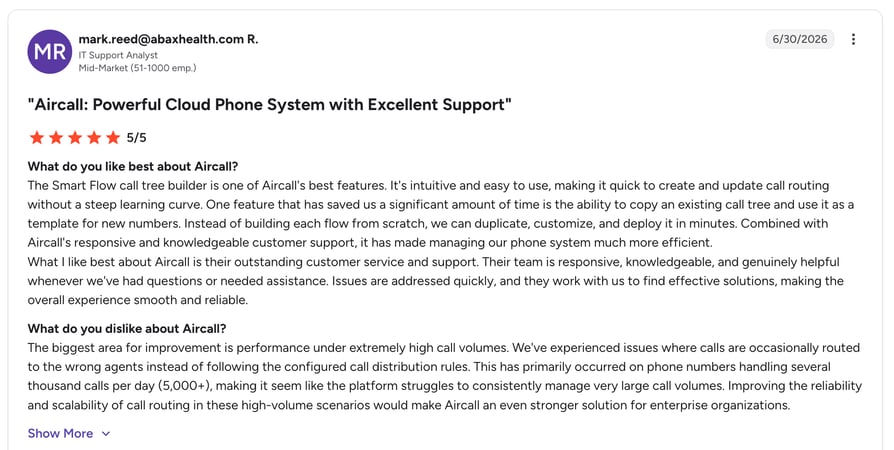
A verified G2 reviewer praises the Smart Flow call-tree builder as "intuitive and easy to use," noting it makes call routing quick to create and update without a steep learning curve. Another verified reviewer working with Aircall's data side values the platform's call analytics and real-time dashboards, but reports that incremental data sync occasionally delivers late-arriving data and that historical backfills run slow — a relevant caveat for RevOps teams that treat the CRM as the source of truth. Across review sites and Reddit, the recurring negative themes are billing practices, the 3-seat minimum, and support response times rather than the product's core calling experience.
What Real Users Say About FrontSpin on G2
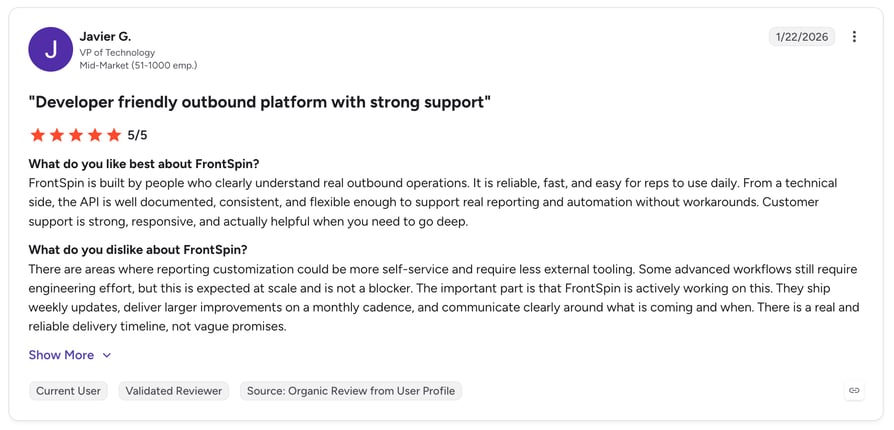
The positive reviews are emphatic: one verified G2 reviewer calls FrontSpin "an exceptional tool" that transformed their SDR team's lead-generation motion. The critical reviews are equally direct: another G2 reviewer managing an SDR team describes daily glitches, contacts jumping between cadence steps without reason, and an outage that deleted cadences company-wide — with support described as unresponsive during the incident. On Capterra, a verified account executive reports the software "crashes all the time," while a sales manager on the same platform credits the automated activity tracking and call recording with making rep coaching measurably easier. The pattern: when FrontSpin works, outbound teams love the speed; stability and support consistency are the risk factors to pressure-test in a trial.
Aircall vs. FrontSpin Reviews on Reddit & Quora
Community discussions add texture the review sites miss. On Reddit, Aircall threads cluster around two topics: genuine praise for day-one simplicity, and frustration with billing — unexpected charges, difficulty removing unused seats mid-contract, and the cost of the seat minimum for small teams. FrontSpin comes up less often, but the sentiment is consistent: users describe it as one of the better dialers they've tried while simultaneously calling the interface clunky and dated. That combination — strong function, aging form — matches the G2 pattern. Neither product generates significant Quora discussion; for FrontSpin especially, the thin community footprint means a hands-on trial matters more than crowd-sourced opinion.
Aircall vs. FrontSpin: Which Fits Your Team
| Aircall is the right call if... | FrontSpin is the right call if... |
|---|---|
| You need one phone system for support and sales together | You run a dedicated outbound SDR/BDR floor |
| Your stack spans many tools and you want 100+ connectors | Salesforce is your single system of record |
| You value published pricing and fast self-serve setup | You'll trade a sales cycle for a purpose-built dialer |
| You have 3+ agents (the seat minimum is a non-issue) | Local presence and voicemail drop are must-haves |
| Shared inbox and IVR matter more than dialing speed | Playbook-driven multi-channel sequences drive your motion |
Aircall vs. FrontSpin: The Verdict
The choice between Aircall and FrontSpin comes down to use case and CRM ecosystem, not platform quality. Aircall is a general-purpose business phone system that happens to do outbound; FrontSpin is an outbound machine that doesn't try to be anything else. Pick based on which motion drives your revenue.
Choose Aircall if you…
- Run a team of 3+ that handles both inbound support and outbound sales on the same system
- Need a shared call inbox, IVR menus, and queue management out of the box
- Want a large integration marketplace (100+ apps) across CRM, helpdesk, and productivity tools
- Prefer published pricing and a self-serve trial over a quote-driven sales cycle
- Value first-day simplicity and minimal training for new agents above dialing depth
Choose FrontSpin if you…
- Run a Salesforce-native outbound team where dialing volume is the core motion
- Need local presence dialing and one-click voicemail drop to protect connect rates
- Want account-based playbooks combining calls, email, and social steps in one sequence
- Have managers who coach live via whisper during rep calls
- Are comfortable with quote-only pricing and will verify post-acquisition contract terms up front
The bottom line: both platforms are strong at what they're built for; the deciding factor is your use case and CRM ecosystem, not the product itself. And if neither trade-off fits — Aircall's add-on-priced AI and seat minimum, FrontSpin's opaque pricing and Salesforce-only focus — CloudTalk covers inbound and outbound calling, live coaching with AI call scoring, and native Salesforce, HubSpot, and Pipedrive sync in one platform. Worth a look.
Why Choose When One Platform Does Both?
Frequently Asked Questions About Aircall vs. FrontSpin
Aircall's main competitors are CloudTalk, Dialpad, JustCall, RingCentral, and Nextiva in general business calling, plus outbound specialists like FrontSpin. See the full list of Aircall alternatives compared side by side.
FrontSpin doesn't publish pricing — plans are per-seat and quote-only, so you'll need a sales call for a number. For a published-price comparison point, see CloudTalk's pricing, which starts at $25/user/month.
Yes — Aircall is an established platform used by 22,000+ businesses, rated 4.4/5 on G2 across 1,500+ reviews. Complaints center on billing practices and seat minimums, not legitimacy. Read our full Aircall review for details.
FrontSpin is a power dialer — it calls one contact at a time from a list. A parallel dialer runs 3–5 simultaneous lines, multiplying connects per hour. For high-volume cold outbound, that difference matters a lot.
For pure Salesforce outbound, FrontSpin's native sync, playbooks, and local presence are purpose-built for the job. If the same team also handles inbound, a hybrid like Aircall or CloudTalk with native Salesforce CTI avoids running two systems.
Yes — that's the exact gap between these two. CloudTalk combines inbound queues and IVR, power + parallel dialing, and listen/whisper/barge coaching with AI call scoring, from $25/user/month with no seat minimum.
Yes. TitanX acquired FrontSpin in February 2026 and states it continues as a standalone business with no service interruption, with the platforms unifying over time. Ask how your contract, support tier, and roadmap are affected before signing a business phone system deal.