10 Best Callback Software Tools in 2026: Tested and Compared
TL;DR: The Best Callback Software
"Callback software" describes three products that do not compete with each other. Queue callback holds a caller's place in a contact centre line. A website callback widget dials a web visitor in under a minute. Missed-call text-back sends an SMS when nobody picks up. Buying the wrong one is the most common mistake in this category, so this guide separates them.
The short answer: CloudTalk is the best all-round callback software, because it is the only tool here that retries an unreachable customer up to 10 times across 48 hours instead of giving up after one attempt. Genesys Cloud CX is the strongest enterprise queue callback. CallPage is the best website callback widget.
The finding that will save you the most money: the callback feature is very often not on the plan you are being quoted. RingCentral sells queue callback on RingEX as a $35 add-on. Zendesk withholds it below Suite Professional at $115/agent/month. Dialpad requires a contact centre licence, not the $15 phone plan. We built a table of exactly which plan each tool needs.
Here is the full lineup:
The 10 best callback software tools at a glance in 2026
| # | Tool | Callback type | Cheapest plan with callback | G2 rating |
|---|---|---|---|---|
| 1 | CloudTalk (Editor's Pick) | Queue exit + automatic retry | Starter, $25/user/mo | 4.4/5 (1,852) |
| 2 | Genesys Cloud CX | Queue, scheduled and web | CX 1, $75/user/mo | 4.4 (1,558) |
| 3 | Aircall | Queue callback | Professional, $50/user/mo | 4.4 (1,648) |
| 4 | Talkdesk | Queue and scheduled | Voice Essentials, $105/user/mo | 4.4 (2,596) |
| 5 | RingCentral | Queue callback | RingEX base + $35 add-on, or RingCX | 4.2 (1,453) |
| 6 | JustCall | Queue callback | Pro, $49/user/mo | 4.3 (2,393) |
| 7 | Dialpad | In-queue callback | Support Essentials, $80/user/mo | 4.4 (4,204) |
| 8 | Zendesk Talk | Queue callback | Suite Professional, $115/agent/mo | 4.3 (7,061, suite) |
| 9 | CallPage | Website widget | Starter, $31/mo flat | 4.7 (31, thin) |
| 10 | Quo (formerly OpenPhone) | Missed-call text-back | Starter, $15/user/mo | 4.7 (3,407) |
Bottom line: decide which of the three callback types you actually need before you compare prices, because the cheapest queue callback tool and the cheapest widget are not in the same market. Jump to the three types explained, or straight to which plan each tool requires.
One number that changes how you should think about callback
86% of calls from an unknown number go unanswered. That is from Hiya's State of the Call 2026, a survey of more than 12,000 consumers across six countries. It is the single most important fact in this category, because it means a callback system that dials once and gives up will fail most of the time. Retry logic, branded caller ID and a confirmed callback window matter more than the feature checkbox.
Your queue is backing up, your abandon rate is climbing, and somebody has suggested callback. Reasonable. Then you start pricing it and the ground shifts. The vendor quotes you a per-seat rate, you get to the feature matrix, and the callback row is greyed out on the plan you were quoted. On one platform it is a separate $35 licence. On another it needs the contact centre product rather than the phone system you already bought. On a third it is a plugin your engineers have to deploy.
None of that is in the marketing copy, and almost none of it is in the comparison articles. We checked the documentation for every tool here, found which plan actually carries the callback feature, and put it in a table. We also separated the three different products that all get called callback software, because the queue callback a contact centre needs and the website widget a marketing team needs are not substitutes.
See Callback That Does Not Give Up After One Try
What Is Callback Software and How Does It Work?
Callback software, also sold as customer callback software, returns a phone call automatically so the customer does not have to wait on hold or dial you again. The software captures the number, holds the request in a queue, and places an outbound call when an agent is free or when the customer asked to be reached. Every callback system does those four steps. What separates them is where the request comes from and how hard the system tries to complete it.
Is Callback Software the Same as a Callback Function in Code?
No, and it is worth saying plainly because the two share a name. A callback function in programming is a function passed into another function to be run later. Callback software is a telephony product that dials a customer back. If you arrived here looking for the programming concept, this is not that article. Everything below is about phone systems.
How Does the Callback Process Actually Work?
- The request is captured. A caller presses a key in the queue, a web visitor types a number into a widget, or an inbound call goes unanswered and the system logs it.
- The request is queued. Good systems hold the caller's original position in line. Weaker ones create a fresh task at the back of the queue, which is a meaningfully worse experience.
- The outbound leg fires. In an automatic call back, the agent is usually dialled first and the customer second, so the customer never hears ringing.
- The attempt is retried, or it is not. This is where products differ most and where almost nobody compares them. Some platforms try once. CloudTalk tries up to 10 times over as much as 48 hours.
What Are the Three Types of Callback Software?
Most comparison articles put every kind of phone callback software in one list, which is why buyers end up with a tool that cannot do the job they bought it for. They solve different problems for different teams.
The three products that all get called callback software
| Type | What triggers it | Who buys it | Typical pricing model | Tools in this guide |
|---|---|---|---|---|
| Queue callback (also called virtual hold) | A caller in an ACD queue presses a key rather than keep waiting | Support and contact centre leaders, buying call center callback software | Per user or per agent, per month | CloudTalk, Genesys, Aircall, Talkdesk, RingCentral, JustCall, Dialpad, Zendesk Talk |
| Website callback widget | A visitor uses call back request software on your site and is called in about 30 seconds | Marketing and demand generation | Flat monthly fee per successful call volume, not per seat | CallPage, Callback24, LimeCall, Novocall |
| Missed-call text-back | An inbound call goes unanswered and an SMS goes out automatically | Local service businesses, clinics, dealerships | Per user, or per location | Quo, Weave, Emitrr, Podium |
| Automatic retry callback | Any abandoned or unanswered call, retried on a schedule until it connects | Teams whose problem is reachability, not queue length | Included with the phone system | CloudTalk |
What Is the Best Callback Software?
CloudTalk is the best callback software for most teams, because it treats callback as a reachability problem rather than a queue problem. Where most platforms place one return call and mark the request closed, CloudTalk retries an unreachable customer up to 10 times across a configurable window of up to 48 hours, spreading the attempts automatically. It also gives queued callers a way out that is not hanging up, covers 160+ countries with local numbers, and includes callback from the Starter plan at $25/user/month rather than gating it behind a contact centre SKU or a paid add-on.
Why Do Users Consider CloudTalk the Best Callback Software?
- Up to 10 retry attempts across 48 hours. Configurable deadline of end-of-day, 24 hours or 48 hours, with the first attempt firing the moment an agent frees up and the rest spread out. Set against the fact that 86% of unknown-number calls go unanswered, one attempt is not a serious answer.
- Callback is on the entry plan. $25/user/month with a one-seat minimum, against $115/agent for Zendesk, $105 for Talkdesk, or a $35 add-on licence on RingCentral RingEX.
- Local numbers in 160+ countries, so the callback arrives from a number the customer recognises rather than an unfamiliar international one. This is the difference between a callback that gets answered and one that does not.
- The queue gives callers a real exit: a callback request, voicemail, or routing to another team, with position and estimated wait time announced instead of silence.
- Native CRM writing to 100+ tools, so it works as callback CRM software: every attempt lands on the contact record rather than in a separate telephony log.

Callback on the entry plan, 160+ countries, and up to 10 retry attempts. See the pricing.

How We Selected These Callback Software Tools
We started from the documentation rather than the marketing pages, because in this category the marketing pages consistently overstate what the product does and never mention which plan you need.
Our Selection Criteria and Testing Methodology
Every tool was assessed against the same seven checks.
- Does the callback feature actually exist? We required a vendor help-centre or developer document proving it, not a mention in a listicle. Two tools that appear on other lists failed this outright and we explain which below.
- Which plan carries it? Traced to the vendor's own pricing matrix or availability box. This is the check nobody else runs, and it changes the ranking.
- Is the caller's queue position preserved? Several platforms create a new task at the back of the line instead, which is a materially worse experience.
- How many retry attempts? One attempt against a population where most unknown calls go unanswered is close to useless.
- Review base depth. G2 and Capterra counts, with thin samples flagged rather than presented as equivalent to deep ones.
- Pricing transparency. Published rate card against quote-only, and whether the published price includes the feature you came for.
- Category honesty. Whether the tool is genuinely callback software or a scheduling, reputation or SMS product that has drifted into the category through keyword association.
Which Plan Do You Actually Need to Get Callback?
This is the table we could not find anywhere else, so we built it. Every figure below comes from the vendor's own pricing matrix, availability box or service description, and each one is the cheapest plan on which queue callback is available. Read it before you take a quote.
The real cost of the callback feature, by vendor
| Vendor | Cheapest plan with callback | How it is gated | The catch |
|---|---|---|---|
| CloudTalk | Starter, $25/user/mo | Included from the entry plan | None. One-seat minimum. |
| JustCall | Pro, $49/user/mo | Tier gate | Not on the $29 Team plan. Two-user minimum. |
| Aircall | Professional, $50/user/mo | Tier gate, no extra fee | Not on Essentials. Three-licence minimum. Existing accounts must opt in. |
| Genesys Cloud CX | CX 1, $75/user/mo | Included from the entry tier | CX 1 is voice only. Digital channels cost extra. |
| Dialpad | Support Essentials, $80/user/mo | Contact centre SKU, also sold as an add-on | Not on the $15 Connect phone plan. The availability wording is ambiguous and may require Premium at $150. |
| Talkdesk | Voice Essentials, $105/user/mo | Requires a voice plan and app provisioning | The $85 Digital Essentials plan will not do it. Talkdesk does not publish the gate explicitly. |
| Zendesk Talk | Suite Professional, $115/agent/mo | Hard tier gate | Not available on Suite Team at $55. This is the steepest jump in the category. |
| RingCentral RingEX | Base plan + $35 Call Queues Booster | Paid add-on licence | Billed per queue member using the feature. Callback attempts once only, and excludes international, toll-free and anonymous numbers. |
| RingCentral RingCX | Included on RingCX | Native to the contact centre product | A different product from the RingEX phone system you may already own. |
| NICE CXone | Not published | Studio action, no published gate | The packaging matrix has no callback row at all. Suites start at $110/agent. |
| Five9 | Not published | No published gate | Three of five bundles are quote-only. 50-seat minimum, per concurrent user. |
| CallHippo | Pro Suite Silver | Tier gate, skips the whole Essential range | The Silver price renders only in rupees, so there is no vendor-published USD figure. |
| Twilio Flex | Any plan | Not a feature. A plugin you install and deploy. | Queue position is not preserved. A new task is created instead. |
| CallPage | Starter, $31/mo flat | Included from entry | It is a website widget, not queue callback. No ACD, so there is no queue to hold. |
Three findings worth acting on
1. RingCentral is the sharpest surprise. Queue callback on RingEX was a feature request open since 2022, marked implemented in October 2025, and it ships as a paid $35 Call Queues Booster licence rather than a plan feature. If you already own RingEX and assumed callback was included, it is not.
2. Zendesk has the steepest gate. Going from Suite Team to Suite Professional to unlock callback is a jump from $55 to $115 per agent per month. On a 20-agent team that is $14,400 a year for one feature.
3. Twilio Flex is not comparable to the rest. Callback is a plugin your engineers install, and it does not hold the caller's place. It creates a fresh task on the same workflow.
Quick Comparison: Best Callback Software at a Glance in 2026
Ten tools, seven columns. If you only compare one thing when picking a call back tool, make it retry attempts. It is the column most buyers never think to ask about and the one that decides whether callback works in practice, because most of the people you call back will not pick up the first time.
Callback software compared on type, price, retries, queue position and rating
| Tool | Type | Cheapest plan with callback | Retry attempts | Holds queue place | Free trial | G2 |
|---|---|---|---|---|---|---|
| CloudTalk (Editor's Pick) | Queue exit + auto retry | $25/user/mo | Up to 10, over up to 48h | Yes | 14 days | 4.4/5 (1,852) |
| Genesys Cloud CX | Queue, scheduled, web | $75/user/mo | Not published | Yes | Yes | 4.4 (1,558) |
| Aircall | Queue callback | $50/user/mo | 0 to 5, configurable | Yes, per help docs | Yes | 4.4 (1,648) |
| Talkdesk | Queue and scheduled | $105/user/mo | Not published | Yes, explicitly | Yes | 4.4 (2,596) |
| RingCentral RingEX | Queue callback | Base + $35 add-on | One only | Yes | Yes | 4.2 (1,453) |
| JustCall | Queue callback | $49/user/mo | Not published | Not stated | Yes | 4.3 (2,393) |
| Dialpad | In-queue callback | $80/user/mo | Retries preserve position | Yes, explicitly | Yes | 4.4 (4,204) |
| Zendesk Talk | Queue callback | $115/agent/mo | Agents may decline; 60-min fallback | Yes | Yes | 4.3 (7,061, suite) |
| CallPage | Website widget | $31/mo flat | n/a, dials in ~28s | No ACD | 14 days, no card | 4.7 (31, thin) |
| Quo (formerly OpenPhone) | Missed-call text-back | $15/user/mo | SMS, not a dial-back | n/a | Yes | 4.7 (3,407) |
Try Callback Without Upgrading Two Tiers to Get It
The 10 Best Callback Software Tools in 2026
Each entry follows the same structure: what it is, why it works as callback software, the features that matter, honest pros and cons, the plan you actually need, and a head-to-head table. The first eight are queue callback platforms. The ninth is a website widget and the tenth is missed-call text-back, both included because Search demand for them is real and they solve different problems.
1. CloudTalk: The Best All-Round Callback Software
What Is CloudTalk?
CloudTalk is an AI-powered calling platform for sales and support teams, used by 5,500+ businesses. For callback specifically it does two things most platforms treat as separate products: it gives queued callers an exit that is not hanging up, and as automated callback software it retries any call that went unanswered, on a schedule you set, until it connects or the deadline passes.
Why Is CloudTalk Strong Callback Software?
- Up to 10 automatic retry attempts across a deadline of end-of-day, 24 hours or 48 hours. The first attempt fires as soon as an agent is free, the second at least an hour later, and the rest spread across the window. CloudTalk recommends four to five.
- Callback is on the Starter plan at $25/user/month with a one-seat minimum, not gated behind a contact centre licence or sold as an add-on.
- Local numbers in 160+ countries, so the return call shows a number the customer recognises. Given that most unknown-number calls go unanswered, the number you call from is not a detail.
- The queue tells callers where they stand, announcing position and estimated wait time, and offers a callback request, voicemail or a route to another team as the alternative to holding.
- Every attempt writes to the CRM across 100+ integrations, so the callback history sits on the contact record rather than in a separate telephony log.
What Are CloudTalk's Key Callback Features?
- Automatic callback with a configurable deadline and 1 to 10 attempts
- Call queuing with position and estimated wait time announcements
- Callback assignment to a specific agent or ring group based on customer profile or priority
- Automatic cancellation when you reach the customer another way before the deadline
- Call Flow Designer to decide when callback is offered and to whom
- Local numbers in 160+ countries so returns come from a familiar prefix
- Analytics on missed calls, abandon rate and callback completion
What Are the Pros and Cons of CloudTalk?
| Pros | Cons |
|---|---|
| Callback included from the entry plan, no add-on licence | Not a full enterprise CCaaS suite in the Genesys or NICE sense |
| Up to 10 retry attempts, the most configurable retry logic here | No native video calling, so an integration is needed |
| 160+ country coverage, the widest in this guide | No standalone website callback widget of the CallPage kind |
| Published pricing with a one-seat minimum on Starter | Cloud only, with no on-premise PBX support |
| 4.4/5 on G2 from 1,852 reviews, plus a 14-day trial with no card |
What Are CloudTalk's Plans and Pricing?
CloudTalk pricing starts at $25/user/month billed annually, and callback is available from that plan:
- Starter: $25/user/month, one-seat minimum, unlimited inbound and internal calls, call queues, callback, automatic recording
- Essential: $29/user/month, adds IVR and smart routing, 100+ integrations and workflow automation
- Expert: $49/user/month, adds Power, Smart and Preview dialers, Salesforce integration and 24/7 phone support
- Custom: quote-based, built for larger contact centres
- 14-day free trial, no credit card
How Do G2 Users Rate CloudTalk?
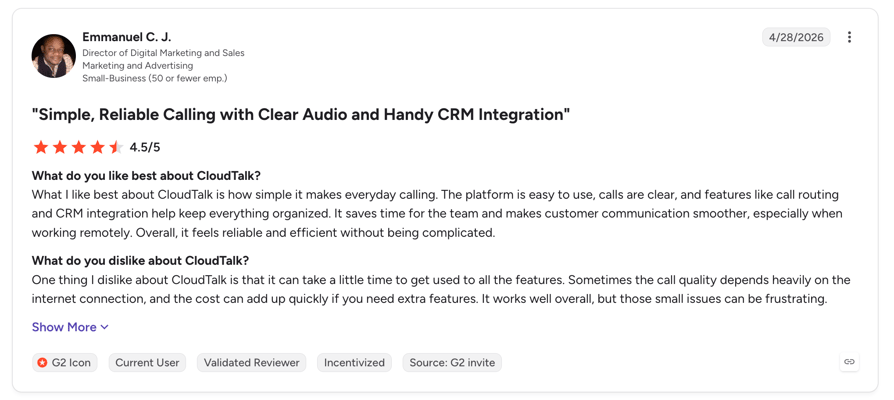
CloudTalk holds 4.4/5 on G2 from 1,852 verified reviews.
2. Genesys Cloud CX: Best Enterprise Callback Software
What Is Genesys Cloud CX?
Genesys Cloud CX is a full enterprise contact centre platform covering voice, digital channels, workforce management and AI. It is the only tool in this guide that ships all three callback mechanisms in one product: in-queue callback, scheduled callback and a website callback widget.
Why Is Genesys Cloud CX Strong Callback Software?
- All three callback types in one platform, so you do not need a widget vendor alongside your contact centre
- Callback is included from CX 1, the $75 entry tier, rather than gated to a higher suite
- Genuine enterprise scale with workforce management, quality management and an extensive AppFoundry marketplace
- Documented callback behaviour, which is rarer than it should be in this category
What Are Genesys Cloud CX's Key Callback Features?
- In-queue callback offered through the call flow when a caller does not want to keep waiting
- Scheduled callback for requests made when no agent is available
- Web callback widget placed on your site by an administrator
- Predictive engagement and journey management across channels
- AppFoundry marketplace for callback and virtual queue extensions
What Are the Pros and Cons of Genesys Cloud CX?
| Pros | Cons |
|---|---|
| Callback included from the $75 entry tier, not gated upward | CX 1 is voice only. Digital channels are a paid add-on on top of $75 |
| The only tool here with queue, scheduled and web callback in one product | Implementation is an enterprise project, not a self-serve signup |
| Deep enterprise feature set: WFM, QM, journey analytics | Retry behaviour is not published, so you cannot compare it on attempts |
| 4.4 on G2 from 1,558 reviews, a solid evidence base | Overkill and overpriced for a team that only needs callback |
What Are Genesys Cloud CX's Plans and Pricing?
Published per user per month, billed annually. Callback appears in the included-features list for every tier.
- Genesys Cloud CX 1: $75/user/month, voice, includes callback
- Genesys Cloud CX 2: $115/user/month, adds digital
- Genesys Cloud CX 3: $155/user/month, adds workforce engagement
- Genesys Cloud CX 4: $240/user/month, adds 30 AI Experience tokens per named agent
How Do G2 Users Rate Genesys Cloud CX?
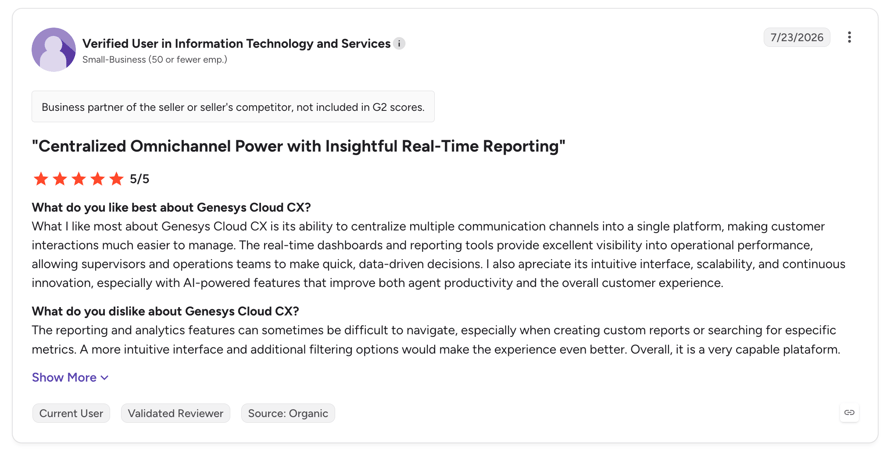
Genesys Cloud CX holds 4.4 on G2 from roughly 1,558 reviews. Reviewers consistently praise configurability and consistently flag the learning curve.
Genesys Cloud CX vs. CloudTalk: Which Callback Software Is Better?
The categories that decide between Genesys Cloud CX and CloudTalk for callback specifically.
Genesys Cloud CX vs CloudTalk
| Category | Genesys Cloud CX | CloudTalk | Winner |
|---|---|---|---|
| Callback types | Queue, scheduled and web | Queue exit plus automatic retry | Genesys |
| Entry price with callback | $75/user/mo | $25/user/mo | CloudTalk |
| Retry attempts | Not published | Up to 10 over 48h | CloudTalk |
| Setup effort | Enterprise implementation project | Self-serve, 14-day trial | CloudTalk |
| Enterprise depth | Full WFM, QM, journey analytics | Analytics and coaching, not full WFM | Genesys |
3. Aircall: Best Queue Callback for Growing SMB Teams
What Is Aircall?
Aircall is a cloud phone system built for sales and support teams that want something simpler than a contact centre platform. Its callback management is one of the better-documented implementations here, with both an automated and a manual mode and configurable retries.
Why Is Aircall Strong Callback Software?
- Two callback modes. Automated places the outbound call itself when an agent frees up. Manual drops the request into the agent's call list to dial when they choose
- Configurable retries from zero to five, with failed attempts returned to the queue rather than discarded
- Callback carries no extra fee once you are on Professional, unlike RingCentral's add-on model
- Clear, public help documentation, which makes it straightforward to verify what the feature does before you buy
What Are Aircall's Key Callback Features?
- Automated callback: caller presses the star key, position is saved, Aircall dials when an agent is free
- Manual callback: the request lands in the agent's call list
- Retry configuration from 0 to 5 attempts
- Shared inbox and call commenting for team handover
- 100+ integrations including HubSpot, Salesforce and Zendesk
What Are the Pros and Cons of Aircall?
| Pros | Cons |
|---|---|
| Genuinely well-documented callback with a retry setting | Not on Essentials. Callback needs Professional at $50/user/month |
| No extra licence fee once on Professional | Three-licence minimum, so the real entry cost is $150/month |
| Fast to set up, strong integration library | Existing accounts must opt in; it is on by default only for new ones |
| 4.4 on G2 from 1,648 reviews | Marketing and help docs contradict each other on whether the caller keeps their place. The help doc says position is saved; the feature page implies they leave the queue |
What Are Aircall's Plans and Pricing?
Published per licence per month, billed annually, with a three-licence minimum. Callback requires Professional.
- Essentials: $30/licence/month, no callback
- Professional: $50/licence/month, includes callback management at no extra cost
- Custom: quote-based, 25-licence minimum
- Three-licence minimum applies to Essentials and Professional
How Do G2 Users Rate Aircall?
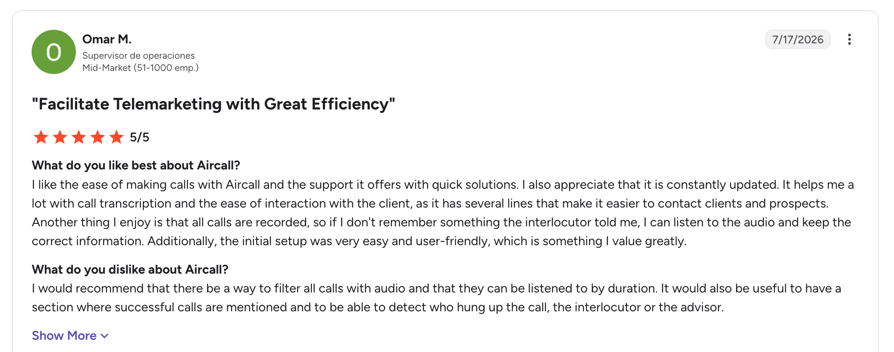
Aircall holds 4.4 on G2 from roughly 1,648 reviews, and 4.2 on Capterra from 465. Reviewers rate the interface highly and raise call quality on international routes most often.
Aircall vs. CloudTalk: Which Callback Software Is Better?
The categories that decide between Aircall and CloudTalk for callback specifically.
Aircall vs CloudTalk
| Category | Aircall | CloudTalk | Winner |
|---|---|---|---|
| Entry price with callback | $50/licence/mo, 3-licence minimum | $25/user/mo, 1 seat | CloudTalk |
| Retry attempts | 0 to 5, configurable | Up to 10 over 48h | CloudTalk |
| Country coverage | Around 100 countries | 160+ countries | CloudTalk |
| Callback documentation | Clear and public | Clear and public | Tie |
| Manual callback mode | Yes, agent-dialled option | Automatic assignment to agent or ring group | Aircall |
4. Talkdesk: Best Callback Software for AI-Driven CX
What Is Talkdesk?
Talkdesk is an enterprise contact centre platform with a strong AI story and, unusually, an explicit written guarantee that a callback request keeps the caller's place in the assignment queue. It also exposes a Callback API, which matters if you want to trigger callbacks from your own systems.
Why Is Talkdesk Strong Callback Software?
- Queue position is explicitly preserved, in the vendor's own words, which several competitors will not commit to in writing
- Priority levels on callback requests, so a VIP callback can jump ahead
- A public Callback API plus Studio components, so callbacks can be triggered from your own applications
- Both queue and scheduled callback, with an administrator guide for each
What Are Talkdesk's Key Callback Features?
- Request Callback from Queue Studio component, position retained, priority configurable
- Callback and Voicemail from Queue as a combined flow option
- Request Direct Callback for API-triggered callbacks
- Scheduled Callbacks via the Callback Scheduler app
- Talkdesk AI for summaries, sentiment and agent assist
What Are the Pros and Cons of Talkdesk?
| Pros | Cons |
|---|---|
| Explicitly documented queue position retention | $105/user/month for Voice Essentials, the cheapest plan that can realistically do callback |
| Callback API for custom triggers, rare in this set | The $85 Digital Essentials plan will not do it, and Talkdesk does not say so plainly anywhere |
| Priority levels on individual callback requests | Requires app provisioning for scheduled callbacks, not just a toggle |
| 4.4 on G2 from 2,596 reviews, one of the deepest bases here | Retry behaviour is not published |
What Are Talkdesk's Plans and Pricing?
Published per user per month. Callback needs a voice plan, though Talkdesk does not state the gate explicitly.
- Digital Essentials: $85/user/month, digital channels only
- Voice Essentials: $105/user/month, the realistic entry point for callback
- Elite: $165/user/month
- Industry Experience Clouds: $225/user/month
- Talkdesk Express: US and Canada only, 25 licences, for businesses under 50 employees
How Do G2 Users Rate Talkdesk?
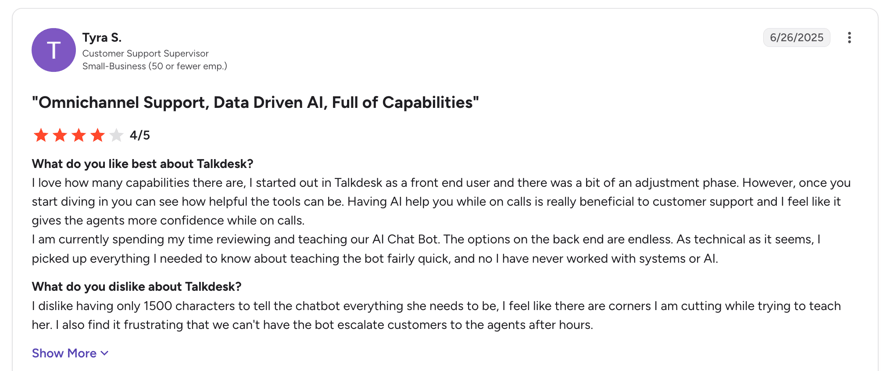
Talkdesk holds 4.4 on G2 from roughly 2,596 reviews and 4.5 on Capterra from 733. Reviewers rate the AI features well and raise support responsiveness most often.
Talkdesk vs. CloudTalk: Which Callback Software Is Better?
The categories that decide between Talkdesk and CloudTalk for callback specifically.
Talkdesk vs CloudTalk
| Category | Talkdesk | CloudTalk | Winner |
|---|---|---|---|
| Entry price with callback | $105/user/mo | $25/user/mo | CloudTalk |
| Queue position retained | Yes, explicitly documented | Yes | Tie |
| Callback API | Yes, public | API available, no dedicated callback endpoint | Talkdesk |
| Retry attempts | Not published | Up to 10 over 48h | CloudTalk |
| Plan clarity | Gate not published | Callback on the entry plan | CloudTalk |
5. RingCentral: Best for Teams Already on RingCentral, With a Caveat
What Is RingCentral?
RingCentral sells two different products and they behave completely differently on callback. RingEX is the business phone system, and queue callback there is a paid add-on that arrived only in October 2025. RingCX is the contact centre product, where callback is native and included. Confusing the two is the single most expensive mistake in this guide.
Why Is RingCentral Strong Callback Software?
- RingCX has native in-queue callback with the caller's place retained, configurable ring time of 20 to 60 seconds and caller-ID confirmation
- RingCX also offers agent-scheduled callback from the agent interface or a disposition
- RingEX finally has queue callback after a feature request that ran from 2022 to October 2025
- Enormous integration ecosystem and a genuinely broad UCaaS product if you need more than calling
What Are RingCentral's Key Callback Features?
- RingCX Inbound Queue Callback: DTMF option, place retained, 20 to 60 second callback ring time
- RingCX scheduled callback from the agent interface
- RingEX callback via the Call Queues Booster add-on, together with position in queue and estimated wait time
- Analytics Live Reports, bundled into the same booster licence
- Video, messaging and UCaaS across the wider platform
What Are the Pros and Cons of RingCentral?
| Pros | Cons |
|---|---|
| RingCX callback is native, included and well documented | RingEX charges $35 extra for the Call Queues Booster, billed per queue member using the feature |
| Position in queue and estimated wait time arrive alongside callback on RingEX | RingEX callback attempts once only, and excludes international, toll-free and anonymous numbers |
| Very large integration ecosystem | RingCX is a separate product from the RingEX licence you may already own |
| RingEX 4.2 on G2 from 1,453 reviews | Base plan pricing is not reliably published. We could not recover current RingEX or RingCX list prices from any RingCentral-owned source |
What Are RingCentral's Plans and Pricing?
This is the least transparent pricing in the guide. RingCentral's plan pages render prices in the browser rather than the page source, so we can confirm add-on prices but not base plan prices. Check the live page before you budget.
- Call Queues Booster add-on: $35, required for callback on RingEX, billed per queue member using it
- Business SMS Booster: $25
- RingEX Customer Engagement Bundle: includes both boosters, price not published
- RingEX and RingCX base plans: prices not recoverable from RingCentral's own pages. Verify directly
- Annual billing advertised as saving up to 33%
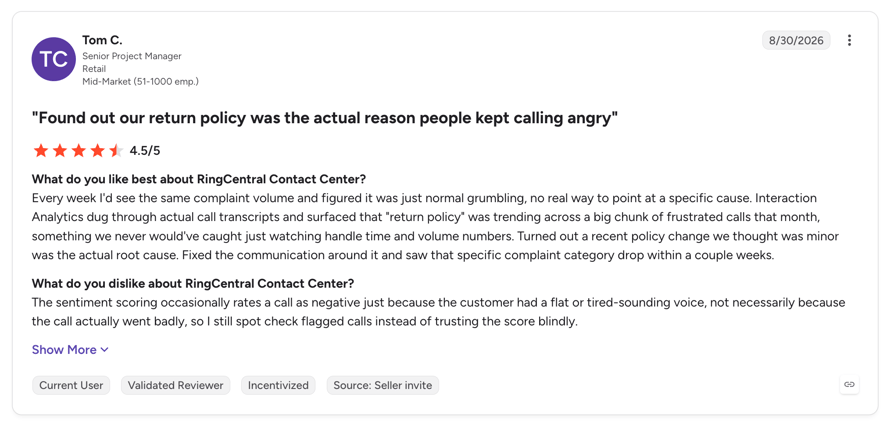
How Do G2 Users Rate RingCentral?
RingEX holds 4.2 on G2 from roughly 1,453 reviews. RingCX, the newer contact centre product, holds 4.4 from only 95, which is a thin base for an enterprise purchase.
RingCentral vs. CloudTalk: Which Callback Software Is Better?
The categories that decide between RingCentral and CloudTalk for callback specifically.
RingCentral vs CloudTalk
| Category | RingCentral | CloudTalk | Winner |
|---|---|---|---|
| Cost of callback | Base plan + $35 add-on on RingEX | Included from $25 | CloudTalk |
| Retry attempts | One only on RingEX | Up to 10 over 48h | CloudTalk |
| Number restrictions | Excludes international, toll-free, anonymous | None stated | CloudTalk |
| Pricing transparency | Base prices not published in page source | Fully published | CloudTalk |
| Breadth of platform | Full UCaaS: video, messaging, contact centre | Calling-focused | RingCentral |
6. JustCall: Best Budget Queue Callback Software
What Is JustCall?
JustCall is a cloud phone system with a strong SMS and multi-channel story, aimed at sales and support teams that want voice, text and WhatsApp on one number. Its queue callback is simple: the caller presses 1 rather than holding, and the system connects them when an agent frees up.
Why Is JustCall Strong Callback Software?
- The cheapest mainstream queue callback at $49/user/month on the Pro plan, undercutting Aircall, Genesys, Talkdesk and Zendesk
- Voice, SMS and WhatsApp on one number, so a callback can be followed up by text without a second tool
- Straightforward setup, documented in a public help article
- 2,393 G2 reviews, a deep evidence base for a tool at this price
What Are JustCall's Key Callback Features?
- Queue callback: caller presses 1, system connects when an agent is available
- SMS and WhatsApp alongside voice on the same number
- AI Voice Agents as a paid add-on for after-hours coverage
- Missed-call auto-reply, though only as an API and webhook recipe rather than a toggle
- 100+ CRM integrations
What Are the Pros and Cons of JustCall?
| Pros | Cons |
|---|---|
| Cheapest real queue callback of the mainstream platforms | Not on the $29 Team plan. Callback needs Pro at $49 |
| Multi-channel on one number, useful for callback follow-up | JustCall does not state whether queue position is retained. Its help article is silent on the point, so do not assume it |
| Public setup documentation | Missed-call auto-reply is a DIY build, not a no-code feature |
| 4.3 on G2 from 2,393 reviews | Two-user minimum, and 10 users on Business |
What Are JustCall's Plans and Pricing?
Published per user per month, billed annually, two-user minimum. Queue callback is ticked on Pro, Pro Plus and Business, and not on Team.
- Team: $29/user/month, no queue callback
- Pro: $49/user/month, includes queue callback
- Pro Plus: $89/user/month
- Business: custom, 10-user minimum
- AI Voice Agent add-ons: $0.99/min pay as you go, or $99 to $249/month
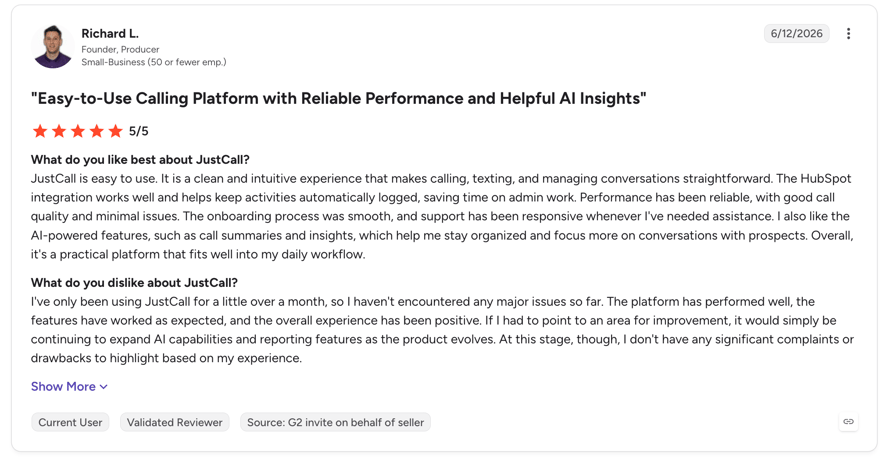
How Do G2 Users Rate JustCall?
JustCall holds 4.3 on G2 from roughly 2,393 reviews and 4.1 on Capterra from 225. Reviewers rate the multi-channel setup well and raise call quality and support most often.
JustCall vs. CloudTalk: Which Callback Software Is Better?
The categories that decide between JustCall and CloudTalk for callback specifically.
JustCall vs CloudTalk
| Category | JustCall | CloudTalk | Winner |
|---|---|---|---|
| Entry price with callback | $49/user/mo | $25/user/mo | CloudTalk |
| Queue position retained | Not stated in the docs | Yes | CloudTalk |
| Retry attempts | Not published | Up to 10 over 48h | CloudTalk |
| SMS and WhatsApp | Included on the same number | SMS available, WhatsApp via integration | JustCall |
| Country coverage | Around 70 countries | 160+ countries | CloudTalk |
7. Dialpad: Best Callback Software for AI Coaching Teams
What Is Dialpad?
Dialpad is an AI-first communications platform sold as three separate products: Connect for business phone, Support for contact centre and Sell for outbound. In-queue callback lives in the contact centre side, not the phone system, which catches people out.
Why Is Dialpad Strong Callback Software?
- Queue position is explicitly maintained, and if a callback attempt goes unanswered the caller is next in line rather than sent to the back
- Real-time AI assist and transcription on every call, including callbacks
- 4,204 G2 reviews on Dialpad Connect, the deepest base of any tool in this guide
- Also sold as a paid add-on, which gives some flexibility if you do not want to move tiers
What Are Dialpad's Key Callback Features?
- In-queue callback with queue position maintained across failed attempts
- Ai Agent Assist surfacing answers live during the call
- Real-time transcription and sentiment
- Ai Recaps with call summaries and action items
- Native CRM integrations across Salesforce, HubSpot and Zendesk
What Are the Pros and Cons of Dialpad?
| Pros | Cons |
|---|---|
| Queue position explicitly maintained, including on failed retries | Not on the $15 Connect phone plan. Callback needs a contact centre licence |
| Strongest AI coaching and transcription in this price band | The availability wording is ambiguous. Dialpad's own doc can be read as requiring Premium at $150/user/month rather than Essentials at $80 |
| 4.4 on G2 from 4,204 reviews | Realistic entry cost is $80/user/month, over four times CloudTalk's |
| Available as an add-on as well as a tier feature | Three-product structure is confusing when you are trying to work out what you need to buy |
What Are Dialpad's Plans and Pricing?
Published per user per month. The plan you need depends on which Dialpad product you are on, and the callback availability note is genuinely ambiguous.
- Connect Standard: $15/user/month annual, no in-queue callback
- Connect Pro: $25/user/month annual
- Support Essentials: $80/user/month annual, the realistic entry point for callback
- Support Advanced: $115/user/month annual
- Support Premium: $150/user/month annual, the safest reading of the availability note
- Sell: $39 to $150/user/month annual
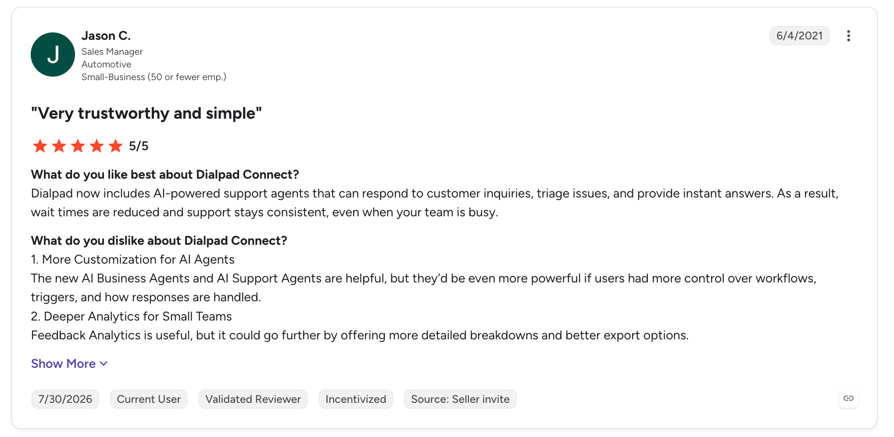
How Do G2 Users Rate Dialpad?
Dialpad Connect holds 4.4 on G2 from roughly 4,204 reviews and 4.2 on Capterra from 570. Reviewers rate the AI transcription highly and raise pricing structure and admin complexity most often.
Dialpad vs. CloudTalk: Which Callback Software Is Better?
The categories that decide between Dialpad and CloudTalk for callback specifically.
Dialpad vs CloudTalk
| Category | Dialpad | CloudTalk | Winner |
|---|---|---|---|
| Entry price with callback | $80/user/mo, possibly $150 | $25/user/mo | CloudTalk |
| Queue position retained | Yes, including on failed retries | Yes | Tie |
| Plan clarity | Ambiguous availability wording | Callback on the entry plan | CloudTalk |
| AI coaching depth | Real-time assist and sentiment | Summaries, sentiment, coaching | Dialpad |
| Review base | 4,204 on G2 | 1,852 on G2 | Dialpad |
8. Zendesk Talk: Best Callback Software for Help Desk Teams
What Is Zendesk Talk?
Zendesk Talk is the voice channel inside Zendesk's customer service suite. Its callback is well built, creating a ticket automatically when an agent accepts and generating a follow-up ticket if every agent declines. The problem is what it costs to reach it.
Why Is Zendesk Talk Strong Callback Software?
- Callback requests become tickets automatically, so nothing lives outside your existing support workflow
- A documented 60-minute fallback: if all agents decline, Zendesk generates a ticket for manual follow-up rather than dropping the request
- The caller's place is held in the queue and their number is confirmed or re-entered in E.164 format
- If your team already lives in Zendesk, this removes an entire integration problem
What Are Zendesk Talk's Key Callback Features?
- Customer callback: caller presses 2, place held, call returned automatically
- Automatic ticket creation when an agent accepts a callback
- 60-minute decline fallback generating a manual follow-up ticket
- Number confirmation or re-entry in E.164
- Full Zendesk suite: ticketing, help centre, messaging, AI agents
What Are the Pros and Cons of Zendesk Talk?
| Pros | Cons |
|---|---|
| Tightest help desk integration of any tool here | The hardest gate in this guide. Callback needs Suite Professional at $115/agent/month and is not available on Suite Team at $55 |
| Callbacks become tickets, so nothing is lost between systems | On a 20-agent team that gate costs $14,400 a year for one feature |
| Documented fallback when agents decline | Talk has no active standalone G2 profile, so there is no rating specific to the voice product |
| Backed by the Zendesk suite's 7,061 G2 reviews | Voice is bundled into the suite rather than sold with published standalone pricing |
What Are Zendesk Talk's Plans and Pricing?
Published per agent per month, billed annually. Callback requires Suite Professional or above, or Support with Talk Professional or Enterprise.
- Support Team: $19/agent/month, ticketing only
- Suite Team: $55/agent/month, no callback
- Suite Professional: $115/agent/month, the cheapest plan with callback
- Suite Enterprise: contact sales
- Talk is bundled into Suite rather than priced standalone
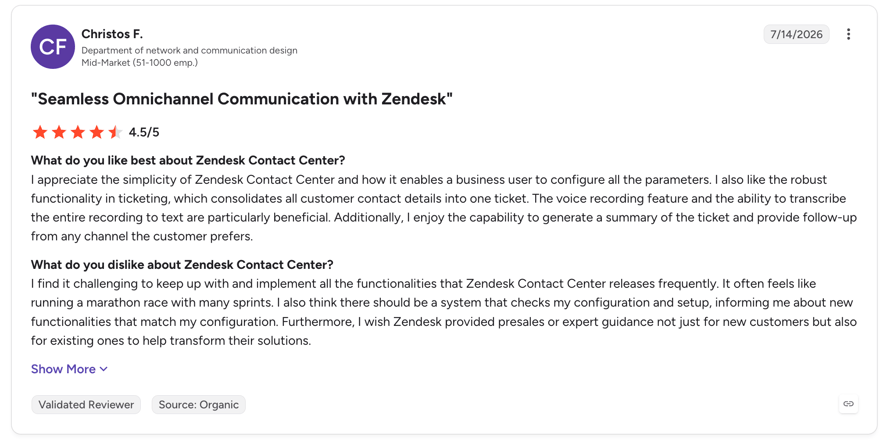
How Do G2 Users Rate Zendesk Talk?
There is no active standalone Zendesk Talk profile on G2, so the honest figure is the parent product: Zendesk for Customer Service holds 4.3 from roughly 7,061 reviews. Do not read that as a rating of the voice channel.
Zendesk Talk vs. CloudTalk: Which Callback Software Is Better?
The categories that decide between Zendesk Talk and CloudTalk for callback specifically.
Zendesk Talk vs CloudTalk
| Category | Zendesk Talk | CloudTalk | Winner |
|---|---|---|---|
| Entry price with callback | $115/agent/mo | $25/user/mo | CloudTalk |
| Ticketing integration | Native, callbacks become tickets | Integrates with Zendesk and 100+ tools | Zendesk |
| Retry attempts | Agents may decline; 60-min fallback | Up to 10 over 48h | CloudTalk |
| Voice-specific reviews | No standalone G2 profile | 1,852 reviews of the calling product | CloudTalk |
| Country coverage | Around 40 countries | 160+ countries | CloudTalk |
9. CallPage: Best Website Callback Widget
What Is CallPage?
CallPage is a different product from everything above it. There is no ACD and no queue. It is a widget that sits on your website, captures a visitor's phone number, then calls your rep and bridges the two in under a minute. The buyer is usually marketing, not support.
Why Is CallPage Strong Callback Software?
- Connects a web lead in under 28 seconds, by the vendor's own claim. That speed is the entire product, and the research on lead response supports why it matters
- Priced per successful call, not per seat, so a two-person sales team pays the same as a two-person team with heavy traffic does not
- Exit-intent and behavioural triggers, so the widget appears when a visitor is about to leave rather than immediately
- Out-of-hours scheduling, letting the visitor pick a slot when nobody is available now
What Are CallPage's Key Callback Features?
- Callback widget with customisable triggers and design
- Exit-intent and time-on-page triggers
- Scheduled callback outside working hours
- Form-submission auto-trigger, calling a lead the moment they submit
- AI Voice Agent for after-hours coverage
What Are the Pros and Cons of CallPage?
| Pros | Cons |
|---|---|
| The clearest category leader among website callback widgets | Only 31 G2 reviews. A high rating on a thin base is not the same as a high rating on thousands |
| Flat pricing that does not scale with headcount | No ACD, so no queue callback. It cannot solve a hold-time problem |
| 14-day trial with no credit card | Capped on successful calls: 50/month on Starter, with overage at $30 per additional 50 |
| 4.7 on G2, the highest rating in this guide | Its own pricing page renders two different figures for the same plans without labelling which is annual |
What Are CallPage's Plans and Pricing?
Flat monthly fee per account, not per user. Plans are capped on successful calls rather than seats, which is the defining difference from everything else in this guide.
- Starter: $31/month annual or $39 monthly, 50 successful calls, 1 user, 1 domain
- Pro: $79/month annual or $99 monthly, 100 successful calls, 2 licences, 2 domains
- Enterprise: custom, from 600 successful calls per month
- Extra user licences: $10/user/month
- Overage: $30 per additional 50 calls
- 14-day trial, no credit card
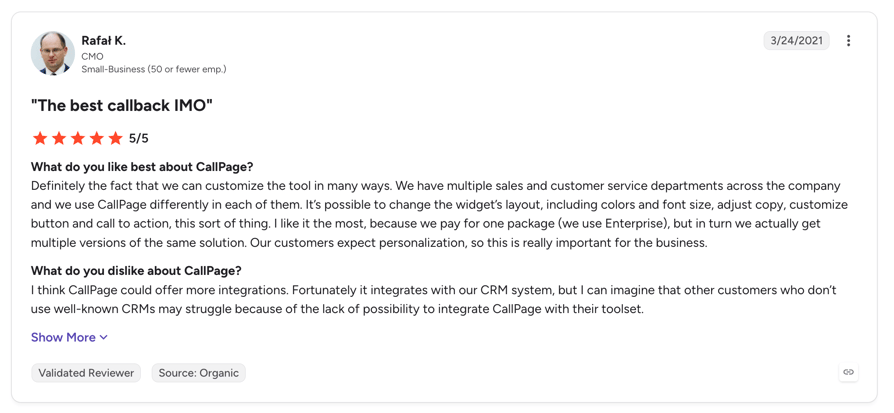
How Do G2 Users Rate CallPage?
CallPage holds 4.7 on G2, but from only 31 reviews, and 4.5 on Capterra from 45. It sits in the Lead Capture category rather than any callback category, because G2 has none.
CallPage vs. CloudTalk: Which Callback Software Is Better?
The categories that decide between CallPage and CloudTalk for callback specifically.
CallPage vs CloudTalk
| Category | CallPage | CloudTalk | Winner |
|---|---|---|---|
| Callback type | Website widget only | Queue exit plus automatic retry | Different products |
| Pricing model | Flat monthly, per successful call | Per user per month | Depends on team size |
| Queue callback | None. No ACD | Yes | CloudTalk |
| Speed to web lead | Under 28 seconds claimed | Not a web widget product | CallPage |
| Review base | 31 on G2 | 1,852 on G2 | CloudTalk |
10. Quo (formerly OpenPhone): Best Missed-Call Text-Back Software
What Is Quo (formerly OpenPhone)?
Quo, which rebranded from OpenPhone, is a business phone system built for small teams, with a shared inbox model and automatic texting when a call goes unanswered. It is included here because missed-call text-back is a genuine third category, and Quo has by far the deepest review base in it.
Why Is Quo (formerly OpenPhone) Strong Callback Software?
- 3,407 G2 reviews at 4.7, the strongest combination of rating and volume anywhere in this guide
- Missed-call auto-text is a native toggle, not an API recipe you have to build
- $15/user/month entry price, the cheapest tool in this guide
- Shared inbox model, so a missed call and its text thread are visible to the whole team rather than trapped on one phone
What Are Quo (formerly OpenPhone)'s Key Callback Features?
- Automatic missed-call text with customisable messages
- Shared phone numbers and inbox across the team
- 24/7 AI call handling on higher plans
- Snippets and auto-replies for common responses
- CRM integrations including HubSpot and Salesforce
What Are the Pros and Cons of Quo (formerly OpenPhone)?
| Pros | Cons |
|---|---|
| 4.7 from 3,407 G2 reviews, the best-evidenced tool here | It sends a text, it does not dial back. If you need an actual return call, this is the wrong category |
| Cheapest entry price in the guide at $15/user/month | No ACD or queue callback, so it will not help a contact centre |
| Missed-call texting works out of the box | Limited international coverage compared with a global calling platform |
| Genuinely good shared-inbox experience for small teams | The rebrand from OpenPhone is recent, so documentation and third-party references still use both names |
What Are Quo (formerly OpenPhone)'s Plans and Pricing?
Published per user per month, billed annually. Missed-call texting is available across plans.
- Starter: $15/user/month
- Business: $23/user/month
- Scale: $35/user/month
- Annual billing, with monthly available at a higher rate
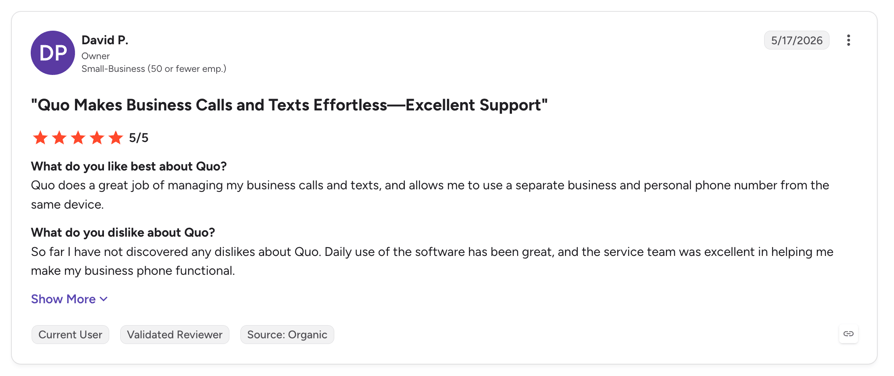
How Do G2 Users Rate Quo (formerly OpenPhone)?
Quo holds 4.7 on G2 from roughly 3,407 reviews under its OpenPhone profile. Reviewers rate the shared inbox and simplicity highly and raise international calling and advanced routing most often.
Quo (formerly OpenPhone) vs. CloudTalk: Which Callback Software Is Better?
The categories that decide between Quo (formerly OpenPhone) and CloudTalk for callback specifically.
Quo (formerly OpenPhone) vs CloudTalk
| Category | Quo (formerly OpenPhone) | CloudTalk | Winner |
|---|---|---|---|
| What happens on a missed call | Automatic SMS | Automatic call retry, up to 10 times | Depends on your customers |
| Entry price | $15/user/mo | $25/user/mo | Quo |
| Queue callback | None | Yes | CloudTalk |
| Review base | 3,407 on G2 | 1,852 on G2 | Quo |
| International coverage | Limited | 160+ countries | CloudTalk |
Stop Losing Customers to Calls Nobody Returns
What Are the Best Callback Widgets for a Website?
If your problem is web leads rather than hold times, the widget category is where you should be looking, and CallPage is not the only option. The thing to compare here is the pricing model, because these vendors meter completely differently and that decides the bill, not the feature list. This is also where searches for the best callback widget for website traffic actually land.
Website callback widget tools compared
| Tool | Pricing | What it meters | Review base | Worth knowing |
|---|---|---|---|---|
| CallPage | $31/mo annual, $39 monthly | Successful calls (50 on Starter) | 4.7 on G2, 31 reviews | The category leader. Exit-intent triggers and an AI voice agent for after hours. |
| Callback24 | Free forever tier, then $49/mo annual | Monthly call cap (15 free, 120 on Starter) | No reviews on G2 | The only credible free callback software in this category. Polish vendor, English and Polish interface only. |
| LimeCall | $29/mo | Successful callbacks (50 on Starter) | No live G2 profile found | Cheapest true telephony widget. Has repositioned around an AI receptionist with the widget as one module. |
| Novocall | $50/mo | Nothing. Call credits are sold separately | No live G2 profile found | No per-tier call limits, but credits are an extra line item. Two-way HubSpot and Salesforce sync on Pro. |
| Callback Tracker | $14/mo US and Canada, $149 global | Minutes and texts, not calls | Not independently verified | Cheapest way to run a widget across unlimited domains. Bundles live chat and SMS. |
| Mega Callback (Shopify app) | Free tier, then $4.99/mo | Leads captured | 5.0 from 11 Shopify reviews | For ecommerce specifically, the Shopify App Store is a better place to look than the SaaS vendors. |
What Is the Best Missed Call Text Back Software?
Most tools marketed as missed call text back software do not call anyone back. They send an SMS when a call goes unanswered and move the conversation to text. For a plumber, a dental practice or a dealership that is often the right answer. It is not queue callback and it will not reduce hold time, so be clear which problem you are solving.
Missed-call text-back tools compared
| Tool | Pricing | G2 | What it actually is |
|---|---|---|---|
| Quo (formerly OpenPhone) | $15 to $35/user/mo | 4.7 (3,407) | A real phone system with missed-call texting built in. The best-evidenced option here. |
| Weave | From $199/mo per location | 4.6 (433) | Dental, veterinary, medical and optometry only. HIPAA-compliant messaging. Missed-call texting is on all three tiers. |
| Emitrr | Not published | 4.8 (24) | Healthcare and home services. VoIP plus missed-call-to-text plus an AI booking agent. Highest rating here but on a small base. |
| Podium | No longer published, sales-gated | 4.5 (2,110) | The category-defining brand for local business texting. Reputation management first, missed-call texting second. |
| Birdeye | Not published | 4.7 (4,216) | A reputation platform, not a callback tool. Largest review base of any vendor mentioned in this guide, but missed-call texting is not its positioning. |
| Text Request | $59.99 to $575/mo | 4.6 (964) | Pure business texting. Landline text-enabling for franchises and SMBs. |
| HighLevel | $97 to $497/mo | 4.6 (651) | "Missed Call Text Back" is not a named feature on HighLevel's own pricing page. It is a workflow template built by its agency ecosystem, which is why so many agency blogs rank for the term. |
| Numa | Not published | 5.0 (2 reviews) | Auto dealerships only. Two reviews is not a review base, and we would not shortlist on it. |
Which Other Callback Service Providers Did We Assess?
Six more callback service providers come up repeatedly when teams shop for call back services. Each has real callback capability, and each was left out of the ranked ten for a specific, stated reason.
Other callback service providers assessed
| Provider | Callback capability | Why it is not in the ranked ten |
|---|---|---|
| Five9 | Queue callback and virtual hold, plus a separate web callback product | 50-seat minimum, priced per concurrent user. Three of five bundles are quote-only and the callback gate is not published. Entry bundles are $119 and $159 per seat. |
| NICE CXone | CALLBACK and QUEUECALLBACK Studio actions, place in queue reserved | The published packaging matrix has no callback row at all, so we cannot tell you which suite you need. Suites run $110 to $249 per agent. |
| Twilio Flex | A Queued Callback and Voicemail plugin from the Flex Plugin Library | Not a feature, a plugin your engineers deploy. And it does not hold the caller's place: a new task is created on the same workflow. Only 36 G2 reviews. |
| CallHippo | Queue callback claimed on the vendor site | No help-centre documentation for it exists. Every other vendor here has a setup doc. It also requires Pro Suite Silver, whose price renders only in rupees. |
| Mindful | Standalone virtual queue and callback layer that sits on top of Genesys, Five9, Twilio and AWS | An overlay, not a platform. A strong enterprise option if you already own a contact centre and want callback added to it. Its published outcome figures carry no methodology. |
| Verint | Voice call back solutions across queue, scheduled up to 15 days ahead, and web | Enterprise only, with no published pricing or quantified claims. Worth a look if you are already a Verint customer. |
Which Tools Appear on Other Callback Lists but Should Not?
We checked every tool that shows up on competing lists. Two of them have no callback feature at all, and one of those two is not even a communications product. We are naming them because repeating an unchecked list is how these errors spread, and our own earlier version of this article carried both.
| Tool | What we found |
|---|---|
| healow Genie | A real AI contact centre product from eClinicalWorks for healthcare, at $249 per seat per month. But the words "callback" and "call back" do not appear anywhere on its feature list. Its own blog describes deflection and escalation, not outbound callbacks. Zero reviews on G2 and zero on Capterra. Real product, wrong category. |
| Anolla | Not a callback tool at all. It is an online booking and appointment scheduling platform for service providers. Zero mentions of callback anywhere on its product pages, and zero reviews on both G2 and Capterra, where it is categorised under Online Appointment Scheduling. It appears to have entered callback listicles by keyword accident. |
How Much Does Callback Software Cost?
Between $15 and $249 per user per month, and the spread is mostly about what else comes with the callback automation. The number that matters is not the vendor's headline price, it is the price of the cheapest plan that includes callback, which is often two tiers above the one you were quoted.
Callback software cost by category
| Category | Typical range | How it is billed | Cheapest verified option |
|---|---|---|---|
| Queue callback (contact centre) | $25 to $249 per user per month | Per user or per agent, monthly, usually billed annually | CloudTalk Starter at $25/user/mo |
| Website callback widget | $14 to $159 per month, flat | Flat account fee metered on successful calls, call caps or minutes | Callback24 free tier, 15 calls/month |
| Missed-call text-back | $15 to $199+ | Per user, or per location for the healthcare vendors | Quo at $15/user/mo |
| Add-on licences | $35 on top of your base plan | Per queue member using the feature | RingCentral Call Queues Booster |
The three hidden costs to budget for
1. The tier jump. Zendesk moves you from $55 to $115 per agent to unlock callback. On 20 agents that is $14,400 a year for one feature.
2. The seat minimum. Aircall needs three licences, Five9 needs 50 concurrent users, JustCall needs two. The advertised per-seat price is not the entry cost.
3. The second product. If you buy a widget for web leads and a phone system for queue callback, you are paying two bills. Check whether one platform covers both before you sign either.
What Do Real Users Say About Callback Software?
We went looking for what practitioners report rather than what vendors claim. Here is what the evidence supports, and where it does not exist.
What Does the Research Actually Show About Hold Times and Callbacks?
This is the part of the category with the worst sourcing, so we traced every figure we intended to use back to its origin. Several widely repeated statistics did not survive.
- 86% of calls from an unknown number go unanswered. Hiya, State of the Call 2026, surveying more than 12,000 consumers across six countries. This is the most useful number in the category and almost nobody cites it, because it argues against naive callback and for retry logic, branded caller ID and confirmed callback windows.
- Average speed to answer is 74 seconds, about a third higher than before the pandemic, and the average inbound call costs $7.20. ContactBabel, US Contact Center Decision-Makers Guide 2026, based on 207 US organisations and more than 1,000 consumer interviews.
- The typical service call now runs over seven minutes, 38% longer than in 2012, and live telephony is still 62% of inbound interactions. ContactBabel again, 2025 edition. Voice is not going away, it is getting slower.
- Contacting a lead within an hour makes qualification roughly seven times more likely than waiting one more hour, and sixty times more likely than waiting a day. Harvard Business Review, 2011, from 1.25 million sales leads across 42 companies. Old, but it is the strongest evidence behind the entire website callback widget category.
Which Widely Quoted Callback Statistics Did Not Hold Up?
Three figures circulate constantly in this category, including in the previous version of this article. We could not stand behind any of them as usually stated.
| The claim | What we found when we traced it |
|---|---|
| "75% of customers prefer a callback to waiting on hold" | The chain runs to a Zendesk blog post, which links to a write-up of a Software Advice survey from 2014. That survey found 63%, not 75%. The number 75 does not appear in the cited source. A separate 2025 Nextiva study does report 75%, but on n=400 with no published fielding dates or method, and with softer wording ("always prefer or at least want"). |
| "Callback reduces call abandonment by up to 32%" | Traces to ContactBabel, 2013, a legitimate research house. But the linked PDF now 404s, the figure is 13 years old, and the original wording is "at least 32%", which is the opposite bound from "up to". |
| "Callback lifts lead conversion 25% to 30%" | Dead end. It traces to an affiliate review blog carrying a discount code, quoting one vendor's claim about its own customers. It is not an industry statistic and we have removed it. |
How Do You Choose the Right Callback Software?
Six questions decide which callback solution fits, and each one removes tools from the list. Answer them in order and you will usually be left with two or three.
1. Which of the Three Callback Types Do You Actually Need?
Answer this first, because it eliminates most of the market immediately and it is the question buyers skip.
Callers stuck on hold? You need queue callback, so look at CloudTalk, Genesys, Aircall, Talkdesk, JustCall, Dialpad or Zendesk. Web visitors leaving without converting? You need a widget, so look at CallPage or Callback24. Calls to a small business going unanswered? You need missed-call texting, so look at Quo or Weave. Buying across categories is the most expensive mistake here.
2. Which Plan Does Callback Actually Sit On?
Check this before you get attached to a vendor. The advertised price and the price of the plan with callback on it are frequently two different numbers, and the gap can be more than double. Our gating table has the answer for every tool here.
Ask the rep directly: which plan includes queue callback, is it a licence add-on, and is there a seat minimum? Get the answer in writing before the trial ends.
3. How Many Times Will It Try?
With 86% of unknown-number calls going unanswered, a system that dials once and closes the request will fail most of the time. This is the single most under-asked question in the category.
RingCentral RingEX attempts once. Aircall lets you configure zero to five. CloudTalk allows up to 10 across as much as 48 hours. Most other vendors do not publish retry behaviour at all, which is itself worth knowing.
4. Does the Caller Keep Their Place in the Queue?
Not a detail. If the callback goes to the back of the line, you have converted a five-minute hold into a thirty-minute wait and an annoyed customer.
Explicitly documented as retained: Talkdesk, Dialpad, Zendesk, NICE CXone, Genesys, RingCX and CloudTalk. Explicitly not retained: Twilio Flex, which creates a new task. Not stated either way: JustCall. Ask.
5. Do You Sell or Support Outside Your Own Country?
This narrows the field fast. A callback that arrives from an unfamiliar international number is a callback that does not get answered, which is why local number coverage matters more in this category than in most.
Widest coverage: CloudTalk at 160+ countries, then Genesys and Aircall at around 100. Watch out for RingEX, which excludes international, toll-free and anonymous numbers from callback entirely.
6. What Is Your Real Seat Count?
Seat minimums change the entry price more than the per-seat rate does.
- Under 3 seats: CloudTalk (1 seat), JustCall (2 seats) or Quo. Aircall's 3-licence minimum and Five9's 50-user minimum rule them out.
- 3 to 25 seats: most of the ranked ten are viable. Compare on the gating table and retry behaviour.
- 25+ seats: Genesys, NICE CXone, Five9 and Talkdesk come into range, and CloudTalk's Custom plan is worth quoting alongside them.
- No seats at all, just a website: a widget, priced flat. Seat count is irrelevant.
Which Callback Software Matches Your Team?
Callback software recommendation matrix
| Your situation | What you need | Best fit | Runner-up |
|---|---|---|---|
| Customers abandoning the hold queue | Queue callback with real retry logic | CloudTalk | Aircall |
| Enterprise contact centre, 100+ seats | Full CCaaS with callback included | Genesys Cloud CX | NICE CXone |
| Already deep in Zendesk | Callbacks that become tickets | Zendesk Talk | CloudTalk with the Zendesk integration |
| Selling into multiple countries | Local numbers so callbacks get answered | CloudTalk | Genesys Cloud CX |
| Web leads going cold | A callback widget, not a phone system | CallPage | Callback24 (free tier) |
| Testing the idea on no budget | Free callback software | Callback24 free tier | CloudTalk 14-day trial |
| Small local business missing calls | Missed-call texting | Quo | Weave (healthcare only) |
| Tight budget, need real queue callback | Cheapest genuine queue callback | CloudTalk at $25 | JustCall at $49 |
| You already own a contact centre | A callback layer on top | Mindful | Verint |
Not Sure Which Type You Need? Bring Us Your Call Data
Ready to Try the Best Callback Software?
The teams that get callback right are not the ones that bought the most expensive platform. They are the ones that worked out which of the three problems they actually had, checked which plan the feature was on before signing, and picked a system that keeps trying when the first call goes unanswered.
That last part is where most callback programmes quietly fail. With 86% of unknown-number calls going unanswered, one attempt from an unfamiliar number is not a callback strategy. CloudTalk retries up to 10 times across as much as 48 hours, calls from a local number in 160+ countries, and includes all of it on the Starter plan at $25 per user per month with a one-seat minimum.
No add-on licence, no tier jump, no contact centre SKU. See the pricing, or start the trial and test it against your own missed calls for 14 days.
See Callback Working on Your Own Call Flow
Frequently Asked Questions About Callback Software
The questions buyers ask most often, answered with what the vendor documentation actually says.
Callback software returns a phone call automatically so the customer does not have to wait on hold or dial again. It captures the number, queues the request, and places an outbound call when an agent is free or at a time the customer chose. The term covers three different products: queue callback inside a contact centre, a website callback widget that dials web visitors, and missed-call text-back that sends an SMS instead of calling.
Queue callback runs from $25 to $249 per user per month, website widgets from around $14 to $159 per month as a flat fee, and missed-call texting from $15 per user per month. The figure that matters is the cheapest plan that actually includes callback, which is often two tiers above the price you were quoted. CloudTalk includes it on Starter at $25 per user per month.
Callback24 offers a genuine free tier at 15 successful calls per month on one domain with two users, which is the only credible free option we found in the widget category. For queue callback there is no free product, though CloudTalk, Aircall, JustCall and Zendesk all offer free trials. Be careful with tools advertising free callback that turn out to be SMS autoresponders with no telephony behind them.
It varies more than you would expect. CloudTalk includes it on Starter. JustCall requires Pro at $49, Aircall requires Professional at $50, Genesys includes it from CX 1 at $75, Dialpad needs a contact centre licence from $80, Talkdesk needs a voice plan from $105, and Zendesk requires Suite Professional at $115 per agent. RingCentral RingEX sells it as a $35 add-on licence on top of your base plan.
Usually, but not always, and it is worth checking. Talkdesk, Dialpad, Zendesk, NICE CXone, Genesys, RingCX and CloudTalk all document that the position is retained. Twilio Flex explicitly does not: it creates a new task on the same workflow, so the caller effectively rejoins the queue. JustCall's documentation does not say either way.
More than once, which sounds obvious but is not how most systems behave. Around 86% of calls from an unknown number go unanswered, so a single attempt will miss most people. RingCentral RingEX attempts once. Aircall allows zero to five. CloudTalk allows one to 10 attempts across a deadline of end of day, 24 hours or 48 hours, and recommends four to five.
A callback widget sits on your website, captures a visitor's number and dials them in about 30 seconds. It has no ACD, so it cannot hold anyone's place in a queue and cannot help with hold times. Queue callback lives inside a phone system or contact centre platform and only applies to people who already called you. They solve different problems for different teams and are priced completely differently.
No. Missed-call text-back sends an SMS when a call goes unanswered and moves the conversation to text. Nobody calls the customer back. For local service businesses that is often the right answer, and tools like Quo and Weave do it well. If you need an actual return call, or you are trying to reduce hold time, it is the wrong category.
Yes, and on the entry plan rather than as an add-on. CloudTalk automatically retries any unanswered or abandoned call up to 10 times across a window you set of up to 48 hours, assigns the callback to a specific agent or ring group, and cancels remaining attempts if you reach the customer another way. Its call queues also give waiting callers a callback request, voicemail or a route to another team as an alternative to holding.
Only if it can call from a local number, which most cannot. A callback arriving from an unfamiliar international prefix is very likely to be ignored. CloudTalk provisions local numbers in 160+ countries. Note that RingCentral RingEX excludes international, toll-free and anonymous numbers from callback entirely, which is a hard limit rather than a configuration choice.