Cartesia Pricing & Plans: Full Guide for 2026
Summary of Cartesia's Pricing Plans
| Plan | Price | Best For | Agents | Credits |
|---|---|---|---|---|
| Free | $0 | Prototyping and personal use | 1 | 20K credits + $1 prepaid agents |
| Pro | $4/mo (yearly) | Individual devs, commercial testing | 3 | 100K credits + $5 prepaid agents |
| Startup | $39/mo (yearly) | Teams starting voice AI in production | 5 | 1.25M credits + $49 prepaid agents |
| Scale | $239/mo (yearly) | High-volume, large-scale businesses | 10 | 8M credits + $299 prepaid agents |
| Enterprise | Custom | Mission-critical, regulated industries | Custom | Custom |
Cartesia Pricing In a Nutshell
Cartesia offers five pricing plans: Free ($0/mo), Pro ($4/mo), Startup ($39/mo), Scale ($239/mo), and Enterprise (custom); each built around the same core voice AI models — Sonic (TTS), Ink (STT), and Line (voice agents), but with increasing credit allocations, concurrency limits, and feature access.
Every paid plan is available with a 20% discount on annual billing. The higher the plan, the more credits and agent slots you get — Scale gives you 80x the model credits of Pro, and drops telephony rates from $0.06/min to $0.014/min.

What Pricing Plans Does Cartesia Offer?

Cartesia's pricing is structured around how much voice AI capacity you need. There are four paid plans: Pro, Startup, and Scale, plus an Enterprise tier for organizations that need custom infrastructure, compliance guarantees, and dedicated support. A permanently free tier is also available for prototyping and personal use.
All plans include access to the same three core products: Sonic (TTS), Ink (STT), and Line (voice agents). What changes as you move up is how many credits you get, how many agents you can run simultaneously, and which features — like Pro Voice Cloning and priority support — become available.
Unlike most SaaS platforms, Cartesia doesn't charge per seat. Instead, it bills based on usage — specifically, characters processed for TTS, seconds of audio for STT, and minutes of call time for voice agents. This makes costs more flexible at low volume, but harder to forecast at scale.
What Are Real Users Saying About Cartesia?
Cartesia is still a relatively young platform — and its public review footprint reflects that. At the time of writing, Cartesia has no verified presence on G2, Trustpilot, or Capterra. This makes evaluation harder than with more established platforms, as it's worth factoring in if user-validated social proof matters to your decision-making process.
The most legit user feedback we found is on ProductHunt, where Cartesia Sonic has accumulated reviews and launch discussion comments from developers and early adopters. The feedback there is largely positive, centering on latency performance and voice quality — consistent with Cartesia's positioning as the low-latency leader in the TTS space.
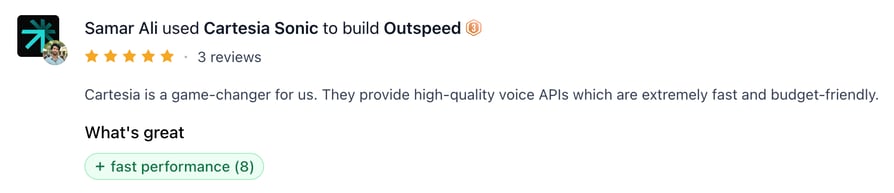
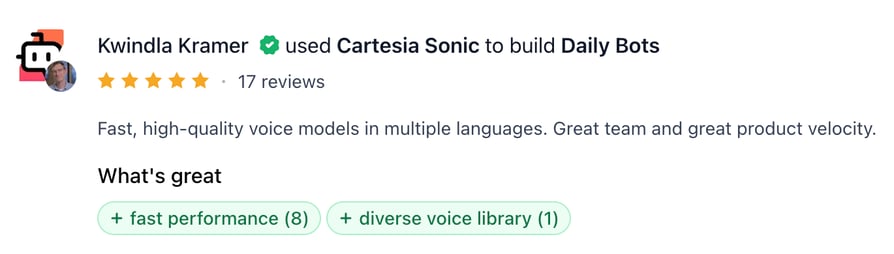
The takeaway: Cartesia is a relatively new platform; therefore, there are few genuine user reviews on trusted rating websites. Whenever evaluating a new platform, it's advised to read verified reviews before committing.
What Is Cartesia's Free Plan?
The Free plan is Cartesia's permanent entry tier, designed for developers who want to explore real-time voice AI without any upfront commitment. At $0/month with no time limit, it gives you hands-on access to all three core products — Sonic, Ink, and Line — with enough included usage to prototype and evaluate the platform before deciding whether to upgrade.
If you're also evaluating AI voice agents as part of your tech stack, it's worth understanding what each tool actually covers before committing.
How Much Does Cartesia's Free Plan Cost?
The Free plan costs $0/month with no time limit. It includes 20,000 model credits and $1 prepaid for voice agents. There is no credit card required to get started.
What's included in Cartesia's Free Plan?
- 20,000 credits for Sonic TTS and Ink STT usage
- $1 prepaid balance for Line voice agent minutes
- 1 agent slot for building and testing voice workflows
- Up to 8 concurrent calls on the Line platform
- 2 concurrent TTS requests via Sonic
- Access to the full Sonic and Ink model library, including Sonic-3
- Discord community support
- Personal use only — commercial deployment not permitted
Who Is Cartesia's Free Plan Best For?
The Free plan is best suited for solo developers and researchers who want to evaluate Cartesia's voice quality and latency before committing to a paid subscription. It provides enough runway to prototype a basic voice agent, run API tests, and form a genuine opinion on whether Sonic's sub-100ms latency fits your use case — without spending a cent. It is not suitable for commercial deployment or production use.
What Are the Limitations of Cartesia's Free Plan?
- No instant voice cloning — locked behind Pro plan
- No commercial use rights
- Only 1 agent slot — not suitable for multi-agent workflows
- 20K credits exhausts quickly in production — approximately 20,000 characters of TTS, roughly 15-20 minutes of audio at normal speaking pace
- $0.06/min telephony rate on Line — the highest rate across all plans
What Is Cartesia's Pro Plan?
The Pro plan is Cartesia's entry-level commercial tier, designed for individual developers who want to test voice AI in production and need instant voice cloning for real projects.
How Much Does Cartesia's Pro Plan Cost?
The Cartesia subscription cost for the Pro plan is $4/month on annual billing ($5/month on monthly billing). This makes it one of the most affordable commercial TTS plans available in 2026 — though the included credits are limited enough that overages will be common for any real production workload.
What Is Included in Cartesia's Pro Plan?
- 100,000 credits for Sonic TTS and Ink STT usage
- $5 prepaid balance for Line voice agent minutes
- 3 agent slots
- Up to 12 concurrent calls on the Line platform
- 3 concurrent TTS requests via Sonic
- Instant Voice Cloning — clone a voice from a short audio sample at no extra cloning fee (1 credit/char for IVC speech)
- Commercial use rights
- Discord community support
Who Is Cartesia's Pro Plan Best For?
Individual developers who need commercial rights and instant voice cloning for light production use or client work. Teams should move to Startup.
What Are the Limitations of Cartesia's Pro Plan?
- No Pro Voice Cloning (PVC) — higher-quality trained voice cloning requires the Startup plan
- No shared API keys / Organizations feature — solo use only
- 100K credits run out quickly for teams: 100,000 characters is approximately 75-90 minutes of TTS audio
- $0.06/min telephony rate — the cheapest rate ($0.014/min) only unlocks at Scale
What Is Cartesia's Startup Plan?
The Startup plan is designed for small teams beginning to use voice AI seriously in production. It unlocks shared API keys (Organizations), Pro Voice Cloning, and a significantly larger credit allocation compared to Pro.
How Much Does Cartesia's Startup Plan Cost?
Cartesia pricing per month for the Startup plan is $39 on annual billing ($49/month on monthly billing). It includes 1.25M model credits and $49 prepaid for voice agents — a meaningful jump from the Pro plan's 100K credits.
What Is Included in Cartesia's Startup Plan?
- 1.25 million credits for Sonic TTS and Ink STT usage
- $49 prepaid balance for Line voice agent minutes
- 5 agent slots
- Up to 20 concurrent calls on the Line platform
- 5 concurrent TTS requests via Sonic
- Organizations feature — shared API keys across a team
- Instant Voice Cloning (IVC) — no cloning fee, 1 credit/char
- Pro Voice Cloning (PVC) — 1M credits to train, 1.5 credits/char for PVC speech generated
- Commercial use rights
Who Is Cartesia's Startup Plan Best For?
Small dev teams or startups building and testing multi-agent voice applications in production. The Organizations feature makes this the minimum viable tier for team use.
What Are the Limitations of Cartesia's Startup Plan?
- No priority support — standard Discord community support only
- Pro Voice Cloning training costs 1M credits — that's 80% of your monthly credit allocation used in a single training run
- $0.06/min telephony rate still applies — the discounted $0.014/min rate is Scale-only
- 5 concurrent TTS requests may bottleneck real-time multi-user applications
What Is Cartesia's Scale Plan?
The Scale plan is Cartesia's highest self-service tier, built for businesses running high-volume voice AI. The Cartesia price for this plan is $239/month on annual billing — and it unlocks the most significant savings in the platform, dropping telephony rates from $0.06/min to $0.014/min.
How Much Does Cartesia's Scale Plan Cost?
The Scale plan costs $239/month on annual billing ($299/month on monthly billing). It includes 8 million model credits and $299 prepaid for Line voice agent minutes.
What Is Included in Cartesia's Scale Plan?
- 8 million credits for Sonic TTS and Ink STT usage
- $299 prepaid balance for Line voice agent minutes
- 10 agent slots
- Up to 60 concurrent calls on the Line platform
- 15 concurrent TTS requests via Sonic
- Pro Voice Cloning and Instant Voice Cloning
- Organizations feature — shared API keys
- Priority support
- High concurrency limits across all three products
- Commercial use rights
Who Is Cartesia's Scale Plan Best For?
Businesses running high-concurrency voice AI applications that need prioritized support and the platform's most favorable self-service telephony rate.
What Are the Limitations of Cartesia's Scale Plan?
- $299/month base before overages — teams with variable call volumes may find costs harder to predict
- Still no custom SLAs, SSO, or HIPAA compliance — those require Enterprise
- 8M credits at 1 credit/character: a voice agent handling 100 calls/day of ~500 characters each burns through ~1.5M credits/month
- Enterprise pricing is the next step — there is no intermediate tier between Scale and Enterprise
What Is Cartesia's Enterprise Plan?
The Cartesia cost for Enterprise is negotiated directly with their sales team. It is designed for organizations with mission-critical reliability requirements, regulatory compliance needs, or custom infrastructure demands.
What Is Included in Cartesia's Enterprise Plan?
- Custom usage pricing — volume discounts on credits and telephony
- Custom concurrency limits across Sonic, Ink, and Line
- Enterprise support via a dedicated Slack channel
- Single Sign-On (SSO)
- PCI compliance
- HIPAA compliance
- Custom SLAs for uptime and response time
- Custom security review
- Custom AI models and on-premise deployment options
- SOC 2 Type II certification
Who Is Cartesia's Enterprise Plan Best For?
Regulated industries (healthcare, finance, legal), large-scale enterprises with high call volumes, and organizations requiring on-premise deployment or dedicated infrastructure. Contact Cartesia's sales team at cartesia.ai/contact for pricing.
What Are Cartesia's Additional Costs?
The full Cartesia TTS pricing cost structure includes credit usage, voice cloning fees, telephony charges, and overage billing — all of which stack on top of the base plan price.
| Cost Item | Rate | Notes |
|---|---|---|
| Instant Voice Cloning (IVC) | No cloning fee; 1 credit/char | Available in Pro plan and above |
| Pro Voice Cloning (PVC) Training | 1M credits one-time training fee | Startup plan and above. 1.5 credits/char for PVC speech |
| Voice Changer | 15 credits per second of audio | Available on all plans |
| Localizing a Voice | 225 credits one-time cost | Per voice localisation |
| Infilling | 300 credits one-time + 1 credit/char | All plans |
| Line Telephony (Free/Pro/Startup) | $0.06/minute | Drops to $0.014/min on Scale plan |
| Text-to-Agent Creation | $0.05 per creation | For a limited time only |
| Credit Overages | Billed at overage rate for your plan | Check Cartesia's pricing for current rates |
| Annual vs Monthly Billing | 20% off on annual billing | All paid plans offer annual billing discount |
How Does Cartesia Calculate Credits?
Understanding credit consumption is critical for accurate cost forecasting. Cartesia sonic pricing per character is 1 credit per character of input text for standard Sonic TTS — making character count, not audio duration, the billing unit.
- Sonic (TTS): 1 credit per character of input text, including spaces and punctuation. This is Cartesia TTS pricing per minute in context: at an average speaking rate of 150 words per minute (~900 characters), that's approximately 900 credits per minute of generated audio — or roughly $0.03/min at pay-as-you-go rates.
- Ink (STT): 1 credit per second of audio input. More predictable than TTS — cost maps directly to how long the audio is.
- Line (Voice Agents): Billed per minute of call time via telephony. Rates vary by plan: $0.06/min on Free through Startup, dropping to $0.014/min on Scale. This is separate from the credit system.
The practical implication: Character-based TTS pricing can be hard to forecast for conversational AI applications where turn length varies. Teams evaluating Cartesia for high-volume production should model their expected average turn length before estimating monthly costs.
What Will Cartesia Actually Cost Your Team?
Cartesia AI pricing is more nuanced than the plan page suggests. The subscription fee is just the floor — once you factor in credits, telephony rates, voice cloning fees, and overages, the real monthly bill can differ significantly. Here are four realistic scenarios.
| Scenario | Plan | Base Cost | Usage Estimate | Est. total/mo |
|---|---|---|---|---|
| Solo dev prototyping a voice agent | Free | $0 | 20K chars TTS + 1 agent slot | $0 |
| Small startup testing in production | Pro (annual) | $4/mo | 100K chars TTS + $5 agent prepaid | ~$9-15/mo |
| Growing team: 3 agents + voice cloning | Startup (annual) | $39/mo | 1.25M chars + $49 agents + PVC training | ~$88-130/mo |
| High-volume: 10 agents, 60 concurrent calls | Scale (annual) | $239/mo | 8M chars + $299 agents prepaid + overages | $538-700+/mo* |
Here are four realistic scenarios to show what you'll actually pay.
Scenario 1: Solo Developer on Free Plan
A developer prototyping a voice agent uses the Free plan. With 20,000 characters of TTS and 1 agent slot, they can test basic call flows and evaluate voice quality.
- Real cost: $0 — until credits run out and overages kick in
- Base cost: $0/month
- Cartesia Sonic TTS per minute cost pricing at Free tier: approximately $0.03/min of audio (at ~900 chars/min speaking rate)
- 20K credits covers approximately 15-20 minutes of audio at normal speaking pace
Scenario 2: Small Startup Testing in Production
A 3-person startup on the Pro plan (annual billing) is building a lead qualification voice agent with instant voice cloning.
- Base cost: $4/month (annual)
- 100K credits covers approximately 75-90 minutes of TTS monthly
- $5 agent prepaid for Line telephony at $0.06/min = approximately 83 minutes of call time
- Estimated real cost: $9-15/month depending on call volume
Scenario 3: Growing Team With Pro Voice Cloning
A 5-person team on the Startup plan needs Pro Voice Cloning for a high-quality branded voice. They train one PVC voice (1M credits one-time) and run 3 agents in production.
- Base cost: $39/month (annual)
- PVC training: 1M credits consumed as one-time fee
- Remaining ~250K credits for production TTS that month
- $49 prepaid agents: approximately 817 minutes of call time at $0.06/min
- Estimated real cost: $88-130/month, higher in PVC training months
Scenario 4: High-Volume Business on Scale
A business running 10 agents with high concurrency on the Scale plan, benefiting from the reduced $0.014/min telephony rate and priority support.
- Base cost: $239/month (annual)
- 8M credits handles approximately 6,000-7,500 minutes of TTS monthly
- $299 prepaid agents at $0.014/min = approximately 21,357 minutes of call time
- Estimated real cost: $538-700+/month after agent usage and potential overages
Which Alternatives Are Better and Cheaper Than Cartesia?
Overall, CloudTalk is the better choice for most SMBs due to its accessibility, ease of use, pricing, and feature it offers.
Cartesia Sonic TTS pricing in 2026 is competitive at the entry level — but it all depends on your use case, budget, and whether you need a standalone API or a complete business communication platform.
| Platform | Starting Price | Latency | G2 Rating | Best For |
| CloudTalk | From EU0/mo | N/A (VoIP) | 4.4/5 (1,700+) | Full VoIP + AI voice agents for SMBs |
| ElevenLabs | Free / $5/mo | ~75ms (Flash) | 4.7/5 | Content creation, voice cloning, audiobooks |
| Deepgram | Free ($200 credit) | ~90ms | 4.6/5 | STT-first, developer-focused transcription |
CloudTalk: Best for SMB Sales and Support Teams Needing Full VoIP + AI Voice Agents
What is CloudTalk?
CloudTalk is a cloud-based call center and AI voice agent platform built for sales and support teams. Unlike Cartesia, which is a developer API for voice synthesis, CloudTalk is a complete business phone system — combining owned telephony infrastructure across 160+ countries with built-in AI voice agents, CRM integrations, and a visual call flow designer.
Why Is CloudTalk a Better Fit Than Cartesia for Business Teams?
- Full VoIP platform — not just a TTS API. CloudTalk handles inbound and outbound calling, routing, recording, and CRM sync out of the box.
- AI Voice Agents included — CloudTalk's CeTe AI handles 24/7 inbound calls, qualifies leads, books appointments, and routes to human agents. No separate LLM subscription or telephony setup required.
- Transparent pricing — plans start at $25/user/month. No credit modeling, no per-character forecasting, no telephony rate surprises.
- 100+ native integrations — HubSpot, Salesforce, Pipedrive, Zendesk, and more, with automatic call logging. Cartesia has no CRM layer.
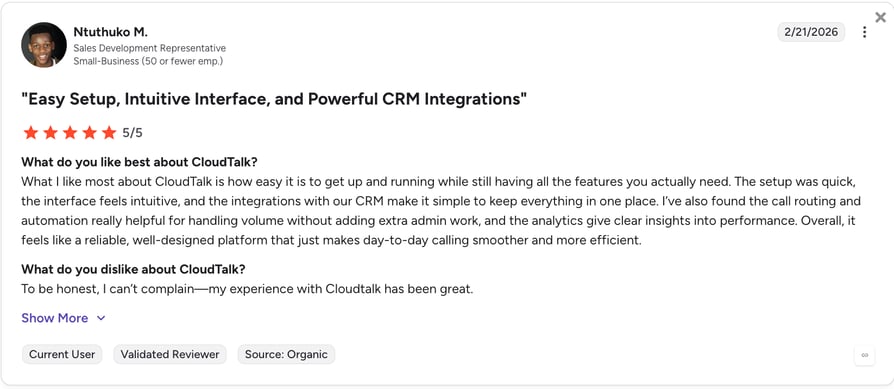
- 1,702+ verified G2 reviews, 4.4/5 rating — vs Cartesia's limited public review footprint.
- 14-day free trial, no credit card required.
What Is CloudTalk's Pricing?
- Starter: $25/user/month
- Essential: $29/user/month
- Expert: $49/user/month
- AI Receptionist: Starting at $99 for 200min/month
- AI Specialist: $349 for 1,000 min/month
- 14-day free trial included, no credit card required
“We just copy the agents, update the scripts, and we’re live. No need to hire and train a completely new team from scratch.”
Owner of Circle Gym

Bottom line: If you are a developer building a real-time voice application where sub-100ms latency is a hard requirement, Cartesia is the right tool. If you are a business team that needs to handle customer calls, integrate with CRM, and scale a support or sales operation, CloudTalk is the more complete, more predictable, and more cost-effective choice.
ElevenLabs — Best for Content Creators Needing Premium Voice Quality
What is ElevenLabs?
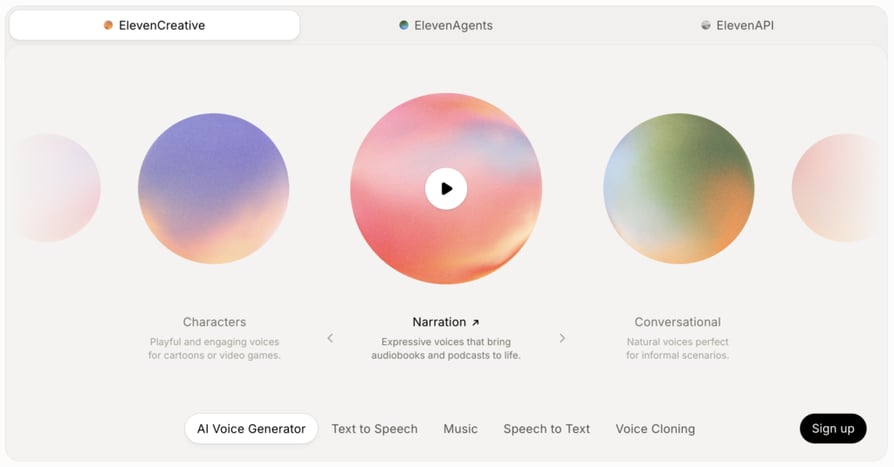
ElevenLabs is an AI audio platform offering text-to-speech, voice cloning, dubbing, and conversational AI agents. It is the quality reference in the TTS market for 2026, with support for 29+ languages and the most extensive voice library of any platform on this list.
Why Is ElevenLabs a Strong Cartesia Alternative?
- Higher voice quality ceiling — ElevenLabs Multilingual v2 and v3 models consistently outperform Cartesia on naturalness in long-form content evaluations
- More languages — 29+ languages vs Cartesia's 15+
- Commercial rights from Starter at $5/month
- Professional Voice Cloning included at Creator tier ($22/month)
What Is ElevenLabs' Pricing?
- Free: $0/month — 10,000 credits, no commercial rights
- Starter: $6/month — 30,000 credits, commercial rights
- Creator: $22/month — 121,000 credits, professional voice cloning
- Pro: $99/month — 600,000 credits, API access
- Scale: $299/month — 3 Workspace seats, 3 Professional Voice Clones
- Business: $990/month — 10 Professional Voice Clones, 10 Workspace seats
Who Is ElevenLabs Best For?
Content creators, podcast producers, audiobook narrators, and teams where voice quality and language coverage matter more than sub-100ms latency.
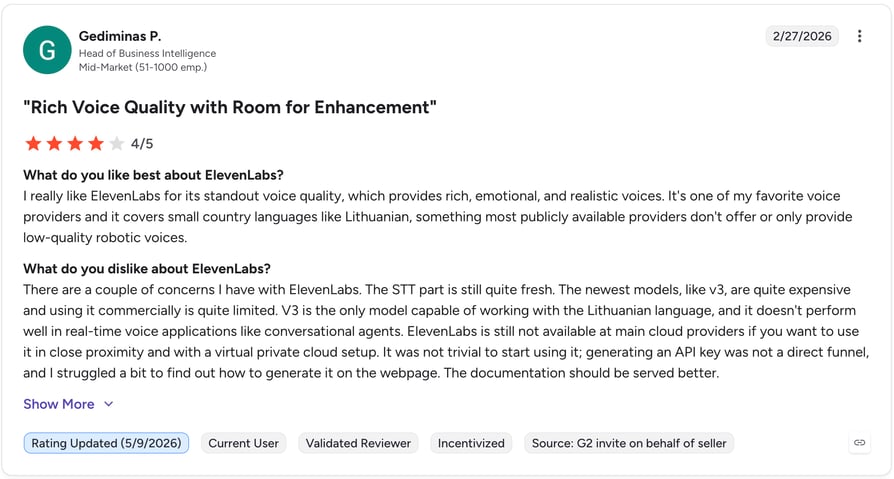
What Are Users Saying About ElevenLabs?
Deepgram — Best for STT-First Developer Teams
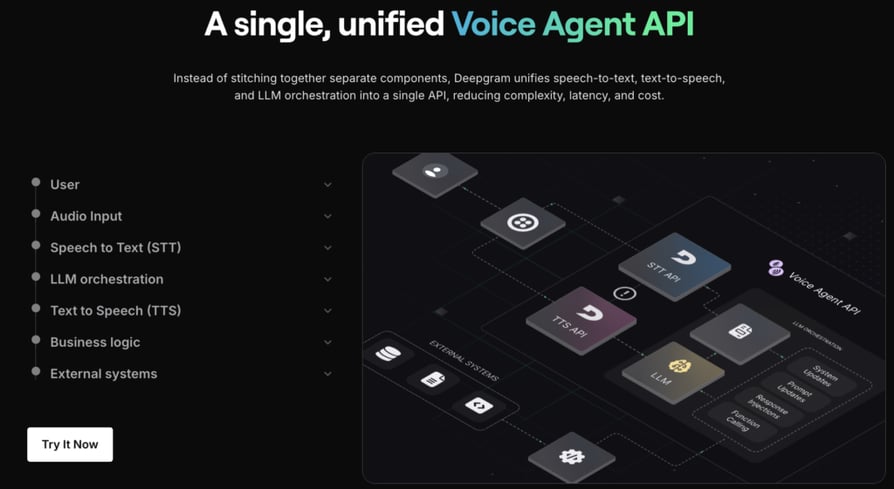
What Is Deepgram?
Deepgram is a developer-focused speech AI platform offering primarily Speech-to-Text (STT) — with TTS via its Aura-2 model as a secondary offering. It is the right alternative for teams whose primary need is transcription or for teams building full STT+TTS pipelines where Deepgram's Aura-2 undercuts Cartesia on TTS cost while matching it on latency.
Why Is Deepgram a Strong Cartesia Alternative for STT Workflows?
- More affordable TTS at scale — Aura-2 at $0.0135/min vs Cartesia Sonic at approximately $0.03/min
- Stronger STT than Cartesia's Ink — Deepgram's Nova-3 model is the STT accuracy leader for conversational AI
- Pay-as-you-go with $200 free credit
- 4.6/5 on G2 — stronger independent review base than Cartesia
What Is Deepgram's Pricing?
- Free: $200 in API credits included
- Pay-as-you-go: STT from $0.0043/min (Nova-3); TTS (Aura-2) from $0.0135/min
- Growth: $5,500/year pre-paid credits
- Enterprise: Custom pricing
Who Is Deepgram Best For?
Developer teams that need best-in-class STT with a solid TTS option at lower per-minute cost than Cartesia.
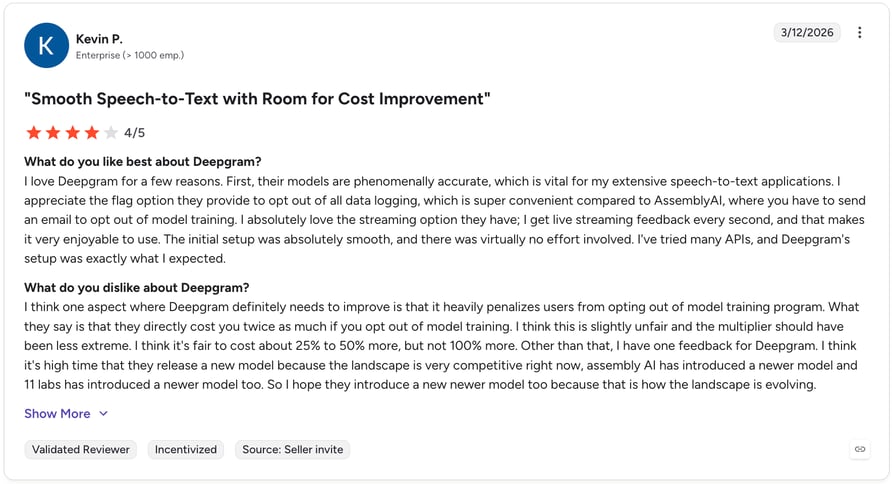
What Are Users Saying About Deepgram?

Elevate your business with CloudTalk.
What Are Cartesia's Best Features?
Ultra-Low Latency Text-to-Speech (Sonic)
Cartesia Sonic pricing is structured to make the platform's core differentiator accessible from the Free tier: sub-100ms time-to-first-audio. Sonic-3 achieves 90ms TTFA, with Sonic Turbo pushing this to approximately 40ms — making it the latency leader in the TTS market in 2026.
- Built on State Space Models (SSMs) — a fundamentally different architecture from Transformer-based competitors, optimized for sequential processing efficiency
- WebSocket streaming API — audio streams as it generates, so the first words play before synthesis of the full response is complete
- Sub-100ms TTFA maintained under load — Cartesia publishes latency benchmarks across 100 measurements at the 90th percentile
- Critical for conversational AI: at 300ms+ latency, AI responses feel noticeably robotic; at sub-100ms, conversations feel genuinely natural
Instant and Pro Voice Cloning
Cartesia provides two voice cloning tiers — Instant Voice Cloning (IVC) and Pro Voice Cloning (PVC). IVC requires just a short audio sample and generates a usable voice in seconds. PVC uses a full training run for higher-fidelity results.
- IVC: No upfront fee — clone a voice at no cloning cost, billed at 1 credit/char for generated speech. Available on Pro plans and above
- PVC: 1M credits to train, 1.5 credits/char for generated speech. Produces more accurate, expressive voice replicas
- Unlimited instant voice cloning on paid plans — unlike ElevenLabs, which caps cloning slots by tier
- Voice localization — adapt a cloned voice to different regional accents and styles (225 credits one-time cost per localization)
Line — Voice Agent Development Platform
Line is Cartesia's integrated platform for building, deploying, and monitoring voice agents. It provides the full development loop from agent creation to production observability — all within one platform.
- Text-to-Agent creation — describe your agent in natural language ($0.05/creation, free for limited time)
- CLI and GitHub integration — version-controlled agent deployment
- Telephony built in — no separate SIP trunking setup required
- Call analytics and observability — review call transcripts, trace spans, and agent performance logs
- Background agents — agents that process information without live call interaction
On-Premise and On-Device Deployment
Unlike most cloud-only voice AI providers, Cartesia supports on-premise and on-device deployment — a meaningful differentiator for regulated industries where sending audio data to external servers is not permitted.
- GDPR and SOC 2 Type II compliant on all plans
- HIPAA compliance available on Enterprise plan
- On-premise deployment — run Cartesia's models on your own infrastructure
- Consistent memory usage — suitable for both mobile devices and large-scale servers
What Are the Pros and Cons of Cartesia?
Evaluating Cartesia features pricing requires looking beyond the headline plan cost to understand what you actually get at each tier — and where the platform falls short compared to alternatives.
| Pros | Cons |
|---|---|
| Lowest latency in the TTS market — sub-100ms TTFA on Sonic, ~40ms on Turbo model | Character-based TTS billing is hard to forecast — cost depends on input length, not audio output duration |
| Flexible, usage-based pricing — credit model scales from free prototyping to enterprise volume | Limited public review base — sparse G2/Trustpilot presence makes independent evaluation difficult |
| All three products (Sonic, Ink, Line) included on every plan — no feature-gated product silos | Developer-only platform — no no-code interface, no CRM integrations, no call routing |
| Generous free tier — 20K credits and $1 agent prepaid, no time limit | Telephony rates are expensive below Scale — $0.06/min vs $0.014/min on Scale, a 4x price difference |
| On-premise and on-device deployment — critical for regulated industries | Pro Voice Cloning training consumes 1M credits — 80% of the Startup plan's monthly allocation |
| Pro Voice Cloning and Instant Voice Cloning on paid plans — no cap on number of cloned voices | Limited language support — 15+ languages vs ElevenLabs' 29+ and Azure/Google's 50-130+ |
| 20% discount on annual billing across all paid tiers | No CRM, analytics, or call center features — teams needing these must integrate external tools |
| SOC 2 Type II certified — enterprise-grade security posture | Concurrency limits are low on lower tiers — 2 concurrent TTS requests on Free |
| Active development — Sonic-3 released January 2026 with multilingual improvements | Enterprise pricing opacity — no public pricing for the tier most large organizations need |
| Strong developer community and comprehensive API documentation | Not suitable for non-technical teams — setup and configuration requires API knowledge |
Is Cartesia the Right Voice AI Platform for Your Business?
Cartesia AI voice pricing is competitive for developers building real-time applications — but it is purpose-built for one thing: low-latency voice synthesis via API. If that description fits your use case precisely, Cartesia is one of the strongest options available in 2026. If your needs extend beyond TTS infrastructure, the picture is more nuanced.
When Cartesia Makes Sense
- You are building a real-time voice agent, conversational AI, or interactive application where sub-100ms latency is a hard requirement
- Your team has engineering resources to work with APIs — no-code deployment is not available
- You are in a regulated industry (healthcare, finance) and need on-premise deployment or HIPAA compliance (Enterprise plan)
- You need unlimited instant voice cloning without per-voice caps
- You are at an early stage — the Free plan provides genuine prototyping value with no time limit
When You Should Consider an Alternative
- You need a complete business phone system — call routing, CRM integration, agent management, and analytics alongside AI voice that can improve cold calling or handle inbound calls. Cartesia provides none of these. CloudTalk is the more appropriate choice.
- Your team is non-technical and needs a no-code deployment path. Cartesia requires API integration for everything.
- Cost predictability matters — character-based billing makes monthly forecasting difficult for variable workloads. Platforms with per-minute or per-user models are more predictable.
- You need wider language coverage — ElevenLabs (29+), Azure (130+), or Google Cloud TTS (50+) significantly outpace Cartesia's 15+ languages.
- You want a strong, independent review validation before committing — Cartesia's limited G2/Trustpilot presence makes pre-purchase research harder.
For teams that need a full-stack voice AI and calling platform — not just a TTS API — CloudTalk delivers everything Cartesia does not: owned telephony infrastructure, native CRM integrations, outbound dialing tools, and 1,702+ verified G2 reviews, starting at $25/user/month with a 14-day free trial.
FAQs: Cartesia Pricing
Cartesia TTS (Sonic) costs 1 credit per character of input text on all plans. Credits are included in each plan: 20K (Free), 100K (Pro), 1.25M (Startup), 8M (Scale). At $50 per 1 million characters on pay-as-you-go, that is approximately $0.03/min of audio at normal speaking pace. If this looks too expensive for you, check out our articles on Cartesia alternatives for more accessible platforms.
Yes. Cartesia's Free plan is $0/month with no time limit. It includes 20,000 model credits and $1 prepaid for voice agents. Commercial deployment requires at minimum the Pro plan ($4/month annually).
Cartesia bills TTS (Sonic) at 1 credit per character of input text, including spaces and punctuation. STT (Ink) is billed at 1 credit per second of audio. Voice agents (Line) are billed per minute of call time at $0.06/min (Free through Startup) or $0.014/min (Scale). Pro Voice Cloning training costs 1 million credits as a one-time fee.
Cartesia starts cheaper ($4/month vs ElevenLabs' $5/month Starter) and has lower latency (90ms vs ~75ms on ElevenLabs Flash). ElevenLabs offers higher voice quality for long-form content, more languages (29+ vs 15+), and a stronger independent review base. For real-time voice agents, Cartesia is the better technical fit. For content creation and naturalness, ElevenLabs leads.
Yes. CloudTalk's AI Voice Agents handle 24/7 inbound and outbound calls in 60+ languages, with built-in transcription, sentiment analysis, and call summaries — included in plans starting at $25/user/month. Unlike Cartesia, CloudTalk is a complete VoIP platform with CRM integrations, call routing, and outbound dialing tools, not just a TTS API.
Choose CloudTalk when you need a complete business calling platform — not just a voice synthesis API. CloudTalk handles the entire call lifecycle starting at $25/user/month with 100+ integrations. Cartesia is the right choice when you are a developer building a real-time voice application where sub-100ms TTS latency is a hard requirement.