Ringly AI Pricing 2026: Plans, Per-Call Costs & Reviews
TL;DR: Ringly AI Pricing at a Glance
Ringly.io moved to a single pay-per-call plan on 12 September 2026. It costs $99/month, covers your first 50 phone conversations, and bills $1.99 for every conversation after that. Spam, hang-ups, wrong numbers, and callers who only want a human are free, and roughly 80% of inbound calls end up billable.
The old plans still exist for old customers. Accounts opened before 12 September stay on Grow ($349/month for 1,000 minutes) or Pro ($799/month for 2,500 minutes) with per-minute overage. If you are comparing Ringly against a per-minute vendor, that difference is the whole story, and this article covers both models.
Quick Answer: How Much Does Ringly AI Cost?
Ringly.io costs $99 a month for the first 50 phone conversations, then $1.99 per conversation, on a month-to-month contract with a 30-day money-back guarantee.
A store taking 200 calls a month pays roughly $318. Above 1,000 calls a month, pricing moves to a custom quote. Legacy Grow and Pro subscribers keep their per-minute plans until they choose to move. If what you are really asking is how much does Ringly.io cost for a store your size, the answer is the base fee plus your billable conversation count, and we model four volumes below.
| Plan | Price | What is included | Best for |
|---|---|---|---|
| Pay per call (current) | $99 /month | 50 conversations, then $1.99 each | Shopify stores with moderate call volume that want costs tied to real conversations. |
| Grow (legacy) | $349 /month | 1,000 minutes, then $0.29/min | Existing customers with long calls and steady volume. |
| Pro (legacy) | $799 /month | 2,500 minutes, then $0.19/min | Existing high-volume stores that need the cheaper per-minute rate. |
| Custom / Enterprise | Quote-based | Negotiated volume | Stores handling 1,000+ calls per month. |
Curious what AI phone support costs when it is priced by the minute, not the call?
What Pricing Plans Does Ringly AI Offer?
Ringly.io is AI phone support built for Shopify brands. Its agent, Seth, handles the calls an ecommerce support team gets over and over: where is my order, returns, exchanges, subscription changes, product and policy questions. That focus explains the pricing model, because in ecommerce a resolved question is the unit of value, not a minute of talk time.
As of 12 September 2026 there is one plan for new customers. Ringly.io pricing is a $99 monthly minimum that covers 50 phone conversations, then $1.99 per conversation beyond that. Billing starts at activation and renews on the same date each month.
What Is Ringly AI's Pay-Per-Call Plan?
The current plan charges for outcomes rather than airtime. You pay $99/month as a floor, which includes the first 50 phone conversations, and $1.99 for each additional conversation.
What is included in Ringly AI's pay-per-call plan
- Phone numbers, included rather than billed separately.
- Knowledge base, included, with up to 500 web pages refreshed every 24 hours and up to 20,000 Shopify products synced automatically.
- Support for 40 languages on the AI phone rep.
- 30+ integrations, including Shopify, Gorgias, Zendesk, Intercom, Recharge, Loop Returns, Narvar, Twilio, and Aircall.
- A monthly spend cap you can set in Settings, after which the agent pauses.
- Month-to-month billing, cancellation from Settings, and a 30-day money-back guarantee.
What counts as a billable conversation
This is the part worth reading twice, because it decides your invoice. A conversation is billable when both Seth and the customer speak. Ringly does not charge for spam, hang-ups, wrong numbers, callers who immediately ask for a human, or your own team testing the agent. Ringly's own estimate is that roughly 80% of inbound calls end up billable, so 100 calls means about 80 conversations.
What you need to know about the pay-per-call plan
Ringly attaches a resolution guarantee: Seth resolves 65% of support calls or you do not pay for that month. That is an unusual commitment in this category and it shifts some of the risk back onto the vendor. The trade-off is that call length no longer affects your bill, which is excellent if your calls run long and expensive if most of your calls are 45-second order lookups.
What Is Ringly AI's Legacy Grow Plan?
Grow was Ringly's entry tier before the change, at $349/month for 1,000 included minutes, with overage at $0.29 per minute. That works out to an effective $0.349 per included minute, and it is still what legacy accounts pay.
- 1,000 minutes of AI talk time per month, with per-minute billing after that.
- Phone numbers and the knowledge base included.
- Charged immediately at signup, with no free trial attached to this tier.
What Is Ringly AI's Legacy Pro Plan?
Pro sat above Grow at $799/month for 2,500 included minutes with overage at $0.19 per minute, an effective $0.32 per included minute. It was the volume tier, and it carried a 14-day free trial that Grow did not.
- 2,500 minutes included, then the cheapest published per-minute rate Ringly has offered.
- Same included phone numbers and knowledge base as Grow.
- The Ringly AI free trial, 14 days, applied to this plan.
What Is Ringly AI's Enterprise Plan?
Stores handling more than 1,000 calls a month move to a custom plan. No public price exists, and the variables on the table are conversation volume, concurrency, and contract length. If you are in that bracket, the number to negotiate is the per-conversation rate, since $1.99 across 1,000 conversations is roughly $2,000 a month before the base fee.
Ringly AI Pricing Plans Compared
| Aspect | Pay per call | Grow (legacy) | Pro (legacy) |
|---|---|---|---|
| Monthly price | $99 | $349 | $799 |
| What the price includes | 50 conversations | 1,000 minutes | 2,500 minutes |
| Overage rate | $1.99 per conversation | $0.29 per minute | $0.19 per minute |
| Phone numbers | Included | Included | Included |
| Knowledge base | Included | Included | Included |
| Free trial | 30-day money-back guarantee | None, charged at signup | 14 days |
| Available to new customers | Yes | No, legacy only | No, legacy only |
Want AI phone support that also gives your team a phone system?
What Are Ringly AI's Additional Costs?
Ringly's current model is unusually clean: one plan fee and one overage meter, with numbers and the knowledge base already inside the price. The costs that still deserve attention are the ones created by how the meter counts, rather than by a list of add-ons.
Per-conversation overage
Every conversation past the first 50 costs $1.99 regardless of length. At 300 billable conversations that is $497 in overage on top of the $99 base. This is the only meter on the current plan, and it is the one that moves your invoice.
Short calls cost the same as long ones
There is no Ringly AI cost per minute on the current plan, and that cuts both ways. A 6-minute returns conversation costs $1.99, which is excellent value. A 40-second "where is my order" also costs $1.99, which works out around $3.00 per minute. If most of your calls are quick order lookups, model the per-minute equivalent before signing.
Legacy custom agent add-ons
Older custom agent setups carry separate charges: $5 per phone number per month and $9 per knowledge base per month. These do not apply to the current Seth product, where both are included, but they still show up on legacy invoices and in older comparison articles.
The floor you pay even in a quiet month
The $99 is a minimum, not a credit bank. A month with 12 conversations still costs $99, which works out at $8.25 per conversation. Seasonal stores should budget for the quiet months as well as the peak ones.
| Cost | Price | What triggers it |
|---|---|---|
| Conversation overage | $1.99 per conversation | Every billable conversation past the first 50. |
| Monthly minimum | $99 | Charged in full even if you use 5 conversations. |
| Extra phone numbers | $0 on the current plan, $5/month on legacy custom agents | Included with Seth; charged only on older setups. |
| Extra knowledge bases | $0 on the current plan, $9/month on legacy custom agents | Included with Seth; charged only on older setups. |
| High-volume pricing | Quote-based | Required above roughly 1,000 calls per month. |
See both meters side by side before you commit
What Will Ringly AI Actually Cost?
The plan price is a floor. Your call volume decides the rest. Below are four realistic scenarios using Ringly's own estimate that about 80% of inbound calls become billable conversations, with an effective cost per conversation and per minute at the end of each. Assume a 3-minute average call unless stated.
Scenario 1: The small store (60 calls a month)
The setup: a growing Shopify brand fielding around 60 calls a month, mostly order status and delivery questions. About 48 become billable conversations, which sits inside the included 50.
| Line item | Unit cost | Quantity | Subtotal |
|---|---|---|---|
| Base plan (includes 50 conversations) | $99 / month | 1 | $99.00 |
| Additional conversations | $1.99 each | 0 | $0.00 |
| Monthly bill | $99.00 / month |
Effective cost:
$2.06 per conversation, roughly $0.69 per minute. The base fee is doing all the work here. A store at this volume is paying a premium for the floor, and the money-back guarantee matters more than the rate.
Scenario 2: The scaling brand (200 calls a month)
The setup: a store past its first big season, taking about 200 calls a month across order status, returns, and exchanges. Roughly 160 become billable conversations.
| Line item | Unit cost | Quantity | Subtotal |
|---|---|---|---|
| Base plan (includes 50 conversations) | $99 / month | 1 | $99.00 |
| Additional conversations | $1.99 each | 110 | $218.90 |
| Monthly bill | $317.90 / month |
Effective cost:
$1.99 per conversation, roughly $0.66 per minute. This is where the model settles. From here on the base fee stops mattering and your bill is simply conversations times $1.99.
Scenario 3: The busy support line (500 calls a month)
The setup: an established brand with a real support queue, around 500 calls a month and roughly 400 billable conversations. This is the volume where the current model and the legacy per-minute plans diverge sharply.
| Line item | Unit cost | Quantity | Subtotal |
|---|---|---|---|
| Base plan (includes 50 conversations) | $99 / month | 1 | $99.00 |
| Additional conversations | $1.99 each | 350 | $696.50 |
| Same volume on the legacy Grow plan (1,200 minutes) | $349 + $0.29/min overage | 200 extra minutes | $407.00 |
| Monthly bill, current plan | $795.50 / month |
Effective cost:
$1.99 per conversation, roughly $0.66 per minute, and almost double what the same volume costs a legacy Grow customer. If your calls are short, per-conversation billing is the more expensive model at scale. This is the single most important calculation to run before signing.
Scenario 4: The peak-season spike (1,000+ calls a month)
The setup: Black Friday through January, with calls tripling to around 1,000 a month and about 800 billable conversations. At list price that is $99 plus 750 conversations at $1.99, which is $1,591.50 for the month.
What to do at this volume:
Ringly asks high-volume stores to talk to sales, and at $1,591 a month you should. Two things to negotiate: a lower per-conversation rate, and what happens in the quiet months either side of peak. Also set the monthly spend cap in Settings before the season starts, since the agent pauses when it is reached rather than billing through it.
The pattern: the Ringly AI cost per minute lands near $0.66 at a 3-minute average call, and roughly $2.00 per minute if your calls average a minute. Per-conversation billing rewards long, complex calls and punishes short ones. Work out your average handle time first, because that single number decides whether this model saves you money or costs you double.
What Do G2 Users Rate Ringly AI?
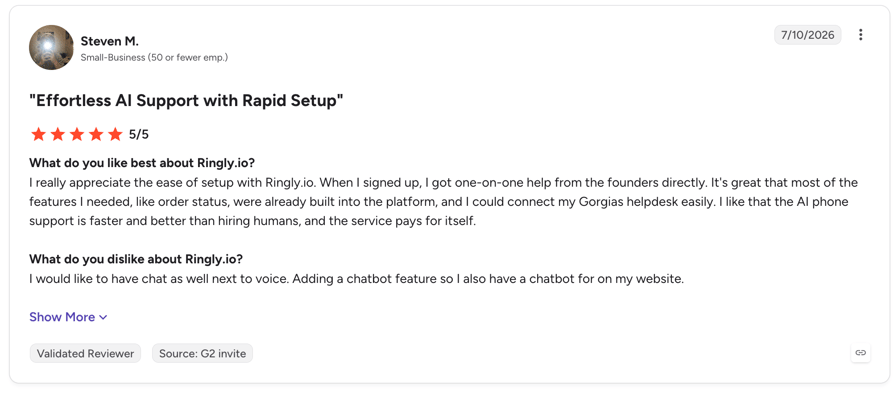
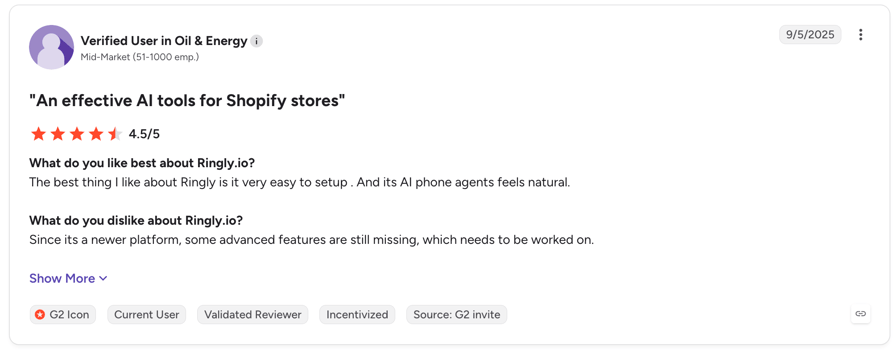
So far, Ringly AI has 2 reviews on G2, and is rated 4.8/5. Even though they're not nearly enough for you to rely on, check them out below:
Price your call volume both ways in one session
Which Ringly AI Alternatives Are Better and Cheaper?
Ringly AI alternatives fall into three camps: per-minute AI voice agents, flat-rate AI receptionists, and phone systems with AI built in. Which is cheaper depends almost entirely on your average call length, so read each price below as a per-minute figure rather than a monthly one.
CloudTalk: Best for teams that answer and make calls
What is CloudTalk
CloudTalk is a business phone system with AI voice agents inside it. Ringly answers the phone for your store; CloudTalk answers it, routes it, records it, and gives your team the lines they call customers back on.
Why CloudTalk may be better than Ringly AI
- Per-minute AI pricing, so a 45-second order lookup costs a fraction of a $1.99 conversation.
- Local numbers in 160+ countries, which matters for a brand selling into more than one market.
- The AI voice agent handles 70+ languages and accents, with sub-800ms latency and handoff to a human carrying full context.
- Everything the human team needs comes with it: routing, recording, and call intelligence across every conversation.
- Native Salesforce, HubSpot, and Pipedrive sync, plus 100+ tools, rather than an ecommerce-only stack.
What is CloudTalk's pricing
- Phone system plans from $25/user/month billed annually, one-licence minimum on the entry plans.
- AI Receptionist: 50 minutes free to start.
- AI Specialist: €349/month for 1,000 minutes with advanced workflows and integrations.
- Volume pricing from €0.15 per minute.
CloudTalk pricing vs Ringly AI pricing
Take the 500-call scenario above: 400 billable conversations at a 3-minute average is about 1,200 AI minutes. On Ringly's current plan that is $795.50. At CloudTalk's volume rate of €0.15 a minute, 1,200 minutes is around €180, and the AI Specialist bundle covers 1,000 of those minutes for €349. The gap widens further when calls are short, because CloudTalk bills the seconds and Ringly bills the conversation.
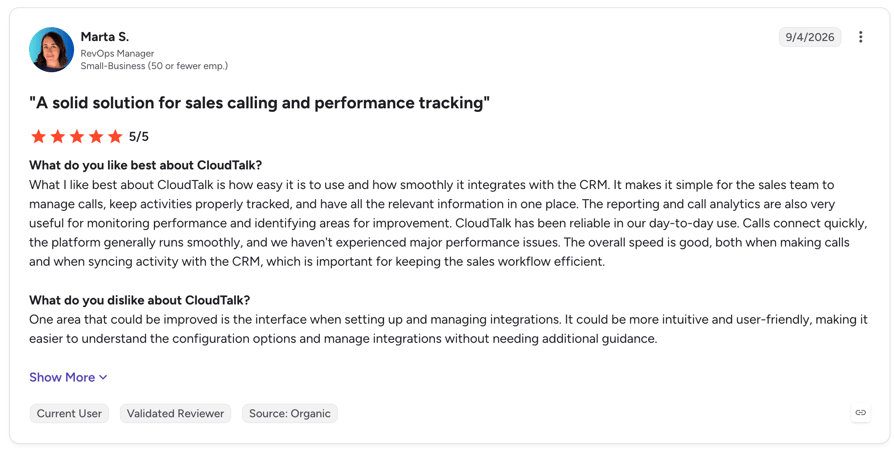
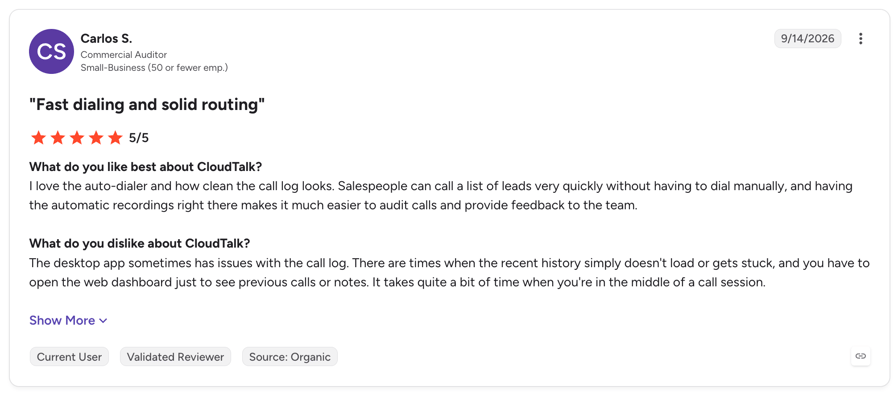
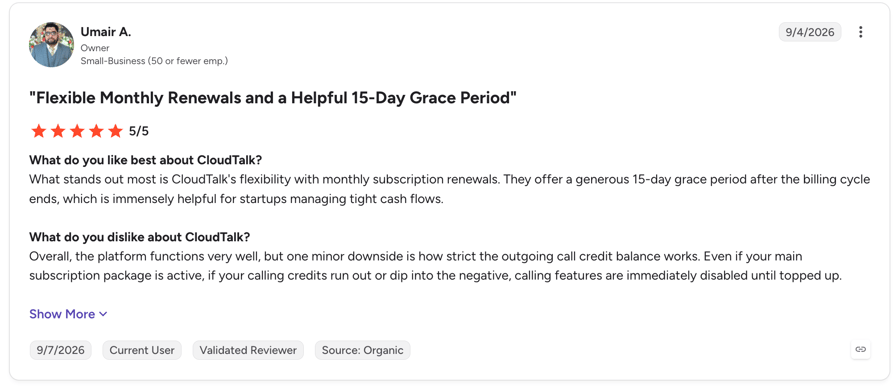
What Do G2 Users Rate CloudTalk?
CloudTalk is rade 4.4/5 by 1800+ verified users on the platform. Check out some of the reviews:
Other Providers Worth Checking Out
If you're interested to learn more about other providers, these articles are worth the read:
Recommended articles
What Are Ringly AI's Best Features?
A Shopify-native agent that knows your catalogue
- Syncs up to 20,000 Shopify products automatically, so the agent answers product questions from live data rather than a script.
- Handles the ecommerce call types that dominate an inbound queue: order status, returns, exchanges, subscriptions, and policy questions.
A knowledge base that refreshes itself
- Crawls up to 500 web pages and refreshes them every 24 hours, so a shipping policy change reaches the agent without anyone retraining it.
- Included in the plan price rather than billed per knowledge base, unlike the legacy custom agent setup.
Billing that skips the calls nobody wants
- Spam, hang-ups, wrong numbers, and callers who only want a human are not billed, which removes the most annoying line on a usage invoice.
- A monthly spend cap in Settings pauses the agent rather than letting the meter run.
A resolution guarantee with money attached
- Seth resolves 65% of support calls or the month is refunded, which is a rare commitment in a category that usually sells potential.
- 40 languages and 30+ integrations including Gorgias, Zendesk, Intercom, Recharge, and Loop Returns, with go-live quoted in under an hour.
What Are the Pros and Cons of Ringly AI?
| Pros | Cons |
|---|---|
| One plan fee and one meter, with phone numbers and the knowledge base included | Per-conversation billing means a 40-second order lookup costs the same $1.99 as a 6-minute return |
| Spam, hang-ups, and wrong numbers are not billed, so about 20% of inbound calls are free | The $99 monthly minimum is charged in full even in a quiet month |
| 65% resolution guarantee, refunded if missed, plus a 30-day money-back guarantee | Costs scale steeply with volume: 400 conversations is roughly $795 a month at list price |
| Purpose-built for Shopify, with product sync, returns, and subscription workflows | Ecommerce-only focus, with no phone system for the team that answers escalations |
| Month-to-month, cancellable from Settings, with a spend cap you control | Almost no public review footprint, so billing and support claims are unverified by customers |
Answer every call without paying a flat fee for a 40-second question
Is Ringly AI Worth the Price for Your Store?
Ringly.io fits a specific store well: Shopify-based, inbound-heavy, with conversations that actually take a few minutes because they involve returns, exchanges, or subscription changes. For that store, $1.99 to resolve a call that would otherwise occupy an agent for five minutes is good value, and the resolution guarantee lowers the risk of trying it.
Is Ringly AI worth it if your calls are short? Less often. At a one-minute average the effective rate is close to $2.00 per minute, which is expensive against per-minute AI agents charging a fraction of that. And the model scales in a way that deserves attention: the same call volume that costs a legacy Grow customer $407 costs a new customer $795 on the current plan.
The other consideration is scope. Ringly answers your store's phone. It does not give your team a phone system, outbound dialing, or reporting across human calls, so if you need those you are buying two products. Teams looking to cut repetitive work with AI tools across the whole operation, rather than on the phone line alone, usually end up wanting the second one anyway.
The decision, in one line: if your average call runs over three minutes and your volume sits under about 150 conversations a month, Ringly is priced fairly and the guarantee makes it low-risk to test. If your calls are short, your volume is high, or your team also makes calls, price a per-minute AI voice agent inside a phone system first. Our roundup of the best AI voice agents and our guide to AI in sales cover the options.

Why pay a flat fee per call when most calls take a minute?

Frequently asked questions
On the current plan there are no included minutes, only 50 included conversations. Past those, each billable conversation costs $1.99 regardless of length. Legacy plans work differently: Grow includes 1,000 minutes with $0.29 per minute after, and Pro includes 2,500 minutes with $0.19 after. On either model you can set a monthly spend cap in Settings, and the agent pauses when it is reached.
The current plan is protected by a 30-day money-back guarantee rather than a conventional trial, and Ringly offers a "try for free" entry point on its site. Among the legacy plans, Pro carried a 14-day free trial while Grow was charged immediately at signup with no trial. If a no-card trial matters to you, CloudTalk's 14-day free trial requires no payment details.
Using Ringly's own estimate that about 80% of calls are billable: 60 calls a month costs $99, 200 calls costs roughly $318, 500 calls costs roughly $795, and 1,000 calls reaches about $1,592 at list price before any negotiated rate. Above 1,000 calls Ringly asks you to talk to sales, and that is the point to push on the per-conversation rate.
For legacy customers, Pro pays for itself once you are consistently past roughly 2,550 minutes a month. Below that, Grow at $349 plus $0.29 per extra minute is cheaper than Pro's $799 floor. Pro's advantage is the $0.19 per minute rate and the 14-day trial Grow never had. Neither plan is available to new customers, who go onto the $99 pay-per-call plan instead.
Yes. Billing is month-to-month with no contract, and you cancel from Settings. Billing runs from your activation date and renews on the same date monthly, so cancelling mid-cycle ends the subscription at the period end. Unused conversations do not roll over, and the $99 minimum is not refunded for a light month, though the 30-day money-back guarantee covers a first month that does not work out.
It depends entirely on call length. At a 3-minute average, $1.99 per conversation works out to about $0.66 per minute, well above CloudTalk's €0.15 volume rate and Aircall's $0.39 to $0.49 pay-as-you-go. At a 6-minute average it drops to about $0.33 and starts looking competitive. Work out your average handle time, convert every vendor to a per-minute number, and compare those rather than the monthly prices.
The calculation worth running is cost per resolved call against the loaded cost of the person who would otherwise take it, plus the value of the calls currently going unanswered. At $1.99 a conversation, Ringly beats a human agent on cost per interaction in most support queues. Where it gets interesting is the second half: an agent answering at 2am recovers revenue no rota covers, and that is usually the number that justifies the spend rather than the labour saving.