CallFluent AI Review: The TL;DR Verdict
| Verdict | Details |
|---|---|
| Overall Rating | 3.5. Fast setup and low entry price, but unclear total costs and mixed support make it harder to trust for long-term use. |
| Best For | Solo operators and agencies testing AI calling on a budget, for a contained use case, who are comfortable running a separate Twilio account. |
| Not Good For | Revenue-critical calling teams that need flat-rate pricing, native CRM, and built-in conversation intelligence. |
| Starting Price | Starter $37/mo (100 min) → Business $67/mo (360 min) → Agency $127/mo (1,600 min). A separate Twilio account is required on every plan. |
| Free Tier? | No permanent free tier and no traditional free trial. A free demo call on the CallFluent homepage lets you hear voice quality before you buy. |
| Setup Time | Fast. Includes a no-code builder, though wiring up Twilio adds a step. |
| Standout Strength | No-code speed plus 400+ neural voices across 40+ languages, with one-click ElevenLabs cloning on Agency and above. |
| Biggest Limitation | Two bills, two platforms: the mandatory Twilio dependency and unpublished overage rates. No native CRM and no conversation intelligence. |
| User Sentiment | Mixed and polarized. Trustpilot sits at 2.9/5 across 17 reviews, and there are no reviews in G2. |
| CloudTalk Verdict | If you want AI voice agents with a phone system included, one flat bill, and no Twilio account to manage, CloudTalk is the business-ready pick. |
CallFluent AI promises a fast and affordable way to launch AI voice agents, and its no-code setup makes that easy. But how affordable is it, really, once you add the required Twilio account and the overage fees that aren’t publicly listed? Given its low Trustpilot rating, is it worth committing to an annual plan?
We took a closer look to find out. This CallFluent AI review covers what CallFluent AI is, its features, its pricing (including the real cost once Twilio is in the mix), real user reviews, its limitations, and the best AI voice agents to consider if it isn't the right fit.
Want predictable pricing and built-in telephony?
CallFluent AI Scorecard: Our Honest Ratings
We scored CallFluent AI using its published product and pricing information, plus verified user reviews from Trustpilot. We use the same six criteria for every AI voice agent review, so the scores stay comparable across tools.
CallFluent AI Scorecard
| Dimension | Rating | Why |
|---|---|---|
| Ease of Setup | 4.5/5 | A genuine strength. The no-code builder gets a first agent live in under 5 minutes (according to their website) no programming required. |
| Call Quality & Voice | 4.0/5 | 400+ neural voices, 40+ languages, 140+ accents, and ElevenLabs cloning on Agency+. The 6 basic voices on lower tiers are noticeably weaker. |
| Pricing Clarity | 3.0/5 | Low headline price, but a mandatory separate Twilio account means dual billing, and CallFluent doesn't publish its overage rate. |
| Features & Capabilities | 3.5/5 | Solid core: recording, transcription, and basic analysis on every plan. Limited evidence of advanced agent coaching or conversation quality tools. |
| Integrations | 3.0/5 | Strong automation layer (Zapier, Make, n8n, GoHighLevel, Google Calendar), but integrations with Salesforce, HubSpot, or Pipedrive should be verified. |
| Support & Reputation | 3.0/5 | Trustpilot sits at 2.9/5, with mixed reviews. Users praise the product and support, but others report setup issues and poor customer service. |
CallFluent AI overall rating: 3.5/5. The setup speed and low entry price are real, and for a solo operator running one contained use case, that combination can be enough. The score sits where it does because the two things a buyer needs most before committing, a clear all-in cost and a trustworthy support record, are exactly where CallFluent is weakest.
What Is CallFluent AI?
CallFluent AI is a 100% cloud, no-code platform for building AI voice agents that handle inbound and outbound calls for sales, bookings, surveys, and support, 24/7. You define an agent in three steps, without writing a line of code, and it can run sales calls, appointment booking, customer support, lead qualification, and billing inquiries around the clock. CallFluent says it processes over 100,000 call minutes daily across its customer base.
Here's the framing that matters most, and the one most launch content skips: CallFluent is a layer on top of Twilio. Every plan requires a separate, self-funded Twilio account to connect an agent to a real phone number. Without it, you have an AI voice with nothing to call. That means two bills, two platforms, and two support surfaces to manage from day one.
Who CallFluent AI Is Best Suited For
CallFluent makes the most sense for small businesses and solo operators who want to test AI calling for a contained use case, like appointment reminders, simple FAQs, or light lead qualification, without a big upfront commitment. It also fits agencies that already run a Twilio account and want a low-cost, white-labelable platform to resell AI calling to multiple clients.
The common thread is low volume and a defined job. If calling is central to your revenue, or you need one predictable bill, the fit weakens fast, and we cover exactly why below. For the wider category, see our guide to what AI voice agents are and the capabilities and use cases of AI voice.
Not Sure a Twilio-Dependent Setup Is Right for You?
How Does CallFluent AI Work?
CallFluent has one mechanic you have to understand before you buy, and it's the Twilio dependency. Here's the build model, honestly, from the no-code builder to the second bill.
The No-Code Builder (3 Steps)
You define the agent's persona, script, voice, and behaviors in a straightforward interface, with no programming required. This is where CallFluent earns its reputation: a non-technical owner can stand up a working CallFluent AI agent in an afternoon, then point it at a use case like booking or FAQ handling.
The Twilio Dependency (Read This Before Buying)
CallFluent explicitly requires a separate Twilio account on every plan to connect an agent to a real phone number. That means you pay CallFluent's subscription and Twilio's separate costs: roughly $1–$2/month per phone number, billed straight to your Twilio account on top of your CallFluent plan minutes.
The honest caveat:
For light users, the Twilio layer is modest. But as call volume scales, running two billing systems—CallFluent's plan allowance plus Twilio's per-minute charges once you exhaust it—pushes your total cost of ownership meaningfully above the headline plan price.
Deployment, Recording & Automation
Once an agent is connected, it records, transcribes, and provides basic analysis of every call, giving you an audit trail from the Starter tier up. For workflows, CallFluent integrates with Zapier, Make, n8n, GoHighLevel, and Google Calendar, so a service business can wire up real-time appointment booking without touching code.
What Are the Key Features of CallFluent AI?
CallFluent's feature set covers no-code building, neural voices, call recording and transcription, and a broad automation layer. Here's what each one gives you, what it means for your team, and where each one falls short.
No-Code AI Voice Agent Builder (Core Strength)
Define persona, script, voice, and behaviors with no programming, and get a first agent live in under an hour. For non-technical buyers, that's a real speed advantage over developer-first platforms like Vapi.
400+ Neural Voices Across 40+ Languages
CallFluent offers 400+ AI neural voices, 40+ languages, and 140+ accents and variants, with a one-click ElevenLabs integration on the Agency plan and above that unlocks voice cloning. On those tiers, the voice quality holds up across multi-turn conversations and is one of the stronger sets in the no-code space.
Call Recording, Transcription & Analysis
Every plan includes automatic recording, AI-generated transcription, and basic call analysis, searchable from the dashboard. Even at Starter, that gives you a useful audit trail for reviewing what customers ask and how agents respond.
Integration Ecosystem via Zapier, Make & Webhooks
Native connections to GoHighLevel, Google Calendar, ElevenLabs, OpenAI, and Twilio, plus Zapier, Make, and n8n for extended automation. Real-time appointment booking through Google Calendar and GoHighLevel is a standout for service businesses.
API & Webhooks
CallFluent offers API access and webhooks so developers can trigger calls, pass real-time data, and integrate agents with external platforms. It's not a developer-first product the way Vapi is, but the hooks are there for teams that want to extend it programmatically.
Skip the Twilio Setup. Test a Voice Agent This Week.
CallFluent AI Pricing Breakdown
CallFluent AI pricing starts at $37/month and runs to $127/month across three plans, each built around a fixed monthly minute allowance with overage charges once you exceed it. This is the short version.
CallFluent AI Pricing: The Four Plans
CallFluent AI Plans and Pricing
| Plan | Monthly Price | Minutes Included | Best For |
|---|---|---|---|
| Starter | $37/mo | 100 min | Individuals and small businesses testing AI calling |
| Business | $67/mo | 360 min | Growing businesses needing more minutes and automation |
| Agency | $127/mo | 1,600 min, unlimited agents / workspaces / seats | Agencies managing multiple clients |
| Agency White Label | $397/mo | 3,600 min + full white-label | Large agencies reselling under their own brand |
Annual billing saves 40–70% across the tiers, so the effective monthly cost drops if you commit for a year. Note the headline rates are promotional: CallFluent lists higher regular prices (Starter's regular rate, for example, is $67/month), so treat the discounts as time-limited. The CallFluent AI white label option only arrives on the top $397/month plan, which adds custom branding, a custom domain, and custom SMTP.
The Real Cost: Twilio + Overages + Add-Ons
The single most important thing to understand about CallFluent's cost is that the plan price is only the floor. Every plan needs a separate, self-funded Twilio account, and several real costs sit outside the subscription entirely.
CallFluent AI Additional Costs
| Additional Cost | Amount | Notes |
|---|---|---|
| Twilio phone number | $1 per active user/hour | Required to connect agents to real numbers. Not included in any plan. |
| Twilio call minutes | $0.014/min (outbound US) | Billed separately via Twilio, on top of CallFluent plan minutes. |
| CallFluent overage minutes | Rate not publicly listed | Charged when you exceed your allowance. The biggest forecasting risk. |
| ElevenLabs voices | Varies (separate account) | Premium neural cloning beyond the 6 included voices. Agency plan and above. |
Is CallFluent AI Free? Free Plan & Demo Details
No. There's no permanent free tier and no traditional free trial. CallFluent offers a free demo call on its homepage so you can hear the AI voice quality before you buy, but deploying your own agents and making real calls requires both a paid plan and an active, funded Twilio account. For a platform pitched at accessibility for small businesses, the lack of a risk-free trial is a notable gap.
What Real Users Say About CallFluent AI Pricing on Trustpilot & G2
CallFluent AI has a 2.9/5 Trustpilot rating from 17+ reviews, with mixed feedback. Currently, there are no reviews on G2.
Positive reviewers highlight the natural-sounding voices, integrations with tools like HighLevel and ElevenLabs, easy setup, and helpful support.
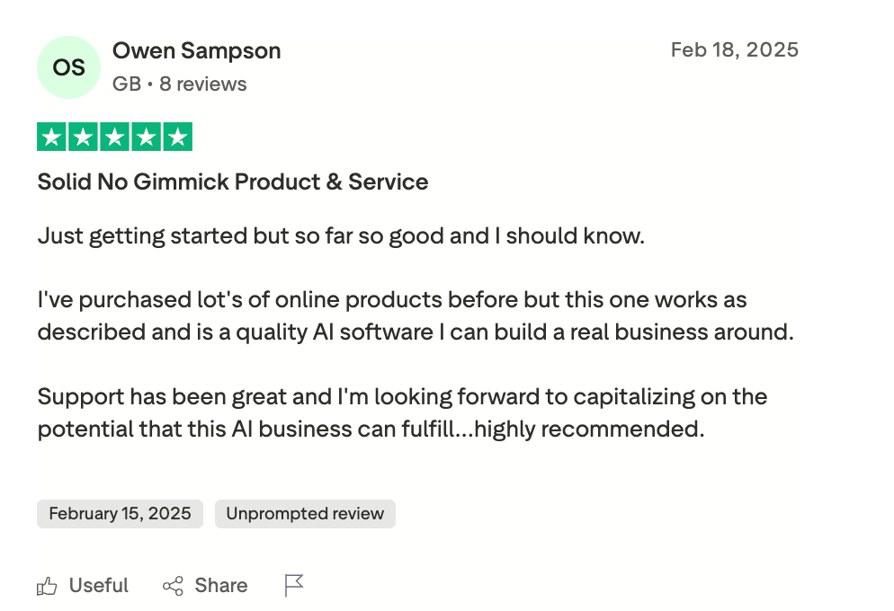
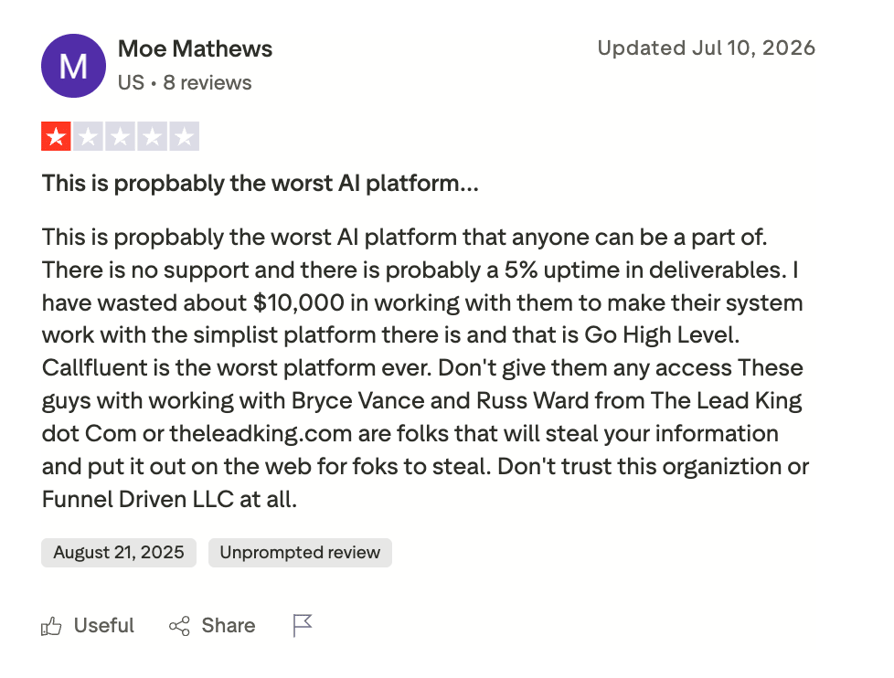
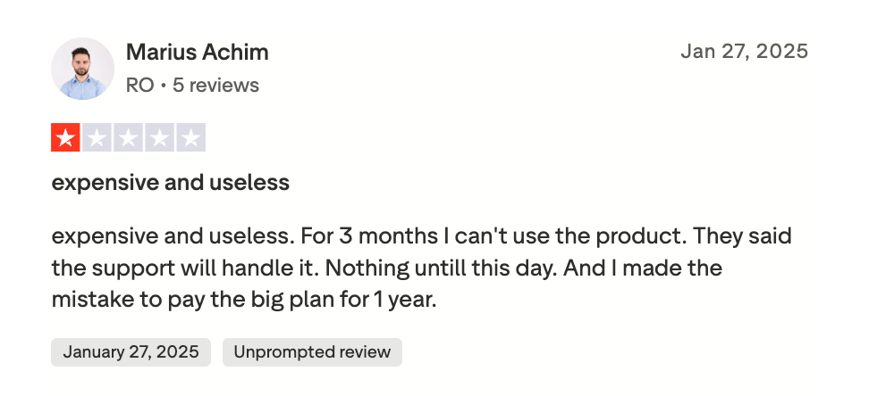
On the negative side, the criticism clusters around cost and support. One 1-star reviewer said they'd wasted about $10,000 trying to make the system work. Another wrote that after paying for a big annual plan, they couldn't use the product for three months, while the support "will handle it" promise went nowhere.
Rated 4.4/5 on G2. Try It on Your Own Calls.
CallFluent AI Review on 6 Must-Have Business Requirements
Six requirements decide most voice AI evaluations: call quality, usability, scalability, language support, integrations, and support. CallFluent publishes enough to be scored on all six, and in a review like this the "what to watch" column matters as much as the strength.
CallFluent AI on 6 Must-Have Business Requirements
| Requirement | How CallFluent Performs | What to Watch |
|---|---|---|
| Call quality & voice | 400+ neural voices, 40+ languages, ElevenLabs cloning on Agency+ | The 6 basic voices on Starter and Business are noticeably weaker; test naturalness on multi-turn calls |
| Usability & setup | No-code builder, first agent often live in under an hour | Setting up Twilio separately adds a technical step most 'no-code' framing skips |
| Scalability & volume fit | Agency tier (1,600 min, unlimited agents) is the first genuinely scalable option | 100/360-min lower tiers run out fast; unpublished overage rates are a real risk for variable volume |
| Language support | 40+ languages and 140+ accents claimed | Confirm which are production-ready neural voices vs basic-tier only |
| Integrations | Strong automation layer: Zapier, Make, n8n, GoHighLevel, Google Calendar | No confirmed native integration with Salesforce, HubSpot, or Pipedrive |
| Support & reputation | Dedicated support included on Agency White Label | Trustpilot 2.9/5; support responsiveness is a recurring complaint |
Is CallFluent AI Legit? Reputation & Trust
Short answer: yes, CallFluent is a real product, not just a landing page. It has a working platform, help center, setup guides, and a support ticket system.
But legit doesn’t automatically mean low-risk. There are a couple of things worth checking before you pay. First, its low Trustpilot rating and complaints about support and reliability are worth considering. Second, the real setup is a little more involved than the marketing suggests: for regular phone calls, CallFluent’s own documentation says you need a Twilio account and number.
So, look past the marketing and check the things that actually affect you: how much you’ll really pay, what you’ll need to set up, and how confident you are in the support. If possible, test the product yourself before committing to a long-term plan.
Who Should (and Should NOT) Use CallFluent AI
CallFluent fits a specific buyer: small, budget-first, and comfortable with a bit of technical assembly. It's a poor fit for teams where calling drives revenue and one clear bill matters. Here's the honest split.
Best Fit: Where CallFluent AI Shines
- Solo operators testing AI calling on a budgetThe $37/mo Starter plan is one of the lowest entry points in the category, ideal for a single contained experiment.
- Teams already comfortable managing a Twilio accountIf you already run Twilio, the dual-billing model is far less of a shock and the setup step is trivial.
- Contained use cases like reminders and simple FAQsLow, predictable call volume keeps you inside your minute allowance and away from the unpublished overage rate.
- Agencies wanting a low-cost white-label entry pointThe $127/mo Agency White Label tier lets you rebrand and resell AI calling at healthy margins if you can keep clients inside their minutes.
Poor Fit: When You Should Look Elsewhere
- Teams where calling is revenue-criticalIf a dropped or low-quality call costs a deal, you want enterprise-grade reliability and one accountable vendor, not a two-platform stack.
- Teams that need predictable, flat-rate pricingA dual-billing system plus unpublished overage rates makes forecasting hard. If you need a number you can budget against, look at platforms that publish the whole thing.
- Teams needing native CRM integrationNo direct Salesforce, HubSpot, or Pipedrive. Routing calls through Zapier or Make adds cost and points of failure.
- Teams that want conversation intelligence out of the boxNo sentiment analysis, topic extraction, or coaching tools on any plan. If you need those, consider a purpose-built platform like CloudTalk.
CallFluent AI: Use-Case Fit
CallFluent AI Use-Case Fit
| Use Case | Fit Assessment |
|---|---|
| Solo operator testing AI calling | Good — low entry price, fast setup |
| Small business, contained use case (reminders, FAQs) | Good — Business or Agency tier |
| Agency reselling white-label AI calling | Good — Agency White Label tier, healthy margins |
| Revenue-critical, high-volume sales/support calling | Weak — unpublished overages, thin analytics |
| Teams wanting flat-rate, single-bill pricing | Weak — mandatory separate Twilio account |
Security, Compliance & Data Privacy of CallFluent AI
Security is the area where CallFluent is least publicly documented, so we'll flag the gaps rather than fill them with assumptions. If data privacy is central to your buying decision, get these answers in writing before you commit.
Data Handling Across Two Platforms
Because telephony runs through Twilio while your conversation data, recordings, and transcripts live in CallFluent, your call data crosses two vendors. That splits responsibility: Twilio governs the call transport and number, CallFluent governs the AI layer and stored transcripts. For any regulated use case, clarify exactly what each system stores, for how long, and where, and confirm how a caller's data flows between them.
Compliance Certifications
CallFluent does not prominently publish SOC 2, GDPR, or HIPAA documentation the way larger platforms do. Absence of a public certification page isn't proof of non-compliance, but it does mean you shouldn't assume coverage. If you handle sensitive customer or payment data, ask CallFluent directly for its compliance posture, its data processing terms, and its stance on AI cold-calling consent rules (TCPA in the US, GDPR in the EU) before deploying an agent.
Ask before you buy:
How is call data encrypted in transit and at rest, and who holds the keys? What data residency options exist? Which compliance certifications (SOC 2, GDPR, HIPAA) can CallFluent evidence today? How is responsibility split between CallFluent and Twilio for stored recordings and transcripts?
What Are the Pros and Cons of CallFluent AI?
CallFluent's strengths are speed, voice variety, and a low entry price. Its trade-offs are the mandatory Twilio dependency, unpublished overage rates, thin CRM support, and a shaky support reputation, which is what pulls the overall score down.
CallFluent AI Pros
- No-Code Setup SpeedAgents are deployable in under an hour with no technical skills, a genuine advantage over developer-first platforms.
- Strong Voice Quality on Higher Tiers400+ neural voices, with ElevenLabs cloning on Agency and above, sound genuinely human-like across multi-turn calls.
- Multi-Language Support40+ languages and 140+ accents cover diverse international markets.
- Low Entry PriceThe $37/mo Starter plan is one of the lowest entry points in the AI voice agent category.
- Broad Automation IntegrationsZapier, Make, n8n, GoHighLevel, and Google Calendar extend functionality without code.
CallFluent AI Cons
- Mandatory Twilio DependencyEvery plan requires a separate, self-funded Twilio account, which means two bills, two platforms, and higher real cost.
- Unpublished Overage RatesPer-minute overage charges aren't listed publicly, making cost forecasting genuinely difficult for variable call volumes.
- Limited CRM IntegrationsNo native HubSpot, Salesforce, or Pipedrive; connecting them requires Zapier or Make and the extra cost that brings.
- Basic AnalyticsNo sentiment scoring, topic extraction, talk-to-listen ratio, or coaching tools on any plan.
- Support & Reputation ConcernsA 2.9/5 Trustpilot rating and recurring complaints about support responsiveness on lower tiers.
The Best 4 CallFluent AI Alternatives in 2026
The four strongest CallFluent AI alternatives are CloudTalk, Vapi, Retell AI, and Synthflow. Here's how they compare on the criteria that actually separate them: telephony model, pricing transparency, CRM, and conversation intelligence.
PolyAI Alternatives Compared
| Capability | CloudTalk | Synthflow | Vapi | Retell AI |
|---|---|---|---|---|
| Best for | AI voice agents plus a full business phone system on a published price | Enterprise buyers wanting a managed, scoped rollout | Developer-first, bring-your-own-model voice agents | Fast prototyping on true pay-as-you-go |
| Pricing transparency | Public: phone plans from $25/user/month, AI Voice Agents add-on from $99/month for 200 minutes | Partly public: one enterprise tier from $30,000/year, then scoped | Public: $0.05/min platform fee plus model costs at cost, Scale is contract-based | Public: $0.07 to $0.31/min with a published component breakdown |
| Self-serve / free tier | Yes, self-serve signup plus a 14-day free trial | Free to build; PAYG when live | Yes, self-serve, 60+ minutes included | Yes, self-serve, $10 in free credits and 20 free concurrent calls |
| Time to first agent | Under 10 minutes via Self-Service Configuration | Minutes (not specified) | Minutes (not specified) | First phone agent in 15 minutes |
| Latency | Sub-800ms response latency | < 500 ms | sub-500ms | ~600ms |
| Languages | 60+ languages and accents | 30+ | Provider-dependent (Azure alone: 100+) | 55+ |
| No-code friendliness | High | High | Low: API-first, built for developers | Medium |
| Enterprise compliance | SOC 2 Type 1 and Type 2, GDPR, HIPAA with BAA support, SSO via SAML | SOC 2, HIPAA, PCI DSS, GDPR, ISO 27001 | SOC 2, HIPAA, PCI, SSO, RBAC; HIPAA is a $2,000/month add-on | SOC 2 Type 1 and Type 2, GDPR, HIPAA with BAA support, GDPR |
| Phone system included | Yes | No | No | No |
Why CloudTalk AIVA Is Worth Considering
The problem with CallFluent isn't that it can't build a good agent. It's that you're not buying one complete product. You need the no-code builder, a separate Twilio account, and potentially extra costs you can't see upfront.
CloudTalk keeps everything in one platform, with natural-sounding AI agents, fully managed telephony, AI conversation intelligence, and predictable pricing. Calls, numbers, routing, recording, transcription, analytics, and AI all work together, so you know what you're paying for.
To be fair, CallFluent's low price and quick setup can work well for a small, budget-conscious experiment. CloudTalk makes more sense if you want one reliable platform that handles the whole calling setup.
CallFluent AI vs CloudTalk: Feature & Capability Comparison
CallFluent AI vs CloudTalk
| Dimension | CallFluent AI | CloudTalk |
|---|---|---|
| Telephony | Layer on top of a mandatory separate Twilio account | Fully managed and built-in — no Twilio required |
| Pricing model & transparency | Plan + Twilio + unpublished overage rate | Bundled minutes |
| Entry price | $37/mo (100 min) + Twilio costs | Phone plans from $25/user/mo; AI Voice Agents from $99/mo (200 min) |
| CRM integrations | No native CRM; via Zapier/Make middleware | Native HubSpot, Salesforce, Pipedrive, Zendesk + 100 more |
| Conversation intelligence | Recording + transcription, sentiment analysis, summaries | Call summaries, sentiment analysis, and topic extraction built in |
| Dialer capabilities | None — not a dialer product | Power, parallel, and smart dialers for outbound teams |
| Country / number coverage | Dependent on your Twilio account | Local numbers in 160+ countries |
| Compliance | Basic security claims, but public information limited | SOC 2, ISO 27001, GDPR, HIPAA with BAA support |
| Support & reputation | 2.9/5 on Trustpilot; no G2 reviews | 4.4/5 on G2 from 1,702+ reviews |
| Time to production | 1 min setup, plus Twilio setup | Self-serve build in minutes, telephony already included |
The key takeaway:
CallFluent gives you a fast agent builder on top of someone else's phone system. CloudTalk gives you the phone system and the AI voice agents together, with transparent pricing, native CRM, and conversation intelligence, without a Twilio account or an overage rate you can't see.
CallFluent AI vs CloudTalk: Pricing & Total Cost Compared
CallFluent's headline price wins on paper: $37/month is hard to beat as a sticker. But the sticker isn't the cost. Add a Twilio number, Twilio per-minute charges, and an overage rate you can't forecast, and the effective cost climbs toward $0.18–$0.30 per minute at scale, on top of managing two accounts. CloudTalk publishes phone plans from $25/user/month and AI Voice Agents from $99/month for 200 minutes, telephony included, so the number you see is the number you pay. At realistic call volumes, the comparison that matters isn't the entry price, it's total cost of ownership, and that's where a single-bill model pulls ahead.
Where CloudTalk Fits Better
- Fully managed telephony, no Twilio dependencyOne vendor owns the whole stack, so there's one bill, one login, and one support team when something breaks.
- Flat-rate pricing with no overage surprisesPublished plans you can budget against, instead of a plan price plus Twilio plus an unlisted overage rate.
- Native CRM integrationsHubSpot, Salesforce, Pipedrive, Zendesk, and 100+ more connect directly, no Zapier middleware required.
- Built-in AI conversation intelligenceCall summaries, sentiment analysis, and topic extraction come standard, not as a second tool you bolt on.
- Power, parallel, and smart dialers + 160+ country coverageFor outbound teams, the dialer stack and global numbers are built in. CallFluent's low entry price still suits a very small, budget-first buyer.
Still Weighing CallFluent Against the Alternatives?
Final Verdict: Is CallFluent AI Worth It?
Is CallFluent AI worth it? It earns its 3.5 out of 5. The no-code builder is genuinely fast, the neural voices on higher tiers are strong, and the entry price is one of the lowest in the category. For a solo operator or agency running one contained use case on a budget, that can be enough. However, there are two things every buyer needs before committing: a clear all-in cost and a trustworthy support record, are exactly where CallFluent is weakest: a mandatory Twilio account, unpublished overage rates, and a Trustpilot rating in the 2s.
CallFluent AI Is a Good Fit For:
- Solo operators and small businesses testing AI calling on a tight budgetThe $37/mo Starter plan is a low-risk way to run one experiment.
- Teams already comfortable managing a separate Twilio accountIf Twilio is familiar, the dual-billing model is far less of a hurdle.
- Contained use casesAppointment reminders, simple FAQ handling, and light lead qualification stay inside the minute allowance.
- Agencies wanting a low-cost white-label entry pointThe Agency White Label tier lets you resell AI calling under your own brand at healthy margins.
CallFluent AI Is Not a Good Fit For:
- Teams where calling is revenue-criticalYou'll want enterprise-grade reliability and analytics, and one accountable vendor. Consider CloudTalk instead.
- Teams wanting predictable, flat-rate pricingA dual-billing system and unpublished overage rates make forecasting a guessing game.
- Teams needing native CRM integrationSalesforce, HubSpot, and Pipedrive only connect through a Zapier or Make workaround.
- Teams needing conversation intelligenceSentiment analysis, topic extraction, and coaching tools aren't available on any plan.
Bottom line:
CallFluent AI is a legitimate, fast, cheap way to test AI calling for a small, contained job, provided you go in clear-eyed about the Twilio account and the overage rates you can't see. If calling drives your revenue and you want AI voice agents, a phone system, and one predictable bill from a single vendor, CloudTalk is the more complete and more transparent choice. Run the numbers on your own volume before you commit either way.
See the Business-Ready Alternative in Action
Frequently Asked Questions about CallFluent AI
Direct answers to the questions buyers ask most when evaluating CallFluent AI.
Yes. CallFluent AI is a real, operating product with genuine infrastructure, a working help center, and paying customers, not a scam. The caution is around trust, not legitimacy: a 2.9/5 Trustpilot rating and recurring billing and support complaints are worth considering.
CallFluent sits at 2.9/5 across 17 Trustpilot reviews, split sharply between 5-star and 1-star with little in between. The negatives cluster around support responsiveness and billing surprises, especially the Twilio dependency. The sample is small, so read individual reviews rather than the headline number, but it's still the most reliable independent source given thin G2 and Capterra presence.
Yes. Every CallFluent plan requires a separate, self-funded Twilio account to connect an agent to a real phone number. That means two bills: CallFluent's subscription plus Twilio's costs
Not directly. CallFluent has no native Salesforce, HubSpot, or Pipedrive integration; you connect them through Zapier or Make, which adds a subscription cost and extra points of failure. It does integrate natively with GoHighLevel and Google Calendar. If CRM-native calling is important, a platform with direct CRM integrations, like CloudTalk, is a better fit.
For teams where calling drives revenue, generally yes. CloudTalk includes fully managed telephony (no Twilio), native CRM integrations, built-in conversation intelligence, and power/parallel/smart dialers, on one bill from one vendor. CallFluent's low entry price still appeals to very small, budget-first buyers, but its dual-billing model and thin analytics create a ceiling that revenue-critical teams hit quickly. Compare both on the best AI voice agents guide.